

Cancelled!
And how you can help me out …

Welcome the bright world!

Cancelled!
Well folks, the Shared Centre was going well. As those who’ve followed it know, in addition to each short video, there’s a 20-odd-minute ‘talking it through’ discussion between Colm O’Regan and me, as well as particular interviews with Martin Wolf and Rory Stewart. And we had daily ‘shorts’ on the usual social media channels YouTube, Instagram, TikTok, Twitter and BlueSky. From all that we’d got half a million hits!
Then I got an email from YouTube telling me my channel had been ‘removed’ for violating YouTube’s policy on “spam, deceptive practices and scams”. I am completely mystified by this.
I’ve included the only documentation I have received from YouTube in this footnote in case you’re interested,1 but if anyone knows anyone in YouTube or anywhere else who might be able to help raise this to the human level (AGI will do), I’d be deeply grateful.
Working for 2 years on a project only to have it debilitated for no apparent reason seems small beer compared with being murdered for resisting armed, masked men. But it’s quite upsetting and disorienting. Well, it’s a reminder of my relative powerlessness, which of course has its spiritual value. I am but a grain of sand. Still, I’d like to go back to being a grain of sand with a YouTube account.
Please get in touch if you can help. And I’d be deeply grateful if you’d like and retweet this tweet.

Meanwhile … Uncomfortable conversations can be fun!
A tech-bro finally denounces ‘performative brutality’

Murder in the streets of Minneapolis is not OK for Reid Hoffman, co-founder of LinkedIn (and one of the original PayPal mafia with Peter Theil.
In the year since President Donald Trump took office, too many Silicon Valley leaders have divested themselves of the responsibility to speak out against the administration’s excesses. They’ve spent the last year telling themselves, “We need to work with whoever’s in power” or, “Getting political risks alienating people.”
January’s tragic events in Minneapolis should end that posture. We leaders in tech and business have power — economic, social, platform power — and sitting on that power right now is not good business. It’s also not neutrality. It’s a choice.
This is not normal.
Minneapolis has become a national alarm. In incidents just days apart, federal immigration agents killed two U.S. citizens — Renee Good and Alex Pretti — and assaulted and terrorized thousands more. Trump and many of his top officials immediately and falsely vilified the murder victims, even when those lies were eminently disprovable. (Just watch the videos.)
It’s not only Minneapolis. In 2026, nationwide, at least six people have died in Immigration and Customs Enforcement custody. This follows at least 30 such deaths in 2025. And since Trump regained office, federal immigration agents have jailed hundreds of U.S. citizens...
Certainly most Americans don’t [want this]. Not judging by the plummeting national support for ICE. A large and fast-growing majority of us disapprove of the Trump regime’s performative brutality...
But however you think that future should look, surely we can all agree: Heavily armed, poorly trained, masked federal troops wreaking havoc in our towns, in our schools and community centers and homes, have no part in it...
The America we love will survive the current authoritarian push (not to say putsch) only if enough of us — especially those of us fortunate enough to be in positions of leadership and influence — choose to condemn it, and loudly.
We in Silicon Valley can’t bend the knee to Trump. We can’t shrink away and just hope the crisis will fade. We know now that hope without action is not a strategy — it’s an invitation for Trump to trample whatever he can see, including our own business and security interests...
When 250 years ago the founders launched history’s greatest experiment in self-government, they didn’t guarantee Americans freedoms. But they did bequeath us structures we could use to earn those freedoms for ourselves, generation after generation.
Now it’s our turn. We can pledge: America will not become the less democratic, less free, more dangerous country Trump so clearly wants — not if we can help it.
The good news is — we can help it. We all can.
Call your political leaders and tell them what you think. Tell your friends, your family, and your colleagues too... Learn from January’s brave Minnesotans about organizing, protesting, protecting one another, and insisting on right over wrong.
Most urgent: More of us must stop treating the Trumpian chaos as political theater that can be sat out. It’s time for all of us to do and say more.
Join ICE

Reactions to Mark Carney
I got some correspondence in response to my circulating Mark Carney’s speech last week and thought I’d record some of it here.
I love your 2012 Troppo post here, Nicholas (and did you really do your doctorate on Puritan sabbatarianism?! [I did indeed - on Nicholas Bounde’s The Doctrine of the Sabbath, 1595 to be specific]) ... but I have watched the reaction to Carney’s speech with some mild disconcertion. I was in two minds about it from the moment I heard it.
Not because of its prescription. Carney’s no fool, and the prescription part of what he said (middle powers had better get real, and cooperating amongst themselves would help) is obviously true.
What worries me is (i) his diagnosis - and (ii) more basically, the fact that he’s the guy delivering this message.
The diagnosis (”living within a lie”) and the allusion to Havel sounds great on the surface - hard-nosed, and at the same time erudite, and calling down a tradition of resistance and freedom. But the analogy is actually totally weird. It equates the rules-based international order with a communist regime in Eastern Europe. You what?
It’s also crucially wrong in a very important way. The problem, Carney says, is that “more recently, great powers have begun using economic integration as weapons. Tariffs as leverage. Financial infrastructure as coercion. Supply chains as vulnerabilities to be exploited.” All true. But. The problem is also war - and esp illegal wars (Kosovo, Iraq, Afghanistan, Georgia, Ukraine). “Financial infrastructure as coercion.” - quite right - but the most important example was the US and EU (and Canada) acting against Russia. Is he saying this was wrong? Right? It matters.So seems to me the disgnosis is all a bit of a mess once you scratch the surface - trashing the bits of the old regime that were mostly actually good (trade; int law; etc) while totally ignoring the bits that were very bad (illegally and incompetently prosecuted wars).
And the flaws in the diagnosis are closely connected to a much more important point: the guy delivering it. That’s right, chaps - it’s none other than one of the foremost spokespeople of the ... errr ... “lie”. You what?! Shades of the orator at the rally in Orwell’s 1984...It matters, because one of the biggest hooks for the insurgent populists is that the old elites are a bunch of hypocrites. They sold you a bunch of lies (”free trade is great!”) which were really good for them but bad for you (”well ... free trade is great or me!”). Carney’s speech has just admitted it in broad daylight. The populists will be rubbing their hands with glee... He couldn’t even manage a mea culpa ... which I suppose might have helped.
I replied as follows:
Thanks for your ‘push-back’ as we say these days (at least it’s better than ‘walking back’ things which I really can’t come at.)
When I posted it, I did have some nagging doubts that, though they were inchoate, weren’t so far away from your concerns.
So I’m not saying this in a defensive way, but more to explore things further.
I liked Carney’s mention of the rules-based order as a fiction because it’s right that it’s a system that has flaws and the hegemon suits themselves in various unfair ways, but, so long as it’s not too egregious it becomes a useful doctrine/fiction on which a lot of behaviour can be based. Money is the same [i.e. it’s a collective hallucination]. So that’s why he’s not engaging in a mea culpa – because at least as far as the issues he’s discussing are concerned, his own bit of fictionalising was done in a good cause – in a system that remained broadly functional.
And now the hegemon has pulled out and gone all Godzilla on us. So that’s over then.
At this point Carney appeals to collective self-help. You know he’s stretching the point (as Havel was with his appeals to heroism as great as his own). He’s also not really telling much of the truth (that Donald Trump is one of the most successfully destructive individuals of our century). I saw the Havel mention as somehow referring to that too – as I said in my intro, that in international affairs, ugly truths like that are rarely spoken at all, so you’re lucky to get it even as a trace element as they hand over letters from King Charles or 747 planes.
Martin Wolf riffing off Carney
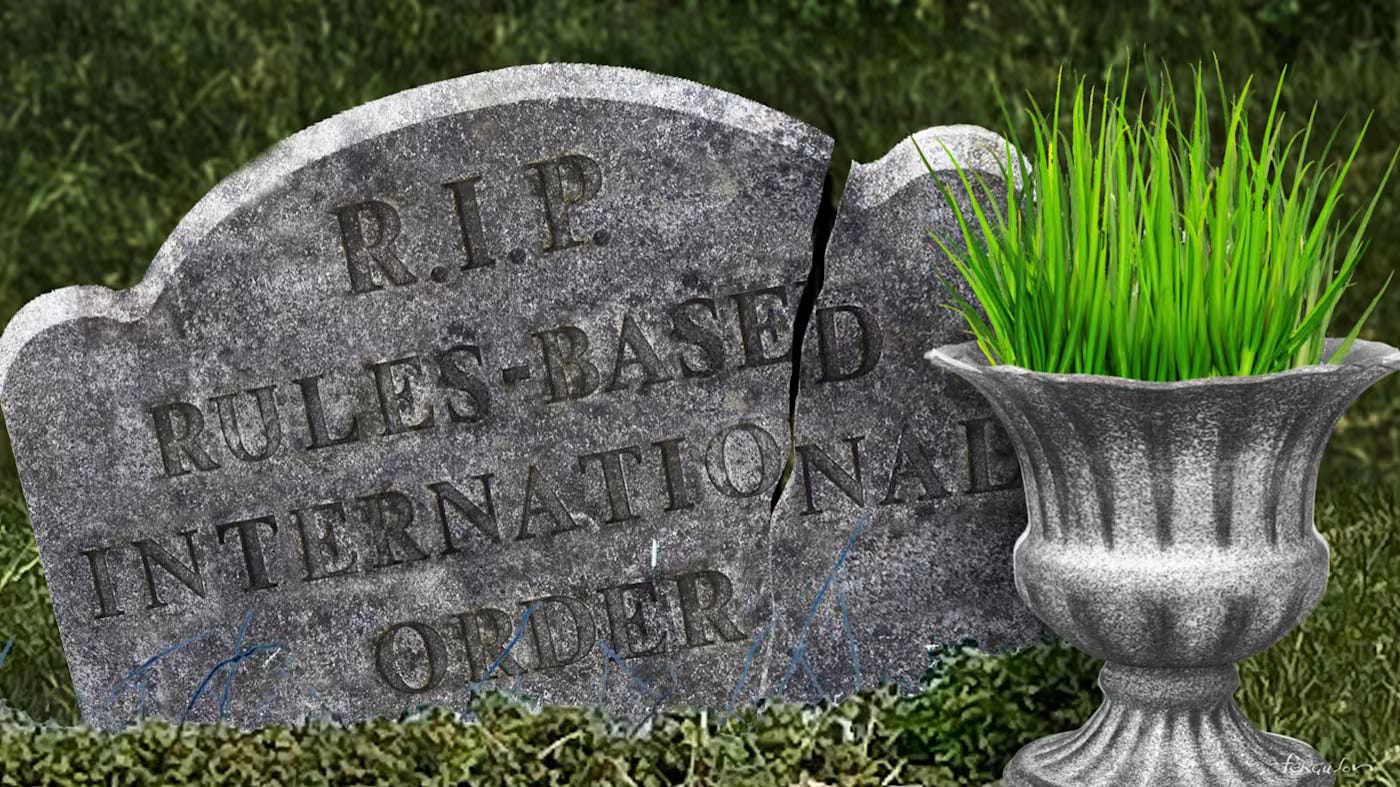
Martin Wolf has his own corrections to the suggestions in Carney’s speech.
At the annual meeting of the World Economic Forum in Davos last week we heard Donald Trump deliver a rambling address suffused with his familiar blend of grievance and megalomania. We also heard Mark Carney, former central banker and now prime minister of Canada, deliver a brilliant speech on the end of the old order and options for “middle powers”. The latter was the bigger event.
Carney began by citing an essay by Václav Havel, writer, dissident and first president of post-communist Czechoslovakia. In this Havel argued that communism sustained itself, in Carney’s words, “through the participation of ordinary people in rituals they privately know to be false”. In a similar way, Carney argued: “We largely avoided calling out the gaps between the rhetoric and reality” of what we called the “international rules-based order”. ... Today, he argued, marks a “rupture, not a transition”. He was right.
Carney insisted not only that the old order is not coming back, but that we “shouldn’t mourn it. Nostalgia is not a strategy.” ...
If we are to turn hope into reality, we must realise that the parallel he drew between the lies that sustained communism and those legitimising the old global regime is misleading. The former were outright lies: the old regimes of eastern Europe failed on every dimension relative to western Europe. The latter, however, were better even than half-truths. ...
Far more important, the post-second world war period was, in the large, one of huge, indeed unprecedented, success. There has been no direct war between great powers since the Korean war in the early 1950s. ... Trump’s chaotic protectionism [is] a fraud.
In sum, integration was a source of both prosperity and vulnerability. The system was far from a lie, but has changed into one, as the mercantilism of a rising China interacted with the protectionism of a declining US. ...
So, where should we go from here if we are to minimise the losses caused by the rupture? Carney’s recommendation is for agreements among “middle powers” as an alternative to a “world of fortresses”. His approach is to be based on what Alexander Stubb, president of Finland, calls “values-based realism”: Canada will be “principled in our commitment to fundamental values”, by “engaging broadly, strategically, with open eyes”. ...
Trade and investment are the easiest areas to sustain. ... [But] the latter only accounted for 17 per cent of world imports of goods in 2024. ...
Money and finance are more difficult. The middle powers will be vulnerable to extortion by the US over use of the dollar and reliance on the US financial system, without some radical reform. ...
Security is a still more difficult challenge. ... There is a limit to the ability of most middle powers to provide security for themselves and their partners. ...
Yet it is going to be even harder to provide certain global public goods, notably action against climate change, if one or more superpowers is fiercely opposed. ...
The more one looks at what lies ahead, the more important becomes the EU — in Trump’s eyes, the greatest enemy. With every passing day, the EU is having more greatness thrust upon it, in all domains. Happily, it is not without weapons. As Robert Shapiro, commerce under-secretary under Bill Clinton, notes, Europe’s financial leverage over the US is substantial. It must use it. ...
We are also losing a world. It, too, was imperfect, though far better than that one. This time, Europe has to be a saviour, not a destroyer. The UK, too, will have to join in the struggles now ahead.
Daniel Ellsberg: traitor to madness
Had he done today what he did with a progressive Supreme Court in place, he’d have rotted in the gulag somewhere.
The Venice option
I’m a big fan of the way Venice built a meritocratic government among the 2,000 odd nobles who ran the city. And the big feature of it was that their meritocracy took great pains to avoid contamination from power or patronage. Not an easy task. I drew attention to it in the most recent Shared Centre video and explained how it could be used within a citizen assembly to enable it to acquire traditions and a corporate memory to enable it to become a self-sovereign institution like existing upper or lower houses of the legislature are.
Here’s a very different, much more rollicking proposal to use Venetian methods to reconfigure electoral democracy. In some ways, it’s a travesty of the Venetian system, but analogies are like that. They take some things and not others. Here’s a very truncated editing of what I thought was a rather too-long piece. Then again, he was spinning a story and enjoying himself.
You can see my comment on it immediately beneath the piece.
Before everything that happened, the idea that a 29-year-old scholar of medieval politics from Bennington College was going to rewrite the rules of American government would’ve struck everyone as absurd.
After everything that happened, after the whole catastrophic series of events leading to the Third Term, a battered and bruised nation convened the Constitutional Convention of 2031. ... people didn’t know about the convoluted process Venice had used to pick its leaders, much less thought they might modernize a thousand-year-old system into a blueprint to protect America from everything that happened ever happening again. ...
The principles were simple enough: the Venetians picked their Doge (not that kind of Doge) in a way that purposefully mixed elements of chance with elements of choice. Much of the process was purely random, and so impossible to game. The rest of it involved deliberation, so you couldn’t end up with some random lunatic in power.
How Democratic Selection Works
The 2032 constitution did away with presidential elections altogether, replacing them with the Democratic Selection process kids learn about at school. ... In the last cycle, 183 candidates filed.
More than 84 million Americans are registered for the selector pool. ... Out of them, 1,000 will be picked to serve as Selectors. ... the 907 narrow the field to 100.
Next, the system does something very Venetian. The 100 candidates are reduced to 50 by lottery ... Candidates who’ve been preparing for years, who advanced through merit in Round One, get eliminated by random number generator. ...
Athenians thought elections were oligarchic because electorates would just pick the richest, most famous candidate, while sortition was truly democratic, allowing anyone to serve. ... The Venetian approach solves the problem by combining sortition with voting in successive rounds. ...
Out of the 907 initial Selectors, 37 Grand Selectors are chosen by lot. ... Within 24 hours, they’re on planes to Utah.
The Selection Ranch sits on 12,000 acres of Utah high desert ... And cameras. Hundreds of cameras, everywhere except bedrooms and bathrooms. ... they vote on each other ... Twenty-five Selectors cross the threshold ... Six Selectors are eliminated by pure chance ... Chance humbles everyone. ... When it’s over, 19 Selectors remain.
The 50 candidates arrive at The Ranch ... They vote to reduce themselves to 30 ... Eleven are eliminated by chance, nineteen candidates remain. ...
Nineteen candidates, nineteen Selectors, one week of intensive deliberation. ... At the end of the week, both groups vote. ... Ten candidates cross the approval threshold ... Nine new Selectors are drawn by lottery ... the 19 Selectors vote. The top 7 candidates will advance. ... Three of the remaining seven candidates are thrown out of the process at random. ... Four candidates remain. ... voting begins. ... The election uses ranked-choice voting. ... The young mayor wins. ... She’s inaugurated three months later to a single six-year term with extensive powers but no reelection. ... it works because it cannot be gamed. Randomness breaks every attempt to coordinate, to buy influence, to build dynasties. ... You can be brilliant, charismatic, and rich — and still get eliminated by lottery. ...
The Venetian Republic lasted 1,100 years ... America’s 1787 constitution lasted 237 years before everything that happened, and then it broke. ... By the 2030s, it had built a head of steam. Now, we couldn’t imagine America without it.
In the five years after the system was adopted, Colombia, Egypt and the Philippines adopted versions of Democratic Selection. ... When France, Germany and Italy adopted it, people began to talk about its spread throughout Europe as inevitable.
The system cannot be gamed. ... By bringing chance and choice together, the system is armored against charismatic demagogues forever.
Venice lasted 1,100 years with this kind of madness. Maybe we can too. So far, it’s working.


The big anti-American hedge

By Hal Brands, Bloomberg Opinion columnist and the Henry Kissinger Distinguished Professor at Johns Hopkins University’s School of Advanced International Studies.
There are moments when you can feel the geopolitical tectonics shifting below your feet. Such a moment is upon us as the second year of Donald Trump’s presidency begins. The world Trump inherited was based, to a remarkable degree, on US commitment and power. ...
But as we’ve seen at the World Economic Forum in Davos, Switzerland, this week, global confidence in US leadership is ebbing at an increasing rate.
In November, I wrote about the “great global hedge” that was happening as countries pursued new capabilities and combinations to protect themselves. In 2026, that process will accelerate, as countries race to reduce reliance on a seemingly out-of-control America — and even US allies search for ways of deterring US power. ...
Many European governments doubt that Trump’s America is still friendly. Day-to-day alliance relationships are better in Asia, but concerns about America’s direction are growing there as well.
As Trump hurls tariffs, shows contempt for international law and seeks territorial concessions from allies, dependence on an unreliable superpower threatens to become an awful liability. Hence, the great global hedge is underway.
New partnerships, strategic and economic, are emerging. The trade deal between the European Union and the Latin American coalition Mercosur was years in the making, but its conclusion this month was an unmistakable response to Trump. ...
Saudi Arabia, worried about an erratic and transactional president, concluded a defense treaty with Pakistan last fall. Countries throughout the Indo-Pacific are pursuing tighter security links with one another, partly as insurance against future US disengagement.
Likewise, states that have long armed themselves with US weapons want alternatives. ... Denmark opted for French-Italian missile defenses over American-made Patriots. ...
Self-help is the order of the day. ... [Allies are] also building a bridge to an era in which they might have to fend for themselves.
Several European states — including France, Germany, Sweden and America’s staunchest ally, the UK — recently tried to deter Trump from taking Greenland by sending token military deployments to the island, something that would have been absurd, unthinkable in the past. ...
If Washington tires of alliance commitments while energizing its efforts to take territory from other states, expect a more extreme form of deterrence and diversification — the spread of nuclear weapons. Nuclear hedging strategies are already under serious discussion in capitals from Seoul and Tokyo to Stockholm, Warsaw and Berlin.
Jilted US allies are even revisiting their dealings with Washington’s foremost rival: China. Last week, Canadian Prime Minister Mark Carney traveled to China to forge a new “strategic partnership” — and blow a hole in the North American tariff wall against Chinese electric vehicles. In Davos this week, Carney called for middle powers to forge a “third path” between Washington and Beijing. ...
Even so, hedging is hard and dangerous. ... NATO allies are desperately trying to get Washington into Ukraine, as part of a potential post-war stabilization force, even as they desperately try to keep the US out of Greenland. ...
The world will enter an age of terrible instability if new security, economic and political structures don’t arise before the old ones are hollowed out. For that reason, the hedging will intensify in 2026.
Trump raised the prospect of real coercion over Greenland last weekend, by threatening to impose punitive tariffs on eight European countries unless they handed over the island to him. ... But he has given the world a glimpse of a future in which the US joins the ranks the revisionist powers seeking to redraw the map through threats and force. That’s exactly the sort of scenario that will give greater urgency to strategic diversification — and perhaps even turn a great global hedge into a great global rift.

I listened to this first time: and enjoyed it again on repeat: recommended
Europe has more bargaining strength than it thinks

Henry Farrel has an idea. Switch the frame from the trade theory to the theory of international negotiation. One thing he doesn’t comment on, but which I wonder about, is whether countries from outside the EU might somehow sign up to become part of its ‘credible threat’ infrastructure. It wouldn’t be easy, but shouldn’t be rejected out of hand without some thought - which I won’t try to do for you here.
One plausible story [about the pullback on Greenland] is that the Trump administration did not realize that the Europeans were willing to come together and push back...
I present: Bessent and Lutnick: a Farce in Four Acts.
Act One: Europe Can’t Do Nothing to Stop Us!
“Scott Bessent suggested the 27-strong group of nations’ slow decision-making would hamper its ability to... wield the so-called anti-coercion instrument...”
Act Two: Actually, Europe, We Don’t Want You to Escalate!
“... the worst thing countries can do is escalate against the United States.”
Act Three: Europe is Escalating But It Will All Work Out for America
Howard Lutnick... projected calm... “If we’re going to have a kerfuffle, so be it...”
Act Four: Exit, Stage Right, Pursued by Bears
US commerce secretary Howard Lutnick was heckled at a World Economic Forum dinner in Davos, with European Central Bank president Christine Lagarde walking out during his speech. The gathering... descended into uproar... This year’s gathering... has the theme: “A spirit of dialogue.”
... I... have a... structural read... in the New York Times this morning. ...
The fundamental message is that Europe needs to start thinking about political economy in a different way, drawing... [on] crisis bargaining from the nuclear era... [to] push back against Trump (and China).
The only way to maintain European independence is to escalate back. ... Europe needs to incorporate... deterrence, credible threats and escalation dominance.
Repeated submission has gotten Europe into a mess. To get out, Europe needs to commit to not back down.
Credible commitments and tripwires are the strategic concepts of Thomas Schelling, the Nobel-winning economist and national security thinker who died in 2016. ...
[The] anti-coercion instrument... [requires] a ‘qualified majority’... of member states... Individual member states cannot stop the measures... That... means... an aggressive coercive power... can’t stymie action by getting a single member state (say: Hungary...) to refuse consent. ... [Economic] sanctions... require unanimous consent... ...
[Schelling’s key point is the] trade-off between flexibility... and ability to make credible commitments... [I] station troops in West Berlin... because they will die if the Soviets pour in... [obliging] me to escalate... The Soviets consider my credible threat, and decline to invade.
If [Europe wants] to increase [its] credibility... in discouraging attacks, [it] must weaken [its]... control, so that [it is] less tempted to back down... That... lowers the chance that the going will get rough, because potential aggressors will see that the Europeans have bound themselves...
[In terms of] escalation dominance, Europe has more options than... [it] seem[s]... [Trump’s] conciliatory speech suggests... Trump knows it.
The... ultimate doomsday weapon stems from America’s national security role as guarantor. The immediate risk is... that [the US] withdraws support from Ukraine. ... [This] would be a disaster for... [both] Europe... [and] the US... It would precipitate a major crisis in transatlantic relations... And... the US would... lose its major hold over Europe, making Europe... [more] likely to... [pull] out of the US technology stack... and... [use] economic leverage... to hurt the US back.
If you are Europe, and you think of the end-stage as ‘the day that the US pulls out of Ukraine,’ ... you may have strong incentives not to challenge the US... If... you think of [it as] ‘the day after... when Europe erupts and the US economy goes to hell,’ you may... revise your calculations...
... Trump... backed down in part because of how markets were reacting to the Greenland dispute... Europeans should take note... [If] they want to... act strategically in a world that is much less friendly to them, they may need to sacrifice flexibility and member state control so as to enhance their credibility against outside threats. ... It needs to get there, and soon.
Very cool

Here comes everybody (again!)

I’ve been wondering how the world will change now that you can write an app in an afternoon. My friend John Allsopp, who’s much closer to that world than me, has just posted on it. As someone who was a little more wary than some of the euphoria that attended Web 2.0 (though nothing like wary enough), I’m a little nervous at how similar this sounds to what we heard then - you know, radical openness will save the world. Wikipedia, open source software and ehem social media.
This coincides with new books by leaders of the original surge - like Chris Anderson and Jimmy Wales. But their new books really don’t get very far out of the 2010 vibe. It would be good if we had deeper knowledge of what went wrong then and how we might make a better go of it now.
Clay Shirky’s Here Comes Everybody (2008) was about the democratisation of coordination. Shirky’s vision didn’t pan out quite as optimistically as many thought. But something is happening now that echoes those Web 2.0 trends. Perhaps it will turn out differently this time.
Yesterday, my 13-year-old daughter sent me a link to Aippy, kind of like TikTok for apps, where folks can create, share, and remix apps. ...
Millions of people who have never written a line of code are starting to build genuine applications with interfaces and logic and persistence. ...the platforms and distribution models we’ve built over the past fifteen years are not designed for the world that’s emerging. ...
The Web as Default
Most people now discovering they can build software will build for the web. ...It’s the path of least resistance — for non-developers, essentially the only path.
Consider the friction involved in building for iOS. You need an Apple Developer account, provisioning profiles, code signing, Xcode, TestFlight or App Store review. ...
Now consider building for the web. You write some HTML, CSS, and JavaScript. You open it in a browser. That’s it. You can build something at 10pm and be using it by 10:15pm. ...
Software as Content
...The App Store model assumes software is a product with high cost of production. ...
But that’s not what most of this new software will be. Someone solves a problem for themselves. ...Maybe it spreads through a community. ...
Or, like most Aippy apps, it’s entertainment. Competing with Netflix, Instagram, and sleep.
This pattern — creation, casual sharing, organic spread — looks more like how content moves on TikTok than how apps move through the App Store. Software becomes something you make and share, and remix. ...
The Platform Problem
The structural misalignment is acute. The devices where people live their digital lives — smartphones — are precisely the devices least equipped to support this new model. ...
But while the Web will be the natural platform, on iOS and Android, the web is constrained. ...Many are policy choices protecting the primacy of native apps. ...
More fundamentally, neither smartphone platform is designed for frictionless software sharing. ...Having someone “install” a web app the way they’d save a TikTok is baffling. ...
The trade-offs were calculated for a world where software was a product made by developers for users. In a world where everyone is potentially a creator, those trade-offs look very different. ...
The Appliance Assumption
When Steve Jobs introduced the iPhone in 2007, people were intimidated by technology. The appliance model — a device that just worked — made sense. ...
That audience has changed. Children have grown up building in Minecraft and Roblox. They’re native to it. ...
And now they’re discovering they can build real software shaped to their needs.
The appliance model doesn’t serve them. It constrains them. ...
Where the Puck Is Going
Steve Jobs was fond of quoting Wayne Gretzky: “Skate to where the puck is going, not where it has been.”
The puck is going somewhere new. The democratisation of software creation is a fundamental shift, as significant as the shift from desktop to mobile. ...
Software will be created by everyone, often ephemeral. Shared like content, discovered through social channels. ...
The mobile platforms that dominate our lives were built for a different world. They assume software is a product made by professionals. They assume gatekeeping is a feature.
These assumptions are antiquated. And the platforms built on them may find themselves on the wrong side of a generational shift.
This shift isn’t coming, it’s arrived (like William Gibson said of the future, “it’s just not evenly distributed”).
Which platforms will adapt, and which will discover too late they were skating to where the puck used to be?
Justin Wolfers endorses an old idea - liberalism
Michael Ignatieff on Canada’s sovereignty
or lack thereof
French nuclear deterrence cost four times Britain’s. Why? Because DeGaulle didn’t trust the Americans. Now the Americans were all very nice then - at least in the scheme of things but it’s certainly an odd thing to make an existential aspect of your national defence dependent on another country, which it seems Britain has done in various ways.
And the same thing happens in economics. Thing is, avoiding dependency is expensive!
On Canada Day, with negotiations between Canada and the US hanging in the balance, it’s a good moment to look back at Canada’s long struggle to balance national independence and economic integration with her stronger neighbor. I begin the story in 1965 when an unknown academic raised the question of survival we’ve been trying to answer ever since. ...
Sixty years ago, an obscure professor of theology published the most excoriating attack on the Canadian liberal establishment ever written.
In an essay entitled Lament for a Nation – ninety-five blistering pages – George Grant accused Lester Pearson and the Liberals of selling out the country to the Americans. The Liberals had capitulated by allowing nuclear weapons to be stationed on Canadian soil. ...
As Canada joined NATO and then NORAD, completely subordinating our economy and defence to the interests of the empire, Liberals pretended we could hold on to our political freedom. Grant disagreed. Once a country surrendered its economy and its defence, he argued, it gave up its political independence. ...
Sixty years later, the Canada that Grant thought was doomed is still here – but the questions he posed remain unanswered.
For Grant struck a nerve by asking: What kind of national independence is possible for a country that shares an undefended border with the incorrigibly violent, expansionist and yet irresistibly attractive monster state to the south?
In Grant’s era, the issue was allowing Americans to station nuclear weapons on our soil. Today, the issue is whether to sign up for Mr. Trump’s “Golden Dome,” the air defence system that is supposed to protect us at an estimated cost of US$71-billion. ...
The existential question that Grant asked sixty years ago, Mr. Trump has put to us once again: Since America protects Canada, and Canada couldn’t survive without U.S. markets and technology, why keep up the fiction of independence? ...
It was left to Brian Mulroney to address this question.
He came out for continental free trade in the election of 1988. John Turner turned himself into the avatar of Canadian nationalism, denouncing a trade deal which would “fundamentally alter our way of life.” ...
When Canadians handed Mr. Mulroney a majority government in 1988, they anchored the conviction that Canadian prosperity required greater integration with the American economy. When Peter Gzowski asked Canadians to complete the sentence “as Canadian as,” the winning entry was “as possible in the circumstances,” revealing our acceptance that we have only as much sovereignty as our dependence allows. ...
Grant’s Lament remains worth reading today.
Grant wondered whether the wellsprings of our identity had run dry, whether we still had what it takes to maintain a distinctive national culture. He believed these wellsprings could be found in Canada’s French and British founding strands. Remaining true to British Parliamentary traditions, the Crown, and “peace, order and good government” would have been the antidote to the American conceit of “life, liberty and the pursuit of happiness.”
With the Pearson Liberals’ surrender in 1963, Grant argued, the lynchpin had snapped. ...
Grant’s politics may no longer make sense, but his diagnosis remains acute. The French and British sources of our identity remain our lynchpin, in permanent tension. ...
Today, we meet the Trump challenge at a moment of regional division, still struggling to answer Grant’s questions.
But a plan beats no plan. A nationalist economic agenda that steadily rebuilds the ties that bind and reduces our dependence on our neighbour may be our best shot at regaining cohesion and control over our destiny. George Grant, that gloomy but prescient sage, predicted that we no longer had what it takes to remain free and sovereign. He was my uncle, and I loved him, but I hope we seize this chance to prove him wrong.

A stunner

Trump isn’t Hitler: he’s the Kaiser
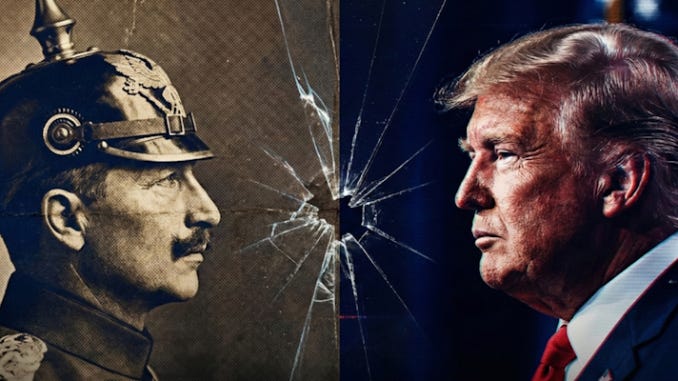
Excellent piece from Oliver Hartwich.
The past month has been difficult to process. American special forces captured Nicolás Maduro, then Donald Trump renewed his threat to annex Greenland. In Minneapolis, Immigration and Customs Enforcement agents shot dead Renee Good, a mother of three, and Alex Pretti, a nurse. No federal investigation has followed.
Some observers reach instinctively for the ultimate historical comparison with Adolf Hitler. ...
But the comparison is wrong. Trump is not a disciplined totalitarian with a coherent programme of racial extermination. He is far too chaotic for that.
A more useful parallel comes from an earlier chapter of German history. Donald Trump is the Kaiser Wilhelm II of our age.
Wilhelm II ruled Germany from 1888 to 1918. The tragedy of his reign was not that he destroyed German democracy, which barely existed back then. It was that he prevented it from developing. ...He dismantled the system of alliances Bismarck had constructed to keep Germany secure, replacing diplomacy with bluster.
Trump is doing something arguably worse. He has inherited a mature constitutional democracy with functioning institutions, independent courts and established norms – and he is breaking them. He is not the engine of a new order. He is sand in the gears of the old one.
The parallels are striking.
Wilhelm was a “media monarch,” addicted to public speeches, who bypassed his ministers to conduct foreign policy via telegrams and newspaper interviews. ...His chancellor learned of it from the morning papers.
Trump has updated Wilhelm’s approach for the digital age. His account posts to Truth Social more than 17 times daily on average. In contrast, he attended just 12 intelligence briefings in his first four months. ...
Wilhelm’s statecraft was personal.
His childhood was emotionally abusive, leaving him with an insatiable hunger for recognition. ...He built a battle fleet to challenge Britain because he wanted admiration, not because Germany needed one.
Trump’s foreign policy runs on the same fuel. He tears at Nato not because of strategic conviction but because European leaders do not flatter him enough. ...The Venezuela operation, according to reports, was accelerated because Maduro wounded Trump’s pride by mocking his dance moves. ...
Wilhelm believed in Gottesgnadentum, the divine right of kings. He answered to God alone.
Trump has developed a secular version of this doctrine. In February 2025, he posted to Truth Social: “He who saves his Country does not violate any Law.” ...It echoes Nixon’s infamous claim: “When the president does it, that means it is not illegal.” ...
The killing of Renee Good showed where this leads. An American citizen died at the hands of a federal agent. The administration quickly defended the officer. ...
Then there is the grift. Trump has taken the monetisation of office to an industrial scale. Qatar gifted a $400 million Boeing 747 through a “presidential library” arrangement that critics say exploits a loophole in the Constitution’s ban on foreign gifts. ...
Yet the grift, brazen as it is, is not the point.
Wilhelm II did not cause the Holocaust.
But his reign destabilised Europe, isolated Germany and created the conditions for the catastrophes of the 20th century that followed. He was not the endpoint of German tragedy. He was the man who removed the guardrails.
Trump is no Hitler. He lacks the ideological discipline, the organisational capacity and the genocidal intent. That makes him more of a Wilhelm II figure. He is taking apart the institutions that constrain executive power, replacing professional governance with loyalty tests. ...
The danger is not that America becomes the Third Reich. It is that America becomes Wilhelmine Germany: a great power made erratic by a leader who cannot distinguish his ego from the national interest.
History does not repeat. But it sure rhymes.
The black origins of the manosphere
An interesting post which was all news to me. One caveat is that I’m suspicious that the Moynihan Report was ‘plainly racist’ and asked about it in comments, with no response at the time I’m writing this.
Every five years or so, there’s a changing of the guard in digital media. ... [In] this rise of coded communities—where affiliation is about vibe and identity more than ideology—we’re seeing the Manosphere go mainstream again. ...
The Manosphere ... refers to a loose network of communities organized around men, masculinity, dating advice, and self-improvement, sometimes tipping into outright hostility toward women. ...
A Short and Non-Exhaustive Timeline of Moments the Pre-Internet Manosphere Penetrated the Mainstream:
The Manosphere ... has at least two distinct antecedents. The first is the mid-twentieth-century convergence of pick-up artistry and men’s rights discourse ...
The second antecedent is the part that I hear people talk about less often. The Manosphere in so many ways is a Black phenomenon. ... [M]any of the aesthetic forms, masculine philosophies, and anxieties that the Manosphere treats as “newly” discovered were articulated in Black American communities decades earlier. These were responses to economic exclusion, social displacement, and the erosion of traditional routes to masculine status. ...
If you’ve read Iceberg Slim, or watched 1970s blaxploitation films like The Mack or Super Fly, the visual language is immediately recognizable. ...
In mid-century America, Black men were systematically excluded from the institutions through which wealth and status quietly accumulate ... [C]onspicuous display ... [was] one of the few available ways to signal success in a society that denied access to the kinds of prestige that don’t need to announce themselves. When wealth can’t whisper ... it has to shout.
The modern Manosphere inherits this aesthetic, adopting the symbols as though they were universal markers of arrival rather than compensatory performances forged under exclusion. ...
Robert Beck, better known as Iceberg Slim, published Pimp: The Story of My Life in 1967, just two years after the Moynihan Report was leaked to the press ... Daniel Patrick Moynihan ... had argued that the “deterioration of the Negro family” was at the heart of Black poverty ...
The report was plainly racist, but both Slim’s book and the report were responding to the same thing: the economic foundations of traditional masculine identity were collapsing ...
The pimp ... was quickly becoming embraced as an inadvertent, unironic symbol of male success, available for adoption by anyone — race agnostic.
The “high-value man” who dominates contemporary Manosphere discourse is this same archetype ... [W]omen are resources to be managed, emotional detachment is strength, and a man’s worth is measured by his material display and his control over female attention. ...
Pearl Davis ... follows a template established decades earlier by Shahrazad Ali, the Black author whose 1989 book The Blackman’s Guide to Understanding the Blackwoman provoked national controversy. ...
Davis makes the same arguments stripped of their racial specificity ... The script was written decades ago, first by a white policymaker diagnosing Black “pathology,” then by a Black woman internalizing that diagnosis as cultural truth, and Davis is performing it for a new audience that believes it is hearing something novel.
The Manosphere’s grievances are not manufactured—just as the pimp’s weren’t. The conditions that produced the pimp archetype in Black America, the sense that legitimate paths to respect and provision have been foreclosed, are now conditions we all experience.
The Manosphere exists because millions of young men — of every race — are asking the same question Black men were asking in 1965: what does masculinity mean when its economic foundations have been removed? ...
The pimp archetype emerged from real deprivation and produced more deprivation, never liberating anyone but redistributing suffering downward—not only onto women but to men.
Today’s Manosphere offers a diluted, algorithmic version of that same exchange, promising power through detachment, success through dominance, respect through performance.
This is what a man looks like when all other options have been foreclosed upon.
The Problem with Pro-Immigration Misinformation
This was a long article, so I asked Claude to summarise it, something you may have noticed, it’s very good at.
The Central Argument
A pro-immigration scholar and policy researcher argues that liberal elites engage in “highbrow misinformation” about immigration—not outright lies, but selective framing, strategic omissions, and half-truths that ultimately undermine the case for freer immigration policies. This misinformation flows through an ecosystem of researchers, advocacy groups, media outlets, and politicians, with each layer stripping away nuance until the public receives overly simplified narratives that don’t match reality.
Five Major Myths
1. “Immigration is About Helping the Vulnerable”
The humanitarian framing dominates progressive discourse, yet most immigrants aren’t humanitarian cases. Less than 20% of international migrants are refugees or asylum seekers—the overwhelming majority move for work, family, or study. This frame resonates with only about 10% of the electorate, while even most left-of-center voters believe immigration policy should prioritize national interest, not charity.
2. “Immigration is Good for Everyone, Everywhere, All at Once”
While serious researchers acknowledge distributional effects—that immigration creates winners and losers—this nuance vanishes as findings pass through advocacy groups and media. The author describes witnessing colleagues soften or remove findings that might “feed the far right,” even when robust. The pattern: reassuring estimates survive peer review, advocacy organizations strip them of nuance, journalists present them as consensus, politicians cite them as proof immigration “has no losers.”
3. “If Immigration is Good in One Case, It Must Be Good in Another”
Evidence gets overgeneralized across contexts. US studies showing immigrants commit fewer crimes than natives become claims that “immigration doesn’t increase crime” anywhere—including Sweden, the UK, or Germany, where different populations, legal statuses, and enforcement systems produce different outcomes. The effects depend on who comes, under what legal status, how enforcement works, and how communities respond.
4. “Immigration is Good... Unless It’s Temporary”
Progressive advocates often condemn temporary work visas and guest worker programs as “indentured servitude.” Yet Michael Clemens’s randomized evaluation of Indian workers in Gulf states found enormous income gains with no evidence of worse well-being than comparable workers who stayed home. Workers queue for years and pay large sums to access these “exploitative” jobs because the alternatives at home are worse.
The author acknowledges real abuses—passport confiscation, unsafe conditions, recruitment debt—but argues these stem from specific design choices, not the concept of temporary visas itself. Countries like South Korea have reformed these programs successfully. There’s a rights-versus-numbers trade-off that progressive messaging ignores: insisting on immediate expansive benefits means admitting fewer migrants.
5. “Immigration is Good... Misinformation is Why People Oppose It”
The most flattering but misleading belief: that opposition stems from ignorance. Yet research shows misperceptions exist across the political spectrum, including among pro-immigration advocates. More striking: studies demonstrate that correcting misperceptions (like the number of asylum seekers) can actually increase opposition to immigration. Attitudes are rooted in deep values about national identity, fairness, and risk—not simply lack of information.
The Personal Stakes
The author, born in Soviet Russia, reflects on the gap between his actual life as a US professor and his counterfactual life—likely conscription into “senseless war.” This productivity difference isn’t about “magic dirt” but about living under functional liberal democracy versus extractive authoritarianism. He pays considerable taxes, educates students, and contributes to American society in ways impossible under his birth circumstances.
The Transformative Potential Being Missed
An “honorable mention” critique: progressive advocates aren’t ambitious enough. While estimates that open borders could double world GDP are likely overstated, even cautious modeling of modest liberalizations shows gains of multiple percentage points of world output. Individual migrants routinely multiply their earnings several times by moving. These gains translate into better health, education, and opportunities through remittances and investments.
Yet current progressive framing focuses on defending existing policies rather than expanding opportunities: “Immigration is already good. Our main job is to fight for rights of those here.” This blinds advocates to counterfactual worlds where many more people could move, work, and thrive under better-designed rules.
Why This Matters
The author argues that resting immigration advocacy on “brittle half-truths” corrodes trust and hands ammunition to forces much further from truth and dignity—as seen in Trump administration’s “senseless and cruel” approach. A politics of honest trade-offs would mean:
Admitting immigration produces both winners and losers, even if overall balance is positive
Being specific about where positive findings hold and where they don’t
Recognizing temporary migration can be life-changing even when it doesn’t fit preferred citizenship models
Acknowledging that migrant rights have costs, and easing one constraint may require tightening another
Accepting that opposition isn’t always reducible to ignorance or bigotry
The hard work: designing better policies that are both humane and demonstrably beneficial to most citizens. This approach won’t just be more honest—it will make immigration popular enough to last.
Achieves considerable heaviosity, but interesting listening
HT: a reader for pointing me to it.

Heaviosity half hour
Walter Lippmann’s 1909 article on women’s suffrage and the madness of the Overton Window
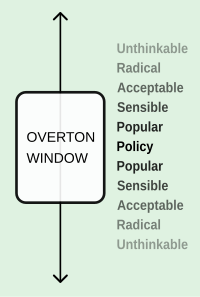
Most readers will have heard of the Overton Window in policy-making. Things inside it are politically possible. You won’t get laughed or shamed out of polite society for suggesting them. If they’re outside the window, they’re not, and you will.
The ‘rational’ interpretation of is that what’s inside the window is determined by the political power of different sectoral interests. But, as I complained a while ago now, a lot of the demarcation is much more arbitrary than that.
<MixedMetaphorAlert>So I have at least two policy horses in the race that are outside the Overton Window for the classical reason that in the order of a trillion dollars of market capitalisation of financial oligarchs would be seriously inconvenienced by them.</MixedMetaphorAlert> But other policy proposals of mine are … moderate, low or very low risk with high to very high potential payoffs.
So why aren’t they talked about? Well no reason really. They’re not talked about because they’re not talked about. Well they’re talked about by me. And when I give a presentation on them, people often respond as if they’re positively elevated to hear them. They complement me on how ‘lateral’ they are. Just hearing such ‘out of the box’ thinking makes them feel more innovative. They leave with a new spring in their step – they might even have scored their inspiration porn for the week. Sometimes they say I really should come and give a talk to their whole management group or some subset of it. They sometimes, though much more rarely, make that happen. But whatever the immediate upshot, the equilibrium results is that they get back to their in-tray.
In fact it’s an old story. And that’s ultimately what this 1909 article by Walter Lippman is about. As he explains, the suffragettes tried persuasion. In fact they succeeded. Most people, most movers and shakers were persuaded. But nothing happened. The civil rights campaigners of the 1950s in the US found themselves in the same position. Most respectable political folk agreed with them. It’s just that it was never quite the right time. It never is. Hence MLK’s expression “the fierce urgency of now”.
And so they turned to stunts to get noticed. And so the madness. Chaining oneself to buildings. Throwing oneself on the track at a horse race. These things were dysfunctional then. They were disruptive and their disruptions disrupted opponents and supporters alike. Still, the seriousness of the injustice they were tackling meant that we mostly look on their deeds with gratitude and awe.
Alas today, the issues are not so stark, not so clean cut. So the dysfunction and injustice of the disruption loom larger. And who says only the deserving use these methods. Today, there’s a vast industry vying for our attention. And many of the changes we need to make, many things that could make our lives better, are not the kinds of things that anyone will march in the streets for. So people keep being persuaded they’re a good idea, and they keep not happening. Things like citizen assemblies. But I would say that wouldn’t I?
“In Defence of the Suffragettes”

It looks as if the modern world had been converted to the Chestertonian philosophy,—the big, serious issues are handled as jokes, leaving the trivialities to be discussed solemnly. Thus you can get plenty of gravity on the subject of the Aldrich tariff, but on the subject of asking one-half of the adult population what it thinks about the gentlemen who framed that tariff bill, you can get nothing but ungraceful lampoons. A cosmic joke like the recent antics of Congress has excited the Dilettantians on both sides of the water; but the mention of votes for women drives the otherwise serious and important “Life,” for instance, to wallow in all the exploded libels which should have been dead and buried with the storm of ridicule that greeted Ibsen’s “Nora.”
Not that there are not gentle, secluded people to whom the suffrage movement is anything but a source of fun and satire. There are people to whom it is a terrifying vision of a tottering social order, brought about by the emotional frenzy of an ignorant electorate, carrying with it images of dissolved homes, ruined domesticity, uncooked dinners, and undarned socks,—or conjuring up a world of “intellectual” women, universal higher mathematics, and Ella Wheeler Wilcox emotions. And with that appallingly prophetic image burning in their imaginations, pious and church-going young men rush to Nietzsche and Schopenhauer for consolation. “Biology” is invoked to prove that equal suffrage is an inversion of natural law; paleontologists are resurrected from amongst their fossils to show that the question was settled against woman suffrage back in the Stone Age; “ethics” is made to proclaim the moral turpitude of the suffragist propaganda, and sociology is supposed to demonstrate beyond all doubt that since government rests on “force,” only those should vote who are prepared to uphold that privilege by knocking down or shooting up those with whom they disagree.
But the humorists and their allies—the terrified theorists—do not exhaust the opposition to votes for women. If they did, it would be a simple matter to turn the shafts of ridicule on the humorists, and exhibit them to an astonished public in all their ancient smugness; it would be easy, as as a matter of history it has been, to show up the naive, uninformed character of the theories advanced against the demand, that in matters of government the category of sex is the least relevant of all categories. As a question of plain fact, the issue does not lie here. The steady stream of great thinkers, from John Stuart Mill to H. G. Wells, who have favored votes for women, have been fully qualified to rout the humorists and to demolish all theorists. They have done so. The result is that Sir Henry Campbell-Bannerman of the Liberal Party, Mr. Balfour of the Conservative Party, Mr. John Redmond of the Irish Party, and Mr. Keir Hardie of the Labor Party all put themselves on record as favoring the entrance of women into politics. The present Liberal Ministry contains men like Mr. Lloyd-George who favor woman suffrage; a majority of the members of Parliament have pledged themselves to support a bill to abolish “the political disabilities of sex.” Why is it that women have not been enfranchised? The answer lies in the fact that the great reactionary forces in the world to-day are not the professed reactionaries, but the great chilling mass of people who don’t care. It is one thing to convince a Parliament or an electorate that the balance of reasonable argument is on your side; but making them believe in you is an entirely different matter from making them act for you. Every progressive movement, like the Equal Suffrage Movement, is a Peer Gynt, slashing about in the darkness at the Boyg which “conquers, but does not fight.”
The true problem that practical suffragist faces is, then, no problem of intellectual conviction. The parlor game of proving the justice of the suffragist claim has been tried for fifty years, with the result that a Ministry which professes to believe in votes for women, supported by a Parliamentary majority sufficient to carry the reform through, refuses session after session to touch the issue. It is plain that some other motive power was needed to compel reasoned support to go over into action. As Mr. Graham Wallas says, “in order to make men think, one must begin by making them feel.” That was the practical conclusion to which propaganda experience brought the women in England.
With that principle in mind the suffragettes adopted their celebrated “militant tactics.” They set out deliberately to raise the suffrage question from the realm of abstract idealism to the realm of what Professor James calls “forced, living, and momentous options.” It is the great work of the militant suffragettes that they have made the question of votes for women a question of practical politics, which no candidate can ignore. They have made themselves such a glorious nuisance to the Government by their active interest in the by-elections, in Cabinet proceedings, and Parliamentary discussion, that it is becoming impossible for an English statesman to defer doing something by being amiable enough to approve of their demands.
It is a strange situation when statesmen agree to the justice of a claim, and yet refuse to grant it. That is the situation which the English suffragists face, and that is the situation which justifies their tactics. When they ask Mr. Asquith why he does not give them the vote, he answers that he cannot take so radical a step without assurance that the country is behind him. However, as a matter of principle the approval of men is of slight importance, for if men opposed votes for women, it would be the strongest possible argument for the need of votes for women. And how are the women of the country to show that they want the vote? The petition is disregarded, and Mr. Asquith refuses to meet deputations. The fact is that the women of England are asking for the very weapon by which alone they can make any demand effective. To ask an unenfranchised class to give definite peaceful assurance that it wants the vote is like asking a dumb person to give assurance that he is happy by singing a song. The only method left to the suffragists is the method they adopted: to advertise themselves at every opportunity, to let no day pass without reminding the country and its politicians of their demand, to raise the issue at every public meeting so that it can never fade from the memories of the people. They have carried out their program with precision and without hysteria. Their conduct has been characterized at times by anger, but generally by a largeness of humor which has won the respect of the English people, and made ridiculous the truckling methods of the politicians.
The worst that has been said against the suffragettes is that they are unladylike. They are unladylike, just as the Boston Tea Party was ungentlemanly, and our Civil War bad form. But, unfortunately, in this world great issues are not won by good manners.
Walter Lippmann
My cancellation. First, I got this email.

There followed a Kafkaesque process of reviewing my response - which just tried to articulate in the 1,000 characters allowed me that I had no idea how the policy had breached and would rectify anything I was notified of.
To which they replied

Naturally I was heartened by the empathy. True, a counsellor from YouTube didn’t materialise to ask if I’d like to talk about my feelings, but YouTube is not a charity.
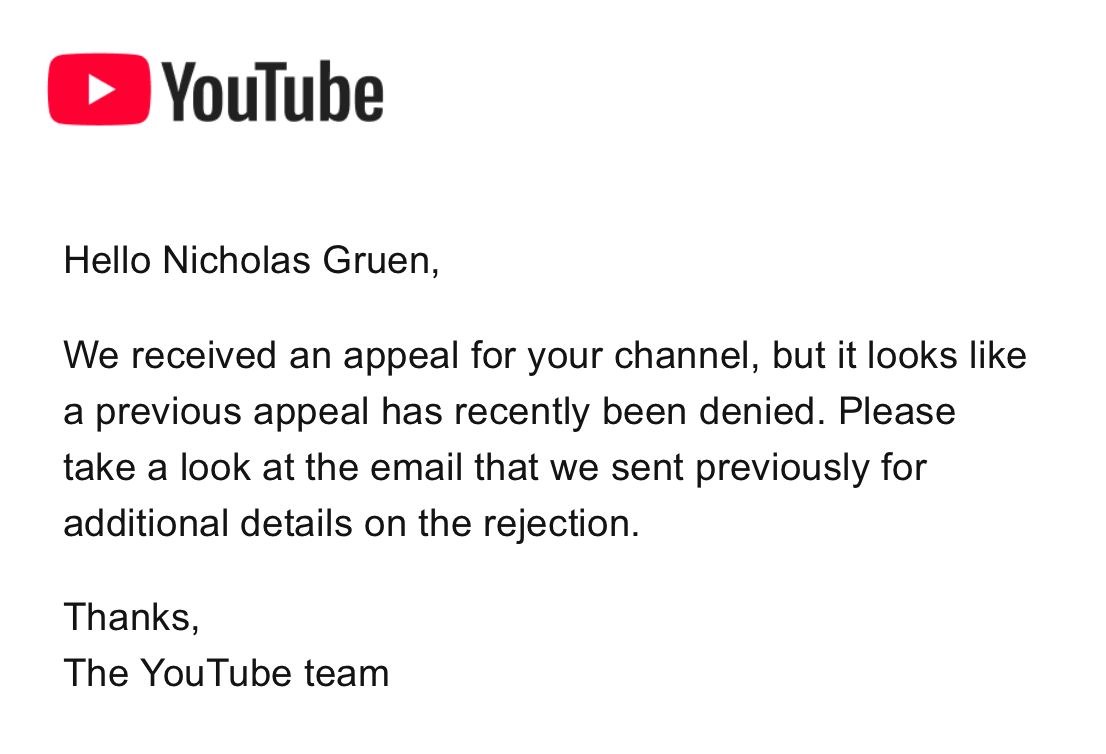
The explanatory webpages they linked to suggested I appeal, which I did to which I received this.
Sounds like someone initiated a copyright strike at you? I'm not an expert but I've seen it happen to others. I believe that (if it's this) it can be appealed but I've never done it myself
Videos 1 - 11 of the series appear to still be there. I’m happy to harangue Google (ie. supplicate their chatbot) to re-enable the video series. I’ve got “http://www.youtube.com/@NicholasGruen”, but I don’t know what this advertising agency has actually done to your account.