


The odious J.D. Vance

Not a great article. But it gave me some satisfaction to read it.
JD Vance was the first real writer to appear on a winning presidential ticket since Woodrow Wilson in 1912. ... Vance ... is the master of the preferred medium of American millennials — the “personal essay”. His raw material is “lived experience”; his method is “autoethnography”. ... Hillbilly Elegy, a personal essay in book form, ... propelled its author to within a heartbeat of the presidency. ...
He wanted to use his lived experience to do social-science analysis of the “ills befalling working-class white people”. ... the “autoethnography” was ultimately in service to an old-fashioned, pull-yourself-up-by-your-bootstraps liberalism. ...
Communion is, its subtitle says, about Vance’s return to faith. ... It ... considers his conversion to MAGA and his conversion to a kind of anti-liberalism and anti-capitalism, alongside his conversion to Roman Catholicism. All these, he makes clear, are closely linked. ...
Why, then, did Vance convert? One of his reasons is that religious people are the most rational and sane. His evidence is ... the presidential election of 2016. ... “my evangelical, Trump-loving father would have turned off the TV, prayed, and said, ‘Well, I hope she ain’t as bad as I feared’”. ...
There is a glaring problem here, however. When Joe Biden beat Trump in the election of 2020, the prevailing attitude among Trump’s followers was a far cry from “I hope he ain’t as bad as I feared”. ... He was picked as Trump’s running mate in 2024 in large part because he cleaves to the dogma of his new faith: that the election was rigged. ...
Communion ... preaches a millennial faith. ... Its politics are ... generic post-Crash progressivism. ... He repeatedly criticizes his own party for being “far too willing to worship the market”. ... A Protestant ethic, the ethic of thrift, might have suited the liberalism of Hillbilly Elegy. His new Catholicism likewise suits this postliberal, anti-market shift. ...
One can believe that Vance is a sincere Catholic, and a sincere postliberal, while also considering some of the more cynical motivations at play. One theme of Communion is the author’s obsession with status. ... His Ayn Rand phase used to have a similar effect: “tax breaks and Social Security cuts were socially acceptable ways to be conservative among the American elite”. ...
What Vance never mentions is that Catholicism is a socially acceptable way to be conservative among the American elite — or, at least, that it grants entry to an elite of its own. ... Catholicism ... provides its initiates with an intricate intellectual pedigree. ... it allows its adherents to seem “deep”. ...
Anyone and his dog can become an evangelical Christian. ... Vance acknowledges this directly: “I really liked that the Church required you to work a little to join”. ... If he was once drawn to atheism and libertarianism because they offered him a certain cachet, how do we know his Catholicism is any different?
In America, Catholicism possesses another distinct advantage. It was never the dominant religion. It is separate from the elite WASP culture that Vance likes to spurn. ...
JD Vance became a Catholic rather than a different type of Christian because Catholicism today is the thinking man’s Christianity. As Candace Owens ... supposedly remarked to Charlie Kirk ...: “You’re too smart to be a Protestant”. ...
The problem for Vance now ... is that he cannot only speak for those high-brow Catholic Right-wingers. ... but he is also the Hillbilly Vice President, the tribune of the plebs. ... This is why Communion, a book about Catholicism, shows on its front cover a Methodist church. ... His political ambition requires him to be ecumenical. ...
Time and again, reading the book, it struck me that Vance’s ideal society ... is sleepy, southern, ancien régime Europe. He wants something like the Portugal of ... Antonio Salazar: a country built on a foundation of Catholic social teaching, one sapped of prosperity and dynamism, but where everybody goes to church. ... It is difficult to imagine such an America putting a man on Mars. ...
As a soldier in Iraq ... he encountered a “genuinely compelling critique” of [American] culture in the fear that, if Iraq grew too “Americanized”, it would become too “consumerist and hypersexualized”. ... “A woman in a niqab was reading the Quran”, he quotes ..., “... and on the TV was Britney Spears dancing in her underwear”. Which of these cultures does JD Vance prefer? Catholic his answer may in fact be; but it does not strike me as very American.
Enjoy


What history means

One of the nicer things about running this newsletter is occasionally following up new subscribers and finding their own Substacks or the Substacks from which they have found my Substack. In this case, this process led me to this post by Ann-Sophie Levidis. As I occasionally tell people studying history, was the only education I ever got, as opposed to the training that gets meted out to economists. It was the discipline that taught me the difficulty of seeing the world from someone else’s point of view, and the value of the attempt. It’s why I’m so affronted by a political system that relentlessly rewards doubling down on one’s own perspective and indeed strategising ways you can embarrass, discredit and undermine your opponent, most particularly when they have something to say that makes you uncomfortable.
I have been writing almost every night this week. It is exhausting — by the time I close the computer, I feel mentally frayed — but still I return to the page. There is too much in me that needs to be written... Writing is not just something I do; it feels like something that insists on being done through me.
This week has also been heavy. My grandmother, who is ninety-six, has stopped her medication. She has been my model my whole life... I can still see her, taking me by the hand through the streets of Angers when I was nine, telling me stories about the war. She described how she carried secret messages on her bicycle under German occupation... She told me how she met my grandfather when he invited her to the cinema during his history studies, and how she told him, matter-of-factly, that she didn’t believe in “unserious relations.” They married soon after.
Together, they were a generous couple... They believed deeply in the ideals of the French Republic — equality, solidarity, a civic duty to others. Her courage was never abstract. Even at ninety, she still took the bus across the city to teach literature to women who had never had the chance to read... She was formidable, and yet everyone loved her, because her strength was never cruel; it was purposeful.
Both of my maternal grandparents were historians of the Annales School... For them, following the tradition of Fernand Braudel, history was not just about kings and battles, but about long durations... the practices of ordinary people... As a teenager, they would drag me to every medieval church and castle in Anjou. I thought it was tedious then, but I see now how it trained my eye, how it gave me a feel for stones, arches, and the sediment of time.
At home, my grandmother would sit me down in their garden and make me translate Cicero or Caesar into French. I was a difficult student... but she was always patient, always insisting that the discipline of reading closely mattered more than speed or brilliance. My grandfather... taught me to respect the archive as a place where voices survive, even when states would rather silence them. I remembered this when I dedicated my PhD to him; I told him so in the hospital... This week, I was grateful to call my grandmother and tell her that my book, Trials of Empire, is finally ready. I wish I could have told her in person.
What they passed on to me was not just a love of history, but a way of working with memory... I hear echoes of their lessons every time I enter a reading room: prepare before you go... Pay attention to the margins, to the stamps and annotations that carry their own stories... Respect privacy, respect restrictions. Accept the anxiety of not capturing everything, and the beauty of hearing voices from the past speak across decades.
I realise now that my grandparents had already given me these principles... For them, history was never just a profession; it was a moral practice. They taught me that history is about rigor, about listening, about justice. Writing this week — late at night, when I am tired but still compelled to go on — I feel that inheritance most strongly. To write is to honour their lessons. To work with archives is to honour their faith that truth matters. To finish this book and share it with my grandmother... feels like the best tribute I could offer to the woman whose stories first made me love history, and who, like Braudel, believed that the smallest traces could reveal the deepest truths.

AI: the good, the bad and the ugly

After a brutal round of pay negotiations, I’m pleased to say that Felix Martin has been threatened into accepting a 2.5% pay rise and is back on assignment for this Substack. Cheap at twice the price.
A year ago Ford CEO Jim Farley warned “artificial intelligence is going to replace literally half of all white-collar workers in the U.S.” ... In February Mustafa Suleyman, head of Microsoft’s AI unit, upped the ante by predicting that most white-collar work would be fully automated within 12 to 18 months.
Sceptics may dismiss these prophets of doom as riddled with self-interest. Yet signs that AI is disrupting human labour markets are everywhere. ... In March, self-driving robotaxi company Waymo announced it had hit more than 500,000 paid rides per week. Last month the United Kingdom unveiled a new Defence Investment Plan dubbed “a seismic shift to smaller, cheaper, uncrewed and autonomous systems” ... Last week, the U.S. Center for AI Safety reported that the ability of leading large language models (LLMs) to substitute for human workers, as measured by its Remote Labor Index, has quadrupled in just 8 months.
Yet for all these ructions, evidence that AI is displacing jobs in the aggregate remains elusive. Even in the United States, the epicentre of the AI explosion, a recent comprehensive review found that “most datasets find little evidence of economywide job loss or wage decline,” ... [concluding instead that the impact of AI to date has shown up in “task reallocation and within-firm productivity gains, rather than mass displacement.”]
There are three reasons for this mismatch. ... The first is that AI’s main achievements to date have come in automating tasks for which success can be clearly defined. ... Predicting the most likely next word in a sentence ... is one such case. Winning at games like chess ... is another. For most real-world tasks, however, it is much harder to specify a precise “loss function“ to guide self-teaching machines. This verification bottleneck frustrates comprehensive automation and requires that a human stay in the loop.
The second reason is that the majority of economically useful human occupations are ... “messy jobs.” ... [They comprise complex combinations of tasks, only some of which can be automated,] and rely on tacit and embodied knowledge that cannot be digitally codified.
The third reason is that the doomsayers focus only on the supply side of the economy ... If the price elasticity of demand is positive, the so-called Jevons paradox obtains: demand rises as production efficiency improves sufficiently to boost, rather than shrink, employment. ... This explains why call centres in the Philippines continue to hire at a rapid clip, ... the number of radiologists in the United States has risen by nearly 20% since Nobel Prize-winner Geoffrey Hinton predicted in 2016 they would become obsolete, and ... employment of American coders is still creeping up, hitting a new all-time-high in 2025 according to Bureau for Labor Statistics data.
Even if AI won’t take our jobs, however, it does pose other, more insidious, macroeconomic threats. One is deskilling -- the risk that delegating work to AI depletes humans’ own mental capacities. ... One alarming study, for example, documents a strong negative correlation between the ability to think critically in adults and the use of AI tools. Another found that students who were AI-tutored, but later had access withdrawn, performed nearly 20% worse on maths tests than peers who had never used the technology.
A second left-field risk is that AI will crush the creative diversity on which modern service economies depend. ... An infamous 2020 article by marketing guru Alex Murrell argued that individual imitation of past successes has produced an “age of average” in which distinctiveness has died and everything looks the same. ... Recent research from Tilburg University suggests that generative AI ... is making such homogenisation worse.
Then there is the fact that AI has dropped the cost of many bureaucratic processes close to zero. ... This is why recruitment campaigns regularly attract unmanageable quantities of AI-authored applications, and public consultations ... are swamped by AI-generated responses. AI risks ensuring that Brandolini’s Law -- which states that “the amount of energy needed to refute bullshit is an order of magnitude bigger than that needed to produce it” -- increasingly applies on an industrial scale.
These are serious drawbacks. Yet a final potential risk stands to put them in the shade. In a brilliant recent column, the Oxford University economist Carl-Benedikt Frey points out that if a technology allows consumers to supply the service they demand themselves, ... the benign Jevons paradox does not hold. Just as washing machines abolished washerwomen, or online booking decimated real-life travel agents, AI’s empowerment of people to be their own lawyer, accountant, or even plumber will drive activity out of the market sector altogether and into the home. Jobs across the service economy would then vanish after all.
This version of the AI jobs apocalypse would be even uglier than the doomsayers predict. In the first chapter of “The Wealth of Nations” Adam Smith explained that specialisation and the division of labour are the ultimate secrets of capitalism’s success. It would be a bitter irony if AI were to unravel the very system which has produced it by returning us to the preindustrial age.
Speaking of Tony Hinton’s warnings …
I do like to be beside the seaside


I do like to be beside the sea


The great AI re-pricing: it’s on!

Pricing of AI to business is becoming more cost reflective which is forcing some changes. All part of the rich tapestry of cataclysmic change.
Artificial intelligence firms initially justified their extreme capital investment—the four largest tech companies expect to spend more than $750 billion for AI infrastructure just this year—by saying that the technology would replace all human workers. They’ve since ... pivoted to promote a sunnier scenario where “we’re going to be able to keep people at the center of everything,” as OpenAI’s Sam Altman said in May.
But there’s a sobering reality underneath the rhetorical shift: AI is turning out to be more expensive for businesses than paying their workers. And that could be one of the many triggers that collapses the fragile economic edifice that the dreams of AI are propping up. ...
AI firms repriced their product for business customers in recent months. Instead of a subscription fee to use OpenAI’s ChatGPT or Microsoft’s Copilot or Anthropic’s Claude, they now use token-based billing. ... But it’s thrown corporate planning for incorporating AI completely out of whack. ...
One unnamed company reportedly spent half a billion dollars on Claude in a single month. Part of this is because AI is being used on mundane tasks like making PowerPoint presentations to “prove” rapid take-up of the technology, something highly prized on Wall Street.
Now, though, we’re seeing the snapback. Companies like Uber and Tesla and Meta and Microsoft are capping worker token usage. ... Palantir CEO Alex Karp said bluntly earlier this month that “something has gone completely wrong” with the billing model. ...
This cost conundrum is separate from other enterprise concerns about AI. [Ford rehired hundreds of engineers after failing to catch AI mistakes cost it billions.] ... But AI errors are the kind of thing that future improvements could theoretically weed out over the years. Simple cost-benefit analysis that makes AI too expensive cannot be remedied by a faster or smarter tool.
That’s a serious hurdle for the economics of AI, which is really another way of saying it’s a serious hurdle for the U.S. economy.
The repricing was necessitated by persistent money-losing from the big AI modelers. OpenAI and Anthropic are simply not making the kind of revenue to keep up with their compute spending, which one estimate puts at 70 percent of entire industry revenues. ...
If companies that have adopted AI are now rebelling against the repricing, then the AI business model has a fatal corruption. The market valuations of these companies, and the “pick-and-shovel” companies that feed them computer chips and data centers to house them, are based on perpetual growth. Capped usage of AI does not fit with that vision. ...
The firestorm of protest over data centers is slowing down deployment ... but delays are one thing, while excess capacity because nobody wants to pay for the end product is something else, something a lot worse.
Meta’s lunge to develop a cloud computing business may be the first signal of overcapacity. ... [The] fact that Meta wants to rent out some of its existing compute capacity ... is an acknowledgment that it has that capacity available.
In other words, Meta spent more than it needs to, and may have to scale back or find an alternative use. That is a horrifying thought for investors. ...
A leaked draft report at the Treasury Department has likened AI risks to investors to the early-2000s dot-com bubble ... If anything, the report is undershooting it. As I have written, the economics inside data center construction has more similarities to the housing bubble, complete with sketchy lending and buildups of debt. ...
Where the leaked Treasury report is correct is its claim that any change in conditions could bring about crisis, and that companies rolling back their AI usage en masse would certainly qualify. Treasury has said the report ... will talk about data center delays as a systemic risk. But that’s hardly the biggest risk here; in fact, if it limits overbuilding that the economic fundamentals cannot rationalize, those delays may be a saving grace.
So maybe we should see Sam Altman offering the U.S. government 5 percent of OpenAI as a scheme not to enrich the public but to dump something on us that isn’t as lucrative as anybody thinks.

If you’re my age you might remember this. It’s fun!
Martha Nussbaum 97: Judith Butler 0
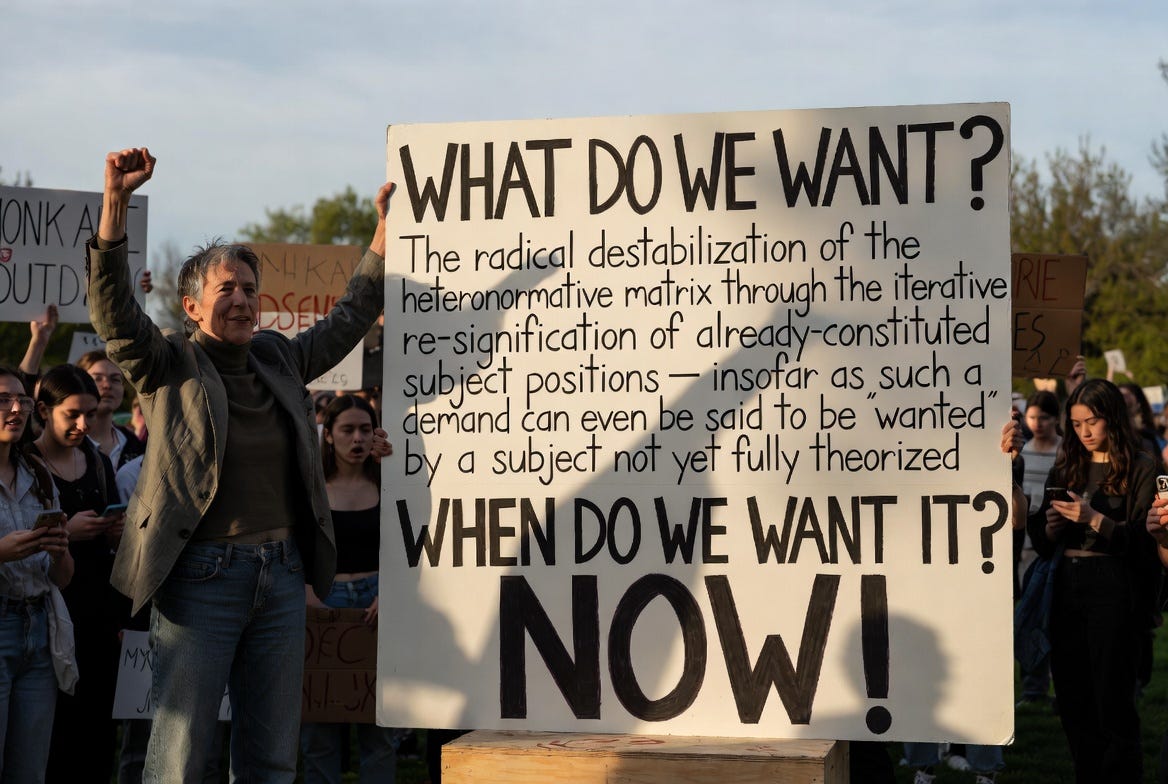

I was reading Clive Hamilton’s ruminations on his participation in the Festival of Dangerous Ideas and his need to respond to the tendentious framing of this survey question.
I’m not sure how much one should attribute our current ideological discontents to the pioneers occupying the commanding heights of academia. I personally think the determining factor in the coming of identity politics was the affordances it provided in the ideological skirmishes of the day. Identity politics gives participants trump cards and apparently principled ways to simply argue ad hominem. They’re offended, they’re traumatised, they feel unsafe and so on.
Anyway, in comments on Clive’s piece I came upon this 1999 Martha Nussbaum hatchet job on Judith Butler. I find Nussbaum unnervingly prolific, but this piece is a cracker. I’m susceptible to assuming people I don’t understand are really just extra deep, but, over the years I have acquired some capacity to distinguish people who really aren’t worth bothering with.
A couple of decades ago, I’d try to figure out what someone like Althusser was saying. (Underneath all the words was Stalinism). It was quite fortunate that, by the time I was doing honours in history, he had strangled his wife. That kind of took the pressure off a bit. Anyway, I was never going to pay too much attention to Butler’s tortured and sloppy formulations. Life’s too short. But now, thanks to Nussbaum, I don’t have to. And the beauty of it is the way Nussbaum anatomises Butler’s method. (The 700 of 8,000 odd words extracted below are focused around that).
And Butler’s method is metastasising all around. Would-be authorities deliver apparently thoughtful statements that actually don’t land anywhere. “We’ve really got to think through the nexus between populism and cost of living pressures”. “We’re facing the complexities of the 21st century with a political system designed for the 19th century.” There are lots of commentators on public administration who use this schtick. But it’s also a good move in a bureaucratic committee and provides a good template for an ARC grant.
In any event, Nussbaum thinks academic feminists should be intellectual handmaidens to feminism’s attempts to advance gender equality in the world: rape law, harassment, workplace conditions, the legal standing of gay and lesbian people, particularly where it harms the less advantaged and those in lower-income countries.
Butler’s agenda couldn’t be more different:
Professor of Parody
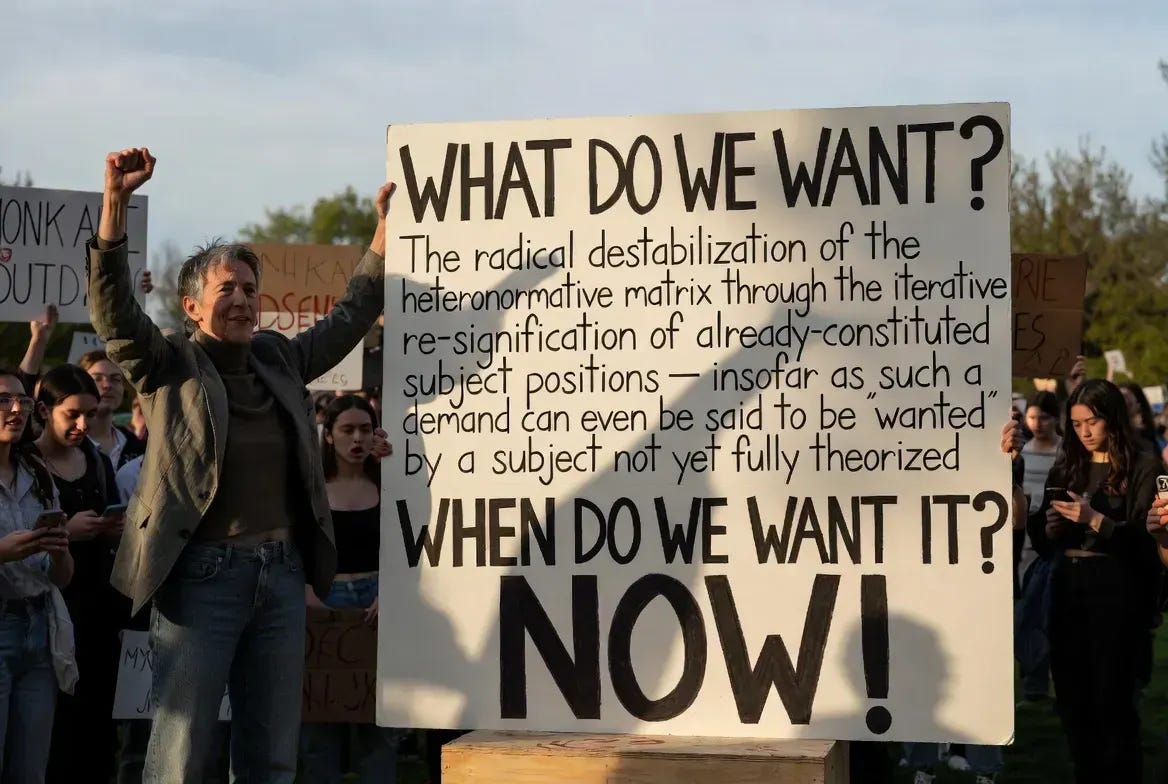
It is difficult to come to grips with Butler’s ideas, because it is difficult to figure out what they are. Butler is a very smart person. In public discussions, she proves that she can speak clearly and has a quick grasp of what is said to her. Her written style, however, is ponderous and obscure.... A further problem lies in Butler’s casual mode of allusion....
It is also obvious that Butler’s work is not directed at a non-academic audience eager to grapple with actual injustices. Such an audience would simply be baffled by the thick soup of Butler’s prose, by its air of in-group knowingness, by its extremely high ratio of names to explanations.
To whom, then, is Butler speaking? It would seem that she is addressing a group of young feminist theorists in the academy who are neither students of philosophy, caring about what Althusser and Freud and Kripke really said, nor outsiders, needing to be informed about the nature of their projects and persuaded of their worth. This implied audience is imagined as remarkably docile. Subservient to the oracular voice of Butler’s text, and dazzled by its patina of high-concept abstractness, the imagined reader poses few questions, requests no arguments and no clear definitions of terms.
Still more strangely, the implied reader is expected not to care greatly about Butler’s own final view on many matters. For a large proportion of the sentences in any book by Butler--especially sentences near the end of chapters--are questions. Sometimes the answer that the question expects is evident. But often things are much more indeterminate. Among the non-interrogative sentences, many begin with “Consider...” or “One could suggest...”--in such a way that Butler never quite tells the reader whether she approves of the view described. Mystification as well as hierarchy are the tools of her practice, a mystification that eludes criticism because it makes few definite claims.
Take two representative examples:
What does it mean for the agency of a subject to presuppose its own subordination? Is the act of presupposing the same as the act of reinstating, or is there a discontinuity between the power presupposed and the power reinstated? Consider that in the very act by which the subject reproduces the conditions of its own subordination, the subject exemplifies a temporally based vulnerability that belongs to those conditions, specifically, to the exigencies of their renewal.
And:
Such questions cannot be answered here, but they indicate a direction for thinking that is perhaps prior to the question of conscience, namely, the question that preoccupied Spinoza, Nietzsche, and most recently, Giorgio Agamben: How are we to understand the desire to be as a constitutive desire?...
Why does Butler prefer to write in this teasing, exasperating way? The style is certainly not unprecedented. Some precincts of the continental philosophical tradition, though surely not all of them, have an unfortunate tendency to regard the philosopher as a star who fascinates, and frequently by obscurity, rather than as an arguer among equals. When ideas are stated clearly, after all, they may be detached from their author: one can take them away and pursue them on one’s own. When they remain mysterious (indeed, when they are not quite asserted), one remains dependent on the originating authority. The thinker is heeded only for his or her turgid charisma....
In this way obscurity creates an aura of importance. It also serves another related purpose. It bullies the reader into granting that, since one cannot figure out what is going on, there must be something significant going on, some complexity of thought, where in reality there are often familiar or even shopworn notions, addressed too simply and too casually to add any new dimension of understanding....
Thus obscurity fills the void left by an absence of a real complexity of thought and argument.
Last year Butler won the first prize in the annual Bad Writing Contest sponsored by the journal Philosophy and Literature, for the following sentence:
The move from a structuralist account in which capital is understood to structure social relations in relatively homologous ways to a view of hegemony in which power relations are subject to repetition, convergence, and rearticulation brought the question of temporality into the thinking of structure, and marked a shift from a form of Althusserian theory that takes structural totalities as theoretical objects to one in which the insights into the contingent possibility of structure inaugurate a renewed conception of hegemony as bound up with the contingent sites and strategies of the rearticulation of power.
Now, Butler might have written: “Marxist accounts, focusing on capital as the central force structuring social relations, depicted the operations of that force as everywhere uniform. By contrast, Althusserian accounts, focusing on power, see the operations of that force as variegated and as shifting over time.”...
Butler gains prestige in the literary world by being a philosopher; many admirers associate her manner of writing with philosophical profundity. But one should ask whether it belongs to the philosophical tradition at all, rather than to the closely related but adversarial traditions of sophistry and rhetoric. Ever since Socrates distinguished philosophy from what the sophists and the rhetoricians were doing, it has been a discourse of equals who trade arguments and counter-arguments without any obscurantist sleight-of-hand. In that way, he claimed, philosophy showed respect for the soul, while the others’ manipulative methods showed only disrespect. One afternoon, fatigued by Butler on a long plane trip, I turned to a draft of a student’s dissertation on Hume’s views of personal identity. I quickly felt my spirits reviving. Doesn’t she write clearly, I thought with pleasure, and a tiny bit of pride. And Hume, what a fine, what a gracious spirit: how kindly he respects the reader’s intelligence, even at the cost of exposing his own uncertainty.
Nussbaum closes by asking a plainer question: what does any of this actually change?
In its small way, of course, this is a hopeful politics. It instructs people that they can, right now, without compromising their security, do something bold. But the boldness is entirely gestural, and insofar as Butler’s ideal suggests that these symbolic gestures really are political change, it offers only a false hope. Hungry women are not fed by this, battered women are not sheltered by it, raped women do not find justice in it, gays and lesbians do not achieve legal protections through it.
Finally there is despair at the heart of the cheerful Butlerian enterprise. … Judith Butler’s hip quietism is a comprehensible response to the difficulty of realizing justice in America. But it is a bad response. It collaborates with evil. Feminism demands more and women deserve better.


Spooky stuff

Pete Buttigieg’s nasty experience.
Someone decided to hurt our family this week. I’m furious, and I want to share what happened.
You’ve probably heard of “swatting.” It’s a cruel and dangerous kind of hoax that has started happening more frequently in recent years... Someone anonymously calls 911 with a false report of imminent danger, such as a hostage situation, at the home of a public figure. Law enforcement swarms the house, guns drawn, terrifying the unsuspecting family, and sometimes even leading to deaths or injuries in the confusion. It’s happened to dozens of lawmakers, judges, celebrities, and others. (When I was in the Cabinet, someone attempted to do this to our home, but fortunately the hoax was quickly detected.)...
Now imagine the same concept, but with Child Protective Services instead of a SWAT team. Hadn’t thought of that? Me neither, until a few days ago when a police officer and a CPS worker showed up at our home and politely asked to speak with me.
I showed them in, invited them on the deck so that we could hear each other over the barking dog, and asked what was going on. They explained that there had been an allegation against me, that it concerned our four-year-old twins, and that a forensic interview had been arranged for the children the following day. I could not be present at the children’s interview, nor could any family member sit in. Afterwards, they would come back and interview me. And only then would they tell me anything about the nature of the allegation.
I was bewildered and troubled, but tried to stay calm. I’m used to any number of falsehoods, attacks, and serious problems being thrown my way. What I didn’t understand was what could have led to this kind of visit. Then the CPS worker told me something that made my stomach turn: I was not to be alone around the children, at least until the interview took place the next day. They asked if I had relatives nearby or could perhaps stay at a hotel for the night.
The officer and the CPS worker wanted to see the children. I invited them to stay until Chasten, who was out running errands and preparing to pick the twins up from summer camp, returned home. When he pulled up in the family car, the kids bounded into the house, looking curiously at the two guests. They were courteous and professional, inviting the kids to inspect the officer’s police car, which fascinated them of course, while the grownups talked in the driveway. We agreed that the kids would stay at their grandparents’ house after dinner that night. And then they left.
The twenty-four hours until they returned are among the darkest hours of my life... I had been accused of something so serious I couldn’t be alone with my own children, and had consented to have them interviewed by strangers, without knowing what the accusation contained...
I’ve been denounced ... threatened, and heckled... I’ve been through political attacks in office, death threats, and rocket attacks in war... But this is the ugliest thing that has happened to me since my career in service began.
After a sleepless night ... picturing what our children were going through, the appointment time for my “interview” finally came... With the kids at their grandparents’ ... and Chasten asked to wait upstairs, the officer and CPS worker sat down at our kitchen table with me and my new lawyer.
Then, for the first time, the officer explained the allegation: an anonymous caller had contacted CPS, saying he’d spoken to a woman who claimed to have met me at a conference years ago in Alabama, where she said I’d told her I had committed unspeakable violent crimes, and that my children were still at risk.
That was all... The officer asked if I had been to the town where the woman claimed to have met me. I have not. He made clear he believed this was politically motivated and would not be referred to a prosecutor... Nothing in the children’s forensic interview had led to concerns...
The CPS worker likewise found nothing to substantiate the allegation... I no longer needed to avoid being alone with my children... Then, per standard procedure, she checked our kitchen had adequate food and asked to look at the kids’ bedroom...
Douglas Murray: not such a nice guy
July 4th created two nations: the US and Australia
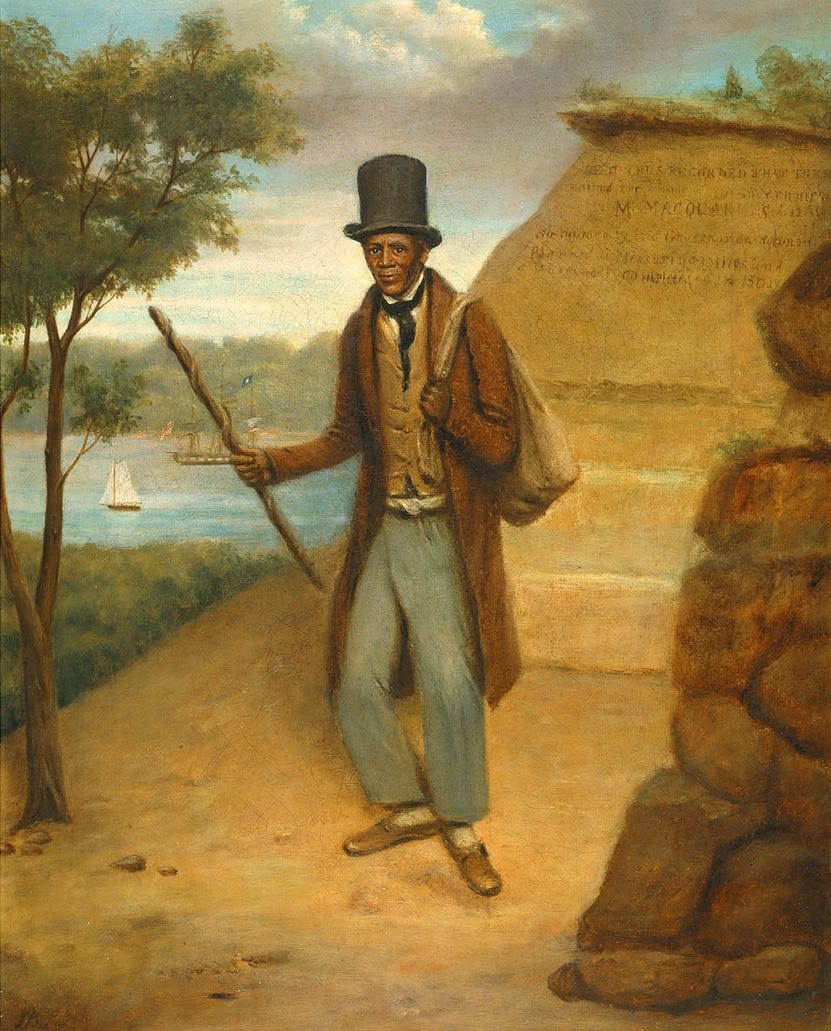
Andrew Kemp informs us of some more stuff which we should all know, but don’t.
Around 50,000 British convicts were transported to the North American colonies between 1718 to 1775... The last landing occurred in April 1776, when the Jenny docked on the James River in Virginia.
Another convict transport, the Tayloe, was to depart Britain in December 1776. The prisoners were instead pardoned on condition of joining the British army. Rather than being sent to work for the American colonists, they were sent over to fight them.
When the American War of Independence broke out, the British men and women sentenced to transportation were kept aboard hulks... In August 1786, the government of William Pitt the Younger chose Botany Bay... As it is sometimes said, the American Revolution really created two nations: the United States, and Australia.
The First Fleet included several convicts who were emancipated slaves from America... Of the 14 black convicts, the historian Cassandra Pybus has argued that most were, at one point, slaves in America. It is likely that they were offered freedom in exchange for fighting on the British side.
John Moseley was one of these convicts. He was born to slave parents in Portsmouth, Virginia... That meant he too was enslaved... In 1775, the royal governor... Lord Dunmore, offered freedom to slaves and indentured servants... so long as they took arms with the British. Moseley accepted the offer.
When the war ended in 1783, the Americans wanted to claim back the enslaved people who had left their masters. The British government refused... Sir Guy Carleton... said that Britain’s “public faith” had been pledged to them. Instead he created a register... John Moseley’s name appears on this list.
Finding a passage to England from Nova Scotia, Moseley lived a precarious existence. He was sentenced to death in 1784 for fraudulently claiming somebody else’s wages... As was typical, the death sentence was commuted to transportation. He arrived at Sydney Cove in January 1788.
A month into the settlement, Mosley was sharing a hut with John Randall, another black convict from America... Randall was one of the earliest ex-convicts to be granted land... He had gone from being a slave in America, to a landholder in Australia.
Mosley appears in an out of the colonial records after 1788. He received his conditional pardon in 1800 and worked as a labourer. By the early 1820s he was employed by Sydney merchants... He died in 1832 an independent man.
For the other black convicts, their lives were as diverse as the rest of the convict population... The most notorious black convict was John Caesar, sometimes credited as Australia’s first bushranger...
The most well-known African American to be transported to Sydney was William Blue, who arrived on the Third Fleet in 1801. He too had served with the British in the American Revolution...
‘Billy’ Blue became something of a celebrity in Sydney life... In 1811, he was appointed harbour watchman by Governor Lachlan Macquarie... In 1817, he was granted 80 acres of land on the north side of the harbour. Today it is known as Blues Point...
Most of the senior naval officers on the First Fleet had served in America. David Collins... fought at Bunker Hill... Another naval officer... was William Bradley. On 23 January 1788 he recorded one of the first interactions between the Eora and a convict of African descent:
A Black man was landed among the working Party with whom the Natives were much pleased & seemed astonished that he did not understand them... as the boat left the shore they retired apparently as well satisfied as if the Man of their own complexion had remained with them.
I’ve often wondered how much the American experience of the senior naval officers tempered their attitude towards the convicts, wary of pushing people too far towards rebellion... [This] helped ease the Australian colonies towards self-government by the mid-nineteenth century.
Another contribution of the American Revolution was the growth of whaling around Australia, its first major commercial industry... Hiring only free men... whalers helped push Australia out of its convict dependence and towards a more independent and commercial existence...
A final note. On 26 January 1808... Governor William Bligh was arrested... in Sydney, during the so-called Rum Rebellion... Leading the Corps up Bridge Street towards Government House... was none other than John Randall. For a moment he must have felt like the most powerful man in Australia.


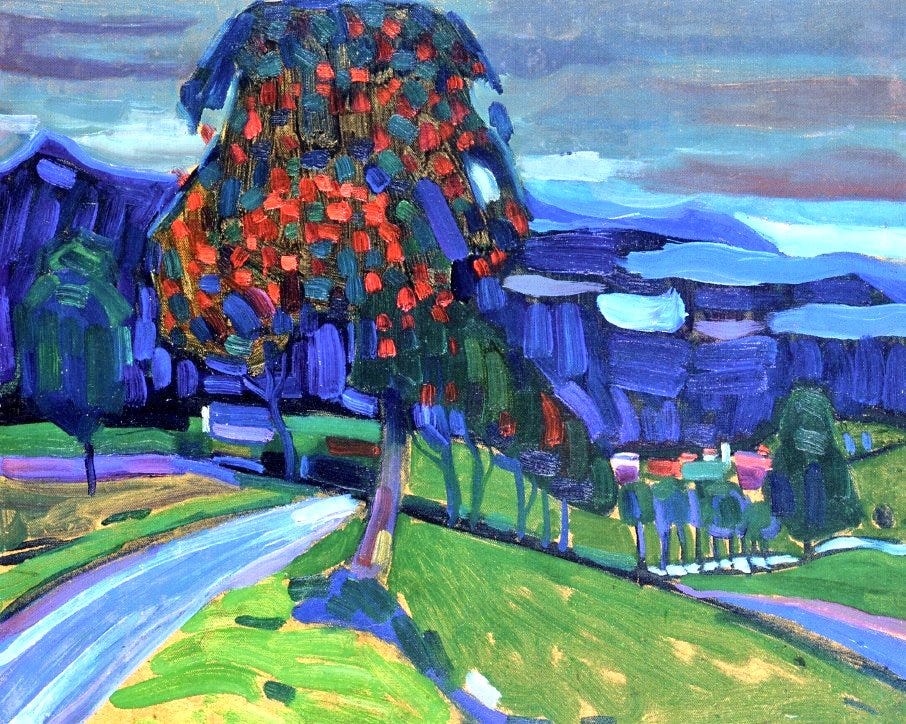
Kandinsky


Heaviosity half-hour
The great Eskimo vocabulary hoax

Who said heaviosity half hour can’t be fun?
Most linguistics departments have an introduction-to-language course in which students other than linguistics majors can be exposed to at least something of the mysteries of language and communication: signing apes and dancing bees; wild children and lateralization; logographic writing and the Rosetta Stone; pit and spit; Sir William Jones and Professor Henry Higgins; isoglosses and Grimm’s Law; Jabberwocky and colourless green ideas; and of course, without fail, the Eskimos and their multiple words for snow.
Few among us, I’m sure, can say with certainty that we never told an awestruck sea of upturned sophomore faces about the multitude of snow descriptors used by these lexically profligate hyperborean nomads, about whom so little information is repeated so often to so many. Linguists have been just as active as schoolteachers or general knowledge columnists in spreading the entrancing story. What a pity the story is unredeemed piffle.
Anthropologist Laura Martin of Cleveland State University spent some of her research time during the 1980s attempting to slay the constantly changing, self-regenerating myth of Eskimo snow terminology, like a Sigourney Weaver fighting alone against the hideous space creature in the movie Alien (a xenomorph, they called it in the sequel Aliens; nice word). You may recall that the creature seemed to spring up everywhere once it got loose on the spaceship, and was very difficult to kill.
Martin presented her paper at the annual meetings of the American Anthropological Association in Washington D.C. in December 1982, and eventually (after a four-year struggle during which bonehead reviewers cut a third of the paper, including several interesting quotes) she published an abbreviated version of it in the ‘Research Reports’ section of AAA’s journal (Martin 1986). This ought to have been enough for the news to get out.
But no, as far as widespread recognition is concerned, Martin labored in vain. Never does a month (or in all probability a week) go by without yet another publication of the familiar claim about the wondrous richness of the Eskimo conceptual scheme: hundreds of words for different grades and types of snow, a lexicographical winter wonderland, the quintessential demonstration of how primitive minds categorize the world so differently from us.
And the alleged lexical extravagance of the Eskimos comports so well with the many other facets of their polysynthetic perversity: rubbing noses; lending their wives to strangers; eating raw seal blubber; throwing grandma out to be eaten by polar bears; “We are prepared to believe almost anything about such an unfamiliar and peculiar group,” says Martin, in a gentle reminder of our buried racist tendencies.
The tale she tells is an embarrassing saga of scholarly sloppiness and popular eagerness to embrace exotic facts about other people’s languages without seeing the evidence. The fact is that the myth of the multiple words for snow is based on almost nothing at all. It is a kind of accidentally developed hoax perpetrated by the anthropological linguistics community on itself.
The original source is Franz Boas’ introduction to The Handbook of North American Indians (1911). And all Boas says there, in the context of a low-key and slightly ill-explained discussion of independent versus derived terms for things in different languages, is that just as English uses separate roots for a variety of forms of water (liquid, lake, river, brook, rain, dew, wave, foam) that might be formed by derivational morphology from a single root meaning ‘water’ in some other language, so Eskimo uses the apparently distinct roots aput ‘snow on the ground’, qana ‘falling snow’, piqsirpoq ‘drifting snow’, and qimuqsuq ‘a snow drift’. Boas’ point is simply that English expresses these notions by phrases involving the root snow, but things could have been otherwise, just as the words for lake, river, etc. could have been formed derivationally or periphrastically on the root water.
But with the next twist in the story, the unleashing of the xenomorphic fable of Eskimo lexicography seems to have become inevitable. What happened was that Benjamin Lee Whorf, Connecticut fire prevention inspector and weekend language-fancier, picked up Boas’ example and used it, vaguely, in his 1940 amateur linguistics article ‘Science and linguistics,’ which was published in MIT’s promotional magazine Technology Review (Whorf was an alumnus; he had done his B.S. in chemical engineering at MIT).
Our word snow would seem too inclusive to an Eskimo, our man from the Hartford Fire Insurance Company confidently asserts. With an uncanny perception into the hearts and minds of the hardy Arctic denizens (the more uncanny since Eskimos were not a prominent feature of Hartford’s social scene at the time), he avers:
We have the same word for falling snow, snow on the ground, snow packed hard like ice, slushy snow, wind-driven flying snow — whatever the situation may be. To an Eskimo, this all-inclusive word would be almost unthinkable; he would say that falling snow, slushy snow, and so on, are sensuously and operationally different, different things to contend with; he uses different words for them and for other kinds of snow. (Whorf 1940; in Carroll 1956, 216).
Whorf’s article was quoted and reprinted in more subsequent books than you could shake a flame-thrower at; the creature was already loose and regenerating itself all over the ship.
Notice that Whorf’s statement has illicitly inflated Boas’ four terms to at least seven (1: “falling”, 2: “on the ground”, 3: “packed hard”, 4: “slushy”, 5: “flying”, 6, 7, ...: “and other kinds of snow”). Notice also that his claims about English speakers are false; I recall the stuff in question being called snow when fluffy and white, slush when partly melted, sleet when falling in a half-melted state, and a blizzard when pelting down hard enough to make driving dangerous. Whorf’s remark about his own speech community is no more reliable than his glib generalizations about what things are “sensuously and operationally different” to the generic Eskimo.
But the lack of little things like verisimilitude and substantiation are not enough to stop a myth. Martin tracks the great Eskimo vocabulary hoax through successively more careless repetitions and embroiderings in a number of popular books on language. Roger Brown’s Words and Things (1958, 234–236), attributing the example to Whorf, provides an early example of careless popularization and perversion of the issue. His numbers disagree with both Boas and Whorf (he says there are “three Eskimo words for snow”, apparently getting this from figure 10 in Whorf’s paper; perhaps he only looked at the pictures).
After works like Brown’s have picked up Whorf’s second-hand misrecollection of Boas to generate third-hand accounts, we begin to get fourth-hand accounts carelessly based on Brown. For example, Martin notes that in Carol Eastman’s Aspects of Language and Culture (1975; 3rd printing 1980), the familiar assertion that “Eskimo languages have many words for snow” is found only six lines away from a direct quote of Brown’s reference to “three” words for snow.
But never mind: three, four, seven, who cares? It’s a bunch, right? Once more popular sources start to get hold of the example, all constraints are removed: arbitrary numbers are just made up as the writer thinks appropriate for the readership. In Lanford Wilson’s 1978 play The Fifth of July it is “fifty”. From 1984 alone (two years after her 1982 presentation to the American Anthropological Association meetings on the subject — not that mere announcement at a scholarly meeting could have been expected to change anything), Martin cites the number of Eskimo snow terms given as “nine” (in a trivia encyclopedia, Adams 1984), “one hundred” (in a New York Times editorial on February 9), and “two hundred” (in a Cleveland TV weather forecast).
By coincidence, I happened to notice, the New York Times returned to the topic four years to the day after committing itself to the figure of one hundred: on February 9, 1988, on page 21, in the Science Times section, a piece by Jane E. Brody on laboratory research into snowflake formation began: “The Eskimos have about four dozen words to describe snow and ice, and Sam Colbeck knows why.” The New York Times, America’s closest approach to a serious newspaper of record, had changed its position on the snow-term count by over 50% within four years. And in the science section. But hey: nine, forty-eight, a hundred, two hundred, who cares? It’s a bunch, right? On this topic, no source can be trusted.
People cannot be persuaded to shut up about it, either. Attempting to slay the creature at least in my locality, I mentioned Martin’s work in a public lecture in Santa Cruz in 1985, in the presence of a number of faculty, students, and members of the general public. I drove home the point about scholarly irresponsibility to an attentive crowd, and imagined I had put at least a temporary halt to careless talk about the Eskimo morpheme stock within Santa Cruz County. But it was not to be.
Within the following three months, two undergraduate students came to me to say that they had been told in class lectures about the Eskimo’s highly ramified snow vocabulary, one in politics, one in psychology; my son told me he had been fed the same factoid in class at his junior high school; and the assertion turned up once again in a “fascinating facts” column in a Santa Cruz weekly paper.
Among the many depressing things about this credulous transmission and elaboration of a false claim is that even if there were a large number of roots for different snow types in some Arctic language, this would not, objectively, be intellectually interesting; it would be a most mundane and unremarkable fact.
Horsebreeders have various names for breeds, sizes, and ages of horses; botanists have names for leaf shapes; interior decorators have names for shades of mauve; printers have many different names for different fonts (Caslon, Garamond, Helvetica, Times Roman, and so on), naturally enough. If these obvious truths of specialization are supposed to be interesting facts about language, thought, and culture, then I’m sorry, but include me out.
Would anyone think of writing about printers the same kind of slop we find written about Eskimos in bad linguistics textbooks? Take a random textbook like Paul Gaeng’s Introduction to the Principles of Language (1971), with its earnest assertion: “It is quite obvious that in the culture of the Eskimos... snow is of great enough importance to split up the conceptual sphere that corresponds to one word and one thought in English into several distinct classes...” (p. 137). Imagine reading: “It is quite obvious that in the culture of printers... fonts are of great enough importance to split up the conceptual sphere that corresponds to one word and one thought among non-printers into several distinct classes...” Utterly boring, if even true. Only the link to those legendary, promiscuous, blubber-gnawing hunters of the icepacks could permit something this trite to be presented to us for contemplation.
And actually, when you come to think of it, Eskimos aren’t really that likely to be interested in snow. Snow in the traditional Eskimo hunter’s life must be a kind of constantly assumed background, like sand on the beach. And even beach bums have only one word for sand. But there you are: the more you think about the Eskimo vocabulary hoax, the more stupid it gets.
The final words of Laura Martin’s paper are about her hope that we can come to see the Eskimo snow story as a cautionary tale reminding us of “the intellectual protection to be found in the careful use of sources, the clear presentation of evidence, and above all, the constant evaluation of our assumptions.” Amen to that. The prevalence of the great Eskimo snow hoax is testimony to falling standards in academia, but also to a wider tendency (particularly in the United States, I’m afraid) toward fundamentally anti-intellectual “gee-whiz” modes of discourse and increasing ignorance of scientific thought.
This is one more battle that linguists must take up (like convincing people that there is no need for a law to make English the official language of Kansas, or that elementary schools shouldn’t spend time trying to abolish negated auxiliary verbs). Some time in the future, and it may be soon, you will be told by someone that the Eskimos have many or dozens or scores or hundreds of words for snow. You, gentle reader, must decide here and now whether you are going to let them get away with it, or whether you are going to be true to your position as an Expert On Language by calling them on it.
The last time it happened to me (other than through the medium of print) was in July 1988 at the University of California’s Irvine campus, where I was attending the university’s annual Management Institute (yes, despite my temperamental unsuitability, I was sent away for a summer course in how to be an administrator; but enough of my private pain). Not just one lecturer at the Institute but two of them somehow (don’t ask me how) worked the Eskimological falsehood into their tedious presentations on management psychology and administrative problem-solving. The first time I attempted to demur and was glared at by lecturer and classmates alike; the second time, discretion for once getting the upper hand over valor, I just held my face in my hands for a minute, then quietly closed my binder and crept out of the room.
Don’t be a coward like me. Stand up and tell the speaker this: C. W. Schultz-Lorentzen’s Dictionary of the West Greenlandic Eskimo Language (1927) gives just two possibly relevant roots: qanik, meaning ‘snow in the air’ or ‘snowflake’, and aput, meaning ‘snow on the ground’. Then add that you would be interested to know if the speaker can cite any more.
This will not make you the most popular person in the room. It will have an effect roughly comparable to pouring fifty gallons of thick oatmeal into a harpsichord during a baroque recital. But it will strike a blow for truth, responsibility, and standards of evidence in linguistics.
References
Adams, Cecil: 1984, The Straight Dope: A Compendium of Human Knowledge, edited and with an introduction by Ed Zotti, Chicago Review Press, Chicago, Illinois.
Boas, Franz: 1911, Introduction to The Handbook of North American Indians, Vol. I, Bureau of American Ethnology Bulletin 40, Part 1, Smithsonian Institution, Washington, D.C. Reprinted by Georgetown University Press, Washington D.C. (c. 1963) and by University of Nebraska Press, Lincoln, Nebraska (1966).
Brown, Roger: 1958, Words and Things, Free Press, New York.
Carroll, John B., ed.: 1956, Language, Thought, and Reality: Selected Writings of Benjamin Lee Whorf, MIT Press, Cambridge, Massachusetts.
Eastman, Carol: 1975, Aspects of Language and Culture, Chandler, San Francisco, California. 3rd printing, Chandler & Sharp, Novato, California, 1980.
Gaeng, Paul A.: 1971, Introduction to the Principles of Language, Harper & Row, New York.
Martin, Laura: 1986, ‘”Eskimo words for snow”: A case study in the genesis and decay of an anthropological example,’ American Anthropologist 88, 2 (June), 418–423.
Murray, Stephen O. 1987, ‘Snowing canonical texts,’ American Anthropologist 89, 2 (June), 443–444.
Schultz-Lorentzen, C.W.: 1927, Dictionary of the West Greenlandic Eskimo Language, Meddelser om Grønland 69, Reitzels, Copenhagen.
Whorf, Benjamin Lee: 1940, ‘Science and linguistics,’ Technology Review (MIT) 42, 6 (April), 229–231, 247–248. Reprinted in Carroll, ed., 207–219.
From: Natural Language and Linguistic Theory 7 (1989) 275–281.


Having been a teacher of English (literature, writing, EAL) I have been more than interested in the nature of the English language - and with some acquaintance with other languages - Latin, French, Spanish, German, Greek, Viet-namese, Japanese - to greater or lesser extent. I have a bookshelf full of books on Language - though mostly on English naturally enough - and as I looked at them and took them from that shelf - there are the titles, authors and years of publication. Thought at the same time let me insert that I am fairly close connection to the foundation editor of the OED - James A H Murray 1837-1915 - something which piqued my interest when so informed by my Scottish teacher grand-mother when I was aged 11 - in 1960 when she was 68 - her maternal grand-father - also James Murray (1837-1912) was a first cousin to "Dictionary" Murray. Roots (family histories of familiar words) Peter DAVIES 1981; The Story of English (R McCrum, W Cran & R MacNeil) 1986; How Language Works David CRYSTAL 2006; Man Made Language Dale SPENDER 1980/1981; The English Language Robert Burchfield 1985/2003; Language Most Foul Ruth Wajnryb 2004; Mother Tongue Bill BRYSON 2003; The Adventure of English Melvyn Bragg 2003; Our Language Simeon Potter 1950/1969; Language Maid Plane {Made Plain] Anthony Burgess 1964/1078; The Unfolding of Language Guy Deutscher 2005; Spoken Here (Travels Among Threatened Languages) Mark Abley 2003; bad english Ammon Shea 2014; Glo-bish Robert McCrum 2010; Native Tongues Charles Berlitz 1983; The Story of Language C L BARBER 1964/1972; The Language Instinct Steven Pinker 1995; and By Hook or By Crook David CRYSTAL 2007. It must have been in the early 1980s when I was first made aware that it was very much an extreme exaggeration (though I had already quoted it as a truth) - the "fact" that Inuit (or Eskimos) had scores of words for snow - and yet as this Heaviosity piece suggests - it continues to live on. So thanks for this. The other thing I wanted to comment on was Billy Blue - born in Jamaica (Long Island - Queens - the location of NY's JFK Airport) around 1740 - died in Sydney in 1834 - the portrait you show here painted just after his death - arrived in Sydney Town in 1801 - not in the Third Fleet - that straggling fleet set out between March and April and arrived as late as October of 1791. I had ancestors who arrived in 1792 - the first ship after the Third Fleet. He was already 60 years old - married Elizabeth Williams - had five children. A daughter married George Lavender - he was in charge of the Hulk moored in the bay now having his name (convicts housed there before being sent to Norfolk Island or Moreton Bay or Port Macquarie (?)). A son, John, had a daughter who married a Montgomery whose son George married one of my Kable cousins - both long since deceased but I think I am right in stating that any BLUE named person in Australia is a descendant. Cassandra Pybus gets full marks from me for her historical research and findings in Black Founders (published 2006). Harry Seidler's beautiful brutalist 25 floor apartment building on Blue's Point stands on the very site of Billy Blue's home - dismantled to make way for - on the end of the little peninsula of land granted to him by Lachlan Macquarie whose favourite he was - and with a fleet of little vessels taking people across the water between that north side and the edges of Sydney Town.
I had to go back and see what you meant about the Murray chap not being very nice. He's really not very nice at all - is he! He is ignorant of history and of the fact that Palestine is truly not the historic homeland of the Ashkenazim out of the Trans-Caucasus. And he seems totally consumed by the fact that Ireland stands up for the Palestinians - but not against Jews - rather against the genocidal, torturing, thieving and destroying Zionists! Who on earth is he?
I loathe Butler's prose. And think Nussbaum is unfair to her on occasion. Nussbaum seems to want clear arguments for established positions - good opinion columns, not raising questions or exploring what is unclear, which is valuable (and more valuable when done in gracious prose).