


Economic and political reform: why its so rare
In this freewheeling conversation with John Humphreys and Gene Tunny, we delve into what’s gone wrong with modern policymaking—and what can be done about it. We begin with the dysfunctional state of our tax system. I argue we should scrap dividend imputation and cut the company tax rate to attract foreign capital and grow the national pie.
We then explore the systemic malaise of democracy: how spin, performativity, and institutional incentives have crowded out real deliberation and made difficult choices all but impossible. Politicians aren’t uniquely bad—they’re trapped in a system that punishes truth-telling and rewards evasion.
All politicians are against tax and for spending and you can see that in the sea of red ink we're sailing into in Tasmania, Victoria, Australia and the US. That leads to my proposal for a deeper reform: embedding citizens’ juries into democratic life.
We discuss how standing citizens’ assemblies could reorient policy debates on issues like housing, infrastructure, climate and budget repair. This is not about trusting “ordinary people” over politicians—it’s about designing a system that enables public reason to flourish again. (OK, well the AI wrote that sentence, which gives you some idea of why we can't hand over to AIs just yet.) If you prefer the audio file, it’s here.
Why are young adults in the English-speaking world so unhappy?
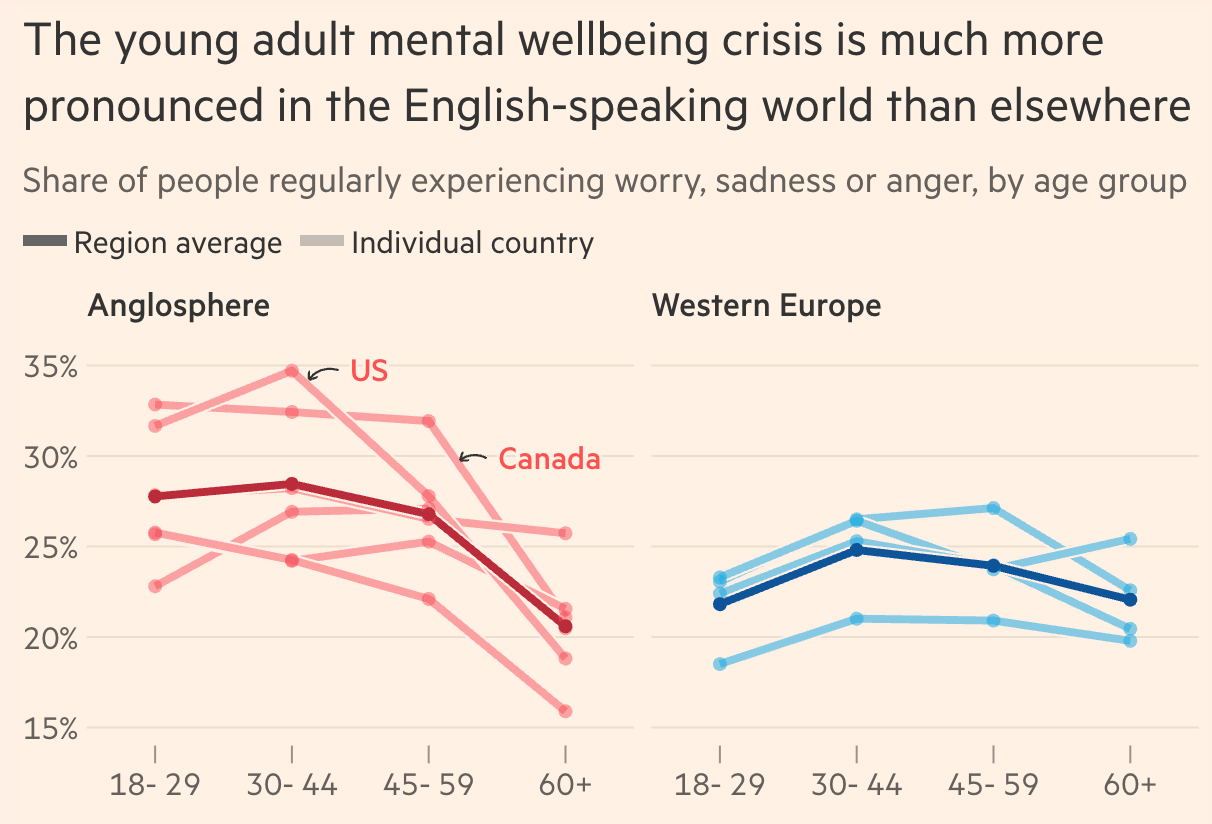
Good, fact driven FT column by John Burn-Murdoch on a very important issue. Thanks to a reader for alerting me to it.
One of the most striking but under-discussed insights from this year's World Happiness Report was that the marked worsening in young adult mental health over the past decade is primarily, if not exclusively, an Anglosphere phenomenon.
The share of young adults regularly experiencing stress and anger has risen sharply over the past 15 years in the US, Canada, UK, Ireland, Australia and New Zealand. But it has been largely stable elsewhere in the west, according to detailed data from the Gallup World Poll used in the report.
It's a similar story for young people's faith in the ultimate social contract: that if you work hard you'll be rewarded with security, stability and status. Outside the English-speaking world, confidence in this fundamental tenet of societal fairness is flat across the age spectrum. In the Anglosphere it is high only among the oldest, and in tatters among the young.
One theory for this Anglo-specific generational gloom is that it is about the English language and associated culture itself. Namely, that young adults in the English-speaking world have developed a particular way of talking about mental health and negative emotions that leads to a rise in reports of malaise...
I find this story fascinating and plausible, but I want to throw another factor into the mix: housing.
While dozens of countries are dealing with deteriorating housing affordability, the issue is especially acute in the Anglosphere.
In Germany and Spain real house prices have climbed 32 and 44 per cent respectively since 1995. In the US the equivalent figure is 85 per cent, while the UK, Ireland, Australia, New Zealand and Canada all come in north of 200 per cent.
The result has been a brutal snatching away of the particularly Anglophone dream of home ownership. Rates of ownership among people aged 25-34 in English-speaking countries have slumped by between 20 and 50 percentage points over the same 30-year period.
While the housing situation in continental western Europe is hardly a panacea, the shocks there have been much more modest, and housing security remains far more common...
What makes the Anglosphere affordability crunch all the more damaging is that it has happened in societies that have placed especially high value on home ownership, both culturally as the go-to marker of having made it in life, and financially as a means to accumulate wealth in less generous welfare systems than those of continental Europe.
English-speaking governments, policymakers and societies more broadly have raised a generation to play the home ownership game. They have then not so much ripped up the rule book as confiscated the board and all the pieces without explanation.
The consequences of this broken promise are plain to see. The steep age gradient in Anglosphere home ownership rates maps neatly on to each age group's sense that hard work still brings success.
Viewed in this light, the increasingly palpable sense of insecurity, stress and even anger among many Anglo under-forties cannot easily be written off as irrational catastrophising or mental health speak. It reflects a generation's direct experience of reality...
People are highly sensitive to their socio-economic status in society. Shorn of the ability to climb the ranks, they will naturally seek ways to reduce others' status instead, even if it means shrinking the pie overall.
The good news is that all of this is fixable. Better yet, policymakers needn't even look outside the Anglosphere for a playbook. From Houston, Texas to Auckland, New Zealand planning liberalisation has spurred housebuilding and improved affordability...
The Anglosphere has cut a generation adrift. It's time to reach out a helping hand.
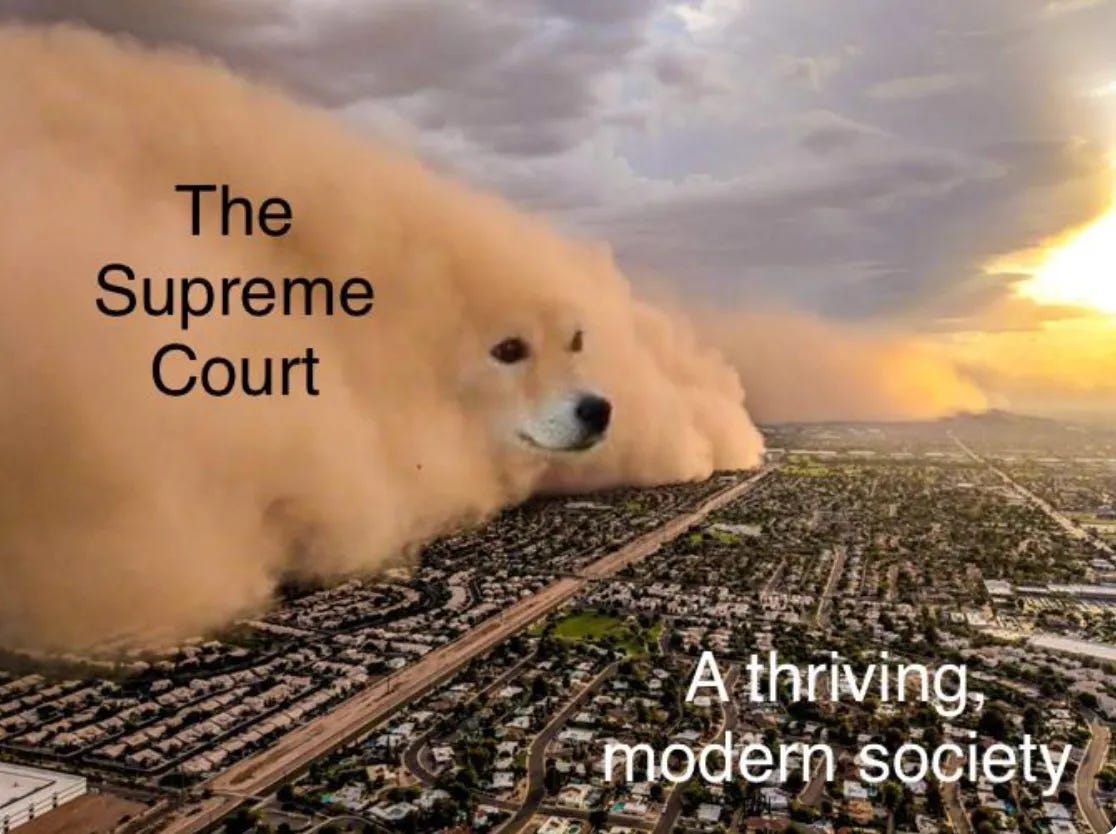
Not sure about ‘thriving’ - I’d say ‘coping: just’
… but otherwise … good meme!
John Quiggin on America and our PBS
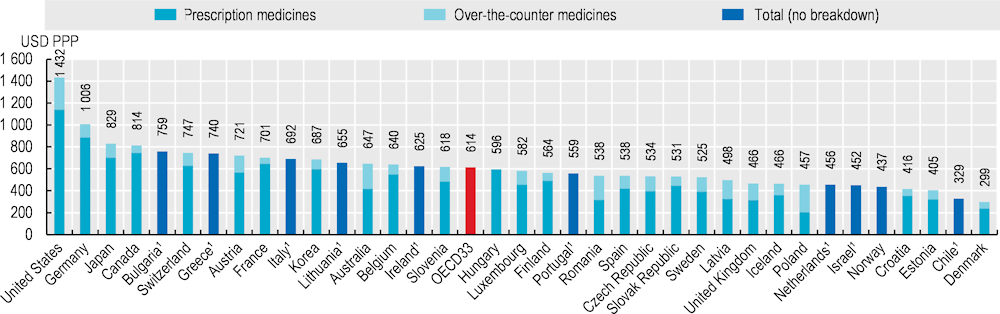
Kind of speaks for itself.
If I were president of the United States, I would certainly be concerned about the cost and performance of the country's healthcare system. The grim statistics are well known. As of 2022, the US spent $12,555 per person on healthcare, almost twice as much as other wealthy countries, including Australia. That gap alone cancels out about half of the difference in income per person between the US and Australia, according to World Bank estimates.
Higher expenditure on healthcare would not be a problem if it delivered a healthier population. But this is not the case. The US has one of the lowest life expectancies of any rich country. And even though more Americans die young, those who survive have worse health than elsewhere. Americans suffer from chronic diseases like diabetes, asthma and depression at around twice the (age-adjusted) rate of other rich countries.
This gap is too large to be accounted for by specific causes like gun violence or drug overdoses, or even unequal income distribution. The US has worse health outcomes at every point on the income distribution scale than other rich countries, even though those at the upper end have much higher incomes...
There's not much hope for rapid progress in US health outcomes. The destruction of US public health infrastructure through budget cuts, the gutting of key agencies such as the Center for Disease Control and the appointment of notorious anti-vaxxer RFK Jr as secretary of health and human services will only make matters worse.
It's unsurprising then that President Donald Trump is looking at the cost side of the equation. As might be expected he has raised, again, the perennial grievances of US health policy. This is the fact that Americans pay far more for prescription medicines than do citizens of other countries where prices are controlled through mechanisms like Australia's Pharmaceutical Benefits Scheme (PBS). And, given his grievance-based approach to the world in general, it is no surprise that his latest statement on the topic describes Australia and other countries as "freeloaders" on the US.
The US government is, of course, entirely within its rights to set its own policy regarding the pricing of prescription drugs. The US Department of Veterans Affairs already has a program similar to the PBS, under which it pays about half as much of the typical US price...
This was arguably true in the second half of the 20th century when the US was the undoubted centre of global medical research, most notably through the National Institutes of Health. But funding for the NIH (adjusted for inflation) peaked in 2004, and has suffered from decades of financial stringency. Meanwhile, the US share of genuine innovations, measured by "new molecular entities" has declined and is no longer notably larger (relative to GDP) than that of leading European innovators. The development of semaglutide (Ozempic and Wegovy) treatments for obesity and diabetes by Danish firm Novo Nordisk is a notable example of a drug of particular importance to the US being developed in Europe...
More generally, if Trump wants to import ideas like the PBS into the US system, Australia has plenty to offer. Australia's Medicare system, combining a single-payer universal scheme for standard healthcare with private insurance and fee-for-service medicine as an upper tier, could provide a politically palatable way of delivering the US demand for "Medicare for all" without destroying the private sector.
But of course, this isn't the Trump way. What we will doubtless see, as in the recent tariff negotiations, is a series of bullying demands, resulting in triumphant announcements of magnificent deals, which turn out, on closer inspection, to be largely illusory.
The bigger lesson for Australia in all of this is that, as with China, we need to treat the US not as an ally or friend but as a trading partner which will seek to push us around whenever possible. The correct response, again as with China, is to stand our ground until the other side sees the pointlessness of bullying and the mutual benefits of free exchange.
Why clamber to the top if you can’t punch down?

Desegregation: what desegregation?
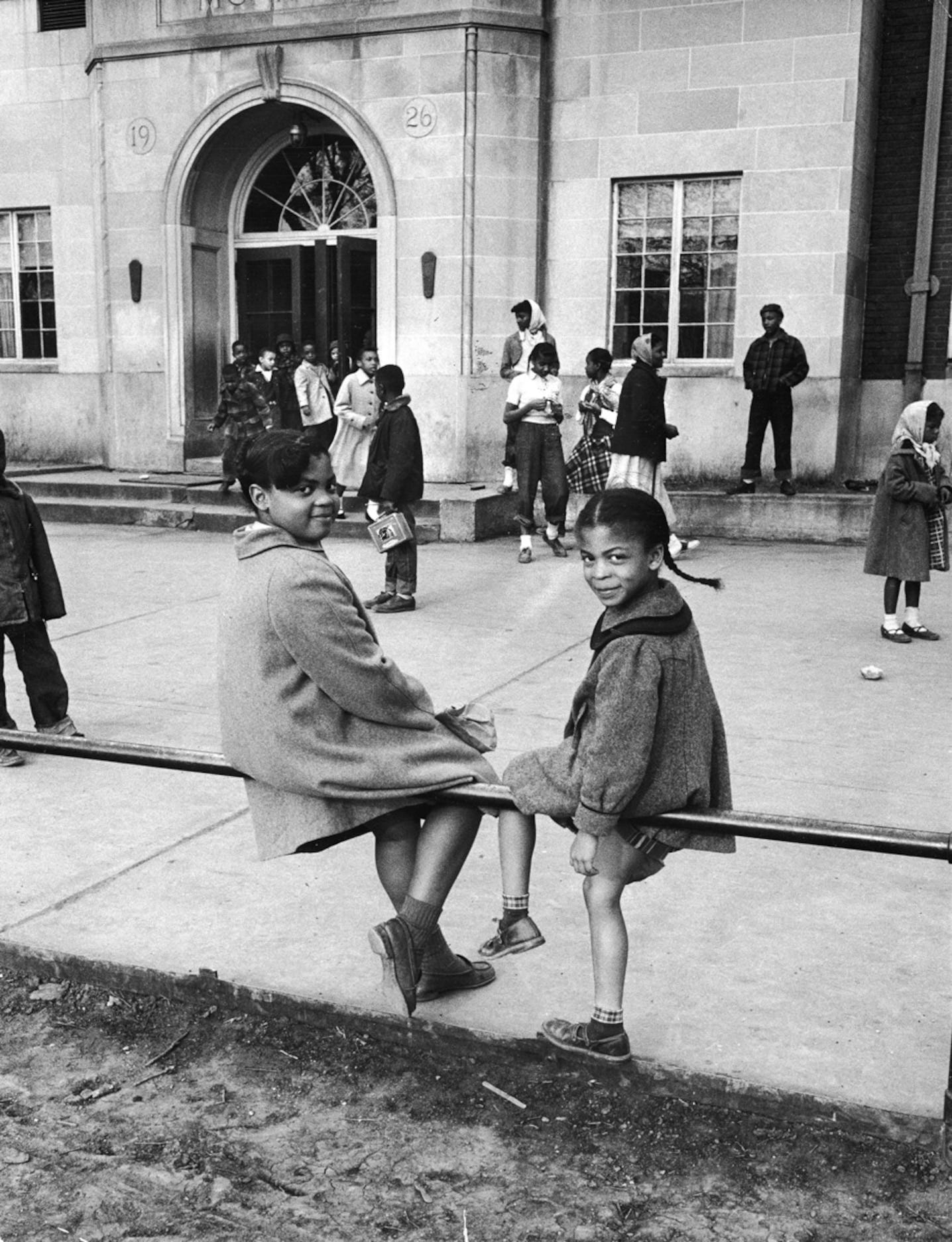
There’s a whole class of historical landmarks which look very good in retrospect. Almost miraculous. But when you learn more about them, you get a key to interpreting them which is less miraculous. And that’s good, because then you see how these events were driven by mixed motives - as all us humangoes are. You see how things might have been otherwise. And generally speaking you get clues about how the ‘miracle’ was a concrete event with seeds of both good and bad in it. And that helps you to understand today, how the miracle lying off in the distant past managed to achieve less good than might have been hoped for it.
From a Jelani Cobb New Yorker article from 2014. Malcolm Gladwell has also done a fantastic revisionist podcast on Brown v Board of Education which I’ve embedded here.
In 1952, an African-American woman named Sarah Bulah filed a lawsuit challenging the segregated education system in her home state of Delaware. Bulah lived near a spacious, modern, whites-only high school, but her daughter, Shirley, was forced to attend a decrepit, single-room school. The state provided transportation only for white students, so Bulah had to drive her daughter to and from school each day, even though the bus route ran right past her home. Hundreds of other black parents in the area faced the same situation, yet Bulah's decision to mount a legal challenge was met with scorn. Her neighbors disagreed with her, while local black teachers voiced their own disapproval. Bulah's pastor doubted the wisdom of her actions. "I was for segregation," he later remarked.
Bulah won her case, and, for the first time, a court ordered a whites-only public school to accept black students. After the state appealed the decision, the lawsuit, Bulah v. Gebhart, became part of a cluster of cases heard by the Supreme Court in Brown v. Board of Education...
But, as we approach the sixtieth anniversary of the Brown decision, next month, the landmark case seems, in hindsight, like a qualified victory. Racially homogenous schools remain a fact of American life... There may be no better example of the ongoing scandal of school segregation than the New York City public-school system, which a recent report by the Civil Rights Project at U.C.L.A. found to be one of the most segregated in the country. Black and Latino students in New York have become more likely to attend schools with minimal white enrollment, and a majority of them go to schools defined by concentrated poverty...
The meaning of the ongoing resegregation of our public schools becomes clearer if we look back at the campaign to integrate them—which was concerned less with race than with resources. We like to think of the men and women whose struggle led to Brown v. Board of Education as democratic idealists, but their motivations were more complex: if the efforts to upend Jim Crow reflected idealism, it was a cynical idealism... In the decades prior to Brown, the civil-rights establishment had fought a fierce and futile battle for the equal distribution of resources between black and white schools. It was only after attempting to force school districts to uphold the latter part of "separate but equal" proved to be a failure that the N.A.A.C.P. Legal Defense Fund changed its tactics, and attacked separation itself...
The architects of Jim Crow were fixated by notions of white racial purity, but black people subjected to that dictatorship of pigment were concerned with a different question: In a hostile society, is it better to be isolated from those who view you with contempt or in close proximity to them? In retrospect, it is easy to see segregation as a moral evil unanimously despised by black people, but even its fiercest critics betrayed ambivalence about what its end would mean. In the thirties, W. E. B. Du Bois inspired rancorous debates within the N.A.A.C.P. by arguing, in his writing, that there were important economic benefits—the built-in market for black businesses, for instance—that came with segregation...
The Supreme Court decision on Brown, in 1954, marked a moral high point in American history, but the practice that it dispatched to the graveyard had already begun to mutate into something less tangible and far more durable. What would, in the end, preserve the principle of "separate inequality" was not protests like the one staged by Orval Faubus, the governor of Arkansas, who deployed the National Guard to Little Rock's Central High School, in 1957, in order to keep black students out. Instead, it was policies like the Interstate Highway Act, whose passage one year earlier helped spawn American suburbia. In the wake of Brown, private schools, whose implicit mission was to educate white children, cropped up throughout the South. The persistent legacies of redlining, housing discrimination, and wage disparity conspired to produce segregation without Jim Crow—maintaining all the familiar elements of the past in an updated operating system.
To the extent that the word "desegregation" remains in our vocabulary, it describes an antique principle, not a current priority. Today, we are more likely to talk of diversity—but diversification and desegregation are not the same undertaking. To speak of diversity, in light of this country's history of racial recidivism, is to focus on bringing ethnic variety to largely white institutions, rather than dismantling the structures that made them so white to begin with.
And so, sixty years after Brown, it is clear that the notion of segregation as a discrete phenomenon, an evil that could be flipped, like a switch, from on to off, by judicial edict, was deeply naïve. The intervening decades have shown, in large measure, the limits of what political efforts directed at desegregation alone could achieve, and the crumbling of both elements of "separate but equal" has left us at an ambivalent juncture. To the extent that desegregation becomes, once again, a pressing concern—and even that may be too grand a hope—it will have to involve the tax code, the minimum wage, and other efforts to redress income inequality. For the tragedy of this moment is not that black students still go to overwhelmingly black schools, long after segregation was banished by law, but that they do so for so many of the same reasons as in the days before Brown.
Slovenia and the first cracks in NATO

Can the centre hold?
At a time when the West is doubling down on militarism, Slovenia briefly challenged the status quo. Spurred by Donald Trump's renewed pressure on NATO members to drastically boost defense spending—culminating in the alliance's recent decision to hike defence budgets to 5 percent of GDP by 2035—Slovenia dared to open a debate that NATO elites hoped was long buried: Should citizens have a say in the military future of their country?
The decision, pushed through at NATO's June summit in The Hague, was Trump's triumph. Praised as a messianic figure by NATO leaders ("daddy") and feted despite his role in recent military escalations, including the strike on Iran, Trump turned the gathering into a celebration of raw Western power. Yet beneath the applause and champagne, many member states—Spain, Slovakia, Hungary, and Czechia—were uneasy. Increasing military budgets amid social crises and economic stagnation is politically toxic.
But the most striking reaction came from Slovenia. In a surprising move, The Left party (Levica), part of Slovenia's ruling coalition, proposed a referendum to ask citizens whether they support raising military spending to 3 percent of GDP. Unexpectedly, the conservative opposition—led by arch-Atlanticist Janez Janša—backed the proposal to weaken Prime Minister Robert Golob. Cornered, Golob upped the stakes, proposing a second referendum: Should Slovenia remain in NATO at all?
It was a historic moment. For the first time since the Cold War, a NATO country was openly entertaining the question of leaving the alliance. In Slovenia—a country whose NATO accession in 2003 was marred by coercion, fearmongering and economic blackmail—public unease about the alliance has never fully disappeared. Many remember how the government back then told citizens they could not join the European Union unless they also joined NATO...
Two decades later, those illusions are wearing thin. The new demands from Brussels and Washington are staggering: Levica estimated that allocating 3 percent of GDP to defense would swallow 20 percent of the national budget. Meanwhile, talk of reinstating mandatory military service has provoked anxieties in a country that once aspired to neutrality and peace...
This risked igniting a political earthquake extending well beyond Slovenia's borders. Biljana Vankovska, professor of political science and international relations at Ss. Cyril and Methodius University in Macedonia, wrote that a NATO referendum "could shatter taboos not just within Slovenia, but across Europe." She added, "Sometimes it takes a small state to shift the scales of public opinion across an entire continent."
With so much on the line, it's not surprising that Slovenia's moment of dissent was extinguished just as quickly as it flared up. On July 19, Parliament voted 44-7 to cancel both proposed referendums, with most members of Parliament abstaining... In truth, it was never meant to be a serious question—it was a scare tactic designed to silence a legitimate debate over skyrocketing defence costs.
Still, the damage was done. The fact that such referendums were proposed at all suggests the first visible crack in NATO's ideological fortress: A member state's government publicly acknowledged that loyalty to the alliance is no longer beyond question. The episode may have ended, but the taboo has been broken.
This reflects a deeper crisis across Europe. As NATO's aggressive geopolitical ambitions grow, they increasingly collide with democratic principles and public opinion. Polls in Slovenia show only 52 percent support for NATO—down sharply from the 66 percent who backed accession in 2003... As the gap between elite ambition and democratic legitimacy widens, repression becomes the only glue holding the project together.
The logic is fiercely authoritarian: more military spending, less social spending; more secrecy, less democracy... Slovenia may have backed down. But the seeds of resistance have been sown.
The Impact of a Child with Down Syndrome Liran Einav, Amy Finkelstein, Petra Persson #34064
We characterize the causal impact of having a child with Down syndrome relative to having one without Down syndrome using event studies around birth and population-wide Swedish administrative data from 1990 to 2019. The incremental effect of having a child with Down syndrome is to increase the likelihood of parental co-habitation and subsequent child-bearing. These effects exist both in an environment with essentially no prenatal testing – where the birth of a child with Down syndrome is random conditional on maternal age – as well as once prenatal screening and testing is more common. In both contexts, total income also increases due to the presence of a generous allowance for families with a child with a disability, but the impact on labor earnings differs. In the “no-testing” environment, having a child with Down syndrome leads to a greater decrease in maternal earnings post-birth relative to having a child without Down syndrome, but this effect reverses sign once! testing is available. Our results speak to the impact on families of a child with Down syndrome in a setting where families are largely insured against any additional financial costs.
AI and your writing
I’ve very much noticed this issue! I don’t think I write at the ‘statistical centre’ very much.
I was deep in a rabbit hole about textual criticism and the Bible when my ChatGPT tutor pointed me toward a concept that completely changed how I think about writing with AI.
Lectio difficilior potior. The harder reading is stronger.
It's a principle scholars have used for centuries. When faced with two versions of an ancient text and asked which is the original, they choose the one that's more difficult to understand. The thinking is that somewhere along the way, some well-meaning copyist, intentionally or otherwise, tweaked the original to make it clearer or more sensible according to their understanding. I'm going to call this cautious copyist a "timid scribe."
The moment I read about this concept, I saw AI playing the role of timid scribe everywhere in my own writing. Where I might write "altar-call energy," AI defaults to "enthusiasm." Where I talk about "collecting screenshots like a doomsday prepper," it recommends "documenting examples." I fed this very essay to the AI editor I've tailored for my Every writing, and Claude Opus 4 pruned away the spiky edges of my opening sentence in the name of editorial efficiency...
AI takes what's specific and makes it general. It takes what's wrinkly and makes it smooth. The consequences are already visible: Scroll through any business blog, marketing newsletter, or LinkedIn feed, and you'll see the smoothing happening at scale.
AI hasn't created this problem, but it's accelerating it quite a bit. When everyone has access to the same polishing tool, we risk a kind of digital invisibility—millions of pieces of content, all professionally adequate, none memorable.
As I talked to ChatGPT about this classic principle of textual criticism, I gained language for something I'd been noticing but couldn't quite name: AI is our era's timid scribe. It's a well-meaning assistant that takes your weird original and makes it sound like everything else. And learning to work with it, not against it, might be the most important writing skill of our time.
The smoothing engine at work
Last week, I was writing a social media post about Every's value proposition and started with this:
"Most Every subscribers don't know what they're paying for."
I asked LinkedIn's built-in AI to refine it. The suggestion:
"Most Every subscribers may not be fully aware of what they're paying for."
Look at what happened there. The AI version added hedges ("may not be"), softened the language ("fully aware" versus "don't know"), and became considerably more professional. It also became bland, beige, and forgettable.
This is AI being very good at producing the statistical average of all business writing ever created. It knows that professional communication typically includes qualifiers. It's doing exactly what it was trained to do: Produce text that fits the pattern.
The rough version has a bluntness that might make readers pause: "Wait, do I know what I'm paying for?" The smooth version slides by without friction. The voice that might lodge in someone's brain gets traded for clarity that evaporates on contact.
Sometimes that trade is worth it! Not every weird metaphor deserves to live. The trick is recognizing when you're smoothing away confusion versus character.
When it's producing text, AI pulls everything toward the statistical center. Sometimes the center is exactly where you want to be. But sometimes the edges are where the interesting stuff lives...
Nice enough picture. But 600K?

Ariel Sharon and Gaza: From another time

From Mischa Saul’s Substack:
I’ll leave you with a spot of optimism. Ariel Sharon recalls a period in the 1970s when he quelled Gazan violence and ordinary Gazans and Israelis were permitted to live in peace. The concern and minimisation for Gazan civilian life and apparent success make it sound almost idyllic beside today’s horrorshow. Another timeline perhaps.
My main success in Gaza was that over a period of seven months, from July 1971 to February 1972, we enabled the people in that district to begin living normal lives again. In those seven months, we managed to kill 104 terrorists and arrest 742 others, essentially all who had been operating in the district. (The last to die was the terrorist, military commander Ziad el Hussein, who committed suicide while hiding in the house of Rashad Ashawa, Gaza's mayor.) And we had accomplished this remarkable feat with an absolute minimum of harm to the civilian population. Specifically, two Gaza civilians had died accidentally in the seven-month-long operation, one woman who had been used by a terrorist as a shield during a firefight, the other a deaf man who was mistaken for a terrorist and did not hear the warnings shouted at him.
At the same time we succeeded in maintaining the calm that we had worked so hard to achieve. The settlements we built cut off the flow of weapons from Sinai, and we also devised a way of preventing the infiltration of arms into Gaza by sea. With hundreds of fishing boats operating out of the district, this task required a complicated system of registration and controlled embarkation and debarkation checkpoints. It was cumbersome, and it imposed inconveniences on the Arab fishermen, but it did put a stop to the flow of arms that came in through them, and it did allow them to continue their fishing.
Another danger point we successfully dealt with was the potential for confrontations between Israeli soldiers and Arab schoolchildren, a problem that has become so painful over the last few years. I gave the strictest orders that Israeli soldiers were not to enter schools. I did not like the idea, and I refused to allow it. But to make sure that there would be no stoning or other dangerous provocations, I invited all the Arab parents to meetings in the schools where our policy was explained to them. There they were told that they themselves would be held responsible for their children. I would not accept a situation where our soldiers would be stoned by students, just as I would not accept a situation where students would be beaten by soldiers. The parents were told that if a child was caught stoning a soldier, that child’s father or eldest brother would be given a jar a [sic] water, a loaf of bread, a head covering, some Jordanian money, and a white flag. We would then transport him to the Jordanian border, point out the direction of the nearest Jordanian town, and send him on his way.
In fact we did this. On two separate occasions we deported a small number of people, less than thirty altogether. That was all that was necessary. Soldiers did not beat students, let alone shoot at them, and students did not stone soldiers. On the other hand, when you walked through the streets of Gaza, you often heard parents disciplining their children vigorously. None of them wanted to end up in Jordan, and none of them was going to tolerate a youngster whose behavior put them in such jeopardy.
Overall, I got tremendous satisfaction from our success in Gaza. I felt I had brought quiet to a place that had been suffering the tortures of the damned. (A comparatively long quiet as it turned out. For ten years afterward there was no terrorism in Gaza; it was completely peaceful.) Achieving this had required innovation and imagination.
As you’ll see if you click through, Misha doesn’t agree with me on Gaza - to put it mildly.
VW: more skeletons in the closet

A little slave labour in the jungle.
When Ricardo Rezende Figueira saw the headline, he felt a chill run through him. It was about Volkswagen. The company said it was finally ready to atone for its past. After admitting that its staff had cooperated with Brazil's military dictatorship to target workers for political persecution, the automaker had begun to negotiate reparations.
Rezende read to the bottom of the article, then sat for a moment, quiet.
The story didn't say anything about the Volkswagen cattle ranch. Nor a word about the Amazon rainforest, where the company's leadership had once presided over a property nearly twice the size of New York City. It sometimes seemed to Rezende as if no one still remembered what had happened there — the forced labor and privation, torture and violence, deception and horror. But Rezende did. He'd recorded it all.
Perhaps it wasn't too late, he recalled thinking.
It was early 2019. Rezende left his small apartment and walked across the street to Rio de Janeiro's federal university, where he taught human rights and coordinates a commission to study modern slave labor. At 73, gray-haired and bespectacled, he no longer resembled the shaggy Catholic priest who had led an investigation into alleged atrocities at the Vale do Rio Cristalino Ranch, owned by an eponymous subsidiary of Volkswagen Brazil. But the documentary evidence he'd gathered during that time was still with him, inside a filing cabinet. It had sat there for years.
Rezende called Rafael Garcia, who prosecutes slave labor cases for Brazil's Labor Ministry. "Did you see that Volks is recognizing what it did?" Rezende recalled asking him. Maybe, he continued, it was time to investigate the Volkswagen cattle ranch, as well. ...
Garcia didn't know what he was talking about. He had no idea Volkswagen had participated in one of the world's first grand experiments in globalization half a century ago, when multinational corporations partnered with Brazil's authoritarian regime to develop the Amazon — pressing poor, unwitting workers into service in the distant rainforest. But Garcia trusted the aging priest and admired his work. He asked Rezende for his files. They ran to more than 1,000 pages; it took Rezende days to photocopy them. But by late February 2019, Garcia was paging through the dossier.
The attorney remembered his pulse quickening as he scanned the records. He'd never seen such a rich trove so carefully collected and preserved. The scope was enormous. There were detailed testimonies from dozens of workers and their families.
"We were inside a prison," said a worker who had escaped.
"I never heard from my son again," said the mother of a worker who hadn't. ...
The dossier identified 69 alleged victims, with testimonies spanning 1977 to 1987. There were notarized declarations, police statements, court filings and lawmaker reports, alongside decades-old press clippings in Portuguese, French and German.
Page after page, the documents recounted how labor recruiters contracted by Vale do Rio Cristalino Co., the Volkswagen Brazil subsidiary, had lured hundreds of seasonal and informal workers to the Amazonian property in Santana do Araguaia with the promise of good pay and a better life. But once on the farm, the workers said, they were trapped — geographically isolated, ensnared by debt, sickened by malaria and forced to toil under threat of violence. Their job was to destroy the forest and make room for cattle.
"We worked Monday to Monday, often without eating," one man said. "They promised to kill us." ...
The labor contractors, known as Chicô and Abilão, were among the Amazon frontier's most notorious and brutal figures, according to contemporaneous records. Under their command was an armed cadre of "inspectors" who used any means necessary, the records allege, to force the men to work.
"They stomped on [a laborer], broke his teeth, brought him to the hospital and put him back to work in the jungle," said José Camilo da Silva, 29, of Anápolis, Goiás. ...
In early March, Rezende granted The Post access to his archives. Reporters spent weeks reviewing the files, as well as contemporaneous records found in court documents and Brazil's national archives. The Post also interviewed 29 people with knowledge of the Volkswagen ranch — 16 worked on the property and nine alleged they had been enslaved. ...
During two trips into the southeastern Amazon, including a visit to the remains of the ranch, The Post was able to find workers who had never spoken with authorities. Their stories closely mirrored those of other survivors. One man, Valdeci Alves Fumeiro, 74, said he went to the ranch in pursuit of a lost lover and was pressed into unpaid service. He said he spent seven years on the property, never once allowed to leave, even when he fell atop barbed wire and ripped open his face. Instead of being taken to the hospital, he said, he was stitched up on the farm and put back to work.
Today he lives alone at the end of a dirt path in the misty hills of the former Volkswagen ranch. His house is barren. His face is marked by scars.
"I have nightmares about what I went through to this day," he said. ...
For Garcia, reading Rezende's dossier was like tumbling into a lost and violent chapter of Brazil's conquest of the Amazon. The military dictatorship, which ruled the country from 1964 to 1985, built highways, encouraged mass migration, and offered tax breaks and public funds to national and multinational corporations, hoping they would invest in what seemed at the time like a quixotic venture: cattle ranching in the world's most forbidding rainforest.
Volkswagen Brazil, then the largest carmaker in Latin America, accepted the challenge. In the untamed municipality of Santana do Araguaia, the Vale do Rio Cristalino Co. — a subsidiary whose leadership included Volkswagen Brazil's president, Wolfgang Sauer, and human resources director, Admon Ganem — obtained a large parcel of land. Executives back in Germany envisioned a herd of more than 100,000 cattle and an answer to world hunger.
"This world not only needs cars," Volkswagen President Rudolf Leiding declared in 1974, "but also meat." ...
In December [2022], their efforts culminated in a federal lawsuit against Volkswagen Brazil that alleged "hundreds" of victims. During the ranch's years of operation, from 1974 to 1986, Volkswagen exploited slave labor and human trafficking on a scale that was "generalized and systemic," the federal attorneys said. Because the alleged abuses occurred on a property owned by a Volkswagen subsidiary, prosecutors contend that the parent company bears ultimate responsibility.
Davos with Jokes:

As regular readers of this newsletter may know, I go to Kilkenomics whenever I can make it. It’s always great fun and, for 3 days every year, us regulars are a bit like actors in a repertory theatre. Here’s the FT’s columnist Simon Kuper way back in 2013. One year, both Simon and I were headed to Paris after the event, so we shared a taxi from Charles de Gaulle Airport into Paris. As we waited at a red light, we watched a car on the cross road drive into the intersection and it was obvious the light would go red before he got across. And so he simply sat in the intersection looking supremely insouciant, blocking everyone’s way until the traffic moved on. Simon, a Brit who’d been living in Paris for many years said to me “Yes. The French don’t really do embarrassment”.
If you're a middle-class person visiting a pretty little city you've never seen before, you stop at the estate agent's window and fantasise about buying something. When I did that in Kilkenny in southern Ireland recently, I had a shock: it was affordable. A nice house round there can cost under €150,000. The halving of property prices since the crash of 2008 is just one index of Irish suffering. A woman buttonholed me on Kilkenny's main street to lament that three of her four children had emigrated – as have nearly a tenth of Ireland's population since 2008...
All this helps explain the extraordinary scenes I witnessed there: all weekend, Kilkenny's theatres and bars were packed for what is probably the only comedy economics festival on earth. Kilkenomics has been described as "Davos with jokes" and "Davos without hookers". It may be a model for the world.
Some of the speakers were big-shot American economists. But they came unpaid, and once in Kilkenny, far from global power, everyone shed their guru status. It's such a small place that almost any pub you stumbled into, however far past midnight, was bulging with famous economists in T-shirts gabbing with ordinary punters. Most tickets to events cost from €5 to €15. This wasn't a Goldman Sachs investors' conference.
Kilkenomics's founder, the Irish economist David McWilliams, calls it "bringing economics to the people". Being Irish, he draws a parallel with Catholicism. "Economists," he explains, "were like medieval priests who had a special relationship with God and spoke in Latin to the average punter, and said, 'This is way above your head. Don't worry about it.' "
But in 2008 the Irish discovered that most economists, and everyone else who ran their country (or other countries), had no idea what they were talking about. Nobody knew anything. In 2010, a troika of international lenders bailed out Ireland for €85bn...
Yet the crisis doesn't seem to have pushed many Irish into a know-nothing, anti-intellectual response à la the American Tea Party. Rather, Kilkenomics is an intellectual response: "Nobody ever taught us about economics. Please try and explain what happened." Colin Murphy, whose play about the Irish bank bailout is touring 12 venues across Ireland, and filled the house in Kilkenny, diagnoses: "The audience is both angry and hungry."
Punters at Kilkenomics didn't want overpaid talking heads with facelifts screaming at each other in a TV studio. They didn't want new priests purporting to reveal The Truth. They just wanted smart people who might possibly shed a little light.
No speaker at Kilkenomics faked omniscience. The ambiance discouraged it: panels were moderated by professional comedians in the backrooms of pubs. Bill Bonner, the American author of the investment newsletter The Daily Reckoning, when asked where the world economy would be in five years, replied: "I have no idea." The Chicago economist Deirdre McCloskey repeatedly shot down fellow-panellists (including me) with a loud, joyous, "That's baloney!"...
The language of Kilkenomics was humour. You looked from comedian to economist, and from economist to comedian, and you could no longer tell which was which. On the Saturday night the Israeli-American behavioural economist Dan Ariely walked on stage in the local theatre wearing a fleece and holding a glass of whiskey, and sat down and talked about dishonesty for 75 minutes without notes while the overflowing house leaned forward, spellbound...
I've been to lots of festivals and conferences, but Kilkenomics may be the best. More than that: it felt like democracy. It recalled the 1960s "teach-ins" on American campuses. It reminded me of the proposal by Bruce Ackerman, Yale law professor, to sit ordinary people down with experts to talk through complicated issues like the Tobin tax or British membership of the European Union and actually change some minds. Kilkenomics could work far beyond Kilkenny.
Interviews with impressive people
I enjoyed this interview with Bob Geldof who was being cute.
Which led to this one. Madonna is very classy and responds well to some inept provocation. Parkinson is a bit weird interviewing women, though not quite as excruciating as when he asked Helen Mirren to discuss her breasts.
In the Shadow of Nietzsche and Dostoevsky

Sean Illing on Camus on Nietzsche and Dostoevsky on nihilism.
Camus lived in the shadow of two ghosts: Nietzsche and Dostoevsky. He read them obsessively, wrestled with their ideas, and ultimately judged himself and his century against their insights. Like Camus, both used fiction and philosophy to confront the moral crises of their time. And like Camus, they asked (in very different ways) how to live without God, how to make meaning without illusions, how to preserve human dignity in a disenchanted world.
Nietzsche and Dostoevsky were also incredibly rich psychological thinkers. Freud once said Nietzsche was the most self-aware human being he'd ever encountered. Nietzsche, in turn, called Dostoevsky the "only psychologist from whom I had anything to learn." Camus admired them both for this reason: they understood the psychological and cultural depth of nihilism...
This series is an attempt to trace this dialogue across Camus' work. I'll pay particular attention to Camus' direct references to Nietzsche and Dostoevsky in his notebooks and non-fiction, which often clarify the deeper philosophical currents beneath his fiction.
Alongside the three main stages of Camus' writing (Sensualism, Absurdity, Revolt), I'll also be tracking two broader shifts in his thought. In the first phase, Camus is concerned with the metaphysics of absurdity. Here Camus is interested in man's relation to the world and in deducing the consequences of absurdity for human behavior...
As Camus' attention shifts from the absurd (the psychological) to revolt (the political), his dialogue with Dostoevsky and Nietzsche deepens. Philosophically, it is in The Rebel that Camus responds most directly to Dostoevsky and Nietzsche. Here Camus' thought reflects his postwar concerns and we discover what Thomas Hanna aptly calls a "positive attack on the ethical-political problems of the twentieth century." And it's here that Camus starts to break with Nietzsche on ethical grounds. He discovers what anyone who reads Nietzsche long enough finally confronts: a moral and political dead-end.
Where Nietzsche offers a psychological diagnosis, Dostoevsky forces Camus to confront the emotional and spiritual consequences of living without God — in a way Nietzsche never really could. Camus struggles constantly with Dostoevsky's most essential claim: that without God and belief in immortality life becomes not only impossible to love but "something unnatural, an unbearable nonsense."...
The Myth of Sisyphus and The Rebel figure prominently because these are the works in which Camus most forcefully confronts these problems. Both essays ask whether there is a meaningful response to absurdity, one that embraces life, preserves human dignity, and rejects nihilism. In The Myth of Sisyphus, Camus explores this at the level of the individual and points to Sisyphus as a positive example for mankind. Sisyphus models two crucial moves for Camus: first, he embraces his fate with lucidity, transforming punishment into resistance. Second, he turns fully to the present, refusing consolation and finding freedom in immediacy...
The Ghosts in His Study
Among the many reasons for Camus' attraction to Nietzsche was Nietzsche's peculiar place in the history of philosophy. Neither an academic philosopher nor a conventional writer, Nietzsche spent the bulk of his productive life in solitude, critiquing his age and culture from afar. He was also a radically engaged thinker who refused to shrink from the crisis of his time: nihilism.
Nietzsche's often dismissed as a nihilist by people who have clearly not read him closely. The reality is that he wasn't celebrating or endorsing nihilism; he was diagnosing it. Camus understood this well and praised Nietzsche for accepting "the entire burden of nihilism."...
Camus never resolved the tensions he inherited from Nietzsche and Dostoevsky — and he didn't want to. For him, the challenge was to live honestly in full view of those contradictions, without retreating into ideology or despair.
I enjoyed and was intrigued by this


Heaviosity half hour
Gordon S. Wood and the ideological origins of the American Revolution

As I’ve mentioned previously, when I studied history in the 1970s, there were two books that were regarded as ‘state of the art’ by the Cambridge school of the history of political thought. This school stressed the effort needed to think one’s way into the mind of the author and the consequent need to avoid anachronism or (in this context) the projection onto the past of ideas that emerged after the period one was studying. I’ve recently been reading one of those books and it’s a great book.
In this section, Wood explains the mysterious process by which those arguing for a strong central federal government - the Federalists (all the founding fathers you’ve heard of) - prevailed over those arguing for a much weaker central government.
3. ARISTOCRACY AND DEMOCRACY
The division over the Constitution in 1787-88 is not easily analyzed. It is difficult, as historians have recently demonstrated, to equate the supporters or opponents of the Constitution with particular economic groupings. The Antifederalist politicians in the ratifying conventions often possessed wealth, including public securities, equal to that of the Federalists. While the relative youth of the Federalist leaders, compared to the ages of the prominent Antifederalists, was important, especially in accounting for the Federalists’ ability to think freshly and creatively about politics, it can hardly be used to explain the division throughout the country. Moreover, the concern of the 1780's with America's moral character was not confined to the proponents of the Constitution. That rabid republican and Antifederalist, Benjamin Austin, was as convinced as any Federalist that “the luxurious living of all ranks and degrees” was “the principal cause of all the evils we now experience.” Some leading Antifederalist intellectuals expressed as much fear of “the injustice, folly, and wickedness of the State Legislatures” and of “the usurpation and tyranny of the majority” against the minority as did Madison. In the Philadelphia Convention both Mason and Elbridge Gerry, later prominent Antifederalists, admitted “the danger of the levelling spirit” flowing from “the excess of democracy” in the American republics. There were many diverse reasons in each state why men supported or opposed the Constitution that cut through any sort of class division. The Constitution was a single issue in a complicated situation, and its acceptance or rejection in many states was often dictated by peculiar circumstances—the prevalence of Indians, the desire for western lands, the special interests of commerce—that defy generalization. Nevertheless, despite all of this confusion and complexity, the struggle over the Constitution, as the debate if nothing else makes clear, can best be understood as a social one. Whatever the particular constituency of the antagonists may have been, men in 1787-88 talked as if they were representing distinct and opposing social elements. Both the proponents and opponents of the Constitution focused throughout the debates on an essential point of political sociology that ultimately must be used to distinguish a Federalist from an Antifederalist. The quarrel was fundamentally one between aristocracy and democracy.
Because of its essentially social base, this quarrel, as George Minot of Massachusetts said, was “extremely unequal.” To be sure, many Antifederalists, especially in Virginia, were as socially and intellectually formidable as any Federalist. Richard Henry Lee was a Virginia aristocrat, but he nonetheless sympathized with the Antifederalist cause. Like Austin and other Antifederalists he believed that moral regeneration of America's character, rather than any legalistic manipulation of the constitutions of government, was the proper remedy for America's problems. “I fear,” he wrote to George Mason in May 1787, “it is more in vicious manners, than mistakes in form, that we must seek for the causes of the present discontent.” Still, such “aristocrats” as Lee or Mason did not truly represent Antifederalism. Not only did they reject the vicious state politics of the 1780's which Antifederalism, by the very purpose of the Constitution, was implicitly if not always explicitly committed to defend, but they could have no real identity, try as they might, with those for whom they sought to speak. Because, as the “Federal Farmer” pointed out, “we must recollect how disproportionately the democratic and aristocratic parts of the community were represented” not only in the Philadelphia Convention but also in the ratifying conventions, many of the real Antifederalists, those intimately involved in the democratic politics of the 1780's and consequently with an emotional as well as an intellectual commitment to Antifederalism, were never clearly heard in the formal debates of 1787–88.
The disorganization and inertia of the Antifederalists, especially in contrast with the energy and effectiveness of the Federalists, has been repeatedly emphasized. The opponents of the Constitution lacked both coordination and unified leadership; “their principles,” wrote Oliver Ellsworth, “are totally opposite to each other, and their objections discordant and irreconcilable.” The Federalist victory, it appears, was actually more of an Anti-federalist default. “We had no principle of concert or union,” lamented the South Carolina Antifederalist, Aedanus Burke, while the supporters of the Constitution “left no expedient untried to push it forward.” Madison's description of the Massachusetts Antifederalists was applicable to nearly all the states: “There was not a single character capable of uniting their wills or directing their measures... . They had no plan whatever. They looked no farther than to put a negative on the Constitution and return home.” They were not, as one Federalist put it, “good politicians.”
But the Antifederalists were not simply poorer politicians than the Federalists; they were actually different kinds of politicians. Too many of them were state-centered men with local interests and loyalties only, politicians without influence and connections, and ultimately politicians without social and intellectual confidence. In South Carolina the up-country opponents of the Constitution shied from debate and when they did occasionally rise to speak apologized effusively for their inability to say what they felt had to be said, thus leaving most of the opposition to the Constitution to be voiced by Rawlins Lowndes, a low-country planter who scarcely represented their interests and soon retired from the struggle. Elsewhere, in New Hampshire, Connecticut, Massachusetts, Pennsylvania, and North Carolina, the situation was similar: the Federalists had the bulk of talent and influence on their side “together with all the Speakers in the State great and small.” In convention after convention the Antifederalists, as in Connecticut, tried to speak, but “they were browbeaten by many of those CicerO'es as they think themselves and others of Superior rank.” “The presses are in a great measure secured to their side,” the Antifederalists complained with justice: out of a hundred or more newspapers printed in the late eighties only a dozen supported the Antifederalists, as editors, “afraid to offend the great men, or Merchants, who could work their ruin,” closed their columns to the opposition. The Antifederalists were not so much beaten as overawed. In Massachusetts the two leading socially established Antifederalists, Elbridge Gerry and James Warren, were defeated as delegates to the Ratifying Convention, and Anti-federalist leadership consequently fell into the hands of newer, self-made men, of whom Samuel Nasson was perhaps typical—a Maine shopkeeper who was accused of delivering ghostwritten speeches in the Convention. Nasson had previously sat in the General Court but had declined reelection because he had been too keenly made aware of “the want of a proper Education I feel my Self So Small on many occasions that I all most Scrink into Nothing Besides I am often obliged to Borrow from Gentlemen that had advantages which I have not.” Now, however, he had become the stoutest of Antifederalists, “full charged with Gass,” one of those grumblers who, as Rufus King told Madison, were more afraid of the proponents of the Constitution than the Constitution itself, frightened that “some injury is plotted against them” because of “the extraordinary Union in favor of the Constitution in this State of the Wealthy and sensible part of it.”
This fear of a plot by men who “talk so finely and gloss over matters so smoothly” ran through the Antifederalist mind. Because the many “new men” of the 1780's, men like Melancthon Smith and Abraham Yates of New York or John Smilie and William Findley of Pennsylvania, had bypassed the social hierarchy in their rise to political leadership, they lacked those attributes of social distinction and dignity that went beyond mere wealth. Since these kinds of men were never assimilated to the gentlemanly cast of the Livingstons or the Morrises, they, like Americans earlier in confrontation with the British court, tended to view with suspicion and hostility the high-flying world of style and connections that they were barred by their language and tastes, if by nothing else, from sharing in. In the minds of these socially inferior politicians the movement for the strengthening of the central government could only be a “conspiracy” “planned and set to work” by a few aristocrats, who were at first, said Abraham Yates, no larger in number in any one state than the cabal which sought to undermine English liberty at the beginning of the eighteenth century. Since men like Yates could not quite comprehend what they were sure were the inner maneuver-ings of the elite, they were convinced that in the aristocrats’ program, “what was their view in the beginning” or how “far it was Intended to be carried Must be Collected from facts that Afterwards have happened.” Like American Whigs in the sixties and seventies forced to delve into the dark and complicated workings of English court politics, they could judge motives and plans “but by the Event.” And they could only conclude that the events of the eighties, “the treasury, the Cincinnati, and other public creditors, with all their concomitants,” were “somehow or other, . . . inseparably connected,” were all parts of a grand design “concerted by a few tyrants” to undo the Revolution and to establish an aristocracy in order “to lord it over the rest of their fellow citizens, to trample the poorer part of the people under their feet, that they may be rendered their servants and slaves.” In this climate all the major issues of the Confederation period—the impost, commutation, and the return of the Loyalists—possessed a political and social significance that transcended economic concerns. All seemed to be devices by which a ruling few, like the ministers of the English Crown, would attach a corps of pensioners and dependents to the government and spread their influence and connections throughout the states in order “to dissolve our present Happy and Benevolent Constitution and to erect on the Ruins, a proper Aristocracy.”
Nothing was more characteristic of Antifederalist thinking than this obsession with aristocracy. Although to a European, American society may have appeared remarkably egalitarian, to many Americans, especially to those who aspired to places of consequence but were made to feel their inferiority in innumerable, often subtle, ways, American society was distinguished by its inequality. “It is true,” said Melancthon Smith in the New York Ratifying Convention, “it is our singular felicity that we have no legal or hereditary distinctions . . . ; but still there are real differences.” “Every society naturally divides itself into classes… Birth, education, talents, and wealth, create distinctions among men as visible, and of as much influence, as titles, stars, and garters.” Everyone knew those “whom nature hath destined to rule,” declared one sardonic Antifederalist pamphlet. Their “qualifications of authority” were obvious: “such as the dictatorial air, the magisterial voice, the imperious tone, the haughty countenance, the lofty look, the majestic mien.” In all communities, “even in those of the most democratic kind,” wrote George Clinton (whose “family and connections” in the minds of those like Philip Schuyler did not “entitle him to so distinguished a predominance” as the governorship of New York), there were pressures—“superior talents, fortunes and public employments”—demarcating an aristocracy whose influence was difficult to resist.
Such influence was difficult to resist because, to the continual annoyance of the Antifederalists, the great body of the people willingly submitted to it. The “authority of names” and “the influence of the great” among ordinary people were too evident to be denied. “Will any one say that there does not exist in this country the pride of family, of wealth, of talents, and that they do not command influence and respect among the common people?” “The people are too apt to yield an implicit assent to the opinions of those characters whose abilities are held in the highest esteem, and to those in whose integrity and patriotism they can confide; not considering that the love of domination is generally in proportion to talents, abilities and superior requirements.” Because of this habit of deference in the people, it was “in the power of the enlightened and aspiring few, if they should combine, at any time to destroy the best establishments, and even make the people the instruments of their own subjugation.” Hence, the Antifederalist-minded declared, the people must be awakened to the consequences of their self-ensnarement; they must be warned over and over by popular tribunes, by “those who are competent to the task of developing the principles of government,” of the dangers involved in paying obeisance to those who they thought were their superiors. The people must “not be permitted to consider themselves as a grovelling, distinct species, uninterested in the general welfare.”
Such constant admonitions to the people of the perils flowing from their too easy deference to the “natural aristocracy” were necessary because the Antifederalists were convinced that these “men that had been delicately bred, and who were in affluent circumstances,” these “men of the most exalted rank in life,” were by their very conspicuousness irreparably cut off from the great body of the people and hence could never share in its concerns nor look after its interests. It was not that these “certain men exalted above the rest” were necessarily “destitute of morality or virtue” or that they were inherently different from other men. “The same passions and prejudices govern all men.” It was only that circumstances in their particular environment had made them different. There was “a charm in politicks”; men in high office become habituated with power, “grow fond of it, and are loath to resign it”; “they feel themselves flattered and elevated,” enthralled by the attractions of high living, and thus they easily forget the interests of the common people, from which many of them once sprang. By dwelling so vividly on the allurements of prestige and power, by emphasizing again and again how the “human soul is affected by wealth, in all its faculties, ... by its present interest, by its expectations, and by its fears,” these ambitious Antifederalist politicians may have revealed as much about themselves as they did about the “aristocratic” elite they sought to displace. Yet at the same time by such language they contributed to a new appreciation of the nature of society.
In these repeated attacks on deference and the capacity of a conspicuous few to speak for the whole society—which was to become in time the distinguishing feature of American democratic politics—the Antifederalists struck at the roots of the traditional conception of political society. If the natural elite, whether its distinctions were ascribed or acquired, was not in any organic way connected to the “feelings, circumstances, and interests” of the people and was incapable of feeling “sympathetically the wants of the people,” then it followed that only ordinary men, men not distinguished by the characteristics of aristocratic wealth and taste, men “in middling circumstances” untempted by the attractions of a cosmopolitan world and thus “more temperate, of better morals, and less ambitious, than the great,” could be trusted to speak for the great body of the people, for those who were coming more and more to be referred to as “the middling and lower classes of people.” The differentiating influence of the environment was such that men in various ranks and classes now seemed to be broken apart from one another, separated by their peculiar circumstances into distinct, unconnected, and often incompatible interests. With their indictment of aristocracy the Antifederalists were saying, whether they realized it or not, that the people of America even in their several states were not homogeneous entities each with a basic similarity of interest for which an empathic elite could speak. Society was not an organic hierarchy composed of ranks and degrees indissolubly linked one to another; rather it was a heterogeneous mixture of “many different classes or orders of people, Merchants, Farmers, Planter Mechanics and Gentry or wealthy Men.” In such a society men from one class or group, however educated and respectable they may have been, could never be acquainted with the “Situation and Wants” of those of another class or group. Lawyers and planters could never be “adequate judges of tradesmens concerns.” If men were truly to represent the people in government, it was not enough for them to be for the people; they had to be actually of the people. “Farmers, traders and mechanics ... all ought to have a competent number of their best informed members in the legislature.”
Thus the Antifederalists were not only directly challenging the conventional belief that only a gentlemanly few, even though now in America naturally and not artificially qualified, were best equipped through learning and experience to represent and to govern the society, but they were as well indirectly denying the assumption of organic social homogeneity on which republicanism rested. Without fully comprehending the consequences of their arguments the Antifederalists were destroying the great chain of being, thus undermining the social basis of republicanism and shattering that unity and harmony of social and political authority which the eighteenth century generally and indeed most Revolutionary leaders had considered essential to the maintenance of order.
Confronted with such a fundamental challenge the Federalists initially backed away. They had no desire to argue the merits of the Constitution in terms of its social implications and were understandably reluctant to open up the character of American society as the central issue of the debate. But in the end they could not resist defending those beliefs in elitism that lay at the heart of their conception of politics and of their constitutional program. All of the Federalists’ desires to establish a strong and respectable nation in the world, all of their plans to create a flourishing commercial economy, in short, all of what the Federalists wanted out of the new central government seemed in the final analysis dependent upon the prerequisite maintenance of aristocratic politics.
At first the Federalists tried to belittle the talk of an aristocracy; they even denied that they knew the meaning of the word. “Why bring into the debate the whims of writers—introducing the distinction of well-born from others?” asked Edmund Pendleton in the Virginia Ratifying Convention. In the Federalist view every man was “well-born who comes into the world with an intelligent mind, and with all his parts perfect.” Was even natural talent to be suspect? Was learning to be encouraged, the Federalists asked in exasperation, only “to set up those who attained its benefits as butts of invidious distinction?” No American, the Federalists said, could justifiably oppose a man “commencing in life without any other stock but industry and economy,” and “by the mere efforts of these” rising “to opulence and wealth.” If social mobility were to be meaningful then some sorts of distinctions were necessary. If government by a natural aristocracy, said Wilson, meant “nothing more or less than a government of the best men in the community,” then who could object to it? Could the Antifederalists actually intend to mark out those “most noted for their virtue and talents ... as the most improper persons for the public confidence?” No, the Federalists exclaimed in disbelief, the Antifederalists could never have intended such a socially destructive conclusion. It was clear, said Hamilton, that the Antifederalists’ arguments only proved “that there are men who are rich, men who are poor, some who are wise, and others who are not; that indeed, every distinguished man is an aristocrat.”
But the Antifederalist intention and implication were too conspicuous to be avoided: all distinctions, whether naturally based or not, were being challenged. Robert Livingston in the New York Convention saw as clearly as anyone what he thought the Antifederalists were really after, and he minced no words in replying to Smith's attack on the natural aristocracy. Since Smith had classified as aristocrats not only “the rich and the great” but also “the wise, the learned, and those eminent for their talents or great virtues,” aristocrats to the Antifederalists had in substance become all men of merit. Such men, such aristocrats, were not to be chosen for public office, questioned Livingston in rising disbelief in the implications of the Antifederalist argument, “because the people will not have confidence in them; that is, the people will not have confidence in those who best deserve and most possess their confidence?” The logic of Smith's reasoning, said Livingston, would lead to a government by the dregs of society, a monstrous government where all “the unjust, the selfish, the unsocial feelings,” where all “the vices, the infirmities, the passions of the people” would be represented. “Can it be thought,” asked Livingston in an earlier development of this argument to the Society of the Cincinnati, “that an enlightened people believe the science of government level to the meanest capacity? That experience, application, and education are unnecessary to those who are to frame laws for the government of the state?” Yet strange as it may have seemed to Livingston and others in the 1780's, America was actually approaching the point where ability, education, and wealth were becoming liabilities, not assets, in the attaining of public office. “Envy and the ambition of the unworthy” were robbing respectable men of the rank they merited. “To these causes,” said Livingston, “we owe the cloud that obscures our internal governments.”
The course of the debates over the Constitution seemed to confirm what the Federalists had believed all along. Antifederalism represented the climax of a “war” that was, in the words of Theodore Sedgwick, being “levied on the virtue, properly, and distinctions in the community.” The opponents of the Constitution, despite some, “particularly in Virginia,” who were operating “from the most honorable and patriotic motives,” were essentially identical with those who were responsible for the evils the states were suffering from in the eighties—“narrowminded politicians. . . under the influence of local views.” “Whilst many ostensible reasons are assigned” for the Antifederalists’ opposition, charged Washington, “the real ones are concealed behind the Curtains, because they are not of a nature to appear in open day.” “The real object of all their zeal in opposing the system,” agreed Madison, was to maintain “the supremacy of the State Legislatures,” with all that meant in the printing of money and the violation of contracts. The Antifederalists or those for whom the Antifederalists spoke, whether their spokesmen realized it or not, were “none but the horse-jockey, the mushroom merchant, the running and dishonest speculator,” those “who owe the most and have the least to pay,” those “whose dependence and expectations are upon changes in government, and distracted times,” men of “desperate Circumstances,” those “in Every State” who “have Debts to pay, Interests to support or Fortunes to make,” those, in short, who “wish for scrambling Times.” Apart from a few of their intellectual leaders the Antifederalists were thought to be an ill-bred lot: “Their education has been rather indifferent—they have been accustomed to think on the small scale.” They were often blustering demagogues trying to push their way into office—“men of much self-importance and supposed skill in politics, who are not of sufficient consequence to obtain public employment.” Hence they were considered to be jealous and mistrustful of “every one in the higher offices of society,” unable to bear to see others possessing “that fancied blessing, to which, alas! they must themselves aspire in vain.” In the Federalist mind therefore the struggle over the Constitution was not one between kinds of wealth or property, or one between commercial or noncommercial elements of the population, but rather represented a broad social division between those who believed in the right of a natural aristocracy to speak for the people and those who did not.
Against this threat from the licentious the Federalists pictured themselves as the defenders of the worthy, of those whom they called “the better sort of people,” those, said John Jay, “who are orderly and industrious, who are content with their situations and not uneasy in their circumstances.” Because the Federalists were fearful that republican equality was becoming “that perfect equality which deadens the motives of industry, and places Demerit on a Footing with Virtue,” they were obsessed with the need to insure that the proper amount of inequality and natural distinctions be recognized. “Although there are no nobles in America,” observed the French minister to America, Louis Otto, in 1786, “there is a class of men denominated ’gentlemen,’ who, by reason of their wealth, their talents, their education, their families, or the offices they hold, aspire to a preeminence which the people refuse to grant them.” “How idle ... all disputes about a technical aristocracy” would be, if only the people would “pay strict attention to the natural aristocracy, which is the institution of heaven… This aristocracy is derived from merit and that influence, which a character for superiour wisdom, and known services to the commonwealth, has to produce veneration, confidence and esteem, among a people, who have felt the benefits…” Robert Morris, for example, was convinced there were social differences—even in Pennsylvania. “What!” he exclaimed in scornful amazement at John Smilie's argument that a republic admitted of no social superiorities. “Is it insisted that there is no distinction of character?” Respectability, said Morris with conviction, was not confined to property. “Surely persons possessed of knowledge, judgment, information, integrity, and having extensive connections, are not to be classed with persons void of reputation or character.”
In refuting the Antifederalists’ contention “that all classes of citizens should have some of their own number in the representative body, in order that their feelings and interests may be the better understood and attended to,” Hamilton in The Federalist, Number 35, put into words the Federalists’ often unspoken and vaguely held assumption about the organic and the hierarchical nature of society. Such explicit class or occupational representation as the Antifederalists advocated, wrote Hamilton, was not only impractical but unnecessary, since the society was not as fragmented or heterogeneous as the Antifederalists implied. The various groups in the landed interest, for example, were “perfectly united, from the wealthiest landlord down to the poorest tenant,” and this “common interest may always be reckoned upon as the surest bond of sympathy” linking the landed representative, however rich, to his constituents. In a like way, the members of the commercial community were “immediately connected” and most naturally represented by the merchants. “Mechanics and manufacturers will always be inclined, with few exceptions, to give their votes to merchants, in preference to persons of their own professions or trades… They know that the merchant is their natural patron and friend; and . . . they are sensible that their habits in life have not been such as to give them those acquired endowments, without which in a deliberative assembly, the greatest natural abilities, are for the most part useless.” However much many Federalists may have doubted the substance of Hamilton's analysis of American society, they could not doubt the truth of his conclusion. That the people were represented better by one of the natural aristocracy “whose situation leads to extensive inquiry and information” than by one “whose observation does not travel beyond the circle of his neighbors and acquaintances” was the defining element of the Federalist philosophy.
It was not simply the number of public securities, or credit outstanding, or the number of ships, or the amount of money possessed that made a man think of himself as one of the natural elite. It was much more subtle than the mere possession of wealth: it was a deeper social feeling, a sense of being socially established, of possessing attributes—family, education, and refinement—that others lacked, above all, of being accepted by and being able to move easily among those who considered themselves to be the respectable and cultivated. It is perhaps anachronistic to describe this social sense as a class interest, for it often transcended immediate political or economic concerns, and, as Hamilton's argument indicates, was designed to cut through narrow occupational categories. The Republicans of Philadelphia, for example, repeatedly denied that they represented an aristocracy with a united class interest. “We are of different occupations; of different sects of religion; and have different views of life. No factions or private system can comprehend us all.” Yet with all their assertions of diversified interests the Republicans were not without a social consciousness in their quarrel with the supporters of the Pennsylvania Constitution. If there were any of us ambitious for power, their apology continued, then there would be no need to change the Constitution, for we surely could attain power under the present Constitution. “We have already seen how easy the task is for any character to rise into power and consequence under it. And there are some of us, who think not so meanly of ourselves, as to dread any rivalship from those who are now in office.”
In 1787 this kind of elitist social consciousness was brought into play as perhaps never before in eighteenth-century America, as gentlemen up and down the continent submerged their sectional and economic differences in the face of what seemed to be a threat to the very foundations of society. Despite his earlier opposition to the Order of the Cincinnati, Theodore Sedgwick, like other frightened New Englanders, now welcomed the organization as a source of strength in the battle for the Constitution. The fear of social disruption that had run through much of the writing of the eighties was brought to a head to eclipse all other fears. Although state politics in the eighties remains to be analyzed, the evidence from Federalist correspondence indicates clearly a belief that never had there occurred “so great a change in the opinion of the best people” as was occurring in the last few years of the decade. The Federalists were astonished at the outpouring in 1787 of influential and respectable people who had earlier remained quiescent. Too many of “the better sort of people,” it was repeatedly said, had withdrawn at the end of the war “from the theatre of public action, to scenes of retirement and ease,” and thus “demagogues of desperate fortunes, mere adventurers in fraud, were left to act unopposed.” After all, it was explained, “when the wicked rise, men hide themselves.” Even the problems of Massachusetts in 1786, noted General Benjamin Lincoln, the repressor of the Shaysites, were not caused by the rebels, but by the laxity of “the good people of the state.” But the lesson of this laxity was rapidly being learned. Everywhere, it seemed, men of virtue, good sense, and property, “almost the whole body of our enlighten'd and leading characters in every state,” were awakened in support of stronger government. “The scum which was thrown upon the surface by the fermentation of the war is daily sinking,” Benjamin Rush told Richard Price in 1786, “while a pure spirit is occupying its place.” “Men are brought into action who had consigned themselves to an eve of rest,” Edward Carrington wrote to Jefferson in June 1787, “and the Convention, as a Beacon, is rousing the attention of the Empire.” The Anti-federalists could only stand amazed at this “weight of talents” being gathered in support of the Constitution. “What must the individual be who could thus oppose them united?”
Still, in the face of this preponderance of wealth and respectability in support of the Constitution, what remains extraordinary about 1787—88 is not the weakness and disunity but the political strength of Antifederalism. That large numbers of Americans could actually reject a plan of government created by a body “compossd of the first characters in the Continent” and backed by Washington and nearly the whole of the natural aristocracy of the country said more about the changing character of American politics and society in the eighties than did the Constitution's eventual acceptance. It was indeed a portent of what was to come.

Thanks, Nick. Relative pessimism pervades all age groups in the Anglosphere, deepening with age. A recent GHD study found young people are relatively more optimistic than older generations, but the overall mood is downbeat. In English-speaking countries, news media and journalism training increasingly emphasise narratives of victimhood. The word 'crisis’ has become the most overused, followed closely by ‘emergency.’ This constant framing of societal wants as existential threats drains national energy, crowds out optimism, and weakens our ability to imagine shared, constructive futures.
Something I wrote today: The latest Gallup World Poll reveals a surprising trend. Despite strong objective metrics, perceived wellbeing is falling in Australia, with less than half of the population reporting they are 'thriving'. How can a country so rich in opportunity feel so uncertain about its future? It marks a downward trend for our nation, even as global wellbeing indicators are rising. According to Gallup’s analysis, more people around the world are reporting that they are living better lives overall. Why is there a reverse trend in Australian optimism? Why do so many of our people feel their wellbeing is diminishing? https://open.substack.com/pub/victorperton/p/wellbeing-and-optimism-wane-in-australia?r=f4d9m&utm_campaign=post&utm_medium=web&showWelcomeOnShare=true