


$7,744 raised for effective charities
Thanks all for your donations, together with my matching donation we raised the amount above for the things listed below. One donor donated $110, and intrigued by the odd number, I recalled the story about the little girl who tells her grandfather that she loves him so much that she wants him to live at least until he’s 100 and three months old. And when he asks why the three months, she says “because I don’t want you to die suddenly”.
Anyway, when going to make my own contribution on the effective altruism website, I discovered the secret to all this. It’s a nudge! And EA is nothing if not up with the literature. Being aware of such techniques, I always feel as Lady Bracknell feels about statistics in “The Importance of Being Earnest”: they’re sent for our guidance. And so effective altruism got an extra 10% of my money as well.

Enjoying America (despite the psycho-in-chief)

Andrew Sullivan celebrates his country of choice.
This, we are told, is the age of tribal hatreds and nationalist fervor, the time when old monsters — antisemitic, protectionist, authoritarian cults — stalk the land. Social media crackles with race war and reactionary rage. The country is so deeply polarized that the 250th Anniversary unites no one. Half the White House is in literal ruins, and algae blooms fill the unreflecting pool.
And in the middle of this humid, oppressive gloom? An unexpected, fresh burst of globalized joy, a spasm of multiracial harmony, and the real shocker: a broad, genuine outburst of love for this country, its big-hearted people, and its unsung prosperity. No one expected the World Cup to be much of a draw this year. But here we are. It’s the one obvious, uplifting, positive thing going on, and it feels like a fucking tonic.
The tournament has vastly expanded to 48 countries from 32 ... so many just psyched to be playing that even defeats were victories. You don’t have to be a soccer fan to get a lump in your throat watching a stadium of cheering Colombians go suddenly quiet as a single Congo fan sings his country’s anthem, then give him a rousing cheer; or marvel at orange-clad Dutchmen in the unlikely streets of Kansas City; or watch an Iraqi chanting alongside a Scot playing bagpipes. The Scots stole the show — the kilts, the pathological beer, the shit-faced throngs somehow never turning violent for the first time in recorded history...
And then the real America showed up. Not the psycho president, but the American people. A Texas sheriff helped Swedes in a broken-down RV; a Texan invited French and Polish fans to his 30-acre property for a cowboy tour. In Lawrence, Kansas, 300 Americans waited in the rain to cheer the arriving Algerian team:
Lawrence and the University of Kansas welcomed the Algerian team with cheers of “Rock Chalk Algeria” [the KU chant is usually “Rock Chalk Jayhawk”]. Lawrence-based artist Stan Herd created earthwork art of the Algerian flag. What really put it over the top for me was learning that a KU band learned the Algerian national anthem, “Kassaman,” to play at the national team’s open practice last Thursday.
It’s always a joy when Europeans express the amazement I felt all those decades ago discovering this wonderland. A Frenchman at Costco: “No less than 20 people have stopped and said ‘Hi’. I do not understand this ‘Hi’. ... We don’t have any guns in France, but if you did that in France, you would get shot.” Then there’s the sheer bounty of cheap food — visitors reacting to ranch dressing “with the urgency of people who have discovered something that should have been available to them their entire lives and wasn’t.” “Indiana is exactly how I dreamed America would be — small towns, cornfields, diners, water towers, friendly people, American flags!” said one Swede. By sending fans to the heartland, the World Cup is giving a more representative picture of the country — arguably the biggest PR victory for America since Obama’s first election.
America is itself a stupendous achievement of multicultural energy — the perfect host for a multiracial global contest. My Scots-filled train to New York collided with the Knicks’ parade in Manhattan: every race and religion, every language, every cantankerous NYC tribe united in post-tribal euphoria, where the only tribe that mattered was the tribe of all tribes.
Sports can do this at their best: harness harmless, low-level tribalism to defang risky, high-level tribalism, using human nature to counter human nature. This World Cup shows there is nothing inevitable about deepening ethnic, religious, and national divides — that with the right moment, the human spirit can both channel and transcend them. Spectacularly.
We are deeply, ineradicably tribal creatures, but we can look up from that if we choose, to something less zero-sum — more curious about and enchanted by others, fascinated by difference rather than afraid of it. We forget too easily the multicultural miracle we have already achieved in this quarter of a millennium, and the loving, generous, bountiful culture that is still America at its core. If it takes a soccer tournament rather than a choreographed 250th Anniversary celebration to remind us of that, so be it. We’re worth celebrating nonetheless.
Should all Substacks have a Jeffrey Smart image of David Malouf?
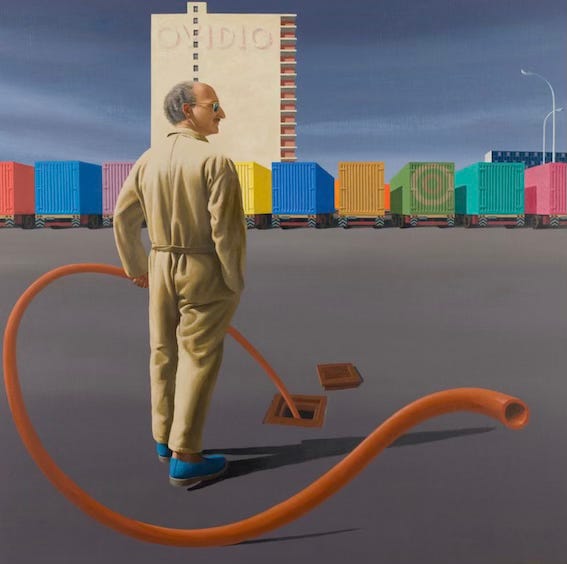
Probably not. But this one does.
Autumn among the miracles:
in a mechanical, rent-extracting civilisation

Claude gave me a trigger warning before editing this piece, so I thought I’d pass it on. If you’re triggered by trigger warnings, please proceed by the nearest wormhole to a universe in which you have not received the trigger warning above. (And no, don’t go back and read what’s above, because then you may get caught up in something altogether more cataclysmic - Peter Thiel is giving lectures on this right now, but I digress).
In any event, I nearly forgot the traditional acknowledgement. These words were written in the traditional orbit of earthlings (never ceded), and I pay my respects to their elders, past, present and those whose existence was blighted by not quite having got things together before the big bang. We reach out to them in brotherly (or sisterly) humourlessness.
Many doctors tell me why I should take these medications. Some have told me that I will die if I do not take them.
They never want to know why I shouldn’t.
I had a heart attack and I now have moderate renal insufficiency. For my heart: statins, beta blockers, anticoagulants, nitrates, enalapril, and prophylactic aspirin. Also duloxetine for my mood, esomeprazole for upper GI bleeding, and sildenafil for erectile dysfunction. For my kidneys: empagliflozin, a selective mineralocorticoid antagonist, and an SGLT-2 inhibitor.
My primary, nephrologist, and cardiologist don’t communicate and soon I have side effects from every drug they have prescribed. Increased cholesterol, joint pain, loss of taste, headaches, too much potassium, irregular heartbeat, type 2 diabetes, and Fournier’s gangrene.
[Each specialist responds with more tests, more medications, and more procedures — dialysis, waitlisting for transplant, mood drugs ordered without a consultation.]...
After being shuffled from doctor to specialist to doctor to specialist, poked, prodded, medicated, analyzed, believed, doubted, examined, and cabbaged over a two year period — while spending a small fortune I could not afford... — I think I could have stayed with the healthy eating routine and daily exercise that used to work well for me.
Meanwhile I realized that the only reason for so many tests, surgeries, and medications was that there is no cure, no remediation, and no reversal of heart and kidney disease. All the medications did was muddy the test results.... Out of money, bedridden, disheartened by lack of progress, and greatly diminished, thoughts of suicide are welcomed.
So, what do I think?
I’m holding out for something better. Why don’t I skip the hundreds of thousands of dollars in medical bills, surgical procedures, tests, years of dashed hopes, over and under medication, group therapy, and just enjoy the time I have left.
If YOU have something better, bring it!
No one is sure what the future holds, and perhaps some medication would be helpful, but the rush to overanalyze and prescribe for the elderly without asking what WE want seems to be the standard.
Everyone alive today will die — what many of us want (but are unable to articulate) is a guide on that journey. And, when our time comes, we want to leave with dignity.
Public goods

Get ready for a bout of talk about public goods. Mariana Mazzucato is on the loose with a new book. Judging from this review, it starts on the right tack, but the most telling sentence in the review was the one claiming that much of the book involves “a restatement of [an] aspiration in more agreeable vocabulary.” So many things these days are restatements of difficult things - things which require thought, or which are just difficult to pull off - organisationally, politically, practically - all wrapped up into pleasing-sounding words.
There’s an obvious in principle validity to many of Mazzucato’s claims about what policy might do. But there are also lots of pleasing-sounding words in there - like public value - covering a multitude of sins. I actually like her advocacy of mission driven innovation because it’s specific and not only will it become public knowledge whether it’s been successful or not, you know pretty much who is responsible for what. Nothing like the prospect of public failure to concentrate the mind of a bureaucrat. Then again, when you think of how corrupted the incentives governments face are, that’s a pretty good argument for care and humility right there.
Mazzucato’s Compass Without a Needle
Mariana Mazzucato’s The Common Good Economy: A New Compass, published by Allen Lane, campaigns against one of the quietest assumptions in economics: that the properties of a good — whether rivalrous, whether excludable — settle the question of who should provide it. … She tells us, persuasively, that the old taxonomy does not determine a good’s publicness. She does not tell us what does. On the one question that matters most — private or public? — her compass does not have a needle, and the recent history of water in England shows what that costs.
The Taxonomy She Is Right to Reject
Standard microeconomics sorts goods by rivalry and excludability, then quietly converts description into instruction: private goods to the market, public goods to the state. … The taxonomy allocates institutional responsibility as though dictated by the physics of the good rather than chosen by anyone.
Mazzucato wants public goods seen “not as corrections of market failures but as common objectives.” … But she has replaced a question that at least had an answer with one that does not. “Is it excludable?” concerns the good. “Does it serve public value?” concerns our values. Neither tells you who should own the reservoir. … It is a restatement of the aspiration in more agreeable vocabulary. …
The Properties of a Good Do Not Decide Its Publicness — Institutions Do
Publicness is not a physical attribute. It is an institutional status, conferred by legal and political arrangements and revisable by those same arrangements. Some goods are collective by nature — a constitution is not a constitution if privately owned. But for a vast range of others — water, rail, electricity, broadband — nothing in the good itself decides. Parliament draws the line; and Parliament, having drawn it, can rub it out.
Mazzucato cites the contention that publicness should be “a question of political interest and capacity to place a specific good in the public … domain” — and walks straight past it. Her book’s compass — purpose, participation, knowledge-sharing, reward-sharing, accountability — describes how to govern a good once we have decided it is collective. It does not tell us how to decide.
Water: The Same Substance, Two Opposite Verdicts
Water in a pipe is about as rivalrous and excludable as a good can be — a textbook private good. And yet across most of the developed world it is priced as a collective one. The physics of H₂O is the same in Glasgow as in London. What differs is the legislation.
The Water Act 1989 privatised England’s ten regional water authorities. Scotland, Wales, and Northern Ireland declined: Scottish Water is a statutory corporation; Dŵr Cymru a company limited by guarantee; Northern Ireland’s water remains government-owned. Four different institutional positions for the same substance, and nothing in its nature accounts for the difference.
The Price of Getting the Assignment Wrong
In 2025, English water companies discharged raw sewage 291,492 times — in the driest spring in over a century, making the dry-day spills the more damning. Thames Water spent the first half of 2026 negotiating insolvency. …
England did not drift into this. It legislated its way in. Water — bound up with public health and shared rivers — was placed in the private domain and managed for dividends; the externalities were dumped, quite literally, into the commons. Mazzucato’s framework can say a great deal about governing a public-spirited water company. It is silent on whether to have one.
What an Institutional Theory Supplies That a Compass Cannot
The cure is to recognise that assigning a good to the private or collective domain is a legislative act: explicit, reasoned, accountable, reversible. That tells us where to look — not at the good, but at the statute; not at the market, but at the legislature. England’s sewage is a failure of assignment, written into the Water Act 1989, and correctable by the same law.
Mazzucato has spent her career insisting that markets are made, not found. It is a pity she did not extend the same insight to goods themselves. A book about the common good that cannot tell us which goods to hold in common has left out the part that does the governing.
Speaking of public goods …
More input from the right
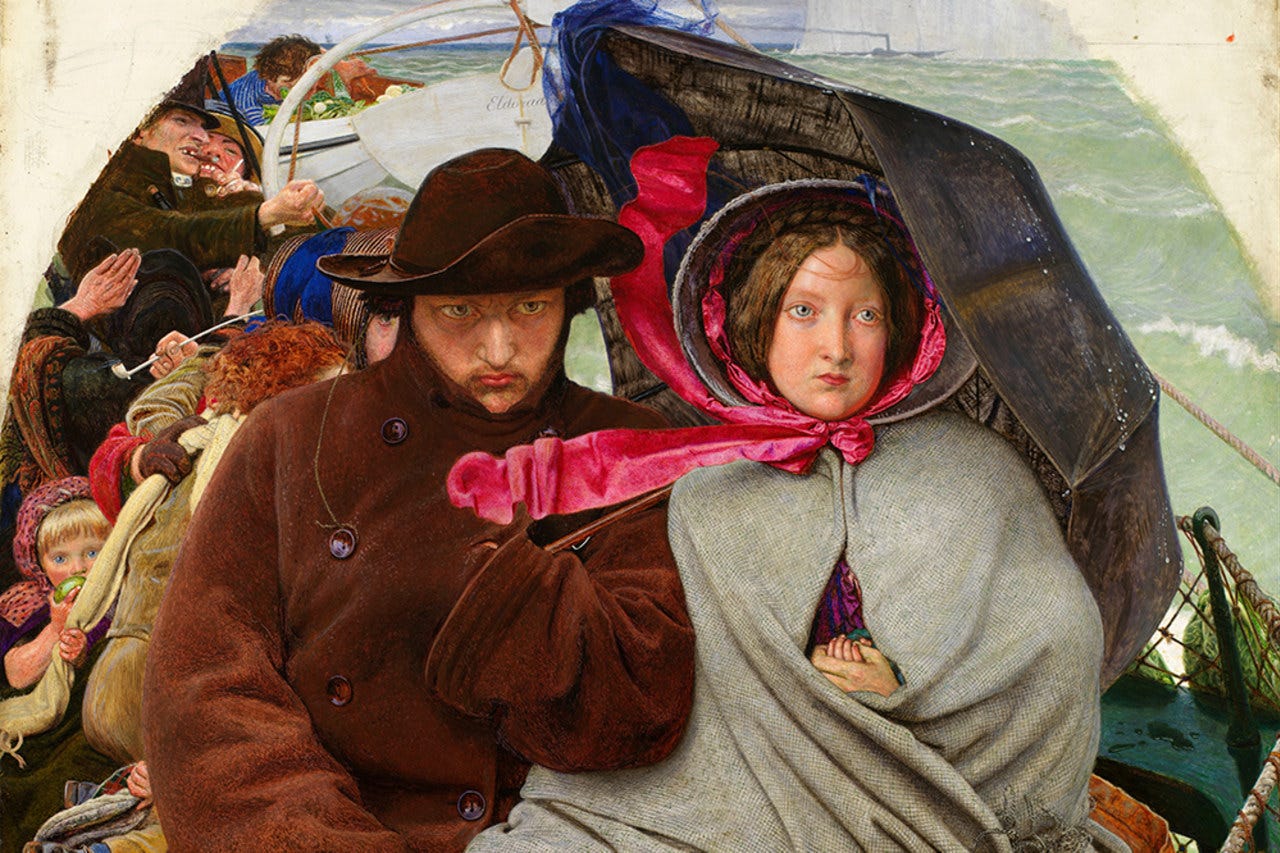
Louise Perry, self-styled ‘reactionary feminist’ is leaving the UK. We all have our ideological biases and sympathies, and perhaps hers are warping her view of reality. But it sure seems worth taking account of to me. And it’s not entirely clear to me why we should privilege one principle (culture blind immigration) to another (ensuring that the overwhelming preponderance of immigrants really believe in women’s equality, that you can’t rape little girls - even if they’re white and asking for it - and that violence has no place in sorting out political differences). Right now, if you’re to the left of the Liberal Party, you can think it. You probably are thinking it. But you can’t say it out loud.
“The Last of England” is an 1855 painting by Ford Madox Brown that depicts a family leaving Britain for Australia... The woman holds the tiny hand of a baby who is tucked beneath her shawl... “The Last of England” expresses a painful relationship with the mother country—a place to run from, and to grieve...
In the months leading up to our departure, a lot of people asked if we were feeling “excited” and the answer I always gave was “no.” As we said goodbye to the country of my birth, I felt bitter and heartbroken. Not because I don’t want to live in Australia... but because I never planned on leaving Britain.
So if we’re not “excited” about our move, then why did we do it?... And while the other standard push-and-pull factors do apply to us, they don’t tell the whole story.
It’s certainly true that healthcare is better in Australia and salaries are higher, since Australia is now a significantly richer country than Britain... Britain used to be the aspirational destination for ambitious young Australians... but that is no longer true, and Australia has been merrily brain-draining Britain...
But there is another reason for leaving, one that is more difficult to say out loud. I’m not only unhappy with how things are right now in Britain, I’m worried that they’re set to get a whole lot worse.
I started thinking seriously about leaving Britain in 2024, spurred by two things: my direct experience of the dire state of NHS maternity services, and my unease about the rise of Muslim sectarianism in politics. This was the year in which the “Gaza Five,” a group of politicians who ran on an Islamopopulist platform, were elected to Parliament...
Meanwhile, the Pakistani Muslim-dominated cities of Birmingham, Oldham and Bradford have seen... arson attacks on politicians’ cars in the lead up to elections... Is it so very surprising that we are now seeing the same disorder in Pakistani-majority areas of Britain?...
I sought out scholarly opinion on the matter, and came across the work of David Betz, a professor of war studies at King’s College London... Since 2019... he has been warning about a threat closer to home: a fracturing within British society that seems to presage violence.
Mr. Betz and I corresponded by email... and at the beginning of 2025 we spoke on my podcast...
He uses established models and ideas... to predict that Britain and France are the Western countries most likely to experience the outbreak of a violent civil conflict that would be fought primarily along ethnic lines. Such conflicts would be the product of economic stress, lost political legitimacy, indigestible levels of immigration from culturally distant places and a sense of “downgrade” among a native population that feels itself to be losing power and status. Britain is, says Mr. Betz, “explosively configured.”
In an article co-written last year with M.L.R. Smith... the two academics underlined the increasingly mainstream status of these predictions:
The strategic logic underpinning the argument is not esoteric. The warning signs—erosion of trust, delegitimised politics, social disintegration, elite denial—have long been legible . . . [T]he steady trickle of retired police chiefs, former civil servants and security officials privately voicing concern indicates that the thesis is apprehended even if never formally endorsed.
It’s possible that these predictions are wrong... But nothing that has happened since 2024 has made me feel more confident about Britain’s trajectory. Since then, we have seen more outbreaks of race rioting and increased political instability... A poorer Britain is hardly likely to be a more peaceful Britain.
I realize that I’m contributing to this potential doom loop by leaving... A message I received from a friend... “every cell of my body wants to emigrate.” If Britons with the means to leave start to do so at scale, then a crisis of mass emigration could be at hand.
Some in Britain will accuse me of cowardice and treachery, not only for leaving, but also for writing about it... But people kept asking, and I grew tired of not telling the whole truth.
My defense is that we wouldn’t have left if it weren’t for our children. That’s why the detail in “The Last of England” that now draws my focus is the one in the center of the painting: the mother holding her baby’s hand.


The intended jewel of Australian universities becomes a pacesetter in soft corruption
And maybe some of the harder stuff

From Nick Feik in Crikey and his Substack. Like the former PM said. Have a go; get a go.
A reckless, corporatised council and a management that cooked its own books to enable the mass sacking of staff ... are just some of the breathtaking revelations in the auditor’s report into the Australian National University’s (ANU) financial management.
The Australian National Audit Office (ANAO) report lays bare the ANU council’s disastrous cost-cutting program known as Renew ANU, and the numerous issues with the council itself, chaired by Chancellor Julie Bishop. The scandal led to Bishop’s recent departure, resignations of several other council members, and of Vice-Chancellor Genevieve Bell, who stepped down in September 2025 – not to mention the hundreds of staff forced out.... The ANAO report provides the clearest picture yet of the governance problems and managerial bastardry that plagued ANU, versions of which also threaten the university sector more generally.
The report found that the ANU Council approved the $250 million Renew ANU program ... “without clear evidence it was needed, achievable, urgently required, or likely to have the intended impact”.... It found that the ANU had possessed strong overall financial health in recent years.... According to the ANAO it did not face any immediate financial crisis.
What Went Wrong at ANU?
The ANAO revealed that in 2023, 2024 and 2025, ANU management diverged from standard auditing practices and altered the university’s underlying operating results and forecasts. The financials presented to the council were much worse than the properly audited figures, and were used to justify a radical cost-cutting program. Instead of consulting with staff and students, ANU employed a private consultancy to design the cure to these self-generated and overstated financial woes. Damningly, “there is no approved documented basis for one-off adjustments to ensure reporting validity or consistency”.
There was no urgent problem. The ANU has an AA+ credit rating and the ANAO reported large average surpluses from 2020–2025.... One alarming fact: the biggest financial hit during Covid was not from reduced student fees (around $32m in 2020) but from the fall in ANU’s investment earnings (around $172m in 2020)....
Yet instead of acknowledging the real source of these unusual weak results... the council embarked on a restructure targeting employment expenses ($100m), with a further $150m to be identified by an Expenditure Taskforce.... The staff union estimated Renew ANU would cost 650 jobs. Bizarrely, ANU’s own analysis suggested $250 million in savings “would not be achievable”, yet “no adjustment to the savings target or timeline was considered or made.”...
The Fallout
Academic staff were confused, furious, and losing their jobs. “The Australian National University keeps making headlines for all the wrong reasons,” Julie Hare wrote in the AFR in March 2025. “Vice chancellor Genevieve Bell faced calls to resign, less than a year into her tenure, for having a second job at Intel;... then it emerged that Bell’s boss, chancellor Julie Bishop, racked up $150,000 on travel and has been hiring her business partner to write speeches for ANU events.”
Amid the Renew ANU cuts, Bell’s School of Cybernetics appeared “immune from the maelstrom”... with “two academic staff members to every student, at a time when tutorials in other parts of the university... are blowing out to 30 or more.” Six of the school’s academic staff had no research outputs. A close acquaintance of Bell’s – a former press photographer with no academic background – was made a tenured professor despite a promotion panel recommending against his promotion....
Renew ANU cost $35.9 million in redundancies and expenses before being retired in October 2025, causing hundreds of job losses and untold psychological harm.... Interim vice-chancellor Professor Rebekah Brown told Senate estimates the reputational damage was in the order of $100 million.
The ANU council accepted the ANAO’s recommendations... but did not accept “the characterisation that the Renew ANU savings target was approved without an understanding of the nature, scale or urgency of the financial challenge”. The ANAO’s pithy reply: the council lacked “evidence of key decisions, supporting analysis and the rationale for choices made”... and materials had never included any “analysis to demonstrate that the $250 million savings target was both necessary, and achievable”. Damning.
Vice-Chancellor Bell walked away with a severance of more than $400,000. Chancellor Bishop tendered her resignation in May.... The ANU faces years of hard work to rebuild its reputation.

Getting an earful from Vincent


Classic: Pauline as monocultural city slicker
Text at footnote.1
... At The Top End Of Town With Their Luxury Beliefs Like No Fault Divorce And Female Participation In Clergy But Really At The End Of The Day Pauline Hanson Is A City Girl Compared To The People In My Electorate And Let Me Just Tell You That We Wouldn't Have Three Proud Generations Of Katters Representing North-West Queensland If We Didn't Have Such A Rich Cultural Tapestry Up Here Because Those People Are Not Only My Family But Also My Voters Who Are All Effectively Descended From The Scoundrel Runts Of Thousands Of Different Litters From Every Corner Of The World And To Think We Should All Belong To The Same Creed Or Be The Same Colour Is What Happens When You Spend Too Long Daydreaming Above A Deep Fryer In Ipswich Which Mind You Isn't Exactly As White As Pauline Hanson Remembers Just Look At The Young Fellas Coming Through The Queensland Origin Squad Now They Certainly Do Not Pass Whatever Criteria One Nation Have For Australian Citizenship I Can Tell You That For Free But Then Again It's Always Been Easier To Wear The Maroon Than The Green And Gold All You Have To Do Is Swear An Undying Allegiance To The State Of Queensland Above All Else Which Most People Are Happy To Do Lets Not Forget That Young Fella Gout Gout I Mean You Either Wanna Break Records And Win Gold At The Brisbane Games Or You Don't That's The Problem With These Flash In The Pan Right-Wingers They Don't Realise That Migrants Tend To Be Very Well Respected In Australia's Hard-Headed Towns Because They Are Willing To Do The Work That Nobody Else Is Willing To Do And Sometimes They Aren't Even Wilfully Doing The Work Just Look At Crisafulli The Only Reason Queensland Has A Premier With That Many Vowels In His Name Is Because Of The Communist Italians That Had To Be Shipped In To North Queensland To Replace The Enslaved Pacific Islanders And Indentured Chinese Who Were Already Being Exploited By Scottish Blackbirders In The Sweltering Cane Fields You Think This Soccer World Cup Is Diverse I Challenge You To Find More Nations Represented In One Place Than North Queensland Which Mind You Is Only A Couple Hundred Clicks South-East Of A Nation Of 300 Million Asian Muslims Yes Indonesia Is Closer To My Electoral Office Than Brisbane Is So Don't You Tell Me How This Country Is Supposed To Look And Sound While Coddled Up On Gina's Private Jet Pinballing Between Canberra And Whatever Other One-Brothel Town That Is Considering Giving The National Party The Arse And Instead Electing A Psychopathic Criminal That Has Not Been Vetted Whatsoever The Thing Is That Everyone Has Their Place The Italians Are Still Doing Cane The Islanders Are On The Railroad And Finally Being Paid An Award Wage Nowadays Just Quietly And Then We've Got The Sikhs In Innisfail With Their Bananas And Of Course The Limping Tobacco Industry In Mareeba Is Still Being Propped Up By The Albanians Who Are... Get This... Also MUSLIMS! White Muslims Yes We've Even Got Them Although They Spell It The Old Fashioned Way Which Is M-O-S-L-E-M And I Actually Don't Have A Burning Desire To Have My Head Punched In So I've Never Bothered Telling A 3rd Generation Tobacco Farmer That They're Spelling Their Own Religion Wrong Because Guess What When You Live In A Multi-Ethnic Tropical Utopia Like North Queensland You End Up Learning Some Bloody Street Smarts Pretty Quickly As It's Always Easier To Show Respect Than Show Regret Which Is What Pauline Hanson Will Be Doing When 10 Million Sheilas, Wogs And Poofters Cast Their Vote In 2028 I Mean I Don't Like To Stereotype But It's A Uniquely Australian Phenomena To Have Elections Decided By Such A Vindictive Cohort Of Minorities I Mean Maybe They Learnt It From The Blackfellas Who Pauline Was Kicking Before She Even Knew The Difference Between Arabs And Indians Which Judging By Her Most Recent Gaffes Is A Distinction That She Might Still Be Struggling With But Do Not Underestimate The Cold-Blooded Revenge That Will Rear Its Head At The Next Election After 30 Years Of Bigotry From That Spiteful Rednut She's Never Really Been Put To The Test At The Ballot And Don't Get Me Started On That Punch Drunk Old Lapsed Catholic Barnaby Joyce And His Ten Dollar Words Because I've Got It On Good Authority That He's Back On The Grog And I Can Tell You This Means One Of Two Things Before The Next Election Either He Ends Up Getting Filmed Lying On His Back In The Streets Of Canberra Or Another Unwitting Staffer Ends Up On Her Back In Some Regional Quest Motel And Finds Herself Carrying Another Love Child Which Probably Won't Help Their Whole Family Values Pitch But Regardless I'll Pay Good Money Betting That This Merry Gang Of Billionaire Puppets Won't Win One State Or Federal Seat In The Deep North Because What We Do Up Here Is Show Respect Even If We Can't Stomach The Sight Of Each Other We Bite Our Tongues And Nod Because We All Would've Killed Each Other Off A Century Ago If We Didn't
From the folks at Psychopathy as a service
As previously featured on this substack.
Quote of the week
They soon found that they were in the position of a factory owner who employs a gang of roughs to break up a strike: he deplores the violence, is sorry for his workpeople who are being beaten up, and intensely dislikes the bad manners of the gangster leader whom he has called in. All the same, he pays the price and discovers, soon enough, that if he does not pay the price (later, even if he does) he will be shot in the back.
A. J. P. Taylor, 1945. The Course of German History.
Holocaust songs from Europe, in Artarmon, NSW
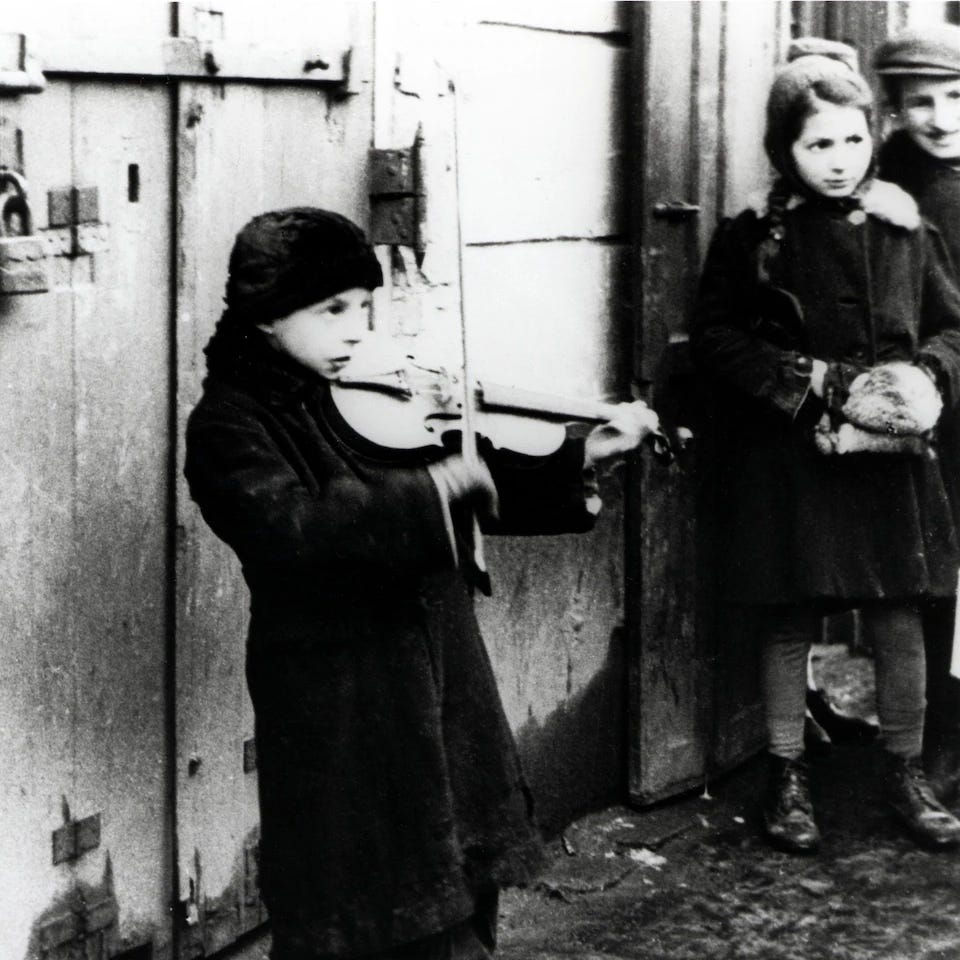
The story speaks for itself.
In 2013, a pamphlet of songs, written in Yiddish, was discovered among the belongings of Sydney-based Polish woman “Olga R”. Her family didn’t understand Yiddish, so they passed it to Joseph Toltz, an Australian ethnomusicologist... originating from the camps and ghettos of Poland between 1939 and 1944... A curator from the Holocaust Memorial Museum ...confirmed the songbook’s provenance: ...it had been part of an original print run of 500, published immediately after the war. Olga R’s copy... is one of the few to have survived...
What was exciting about this one to Toltz ...was the immediacy of the art form. These songs – 20 in total, with several composed by children and teenagers – were written and performed... “Many of the testimonies we have about the Holocaust tended to have been written much later, and often by intellectuals. But most of these songs were either written in the camps... So they felt extremely fresh.”
Toltz and his colleague Anna Boucher... have spent 12 years tracking down the story behind each of these songs... The result is the book Out of the Depths...
Performed ...in the ghettos and sung during slave labour ...in the camps, these songs are full of fury and despair, hope and yearning... “There were those in the Vilna Ghetto who argued that ‘you can’t create a theatre in a cemetery’. But others realised that performance was a way to help people process what was happening...,” says Toltz.
“Many of these songs stem directly from the pre-war golden age of Yiddish culture,” adds Boucher. ...”And where books can be burned... no one can steal a song from you or destroy it.”...
Many of the songs betray unfathomable depths of suffering. The Eternal Song, written by Wolf Sambol, an electrician, is a despairing lament for his home town Rava-Ruska, whose 7,000-strong Jewish population was nearly wiped out in a series of pogroms...
Others boldly deploy gallows humour. “Soup, it has no fault whatever / salt and fat and taste are absent. Worse than any diet / really you should try it,” writes Sholem Goldberg... in Camp March.
All, however, can be seen as acts of resistance. “The camp orchestras tended to be initiated by the Gestapo,” says Boucher. ...seeking to undermine the Gestapo... So one way to undermine the enemy was to simply sing the song in another language.”
The story of the printed pamphlet itself originates in Bucharest, where Polish survivor Yehuda Eismann began collecting survivor testimonies... “May these few modest songs, written with blood and not with lead, in the red nights of gushing Jewish blood and crematoria fire, be a contribution to a memorial stone for Polish Jewry,” Eismann writes in the original introduction... the edition in her possession carries a handwritten dedication from Eismann.
What new insights can this modest little book provide us with on one of the most written-about events in history? “There’s a particularly beautiful song called Shadows, in which the lyricist, whom we know witnessed several massacres, berates those who stood by and watched the horrors and did nothing,” says Toltz. ...
“A general theme that comes out is vigilante violence ...and neighbours taking on the work of the Gestapo,” adds Boucher. “When we interviewed Ayzik Flaysher’s wife, she described seeing her uncle’s head being paraded around the town square... We both had nightmares.”
Most of these songs have now been forgotten... But one or two have become famous. The Partisan Song is still sung at Holocaust Memorial Day services around the world. So is Ponar (meaning “lullaby”), composed in the Vilna Ghetto by the then 11-year-old Tamir Kaczerginski, and the collection’s most musically sophisticated work...
Like so many of the lyricists and composers Toltz and Boucher spoke to, Tamir refused to claim ownership of Ponar... “These songs were written to be performed and transmitted, not to be controlled or to be part of a copyright system,” says Boucher. ...”he laughed and said: ‘Don’t be ridiculous.’”...
“We hope that that song is a gateway to approaching the Holocaust in a different way,” says Toltz. “The Holocaust as an educational subject is under threat... A song like The Eternal Song is written at the height of despair, it indicates a deep loss of faith in humanity, but also in God.”...


Misha Saul v Robert Manne
The Collison billionaire brothers presumably like being billionaires, but they seem to want to be public intellectuals even more. And there’s our own Misha Saul, who I don’t think has made it to billionaire status yet, but plies his trade in Sydney’s financial world, funding some of the more entrepreneurial ventures our market has to offer. But judging from the quality of his Substack posts, he’s conforming with Stefan Zweig’s descriptions of Jews he knew. (From his valedictory memoirs The World of Yesterday).
It is generally assumed that getting rich is a Jew’s true and typical aim in life. Nothing could be further from the truth. Getting rich, to a Jew, is only an interim stage, a means to his real end, by no means his aim in itself. The true desire of a Jew, his inbuilt ideal, is to rise to a higher social plane by becoming an intellectual.
Unconsciously, something in a Jew seeks to escape the morally dubious, mean, petty and pernicious associations of trade clinging to all that is merely business, and rise to the purer sphere of the intellect where money is not a consideration…
Among Jews, then, the urge to make a fortune is nearly always exhausted within two or at most three generations of a family, and even the mightiest dynasts find that their sons are unwilling to take over the family banks and factories…
It is no coincidence that Lord Rothschild became an ornithologist, one of the Warburgs an art historian, one of the Cassirer family was a philosopher, one of the Sassoons a poet…
Anyway, here’s an edited version of Misha’s confutation of Robert Manne’s essay - which I liked and published last week.
In his latest essay, Robert Manne enlists Hannah Arendt to argue that Israel’s creation was a mistake — or at least that it was done the wrong way. Better, he suggests, to have forgone statehood rather than provoke Arab wrath, and to have worked first toward a binational settlement. He would have had Israel accept trusteeship under the US, Britain and the UN, throwing in his lot with Judah Magnes, founder of Ihud, and the cultural Zionists of Brith Shalom whose binationalism Arendt shared. What united them was the conviction that “unless the Jews first made peace with the Arabs, the fulfilment of the Jewish claim to a homeland in historic Palestine…would end in disaster.”
Manne has not read how this story ends. The founders of Brith Shalom and even Magnes himself ended their lives disillusioned following total Arab refusal to contemplate Jewish co-existence. The UN proved impotent. ...
Manne opens with two specific Arendt concerns: first, that the extinguishment of Israel would be the defining catastrophe of Jewish history. This did not happen! ... Second, that it would “destroy one of the great social experiments among the Jewish settlers in Palestine: the non-capitalist, collectivist kibbutz”. ... Well, that did happen — but not by Jewish militarism. By Jewish prosperity. ... Socialism lost.
The idea of exchanging sovereignty for joint UN and US trusteeship is absurd. One can forgive it of Arendt, writing contemporaneously. But for Manne — ludicrous. ... The UN has repeatedly proven inept: U Thant’s craven withdrawal of peacekeepers from Sinai the moment Nasser demanded it in 1967, the “Zionism is racism” resolution of 1975, UNIFIL presiding over Hezbollah’s rearmament in southern Lebanon.
Jewish statehood was not the catalyst for Arab violence against Jews — it long preceded it. The Nebi Musa riots of 1920, the Jaffa riots of 1921, the riots of 1929, the Arab revolt of 1936–1939, the Hadassah medical convoy massacre, the Ben Yehuda Street bombing, the massacre of ~150 Jews in Kfar Etzion. No Jewish state! Just Jews. ...
Manne pines for the cultural Zionists of Brit Shalom, but Arthur Ruppin, a founder, concluded by 1936 that binationalism was “nothing more than a pipe dream”. Brit Shalom dissolved by 1933. ... Magnes himself — the figure Manne most reveres — found “no Arab partners, or even interlocutors, who shared the binational vision”, wrote in 1932 that “Arabs will not sit on any committee with Jews”, and concluded in 1937 that “Islam seemed to be a religion of the sword”. ...
For better or worse, Israel was a Schelling point for global Jewry. Those sceptical of the scrappy Zionists perished in Galician killing fields and gas chambers. Only armchair philosophers can point to the giants who willed that tiny state into existence against all odds and say — actually no, it would have been better to have done it like this or like that.
Manne would rather no state than an imperfect one. An impotent Jewry on its knees than one wielding its own destiny. ...
Curiously, Manne’s reading of Arendt is incomplete. In the same book he quotes, Arendt notes the Arabs refused UN partition in 1947:
The Arabs, however, instead of concluding at least local truce agreements, have decided to evacuate whole cities and towns rather than stay in Jewish-dominated territory. This behavior declares more effectively than all proclamations the Arab refusal of any compromise; it is obvious that they have decided to expend in time and numbers whatever it may take to win a decisive victory.
So even Arendt notes that Manne’s ‘Nakba’ was meaningfully a result of Arab total intransigence.
Arendt was also an Ashkenazi supremacist (no judgement), totally dismissive of Arabs and Arab-esque Jews. ... She is to Manne what a wolf is to a poodle: by the time we get to Manne, we are left with a defanged, fluffy, and incomplete version of her condescension. ... In his world, agency resides entirely with the Jew. The Arabs kill because of the Jews, and the Arabs are killed because of the Jews. Never mind that over ten times the number of Arab Muslims have been killed by Arab Muslims since 1948 than by Jews.
Arendt is one of the magnificent political writers of all time. Her errors have the excuse of contemporaneity. Manne’s do not. ... It is a terrible irony that the last vestiges of his kind in Israel — older Ashkenazi leftist Jews — were at the pointy end of Arab barbarism on October 7, tortured and massacred by the people they put such faith in.
The view from the Titanic: Srsly!


LOLs of our lives


Journalism: truth being the first casualty and all
From the Centre for the Protection of Journalists under the headline “Record number of journalists killed in 2025; Israel responsible for two-thirds of deaths”.
New York, February 25, 2026—A record 129 journalists and media workers were killed worldwide in 2025, more than any other year since the Committee to Protect Journalists (CPJ) began collecting data in 1992, according to a new report released today.
It was the second consecutive annual record for press deaths worldwide, with Israel responsible for two-thirds of the global total. The Israeli military has now committed more targeted killings of the press than any other government’s military on record — the vast majority of those killed were Palestinian journalists and media workers in Gaza.
“Journalists are being killed in record numbers at a time when access to information is more important than ever,” said CPJ CEO Jodie Ginsberg. “Attacks on the media are a leading indicator of attacks on other freedoms, and much more needs to be done to prevent these killings and punish the perpetrators. We are all at risk when journalists are killed for reporting the news.”
Over three-quarters of all press deaths in 2025 were in conflict settings. ...the numbers [in Ukraine and Sudan] were still very low compared to Israel, which remains a significant exception.
One significant finding in this year’s report was an uptick in the use of drones to kill the press, with 39 cases documented, including 28 killings by Israel’s military in Gaza and five by paramilitary Rapid Support Forces in Sudan.... In Ukraine, four journalists were killed by Russian military drones, the highest annual number of journalist deaths in the war since 15 were killed in 2022.
The rising number of journalist deaths globally is fueled by a persistent culture of impunity. Very few transparent investigations have been conducted into the 47 cases of targeted killings documented by CPJ in 2025 — the highest number of journalists deliberately killed for their work in the past decade — and no one has been held accountable in any of the cases.
CPJ argues that the continued failure of government leaders to protect the press or hold their attackers to account lays the groundwork for more killings, including in countries not at war. Journalists were killed in Mexico, India, and the Philippines in 2025, all countries that have persistently failed to secure justice for journalists’ murders. CPJ has called for radical reform in the ways governments investigate journalist killings in order to bring perpetrators to justice, including establishing an international investigative task force and imposing targeted sanctions.
In Mexico, CPJ recorded at least six journalists killed in 2025, ... with at least one journalist killed in [that country] every year for the past 10 years. In the Philippines, three journalists were shot dead in 2025, but only one case has resulted in an arrest.
In Asia and Latin America, journalists reporting on corruption and organized crime were brutally targeted for their work. Authoritarian regimes also continued to punish journalists with death. In Saudi Arabia, prominent columnist Turki al-Jasser was executed following seven years in detention.


Good singing
HT: this tweet.
Magnificent


Heaviosity half hour
Wilfred Trotter
I first came across Wilfred Trotter in Seamus O'Mahony’s The Guru, the Bagman and the Sceptic: A Story of Science, Sex and Psychoanalysis. It’s the story of Sigmund Freud (the guru), Ernest Jones (Freud’s acolyte) and Wilfred Trotter.
Trotter is the magnificent hero of the book. A man of Freud-like ability who was nevertheless almost constitutionally uninterested in acolades. Ernest Jones adored him, learned Freud through him, and wanted something like discipleship or intimacy; Trotter, by O’Mahony’s telling, would not play guru.
Trotter recognised Freud’s importance early, attended the 1908 Salzburg psychoanalytic congress, and Jones later said Trotter was among the first few in England to grasp the significance of Freud’s work. But his admiration remained that. He respected Freud as an original mind while resisting Freudianism as doctrine, cult, or total explanation.
Though Trotter was a physician, he always had a keen interest in and insights into psychology. Indeed, his Instincts of the Herd in Peace and War, first published during the First World War, made him a notable theorist of crowd psychology and social instinct. He understood suggestibility, group feeling, intellectual conformity, and the social hunger to believe—perhaps too well to be converted by the psychoanalytic congregation around Jones.
Rung in the middle of the night as giving the King his best chance to survive his empyema Trotter saved him and then knocked back the knighthood he was offered in return. He spent decades building the teaching hospital at University College London revered throughout the land. But now is barely known, having no doubt gone out of his way to make sure no building was named after him. And he was a great apostle of the need to meld the science of medicine with the ethic of care.
Anyway, here’s a lecture he gave at the Institute of Pathology, St. Mary’s Hospital, 20 June 1939. Reprinted from the Lancet*, 24 June 1939.*
Has the Intellect a Function?
HERE is no aspiration more commonly expressed by conscientious teachers than that they should be able to give their pupils the power to think for themselves. This ambition seems so innocent and laudable that we are apt to let it pass without examining its merits as a practical proposition. If we do look at it closely in that light we cannot fail to notice certain unexpected features about it. One is that those who propose to confer this great gift of free thought often manifest but little of that activity themselves. A second is that when a pupil does by chance show some evidence of individual thinking the teacher himself is apt to seem a little disconcerted; but perhaps the oddest thing that is noticeable in these good intentions is a reticence about how they are to be carried out. Pupils are to be taught to think for themselves but how it is to be done is withheld from us. I have produced this little problem merely as an introductory note. Before passing on, however, we may extract from it a more general reference. We have before us the assumption that the exercise of thinking—and especially of independent thinking—is beyond all question good and desirable. But we also find that this approval is not in practice so wholly unqualified as seems at first to appear. I have called to mind the fact that in the rare case of a pupil developing independence of thought even the teacher is apt to show as a little taken aback. We have the hint, then, that our general applause for thinking is not without an eye on what is thought that when we urge the young to think for themselves we are inclined to be disappointed if they do not think like us. At the climax of Mansfield Park we become aware of some anxiety lest the amiable inertia of Lady Bertram should prevent her reacting to the elopement of her married daughter with the proper indignation. We are reassured, however, by this remark of the author: ‘Lady Bertram did not think deeply but, guided by Sir Thomas, she thought justly on all important points.’ It is to be feared that when we desire our pupils to think for themselves our anxiety is not so much that they should think deeply as that they should think justly on all important points.
The Problem Itself
These trivial preliminary reflections serve to bring us without undue abruptness into the presence of our actual problem, which is the behaviour of the faculty of reason in man. Without pausing here to fidget with definitions it is necessary to say that I use this expression—faculty of reason—which is now so old-fashioned as to be practically out of work, to denote in a broad rough way the capacities in which man differs from the other animals. Now the faculty of reason in one aspect may be said to be the indispensable agent in everything man has accomplished. It enables him to learn, to add knowledge to knowledge and preserve it, to build up arts, sciences, and civilizations without limit. Yet, in another aspect, this same implement can as it were, turn in his hand and become the enemy of all constructive activities. With its Ptolemaic systems, caloric fluids, and phlogiston theories, reason has been deleterious enough even in the quiet fields of science. It taught astronomers that planetary orbits are circular because the circle is the perfect curve; it proved that the number of planets could be no more than seven and enabled Hegel to deride the none the less successful search for an eighth by Adams and Le Verrier; and even to-day it probably exercises over free experiment a quiet censorship far stronger than most of us would like to admit. The history of medicine teaches us that when reason took a hand there it was not only truth that suffered. The rational system of a Stahl, a Brown, a Rush, or a Broussais unfortunately did not exist in a mere metaphysical vacuum but at the bedside—and armed with opium, antimony, alcohol, mercury, the lancet, and the purge. Thus, the consequences of the confident use of reason in medicine have been gloomy enough. When the same implement has been applied to the general affairs of life the results have been even more dreadful. Few proscriptions, persecutions, and massacres but have had their reasoned and logical justification. The various systems of doctrine that have held dominion over man have been demonstrated to be true beyond all question by rationalists of such power—to name only the greatest—as Aquinas and Calvin and Hegel and Marx. Guided by these master hands the intellect has shown itself more deadly than cholera or bubonic plague and far more cruel. It is a strange fact that this pestilential virulence of reason has never fired the ambition of some great sanitarian of the mind. The incompatibility with one another of all the great systems of doctrine might surely have been expected to provoke some curiosity about their nature.
Accepted Solutions
These few random instances should be enough to enforce what is after all a very old discovery. The things that come into the mind have a disarming air of obviousness and certainty. But it must have been known at a very early period that they are not to be taken for what they seem without some corrective test of their validity, and some other authentication than their own charm. In the agelong struggle with this problem no solution has been found that has been able to make human reason a universally applicable and generally trustworthy implement. Nevertheless something has come out of the struggle. This has been the evolution of three methods of setting about the pursuit of knowledge. They are not sharply marked off from one another and tend a good deal to overlap the limits one may be tempted to define for them. They do, however, clearly differ in the aspect of their task on which each lays its chief emphasis. Of these three methods the first is that of the practical art, which is mainly directed to the preservation of knowledge; the second is that of the natural sciences, which is directed to the increase of verifiable knowledge; and the third is that of philosophy, which seeks the unification of knowledge. The objects then of these three attitudes towards experience—the rewards of man’s struggle for intellectual discipline—are respectively to preserve, to verify, and to unite. What their success has been we may now inquire.
The Method of the Practical Art
The method of the practical art is that of the carpenter, the farmer, the builder, the doctor; it has, of course, as such, nothing to do with the plastic arts and the aesthetic, but it may well excite our reverence as perhaps embodying the fundamental intellectual discovery on which all civilizations have been built up. Its primary interests have always been the preservation and transmission of knowledge rather than its discovery. These characters have made it the nurse of civilization at a time when a new discovery could survive only by being fixed in the tradition of an art. A practical art comes then in its very nature to be strongly conservative, reluctant to accept the new, still more reluctant to give up the old; it will teach by precept and example of the master, by apprenticeship; it will embody its lore in traditional dogma and in rule of thumb. Its ideal of success will thus be fulfilled as much by a given course of conduct having been correctly carried out as by its object having been attained. If he knows that he has proceeded secundum artem the practitioner will not be greatly distressed by a mere lack of success; and will readily blame the weather for the failure of his crop, the materials for the collapse of his building, and his patients’ constitutions for their diseases. The extended reasoning process has little function in the practical arts. If allowed to enter them it finds itself in an environment possessing no indigenous methods of controlling it and is apt to develop a harmful exuberance. Nothing could illustrate this principle better than the speculative systems that devastated the medicine of the eighteenth and early nineteenth centuries in the way I have already referred to. To maintain its health a practical art must be sparing of theory and keep closely in contact with facts. It has no method of discovery other than that of almost purely random trial and error; it has no characteristic method of proof and can assimilate truth only when the prestige of its discoverer is great. For example, Steinhaeuser might discover in 1840, and Hughes Bennett proclaim, that cod-liver oil cures rickets, but this enormously important fact remained unproved
and no more than a not very respectable pious opinion for the next eighty years.
The Method of the Natural Sciences
The second of what I have called the three methods of setting about the pursuit of knowledge is that of the natural sciences. We need not attempt a complete definition of natural science, and if we were to try we should find that its margins tend to grow indistinct as we concentrate on them. A perfectly adequate practical definition is the statement that its central function is to acquire verifiable knowledge. A verifiable fact is one that has shown itself to have a relation to certain definable conditions such that wherever and whenever the conditions have been reproduced the fact in question has always accompanied them. Such verification is the characteristic and only sanction of science. Whether we like a given fact or not, and whether it seems true or revolts our reason, are quite irrelevant to its scientific validity. All knowledge comes from noticing resemblances and recurrences in the events that happen around us. Although some of us may be much quicker than others in the power of seeing and comparing, it is obvious that the greatest talent cannot carry us very far as long as observation and experiment are applied only to random experience. It is the discovery of natural science that experience can be simplified so that on the one hand resemblances and recurrences in events can be more easily seen, and on the other that the conditions in which they occur can be completely specified. This, using the term in the broadest sense, is the experimental method. In one aspect it may be regarded as a mere refinement of the rough and ready trial and error of the craftsman and the common man. In another aspect, however, the change is so great as to be virtually a qualitative one and to make the method distinct from all others. It is not necessary to dilate here on the power it has displayed in advancing knowledge or the huge acceleration it has imparted to that process. It is more relevant to note the limits to which its application is subject. The scientific method is unfitted to tackle directly the turbulent stream of everyday experience and common affairs; it must run off minute fractions of it into carefully specified and engineered channels before it can bring its powers to bear. Thus, for example, the work of social government is not as such directly accessible to it on account of the jumbled miscellaneity of the matters involved. In saying this I must guard myself against being thought to pronounce on a wholly different question which might be supposed to be similar. It is, of course, obvious that governments now existing fail to make use of much knowledge already established by science and capable of immediate application. Even, however, if this deplorable lag could be abolished, the direct application of scientific method to government itself as a whole would, with our present powers, be impossible. After what has been to some extent a digression we pick up the line of our argument again when we ask ourselves what part in the scientific method is taken by what I have called the extended reasoning process. The history of science is generally supposed to furnish a wonderful display of the triumphs of human reason. I must confess that the reading of it does not induce in me any such grandiose conception of the mind. The separate steps of progress have rarely been much prepared for by long flights of rational forecast. Great investigators seem mostly to have been led from fact to fact; to have depended on a kind of intuitive flair for the behaviour of their material; and to have used reasoning rather for the planning of their work and the design of experiments than for elaborate structures of argument. Although rational and imaginative speculation is of the greatest general value to science in keeping it from going dry and orthodox, as an actual implement of research it has not very much to its credit. Experience has shown time and again that as soon as science leaves immediate contact with the facts it begins to lose direction and reality, and must constantly return to them for orientation. Great discoveries will therefore continue to be unexpected and the advance of science occur on an irregular front in which the salients mark the places where amongst the facts the going is good. Even research deliberately directed against short-range targets is apt to be held up contrary to all reasonable expectation or to score its successes through unintentional deflections. In the light of these considerations we may contemplate with benefit the bitter war of attrition that has marked the enormous and world-wide attack on cancer; or remember Rayleigh setting out to determine the atomic weight of nitrogen and coming up against argon, or Holst and Frohlich setting out to study beriberi and finding the cause of scurvy. We thus seem to get the plain hint of a rather odd conclusion. It is that natural science—by far the most successful of man’s inventions for setting about the pursuit of knowledge— has not been able to make any extended use of the directive faculty of reason. If we were to allow the sceptical spirit full liberty for a moment, we might find ourselves wondering whether the vast mass of scientific knowledge has not in some queer way invented itself— a suggestion that makes it seemly to change the subject.
The Method of Philosophy
The third method of setting about the pursuit of knowledge is that of philosophy. We may content ourselves here by defining philosophy no more closely than to say it has for its central object the search for unification or less summarily the effort to bring all knowledge whatever into a single consistent scheme. We have perhaps been a little disconcerted at finding ourselves able at least to defend the view that the rational activities of the mind have played no overwhelming part in the practical arts or the natural sciences. We shall not have that fault—if it is a fault—to find with philosophy. As far as history is able to tell us, the deliberate use of rational thought as an implement of research was invented by the Greeks of classical times some 2,500 years or more ago. It is difficult to think of now as a definite discovery and to call it such sounds like calling locomotion or digestion a discovery. Nevertheless it was a true discovery and produced a real deflection in the strange roads of human destiny. We can call a discovery great when it catches man unprepared, and we find in the history of many such the evidence of man’s unpreparedness in the way he has tended to mix the use and misuse of these gifts. Rational thought in the pursuit of knowledge bears these marks of mixed use and misuse as plainly as do printing, gunpowder, and the internal-combustion engine. This new implement was to impel intellectual activity into a course it was to follow for two and a half millennia. We may therefore well ask ourselves what precisely was the device that could exercise so strong an influence. It was abstract thought. At that name of power we find ourselves at last compelled to devise an exact definition. The discovery that was made by the Greek, and that we may fairly say intoxicated him, was that you can consider the qualities of things apart from the things themselves. You survey, let us suppose, a miscellaneous collection of objects, untidy and with no coherent meaning. Suddenly you notice that they possess in common some such quality as hardness or colour or weight, and that you can think of this as existing apart from the disorderly mess you are looking at. A new thing has appeared—an abstraction—having an existence of its own and superior to the accidents of the apparent world. You find that these abstractions are easy to think about. They are clear, shapely, and can be depended on to stay where you put them. You can consider their relations to one another at your ease without being bothered by odd and ‘insignificant’ individualities. No wonder its discoverers were enchanted by this method of introducing order and seemliness into the chaos of experience and that they exploited it to excess. A good deal of mystery has been made of the fact that the Greeks, with all their curiosity and liveliness of mind, turned away so obstinately from the immediate study of nature. Even Aristotle was rather contemptuous of direct observation and experiment, and Plato says somewhere concerning the study of natural phenomena, ‘these things have no absolute first principle and can never be the objects of reason and true science’. The mystery seems to me rather artificial. The Greeks despised the mere pedestrian grubbing among facts because they had discovered something superior to it. In the abstract world they had found a better kind of reality — orderly, clean, unaccidental, and capable of being successfully manipulated without soiling a gentleman’s fingers or compromising his dignity. It must be admitted fully that the abstract method is ineradicably entwined in all our thinking and is indispensable. This is, however, by no means to acquiesce in its universal dominance or to excuse the general failure to examine sceptically its nature and limitations. The charm and the use of the method are that it permits us to take into our minds phenomena in their essence only, to examine them there, and as it were acquire experience of them without being distracted by their mere individual oddities. The abstraction ‘space* thus comes to represent a certain common quality of innumerable experiences in the world of corners, surfaces, heights, depths, and breadths. Vertebrate, amphibian, man are the well-behaved substitutes of countless creatures creeping, jumping, and running about the world in their odd unaccountable way. This process of abstracting what I have rather light-heartedly called the essence of phenomena, will be found to reward a rather closer attention and such attention may well be directed first to the simplest case of the process. Remarkably little attention seems to have been given to the important fact that the only quality we know of which can be completely abstracted is number. Five digits in the mind are, as regards number, as good as five fingers of the hand. Every numerical experience of them and every such manifestation of them that is possible in the outer world can be initiated or repeated in the mind and with equal validity. The science of positive numbers is then the science which is at once perfectly abstract and perfectly experimental. The moment we leave number there begins to appear a decline in the exactitude of the correspondence between the abstraction and the reality. For a long time it seemed that the qualities of space could also be completely abstracted because the conclusions derived from the abstract consideration of space seemed to be confirmed everywhere in the outer world, even on the astronomical scale. Ultimately, however, it dawned on the geometers that there is a discrepancy between the abstraction and the reality. The need of an Einstein to point this out and the uproar that followed are perhaps a little surprising to mere common sense. What seems truly remarkable is not that intuitions derived from the stretch of the arms and the range of the eye should ultimately break down, but that their validity is so wide and their error so small. When we apply the abstract method to events of the living world as we constantly do and must, we find ourselves faced by a great increase in the individuality of phenomena and should be prepared for a sudden drop in the representative value of all abstractions. The abstraction ‘man* must always be a thin, imperfect, and easily misleading summary of the innumerable individual ‘men’. It is in the world of ideas, however, that the abstract makes its highest flights and develops to the full its fascinations and its dangers. Truth, justice, honour, beauty, being, right, wrong; I give a mere random list of abstractions from that world. These are no mere manageable equivalents designed for convenience of thought. They are creations which, made in all innocence, have taken on a life of their own and become the rulers of the mind. Could there be a more plausible and useful-looking conception than that of Truth’—a unitary principle that is to be the ultimate sanction at once of the statesman and the theologian, the man of science and the poet? Yet it is easy to make out that such a supposed unity can never be, and that behind its solemn frontage is a mere jumble of ideas. Nevertheless this bogus unit has notoriously had a strange power over man’s mind and proved itself to be perhaps the most disastrous idol he has ever set up. Abstraction of some degree is universal and inveterate in all kinds of thinking; in philosophic thinking, however, it is in addition characteristic and indispensable. The aim of philosophy is to unify all knowledge; it must therefore seek the generality it supposes to lie behind the multitudinous particulars of experience. In thus separating reality from its accidents it must depend on the abstract method as its instrument and on reason as its sanction. Things will be true when they are pronounced true by the informed and enlightened intellect. The ultimate standard of philosophic truth is therefore an internal one; in the last resort such a truth is one that ‘feels true’ to the philosopher. Philosophy has been cultivated by many, perhaps even most of the ablest minds the human race has produced. It has evolved innumerable systems of doctrine, each rationally proved by its founder to be true, and all inconsistent with one another. No enterprise has ever been longer or better pursued than the effort to find a body of philosophic doctrine which should compel the universal assent of rational minds. An experiment that has gone on failing for two and a half millennia may well make us wonder whether the apparatus is adequate or the method sound.
Science and Philosophy in Contrast
The rough definitions I have tried to make of the scientific and philosophic methods should now permit us to bring the two into useful comparison with one another. Before doing so, however, it is necessary to have clearly in mind that in practice the two procedures are by no means always kept distinct. Many a supposedly scientific opinion gets itself supported on purely rational grounds, and many a philosophic conclusion affects to depend on verification. We are concerned here with the characteristic quality of the two methods, and the fact that in actual use they are often confused only adds to the need for clear definition. Philosophy then desires its conclusions to feel true, science that they should come true; philosophy needs certitude, science needs verification. Science has no certitudes because its conclusions are based not at all on internal conviction but wholly on the regularities of observed experience. It seems at first sight a very hard saying that science has no certitudes. In face of it we may expect to be reminded that the precision and trustworthiness of science are its very essence. These are undoubtedly among its most attractive characters, but they do not depend on the complete inner conviction of truth that alone gives the sense of certitude. Science makes great use of reason in its special way; it often appeals to the rationality of its conclusions in confirmation of them; and most of its conclusions do in fact come ultimately to seem profoundly reasonable. Nevertheless it does not possess, and should not claim to be based on, a fundamental rationality; the conception that the order or rationality of the universe tallies with the order or rationality of the best human minds, while it is for philosophy a vital necessity, is for science no more than a useful working hypothesis and therefore the servant rather than the master of research. Expositors of science, however, have unfortunately sometimes tended to drift into the philosophic mood. On such occasions they are apt to tell us of the august and inflexible uniformities of nature, the iron laws of cause and effect, the inevitable certainties of science and similar rationalistic dreams. If we examine science more realistically we shall find that its two most impressive aspects are first its detailed trustworthiness in practice, and secondly its provisional quality. It is in this second and rather unobtrusive character that the essence of natural science is revealed. The man of science within his own, often narrow, department can cheerfully regard all his knowledge as provisional only, and indefinitely liable to subversion by further inquiry. He gives us our only hope that some day the human spirit may learn to distrust all certitude, and live bravely in its own right and its own strength. While it is to be insisted on that rationality is not the ultimate test of scientific truth, there is no reason to question the value of the rational process as an implement of research. It is, however, an implement of which no finding can be regarded as valid until it has found verification in experience. Whatever flights of reasoning science may take, it must ever be returning to the facts for reassurance. Even in the most extended feats of pioneering in the light of theory—as, for example, we see in some degree in the evolution of the thermionic valve—there must be this repeated verification of actual experiment. The wings given to science by reason must be used like those of the ostrich rather than like those of the eagle, and help it along without raising it from the solid earth. Philosophy, on the other hand, is characteristically free from these scruples about the validity of the most extended processes of reasoning. It insists, of course, that reason must be correctly used, but with this restriction, inflexibly maintains its ultimate validity. I need not repeat the pessimistic conclusion we have been compelled to draw from the failure of philosophy to yield any single dominating system of doctrine. But it is necessary to notice the even more formidable attack on the ultimate validity of reason made by modern psychology. To the rationalist the intellect presents itself as a perfect instrument; if its material is prepared for it by competent logic, precise definition, and a proper awareness of the difficult relations between language and meaning, then its operations must be carried on with frictionless integrity and its conclusions possess irresistible force. I have expressed this view in its extreme and perhaps least credible aspect. Other forms of it, less frank but far more insidious, are so nearly general in us all, that it should be described quite brutally as a complete delusion. To the eye of the psychologist the intellect has shown itself to be after all no more than a human organ, with preferences and caprices like the stomach and the kidney. Every structure of argument it builds, however massive and symmetrical it may look, rests on foundations from which it has no means of excluding disturbance by bias and preconception. Under the attack of this kind of knowledge there can be no doubt that sooner or later the supposed independent validity of reason must go down.
The Intellect in Daily Life
We set out on this inquiry with the innocent and laudable idea that people should be able to think for themselves. It has already led us rather far, so that before allowing ourselves to be still more deeply involved we may well ask what is to be the function of this admittedly desirable independent thinking. It is to enable us to contemplate usefully our current experience, and to develop opinions on social, political, and national situations without being entirely directed by custom and by prejudice. Now it is characteristic of the experience of daily life that it comes before us as a miscellaneous jumble of elements of which the mixture is irreducible. It must therefore be obvious that the scientific method cannot be directly applied to it since that method demands complete specification of its situations so that they may be subject to direct observation or controlled experiment. It is necessary here to guard ourselves from thinking that the practice of the scientific method enlarges the powers of the mind. Nothing is more flatly contradicted by experience than the belief that a man, distinguished in one or even several departments of science, is more likely to think sensibly about ordinary affairs than anyone else. The philosophic method, on the other hand, is no more useful for direct application in daily life than is the scientific. Its rationalism and its confident faith in abstraction would in themselves disqualify it as a guide in the real world. In judging its capacity for this part, however, we are in a stronger position than we are with regard to science. The scientific method has never been tried in public affairs; the philosophic method has been tried with a persistence and self-devotion worthy of the higher insects. Utilitarianism, Hegelianism, dialectical materialism, totalitarianism are all characteristic products of the philosophic method; however rational and self-consistent they may be, they do not seem very helpful in causing people to think for themselves. Our search for a method that shall assist the useful contemplation of daily experience has thus had a totally negative result. The common tendency to regard destructive criticism as always easy and generally reprehensible is one that I do not share; indeed, I doubt if it could be acquiesced in by any sensible person making a frank survey of the intellectual world of to-day. We cannot but be struck by the remarkable prevalence of systems of doctrine, by their loudness, their confusion, and their deleterious effect on conduct. In all these systems the most indulgent examination will find little evidence of really enterprising thought, but it will find a great deal of reconditioned lumber, at its best of a low order of reality and now used to justify the lazier, the uglier, and the baser inclinations of the human spirit. At no time in the history of the intellect has the sanitary work of destructive criticism been more needful.
Correction of Thought
Although one might be reluctant to accept the orthodox view that destruction is justified only as a preliminary to rebuilding, we can all agree that the one is an excellent preparation for the other. If we have learnt to distrust the validity of the operations of the intellect, we at least have gained the advantage of looking at its proceedings with a new objectivity. If we have been expelled from our rationalistic paradise, at least the world is all before us where to choose. To throw the helve after the hatchet is proverbially the temptation to which disappointment exposes us. It is not surprising, therefore, that we are sometimes advised, by what seems to be a growing body of opinion, actually to abandon the use of reason. This advice is, I suspect, more often founded on a dislike for the conclusions of reason than on any radical doubt of their validity. We possess in reason an instrument that is powerful but admittedly very awkward to handle, and apt to pinch our fingers or jump back on our shins. It seems more sensible and less pusillanimous to learn how to use it rather than to throw it away. On attempts to make the intellect a practical and handy implement a truly enormous amount of very difficult work has been done. It is almost impossible to overstate the power and the ingenuity that have been given to the study of logic and to the relations of language and meaning. What little I know of these prodigies I regard with awe, but with an uneasiness that, in spite of the best will in the world, remains incurable. Each seems to promise that with a little more polishing, a screw tightened here and a nut adjusted there, the intellect will at last have been made the perfect instrument. If, however, as I have tried to indicate, the whole instrument is subject to fundamental and incurable deflections, its operations cannot be rectified by the mere detailed adjustment of its inner machinery. Indeed the perfection of its inner mechanism may even exaggerate its total error, for no one is more commonly impenetrable to ideas than the master of dialectic. For a good deal longer than 2,000 years the ablest men of every age have been fidgeting with the mechanism of the intellect in the hope of helping mankind to think and therefore behave reasonably. The state of the world to-day cannot but suggest that if practical thought is to become strong enough to help in saving our social systems from their increasing confusions, some more radical corrective is necessary. The correction of instrumental errors is a familiar idea in practical science. The maker, having turned out as perfect an instrument as he knows how, studies the quality of its performance. Any error now found is to be dealt with not by tinkering with the machine but by having the constancy and amount of it carefully estimated and stated in a form that can be applied to the results. It is this method that forces itself upon us in determining the function of the intellect and rendering it fully available. Psychology has told us a great deal about the working of the mind and in an incidental way about its liabilities to error; but it has not systematically undertaken just this special practical task of, as it were, calibrating the intellect for the contemplation of ordinary experience. Unless such a work can be done it seems probable that the ominous fatuity and confusion that mark our social and political affairs must continue to increase. We have defined our problem and indicated the direction in which its solution seems to lie. The end of so long an argument is no place to examine in detail the ways in which this solution is to be applied. It would, however, be too gross a failure in enterprise if I were not to set out in plain terms a few crude examples of such application which we can all put to use. In the first place we must get rid of the disastrous belief that there is any activity of the mind corresponding with the conception of pure reason. The mind has no such function. All processes of reasoning, however abstract, are participated in and influenced by feeling. We cannot separate off the reasoning process as such and set it to work in an emotional vacuum. What we can do is to suspect the grosser cases of the effect of feeling and to make an appropriate correction. There are many emotional states of which the action may be so deeply masked that it is impossible to detect them at work by direct observation. Such, for example, are the influence of nationalism, religion, personal vanity, and fear—of death, of cruelty, of humiliation. Do not let us nourish the delusion that we can catch these in action and cast them out. We can tame them a little—only perhaps to make them more insidious—but even in the most dispassioned train of reasoning they are apt to exercise a steady treacherous pressure.
There is probably no commoner error than that of supposing it to be possible by a direct effort, and for the purpose of fair discussion, to free the mind from preconception and prejudice about a given question. ‘Mind you I am looking at it without prejudice’; how often have all of us said that in such circumstances. It is always untrue. We should do well on these occasions to inquire closely by what precise mechanism this supernatural purgation has been effected. We are accustomed to regard evidence as a very positive and objective thing, which we blandly pronounce conclusive or inadequate or what not in the appropriate circumstances. More reasonably science allows itself a certain amount of practical compromise and is willing for everyday purposes to accept quite a small amount of evidence for a phenomenon when it is consistent with its context. When, however, the context of a new phenomenon is thought to be incongruous, troubles are apt to arise, and perfectly respectable evidence be rejected. The history of the discovery of argon and of X-rays admirably illustrates this. On both those occasions the insidious category of ‘experimental error’ was able to conceal the truth for long periods—in the case of argon for no less than 100 years. Even science then shows that in practice its famous ‘experimental evidence’ is no infallible safeguard against preconception. In regions where the relatively unemotional air of the laboratory does not prevail, the influence of feeling easily becomes strong enough to deprive even highly respectable bodies of evidence of any serious value. It is, for example, a curious fact that in the very full discussions of spiritualistic phenomena attention has been chiefly concentrated on the dissection of the evidence itself. To the psychologist it is meanwhile obvious that testimony, of however irreproachable an appearance, which has been collected in the atmosphere of a strong desire to believe, must as a whole be subject to such deductions that its evidential value practically vanishes. The last I shall produce of these rather random examples of how we may set about the correction of the rational process concerns the reception of new ideas. We like to suppose ourselves easily receptive of the new, and that we are so by virtue of a natural mechanism. Unfortunately this is the exact opposite of the truth. The mind likes a strange idea as little as the body likes a strange protein, and resists it with a similar energy. It would not perhaps be too fanciful to say that a new idea is the most quickly acting antigen known to science. If we watch ourselves honestly we shall often find that we have begun to argue against a new idea even before it has been completely stated. I have no doubt that that last sentence has already met with repudiation—and shown how quickly the defence mechanism gets to work.


Bob Katter’s spray
... At The Top End Of Town With Their Luxury Beliefs Like No Fault Divorce And Female Participation In Clergy But Really At The End Of The Day Pauline Hanson Is A City Girl Compared To The People In My Electorate And Let Me Just Tell You That We Wouldn’t Have Three Proud Generations Of Katters Representing North-West Queensland If We Didn’t Have Such A Rich Cultural Tapestry Up Here Because Those People Are Not Only My Family But Also My Voters Who Are All Effectively Descended From The Scoundrel Runts Of Thousands Of Different Litters From Every Corner Of The World And To Think We Should All Belong To The Same Creed Or Be The Same Colour Is What Happens When You Spend Too Long Daydreaming Above A Deep Fryer In Ipswich Which Mind You Isn’t Exactly As White As Pauline Hanson Remembers Just Look At The Young Fellas Coming Through The Queensland Origin Squad Now They Certainly Do Not Pass Whatever Criteria One Nation Have For Australian Citizenship I Can Tell You That For Free But Then Again It’s Always Been Easier To Wear The Maroon Than The Green And Gold All You Have To Do Is Swear An Undying Allegiance To The State Of Queensland Above All Else Which Most People Are Happy To Do Lets Not Forget That Young Fella Gout Gout I Mean You Either Wanna Break Records And Win Gold At The Brisbane Games Or You Don’t That’s The Problem With These Flash In The Pan Right-Wingers They Don’t Realise That Migrants Tend To Be Very Well Respected In Australia’s Hard-Headed Towns Because They Are Willing To Do The Work That Nobody Else Is Willing To Do And Sometimes They Aren’t Even Wilfully Doing The Work Just Look At Crisafulli The Only Reason Queensland Has A Premier With That Many Vowels In His Name Is Because Of The Communist Italians That Had To Be Shipped In To North Queensland To Replace The Enslaved Pacific Islanders And Indentured Chinese Who Were Already Being Exploited By Scottish Blackbirders In The Sweltering Cane Fields You Think This Soccer World Cup Is Diverse I Challenge You To Find More Nations Represented In One Place Than North Queensland Which Mind You Is Only A Couple Hundred Clicks South-East Of A Nation Of 300 Million Asian Muslims Yes Indonesia Is Closer To My Electoral Office Than Brisbane Is So Don’t You Tell Me How This Country Is Supposed To Look And Sound While Coddled Up On Gina’s Private Jet Pinballing Between Canberra And Whatever Other One-Brothel Town That Is Considering Giving The National Party The Arse And Instead Electing A Psychopathic Criminal That Has Not Been Vetted Whatsoever The Thing Is That Everyone Has Their Place The Italians Are Still Doing Cane The Islanders Are On The Railroad And Finally Being Paid An Award Wage Nowadays Just Quietly And Then We’ve Got The Sikhs In Innisfail With Their Bananas And Of Course The Limping Tobacco Industry In Mareeba Is Still Being Propped Up By The Albanians Who Are... Get This... Also MUSLIMS! White Muslims Yes We’ve Even Got Them Although They Spell It The Old Fashioned Way Which Is M-O-S-L-E-M And I Actually Don’t Have A Burning Desire To Have My Head Punched In So I’ve Never Bothered Telling A 3rd Generation Tobacco Farmer That They’re Spelling Their Own Religion Wrong Because Guess What When You Live In A Multi-Ethnic Tropical Utopia Like North Queensland You End Up Learning Some Bloody Street Smarts Pretty Quickly As It’s Always Easier To Show Respect Than Show Regret Which Is What Pauline Hanson Will Be Doing When 10 Million Sheilas, Wogs And Poofters Cast Their Vote In 2028 I Mean I Don’t Like To Stereotype But It’s A Uniquely Australian Phenomena To Have Elections Decided By Such A Vindictive Cohort Of Minorities I Mean Maybe They Learnt It From The Blackfellas Who Pauline Was Kicking Before She Even Knew The Difference Between Arabs And Indians Which Judging By Her Most Recent Gaffes Is A Distinction That She Might Still Be Struggling With But Do Not Underestimate The Cold-Blooded Revenge That Will Rear Its Head At The Next Election After 30 Years Of Bigotry From That Spiteful Rednut She’s Never Really Been Put To The Test At The Ballot And Don’t Get Me Started On That Punch Drunk Old Lapsed Catholic Barnaby Joyce And His Ten Dollar Words Because I’ve Got It On Good Authority That He’s Back On The Grog And I Can Tell You This Means One Of Two Things Before The Next Election Either He Ends Up Getting Filmed Lying On His Back In The Streets Of Canberra Or Another Unwitting Staffer Ends Up On Her Back In Some Regional Quest Motel And Finds Herself Carrying Another Love Child Which Probably Won’t Help Their Whole Family Values Pitch But Regardless I’ll Pay Good Money Betting That This Merry Gang Of Billionaire Puppets Won’t Win One State Or Federal Seat In The Deep North Because What We Do Up Here Is Show Respect Even If We Can’t Stomach The Sight Of Each Other We Bite Our Tongues And Nod Because We All Would’ve Killed Each Other Off A Century Ago If We Didn’t