Why birth rates are falling everywhere all at once
Stunning stuff on falling fertility from the very valuable data journalist John Burn-Murdoch. HT: Very highly placed sources in the Australian Bureau of Statistics.
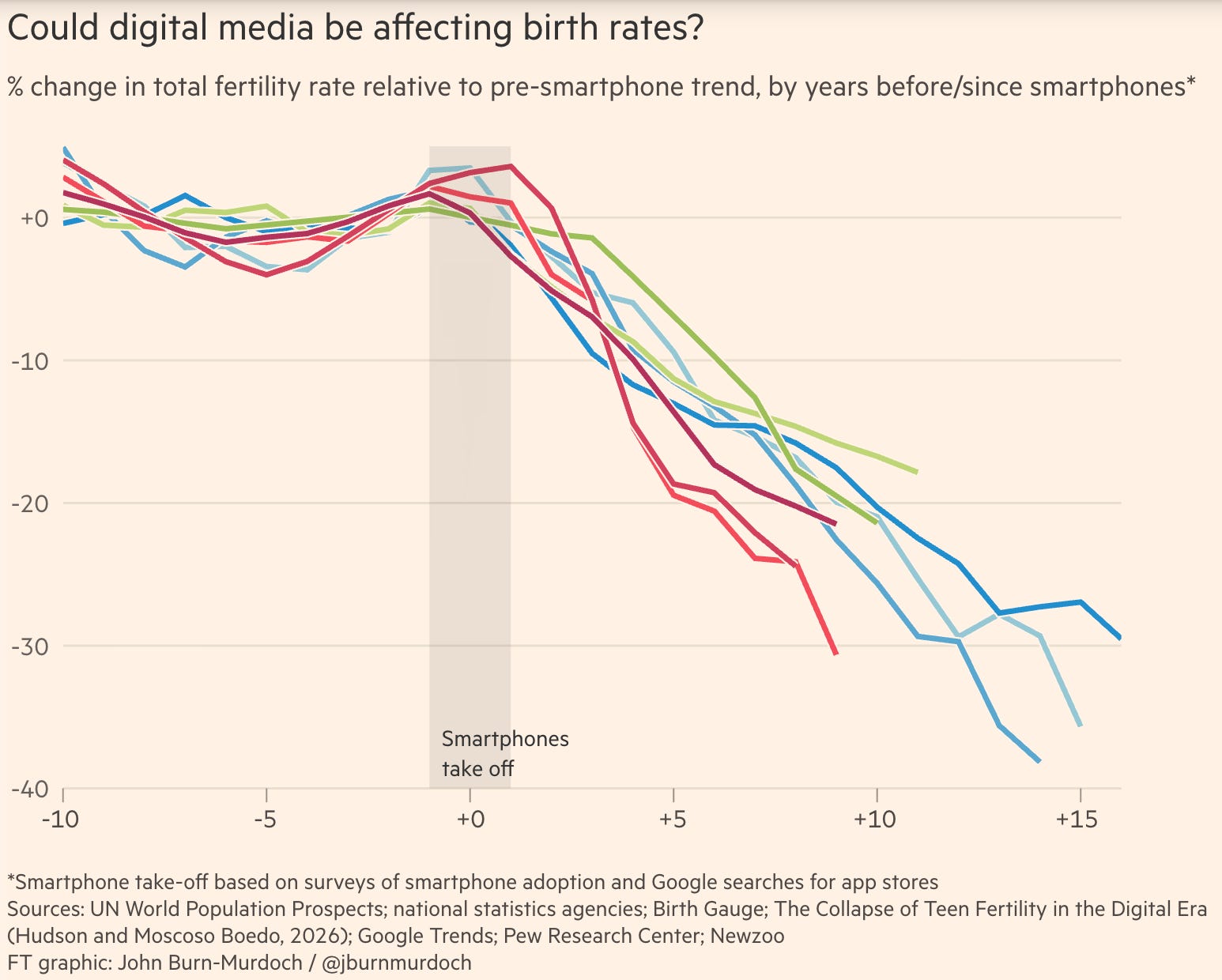
The demographic landslide defining our era is gaining speed — and terrain.
In more than two-thirds of the world’s 195 countries, the average number of children born to each woman has fallen below the “replacement rate” of 2.1. In 66 countries, the average is now closer to one than to two. Just five years ago the UN predicted 350,000 births in South Korea in 2023. That was a 50 per cent overestimate: the real figure was 230,000. ...
In 2023 Mexico’s birth rate fell below that of the US for the first time — as, subsequently, did those of Brazil, Tunisia, Iran and Sri Lanka. Lower- and middle-income countries are now getting old before they get rich.
The defining problem of our time
Population ageing shrinks the workforce — Japan’s stagnation since the 1990s is almost entirely explained by low birth rates. Fiscal pressure from ballooning spending on pensions and care crowds out investment in infrastructure, fuelling anti-system politics. ...
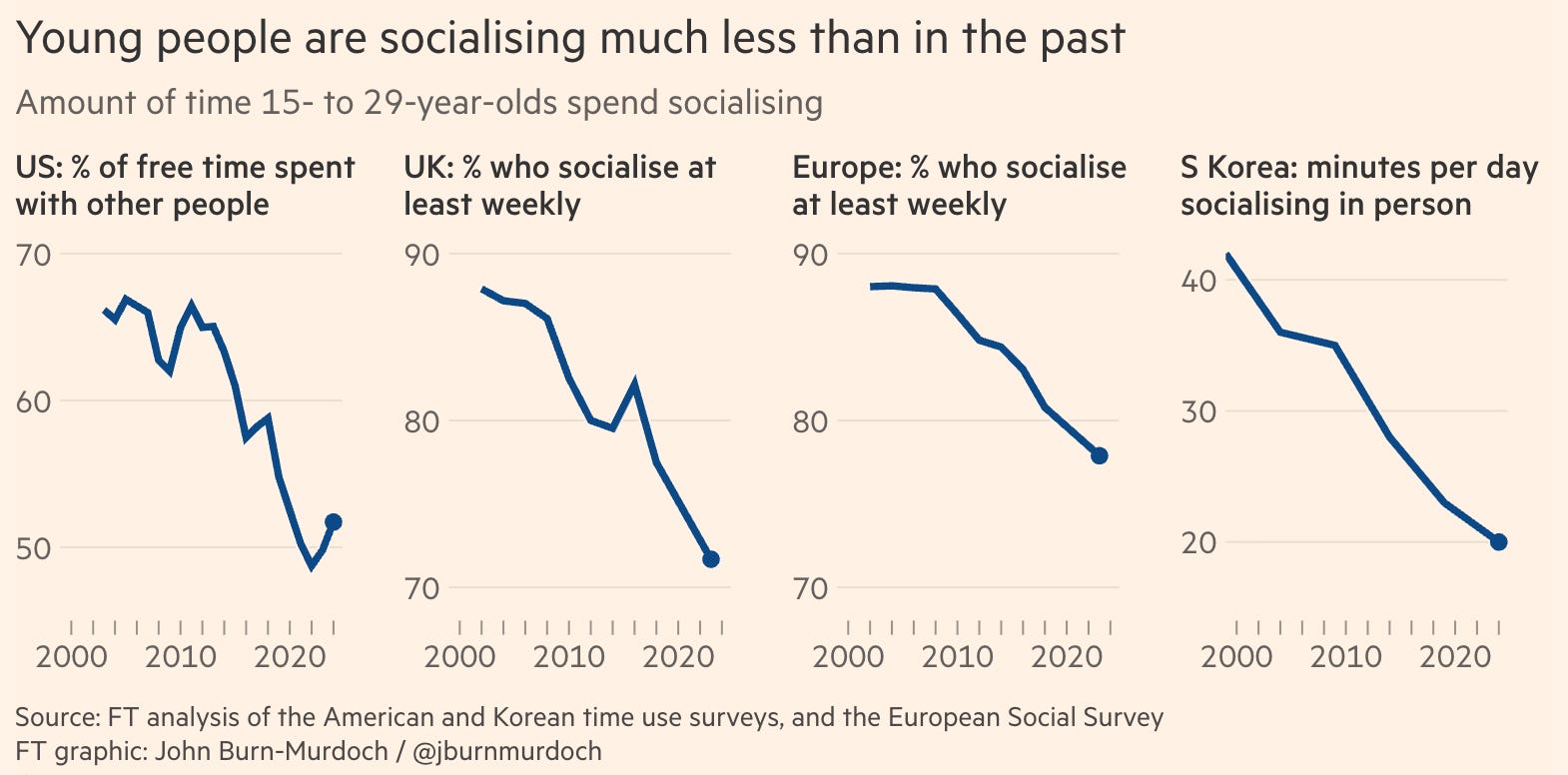
Birth rates are often collapsing despite, not because of, people’s desires. Most young men and women still report wanting around two children — even in South Korea where most women now have zero. There is a “fertility gap” between goals and outcomes, due to frictions that have much to do with modern lifestyles — our homes and, increasingly, our phones.
Singles’ night forever
In previous decades, the world’s fertility rate went down because couples had fewer children. Now the main reason is that there are fewer couples. A pioneering study by demographer Stephen Shaw shows that in the US and most high-income countries, the number of children that mothers give birth to is stable or even rising. But the proportion of women who have any children at all has fallen steeply in the past 15 years — and more steeply among those with the least education and lowest incomes. Family formation has become K-shaped.
Home economics
In several rich countries, as much as half the decline in fertility rates since the 1990s can be explained by falling home ownership. But this cannot account for the most recent steep decline or its global breadth: fertility has fallen in the Nordic region despite economic stability, and across countries regardless of whether they were hard hit by the global financial crisis. Economic explanations — precarious youth earnings, the gender gap in education and income — are gradual shifts that do not fit a sudden global plunge. ...
The population threat in your pocket
Researchers are beginning to point the finger at a new culprit: digital devices. Nathan Hudson and Hernan Moscoso-Boedo of the University of Cincinnati found that births fell first and fastest in areas that received high-speed mobile connectivity earliest. FT research shows the same pattern globally: US, British and Australian birth rates began falling markedly from 2007; France and Poland from 2009; Mexico and Indonesia from 2012; Ghana, Nigeria and Senegal from 2013–15. All of these inflection points coincided with the mass adoption of smartphones. The younger the age group, the more pronounced the downturn.
“To meet a person you are going to marry requires filtering through a lot of people,” says demographer Lyman Stone. “If you socialise much less, it takes you much longer to find a match if you find one at all. If you spend your time on Instagram, your standards are anchored to an artificial sense of what is normal.”
Social media leaves its mark
Stanford’s Alice Evans argues that the more traditional a culture is in its gender roles, the greater the impact of smartphones — and the data bears this out. She describes “cultural leapfrogging”: “Instagram and TikTok enable young women across the world to bypass traditional authorities . . . raising their expectations for a relationship in a way their male counterparts are often not prepared for”. Social media may also amplify economic anxieties and make decades-long trends feel like sudden waves, creating a persistent sense of insecurity that can act as a prophylactic. ...
Time for a solution
Governments have to resist the lure of unrealistic solutions — there is no uninventing the smartphone. As Stone says: “If someone has bad eyes, we don’t fix their genes: we give them glasses.” Providing secure homes to young couples increases their likelihood of starting a family. “Baby bonuses” may help too — but only if sufficiently generous.
Totalitarianism begins in contempt for what you have. The second step is the notion: “Things must change—no matter how, Anything is better than what we have.” Totalitarian rulers organize this kind of mass sentiment, and by organizing it articulate it, and by articulating it make the people somehow love it.
My interest in trying to entrench obstacles to tyranny goes back a long way. In 1981 as a staffer for John Button, Leader of the Opposition in the Senate, I drafted a bill for an act which would have subjected the Australian Parliament’s power to imprison people for contempt of Parliament to due process. In any event, as we watch functioning democracies under siege from authoritarianism and gangsterism it simply amazes me that there isn’t widespread discussion of how to harden our democracies to the predators that we know are among us - and working in concert around the world. Anyway, there you go. We don’t. But as Martin Wolf pointed out in a recent colum, at least one group in the UK are talking about it. I got Claude to summarise the position paper they’ve just put out on what they call “Defensive Constitutional Reform” and what I call ‘hardening democracy’. Anyway, I guess we can all be grateful that none of these kinds of bad things could ever happen in Australia.
Mark E Thomas (lead author), with Professor Andrew Blick, Paul Bradford, Tom Brake, Harley Harrison, and Mark Kieran
The 99% Organisation argues that without urgent action there is roughly a one-in-three chance of a Project 2025-style seizure of power in Britain. Their methodology — borrowed from information security — models the threat as a sequence of exploitable constitutional vulnerabilities rather than a one-off attack.
The core problem is that British constitutional thinking has operated on Lord Hennessy’s “good chaps theory of government,” assuming well-intentioned actors. The warning signs of bad actors are already visible: Cambridge Analytica-style PsyOps in Brexit, Johnson’s systematic weakening of executive oversight, Elon Musk’s reported offer of £78 million to Reform UK (described by a Conservative Co-chair as “basically buying one of the political parties here”), a US-donor-backed think tank preparing Reform for government on the Project 2025 model, and the new US National Security Strategy explicitly committing to supporting European far-right parties.
The report estimates a ~45% chance of a far-right election win and ~35% chance of a UK Project 2025 being implemented if nothing is done.
Immediate Actions — Easy to Implement, Major Impact
Ban UK-based shell companies from donating money originating abroad
Require companies to use only UK-generated funds in political donations
Cap total political donations
Dramatically increase Electoral Commission fines — the current £20,000 maximum is described as part of the “cost of doing business”
Restore the Electoral Commission’s power to bring criminal prosecutions, removed by the Elections Act 2022
Restore the Electoral Commission’s full strategic independence, further undermined by the same Act
Introduce proportional representation following a Royal Commission — under current first-past-the-post, Electoral Calculus projected Reform could win over 300 seats on 30% of the vote
Immediate Groundwork — Difficult to Implement but Major Impact
Establish a Royal Commission on media regulation; extend Ofcom’s powers to enforce a duty not to recklessly publish false information
Address the structural press imbalance (right-leaning titles: 2.1 million combined circulation; left-leaning: 300,000)
Develop a comprehensive public communications strategy on the US experience and the UK’s exposure
Structural Constitutional Protections
Designate a shortlist of legislation as “constitutional” — including limits on prorogation, human rights protections, and Electoral Commission independence — requiring a two-thirds parliamentary supermajority to amend or repeal
Limit Prime Ministerial patronage through an independent appointments commission covering the judiciary, senior civil service, the BBC, academia, and the House of Lords
Establish a House Business Committee giving Parliament rather than the government control over the parliamentary agenda
Provide longer-term funding settlements (rather than annual grants) for regulators and key institutions, insulating them from political pressure
Codify in law the conventions around no-confidence votes
Introduce legally binding ministerial oaths to uphold the constitution and govern in the interests of all citizens
Introduce “constitutional Prometheanism” — legal obligations on key institutions (judiciary, civil service, media, devolved governments) to defend one another against executive overreach
Apply a Three Lines of Constitutional Defence model: operational compliance, parliamentary oversight, and independent Supreme Court assurance with powers to issue Yellow and Red Card judgements against unconstitutional government action
Process Steps
Commission a rapid cross-departmental risk assessment chaired by the National Security Adviser to formally validate the threat and add it to the National Risk Register
Build cross-party political consensus to depoliticise the reforms
Establish a cross-disciplinary inquiry team with expertise in propaganda, PsyOps, politics, and constitutional law.
You’ve probably read about this by now - but anyway … you can enjoy it again.
“The best liberal arts book I’ve read”
Thus, Alan Jacobs characterises this book.
Sean Keilen’s Shakespeare’s Scholars: Three Lessons from the Liberal Arts may be the best book about liberal education that I’ve ever read.
Keilen maintains throughout the book a double focus. Focus one is Shakespeare’s portrayal of scholars in three plays, and the lessons those characters must learn about the relationship between scholarship and life.
The first play considered is Love’s Labor’s Lost, in which we see four young men declare themselves emancipated from non-scholarly concerns... and withdraw into a purely scholarly world... Keilen: “Love’s Labours Lost is a sustained reflection on obscure motives... that lead scholars to believe they are, or must become, different from and better than everybody else – even though... this alienating belief is vain and foolish and exposes them to mockery.”...
The second play features that formidable scholar of the University of Wittenberg, Hamlet, Prince of Denmark. [Keilen argues that when Hamlet, on hearing the ghost’s “Remember me!”, vows to wipe from his memory “all saws of books, all forms, all pressures past”, he refers to his commonplace book.] Hamlet here proves himself to be a poor student... because he has not understood his studies as source of wisdom. By renouncing what he has learned as irrelevant to the challenge he faces, Hamlet leaves himself dependent on his own internal resources — and those prove to be insufficient...
The third scholar... is Prospero in The Tempest... a person of manifest intellectual power who does not know... how to exercise that power wisely... because he doesn’t know himself... And eventually he has to cast aside his powers: they are poor teachers...
Those three plays are one focus of Keilen’s book. But what is Focus Two?
[Keilen asks his fellow professors what these plays teach about the costs of professionalising scholarship.]... There’s no question that through professionalization literary studies gained a certain rigor... But what price did we pay for that rigor?
Keilen believes that Shakespeare is the ideal guide... first because of the abiding and generous humanity that radiates through all his work...
But it also matters that Shakeapeare was a playwright — a writer whose work is intrinsically and necessarily collaborative.
[Keilen’s own conventional career was reoriented by working with a theatrical company in Santa Cruz.] That experience led him to deploy his learning... in service to a communal endeavor pursued by people who... have a great interest in reading, discussing, and staging Shakespeare’s plays....
Keilen testifies that this experience... helped him to realize that what Shakespeare’s scholars needed to learn – the vital necessity of humility, wisdom, and self-knowledge – was not being taught within our profession. And so his book is a kind of plea for members of this... shrinking profession to turn their gaze outward and spend less time seeking the approval of their disciplinary peers, and more time putting their knowledge in the service of the communities in which they live....
The subtitle of Keilen’s book is slyly misleading, because in an “Envoi” at the end he brings in a fourth scholar: Marina, daughter of Pericles and Thaisa, from Pericles, Prince of Tyre. Marina has been forced into prostitution, but... uses her time with clients to teach them virtue... She can’t escape the need to work for a living, but she can, as Keilen puts it, “transform the conditions where she works.”...
But for Keilen the key point is this: “The success of Marina’s pedagogy locates the true home of the humanities in the populous city, not the academic grove. It also underscores why it is essential to define the purpose of literary education as human flourishing and the cultivation of moral and intellectual virtues.”
Keilen implicitly treats Marina’s situation as a kind of allegory of the life that we academics have made for ourselves... We have, in a sense, prostituted ourselves to standards of scholarly productivity and achievement that have nothing to do with “human flourishing and the cultivation of moral and intellectual virtues.” [We must] transform our understanding of our own work, to make it into something that matters to us and to the members of our community who are not scholars. It is because she does this so beautifully that Keilen says Marina is “the humblest and the wisest of all [Shakespeare’s] scholars.”
Gwen John’s Landscape at Tenby With Figures, c1896/7.
Gwen John’s Autoportrait à la Lettre, c 1907-9.
When the keys to productivity are organisation rather than engineering
There’s something I find intensely exciting about organisational transformation (though not the kind which is supposed to begin with a strategic retreat — an activity that I have been known to feign death to avoid). Something which, in explaining how it works, we see a miracle before us. We see people doing things that used to be impossible. And the thing I find exciting about this is that somehow, through insight and iteration, some new collective capability is forged. These are not just practical achievements, being achievements in human cooperation; they are ethical achievements, and perhaps because of that, our most important achievements.
As people from Aristotle to William James have said, an individual’s ethical progress is a matter of habit. And new, more productive organisational forms are also generally higher forms. And they build the sinews of material and ethical improvement.
As I wrote in this essay, I’ve always been outraged that economics didn’t take more notice of some of the extraordinary organisational and ethical advances we have witnessed from the Toyota production system to peer production and microcredit. In any event, we are witnessing something similar in Ukraine’s drone industry as outlined in the following extract.
Along Ukraine’s eastern front, a drone stutters mid-flight. On the operator’s screen a few kilometers away, the grainy view of splintered treelines and trenches fades into static. The control link drops. He removes his headset. Russia has jammed the frequency. Again.
It’s 2024, near Bakmut. Mykola Volokhov, commander of the Terra drone unit of the 3rd Separate Assault Brigade, has watched the slow degradation of his command links: a system that had worked at eight kilometers out starting to fail at four, then at two. ... Later, speaking on camera, Mykola described the reversal with a soldier’s understatement. “But this problem was overcome… and now it is not with us. No problems!”
The repair did not come through a ministry, a tender or a requisition form. It came through a phone call. In the words of Dimko Zhluktenko, a soldier in Ukraine’s Unmanned Systems Forces:
We called the manufacturer and said, ‘Guys, we had this kind of issue...’ It is very direct, and they are very open to help us. They don’t need a shitload of documents or anything.
This is the operating model. A device is designed, fielded, disabled by the enemy, diagnosed through a conversation between operator and engineer, then redesigned and redeployed in roughly seven days.
In the US and Europe, weapons systems move from concept to deployment over five, ten, sometimes fifteen years. A major capability iteration of the F-35 can take close to a decade. That gap — one week versus seven years — is not just down to exceptional engineering talent. It is the product of how work is organized, how quickly information reaches the people who can act on it, and how much authority those people hold. ...
The formula
In early 2024, Oleksii Kamyshin, Ukraine’s Minister of Strategic Industries, formalized a metric: “cost per kill.” ... “You can’t improve what you don’t measure.”
Weapons are not evaluated on whether they meet a pre-war specification. The evaluation is: in the field, did they work at a price the system can afford? Runts are discarded. High performers are scaled. The cost per kill today is $1,000, down from around $60,000 in 2022.
Compare the Western model: someone decides the drone should cost $800 and hit the target 70% of the time. Three years later, the specification is an artefact of a long-forgotten planning meeting. The $1,000 cost-per-kill came from a feedback loop: engineers talking directly to operators, designs changing every week, five hundred manufacturers running parallel experiments treated as data. Performance is what the system arrives at, not what it’s told to produce.
The cycle
Early drones relied on standard radio control — until Russian units learned to jam or spoof their signals. The Ukrainians initiated dozens of competing experiments across hundreds of small manufacturers. Some switched to fibre-optic guidance, unjammable but easily cut in flight. Others tried encrypted multiband radio. What stuck was a hybrid — fibre with a live radio fallback for the moment the cable breaks. Rapid iteration increased target accuracy from around 10% to 80% within a single upgrade cycle.
The network
When Putin launched his invasion in 2022, there were perhaps seven domestic drone manufacturers in Ukraine. Today there are about five hundred, producing 4 million units last year — 140 times US annual output.
There is no single dominant contractor, no centralized R&D pipeline. Hundreds of firms operate in parallel. When conditions change — and on the battlefield there is more change than constancy — the network responds. Firms can fail, factories can be bombed. The network persists.
The line
The one-week cycle is not a product of exceptional engineering talent. It is a product of feedback loop architecture: how quickly failure data reaches the people who can act on it, and how many parallel experiments are running simultaneously. Any organization that treats hardware R&D as a capability problem rather than a structural problem will misdiagnose it — importing the metric without the structure produces neither the speed nor the cost.
Ukraine has industrialized its drone capability. Monthly FPV output grew from roughly 20,000 units in early 2024 to 200,000 by year’s end — a tenfold increase in twelve months, even as designs changed week by week. The core mechanism is modularity: standardized components, common software frameworks, interchangeable subsystems. A new guidance update requires swapping a module, not retooling a line. ...
I support Bernie Sanders in the Democratic primary. I don’t support Sanders because I think he is brilliant in some academic way. I don’t support Sanders because I am particularly impressed with the details of his policy proposals, although they are not nearly as hopeless as some self-proclaimed technocrats make them out to be. A democracy is not a graduate seminar.
It is not that I am for Bernie Sanders, but that Bernie Sanders is for me. Bernie Sanders, more than any politician who has ever had a serious shot at the office of United States President, represents my interests and values. By that I don’t mean my interests in a narrow, self-interested sense, but in his vision for what kind of country my country can and should be.
A democratic polity does not elect a technocrat-in-chief, but politicians whose role is to define priorities that must later be translated into well-crafted policy details. Paul Ryan’s various budgets haven’t been wrong because they require giant magic asterices to make the numbers add up. They have been wrong because the interests and values Paul Ryan represents are wrong. The magic asterices don’t reflect dumb mistakes, but smart politics. The problems of our polity do not arise because one faction or another is too stupid to do high quality science. If your interests are the interests of the fossil fuel industry, and you are unwilling or unable to transcend the narrowness of those interests, then confusing the public about the science of climate change is a mark of intelligence, not stupidity. Being smart is great. You may be proud of your GRE scores, your PhD, your Nobel Prize even. And deservedly! But raw intellect is not scarce, and no faction holds anywhere near a monopoly.
In a democratic polity, wonks are the help. The role of the democratic process is to adjudicate interests and values. Wonks get a vote just like everyone else, but expertise on technocratic matters ought not translate to any deference on interests and values. If your theory of democracy is that informed citizens ought to cast votes based on the best social science, you have no theory of democracy at all. If you are honest, you will follow your own theory where it leads, as Bryan Caplan has, and work to limit democracy. But Caplan, whom I love, is mistaken, because he begins with a mistaken theory of politics. If you want to see how that theory of politics works in the real world, look no farther than the European Union, which is a real-time experiment in demoting democratic adjudication of values in favor of technocratic adjudication of facts. I know, you don’t agree with their science. Their economists haven’t died quickly enough to realize that a decades-old consensus has been discredited. Technocracy, like communism, like capitalism, has never been tried. Elevating technocracy above democracy is similar to, and as insidious as, letting military power escape civilian control. The problem with life under military rule is not that the army lacks patriotism, or that it doesn’t mean well. But the interests of the military are not the interests of the polity, and we invented democracy because human beings have a tendency to confuse their own interests with the public’s. The interests of the class of humans who might reasonably qualify as technocrats are also not the interests of the polity.
So, I am for Bernie. I am not against Hillary. But just as it’s foolish to say that Democrats and Republicans are “all the same” because they are both corporatist parties, it is foolish to claim that Bernie and Hillary do not represent meaningfully different interests and values. I’ll enthusiastically support either Bernie or Hillary over a Jeb Bush, Marco Rubio, Ted Cruz, or Donald Trump. But it is Bernie Sanders who is for me, and I’m supporting him without apology. If your interests and values are my interests and values, I hope that you do too.
The article speaks for itself, but I will introduce it with a few of my own musings. We’re tempted to attribute America’s success at growing its economy to its greater market orientation, its relative hesitancy to regulate. I don’t want to gainsay that. But there are other things going on. I can think of two things that turned into monster advantages for the US. The first is by far the biggest developed single-language market. That makes it the obvious place where the biggest new things in the IT revolution would happen.
And following on and building upon that, the vast wealth generated by the early movers in the IT revolution attracted vast wealth and talent into Silicon Valley venture capital. The venture capitalists back east in the United States weren’t anything too special. Those out west really started to do things differently and the snowball simply got bigger and bigger. And given its size, it then hoovered up the budding unicorns and potential unicorns of Europe. Skype, WhatsApp, Spotify, Deep Mind.
Paul Krugman wrote twoposts this week arguing that Europe is broadly not falling behind the United States — that the divergence measured by the Draghi report is mostly due to tech-sector growth that has distorted GDP without raising living standards. We should believe our eyes when we walk around France and walk around Mississippi.
Unfortunately, Krugman is wrong. The opponents of change in Europe argue it is either at the frontier, or that Americans are wealthier only because of worse public services or greater inequality. This is not true.
1. What’s going on with the growth numbers?
Krugman compares the US, France, and Germany at purchasing power parity in current prices, finding their position relative to America roughly constant since 2000. But current price comparisons miss productivity gains in sectors where prices fall. Imagine America produces twice as much software while the price of each unit halves: software output looks unchanged at current prices even though its volume has doubled....
For growth comparisons over time, economists fix the base-year PPP price level and apply each country’s real output growth on top. In volume terms, America has pulled away from Europe.
2. Is it all the tech industry?
Krugman argues that the constant-price divergence is not welfare-relevant: Europeans buy the same iPhones at the same world prices, so the gap is an accounting artefact.
But much of what households buy is non-tradable: housing, healthcare, childcare, restaurants, education. Once a good is non-tradable, wages are set locally. American tech companies bid workers away from haircutting and waiting tables to write code. Since Americans cannot import haircuts, hairdressers’ wages rise — without affecting hairdressers’ wages in Germany. American software wages rise and so do American non-software wages.
Another problem: software is not priced at marginal cost. Apple’s margins are around 40 percent; Anthropic’s inference margins are at 70 percent. A large share of the gains stays as profit, held mostly by American equity-owners. The median Meta employee earned $388,000 in 2025....
Nor is this advantage going away. Krugman’s own 1991 Nobel-cited paper showed that comparative advantage in modern industries is produced by increasing returns to scale and agglomeration — once an industry concentrates somewhere, it is self-reinforcing. Europe is being pushed away from the next round of technology industries.
3. What about inequality?
Despite high pre-tax income inequality, the US achieves higher median incomes — in part because it actually redistributes more than many European countries. On median equivalised disposable household income (after taxes and transfers), the median American earns 30 percent more than the median Dutchman, 31 percent more than the median German, and 52 percent more than the median Frenchman [OECD, 2021]....
4. What about hours worked?
For a growing hours gap to explain divergence since 2000, Americans must be working more relative to Europeans now than then. The opposite has happened. A 2026 NBER paper shows about half the American-European hours gap from the 1990s has reversed: Americans now work fewer hours per person than in 2000, while most Europeans work more....
5. Is America not a bad place to live?
Krugman’s “walking around test” — walk around Alabama and France — is misleading. American cities often have poorer centres and richer suburbs; European cities preserve richer historic cores. The places Americans show visitors are not where American private consumption is concentrated.
Do a driving around test instead. Go to the periphery of any modern American city and see a level of new-built material wealth extremely uncommon in Europe — thousands of enormous four- or five-bedroom homes, hundreds of luxury apartment buildings springing up in Nashville and Austin. This construction boom is replicated virtually nowhere in Europe today....
The other question is generational. Housing often costs more in Europe than in the United States, despite Americans generally having better-quality stock. The starting pay for a London police officer is $57,000; in Washington, DC, it is $75,000. The entry-level Deloitte job in Madrid pays ~$33,000; in Charlotte, North Carolina, $63,000. Europe looks great to Americans because it is great for people with American incomes. But the nicest it has to offer is not available to young people in Europe today.
We are neither compulsive Americanophiles nor rabid Europhobes. There are many things to dislike about life in America. But it is a central truth about the world that, relative to 25 years ago, the gap in material wealth has shifted dramatically in America’s favour. Something that America is doing is working.
The point Mike Brock makes in this piece seems right to me. And like the guy says, railways and the dot.com bubble were about real and transformative technologies. But they were still bubbles. However transformative a technology is, however general are the purposes to which it is ultimately put, that’s a quite different thing to the question of whether those who build the infrastructure will earn a decent return on their investment. The article is inordinately long, repetitive and performative. It announces the insight I’ve just outlined with indecent self-pleasure, and many times. So I edited out most of the hijinks. At least he explains how he thinks the big investors in infrastructure will be undercut. By local compute. That sounds right too, but what would I know?
I am going to say two things that sound contradictory and are not.
The first is that AI is the future. Large language models are the most significant advance in the history of software. The second is that the current AI buildout is a bubble — not because the technology is overhyped, but because the capital being deployed is massively misaligned with where the technology is actually going. That simultaneity is what neither Wall Street nor the hyperscaler executives are prepared to face, because the implication is that the entire cloud-software business model of the last fifteen years is about to be dismantled by the technology the same industry is pouring trillions into building.
What LLMs actually do to software.
Large language models, properly deployed, collapse the cost of producing custom software by an order of magnitude. Tasks that used to require a six-month engagement can now be done by one engineer in a week. Sometimes in a day. ...
LLMs are translation engines. They translate business requirements into code, specifications into implementations. That translation function collapses the economics of custom software — all of the tasks that made enterprise software expensive to build, the reason companies paid Salesforce forty thousand dollars a seat per year instead of building their own CRM.
SaaS exists because the cost of building bespoke software was historically higher than renting generic software from a vendor. That equation is in the process of inverting.
A mid-sized consultancy can now build a company a custom CRM — not a generic CRM configured to approximate their workflow — for less than three years of Salesforce licensing fees. The economics are not close. They are not going to be close.
Enterprise SaaS is going to experience what the record industry experienced when MP3s got compressed enough to download. The dependence is deeper and the lock-in stronger — which means the reckoning will take longer to arrive and will be more violent when it does.
Where inference is going.
The second piece of the mispricing: the assumption that large-scale inference will continue to run in hyperscaler data centers. This is not going to hold.
Apple Silicon’s Neural Engine — engineered specifically to run transformer models on-device — has been accumulating capability for years. Combined with algorithmic improvements — quantization, distillation, sparse attention — it is making local inference viable for models that two years ago required a cluster of H100s. Within the next several hardware iterations, Apple will run a local model on your phone as capable as ChatGPT or Claude is today. For free. Without sending your queries to a server. Without surveillance.
Once the local version is good enough — and “good enough” is a rapidly moving target — the economics of cloud inference collapse for consumer use cases. The hyperscalers are building data centers to serve a market that will migrate to a substrate they cannot charge for.
Why this is a bubble without being a fraud.
A bubble does not require the underlying technology to be fake. It requires capital to be misallocated relative to where the value will actually land. The dot-com and railroad bubbles were real despite the technologies behind them being real. The question is never whether the technology is real — it is whether the capital deployed will earn a commensurate return.
The technology is going to do in-situ business model destruction to the companies building it. Microsoft is pouring capital into OpenAI while presiding over an enterprise software portfolio that AI will cannibalize. Every individual actor is responding rationally to their local incentives. The aggregate outcome is irrational. ...
The gap between the two claims — the technology is revolutionary and the capital deployed will not earn its return — is the gap where most of the money is going to be lost.
What to watch.
Watch three things. First, consultancy revenue: if companies start canceling SaaS subscriptions and moving to in-house systems built by smaller teams, that is the leading indicator. Second, Apple’s on-device AI: the moment local inference matches cloud chatbots for the average consumer, the cloud consumer revenue thesis dies. Third, what the hyperscalers do with data centers when training demand plateaus — the buildout assumes continuous exponential growth, and when the curve bends, other uses pay far less.
The reckoning will not arrive dramatically. It will arrive quarterly — in earnings reports that slightly underperform, in write-downs framed as strategic realignments. ...
AI is the future. The current AI buildout is a bubble. Both are true. The technology is real and the capital is misaligned. The revolution is coming and will destroy the business models of companies currently valued on the assumption that they will capture it.
I found these essays following up some footnotes in a biography of Walter Lippmann. I am particularly interested in the way in which, in modern times, the idea of merit has collapsed into winning various competitions - for money, power or a KPI (like IQ).
Anyway, I found these essays fascinating, which, given that they’re by John Dewey, is no surprise!
Individualism is about the most ambiguous word in the entire list of labels in ordinary use. It means anything from egoistically centred conduct to distinction and uniqueness. It is possible to say that excessive individualism is an outstanding curse of American civilization, and that absence of individualism is our marked deficiency. When the former remark is made, economic and legal conditions are in mind; when the latter, intellectual life is in question. Individuality is a surer word; it carries with it a connotation of uniqueness of quality, or at least of distinctiveness. It suggests a freedom which is not legal, comparative and external but which is intrinsic and constructive. Our forebears who permitted the growth of legal and economic arrangements at least supposed, however mistakenly, that the institutions they favored would develop personal and moral individuality. It was reserved for our own day to combine under the name of individualism, laudation of selfish energy in industrial accomplishment with insistence upon uniformity and conformity in mind.
Now that we have reached the point of reverence for mediocrity, for submergence of individuality in mass ideals and creeds, it is perhaps not surprising that after boasting for a long time that we had no classes we now boast that we have discovered a scientific way of dividing our population into definite classes. Just as Aristotle rationalized slavery by showing how natural it was for those superior by nature to constitute the ends for others who were only tools; so we, while marvelling perhaps at the callousness of the Greek philosopher, rationalize the inequities of our social order by appealing to innate and unalterable psychological strata in the population. Thus Mr. George B. Cutten in his inaugural address as president of Colgate University recently informed us that it is now “discovered” that “only 15% of the people have sufficient intelligence to get through college” From this “discovery” he draws the conclusion that as we have never had a real democracy, so “the low level of the intelligence of the people will not permit of our having one.” He not only makes the undeniable statement that we are ruled by an aristocracy in industry, commerce, professions and government, but he terms this aristocracy an intellectual aristocracy! The adjective seems incredible. But President Cutten thinks there is the same scientific warrant for assuming that conspicuous success under present conditions is a sign of innate intellectual superiority as for saying that twenty-five percent of the population are mentally subnormal and that only fifteen percent are capable of higher education.
Mr. Cutten begins his presidential career with a startling view of the social stratification which is to be the ultimate outcome of an educational classification based on intellectual classifications by means of mental testing. We are to arrive at a caste system like that of India, “but on a just and rational basis.” For “when the tests for vocational guidance are completed and developed, each boy and girl in school will be assigned to the vocation for which he is fitted.” There will be no difficulty about filling the ranks of unskilled labor and mechanical operators, for Mr. Cutten implicitly believes the yarn that the army tests have shown that the “average mentality” of the population is slightly over thirteen years. Considering only the energy and unspoiled curiosity of the average thirteen-year-old in comparison with the dulled observation and blunted vigor of the average adult one might hope that this statement were true. It would be most encouraging. But it is more to the point to remark that, as Mr. Lippmann has so clearly shown in these pages, the statement interpreted as Mr. Cutten means it is like saying that perhaps sixty-five percent of the population rank below the lowest fifty percent; it takes absolutely what is only a comparative statement, thereby rendering it literally senseless. What makes this performance more than a mere individual mistake is that it affords striking evidence of the habit of ignoring specific individualities, of thinking in terms of fixed classes, intellectual and social.
There is no need to re-traverse the ground so admirably covered by Mr. Lippmann. But why has it been so generally assumed among our cultivated leaders that a purely classificatory formula gives information about individual intelligence in its individuality? To say that Johnnie Jones who was born in 1913 has in 1922 a mental age of eight or of ten years only means that he belongs, on the basis of his performance of certain exercises, to a class of persons at least over a million in number, who were born in 1912 or 1914 respectively. Why then is it so frequently supposed that the individual mentality of John Jones has been definitely determined? To say that one belongs in a class which is a million or so large, with respect to which one is accelerated or retarded by a year in comparison with another class of a million, does not, after all, throw much light on the intrinsic capacities of a given individual.
The assumption seems to indicate one thing. We are irretrievably accustomed to thinking in standardized averages. Our economic and political environment leads us to think in terms of classes, aggregates and submerged membership in them. In spite of all our talk about individuality and individualism we have no habit of thinking in terms of distinctive, much less uniquely individualized, qualities. The inference to be drawn from the popular reception of mental testings concerns the acquired habits of intellectual spokesmen, rather than the inherent intellectuality of the populace. This fact is indeed significant for the prospects of democracy. But the reason it is ominous for democracy is radically different from that often assigned. For it reflects not upon the innate mentality of the mass but upon the acquired intelligence of men in high positions. It shows how their education, that given by their surroundings as well as by their schools, has fixed in them the disposition to judge by classification instead of by discrimination, and by classifications which represent the average of massed numbers, mediocrities instead of individualities.
We may be thought to ignore the interest which many testers have shown in pupils of superior abilities. For some of the testers tell us that one of the chief beneficial consequences of testing is that it enables us to pick out the superior tenth, to rescue the saving remnant from the ruck in which they are now submerged. But the seeming exception proves the rule. The idea of classification still fatally pursues and dominates. “Superior” is still a classificatory word. The size of the class is reduced, say from a million to a hundred thousand. But what kind of superiority marks a particular individual is still unrevealed to us.
The practical educational use to which testers propose that the results of testing should be put strengthens the proposition that even cultivated minds are dominated by the concept of quantitative classes — so much so that the quality of individuality escapes them. For many of them are now telling us that the chief use of the results of the tests is to secure a more accurate ranking or grading of pupils. Instead of mixing up together a lot of pupils of different abilities we can divide them into a superior, a middle and an inferior section, so that each can go its own gait without being kept back or unduly forced by others. An individual is not conceived as an individual with his own distinctive perplexities, methods and rates of operation. The classificatory submergence of individuals in averaged aggregates is perpetuated: it is standardized and rendered more efficient. It may turn out that the net result will be to postpone the day of a reform of education which will get us away from inferior, mean and superior mediocrities so as to deal with individualized mind and character. The movement is on a par with the movements to make instruction more efficient while retaining that notion of teaching which emphasizes the receptively docile mind instead of an inquiring and pioneering purpose.
These remarks are in no sense a hostile criticism of the scientific procedure of mental testing. They are an attempt to suggest its proper goal and to indicate the stage which has now been reached in moving toward that goal. The goal is a method of discrimination, of analysis of human beings, of diagnosis of persons, which is intrinsic and absolute, not comparative and common. Before this goal can be reached it is necessary that certain average statistical norms should be determined. But their function is scientific, not practical either for schooling or for the conduct of democracy. They are of value in working out a system of tests to be used ultimately in analysis of an individual. You cannot be sure, for example, that you have a good test for mechanical ingenuity in a particular person until you have seen how large numbers react to different exercises. The pity is that a scheme for testing tests which are ultimately to be employed in diagnosing individuality has been treated as if it already provided means of testing individuals.
Life insurance is impossible, for example, without extensive statistical investigations, establishing quantitative mean norms. Individuals are graded as to their degree of insurable risk on the basis of these norms. But no one supposes that the result determines the fate of any particular person. If to be accepted as a good risk were a guarantee of long life, clearly no one after being accepted would insure himself. And similarly to a sensible person rejection is not a fatalistic sign of sure death. It is a warning to have a thorough individual examination made, and to undertake individualized remedial measures on the basis of this individual diagnosis. An I.Q. as at present determined is at most an indication of certain risks and probabilities. Its practical value lies in the stimulus it gives to more intimate and intensive inquiry into individualized abilities and disabilities.
As a matter of fact, President Cutten’s educational outlook in the concrete is much more intelligent and humane than is indicated by his credulous use of the army tests. He saves himself by losing his logic. He says that education is conservative as compared with theology and philosophy; he declares that if we are teaching the wrong subjects, the better the teaching the more disastrous the results; his conviction that we are largely teaching the wrong subjects is perhaps indicated by his statement that our curricula have not changed much in the last millennium. He points out that the whole system is strong on its receptive side and weak on the creative side; and that the consequence is the comparative scarcity of creative artists and thinkers among us. Students who merely pass in college and who are conspicuous for breaches of discipline become later in life leaders and executives.
Is it possible to admit these facts and not also admit that as a practical measure we should devote ourselves to changes in education which are within our control rather than worry about innate differences which are not within our control? If there prevailed from the elementary school up the kind of inquiring and creative education which President Cutten desires for the college, perhaps democracy, in spite of native inequalities and inferiorities, would not be in such a parlous condition. Until we have tried the educational experiment, we simply do not know and shall not know what individual capacities and limits really are. For it is not just the quantity of our education which is confessedly at fault; it is its quality, its spirit, method and aim.
A change from a receptive education to a creative one, to one which as President Cutten well says would result in “ability to meet a unique situation,” obviously implies studying and treating individuals in their distinctive and unique qualities. It involves getting away from that class and averaged education to which the current interpretation of the results of mental testing the more rigidly commits us. One appeals with unusual pleasure from President Cutten dealing with a subject matter of a science in which he is a somewhat credulous non-expert to the field of education in which he is a wise expert. From an ad hominem point of view, the difference of attitude in the two fields indicates how much what is termed intelligence is an acquired matter, due to opportunity and experience. No matter how much innate qualities may set limits, they are not active forces. Experience, that is to say education, is still the mother of wisdom. And we shall never have any light upon what are the limits to intelligence set by innate qualities till we have immensely modified our scheme of getting and giving experience, of education. Barring complete imbecility, it is safe to say that the most limited member of the populace has potentialities which do not now reveal themselves and which will not reveal themselves till we convert education by and for mediocrity into an education by and for individuality.
Editor’s note: First published in New Republic 33 (1922): 35-37. Republished in Characters and Events, ed. Joseph Ratner (New York: Henry Holt and Co., 1929), 2:479-85, and in Education Today, ed. Joseph Ratner (New York: G. R Putnam’s Sons, 1940), pp. 164-70.
Individuality, Equality and Superiority
An article entitled “Mediocrity and Individuality” pointed out that the current reception of the results of mental testing proves the extent to which we are given to judging and treating individuals not as individuals but as creatures of a class, a quantitative class which covers up truly individualized traits. Our mechanical, industrialized civilization is concerned with averages, with percents. The mental habit which reflects this social scene subordinates education and social arrangements to stratifications based on averaged gross inferiorities and superiorities. We accept standards of judging individuals which are based on the qualities of mind and character which win under existing social conditions conspicuous success. The “inferior” is the one who isn’t calculated to “get on” in a society such as now exists. “Equals” are those who belong to a class formed by like chances of attaining recognition, position and wealth in present society.
This intellectual acceptance of standards for valuing individuals of a society which every candid mind admits to be lopsided and disordered gives occasion for a reexamination of the fundamental ideas of superiority and equality. What do these words mean? Professors have one measure of superior ability; captains of industry another. One class esteems aptitude for learning academic subjects; the other class appraises in terms of power in execution. Suppose that investigators and artists were so socially dominant that they were effectively articulate. Should we not then employ quite other standards of measurement? At present superior races are superior on the basis of their own conspicuous achievements. Inferior races are inferior because their successes lie in different directions, though possibly more artistic and civilized than our own.
Superiority and inferiority are meaningless words taken by themselves. They refer to some specific outcome. No one should use the words until he has asked himself and is ready to tell others: Superior and inferior in what ? Is a student inferior for purposes of reciting lessons, of fitting into a school administration, of influencing companions, of “student activities” or what? Is an adult superior in money-making, in music, in chicanery and intrigue, in being a wise parent or good neighbor, as a homemaker, a chauffeur or a librarian, a congenial companion, a confidence man, an investigator of higher mathematics, an expert accountant, a tractable worker or a revolutionist, in writing acceptable movie scenarios or in research in the laboratory?
There are as many modes of superiority and inferiority as there are consequences to be attained and works to be accomplished. And until society becomes static new modes of activity are continually developing, each of which permits and exacts its own specific inferiorities and superiorities. There is doubtless some degree of correlation between traits which promote superiority in more than one direction. But the idea of abstract, universal superiority and inferiority is an absurdity. The current loose use of these conceptions suggests overcompensation on the part of those who assume that they belong to a superior class. It appears like an attempt to escape from the limitations and incapacities which we all know, subconsciously at least, that we possess.
When classifications are rigid, the quantitative, the more or less, phase of superiority is inevitably conspicuous. Castes are ranks or grades of superiority; within each caste the hierarchical order of higher and lower is repeated. The endeavor to discover abstract degrees of mental superiority which fit for “leadership” in the abstract is evidence of the hold upon us still exercised by feudal arrangements. Our new feudalism of the industrial life which ranks from the great financier through the captain of industry down to the unskilled laborer, revives and reenforces the feudal disposition to ignore individual capacity displayed in free or individualized pursuits. Sometimes in theory we conceive of every form of useful activity as on a level with every other as long as it really marks the performance of needed service. In these moments we also recognize in idea at least that there are an infinite number of forms of significant action. But these ideas are usually restricted to religiously accented moments. When it comes to “practical” matters, the very person who in his religious moods asserts the uniqueness of individuality and of opportunity for service falls back upon a restricted number of conventionally formulated and esteemed occupations and is content to grade persons in a quantitative comparative scale.
It was once supposed, at least by some, that the purpose of education, along with equipping students with some indispensable tools, was to discover and release individualized capacities so that they might make their own way with whatever of social change is involved in their operation. But now we welcome a procedure which under the title of science sinks the individual in a numerical class; judges him with reference to capacity to fit into a limited number of vocations ranked according to present business standards; assigns him to a predestined niche and thereby does whatever education can do to perpetuate the present order. The motto concerning genuinely individual distinctions is that of the tank corps. “Treat ’em rough” —except as they give promise of success in this or that established social classification. Otherwise, the person might grow up to be a conscientious objector or a social innovator, or be inclined to demand social recognition for activity in free scientific inquiry or in art or some other luxurious and ornamental calling.
The irony of the situation is that this course is usually taken in the name of aristocracy, even of intellectual aristocracy, and as part of an attack upon the tendencies of democracy to ignore individuality. It may be that the word democracy has become so intimately associated with a particular political order, that of general suffrage and elective officials, which does not work very satisfactorily, that it is impossible to recover its basic moral and ideal meaning. But the meaning remains whatever name is given it. It denotes faith in individuality, in uniquely distinctive qualities in each normal human being; faith in corresponding unique modes of activity that create new ends, with willing acceptance of the modifications of the established order entailed by the release of individualized capacities.
Democracy in this sense denotes, one may say, aristocracy carried to its limit. It is a claim that every human being as an individual may be the best for some particular purpose and hence be the most fitted to rule, to lead, in that specific respect. The habit of fixed and numerically limited classifications is the enemy alike of true aristocracy and true democracy. It is because our professed aristocrats surrender so gladly to the habit of quantitative or comparative classifications that it is easy to detect snobbery of greater or less refinement beneath their professed desire for a regime of distinction. For only the individual is ultimately distinctive; the rest is a matter of common qualities differing merely in degree. Even in the crudest pioneer democracy there was something more distinctive, more aristocratic, than in that smoothed-off communal worship of qualities belonging to certain classes which is characteristic of present day critics of democracy.
The most ardent of the early advocates of equality never fell into the stupidity of alleging that all persons are qualitatively alike. Rousseau was one of the first to insist upon natural differences, psychological and physical. It was his profound conviction of the intensity and scope of these differences which made him so insistent upon political, legal and, within certain limits, economic equality. Otherwise some form of native superior energy would result in the enslavement of the masses, adding artificial enfeeblement to their natural deficiencies, while corrupting those of superior ability by giving them an artificial mastery over others and a cruel, contemptuous disregard for their welfare.
In our own earlier history, John Adams is perhaps the chief proponent of the unavoidable necessity of recognizing the aristocratic principle in politics because of inequality of natural endowments. But Adams was a realist. He did not assume that superiority of gifts meant intellectual superiority or that aristocracy in practice means the rule of the mentally and morally superior. He saw that the native superiorities which were bound in any political system to find outlet and to warp institutions to their ends are of indefinitely many kinds — power, power to command and influence the action of others, being their only common divisor. In his own realistic words: “An aristocrat is any man who can command two votes, one besides his own.” And this superior influence may be due, he points out, to virtue, talent or intrigue and debauchery; to loquacity or taciturnity, to frankness or reserve, to goodfellowship or fraud, violence and treachery, to deism or atheism. Powerful is as powerful does. Adams never fell into that mealy-mouthed sentimentalism of contemporary defenders of aristocracy who assume that native superiorities are all in the direction of talent and virtue, and inferiorities all in the opposite direction.
Thomas Jefferson is associated with the democratic school. But he writes to John Adams: “I agree with you that there is a natural aristocracy among men. . . . The natural aristocracy of virtue and talents is the most precious gift of nature. . . . That government is best which provides the most effectively for selection of these natural aristocrats into the offices of government.” And he proceeds to state that the differences between Adams and himself concern the means which are best calculated to secure this result. Adams thought that some express and definite institution was necessary; Jefferson thought that such explicit recognition would encourage the “tinsel” aristocracy of wealth and birth at the expense of natural aristocracy; for the wealthy will manage to protect themselves anyway and need no artificial protection against the feebleness of the poor. Both agreed that equality is moral, a matter of justice socially secured, not of physical or psychological endowment.
No intelligent defender of democratic equality has ever believed anything else. Today he is not as sure as men were a century ago that any legal and political system can of itself prevent the untoward working of native differences of power. He sees very clearly that a regime of economic anarchy like the present overstimulates many of the least desirable forms of superior native power, and that the result overrides the legal and political bulwarks of moral equality. In consequence he sees that moral equality cannot be conceived on the basis of legal, political and economic arrangements. For all of these are bound to be classificatory; to be concerned with uniformities and statistical averages. Moral equality means incommensurability, the inapplicability of common and quantitative standards. It means intrinsic qualities which require unique opportunities and differential manifestation; superiority in finding a specific work to do, not in power for attaining ends common to a class of competitors, which is bound to result in putting a premium on mastery over others. Our best, almost our only, models of this kind of activity are found in art and science. There are indeed minor poets and painters and musicians. But the real standard of art is not comparative, but qualitative. Art is not greater and less, it is good or bad, sincere or spurious. Not many intellectual workers are called to be Aristotles or Newtons or Pasteurs or Einsteins. But every honest piece of inquiry is distinctive, individualized; it has its own incommensurable quality and performs its own unique service.
Upon reflection, however, it is apparent that there is something academic in confining the models of moral equality to art and intellectual pursuits. Direct personal relationships, the affections and services of human companionship are its most widespread and available manifestations. The snobbery of the snobbish, who call themselves aristocrats, is nowhere as evident as in their neglect of the superior gifts and attainments of the humble of the earth in these respects. No contact of this human sort is replaceable; with reference to it all are equal because all are incommensurable, infinite. Democracy will not be democracy until education makes it its chief concern to release distinctive aptitudes in art, thought and companionship. At present the intellectual obstacle in the way is the habit of classification and quantitative comparisons. Our pseudo-aristocrats with their flourishing of abstract and uniform superiority and inferiority are now the main defendants of a concept of classes which means only the mass divided into smaller portions. The democrat with his faith in moral equality is the representative of aristocracy made universal. His equality is that of distinction made universal.
Editor’s note: First published in New Republic 33 (1922): 61-63. Republished in Characters and Events, ed. Joseph Ratner (New York: Henry Holt and Co., 1929), 2:486-92, and in Education Today, ed. Joseph Ratner (New York: G. P. Putnam’s Sons, 1940), pp. 171-77.
Social media stops social interaction - Circa 1959























"very highly placed sources in the ABS". For those who know, lol.
The Mike Brock piece is the conventional wisdom of my whole LinkedIn feed that has not gone in on "stochastic parrots" altogether