


A feast to which many contribute is better than one supplied at a single man’s expense.
Aristotle
I
In a hotel room recently, I channel surfed my way to this year’s Australian Idol auditions. The final is this Monday. Having last watched the show twenty-odd years ago when my kids were at school,1 I was reliving old pleasures and wondering if old irritations would surface. In most reality TV, ordinary people are placed in confined, artificial and often very difficult situations for entertainment. It’s endlessly engrossing, but ultimately invidious — manipulation radiating in all directions.
Australian Idol uses the same toolkit: the backstage interview, the confessional, the personal story set against swelling music, the cutaway comment or cliffhanger into the ad break. But unlike Survivor or Love Island, the difficulty the Idols’ contestants endure isn’t for our voyeuristic curiosity. In a rare twist, the apparatus of reality TV is placed at the service of human accomplishment.
The drama of the contestants is that of any attempt at a life well lived. Each week, we see young kids willing themselves past their doubts. “Surely I don’t belong here. That’s for other people, not a kid like me.” The backstage interviews are about where they come from and who believed in them. The confessional moments are about whether they can embrace the discomfort necessary to take the next step. The cut to a reaction shot is to a loving parent, grandparent, or teacher.
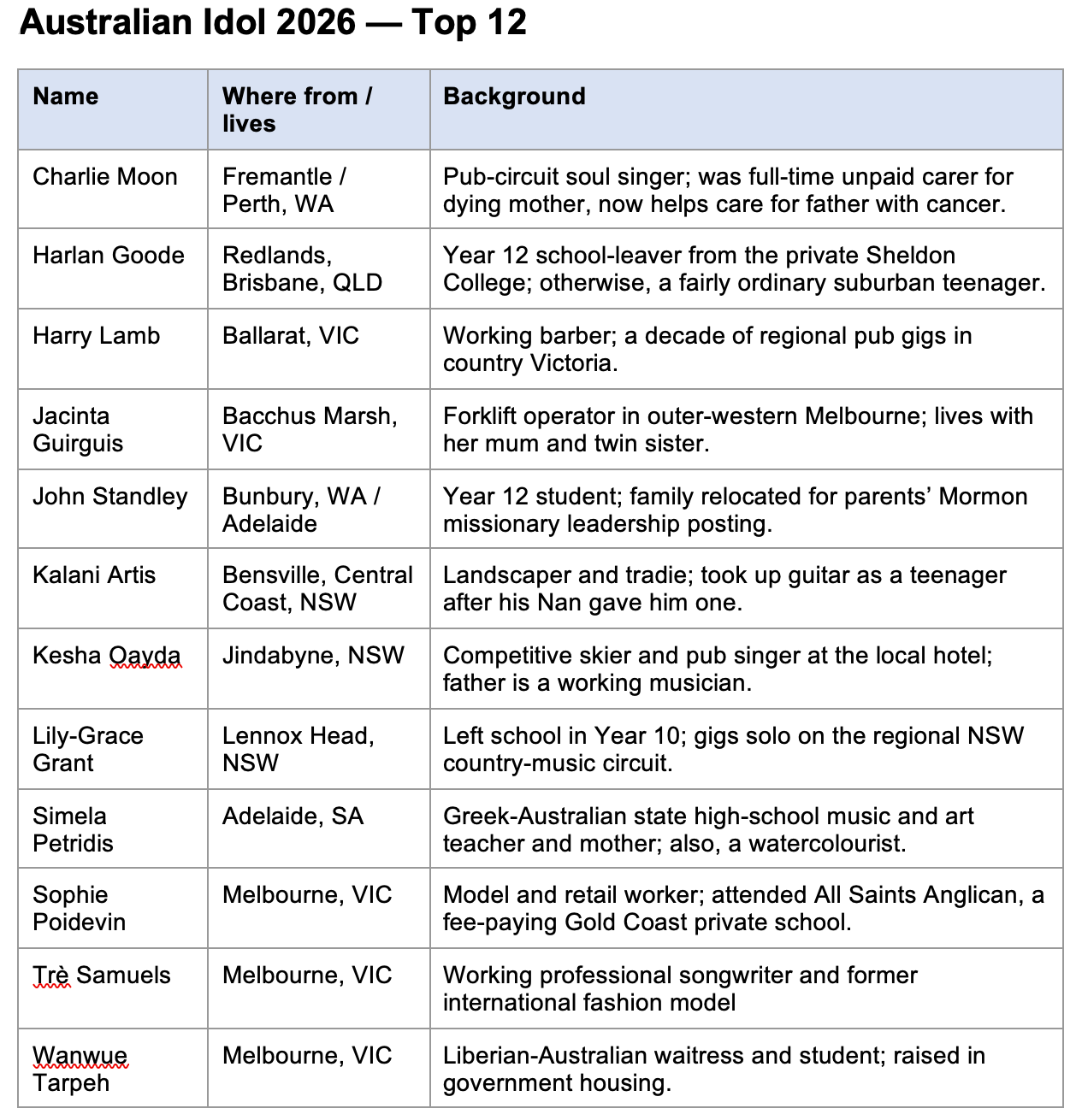
Last week’s episode required contestants to choose and perform songs to dedicate to their heroes. Most heroes were parents and teachers. One contestant’s hero was his hometown of Bunbury in regional Western Australia. Everyone in his school was mainlining his agony and ecstasy. His origins were typical of the group, almost all from middling or struggling families, from country towns and the outer suburbs (see table). And, while the adults behind these kids are desperate for them to succeed, the storytelling emphasises the human bonds of the lifeworld — the nurturing, the sacrifice, the role modelling. There’s no sign of the pushy parent, or the impresario of their kids’ entry to the right schools, universities and networks with a nicely curated CV and PukeMaxxing statement of values (“I’ve always been passionate about giving back”)
II
Australian Idol is very democratic, very open. But — and this is what thrills me far more — it’s not a democracy of sullen levelling, but rather, one of joyous achievement. It finds, cultivates and recognises people with passion and talent. Have a look at Harlan above. Now, pop music pervades our culture, so it’s no surprise that there are some top-rate pop-stars hiding undiscovered among Australia’s 27 odd million population. But in 2008, the dance equivalent of Idol, So You Think You Can Dance, showed that there was more to it than that. I assumed we’d be visibly outclassed by the American franchise of the same show, given America’s much stronger dance culture and gargantuan population.2 But no. Our finalists were perhaps marginally less technically polished. But if that was even true, it was more than made up for (at least for me) by their relative unaffectedness. Still, I expected one series would surface most of the great talent. But again, I was wrong. There were four series, and the talent just kept on coming.
It gets you wondering how much talent our creaking systems of education, training, credentialing, recruiting and promotion leave lying around. Of course, the vested interests of the professionals running these systems help explain why they’re resistant to change, but never underestimate the extent to which change is foiled not because resistance would be fierce, but rather for lack of what I call “imaginative vigour”. Suffice it to say that, for as long as those increasingly sclerotic structures survive, they exert a gravitational force on social mobility with success increasingly dependent on the right schools, marks, courses, universities, CVs, and the accumulated peer and generational pressure of well-placed parents and their networks.
Some years ago, I met with Ita Buttrose and David Anderson, then chairman and the CEO of the ABC, respectively. We discussed my proposal for the ABC to establish a citizens’ council chosen by lottery to provide a considered, community view as to any claims of bias. In addition to garnering stronger popular support than any expert body, I argued it would enable them to get on the front foot, inviting critics like News Ltd to submit their own outlets to the same process.
They were very intrigued and, from memory, the meeting went on more than twice as long as the half hour allocated for it. Even then, they seemed reluctant to end it, Ita asking me if I’d like to add anything in conclusion. I spoke about how “Britain’s Got Talent” had surfaced someone as unlikely as Susan Boyle and how much talent had been unlocked by Australian Idol all those years ago. I said that choosing people by lottery was somehow similar, that it shook people out of their lethargy, out of their buck-passing to others. It asked people to step up — despite their doubts. And they almost always did. Hold that thought, as I’ll come back to it.
I finished with a heartfelt flourish. There are great journalists and other creatives out there that your recruiters might never find scouring the graduates’ applications. I told them they were already in charge of a network, and that their network could be turned to performing the kind of miracles reality television was already performing — miracles of discovering, cultivating and rewarding talent. “There’s talent oozing out of every country town on this continent. Where’s your Australian Idol?”
I’d already tried to sketch an “Australian Idol” career pathway for government in 2009 when chairing the Government 2.0 Taskforce. Australia’s National Library had been digitising its historical collection of Australian newspapers, and the optical character recognition of the day was producing plenty of errors when pointed at yellowed pages set in antique fonts. So, it built a platform that let members of the public correct the errors as they read the newspapers. Within six months, millions of errors had been corrected. With over half a million corrections to her name, Julie Hempenstall from Bendigo had become the most prolific volunteer corrector in the country. (Julie’s demographic similarity to the Idol finalists only occurs to me now.)
I thought Julie’s achievement was a signal we ignored at our cost.3 On an admittedly straightforward task, she’d shown dedication and patience, and because she’d volunteered, we could see that she’d been intrinsically motivated. Conventional recruitment is structurally blind to much of this. As I argued in a newspaper column, governments could draw volunteer enthusiasts more closely and explicitly into their own policy and service delivery activities. Shouldn’t the best volunteer contributors, whether they’re correcting text or discussing policy alternatives on blogs, be afforded greater recognition?
Over time we could see if they were interested in being given greater responsibility just as public servants are offered promotions? This could widen the pool of available talent to the public service and provide alternative pathways for recruiting people and developing their skills and authority. If those pathways of promotion were built, as structures of authority are built in the world of Web 2.0, they would be based on self-selection, enthusiasm and a record of aptitude and contribution in the field.
In the wake of all this, Australia’s National Library invited me onto its council. They were keen to take ideas like this further. I’m sure they had thoroughly good intentions. But, unlike the successful Idol contestants, they weren’t up for even mild discomfort. I suggested we take one per cent of what we’d budgeted for oral history and use it to seed a ‘Wikipedia of Australian oral history’. The Library wouldn’t do the work, but it already had strong engagement with Australia’s regional libraries and would encourage volunteers in those communities to bring together school kids and aged care residents, to document local stories, and record them on a wiki on which volunteers would identify, nurture and promote the best.
My wife got talking to a friend of hers about the idea, and I Wish I’d Asked was duly rolled out in the Victorian regional town of Shepparton. Oral history became just one activity among thirteen others, all connecting different generations. Storytelling, cooking, dancing, gardening, and philosophy. The kids reverse mentored the oldies in IT and social media. Veterans who’d never spoken of their time in Vietnam finally accessed the therapy of telling their stories. An isolated kid on the spectrum formed a powerful bond with a Vietnam vet, focused initially on the vet’s medal collection. The most miraculous result was the most unexpected. While the nation pondered from what foreign shore its future aged care workforce might be recruited, three of the ten or so adolescent boys involved said they’d consider aged care as a career.
III
Through its commercialism, Australian Idol offers a near-perfect fusion of egalitarian opportunity and exacting meritocracy. All this while out in the world, there’s been a great narrowing, as education, recruiting and promotion became endlessly more entangled in process and performativity, and drifted ever further from their social and economic purpose. The ideas I proposed to the ABC, in my newspaper column and to the National Library Council were, and still are, outside the Overton Window. But that’s not because they’re revolutionary or even disruptive. Nor is it because they’d trigger strong hostile interests. It’s that building something on a new operational logic — however carefully or incrementally — requires imaginative vigour. Inside established organisations, what the reformer encounters instead is that swamp that recurs in folk tales, which keeps the hero from their mission. It’s the bemusement of those who’ve endured plenty of ‘change management’, mostly for nothing, and who’ve learned to keep their heads down.
Still, as Australian Idol shows, the principles are simple:
Find it. Cultivate it. Reward it with recognition.
And even if building a pathway for volunteers into the ABC’s governance or the bureaucracy or putting school kids in touch with aged care residents seems a little, shall we say ‘left field’, it’s easy and cheap to do it in low-risk, exploratory ways. And you wouldn’t impose it on anyone. You’d make some resources available for a few organisations with the enthusiasm to give it a go. You’d come back in a couple of years and look for successes, large or small. You’d find them, cultivate them and reward them with recognition.
One final thought. Consider those episodes that mark grand flowerings of Western culture. I can think of about eight or nine. All of them correspond with openings up of various kinds, certainly commercial, but also often greatly increased social mobility. Three of them are ancient Athens, Medieval and Renaissance Florence and Venice. And all three made extensive use of lotteries to govern themselves — citizens, in Aristotle’s phrase, taking turns in governing and being governed.
Find it. Cultivate it. Reward it with recognition.
In addition to the craft of the TV production itself, some of the worst features of the genre, which were carried over from reality TV, have now been largely remedied. The show I half-remember from 2003 on had some genuinely ugly qualities. Just as the contestants in Big Brother were edited in mendacious ways with some getting ‘hero edits’ and others getting ‘villain edits’, so on Idol there was always a designated bad guy — back then it was ‘Dicko’. His job was to generate column inches by saying something transgressive. The favourite, and most commercially successful, move was telling female contestants to lose weight, to much tabloid excitement. And those who auditioned particularly badly were routinely humiliated. Ha ha ha. The revived version has dropped the cruelty and indeed, one of the judges who played follow-on baddie after Dicko — Kyle — is supportive without any loss of masculine energy from the wrong side of the tracks.
The show ran for four seasons on Network Ten: 2008, 2009, 2010, and then, after a gap, 2014. The American original had begun in 2005. Not to be confused with Dancing with the Stars, which pairs celebrities with professional dancers and is a different kind of show doing different kinds of work.
I just asked Claude if there was a word for “a possibility that is visible but goes ignored”. It duly reported that English doesn’t possess a word that really nails the idea but that the German word versäumt does. It signifies “missed, neglected, allowed to slip past”.
These issues may have been fixed by the time Australian Idol made it to air but I have now looked up The Voice Australia on wikipedia and seen that it has aired since 2012. Once The Voice came to the United States the reward was never commercial success as much as it was having won The Voice but it was actually watchable by anyone who cared anything about music especially since the highly emotional American Idol winner style was set after seasons 3 or 4.
Thank you.
The perfect piece of inspirational reading to get the week moving.