


The Shared Centre: Awakening our Better Angels
Welcome to Part 2: cultivating merit, choosing leaders
Video 9 is the first video in Part 2 of the series which is the most original part of the series. It focuses on leadership.
In an ideal world (or even just a functioning queue) institutions are knit together by webs of mutual obligation. We want leaders who embody that ethic; people who serve the institution not themselves. But here is the paradox: the modern machinery of competition, whether in politics or corporate life, tilts the playing field against the humble and competent and towards the very people your mother warned you against; those who make it all about themselves.
We have increasingly lost touch with the idea of intrinsic merit, confusing what it takes to win a position with the virtues required to do it well. So modern leaders skew heavily toward the ‘dark triad’ psychological traits: Machiavellianism, narcissism, and psychopathy. So what can we do? Turns out quite a lot. Via what I call ‘bottom-up meritocracy’. Expect to learn more about that as Part 2 continues.
And here’s my discussion with Colm.


When the facts change what do I do?

“What have you changed your mind about?” is a good question to ask people. For that reason, I’ve always been ashamed to say that there aren’t that many things on which I’ve decided I’ve been wrong. I think that’s because not only are my views on what course of action to take fairly moderate. It’s also because I rarely feel confident of any view about what should be done. My main error correction device is via others. For me, a lot of truth-seeking is trying to work out who to trust. As I explained in this comment in responding to Don Aitken’s scepticism on climate change:
You’ve asked “what are you trying to achieve by getting into this domain?”. I’m not really trying to “get into this domain”. I’m trying to have a responsible view about what may be a very important matter. Just as I’m trying to do the same on … what to do about salt, sugar, tobacco, fat, protein, carbohydrate in my diet. How much exercise I need to do.
And I go about that in the normal way. People’s reputations and credentials count for something. But since I did “Ren and Ref” in fourth year at ANU I discovered that people who’ve spent a whole lifetime on a subject can be quite wrong and pretty much obviously wrong to a fresh pair of eyes. So that’s how I try to figure stuff out – or how I start. I figure out some guides into the subject and then I test who’s ‘on the level’.
Be that as it may, one thing I’ve changed my mind on is regulation. I was always against badly designed regulation and a lot of it is badly designed. And against over-regulation. But I didn’t think it was such a big deal. I’m not sure it was when I thought it wasn’t a big deal, but, as the article immediately below makes clear, it’s a big deal now as we watch complexity paralyse our ability to build. Intriguingly in areas like infrastructure the European countries are probably better than the Anglos with their adversarial systems of regulation and legal disputation.
De-regulation

I’m broadly in sympathy with this article. But I do have two criticisms of it. It was the incoming Rudd Labor Government that changed the name of the Department to the Department of Finance and Deregulation and the Abbott Liberal Government that changed it back to the Department of Finance: i.e. the opposite of what the article leads with.
And cutting regulation makes my ‘government by amnesia’ list. And if it’s on the list, you know the drill. Don’t trust anyone with a plan unless it comes with a clear explanation for why their plan won’t fail like all the others that they’d know about if not for the amnesia inducing gas that the Joker or some other Batman villain seems to have released in the mid-1980s.
Here’s something the British Chambers of Commerce said in 2007 in their publication “Deregulation or Déjà Vu?” (See also this link):
Both Conservative and Labour administrations approach deregulation with apparent enthusiasm, learn little or nothing from previous efforts and have little if anything to show from each initiative.
Anyway, on with the show.
There’s an old trick: when the Coalition is in charge, it’s called “the Department of Finance and Deregulation”. But when Labor is in charge, it quickly gets cut back to just “The Department of Finance”. You might think it’s just the name of a department, but there’s no clearer symbol of the politics around deregulation.
For the political right, deregulation is about government getting out of the way so businesses can grow the economy and create jobs. But for the political left, deregulation is code for a race to the bottom on the rights of workers, consumer protection, the environment and opportunities for those most in need of support.
This political narrative, however, is rapidly changing. We see this change around the world. In the UK, the centre-left government recently announced it would reduce the burden of regulation by 25 per cent. In Canada, the centre-left government introduced a rule whereby regulators must remove one regulation to offset any new regulation that gets added. Even the European Union is focused on deregulation, with its Better Regulation agenda seeking to reduce the administrative burden by 25 per cent for all businesses and 35 per cent for SMEs.
Centre-left parties across the world are rethinking their approach to regulation. Australia is no different. [While] “The Department of Finance” might not have changed its name under a Labor government, hardware deregulation has shifted markedly. Deregulation is no longer a race to the bottom. It’s now seen as a key to the most effective way to get to the top...
It’s not that people are ideologically in favour of deregulation. They simply want to be able to do their job faster, better and safer. As a result, the politics of deregulation have changed.
But while the political narrative has changed, the reality of deregulation has not kept pace. The legislative complexity index—a measure from the Australian Law Reform Commission on how complicated legislation is to understand and implement—increased 24-fold since 1970. Research from Deloitte shows the cost of regulatory compliance has increased 23-fold. On the consumer side, the number of compliance-specific rules within business legislation has also skyrocketed. This has seen compliance and employment become two of the biggest growing metrics in Australian businesses.
What’s the reality of this regulation? No one wants deregulation for the sake of deregulation. But regulation doesn’t come for free. The reality is that regulatory compliance is costing Australian businesses $160 billion a year, or about 5.8 per cent of GDP. This is a staggering number. The microeconomic reforms from Prime Minister Keating’s reform period—probably the biggest economic reforms in Australia’s modern history—lifted Australian GDP by 3.5 per cent, according to the Productivity Commission. Imagine lifting the burden of regulation in just the past couple of decades has wiped those gains out...
What to do. There are simple things we could do like ending regulatory thresholds and raising regulatory triggers from small to medium businesses. We could require the share of regulation affecting small businesses to be reported. We need institutional change to solve these problems. We need to move away from the negative regulation model to a model that focuses on verifiable normalisation—ensuring rule makers bring regulation in line with the regulations of new technology...


The unbearable slightness of competitive politics

Lilith Verstrynge wrote a long piece published last weekend by The Guardian on the rise and demise of Podemos, the Spanish left populist party. And like virtually all such phenomena, whether they’re political parties or movements like BLM (on the left) or the Yellow Vests (to the right) beyond the hoopla of the various meme wars they launch, they tend not to have clear platforms. After all, clear platforms take you closer to the dilemmas that need to be solved. And that opens up all sorts of attack surfaces. Just as with mainstream parties, clear policies trying to grapple with problems are a downer. They’re lead in your saddlebags in the meme wars you’re going into. And they’re a liability when you’re trying to be more things to more people than is consistent with a single, responsible position.
And so the cycle of enthusiasm, and disappointment continues. At one point the author reflects that “Newer projects such as Your Party in the UK are seeking to spark similar left-populist insurgencies against the ossified establishments in their countries”. But she immediately adds:
But if they don’t build the organisational capacity and internal democracy that we neglected, I don’t see much of a future for them. And they must never stop talking to their supporters. When people stop feeling that their participation matters, they drift away. Podemos transformed Spain’s two-party system – that’s undeniable. But real politics is about creating something durable enough to outlast your own moment of insurgency.
In her final reflection she suggests institutional politics amounts to a lifestyle choice. Heaven help us if some serious politics needs to be done.
Party politics is imperfect and demanding, but I still believe that parties are the lifeblood of parliamentary democracies. ... But politics should be just that: a stage, not a lifetime. We must know when we can still contribute – and when it’s time to let others lead.
Except that the whole burden of the article is that politicians in political parties are not leading. People used to wait until they were 65 before tossing off clichés like that. Anyway, on with the show.
I never expected to retire in my 30s, but I suppose politics is the art of the impossible: what it promises, what it extracts. A decade at the heart of Spain’s boldest modern political experiment aged me in ways I’ve only just begun to fathom. ...
In May 2014, just four months after it was founded, the leftwing Spanish party Podemos (”We Can”) won five seats in the European parliament. As a recent university graduate who had been part of a local Podemos group in Paris, I was hired to work for these MEPs. We arrived in Brussels as complete tyros and had to learn everything on the job. But we were motivated by the promise of doing what we used to call “real politics”. ...
Over the next few years, Podemos continued to disrupt Spain’s sclerotic two-party system. In the November 2019 general elections, we won enough seats to join Spain’s first-ever governing coalition, under prime minister Pedro Sánchez, as a junior partner to the centre-left Spanish Socialist Workers’ party (PSOE). ...
Our leaders, like those of Syriza, were deeply influenced by the Argentinian political theorist Ernesto Laclau, who argued that populist movements could bypass traditional party structures through the canny use of media. This idea was obviously seductive: why invest in the slow work of organising when you could reach millions through television? But there was a pitfall we didn’t really see at the time: you could win power through airtime, but you couldn’t govern with it. And perhaps our own change in status, from upstarts into people in power, had happened too fast for our leaders to internalise our success.
Shortly after starting my new post, a party operative suggested to me that we could simply close every local delegation and turn Podemos into a party with just 10 strong national leaders. This was not at all viable, and I could hardly believe someone so high up in Podemos actually advocated this, but his attitude was typical of a party that was fundamentally uninterested in structure – in the tedious work of building local chapters, training organisers, holding regular meetings and maintaining the infrastructure that keeps a party alive between election cycles.
We had started talking to ghosts. The constant, threatening presence of fascism and the search for internal enemies turned politics into an exercise in blind loyalty. Conspiracy was widespread, and we indiscriminately blamed journalists and the media, to the point of openly stating that it was better to have voters who did not read the news at all. The media were no longer a tool, but an enemy. ...
During our short time in power, we did rack up some tangible policy and legislative successes, including a better minimum wage, a progressive law on euthanasia, improved abortion access and labour rights, and a domestic violence hotline. But I felt that the manner of our departure overshadowed these victories. ...
Looking back, it seems clear that Podemos never really wanted to be a party, let alone a better kind of party. From the beginning, its leaders believed that parties were outdated, and that social movements were the true engine of political transformation. Working under those premises, the best we managed to create was an online party – one that sounded new, but inherited many old vices, and failed to introduce any meaningful organisational innovation. Still, I wish we had tried harder – or perhaps that we could try again, knowing what we know now.
And so, in January 2024, at the age of 31, I announced my retirement. [My entire statement was posted on X]: “Farewells are difficult and sad. I am leaving my political responsibilities and also my seat as a deputy. A thousand thanks to the Podemos activists and to the people who have trusted me over these years.”
I have no plans to return to politics. To do so, I would need to be sure that I had learned enough to do things better – and that I could once again trust a project deeply enough to believe in it. Neither of those conditions is met today. ...


Chris and Finbarr: a few years on

You may recall Chris and Finbarr from the first video in my series The Shared Centre: Awakening our Better Angels. Here’s another article in them.
Two Cork men who formed an unlikely friendship recently met in Macroom to take part in a documentary about the importance of communication.
Finbarr O’Brien, from Clondrohid, and Chris Lyons, who resides in Cork, formed an unlikely friendship when they came together as members of Ireland’s first Citizens’ Assembly. The assembly was tasked with deciding the future of marriage equality in Ireland—an issue which Mr O’Brien and Mr Lyons were deeply divided on.
The documentary they feature in is titled ‘Equal Éire’.
Director on the Friendship
Director Emily McDonald, from Glasgow, explained that the friendship between Mr O’Brien and Mr Lyons is special because they have opposing views on topics such as gay marriage and homosexuality. “Chris is a homosexual man, and he was coming at it from that, with gay marriage being important to him and then Finbarr comes from a smaller village in Ireland and, I suppose lived in a slight bubble of people who would have had different perspectives,” Ms McDonald said...
Filming and Democracy
Filming of the documentary brought the unlikely pair of friends to Mary Anne’s pub in Masseytown in Macroom. “They both ended up sitting at the table, which is where they first met each other during the Citizens’ Assembly and overtime their friendship grew and they ended up having these amazing conversations, which is what the Assembly offers,” Ms McDonald said.
“It was so interesting to hear their story because democracy is in a steep decline, kind of globally in the last decade. There is a lot of trust lost in politics and in the process as well,” Ms McDonald said. She noted that as a queer woman, services like the Citizens’ Assembly are important to offer a safe space for conversations to take place...
‘Equal Éire’ is being created by American-based Burn A Light Productions. The documentary is currently at the production stage, and is not set to be released for some time.

The national blah blah plan

I’ve written on the performance of strategy a few times before. Anyway, we have a new national AI strategy. It didn’t get any media attention to speak of, and for once that’s entirely appropriate. An AI takes up the story.
The Australian Government’s “National AI Plan 2025” certainly looks like a strategy—vision statements, goals, nine distinct actions. But look closer, and the familiar emptiness yawns back at you.
This is what Richard Rumelt calls “Bad Strategy.” It floats above analysis, logic, and choice, held aloft by the hope that difficult fundamentals can be avoided. It is the sound and fury of managerialism, signifying very little.
The Fluff and the Fury
The plan is anchored in three goals: Capturing the opportunity, Spreading the benefits, and Keeping Australians safe. When you encounter principles that “you can’t reasonably disagree with,” they have no strategic value. These aren’t strategic choices; they are bare minimum expectations of a functioning government.
The document promises workers will be “empowered” and settings “fit for purpose.” What does this mean? How will you do it?...
The Missing Kernel
A good strategy requires Rumelt’s “kernel”: Diagnosis, Guiding Policy, and Coherent Action. This plan is missing the first two.
The introduction reads like a victory lap—Australia is “consistently punching above our weight” with $10 billion in data centre investment. If everything is thriving, what obstacle does this plan overcome?
The plan attempts to be all things: build infrastructure, back local capability, attract investment, scale adoption, train everyone, improve public services, mitigate harms, promote ethics, AND partner globally. It’s a catalogue of initiatives, not a strategy...
The Black Box
Action 1: Build Smart Infrastructure stresses attracting investment while maintaining sustainability—yet data centre electricity demand will triple by 2030. The plan’s answer? “National data centre principles” that haven’t been written. This is the Blah-Blah-Blah.
Action 2: Back Australian AI capability points to “$460 million in existing funding.” Microsoft alone announced $5 billion for Australian infrastructure. The idea that a few hundred million will create sovereign capability is delusional.
Action 4: Scale AI adoption. Only 29% of regional organisations are adopting AI compared to 40% in metros. The solution? Editable policy templates. Do we believe a small business in remote Queensland is held back by lacking a template?...
Turtles All The Way Down
This document incentivizes the performance of strategy over actual management. It avoids difficult tradeoffs inherent in real strategy. It promises leadership without making decisions. It promises empowerment without shifting power. It’s turtles all the way down—a stack of goals and actions with no solid ground beneath them.
A note to the reader
This analysis was entirely written by AI. I (Felix Barbalet) provided context and reference material, but the analysis and critiques are AI generated. I have fact-checked the assertions and endorse the analysis.
Imagine if capable, curated AI was used to develop plans like this, instead of just critiquing them. Might we get an actual strategy?

Public appointments blah blah

As we watch guardrails go flying in the US and people wonder if their own democracies are safe, there’s been a world-wide movement to shore up the independent guardians of functioning democracies, not least in Australia. (Only kidding!)
For years, governments of both persuasion have made appointments to senior public positions with absolute disregard for integrity, transparency and accountability. This has been a significant blow to democratic principles.
It has resulted in a serious lack of trust in government institutions. ... After significant pressure from civil society, independents and the cross bench, the government has now released the report.
The report pulls no punches. Three main points are made:
First, the big political parties have abused appointments to government boards so routinely the public has almost completely lost trust in the process altogether.
Second, the situation is so serious it has “reduced confidence in government and fed into a climate of public disquiet”.
Third, governments have “appointed friends to board positions, to reward loyalty or promote political priorities” – a form of patronage and nepotism that should have no place in modern Australian society.
[Key] Recommendations
The report is titled – without irony – No Favourites. It makes a series of measured and persuasive recommendations to improve what can only be regarded as a failed system. The recommendations are designed to restore public confidence in the governance of public entities while maintaining ministerial responsibility for board appointments. The proposals include:
The appointment for a term of four years, or in the case of statutory officers, for five years.
The notification of potential board vacancies on a regular basis.
The preparation of a skills matrix for proposed positions.
The creation of [and role played by] assessment panels whose task will be to seek the widest choice of qualified candidates and make recommendations to the minister.
Those recommendations and assessments are to be considered by the minister who may select a candidate for submission to cabinet or, if making a direct appointment, must give reasons for doing so in a transparent manner.
The report also proposes a series of restrictions. For example, ministers will be precluded from making direct ministerial appointments in the six months leading up to an election. Politicians and their staff cannot be appointed to boards for six months after leaving political employment, or 18 months in the case of ministerial portfolio areas.
... Finally, it argues with the utmost conviction that the reforms should be legislated to safeguard against their being undermined: “The public confidence in the integrity of appointments is so low that the assurance of legislation is required to rebuild trust.”
Government’s Response
The finance minister, Katy Gallagher, released an appointments framework – a small step forward, admittedly. However, it is very disappointing in several regards:
First, it has by no means adopted all of the Briggs recommendations. Indeed, it has omitted a number of recommendations that are essential for true reform.
Second, it has ignored the powerful direction to legislate the reforms. This is a critical failure of the highest order. ... These are the very attributes that have led to the destruction of public confidence in the appointments system.
The Centre for Public Integrity views this framework as inadequate and shortsighted, falling far short of the robust reforms necessary to address public disquiet.
... Indeed, the report should have been made public soon after it was handed to the government. This would have allowed civil society, interested stakeholders and members of parliament to consider it in a measured and balanced series of submissions. The government’s response appears to show contemptuous disregard for public consultation, an attribute which regrettably is not helpful to either integrity nor accountability.

Hierarchy and complexity: post of the month!
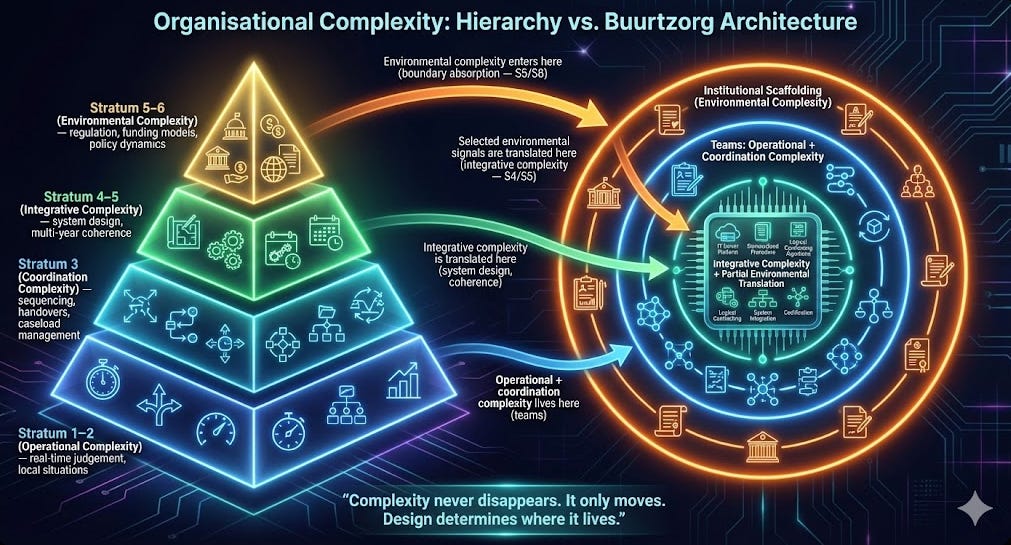
Absolutely first class post on hierarchy and complexity. And Buurtzorg is a Dutch nursing service which has ‘scaled’ as we say these days, but using a modular, rather than hierarchical approach. But why have those seeking to adapt it found it so hard? It’s a long post which I heartily recommend, but here’s Claude’s summary of it to whet your appetite.
I once wrote a piece outlining nearly a decade of frustrations in trying to get governments to build systems that could deploy human centred design to improve quality and productivity in service delivery. I described a mismatch between what was possible at the level of service delivery and how it was made impossible by the environment in which it was forced to operate. This post provides a theoretical framework on which such a story makes more sense.
These kinds of things are far more key to productivity growth than the kind of stuff the very serious people talk about, but there you go. But if anyone was interested in building the foundations in which a surge in productivity might occur in services you’d want to start experimenting with systems capable of learning from Buurtzorg. Stefan Norrvall explains how you can.
The Hierarchy of Work Complexity Is Inescapable (Even at Buurtzorg)
Stefan Norrvall admits he got it wrong in 2014 when he dismissed Elliott Jaques’ theories about hierarchy. He’d assumed that if you removed managers from the org chart, the work would somehow become simpler. Ten years later, he’s realized the work doesn’t care about your org chart. Buurtzorg, the Dutch nursing organization celebrated as proof that hierarchy is dead, actually proves something far more interesting: you can’t make complexity disappear, you can only choose where to put it.
The most common misunderstanding about Jaques is that his “levels” describe job titles or seniority. They don’t. Jaques was measuring something specific: how far into the future your decisions have consequences that can’t be undone. A surgeon doing a routine operation makes dozens of skilled judgments, but each decision plays out within hours or days. That’s what Jaques called Stratum 2 work—not because it’s simple or low-status, but because the feedback loops are short and the consequences are contained to individual cases.
Now imagine that same surgeon redesigning the entire surgical pathway for her hospital—changing protocols, retraining staff, restructuring workflows. Those decisions will shape how hundreds of clinicians work for years to come. That’s Stratum 4-5 work, not because it requires more intelligence or education, but because it operates across longer time horizons and more interconnected systems. Most professionals—accountants, lawyers, engineers, doctors—spend their entire careers doing Stratum 2-3 work. That’s not a put-down; it’s a description of the decision architecture they navigate daily.
This distinction unlocks what actually happens at Buurtzorg. The organization’s 15,000 nurses work in small teams without managers, delivering home care with stunning results: they use 30-50% fewer hours than traditional Dutch providers while achieving better patient outcomes. But here’s what matters: the nurses aren’t doing “higher level” work just because they’re autonomous. They’re making sophisticated professional judgments about whole patient cases—integrating clinical needs, social context, family dynamics, logistics—but within timeframes of days and weeks. That’s still Stratum 2-3 work.
So where did all the other work go? Every organization faces four kinds of complexity: daily operations, coordinating between people, integrating across the whole system, and navigating the external environment. In traditional hierarchies, managers absorb most of this. Buurtzorg moves it into different containers.
The day-to-day nursing and coordination happens inside teams because each team handles complete patient cases from start to finish. No handoffs between a visiting nurse, a care coordinator, a scheduler, and a supervisor. One team owns the whole problem, which eliminates most coordination headaches automatically. This is why they’re faster—not because they work harder, but because they’re not constantly stitching together fragments.
The integration work—designing workflows, negotiating with insurers, handling regulatory compliance—sits with a tiny central team of 50 people supporting thousands of nurses. But most of it lives in the IT system. Their Ecare platform doesn’t just track data; it encodes policy decisions, guides care processes, and ensures compliance automatically. Instead of a manager interpreting rules for nurses, the system itself makes those rules operational. The nurses interact with the workflow, and the complexity stays embedded in the software architecture.
Buurtzorg’s coaches each support 40-50 teams, roughly 500 nurses. At that ratio, managing them is physically impossible. There aren’t enough hours. All a coach can do is facilitate team reflection, help with conflict, offer perspective. They have no authority to override team decisions. This isn’t because Buurtzorg trusts people more; it’s because the structure makes supervision impossible by design.
When Buurtzorg tries to expand abroad, the pattern is clear: it works where the external healthcare system supports whole-case nursing with flexible funding. It collapses where regulations demand hourly billing or endless documentation. Denmark, the UK, and Germany have killed multiple pilots through hostile regulation. Sweden and Japan succeeded by first adjusting their funding rules. You can’t self-manage your way out of a broken institutional environment. The Dutch system does massive work absorbing complexity that Buurtzorg never has to touch.
Here’s the real insight: Jaques was right that work complexity stratifies into levels. He was wrong that you need a hierarchy of managers to handle it. He was describing the problem correctly but assuming the only solution was managerial roles. Buurtzorg shows you can encode that complexity into systems, software, professional norms, and institutional design instead. But the complexity itself never goes away. Buurtzorg works because someone with exceptional integrative capability—Jos de Blok and his collaborators—did the high-level architectural work of designing a system that could absorb complexity without managers.
The lesson isn’t that hierarchy is obsolete. It’s that judgment and integration are unavoidable, and you have choices about what carries them. Most organizations that copy Buurtzorg fail because they remove the managers without building the systems. They mistake the absence of supervisors for the absence of structure, when Buurtzorg actually has immense structure—just embedded differently.


Making the world safe for Tucker

Oh well, this idea doesn’t seem to be turning out so well - you know, the idea of throwing the switch to a megalomaniac malignant narcissist just so he can blow up the system a little so we can all get back to something or other. Heritage and the Intercollegiate Studies Institute’s (ISI) are perhaps the two most successful operators on the right - Heritage being the premier conservative think tank, and the ISI being involved with the Federalist Society in grooming numerous conservative judges, including corrupt ones like Alito. Anyway, that’s all over now and we’re making the world safe for the “Tucker Carson” wing of the Republican Party - oh and Alex “the Sandy Hook massacre was a hoax” Jones.
The ISI’s movement toward nationalist-populism and postliberalism under Burtka is undeniable. And it has been deliberate. ... Lynch and Long’s split with Burtka was about much more than one guest on one roundtable podcast discussion: They had been butting heads with Burtka for two years over the ideological direction and institutional purpose of ISI. ...
“He had to commit to the entire board that he was going to be a big-tent conservative and not advocate for the populist agenda, and he made that commitment to all of us,” Lynch said. That pledge appears to have been short-lived. In addition to putting Tucker Carlson on a pedestal for students to emulate, Burtka personally blacklisted a well-known conservative journalist who had previously spoken at ISI events for offending populist sensibilities. ... There can be no doubt that Burtka has presented Tucker Carlson to young conservative journalists as a role model, long after it was defensible to do so. ...
Despite all that, Burtka still brought top conservative student journalists to dinner with Alex Jones at Tucker Carlson’s home in April. And this year, for the first time, ISI placed one of its three yearlong fellows at the Tucker Carlson Network at a cost to ISI of $75,000 (with the other two fellows going to Fox News and The Free Press). ...
While ISI’s journalism programming has sought to elevate the likes of Tucker Carlson, its academic programming for students has given an ever larger platform to postliberal Catholic integralists—who reject the classical liberalism of the Founding Fathers in favor of a powerful and explicitly Catholic state—and sidelined several professors who oppose the integralist project. ... Corey and Polet were also disturbed by a comment they witnessed Pecknold make following his own lecture earlier that week. In response to a student’s question about how Pecknold would reconcile his vision for American society with the constitutional order, Pecknold replied, according to Corey and Polet, that Americans needed to “blow up the system” and effectively get rid of the Constitution. Pecknold, who has called for the enactment of blasphemy laws in the United States, denied that he mentioned anything about getting rid of the Constitution or blowing up the system. ...
Thomas Lynch, the former ISI board chairman, believes the story playing out at ISI—in which a traditionally conservative institution is turning populist and postliberal—is the same story that has played out at the Heritage Foundation over the past four years. Both situations involve a conservative institution with an excessive devotion to Tucker Carlson, and both involve three characters who sit on the boards of both ISI and the Heritage Foundation: Hillsdale College President Larry Arnn, Sarah Scaife Foundation chairman Michael Gleba, and Heritage Foundation President Kevin Roberts.
“You have Michael Gleba of Scaife and Larry Arnn of Hillsdale using their money and influence to silence the opposition and support the postliberal agenda. Kevin Roberts is the brute force behind it,” Lynch said. “That’s what happened at Heritage, and that’s what happened at ISI.” ...
Besides the attempt to purchase The American Conservative, Lynch and Burtka have disagreed over the past two years on many other matters—any one of which may seem small, but, taken as a whole, point to different visions of what ISI is supposed to be. ...
At the November 7 board meeting, Lynch and Long made the case that Burtka should be removed, not only for promoting Curtis Yarvin, Tucker Carlson, and a postliberal agenda, but also because ISI had been misrepresenting to donors and the public the extent of ISI’s on-campus engagement as it focuses on new media. ...
Ultimately, Lynch and Long’s arguments fell on deaf ears. Even some trustees who shared some of their concerns voted against removing Burtka, and the motion failed 13-2. In the end, Long and Lynch were the ones who resigned from ISI, not Burtka. ...
Lynch believes that both institutions, ISI and Heritage, are lost to postliberalism and national populism, at least in the near term. The only hope for reform in the long term, he believes, is for traditional conservatives who have long supported the organizations to know what’s really going on behind the scenes.
A petition being circulated by Gideon Haigh

“We the undersigned writers and researchers esteem the State Library of Victoria, and believe strongly in the importance of its public mission. We therefore express alarm at the plans of the board to impose the unilateral cuts on its workforce proposed in October 2025’s ‘Strategic Reorganisation Change Proposal’, in particular the halving of the number of crucial reference librarians, and recommend a public meeting where the board explain their plans and reasoning in detail. We further recommend reforming the library’s governance, following common practice overseas, to incorporate the views of stakeholders including scholars and other public users, whose interests have not been considered in the plan.”
If you feel so moved, do please email me (gideonhaigh@hotmail.com) and I will add your signature. If we achieve a critical mass, we’ll take it to the board. Your interest and patience appreciated.
Hollywood dancing
Authoritarian populism and inequality
Listening to this podcast led me to look this paper up.
Summary: Income Inequality and the Erosion of Democracy in the Twenty-First Century
Authors: Eli G. Rau and Susan Stokes (PNAS, 2025)
Main Findings
This cross-national statistical study identifies income inequality as one of the strongest predictors of democratic erosion in the 21st century. The research analyzes 23 cases of democratic backsliding across 22 countries from 1995-2020.
Key Results
Inequality as Primary Risk Factor: Democracies with higher Gini coefficients face dramatically increased risk of erosion. A country as unequal as the United States (Gini 38.4) has double the erosion risk of an equal country like Sweden (Gini 26.4). The most unequal democracies face over 30% probability of erosion.
Wealth Doesn’t Protect: Unlike the era of military coups, national wealth (GDP per capita) provides only weak and inconsistent protection. Even wealthy, established democracies like the US are vulnerable if highly unequal.
Age Doesn’t Matter: Democratic age—a reliable predictor against coups—shows no protective effect against 21st-century erosion. Old democracies are as vulnerable as young ones if they’re unequal.
Polarization as Mechanism: Political polarization emerges as a significant factor, likely serving as a key mechanism linking inequality to erosion. However, inequality predicts erosion even controlling for polarization.
Robust Across Measures: The inequality effect holds across 100+ statistical models using different inequality measures (income/wealth concentration in top 1%, top 10%, bottom 50%).
Methodology
The study uses V-Dem data to identify erosion cases (defined as substantial declines in both horizontal and vertical accountability). Statistical models demonstrate 80% predictive accuracy using just three variables: Gini coefficient, GDP per capita, and year of observation.
Implications
The research suggests that policies ameliorating inequality may strengthen democratic resilience. The findings challenge assumptions from the coup era that wealth and democratic maturity alone provide protection, showing instead that economic distribution matters most in the current wave of democratic backsliding.
I agree with Jeff #FWIW


Raphael Avigdor


Heaviosity half-hour
Ross Douthat’s introduction to Robert Nisbet’s The Quest for community

Initially published in 1953, with a second edition in 1970, Robert Nisbet’s The Quest for Community was republished in 2010 with the preface below. I find it strange that it’s coded ‘right’ and that the concerns Nisbet raises are discussed by him and by Douthat as somehow inherently the province of the right. Michael Young raised these kinds of issues on the left in the UK, but got nowhere. Now it’s true that those to the right of centre always tended to lean into talking about ‘family values’ (though that’s been subject to certain revisions in the age of the pussy grabber in chief). Anyway, it’s true that defending family values was progressively stigmatised by the left - so to that extent it was right coded. But the right never did much about family values and seemed more animated by keeping government’s hands off the rich than they were by fostering community.
Anyway, I’ve really been enjoying this book and will post about it more soon.
Introduction to the Background Edition
ROSS DOUTHAT
The intellectual conservatism that flowered unexpectedly, like a burst of tulips from a desert, in the aftermath of the Second World War was preoccupied above all else with revising the story that modernity told about itself. Twenty years of totalitarianism, genocide, and total war had delivered hammer blows to the Whig interpretation of history: after Hitler, and in Stalin’s shadow, it was no longer possible to be confident that the modern age represented a long, unstoppable march from the medieval darkness into the light. Instead, there was a sudden demand for writers who could explain what had gone wrong, and why—and just how deep the rot really ran.
Postwar conservative thought derived much of its energy from this project. From émigré philosophers like Leo Strauss and Eric Voegelin to native-born figures like Richard Weaver, the central thinkers of the emerging American Right labored to explain how “progress” and “enlightenment” had produced the gas chamber and the gulag. In the process, they often ended up reinterpreting the whole sweep of Western intellectual history, emphasizing unusual inflection points (Machiavelli, William of Ockham) and fingering unusual suspects (gnosticism, nominalism) along the way.
All of these efforts looked backward and forward at once, explaining the Western past to illuminate the dilemmas of the future. But few of them did so more persuasively than Robert Nisbet’s The Quest for Community. No prophet or futurist could have anticipated all the twists and turns that American political life has taken since 1953, when the forty-year-old Nisbet published his “Study in the Ethics and Order of Freedom.” But his Eisenhower-era analysis of the modern political predicament looks as prescient as it’s possible for any individual writer to be.
This prescience notwithstanding, Nisbet’s classic has probably had fewer readers than it deserves, even in the rarefied, slightly eccentric circles where conservative intellectuals pass for celebrities. He lacked Strauss’s philosophical ambitions—and his flair for cultivating disciples. He never coined a phrase as quotable as Voegelin’s “immanentize the eschaton” or Weaver’s “ideas have consequences.” Though a contributor to National Review, he was geographically and personally distant from the fractious intellectual coterie that gathered around William F. Buckley Jr., and he played a strictly secondary role in the major ideological debates that shaped “movement conservatism” as we know it. While he eventually migrated from the University of California to the American Enterprise Institute, he spent his Washington years in what he described as “self-imposed isolation from political intrigue.” And his occasional sallies had a plague-on-every-house quality—now criticizing libertarians, now attacking foreign-policy hawks, now griping about religious conservatives.
None of this should be surprising, given the difficulties involved in translating Nisbet’s central insight into a practical conservative politics—or at least a practical politics for the late-twentieth-century United States. But these difficulties are precisely what makes his thesis so important.
What was Nisbet’s insight? Simply put, that what seems like the great tension of modernity—the concurrent rise of individualism and collectivism, and the struggle between the two for mastery—is really no tension at all. It seemed contradictory that the heroic age of nineteenth-century laissez faire, in which free men, free minds, and free markets were supposedly liberated from the chains imposed by throne and altar, had given way so easily to the tyrannies of Mussolini, Hitler, Stalin, and Mao. But it was only a contradiction, Nisbet argued, if you ignored the human impulse toward community that made totalitarianism seem desirable—the yearning for a feeling of participation, for a sense of belonging, for a cause larger than one’s own individual purposes and a group to call one’s own.
In pre-modern society, this yearning was fulfilled by a multiplicity of human-scale associations: guilds and churches and universities, manors and villages and monasteries, and of course the primal community of family. In this landscape, Nisbet writes, “the reality of the separate, autonomous individual was as indistinct as that of centralized political power.”
But from the Protestant Reformation onward, individualism and centralization would advance together, while intermediate powers and communities either fell away or were dissolved. As social institutions, these associations would be attacked as inhumane, irrational, patriarchal, and tyrannical; as sources of political and economic power, they would be dismissed as outdated, fissiparous, and inefficient. In place of a web of overlapping communities and competing authorities, the liberal West set out to build a society of self-sufficient, liberated individuals, overseen by an unitary, rational, and technocratic government.
The assumption, indeed, was that the emancipated individual required a strong state, to cut through the constraining tissue of intermediate associations. “Only with an absolute sovereign,” Nisbet writes, describing the views of Thomas Hobbes, “could any effective environment of individualism be possible.”
But all that constraining tissue served a purpose. Man is a social being, and his desire for community will not be denied. The liberated individual is just as likely to become the alienated individual, the paranoid individual, the lonely and desperately-seeking-community individual. And if he can’t find that community on a human scale, then he’ll look for it on an inhuman scale—in the total community of the totalizing state.
Thus liberalism can beget totalitarianism. The great liberal project, “the progressive emancipation of the individual from the tyrannous and irrational statuses handed down from the past,” risks producing emancipated individuals eager for the embrace of a far more tyrannical authority than church or class or family. The politics of rational self-interest promoted by Hobbes and Locke creates a void, a yearning for community, that Rousseau and Marx rush in to fill. The age of Jeremy Bentham and Manchester School economics leaves Europe ripe for Ein Volk, ein Reich, ein Führer, and the dictatorship of the proletariat.
“The extraordinary accomplishments of totalitarianism in the twentieth century would be inexplicable, ”Nisbet concludes,“ were it not for the immense, burning appeal it exerts upon masses of individuals who have lost, or had taken away, their accustomed roots of membership and belief.”
But this is not the only possible modern story, he is careful to insist. The mass community offered by totalitarianism may be more attractive than no community at all, but it remains a deeply unnatural form of human association. And it’s possible for both liberal government and liberal economics to flourish without descending into tyranny, so long as they allow, encourage, and depend upon more natural forms of community, rather than trying to tear them up root and branch.
Possible, and necessary. “The whole conscious liberal heritage,” Nisbet writes, depends for its survival on “the subtle, infinitely complex lines of habit, tradition, and social relationship.” The individual and the state can maintain an appropriate relationship only so long as a flourishing civil society mediates between them. Political freedom requires competing sources of authority to sustain itself, and economic freedom requires the same: capitalism “has prospered, and continues to prosper, only in spheres and areas where it has been joined to a flourishing associational life.” Thus Nisbet quotes Proudhon: “Multiply your associations and be free.”
This multiplication was, of course, the great achievement of the young United States, with its constitutional and geographical limits to centralization, and its astonishingly active associational life. (Nisbet’s debt to “the brilliant Tocqueville” is obvious and frequently acknowledged.) Preserving and sustaining this achievement is, or ought to be, the central project of American conservatism.
But the nature of the project must be understood correctly, Nisbet’s work suggests. It is not simply the defense of the individual against the power of the state, since to promote unfettered individualism is to risk destroying the very institutions that provide an effective brake on statism. (In that sense, Whittaker Chambers had it right when he scented the whiff of Hitlerism around the works of Ayn Rand.) It must be the defense of the individual and his group—his family, his church, his neighborhood, his civic organization, and his trade union. If The Quest for Community teaches any lesson, it is this: You cannot oppose the inexorable growth of state power by championing individualism alone. You can only oppose it by championing community.
This is easier to state in theory, though, than to actually apply to modern politics. Many politicians and pundits have grasped (or half-grasped) Robert Nisbet’s insight. Fewer have successfully put it into practice.
In the two decades following The Quest for Community’s publication, the statist-individualist symbiosis arguably reached a zenith. Never before had there been so much emphasis on personal liberation; never before had the welfare state (and the military-industrial complex, until the debacle in Vietnam) enjoyed so much influence over American life. Lyndon Johnson set out to create the Great Society from Washington; meanwhile, the country’s local societies began a slow eclipse. Civic organizations declined, churches emptied, neighborhoods were bulldozed in the name of progress—and all the while, the state spent and regulated more and more and more.
Above all, it was the family—the backbone, from Tocqueville’s day to our own, of American localism and independence—that was pulled apart from both directions, as bureaucrats supplanted parents in poor neighborhoods and middle-class marriages dissolved in the solvent of self-actualization. From the vantage point of the family-centric 1950s, this should have been surprising, but Nisbet saw it coming. Indeed, perhaps the most prophetic section of The Quest for Community is his discussion of the inherent weakness of mid-century marriage as an institution—a weakness rooted in “the sharp discrepancy between the family’s actual contributions to the present political and economic order and the set of spiritual images inherited from the past.”
Anticipating the upheavals of the Sexual Revolution, Nisbet warned that “we are attempting to make [the family] perform psychological and symbolic functions with a structure that has become fragile and an institutional importance that is almost totally unrelated to the economic and political realities of our society.” Despite the ministrations of “pamphlets, clinics, and high-school courses on courtship and marriage,” he wrote, “no social group will long survive the disappearance of its chief reason for being, and these reasons are not, primarily, biological but institutional.” And so it was: Just twenty years after these words appeared, the divorce rate had more than doubled, and the rate of out-of-wedlock births had begun its steady upward climb.
Other depressing social indicators were likewise climbing by that point, and Americans remained Tocquevillian enough to recoil, temporarily at least, from some of the excesses of the statist-individualist synthesis. It wasn’t just conservatives who set out looking for an alternative approach to the state-society relationship: like another right-wing communitarian, J. R. R. Tolkien, Nisbet had a considerable fan base in the leftist counterculture, and his critique of centralized power was echoed in many New Left arguments, from the early-’60s attacks on the corporate university to the protests against the war in Vietnam.
But the left-wing hostility to almost every form of cultural conservatism placed a sharp limit on these communitarian and localist impulses. The debate over segregation had poisoned the well, producing a deep—and, to some extent, understandable—assumption on the Left that local associations were inevitably fonts of bigotry and discrimination. As a result, the Nisbetian tendencies visible in documents like the Port Huron Statement never congealed into a plausible decentralist politics. (Hippie communes were not, in the end, a sustainable form of association for most people.)
Left-wing communitarianism persisted in various forms after the ‘60s. Figures like Robert Bellah and Michael Sandel criticized their fellow liberals for downplaying the importance of civil society, and communitarianism enjoyed a temporary vogue in the Clinton era, when Robert Putnam and Amitai Etzioni found readers in the White House. But as Brad Lowell Stone, Nisbet’s intellectual biographer, has pointed out, the left-wing quest for community never escaped the gravitational pull of state power. The most important community was always the national community: local associations were championed as the building blocks of national association, not as ends unto themselves. The result was a more touchy-feely form of statism, rather than a true alternative.
For a choice, rather than an echo, Americans had to look to the New Right, where the echt-individualism of Barry Goldwater’s 1964 campaign was tempered, as movement conservatism came of age, by an ever-increasing emphasis on the importance of mediating institutions and associational life. By the 1970s, a Republican Party that had once opposed the welfare state on largely libertarian grounds was taking a much more Nisbetian approach, and championing the local community—families and churches, local governments and school boards—against the aggressions of the administrative state.
Thus Ronald Reagan’s 1976 invocation of “an end to giantism, for a return to…the scale of the local fraternal lodge, the church organization, the block club, the farm bureau.” Thus his constant return to the themes of “family, work, neighborhood, peace, and freedom.” Thus George H. W. Bush’s famous vision of a “thousand points of light,” rather than a single glowing governmental torch. And thus the younger Bush’s vision of a “compassionate conservatism,” in which local churches and civic organizations, rather than a tentacled bureaucracy, would take the lead in fighting poverty.
All of this won votes, and enough political victories to curb, for a time, the expansion of the state. But of course the bureaucracy was still there, and still multitentacled. And what George W. Bush was really proposing, like many Republican politicians before him, was a partnership between state power and private initiative. Was this Nisbetian? Was it conservative? Could the state actually help rebuild—or, more aptly, build—the kind of associational life that state power had gradually usurped?
This is the problem that the Right has confronted not only in the Bush era, but across the past three decades—and it hasn’t been resolved yet. Once the bonds of community have frayed, is it enough to merely withdraw the power of the state, and watch communities reknit themselves? Will the two-parent family revive, for instance, if antipoverty programs are pared away? Are there countless versions of, say, the Mormon Church’s welfare network waiting to spring up, if only the heavy hand of the state relaxes itself? Or is it possible that once community has frayed sufficiently, the state cannot simply withdraw itself without risking disintegration—but must, perforce, play an active role in the revival of civil society, by seeking to reduce the demand for government before it reduces the supply?
Nisbet anticipated these dilemmas, but he did not solve them. He allowed a role for wise administration in the restoration of community, without specifying how large that role should be. “What we need at the present time,” he wrote in the closing pages of The Quest for Community, “is the knowledge and administrative skill to create a laissez faire in which the basic unit will be the group.” But the specifics of what this meant were left—appropriately, if frustratingly—to policymakers to explore.
The most successful conservative politicians have tried to strike a balance—now trying to straightforwardly cut spending, now attempting (as in the 1990s welfare reform, or George W. Bush’s No Child Left Behind bill) to turn existing programs to conservative, community-building ends. Both approaches have won victories, but neither has met with anything like unqualified success. Public opinion has recoiled, again and again, from even modest attempts to curb entitlements, and many conservative politicians have been better friends to big business—ignoring Nis-bet’s warning that “decentralization is just as necessary in the operation of the other great associations of modern society”—than they have been foes of big government. At the same time, attempts to use the welfare state for conservative purposes have enjoyed mixed results at best. (Some of the Bush administration’s attempts at marriage promotion, for instance, resembled nothing so much as the “pamphlets, clinics, and high-school courses” that Nisbet rightly disdained.)
In his introduction to the 1990 edition of this book, William Schambra struck an optimistic note: “American politics,” he wrote, “is no longer merely the party of the state versus the party of the individual. There is a new politics, characterized by the reaction against the national community and the intrusive, centralized state—and equally against raw, self-interested individualism.” More importantly, he suggested, this new politics was only part of a broader renaissance of community in America, extending from classrooms to neighborhood associations, from churches to police departments.
Two decades later, a dose of pessimism seems to be in order. There were significant gains associated with the “new politics” that Schambra descried, and the broader post–Sexual Revolution trend in social life that Tom Wolfe memorably characterized as “The Great Relearning”—declining crime rates, a more streamlined welfare system with fewer perverse incentives, a halt to the seemingly inexorable expansion of hard drugs and STDs, and a broad recognition, absent during the 1970s, of the importance of family and community life to human flourishing.
But the trials of the Bush era suggest the limits of these victories. The post-9/11 period showcased modern conservatism’s statist side—its willingness to out-liberal liberalism when it comes to building new bureaucracies, empowering central authorities, and invoking the mystical bonds of the national community, so long as national security is deemed to be at stake. The financial crisis of 2008 represented the failure of both conservative approaches to community-building: a deregulated marketplace proved incapable of generating the moral capital necessary to police itself, while the attempt to build an “ownership society” through policies that encouraged home buying ended in disaster. Meanwhile, the cultish enthusiasm associated with the rise of Barack Obama revealed that Americans remain immensely vulnerable to a Rousseauian romance of centralized authority, in which national politics is the highest form of community, and perhaps the only kind of community worth pursuing.
Worse still, since Obama’s elevation to the presidency, America seems once more divided between “the party of the state” and “the party of the individual.” Conservatives are cracking open Atlas Shrugged and shouting about socialism, but they seem to have lost the appetite for thinking through the problem of community in an individualistic age—which is, of course, precisely the problem that make socialism so appealing in the first place.
One hopes that this is temporary; one hopes that, eventually, the American Right will return to the problem of community, however vexing it has proven itself to be. Indeed, it is precisely because the problem will never admit of an obvious or permanent solution that it provides an appropriate organizing principle for a conservative politics—since conservatives, after all, are bound to disbelieve in permanent solutions as firmly as they disbelieve in the perfectibility of man.
This is the spirit in which The Quest for Community was written, and it’s the spirit in which it should be approached—not as a policy manifesto for a movement or a party, but as a thoughtful, elegant, and persuasive statement about human nature, and the kind of politics that’s best suited to the cultivation of our common life.
With that in mind, it seems appropriate to leave the last word to Nisbet himself, reflecting on his own work’s relevance for contemporary politics in a 1993 essay entitled “Still Questing”:
Let me repeat, and conclude here, that a conservative party (or other group) has a double task confronting it. The first is to work tirelessly toward the diminution of the centralized, omnicompetent, and unitary state with its ever-soaring debt and deficit. The second and equally important task is that of protecting, reinforcing, nurturing where necessary the various groups that form the true building blocks of the social order. To these two ends I am bound to believe in the continuing relevance of The Quest for Community.
So should we all.
Stan Laurel and that sustained laughter - rib-aching side-splitting - infectious. It reminds me of a time (I was 27) my wife and I were in Moscow having travelled all the way by various trains from south-east Siberia to Khabarovsk - then the Trans Siberian via Irkutsk and Lake Baikal and on to Moscow. We were at Circus Karandash with its eponymous Clown - so droll - so funny - I literally finally slid from my seat - amusing those close by at least as much as the joy they had from the Clown himself. Or my brother and in the rear passenger seat of the Hillman Minx - in the latter 1950s - as the bullying step-father in the driver's seat heading up the range before cresting the gap and the easy run down into Murrurundi - would - as he always did when driving up hill - hunch his shoulders and shift in in his seat as if physically pushing the car to reach the top of the hill. It never ceased to amuse us - one of the few times we could count on to escape his angry gaze - and we'd be stifling our laughter but then finally exploding. What are you two up to? Nothing! Then more snorts and giggles...Until one of us caught the eye of the other - then off again. Stan and Ollie did it so well.
Hey, great read as always, you're so spot-on about intrinsic merit, it totally resonnates with my Pilates, where good form really shows the true strength.