


Does partisan professionalism bend towards truth?
Hint: no. It’s a giant, wasteful vice-machine
Video 6 is out further elaborating arguments I first articulated here.
And just in case anyone’s paying attention through the entertainment,
if you appreciate this newsletter - and it seems there are nearly 20 thousand who do;
if you think pursuing the ideas I pursue in the videos might help a fast failing world (just a teensy bit obviously!);
Please click on the 4 minute YouTube video (and watch it for at least 30 seconds so the YouTube algorithm thinks you’ve been suitably diverted).
I know everyone says that. But this is different. Or I like to think so.
Remember, please #LikeShareSaveTheWorld!
On other news, things continue to fall apart. This newsletter is a little top heavy with my anxieties about such things. So before we get going …
Greetings from Kilkenomics
This newsletter is coming to you from the great festival of economics and comedy which is Kilkenomics. I am having a great time as I always do here. Noah Smith is here, so I’ll hand the mic over to him.

My dinner with Andre[essen]

I suspect this piece is unfair to Andreessen. Still what sticks out is something that I think might be uniquely American. An ultra elite without noblesse oblige. American Ivy League university frat clubs celebrate a kind of utilitarian hazing in which the newer members are servants to older ones. Hazing goes on elsewhere, but it’s very much out of favour in the general, and even in the elite culture. But it’s still celebrated in the US. And I wonder whether this helps establish a uniquely unapologetic elitism among the tech bros. Still, tens of billions of dollars in wealth never does any harm to the cause.
Recently, I read about venture capitalist Marc Andreessen putting his 12,000-square-foot mansion in Atherton, California, which has seven fireplaces, up for sale for $33.75 million. This was done to spend more time, one supposes, at the $177 million home he owns in Paradise Cove, California; or the $34 million one he bought beside it; or the $44.5 million one in a place called Escondido Beach. Upon reading this, I realized it was time to stop procrastinating and tell you all a story I’ve been meaning to set down for a long time now about the time I visited that house (the cheap $33.75 million one, I mean)...
It was 2017, and a YIMBY activist invited me to talk about my book Nixonland with his book club, which also happened to be Marc Andreessen’s book club. They offered a free flight and hotel; I accepted...
Andreessen, I learned, was “Tomorrow’s Advance Man.” He superintended the “newest and most unusual” venture capital firm on Menlo Park’s Sand Hill Road. He “seethes with beliefs” and is “afire to reorder life as we know it.”...
Last year, a manifesto he published on the website of his VC firm Andreessen Horowitz got a good deal of attention. It includes lines like “Technology is the glory of human ambition and achievement, the spearhead of progress, and the realization of our potential.” (The residents of Nagasaki and Hiroshima might once have wished to disagree.)...
The big idea: “Our enemy is the Precautionary Principle.” Normal people define that as the imperative of seeking to prevent and contain certain potentially civilization-ending potentialities like nuclear holocaust and pandemic. Andreessen, conversely, calls precaution “perhaps the most catastrophic mistake in Western society in my lifetime … deeply immoral, and we must jettison it with extreme prejudice.”...
Come with me, then, inside that $33 million manse and hear what this extraordinarily powerful individual who helped oversee the CIA and one of the most powerful instruments of communication in human history (Facebook, whose decisions the previous year had helped make Donald Trump president) said when the subject turned to rural America. It was like the first scene in an episode of Black Mirror.
I KNEW FROM THE NEW YORKER THAT ANDREESSEN had grown up in an impoverished agricultural small town in Wisconsin, and despised it. But I certainly was not prepared for his vituperation on the subject. He made it clear that people who chose not to leave such places deserved whatever impoverishment, cultural and political neglect, and alienation they suffered...
I brought up the ordinary comforts of kinship, friendship, craft, memory, legend, lore, skills passed down across generations, and other benefits that small towns provide: things that make human beings human beings...
And that’s when the man in the castle with the seven fireplaces said it.
“I’m glad there’s OxyContin and video games to keep those people quiet.”
I’m taking the liberty of putting it in quotation marks, though I can’t be sure those were his exact words. Marc, if you’re reading, feel free to get in touch and refresh my memory...
He was joking, sort of; but he was serious—definitely. “Kidding on the square,” jokes like those are called. All that talk about human potential and morality, and this man afire to reorder life as we know it jokingly welcomes chemical enslavement of those he grew up with, for the sin of not being as clever and ambitious as he.
There is something very, very wrong with us, that our society affords so much power to people like this.

Delightful reading from Henry Oliver

Mary Harrington jumps on the kings bandwagon

Harrington theorises grandly about the paradigm shifts involved in the digital world - a little too grandly for my taste, but it’s fun and done well enough. And then she throws her lot in with the dictatorship crowd like Peter Thiel and Curtis Yarvin. She doesn’t actually say it’s a good thing, just that the writing is on the wall - that it’s coming.
It’s starting to feel like that time before WWI when everyone thought a war would be a jolly good thing - clean a lot of the cobwebs out. Get us back on track. Pull us up by someone else’s bootstraps. Everyone who’s anyone on among muscularly right wing intellectuals seems to be making way for dictatorship. How very, very, very odd. How very, very, very unlikely to turn out well. But there it is.
The printing press did not just change how people shared information. It changed the normative patterns of consciousness itself. After those changes came a period of chaotic upheaval, out of which emerged the worldview and political settlement characteristic of modernity. In England, that upheaval reached a crisis in the seventeenth century, in a series of convulsions that birthed not just a new political settlement, but also a reality-picture that would in turn shape the cultural, scientific, and technological imaginary of the modern era—and, in time, give rise to our modern democratic norms.
Though many still believe in Whig history, it is already over—a casualty of the post-print counter-Enlightenment. For while believers in Whig history generally recognize the contribution made by the printing press to their story, most assumed the advent of digital culture would continue this trajectory. They were wrong. The digital revolution is profoundly reactionary. The transformations it brings are less revolution, in the laudatory Whig sense, than putsch—one that critically undermines every presupposition underpinning Whig history.
The end of print culture is already upon us. With its end, we are already witnessing the disintegration of modernity’s load-bearing foundations, including the valorization of facts and objectivity, and a conception of the individual subject as a universal model of human personhood. This reality-picture, which crystallized in the seventeenth century, is already well on its way to dissolution in the solvent bath of digital media, a process radically accelerated by the spread of AI...
But of all possible alternative modes of governance, the one that today carries the most potent cultural charge still lurks, mostly shadowed, at the fringes of the contemporary political imaginary. It is not deemed legitimate among respectable people, in respectable countries. And no wonder: It is the political form whose abolition forms the origin story of Whig history as such. It was the most common mode of governance across the West in premodern times, this political form that now seems, at least to many of today’s extremely online young radicals, to call seductively not from the deep past but rather from the future: the king. Even as democracy has become something other than itself under digital conditions, so this potent, enchanted-seeming figure has slipped from the reactionary fringes to animate a substantial minority...
The printing press extended the mind-altering information revolution of literacy from a relatively small premodern political and clerical elite to the general population. It transformed the prevailing culture. It spread rationality: Eisenstein, for instance, documents the mania for tabulation, classification, and systematization across every field of knowledge that erupted in medieval Europe with the first spread of print. And it spread individualism, with far-reaching political consequences...
The idealized political subject for this reality-picture is rational, politically engaged, and agentic, able to absorb information, reason clearly, and form sober individual judgments. This subject found an influential voice in Milton’s critique of state censorship and, later, in the argument for such subjects’ right in aggregate, as “the people,” to modulate or even discard monarchic authority...
But this account has it backwards. In Whig terms, the digital is not a revolution but a putsch, for digital communication differs from print not just in quantity but in kind. All the evidence suggests that the digital is every bit as potent today as print was after Gutenberg in shaping the consciousness of those who spend a great deal of time doing it. But it is formative in radically different ways, some of which undermine the development of that rational, analytic subjectivity upon which the modernist project is predicated, along with its preferred mode of governance...
A report in the Financial Times earlier this year showed that across the world, verbal and numerical reasoning and concentration are collapsing, having peaked in the 2010s. The author links the collapse to the rise of a “post-literate” society and the replacement of focused, intentional reading with context-switching and endless scrolling...
[Yet] amid the shroud-waving over smartphones and IQ, another consciousness-altering effect has gone relatively unremarked: the re-emergence of modes of thinking that emphasize pattern, image, and symbolism...
None of this is to claim that the only possible model for post-print political legitimacy is explicit monarchy. But we have long since ceased to form democratic subjects, while the transposition of democratic desiderata into the post-print era produces not perfect, headless swarm democracy but brittle, technocratic puppet regimes widely experienced as hostile and illegitimate...
If [the rise of AI governance] happens, and I think it will, the return of the king will be not only possible but urgently necessary. Left headless, an algorithmically swarming regime of machinic proceduralism would represent the most monstrous pseudo-democratic tyranny of all. Our best safeguard against this fate is the ordering power of a human ruler, with a human head capable of prudence and justice, and a human heart capable of friendship.
You can’t say we weren’t warned
A fun post

“For the first time, I’m starting to doubt that will happen”— Rod Dreher
Rod Dreher wrote The Benedict Option, which riffs off the end of Alasdair MacIntyre’s After Virtue, where MacIntyre appeals to the idea that maybe the best hope for Western civilisation is something along the lines of the hunkering down led by St Benedict as Roman civilisation fell apart. Naturally intrigued by the reference to MacIntyre, a quick squiz at it revealed it to be a right wing rave and I took no more notice.
Anyway, Dreher is a major figure among the post-liberals and you can’t fault him for commitment, converting to Catholicism and then to Eastern Orthodoxy. And he’s starting to think that the right are blowing it. Whodda thunk that throwing your lot in with a psychopath would start going so pear shaped? I mean what’s wrong with spending $45 billion sending masked men around the country to kidnap people?
I suppose I don’t have to recount for your readers what the Great Awokening did to the consciousness of we who found ourselves on the wrong side of it. I had hoped that Trump, for all his flaws, would result in a correction, in a return to some kind of stable center — a center that would firm up after he left the scene, and his successor, likely J.D. Vance, took over.
For the first time, I’m starting to doubt that will happen. This is why the Fuentes-on-Tucker thing strikes me as such a Rubicon moment. I was talking today with a Christian I know who is a big player in conservative politics, and who is as appalled by it as I am. He tells me that what normie outsiders like me don’t know is that something like 30 to 40 percent of the Republican staff in Washington under the age of 30 are Groypers — that is, followers of Nick Fuentes.
Let that sink in.
I told my friend that this makes zero sense to me. I’ve watched about as much of Fuentes as I can stand in any one sitting, and he comes across as a runty incel pervert on coke who believes in nothing more than being outrageous. Here’s a video link to one of his most infamous moments, in a 2022 livestream with the left-wing podcaster Destiny. Transcript:
Destiny: “Children are hotter than adults.”
Nick Fuentes (laughing): “Based. Let’s f**king go. That’s why we love Destiny. That’s why we love this guy.”
I can hear the Groypers now: “But it’s performative! He doesn’t really mean it!” [On this see Rufo on Fuentes here - NG.] Well, he might mean it (see Chris Brunet’s collection of receipts about pederasty-normalizing among Groypers). But even if it’s just a transgressive joke, I don’t want people who make jokes about having sex with children within 100 miles of political power! This is the guy who just got normalized on Tucker’s show this week.
The thing about Fuentes is that there’s rarely anything serious there at all, nothing you can argue with, or think about. Even when he makes substantive claims, they aren’t informed by much of anything (he’s only 26, and uneducated). Plus, the guy praises Hitler and Stalin both. What the hell are we supposed to make of that? What is the appeal?
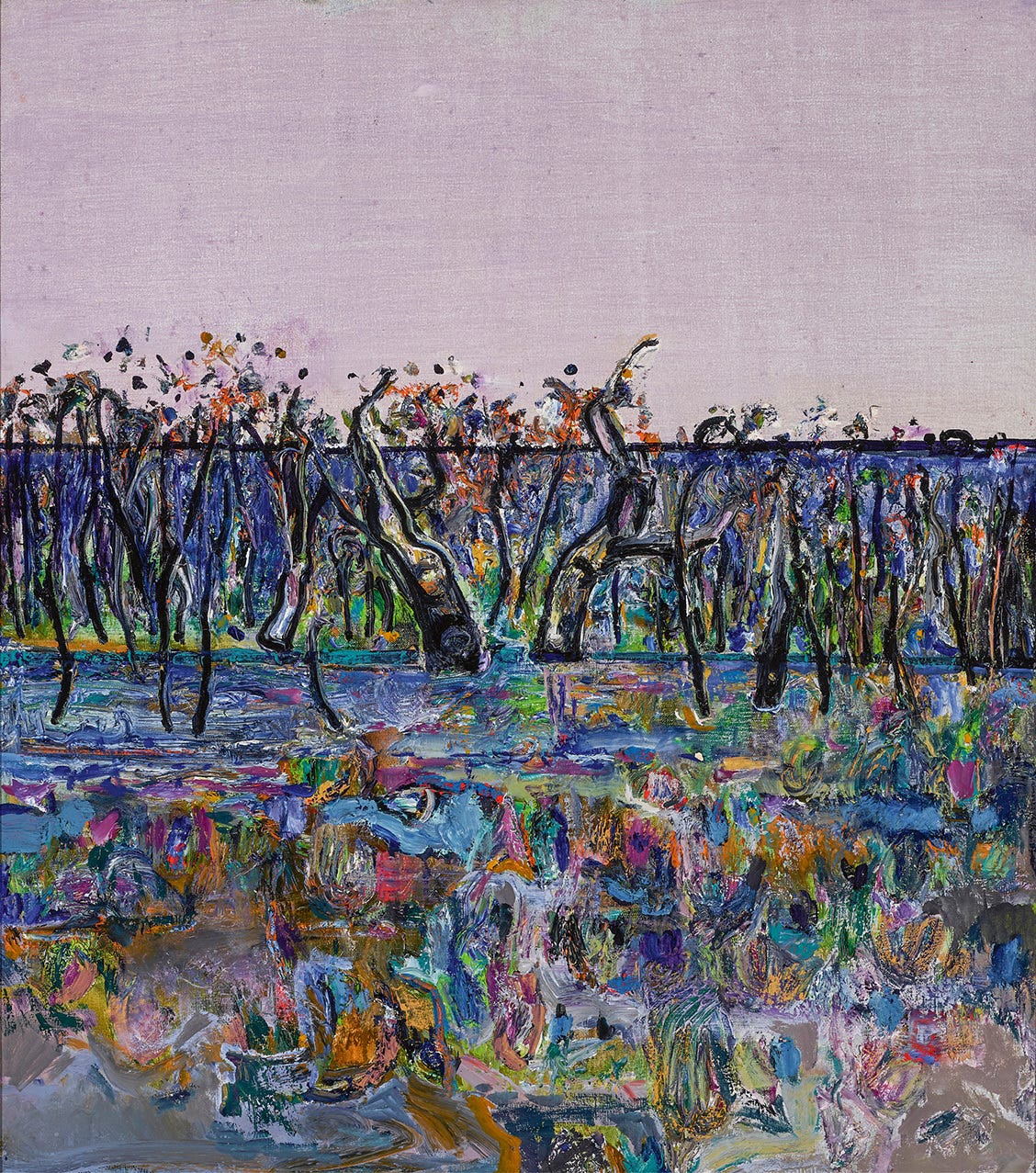

DEL KATHRYN BARTON, the heart land 2013-14 (panels 1-5) (Yours for around $2 mil)
Bending toward Fuentes
Richard Hanania on the madness.
I’m in UnHerd on what to make of Heritage bending the knee to Groyperdom.
Things are happening much more rapidly than I expected. My article focuses on the comparison to wokeness, and why Groyperization might actually be much more powerful and long lasting in the end.
We’re at the start of something, not the end of it. This is more like wokeness in 2014 than wokeness in 2022. And to make a comparison to wokeness might be underselling it. I would point to three factors that potentially make Groyperism stronger.
First, the appeal of wokeness was always largely astroturfed. The woke relied on censorship and nonstop propaganda from elite institutions. Relatively few Americans bought into the craziest ideas about race and gender. Robin DiAngelo’s White Fragility may have sold more than a million copies, but Carlson has nearly five million subscribers on YouTube...
We’ve never seen numbers like this for anything affiliated with wokeness, which was a hysteria driven by individuals in the rarefied fields of journalism, academia, and activism. They were always outnumbered in the rest of the country, and relied on being able to control powerful institutions and the informational ecosystem.
The second point is related: namely, that Right-wing radicalism taps into human nature in a way that wokeness never could. From a historical perspective, large numbers of young people wanting to experiment with a different gender is quite odd. Usually, males and females seek to portray and cultivate traits that are attractive to the opposite sex. Members of a majority group supporting discrimination against themselves is likewise unnatural, but this has always been core to DEI and the ideology of white guilt...
Finally, the Right lacks the institutional guardrails to contain Groyperization. The culture of the Left is shaped by elite institutions, like universities and major media outlets, in addition to labor unions, professional associations, and nonprofits... At the same time, the institutional framework in which these battles took place allowed for pushback from within. The New York Times editorial board is capable, for example, of gently shifting away from trans extremism. Universities can adopt free-speech policies, as many have done, in response to both internal and external pressure.
In contrast, it is unclear in what format moderates on the right would take on the fringes. Individuals like Owens, Fuentes, and Carlson — in addition to countless lesser influencers — get their power directly from the audience and, as a result, place real pressure on politicians... Robin DiAngelo is no longer cited in the media, and Ibram X. Kendi’s antiracist center was closed down. Without institutional support, their power and influence have waned. By contrast, the podcaster who reflects and shapes the minds of the most engaged GOP voters can’t in a similar way lose his place at the center of political discourse...
Everyone was like oh we’re sick of this liberalism stuff, we’re sick of elites telling us what to do, sick of gatekeepers. Social media should treat all views equally. We don’t cancel! The answer to bad speech is more speech. Well, ok. We’re running that experiment...
If you’re a conservative now who isn’t an ethnonationalist, you’re just completely outmatched. The other side has the numbers and the energy, and there is such a thing as the internal logic of a movement... The equivalent for the right now is the young male who is racist, angry, and sexually frustrated – the Groyper. People like Trump and Vance can’t denounce them, nor can supposed intellectuals like Yoram, because Fuentes is just the undistilled version of what they’re selling, which is white grievance, showmanship, and anti-liberal posturing.
Groyperization is the natural endpoint of what the entire Trump era has been about. And there’s no guarantee that it will burn itself out...
A little light relief as we continue with our Post Melbourne Cup recovery routines

HT: The Australian Statistician
Sad learning of the comic vanity of a great intellectual
The metaphysics of Miller and MAGA

I was interested in this piece, and finally understood - in the sense of being able to relate to - Augustine’s objection to Manichaeism.
“You, [our ‘enemies’], have nothing. You are nothing. You are wickedness, you are jealousy! You are envy! You are hatred!… You can produce nothing. You can create nothing. We are the ones who build… We have beauty, we have light, we have goodness, we have determination, we have vision, we have strength… We are on the side of God.”
Stephen Miller -
“It was granted me to carry away from my prison years on my bent back, which nearly broke beneath its load, this essential experience: how a human being becomes evil and how good… Gradually it was disclosed to me that the line separating good and evil passes not through states, nor between classes, nor between political parties either—but right through every human heart—and through all human hearts. This line shifts. Inside us, it oscillates with the years. And even within hearts overwhelmed by evil, one small bridgehead of good is retained. And even in the best of all hearts, there remains…an unuprooted small corner of evil.”
Aleksandr Solzhenitsyn -
Like many across the nation, my wife and I tuned in last Sunday to the Charlie Kirk memorial held following his brutal murder. One of the first things that struck us was its metaphysical register. I do not use this word lightly, to refer merely to apocalyptic language, weighty themes, or philosophical airs. I mean this in the technical sense: the science of what is insofar as it is; being qua being. Fundamental claims were advanced about first principles, participation, the great chain of being, and the ontological status of evil.
In what follows, I will draw attention to the metaphysical statements made at the memorial by two men in particular: Stephen Miller and Larry P. Arnn.
Together, their speeches present an erroneous and dangerous vision of the nature of evil, one which is foreign to both classical and Christian philosophy of evil as privation of/parasitic on the good, even while they enlist the support of Athens and Jerusalem. Theirs is a view in which evil succeeds in cutting itself off from any relation to the good, becoming a “nothing” which is nonetheless substantial, standing apart from and opposed to the good. It is, somehow, at once an existential threat and entirely powerless...
Miller’s Manichean vision assumes an implicit metaphysics. “We” are the light, resplendent in purity, responsible for all that is good. “We” are the rightful heirs and guardians of civilization. “We” are, in short, being, pure and substantial.
“They,” our enemies, oppose all that is good, for no reason but pure malice. They worship at the altar of evil and chaos. They are outside civilization, even outside humanity...
But even the slightest familiarity with the actual Western tradition allows one to spot Miller’s mistake. The idea that evil is the good’s substantial other (or, which comes to the same thing, entirely deprived of being or goodness) is as foreign to Plato and Aristotle as it is to Augustine and Kant.
For Plato and his successors, evil is always a privation of something good. Indeed, in an important sense there is, in the end, no such thing as malice or choosing evil for evil’s sake; we are ineluctably oriented to the good and can at most fall short of it through ignorance. Evil has neither independent existence nor reified non-existence...
The Christian tradition, following Augustine, is more willing to speak of perversity or evil proper, rather than mere ignorance. But even here, evil is always parasitic upon the good. It has no intelligibility or positive being of its own, but “exists” only by twisting or totalizing something which is, in itself, good...
Arnn’s “Ladder” of Being and Its Sudden Collapse
Arnn begins by positioning himself as someone who can offer this deeper perspective. He writes that he once asked a young Charlie Kirk “some questions he couldn’t answer.” “You have to suffer,” Arnn told him, directing him to immerse himself in the texts of the Western tradition...
Even better, Arnn immediately introduces a genuine theme of the metaphysical tradition, the great chain of being. “There’s a ladder that reaches up toward God,” he intones. “And at the bottom of it are the ordinary good things that are around us everywhere. If we can call them by their names — they have being, and the beings of the good things are figments of God.” This “ladder” is a Neoplatonic commonplace, and thus it seems that at last we make contact with an actual philosophical tradition...
Yet Arnn’s remarks soon take a somewhat shocking turn. “Do you know,” Arnn informs us, “a good thing is a thing that has being. An assassin is not a thing that has being. The assassin must give up his humanity to destroy something that has being.” Just a moment after being introduced, our ladder of being is discarded, and we have returned to the Manichean imaginary. There is a distinction, apparently, between “the good things” which are figments of God, and other things which in no way are...
Metaphysics, it turns out, matters. But even in these dark days, there is no place for despair, or for a parallel dehumanization of those who instrumentalize all that is noble. Tyler Robinson, Stephen Miller—these are inner possibilities of our own souls, which are constantly in movement, constantly converting to something. And we can trust that the Good shines through, in its illimitable power, despite our distortions and political machinations.
From a reader
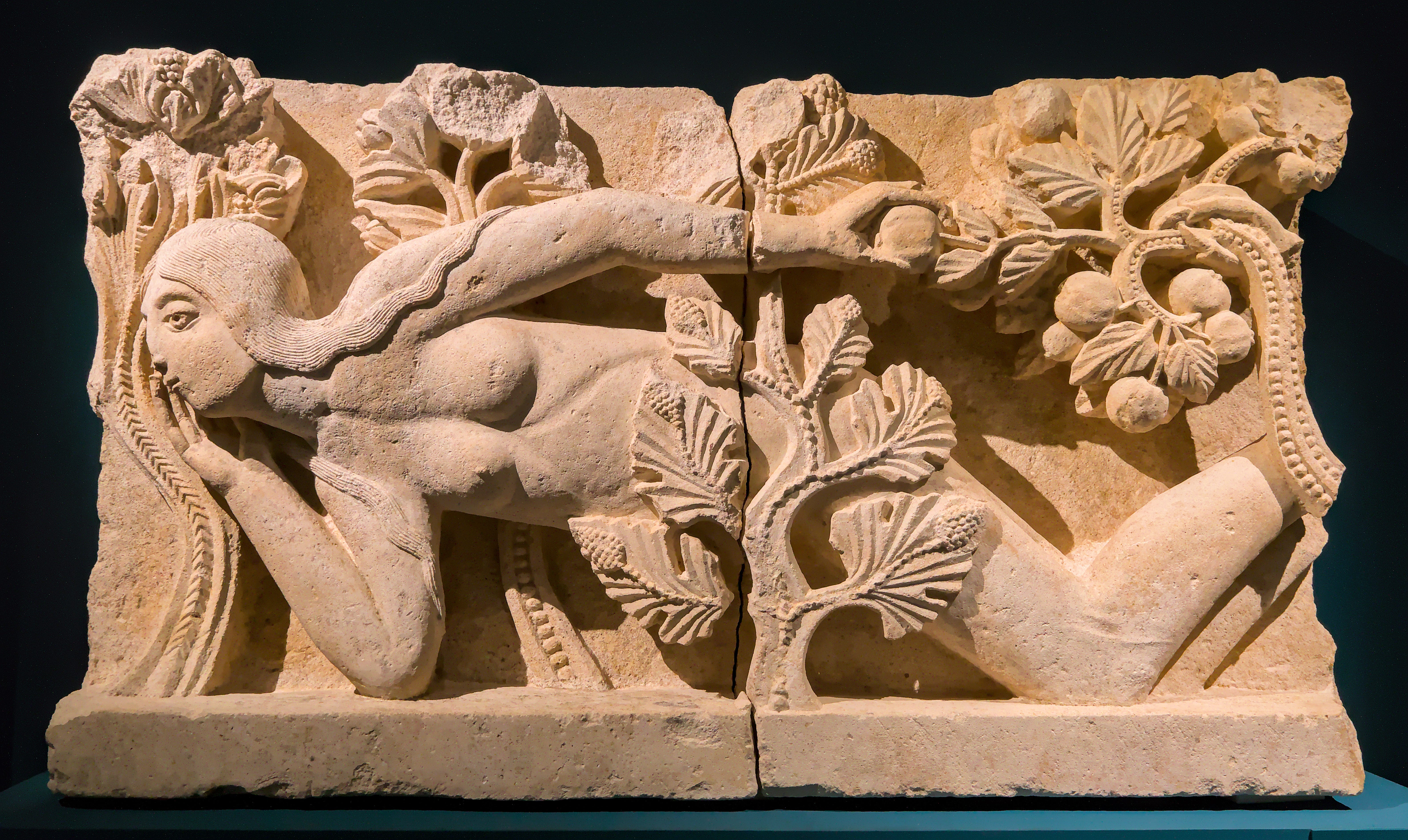
Thank you for giving a run to the Gislebertus carving of the Magi being reminded to get a move on lest they miss the birth of Our Blessed Saviour.
I saw it 40 years ago in Autun and it’s stayed with me vividly, as have many of the artist’s other work in that town - the carving of Eve in the Rollin Museum especially.
Paddy Gourley
Which spurred me to present it to you.
Good review of Jordan Peterson’s latest
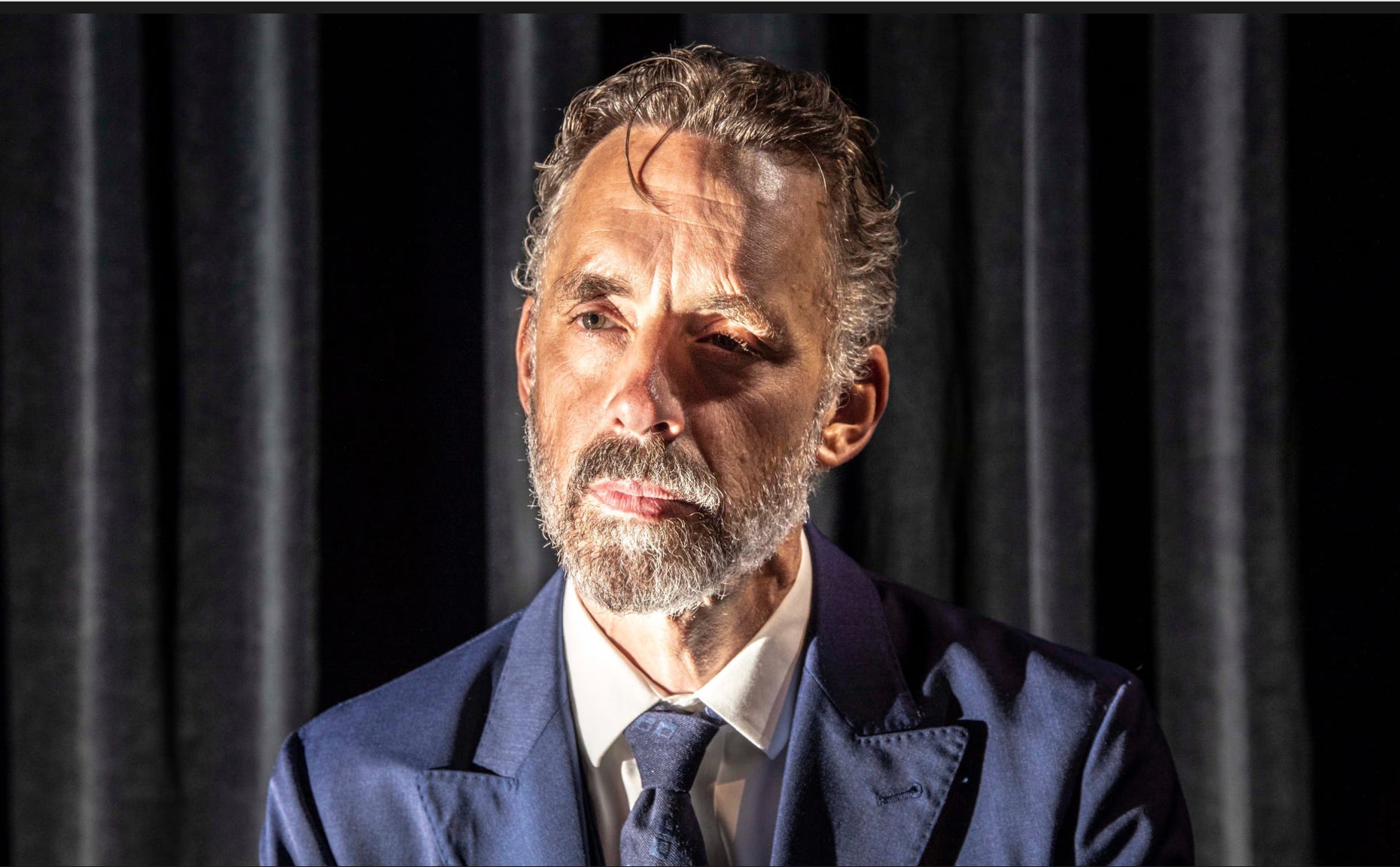
Which is to say I agreed with it - even without reading the book ;)
By Rowan Williams.
It is not easy to review any book by Jordan Peterson, the prolific Canadian psychologist turned lifestyle sage. The temptation is to respond not to the work but the person (or persona): irascible, derisive, uncompromising, contrarian. But here, the work itself poses problems; it is a sprawling, repetitive text that could have done with some ruthless editing. Ostensibly a step-by-step guide through the biblical narratives of Genesis and Exodus (and, for some reason, Jonah), with the goal of uncovering wisdom to help meet present-day moral challenges, it in fact returns persistently to some of Peterson’s favourite tropes about modern culture, its flabbiness and confusion.
At one level its structure and argument are clear enough. The scriptural text confronts us, says Peterson, with a set of life-and-death choices. We can conform our rebellious fantasies and myth-driven aspirations to the underlying moral structure of reality, or we can refuse. If we refuse, we wreck our own lives and those of others. If instead we recognise reality, we then face two sorts of pressure...
There is the social pressure to adjust, not to reality itself, but to fashionable orthodoxies – particularly around gender fluidity, racial sensitivities, the reluctance to call people to responsibility for their actions. And there is the internal pressure of a self-serving, sentimental quest for low-cost answers to challenges of moral significance – false compassion, over-identification with the supposedly vulnerable, cheap indulgence of the surface wants of self and others. But if we are prepared to stand firm in the face of these pressures, the reward is a life of integrity, inner strength and the capacity for living with “adventure” (a favourite word). The stories of Jewish scripture – read with a strong admixture of Christian material – provide stark illustrations of the consequence of dishonesty or unreality, and powerful images of the kind of integration and strength generated by obedience to the truth.
Two points to begin with. One is that Peterson remains ambiguous about what many would consider a fairly crucial issue: when we talk about God, do we mean that there actually is a source of agency and of love independent of the universe we can map and measure? Faith is “identity with a certain spirit of conceptualization, apprehension, and forward movement”, he writes in relation to Noah; it amounts to “a willingness to act when called on by the deepest inclinations of his soul”. Echoes here not only of Jung, who figures as a key source of inspiration, but of the radical 20th-century Protestant theologian Paul Tillich, who proposed redefining God as whatever is the focus of our “ultimate concern”. Some passages imply that God is identical to the highest human aspirations – which is not quite what traditional language about the “image of God” in humanity means...
The second point is connected. Peterson’s readings are curiously like a medieval exegesis of the text, with every story really being about the same thing: an austere call to individual heroic integrity. This is a style of interpretation with a respectable pedigree. Early Jewish and Christian commentators treated the lives of Abraham and Moses as symbols for the growth of the spirit, paradigms for how a person is transformed by the contemplation of eternal truth. But, as with these venerable examples, there is a risk of losing the specificity of the narratives, of ironing out aspects that don’t fit the template...
The effect is somewhat one-note; the actual way in which the stories develop, speak to one another, correct one another, handle internal tensions and debates is muted at best. This is the sort of thing that classical rabbinical exegesis in fact relishes, and that some more modern Jewish discussion – by Emil Fackenheim, Jonathan Sacks, Nathan Lopes Cardozo and others – models very powerfully. Peterson is rightly hostile to antisemitism, and this might have led him to engage a bit more with the rich world of Jewish interpretation. Instead, he relies a lot on rather dated Christian commentaries (and seems to have a limited acquaintance with Hebrew, a drawback for a project like this).
In fairness, he does pick out some distinct trajectories within the stories, for example, in the narratives about Moses. But the expositions constantly shade into meandering polemic about a range of modern issues, especially gender, on which Peterson has made his position pretty clear elsewhere...
Predictably (for those familiar with his online battles), he sees any qualification of the simple binary of gender identity as equivalent to denying the difference between good and evil, a refusal of the basic polarities of reality. But most serious discussions of gender fluidity do not deny evolutionary biology or sexual differentiation as such; they are asking for a more painstaking attention both to the social construction of roles and to the specifics of dysphoria. They deserve a better level of engagement...
And so on, with other issues as well [such as] the conclusion of the Book of Jonah [being] made the occasion for a tirade about valuing the “natural” world over human life, which seems to have something to do with Peterson’s hostility to some kinds of environmental ethics; not really what the text is about. These rabbit holes do no great service to the broader challenges Peterson wants to draw attention to. There really are corrosive manifestations of hedonism, relativism and infantilism in our culture; there really is a mentality that deludes us into thinking that we can be whatever we want to be, and that any notion of short-term sacrifice for a more durable and fully shareable good is unimaginable.
But the insistent contempt for nuance and disagreement (”idiotic”, “addled”, “egregious”), and the reduction of any alternative perspective to its most shallow or trivial form, does not encourage the serious engagement Peterson presumably wants. This is an odd book, whose effect is to make the resonant stories it discusses curiously abstract. “Matter and impertinency mixed”, in Shakespeare’s phrase.
What is it with pumping stations


Heaviosity half hour
Kissenger on Raymond Aron
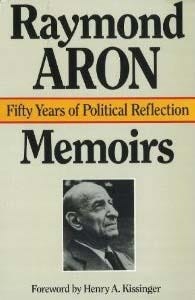
Whodda thunk?
From the forward to Raymond Aron’s memoirs Fifty Years of Political Reflection.
Henry A. Kissinger Raymond Aron was a philosopher and a journalist. He wrote seminal works on the philosophy of history, on Clausewitz, on war and peace. He composed several trenchant columns a week, mostly for Le Figaro but also for an extraordinary range of other publications, philosophical, historical or topical in scope. And he maintained that pace with astonishing brilliance for nearly fifty years.
Raymond Aron was my friend. He was also my teacher. Few intellectuals have had a deeper impact on my thinking; none a greater one. Lest I burden his memory with my critics, let me add that he was on occasion less than satisfied with his student.
I met Raymond Aron in Paris in the fifties. It was in his apartment along the Seine--I a graduate student and he already a famous intellectual. At the time I was editing a publication called Confluence, a journal of limited circulation which I had launched in naive ignorance of the mechanics of publishing a small magazine, not to mention the financial vagaries. It was to be a medium through which European and American intellectuals could debate a series of issues of mutual interest. Aron seemed surprised at my youth; I was intimidated by his fame and somewhat skeptical manner. It was my initiation to Aron’s characteristic mixture of intellectual rigor and emotional support. Though he had much better outlets, Aron not only wrote for Confluence but was also a great help in inducing other well-known French authors to do so.
Until his death some thirty years later, that first meeting set the tone of our relationship. I genuinely admired Raymond Aron; in turn, he gave me every indication of his regard, even of his affection, though in these memoirs he feels compelled--quite properly--to make clear that he was never one to surrender his judgment to the friendship of a Secretary of State.
In the Epilogue of these memoirs, Aron speculates about whether he was considered cold. Those who knew him had no such doubts. They realized that he was a man of passion, deeply committed to liberty, to Western culture, and to democratic ideals.
Aron was French and he was Jewish. He witnessed the decline and rebirth of France and the persecution and survival of the Jews. He lived through the confusion of prewar Europe; through exile in London during the war and all the tumults of internecine struggles, decolonization and internal debate of postwar Europe.
Through all this turbulence Raymond Aron maintained his sense of proportion and above all his sense of direction. Like a rock against which the waves hurl themselves, on the surface the very cause of their turmoil, in historical perspective Aron becomes the figure to illustrate others’ transitoriness. What a record of steadfastness the writings of Aron represent in opposition to the conventional wisdom of his day! By the time the Second World War broke out he had already witnessed the fatuousness of a policy that sought to protect the small countries of Eastern Europe by a defensive strategy in the West. He warned against the failure to resist--in the name of peace and negotiation--the German reoccupation of the Rhineland, which gave Nazi Germany a glacis behind which it effected the overthrow of the existing European order. Aron understood that the British guarantee of Poland amounted as well to a guarantee of the Soviet borders since the German armies could not reach the Soviet Union without first crossing Poland. And he saw clearly that, therefore, paradoxically and unjustly, negotiations with Moscow would be rendered more difficult by Britain’s decision at last to abandon appeasement.
In London during the war Aron supported the Free French. Throughout the postwar period, he was a staunch supporter of European unity, American friendship and Franco-German reconciliation. In the travails of France, he usually took the unpopular position. He was an early advocate of Algerian independence, recognizing that the “liberal” solution of greater autonomy would never satisfy on a continent where all colonies were on the road to independence.
Aron’s friendship for America was deep but far from uncritical. Indeed, side by side with his defense of Atlantic partnership, persisted a masterful-occasionally scathing--critique of the policies by which this partnership was being implemented, including those of the author of this foreword. On Vietnam he deplored the extent to which America had staked its prestige even as he understood the struggle to extricate itself with honor.
Through the decades, Aron never wavered in his commitment to the cause of freedom. He never joined the Marxism in vogue with such contemporaries as Sartre and Merleu-Ponty, or the fashionable anti-Americanism of Malraux. He walked alone for the greater part of his life, only to be vindicated at the end by the turn of French intellectuals away from Marxism--though perhaps too late to give him the formal recognition of intellectual leadership which was his due.
Documenting Aron’s intellectual life might easily overwhelm even the most devoted biographer, for how could anyone distill the passion, the honesty and the dedication behind such a stupendous output?
Fortunately for posterity, Aron undertook the task himself at the end of his life.
In this intellectual biography, at once modest and moving, Aron steers the reader through the spiritual odyssey of his life using extracts from his own reader through the spiritual odyssey of his life using extracts from his own most significant articles and books as guideposts. One meets not only the author but also the extraordinary group of men and women he encountered on the way. The memoirs are profound, yet easy to read; they reveal a warm, caring personality whose commitment to the principles of freedom provided the impetus for his extraordinary labors.
For a man like myself, involved for many years in the mundane tasks of diplomacy, Aron’s book is not always comfortable reading. Clearly, his judgment of my efforts as a statesman is less admiring than mine of his contributions to Western thought.
This is as it should be. The philosopher deals with truth; the statesman addresses contingencies. The thinker has a duty to define what is right; the policymaker must deal with what is attainable. The professor focuses on ultimate goals; the diplomat knows that his is a meandering path on which there are few ultimate solutions and whatever “solutions” there are, more often than not turn into a threshold for a new set of problems.
De Gaulle characteristically summed up the dilemma in a letter cited by Aron: “It happens that I am sometimes not convinced by what you write and I know that from the outset you have rarely approved what I do. However, please believe that I admire the way in which your mind attempts to encompass the great flood that is carrying all of us toward an apparently measureless and, in any event, unprecedented fate.”
I last saw Aron in the summer of 1982. An obscure bank official from a small town in the south of France wrote to him that it was his dream to bring Aron and me to Draguignan for a dialogue. Aron took up this unusual request with his usual dedication, However, he had by then become quite frail, and my wife, Nancy, urged me not to delay accepting because she feared that he soon would not have the strength to go through with it.
So we went to Draguignan in June 1982. The organizers and a group of French veterans first took Aron and me to an American military cemetery at the edge of town as a symbol of their ties to America. The mayor of the town had refused to make a public building available, whether in protest against Aron or me I no longer remember. But a large tent had been erected and Aron questioned me before an audience of several thousand, He did so with a fierce tenderness, being, both demanding and confident that I would withstand his rigorous cross-examination.
In the final years he had taken to kissing me whenever we met or parted-a sign, I felt, that he thought every meeting might be our last. A few months after Draguignan, Aron died, on the steps of a courthouse where he had gone to testify for a friend unjustly accused of collaborating with the Nazis.
It was an honor to have been his contemporary.

Here is Arno Rosenfeld on Carlson-Fuentes and I am delighted to say that the Forward took down their paywall about 2 years ago https://forward.com/news/antisemitism-decoded/781786/heritage-tucker-carlson-fuentes-maga-israel/. That was enough to convince that Fuentes getting anywhere near the mainstream is very, very scary
There may be no central woke figure who can get 5 million subscribers on YouTube. (New York Magazine is probably my primary source of woke commentary and they have nothing like 5 million subscribers.) But Tucker Carlson may have that 5 million because he is seen as the only person doing straightforward right-wing populism whereas woke messages are diffused across a whole universe of mainstream TV shows and podcasts.