



Yes folks, as he reflected on his handiwork, Thomas Jefferson thought there was something fundamental missing from the democracy he’d help establish in America. Of course he was trying to head off democracy, but that’s another story. The important thing is that he knew that if citizens were to exercise their responsibilities wisely, they’d need to practice doing so. Citizenship couldn’t be left a spectator sport. Citizens needed to able to participate in public business as it was being transacted from day to day.
Their private rights needed protecting. But they needed also to be personally involved in defending the public realm. After all, that’s what a republic was. Res publica - which literally translates as ‘the public thing’. If this reminds you of citizens’ juries, that’s what it reminds me of, though, as you’ll read, Jefferson’s thinking took a somewhat different direction. Anyway, rush on down to Heaviosity half hour at the end of this newsletter where I extract Hannah Arendt’s writing on this intriguing aspect of Jefferson’s thinking. (She agreed with him of course.)
In the meantime, I recommend this excellent introduction to the relevance of Hannah Arendt today.
The truth will set you free (only kidding)
Based on Yascha Mounk’s comments below and my own opinion of Kamala Harris, I didn’t watch the interview above, though it’s there as a source if you’d like to consult it.
After half a year out of the public eye, Kamala Harris reemerged… to promote a book. In an appearance this summer on the “Late Show With Stephen Colbert,” Harris announced that her book, 107 Days, would give readers a “personal and candid” tour of last year’s ill-fated presidential campaign. But it rapidly became clear that the book would hardly provide a hard-hitting look at the reasons Donald Trump won back the White House.
When Colbert asked what Harris would have done differently, she responded that “none of us achieves any success without having an incredible team.” Asked whether she could have done more to distance herself from Joe Biden, Harris assured the audience that “I have an incredible amount of respect for him.” By the end of the half-hour interview, even Colbert, about as sympathetic an interviewer as Harris could have hoped for, lost patience. When Harris evaded yet another question by saying that a full answer “requires a lot more time than we have right now,” Colbert turned to the audience and dead-panned: “Are we in a hurry, guys?”
The book, published this week, confirms that Harris doesn’t have a serious theory as to why she lost. She has become a little more willing to criticize Biden; but rather than grappling with the real failings of the administration in which she served as vice president, she mostly focuses on his supposed lack of loyalty to her...
This has left the Democrats in a strange position. After eight tumultuous months in office, Donald Trump has grown unpopular with the American public. His approval ratings have steadily fallen. He is now about 10 points underwater. But despite this window of opportunity, Democrats are failing to capitalize on their opponent’s weakness.
According to a poll this summer in The Wall Street Journal, 33 percent of voters hold a favorable view of Democrats, compared with 63 percent who hold an unfavorable one—the party’s worst numbers in the history of the poll...
So what would an honest autopsy reveal? Why are Democrats so unpopular with so many Americans? And how can the party accomplish the one thing that is indispensable if it wants to resist Trump’s escalating attacks on the basic rules and norms of the American Republic—win elections?
The most important reason for the difficulties Democrats are facing is [that] they are out of step with the views and the values of most Americans.
It is at times tempting to think that American voters don’t know what they want. They were angry at Biden’s lax handling of the southern border but quickly turned on Trump’s heavy-handed immigration policies. They mistrust Democrats on economic policy, fearing that they will raise taxes without courting economic growth, and yet they dislike Trump’s “big and beautiful” budget bill.
But there is a coherence beneath the apparent confusion. On both economic and cultural issues, most Americans have views that are both moderate and reasonable. Those views don’t merely amount to splitting the difference between the current positions of Democrats and Republicans; they are a principled expression of moderation...
All of this suggests a path forward for Democrats that is both principled and pragmatic.
Take the economy. When Democrats attack capitalism, they make themselves electorally irrelevant in large swaths of the country they desperately need to vanquish Trumpism. But Democrats can absolutely expand their coalition by combining an appreciation of the free market with a sharp condemnation of the ways in which the current practice of capitalism is rigged...
Something similar holds true for culture. During the time of Richard Nixon, the “silent majority” of Americans may have been sexist, racist, and homophobic. Today it is not. It is absolutely possible to win electoral majorities if you fight for a tolerant America that opposes racism without degenerating into a zero-sum brand of identity politics...
For all these reasons, the energy in the party has for the past decade been with a toxically unpopular form of identity politics. Some senior figures within the party continue to defend these ideas—and the more radical the actions of the Trump administration become, the more loudly they will claim that any course correction amounts to capitulating to the White House. If Democrats decide to dig in their heels, they will likely continue to lose favor with the American public.


Inquiry into cause of death finds no cause of death
Meanwhile the Democrats vote no confidence in the electorate. (I know how they feel, but I’m not running for office.) Here are some extracts from a report on the Democrats’ ‘autopsy’ into their loss.
The Democratic National Committee’s examination of what went wrong in the 2024 election is expected to mostly steer clear of the decisions made by the Biden-turned-Harris campaign and will focus more heavily instead on actions taken by allied groups, according to interviews with six people briefed on the report’s progress.
The audit, which the committee is calling an “after-action review,” is expected to avoid the questions of whether former President Joseph R. Biden Jr. should have run for re-election in the first place, whether he should have exited the race earlier than he did and whether former Vice President Kamala Harris was the right choice to replace him, according to the people briefed on the process so far.
Nor is the review expected to revisit key decisions by the Harris campaign — like framing the election as a choice between democracy and fascism, and refraining from hitting back after an ad by Donald J. Trump memorably attacked Ms. Harris on transgender rights by suggesting that she was for “they/them” while Mr. Trump was “for you” — that have roiled Democrats in the months since Mr. Trump took back the White House.
Party officials described the draft document as focusing on the 2024 election as a whole, but not on the presidential campaign — which is something like eating at a steakhouse and then reviewing the salad...
“We are not interested in second-guessing campaign tactics or decisions of campaign operatives,” said Jane Kleeb, the Nebraska Democratic chairwoman, who heads the association of Democratic state chairs and is a close ally of Mr. Martin. “We are interested in what voters turned out for Republicans and Democrats, and how we can fix this moving forward.”
Locked out of power at the federal level, Democrats are struggling to show that they have taken to heart the message that voters sent in November and are well suited to regain power in future elections.
The review, which was begun in March and is being led by Paul Rivera, a veteran Democratic operative, is not yet complete and the report is not fully drafted. Mr. Rivera nonetheless has begun briefing people on what the report has found so far, and those briefings suggest that the Democratic autopsy will avoid addressing some of the likeliest or leading causes of death...
Top Democrats said they did not intend for the report to address strategic decisions made by leaders of the Biden and Harris campaigns. Indeed, in a sign of the report’s narrow scope, more than half a dozen people who were senior officials on the campaigns say they have not yet been interviewed...
People briefed on the report’s progress said they had been told it would focus more on outside groups and super PACs that spent hundreds of millions of dollars aiding the Biden and Harris campaigns through advertising, voter registration drives and turnout efforts.
Ms. Kleeb said she expected the report to accelerate the party’s diversion of resources from advertising to organizing.
“The days of us spending millions and millions of dollars on traditional TV ads are over,” she said. “And I do think that this report will put an exclamation point on that.”
In particular, the people briefed on it said, the after-action review is expected to place blame with Future Forward, the party’s main super PAC, which spent $560 million to support Mr. Biden and then Ms. Harris. They said the report would argue that Future Forward spent far too much propping up Ms. Harris and not nearly enough attacking Mr. Trump...
The D.N.C.’s election review, which will extend to contests for Congress and state offices, is not the only one underway. Jen O’Malley Dillon, who oversaw the Biden and Harris campaigns, is involved in a separate monthslong project being led by Melissa Williams, a former top official at Emily’s List who oversaw the group’s independent political spending...
A third look back is being led by the Strategic Victory Fund, a network of liberal donors and organizations...
“So many people in my world, after 2016, jumped into a resistance mode that there wasn’t a real thoughtful moment to talk for a minute with all the key people about what we’re doing right and wrong about every aspect of politics and culture,” Mr. Anderson said. “We really need to take a step back in a way that I don’t feel was done after 2016, and have hard conversations.”
The D.N.C.’s report is expected to be far different from the so-called autopsy that Republicans produced after the 2012 election of Barack Obama. In March 2013, the Republican National Committee released a 100-page “Growth and Opportunity Project” report that declared the G.O.P. was in an “ideological cul-de-sac” and called for moderation on immigration along with a number of other changes.
While Republican leaders did adopt many of its recommendations in time for the 2016 election, Mr. Trump’s campaign ran counter to many of the changes the R.N.C. had proposed, and he has since remade the Republican Party in his image.
Kirk’s killer could have been my son …

Perhaps a little too neat, a little too pat. But a powerful thought nevertheless.
That could be my son. This thought has been stabbing at me for the past two days since they identified Charlie Kirk’s killer. And, if I’m being honest, it’s been niggling at me for the last three years with every senseless shooting perpetrated by a lone, white, young male.
That could be my son. It’s not just that Tyler Robinson looks a little like my 19-year-old. It’s also not that he, too was raised in a loving, conservative home. No, it’s that Tyler Robinson, like my son, went from being a highly intelligent and well-adjusted (albeit slightly socially awkward) boy with a promising future to a radicalized young adult—and seemingly overnight.
Three and a half years ago, my son chose trans. Tyler Robinson chose murder. It is my belief that these young men (and all the other lone, white young male shooters) have a common starting point.
Let me begin by saying they are all culpable. Whether it’s invading women’s spaces or assassinating innocent souls, only they themselves are to blame for their actions. With that out of the way, I’d like to talk about what got them there. Because if we can begin to understand, perhaps things can begin to change...
We have been telling boys for well over 20 years now that their base instincts are primitive and disgusting. We have told them again and again that their mere presence is a threat to women. Not their actions—their presence. I support the good that came from the #metoo movement (it was a needed correction, for sure), but a lot of damage came with the fallout.
Our boys became hyper-aware that every interaction they have can be misinterpreted and cast as suspicious... And that’s just the male part of their identity! They also absorbed and internalized the message that their whiteness carried with it a history of grave harm. In the last three decades, in a mostly well-intentioned effort to correct the wrongs of the past, our educators have taught a message loud and clear: white supremacy and patriarchal systems have harmed millions of people throughout history.
How could our boys not begin to hate what they saw in the mirror? They were born with two immutable traits that the rest of the world defines as threatening, two traits that put them at great risk for social rejection...
For our boys—our highly intelligent, sensitive, slightly awkward ASD trait boys—most didn’t have that safety net. Making friends “IRL” was never easy. And so maybe they scratched that itch online. They found their people in the virtual world. Some found it on Discord, others on gaming platforms, and still others in very dark recesses of the internet.
And here is where the problem begins to bear rotten fruit. Unlike their well-adjusted male counterparts, their real-life exposure to peer groups begins to stand more and more in sharp contrast to their online spaces of full acceptance... They stand at the crossroads of three radicalized paths: rejecting their maleness, fighting as a radical ally, or becoming the very threat the world says they are.
But let’s pause for a moment and remind ourselves of what else was going on during this era. At the same time that being white and male was increasingly becoming a social liability, the world began to lie about the mutability of one of those traits. Since 2010, there has been a massive spike in transgender-identification among late teens and young adults...
It is my belief that these intelligent and sensitive boys, without a healthy way to reinforce a stable sense of self through peer interaction, had to find a way to survive their own existence. Whether it was a burning need to explain their suffering (brought on by social isolation or trauma), a desperate desire to literally rid themselves of those unwanted traits, or a fierce and tormented longing to belong somewhere... they did what they had to do.
“Becoming a woman” was my boy’s escape from self-hatred. With that choice came instant acceptance (and not just online). It also offered a ready-made explanation for his pain... For others, adopting the role of a “warrior ally” is their ticket out of self-shame. They fuse their identity so tightly with the cause against white supremacy and patriarchy that it tips into radicalization. And still others, in a huge, defiant f-you, throw themselves into the alt-right corners of the manosphere...
Martin Wolf: British European and man of the world

Martin Wolf appreciation of coffee for the FT. As you can tell, he loves civilisation.
I am a coffee addict. I do drink tea, especially excellent Chinese and Darjeeling teas. But I adore the powerful flavours of good coffee, not to mention the stimulus it provides to the tired mind. I learnt to love coffee as a teenager in Italy, and nearly always drink Italian-style coffees: cappuccino, espresso and macchiato.
Every morning, when at home in London or at our apartment in Italy, the first thing I do is make my cappuccino in a Pavoni coffee maker. I love the feeling of controlling the intensity of the coffee when pulling the lever. Steaming the milk is still an enjoyable challenge. Sometimes it is the perfect blend of milk and foam. Sometimes it is not.
Again, as is normal in Italy, I have my last cappuccino no later than midday. I then switch to espresso or macchiato. For that I sometimes use Bialetti machines, which boil the water on a hob. I also use the AeroPress or the cafetière, which make longer coffees. Of the two, I much prefer the AeroPress, which makes a single cup of really strong coffee. But the Pavoni is my favourite gadget.
Then there is the big question of beans. I grind mine myself as I like them finely (and freshly) ground. The result tends to be more intense and somehow livelier coffee. Some people roast their own beans but that is not for me. I buy them already roasted. It is easy to get high quality beans of many different varieties. So, I experiment. My current favourite is “monsooned Malabar”, which I get from Coffee Direct. These beans are exposed to the monsoon rains and winds of southern India. This, they say, causes the beans to swell and lose their acidity. The taste is intense and yet without any bitterness. For me, that combination is perfect.
Two final things: no sugar and no cocoa powder, ever. Coffee on its own is supreme. And as to the coffee one gets in most London coffee bars, the less said about that the better.
Separating power and authority

I remember looking at that view from Namura Securities in Tokyo in 1984. But I digress. Andrew Middleton posted this comment on LinkedIn. As you’ll see, it raised issues I’ve been thinking about for a while.
Rebecca Drew told me about a Japanese idea that stopped me mid-coffee.
In Japan, when the boss retires, the company doesn’t just throw a party, hand them a gold watch, and wave as decades of knowledge walk out the door. Instead, they give them a small but important role: sodanyaku or komon.
It’s as if they’re moving from the driver’s seat to the passenger seat. The new boss has the wheel, but the old one stays in the car for a while, pointing out the sharp bends and the shortcuts.
These senior advisors don’t run the business. They don’t meddle in day-to-day stuff. They turn up now and then with a lifetime of wisdom, a few valuable contacts, and the kind of calm you only get after years of disasters survived and mistakes made.
Meanwhile, the new boss learns the ropes without falling into the same holes.
I’m no expert in this. I’m only just finding out about the concept myself. I’m sure there are people out there who can explain it far better. It just sounds like something that might have real value in other countries as well.
The role is simple. One day a week. It’s a clear job: mentor a couple of people, keep three big relationships warm, and offer advice on one or two key projects. There is no line management, no endless meetings, just wisdom on tap.
Outside Japan, we often do the opposite. Friday night, retirement speech, slice of cake, then off they go. Monday morning, the new leader arrives and… promptly repeats half the same mistakes because no one told them why things are the way they are.
This Japanese idea could change that. Respectful. Practical. Human.
Maybe it’s time more of us borrowed it.
I’d love to hear from anyone who’s seen this done well, either in Japan or elsewhere. How does your organisation handle the handover when senior leaders retire? What’s worked, what hasn’t, and what could others learn from it?
As I commented:
The separation of power from authority.
It's an old trick we've studiously forgotten about as the locust plague of modernity munched through our cultural social and economic capital. But you can't usually airbrush such things perfectly.
Two remaining examples are emeritus positions in academia and of course, the elder statesmen (so far all men as far as I know) of Japanese corporate life.
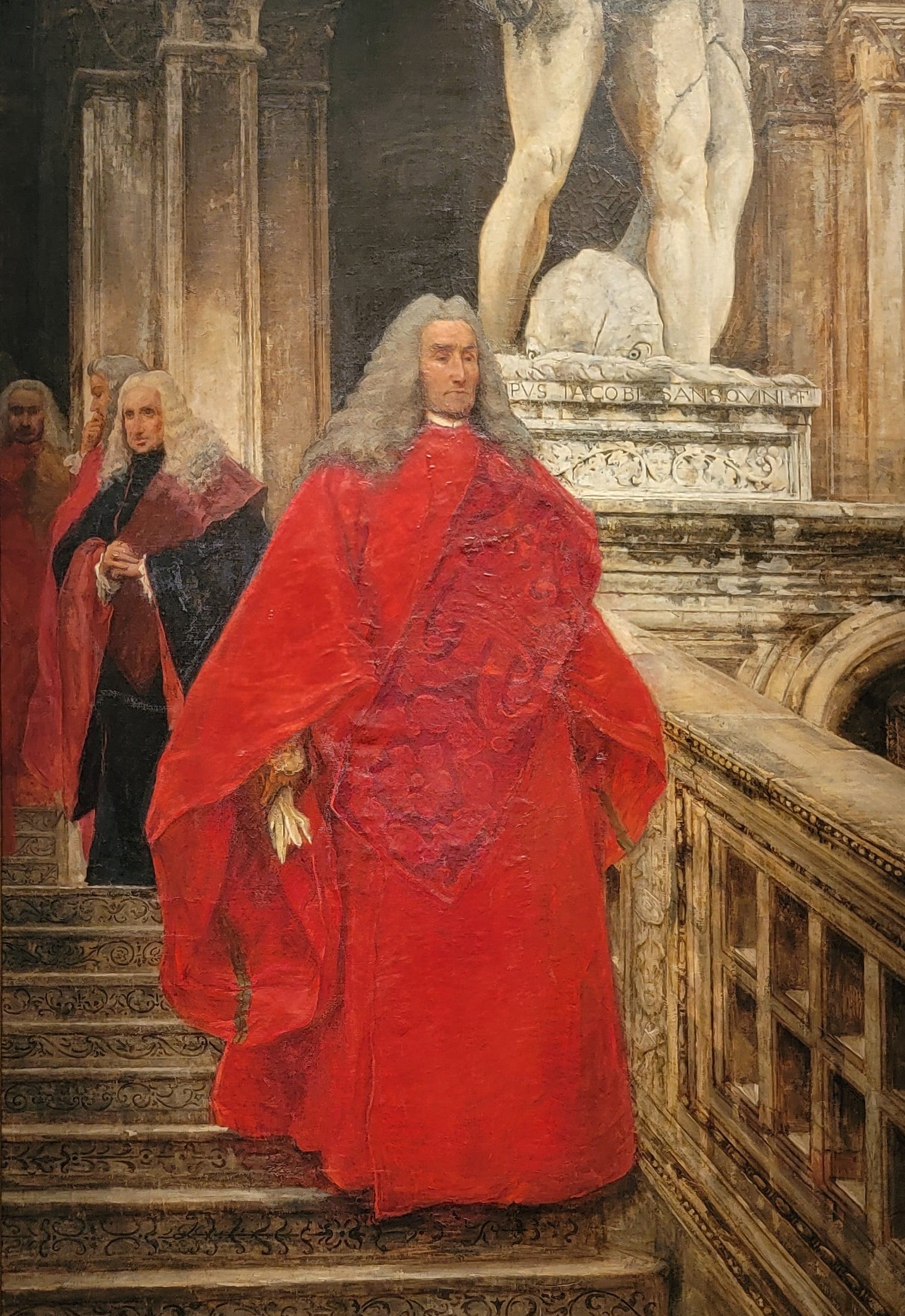
The finest separation I know of from history was the position of Venice's Doge. He was a monarch elected for life (invariably after a successful career elsewhere) by an extraordinarily exacting and comically torturous process.
The point was to select a wise man. On election, he signed a 100-page document (it grew to 300 pages over the life of the republic. The Doge had to do what he was told by his council. Venice is the only state in Europe I know of that had no civil wars or successful coups in the 500 years from 1297 to 1797 when the republic ended with Napoleon's invasion.
Many modern monarchies tap into the same idea, but, being hereditary, they're a lucky dip and, not being meritocratic can't claim the authority the Doge had.

Steve Bannon’s digital coordination strategy

A left wing analysis of what Steve Bannon’s been up to. It was a bit jargony for me but had some good stuff in it, so I got Claude to summarise it.
The article analyzes how Steve Bannon discovered and weaponized digital coordination mechanisms to achieve political power, contrasting his approach with traditional left-wing organizing methods.
Central Arguments:
Coordination Transcends Ideology: Bannon recognized that technological coordination systems could mobilize people more effectively than ideological arguments. Through his observations of online gaming communities, he discovered how shared tasks created powerful solidarity without requiring shared beliefs. This insight became foundational to his political strategy—recognizing that digital platforms could channel collective action regardless of participants' individual motivations.
Speed as Strategic Weapon: Bannon revolutionized political communication by weaponizing speed itself. At Breitbart, he implemented a methodology where content prioritized immediate emotional impact over factual accuracy. This approach exploited fundamental weaknesses in traditional media's response capabilities—while establishment outlets maintained fact-checking protocols and deliberative processes, Breitbart deployed rapid-fire content designed to overwhelm thoughtful discourse. This temporal manipulation proved devastatingly effective during the 2016 election cycle, where scandals and controversies accumulated without any single issue maintaining sufficient public attention to damage his candidate.
Infrastructure Supersedes Rhetoric: The article argues that contemporary political power emerges primarily through control of technological infrastructure rather than persuasive messaging. While progressive movements retreated into what the author terms "folk politics"—methodologies emphasizing local organizing, consensus procedures, and face-to-face interaction—Bannon embraced digital platforms to coordinate action at unprecedented scales. This strategic divergence created an asymmetrical contest where right-wing populism could operate with greater velocity and reach than traditional left organizing.
Organizational Techniques Transcend Content: Perhaps most disturbing for progressive readers, the article demonstrates how organizational principles pioneered by leftist movements have been effectively repurposed for right-wing mobilization. The distributed coordination methods that once powered anti-globalization protests and mutual aid networks now animate Bannon's efforts to restructure the Republican Party from within. This pattern suggests that coordination systems themselves are ideologically neutral vessels that can carry either emancipatory or reactionary visions depending on who controls them.
The author concludes with a call for the left to develop "infrastructural socialism"—technological platforms and coordination systems that serve human flourishing rather than domination. This approach would neither imitate Bannon's nihilistic methods nor retreat into organizational purity, but instead harness digital infrastructure toward liberatory ends. The fundamental question is not whether these powerful coordination tools will be used, but what futures they will be used to create.

More depressing news from Cato
It certainly checks out with my own intuition. Causation between human capital and income mostly goes from human capital to income, not in the other direction. At least in the short to medium term. And who knows what happens in the long run. (Though I have it on good authority that by then none of us will be at all well.)
“The Effect of Family Income on Children’s Academic Achievement” by Dhaval M. Dave, Bentley University and IZA—Institute of Labor Economics; Robert Kaestner, Harris School of Public Policy, University of Chicago; Wei Lyu, University of Alabama at Birmingham; and George L. Wehby, University of Iowa.
There is a well-established positive association between family income and children’s test scores in math and reading. Whether this correlation is causal is a question of continuing debate that is important for policy. Our research examines the effects of increases in family income due to minimum wage hikes on the test scores of US children born between 1980 and 2000 whose mothers had earned a high school diploma or less. Our findings reveal that minimum wage hikes increased family earnings, but this had little effect on children’s test scores. The largest of our estimates suggests that $1,000 of additional income was associated with an increase of less than 0.01 standard deviations in math and reading test scores. We can rule out increases of more than 0.03 standard deviations, and many of our estimates suggest that additional income had no effect on scores. Prior research demonstrates that when families have more income, their children are more likely to go to college. Our findings indicate that this effect is not driven by gains in cognitive skills but by factors such as parents’ greater ability to cover college costs.
Learn more by reading the brief here.
Very funny
Australians: unusually good magicians
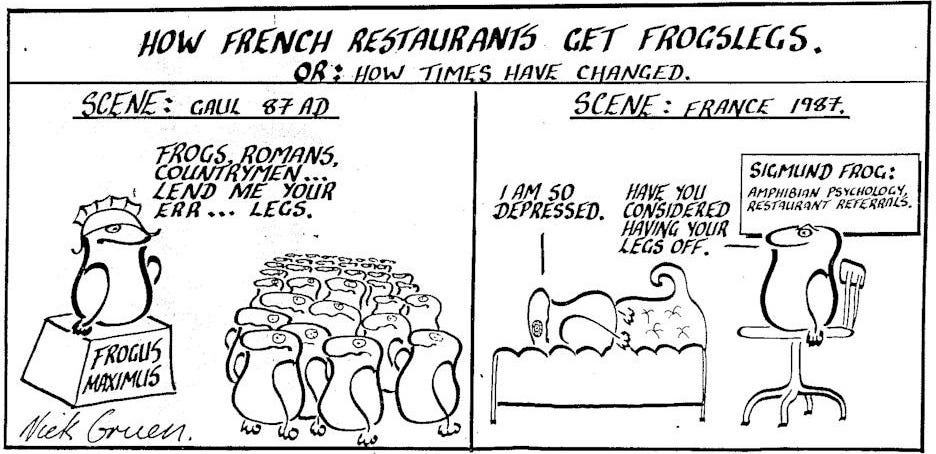
As I toured the world selling my cartoons in 1988 I discovered that Australians were the best cartoonists in the world. Being Australian, I’m biased I know, but there you go. 5 of my favourite cartoonists were Australian. Folks like Leunig, and Petty and Moir and Tandberg and Horacek.
Anyway, since the algorithm detected me watching the video immediately below, its served me up others. And there are a lot of Australians and they’re awfully good. And the last one has fooled Penn and Teller more than anyone else and sounds a little like Helen Garner and Karen Goldsworthy.
He seems now to be busking in the UK.
Speaking of Australia
And speaking of Australia, here’s Chris Arnande’s final post from here.

Taking a few more steps towards autocracy
As Jesus said “love the sin, hate the sinner”. Or something like that. Nicely written FT op ed by Edward Luce
Freedom is the freedom to say two plus two equals four, said George Orwell. By that standard, the US is hurtling towards unfreedom. Those who point out that the late Charlie Kirk was a Christian nationalist provocateur risk their jobs or worse. The official line is that the appalling murder of Kirk made him a martyr to God and American liberty. Dissenters to such hyperbole risk being branded as terrorists. In the post-Kirk world, two plus two equals five.
Orwell is erroneously quoted as having said that at a time of universal deceit, truth-telling is a revolutionary act. Here is the truth about Kirk. He believed that the US Civil Rights Act was a mistake, that leading African-American women, including Michelle Obama, lacked “brain processing power”, that Joe Biden should be jailed or even killed for his presidential sins and that the US should have public executions...
Under America’s First Amendment, pretty much all speech is protected by law. That is as it should be. Shouting “fire” in a crowded theatre endangers the lives of others. Booing the stage performance or claiming the tickets were a rip-off does not. Those who called out Kirk’s toxicity were as American as apple pie. As was Kirk. The right to say what you want dates to the country’s founding. Nobody should be prosecuted, let alone killed, for being obnoxious.
A few months before the 250th anniversary of the declaration of independence, Donald Trump is pulverising the country’s founding principles with astonishing ease. His war on speech is no drill. Late-night comedians are being targeted. Corporations like Paramount are meekly submitting to his will. Ivy League presidents and globally renowned law firms act as though the First Amendment no longer holds. Outspoken business leaders have suddenly lost their tongues...
Trump misses no opportunity to punish dissent, and Kirk’s assassination is his biggest so far. Last week he claimed that 97 per cent of network coverage of him was negative and should be illegal. The federal state’s vast powers are being used to pursue private vendettas. Officials have been forced to take polygraphs to test their loyalties. FBI agents who investigated Trump have been fired. Morale at US spy agencies has never been lower. Trump has publicly instructed the US attorney-general to prosecute three named opponents.
That his economic ratings are in freefall should be a source of alarm not complacency. Less than a year after Trump was elected, the separation of powers is not working. Congress is irrelevant. The Supreme Court is quiescent. The media is punch drunk. Democrats are fragmented. Independent federal agencies are losing autonomy...
It has been widely observed that the speed of America’s democratic slide surpasses that of other “elective autocracies” such as Narendra Modi’s India and Recep Tayyip Erdoğan’s Turkey. But that understates Trump’s impatience. Others have shifted to authoritarianism with relatively fast-growing economies, which makes it easier to sustain public support. Trump’s trade war and his “big beautiful [budget] bill” will rob most Americans of income growth...
At the huge religious revival-style memorial for Kirk in Arizona on Sunday, his widow, Erika, struck a courageous note of dissent from the dominant spirit of vengeance. In the spirit of the Christian gospels, she forgave her husband’s killer. Speaking straight afterwards, Trump corrected her. He could not forgive his enemies, he said. Indeed, he hated them. Trump’s wrath produced cheers from tens of thousands of “Christians” in the stadium.
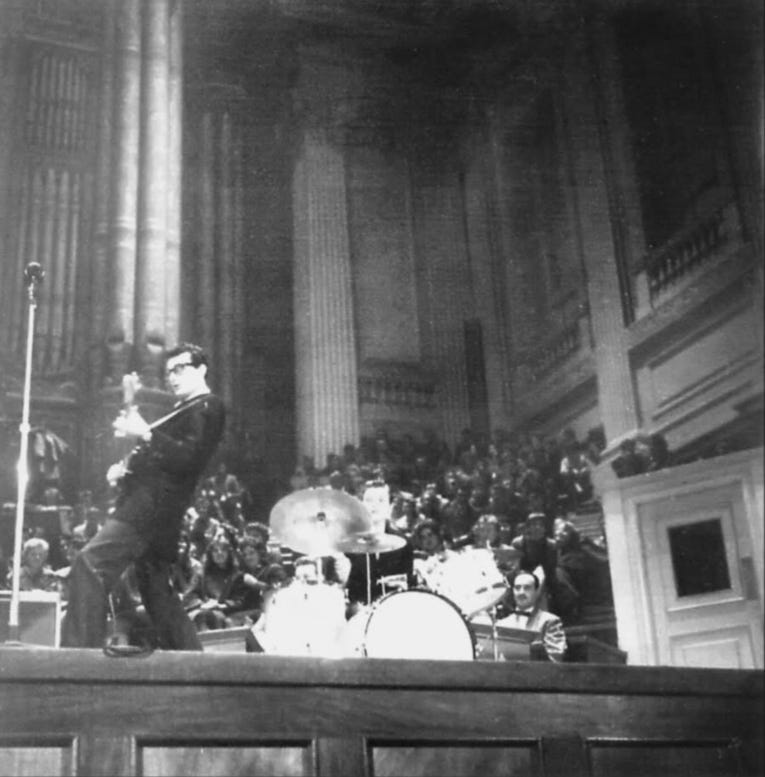
Old guys, glory days and lots of fun
Heaviosity half-hour
Arendt on Jefferson on Wards
You can’t do better than Arendt’s description of what Jefferson thought was missing from American government. And while both Arendt and Jefferson thought people could be involved in government via the hyperlocalism of ‘wards’, much greater use of citizens’ juries would also serve very similar ends. And some others besides.
‘As Cato concluded every speech with the words, Carthago delenda est, so do I every opinion, with the injunction, “divide the counties into wards”.’51 Thus Jefferson once summed up an exposition of his most cherished political idea, which, alas, turned out to be as incomprehensible to posterity as it had been to his contemporaries. The reference to Cato was no idle slip of a tongue used to Latin quotations; it was meant to emphasize that Jefferson thought the absence of such a subdivision of the country constituted a vital threat to the very existence of the republic. Just as Rome, according to Cato, could not be safe so long as Carthage existed, so the republic, according to Jefferson, would not be secure in its very foundations without the ward system. ‘Could I once see this I should consider it as the dawn of the salvation of the republic, and say with old Simeon, “Nunc dimittis Domine.”’52
Had Jefferson’s plan of ‘elementary republics’ been carried out, it would have exceeded by far the feeble germs of a new form of government which we are able to detect in the sections of the Parisian Commune and the popular societies during the French Revolution. However, if Jefferson’s political imagination surpassed them in insight and in scope, his thoughts were still travelling in the same direction. Both Jefferson’s plan and the French sociétés révolutionaires anticipated with an utmost weird precision those councils, soviets and Räte, which were to make their appearance in every genuine revolution throughout the nineteenth and twentieth centuries. Each time they appeared, they sprang up as the spontaneous organs of the people, not only outside of all revolutionary parties but entirely unexpected by them and their leaders. Like Jefferson’s proposals, they were utterly neglected by statesmen, historians, political theorists, and, most importantly, by the revolutionary tradition itself. Even those historians whose sympathies were clearly on the side of revolution and who could not help writing the emergence of popular councils into the record of their story regarded them as nothing more than essentially temporary organs in the revolutionary struggle for liberation; that is to say, they failed to understand to what an extent the council system confronted them with an entirely new form of government, with a new public space for freedom which was constituted and organized during the course of the revolution itself.
This statement must be qualified. There are two relevant exceptions to it, namely a few remarks by Marx at the occasion of the revival of the Parisian Commune during the short-lived revolution of 1871, and some reflections by Lenin based not on the text by Marx, but on the actual course of the Revolution of 1905 in Russia. But before we turn our attention to these matters, we had better try to understand what Jefferson had in mind when he said with utmost self-assurance, ‘The wit of man cannot devise a more solid basis for a free, durable, and well-administered republic.’53
It is perhaps noteworthy that we find no mention of the ward system in any of Jefferson’s formal works, and it may be even more important that the few letters in which he wrote of it with such emphatic insistence all date from the last period of his life. It is true, at one time he hoped that Virginia, because it was ‘the first of the nations of the earth which assembled its wise men peaceably together to form a fundamental constitution’, would also be the first ‘to adopt the subdivision of our counties into wards’,54 but the point of the matter is that the whole idea seems to have occurred to him only at a time when he himself was retired from public life and when he had withdrawn from the affairs of state. He who had been so explicit in his criticism of the Constitution because it had not incorporated a Bill of Rights never touched on its failure to incorporate the townships which so obviously were the original models of his ‘elementary republics’ where ‘the voice of the whole people would be fairly, fully, and peaceably expressed, discussed, and decided by the common reason’ of all citizens.55 In terms of his own role in the affairs of his country and the outcome of the Revolution, the idea of the ward system clearly was an afterthought; and, in terms of his own biographical development, the repeated insistence on the ‘peaceable’ character of these wards demonstrates that this system was to him the only possible non-violent alternative to his earlier notions about the desirability of recurring revolutions. At any event, we find the only detailed description of what he had in mind in letters written in the year 1816, and these letters repeat rather than supplement one another.
Jefferson himself knew well enough that what he proposed as the ‘salvation of the republic’ actually was the salvation of the revolutionary spirit through the republic. His expositions of the ward system always began with a reminder of how ‘the vigour given to our revolution in its commencement’ was due to the ‘little republics’, how they had ‘thrown the whole nation into energetic action’, and how, at a later occasion, he had felt ‘the foundations of the government shaken under [his] feet by the New England townships’, ‘the energy of this organization’ being so great that ‘there was not an individual in their States whose body was not thrown with all its momentum into action’. Hence, he expected the wards to permit the citizens to continue to do what they had been able to do during the years of revolution, namely, to act on their own and thus to participate in public business as it was being transacted from day to day. By virtue of the Constitution, the public business of the nation as a whole had been transferred to Washington and was being transacted by the federal government, of which Jefferson still thought as ‘the foreign branch’ of the republic, whose domestic affairs were taken care of by the state governments.56 But state government and even the administrative machinery of the county were by far too large and unwieldy to permit immediate participation; in all these institutions, it was the delegates of the people rather than the people themselves who constituted the public realm, whereas those who delegated them and who, theoretically, were the source and the seat of power remained forever outside its doors. This order of things should have sufficed if Jefferson had actually believed (as he sometimes professed) that the happiness of the people lay exclusively in their private welfare; for because of the way the government of the union was constituted—with its division and separation of powers, with controls, checks, and balances, built into its very centre—it was highly unlikely, though of course not impossible, that a tyranny could arise out of it. What could happen, and what indeed has happened over and over again since, was that ‘the representative organs should become corrupt and perverted’,57 but such corruption was not likely to be due (and hardly ever has been due) to a conspiracy of the representative organs against the people whom they represented. Corruption in this kind of government is much more likely to spring from the midst of society, that is, from the people themselves.
Corruption and perversion are more pernicious, and at the same time more likely to occur, in an egalitarian republic than in any other form of government. Schematically speaking, they come to pass when private interests invade the public domain, that is, they spring from below and not from above. It is precisely because the republic excluded on principle the old dichotomy of ruler and ruled that corruption of the body politic did not leave the people untouched, as in other forms of government, where only the rulers or the ruling classes needed to be affected, and where therefore an ‘innocent’ people might indeed first suffer and then, one day, effect a dreadful but necessary insurrection. Corruption of the people themselves—as distinguished from corruption of their representatives or a ruling class—is possible only under a government that has granted them a share in public power and has taught them how to manipulate it. Where the rift between ruler and ruled has been closed, it is always possible that the dividing line between public and private may become blurred and, eventually, obliterated. Prior to the modern age and the rise of society, this danger, inherent in republican government, used to arise from the public realm, from the tendency of public power to expand and to trespass upon private interests. The age-old remedy against this danger was respect for private property, that is, the framing of a system of laws through which the rights of privacy were publicly guaranteed and the dividing line between public and private legally protected. The Bill of Rights in the American Constitution forms the last, and the most exhaustive, legal bulwark for the private realm against public power, and Jefferson’s preoccupation with the dangers of public power and this remedy against them is sufficiently well known. However, under conditions, not of prosperity as such, but of rapid and constant economic growth, that is, of a constantly increasing expansion of the private realm—and these were of course the conditions of the modern age—the dangers of corruption and perversion were much more likely to arise from private interests than from public power. And it speaks for the high calibre of Jefferson’s statesmanship that he was able to perceive this danger despite his preoccupation with the older and better-known threats of corruption in bodies politic.
The only remedies against the misuse of public power by private individuals lie in the public realm itself, in the light which exhibits each deed enacted within its boundaries, in the very visibility to which it exposes all those who enter it. Jefferson, though the secret vote was still unknown at the time, had at least a foreboding of how dangerous it might be to allow the people a share in public power without providing them at the same time with more public space than the ballot box and with more opportunity to make their voices heard in public than election day. What he perceived to be the mortal danger to the republic was that the Constitution had given all power to the citizens, without giving them the opportunity of being republicans and of acting as citizens. In other words, the danger was that all power had been given to the people in their private capacity and that there was no space established for them in their capacity of being citizens. When, at the end of his life, he summed up what to him clearly was the gist of private and public morality, ‘Love your neighbour as yourself, and your country more than yourself,’58 he knew that this maxim remained an empty exhortation unless the ‘country’ could be made as present to the ‘love’ of its citizens as the ‘neighbour’ was to the love of his fellow men. For just as there could not be much substance to neighbourly love if one’s neighbour should make a brief apparition once every two years, so there could not be much substance to the admonition to love one’s country more than oneself unless the country was a living presence in the midst of its citizens.
Hence, according to Jefferson, it was the very principle of republican government to demand ‘the subdivision of the counties into wards’, namely, the creation of ‘small republics’ through which ‘every man in the State’ could become ‘an acting member of the Common government, transacting in person a great portion of its rights and duties, subordinate indeed, yet important, and entirely within his competence’.59 It was ‘these little republics [that] would be the main strength of the great one’;60 for inasmuch as the republican government of the Union was based on the assumption that the scat of power was in the people, the very condition for its proper functioning lay in a scheme ‘to divide [government] among the many, distributing to every one exactly the functions he [was] competent to’. Without this, the very principle of republican government could never be actualized, and the government of the United States would be republican in name only.
Thinking in terms of the safety of the republic, the question was how to prevent ‘the degeneracy of our government’, and Jefferson called every government degenerate in which all powers were concentrated ‘in the hands of the one, the few, the well-born or the many’. Hence, the ward system was not meant to strengthen the power of the many but the power of ‘every one’ within the limits of his competence; and only by breaking up ‘the many’ into assemblies where every one could count and be counted upon ‘shall we be as republican as a large society can be’. In terms of the safety of the citizens of the republic, the question was how to make everybody feel ‘that he is a participator in the government of affairs, not merely at an election one day in the year, but every day; when there shall not be a man in the State who will not be a member of some one of its councils, great or small, he will let the heart be torn out of his body sooner than his power wrested from him by a Caesar or a Bonaparte’. Finally, as to the question of how to integrate these smallest organs, designed for everyone, into the governmental structure of the Union, designed for all, his answer was: ‘The elementary republics of the wards, the county republics, the State republics, and the republic of the Union would form a gradation of authorities, standing each on the basis of law, holding every one its delegated share of powers, and constituting truly a system of fundamental balances and checks for the government.’ On one point, however, Jefferson remained curiously silent, and that is the question of what the specific functions of the elementary republics should be. He mentioned occasionally as ‘one of the advantages of the ward divisions I have proposed’ that they would offer a better way to collect the voice of the people than the mechanics of representative government; but in the main, he was convinced that if one would ‘begin them only for a single purpose’ they would ‘soon show for what others they [were] the best instruments’.61
This vagueness of purpose, far from being due to a lack of clarity, indicates perhaps more tellingly than any other single aspect of Jefferson’s proposal that the afterthought in which he clarified and gave substance to his most cherished recollections from the Revolution in fact concerned a new form of government rather than a mere reform of it or a mere supplement to the existing institutions. If the ultimate end of revolution was freedom and the constitution of a public space where freedom could appear, the constitutio libertatis, then the elementary republics of the wards, the only tangible place where everyone could be free, actually were the end of the great republic whose chief purpose in domestic affairs should have been to provide the people with such places of freedom and to protect them. The basic assumption of the ward system, whether Jefferson knew it or not, was that no one could be called happy without his share in public happiness, that no one could be called free without his experience in public freedom, and that no one could be called either happy or free without participating, and having a share, in public power.

The Japanese practice of sodanyaku or komon - as a contrast, this piece reminded me of the poignant scene in the movie "About Schmidt", where Jack Nicholson, as the recently retired CEO of a small town US life insurance company, makes an unsolicited call on his successor a few days after his retirement party and sees his prized library of actuarial books in a skip outside the office building.
The caravan moves on ...