This video surveys all the ground we’ve covered in the first 17 videos, before the final two videos finish off the series. And in the video below Colm and I discuss the theatrical nature of our democratic system and why it so often fails the very people it is supposed to serve. We explore how human beings are naturally wired to learn and cooperate through games, relying on common, shared rules to function and thrive.
Yet, in the modern political arena, powerful private interests frequently colonise these shared spaces. They rewrite the rules to their own advantage, forcing even well-intentioned politicians to rely on the dark arts of manipulation and endless public spectacle. They have no choice if they want to survive. Parliament is rarely a place of genuine deliberation where minds are changed; instead, it operates as a rigid performance.
This article is about what makes interesting people become uninteresting. Not thinking that especially interesting, I fed the overly long post into Claude. Its summary sent me back to read it.
For me, the article’s focus on “interestingness” maps quite directly onto how truth gets ferreted out—at least truth about our human world. And that is by noticing and then confronting uncomfortable things.
Think of our very uninteresting political discourse. As the article argues, one way people become uninteresting is by becoming politically prominent. This usually involves acquiring constituencies. And then their speech becomes an exercise in managing those constituencies. They must avoid offending numerous audiences whose sensitivities may not even align. Under those conditions, public speech might be described as unthinking aloud. It becomes bland, evasive, and cliché-ridden (sound familiar?).
Moreover, advocates for the ‘left’ and the ‘right’ can be understood as practitioners of contrasting strategies for managing coalitions. And both generate their own characteristic forms of shallowness.
On the left, to maintain one’s standing, one must affirm the innocence and virtue of recognised out-groups and the culpability of their antagonists. This creates a powerful disincentive to engage with dilemmas or trade-offs. To suggest that a disadvantaged group might need to change certain behaviours—or to acknowledge that competing goods are in tension—is to risk moral sanction. And so such thoughts are not pursued. The result is wishful thinking dressed up as analysis: ostentatious concern accompanied by a fatal incuriosity about reality.
On the right, the pressure takes a different form: a willingness to name problems, but within a framework that too readily attributes them to cultural or moral deficiency in the out-group — or to the superiority of the dominant culture. This forecloses inquiry by prematurely settling the question of what is causing some problem and what to do about it. It converts what should be a shared problem into the performance of supremacy. And in doing so, it triggers precisely the defensive reactions that make further thinking well nigh impossible.
In both cases, the underlying dynamic is the same as the one identified in the article: the management of audiences crowds out the pursuit of truth. Once this dynamic takes hold, the possibility of genuinely interesting thought atrophies. To be interesting, in the relevant sense, is to engage with reality in a way that reveals something not already encoded in the script—to hold tensions in view, to explore trade-offs, to resist premature closure. But that requires a willingness to risk misalignment with one’s coalition — with one’s “base”. And in a system organised around coalition maintenance, that is a fool’s errand.
Anyway, given how much it has reduced the word count, what follows is masterful editing by Claude (carefully prompted and re-prompted by me!). You’re welcome!
About halfway through Marc Maron’s recent interview with Barack Obama, the final episode in Maron’s extraordinary 16 year run as a podcaster, I realized I was zoning out. Obama was speaking in platitudes, and he wasn’t giving himself to the encounter in the way that he had the previous time.
It was a striking example of a fairly obvious but undertheorized truth: accomplished, influential, and highly respected people are often quite boring in public....
This essay is an attempt to map the terrain of public dullness among the potentially fascinating....
THE FIVE RISKS
1. Internalized Politics: The Cost of Caution
The obvious point is that if you have a lot of real and imagined constituencies you don’t want to offend or disappoint, you’re almost certainly going to be too cautious to be interesting.
High status figures tend to operate within incentive structures that reward caution and punish spontaneity. Politicians are trained to avoid offense, pander to constituents, stay on message. CEOs have a fiduciary responsibility to consider the interests of employees, board members, and shareholders. Celebrities obsessively curate their brand....
The more subtle problem is that over time the logic of caution begins to shape not just how we speak, but what and how we think. The politics cease to be merely a filter we layer on top of what we’d like to say, but instead are fully internalized, naturalized. The mask becomes the face....
Barack Obama didn’t really have anything to lose by taking some risks on Marc Maron in 2025, but he was so accustomed to having something to lose, over so many years, that the interestingness muscles had atrophied.
2. Deference: The Feedback Vacuum Around Power
By the time highly successful people feel motivated to step out as public figures, the incentive structure that surrounds them is rarely optimized for honest feedback. Which of their direct reports is going to say, after a podcast appearance, “It was fine, but not very interesting”?
Deference short-circuits improvement. It creates the illusion that existing skills are easily transferable—that being good at running a company means you’ll be good at talking about it in public. Most people aren’t. And because they’re surrounded by people who won’t tell them otherwise, they may never realize it....
3. Expertise Creep: The Overreach of the Competent
Interestingness is not a general trait. It’s domain-specific: Interestingness = Expertise + Charm − (Overconfidence × Distance)
This is the problem of expertise creep—the mistaken assumption that adjacent expertise is interchangeable with deep expertise. Being experienced at energy trading doesn’t mean you’re instantly qualified to opine on federal energy policy....
When it comes to public communication, the same people who would move with great care in a new professional role often just go for it without much fear. They assume that because they’ve mastered one kind of thinking, they’ve mastered them all. This is why so many public figures end up sounding generic when they talk about politics, culture, or leadership.
4. The Advice Fallacy: A cognitive bias club sandwich
When accomplished people distill their life experience into advice, they mistakenly assume that a) they know what worked for them, b) why it worked for them, and c) that it will work for others. The advice-giver is retrofitting coherence onto what felt uncertain in real time.
The successful entrepreneur who insists “you just have to trust your gut” ignores the thousands who trusted their gut and failed. The advice reflects temperament, timing, luck, and context—and is usually nontransferable....
Evolutionary psychologist David Pinsof has a great, hilariously cynical post on this. His favorite hypothesis: advice is rarely focused on the goals we actually have. Here’s what the self-help section might look like if it were:
The Lips 2 Butt Method: Take Control of Your Life by Sycophantically Ingratiating Yourself with High-Status People
Eat, Pray, Confabulate
5. Underestimating the Challenge
The capacity to translate deep expertise into public-facing communication is not intuitive. It’s a separate skill. And it’s hard.
We tend to forget how much of our professional competence is tacit. Even in overtly cognitive fields—law, medicine, academia—expertise is layered, contextual, and difficult to articulate. Public communication requires a different kind of clarity, rhythm, empathy. You have to know how your audience hears you, anticipate confusion, build a bridge between your world and theirs....
4 Modest Suggestions
[I want to stress the “modest” element.] We don’t know much that’s useful about how to deploy words to help people improve themselves. Real change happens through long-term, structured interactions—AA, church, therapy, a generative workplace. So take these as exploratory thoughts, not recommendations....
Define your expertise and commit. There simply aren’t many people who can talk or write interestingly in most realms of life. Even within saturated spaces, a lot is up for grabs. Slice off a piece you do well and can really deconstruct, do your research, and lean into it. You have to really enjoy the topic—it almost never works to reverse-engineer what you should say from what you think people want....
Get expert help. The implosion of journalism is a great opportunity to find good collaborators cheaply. But it has to be a true collaboration with a minimum of deference. The Agassi/Open model: Moehringer describes their early conversations as “painful,” with Agassi “completely locked—stilted, resistant, halting.” The result is honest and interesting in ways celebrity memoirs almost never are....
Optimize your incentive structure. Create a structure where incentives are aligned with your goal of being interesting. Launch a Substack or podcast; let the metrics tell the tale. If you’re receiving entirely positive feedback, be extremely skeptical....
Go to therapy. Our psychological defenses don’t just make us guarded in conversation—they make us repetitive thinkers. A defense routes attention back toward the familiar, the pre-narrated. People stop generating new thoughts about themselves. What you get in public is not someone thinking but someone reciting from a box set of the classics.
Therapy introduces friction into mental grooves that have grown too deep. As you develop a richer relationship with your own experience, you’re more likely to say richer things in public....
We should try to be more interesting because interestingness is a virtue in its own right; it makes the world richer, more vital. But also because it’s one way—not the only one, but a good one—to pursue the good life.
A really great post. I’ve previously lauded the phenomenology of William James (and the lamentable surplus of syllables in the word ‘phenomenology’!). Phenomenology is no more nor less than trying to pay attention to the way our mental life is experienced. Anyway, David Bessis is a French mathematician who, like me, gets arithrophobia once he’s done more than three lines of calculations. (What if there’s a technical mistake in there?)
Bessis argues that calculating isn’t at the heart of what mathematicians do. Rather, they train their intuition. And in trying to capture how he does mathematics, I think he comes up with a much better understanding of how our minds do and should work than Daniel Kahneman did in his tome Thinking Fast and Slow. Anyway, I commend it to your attention. And, if you like it, I can recommend the next step he took to a model of the human mind, “Attention is all we have”.
A ball and a bat cost a total of $1.10. The bat costs $1 more than the ball. How much does the ball cost?
I borrowed this problem from Daniel Kahneman‘s Thinking, Fast and Slow. Most people will answer that the ball costs 10¢, but that’s not the right answer. The correct answer is 5¢. ...
The ball and bat problem illustrates the theory of cognitive biases, which Kahneman developed with Amos Tversky. System 1 gives immediate, instinctive responses. System 2 is reliable but tiresome. In certain situations our System 1 is systematically wrong—these are the “cognitive biases” the theory aims to study. Kahneman’s recommendation: learn the list of biases and, each time you recognise one, use your System 2. I think there is a better way.
“That’s cheating!”
The first time I heard the story, it was from a friend studying cognitive science at Princeton. Without thinking, I gave the first answer that popped into my head: “5¢.” I was supposed to answer “10¢.” A guy had even won the Nobel Prize for showing it was impossible. Her explanation: “That’s cheating! You’re a mathematician!” ...
My hypothesis: when I sense conflict between intuition and reason, I treat it as a sign I’m not ready to decide. That unusual response is the key that allowed me to become good at math. ...
This isn’t a reasonable assumption
Kahneman writes that it is safe to assume that the intuitive answer also came to the mind of those who ended up with the correct number—they somehow managed to resist the intuition. In other words, Kahneman finds it safe to assume that I shouldn’t exist. But more troublingly, he reasons as if our intuition were hardwired. Had he lived in the ancient Roman era, he would almost certainly have said that it was impossible to represent mentally the result of 1,000,000,000 - 1, because the number greatly exceeded the capacities of human intuition.
System 3
When my intuition tells me A and my reason tells me B, I tell myself I’m not ready to make the decision. That’s the moment to resort to what I call System 3—an assortment of introspection techniques aimed at establishing a dialogue between intuition and rationality. I force myself to translate my intuition into words and picture what logical reasoning is expressing. In the end, it’s almost always my intuition that wins. Logic is something inert, like a pebble. My intuition is organic, living and growing. ...
The price of a ball
I have a tendency to visualize price in terms of length. When my friend told me the ball and bat together cost $1.10 and the bat cost $1 more, two images morphed together in my head.
When she told me that the bat cost $1 more than the ball, here’s how I saw it:
Then the two images came together in my head and morphed into something like this:
A mental image is neither good nor bad in and of itself. Its value lies in what it allows you to understand. There are countless ways to visualize the problem and I don’t pretend that mine is better. My numeric intuition isn’t all that remarkable. I wouldn’t be able to do the calculation if the ball and bat together cost $2,734.18 and the bat cost $967.37 more than the ball. If this is how you visualize the problem, it doesn’t take a genius to figure that a ball costs 5¢. ...
The most important messages: (1) You can reprogram your intuition. (2) Any misalignment between your intuition and reason is an opportunity to create within yourself a new way of seeing things. (3) With time and practice, the right answer will suddenly seem obvious. ...
Solving the problem of the ball and the bat is like standing up on a surfboard. Kahneman’s advice: get out of the water and learn the laws of physics by heart. My advice: get back up on the board.
Thinking fast, slow, and super slow
Nothing is counterintuitive by nature—something is only ever counterintuitive temporarily, until you’ve found means to make it intuitive. ...
The great misunderstanding of math teaching stems from the fact that all the tangible manifestations of mathematics seem to tie it to System 2. Most people become discouraged. But a few choose to rely on their System 3. Math just feels easy to them—they’re seeing pictures in their heads, asking themselves naïve questions. It certainly doesn’t feel like they have a gift.
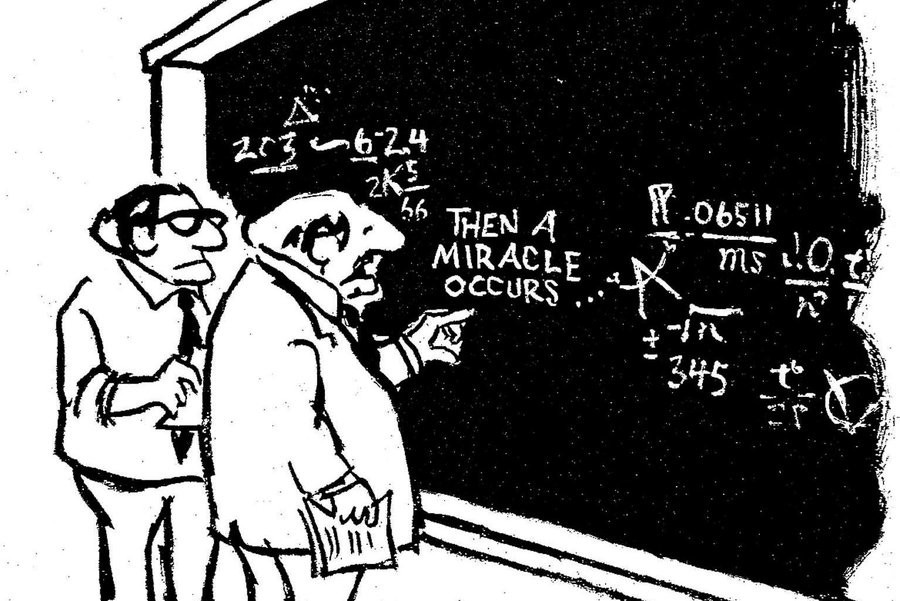
Given that it’s ostensibly on another subject, this is a surprisingly apposite cartoon for one I drew forty years ago!
Some paragraphs that jumped out at me, from Tom Nichols’ latest in the Atlantic.
Few people besides the president himself have done more to advance the cause of vice signaling than Secretary of Defense Pete Hegseth, a man who honed his communication skills at Fox News, where the hosts routinely say outrageous things as a way of showing their viewers how eager they are to own the libs. Hegseth, for example, has long stewed about the fact that women occupy positions of leadership in the U.S. military, and he has hammered on the idea of “merit” as a way of implying that minority officers have been promoted because of their race rather than their talent. He put those beliefs into action almost immediately upon arriving at the Pentagon by pushing for the firing of one Black and several female senior officers who were then replaced with white men.
A few weeks ago, he did it again: According to The New York Times, Hegseth intercepted the Army’s promotion list, which consists mostly of white men, and struck off four officers—two Black men and two women—preventing them from advancing from colonel to brigadier general. Hegseth did not provide a public explanation for his decision, but military officials told the Times that one officer was singled out for writing a paper about the career choices of African American officers, and another was targeted because she had served during the pullout from Afghanistan.
Usually, the defense secretary doesn’t get involved at that level of the process. Promotions like these, to one and two stars, are generally a routine matter, decided on by promotion boards within the military and then presented to the Senate for approval. (Promotions to three and four stars get a lot more scrutiny; those generals and admirals will likely head major commands and become part of the civil-military leadership in Washington.) Hegseth had to know that carving those four colonels out of the list looks both misogynistic and racist, and he chose to send a clear message to the rest of the military: I will intentionally harm the careers of loyal American officers in a display of obvious bigotry just to show that I’m a tough guy. …
Vice signaling is rampant throughout the Trump administration because the president’s appointees know that the boss likes underlings who emulate his aggressive indecency. But when the man in charge of the Defense Department disgorges this kind of toxic waste, it seeps into the groundwater of military culture. It tells young service members—and men, especially—that racism, sexism, and the display of faux masculinity are signs of a true warrior.
Whether Pete Hegseth is sincerely a man of faith, I cannot say. His brand of Christianity is unrecognizable to me, but ostensibly we worship the same God, and we definitely read the same Bible. So perhaps I can suggest that he revisit Matthew 6:5, in which Jesus admonishes his followers about showy displays of piety: “And when you pray, do not be like the hypocrites, for they love to pray standing in the synagogues and on the street corners to be seen by others. Truly I tell you, they have received their reward in full.”
This piece is a little overwrought. As we get richer we spend more on satisfying our specific needs. Still, it’s not all wrong as we say around these parts. The passage that got me in, which I’m trying use to get you in is this one:
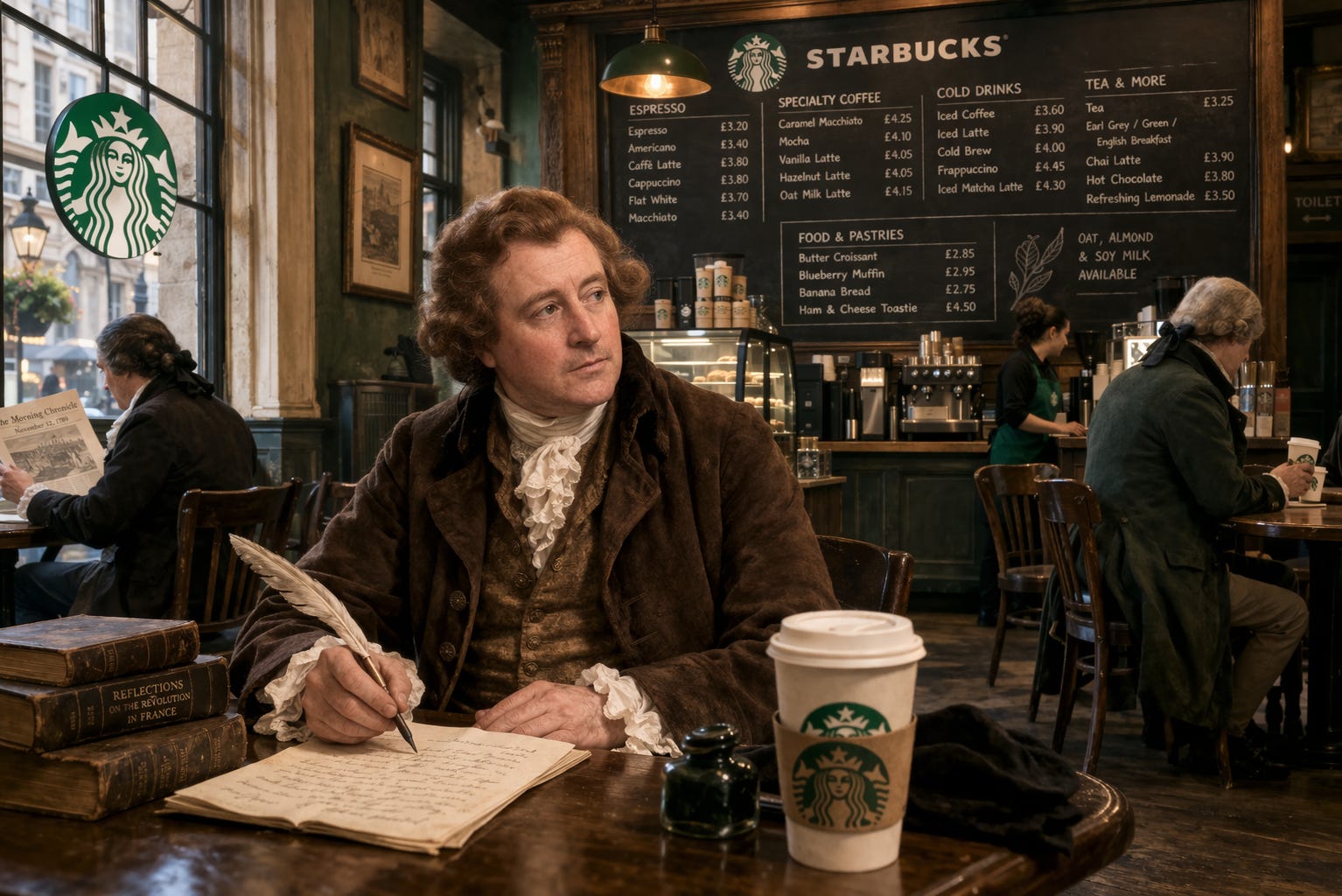
When you order a dirty spiced chai with oat milk, you are not only wasting the time of other customers in line but also signaling that your personal appetites demand an elaborate, customized response. You are asserting your primacy, unique in the complexity of your desires, and standing apart from your nation’s simple rituals. No wonder you’re alone.
Anyway, read on, if only for the Burke quotes. It might have taken us a couple of centuries to really appreciate their wisdom, but if we haven’t learnt yet, the recent war in the Middle East (only countries run by gangsters need apply) is cooking up something which might help those up the back appreciate the point.
The atomization of society begins with your morning coffee.
According to the National Coffee Association, last year, 46 percent of Americans had some “specialty” coffee in the past day. Simultaneously, 54 percent of U.S. adults feel isolated and half of them feel bereft of companionship “often or some of the time,” according to the American Psychological Association. As specialty coffee consumption has surged (84 percent since 2011), so has the loneliness epidemic. Just a correlation? Consider what your coffee order reveals.
The salted caramel mocha latte, the iced brown sugar soy milk shaken espresso, the white chocolate macadamia cream cold brew are the triumph of hyper-individualization over communal norms. … This slide toward caffeinated fussiness began long ago. Economists call it “segment of one” marketing, the indulging of those desperately searching for meaning with the absurd customization of their daily beverage. At what societal cost?...
Edmund Burke would have thought, correctly, that liberty is put at risk by the consumption of that vanilla sweet cream nitro cold brew. People “are qualified for civil liberty,” he wrote in a letter, “in exact proportion to their disposition to put moral chains upon their own appetites … in proportion as they are more disposed to listen to the counsels of the wise and good.”
The moment we let our appetites rule us, devising ever more intricate beverages, we knock one more chunk from society’s foundation. Burke continued, “society cannot exist, unless a controlling power upon will and appetite be placed somewhere; and the less of it there is within, the more there must be without.”
Modernity, for all its thrilling innovations, brought us not just the bloody French Revolution but also individually tailored goods, in open disregard for the wisdom of the ages and in loud disdain for the importance of cultural unity. Customization presented as a feast of creativity instead produced just a cacophony of coffee drink orders and growing loneliness....
Americans’ infatuation with specialized coffees is all the more jarring when one visits Italy, where the simple espresso is still king. The priority there is having a quick drink and chat with friends or strangers, not sitting alone in the corner, AirPods in place, sucking through a straw a pink soy coffee drink with whipped cream on top.
Maybe there is a gap in the U.S. marketplace for some enterprising coffee aficionado who sees the wisdom of making coffee simple again. Limit the menu. Speed the line. Preserve the ritual. Forbid the toasted vanilla oat milk shaken espresso with an extra pump of caramel. Declare this a no-matcha zone. It just might save society.
Graham Young was once Queensland Liberal Party Vice President and Campaign Chair. He is now Executive Director of the Queensland-based Australian Institute for Progress. And he continues to operate Online Opinion (of which I was chair for quite a few years). In any event, here is his analysis of the significance of the rise of One Nation in the context of the South Australian election:
Some people have asked me why the fascination with One Nation in South Australia – after all they have only won one seat at the moment?
That might be true, but if I’m reading the tea leaves correctly, they boosted Labor’s 2PP margin by around five percentage points and delivered them 68 per cent of the seats on a notional two-party-preferred of about 60 per cent.
In other words, One Nation are currently kryptonite to the chances of centre-right governments.
Then there is the fact that the Liberal Party, which has been the dominant party in Australia for almost 80 years, came in third on first preferences after Labor and One Nation, with One Nation finishing in the top two in around half the seats....
There is a theory that if only the Liberal Party would move to the right they would start winning elections. This election provides evidence against that. While One Nation did well, it didn’t expand the non-Labor vote. Before One Nation’s rise Labor was sitting on a 2PP of about 54 per cent; after One Nation’s surge the 2PP lifted to around 60 per cent.
There is a ‘purity/disgust’ element to voting for One Nation. The party has been so heavily demonised that some respectable people cannot countenance ever voting for it. Allocating preferences to the ‘untouchables’, as the Liberals did, can accentuate that purity spiral, damaging Liberal as well as One Nation when it comes to preference flows....
The combination of these defections, prior tribal allegiances, the ‘anyone but Hanson’ tendency, and the demographic locations where they occurred meant that preferences could disproportionately favour Labor. There were more metropolitan seats vulnerable to these forces, which is where Labor secured its outsized results.
That suggests that while the One Nation insurgency doesn’t reduce the overall non-Labor vote, it interacts with the compulsory preferential system in a way that makes it even harder to win from the right.
We should not be surprised. In Europe there has been a concerted effort to keep National Rally and the AfD out of government despite their large followings. Tactical voting in the UK and Canada has produced similar outcomes, neutering Reform and the Canadian Conservatives.
This election provides limited guidance for non-Labor parties elsewhere. Victoria is next, where the government should fall – meaning Liberals and One Nation may be competing for government, not opposition.... One Nation would be crazy to enter a formal preference deal, given its positioning against the ‘uni-party’. The Liberals should probably avoid them too, despite advice from former Premier Jeff Kennett....
Much of the analysis of the One Nation vote has been economically reductionist – inferring that its voters are poorer and less educated. That is not what the data shows. It shows that One Nation does well in areas with higher proportions of voters with those characteristics. Our polling suggests One Nation voters themselves are often better educated and higher earning than the average....
One Nation is another example of the corporatisation of politics, where new parties are not mass movements but top-down, personality-driven brands. Pauline Hanson, Clive Palmer, Jacqui Lambie, Derryn Hinch, and Nick Xenophon all built parties around themselves. The Teals have a similar model, though structured as ‘community independents’ backed by Climate 200.
These models lack internal democracy. They operate on a take-it-or-leave-it basis: if you don’t like the product, choose another vendor, but you are not invited into the kitchen to refine it. That is a good model for disruption, but not for governing.
The question for One Nation is whether it can bridge the gap between protest movement and serious governing party. Pauline Hanson’s decision to remove her name from the party brand suggests some awareness of this. But will a loosening of control follow?
Or will One Nation remain an episodic disruptor – splitting the non-Labor vote, driving moderates toward Labor, and delivering it larger majorities than it otherwise deserves? And, in doing so, ultimately consign itself once again to the political margins?
Well, there’s nothing terribly clever about this, but the very funniest things rarely are. They’re about relatable stupidity. I laughed and laughed. So does John Cleese.
Robots behaving badly
From the Lowy Institute’s regular newsletter.
Throughout the war, Ukraine has relied on technology to offset Russia’s greater numbers in personnel and materiel. Aerial drones became the backbone of that effort, helping blunt assaults, guide artillery and strike deep behind the front. Now the same logic is moving onto the ground.
As the kill zone expands, Kyiv is increasingly turning to unmanned ground vehicles (UGVs) to carry supplies, evacuate the wounded, and, in some cases, go on the offensive. This shift is being driven by necessity. Ukraine now has 280 companies developing UGVs.
On large stretches of the front, the most dangerous task is simply getting in and out. Ukrainian UGVs now regularly destroy Russian drones waiting in ambush along these routes, helping protect human vehicle drivers and wounded soldiers, also being evacuated by UGVs.
The 3rd Assault Brigade reportedly transported more than 200 tonnes of goods in one month alone using UGVs, the equivalent of 10,000 soldiers each carrying 20 kilograms to frontline positions. Colonel Anatolii Kulykivskyi has said that ground drones now handle 70% of the brigade’s frontline logistics. Defense Minister Mykhailo Fedorov has said Ukrainian forces carried out more than 7,000 UGV missions in a single month....
Brigadier General Andriy Biletskyi, commander of Ukraine’s 3rd Army Corps, has argued that units that actively integrate UGVs could reduce frontline infantry requirements by up to 30% by the end of 2026, which could reach up to 80% in the future.
One machine-gun-equipped UGV reportedly held a position for about 45 days. In January, the 3rd Assault Brigade released footage showing a kamikaze UGV loaded with 12 TM-62 anti-tank mines attacking Russian troops sheltering in a building.
In January, three Russian soldiers surrendered to a Ukrainian UGV near Lyman, likely the first recorded case in warfare of troops surrendering to a remotely piloted ground vehicle. Fedorov has said that during the winter alone, more than 100 Russian troops laid down their arms thanks to Ukrainian unmanned systems.
Going on the offensive, turreted UGVs are able to roll to a Russian dugout, open fire, destroy the position and then withdraw. Ukrainian company DevDroid has added an AI-assisted target detection and identification system to its ground robots, using multiple cameras, including thermal imaging, to help operators detect enemy personnel and movement at longer range.... Kyiv recently showed a UGV designed to carry FPV drones to a concealed launch point and release them from the vehicle itself, which would allow ambushes from unexpected positions while keeping human operators farther from the front.
None of this means robots are replacing infantry. Ukraine still needs soldiers to clear trenches, hold ground, and exploit battlefield opportunities in ways machines cannot. Even so, footage of a UGV shooting and killing Russian soldiers is becoming a common sight.
There are serious limits. One Ukrainian officer said the robots fail to reach their destination four times out of five in some conditions, due to the threat from Russian drones and rough terrain. Communications are another major vulnerability. Crews still need radio backups, airborne relays and workarounds for signal loss and electronic warfare.
Russia, meanwhile, is adapting too, working on UGVs designed to carry and launch FPV drones.... During the 2025 winter, Russian forces recorded a sharp increase in UGV usage across the front. This is becoming a competition in battlefield adaptation, in which the side that learns faster, trains better and scales at an industrial level more effectively will gain an advantage.
This shift will also change how Ukraine builds fortifications.... First came drones in the sky and at sea. Now robots are increasingly becoming part of the front line itself. That will not solve Ukraine’s personnel problem. But it does continue the country’s larger wartime pattern of using relatively cheap technology to innovate asymmetrically against a bigger Russian army.
Hollis Robbins, English academic, indefatigable Substack poster with a thing about LLMs. What she says checks out. But what’s even better is that there’s a good bit of self-help at the end.
Do you know what makes great writing? Great paragraphs. Back in middle school you may have learned paragraphing as the practice of indenting to introduce a new idea — a signpost for your reader that says what came before was one thing; what comes next is a different thing; adjust your focus accordingly. Paragraphs are crucial when the content of a text is unfamiliar; readers need to rely on structural cues to organize what they read. Good paragraphs build trust, as the reader can relax and presume coherence.
Strong paragraphs are essential for making strong arguments, for lodging ideas in a reader’s memory. Paragraphs are bricks. Each one has to hold together internally and bear weight in relation to the ones around it. If you can’t remember something you just read, it was likely a motley pile. LLMs will litter their prose with bold and italicized phrases, bullets, and one-sentence-per-line formatting to disguise weak paragraphs.
An economist might characterize paragraphing as a coordination game: two agents with partially aligned interests need to converge on the same interpretation of a structure. A writer has an intended discourse plan; the reader must infer that plan from surface cues. Both parties benefit when the reader can reconstruct the writer’s intended segmentation with low friction. Over time, local equilibria are established and small cues become efficient. When a cue is violated, readers may not know immediately why something feels off. Annoyance seems to come out of the blue.
So why are LLMs bad at paragraphing? First, there is no local equilibrium with LLM prose unless your prompt specifies one — writers who don’t specify their audience put themselves at the mercy of an LLM reinforced to mimic surface-level coherence. Second, LLM training data is saturated with internet text where discourse units may have few rules; internet prose often wants you to act, not remember. Third, LLMs respond to local patterns when generating a paragraph break, not to the global structure of an argument. Research on coherence boosting underscores that models can underuse distant context during generation. The result is paragraphing plausible in the moment, while weakly anchored to the overall structure.
Bullet points are pebbles, not bricks. Under-segmentation results in confusion; mis-segmentation results in betrayal; over-signaling results in numbness. LLMs “learned” during RLHF to produce typographical tricks like bullets to make text “readable,” likely because human evaluators working under time pressure registered formatting as evidence of coherence. But as I’ve explained in depth with regard to the “not X but Y” LLM tic, these metannoying constructions are a cognitive burden on serious readers....
One of the first things I do when opening an essay is look at the first line of each paragraph. If I see empty openers such as ‘This matters because,’ ‘Here’s the thing,’ ‘It’s worth noting that,’ ‘But here’s the catch,’ I stop reading. Each one tells you to pay attention without explaining how a new block of text connects to what you just read.
Fortunately, everyone benefits from strong paragraphs. Prompt your LLM to write a one-sentence-per-paragraph plan that states each paragraph’s role in your larger argument and to generate each paragraph against that plan. Then, revise, attending to paragraph breaks and topic sentences, asking whether each unit delivers on its promise. Use your trowel to place each brick carefully. Keep your whole plan in view and treat every paragraph break as a promise to the reader that, at length, you have their understanding in mind.
We’ve had an Office of Best Practice Regulation1 with well over a dozen officers for forty years. You’d think it might have been on to this. But it spends its time administering regulatory impact statements - an attempt to regulate the regulators which appears not to work. You’d think this might have come up in the wake of the Productivity Roundtable. After all, there must be some appetite for no losers reform since then - you know to convince the public that the government is actually trying. While they’re at it they could impose an access regime on Australia Post to improve parcel delivery to rural and regional communities. Anyway, the Government’s official response was released in what is becoming an annual event. The “Look over there, is that the time, I really must be going” report.
From The Canberra Times, Thursday, March 19th, 2026.
Hugh White whittles it all down to four and a half hours!
I’m a big fan of Hugh White’s. In fact, as I’ve warned him, he’s in the very dangerous position of never expressing a view with which I didn’t agree. In any event, even though I’m not normally a fan of really long podcasts, I’m a little over half-way through the four and a half hours in this interview with Joe Walker, and I think it’s marvellous. Really well done all round.
Tom Samek
Thanks to reader Robert Banks (who, in his spare time, is a Tasmanian) for alerting me to Tom Samek - a remarkable guy. I recommend his website here. And here’s his obit on the ABC website. There’s something which I recognise (rightly or wrongly) as central European about his aesthetic. Anyway, he got 71 years before he was taken away by the hideous disease of MND
Anyone who spends time in Tasmania's capital is almost sure to come across a Tom Samek artwork.
The artist is being remembered for his “quirky, witty and engaging” contributions to Hobart’s art scene, his “wonderful sense of humour” and compassion.
Samek died last week, aged 71, after battling a chronic illness.
He was behind some of Tasmania’s most well-known art works, including the floor mural Flawed History of Tasmanian Wine at Meadowbank Estate.
His large-scale pieces around Hobart include a mural in the foyer of the RACT building and two murals at the University of Tasmania’s Engineering School at Sandy Bay.
Samek was born in Prague, in the Czech Republic, and moved to Tasmania in the 1970s at the age of 21.
Ms Curtis said he was initially concentrating on being a chef, but had a passion for life, love, sex, food and wine.
“So he took his love for food and wine and he developed it into art … Initially a lot of his work was print making and these were very well known and gave him early renown,” she said.
Former and current politicians also shared memories and paid tribute to the man they said was one of the state’s best known and celebrated artists.
“Tom Samek’s unique style imbued humour and whimsy into his visual reflections on everyday life,” Arts Minister Elise Archer said.
Earlier this week, Donald Trump was asked whether he was surprised that no one briefed him that Iran might respond to an American attack by targeting Gulf countries. His response? “Nobody. Nobody. No no no.”
That is evidence that either Trump is lying or his administration has so cut itself off from experts that no one briefed him on common wisdom — that major strikes on Iran could prompt Tehran to target oil infrastructure, US bases, and close the Strait of Hormuz.
For the past 15 years, I’ve participated in and helped run war games on Iran both at the Pentagon and outside government. Here are five things Trump should have known:
1. When the regime feels existentially threatened, Iran will escalate
In most war games, Iran calibrated its response at lower levels of conflict. But once the United States entered directly and the regime believed its survival was at stake, those restraints disappeared. Iran’s playbook was well understood: strike US bases, harass Gulf shipping, activate proxies, target oil infrastructure. Entirely predictable....
2. It is easy to close the Strait of Hormuz. It is hard to reopen it
Iran does not need to shut the strait entirely — only to create enough uncertainty to scare off shipping and drive up prices, while still moving significant amounts of oil, especially to China. When I studied such scenarios, we concluded a major war could send oil prices to $175–$200 per barrel, with a lasting risk premium long after....
3. Russia always wins
Higher oil prices benefit Russia. Pressure to stabilize markets eases sanctions on Russian energy. And resources that might otherwise support Ukraine are redirected to the Middle East. For Putin: more revenue, less pressure, and a distracted United States....
4. The aftermath is incredibly costly
An air and naval war would likely leave the regime in place — weakened but still standing, and more aggressive. Think Iraq in the 1990s after the first Gulf War: a hostile regime requiring a long, expensive American commitment. Today, with China and Russia as serious competitors, we cannot afford another prolonged Middle East containment mission....
5. Buying time was always the best option
All the options were bad, but war was among the worst. The smarter alternative was to contain, deter, pressure, negotiate, and wait for 86-year-old Supreme Leader Khamenei to die and see if more pragmatic leadership followed.... By escalating to war and killing Khamenei, the United States and Israel ensured the dominant imperative inside Iran was simply survival — producing a new hardline leader close to the Revolutionary Guard Corps. A historic opportunity lost.
A major US-Iran war is not some unknowable black box. People have spent decades studying it. The conclusion has been consistent: enormously costly for Iran, the United States, the Middle East, and the global economy — with no real winners except Vladimir Putin. That is why, for decades, presidents of both parties listened to experts and tried to avoid it until Trump ended all of that.
While I did not read the Dennis Altman piece, it sent me into a nostalgic place thinking about him. My mum attended La Trobe University as a mature student in the Arts Department in the late 1990s. And I remain struck that La Trobe University, only one generation ago, has a collection of public intellectuals, who were not easily pigeonholed and each made a lasting contribution to public debate: Dennis Altman, Robert Manne, Judith Brett, John Hirst, Robin Jeffrey, Joe Camilleri. I was fortunate to tagalong as a teenager to a few of her lectures and seminars when I was sick or disinterested in school.
Sad indeed.
Heaviosity half-hour
Ever since I encountered the Toyota Production System, I’ve been fascinated with the power of organising things from the bottom-up. After all, a vast amount of the knowledge of most human systems exists where the work is done at the coalface. The other thing is that talking about things being bottom-up is one thing. Making it happen in the presence of the power of the people at the top is a very different thing indeed.
Likewise, systems that think of themselves as bottom-up — what could be more bottom-up than an election — nevertheless are contaminated by the power of the powerful. How do you win an election? Go and see powerful people who can give you campaign funds, can help you get favourable stories in the media, etc. In this regard, liberalism thinks of itself as bottom-up, as a system which guarantees people’s rights so they can all do what they want.
But the other strand of liberalism, indeed the operative strand of liberalism, comes as a compromise - a social contract if you like - between demands from below and the need of those with power and property to hang on to what they have. That’s what America’s founding fathers fought for against the more democratic instincts of their anti-federalist opponents.
So I was more than a little intrigued by this excursion from Gerald Gaus, who tries to sketch out a liberalism that could be the product of bottom-up processes, rather than be imposed by the powerful or the product of a social contract. In the modern idiom, it is populated by entirely self-interested agents, which presumes an unrealistically mechanical and Hobbesian psychology. Not quite to my taste, but pretty necessary if you’re to get the problem out as an exercise in deductive reasoning.
Also, as is my practice these days, with pretty much any academic paper written after 1970, I get AI to summarise it to remove all words that function as an academic proof-of-work.
Self-organizing Moral Systems: Beyond Social Contract Theory
Most moral philosophy operates on what Gaus calls the “I conclude we ought” view: a conscientious individual deliberates, reaches the best moral conclusion available to her, and acts on it — expecting others to do likewise. The trouble is that moral life is fundamentally social. Justice isn’t something you can achieve unilaterally. You can be honest alone; you cannot maintain a system of property rights or mutual obligations alone. The moment morality concerns what we do together, your conclusion about what we ought to do is hostage to what others will actually do.
This creates a genuine tension. Kant saw it clearly: even a world of perfectly sincere and good-natured people, each acting on their own private moral judgment, would fail to achieve justice — because justice requires convergence, and sincere private judgments reliably diverge. Gaus formalises the point with simple game theory. In a coordination game where both parties gain most by acting on the same rule, each acting on their own best moral view can leave everyone worse off than if they’d compromised. “I believe we ought to α” does not automatically entail “I ought to α.”
What’s Wrong with the Social Contract Fix
The traditional answer is a Joint Reasons Requirement: a valid claim of justice must somehow be grounded in the reasons of all members of society, not just one person’s private verdict. This is the animating logic of Hobbes, Locke, Rousseau, Kant, and Rawls.
But Gaus identifies a deep flaw in how this tradition has pursued the requirement. Rawls, for example, asks what principles reasonable and rational persons would agree to — but this is still, at bottom, one theorist’s view of what all reasonable people would converge on. Rawls constructs a “we believe we ought” view, but the construction happens inside Rawls’s own head. Habermas was right to call it “monological at the highest level.” And indeed, Rawls himself eventually conceded that reasonable people disagree even about what the most reasonable conception of justice is.
Procedural fixes — let the majority vote, appeal to a neutral umpire — don’t escape the problem either. Voting can settle which rule prevails, but it cannot make that rule morally authoritative to someone who conscientiously rejects it. A free moral agent is not simply obligated to accept whatever 50%+1 decrees. As Gaus puts it, echoing Luther: sometimes conscience prohibits accommodation.
Bargaining approaches (Gauthier’s minimax relative concession, Nash bargaining) attempt to split the difference between competing conceptions of justice. But Gaus argues these too founder. If Betty concedes more at outcome (a,a) than Alf does at (b,b), that’s partly because Betty places higher inherent value on living by her preferred rule. Alf has no obligation to treat Betty’s (in his view mistaken) valuation as conferring a symmetric claim on moral gains. The numbers look like a resource-division problem, but they’re actually a record of moral disagreement — and the disagreement doesn’t dissolve just because you’ve given it cardinal values.
The Alternative: Spontaneous Moral Order
The social contract tradition, Gaus argues, is inherently constructivist and top-down: theorists design a collective solution to the coordination problem and deliver it to the rest of us. What would a genuinely bottom-up moral order look like?
Gaus proposes modelling morality as a self-organizing system of free agents. Each person has two inputs to their moral decision-making: (1) their inherent evaluation of a rule — how well it matches their own conception of justice on a scale from 0 to 10 — and (2) a weighting of how much they value acting on a rule that others share. The total utility of a rule for any person is the product of these two: inherent justice score × social weight. The social weight rises with the proportion of the population acting on the rule.
People differ not only in their moral views but in how much they care about convergence. Gaus identifies four stylised types:
Quasi-Kantians: give moderate weight to sharing; reach maximum weight once about half the population is on board. They act on the categorical imperative — if some others do too.
Linear Agents: weight sharing proportionally from the outset; any uptake gives some positive weight.
Moderately Conditional Agents: Humean cooperators who give zero weight to a rule unless about 30% are already following it, reaching maximum at 80%.
Highly Conditional Cooperators: near-inert until a large majority (~90%) has converged; then pile in decisively.
Gaus runs agent-based simulations with 101 agents. Key findings:
In a fully random population — inherent utilities assigned at random, so rules start with near-even support (51 vs 50 agents) — convergence on one rule typically occurs within five periods, regardless of which three of the four weighting types are present. Omitting Highly Conditional Cooperators slows the process; they turn out to be excellent cascade-completers, jumping in decisively once momentum builds.
In a polarised population divided into High-Low groups (one group rates R1 highly and R2 poorly; the other does the reverse), convergence is harder but not impossible. A very close split (52/49) produces stalemate. But a modest asymmetry (56/45) is enough for convergence within four to ten periods, depending on which types are present. Quasi-Kantians are the slowest to defect from their preferred rule — they tend to reinforce polarity by weighting their own subgroup most highly. But even they eventually switch when the other types have moved far enough.
The striking normative implication: diversity of weighting types can overcome polarisation in inherent moral views. Right/left polarisation — the defining fact of Western political life for 150 years, now multiplied by environmental, feminist and other cleavages — need not be fatal to shared moral life. One kind of heterogeneity (divergent weighting functions) can counteract another (divergent moral convictions). The right question is not “do we agree enough?” but “does the overall configuration of homogeneity and heterogeneity produce convergence?”
In differential reference group models (where agents update based on different subsets of the population), convergence across the whole group is still achievable, though slower and more path-dependent. Crucially, who moves first matters: groups that bridge otherwise opposed reference clusters — the paper’s “Group A,” a random mixed population — can pull polarised outliers toward convergence by stages. Even Group C2, a subgroup with a 64% inherent bias toward R2 and a reference group equally biased that way, eventually converges on R1, pulled along in the wake of the wider population’s movement.
A brief test of strategic manipulation finds that a dedicated 10% bloc of agents who act on R1 no matter what — refusing to respond to the evidence of others’ choices — cannot reliably tip a near-evenly split population their way. The rest of the population converged on R2 at the same pace as without them; the strategists merely ended up stranded in their own small R1 network.
The Larger Argument
Gaus situates this within the tradition Isaiah Berlin associated with Romantic pluralism: the recognition that human ends are genuinely plural and sometimes incommensurable, not merely the product of error or bias. Against this background, moral diversity is not a problem to be solved by a clever contract — it is the datum from which moral theory must begin.
The social contract tradition, including Rawls, has tried to “manage difference” by rising above it to reveal an underlying homogeneity. Hayek’s critique of central planning applies here too: the planner cannot access the distributed information necessary to design the solution, so normalises it away. Self-organizing models start instead from the actual diversity of moral views and convergence weights, and ask what dynamics arise from free individual choices in each other’s presence. The result, on Gaus’s evidence, is often convergence on shared rules — not because anyone imposed them, but because each person, acting on her own understanding of justice (including her own valuation of sharing), found it in her moral interest to move toward them.
The moral law, as Frans de Waal’s epigraph has it, is not imposed from above or derived from well-reasoned principles. It arises from the values of individuals and their distinctive searches for integrity and reconciliation in their social-moral lives.
Allan Rohan Crite, a contemporary of the Harlem Renaissance, forged his own artistic path in Boston. He has left us a celebration of community. More here.
Now the Office of Impact Assessment. The name change is significant. For decades the OBPR and its predecessors were there to allow their political masters to say that ‘something is being done’ on over regulation. But pretty much all they did was administer regulatory impact statements, which seek to reduce over-regulation by - don’t laugh - regulating regulators. What could possibly go wrong. Anyway, you’d think that a body of several dozen people might have spotted this anomaly and actually publicised it. Oh well.