

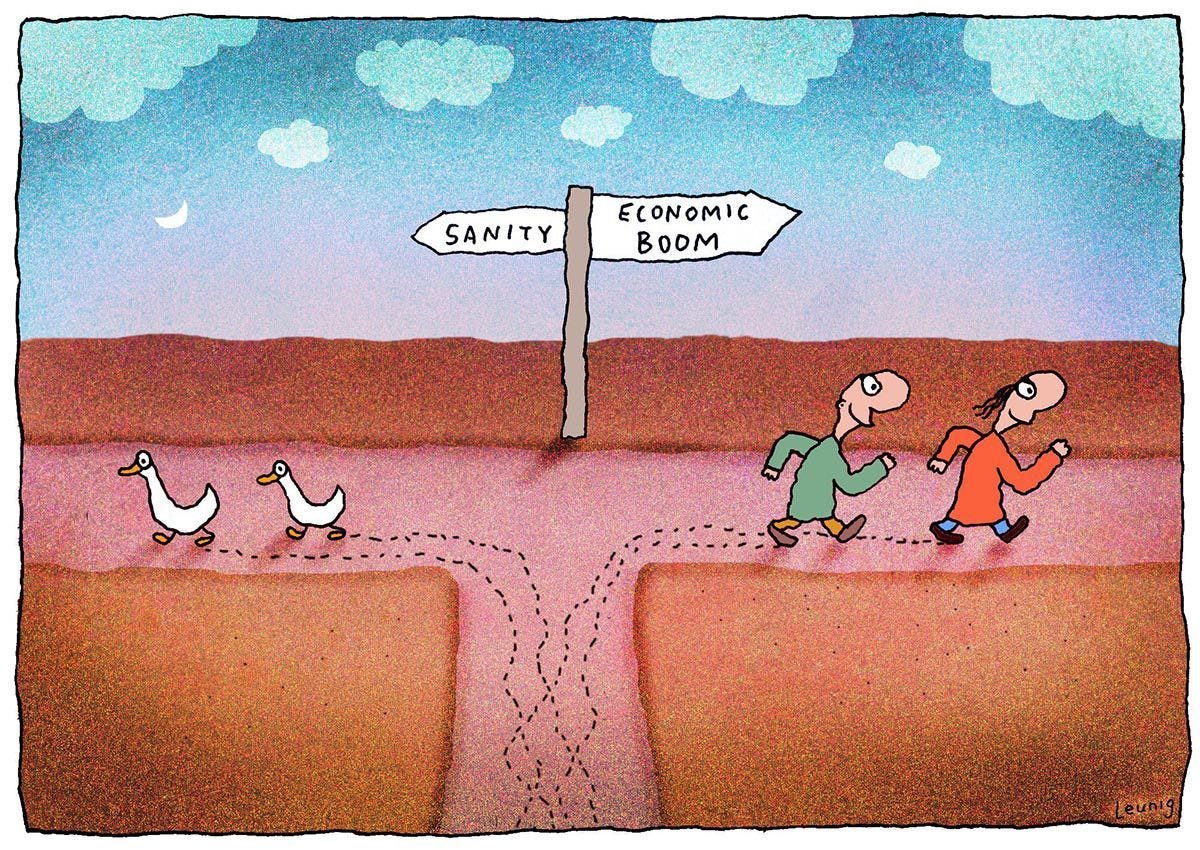
Another day in paradise

Trusting America …
Or maybe not.
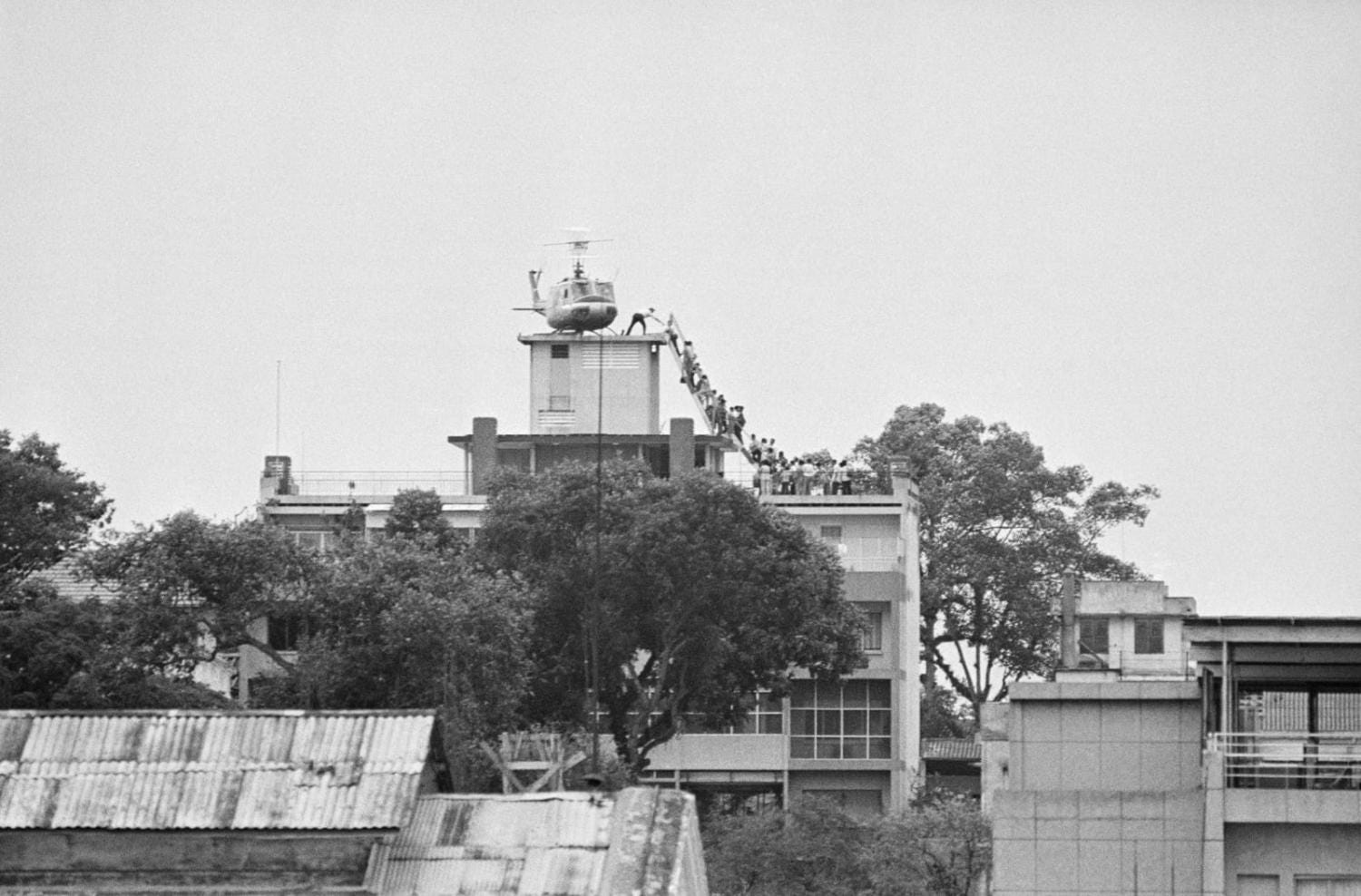
From Steven Grenville at Lowy. As Henry Kissinger said to William F. Buckley Jr, if one South Vietnamese leader came to the same fate as his predecessor “the word will go out to the nations of the world, that it may be dangerous to be America’s enemy, but to be America’s friend is fatal.”
The 50th anniversary this week of the fall of Saigon may trigger thoughts about contemporary war and Ukraine's future. But Saigon is not the only precedent. The withdrawal of American support has often-enough been decisive in settling conflict. Afghanistan most recently. But also, more than a century ago, with America's role in the First World War.
The US was not a participating belligerent in the first three years of the Great War but nevertheless exercised enormous economic power. While America was not providing either troops or munitions in these years, it was the essential supplier of raw material and food to the Entente allies (Britain, France and Russia). These supplies were financed by commercial loans from Wall Street, with JP Morgan organising not only the finance, but also the detailed procurement and shipping.
Adam Tooze, historian and ubiquitous commentator on past and current world affairs, describes President Woodrow Wilson's ambitions in 1916 this way: "The American President, elected with a mandate to keep America out of the war, tried to do something far more ambitious. He attempted not just to preserve neutrality, but to end the war on terms that would place America in a position of pre-eminent global leadership."...
Both Britain and France were exhausted after the battle of the Somme in 1916. Further massive financing from the US would be required if the vital raw materials and food were to continue to flow in 1917. JP Morgan and other financiers were becoming nervous about their credit exposure. To add to their worries, the US Federal Reserve, under instructions from Wilson, issued a statement in November 1916 warning banks and investors against further funding of the war.
In January 1917 (a year before his more-famous 14-points speech), Wilson took the unusual step of addressing the Senate. His key objective was "peace without victory."
Tooze again: "The first dramatic assertion of American leadership in the 20th century was not directed towards ensuring that the 'right' side won, but that no side did."
At this stage, Germany still occupied Alsace-Lorraine and Belgium on the western front and Serbia in the east. To end the war with these territorial conquests intact would have rewarded Germany's aggression...
While many Americans (and influential Republicans such as Theodore Roosevelt) regarded the Entente powers as America's natural allies and saw their victory over Imperial Germany as being in America's interests, Wilson's view was quite different. He had little sympathy for Europe's territorial disputes, warmongering and imperialist colonial adventures. An enforced peace without victors would leave all the European powers weakened. Wilson had already set in train a naval building program that would in time outsize the war-impoverished British fleet. Europe was already deeply in debt to the United States, and without reparations from a defeated opponent, could not match the economic heft of America. The United States would be left as the dominant hegemon...
This put the Entente in a quandary: how to resist Wilson's wishes while retaining his critical logistical support. They were extricated from this dilemma when, amazingly, Germany rebuffed this advantageous opportunity and declared open submarine warfare, including on American shipping. America declared war.
Where might we find some continuity in history, relevant to President Donald Trump's uncompromising stance on Ukraine?
First, a self-assured and determined American president can impose an outcome seemingly at odds with the views of the public and many politicians.
Second, realpolitik outweighs values. Wilson's moral equivalence – equating Germany's aggression and the Entente's resistance – foreshadows Trump's argument that Russia [would] be making a full contribution to peace if it just refrained from conquering the whole of Ukraine.
Third, both Wilson and Trump envisaged a larger agenda, centred on increasing America's global hegemonic power.
Fourth, a mendicant country risks having its critical support withdrawn when its patron tires or its objectives change. In settling the outcome your protector can parlay and do deals with the other side without your participation, as Henry Kissinger did with Le Duc Tho in the leadup to the 1973 agreement on Vietnam, and as Trump is doing for Ukraine.
One more lesson from Vietnam. America may soften the blow of withdrawn support with a promise to return to the fray if the truce is broken. As part of the Kissinger negotiations, it was understood that America's airpower would return if Hanoi sent its tanks southward in open invasion. But with Nixon mired by Watergate in 1975, these undertakings were worthless.
There are lessons here for dependant countries, not only for Ukraine, but for Australia.
An interesting intervention from Peter Turchin

That they might have life and have it abundantly

Here’s Brink Lindsay drawing attention to the right of centre ancestry of the abundance agenda recently given a shot in the arm on the left by Klein and Thompson. As he says, it’s a simple recognition of “the popular but perverse policy combination of simultaneously restricting supply and subsidizing demand.” It reminds us all of how Lord Acton’s paradox so often sits at the heart of government. Lord Acton referred to rowing as the perfect preparation for public life because you learn how to face in one direction, while travelling in the other.
Like I wrote in an essay a few years ago, I used to use the joke as a kind of embellishment - but it really needs to be brought centre stage in an analysis of the dysfunctions of government.
The prehistory of the abundance movement
The argument that Klein and Thompson synthesize in Abundance is ... extremely familiar ... to me — and that's because, as they graciously acknowledge in their book and recent podcasts, my Niskanen Center colleagues and I are responsible for developing significant parts of it. ... If you ask me, the pro-abundance intellectual movement can be traced back to a pair of Kindle singles — Ryan Avent's The Gated City in 2011, followed by The Rent Is Too Damn High by Matt Yglesias (now a senior fellow at Niskanen) in 2012. I wasn't far behind: my Human Capitalism, which came out as a Kindle single in 2012 and then ... a physical book the following year, cited Avent in arguing for the deregulation of new home construction. ...
The Niskanen Center opened its doors in 2015 as a libertarian think tank focused pragmatically on getting policy wins. By the time I got there in 2017, it had already moved beyond its libertarian roots in a "liberaltarian" direction, a shift that I further encouraged once on board. In 2018, we published a policy manifesto unveiling our ... policy vision, one that aims at improving the performance of both the private and public sectors. And just as Klein and Thompson do now, we argued that this is the best way to respond to Trumpism's assault on American institutions:
There is only one sure way to quiet our populist distempers and restore faith in democratic institutions, and that is for those democratic institutions to deliver effective governance. The failures of governance are what got us into this mess; public confidence in government will return only when government demonstrates through successful problem-solving that such confidence is merited.
... Niskanen addresses other ... issues as well, but there is considerable overlap between our work and Klein and Thompson's abundance agenda. Our state capacity initiative seeks to improve the government's ability to implement policy and deliver results ... Our climate team focuses on expediting the buildout of transmission infrastructure that connects places where the sun shines and the wind blows to the places where people live — a challenge that requires a frontal assault on vetocrats and procedure fetishists. Our social policy team advocates policies for unlocking abundance in housing and healthcare.
Niskanen's conception of the politics of the abundance agenda differs from Klein and Thompson's, but I believe the two approaches are ... complementary. Klein and Thompson are ... progressives who are addressing fellow progressives and offering a new paradigm for center-left politics. At Niskanen, on the other hand, we try to transcend political and ideological divisions: we develop policies that can appeal to ... progressives for progressive reasons and ... conservatives for conservative reasons. ...
The apparent difference in substantive governing priorities masks a deeper divide between the abundance agenda and progressive politics as usual. Klein and Thompson see the business of politics as pragmatic problem-solving: creating new capabilities and removing old obstacles to achieve broad public benefits that cut across regional, demographic, and cultural lines. By contrast, much of recent progressive politics — especially the "woke" embrace of social justice radicalism — has been fundamentally performative ... much less concerned with actual governing outcomes than with elevating zero-sum symbolic fights designed to confirm ... progressives' intellectual and moral superiority. ...
The abundance movement vs. the crisis of dynamism
Let me conclude by trying to place the nascent abundance movement in the broader historical context ... In other words, what is the significance of the abundance movement in the larger drama of the permanent problem?
This much ... should be clear to regular readers: the abundance movement represents a recognition of and response to capitalism's crisis of dynamism. Over the past half-century or so, productivity growth has been consistently disappointing in the advanced capitalist economies; since the financial crisis of 2008-9, it has been all but nonexistent outside the U.S. ...
Innovation consists of invention plus diffusion, but that critical and less glamorous second step must advance in the face of proliferating obstacles — in particular, the vetocracy and fetishistic attachment to procedure described by Klein and Thompson. ...
The bottom line ... is that the problems targeted by Klein and Thompson have roots that extend deep into our culture. Accordingly, an abundance movement capable of defusing capitalism's crisis of dynamism will need to reach deep as well. Seeking changes in policy and the policymaking process isn't enough: thoroughgoing institutional and cultural renewal must be our ultimate aim.
But any labor, however Herculean, must begin somewhere. And Ezra Klein and Derek Thompson, with their excellent new book, have chosen promising ground on which to start. All of us who hope for a future blessed with both material and spiritual abundance should applaud their efforts and seek to lend their own. Success is never guaranteed, but working on a difficult and important task brings its own rewards.
Joy!
Romania’s election(s)
I’m in no position to advise you on whether this article is a good take on its subject, but I knew little about that subject before reading it, and it came across as a reasonable take.
No matter who wins Sunday's first round of the Romanian presidential election, it is a crisis for the country, for the European Union and for the relations of both with the United States.
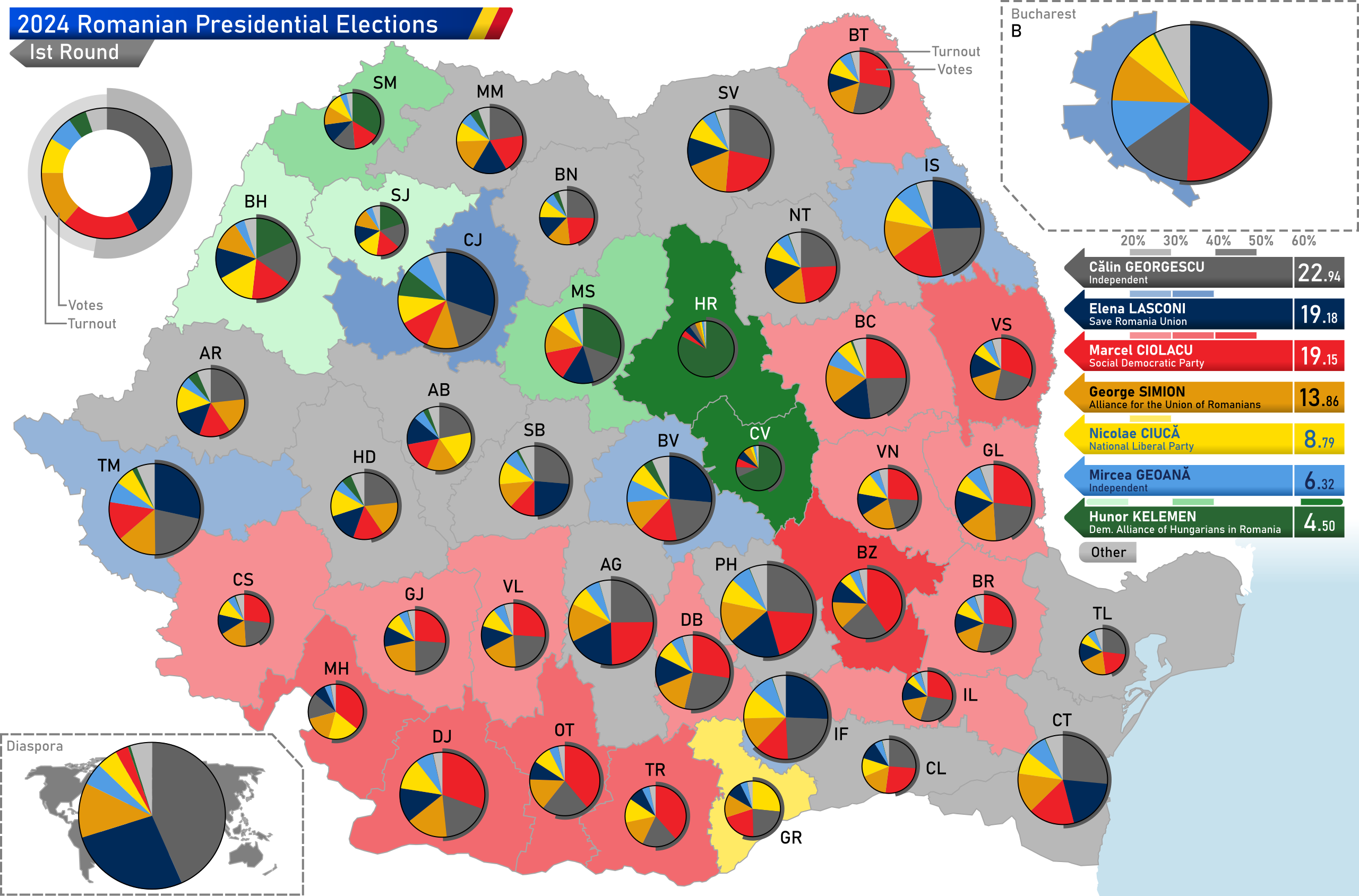
This is the second attempt to hold the election. The regularly scheduled one was annulled last December amid accusations of candidate and government corruption. Cǎlin Georgescu, a Romanian nationalist, populist admirer of Donald Trump, mystical Christian and opponent of the Ukraine war, came seemingly out of nowhere to win the first round. He took 23% of the vote on the strength of a charismatic TikTok campaign, advancing to the second round against the centrist Elena Lasconi. For the first time since Communism, the country's invincible-looking political establishment seemed to have been shut out of the presidency.
That's not so odd: Romania today is (by European standards) poor, unequal, corrupt and war-weary. Its population peaked in the last years of communism at almost 25 million. Today, through a combination of emigration and lost mojo, it is just 19. Sharing a longer border with Ukraine than either Poland or Hungary, it has become a hub for the Nato war effort. And for Ukrainian refugees, 180,000 of whom can claim temporary protections...
Like all members of the EU, Romania is prone to bitter clashes between Europhiles and so-called "sovereigntists"... Sovereigntists tend to thrive where the responsibility for solving desperately important problems — like mass immigration — is taken out of national hands, and those problems go unsolved.
Romania has followed a different path. The decades-long dictatorship of Nicolae Ceaușescu was particularly brutal, and the violent exit of Romania from communism unique. Ceaușescu was executed alongside his wife on Christmas Day 1989. Romanian sovereigntists have found it hard to rally citizens to the cause of winning back powers for their own democracy, the way the Kaczyński brothers' Law and Justice party (PiS) managed to do in Poland until 2023, or Viktor Orbán's Hungarian Fidesz and Robert Fico's Slovakian Smer continue to do today.
That has now changed. Georgescu is in some ways a thrilling political novelty: an accomplished civil servant and diplomat, a scientist of distinction, and a would-be policymaker of some sophistication. (He has called for Romania to be more "Hamiltonian", referring to the first American treasury secretary's aggressive, nation-based industrial policy...) Georgescu is also religious in a way that swept many of his Orthodox co-religionists off their feet, promising to "trust in God with His power of love". Romania is a society of relatively high church attendance (about a quarter) and trust in religious hierarchies... Georgescu can come off as weird, conspiratorial and over-indulgent of his country's fascist past. Covid, in his view, was a "plan-demic".
How could such a candidate score as high as Georgescu did? The Constitutional Court was eager to find out. It called for a recount, which found no irregularities. On 6 December, though, with second-round voting already underway, the court cited material declassified by the country's Supreme Council for National Defense (CSAT) to annul the elections on the grounds of national security, not of election irregularity.
The "declassified" material actually consisted of assertions, not previously classified proofs... Weeks later, Romanian president Klaus Iohannis, who had summoned CSAT in the first place, explained that election meddling was actually "nearly impossible" to prove. The actions "are so broad and complex that only state actors can do that… And here it was Russia." We know it's Russia, he assured us, because "they hide perfectly in cyber space". The lack of evidence of meddling became the main evidence of meddling.
The EU didn't fuss much, either. Romania and Bulgaria were due to be admitted to the EU's Schengen open-borders regime this New Year's Day, barely a month later. No one alluded to Romanians' cancellation of elections... "Fully in Schengen," European Commission president Ursula von der Leyen tweeted to Romanians, "where you belong."
The Biden administration — barely three weeks after its own electoral ouster by Trump's forces — issued a statement casting the election result in a dubious light. The ambassador in Bucharest signalled that remedial intervention might be welcomed...
In this context, one can understand why J.D. Vance alluded to the incident in his speech at the Munich Security Conference. Were Romania's authorities acting to prevent Russia from gaining influence within the European Union? Or to prevent the Trump-era United States from gaining influence within the European Union?...
And that makes the present situation potentially grave. Since last December, there have been two loudly asserted contrary accounts of what happened in Romania's halted presidential election: either Georgescu won the first round with the votes of actual Romanians or someone faked up such a result through the clever deployment of TikTok. Everything we have learned since December favours the first, more straightforward explanation...
In February, Georgescu was arrested on charges involving "incitement to actions against the constitutional order"...
It has not been forthcoming. BBC 4's Crossing Continents sympathetically interviewed a Romanian media researcher credited as an "important source of information for the authorities" on the Georgescu matter, and asked whether his "massive uptick" in social media traffic had come from Romania or abroad. "I think my subjective opinion is both", she said. "It's externally with internal help, but this is how the Kremlin playbook of propaganda works." Her complaint about Georgescu's campaign offers no proof of corruption or criminality beyond the "subjective"... This is not necessarily wrong as a historical assessment. But it is wrong as a democratic modus operandi...
"Whether Romania's secret police has evidence against Georgescu is something unknowable except to them."
But we do know enough about the state of Romanian voters' minds to pass judgement on what happened with its democracy last autumn. Obviously there was a genuine wave of rebellion behind Georgescu... In Georgescu's absence, George Simion, a member of the Right-wing Alliance for the Union of Romanians, is well ahead of the pack in the latest polls, at around 30%...
Simion has risen primarily by consolidating his party's base... he has nonetheless tried to drape himself in Georgescu's cause, showing up to Easter services with him. Simion even suggested he might make Georgescu his prime minister if elected. And he attended the inauguration of Donald Trump in Washington... Shaken by the persistence of a disruptive war and the return of Donald Trump to the White House, the Romanian political landscape is changing.
Again, there is much that is unknowable for those who are far from the backrooms of Bucharest. But among the candidates who are actually running and are betting their careers on an accurate diagnosis of the Romanian mind, there is a working assumption that the votes Georgescu won last autumn reflected a genuine uprising, not a bot-generated simulacrum. If they are right, then it is possible that we really did see an election brazenly stolen in a vital European Union country. The consequences will extend beyond these coming elections.

Two good articles - both of which were way too long
I had excuses for getting from start to finish for both pieces, but you may not. I recommend Sam Kriss’s funny take on Australia’s Married at First Sight but would have started skimming after a while if I’d not been listening to it while working out at the gym.

And this incandescent piece from Freddie Deboer was a nice bit of writing but, as is Freddie’s way, hopelessly in need of paring back.
The epistemics (or is it really ethics?) of Black Like Me
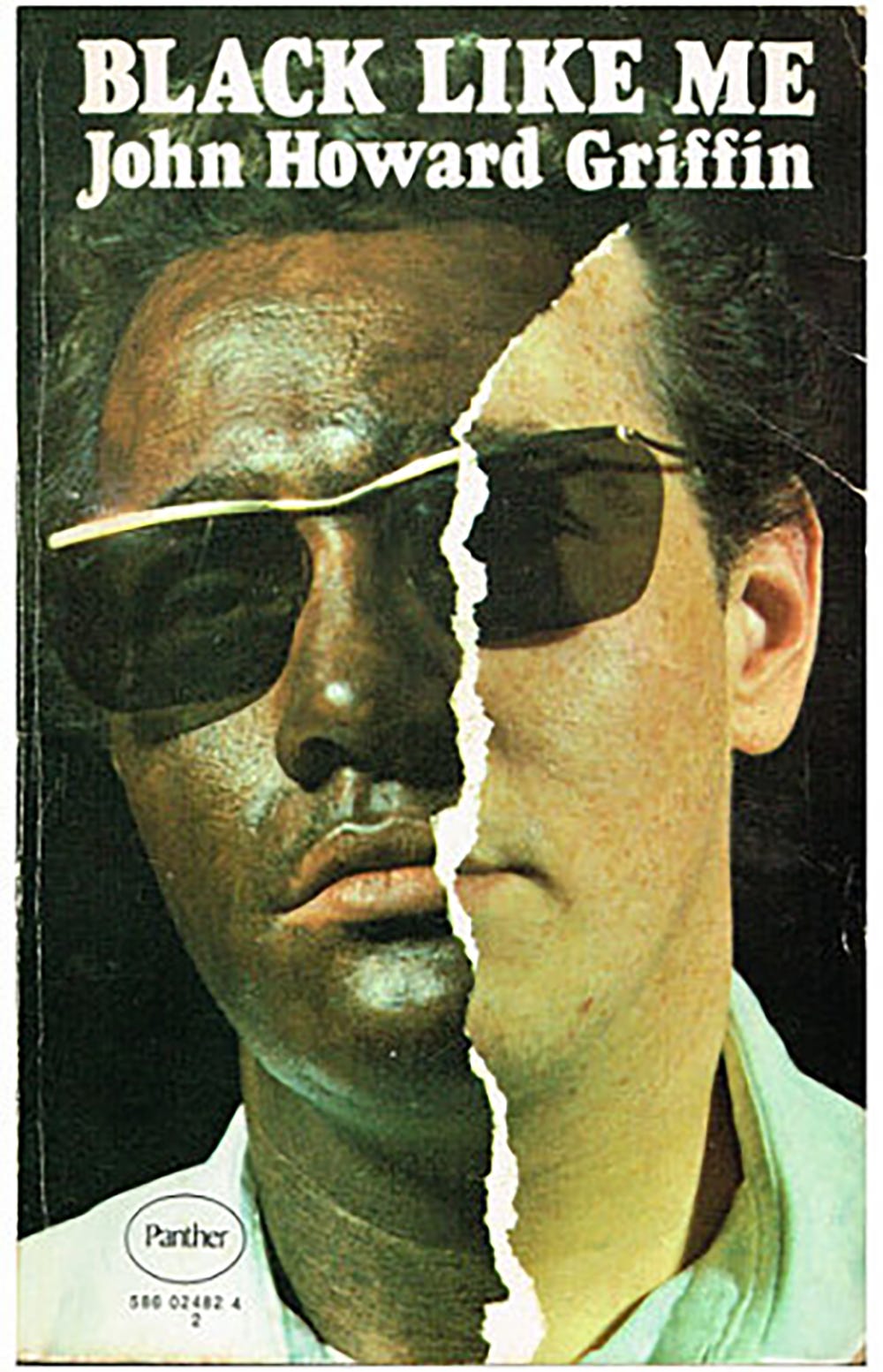
This piece irritated me. I read Black like me in my teens and it made a big impression. Someone just like me could be discriminated against for no reason - other than the colour of my skin. How fair is that? I wrote a few weeks back about what I called ‘perspectivism’. Since we see everything from a perspective, you have to be careful when you suggest one is better than another.
What perspective is best to help a white person understand the life of a black person in the US in the early 1960s. Well, if you’re a white person, you’d surely be interested in the experiences of John Howard Griffin - a white journalist who blackened his skin and went into the world to experience the difference. Does this tell you everything you need to know about the experience of black folks at the time? Obviously not. Would it be better to read about the experiences of black folks themselves. Well in some ways yes and some ways no. I’d be happy to leave it there with the hope that learning about Griffin might be a gateway drug for some to read more from black folks. Anyway, this article makes popular philosophy out of it. Epistemology no less.
It is easy to see why one might be skeptical of Griffin's project. By the time Black Like Me was published in 1961, there was no shortage of accounts by Black Americans describing their experiences under Jim Crow segregation. From W. E. B. Du Bois and Richard Wright to James Baldwin, the moral and social reality of anti-Black racism had been documented with depth, clarity, and urgency. What could a white man posing as Black for six weeks possibly add to this picture?
Part of the answer is that Griffin's account may have seemed more credible simply because the author was white. As Louis Lomax (1961) wrote in an early review of Black Like Me, "since there are white people who doubt everything a Negro says, perhaps now they will hear us." Griffin himself was acutely aware of this dynamic. Reflecting years later on the impact of the book, he noted: "I, as a man now white once again, could say the things that needed saying but would be rejected if black men said them" (Griffin [1977] 2010: 177) ...
Epistemic Contrast
… Unlike someone born into racial oppression, whose interpretive habits are shaped over time through endurance and adaptation, Griffin entered the world of exclusion with expectations formed under privilege. The friction he encountered as a Black man was, for him, new and shocking...
We see this at several points in Black Like Me. Griffin is suddenly denied basic services and protections, such as police assistance (2019: 33) and the ability to cash a traveler's check at establishments that would have readily served him before (2019: 43–44). These experiences are significant not only because they are unjust, but because they violate assumptions of safety and access that Griffin had never previously had reason to question...
Interestingly, some of Griffin's white critics suggested that he felt "this degradation more deeply than Black people" because he was unaccustomed to it (2019: xii). The charge was that his unfamiliarity distorted his judgment. But this objection misses the point. The depth of his reaction was not a failure of perspective, but a sign of it. His moral perception was not dulled by repetition. It was sharpened by its absence...
Outsider Insight
One way to grasp the nature of Griffin's unique perspective is to think of oppression not as something hidden, but as something constantly present, like a pervasive noise that saturates everyday life. For those who grow up within its reach, that presence is relentless. Over time, survival demands adaptation...
Griffin, by contrast, had never undergone that process of psychic adjustment. He entered the world of racial exclusion with expectations still shaped by privilege. What others had long since learned to manage, he encountered as new and unendurable...
The Advantages and Limits of Outsider Insight
Griffin's case is unique. He was not a pure outsider peering in from afar; he was someone who had long been at the center of white society and who suddenly found himself on its margins. Griffin's insight came from inhabiting Black life while retaining the cognitive and moral frame of someone who knew what it meant to be protected, respected, and welcomed...
Of course, there are important limits to Griffin's position. He was never fully vulnerable. He could leave at any time, and he knew it. That awareness shaped what he felt and what he could see...
The most plausible view is a mixed one. Griffin had some epistemic advantages, but he lacked others. I do not claim that his position was epistemically superior overall. In fact, I strongly doubt that it was. Still, his ability to cross between two social worlds plausibly gave him a unique form of contrast-based insight that many people who grow up marginalized may not experience in the same way.
David Hare
I recently discovered the BBC radio program “This cultural life” a 45 minute interview with some cultural figure of stature. It’s almost universally excellent. I’m a big fan of Hare’s plays and this episode was particularly good.
This one with Anne Enright is also great


Can things be turned around with the people?
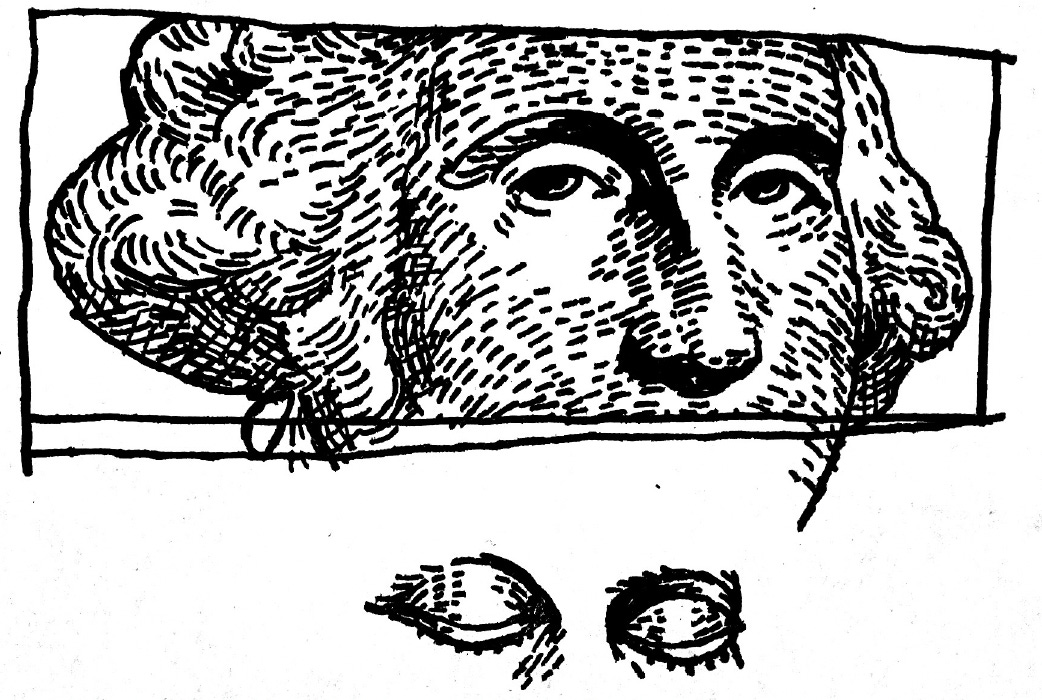
Quite a good piece with which I agree. From Compact.
I've worked inside the "pro-democracy" apparatus, which includes publications like The Bulwark, nonprofits like Protect Democracy, and an array of PACs, SuperPACs, and Substacks. ... The people I worked alongside in this world believe they're doing the right thing—defending institutions, stabilizing norms, standing up against Trump's authoritarian overreach.
But beneath that moral clarity is a problem they can't—or won't—admit: The crisis isn't just about Trump. It's also about the system that produced him—a system they still serve.
The professionalized anti-authoritarian center is fundamentally backward-looking. ... Its members oppose Trumpism, but preserve the structure that made it possible: the politics of technocracy, financialization, elite consensus, and electoral theater. They name the threat, but refuse to name the conditions that gave rise to it....
The result is a strange form of elite nostalgia disguised as resistance—a belief that we can fight authoritarianism without confronting inequality, that we can defend norms without examining who they excluded, and that we can beat Trump without altering the conditions that made him inevitable. What this movement cannot admit is that legitimacy is not a message problem. It is a material one. ...
Alexandria Ocasio-Cortez and Bernie Sanders are drawing large crowds to their "anti-oligarchy" tour because they name the system and tell voters what they already suspect: that both parties have served capital more than people, that politics has become a spectator sport funded by billionaires, and that real change will not come from better messaging, but from rebalancing power. ...
This is the deeper crisis that the pro-democracy center refuses to confront: that legitimacy cannot be restored by rebranding the status quo ante. You cannot poll-test your way out of 40 years of bipartisan neglect. If democracy feels fragile, it's because for many, it never felt like theirs to begin with. ...
... They walked away from a party, but not from a system that sees democracy as management.
So here's the challenge: If you had the clarity to leave your party, can you find the clarity to give up the assumptions that guided it for decades and rendered it vulnerable to Trump's hostile takeover in 2016? Can you question not just the tactics of authoritarianism, but the foundations that made it plausible? ...
Democracy, if it's going to mean anything, has to belong to those who've been denied it the longest. It has to be rebuilt with people, not for them. ...
The most important question in American politics is not whether we can defeat Trump again, but whether the bipartisan class that produced him—and that continues to dominate our media, campaigns, and institutions—can admit what it built. It will come down to whether the pro-democracy center can face the possibility that Trump is not an anomaly, but a consequence. That authoritarianism didn't arrive from outside, but emerged from a system emptied of meaning, purpose, and trust, and eroded by elite capture, institutional decay, and top-down cynicism. Until that reckoning happens, the so-called pro-democracy movement isn't saving anything. It's managing decline.

Van Gogh blues
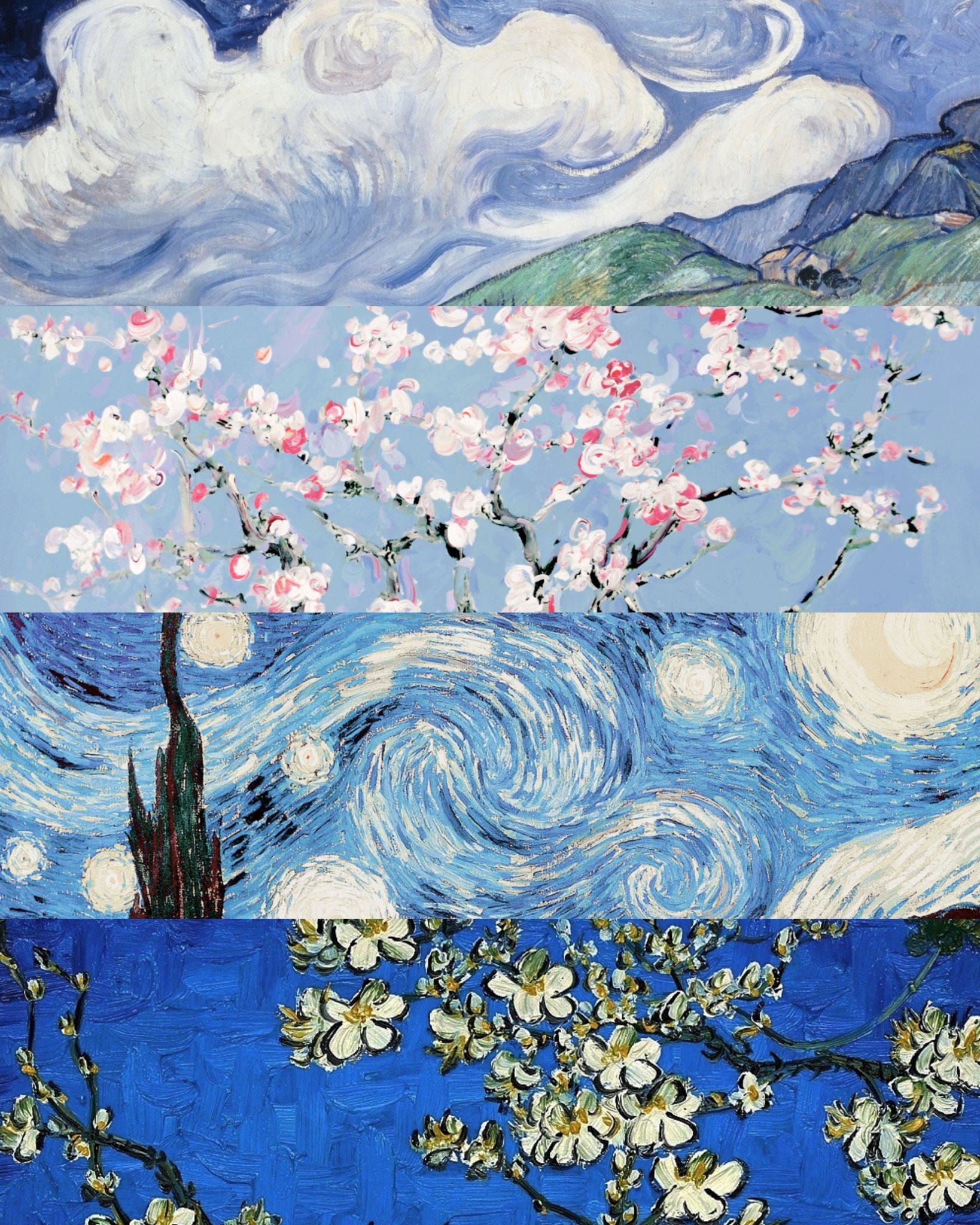
The painter and his subject
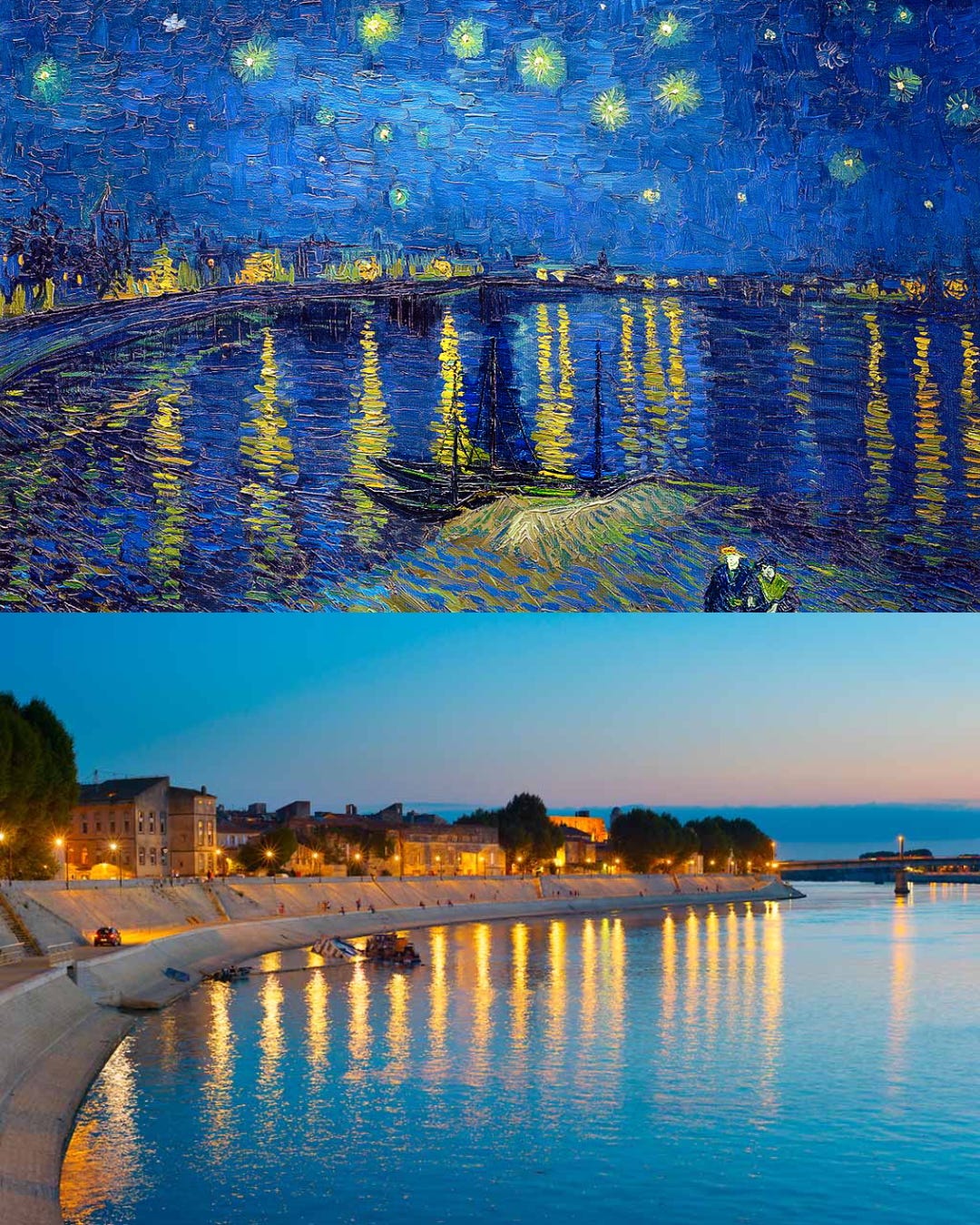
Heaviosity half hour
Hannah Arendt on Stefan Zweig
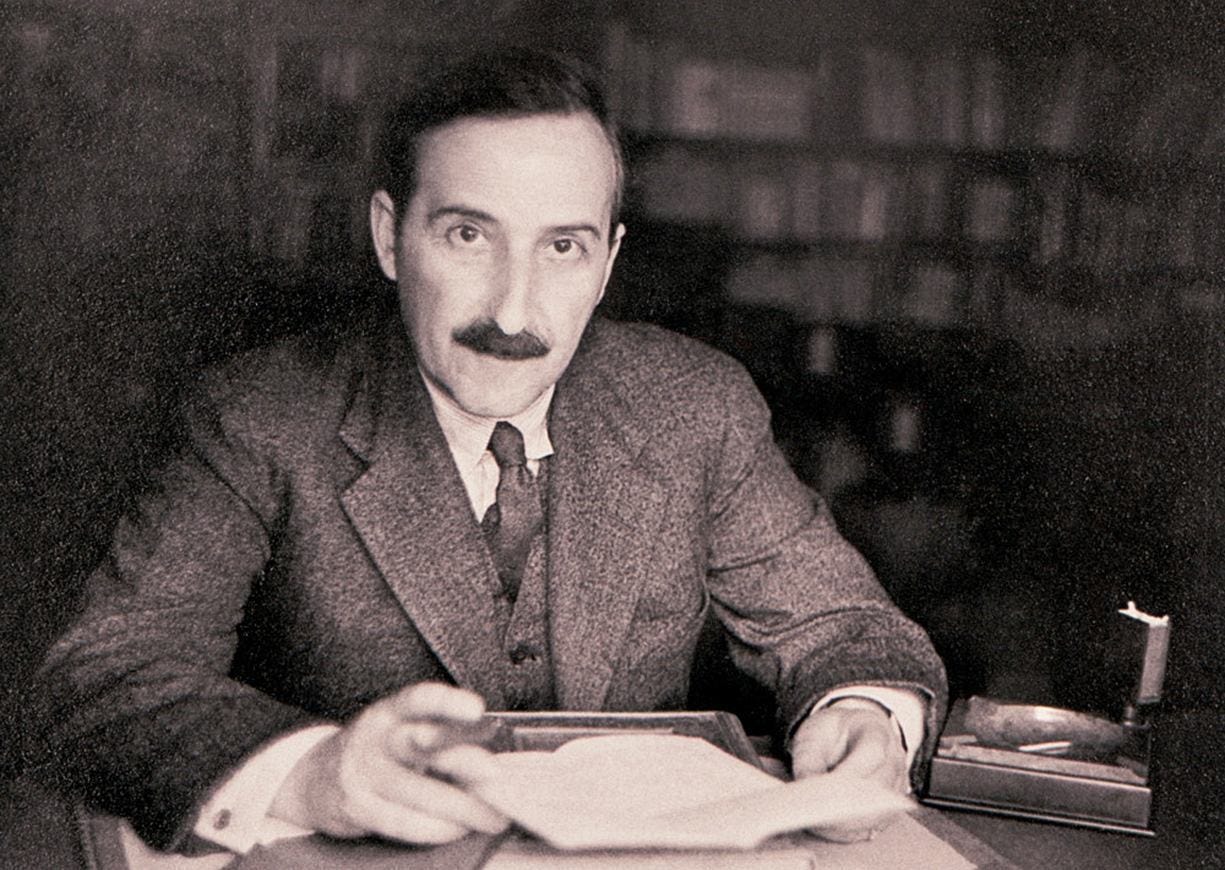
There’s a letter my Viennese grandmother sent someone saying that she was enjoying the company of Stefan Zweig and may spend more time with him. I don't know any more, but there you go. In any event, his The World of Yesterday is a mavellous read, as well as an elegy for a world he has lost. He seems to have written it as a prelude to his suiciding with his wife in the home they had hurriedly made for themselves having escaped Austria for Brazil during WWII.
Such a vibrant, privileged, productive and peaceful life. Smashed to pieces.
In this essay Arendt is respectful of Zweig, who might have been the best known contemporary European writer in his heyday in the 1920s and early 1930s. But she’s ultimately not impressed. It’s a powerful piece to ponder as we work out how to react to the madness, and who’s door we’d knock on if they came after us in the night.
Stefan Zweig: Jews in the World of Yesterday
A hundred and thirty-five years ago Rahel Varnhagen jotted down the following dream: She had died and gone to heaven, together with her friends Bettina von Arnim and Caroline von Humboldt. To relieve themselves of the burdens they had acquired in their lives, the three friends assigned themselves the task of inquiring into the worst things they had experienced. Rahel thus asked: Did you know disappointed love? The other two women broke into tears, and all three thus relieved this burden from their hearts. Rahel asked further: Did you know disloyalty? Sickness? Worry? Anxiousness? Each time the women said yes, as they cried, and again all three were relieved of their burdens. Finally Rahel asked: Did you know disgrace? As soon as this word had been spoken, there was a hushed silence, and the two friends took their distance from Rahel and looked at her in a disturbed and strange manner. Then did Rahel know that she was entirely alone and that this burden could not be taken away from her heart. And then she awoke.
Disgrace and honor are political concepts, categories of public life. In the world of culture, cultural goings-on, and purely private existence, it is just as impossible to get a handle on these categories as in the life of business. Businessmen know only success or failure, and their disgrace is poverty. The literati know only fame or obscurity, and their disgrace is anonymity. Stefan Zweig was a man of letters, and in his last book he describes the world of the literati—a world in which he had once acquired Bildung and fame. A friendly fate protected him from poverty, a favorable star from anonymity. Concerned only with his personal dignity, he had kept himself so completely aloof from politics that, in retrospect, the catastrophe of the last ten years seemed to him like a lightning bolt from the sky, as if it were a monstrous, inconceivable natural disaster. In the midst of this disaster, he tried to safeguard his dignity and bearing as well and as long as he could. He considered it unbearably humiliating when the hitherto wealthy and respected citizens of Vienna had to go begging for visas to countries which only a few weeks before they would have been unable to find on a map. That he himself, only yesterday so famous and welcome a guest in foreign countries, should also belong to this miserable host of the homeless and suspect was simply hell on earth. But deeply as the events of 1933 had changed his personal existence, they had no effect on his basic attitude with respect to the world and to his own life. He continued to boast of his unpolitical point of view; it never occurred to him that, politically speaking, it might be an honor for him to stand outside the law when all men were no longer equal before it. What he sensed—and did not hide from himself—was that during the 1930s the better classes in Germany and elsewhere were steadily yielding to Nazi precepts and discriminating against those whom the Nazis proscribed and banned.
Not one of his reactions during all this period was the result of political convictions; they were all dictated by his hypersensitivity to social humiliation. Instead of hating the Nazis, he just wanted to annoy them. Instead of despising those of his coterie who had been gleichgeschaltet, he thanked Richard Strauss for continuing to accept his libretti. Instead of fighting, he kept silent, happy that his books had not been immediately banned. And later, though comforted by the thought that his works were removed from German bookstores together with those of equally famous authors, this could not reconcile him to the fact that his name had been pilloried by the Nazis like that of a "criminal," and that the famous Stefan Zweig had become the Jew Zweig. Like so many of his less sensible, less talented, and less endangered colleagues, he failed to perceive that the dignified restraint which society had so long considered a criterion of true Bildung was under such circumstances tantamount to plain cowardice in public life. And he likewise failed to perceive that the distinction that had so effectively and for so long protected him from all kinds of unpleasant and embarrassing events would suddenly give rise to an endless series of humiliations that really did turn his life into a hell.
Before Stefan Zweig took his own life, he recorded—with the pitiless accuracy that springs from the coldness of genuine despair—what the world had given him and then done to him. He records the pleasure of fame and the curse of humiliation. He tells of the paradise from which he had been banished—the paradise of cultured [gebildeten] enjoyment, of meetings with like-minded and equally famous people, of infinite interest in the dead geniuses of humanity; penetrating into their private lives and gathering their personal relics was the most enjoyable pursuit of an inactive existence. And then he tells of how he suddenly found himself facing a reality in which there was nothing left to enjoy, in which those as famous as himself either avoided him or pitied him, and in which cultured [gebildete] curiosity about the past was continuously and unbearably disturbed by the tumult of the present, the murderous thunder of bombardment, the infinite humiliations at the hands of the authorities.
Gone, destroyed forever, was that other world in which, "frühgereift und zart und traurig" [early ripe and tender and mournful] (Hofmannsthal), one had established oneself so comfortably; razed was the park of the living and the dead, in which the chosen few—those with taste, that is—idolized art; broken were the trellises that kept out the profanum vulgus of the uncultured more effectively than a Chinese wall. With that world had passed also its counterpart, the society of famous young men, among whom, astonishingly enough, one hoped to discover "real life": the bohemians. For the young son of a bourgeois household, craving escape from parental protection, the bohemians—from whom he was completely separated by essential things (the bohemians, after all, only rarely combed their hair and when they did, they weren't happy about it, and anyway they could never pay for their coffee)—became identified with men experienced in the adversities of life. For the arriviste, those "unarrived," who only dreamed of large editions of their works, became the symbol of unrecognized genius and the example of the dreadful fate that "real life" could prepare for hopeful young men.
Naturally, the world that Zweig depicts was anything but the world of yesterday; naturally, the author of this book did not actually live in the world, only on its rim. The gilded trellises of this peculiar sanctuary were very thick, depriving the inmates of every view and every insight that could disturb their enjoyment. Not once does Zweig mention the most ominous manifestations of the years after the First World War, which struck his native Austria more violently than any other European country: unemployment. But the rare value of his document is not diminished in the least by the fact that, for us today, the trellises behind which these people spent their lives and to which they owed their extraordinary feeling of security seem little different from the walls of a prison or a ghetto. It is astounding, even spooky, that there were still people living among us whose ignorance was so great and whose conscience was so pure that they could continue to look on the prewar period with the eyes of the nineteenth century, and could regard the impotent pacifism of Geneva and the treacherous lull before the storm, between 1924 and 1933, as a return to normalcy. But it is admirable and gratifying that at least one of these men had the courage to record it all in detail, without hiding or prettifying anything. Zweig finally realized what fools they all had been, even if he never gained insight into the connection between their misfortune and their folly.
The same period that Zweig calls the Golden Age of Security was described by his contemporary Charles Peguy (shortly before he fell in the First World War) as the era in which political forms, presumably outmoded, lived on with inexplicable monotony: in Russia, anachronistic despotism; in Austria, the corrupt bureaucracy of the Habsburgs; in Germany, the militarist and stupid regime of the Junkers, hated by the liberal middle class and the workers alike; in France, the Third Republic, which was granted twenty-odd years more despite its chronic crises. The solution to the puzzle lay in the fact that Europe was much too busy expanding its economic radius for any social stratum or nation to take political questions seriously. For fifty years—before the opposing economic interests burst into national conflicts, sucking the political systems of all Europe into their vortex—political representation had become a kind of theatrical performance, sometimes an operetta, of varying quality. Simultaneously, in Austria and Russia, the theater became the focus of national life for the upper ten thousand.
During the Golden Age of Security a peculiar dislocation of the balance of power occurred. The enormous development of all industrial and economic potential produced the steady weakening of purely political factors, while at the same time economic forces became dominant in the international play of power. Power became synonymous with economic potential, which could bring a government to its knees. This was the real reason why governments played ever-narrowing and empty representative roles, which grew more and more obviously theatrical and operettalike. The Jewish bourgeoisie, in sharp contrast to its German and Austrian equivalents, was uninterested in positions of power, even of the economic kind. It was content with its accumulated wealth, happy in the security and peace that its wealth seemed to guarantee. An increasing number of sons from well-to-do homes deserted commercial life, since the empty accumulation of wealth was senseless. The consequence of this situation was that within a few decades both Germany and Austria saw a great number of their cultural enterprises, such as newspapers, publishing houses, and the theater, fall into Jewish hands.
Had the Jews of Western and Central European countries displayed even a modicum of concern for the political realities of their times, they would have had reason enough not to feel secure. For, in Germany, the first antisemitic parties arose during the 1880s; Treitschke made antisemitism "fit for the salon." The turn of the century brought the Lueger-Schoenerer agitation in Austria, ending with the election of Lueger as mayor of Vienna. And in France the Dreyfus affair dominated both internal and foreign policies for years. Even as late as 1940 Zweig could admire Lueger as an "able leader" and a kindly person whose "official antisemitism never stopped him from being helpful and friendly to his former Jewish friends." Among the Jews of Vienna no one took antisemitism, in the amiable Austrian version Lueger represented, seriously—with the exception of the "crazy" feuilleton editor of the Neue Freie Presse, Theodor Herzl.
At least, so it would appear at first glance. Closer examination changes the picture. After Treitschke had made antisemitism fit for the salon, conversion ceased to be a ticket of admission to non-Jewish circles in Germany and Austria. Just how antisemitic "better society" had become could not be easily ascertained by the Jewish businessmen of Austria, for they pursued only commercial interests and cared nothing about invitations to non-Jewish groups. But their children discovered soon enough that in order for a Jew to be fully accepted into society, there was one and only one thing to do: become famous.
There is no better document of the Jewish situation in this period than the opening chapters of Zweig's book. They provide the most impressive evidence of how fame and the will to fame motivated the youth of his generation. Their ideal was the genius that seemed incarnate in Goethe. Every Jewish youth able to rhyme passably played the young Goethe, as everyone able to draw a line was a future Rembrandt, and every musical child was a demonic Beethoven. The more cultured the parental homes, the more coddled were these imitative Wunderkinder. Nor did this stop with poetry and art; it dominated every detail of personal life. They felt as sublime as Goethe, imitated his "Olympian" aloofness from politics; they collected rags and gewgaws that had once belonged to famous people of other periods; and they strove to come into direct touch with every living period of renown, as if a tiny reflection of fame would thus fall upon them—or as if one could prepare oneself for fame by attending a school of celebrity.
Of course, the idolatry of genius was not restricted to the Jews. It was a gentile, Gerhardt Hauptmann, who, as was well known, carried this idolatry as far as to make himself look, if not like Goethe, at least like one of the many cheap busts of the master. And if the parallel enthusiasm that the German petite bourgeoisie showed for Napoleonic splendor did not actually produce Hitler, it contributed mightily to the hysterical raptures with which this "great man" was greeted by many German and Austrian intellectuals.
Although deification of the "great man," without much consideration for what he actually achieved, was a general disease of the era, it assumed a special form among the Jews and their particular passion for the great men of culture. In any case, the school of fame that the Jewish youth of Vienna attended was the theater; the image of fame that they held before them was that of the actor.
Again a qualification is in order. In no other European city did the theater ever acquire the same significance that it had in Vienna during the period of political dissolution. Zweig recounts how the death of a famous court actress made his family cook, who had never heard or seen her, burst into tears. Simultaneously, as political activity began to resemble theater or operetta, the theater itself developed into a kind of national institution, the actor into a national hero. Since the world had undeniably acquired a theatrical air, the theater could appear as the world of reality. It is hard for us today to believe that even Hugo von Hofmannsthal fell under the spell of this theater hysteria and for many years believed that behind the Viennese absorption in the theater lay something of the Athenian public spirit. He overlooked the fact that Athenians attended the theater for the sake of the play, its mythological content, and the grandeur of its language, through which they hoped to become masters of their passions and molders of their national destiny. The Viennese went to the theater exclusively for the actors; playwrights wrote for this or that performer; critics discussed only the actor or his parts; directors accepted or rejected plays purely on the basis of effective roles for their matinee idols. The star system, as the cinema later perfected it, was completely forecast in Vienna. What was in the making there was not a classical renaissance but Hollywood.
Whereas political conditions made this inversion of being and appearance possible, Jews put it into motion, supplied the public demand, and spread its fame. And since the European world, not unjustifiably, considered Austrian backstage culture representative of the whole period, Zweig is not wrong when he proudly asserts that "nine-tenths of what the world celebrated as Viennese culture in the nineteenth century was promoted, nourished, or even created by Viennese Jewry."
A culture built around an actor or virtuoso established standards that were as novel as they were dubious. "Posterity weaves no wreaths for the mime," and so the mime requires an incredible amount of present fame and applause. His well-known vanity is, as it were, an occupational disease. To the degree that every artist dreams of leaving his mark on future generations, of transporting his period into another, the artistic impulses of virtuosi and actors are forever frustrated and require hysterical outlets. Since the actor must renounce immortality, his criterion of greatness depends altogether on contemporary success. Contemporary success was also the only criterion that remained for the "geniuses in general," who were detached from their achievements and considered only in the light of "greatness in itself." In the field of letters this took the form of biographies describing no more than the appearance, the emotions, and the demeanor of great men. This approach not only satisfied vulgar curiosity about the kind of secrets a man's valet would know; it was prompted by the belief that such idiotic abstraction would clarify the essence of greatness. In their respect for "greatness in itself," Jews and gentiles stood side by side. That was why Jewish organizations of most cultural enterprises, and particularly of the theatrical culture of Vienna, could go on without restraint, and even become in a sense the epitome of European culture.
Stefan Zweig's thorough knowledge of history preserved him from adopting this yardstick without any qualms. Yet, despite his "connoisseurship," this knowledge could not prevent him from simply ignoring the greatest poets of the postwar period, Franz Kafka and Bertolt Brecht, neither of whom were ever great successes. Nor could it prevent him from confusing the historical significance of writers with the size of their editions: "Hofmannsthal, Arthur Schnitzler, Beer-Hofmann, and Peter Altenberg gave Viennese literature European standing such as it had not possessed under Grillparzer and Stifter."
Precisely because Zweig was modest about himself, discreetly glossing over the uninteresting personal data in his autobiography, the repeated enumeration of famous people he met in his life or entertained at home is especially striking. It seems like exact proof that even the best of those cultured Jews could not escape the curse of their time—the worship of that great leveling idol, Success. Nothing does more harm to a highly differentiated sensibility than the comic vanity that, without any principle of selection and without any sense for differences, drops as many famous names as possible.
In his guest book at Salzburg, Zweig gathered "eminent contemporaries" as passionately as he had collected the handwriting and relics of dead poets, musicians, and scientists. His own success, the benign renown of his own accomplishments, failed to sate the appetite of a vanity that could hardly have originated in his character. Presumably his character found it repulsive, but this vanity was solidly rooted in the depths of a conviction that formed its own weltanschauung—the conviction that began with the search for the "born genius" or "poet made flesh" and considers life worth living only insofar as it plays itself out in the midst of an atmosphere of fame among a chosen elite.
Incomplete satisfaction in one's own success, the attempt rather to transform fame into a social atmosphere, to create a caste of famous men like a caste of aristocrats, to organize a society of the renowned—these were the traits that distinguished the Jews of the period and differentiated their manner from the general genius-lunacy of the times. That was also why the world of art, literature, music, and the theater played, as it were, right into their hands. They alone were really more interested in those things than even in their own personal achievements or their own fame.
While the turn of the twentieth century brought economic security to the Jews and recognized their civic rights as a matter of course, at the same time it made their situation in society questionable, their social position insecure and ambiguous. Seen from the perspective of society, they were and remained pariahs as long as they failed to make themselves fit for the salon by some extraordinary means, such as fame. With regard to a famous Jew, society would forget its unwritten law. Zweig's "radiant power of fame" was a very real social force, in whose aura one could move freely and could even have antisemites as friends, such as Richard Strauss and Karl Haushofer. Fame and success offered the means for the socially homeless to create a home and an environment for themselves. Since great success transcended national borders, famous people could easily become the representatives of a nebulous international society, where national prejudice appeared to be no longer valid. In any case, a famous Austrian Jew was more apt to be accepted as an Austrian in France than in Austria. The world citizenship of this generation, this remarkable nationality that its members claimed as soon as their Jewish origin was mentioned, somewhat resembles those modern passports that grant the bearer the right of sojourn in every country except the one that issued it.
This international society of famous people was punctured for the first time in 1914 and finally buried in 1933. It is all to Zweig's credit that he never allowed himself to be fooled into participating in the universal hysteria of the First World War. He remained loyal to his principles and kept his distance from politics; he never yielded to the temptation that afflicted so many literati—the temptation of using the war to establish a place in society outside of the circle of international intellectuals. It thus came about that, for him, the remnants of this prewar society preserved itself throughout the war. And it is well known that in the 1920s, which is to say, in the years to which Zweig owes his greatest success, the international society of fame once again functioned in Europe. But after 1938 Zweig learned some bitter lessons: that this international society, including the rights of its citizenry, depended on the possession of a very national passport, and that, for the stateless, there is no "international" anything.
The international society of the successful was the only one in which Jews enjoyed equal rights. Little wonder, then, that the most meager talents developed quite happily; still less that, for them, "the most beautiful odor on earth, sweeter than the rose of Schirach, [was] the smell of printers' ink." There was nothing in their lives more joyous than the printing of a book, the reviews, the complimentary copies, the translations into foreign languages. It was an ever-renewed ritual of placing oneself in relation to a world where one gets one's name into print so as to be admitted.
The fame that gave the social pariah something like the rights to a homeland in the international elite of the successful brought another privilege, which, according to Zweig's own judgment, was at least equally important—the suspension of anonymity, the possibility of being recognized by unknown people, of being admired by strangers. Even if one fell back into anonymity for a time, fame stood like a solid suit of armor that one could don again at any moment in order to protect oneself from the terrible effects of life. There is no question that Zweig feared nothing more than sinking back into an obscurity where, stripped of his fame, he would become again what he had been at the beginning of his life—except that now everything would be different and much worse: he would be no more than one of the many unfortunates who are confronted with the almost insuperable problem of conquering, bedazzling, and forcing oneself onto a strange, uncanny world—which is precisely how society must look to anyone who does not belong to it from birth and to all those against whom it discriminates.
Fate, in the form of a political catastrophe, eventually did almost thrust him into this very anonymity. Robbed of his fame, he knew—better than many of his colleagues—that the fame of a writer flickers out when he cannot write and publish in his own language. His collections were stolen from him, and with them his intimacy with the famous dead. His house in Salzburg was stolen, and with it his association with the famous among the living. Stolen, finally, was the invaluable passport, which had not only enabled him to represent his native land in other countries but had also helped him to evade the questionable character of his own civic existence within his native land.
And again, as during the First World War, it is to Zweig's credit that he was neither enflamed by the universal hysteria nor beguiled by his newly acquired British citizenship. He could hardly have represented England in other countries. Since, finally, the international society of the famous disappeared completely with the Second World War, this homeless man lost the only world in which he had once had the delusion of a home.
In a last article, "The Great Silence" (ONA, March 9, 1942), written shortly before his death—an article which seems to me to belong with the finest of Stephan Zweig's work—he tried to take a political stand for the first time in his life. The word "Jew" does not occur to him, for Zweig strove once again to represent Europe—more exactly, Central Europe—now that it was shocked into silence. Had he spoken about the terrible fate of his own people, he would have been closer to all the European peoples who are today, in the battle against their oppressor, struggling against the persecutor of the Jews. The European peoples know—better than did this self-appointed spokesman who had never in his whole lifetime concerned himself with their political destiny—that yesterday is not detached from today, "as if a man had been hurled down from a great height as the result of a violent blow." To them yesterday was in no way that "century whose progress, whose science, whose art, and whose magnificent inventions were the pride and the faith of us all."
Without the protective armor of fame, naked and disrobed, Stefan Zweig was confronted with the reality of the Jewish people. There had been various escapes from social pariahdom, including the ivory tower of fame. But only flight around the globe could offer salvation from political outlawry. Thus this Jewish bourgeois man of letters, who had never concerned himself with the affairs of his own people, became nevertheless a victim of their foes—and felt so disgraced that he could bear his life no longer. Since he had wanted all his life to live in peace with the political and social standards of his time, he was unable to fight against a world in whose eyes it was and is a disgrace to be a Jew. When finally the whole structure of his life, with its aloofness from civic struggle and politics, broke down, and he experienced disgrace, he was unable to discover what honor can mean to men.
For honor never will be won by the cult of success or fame, by cultivation of one's own self, nor even by personal dignity. From the "disgrace" of being a Jew there is but one escape—to fight for the honor of the Jewish people as a whole.
1943
Your posts are terrific gifts. Thank you for doing this.