


Why Wikipedia works
Hint: it’s the middleware
I think it was Arthur C. Clarke who said something like ‘new technology always arrives looking like magic’. Certainly, Wikipedia did. By every rule of logic, giving a global army of volunteers the power to write their own encyclopedia should have produced chaos. This video argues we’re still missing why it worked. While we’re mesmerised by its radical openness— the same radical openness that is plunging our world into darkness on social media — we’re missing the prior miracle. I call it the 'middleware' of peer production.
And here’s Colm and me trying to figure it all out.
Must watch for all non-Australians
Spoiler alert: Australians know how this ends …
What with the Winter Olympics being on and all
Promo for a series that’s coming soon to the podcast app near you
The two giant markets gnawing at our soul

A comment I made on this interesting Substack note from Andrew Kemp.
Our system is driven by two giant preference aggregators - the markets for money and the market for votes. Each have made vast contributions to modern wellbeing. Each is a good servant. Both become our masters in subtle ways - by privileging competition over cooperation.
For most people, competition sounds socially destructive so putting competition ahead of cooperation sounds like a bad idea. That’s why we hate Woolies for not helping us out by lowering their margins when prices are rising.
But that’s applying the logic of the tribe when large groups of people need to move towards more objective means of preference aggregation. (Almost all seats in the House of Commons were by unitary selection of the district, and only started being competed for with any regularity in the second half of the 17th century).
The pity of it is that, through all this, there remains some wisdom in the folk wisdom that competition is dangerous and destructive of very valuable aspects of the social fabric. And so as these two giant markets grind through our social norms turning all that is solid into air, we find ourselves ethically adrift.
Alasdair MacIntyre had all this nailed nearly fifty years ago:
In any society which recognized only external goods, competitiveness would be the dominant and even exclusive feature… We should therefore expect that, if in a particular society the pursuit of external goods were to become dominant, the concept of the virtues might suffer first attrition and then perhaps something near total effacement, although simulacra might abound.
Lovely!


Paintings in the uncanny valley of looking like photos


Post-Liberals don’t know what they’re talking about: SHOCK!!
Though this post is a little more confident about neoliberal economics than I am, it documents the complete economic illiteracy of the post-liberals.
It reminds me of a time 40 years ago when I was critical of a particular blind spot of early neoliberalism in Australia - then called ‘economic rationalism’. In the context of gradually lowering tariffs, I was arguing for transitional assistance to manufactured exports via instruments like import-export drawback which had been widely used to transition from import replacement to export led growth in Japan, Korea, Taiwan and Singapore (Yes, Singapore! It had trade barriers for some manufactures like car components - of all things. Extremely silly for a country trying to make its way as an entrepôt port I know, but there you go!)
Anyway, some folks in Queensland invited me up to talk about import/export links and I found myself in the full pomp of my late twenties on a stage behind which was a huge graph of the trade balance with red ink everywhere. While I was clearly uncomfortable, he was in his element. These inane economic rationalists didn’t understand that Australian industry couldn’t survive on its own. It needed us Aussies to pay more for our stuff to give it a leg up. I remember that, at about this time, Robert Manne who’d also been an anti-economic rationalist, decided to pull out of that game because he didn’t really understand it. Neither did John Carroll, but he didn’t let that slow him down.
Anyway, ignorance dies hard. It turns out America’s right-wing post-liberals know, just know that it’s pretty terrific when politicians direct economic development. What could possibly go wrong?
After being denied tenure at Princeton in 2004, Deneen shifted toward environmental crisis concerns. In a 2007 blog post, he predicted “severe civilizational dislocation in coming months and years as a result of peak oil.”
Peak Oil Theory foresaw imminent resource depletion... It has since fallen by the wayside as new exploration expanded estimated reserves...
For Deneen, Peak Oil provided the “eureka” moment for postliberalism:
[W]hen I learned about “peak oil”... it finally made sense why a philosophy I held to be fundamentally false - modern liberalism - nevertheless had prospered...
Modern liberalism... is against nature, and therefore ought not to have “worked.”
Peak Oil revealed liberalism as the culprit... Modernity borrowed from the planet’s future. The liberal façade would crash as Peak Oil enforced itself.
Except the collapse, said to be months away in 2007, never happened.
When the prophecy failed
Deneen abandoned Peak Oil and his draft paper “Peak Oil and Political Theory: The End of Modernity?”... Free markets and libertarians remained the cause of every problem.
Deneen believed he’d exposed a flaw in “liberal” modernity... His arguments were aesthetic grievances from someone who neither understood economics nor cared to...
The real objection was revulsion at modernity... Postliberalism emerged to reorient society to its “natural” course through a “common good” that looks like Deneen’s personal preferences.
When “virtue” and “common good” mean one’s political aesthetic, deviation becomes rebellion against “nature.”
Trumpism is proving postliberal economics wrong
Markets reshape social life, eroding nonmarket goods... Efficiency produces deindustrialization, fragile supply chains, fractured culture...
Disagreement over the common good is why liberalism exists.
Postliberals don’t understand economics... Problems they blame on liberals are caused by other factors and would worsen under their policies...
They claim a manufacturing crisis, ignoring more job openings today than 20 years ago. Trump’s tariffs coincided with blue collar declines.
Trump’s record proves postliberals wrong...
Postliberalism replaces mainstream economics with heterodox crankery from the Hungarian Institute of International Affairs, run by Gladden Pappin...
When bad history becomes a permission slip for bad policy
Postliberals cite Henry Clay’s “American System” of tariffs, subsidies, and central banking... contrasting this with British “laissez-faire” designed to ensure U.S. subservience...
But free-market economists engaged with these arguments from the start.
The “American System” performed poorly, culminating in the 1930 Smoot-Hawley Tariff Act... It collapsed global trade and deepened the Great Depression...
Evidence shows protective tariffs hindered 19th-century development. Deneen and Pappin either don’t know this or don’t care — their goal is installing their social-cultural regime, regardless of cost...
Libertarians became the primary scapegoat...
In 2026, using state power for minoritarian views has proven disastrous. Voters judged woke overreach harshly in 2024, settling on Trump faute de mieux. The right should learn this, not repeat it.
Postliberals convinced part of the right...
JD Vance credited Trump for “attacking the libertarian consensus.” Friends with Deneen and Pappin, Vance credits both for his postliberal conversion.
Postliberals can now test their theories. If wrong — as records suggest — Americans will pay higher prices watching a minority “common good” fail. The economists they scapegoated will be the least of their problems.
Great fun

Will Democrats lose their next big battle?
Somehow, I don’t think it will end up this bad, but who knows?
Are you sitting down? There’s big news from the Democratic Party. No, they haven’t developed a coherent plan to address ICE shooting civilians on American streets. Nor have they much to say about Trump’s foreign policy, which is so disruptive that it forced European nations to remember they have armies and deploy troops to Greenland.
No, this is much more important for the country. Kamala Harris has released a video. Standing in an office so generic it could be a Zoom background, a beaming Harris announces that KamalaHQ is being renamed Headquarters, “a place where you can go online to get basically the latest of what’s going on, and also to meet and revisit with some of our great, courageous leaders.” ...
“Conservatives build permanent organizing infrastructure. Progressives have historically built machines that dismantle after Election Day. Headquarters is the end of that cycle,” enthuses the accompanying press release. ... Headquarters will be a “new Gen-Z led progressive content hub.” ...
Look, I see the appeal. Harris is right that Democrats have struggled to keep momentum going after 2024. But the solution isn’t to pretend that a glossy website counts as a genuine gameplan. As the Democrats’ cringey YouTube channel showed us, the issue isn’t a lack of content. It’s a lack of substance. ...
This lack of interest in new media is indicative of something deeper—a lack of a clear plan for what the Democrats will do to fix the country. ... After scrapping their autopsy report, arguing that its release would be “counterproductive,” the Democrats have struggled to unite around any policies or develop any kind of roadmap for winning the midterms, let alone the next presidential election.
The goal of Headquarters is “to build an effort to mobilize pro-justice, pro-fairness, pro-democracy young people against far-right extremism.” (I’m not quite sure what it means to “build an effort to mobilize.” Why not just mobilize?) But by choosing this kind of platform, and with such a convoluted message, Harris and her team fundamentally misunderstand what, today, is attracting an increasing number of young people to the far right.
Globally, more and more young voters are choosing right-wing parties and reporting dissatisfaction with democracy. There is a deep feeling that our current political system and institutions don’t work. Part of the reason is that politicians seem ever more corporate and out of touch. ...
Frustrated with a lack of opportunities, feeling left behind and unheard—these are emotional responses to changes in our economy and social values, and cannot be addressed by someone in a suit burbling corporate-style jargon. Young people are often instinctively repelled by performative behaviors and attempts to be cool. They choose authenticity over polish. ...
Harris’ greatest weakness has always been her inability to appear like a normal person, and this is causing her, yet again, to retreat into strategic soundbites rather than actually listening and responding. Young people don’t want to “meet and revisit with some of our great, courageous leaders” through a soulless website and curated videos. They want to see a human being who sees them, too.
It’s hard not to see this as the Democrats workshopping possible TikTok memes as the country burns. Harris and her team are cringe—but the Trump administration is genuinely dangerous, undermining American democracy in ways that may be irreversible, and putting the lives of civilians, including U.S. citizens, at risk. It’s unforgivable that, over a year into Trump’s presidency, the Democrats still don’t have their act together. ... I just wish the Democrats could give us more than polished videos and websites that ultimately say nothing.
“I’m really excited about it. Stay engaged, and I’ll see you out there,” Harris concludes in her video. I’m not sure where “out there” is, but I’ll be there anyway, underwhelmed.
A tweet on Starmer
Here’s a tweet on Starmer and my reply:
The level of personal hostility directed at Keir Starmer over the last week deserves scrutiny in its own right. Not because he should be immune from criticism, but because the tone and intensity of the attacks tell us something unhealthy about the state of democratic politics.
1. Starmer is a conventional political figure. Cautious, legalistic, incremental. He frustrates people precisely because he is managerial rather than messianic. Yet the reaction to him often goes far beyond disagreement, tipping into visceral hatred more commonly reserved for authoritarians or demagogues.
2. Much of this hostility is disconnected from concrete policy. It is not about specific votes, proposals or outcomes, but about projection. A belief that Starmer embodies betrayal, bad faith or hidden malice. That kind of politics runs on suspicion rather than evidence.
3. This matters because democracy depends on the assumption of good faith among opponents. You can think a leader is wrong, timid, or misguided without believing they are fundamentally illegitimate. Once politics becomes moralised to the point of demonisation, compromise is reframed as treachery and pluralism as weakness.
4. The pattern is familiar. In fragmented, polarised systems, anger concentrates not on extremists, whose intentions are clear, but on moderates, who disappoint maximalists on all sides. The centre becomes the lightning rod precisely because it resists totalising narratives.
5. There is also a media and online dynamic at work. Incentives reward outrage, not proportionality. Algorithms favour contempt over analysis. Over time, this creates a political culture in which relentless personal attack feels normal, even virtuous, rather than disgusting.
6. None of this is a defence of Starmer’s decisions, instincts or record. Those should be argued over robustly as you do in a democracy. The problem is the substitution of critique with hostility and the quiet erosion of democratic norms that follows when political opponents are treated as enemies rather than rivals.
7. A democracy cannot function if every election is framed as an existential struggle against internal evil. At some point, the target may change, but the damage to trust, restraint and culture remains.
My response on Twitter
I think it's also bullying behaviour. I was a Labor staffer in Australia 30 years ago and watched some horrible bullying in the caucus.
Today the rot has descended from the fish's head down into the body.
Starmer is an awkward dude. Just can't seem to sound like he means anything. Yet he's competent, thorough - amid the inevitable improvising which is the way of life of a politician.
And the expectation of smooth delivery, indeed of being ENTERTAINING just grows and grows in the electorate.
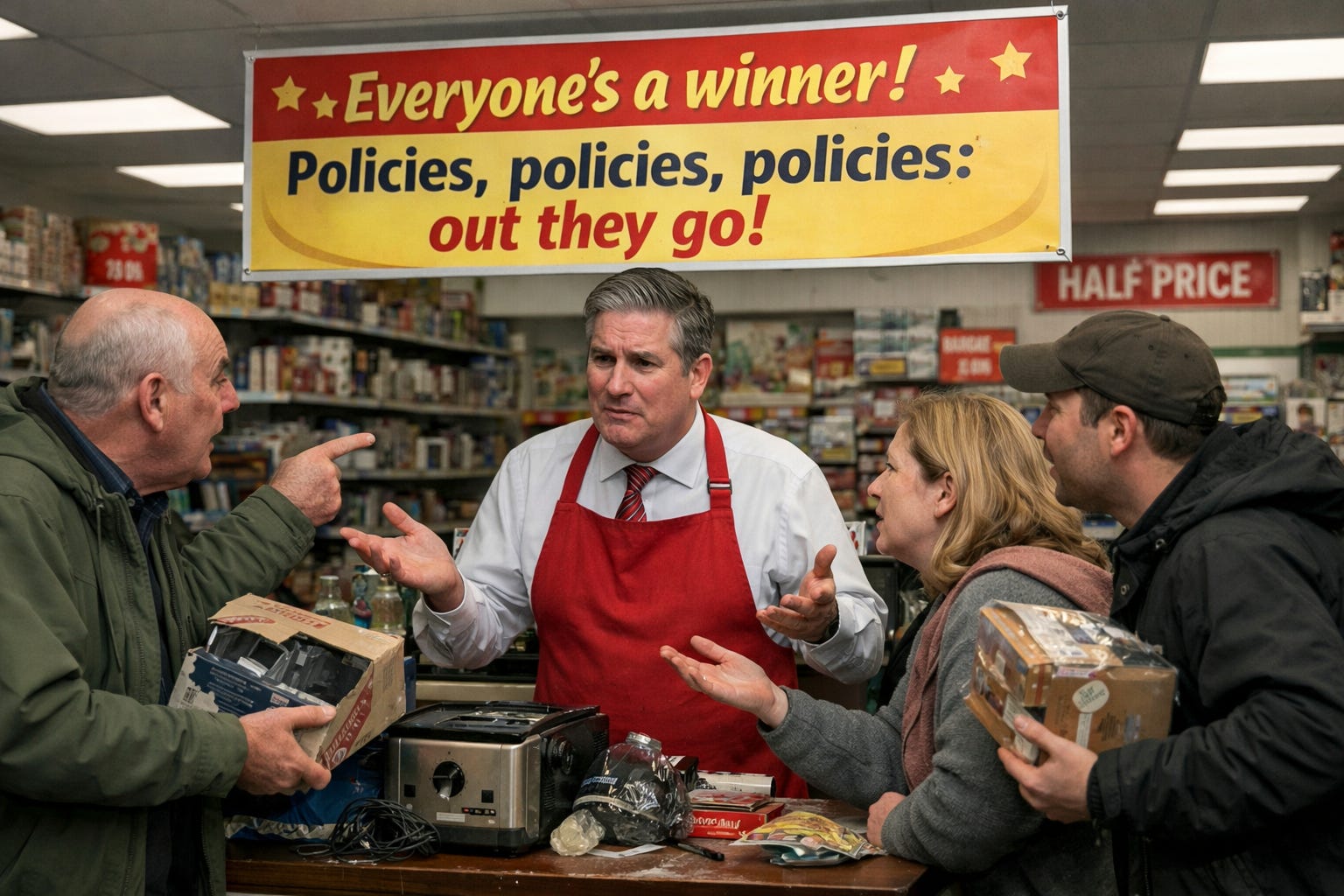
Voters are like angry customers back in the discount shop to complain that the product they bought isn't much chop. Of course it's not much chop. If it was, they'd never have been tempted into purchasing it. But it's always about the bad shopkeeper, never about the bad customer.
Wonderful
Melania: the film
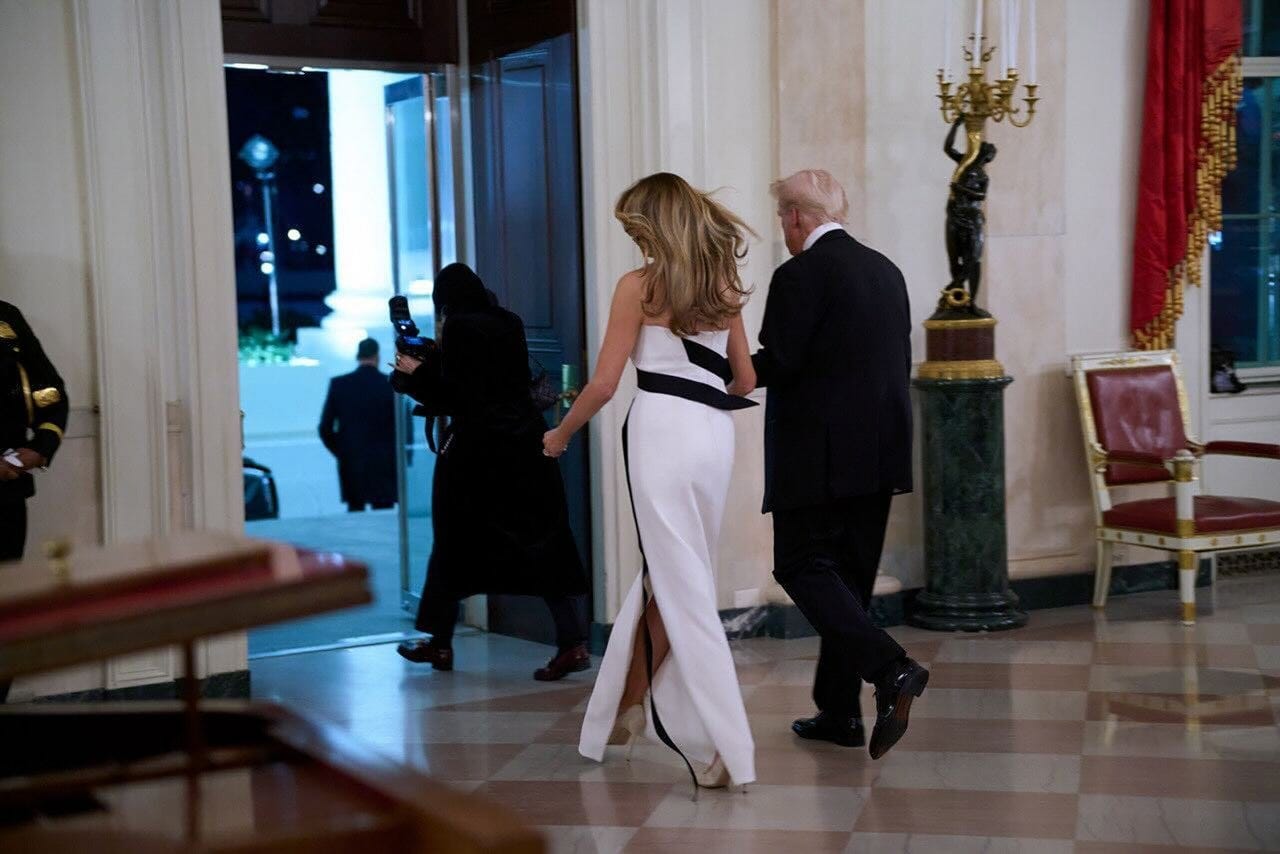
The peeps in our film reviewing division asked Christos Tsiolkas (of Slap fame) to pop down to his local arthouse cinema to review Melania. He went looking for camp. But was disappointed. On all counts.
The most obvious – and the least interesting – thing to say about the documentary Melania is that it is propaganda. Much more fascinating is the film’s critical reception since its release two weeks ago...
She’s a figure who lives in the shadows, her life and persona eclipsed by the blinding glare – the vehement loathing and equally intense adoration – that clings to her husband, Donald Trump. Melania keeps the First Lady front and centre of nearly every frame, but she never emerges from the gloom of contemporary American culture...
If there is any animus, any passion guiding the making of Melania, it is contempt for liberal audiences. A smarter, more dangerous right-wing filmmaker would have brought that detestation to the fore. Director Brett Ratner is such an apathetic and timid hack that he shirks even that possibility...
The best part is the first 10 minutes, where we see Melania in discussion with designers and couturiers...I wondered if the doco was going to sequester all current affairs from its purview and concentrate only on the sartorial and technical details of the preparations. That would have been an arguably radical choice...
However, given it’s helmed by Ratner, a hireling director whose career was curtailed by #MeToo accusations, and also that it was financed by Amazon, there was little chance the documentary was ever going to be daring...
As soon as Melania’s narration begins, the off-screen, stage-managed scripts that are controlling the production become obvious...Melania’s words are banal, all poorly scripted feel-good statements and generic platitudes...she sounds detached and unemotional.
This emotional emptiness is compounded by Ratner’s astonishing incuriosity. The upheavals of the former Yugoslavia, the trajectory that led Melania from a jobbing gig as a model to meeting Donald Trump, don’t seem to interest the director at all...
The sexism is dumbfounding. Here are two of the most powerful women in the world and Ratner isn’t remotely interested in who they are and what they have to say. Even though he is only an extra in the film, Donald Trump is the true subject being canonised...
If nothing is revealed beyond the mask of the First Lady’s face, the blame can’t solely be laid at her feet, nor at the behind-the-scenes manipulations overseeing the production. Melania is a failure as a documentary and the responsibility for that lies with the filmmakers...Ratner isn’t interested in any of that. Neither, for that matter, are the lauded American documentarians Kirby Dick and Alex Gibney. Melania is a crock, but the gnashing scorn poured on it by critics is disingenuous...


Epstein
I was intrigued by a Twitter conversation where someone asked just how the hijinks on Epstein’s island (as opposed to Epstein’s earlier abuse of underage girls) differed from Hugh Hefner’s operation. A good question I thought. Here’s a similar argument from The Atlantic
In Jeffrey Epstein’s case, association implies guilt. The release of the Epstein files is generating firings, resignations, and apologies. Peter Attia resigned from a protein-bar company... Brad Karp is stepping down as chair of Paul Weiss... [Dozens are] issuing statements insisting they did nothing illegal.
Nothing comparable happened with other sex criminals. Epstein is different because presence in the files is presumptively damning. [The] conventional wisdom holds that Epstein trafficked teen girls to powerful men, whom he blackmailed; that his plane and island were brothels; and that friends who didn’t participate were aware.
Those assumptions are widely held—but poorly substantiated. The files bolster the case that terrible crimes were committed, [but] there never was a larger conspiracy.
[But] the accusations that led to [Epstein’s] initial conviction were specific to Epstein himself. The notion of other abusers arose later, [owing to] allegations by Virginia Giuffre... [These] claims have never been substantiated...
[Attorney] Brad Edwards has represented more than 200 Epstein victims. [Yet he] dismissed the idea that Epstein ran a trafficking ring. “Jeffrey Epstein was the pimp and the john. He was his own No. 1 client,” he said... [He argued] that Epstein lived a double life. “For the most part,” Edwards said, “those two worlds did not overlap.”
The theory that Epstein was blackmailing his contacts was always speculation. Epstein built his fortune as a wealth manager for superrich old men...
[It’s not] obvious that Epstein’s friends knew about his crimes... His 2008 plea deal allowed him to admit to soliciting underage prostitution. He spent only a year in jail...
[But being] friends with Epstein before his conviction is no proof of ignorance. [Trump] told New York magazine in 2002 that Epstein “likes beautiful women as much as I do, and many of them are on the younger side.”
[In] death, Epstein has taken on far more significance than he did in life... [The] notion of a “client list” [seemed to] explain why he’d received a lenient deal...
[The MAGA] movement nurtured the idea that Democrats were covering up “the Epstein files.” Trump said he would release the files... Then [he] abruptly backtracked. [The longer he] delayed, the more explosive the files seemed.
[But there] never was a client list. The Epstein files encompass millions of documents... Being “in the Epstein files” doesn’t mean much...
Many emails are newsworthy. Some of Epstein’s friends relied on him for introductions to young, but not underage, women... Peter Mandelson emerges as one of Epstein’s creepiest confidants... Noam Chomsky advised Epstein on managing fallout from his conviction.
Documents contradict what prominent people have said. Elon Musk posted that Epstein “tried to get me to go to his island and I REFUSED.” [But the] files show Musk emailed Epstein: “What day/night will be the wildest party on your island?”...
Because the Epstein conspiracy theory is treated as reality by so many, however, merely appearing in the files seems to be grounds for suspicion. And because Epstein cultivated as many high-profile contacts as possible, that leaves a whole lot of people potentially exposed to unfounded insinuations...
Epstein committed horrific acts against a staggering number of women and girls, but, judging from the available evidence, he was not at the center of a global pedophilia ring that included dozens of criminal co-conspirators. The apparent truth is somehow even more depressing. Smarmy jerks can get obscenely wealthy in this country just by managing other people’s money. Men who sexually abuse women and children can be charming. The most accomplished people in our society can be terrible judges of character. They can, in the pursuit of proximity to wealth and power, ignore or downplay what’s right in front of them. The Epstein files show us that the world is an ugly and unfair place. But we already knew that.
Helen Landemore’s latest
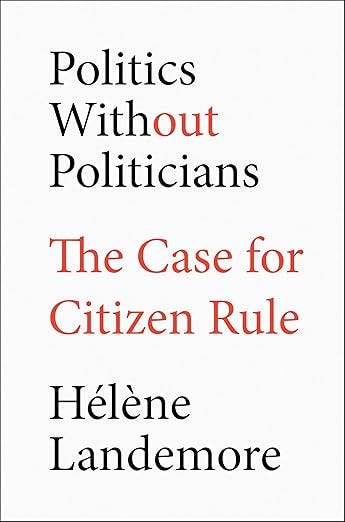
Landemore is one of the premier academic advocates of sortition. And she’s got a new book out.
I’ve got both good and bad news. The bad news: electoral politics is beyond repair. The good news: democracy isn’t. We can fix it.
Before we arrive at the good news, we first need to start with the failure of electoral politics... Yet the populists have a point: a system based on electoral representation is no longer — if it ever was — capable of delivering either democratic or good governance.
Consider that the United States Congress currently holds a 15% approval rating and has consistently hovered well below 50%, on average, for decades... Consider that in three of the world’s so‑called most advanced democracies — the United States, the United Kingdom, and France — over two-thirds of the population think their governing elites are corrupt. (In my native country of France, this figure reached 74% in 2025!)... Consider that when political scientists crunch the numbers, they find that the preferences of rich people shape policy outcomes and law substantially more than those of the majority do.
We could blame these problems on external factors and forces, such as globalization, capitalism, and the fast-paced changes brought by new technologies, foreign threats, or immigration — all of which undeniably make the job of governing at the scale of a nation-state quite difficult...
But excuses can only go so far. Chronic underperformance and widespread dissatisfaction with the system — along with a growing retreat from it — should make one thing clear: there’s a fundamental problem with the system itself. While electoral representation may have made sense two centuries ago, in a vastly different context and for very different populations, it’s no longer up to the task, especially in modern societies of educated citizens with access to information...
Politics without politicians? What does that even mean?... If not politicians, then who?
Let me first paint with a broad brush a picture of the alternative system I have in mind. Imagine hundreds of everyday people from all around the country, from every age and walk of life, all selected by a national lottery. They come together for extended periods of time in a parliament-like institution to deliberate and decide ways to address the housing crisis or the opioid crisis, or how to do something about gun regulation. They are paid for their time and all their expenses are covered. Their deliberations are enriched by input from the larger population and by the support of experts and civil servants...
On April 25, 2019, inspired by Irish precedents, President Macron announced the Citizens’ Convention for Climate... Essentially he said: “So you think my fuel tax is a bad idea? You go and figure out a better answer to climate change, then.”
On the first weekend of October 2019, 150 randomly selected individuals from all over France, including its overseas territories, met for the first time in the Iéna Palace in Paris... These citizens were embarking on a nine-month process that spanned seven weekends...
In June 2020, after several months of hard work, the convention voted on and approved 149 proposals. Among them were, for example, an ambitious proposal to render global housing renovation mandatory by 2030 under threat of sanctions, a ban on publicity for heavily polluting goods, [and] the promotion of vegetarian meals in public schools... Strikingly, none of these 149 proposals included a carbon tax.
What stands out is the commitment shown by participants. They returned every weekend, often traveling great distances... The sole dropout left reluctantly, as a new job conflicted with her participation. This dedication endured despite numerous setbacks and crises. It’s a testament to the power of meaningful engagement in fostering commitment and resilience.
This article is an excerpt from Politics Without Politicians: The Case for Citizen Rule, by Hélène Landemore, reprinted with permission from Penguin Random House.
Taking fascism seriously from the left
The left of the ideological brain seems to have checked out in the last decade or three, culminating in entire culture wars set up to be disastrously lost. Men self-identifying as women getting a free pass to women’s toilets and changing rooms, boxing competitions and prisons (even if they’re violent rapists). Go figure. To say nothing of trying to tackle entrenched social disadvantage without ever saying anything nasty about anyone. My first foray into the ‘alt-centre’ was this somewhat tongue-in-cheek piece. But nothing like settling in. I’m reading Carl Schmitt, high jurist of the Third Reich for ideas. His solution was tragi-comically catastrophic, but his preoccupation - that parliamentarism is not self-grounding is now upon us all over again. Anyway, it’s nice to see Jacobin offering some thoughtful commentary on our situation. Viz:
One of the most dangerous clichés about the far right is that it appeals exclusively to stupid people. But the truth is far more unsettling.
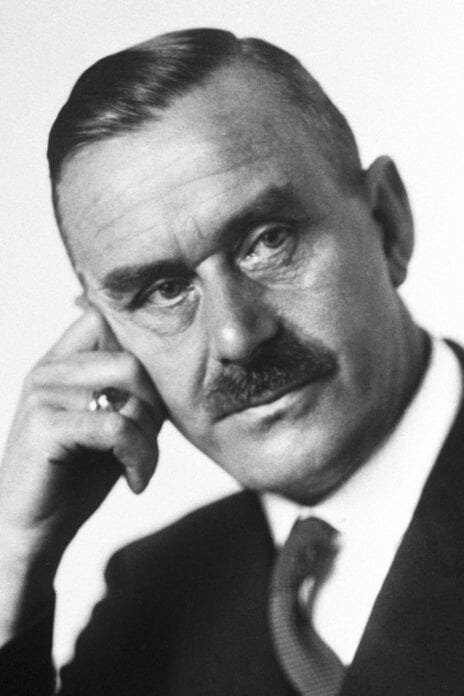
In The Anatomy of Fascism, historian Robert Paxton describes fascism as little more than a set of “mobilizing passions.” ... The sociologist Michael Mann once sneered that fascist ideology was the playpen of the “lesser intelligentsia.” ... But it is simply untrue to describe the far right as uniformly thoughtless. ... For the Left to be effective in combatting a resurgent far right it is crucial to understand it without self-flattering illusions. One of the finest works to dissolve these illusions is Thomas Mann’s Doctor Faustus.
His Satanic Majesty Presents
Born in Lübeck in 1875, Mann would become one of Germany’s premiere authors, winning the Nobel Prize in 1929. ... In 1933, Adolf Hitler won power supported by many of Germany’s cultural elite — including Martin Heidegger and Carl Schmitt. Mann fled into exile ... where [he] watched Nazism with horror.
Published in 1947, Doctor Faustus reworks the Faust myth to explore how Germany’s cultivated elite bartered everything away to the Nazis. ... [Protagonist Adrian] Leverkühn agrees to sell his soul to Satan for twenty-four years of creative achievement. Satan insists Leverkühn’s life must remain “cold” for his powers to be unsullied. ... As he ages, Leverkühn regrets his choice ... But he only brings pain to those unlucky enough to become the objects of his affection.
In the end, Leverkühn confesses his Satanic pact and collapses into an infantile state. There are clear parallels with Friedrich Nietzsche, a formative influence on the broader German right. ...
The Sublimity of Evil
Mann’s retelling allegorizes Germany’s decline into nihilistic ambition and fascist self-destruction. ... Highly cultured Germans felt themselves superior persons for whom everything ought to be permitted. ... Many channeled these feelings in a sociopolitical direction, convinced their innate superiority entitled them to empire and dominion. ... The result was toxic resentment at being dispossessed of power, coupled with anxieties of a victim who sees persecutions everywhere. ...
After Hitler came to power, war was reconceived as both means and end of aesthetic greatness, whatever its impact on the countless victims of Nazism might be. ...
The Rhyming of History
... The far right is gaining ground, with cultural partisans from Curtis Yarvin to “Bronze Age Pervert” to J. D. Vance. ... By dissociating themselves from flesh-and-blood people, it becomes easier to deny the moral relevance of their humanity.
The far right combines indifference to factual accuracy with soaring rhetoric about truth and greatness. ... In a 1922 speech Mussolini admitted his adulation of the Italian nation was a manufactured myth. ... In 2004, [Karl Rove] dismissed the “reality based community,” insisting “we create our own reality.” ... J. D. Vance has insisted if he must fabricate stories to attract people, he’ll do so.
... For the far right, politics must be understood in theological terms. ... Only hierarchical order backed by strength can prevent [chaos]. ... Superior individuals — or superior races — are entitled by what Hitler called the “aristocratic principle of nature” to create their own values and subordinate all else.
Holding Reason in Contempt
... The far right finds liberal rationalists’ fact-checking unbearably naive. ... Mann describes this: scientists attempted to prove the humbug to be humbug, but their efforts were futile against “a dynamically and historically productive fiction.” The advocates grew “all the more sardonically arrogant the more diligently one attempted to refute them on ... the basis of science, or respectable, objective truth.” ...
The far right associates the liberal emphasis on reason with egalitarianism ... perceiving this as threatening to hierarchical authority and the aspiration for greatness. ... Once you deny that critical reason has independent force, power alone decides who believes what. ... But that is only decisive if you think ordinary people feel logic is more persuasive than Triumph of the Will or bullets.


Heaviosity half-hour
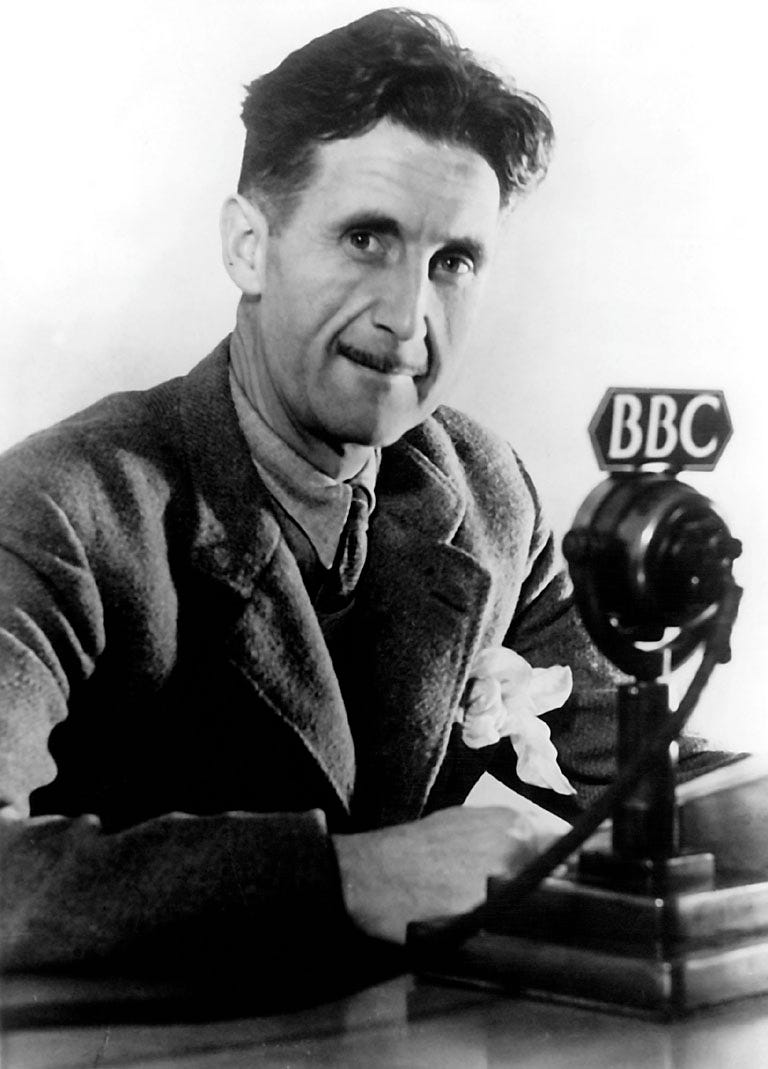
Thanks to Gareth Hutchins for sending me this. As Christopher Hitchens said, George Orwell was right about the three biggest issues of his time: Imperialism, fascism, and Stalinism. He had firsthand knowledge of the former and latter. And fascism. Well, just on first principles, you wouldn’t expect it to end well for the inhabitants.
In any event, here he is in July 1939 on imperialism.
Not Counting Niggers
A dozen years ago anyone who had foretold the political line-up of today would have been looked on as a lunatic. And yet the truth is that the present situation — not in detail, of course, but in its main outlines — ought to have been predictable even in the golden age before Hitler. Something like it was bound to happen as soon as British security was seriously threatened.
In a prosperous country, above all in an imperialist country, leftwing politics are always partly humbug. There can be no real reconstruction that would not lead to at least a temporary drop in the English standard of life, which is another way of saying that the majority of left-wing politicians and publicists are people who earn their living by demanding something that they don’t genuinely want. They are red-hot revolutionaries as long as all goes well, but every real emergency reveals instantly that they are shamming. One threat to the Suez Canal, and ‘anti-Fascism’ and ‘defence of British interests’ are discovered to be identical.
It would be very shallow as well as unfair to suggest that there is nothing in what is now called ‘anti-Fascism’ except a concern for British dividends. But it is a fact that the political obscenities of the past two years, the sort of monstrous harlequinade in which everyone is constantly bounding across the stage in a false nose — Quakers shouting for a bigger army, Communists waving Union Jacks, Winston Churchill posing as a democrat — would not have been possible without this guilty consciousness that we are all in the same boat. Much against their will the British governing class have been forced into the anti-Hitler position. It is still possible that they will find a way out of it, but they are arming in the obvious expectation of war and they will almost certainly fight when the point is reached at which the alternative would be to give away some of their own property instead of, as hitherto, other people’s. And meanwhile the so-called opposition, instead of trying to stop the drift to war, are rushing ahead, preparing the ground and forestalling any possible criticism. So far as one can discover the English people are still extremely hostile to the idea of war, but in so far as they are becoming reconciled to it, it is not the militarists but the ‘anti-militarists’ of five years ago who are responsible. The Labour Party keeps up a pettifogging grizzle against conscription at the same time as its own propaganda makes any real struggle against conscription impossible. The Bren machine-guns pour from the factories, books with titles like Tanks in the Next War, Gas in the Next War, etc pour from the press, and the warriors of the New Statesman gloze over the nature of the process by means of such phrases as ‘Peace Bloc’, ‘Peace Front’, ‘Democratic Front’, and, in general, by pretending that the world is an assemblage of sheep and goats, neatly partitioned off by national frontiers.
In this connextion it is well worth having a look at Mr (Clarence K.) Streit’s much-discussed book, Union Now. Mr Streit, like the partisans of the ‘Peace Bloc’, wants the democracies to gang up against the dictatorships, but his book is outstanding for two reasons. To begin with he goes further than most of the others and offers a plan which, even if it is startling, is constructive. Secondly, in spite of a rather nineteen-twentyish American naivetй, he has an essentially decent cast of mind. He genuinely loathes the thought of war, and he does not sink to the hypocrisy of pretending that any country which can be bought or bullied into the British orbit instantly becomes a democracy. His book therefore presents a kind of test case. In it you are seeing the sheep-and-goats theory at its best. If you can’t accept it in that form you will certainly never accept it in the form handed out by the Left Book Club.
Briefly, what Mr Streit suggests is that the democratic nations, starting with fifteen which he names, should voluntarily form themselves into a union — not a league or an alliance, but a union similar to the United States, with a common government, common money and complete internal free trade. The initial fifteen states are, of course, the USA, France, Great Britain, the self-governing dominions of the British Empire, and the smaller European democracies, not including Czechoslovakia, which still existed when the book was written. Later, other states could be admitted to the Union when and if they ‘proved themselves worthy’. It is implied all along that the state of peace and prosperity existing within the Union would be so enviable that everyone else would soon be pining to join it.
It is worth noticing that this scheme is not so visionary as it sounds. Of course it is not going to happen, nothing advocated by well-meaning literary men ever happens, and there are certain difficulties which Mr Streit does not discuss; but it is of the order of things which could happen. Geographically the USA and the western European democracies are nearer to being a unit than, for instance, the British Empire. Most of their trade is with one another, they contain within their own territories everything they need, and Mr Streit is probably right in claiming that their combined strength would be so great as to make any attack on them hopeless, even if the USSR joined up with Germany. Why then does one see at a glance that this scheme has something wrong with it? What is there about it that smells — for it does smell, of course?
What it smells of, as usual, is hypocrisy and self-righteousness. Mr Streit himself is not a hypocrite, but his vision is limited. Look again at his list of sheep and goats. No need to boggle at the goats (Germany, Italy and Japan), they are goats right enough, and billies at that. But look at the sheep! Perhaps the USA will pass inspection if one does not look too closely. But what about France? What about England? What about even Belgium and Holland? Like everyone of his school of thought, Mr Streit has coolly lumped the huge British and French empires — in essence nothing but mechanisms for exploiting cheap coloured labour — under the heading of democracies!
Here and there in the book, though not often, there are references to the ‘dependencies’ of the democratic states. ‘Dependencies’ means subject races. It is explained that they are to go on being dependencies, that their resources are to be pooled among the states of the Union, and that their coloured inhabitants will lack the right to vote in Union affairs. Except where the tables of statistics bring it out, one would never for a moment guess what numbers of human beings are involved. India, for instance, which contains more inhabitants than the whole of the ‘fifteen democracies’ put together, gets just a page and a half in Mr Streit’s book, and that merely to explain that as India is not yet fit for self-government the status quo must continue. And here one begins to see what would really be happening if Mr Streit’s scheme were put into operation. The British and French empires, with their six hundred million disenfranchised human beings, would simply be receiving fresh police forces; the huge strength of the USA would be behind the robbery of India and Africa. Mr Streit is letting cats out of bags, but all phrases like ‘Peace Bloc’, ‘Peace Front’, etc contain some such implication; all imply a tightening-up of the existing structure. The unspoken clause is always ‘not counting niggers’. For how can we make a ‘firm stand’ against Hitler if we are simultaneously weakening ourselves at home? In other words, how can we ‘fight Fascism’ except by bolstering up a far vaster injustice?
For of course it is vaster. What we always forget is that the overwhelming bulk of the British proletariat does not live in Britain, but in Asia and Africa. It is not in Hitler’s power, for instance, to make a penny an hour a normal industrial wage; it is perfectly normal in India, and we are at great pains to keep it so. One gets some idea of the real relationship of England and India when one reflects that the per capita annual income in England is something over £80, and in India about £7. It is quite common for an Indian coolie’s leg to be thinner than the average Englishman’s arm. And there is nothing racial in this, for well-fed members of the same races are of normal physique; it is due to simple starvation. This is the system which we all live on and which we denounce when there seems to be no danger of its being altered. Of late, however, it has become the first duty of a ‘good anti-Fascist’ to lie about it and help to keep it in being.
What real settlement, of the slightest value, can there be along these lines? What meaning would there be, even if it were successful, in bringing down Hitler’s system in order to stabilize something that is far bigger and in its different way just as bad?
But apparently, for lack of any real opposition, this is going to be our objective. Mr Streit’s ingenious ideas will not be put into operation, but something resembling the ‘Peace Bloc’ proposals probably will. The British and Russian governments are still haggling, stalling and uttering muffled threats to change sides, but circumstances will probably drive them together. And what then? No doubt the alliance will stave off war for a year or two. Then Hitler’s move will be to feel for a weak spot or an unguarded moment; then our move will be more armaments, more militarization, more propaganda, more war-mindedness — and so on, at increasing speed. It is doubtful whether prolonged war-preparation is morally any better than war itself; there are even reasons for thinking that it may be slightly worse. Only two or three years of it, and we may sink almost unresisting into some local variant of austro-Fascism. And perhaps a year or two later, in reaction against this, there will appear something we have never had in England yet — a real Fascist movement. And because it will have the guts to speak plainly it will gather into its ranks the very people who ought to be opposing it.
Further than that it is difficult to see. The downward slide is happening because nearly all the Socialist leaders, when it comes to the pinch, are merely His Majesty’s Opposition, and nobody else knows how to mobilize the decency of the English people, which one meets with everywhere when one talks to human beings instead of reading newspapers. Nothing is likely to save us except the emergence within the next two years of a real mass party whose first pledges are to refuse war and to right imperial injustice. But if any such party exists at present, it is only as a possibility, in a few tiny germs lying here and there in unwatered soil.


Before Cameron Kasky briefly chose to run for Congress he at least had a podcast with Tim Miller at the Bulwark that was about Gen Z and had guests from the Gen Z activist space. A center-left podcast by and for Gen Zers would be an excellent idea but probably should be neutral between the many possible 2028 candidates for now.
Complete nostalgia for "peak oil" which was a very respected consensus position at Daily Kos at the time