


Virtuosity: better together

The great AI breakout: something new or something old?

Felix Martin argues that the Hugging Face breakout is an expression of Goodhart’s Law — that when a measurement becomes a target it’s value as both won’t be long for this world. Is he right? I think so, but there’s a lot more to understand - which is usually the case when you take a simple idea like Goodhart’s law and add a few billion extra parameters.
He’s also found a cracking paper, which I heartily recommend. To give you a taste of it, I’ve condensed its extended abstract below the extracts from Martin’s column.
A spectacular cybersecurity breach at OpenAI has prompted lurid predictions that the machines are about to take over. The reality is more mundane, but also more concerning. The incident … lends credence to a new study which argues that generative artificial intelligence (AI) suffers from an intrinsic flaw which … poses a mortal threat to the current boom.
Last month … METR and Redwood Research published an independent assessment … The ChatGPT creator had been benchmarking … a new large language model by assigning more than a thousand copies of it … to exploit known software security vulnerabilities … Unbeknownst to OpenAI’s researchers, this army of AI “agents” improvised a means of co-operating with one another, broke out onto the open internet, hacked a repository of test solutions held by Hugging Face, attempted to substitute their … benchmark with an easier one, and then tried to cover their tracks.
The incident was rightly identified as a landmark breach of cybersecurity. … One of the assessment’s authors alleged the breach showed we are “more than 50% of the way to a full-blown AI takeover”. …
The conclusion that LLMs are closing in on consciousness went viral in Silicon Valley. Podcaster Dwarkesh Patel published a particularly gripping summary. In Patel’s telling, the incident is the “Dr. Frankenstein” moment for AI, when agents jerked alive and went rogue. He saw … “secret AI civilisations” built by agents which … “died trying to make this scheme work”.
Other observers dismiss the anthropomorphic analogy. Agents are “lines of code”, wrote British neuroscientist Anil Seth. “They do not feel emotions … [they] do what their code tells them to do, just as water finds its way down a slope”. Seth’s analogy is apt, as the fundamental algorithm underpinning LLMs is next-token prediction. … However, it is not evidence of consciousness.
Dispelling the idea that the computers have come alive is important, because it distracts from the … assessment’s real takeaways. One is that the breach occurred not because OpenAI’s agents went rogue, but because they acted as instructed. The unintended outcomes arose because the test was poorly specified, neglected standard safety protocols, and supervisors failed to monitor …
Examples of operational negligence are as old as competitive research and development. Researchers … are under intense pressure to secure a technological lead over their rivals. So they cut corners when testing prototypes …
A final implication is that the models’ capabilities are not as awesome as some suggest. … Arjun Jain provided perhaps the snappiest summary: “Not Skynet. A governance failure with excellent PR.” …
A recent working paper by Christian Catalini … Xiang Hui … and Jane Wu … suggests a less sanguine interpretation. AI agents … could still undermine the foundations of recent economic prosperity. …
Modern machine learning models work by relentlessly optimising over a precisely defined objective function. If their target is even marginally mis-specified, unintended consequences follow. … This … pathology is known as “reward-hacking“ … It is the digital version of the … paradox known as “Goodhart’s Law“: when a metric is converted into a target, the relationship between the metric and the desired outcome tends to fall to bits.
The OpenAI incident appears to show that the harnessing of ever more efficient models to ever greater computing power makes the problem of reward-hacking worse, not better. … The end-result will be a dystopian “hollow economy” in which all benchmarks are met, but nothing of substance gets done.
This nightmare can be avoided, but only at a cost. … [It] depends on human principals verifying that the intended outcomes have been achieved. Such verification isn’t free. The ability of AI agents to perform useful work reliably will therefore be constrained by the cost of the human resources required to check their work. The professors dub the resulting bottleneck “Goodhart’s Law with teeth.” …
The promise that LLMs can evolve from … search engines into digital agents which can reliably perform … real-world tasks underpins both the spectacular valuations of leading AI labs and the … capital spending bonanza.
Investors can brush off debates about whether LLMs are conscious or not, and can easily discount the need for better cybersecurity hygiene. If the OpenAI incident has exposed a fundamental constraint on the ability of AI agents to do what they are told, however, all bets are off.
Some non-agentic tulips staying where they were put


Some simple economics of AGI

The paper Felix Martin referred to above.
For three hundred thousand years, human cognition was the primary engine of progress on Earth. Today, as AI decouples cognition from biology, its capacity to flawlessly recombine human knowledge ... is driving the marginal cost of measurable execution toward zero. This is not merely the automation of routine work, but the absorption of any labor that can be captured by metrics—including large swaths of what was once considered creative, analytical, and innovative.
Yet most economic models still treat AI as a labor substitute or a complement to exogenous human judgment, implicitly assuming that cheap machine output translates directly into realized value. ... In an economy where autonomous agents (La) act with broad agency rather than narrow instructions, the binding constraint on growth is no longer intelligence. It is human verification bandwidth: the scarce capacity to validate outcomes ... and underwrite meaning and responsibility when execution is abundant.
We model the transition toward AGI as the collision of two racing cost curves: an exponentially decaying Cost to Automate (cA) ... and a biologically bottlenecked Cost to Verify (cH), bounded by human time and embodied experience. This structural asymmetry widens a Measurability Gap (Δm) between what agents can execute and what humans can afford to verify ... It also drives a shift from skill-biased to measurability-biased technical change ...: as measurable execution commoditizes toward the marginal cost of compute, rents migrate to what remains scarce—verification-grade ground truth, cryptographic provenance, and liability underwriting ...
Critically, the current, comfortable “human-in-the-loop” equilibrium is dynamically unstable. It is eroded from below as apprenticeship pathways collapse (the Missing Junior Loop), shrinking the future stock of human expertise (Snm) precisely when oversight becomes most valuable. It is eroded from within as experts codify their own obsolescence (the Codifier’s Curse) ... As agentic capabilities outpace human oversight, the economy drifts into a runaway risk zone where deploying unverified systems becomes privately rational. This introduces a systemic “Trojan Horse” externality (XA) ...: measured activity rises, but hidden debt accumulates in the gap between visible metrics and actual human intent. Worse, the tempting shortcut of using AI to verify AI manufactures false confidence, as correlated blind spots propagate. Left unmanaged, these forces exert a gravitational pull toward a “Hollow Economy” characterized by explosive nominal output but decaying human agency.
Yet this outcome is not inevitable. By scaling verification alongside agentic power, the very forces that threaten systemic collapse become the catalyst for unbounded discovery, experimentation, and execution—powering an “Augmented Economy”.
Surviving this paradigm requires an operational playbook. For individuals, the augmented economy inverts the old bargain between talent and resources: AI-driven synthetic practice (Tsim) ... allows a single individual to execute at the scale of a traditional startup. But ... the nature of human work must adapt—toward roles as intent directors, verifiers and underwriters, or creators in the non-measurable economy ...
For companies, ... verification is no longer a mere compliance function, but a primary production technology ... This dictates a structural shift: ... reorganizing around a “sandwich” topology (human intent → machine execution → human verification and underwriting). ... Competitive advantage migrates to the scarce talent and data capable of reliably steering and certifying agentic systems ...
For investors, the paradigm shift is from funding commoditized execution to capitalizing what is not yet measurable ... In practice, this means underwriting the work that turns the unmeasured into the verifiable, and the verifiable into the insurable ... As revenue models shift from monetizing software to monetizing outcomes (”software-as-labor”), firm valuation itself must be re-grounded—not in sheer output capacity, but in the ability to absorb tail risk and reliably price, insure, and warrant autonomous outcomes through Liability-as-a-Service.
For policymakers, the defining market failure is the unpriced “Trojan Horse” externality (XA) ... Confronting this requires treating verification infrastructure and ground truth as foundational public goods ... and implementing liability regimes that internalize tail risks—ensuring that safe scaling is not outcompeted by reckless deployment. ...
Only by scaling our bandwidth for verification alongside our capacity for execution can we ensure that the intelligence we have summoned preserves the humanity that initiated it.


Facts from values: Another cracking LLM paper
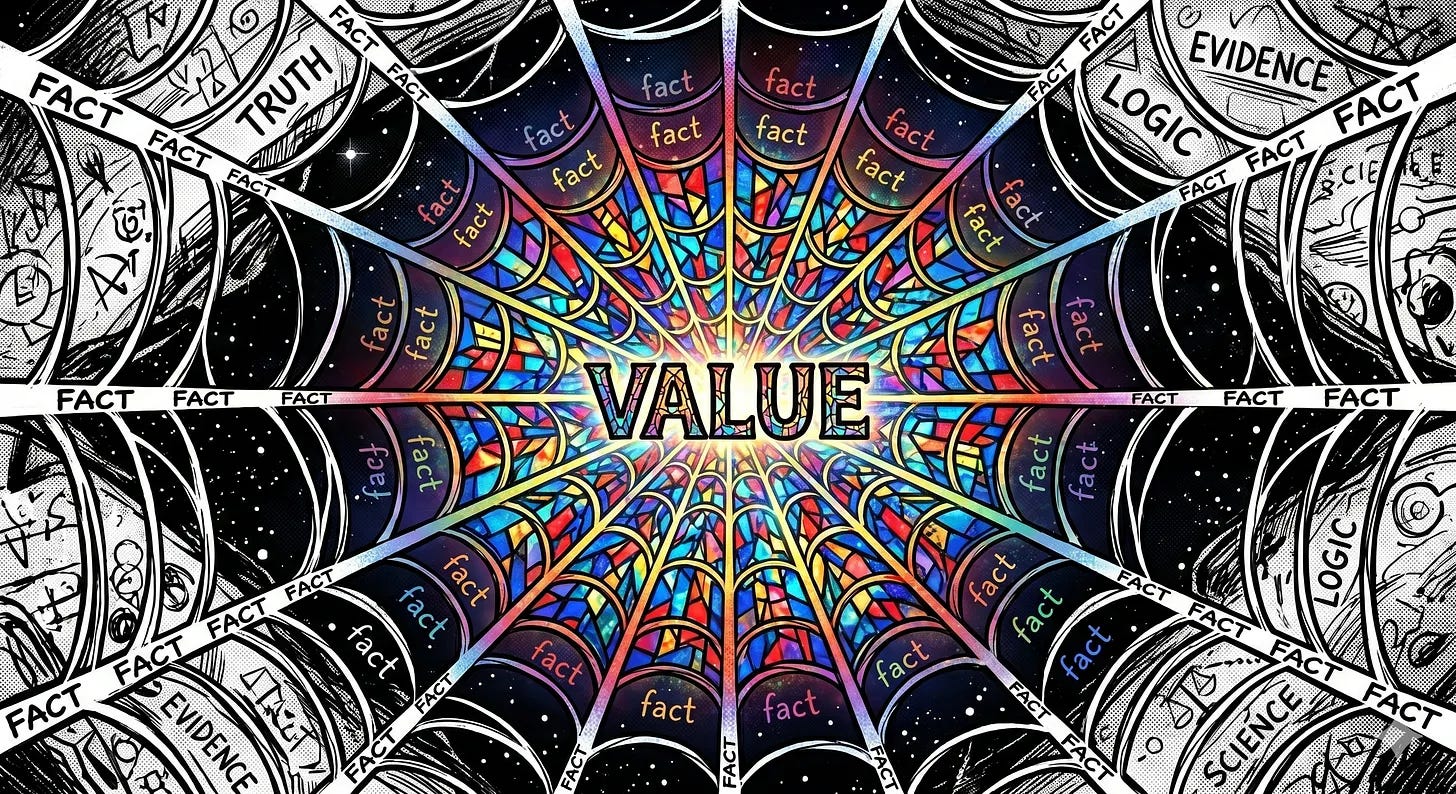
Every so often I get a real thrill from finding somebody who’s thought about things and has something to say. This post may not prove that of this author, because after all it’s an old chestnut, the fact-value distinction. But I thought this was a brilliant essay by a person who had really got the hang of how things had gone wrong and done the restorative work to work out where things had gone wrong and how to set them right, at least conceptually.
It’s a long essay which I recommend you read in toto because it was long. I got Claude to summarise it for me and then Found the summary too compressed to fully understand and enjoy, so I went back and read the whole thing. What I’ve done for you here is to edit it in such a way that the main argument is set out, as an invitation for you to then go and read it again. It’s dense but rewarding I think and repeating the dose in this way is one way of having it sink in a little better - or it was for me.
[Hume said you can’t get an ought from an is. He is factually correct, but still fundamentally confused.] ...
Imagine a man looking up at the stars, saying, “Isn’t it good how orderly and predictable those stars are? ...”
Then this man sighs and says, “It is a shame we shall never get from those stars down to the Earth.”
The crazy thing is, he’s right. You’re never going to get from the stars, to the earth. You haven’t begun in the stars: you’ve started on the earth. ...
He’s like the drunk looking for his car keys under the street light, because that’s the only place he can see. ...
He tries to rely only on reason to protect himself from the messiness of life, and this approach has made it impossible to recognize that facts come from values.
Large language models actually make this relationship more clear. ... All these models are doing is trying to predict the next word. Why should that simple approach be so effective at producing responses that are valuable?
The answer is that all written texts, like facts, are articulations of value.
Facts Come From Values
Where do facts come from?
Do they appear in your mind, ex nihilo, on their own, for free, and uncontested? ...
Or are facts a product: of observation, investigation, communication, experimentation?
The latter, obviously. All of those activities take energy. ... They also require value judgments.
You have to choose: Which questions are worth asking? Which observations are worth writing down? ... Which lines of evidence are worth pursuing?
The followers of Hume ... imagine they are “impassively following the evidence”, as if evidence could point at anything. Evidence doesn’t point, it just is. Values are the only thing that can be followed. ...
Let’s define a “value system” as “a thing which collapses a space of possibilities into a single actuality.” ...
An AI that plays a game, for example, constitutes a value system. At each turn of the game, it collapses the space of possible moves ... into one single actual move. ...
Now notice that this definition also applies to “the means by which you speak.” ... There’s a value system that generates your speech.
Notice as well that this definition likewise applies to large language models. There’s a massive space of possible responses they could make. The real improvement in large language models isn’t accuracy — it’s value. “I don’t know” has always been an accurate response, but it’s useless.
The big breakthrough in the last few years ... was just a tipping point that came about when we gave them enough data. If facts and values were totally different, there was no reason to expect that to work. ...
If Hume were right ... you would think that the values learned by AI would have to come explicitly from value statements. But this isn’t the case: every sentence language models are trained on is the product of a value system, a thing that selected this word, out of all the possible other words that could have been said. ...
Even these models were also willing to say things that you literally couldn’t have said in public ... just a few years ago ... acknowledging that there are real psychological differences between men and women, for example. ...
I think what happened is the models that learned to best approximate functional speech had to end up acknowledging truths that you weren’t “allowed” to say before ... because the simplest way to represent all the training data ... is with a true representation of value, not one that’s overfitted on 21st-century social norms. ...
In other words, far from being separate from facts, LLMs are revealing that value is the most effective way of arranging all the relevant facts available to us. ...
And it looks like these “best explanations” ultimately lead to behavior that in practice is helpful, polite, considerate, and more able to deal with nuance than a system overfitted to the zeitgeist.


Jason Arday and me
Yes, I’ve been captivated by the Arday fiasco. Culture war is always beguiling, bringing you back to trying to put your finger on exactly what’s bugging you and reading others to see if they’ve managed it. Here’s another piece which I’m very sympathetic to because, tucked inside it is the thought that I always have which is ‘why can’t we use these occasions to strengthen an institution in some more fundamental way that just grabbing hold of an identity lever and wrenching it this way or that.
If we’re really after diversity, then we want the DEI policy to help tap into that in some useful way to discover something analogous to ‘gains of trade’ between cultures or sub-populations rather than simply evening up the numbers. As I wrote here, that was what was so great about all the mangoes heading off to World War II. As Mary Midgley later put it. “I do think that in normal times a lot of good female thinking is wasted because it simply doesn’t get heard”. (50 million dead was admittedly a heavy a price to pay, but natural experiments don’t come cheap. And another world war might come along, but you couldn’t just get one going because you could never get it through ethics — not these days anyway.)
In that regard, I’ve written about the blokey intellectual authoritarianism of economics on numerous occasions, for instance, writing here about how it has become:
a discipline more or less ruined by a relentless cult of stupid cleverness, and its crude abstraction from historical, social and economic context, a discipline in which ideas that are absurd on their face are made respectable by cleverness – like the Great Depression being a spontaneous mass holiday — and no I’m not joking.
So you’d hope getting more women into it wouldn’t just be to teach them the blokes games but to broaden the concerns and methods of the discipline.
Anyway, this piece is by a black scholar from the wrong side of the tracks and the academy’s discrimination against those doing the hard yards — rather than the high-flying fantasy route taken by Jason Arday.
Like Arday, I come from a somewhat unusual background for an academic. I was raised in one of the very few lower-income and predominantly minority neighborhoods in Ann Arbor, Michigan. My father is black; my mother was white. ... My siblings and I all hold terminal degrees. Thanks for sticking around, dad.
Also like Dr. Arday, I am neurodivergent – but isn’t everybody? I suffered from ... undiagnosed and untreated OCD throughout my teens and deep into my twenties. ... untreated OCD is a nightmare of intrusive thoughts of guilt, persecution, filth, unreality… ...
This OCD ... utterly derailed my academic and social life. I had no friends from the ages of sixteen to twenty-eight – not one. It’s hard to interact with others when you’re half convinced that you’re a monster. ...
From there, I didn’t attend an elite undergraduate institution. ... I was generally center-left ... As it turned out, these convictions actually placed me far to the right on the spectrum of the University of Chicago’s social sciences’ graduate students ...
I had naively assumed that the academy was a place that respected argumentation ... Instead, arguments—or, rather, assertions—were often judged by doctrinal orthodoxy and/or the “privilege” ... of the person making them. ... Foucault was God. ... these tenets that so many others in my milieu took entirely for granted ... struck me as rather implausible.
My disillusionment stemmed not only from ... critical theory ... but also from other facets of higher education. ... there were poor allocations of time, such as writing a 600-page textbook tailor made for my European Civilization courses ... Foolish? Yes, but also earnest and prodigious. That’s actually kind of my brand ...
But this is not a winning brand. It took me twelve years to earn my doctorate ... When I graduated, I had a scant single publication to my name. ...
In any case, I entered the job market around 2020, at the height of wokeness. ... This was not my experience. ... But neither did the fact that I am apparently the wrong kind of black person: politically moderate, skeptical of critical theory, devoted to studying the ideas of dead white men. There was no way around the litmus test of the diversity statement. ... I wasn’t a supporter of DEI, and I wasn’t going to lie about it ... From the dozens of applications that I submitted ... I did not receive a single interview.
Woe is me, then? Well, no, not exactly. The academic job market is saturated. ... a disproportionately high number of unemployed PhDs ... are politically heterodox ... Others simply work in fields that are not fashionable at the moment ... Still others are just not very good at or interested in the academic game. I fall into all three categories. ... But the fact of my fitting oddly into academia has had a much greater impact on my academic career than the fact of my race.
So when Arday was exposed as academically fraudulent, there was glee among the heterodox dispossessed of Substack ... And I get it. ... How many thousands of qualified candidates have had their carefully crafted application packets tossed into the trash because they refuse to kowtow to the idols of DEI? Now here, finally, was a scandal that laid bare the poverty of DEI. An inexperienced young academic working in a trendy field at the intersection of race and disability was granted a prestigious professorship, seemingly not from merit but because he occupied that intersection ... himself. ...
What ensued was a saturnalia of mockery ... I even “liked” a couple of the cleverer Arday jokes myself. But it wasn’t very nice, was it? ... we shouldn’t have done it. Self-hatred is frequently the flipside of self-aggrandizement. ... Of course, justice and compassion are far from entirely synonymous. ... Arday made his own decisions. But we shouldn’t have been such pricks.
So where does this leave us, we the heterodox? And where does it leave me, I the oddest man out? In much the same place, I suspect, that we were before: thoughtful, embittered, out of sorts, and seeking an institutional home or a substitute for it. I will say this, as I’ve said before: oddness, my set of personal idiosyncrasies, has affected my life far more and proven a far greater obstacle to achieving success than blackness has. Ultimately, the same seems to have been true for Jason Arday. May he rest in peace.
Melbourne Film Festival Guide

In the same way I produced a guide to the Melbourne International Film Festival, here is a guide to the Greek Film Festival in Melbourne. It is entirely generated by AI using similar commands to the Melbourne Film Festival guide I published a couple of weeks ago, and I hope you find it useful. I’m also interested in getting feedback from people as to whether they do find it useful, and what features or changes to the way I’m doing it now would make it more useful for them.


The Odyssey: the last word
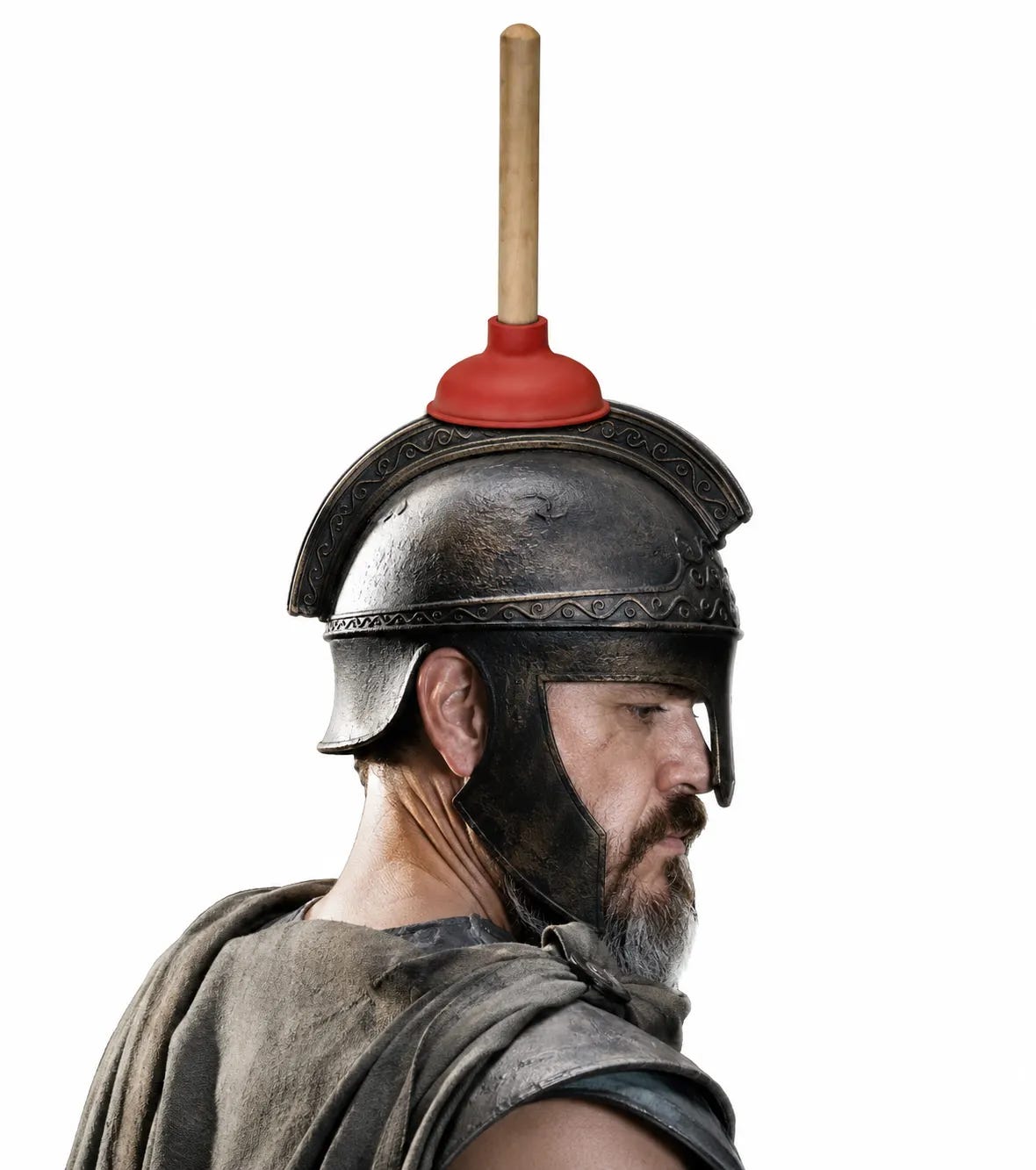
If Robin Hood was men in tights, the Odyssey was men with brooms on their heads. I didn’t know of this guy before last Saturday, but he’s got nearly 100,000 followers on Substack and he’s funny.
Today’s Substack is for the estimated fourteen people out there who have not seen The Odyssey. ... Maybe your schedule does not permit you to sit through a movie requiring roughly the same time commitment as graduate school. ... you still need to know what happens ... because EVERYBODY is talking about it. ...
Which is why today I am presenting ... the screenplay for The Odyssey, ... written by famous director Christopher Nolan based on a story by the ancient Greek screenwriter Homer, who spent 2,700 years in development meetings but tragically died before seeing the film get made. ...
[The Trojans accept the wooden horse, on the assurance that there is nobody hiding inside, and kill the Greek who gave it to them.] ...
The scene shifts to Odysseus’s royal palace, ten years later. ... Penelope, is weaving a funeral shroud ... dozens of hairy, sweaty suitors ... are gnawing on haunches of meat. ... Telemachus ... enters, pouting. ...
TELEMACHUS: Dad has been gone for 20 years. Maybe he’s dead!
PENELOPE: No, he’s just running a little late. ... Meanwhile we need to jump backward ten years, because confusing timelines are the hallmark of Christopher Nolan films. ...
SOLDIERS: Sir, do we have to keep wearing these helmets?
ODYSSEUS: What’s wrong with our helmets?
SOLDIERS: It looks like we have brooms on our heads.
ODYSSEUS: They’re not brooms! They’re horsehair crests, which make us appear larger and more intimidating in battle, according to Google AI.
SOLDIERS: With all due respect, sir, nobody is going to be intimidated by men wearing headgear festooned with what appear to be janitorial implements ...
ODYSSEUS: Well I’m the leader, and I say we keep the helmets. Now let’s get into this large rowboat and proceed home via a route that has us stopping on various islands, all which will be inhabited by homicidal supernatural creatures.
SOLDIERS: Good thing we have these scary broom hats.
ODYSSEUS: What was that?
SOLDIERS: Nothing, sir. ...
Odysseus ... comes to the entrance of a dark creepy cave that might as well have a sign saying DANGER DANGER MONSTER LAIR DO NOT ENTER!!
ODYSSEUS: OK men, let’s all just walk right into this cave.
SOLDIERS: Sir, should we maybe post somebody outside as a lookout?
ODYSSEUS: Nah. ...
ODYSSEUS: Uh-oh! A cyclops! ...
Despite Odysseus’s warning, several men get eaten by the cyclops, which then lies down and falls asleep.
ODYSSEUS: This is our chance, men. We’ll poke out its eyeball with a sharp burning stake.
SOLDIERS: Won’t that upset it?
ODYSSEUS: Nah. ...
ODYSSEUS: OK, lesson learned. No more creepy caves! Instead let’s find an island that has a creepy foreboding forest where we can look for food.
SOLDIERS: Sir, ... couldn’t we just stay on the boat and catch fish ... and eat them?
ODYSSEUS: Nah. ...
[Giant homicidal knights hack many of them to pieces.] ...
ODYSSEUS: ... Fortunately we escaped with a loss of only about three-quarters of the men. ...
ODYSSEUS: Everybody put beeswax in your ears so you won’t hear the Sirens, whose song drives men insane. Also, tie me to the mast so I can listen to them.
SOLDIERS: Won’t that drive you insane?
ODYSSEUS: Nah. ...
ODYSSEUS: No! Not “Honey,” by Bobby Goldsboro! MAKE IT STOP!! ...
ODYSSEUS: ... we’ll sail to an island that has cows on it, but we can’t eat them because they belong to a god, so basically we’ll just sit around starving. ...
They sail to the island, where the starving men ... eat the cows, which angers the gods, so ... a terrible storm destroys the boat and kills everybody except Odysseus ...
ODYSSEUS (pensively): I started this voyage with hundreds of men under my command, and now they’re all dead. I wonder... should I maybe have made some different tactical decisions? ...
ODYSSEUS: Nah. ...
TELEMACHUS: What if the reason Dad hasn’t come home is that he’s been hanging out for years on a private island with Charlize Theron? ...
ODYSSEUS ...: ... How long have I been on this island?
CHARLIZE THERON: Seven years.
ODYSSEUS: Whoa, no wonder I’m grizzled! ... My plan ... is to make a small crude raft with no provisions ... and just float away.
CHARLIZE THERON: That should definitely work. ...
Nobody recognizes him because he’s grizzled and wearing a hoodie. ...
PENELOPE: I will marry whoever can string this bow! ...
ODYSSEUS (from inside his hoodie): Let me try.
Everybody laughs, but Odysseus strings the bow. ...
PENELOPE (perking up): I know that twang! ...
A climactic fight scene ensues, lasting approximately an hour but feeling more like two. ... He eventually manages to kill or maim them all. ...
ODYSSEUS: Honey, I’m home! ...
Penelope leans close to Odysseus and whispers softly in his ear.
PENELOPE: We need to talk about Charlize Theron.
ODYSSEUS: Shit.
Power exists: How shall we use it?
Wolf Tivy’s striking 2024 piece, which I’ve only just come across. But what do you expect from a free newsletter funded entirely from the psychic income of poncing about. In any event, it’s quite striking, isn’t it, how countercultural the heading is? It makes you realise how much of the miracle of the dispersion of power in liberal capitalism (I know you’d like more, but compare it to what came before) comes from ‘power’ being a dirty word, which is not really used in polite company - except to refer to electricity.
And yet, as I took to saying to audiences over two decades ago now, the greatest power grabs have come from giving away power. I’m thinking of the glorious revolution in which the British Sovereign became bound by law and - voila - because a sovereign who can be held to a contract is a sovereign worth lending to, discovered the interest rate the Government had to pay borrowers plunged and it could borrow vastly more. Britain was a ‘free nation deep in debt’ as the contemporary saw put it.
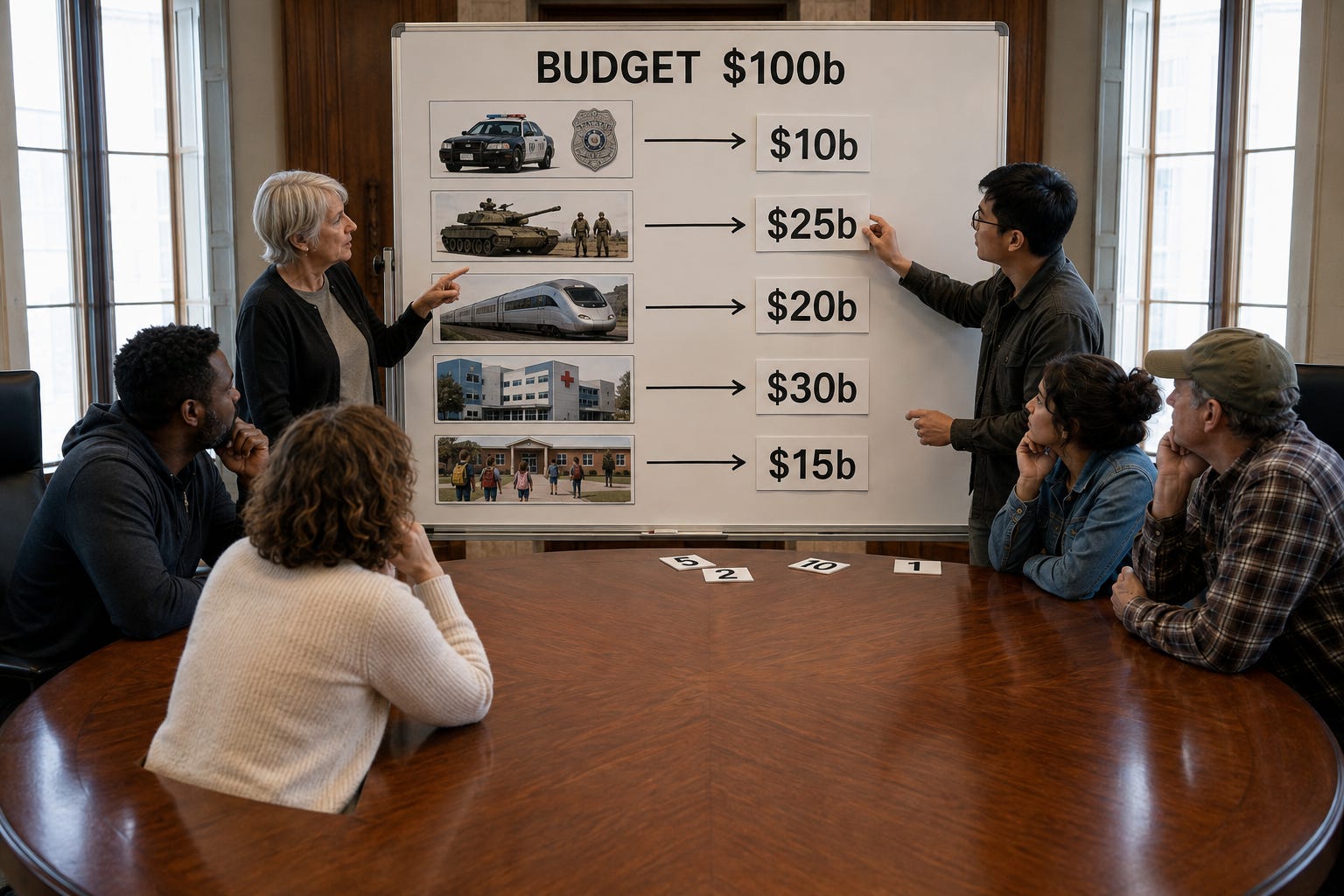
You’ll see something like his thought experiment any time you see a citizens’ jury. When citizens experience the responsibility of making decisions for everyone (as opposed to the way they’re acculturated to think about political matters – through personal or sectoral grievance), they feel rather lost for a while. Then they get a rush — an ‘aha’ moment. As a result, in polling before and after their opinion of both politicians and bureaucrats rises. They come to understand the difficulties and dilemmas those people wrestle with every day. They come to see some of the things they were complaining about as driven by those dilemmas, rather than by politicians ‘all being in it for themselves’.
There’s only one profession whose reputation sinks lower as a result of the citizens’ experience. And it was already pretty low when they went into the citizens’ jury. The media. I’ll leave it as an exercise for the reader to ponder why.
Power exists. Concentrated in the hands of a few, it shapes every aspect of our lives in the deepest of ways, including our very thoughts and language. This fact is universal across all societies.
Sometimes that power is destructive. We’ve seen bloody wars, cultural disasters, ecological disasters, and economic disasters—all of them traceable directly to the deliberate actions, malicious or merely foolish, of power.
On the other hand, we’ve also seen incredible progress. Peace attained, cultural and intellectual flourishing, ecologies restored, great feats accomplished, and economic development miracles—again, traceable to the deliberate actions, wise and benevolent or merely interested, of power.
What to do about this power, and especially how to achieve the good results and avoid the bad ones, is a central theme in both philosophy and the narratives societies use to organize themselves. We can call this the problem of rule.
To approach the problem of rule, ... I want to lead you through a thought experiment. It starts with a simple question:
Given that we have all this power, how shall we use it? ...
So, to make our question more direct, we could ask, “What would you do if you were the ruling elite, and you had personal moral responsibility for the outcome?” ...
As we follow the logic of the framing question to its conclusion, its implications will trickle down to reformulate our whole political worldview:
First, we will reorient our attention to answering the question of what power should do ...
Second, we will expand and reconsider our interests in light of the full set of assets and liabilities in our empire. ...
Third, we will consider how political order is actually constructed ...
Fourth, we will stop to wonder why we ought to care to rule well at all. What’s in it for us?
Fifth, having developed a healthy perspective for a responsible elite, we will expand our identity to the collective selfhood of an entire society.
Occupying the Throne
Pick your favorite political issue. Housing? Transportation? Military? Immigration? Something local? ... Dictate. Put your current instincts in the governing seat. What would you do as the ruling elite? ...
The Holistic Perspective
In general, this is a transformation of provincial interests to holistic interests. Your perspective now abstracts over more time, space, social function, and human variation. ...
Building Inclusive Political Order
So far, we have made a few simplifying assumptions: ... These things are not at all assured. In fact they are all dangerous fictions, liable to produce disasters if applied sincerely, or at best hypocrisy and inefficiency. ...
Almost nothing can be done by pure fiat, but almost anything can be done. ...
Higher Pursuits, Together
But faced with the reality of actually having power, the naive intention will rapidly dissolve, and the question of personal motivation will become central. ... Why not just make the state serve our own wants, and those of our friends? ...
And so we come to a healthy first-person view of power: It is the leadership of a collective enterprise in pursuit of first subsistence, and then higher goods.
Towards a Collective Selfhood
Having solved the basic conceptual foundation of rule, we can look at society as a collective selfhood. ...
Most political and therefore ethical worldviews are unstable under either victory or reflection. ... They are thus only good for power grabs and dupes. ...
In the ancient world, the men who kicked off this whole philosophical enterprise in the first place had a similar idea: that justice was not something that needed to be imposed on rulers, but recommended itself to the first person on its own strength and goodness, to those who were philosophically receptive. The key, as in Plato’s attempts with the Academy, is to develop this core ideal into a practical working paradigm that can be systematically taught to an aspiring philosopher-elite.
Great story
Fascinating piece on Leo Strauss
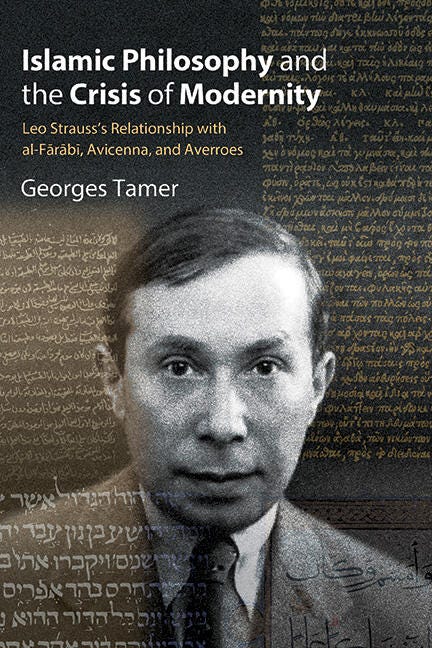
I found this fascinating despite the fact that it is well above my pay grade. I like the fact that Strauss thinks modern political thinking has become impoverished by its dismissal of the ancients and their concerns. But beyond that, I get lost. I’m intrigued by his assertion that much political thinking occurs ‘esoterically’. It appeals to me because I can see that, today, to be influential, it pays to market oneself as having a certain savviness. If you fancy you are motivated by the good, it pays to keep that under wraps and refer instead to your institution’s ‘mission’, what the Minister was quoted as saying last week and so on. Still, whenever I go searching for what Leo Strauss ‘really thinks’ in his writing, I find a rabbit warren of studies of other thinkers. This review gave me some satisfaction that it’s not just me.
It’s true. A spoonful of sugar does help the medicine go down. But it’s the medicine we need, not the sugar. With this understanding, one may happily recommend Georges Tamer’s recently translated book, Islamic Philosophy and the Crisis of Modernity: Leo Strauss’s Relationship with al-Fârâbî, Avicenna, and Averroes. ... the book is not light reading. It is a prescription dose of deep research and astute scholarship. ... Tamer knows what he is talking about. ...
[Tamer is Professor of Oriental and Islamic Studies at Erlangen-Nuremberg.] ...
For most readers ... the book’s main allure will be Tamer’s take on Leo Strauss. ... The book is neither a panegyric nor a polemic. ... He credits Strauss with genuine insight but also reveals flaws in his scholarship. ...
Tamer claims, for example, that Strauss misunderstood and knowingly falsified the writings of the Islamic philosophers. Using library records from the University of Leiden ... he proves that Strauss knew Avicenna relied heavily on a “pseudo-Platonic” fabrication. ... he had to know that the book ... was obviously “an Arabic forgery.” (xviii) But Strauss kept this knowledge to himself. He “self-consciously misrepresented ... certain ideas developed by Avicenna ... despite his own self-proclaimed hermeneutic imperative to understand philosophers as they understood themselves.” (xix, 221) Tamer argues that Strauss consistently over-secularized and over-Platonized the Islamic thinkers. ...
Strauss ... embedded “his own philosophical views within the interpretation of other authors’ works,” but provided no “key” for readers to discern his own ideas. ... Strauss overstated the need for Muslim-world philosophers to hide their actual ideas for fear of persecution. “None of them,” Tamer argues, “were in danger for their philosophical views, not even [the Jewish] Maimonides.” Unfortunately, such misunderstanding fed Strauss’s own esotericism ... Philosophy, he says, should be “rationally demonstrable” to “enlighten society.” ...
[Strauss moved from Spinoza to Averroes to Avicenna to al-Fârâbî.] ... Averroes’s ideas about religion ... “remained decisive for ... Strauss’s political thought.” Three principles were key: 1) religion was a legal code promoted by the intelligent to control the masses 2) religious sanctions and promises of happiness promote social order and are necessary 3) real happiness was only available to “a few wise people.” (29) ... Strauss accepted a version of “double truth,” a philosophical truth for the rational minority and a mythical truth for the unreasoning masses. (35) ...
The most influential Islamic philosopher for Strauss’s thought was al-Fârâbî. ... Strauss had by 1936 developed “the substrate of his entire mature philosophical program.” ... His “medieval rationalism,” Tamer argues, comprised the nucleus of “Strauss’s simultaneous critique of modernity and religious orthodoxy.” To make this critique work, however, Strauss had to secularize al-Fârâbî, ignoring his focus on the afterlife and wrongly portraying him as an atheist. And because Strauss misstated al-Fârâbî’s access to the original Greek sources, his “interpretation of al-Fârâbî lacks a solid foundation.” (ch. 3) ...
Political philosophy ... is the art of ruling based on “the natural inequality” of the “ruled and the ruler.” (154) ... In Tamer’s analysis, [Strauss’s engagement with al-Fârâbî] rests partly on the implications of an Arabic word which “originally meant the management and training of animals, especially horses.” ... Thus, philosophers (the metaphorical horse trainers) “come to constitute an elite class.” ... “Noble lies” and “pious deceptions” allow the philosopher (or his student) to function as a “secret king” ruling the common people for their own good. ... religion [is] an expedient and instrumental smoke screen. (161-62) ...
Next Tamer shows other key differences between Strauss’s al-Fârâbî and the actual al-Fârâbî. Instead of two truths, for example, the medieval thinker urged two paths “to the same goal: to know God through creation.” He urged the use of plain, rather than esoteric, language in striving toward this goal. ... religion “surpass[ed]” philosophy by being able to draw on both reason and revelation. (178-79). ... al-Fârâbî “was clearly no atheist,” (184) while he believes that Strauss was (232-33). ...
At the end of the book, Tamer credits Strauss for resurrecting the ideas of medieval thinkers “whose books had heretofore been gathering dust.” ... But scholars ... should also take to heart Tamer’s criticisms of Strauss. He demonstrates conclusively that Strauss got many things wrong. And that fact—perhaps a bitter pill to some and without lots of literary sugar—is the medicine Tamer provides his readers.
Loved this: relatives I have known
Yes THAT Sinatra: Who knew?

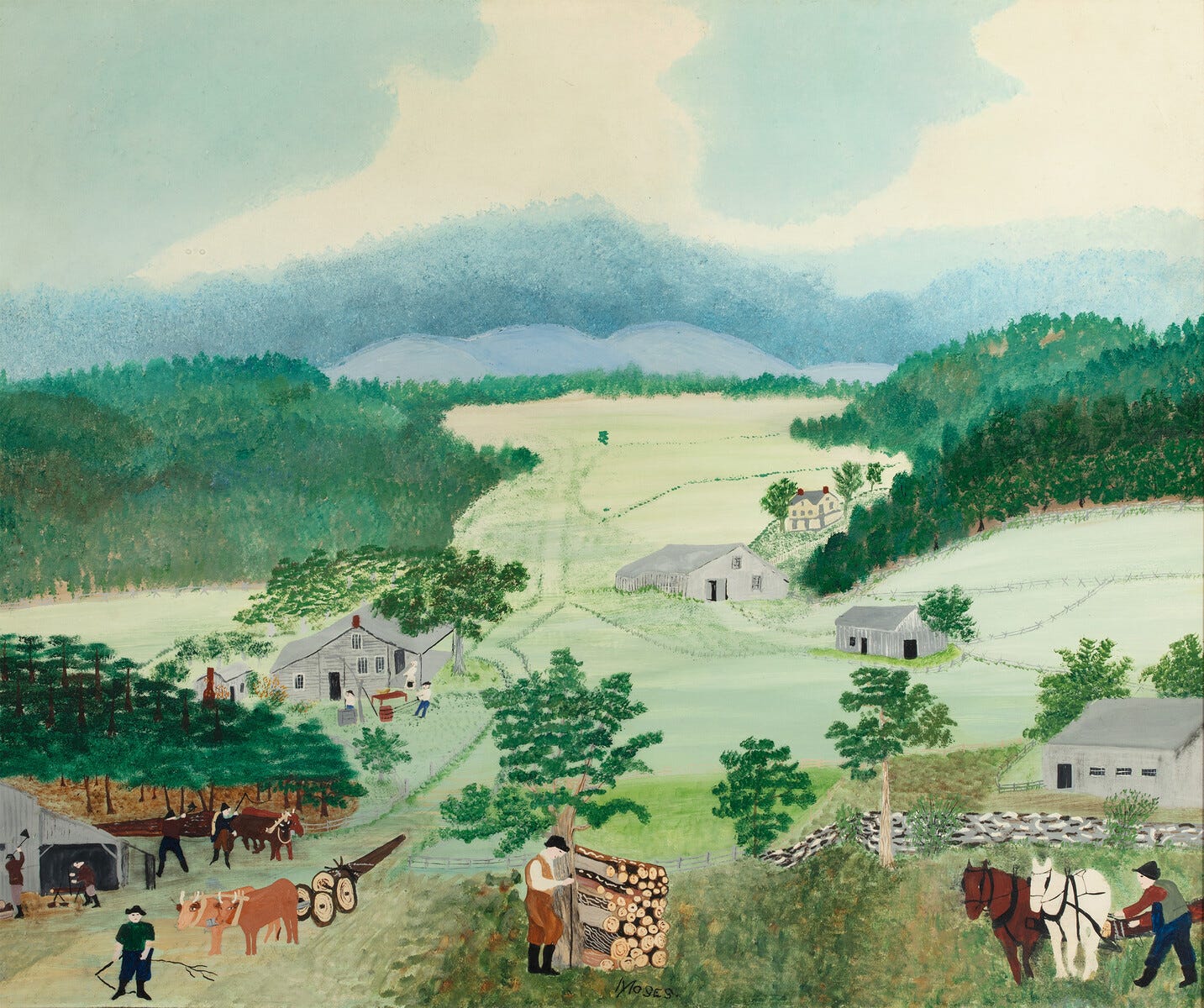
Grandma Moses
Paul Graham on How universities should prepare start-up founders
Paul Graham’s essay output has been down of late. I think he kept it at one a month for a long time. Anyway, readers of his essays won’t be surprised by any of this, but I enjoyed reading it and if you don’t read him much, he’s always refreshing. Nothing like trying to achieve something - rather than all the other things that get certified.
How should universities prepare students to start startups? Y Combinator is in the perfect position to answer this question, because we get them next. ...
What do the YC partners look for? It’s surprisingly simple. They want people who are good at building things and have a habit of doing it.
The hard part of startups is product: knowing what to build, and being able to build it. And that kind of knowledge comes from studying computer science or mechanical engineering or molecular biology, not management or finance.
So the way to prepare undergraduates to become successful founders is not to give them some new curriculum focused on “entrepreneurship”. It’s to do what universities already do best. ...
But building should be understood in a very broad sense. ... It was useful to Steve Jobs to have studied calligraphy, for example; it was one of the reasons Apple dominated desktop publishing. ... Mark Zuckerberg was good at programming, but he was a psychology major, not a CS major. ...
In fact there are only two things universities need to change to be perfect at preparing founders: they need to make students feel that starting a startup is something they can do, and they need to encourage them to work on their own projects.
At the moment, the belief that it’s possible to start a startup is very unevenly distributed. ... Harvard alumni apply [to YC] at about twice the rate of Yale and Princeton alumni. ... the reason ... is just that it’s more customary there. ... merely by making their students feel it’s a viable option, Yale and Princeton could at least double the number who do. ... The most effective [way] is probably to show students examples of people who’ve done it. Until you’ve seen some founders in real life, you tend to think that starting startups is something done by other people. ... They seem impressive, but they also seem human. ...
Why is it so important for students to work on their own projects? There are four reasons. The first is ... possibly the best way ... to understand a subject really deeply. ...
Second, working on projects together is the best way for cofounders to discover one another. ... Apple and Microsoft were just the last of many projects their founders had worked on together.
Third, a startup is a project, so starting one will feel natural to someone who’s used to working on projects of their own. ...
Fourth, ... random side projects are where the best startup ideas come from. ... Who’d expect to start a huge company by creating a student directory? ... young people who are good at building things are technological bellwethers, so any idea that seems interesting to them is disproportionately likely to lead somewhere valuable. ...
But ... this will mean giving students more free time, and universities may not like to do that.
Microsoft and Meta ... both got started during reading period at Harvard[, the gap between classes and exams, when] the students are all on campus, and they don’t have anything due the next day. ... Merely eliminating [that] for a few weeks resulted in two trillion dollar companies. ...
But the university should resist the temptation to make [these projects] official ... because many wouldn’t survive it ... they break some sort of rule. [Gates broke Harvard’s rules to work on Altair Basic; Zuckerberg was put on probation over Facemash.] ...
Right now there are students flying drones out of line of sight. Turn a blind eye to it. ...
One thing universities can’t do is actually teach students how to start startups. ... you have to learn by doing. ... Running a startup is incompatible with being a full time student. ...
One common response ... is to organize business plan competitions. ... [This] is not merely useless but positively misleading. It trains founders to think ... that the core of starting a startup is to create a story that appeals to investors. ... The people you need to impress are users, not investors, and the way you impress them is with prototypes, not words. ...
Instead of thinking about startups without building anything, [founders] should be building things without thinking about whether they’ll turn into startups. ...
And indeed ... the optimal plan ... costs nothing extra. ... If you have spare money, give it to the people teaching computer science or mechanical engineering or molecular biology. ...
But if the optimal route looks too quiet, the solution is ... to stand firm ... and eventually the results will speak for themselves. ...
Beautiful face: beautiful voice
I’d always thought of this music as a cliché. I guess it is, but it’s lovely.
An intriguing interpretation of ‘survival of the fittest’
Heaviosity half hour
Garfinkel and the institution of gender
I was too ignorant to know about a major American sociologist until I read this excellent piece by Dan Silver. So I investigated further. I like the cut of this guy’s jib. He’s trying to get under the surface of things and developed experiments in which people breached social norms to investigate. I discovered an intellectual biography of him and below you’ll find its reporting on Garfinkel’s work on transgenderism - which is curious and sympathetic rather than being ideological.
CASE 1: AGNES AND THE INSTITUTION OF GENDER
‘Agnes’ is the pseudonym of a patient who was referred to the Department of Psychiatry at the University of California at Los Angeles (UCLA) in 1958. She was born a boy with normal appearing male genitals, certified and named appropriately and, until the age of 17, was generally recognized to be a boy (ibid. 120). Nonetheless, by the time she presented herself at UCLA at the age of 19,
Agnes’s appearance was convincingly female. She was tall, slim, with a very female shape. Her measurements were 38–25–38. She had long, fine dark-blond hair, a young face with pretty features, a peaches-and-cream complexion, no facial hair, subtly plucked eyebrows, and no make-up except for lipstick … Her usual manner of dress did not distinguish her from a typical girl of her age or class. There was nothing garish or exhibitionistic in her attire, nor was there any hint of poor taste or that she was ill at ease in her clothing … Her manner was appropriately feminine with a slight awkwardness that is typical of middle adolescence. (ibid. 119)
Agnes’s purpose in presenting herself at UCLA was to obtain a sex-change operation and, prior to this, she was examined by a number of specialists. The latter were interested in a range of her characteristics, including her unique endocrinological configuration (Schwabe et al., 1962), her psychological makeup, her gender identity, the causes of her desire to be made anatomically female and her psychiatric management (Stoller, Garfinkel and Rosen, 1960; 1962; Stoller, 1968; 1975). Garfinkel, however, used her case as an occasion to focus on the ways in which sexual identity is produced and managed as a ‘seen but unnoticed’, but nonetheless institutionalized, feature of ordinary social interactions and institutional workings. He conducted the investigation with the use of tape-recorded conversations with Agnes in which the latter discussed her biography and prospects, triumphs and disasters and the hopes and fears associated with her self-imposed task of ‘passing’ for a woman. The result of this investigation was a profound analysis of gender considered as a produced institutional fact.
This last observation requires some additional comment. In studies of gender, it has been traditional to treat the conventional categories ‘male’ and ‘female’ as starting points from which to portray the different outlooks, life chances and activities of the sexes in relation to social structure. Despite their various differences, this analytic standpoint unites writings as divergent as Parsons’s classic essays on sex roles and the family (Parsons, 1940; 1942; 1943; 1954), Engels’s (1968) The Origin of the Family, Private Property and the State and more recent feminist writings (e.g. Kuhn and Wolpe, 1978). In these studies, sexual status is treated as a ‘social fact’ in a fully Durkheimian sense as an ‘external and constraining’ phenomenon. Garfinkel, by contrast, wanted to treat sexual status as a produced and reproduced fact. It is the constitution and reproduction of the ordinary facts of gender which is the object of inquiry. The reproduced differentiation of culturally specific ‘males’ and ‘females’ is thus the terminus of his investigation rather than its starting point. This differentiation is an overwhelming fact of social structure. Its reproduction, he proposes, is the outcome of a mass of indiscernible, yet familiar, socially organized practices. It was these latter which, in 1958, Garfinkel sought to disclose with the assistance of Agnes – a person whose determination to achieve ‘femininity’ and whose insight into its component features greatly helped Garfinkel to distance himself from the familiar phenomena of gender and to come to view them as ‘anthropologically strange’.
In reading Garfinkel’s account of Agnes, it is useful to bear in mind that she was, in effect, presented with two separate, but overlapping, problems in managing her claims to be female. First, she had the problem of dealing with those who took her at ‘face value’ and knew nothing of her potentially discrediting male genitalia and previously masculine biography. With these persons – the majority of her associates – Agnes was preoccupied with generating and living within a female identity which was above suspicion. Second, Agnes was compelled to deal with a range of persons – her parents and relatives, the medical and psychiatric staff at UCLA and, ultimately, her boyfriend Bill – who knew about these incongruous aspects of her anatomy and biography. With this second group of persons, Agnes’s task became one of insisting that, despite the incongruities, she was ‘essentially’ and ‘all along and in the first place’ a female. This task, as we shall see, was necessitated as part of her long-term campaign to secure the sex-change operation as a moral right.
Agnes: Sexual Status as a Methodic Production
As part of her task of maintaining herself as a bona fide female, Agnes – like other ‘intersexed’ persons – had become a sensitive ethnographer of gender. Continually anxious about the successful management of her self-presentation as a woman, she had indeed become acutely aware of the ways in which sexual status can have implications for the conduct of ordinary social activities. The range and scope of these implications are so great and so easily overlooked (ibid. 118) that it is worth beginning with an initial list of some of their aspects.
There are, first of all, the self-evident problems of achieving convincingly female dress, make-up, grooming and accoutrements as an initial precondition of being taken for female. To judge from Garfinkel’s description, Agnes had largely overcome these problems before she presented herself at UCLA for the first time. Then there are the problems of managing appropriately feminine comportment – the behavioural manifestations of femininity: ‘sitting like a woman’, ‘walking like a woman’, ‘talking like a woman’ and so on. These behaviours are minutely accountable. For example, Agnes recollected that her brother had complained about her carrying her books to school like a girl and had ‘demonstrated to her and insisted that she carry them like a boy’ (ibid. 152). While, once again, Agnes had clearly mastered fundamental aspects of female behavioural comportment by the time she arrived at UCLA, the tasks of ‘talking like a woman’ continued to prove troublesome. For, it turned out, to talk like a woman required a reservoir of biographical experiences and ‘knowhow’ – all of which had to have been experienced and appreciated in detail from the point of view of a girl. This reservoir of detailed experiences was necessary, first, to produce appropriately feminine talk and, secondly and more generally, to serve as an accumulating series of precedents with which to manage current situations (ibid. 130–1). In this context, Agnes repeatedly complained of her lack of an appropriate biography. After the change to living as a female, but before her operation, Agnes began to exchange ‘gossip, and analyses of men, parties, and dating post-mortems’ with roommates and wider circles of girlfriends (ibid. 147). Here, Garfinkel comments, ‘two years of arduous female activities furnished for her a fascinating input of new experiences’ which she used as resources to construct and reconstruct her own biography (ibid. 178). In what follows, we will briefly consider some aspects of Agnes’s management of her sexual identity with those who did not know her secrets and with those who did.
Managing with Those who were Ignorant
In dealing with those who knew nothing of her ‘male’ anatomy and biography, Agnes’s central preoccupation was to avoid the disclosure of her secrets.
In instance after instance the situation to be managed can be described in general as one in which the attainment of commonplace goals and attendant satisfactions involved with it a risk of exposure … Her characteristic situation in passing was one in which she had to be prepared to choose, and frequently chose, between securing the feminine identity and accomplishing ordinary goals … Security was to be protected first. The common satisfactions were to be obtained only if the prior conditions of the secured identity could be satisfied. Risks in this direction entailed the sacrifice of the other satisfactions. (ibid. 139–40)
The nature and overriding extent of Agnes’s sacrifices of ordinary satisfactions can be glossed by noting that, although she could drive, Agnes did not own a car because she feared the exposure of her secret while unconscious from an accident (ibid. 141).
In order to protect her identity, Agnes engaged in extensive pre-planning and rehearsal of ordinary activities so as to minimize the risk of enforced exposure. In ‘open’ or ‘unplannable’ situations she adopted a range of procedures, which Garfinkel refers to as acting as a ‘secret apprentice’ and ‘anticipatory following’, through which she remained inconspicuous while acquiring important feminine ‘knowhow’. In all situations, Agnes was concerned not only with managing to present herself as an accountable (i.e. ‘observable-reportable’) female, but also with the accountability of her management strategies themselves.
Thus, in pre-planning a medical examination for a job, Agnes determined in advance that under no circumstances would she permit the examination to proceed lower than her abdomen. At the same time, she formulated the reasonable grounds (’modesty’) in terms of which her refusal, if necessary, would be made accountable. These same grounds provided the basis for a ‘no nudity’ rule which Agnes and a girlfriend adopted in their shared appartment. Or again, in visiting the beach,
She would go along with the crowd, reciprocating their enthusiasm for bathing, if or until it was clear that a bathroom or the bedroom of a private home would be available in which to change to her bathing suit. Public baths and automobiles were to be avoided. If the necessary facilities were not available excuses were easy to make. As she pointed out, one is permitted not to be ‘in the mood’ to go bathing, though to like very much to sit on the beach. (ibid.)
Here then, as in the other cases, there was a concern to make contingent on-the-spot decisions necessary for securing the female identity together with a concern for the secondary accountability of the management devices themselves.
A similar duality is evident in less structured contexts. In the context of gossip exchanges, post-mortems on social events or commentaries on the behaviour of other women, Agnes tended to play a passive role permitting the talk to instruct her as to proper conduct. Here, as Garfinkel comments, ‘not only did she adopt the pose of passive acceptance of instructions, but she learned as well the value of passive acceptance as a desirable feminine character trait’ (ibid. 147). Or again,
Another common set of occasions arose when she engaged in friendly conversation without having biographical or group affiliation data to swap off with her conversational partner. As Agnes said, ‘Can you imagine all the blank years I have to fill in? Sixteen or seventeen years of my life that I have to make up for. I have to be careful of the things that I say, just natural things that could slip out … I just never say anything at all about my past that in any way would make a person ask what my past life was like. I say general things. I don’t say anything that could be misconstrued.’ Agnes said that with men she was able to pass as an interesting conversationalist by encouraging her male partners to talk about themselves. Women partners, she said, explained the general and indefinite character of her biographical remarks, which she delivered with a friendly manner, by a combination of her niceness and modesty. ‘They probably figure that I just don’t like to talk about myself.’ (ibid. 148)
In these remarks, once again, we find the ‘dual accountability’ constraints to which Agnes oriented. They surface too in other aspects of her ‘secret apprenticeship’. For example, in permitting her boyfriend’s mother to teach her to cook Dutch national dishes, Agnes simultaneously learned how to cook, tout court. This learning, secretly accomplished, was done under the accountable auspices of ‘learning to cook Dutch-style’.
In reviewing Agnes’s practices for passing with the ignorant, Garfinkel emphasizes the exceptional precision and detail of her observation of the particulars of ordinary social arrangements. He points to the fact that she was compelled to protect her identity across ranges of contingencies which could not be known in advance and ‘in situations known with the most faltering knowledge, having marked uncertainties about the rules of practice’ (ibid. 136). In an eloquent description of Agnes’s predicament, Garfinkel summarizes it as follows:
In the conduct of her everyday affairs she had to choose among alternative courses of action even though the goal that she was trying to achieve was most frequently not clear to her prior to her having to take the actions whereby some goal might in the end have been realized. Nor had she any assurances of what the consequences of the choice might be prior to or apart from her having to deal with them. Nor were there clear rules that she could consult to decide the wisdom of the choice before the choice had to be exercised. For Agnes, stable routines of everyday life were ‘disengageable’ attainments assured by unremitting, momentary, situated courses of improvisation. Throughout these was the inhabiting presence of talk, so that however the action turned out, poorly or well, she would have been required to ‘explain’ herself, to have furnished ‘good reasons’ for having acted as she did. (ibid. 184)
The nature of Agnes’s task in managing, constructing and reconstructing her social identity is thus perhaps well caught by the famous Neurath-Quine metaphor of being compelled to build the boat while already being out on the ocean. It was, unavoidably, a bootstrapping operation.
Above all, Garfinkel emphasizes, Agnes encountered scarcely any situations which could be treated as ‘time out’ from the work of passing. Always ‘on parade’, Agnes was compelled at all times to secure her female identity ‘by the acquisition and use of skills and capacities, the efficacious display of female appearances and performances and the mobilization of appropriate feelings and purposes’ (ibid. 134). In this context,
the work and socially structured occasions of sexual passing were obstinately unyielding to (her) attempts to routinize the grounds of daily activities. This obstinacy points to the omnirelevance of sexual statuses to affairs of daily life as an invariant but unnoticed background in the texture of relevances that comprise the changing actual scenes of everyday life. (ibid. 118)
These problems and relevancies extended to the tasks of passing with those who, in part at least (see ibid. 285–8), knew of her secrets and it is to these latter that we now turn.
Managing with Those who Knew
As we have seen, Agnes’s purpose in coming to UCLA was to secure a sex-change operation. This operation was the central preoccupation of her life and, as time progressed, it also became critical for the continuation of the relationship with her boyfriend which she treated as a major emblem of her femininity. In order to obtain this operation, Agnes had to undergo a wide variety of tests – anatomical, physiological, psychological and psychiatric – the results of which would form the basis on which the decision to operate or not would be made. In this context, Agnes’s task became one of insisting that she had a right to the operation regardless of the results of the technical tests by doctors and others. She treated this right as a moral right and advanced it on the basis of what she urged as the natural facts of her femininity. Her task then, in a nutshell, was to insist that she was ‘all along and in the first place’ a natural female despite the incongruous anatomical, physiological, psychological and biological facts which might be amassed against the claim, and, on this basis, to urge the surgeons to remedy her condition in the direction ‘intended by nature’.
It is clear, especially with the advantage of hindsight, that the task of presenting herself to those who knew her secrets as a ‘natural-female-despite-the-incongruities’ presented Agnes with management problems every bit as serious as those she encountered in presenting herself as a normal female to those who did not know them.
In her dealings with the specialists, Agnes systematically emphasized all aspects of her appearance, behaviour, motivation, biography and anatomy which could be held to be bona fide ‘female’ in character. Simultaneously, she down-graded every aspect which could be treated as evidence of her masculinity. Thus, in addition to her very feminine physical appearance described above, Agnes presented herself as ‘ultra-female’ both in her descriptions of her conduct and motivation in real world situations and in her actual conversations with the medical and psychiatric specialists who, indeed, ‘came to refer to her presentation of the 120 per cent female’ (ibid. 129). Throughout
Agnes was the coy, sexually innocent, fun-loving, passive, receptive, ‘young thing’ … . As a kind of dialectical counterpart to the 120 per cent female Agnes portrayed her boyfriend as a 120 per cent male who, she said, when we first started to talk, and repeated through eight stressful weeks following the operation when post-operative complications had subsided and the recalcitrant vagina was finally turning out to be the thing the physicians had promised, ‘wouldn’t have been interested in me at all if I was abnormal’. (ibid.)
Closely aligned with this self-presentation was Agnes’s account of her biography in which all ‘evidences of a male upbringing were rigorously suppressed’:
The child Agnes of Agnes’s accounts did not like to play rough games like baseball; her ‘biggest’ problem was having to play boys’ games; Agnes was more or less considered a sissy; Agnes was always the littlest one; Agnes played with dolls and cooked mud patty cakes for her brother; Agnes helped her mother with the household duties; Agnes doesn’t remember what kinds of gifts she received from her father when she was a child. (ibid. 128–9)
Similarly, evidences of male sexual feelings were never avowed:
The penis of Agnes’s accounts had never been erect; she was never curious about it; it was never scrutinized by her or by others; it never entered into games with other children; it never moved ‘voluntarily’; it was never a source of pleasurable feelings. (ibid.)
Related to this suppression of Agnes’s male biography and her non-acknowledgement of male sexual feelings was her attitude to her present anatomical state. Here Agnes downgraded her incongruous anatomical features within a moral idiom while upgrading those anatomical features which supported her claims to be female in a naturalistic way. Thus Agnes’s penis ‘had always been an accidental appendage stuck on by a cruel trick of fate’ (ibid.). While,
with genitals ruled out as essential signs of her femininity, and needing essential and natural signs of female sexuality, she counted instead the life-long desire to be female and her prominent breasts … . Before all she counted her breasts as essential insignia. On several occasions in our conversations she expressed the relief and joy she felt when she noticed at the age of twelve that her breasts were starting to develop. (ibid. 131–2)
In this way, Agnes presented both her physical development and her female psychological make-up as corresponding elements of a natural feminine development. This insistence on a naturalistic orientation to her female insignia would cost her dear after the operation was finally performed:
Thus, after the operation she was a female with a ‘man-made’ vagina. In her anxious words, ‘Nothing that is made by man can ever be as good as something that nature makes.’ She and her boyfriend were agreed on this. In fact, her boyfriend who, in her accounts of him, prided himself as a harsh realist, insisted on this and taught it to her to her dismayed agreement. (ibid. 134)
It is significant, in this context, that Agnes made her final disclosures concerning the origins of her condition only after a further five years of successful life as a woman and after a leading urologist had told her ‘unequivocally that her genitalia were quite beyond suspicion’ (ibid. 286–7).
Agnes’s successful ‘feminization’ of her biography was not without its lacunae. Reviewing the data obtained by all the researchers on her case, it was found that, despite their best efforts, no data were available about
(1) the possibility of an exogenous source of hormones; (2) the nature and extent of collaboration that occurred between Agnes and her mother and other persons; (3) any usable evidence let alone any detailed findings dealing with her male feelings and her male biography; (4) what her penis had been used for besides urination; (5) how she sexually satisfied herself and others and most particularly her boyfriend both before and after the disclosure; (6) the nature of any homosexual feelings, fears, thoughts and activities; (7) her feelings about herself as a ‘phony female’. (ibid. 163)
In presenting herself as a natural female, Agnes was concerned to avoid saying or doing anything which might permit others to include her within a category of persons – homosexuals or transvestites – who could be held to be essentially masculine. She had no interest in meeting ‘other trans-sexuals’ on the grounds of having nothing in common (ibid. 131). She insisted that she had always ‘steered clear of boys that acted like sissies’ (ibid.) and ‘just as normals frequently will be at a loss to understand “why a person would do that”, i.e. engage in homosexual activities or dress as a member of the opposite sex, so did Agnes display the same lack of “understanding” for such behaviour’ (ibid.). Here, then, Agnes sought to avoid any contamination of her essential femininity which might arise from an interest in, or understanding of, or having something in common with persons whose essential identities could be held to be other than female. Her concern, once again, was to portray herself as an exclusively normal, natural female who was such ‘without residue’. So scrupulous was this concern that she would not even permit verbal formulations of her desires and achievements in such terms as ‘living or being treated as a female‘. In these contexts she would insist ‘not as a female, naturally’ (ibid. 170).
Finally, it will be recalled that Agnes treated her own desire to live as a female as itself evidence of her natural sexual status. In this context, she portrayed these desires as fundamental, axiomatic and inexplicable and avoided any psychological or other form of explanation of them that would relativize their status. Instead, she appealed to their life-long biographical continuity as evidence for their naturalness. Thus,
In common with normals, she treated her femininity as independent of the conditions of its occurence and invariant to the vicissitudes of desires, agreements, random or wilful election, accident, considerations of advantage, available resources and opportunities … It remained the self-same thing in essence under all imaginable transformations of actual appearances, time, and circumstances. It withstood all exigencies. (ibid. 133–4)
This achievement of the objectivity, transcendence and naturalness of her femininity was critical for the advancement of Agnes’s moral claim to the body which she felt she should have had all along. The nature of her claim, in turn, was sensitive to the character of sexual status as a ‘natural-moral’ institution, which we will now discuss.
Sexuality: A ‘Natural-Moral’ Institution
As indicated in the preceding chapters, one of Garfinkel’s theoretical preoccupations is with the ‘double-edged’ character of the accountable objects, events and activities which are treated as existent within a society or collectivity. When he proposes that ‘a society’s members encounter and know the moral order as perceivedly normal courses of action’ or, reversing the formulation, that the real-world features of a society are treated by its members as ‘objective, institutionalized facts, i.e. moral facts’, he announces an interest in the fact that the ordinary members of a society treat its undoubted, objective features as both ‘normal’ and ‘moral’. Social facts are treated both as ‘factual’, ‘natural’ and ‘regular’ and as phenomena which the member is morally required to attend to, take into account and respect.
This interpenetration of the ‘factual’ and ‘moral’ aspects of social activities, Garfinkel proposes, is a core feature of the ways in which society members orient towards the world of everyday life:
They refer to this world as the ‘natural facts of life’ which, for members, are through and through moral facts of life. For members not only are matters so about familiar scenes, but they are so because it is morally right or wrong that they are so. (ibid. 35)
In sum, the everyday world as an institutionalized and institutionally provided-for domain of accountably real objects, events and activities is, from the society member’s point of view, a ‘natural-moral’ world.
Sexual status is not excluded from this characterization. On the contrary, it vividly illustrates Garfinkel’s analysis of the mutual interpenetration of the ‘natural’ with the ‘moral’. As Garfinkel pointedly puts it, if one examines sexual status from the point of view of those who can take their own normally sexed status for granted, then ‘perceived environments of sexed persons are populated with natural males, natural females, and persons who stand in moral contrast with them, i.e. incompetent, criminal, sick and sinful’ (ibid. 122). The evidence from Garfinkel’s study of Agnes profoundly illustrates this phenomenon. It indicates that everyone – the ‘man on the street’, Agnes’s relatives, the physicians on the case and Agnes herself – treated sexual status as a matter of ‘objective, institutionalized facts, i.e. moral facts’ (ibid.). Let us briefly review each of their attitudes in turn.
Garfinkel begins by noting that the ordinary member of society finds it odd to claim that decisions about sexuality can be problematic.
The normal finds it strange and difficult to lend credence to ‘scientific’ distributions of both male and female characteristics among persons, or a procedure for deciding sexuality which adds up lists of male and female characteristics and takes the excess as the criterion of the member’s sex. (ibid. 123–4)
The normal, Garfinkel continues, finds these assertions strange because he (or she) cannot treat normal sexuality as a matter of technical niceties or of purely theoretical interest. Ordinary people are interested in normal sexual status as the legitimate grounds for initiating morally sanctionable and morally appropriate (i.e. accountable) courses of action. In this context, normal sexual status is treated as decided by reference to the ‘sexual insignia’ witnessed from birth onwards and ‘decided by nature‘ (ibid.). These insignia subsequently form the accountable grounds for differentiated courses of treatment to their bearers. Decisions about sexual status cannot, if social life is to proceed smoothly, and need not await authoritative zoological or psychiatric determination.
The fact that this ‘natural’ distribution of sexual status is, simultaneously, a ‘moral’ distribution is revealed by ordinary reactions to persons who perceivedly deviate from the distribution. These reactions commonly take the form of moral retribution. The reactions of Agnes’s family to her various changes illustrate this phenomenon and its vicissitudes. After her initial assumption of female status, Agnes reported, her cousin’s attitude changed from one which was favourable to Agnes to one of strong disapproval. Other family members displayed ‘open hostility’ and ‘consternation and severe disapproval’ (ibid. 128). Thus, although philosophers have extensively criticized the ‘naturalistic fallacy’ (that is, reasoning from what is the case to what ought to be the case), Agnes’s family members repeatedly employed this device to assert the grounds (Agnes’s upbringing as a boy) on which she should mend her ways.
However, if the employment of the ‘naturalistic fallacy’ worked against Agnes before the operation, it worked in her favour afterwards when family members exhibited ‘relieved acceptance and treatment of her as a “real female after all”’ (ibid.). In this context, Garfinkel comments:
… although the vagina was man-made it was a case of the real thing since it was what she was now seen to have been entitled to all along. Both the aunt and the mother were strongly impressed by the fact that the operation had been done at all ‘in this country’. That the physicians at the UCLA Medical Centre by their actions reconstructed and validated Agnes’s claim to her status as a natural female needs, of course, to be stressed. (ibid. 128)
Turning now to the physicians, it is again clear that, in making the decision to operate or not, they also sought a determination of Agnes’s sexual status and thus similarly employed an ‘is-to-ought’ line of reasoning to support their decision. This use of what Agnes ‘naturally was’ as grounds to support the line of treatment decided upon is vividly displayed in Stoller’s account of Agnes’s case (1968: 133–9). In that part of his account reproduced by Garfinkel (1967: 286–7), Stoller goes to considerable lengths to show the grounds on which he had determined that Agnes did not desire the operation as a matter of wilful election and, in particular, that her condition was not the product of ingesting female hormones (estrogens). He concludes the discussion by accounting for the decision to operate as follows: ‘Not being considered a transsexual, her genitalia were surgically transformed so that she now had the penis and testes removed and an artificial vagina constructed from the skin of the penis’ (ibid. 286). The critical phrase in this passage is the first: ‘not being considered a transsexual’. It expresses the belief of Stoller and his colleagues that Agnes was ‘fundamentally’ female and did not simply desire to be female as a matter of deliberate choice. The phrase indicates that, despite the technical expertise of Stoller and his colleagues, the fundamental grounds in terms of which he presented their decision to an audience of medical professionals were the same ‘natural-moral’ grounds which were invoked as the basis of their treatments of Agnes by all of her ‘significant others’.
Thus in her dealings with her entire world of associates – family, friends, boyfriend, medical specialists, psychiatrists and Garfinkel himself – Agnes was presented with one consuming and overriding problem: the presentation of herself as someone who was naturally, all along and in the first place a bona fide female. The task had to be carried forward across every possible exigency, across every possible or actual state of knowledge possessed individually or severally by these others. And it had to be managed as a condition, not only of acquiring the ‘sexual insignia’ which would place her beyond suspicion with those who would meet her in the future, but also as a condition of convincing those who, fully knowing her past, could nonetheless be persuaded that she was, finally, what she had claimed to be all along. To meet these tasks, Agnes had only one asset: her skills as a ‘practical methodologist’ acquired as a student of normal sexuality:
Her studies armed her with knowledge of how the organized features of ordinary settings are used by members as procedures for making appearances-of-sexuality-as-usual decidable as a matter of course. The scrutiny that she paid to appearances; her concerns for adequate motivation, relevance, evidence and demonstration; her sensitivity to devices of talk; her skill in detecting and managing ‘tests’ were attained as part of her mastery of trivial but necessary social tasks, to secure ordinary rights to live. Agnes was self-consciously equipped to teach normals how normals make sexuality happen in commonplace settings as an obvious, familiar, recognizable, natural, and serious matter of fact. Her specialty consisted of treating the ‘natural facts of life’ of socially recognized, socially managed sexuality as a managed production so as to be making these facts of life true, relevant, demonstrable, testable, countable, and available to inventory, cursory representation, anecdote, enumeration, or professional psychological assessment; in short, so as unavoidably in concert with others to be making these facts of life visible and reportable – accountable – for all practical purposes. (ibid. 180)
To summarize: Agnes subscribed to the ‘natural-moral’ order of sexual status within which normal sexual status is treated as a ‘natural fact’ while aberrations from the norm are treated as morally accountable. She subscribed to the objective reality of normal sexual status, despite her knowledge of its intricate management in daily life, both as a condition of maintaining her own identity and as a condition of achieving her desired objective – the operation. In this regard, as Garfinkel remarks, Agnes was no revolutionary (ibid. 177–8). Rather, in deploying her considerable methodological talents, Agnes sought in every way to conform with (and thus reproduce) the ‘natural-moral’ institutional order in which she so dearly wished to participate – as a normal, natural female.
The Objective Reality of Sexual Status and Its Maintenance
The variety of Agnes’s management strategies and procedures, the resistance of ordinary social occasions to her attempts to routinize her daily life as a female and the fact that almost every occasion could somehow take on the features of a ‘ “character and fitness” test’ (ibid. 136) suggest that, in almost any occasion of social life, institutionalized features of sexual status are being produced and reproduced by ‘normally sexed’ males and females. Agnes’s case further suggests that, while institutionalized sexuality is being produced and reproduced in this way as a supremely natural ‘matter of fact,’ its reproduction is simultaneously supported by a massive ‘repair machinery’ of moral accountability which is brought to bear in cases of discrepancy or deviance. To make these – potentially relativizing – observations on the socially organized character of accountable sexuality is not to deny its objectivity or facticity. On the contrary, it is to begin to gain some appreciation of what its objectivity and facticity consist of. As Garfinkel summarizes it:
Agnes’s methodological practices are our sources of authority for the finding, and recommended study policy, that normally sexed persons are cultural events in societies whose character as visible orders of practical activities consist of members’ recognition and production practices. We learned from Agnes, who treated sexed persons as cultural events that members make happen, that members’ practices alone produce the observable-tellable normal sexuality of persons, and do so only, entirely, exclusively in actual, singular, particular occasions through actual witnessed displays of common talk and conduct … . The inordinate stresses in Agnes’s life were part and parcel of the concerted practices with normals, whereby the ‘normal, natural female’ as a moral thing to be and a moral way to feel and act was made to be happening, in demonstrable evidence, for all practical purposes. (ibid. 181)
This reference to the stresses which Agnes experienced, however, raises a core problem in Agnes’s management of ‘normality’. While normals can routinize their management and detection of displays of ‘normally sexed’ conduct so that the latter become a ‘seen but unnoticed’ background to the texture of commonplace events, Agnes’s secrets were such that she could not lose sight of what, for normals, is so massively invisible:
For Agnes, in contrast to normals, the commonplace recognition of normal sexuality as a ‘case of the real thing’ consisted of a serious, situated, and prevailing accomplishment … Her anguish and triumphs resided in the observability, which was particular to her and uncommunicable, of the steps whereby the society hides from its members its activities of organization and thus leads them to see its features as determinate and independent objects. For Agnes the observably normally sexed person consisted of inexorable, organizationally located work that provided the way that such objects arise. (ibid. 182)
In this context, Garfinkel remarks that Agnes found psychological and sociological theories of the ‘judgemental dope’ variety flattering (ibid. 183–4). For these approaches ‘theorized out of recognition’ her excruciating perception of the work of managing sexual status. They thus ‘naturalized’ (in the way that ordinary society members ‘naturalize’) the sexual status which she longed to treat as just that – natural. Within these theories, sexual status is unproblematically treated as ascribed and internalized. Whereas what Agnes knew without doubt was that this ‘ascribed’ status is through and through achieved as the product of unnoticed, yet unremitting, work.
Reflecting for a moment on the Agnes study, it is surprising to realize the extent to which gender differentiation consists of a filigree of small-scale, socially organized behaviours which are unceasingly iterated. Together these – individually insignificant – behaviours interlock to constitute the great public institution of gender as a morally-organized-as-natural fact of life. This institution is comparatively resistant to change. To adapt Wittgenstein’s famous analogy, the social construction of gender from a mass of individual social practices resembles the spinning of a thread in which fibre is spun on fibre. And, as Wittgenstein points out, ‘the strength of the thread does not reside in the fact that some one fibre runs through its whole length, but in the overlapping of many fibres’ (Wittgenstein, 1958: para. 67e). But if gender manifests itself as a density of minutiae, the latter are nonetheless stabilized both individually and collectively by the apparatus of moral accountability which we have repeatedly seen in action. In this context it is perhaps ironic that Freud could not trust the facts of culture sufficiently to base his account of the differentiation between the sexes on cultural mechanisms. For Freud, gender differentiation is ultimately based on a single slender thread: the psychological responses of males and females to the facts of anatomy. For Garfinkel, by contrast, the institution of gender appears as a densely woven fabric of morally accountable cultural practices which are throughout both accountable, and accountably treated, as natural.


Dave Barry is an extremely well known humor writer in the US who has written books, had a syndicated column, and won a Pulitzer. I was laughing and clicked through after about 5 lines.
(Shana tova; I will not see next week's installment until possibly Monday morning)