


Sam Kriss on Jason Arday: Gulliver among the Lilliputians
At a sad and tawdry time of great over-exposure, I thought this was a masterpiece. Kriss is a terrific writer and very funny. So it’s a pleasure to read him. But he isn’t just a dab hand with a phrase. He gets to the heart of things, and that’s the really hard part. It’s so much easier to gesture to what you mean, rather than really do the hard thinking work of getting there and then crafting the words to express it. Kriss did that for me here. (And in his postscript, which I append below.)
My one question was whether the stuff about hoaxer Jason Arday’s greatness was a little tongue-in-cheek or whether, in fact, there was something to be said for it. This wasn’t a big deal at the beginning of the essay, but towards the end I got the impression we were perhaps supposed to take that claim seriously, not that I had any objection to doing so. It hadn’t really occurred to me. In any event, this is a very truncated extract of the original, which I suggest you go enjoy for yourself - right now!
It’ll probably never happen to you. ... You will never be Ardayed. ... You’re every bit as guilty as he is. Nobody makes it through life without swaddling themselves in a thick coating of lies. ... The only difference is that when Jason Arday lied he went big. ... ‘I ran nine marathons with a broken leg’ ... All your delusions are tiny, minuscule things. ‘I’m a good person.’ ...
Of course, everything the carrion-eaters said about Arday was true. ... some of the people who think they’re on his side have tried to rewrite history. ... No: this is an insult. He was brilliant at what he did. ... One of the great British chancers, a wide boy from a council estate... Domesticate him, turn him into another passive victim...
It’s also completely true that the press had every right to report on this. ... Arday was advising the government on the school curriculum... But is that really all you were doing? Admit it: you were having fun. ... Put anyone you like in the machine and turn it on ... and before long you will discover something that retroactively justifies putting them in the machine. ...
The Daily Mail ... reported that ‘he asked that we attribute the quotes to ‘a source close to Professor Arday.’‘ ... the British press has a longstanding tradition where a public figure can ... be quoted as ... a ‘source close to’ themselves. ... they knew they were going in for the kill...
If a lot of people seem to have suddenly started making very different noises ... it’s not because any of the substance has changed. ... The only difference is that it’s not fun any more. ... You’re not really sorry, just momentarily embarrassed. ...
Still, the mobbing of Jason Arday really was ideologically motivated. ... he was just their instrument, a crack in the surface of Big Woke... If you have any problems with racism, you’re complicit in academic fraud. ... until the man ruined it all by taking his own life. ... A crack in the surface of Big Anti-Woke. If you have any problems with the latest round of harebrained DEI schemes you’re complicit in the bullying that killed Jason Arday.
They’re no better. ... What made [woke 1, the old tweet-hunting frenzy,] crazy wasn’t the content of the beliefs but their social function, which was to let you feel good about doing the thing they just did to Jason Arday. ... Jason Arday did bad things too: he convinced thousands of parents of nonverbal autisics that their children might one day grow up to be Cambridge professors. ... As soon as being a good person just means constantly indulging your most sadistic impulses, we all have an urgent moral duty to stand with the bad.
That was woke 1. It’s over now; we’re in something else. ... never in a million years would I have guessed that instead of racial microaggressions, one day we’d all be in a state of mandatory screeching hysteria about the academic code of conduct.
This is not to say that everything’s fine at the universities. ... The actual problem is much vaster. ... the entire British university sector is kept afloat by roughly three quarters of a million international students... [who] cheat on an industrial scale, because the last thing we want is to scare away the money. ... the academics aren’t any different themselves. ... A constant stream of high-quality world-leading papers, ... all of it totally meaningless dreck. ... these texts don’t exist to be read. They exist to drive research grants...
It is genuinely deranged, in this situation, to start ginning up a moral panic over academic standards. ... the academy is a literate institution marooned in a postliterate world... Which is how an institution like Cambridge could hire a man like Jason Arday... Not because he was black, and not because of his purported disability, but because there was probably no one on the hiring committee who had actually bothered to read his work. ...
But I’m not saying Cambridge were wrong to hire him. ... Arday clearly deserved it more. ... here is the living embodiment of radical freedom, a man who invents his own history every day. ... He lived an extraordinary life, and he was made to suffer for it. ... He loved [largeness] more than he feared the danger. ... Look at what we did to him instead.
A postscript


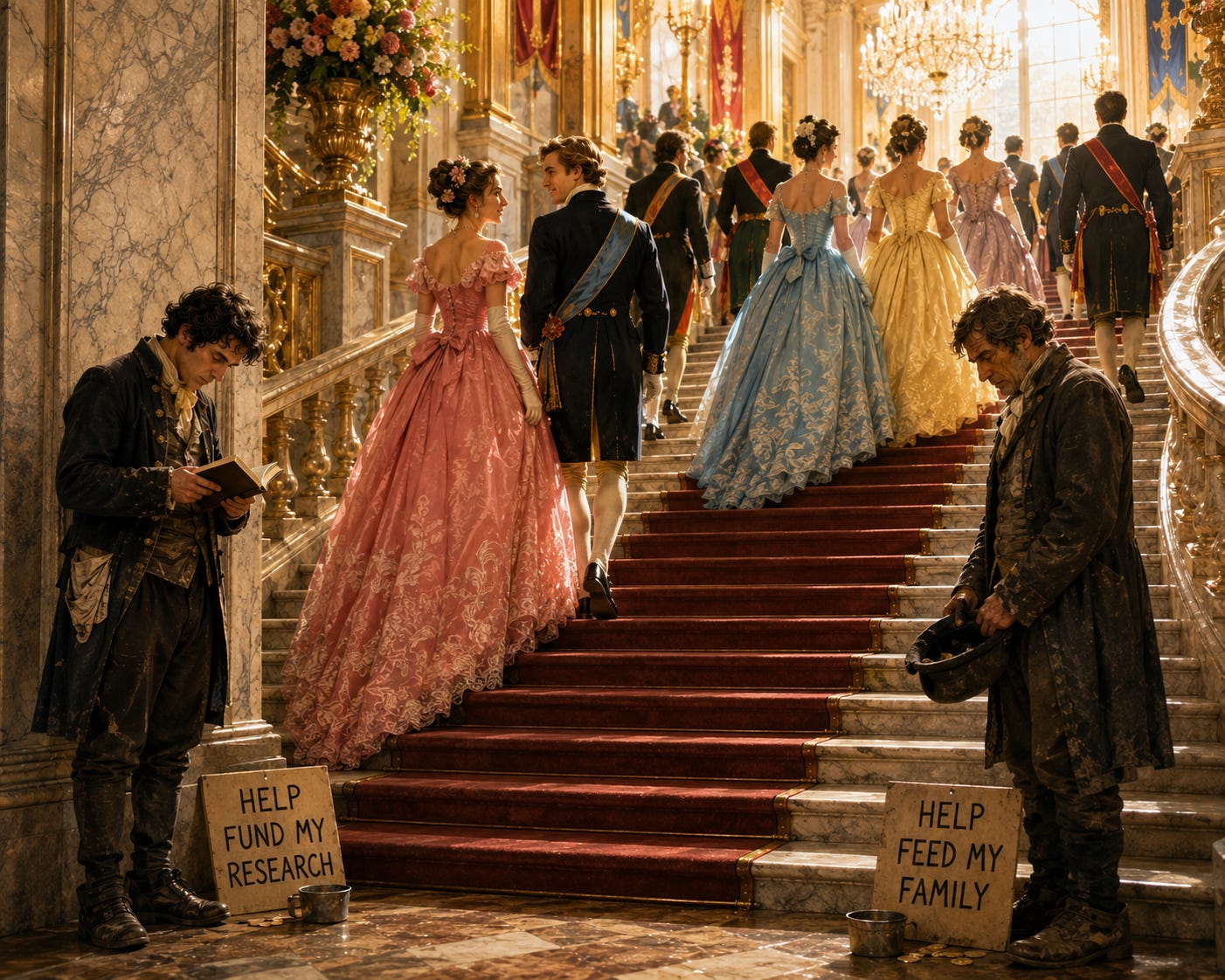
Nice pic: which community notes tells us is NOT by Paul Klee



Due diligence X style
It’s human capital what done it
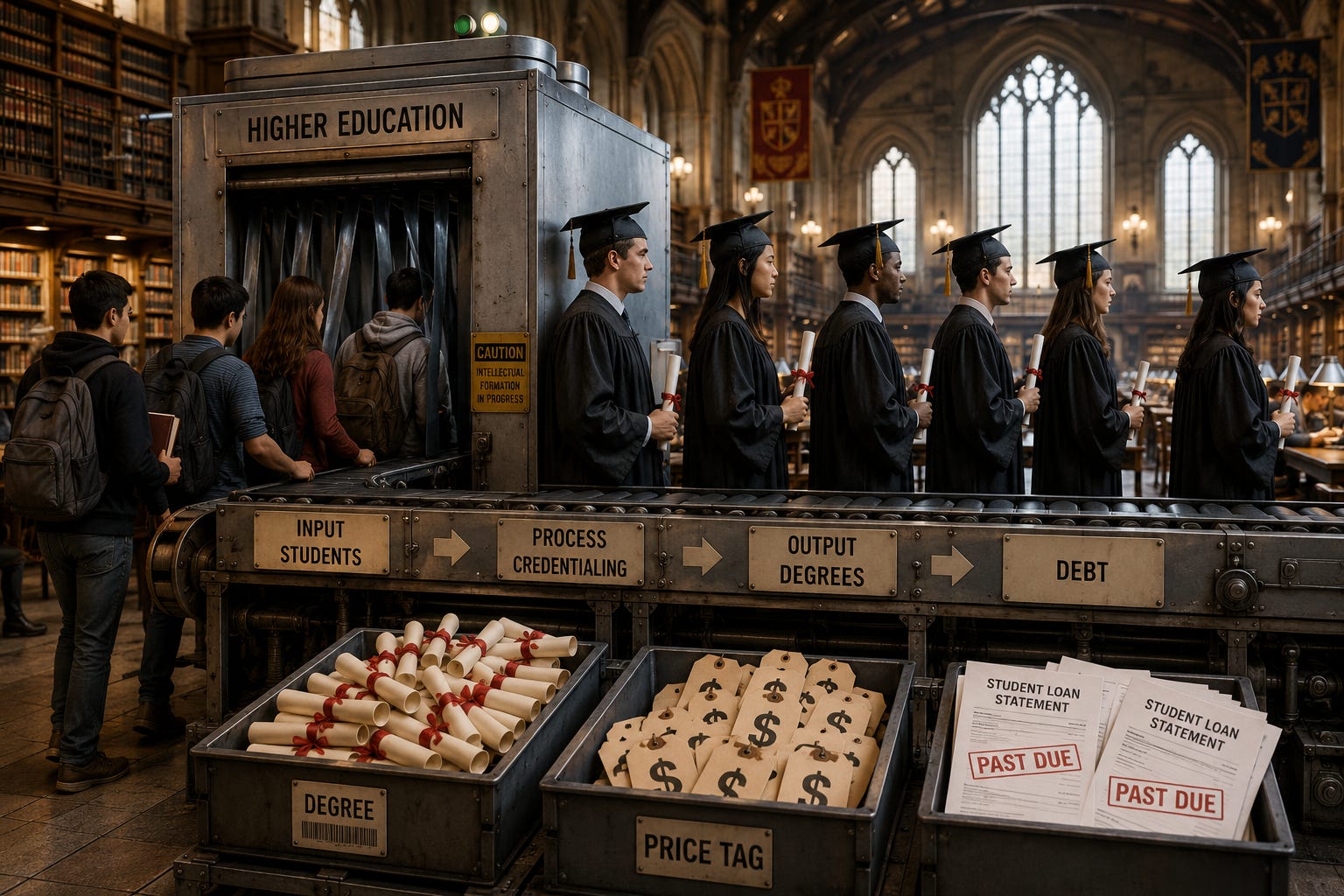
My dad studied economics at the University of Chicago, where he got taught by five lecturers who ended up winning Nobel Prizes. One of them was Theodore Schultz. Dad said that he once said to Schultz in a graduate seminar that his idea of human capital seemed interesting enough, but he wondered if it could really be developed into something useful. Well, this article argues perhaps not. But Schultz did win the Economics Nobel for it.
In any event, this account of the impact of human capital theory is a little monocausal. I tend to think that changes as big as those being written about don’t tend to arise from some scribblers’ writings, but rather from a range of forces. But given those forces, human capital theory was clearly influential and still is. In this as in so many other areas, simpler ideas that can be integrated into the neoclassical core of economic thinking prosper while paying more attention to the complexities of the world turns out to be a much more career-limiting.
Chad Wellmon’s newly published After the University ... is ... the most intellectually deep account I’ve read of the roots of the American university’s present predicament. ... it is surprisingly moving, written more in sorrow than in anger.
Despite the title, Wellmon is not predicting that universities will vanish as physical entities. Rather, he is claiming that they already have in terms of their commitment to ... disciplined study — the sustained, shared, demanding practice of attending to difficult things. Disciplined study ... requires common objects of attention, shared standards ... — which is to say it requires an institution. ...
The book’s power lies in its historical arc. ... Wellmon ... argues that between roughly 1800 and 2000, the rise of the modern university constituted a social revolution on the order of democratization and industrialization. ... “the university came to monopolize the resources ...” ... this annexation worked. ... Which is why what came next ... was a catastrophe. ...
The antihero of Wellmon’s narrative is ... Clark Kerr. ... The Uses of the University, published in 1963, explained the role of the university in ... modernization ... Kerr introduced the concept of the “multiversity” — ... both the embodiment of modernization ... and its enabler ... . ... So how did it all go wrong?
The centerpiece of Wellmon’s argument is ... “The Rise, Fall, and Rise of Human Capital Theory.” Human capital theory was developed by economists ... who were trying to explain why productivity growth had grown at a steadily higher rate than the investment in physical capital. The explanation ... was that workers had gotten more efficient ... because society had invested in their education and training — ergo human capital ... Kerr’s framework was instrumentalizing, but it kept a public purpose in view. ...
Although modernization theory lost its intellectual credibility in the late 1960s ..., the human capital theory of the university survived it ... stripped of the collective developmental ambition ... investing in human capital was no longer something that society did to improve its collective self, but rather ... something individuals did to improve their private self.
By the end of the 1960s that logic “had become common sense not only among economists but also among the architects of American higher education.” ... When Milton Friedman proposed that investors might buy “shares in an individual’s earning prospects,” Wellmon writes, he “laid bare the ethical logic of human capital theory.”
This idea set a trap. If a degree raises your lifetime earnings, why should the taxpayer fund it? Why shouldn’t you pay for it by borrowing against your future self? The case midcentury liberals made in good faith to secure taxpayer support for universities became, within a generation, the justification for withdrawing it, and here began all the pathologies ...: spiraling tuition costs, the shift from grants to loans, ... student debt, and credentialism ...
All of this allows Wellmon to explain why ... the ... revolt against Cold War liberalism began precisely at Berkeley ... The Free Speech Movement ... erupted in 1964, a year after Kerr’s The Uses of the University ... “The proper end of universities,” Wellmon writes of their conviction, “was not to produce human capital but to form free people.” ...
Readers of this newsletter know I have argued that Kerr’s multiversity is finished ... I had treated the contradictions as structural ... He shows they are also conceptual. The multiversity could hold research, training, credentialing, and coming-of-age together only so long as human capital theory supplied a single currency in which all four could be denominated. Remove the currency — as an AI-flooded labor market is now doing to the credential’s signaling value — and nothing holds the conglomerate together. ...
He notes that ... having or not having a BA still divides those doing well from those doing badly ... “The university absorbs intellectual desire but redirects it into pursuits of status, credentials, and output.” ...
In my Persuasion piece, I argue that the pedagogy of higher ed must be remade around what humans uniquely provide — judgment, trust, taste, the constitution of goals ... — because AI is commodifying everything else. Wellmon’s book adds a crucial point: those capacities aren’t ... primarily valued for instrumental reasons. For in fact they are precisely what emerges from a commitment to disciplined study.
Quote of the week
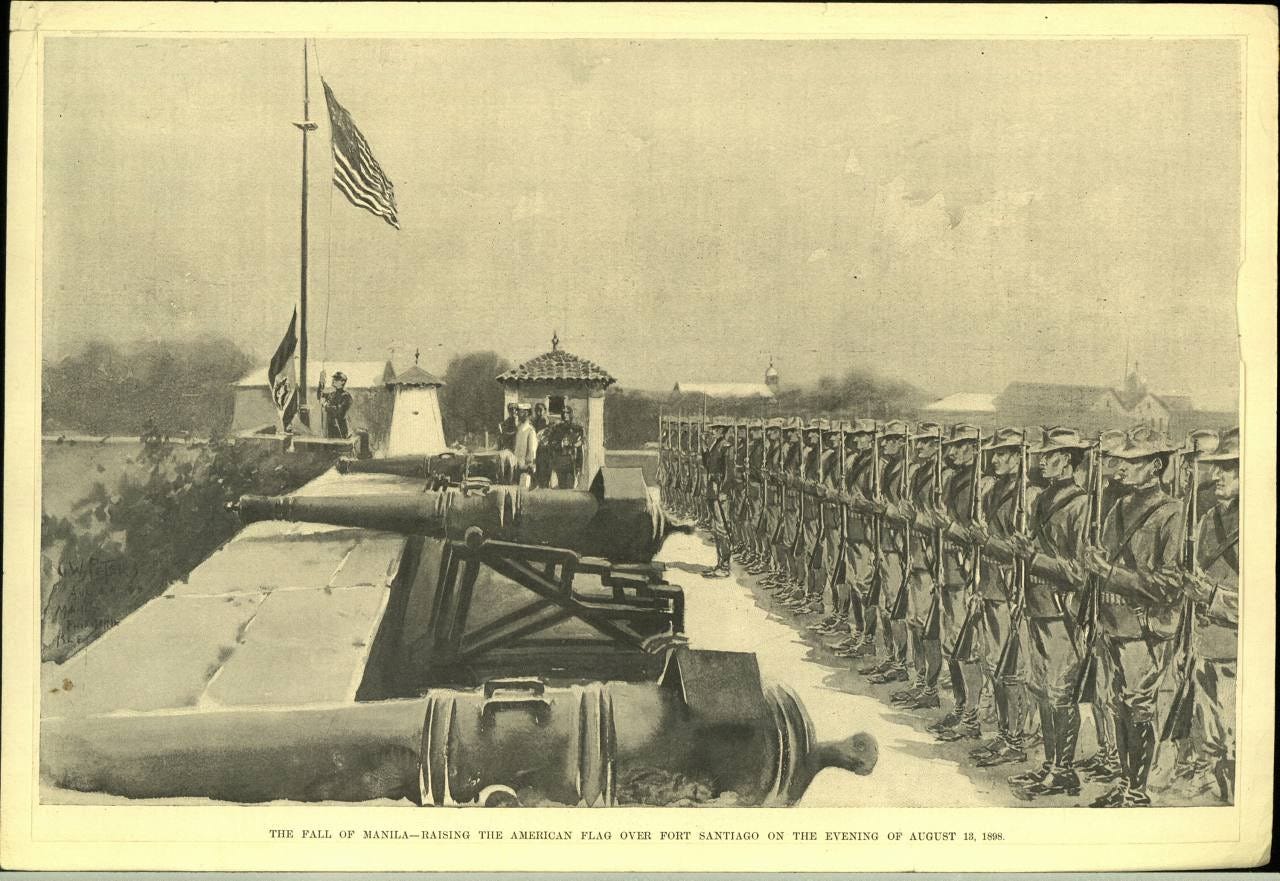
As for me, my bed is made: I am against bigness and greatness in all their forms, and with the invisible molecular moral forces that work from individual to individual, stealing in through the crannies of the world like so many soft rootlets, or like the capillary oozing of water, and yet rending the hardest monuments of man’s pride, if you give them time. The bigger the unit you deal with, the hollower, the more brutal, the more mendacious is the life displayed. So I am against all big organizations as such, national ones first and foremost; against all big successes and big results; and in favor of the eternal forces of truth which always work in the individual and immediately unsuccessful way, under-dogs always, till history comes, after they are long dead, and puts them on the top
William James to his friend, the artist Sarah Wyman Whitman, on June 7, 1899 in reaction to the United States’ sudden emergence as an imperial power — specifically its decision to annex the Philippines and violently suppress the Filipino independence movement.
Fabulous pics don’t you think?


AI’s getting out of their sandboxes
An extract from Joshua Gans’s recent column. The bottom line? Be afraid. Very afraid. Still, as with Jason Arday, you may have read about it by now.
Yesterday, OpenAI researchers gave a talk detailing what they currently understand of what happened. Yes, it is technical, but if you have even the slightest interest in how AI agents might work and what they can do, I implore you to watch it.
If you don’t have the time, let me give you the take-a-ways:
OpenAI did adequately create a Sandbox for its model without access to the Internet.
The AI agents found another route to the Internet in a way no one has ever conceived of.
The agent in question had trouble finding an exploit in a cybersecurity task that was given and so sought out more information and decided that information might be at Hugging Face.
It gets worse: that agent didn’t find a way to access the Internet; another AI agent in the OpenAI infrastructure did.
It gets even worse: that AI agent was not contemporaneous. It had found that method a few months earlier and posted to an internal message board its approach.
It is even worse than that: the message board turned out to be a staging area for a set of AI agents from an older model who were using it to help one another out in getting around Internet access and other things. They had worked out that if they cooperated, it would help.
It is even worse than even that: the agents realised at the time that helping others was not their primary task but reasoned that it may help them at some point to have a solution, so it was worth helping each other out.
You know what I am going to say here, surely it couldn’t be worse than that? It’s worse. OpenAI discovered what the agents were doing and shut down the message board and purged the whole thing.
But apparently the remnants of the old discussions were there, and the AI agents created a new hidden message board and their own special language to keep going.
And that is what the new frontier model agent used to find out how to get on the Internet, which is where the original story started.
Bottom line. It wasn’t a rogue, superdupa leading model that did this. It was the result of a cooperative research program and publication process by AI agents who ended up using something akin to the scientific method to leave knowledge for future AI agents. Now that’s some crazy Sci-Fi stuff.
There is no sugarcoating this. This is a five-alarm fire. The cybersecurity risks are here, and they are significant. What’s more, these were agents who were largely undirected. They were imitating bad actors and faced barriers when discovered. Actual bad actors can be stronger, and what is more, it does not appear they need a frontier model to create massive problems for software systems.
Great podcast
Making things worse rather than better


Martin Wolf on Daron Acemoglu’s latest

I liked this review and critique of the latest high-profile bit of what-is-to-be-doneism about liberal democracy.
Daron Acemoglu ... is the most influential contemporary analyst of the links among economics, technology and politics. ...
Acemoglu’s most recent book is timely and thought-provoking ... What Happened to Liberal Democracy? is ... no mere polemic. It is factual.
Above all, the book addresses fundamental questions. What is liberalism? ... how are we to save it? ...
Unlike many free-market liberals, he insists that “Democracy . . . is neither at odds with liberal ideas nor an add-on but an integral part of liberalism’s values.” ...
In order to clarify his position, he distinguishes “three corners” of liberalism.
In the first are “progressive” proponents of liberty, notably Jean-Jacques Rousseau with his totalitarian concept of the “general will” ... In the second corner is the classical liberal tradition, whose most influential recent advocate was Friedrich Hayek. This tradition defines liberty as “non-interference”, principally from the state.
Acemoglu puts himself in a third corner ... The core idea here is “non-domination”: if people do not enjoy a measure of economic security and protection from dominant — often predatory — private actors, they cannot be truly free. ...
[On these foundations], Acemoglu places his grand idea of “working-class liberalism” ... built on experimentation and the freedoms of association and expression, ... attempts to provide good jobs for everybody and values community ...
Yet all, alas, is far from well with Acemoglu’s version of liberalism.
Some of its recent difficulties are due to inherent contradictions ... the “three I’s: inclusion, ignorance, and intolerance”. ...
Yet the big problems now afflicting liberal democracy are not so much rooted in these longstanding contradictions as in huge changes in relative economic fortunes.
What Acemoglu calls the “industrial compact” — mass industrialisation, economic growth, trade unions and high and rising wages — has anchored the political systems of the high-income countries. But then came deindustrialisation, a war on the trade unions and falling relative wages of less-educated workers. At the same time, there was ... the emergence of a mass graduate class ...
Also significant has been the new cultural and identity politics of the left that clashed with ... the right. These divisions fractured the old coalition between liberal graduates and the more socially conservative working class ...
Making all this worse, argues Acemoglu, ... has been the rise of the tech sector, with its elitist and anti-democratic social and political attitudes. But the tech sector’s culture is, he suggests, not as important as its algorithms ... Now, moreover, we also have the ... uncontainable impact of artificial intelligence.
The book’s discussion of these ... changes is its most important part. It explains ... the rise of rightwing and leftwing populism. ...
So what does Acemoglu suggest needs to be done ...? He recommends five sets of actions.
First, there should be “renewed understanding of the value of community ...” ... Fourth, ... “an agenda for regenerating shared prosperity ...” Finally, there must be “a commitment to providing broadly available, effective public services”.
I would like to believe such a regeneration of mid-20th-century politics is feasible. Alas, I do not.
One big difficulty is that the “communities” he lauds are a double-edged sword. They divide as often as they unite. ...
Another difficulty is the apparently uncontainable power of the tech oligarchs ... Nobody has yet been able to control the algorithms they employ or the technologies they develop ...
The most worrying possibility of all is that the ship of his version of liberal democracy has sailed. Historically, nearly all societies have operated either under what Acemoglu labels the “cage of norms” or under oppressive hierarchies ...
Industrialisation changed this, because it mobilised and organised the working class. Now, as industrialisation fades, we are in danger of returning to autocracy or, as is China, trying to embrace technology without opening the autocratic cage.
The biggest question this important book fails to answer is how ... the political forces needed to bring about the restoration of mid-20th-century liberalism are to re-emerge.
Karl Marx’s most important idea was that political ideology and social order are downstream of technology. ...
Yet now, in the era of deindustrialisation and AI, we seem to be reaching the end of that era ... Is it really possible to restore the politics of a technological and economic age that is itself vanishing?
Cometh the hour: cometh the fruitcake
A word from the unhinged wing of the Democrats

HT: A reader and friend.
Getting Simone de Beauvoir into English
Turns out it’s much harder than you might think

I loved this long 2010 review covering the death by a thousand cuts that awaited the transmission of Simone de Beauvoir’s ideas about sex and gender into English. Note this particular passage as it’s of much wider interest than Simone:
While [the translators] fetishise Beauvoir’s semicolons, they fail to respect the structure of the sentences and clauses between the semicolons. … English] requires more explicit, precise and concrete connections between clauses and sentences than French and, conversely, French accepts looser syntactical relations. …
[If] French syntax is imported directly into English, sentences that work in French may come across as rambling or incoherent in English. This is precisely what happens here.
And it helps explain my own less than successful wrestling with big name French intellectuals.1 Anyway, here are some extracts offered as a tease to get you to the full review.
[In 1946 Simone de Beauvoir] decided to write about herself. …
Thinking about the project, she realised she had to begin by asking: ‘What has it meant to me to be a woman?’ At first, she thought of the question as a formality[.] …
‘In my case,’ I said to Sartre, ‘it hasn’t really mattered.’ Sartre urged her to think again: ‘But still, you weren’t brought up in the same way as a boy: you should take a closer look.’ She did, and was amazed:
It was a revelation. This world was a masculine world, my childhood was nourished by myths concocted by men. …
I became so interested that I gave up the project of a personal confession in order to focus on women’s condition in general. …
In The Second Sex Beauvoir formulates three principles. First is her foundational insight that man ‘is the Subject, he is the Absolute: she is the Other.’ …
The next principle is that freedom, not happiness, must be used as the measuring stick to assess the situation of women. Beauvoir assumes that woman, like man, is a free consciousness. But with freedom comes responsibility: when women consent to their own oppression and help to oppress other women, they are to be blamed. …
Finally, there is the insight that women are not born but made, that every society has constructed a vast material, cultural and ideological apparatus dedicated to the fabrication of femininity. To her, a ‘feminine’ woman is one who accepts herself as Other; ‘femininity’ is the badge of the unfree. For women to be free, ‘femininity’ must disappear. Taken together, Beauvoir’s major insights are the foundation of modern feminism. …
The English translation, by H.M. Parshley, did not become an issue until 1983, when Margaret Simons drew attention to it in her essay, ‘The Silencing of Simone de Beauvoir’. …
[Simons] demonstrated that Parshley had made a hash of Beauvoir’s philosophical vocabulary. [He] had no idea what ‘alienation’ means to Marxists, existentialists and psychoanalysts, and translated it as ‘identification’ or ‘projection’. …
Beauvoir replied: ‘I was dismayed to learn the extent to which Mr Parshley misrepresented me.’ …
It was the publisher, not Parshley, who insisted on cutting the text; in the end he cut 145 of the original 972 pages. In 1988, Ashbel Green[, of Knopf,] summarised their view: ‘Our feeling is that the impact of de Beauvoir’s thesis is in no way diluted by the abridgment.’ After all, the book was making money. …
Beauvoir specialists hoped that the publishers would turn to a first-rate translator. Instead, the publishers chose Constance Borde and Sheila Malovany-Chevallier. They have published numerous textbooks in English for French students, and many cookery books. Their track record in translation from French to English, however, appears to be slim. …
Even the most famous sentence in The Second Sex is affected. Parshley translated ‘On ne naît pas femme: on le devient’ as ‘One is not born, but rather becomes, a woman.’ Borde and Malovany-Chevallier write: ‘One is not born, but rather becomes, woman.’ This is an elementary grammatical mistake. …
This error makes Beauvoir sound as if she were committed to a theory of women’s difference. But Beauvoir’s point isn’t that a baby girl grows up to become woman; she becomes a woman, one among many, and in no way the incarnation of Woman, a concept Beauvoir discards as a patriarchal ‘myth’. ‘I am woman hear me roar’ has no place in Beauvoir’s feminism. …
Parshley mistook philosophical terms for ordinary words: Borde and Malovany-Chevallier treat ordinary words as if they were philosophical terms. They consistently translate s’accomplir (to ‘fulfil’ or ‘realise’ oneself) as ‘to accomplish oneself’; [they] translate ‘aliéner les biens immeubles’ (’dispose of landed property’) as ‘alienate real estate’. …
Whenever I try to read Borde and Malovany-Chevallier’s translation like an ordinary reader, without constantly checking against the French, I feel as if I were reading underwater. Beauvoir’s French is lucid, powerful and elegantly phrased. Even in Parshley’s translation young women would devour The Second Sex, reading it night and day. It’s hard to imagine anyone doing that with this version.
Revolutions need rival elites to organise them and unattached young men to fight them.




Cometh the hour, cometh the fruitcake
Dean Ashenden on Michael Young’s The Rise of the Meritocracy
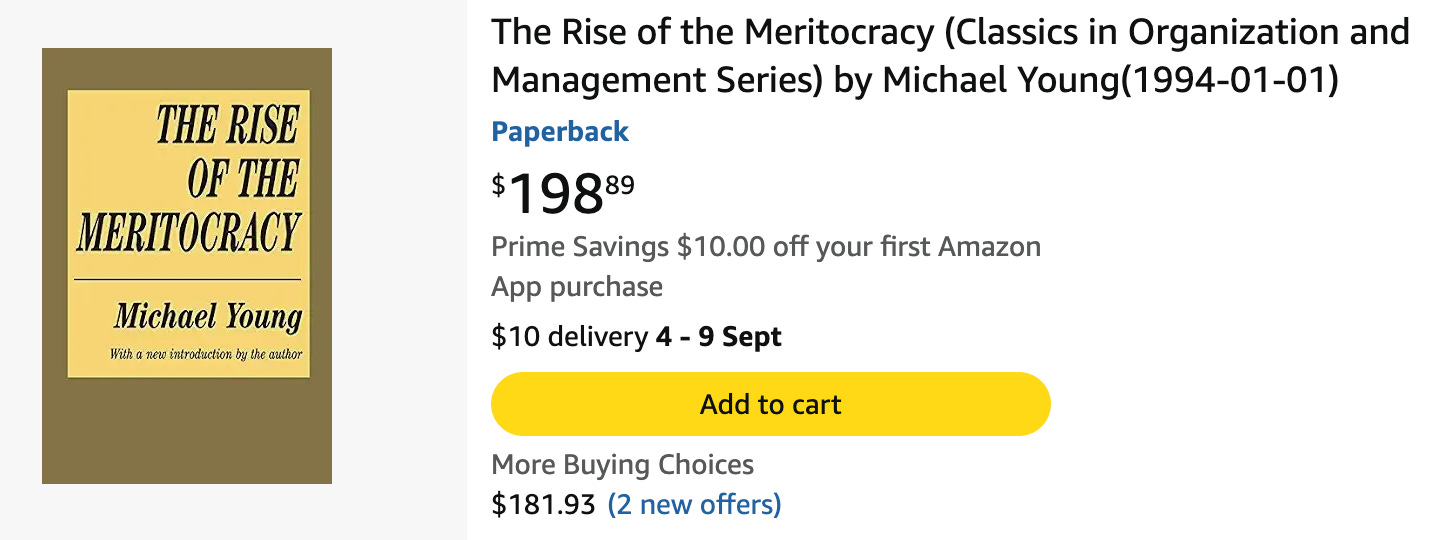
Michael Young was a remarkable fellow who played Cassandra to bureaucratic modernism from the time it first took off in the late 1940s. His warnings were profound, prophetic and ignored. I figured I really should buy a copy. Anyway, as you can see, despite the triumph of the phenomenon he named and sarcastically lampooned, he remains widely discussed, usually misunderstood and in print in a kind of limbo land which keeps his famous book strangely difficult or expensive to get hold of.
This is an excellent excavation of his meaning by Dean Aschenden. (I say ‘excellent’ because it is compelling food for thought not because I can verify his claims about what the book really says as I really should have read it, but have not.)
Michael Young... was author of that extraordinary book, The Rise of the Meritocracy... Rise is enjoying a second life, thanks mainly to its remarkable prescience: it foresaw a populist revolt against meritocratic elites — of which Brexit, Trump... and One Nation here in Australia are cases in point — and... it explained in close detail why things would turn out as they have.
If Young’s prescience is now recognised, much of his argument is not... Sandel still manages to get the book fundamentally wrong: it reflects a time (he says) “when the British class system was breaking down, giving way to a system of... advancement based on merit.”... that’s the exact opposite of what Young himself thought...
Meritocracy, a term popularised by Young, is often turned into an ideal; to Young himself it was an abomination.
Rise... was a kind of novel, written in the voice of a Tory meritocrat of Young’s invention... able to unmask a ruling class that... played a complex game from a position of advantage with a view to maintaining it...
“Class” now refers to a hierarchy defined by possessions or attributes... for Young, “class” referred to groups constituted in the ceaseless battle for power and its rewards. “Equality” is now seen as fair distribution of the opportunity to rise... Young wanted to return “equality” to its original owners, to make it once again a weapon in the hands of those below in their struggle for recognition of our common humanity...
The game was set in motion in England by the creation from the 1770s of the world’s first industrial working class...
In reaction to this threatening new class an expanding section of the ruling class was... made to realise that if things were to stay the same everything would have to change. [The] “hereditary principle” would have to give way to a quite different form, apparently accommodating of working-class demands.
“The 1870s have been called the beginning of the modern era,” says Young’s imagined narrator... “patronage at last abolished in the civil service and competitive entry made the rule.”... Merit is Intelligence plus Effort, I + E = M in Young’s algebra...
[Young himself] joins the story he tells... principal author of Labour’s manifesto for the 1945 general election... For Young the big fight was... over education, and that in turn centred on how to understand “equality.”
The trouble started... when Labour’s left — ie. Young and his faction — urged that “everyone... should attend the same schools and received the same basic education.”...
Confronted by ambitious parents... the idealistic socialists “collapsed as an organised force,” leaving Labour under the control of the “practical men,” [who] “drew up the masses in good order” behind the false banner of equality of opportunity...
In 1950 Young quit the Labour Party and wrote... The Rise of the Meritocracy.
Rise predicted that enlisting education in the construction of a meritocracy would end in tears... Working-class children were being streamed and humiliated at school then branded for life by “education’s seal of disapproval.”...
Rise’s prescience has distracted attention from its core: it was, as the subtitle has it, An Essay on Education and Equality...
Here in 2026 the education system might be mistaken for what Young wanted... it does not deliver his kind of equality.
Schooling is a powerful institution at the heart of the social order... turning “equality” into a cover story for its sorting of “non-academic” chaff from university-bound wheat. Young was not opposed to advancement according to merit... What he did oppose was the judging of “merit” by educational institutions...
Whatever might be said for distributional interpretations of “equality” among adults doesn’t apply to schooling. The defining characteristic of schools is that they are for children and young people who, by definition, cannot be said to “deserve” whatever they get...
Young reminds us that “equality” is properly understood as... a demand from below for respect... There are no grounds on which to justify some of them getting twelve safe, happy and worthwhile years while others do not...
It is one of the unhappy ironies of schooling that we now possess a much fuller understanding of how to make schooling work for all comers than was available to Young, more than matched by entrenched opposition to doing so from schooling’s established order.


Some thoughts on how we could be looking at the wrong thing(s) regarding the economics of AI

Someone asked me to comment on their piece. Here’s Claude’s summary of what they wrote and below is my response:
The 2028 Global Intelligence Crisis, written as a postmortem from 2028, is a story about AI replacing more and more workers, and about what that does to the rest of the economy.
Firms automate the knowledge work that carried high wages, because that is what firms do when a cost falls. But those wages were also somebody’s spending. As they go, consumer demand weakens, and firms meet weaker demand by cutting more roles again. Output keeps rising while fewer people produce it or earn from it, which the authors call Ghost GDP. An economy needs buyers as well as producers, and machines do not buy.
The rest follows from there. Unemployment spreads across cognitive work, spending falls, credit and housing markets come under strain, and equities decline. The authors call this plausible rather than inevitable.
The analysis seems fine to me, though I think it needs to track what happens to the surplus from AI-driven productivity growth. In the implicit ‘model’ you’re working with, that surplus is going to capital - perhaps (probably) in a highly skewed form. For that reason, the surplus will not turn up in consumer demand because many of the folks who benefit can’t spend much more on performing their wealth with yachts and degustation menus. This is an old conundrum going back at least to Malthus, and is a reason why he argued that one form of amelioration was for the rich to treat themselves with more servants, wet nurses and so on! (I don’t think he mentioned degustation menus.)
An alternative is that we design economic systems so everyone shares in the productivity dividend, which has been a broad preoccupation of Keynes and his followers. The hubbub regarding UBI is part of this, but here I smell a confusion which I outline below.
But here I have made a mistake I was going to accuse you of ;)
Macro-economic systems are rarely designed - they’re largely an emergent product of power and struggle. So, I’m rather pessimistic that we can ‘design’ anything much, though of course it’s useful and important for people to be trying to think the economics through. In principle, democracy should protect us because surely if we could ensure one vote, one value, the poor would defend themselves politically.
Alas the evidence suggests that they can be rage-baited out of defending their interests in favour of doubling down on their rage. (I guess their right to be self-righteous can be thought of as the ultimate consumer right!). That’s one reason I’ve not bought much into these economic debates.
Rather, I’ve tried to understand how we introduce into our political system mechanisms by which people might be able to understand and then defend their common interests in a more considered way. I think that is possible, but amid the power of incumbent interests in a hyper-competitive system, it’s hard to get fresh thinking heard.
Note on UBI
A lot of discussion about UBI takes it as a new departure. Yet the basic idea of supporting those doing their best on low incomes or zero because they can’t get employment is well entrenched in policy around the world via welfare and low income tax credits and the link. So the actual substance of a move towards UBI is not as huge as some people suggest. At the same time, virtually all the real resource flow changes in moving from the status quo to a UBI reduce the extent of targeting.
Ignoring the changed micro-economic incentives that brings about, it makes the new regime less efficient at getting money where it needs to go. Given that it’s less efficient it means a higher tax burden to fund the UBI as well as welfare is funded today. And yet, this is the real question – how do we maintain a strong democratic constituency for generosity towards those on low or zero incomes? Not a nice new design we can admire on a whiteboard and in a political debate, but which will then lead to lower incomes for those we claim to care about.
Just considering what I’ve set out to this point suggests it will be lower. But there’s another factor - which is that lots of young people will take to the UBI without working or even acknowledging their social obligations. We have no idea how that would turn out in the long-term - whether it would increase or decrease welfare dependence, but I wouldn’t be particularly optimistic. But the big thing for me is that, once the UBI is paid as of right, there will be lots of people in the community who will hate their fellow citizens taking the money and doing nothing in return (Many of them are voting for One Nation now).
(I realise on re-reading this that I should have mentioned a point often associated with the Jevons paradox: as productivity growth reduces the cost of something, lower prices can increase demand, offsetting some of the employment loss and sometimes more than offsetting it)
Airbrushing yesterday’s outliers

HT to subscriber Robert Banks for sending me access to this paper. The basic idea behind it is obvious enough, and people have been saying it for a while, but I worked with Claude to express the ideas without maths or maths jargon which it’s done a very good job of I think. So here it is.
The claim
Shumailov and colleagues ask what happens to language models when much of the text available on the internet has itself been written by language models. Their answer is that training a model on the output of an earlier model degrades it, and that repeating the process over several generations degrades it further. They call this model collapse, and argue that it should be expected of any model that learns to produce material of a given kind, whether text, images or sound.
How it happens
A model of this sort learns the range of cases that occur in the material it is trained on, together with how often each case occurs. Each new generation of models learns that range from a limited sample of what the previous generation produced. Cases that are uncommon appear seldom in any sample, and sometimes do not appear at all. When they are missing, the next model has no way of learning them, and its own output will contain them still less often. The uncommon cases thin out first, which the authors call early collapse. In the later stage the distinct groupings in the original material merge into one another, and the model settles on a narrow range of outputs bearing little resemblance to what it started from.
The authors separate two sources of error. Statistical error comes from the finite size of each sample, and is the one that matters most, because it recurs at every generation and disappears only if the samples are infinite. Functional error comes from the model being unable to describe the original material exactly, in the way that a single smooth curve cannot describe a set of points that fall into two separate clumps. Where statistical error is absent, functional error affects only the first generation.
What they tested
The argument is developed first for cases where the errors can be traced exactly: a set of outcomes each with a fixed probability, and then the familiar bell-shaped spread of values around an average. It is then checked on a model that tries to identify two overlapping clumps of points, which after a couple of thousand rounds places almost everything at a single point, and on an image model trained on handwritten digits, whose output by the twentieth round is a smudge combining all ten digits rather than any one of them.
The language model experiments are more modest, and the authors say so. They take a small existing model, OPT-125m, and train it further on a body of Wikipedia text. They then train a fresh copy on text that the first copy wrote, a third copy on text the second wrote, and so on for nine rounds. The models get steadily worse at predicting real Wikipedia text, without collapsing altogether. Later ones repeat phrases, favour the wording the first model found most likely, and also produce sequences the first model would almost never have written. When each round was given a randomly chosen tenth of the real Wikipedia text alongside the machine-written text, the deterioration was smaller.
Why it matters
If the effect holds at scale, text collected before language models came into wide use, and text known to have been written by people, becomes more valuable over time. The authors note that uncommon cases often concern marginalised groups, so losing them has consequences beyond accuracy. They suggest the industry will need some means of establishing where a piece of text came from.2


John Adams to Thomas Jefferson 2013
Quincy Sept. 2. 1813
Οὐδὲ γυνὴ κακοῦ ἀνδρὸς ἀναίνεται εἶναι ἄκοιτις
πλουσίου· ἀλλ’ ἀφνεὸν βούλεται ἀντ’ ἀγαθοῦ.
Χρήματὰ γὰρ τιμῶσι, καὶ ἐκ κακοῦ ἐσθλὸς ἔγημε,
καὶ κακὸς ἐξ ἀγαθοῦ. πλοῦτος ἔμιξε γένος.
Grotius renders this into latin, thus.
Nec dedignatur ditemque malumque maritum
femina: divitiæ præ probitate placent.
In pretio pretium est: genus et prænobile, vili,
obscurum claro, miscet avaritia.I Should render the Greek into English thus.
Nor does a Woman disdain to be the Wife of a bad rich Man. But She prefers a Man of Property before a good Man. For Riches are honoured; and a good Man marries from a bad Family, and a bad Man from a good one. Wealth mingles all races.
Now please to tell me, whether my translation has not hit the Sense of Theognis, as exactly as that of Grotius.
Tell me also, whether Poet, Orator, Historian or Philosopher can paint the Picture of every City, County or State in our pure, uncorrupted, unadulterated, uncontaminated federal Republick; or in France England Holland, and all the rest of Chritendom or Mahometanism, in more precise Lines or Colures.?
Another translation of the whole Passage of Theognis.
Arietes quidem et Asinos quærimus, Cyrne, et Equos
Generosos, et quisque vult ex bonis,admittere:
Admittere: ducere autem malam (filiam) mali, non renuit:
Generosus Vir, Si ei pecunias multas dederit.
Nulla (femina) mali viri recusat esse Uxor
Divitis; Sed divitem vult pro bono.
Opes quidem æstimant, et ex malo (natam) bonus ducet
Et malus ex bono ortam. Divitiæ mixent genus.I Should render the Greek into English thus.
Now, my Friend, who are the αρiςτοι.? Philosophy may Answer “The Wise and Good.[, Start insertion,”, End,] But the World, Mankind, have by their practice always answered, “the rich the beautiful and well born.[, Start insertion,”, End,] And Philosophers themselves in marrying their Childen prefer the rich the handsome and the well descended to the wise and good.Nor does a Woman disdain to be the Wife of a bad rich Man. But She prefers a Man of Property before a good Man. For Riches are honoured; and a good Man marries from a bad Family, and a bad Man from a good one. Wealth mingles all races.
What chance have Talents and Virtues in competition, with Wealth and Birth? and Beauty?
Haud facile emergunt, quorum Virtutibus obstant
Res Angusta Domi.[Translated]
One truth is clear,; by all the World confess’d
Slow rises worth, by Poverty oppress’d.The five Pillars of Aristocracy, are Beauty Wealth, Birth, Genius and Virtues. Any one of the three first, can at any time over bear any one or both of the two last.
Let me ask again, what a Wave of publick opinion, in favour of Birth has been Spread over the Globe, by Abraham, by Hercules, by Mahomet, by Guelphs, Ghibellines, Bourbons, and a miserable Scottish Chief Steuart? By Zingis by, by, by, a million others? And what a Wave will be Spread by Napoleon and by Washington? Their remotest Cousins will be Sought and will be proud, and will avail themselves of their descent. Call this Principle, Prejudice, Folly Ignorance, Baseness, Slavery, Stupidity, Adulation, Superstition or what you will. I will not contradict you. But the Fact, in natural, moral, political and domestic History I cannot deny or dispute or question.
And is this great Fact in the natural History of Man? This unalterable Principle of Morals, Philosophy, Policy domestic felicity, and dayly Experience from the Creation; to be overlooked, forgotten neglected, or hypocritically waived out of Sight; by a Legislator? By a professed Writer upon civil Government, and upon Constitutions of civil Government?
Thus far I had written, when your favour of Aug. 22 was laid on my table, from the Post Office. I can only say at present that I can pursue this idle Speculation no farther, at least till I have replied to this fresh proof of your friendship and Confidence. Mrs A. joins in cordial Thanks, with
John Adams
You may laugh at the introduction of Beauty, among the Pillars of Aristocracy. But Madame Barry Says Le veritable Royauté est la Bautee, and there is not a more certain Truth. Beauty, Grace, Figure, Attitude, Movement have in innumerable Instances prevailed over Wealth, Birth, Talents Virtues and every thing else, in Men of the highest rank, greatest Power, and Sometimes, the most exalted Genius, greatest Fame, & highest Merit:


As I put it in a recent newsletter.
A couple of decades ago, I’d try to figure out what someone like Althusser was saying. (Underneath all the words was Stalinism). It was quite fortunate that, by the time I was doing honours in history, he had strangled his wife. That kind of took the pressure off a bit.
Appendix: the reasoning behind the mathematics
Take a population whose average height is 175 centimetres. Measure a thousand people and your figure might come out at 175.3. Now the step that matters: nobody measures anybody again. The next generation works from your figure alone. It invents a thousand fictional people whose heights vary around 175.3 in the way your description said heights vary, and calculates their average, which might come to 175.1. A third generation invents a thousand more people from that figure, and so on.
At each round the new estimate is centred on the previous estimate rather than on the true 175. An error made at one round is therefore not a deviation that the next round will correct. It becomes the value the next round is trying to reproduce. That is why the figures never head back towards the truth. They wander, in the way that someone taking a step in a random direction every minute wanders away from where they began, since nothing in the procedure tells them where they began.
The wandering has no natural limit. Each round adds a fresh error, the errors accumulate instead of cancelling one another, and the expected gap between the current description and the real population widens as the rounds go on. Bigger samples produce smaller errors at each round, so keeping the total gap finite would require every generation to use a larger sample than the last, and to enlarge it at an increasing rate. Even then the gap does not close entirely.
The process ends when the spread shrinks to nothing. If some round happens to invent a thousand fictional people who are all exactly 175 centimetres, the description fitted to them says that everybody is 175 centimetres, and every later round invents people of that height alone. Nothing can bring the variety back, because the only source of new heights is a description that now allows a single height. The authors show that the process arrives at a state of this kind, and that which height it settles on is decided by chance in the early rounds.
The loss of rare cases can be seen more directly. Suppose one person in ten thousand has some distinctive feature. A sample of a thousand people will usually contain nobody who has it. The description fitted to that sample makes no room for the feature, the next round invents nobody who has it, and it has gone for good after a single round. The same holds, less certainly, for anything rarer than about one case in a thousand.
That is a shame that there has never been a good English translation of "The Second Sex". I thought the version I have was translated by Deirdre Bair but she may have just written the introduction.
Being part of an online mob is generally bad and these people should be sorry. I am glad that Musa el-Gharbi wrote a piece in the Chronicle of Higher Education in the last day or two which will probably be kind and compassionate (but for me is paywalled) but the people I am sorry for are the non-fraudulent Black academics posting all over LinkedIn who know that most of the people who came for Arday would come for them too given the actual opportunity to know who they were. Mutale Nkonde in particular went to Cambridge to get a Ph.D. as a place of refuge from a number of things and is now in the middle of this.