


The Boaty McBoatface factor: Irony to the rescue

The two most promising sources for renewing our democracy come from the two most beleaguered English-speaking democracies — the US and the UK. Sortition is creeping into the machinery of American government, at least in tiny ways, such as the Michigan Independent Citizens’ Redistricting Commission.
And in the UK, things have got so desperate that they’re really starting to pull out the big guns. The master key of their constitution: Irony.
In the UK, the populace loves the royal family, except when it hates it. The crowd that queues through the night when royals lie in state buys the scandal sheets that expose the royal scandals. Britain gave us Dickens’s Great Expectations, where the only way for Miss Estella to save Pip is to betray him. So she does. Miss Havisham raised her to break men’s hearts. So the man she would spare is the one she must jilt.
Likewise, there were two roads to modern democracy: the straightforward path of revolution effected by France and the United States, where monarchies were overthrown or cast off. And the evolutionary path where they were transformed. And the agent of that transformation was irony — the transformation of ‘forms of words’ to mean something different to what they’d previously meant to such an extent that they come to mean the opposite of their common meaning.
The same capacity that enables a young lion cub to learn about things by rehearsing them, ironically as it were, in play — the bite that is not a bite — is the capacity by which the British transformed their constitution. Having trodden the blood-soaked path of the 1640s, the British kept the blood-letting of 1688’s Glorious Revolution to a trickle while certain words sloughed off their plain meaning and ministers’ advice came to mean instructions to their sovereign. So by 1940, Prime Minister Churchill delivers the threat of court-martial to His Royal Highness the former King Edward VIII, thus: “I most strongly urge immediate compliance with the wishes of the Government.”
Like the lion cub once grown, the play bite became the real bite. And now, as explained in Brian Klaas’s piece extracted below, Count Binface takes on Nigel Farage. Farage offers mass deportations. Binface proposes renaming London Bridge after an English actress with a double-barrelled name — Phoebe Waller-Bridge.
What a lovely green shoot to enter our ravaged political life, though I can’t quite trace the path from this to salvation.
Still, all power to Count Binface.
Authoritarian populists thrive on anger and fear. They demonise their opponents... and relish being seen as strongmen...
But sometimes, the greatest danger to authoritarian populists comes from something much more devastating than institutional constraints or mass protests: being turned into a punchline.
In Britain, that hypothesis will soon be tested in the funniest way imaginable.
I: Masterstroke?
A few days ago, Nigel Farage, the far-right populist leader of Reform UK, thought he had played a strategic masterstroke...
Farage had found himself under attack from politicians and the press... Allegations were swirling that he had failed to disclose a £5 million donation from British-Thai crypto-billionaire Christopher Harborne... after which, in a totally unrelated decision, Farage decided to allegedly lobby economic bigwigs to loosen regulations around cryptocurrencies... [Farage] decided to grasp the nettle: he resigned from parliament, then declared his intention to immediately run again for his vacant seat...
There was just one problem with Farage’s apparent masterstroke... a pesky little “Recyclon” from the Planet Sigma IX who was about to descend on Clacton-on-Sea. Farage hadn’t accounted for Count Binface.
II: From Lord Buckethead to Count Binface
British political humour is unparalleled in Western democracies... [C]andidates can run for office regardless of where they reside, so perennial longshot candidates can keep standing for parliament wherever they want...
Since the 1980s, Lord Buckethead repeatedly launched his candidacy for parliament, [winning] 131 votes in his race against Margaret Thatcher... However, the creator of Lord Buckethead claimed ownership of the character, forcing the arrival of a new persona: [Count Binface], an aspiring member of parliament / intergalactic space warrior who purports to be 5,900 years old...
Now, all of this is done in good fun... But in Nigel Farage’s constituency, all of the major parties have announced that they won’t contest the by-election since they see it as a blatant political stunt... the election is shaping up to be a showdown between just two main candidates: an absurd, over-the-top cartoon villain with garbage for ideas who is obsessed with aliens…and Count Binface...
And Farage should be scared, too, as Count Binface is running a shrewd, policy-driven campaign... he promises to force anyone who uses speakerphones on public transport to watch the movie Cats every day for one year...
III: Barrels of Laughs and Dilemma Actions
But beneath the humour, there is a serious lesson for crafting effective resistance to far-right populists and authoritarian strongmen.
Authoritarians and far-right populists effortlessly brush off scandal... Becoming a joke is far deadlier politically...
In political science research, this is known as a “dilemma action.” As the Serbian prankster and anti-authoritarian activist Srdja Popovic notes, the idea is to make it a lose-lose proposition between being laughed at or turning oneself into even more of a joke by over-reacting to amusing mockery. “If your opponent reacts, there will be a cost. If your opponent doesn’t react, there will be a cost,” Popovic explains.
In his own activism, Popovic found a rusty old barrel in Serbia, then painted the dictator’s face on it, and placed it in a busy shopping area with a sign that said “smash his face for a dinar”... The police, unable to ignore the provocation, “arrested” the barrel, bundling it into custody, thereby producing photographs of authoritarian overreach that made the regime look ridiculous...
In Turkey, President Recep Tayyip Erdoğan prosecuted a doctor who shared a meme that compared Erdogan’s appearance to that of Gollum... Ultimately, the doctor lost his job but won the criminal case, with the net result that Erdogan looked absurd—far worse than if he had not reacted at all.
The great anti-authoritarian political theorist Hannah Arendt had it right: “The greatest enemy of authority, therefore, is contempt, and the surest way to undermine it is laughter.”...
IV: Could Binface Prevail?
In Clacton-on-Sea, Count Binface remains an electoral underdog...
Win or lose, Farage’s political masterstroke has backfired... whether Binface can beat Farage, an outer space alien vs. a far-right populist who says Britain’s out of space for aliens.
Scheme as he might, it will now be Farage, not the man dressed as a bin, who’s seen as the joke in the race.
Ask a silly question


Digital public goods and common purpose
In this discussion, Gene Tunny and I react to a UN Institute report on AI that identified me as the possible originator of the expression “digital public goods”. I have been mulling on the question of public goods since well before chairing the Government 2.0 task force in 2009, realising that many of the public goods of the twenty-first century are digital. Most people haven’t noticed yet, but the Ostroms’ quadrant in which a public good is both non-rival and non-excluded is no longer good enough as a definition. It denies public goods as a problem solved. But Wikipedia is a public good, and it’s excludable. It’s just that its founders wanted to open it and could raise the funds to do so as a charity. Likewise, just as free-to-air TV figured as a public good in some 1950s and 60s textbooks, so Google, Facebook and Twitter(X) are public goods even though they’re funded by advertising. (And of course, you’re free to think that X or any of the other social networks are public BADs, but in econospeak they’re still public goods. They just generate negative value.
We then go on to explore ways in which social media could contribute to social mobility - something I wrote about here though the main thing that needs to be done is rewiring our credentialling systems. And Gene asks me some questions about AI. I think it’s obviously intelligence in any reasonable use of that term. Chatting with Claude and ChatGPT reveals a mysterious, shape-shifting intelligence that can easily beguile us without being truly conscious.
Audio is here.


Powerful doco on citizens’ juries
Watch it. Watch it now!
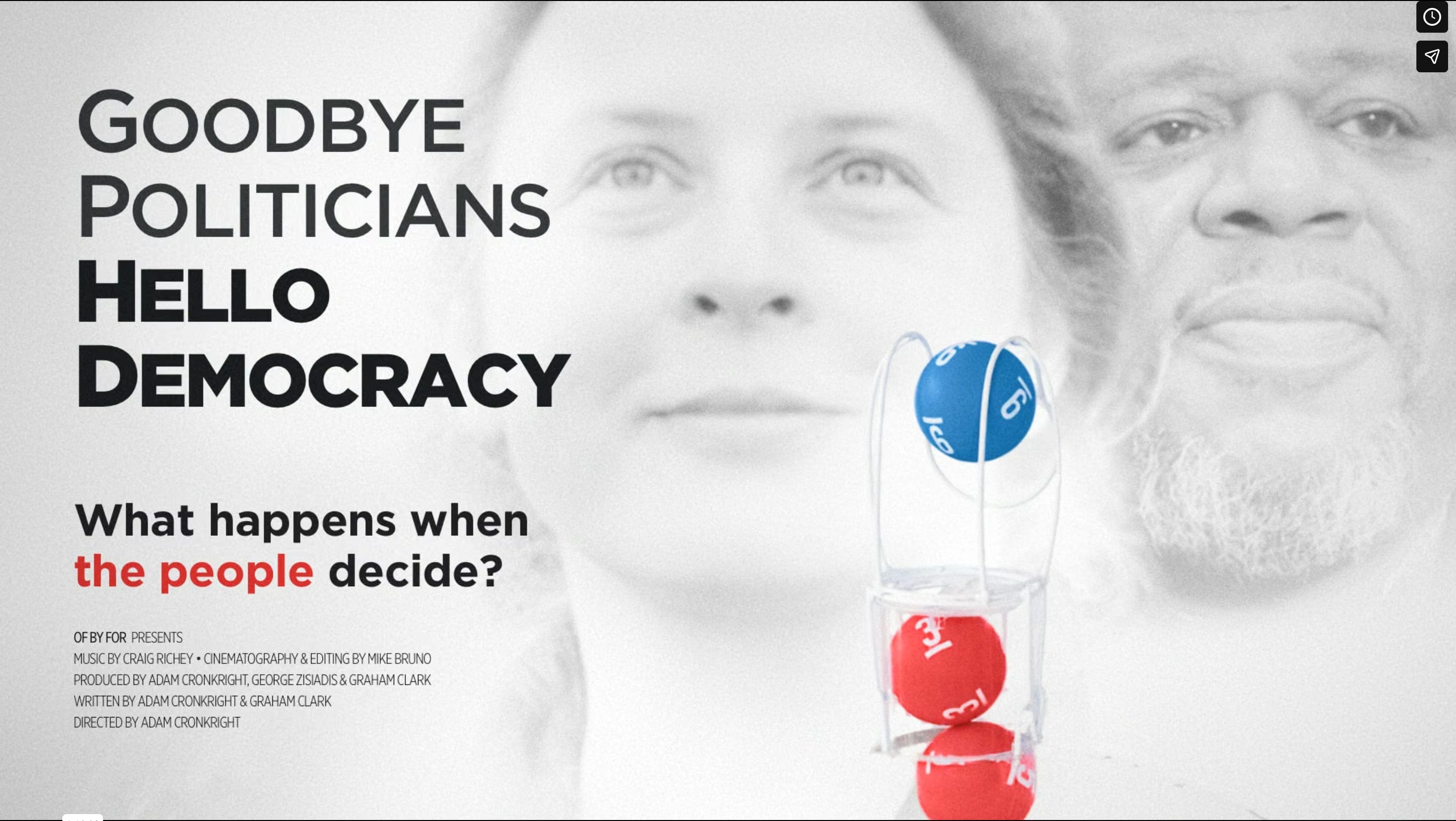
I saw an early cut of this documentary some years ago and was blown away, so I’m glad the producers finally released it — on the 4th of July to be exact. They’ll be winding up publicity on it as the US heads to the mid-terms.
What blew me away was the last 15 minutes which show you how this way of doing democracy does the exact opposite of what our electoral democracy is doing. Where electoral democracy drives people apart, even when they have relatively small differences (no more than a few percentage points of GDP in tax and government spending) a well-run citizens’ jury nurtures strong bonds of respect and even affection between people who continue to disagree with one another, even strongly!
Anyway, check it out, by clicking here. And if you don’t want to watch the whole thing, jump-skim the early bits and watch the last 10-15 minutes.
Paul Krugman has a ‘come-to-citizens’ juries moment
Whatever happened to architecture?
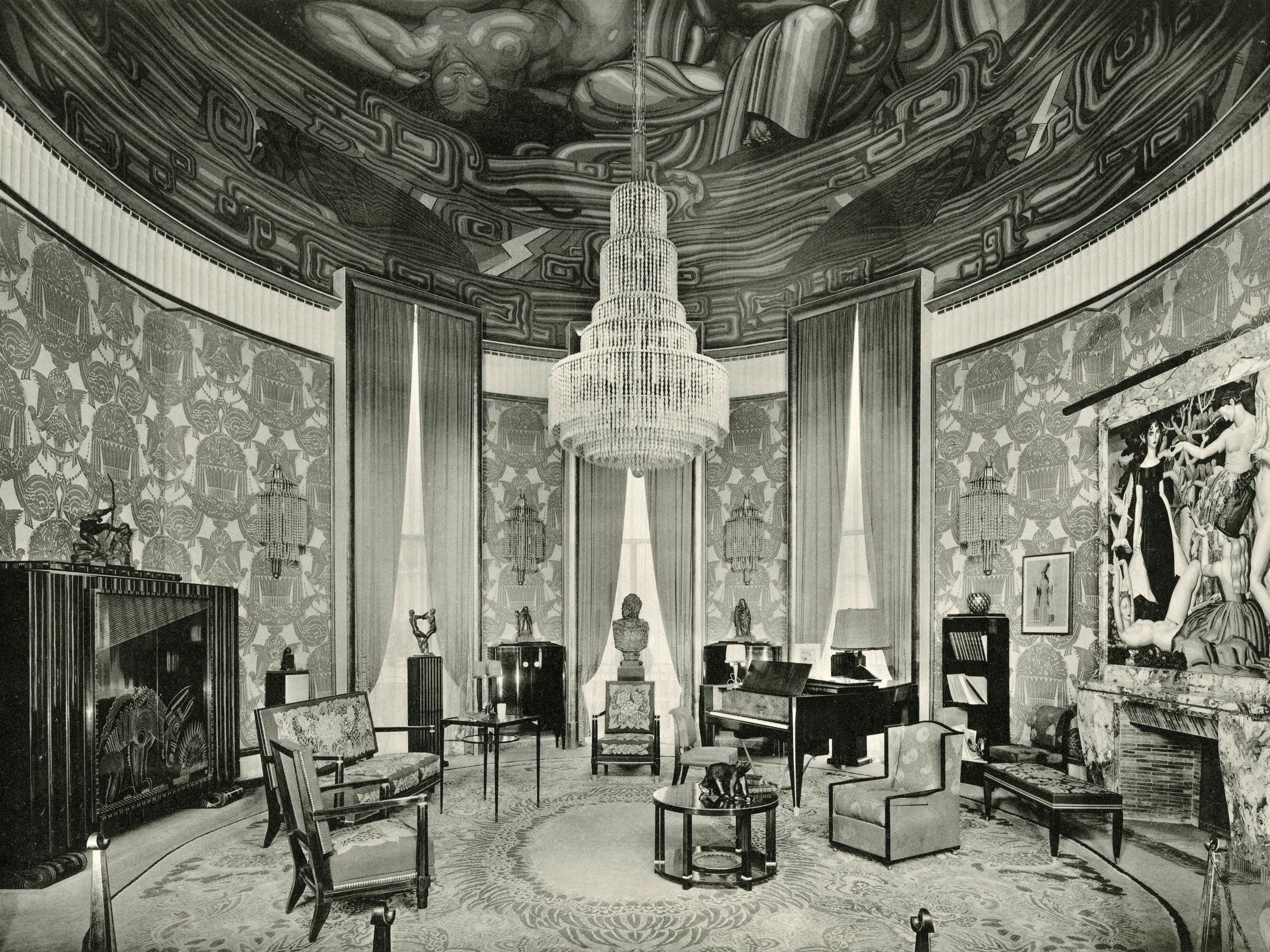
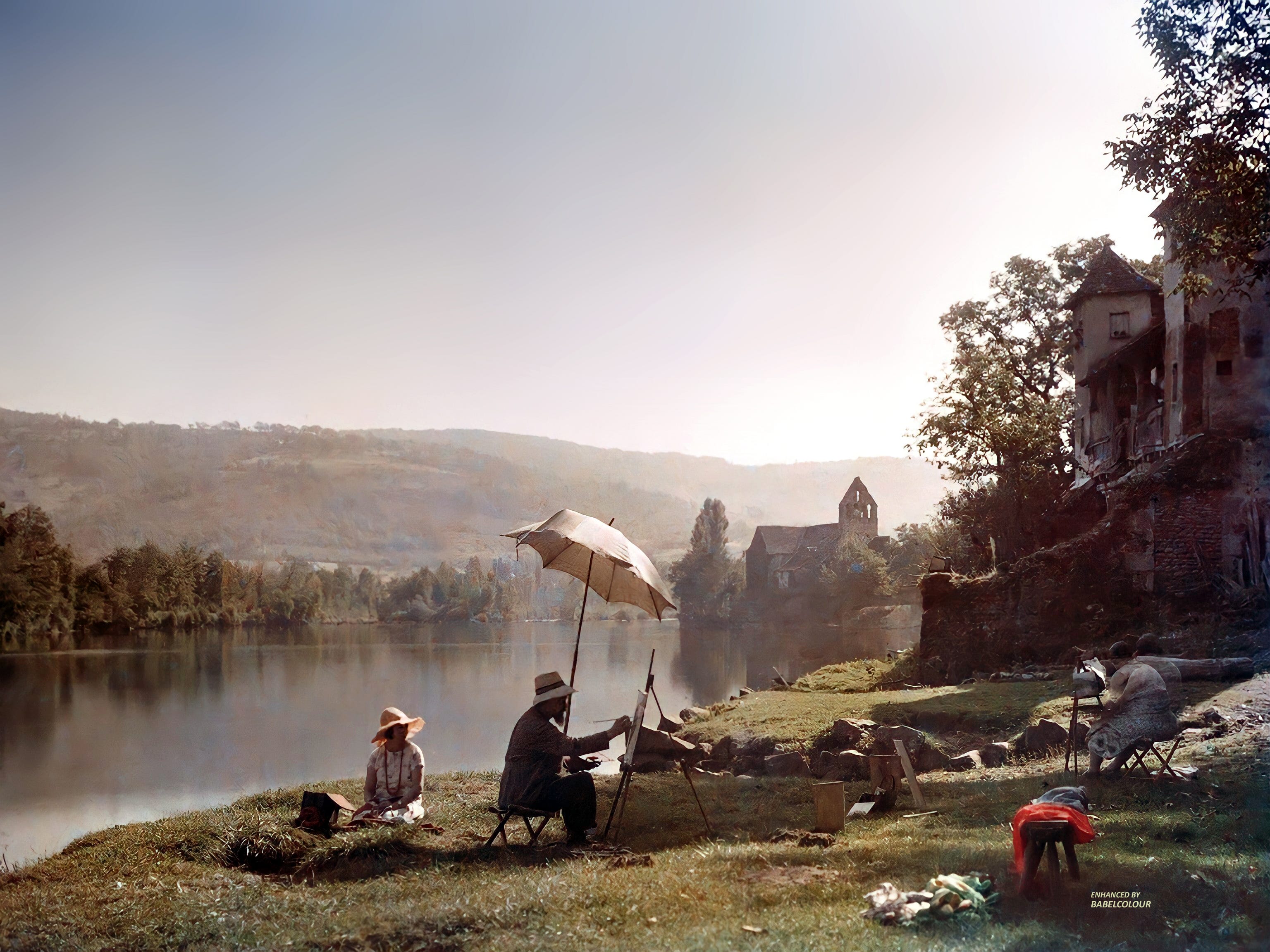
Can’t say I know. But I liked these two paragraphs accompanying a giant version of the photo above.
[W]hen I look at [art deco] relics – say, in a photo from the 1925 International Exhibition of Modern Decorative and Industrial Arts, the Big Bang of Art Deco – I realise, tilting my neck, that I’m not looking back at all. The dining room composed by René Lalique for the Sèvres pavilion, for example, is not ‘antique’ in the way we used to mean: neither ancient, nor remote, nor quite belonging to former times. Nor does it appear to hail from the present. The room reflects an era of high technology better than any of today’s shop-new scalloped doodahs ever could: its coffered ceiling of milky, engraved glass glowed with the electric light then transforming Paris, while the walls and floors (marble inlaid with silver niello by the Manufacture Nationale de Sèvres) represent an industrial revival of an artisanal technique dating from antiquity. For all its air of aesthetic reduction, hand-crafted ornament suffused every surface – something we can scarcely dream of in 2026, despite an epidemic of craftwashing in contemporary design discourse.
It’s almost as if dreaming was the point: in 1925, it was possible to conjure a material world that sublimated the conflict between the machine and the hand, ancient craft and modern industry pressed alike into service of how we might live. We’ve given up on that fantasy. Our rooms are from the archival past or resigned present – but, unlike the Sèvres dining room, they fail to imagine new futures.
Kevin Kelly on AI’s latent space

The often-fascinating savant Kevin Kelly, being fascinating again: this time about the issue du jour, AI.
Lately I’ve been asking myself: what might artificial intelligence be good for besides answering questions and writing code? My answer is the latent spaces within AIs themselves will become a new medium for creativity. I will first explain what I mean by latent space, and then at the end of this explanation, I offer possible ways scientists and artists may use the latent spaces inherent in neural nets to serve as a new platform for creativity.
A Large Language Model (LLM) is like a small zip file that contains all human knowledge. ... Even the biggest frontier models compress down to several hundred gigs, which is small enough it can fit on a card in your palm. ... This dense, high order compression of human knowledge — called “latent space” — may also be a new medium itself. ...
What we can say for sure is that the LLM does not contain copies of everything it knows. For instance it knows all Shakespeare plays, and it could create a new play that sounded exactly like Shakespeare, and can even quote famous lines in his plays, but nowhere in the model are the actual texts of Shakespeare. ... Likewise, the LLM could recognize the face of almost any person, and it could generate any possible human face, but nowhere in its code are copies of human faces. Rather, the model is storing all the information about human faces, without storing any faces.
This is weird. ... The neural nets of an LLM do a magic trick by abstracting the information of everything at once, so that it uses the myriad common relationships between things and ideas to compress and abstract them into this virtual “latent” or hidden space. ...
Latent space is an abstraction, a map built not in two dimensions, but in billions of dimensions. Imagine a brain made up of billions of straight long arrows going in all directions. ...
You can think of every concept that we can put into words as being a direction in this space. The dog arrow is really a direction of dogness. Catness is a direction, and so is fluffiness. Anything can become more catlike, or fluffier. ... There are billions of directions in this space. ...
This mapping works for not just nouns, but any idea, any sound, any image. ... This is one of the most astounding, yet underappreciated aspects of an LLM latent space: Everything — everything! — appears on just one map. ... One map for all! This has long been a holy grail. ...
When you ask an LLM a question, it will find the answer in latent space. Your question itself begins as a direction, which points to the answer. ... In this way the answer is grown, rather than found.
We naively imagine that an LLM has a mind that thinks a thought and then expresses it. But the LLM finds the answer as it writes the words. ... The words are the thinking. ...
This is the beauty of latent space. ... You can ask an AI to transfer the watercolor style of Winslow Homer onto a black and white sketch you made. ...
This works with ideas and concepts as well. ... You can apply the idea of gunpowder to the Romans. Our prompt might be: “What would the history of the world look like if Romans had discovered gunpowder?” ... Latent space includes not just everything real but everything possible based on its training. ...
We are only on Day One of understanding how they work and what they can do. A great potential lies ahead. What follows are my speculations of possible ways to exploit the new medium of latent space. ...
Alongside all this, latent spaces will continue to provide fantastic superhuman answers to questions, and ingenious solutions to gnarly problems. ... I believe latent space, this continuous, multidimensional map of both the real and the possible, one that transcends domains, will usher in whole new goods and services we have never imagined before. And most likely the greatest of them will be ones I have not thought of here.
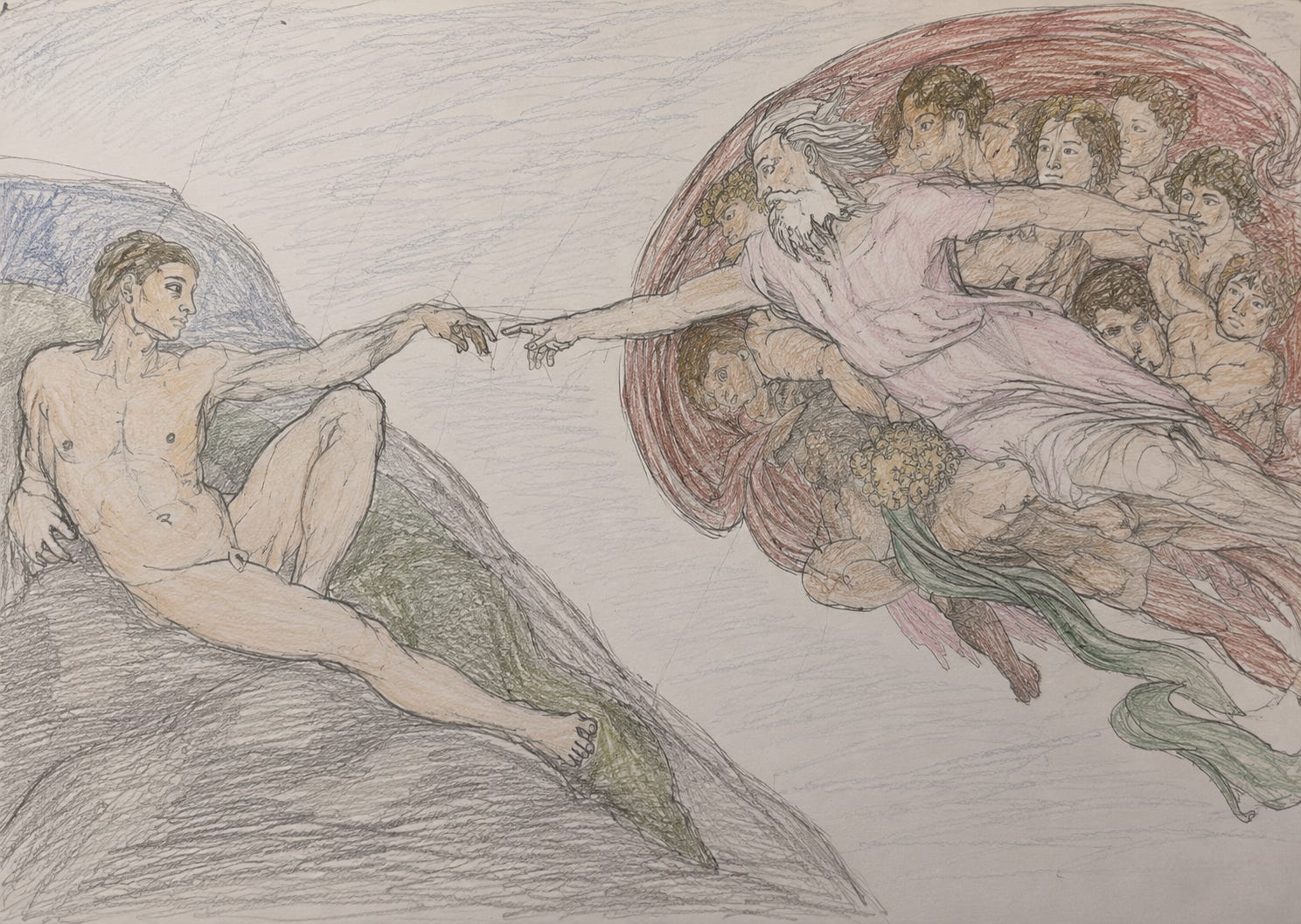
Amazing what comes up in your feed
The dinner party from hell

“A safe place for difficult conversations” and other pukemaxxing expressions. Great piece which repays the longer read if you want to check it out.
I knew the evening was in trouble when the hostess described the table as “a safe space for difficult conversations.”
Nothing good has ever followed such words.
A safe space for difficult conversations is usually a space in which everyone is free to express precisely the same opinion, provided they do so using slightly different therapeutic vocabulary. Disagreement is welcome in the way vegetarians are welcome at a barbecue ...
[Oliver and Beatrice had invited a dozen friends to dinner for “necessary conversation.” I had been included as the necessary conversation.] ...
“This is our pro-Israel friend,” Beatrice announced.
I gently corrected her that I was not pro-Israel but an actual Israeli, which caused a murmur.
It was a curious introduction. Nobody else was introduced by the country they were expected to defend. There was no “This is our pro-France friend” ...
Apparently, Israel was no longer a country. It was a personality disorder, and not a borderline one. ...
For the first 10 minutes, the conversation was restrained. ... Then Nadia placed her fork carefully beside her plate and sighed.
“I just don’t understand how anyone can still defend Israel.” ...
“What is it that you don’t understand?” I asked.
“All of it,” she said.
This was at least honest.
“The occupation. The apartheid. The genocide. The colonialism.”
Four accusations, delivered with the rhythmic confidence of a wine list.
“Those are different claims,” I said. ...
Julian smiled. “I think what Nadia means is that the entire structure is indefensible.”
“What structure?”
“The structure of oppression.”
“Could you be more specific?” ...
“The occupation of Palestine.”
“Which territory?” ...
“Gaza?”
“Obviously Gaza.”
“Israel withdrew every soldier and civilian from Gaza in 2005.”
“That doesn’t mean the occupation ended.”
“What would have meant the occupation ended?”
“Freedom.”
It was an excellent answer because it had no content and therefore could not be disproved.
“Israel removed its military, dismantled settlements, expelled its own citizens from their homes and left Gaza under Palestinian control. Shortly afterwards, Hamas took power, murdered its Palestinian rivals and converted the territory into an armed base. What part of that sequence is Israel’s colonial occupation?”
Eleanor lowered her wine glass.
“You’re framing it in an extremely selective way.”
“I’m using dates.”
“Dates can also be ideological.” ...
I had not realised the calendar had been colonised. ...
“You claim to support Palestinians, but you refuse to expect anything from Palestinian leaders. No compromise. No restraint. No democratic standards. No protection of civilians. No abandonment of eliminationist ambitions. Nothing. You reserve all moral agency for Israel and all moral exemption for its enemies, then call this compassion.”
Eleanor’s face hardened.
“You are deliberately misrepresenting us.”
“No, I have listened to you for two hours. You know less than nothing about the conflict. You do not know the wars, the borders, the offers, the withdrawals, ... or the chronology. Yet each of you speaks with the serene confidence of a tribunal.” ...
To Theo: “You call Israel a European colony while apparently unaware that most Israeli Jews are not descendants of colonial Europeans.”
To Simon: “You recommend trusting an international system whose guarantees have repeatedly proved worthless when Jews were under threat.” ...
Then to Eleanor.
“And you treat every fact that complicates your worldview as a form of violence.” ...
“You are not courageous dissenters. You are the local branch office of an international consensus assembled from newspaper headlines, dinner-party fashion and the intoxicating pleasure of condemning Jews for surviving incorrectly.” ...
Beatrice opened the door. The conversation, she said, had become unsafe.
I thanked her for the meal. ...
Outside, the night air was cool and gloriously free of moral vocabulary. [I reflected on] the strange burden of being pro-Israel in polite society. One is expected to arrive with evidence, history, nuance, empathy, ... and a detailed alternative strategy for every available course of action.
The other side need only arrive with adjectives. Colonial. Genocidal. Apartheid. Brutal.
Each word is placed on the table like a royal flush. No definitions required. No chronology necessary. No awareness of competing claims. The accusation itself is treated as evidence, while any response is proof of callousness.
The ignorance would be less irritating if it were accompanied by humility. Yet ignorance among the educated rarely travels alone. ... Its possessors do not merely lack knowledge. They regard knowledge as faintly disreputable, particularly when it interferes with the emotional clarity of their conclusions.

Martin Wolf on the great EU v US productivity and living standards debate
As I’ve covered this debate previously in this newsletter, here’s Martin Wolf summing it up better than others.
The general view, not just in the US, is that the contemporary European economy is a dying duck. As the Nobel laureate Paul Krugman notes..., “there is . . . a widespread perception that Europe is living off its past glories, that it is lagging behind America and China in ways that will undermine its ability to maintain its economic standing in the world”. Indeed, just this fear animates reports recently produced in Europe, notably the highly influential analysis by Mario Draghi....
At the same time, we should remember those bold words about “life, liberty and the pursuit of happiness” in the Declaration of Independence. Life expectancy for US men was 76.5 in 2024, against an average of 80.5 in comparable high-income countries. For women, it was 81.4 against 84.8.... The US homicide rate was 5.9 per 100,000 in 2023, against 1.3 in France and 0.9 in Germany.... Thus, if one takes a wider view of human welfare, the US is very far from superior.... Yet, what about the economy more narrowly defined as the ability to produce the goods and services that are measured in GDP?
Here, Krugman argues, we find a fascinating paradox.... He suggests there are two ways of comparing GDP performance: growth in real GDP per head over a period; and the relative level of GDP per head in any given year. It turns out that if one compares the US with the Eurozone on growth since 2000, its performance is hugely superior. But if one compares relative GDP per head, this is not true: Eurozone GDP per head has risen relative to the US’s.
[The puzzle is how one economy can grow faster than another without ending up relatively richer. The answer lies in what is being measured, and how.]
What explains the discrepancy in growth in GDP per head? Strikingly, even though the tech sector was only 9.2 per cent of US GDP, against 5.4 per cent of the EU’s, almost half of the difference in productivity growth between the two economies was explained by differences in the relative size of this one sector.... So, overall, the tech sector alone accounts for well over half of the overall difference in growth of GDP per head.
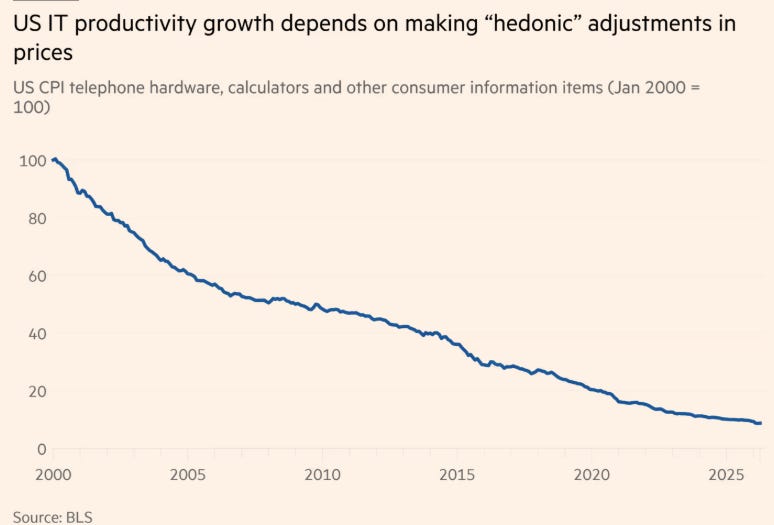
A related explanation for the difference is problems in measuring growth. The extraordinarily rapid reported productivity growth in US tech depends on making “hedonic” adjustments in the prices of products.... But such measures are inherently highly uncertain, so the higher growth of productivity in the US tech sector is questionable, not because it is wrong, but because this is a matter of judgment.... productivity growth of sectors other than tech, which make up the vast bulk of both economies, is quite similar.
[Comparing GDP per head at purchasing power parity is simpler: one values US and European output in a given year at the same price, as the World Bank’s International Comparison Program has done for more than half a century. It is the only sensible way to compare standards of living across countries, since money GDP per head is too volatile and grossly distorts comparisons of non-tradeables.... European real consumption per hour has also grown more slowly than in the US, though this too may partly reflect hedonic adjustments;] the direct comparisons of consumption per head show the same pattern over time as for GDP per head.
So, what fundamentally explains the paradox? The answer, a simple model explains, is that the US tech sector is a provider of a global public good: the most advanced technology. This benefits the non-tech world equally, at home and abroad, and so sustains relative standards of living.... But they can (and do) live anywhere.
The conclusion is that Europe does not suffer any disadvantage in relative welfare vis-à-vis the US. But — a crucial but — it is indeed far weaker. Not least, its ability to exploit the technological advances made in the US depends on access to US supplies. The big threats Europe confronts are not narrowly economic ones. They are those of security and defence. It must meet them.


Another day: another failed audit

Rex Patrick on the latest defence scandal. Isn’t the point of a competitive political system that incoming governments can clean out the skeletons in their opponents’ closets? I guess not. Anyway, AUKUS seems so much worse — somehow more thoroughly negligent — than the last existential catastrophe we signed up to - the fall of Singapore.
In 2020, the Australian government signed a 10-year $1.2 billion contract with Thales — a partially French state-owned defence company — to operate two Commonwealth-owned factories to domestically produce guided weapons, explosive ordnance and other munitions ...
As Bernard Keane wrote for Crikey in 2024, this billion-dollar contract was awarded after a tender process that only included Thales as a bidder, and for which Thales assisted in writing the tender documents. Despite this, Thales still bungled its proposal, ... with 199 non-compliances against the tender documents that Thales helped create.
Despite this, Defence awarded the contract to Thales anyway.
We know all of this from part one of an audit ... by the Australian National Audit Office (ANAO) in 2024, which found the munitions contract ... lacked probity and involved unethical conduct. ...
A Waste of Taxpayer Money
Last week, ANAO published the second instalment of its examination ... looking ... at the conduct of the contract’s implementation ...
ANAO asked, essentially, ... has [Defence] managed the contract effectively to achieve value for money ...? The answer — no, not really. Defence has only been “partially effective” and could only provide “limited assurance” that it has spent taxpayer money efficiently ...
It also found that the original munitions contract value ... has increased by $608 million to a total of $1.9 billion. That is not necessarily an indicator of poor performance ... But ANAO did find that $43 million had been wasted on cancelled orders and products not delivered as planned.
Further, ... ANAO found there was a gap of $109 million between the publicly reported total contract value and Defence’s total financial commitments under the contract. The dog ate my $109 million!
But the overarching concern uncovered in ANAO’s new audit is that it seems Defence, like a kid in a candy store, is simply treating these munitions facilities as a place to buy bullets and bombs — not looking at them as a domestic asset to meet future defence needs.
There was no focus on resilience and scalability ... Industrial preparedness and manufacturing uplift were not being built into contracts ... there’s been a 70% increase in breakdown maintenance ... [and] the reported risk of a shrinking pool of specialist personnel.
One imagines a local garage where the mechanics are working with increasingly unreliable equipment, and there’s no plan to get the workshop ready for electric vehicles. ... You’re left wondering if the garage is going to be there when you might need it to fix your car.
What Hope Does AUKUS Have?
The second instalment ... comes in the wake of the government’s realisation, finally, that Defence procurement is a basket case. ... Defence has wasted colossal amounts of money on its projects ... hampered by delays and cost blowouts.
At a Press Club address earlier this month, Defence Industry Minister Pat Conroy ... [said] of one navy procurement: “When navy wrote the capability requirement that breached the laws of physics, Defence went to the market asking for those laws of physics to be broken, and [industry] contractually agreed to breach the laws of physics! ...”
He then went on to state that reform was afoot, with a greater focus on off-the-shelf options ... But, ironically, those reforms aren’t being applied to the biggest and costliest bespoke Defence project: our trilateral AUKUS agreement ... over nuclear-powered submarines.
Despite the government’s recognition of the project’s risks, AUKUS is full steam ahead. But if Defence can’t manage two munition factories, how is it going to manage a much riskier program with gigantic cost implications?
Further, how much impact will a budget-draining project like AUKUS have on goals like munition supply resilience? ... Several projects are already being trimmed to ... meet the financial commitments made under AUKUS.
Munition supply in time of war is critical ... But as ANAO’s audit ... [shows], we aren’t getting these things right. If you struggle to buy bullets, you probably shouldn’t be focusing on buying submarines that only exist on paper and that break the laws of physics.
A Natural Aristocracy Among Men
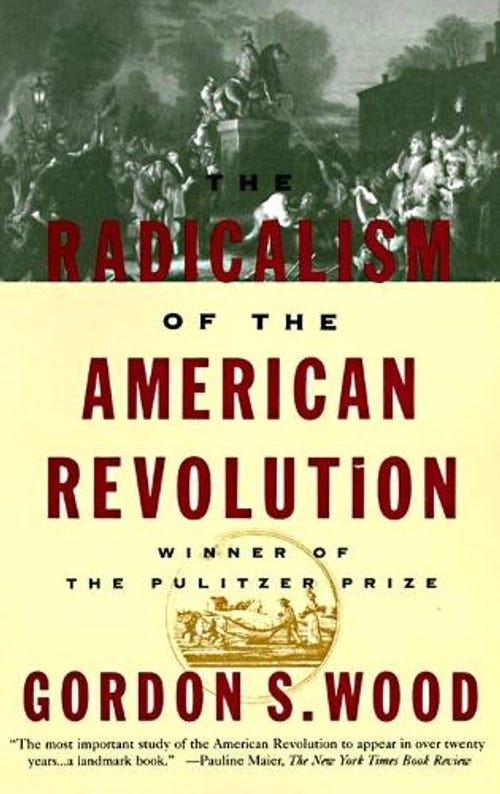
Gordon Wood died last week and was a fine American historian. As this review outlines, he showed how the American Revolution really was a pretty revolutionary event, even if, in the upshot it betrayed the hopes of the gentlemen — and they certainly thought of themselves as gentlemen — who engineered it.
[M]en by their constitutions are naturally divided into two parties. 1. those who fear and distrust the people, and wish to draw all powers from them into the hands of the higher classes. 2dly those who identify themselves with the people, have confidence in them cherish and consider them as the most honest & safe, altho’ not the most wise depository of the public interests.
Thomas Jefferson to Henry Lee, August 10, 1824
In the end, they were... men of impulse, of passion, of ambition and of regrets... John Adams... shown the door by the electorate in 1800, remained an outsider for the rest of his long life... railing at the uncouth, the undemocratic, the unmeritocratic, and the uneducated... And, of course, there’s Jefferson.
In Gordon S. Wood’s telling in his Pulitzer Prize-winning 1993 book, The Radicalism Of the American Revolution, this result was entirely rational. “A new generation of democratic Americans was no longer interested in the revolutionaries’ dream of building a classical republic of elitist virtue...”
Professor Wood died last month at 92... Radicalism... has what was... a compelling, even “radical” idea—that despite a relatively low effusion of blood, the American Revolution was, in fact, an earthquake. It was a real revolution, and not just the “evolution”...
In 1763... its escalating acts of autocracy—whether... the Intolerable Acts, or... Jefferson’s recital of outrages in the Declaration of Independence—drew the colonists closer to action.
Here’s where Wood differs from many of his peers. In the prevailing analysis of the time, that action by the colonists would essentially be a conservative one... but the average American... would maintain many of the same social and economic relationships as before... That would be an evolutionary change. A “revolutionary” change would have more Danton and Robespierre in it—massive changes in leadership, social structure, and wealth distribution.
Wood puts forward a third way... Earlier colonial society displayed... a strict, basically caste system... But moving from the early part of the 18th century toward the 1750s, these started to unravel... “After eighteenth-century Americans threw off their monarchical allegiance in 1776, they struggled to find new attachments befitting a republican people.” ... So they fell back on... “pursu[ing] happiness in the here and the now.” A revolution like this works in two phases. The first is political, and that comes quickly. The second... might best be thought of like the melting of an ice sheet, invisible at first... discernably smaller, calving, breaking up...
What of “republicanism”?... it had to be more than a mere election... a way of thinking... the presumption that those who need not work are somehow imbued with almost supernatural capacities for leadership... Such was the iron lock on social status... that would cause a successful Pennsylvania inventor... to sell his business at the age of 42. Ben Franklin wanted to rise to the level of “gentleman”...
One of the great paradoxes of the American Revolution is that, in its success, it left behind some of its greatest talents... The one thing they did not offer was what many of the Founders craved—not honors for themselves, but the adoption of a system where the long-term governance was done by men steeped in Enlightenment values...
The Founders had risked all to rid the country of an impulsive, destructive monarch... Democracy had made the average citizen an equal partner, but it had not made him an insatiable reader... an author of timeless documents... Democracy binds, it empowers, it liberates, but what it does not do is create equals. Equals can only be made—through desire, education, inspiration, and time...
Such is democracy... Madison’s Federalist 10... he was prescient. It turned out men did group together in factions... In a democracy, they were answerable to voters who might care a lot less about right and wrong, and a lot more about winning.
One wonders whether the Founders ever really grasped what the future would be like... They weren’t expecting the messiness, the crassness, the embrace of sometimes mercenary Capitalist virtues. Nor, I think, would they have been prepared to recognize those qualities as largely inseparable from our future success.
Instead, as they left the stage, they stayed in touch with old friends and associates, and occasionally expressed themselves by letter. Jefferson was a prolific writer. Two struck me as particularly pertinent.
Hundertwasser toilets






Breaking through the rhetoric

Here’s Peter Mulherin’s LinkedIn post
Here is my cautionary tale. I am keen to hear what your lesson might be?
I have spent years working with government and business, trying to turn good ideas into lasting change.Government often supports change for a time, then priorities shift, people move on and programs are renamed, reduced or abandoned. Business can be equally willing, until the work threatens profit, market position or short-term returns.
That does not make government or business the enemy. We all depend on them, work within them and benefit from them. But neither is designed to hold a course across generations.
The problems we face; climate change, inequality, housing, biodiversity loss, are long-term, systemic and grounded in physical reality. They cannot be solved through short political cycles, temporary grants, corporate goodwill or another campaign.
My experience (30 yrs) and now research (last 10yrs) says we need institutions, measures and forms of accountability that survive changes of government and market pressure. If the commitment of a frontbench minister can disappear in the halls of power, and the head of a leading industry association sees necessary change as too risky, then neither promise nor leadership is enough.
We need solutions built into everyday decisions, not added when convenient and removed when difficult.
Government and business can and must help for their own longevity.
It is that lasting change cannot depend on their continued enthusiasm alone. It must be designed to endure the cycles and individuals within these institutions and organisations. The upside is that a little fire was lit that keeps me going.
I reached similar conclusions to you after only ten years banging my head (though the whole story abouts to a similar number of decades to you). You see the story for what it is, but, judging by the end of your post, you’re still reaching for rhetorical salves. As far as I see it, they are actually part of the problem. It takes quite a bit of self-command - as they used to call it - to resist that hankering to put lipstick on the pig. And admitting the structural impossibility of what you’re hankering for deals you largely out of the game - of the cool kids’ (the courtiers’) conversations and endless repackagings. Will it be … let’s see, sustainability, resilience, joined up, evidence based?
Here’s the essay I wrote to try to sketch out what was going on - what the game was and what was required to get it somewhere, which was just a little bit better. These days, I apply the red line test. It saves a lot of time.
These responses are not perfect but they are:
the best I can do and
they leave me with the satisfaction that, subject to 1) they leave me feeling truthful.
Captain Matchbox Whoopie Bankd Take 2
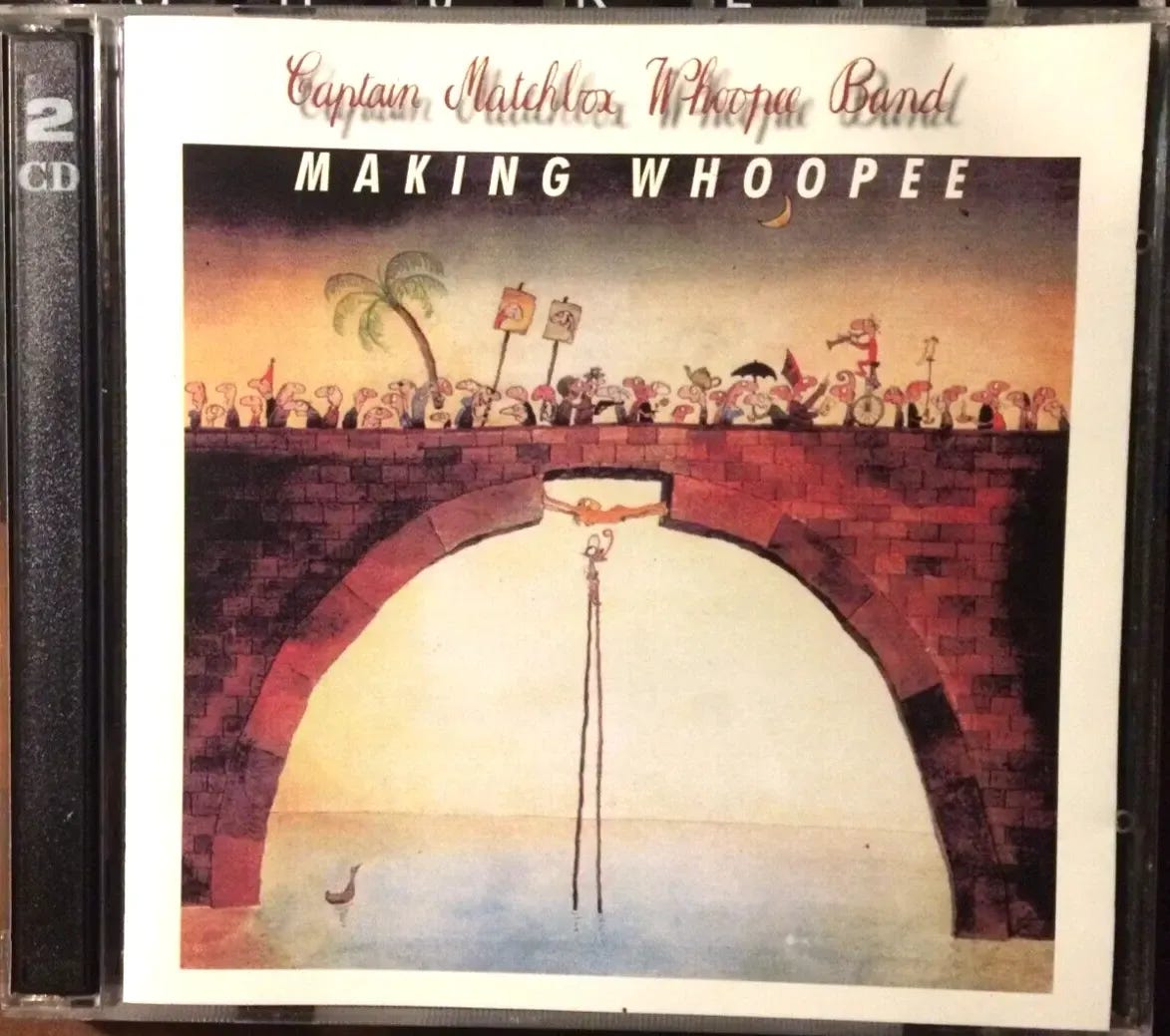
Thanks to subscriber Robert who reminded me of this after seeing last week’s Substack. In addition to publishing it here, it reminded me that I’d forgotten to inform youngsters among the subscriber base of the album cover — back when Michael Leunig was very cool. (And in fact retail CDs didn’t exist - so what is below is already a bit of nostalgia commercialism.)


Quote of the week
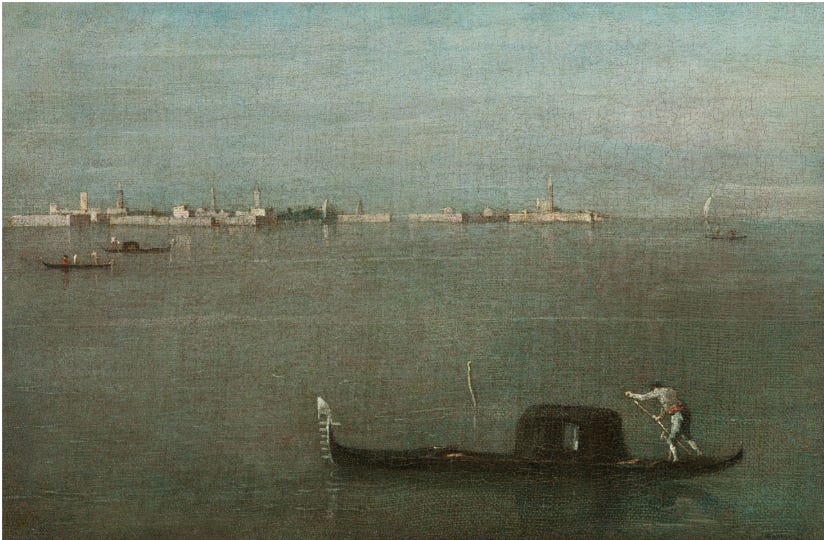
From the time that she declared herself independent of Byzantium in AD 727, Venice had chosen to be a republic. So indeed had most of the other great cities of north Italy; but over the years virtually all of them were to be taken over by one leading family or another – the Medici in Florence, the Sforza and Visconti in Milan, the Gonzaga in Mantua, the Este in Ferrara. Not so in Venice, where the fear of such an eventuality was almost pathological. This was not a democracy, however; in 1298 membership of the Maggior Consiglio – the Great Council of the Republic – had been restricted to the noble families, whose names were listed in the Libro d’oro, the Golden Book. Still, Venice was determined that no one man should assume too much power, and would go to almost any lengths to ensure it. Thus the system for the election of the Doge (head of state) was quite grotesquely complicated, the more so in that once elected he enjoyed virtually no effective power – less, probably, than the Queen of England has today. The actual business of government was entrusted to innumerable faceless committees, many of them serving only a few months, whose decisions were all taken by a majority vote. Consequently Venetian political history contains the names of practically no great men; but for around 700 years until her final defeat by Napoleon in 1797 the government of the Most Serene Republic remained rock solid.
John Julius Norwich, The Great Cities in History.
Thomas Tuchel
On seeing Herr Tuchel hop into the team I was coaching I was reminded of a wonderful documentary about the miracle year the Greek team won the European Championship, with a taciturn German coach. See it if you can.


Gittins on O’Mahony on productivity

Ross Gittins, (who commissioned my firm, Lateral Economics, to build the HALE index of wellbeing) reports on John O’Mahony’s recent paper, pointing out the importance of remembering why we want productivity growth - to improve wellbeing. What John and Ross are saying is right, but that’s the easy bit. Building policy to improve wellbeing isn’t all that difficult. We’ve just never tried.
The great new god of economics, productivity, may have feet of clay.
The modern world is a noisy place, but you’ve probably noticed the way economists now give speeches extolling the virtues of “increasing productivity” ...
In more recent times, however, productivity seems to have faltered. ... The feds have renamed one of our economic quangos as the Productivity Commission ...
There’s just one small problem. John O’Mahony, a partner in Deloitte Access Economics ... has published a paper questioning our newfound obsession with productivity ...
The economics profession has taken up with great confidence the incessantly repeated remark of Nobel Prize-winning economist Paul Krugman that “productivity isn’t everything, but in the long run, it is almost everything”.
But first, let’s get something clear ... what it means is that we should improve the efficiency of our output of goods and services relative to the inputs of land, labour and capital ...
So far, all very obvious. It’s improved productivity that lifts our material standard of living.
So what’s the problem? Although all this makes sense in principle, it’s not measurable in practice. “The moment you introduce a real economy, with real people living in it, the claim that productivity is almost everything collapses,” O’Mahony says.
Productivity is a concept – a perfectly sensible concept, but it’s not “directly observable”. You can’t see it and touch it, meaning you can’t measure it directly.
So you start with the economy’s production of goods and services – real gross domestic product – and take away things you know aren’t relevant. What’s left – the residual – should be productivity.
Trouble is, in measuring GDP, you left out a lot of things you couldn’t measure. Such as? What economists used to call “land”. Today we call it “the natural environment”.
When you use natural resources but don’t count them, you’re counting them as though they were adding to productivity, not depleting resources. O’Mahony says Kuwait is not twice as productive as the United States, it’s just sitting on a lot of oil.
Australia’s 7.6-fold increase in energy consumption per person over the 20th century was counted as improved labour productivity.
Sometimes what we’ve taken to be a productivity slowdown is actually a reduction in greenhouse gas emissions. Something we’ve worked hard to achieve ... is taken to be a slip backwards.
Then we’ve got GDP’s limited ability to capture improvements in the non-market sectors of the economy such as health and education. Patients and students benefit from advances ... but this doesn’t show up in GDP ...
Even so, quality-adjusted health productivity improved at the rate of 3 per cent a year over the decade to 2019.
What all this tells us is that the economy has changed a lot over the decades without any improvement in the way we measure it. ...
In some other respects, presumably, our performance has deteriorated without that backward step being recorded.
The interesting thing will be how the nation’s economists respond to O’Mahony’s scarifying attack ... All of them could justly claim that none of O’Mahony’s criticisms were new to them. But this would not justify anyone ignoring them.
O’Mahony concluded his report with a challenge for decision-makers. “Ultimately,” he wrote, “economic policy should aim to maximise societal wellbeing, not simply measured productivity. And in a mature, high-income economy like Australia, success may increasingly be defined not by how fast we grow, but by what we choose to value.”
The official way of measuring the economy has fallen way behind and work to update the measurement tools must begin forthwith. Productivity improvement – correctly measured – remains of great importance.
Heaviosity half hour

Tocqueville: The Effect Of Democracy On Language
Here I was reading this Substack article, thinking it was all too abstract. Here were great abstractions battling it out. Marxism, Stalinism, Democracy. Yada yada.
“Western Marxism” can be understood as a philosophical response to the contradiction produced by communism without democracy. After Stalinism, Marxism could no longer be treated simply as a science of history, a theory of economic exploitation, or a revolutionary doctrine destined to realise itself through the party-state. The historical experience of state socialism revealed that a politics founded on emancipation and equality could also become a machinery of domination, censorship, bureaucratic command, and the suppression of political plurality. Western Marxism emerged from this wound. Its central question was no longer only how capitalism exploits labour, but how domination is reproduced through culture, ideology, subjectivity, and everyday life.
Whatevs. Anyway, as I was mulling over what I disliked about that kind of talk, I happened to dig into a bit of Tocqueville after dinner - as you do. And there it was, a century before Orwell, with similar insights (though without without the latter’s trenchancy. Not that there’s anything wrong with Orwell’s kind of trenchancy).
In aristocratic ages, when each nation tends to stand aloof from all others and likes to have distinct characteristics of its own, it often happens that several peoples which have a common origin become nevertheless estranged from each other, so that, without ceasing to understand the same language, they no longer all speak it in the same manner. In these ages each nation is divided into a certain number of classes, which see but little of each other, and do not intermingle. Each of these classes contracts, and invariably retains, habits of mind peculiar to itself, and adopts by choice certain words and certain terms, which afterwards pass from generation to generation, like their estates. The same idiom then comprises a language of the poor and a language of the rich—a language of the citizen and a language of the nobility—a learned language and a vulgar one. The deeper the divisions, and the more impassable the barriers of society become, the more must this be the case. I would lay a wager, that amongst the castes of India there are amazing variations of language, and that there is almost as much difference between the language of the pariah and that of the Brahmin as there is in their dress. When, on the contrary, men, being no longer restrained by ranks, meet on terms of constant intercourse—when castes are destroyed, and the classes of society are recruited and intermixed with each other, all the words of a language are mingled. Those which are unsuitable to the greater number perish; the remainder form a common store, whence everyone chooses pretty nearly at random. Almost all the different dialects which divided the idioms of European nations are manifestly declining; there is no patois in the New World, and it is disappearing every day from the old countries.
The influence of this revolution in social conditions is as much felt in style as it is in phraseology. Not only does everyone use the same words, but a habit springs up of using them without discrimination. The rules which style had set up are almost abolished: the line ceases to be drawn between expressions which seem by their very nature vulgar, and other which appear to be refined. Persons springing from different ranks of society carry the terms and expressions they are accustomed to use with them, into whatever circumstances they may pass; thus the origin of words is lost like the origin of individuals, and there is as much confusion in language as there is in society.
I am aware that in the classification of words there are rules which do not belong to one form of society any more than to another, but which are derived from the nature of things. Some expressions and phrases are vulgar, because the ideas they are meant to express are low in themselves; others are of a higher character, because the objects they are intended to designate are naturally elevated. No intermixture of ranks will ever efface these differences. But the principle of equality cannot fail to root out whatever is merely conventional and arbitrary in the forms of thought. Perhaps the necessary classification which I pointed out in the last sentence will always be less respected by a democratic people than by any other, because amongst such a people there are no men who are permanently disposed by education, culture, and leisure to study the natural laws of language, and who cause those laws to be respected by their own observance of them.
I shall not quit this topic without touching on a feature of democratic languages, which is perhaps more characteristic of them than any other. It has already been shown that democratic nations have a taste, and sometimes a passion, for general ideas, and that this arises from their peculiar merits and defects. This liking for general ideas is displayed in democratic languages by the continual use of generic terms or abstract expressions, and by the manner in which they are employed. This is the great merit and the great imperfection of these languages. Democratic nations are passionately addicted to generic terms or abstract expressions, because these modes of speech enlarge thought, and assist the operations of the mind by enabling it to include several objects in a small compass. A French democratic writer will be apt to say capacites in the abstract for men of capacity, and without particularizing the objects to which their capacity is applied: he will talk about actualities to designate in one word the things passing before his eyes at the instant; and he will comprehend under the term eventualities whatever may happen in the universe, dating from the moment at which he speaks. Democratic writers are perpetually coining words of this kind, in which they sublimate into further abstraction the abstract terms of the language. Nay, more, to render their mode of speech more succinct, they personify the subject of these abstract terms, and make it act like a real entity. Thus they would say in French, “La force des choses veut que les capacites gouvernent.”
I cannot better illustrate what I mean than by my own example. I have frequently used the word “equality” in an absolute sense—nay, I have personified equality in several places; thus I have said that equality does such and such things, or refrains from doing others. It may be affirmed that the writers of the age of Louis XIV would not have used these expressions: they would never have thought of using the word “equality” without applying it to some particular object; and they would rather have renounced the term altogether than have consented to make a living personage of it.
These abstract terms which abound in democratic languages, and which are used on every occasion without attaching them to any particular fact, enlarge and obscure the thoughts they are intended to convey; they render the mode of speech more succinct, and the idea contained in it less clear. But with regard to language, democratic nations prefer obscurity to labor. I know not indeed whether this loose style has not some secret charm for those who speak and write amongst these nations. As the men who live there are frequently left to the efforts of their individual powers of mind, they are almost always a prey to doubt; and as their situation in life is forever changing, they are never held fast to any of their opinions by the certain tenure of their fortunes. Men living in democratic countries are, then, apt to entertain unsettled ideas, and they require loose expressions to convey them. As they never know whether the idea they express to-day will be appropriate to the new position they may occupy to-morrow, they naturally acquire a liking for abstract terms. An abstract term is like a box with a false bottom: you may put in it what ideas you please, and take them out again without being observed.
Amongst all nations, generic and abstract terms form the basis of language. I do not, therefore, affect to expel these terms from democratic languages; I simply remark that men have an especial tendency, in the ages of democracy, to multiply words of this kind—to take them always by themselves in their most abstract acceptation, and to use them on all occasions, even when the nature of the discourse does not require them.


Epic cheers for the dinner party from hell. I would be intimidated in this setting by not having read every word of "The Hundred Years War On Palestine" because I am a big coward* but these idiots who are interlocuting our hero do not seem to have done so either. If they were a smidge smarter they would point out that Gaza cannot really be an independent recognized entity without the West Bank which IS under occupation and good Haaretz readers know that it was in Netanyahu's interest to let Gaza fester under Hamas which is rightly unacceptable to Israel so that there could be no Palestinian leader who represented all of Palestine and could make a peace deal. When people are stupid like this it is OK to feel afraid and betrayed if you are 20 years old but not if you have made the least effort to care about Israel/Palestine when there is only low-level violence.
(I did not expect half of Shaul Magid's "The Necessity Of Exile" to be specifically about Zionism and I am not sure I buy his definition of what Zionism is but it is a very civilized and nuanced book relatively speaking. Published before October 7)
*In fairness it would have to be hidden from spouse