In this final talk at Web Directions NEXT, I explore how we might breathe new life into democracy—by giving ordinary people a permanent seat at the table. The idea is to establish a House of Citizens—a standing assembly of everyday people, chosen by lottery, deliberating on the same laws and policies as parliament or congress. No formal power at first. Just visibility to the public who get to see another way to do democracy.
That other way involves building a new institution in which the considered judgement of citizens can be forged and then express itself. Imagine, how might that shift previously vexed debates on guns in the US, carbon pricing in Australia, or Brexit in the UK?
I also reflect on conversations with Google’s Vint Cerf about building better online platforms for cultivating good discussion. The audio file is here.
Great piece by Ralph Leonard. The first couple of paragraphs were music to my ears. And the last paragraph. In between it talks about the craze for (cultural) decolonization with a dig at Douglas Murray. Far be it if from me to object to digs at Douglas Murray, but it didn’t address my concern with cultural decolonisation which is that it’s a vibe, not a practical agenda, nor even a coherent one.
If you want to tear down some of the most egregious statues go for your life (and best of luck in working out where to draw the line and try to make sure Abraham Lincoln is one of the good guys). But don’t think you’re achieving much. Instead, why don’t you work out exactly what you think decolonisation might entail and then argue for it. It’s a bit like post-liberalism. The opposite of something you don’t like might not be something you will like.
One of the great lines from Goethe's Faust states: "What you inherit from your forbears, must be earned before it is owned." Today's anti-woke culture warriors would do well to heed this lesson. They treat Western civilization as a heritage that one comes into by being born with European ancestry in Western Europe and its settler offshoots in North America and Australasia.
But the anti-woke right is not worthy of this heritage; its militants haven't earned the right to claim ownership over Thucydides, Cervantes, Shakespeare, or Goethe, let alone defend them. And so long as they exploit the monuments of Western culture as mere trappings for their own brand of identity politics, they never will.
To be sure, the impulse to take on the mantle of Western civilization—to promise to defend and preserve it—is understandable. Over the past decade or so, an energetic legion of activists and academics has been agitating for a range of institutions and disciplines to be "decolonized." Everything from the curriculum to the museum, Shakespeare, classical music, mathematics, and even the idea of love has been in the decolonizers' crosshairs...
The decolonial agenda spread beyond the academy and penetrated the mainstream culture wars with the #RhodesMustFall movement, which started in the University of Cape Town in South Africa in 2015 and spread to Oxford shortly after that. With the 2020 "awokening" after the death of George Floyd, it reached its crescendo. Protests across Western societies sought to cleanse the historical and cultural landscape of the traces of colonialism—in the form, for instance, of statues of imperialists and slave traders.
Inevitably, this effort to culturally "decolonize" the Occident provoked resistance from the culturally conservative liberals as well as the right, for whom these gestures of "decolonization" were brute vandalism carried out by nihilistic radicals...
There are many legitimate objections with the theory and practice of "decolonization" as progressives have recently pursued it. However, reading polemics against it such as Douglas Murray's War on the West reveals the poverty of the anti-woke right's counterarguments.
Murray and his allies answer the decolonialist's racial grievances and nativist identitarianism back in kind. They accept the decolonial premise but positively affirm it. They fetishize Western culture as a sacred artifact that is to be worshipped, turning it into a mere relic in the process...
When Murray and other culture warriors call for defending "the West," they are really affirming a late 19th- and early 20th-century vision of the West, coming from the time when European power and confidence were at their zenith. At this time, an invented tradition was constructed that linked ancient Greeks and Romans, humanist scholars, Renaissance artists, and Enlightenment philosophes into a single lineage that embodied the inexorable forward march of the West—and supposedly evidenced the superiority of white Europeans over the inferior non-European races.
But this romantic, triumphalist image of Western civilization was shattered over a century ago in the muddy bloodbaths of the Somme, Verdun, and Ypres. Wilfred Owen indicted none other than the great Latin poet Horace for contributing to that catastrophe:
My friend, you would not tell with such high zest To children ardent for some desperate glory, The old Lie: Dulce et decorum est Pro patria mori.
It is here that we find the origins of the West's ambivalence toward the triumphalist narratives it once told about itself...
What we often mean by "Western civilization" is the form of modern bourgeois society and culture of the past five centuries that began in Europe and spread across the world. Contrary to the anti-woke conservatives' invocation of a solid, stable legacy, this version of the West is fundamentally revolutionary...
The revolt of the third estate, culminating in the universalization of free labor, the emergence of a cosmopolitan civil society, and in the American, French, and Haitian revolutions, made possible the ideal of universal freedom. Humanity now had the capacity to consciously transform itself and society—as Thomas Paine put it, to "begin the world again."
This was not a simple continuation of the ancient heritage of Athens, Rome, and Jerusalem; it was also a break from it. Our shared legacy tasks us with realizing the modern project of freedom—a task that ought to be renewed. Who is worthy of it?
James O’Brien’s interviews are often very good as this is. I loved Lewis’s infectious enthusiasm for his calling in life and his discussion of how New Orleans culture made him what he is today.
Alas poor Tom: a hero from another time
This has sat unsent on my Substack for a week or so. It will hardly be news. When I got the news I wrote this to a good friend.
As you may know, Tom Lehrer was a hero of my mother.
So I was very sad to learn of his death.
David sent me this profile which confirms my memory of him – and of the time. He went through the great thaw in Western culture from McCarthy in the 1950s to the late 60s by which time things were curdling.
And it’s got worse and worse and worse and worse.
This is not one of his best songs, but perhaps because of that, it illustrates his talents. No two second interval goes by without you noticing something else he’s brought into the music, or the rhyming scheme or whatever
It’s very, very sad.
He was a hero for my mum I guess because he crystallised her own change of course in her life, her own opening up to a wider world in marrying my dad, and casting aside the values harboured by her father; the father for whom, as a 12 year old girl, she had baited the hooks on his fishing rods and stood ready to continue doing so, so he was ready when the tailor were running just off the beach in the critical ten minutes after the sun set.
How could a man as clever and self-effacing as Tom Lehrer not be on the right track?
And here’s the NYT obit if you missed it.
Tom Lehrer, the Harvard-trained mathematician whose wickedly iconoclastic songs made him a favorite satirist in the 1950s and '60s on college campuses and in all the Greenwich Villages of the country, died on Saturday at his home in Cambridge, Mass. He was 97.
His death was confirmed by David Herder, a friend.
Mr. Lehrer's lyrics were nimble, sometimes salacious and almost always sardonic, sung to music that tended to be maddeningly cheerful. Accompanying himself on piano, he performed in nightclubs, in concert and on records that his admirers purchased, originally by mail order only, in the hundreds of thousands.
But his entertainment career ultimately took a back seat to academia. In his heart he never quit his day job; he just took a few sabbaticals.
He stopped performing in 1960 after only a few years, resumed briefly in 1965 and then stopped for good in 1967. His music was ultimately just a momentary detour in an academic career that included teaching posts at Harvard, the Massachusetts Institute of Technology and the University of California, and even a stint with the Atomic Energy Commission...
As popular as his songs were, Mr. Lehrer never felt entirely comfortable performing them. "I don't feel the need for anonymous affection," he told The New York Times in 2000. "If they buy my records, I love that. But I don't think I need people in the dark applauding."
Mr. Lehrer's songwriting output was modest, but it was darkly memorable. In the tasteless world he evoked, a seemingly harmless geezer turned out to be "The Old Dope Peddler" and spring was the time for "Poisoning Pigeons in the Park."...
Thomas Andrew Lehrer was born in Manhattan on April 9, 1928, one of two sons of James Lehrer, a tie manufacturer, and Alma (Waller) Lehrer. Young Tom was precocious, but his precocity had its limits. He took piano lessons from an early age, but balked at learning classical music and insisted on switching to a teacher who emphasized the Broadway show tunes he loved...
After graduating early from the Loomis Chaffee School in Connecticut, Mr. Lehrer went to Harvard, where he majored in mathematics and received his bachelor's degree in 1946, at 18. He earned a master's from Harvard the next year and then pursued doctoral studies there and at Columbia University. (He continued his studies on and off for many years, but he never completed his Ph.D. thesis.)
While at Harvard, Mr. Lehrer began to write songs for his own amusement and that of his fellow students. He told his friends that the songs simply came to him and that he wrote them down in just about the time it took him to brush his teeth, but they quickly found an audience on campus...
In 1953, encouraged by friends, he produced an album. To his surprise, "Songs by Tom Lehrer," cut and pressed in an initial run of 400 copies, was a hit. Sold through the mail and initially promoted almost entirely by word of mouth, it ultimately sold an estimated half-million copies.
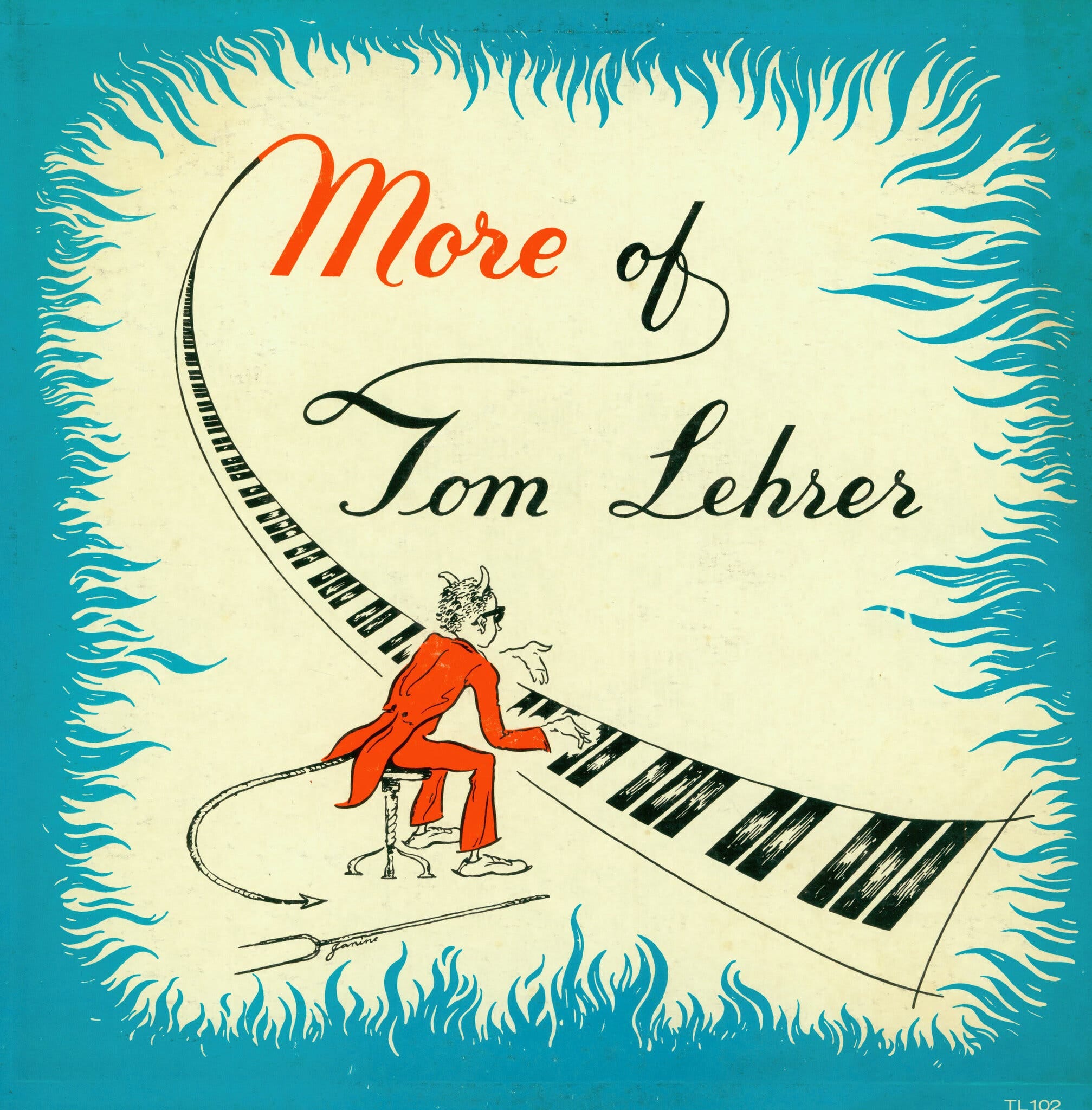
The cover contained a drawing of Mr. Lehrer seated at the piano, with horns coming out of his head and a devil's tail emerging from his formal attire. (His follow-up album, "More of Tom Lehrer," used the same image.) The 11 songs lived up to that image, among them "My Home Town" and the necrophiliac ballad "I Hold Your Hand in Mine."...
In 1964 and 1965 he wrote several songs for "That Was the Week That Was," the short-lived satirical NBC television series. He did not appear on the show, but he did return to the road for a while, recording his new songs at the hungry i in San Francisco for the 1965 album "That Was the Year That Was."...
Mr. Lehrer gave up performing again after a concert in Copenhagen in September 1967. This time he stuck to his decision. The rest was almost, but not quite, silence.
His last sustained burst of songwriting came in 1971, when he contributed "Silent E" and other educational ditties to the PBS children's series "The Electric Company." The next year he performed at a rally for the presidential campaign of Senator George S. McGovern. But there were no more nightclub or concert performances, and no more albums...
Mr. Lehrer divided his time for many years between Cambridge, where he taught at both Harvard and M.I.T., and Santa Cruz, where he taught courses on mathematics and musical theater at the University of California from 1972 to 2001.
When a fan once asked Mr. Lehrer if he had ever married or had children, he replied, "Not guilty on both counts." He leaves no immediate survivors.
Reflecting on his bicoastal life in a 1981 interview for Newsday, he said he planned to keep his Massachusetts home "until my brain turns completely to Jell-O, at which time I will of course move to California full time."
The full concert from which this clip came is here. RIP.
Work on spec; pay on spec
Prompt: Draw the dashboard of an Uber car, with phones open at Uber's mapping app, with a gauge that looks like a spedometer, but it's measuring "% Money to me" and "% Money to the boss" (Perhaps I should have included “Oh, and feel free to bollocks up the lettering as is your wont”)
Another good column from Sarah O’Connor:
Sometimes, a "scandal" comes along that leaves you underwhelmed. In my case, I have struggled to muster much outrage over complaints that "dynamic pricing" algorithms push up the price of items such as pop concert tickets when demand is high...
But what if you took that logic, and applied it to wages? What if you couldn't predict how much you would be paid each day, regardless of the hours you put in or the performance you achieved, because your pay rate would be varied by an algorithm, based on a range of factors you couldn't necessarily control?
This is not a hypothetical scenario. Over the past few years, a number of gig economy companies in the ride-hailing and food-delivery sectors have implemented algorithmically determined dynamic pay for the workers on their platforms... they are now offered a bespoke fee for each task, which they must quickly decide whether to accept or reject in their app.
Deliveroo, for example, tells riders that "the fee for each order is unique" and is based on estimates of time, distance, the rider's location, the time of day, the day of the week, the busyness of the restaurant...
What's in it for the companies? ... Indeed Len Sherman, an adjunct professor at Columbia Business School, has argued that Uber's recent improvements in profitability can be attributed to its implementation of dynamic pricing and pay.
When researchers at the University of Oxford's department of computer science analysed data volunteered by 258 Uber drivers... they concluded that after dynamic pay and pricing was introduced in London in 2023, "Uber's cut has increased, job allocation and pay is less predictable, inequality between drivers [has] increased, and drivers spend more time waiting for jobs."
... An Uber spokesperson said: "We do not recognise the figures in this report"...
Deliveroo told me its pay model was "designed for flexibility and transparency"...
In truth, it is very hard to know from the outside what effect dynamic pay has on workers — and for workers, that is part of the problem. Without knowing why exactly your pay changes, it is easy to suspect you are not being treated fairly.
When the Low Pay Commission (LPC), the independent UK body appointed by the government to advise on minimum wages, investigated the gig economy in a report last year, it heard "frequent complaints about the opacity of pay"... One worker told the commission: "On delivery you don't have a set structure for the price, so they make it up as they go in my opinion." Another said: "They've upped the prices, the delivery fee, but we . . . actually get less money."
The other problem is the uncertainty. Of course, when you are paid by the task rather than the hour, you already have an uncertain income because the number of tasks might vary. But dynamic pay adds another layer of unpredictability...
Reuben Binns, one of the researchers in the Oxford study, has come to a similar conclusion. "To have that uncertainty hanging over you all the time . . . it turns work into a gamble, basically," he told me. Indeed, Veena Dubal, a law professor at University of California, Irvine, has described the use of algorithms to set pay as the "gamblification" of work.
There is a lesson here too for companies that want to use dynamic pricing for consumer goods and services (and for people like me, who have hitherto had trouble seeing what the fuss is about when it comes to prices). Unpredictability and opacity do not sit well with people; they breed insecurity and mistrust. If these practices continue to expand, and trying to buy things or earn money begins to feel increasingly like making a series of bets in the dark, then more and more people will start to suspect the corollary: that the house always wins.
I remember watching it threaded through an episode of Utopia. The story of our lives as we try to hang onto the lifeworld as the bullshit world comes after it.
Elise Beal, a Californian high school student recommends a Japanese philosophy of finding pleasure in the small things for escaping the vortex of online addiction.
"Our generation is so screwed." I hear it everywhere on social media, and whispered in-between the lockers at the high school (I am a sixteen year old girl who thinks a lot, and notices more)...
Teenagers between thirteen and eighteen spend an average of eight and a half hours online, daily (The Common Sense Census: Media Use by Tweens and Teens, 2021), with the potential to be exposed to the worst kinds of content. It's so prevalent, that society has coined a term for mindlessly scrolling past post after post of depressing content: doomscrolling.
A Core of Hope
However, seemingly in response to this influx of bad news, teenagers are turning to new ways of coping... These online trends share striking similarities with traditional Japanese philosophical concepts that were created to help one find one's purpose in life.
Though social media has long been the bearer of bad news, many people have taken to creating under the hash-tag 'Hopecore' – a term first coined around March 2023...
'Hopecore', as its name suggests, is an aesthetic focusing on hope. Often while scrolling through the hopecore hashtag, one will find simplistic pictures, say, of rabbits asleep in fields, accompanied by inspirational quotes like "Lovely things come and go, but they come" scrawled atop the image...
Small & Beautiful
Interestingly, hopecore shares a striking resemblance to the Japanese philosophical concept of ikigai.
To understand their similarities, first, we must debunk some misconceptions about what ikigai is and why it was created. Translating roughly to 'a reason to live', ikigai has its roots in Buddhist philosophy and traditional Japanese values.
At its core, it's simple, and if you asked any older person in my Japanese American community what it meant to them, you would get a straightforward response: it's seeking joy in the little things... More expansively, ikigai implies that the meaning of life can be found through purpose, and that purpose can be found by starting small.
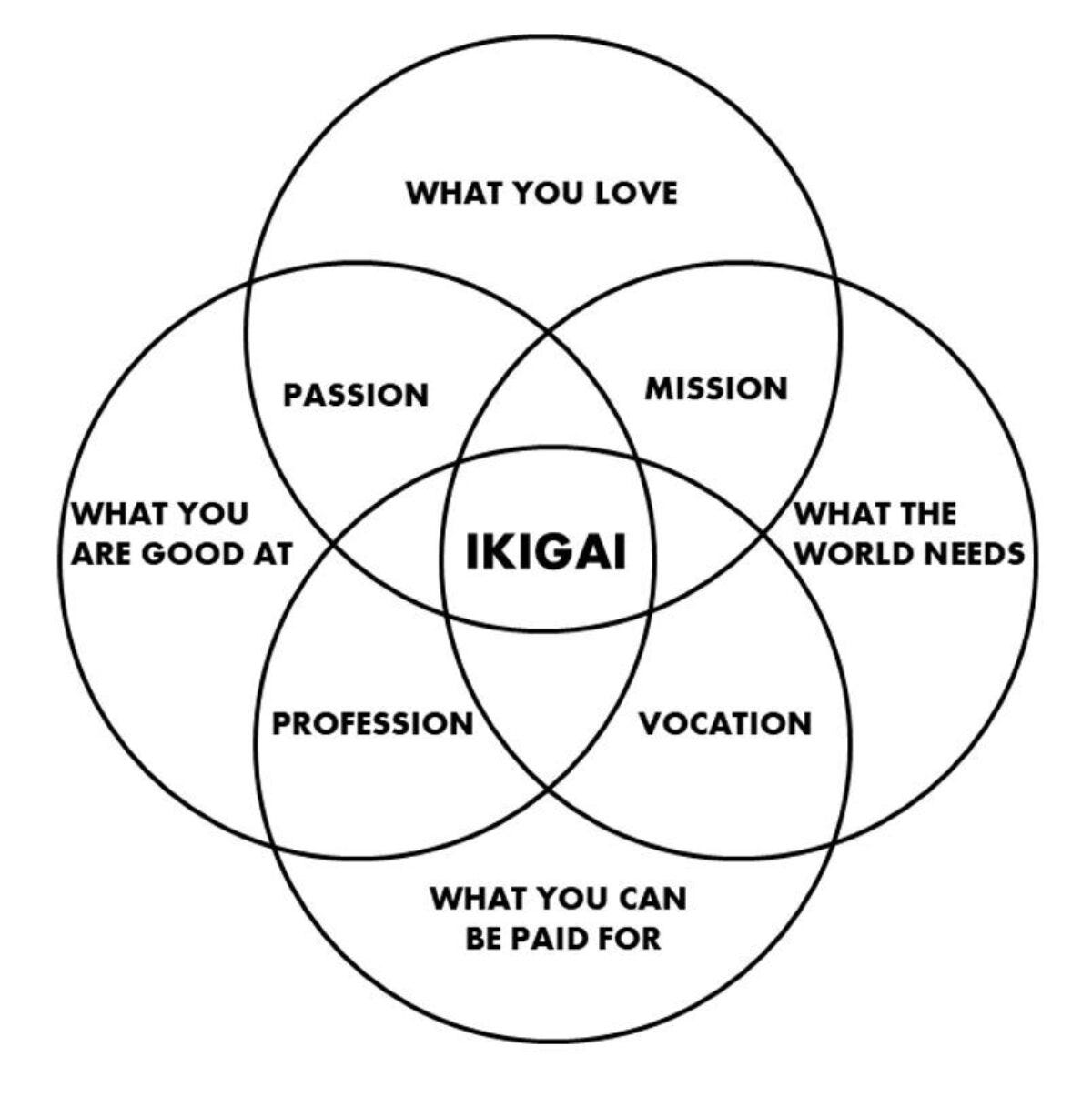
Western interpretations of ikigai are very different. In Western media, ikigai is often depicted through a Venn diagram, as an uncomplicated way of finding happiness and purpose in life...
“If you’re not hitting your life KPIs, get out of the cave and into a Venn diagram.” Plato, The Republic.
This is why in Western culture ikigai is often depicted as an endpoint – an overarching goal of finding everyday beauty that, once reached, will reward the person with a concrete sense of purpose... I think the pressure to succeed has caused much of the West to interpret ikigai as a destination, something to be found, rather than the concept that it was originally: finding small joys. Basically, 'finding' ikigai isn't something grand and monumental, but rather consists of many, many little moments that each make you appreciate life. The idea is that it is from this appreciation that purpose is born. It is from this latter, traditional definition that we can draw similarities with hopecore. In essence, both ikigai and hopecore are simple: The little things make life worth living.
Understanding hopecore's similarities with ikigai gives us a unique perspective on the younger generation and how we deal with complex topics...
A Last Little Bit of Hope
However much society and culture changes with time, I am confident in one thing: humanity's unyielding hope... creating a philosophy to appreciate the mundane in the hope that this will grant you meaning.
With that, I leave you with, not the ending, but the middle of a million peoples' story... And occasionally, in between the clips of cute dogs and news stories about the latest atrocity, I will read a line or a poem that reminds me to pause. To appreciate the small joys. And maybe, with that, I will find a tiny bit more meaning in my life.
Sabrina Nangala Robertson with Patrick Waterhouse, Revised with Sabrina Nangala Robertson, Tropical cyclone Paul hitting Northern Territory in 2010, acrylic paint on archival pigment print on paper, 106 x 81 cm | 41 3/4 x 31 7/8 in
Between the early 1990s and 2015 the relationship between mental despair and age was hump-shaped in the United States: it rose to middle-age, then declined later in life. That relationship has now changed: mental despair declines monotonically with age due to a rise in despair among the young. However, the relationship between age and mental despair differs by labor market status. The hump-shape in age still exists for those who are unable to work and the unemployed. The relation between mental despair and age is broadly flat, and has remained so, for homemakers, students and the retired. The change in the age-despair profile over time is due to increasing despair among young workers. Whilst the relationship between mental despair and age has always been downward sloping among workers, this relationship has become more pronounced due to a rise in mental despair among young workers. We find broad-based evidence for this finding in the Behavioral Risk Factor Surveillance ! System (BRFSS) of 1993-2023, the National Survey on Drug Use and Health (NSDUH), 2008-2023, and in surveys by Pew, the Conference Board and Johns Hopkins University.
The next financial crisis: crypto (why do you ask?)
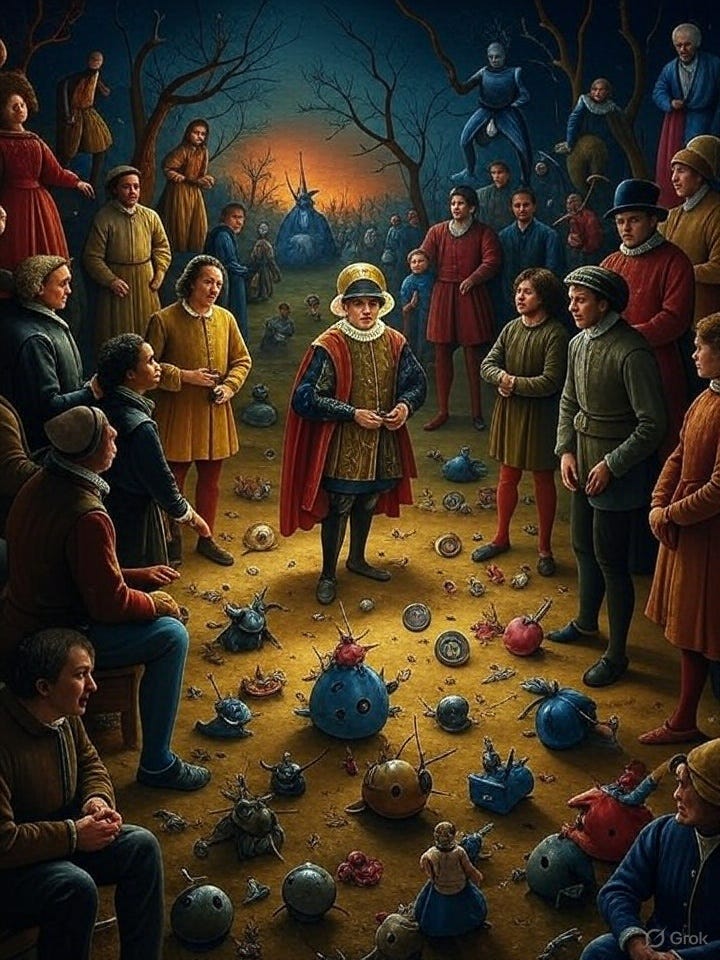
I asked this of the AI “Image of the most lurid scene by Hieronymus Bosch, with Bitcoins being exchanged in place of the bad things happening.” I’m not quite sure that this fits the bill, but I do like it. And I guess that’s a Bitcoin halo.
Rana Foroohar on the way we’re re-running the reregulatory mistakes of the early 2000s. “Reregulatory” I hear you cry. Surely you mean “deregulatory”. Alas no. In all the problematic areas, de-regulation is not possible. The whole way we got to the comprehensive regulation we had was to solve very knotty market failures. So what passes for deregulation is invariably reregulation. And that means we were often sold a pup. Over to you Rana:
My heart sank last week when I read that JPMorgan Chase was looking into lending against clients' cryptocurrency holdings, even though we all knew the day was coming when crypto would make its way into the real economy.
Bitcoin, one of the digital assets banks may lend against, has been nearly four times as volatile as major indices since 2020. It has also had ties to terror funding, and I have yet to read anything that made me think it is more than a tool for speculators and criminals. But that hardly matters when the largest political donors are behind it.
Crypto political action committees have, over the last several years, spent tens of millions of dollars donating to not only Republican politicians but many Democrats too. This effort culminated a couple of weeks ago in the passage of the Genius Act. Legislation covering other crypto assets is expected later this year. I predict all this will not only cause the next financial crisis, but fuel even more political populism and unrest in the US.
It's all too reminiscent of 2000, when advocates for over-the-counter derivatives descended on Washington begging to be properly "regulated" so that they could gift the world with financial "innovation." What we got instead was a seven-fold increase in poorly regulated credit default swaps that culminated in the great financial crisis of 2008...
As Democrat Elizabeth Warren, the ranking member of the Senate banking commission, told me last week: "We've seen this movie before," with lobbyists "saying, 'Please regulate us' because they want the gold sticker of government confirmation that they are a 'safe' investment," and politicians offering up bipartisan support for deregulation.
Indeed, you can draw a clear line from derivatives deregulation in 2000, and the broader Clinton era deregulation that eroded the barriers between trading and lending, to the weakening of Dodd Frank regulation for regional banks in 2018 (which contributed to the banking crisis of 2023), and now, the Genius Act. All of it was bipartisan.
Warren, who was brought to power by voters who felt betrayed by mainstream politicians of both stripes, waged an unsuccessful campaign to convince Democrats not to go along with Republican support for the Genius Act.
But money talks, and the crypto lobby has already shown tremendous power by spending $40mn to defeat critics like Sherrod Brown of Ohio, the former Senate Banking chair. While almost two-thirds of Senate Democrats voted against the Genius Act, the proponents — including influential Democratic senators like Virginia's Mark Warner and New York's Kirsten Gillibrand — were enough for the legislation to pass.
This worries me for four reasons.
First, the Genius Act (like the Commodity Futures Modernization Act of 2000) is being marketed as a way to make crypto safer, with stablecoins backed one to one by US dollars.
But that doesn't make what is, more broadly, a volatile asset class any less volatile. Indeed, it may only make the overall market more so... A recent Fidelity report found bitcoin's rolling 3-year beta to the S&P was 2.6.
Second, I can't imagine a worse moment to encourage financial "innovation" than when markets, economics and monetary policy are so uncertain.
Consider what could happen if, over the coming months or years, the Fed must raise interest rates more sharply due to inflation. Markets would tank, as they always do when rates go up. Crypto would fall further and faster. Financial institutions (including any number of shadow banks) holding crypto on their balance sheets could then run into trouble, causing credit markets to freeze.
Suddenly, we're facing echoes of 2008. Enter my third worry. Genius Act proponents say it will support the dollar and the Treasury market. But one could easily imagine a flight to safety into which crypto companies like, say, Tether (which has more US Treasury holdings than Germany) must sell T-bills into a down market to cover redemptions. Then you've got a fire sale, higher borrowing costs, and yet another disastrous situation...
But this time, it comes after more than two decades of growing cynicism with politics. This gets me to my final worry. Financial deregulation from the late 1990s under the Clinton administration set the stage for both 2008 and a loss of working people's support for Democrats. That in turn set the stage for Trump's rise.
Trump has now set the stage for our next financial crisis by backing (and of course, trading) crypto. What happens when we get financial chaos and more voter cynicism about mainstream politics at a time when there is less interest or ability for the government to buffer a downturn? No coin, and nothing stable.
Hollis Robbins reviews the big new book from the Techbros
In 2018, I was in the audience at a Pitch Day event in San Francisco as two computer science majors pitched to potential investors an app that allowed them to jump the beer line at the stadium so they wouldn't miss any of the game. The deck was crisp and compelling. The young men were good looking, confident, and articulate. The idea? I left while everyone was applauding.
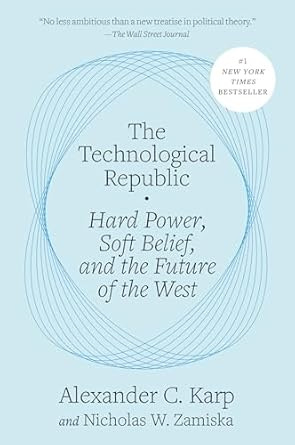
I thought back to this moment while reading Alexander Karp and Nicholas Zamiska's bracing new book, The Technological Republic: Hard Power, Soft Belief, and the Future of the West (Crown Currency, 2025). I thought of the pitch again this week when I saw a NYT front page story about Phoebe Gates, daughter of Bill Gates and Melinda French Gates, and her new online shopping tool.
What led an entire generation to spend its energies on vanities? Why is the apex of world historical advances in technology just another phone app that matches people to things (and other people) efficiently? Where is the collective patriotic fervor and moral grounding of eras past? Is the problem political? Cultural? What would it take to turn Silicon Valley's productive energies toward the safety and flourishing of our nation? ...
The problem
"A moment of reckoning has arrived for the West," The Technological Republic proclaims, calling for a new focus on America and the national interest. Silicon Valley has been making whimsical apps and billionaires while the world spirals into crisis and something needs to change. Who can disagree? ...
The authors offer a reason for the lack of seriousness in the software world. "The Silicon Valley giants that dominate the American economy have made the strategic mistake of casting themselves as existing essentially outside the country in which they were built":
The founders who created these companies in many cases viewed the United States as a dying empire, whose slow descent could not be allowed to stand in the way of their own rise and the era's new gold rush…The vital yet messy questions of what constitutes a good life, which collective endeavors society should pursue, and what a shared and national identity can make possible have been set aside as the anachronisms of another age.
Yet Adam Smith warned us that national pride and maximizing profits are often at odds:
A merchant, it has been said very properly, is not necessarily the citizen of any particular country. It is in a great measure indifferent to him from what place he carries on his trade; and a very trifling disgust will make him remove his capital, and together with it all the industry which it supports, from one country to another.
The argument
The Technological Republic comes in four parts that build slowly and somewhat meanderingly toward the conclusion that Palantir is the answer to the world's problems. ...
"The Abandonment of Belief" reprises the argument that Americans are coddled, don't like speech they don't agree with, care too much about the personal lives of their leaders, and care more about the performance of belief than belief. "Technological Agnostics" reprises the Adam Smith point, characterizing "the current leaders of Silicon Valley, who have constructed the technical empires that now structure our lives" as "post-national," as "citizens of no country; their wealth and capacity for innovation had, in their minds, set them free." ...
Yet The Technological Republic waffles in assigning blame for the conditions being lamented. "The instrumentalization of American higher education continues unchecked. The number of graduating college seniors who earned a degree in humanities fell from 14 percent in 1966 to 7 percent in 2010," they note. So who or what is the agent of this falling off? "The market," they say. ...
The energy of the era was directed at addressing the inefficiencies that would-be-founders encountered in their own quotidian lives…The inconveniences of daily life for those with disposable income – hailing taxis, ordering food, sharing photos with friends – would eventually provide much if not most of the fodder for their inventions. ...
An ownership society, but for whom?
Finally, "The Next Thousand Years" is about national pride and group solidarity and the stories required to make a vast number of people come together and believe they are bound up in the same national project:
What is capable of binding us together, of offering some degree of cohesion and common narrative that might allow large groups to organize around something other than our own subsistence? It is, without any doubt, some blend of shared culture, language, history, heroes and villains, stories, and patterns of discourse.
Indeed, this is what I teach, research, and write about. ...
The solution, the authors say, is an ownership stake. "The union of the pursuit of innovation with the rigor of engineering execution requires a degree of insulation with the outside world, some protection from the instincts and often misdirections of the market." I agree.
But if the case has been made that "shared culture, language, history, heroes and villains, stories, and patterns of discourse," is critical for a flourishing future, if the "abandonment of an aesthetic point of view is lethal to building technology," where do those of us who teach culture and aesthetics fit in? As I asked at the beginning, how exactly, in dismantling the old order to build a new technological republic, will teachers and purveyors of national virtues and values be part of the ownership culture?
Speaking of the techbros, here’s a version of a long article on Girard, Vance and (mostly) Thiel. It seems good to me, but I’m no Girard scholar.
This past summer, I was surprised to encounter a face I knew in two most unexpected places. The first was in a photo montage accompanying an article written by Josh Kovensky of Talking Points Memo in the wake of J.D. Vance becoming the Vice Presidential nominee, entitled "A Journey Through the Authoritarian Right." Arranged in the collage among images of a ripped man with lasers shooting from his eyes, of anti-democracy blogger Curtis Yarvin, and of Peter Thiel rubbing Benjamins between his thumb and forefinger, was my former professor and friend from Stanford University, René Girard. I was in France at the time; mere hours after reading Kovensky's piece, I saw through the window of a taxi René's face again—this time in the form of a larger-than-life decal on a light rail car in Avignon, where as it happens he is one of a dozen local heroes permanently celebrated on the new transit system. What do the medieval, culturally-rich, Provençal city of Avignon and the American authoritarian right have in common? Both claim a bond with this influential philosopher and member of L'Académie Française, who died in 2015. Only one of the claims is legitimate. The misappropriation of Girard's ideas by the American right is not just a matter of academic concern; it has significant implications for our political discourse and society.
As it turns out, I know exactly where this illegitimate claim to Girard's legacy started. For several years in the 1990s, I was part of a small reading group that met bi-weekly on the Stanford campus in a trailer left over from the 1989 Loma Prieta earthquake. The group—a kaleidoscope of visiting scholars, a few former students and some of Girard's campus friends—was led by Girard himself, and though he was already an influential thinker at the time, and though his theories and ideas pervaded our discussions and were the reason we gathered, one member of that intimate group of ten or so has gone on to eclipse Girard in terms of visibility and political influence: Peter Thiel...
However, the real concern isn't about misreadings from afar but about how Girard's ideas are actively distorted by Thiel and other influential figures within powerful right-wing circles. This manipulation carries real-world consequences. Thiel's profound engagement with Girard's work has been instrumental in shaping his worldview, yet he selectively twists Girardian concepts in ways that distort their original meaning. This extends beyond Thiel to figures like his political protégé, J.D. Vance. Examining how both Thiel and Vance misconstrue Girard's themes shows how their misreadings shape the way power is understood and exercised, affecting not just academic debates but the actual conduct of political life.
Vance: Inverting "The Modern Concern for Victims"
Girard's mimetic theory posits that human desires are not innate but are shaped by imitating others. This imitation leads to rivalry as individuals compete for the same objects or status, escalating into conflict. To restore order, societies historically resorted to scapegoating—transferring collective aggression onto an innocent victim. This act temporarily unites the community but perpetuates cycles of violence concealed by myths that portray the scapegoat as deserving of punishment.
According to Girard, the Judeo-Christian tradition is primarily responsible for unmasking this mechanism by giving voice to the victims, revealing the injustice of scapegoating...
The importance to Girard's work of what he labeled "the modern concern for victims"—which emerged as a specific focus during the reading group years of the 1990s—cannot be overestimated... Girard believed the concern for victims was the Absolute of our contemporary world. As he said in 1996:
The concern for victims has all the attributes of a genuine Absolute. It can withstand all assaults; it is the one principle invulnerable to all possible forms of skepticism…As soon as we become aware that our concern for victims might be our real Absolute, many clues can be gathered that point to the extreme pertinence of that Absolute as a synthetic concept, which would explain our history. We can see that our whole history seems to converge upon that theme…
According to Girard, the concern for victims is a moral imperative emerging from this tradition—but one with a shadow side: the manipulation of victimhood to justify aggression against others.
In today's world, political leaders and influencers often invoke victimhood to justify aggressive policies or silence opposition. Claims of oppression become a rhetorical strategy, turning the concern for victims into a justification for making additional victims...
In a meeting from February 1993, Girard observed, "We have reached a stage where the only way you can be violent is against the violent ones. That's why everything today is propaganda… . You always claim to be fighting the violence of others."
Peter Thiel and J.D. Vance both exemplify how the knowledge of scapegoating can be misused, even by those who claim to appreciate Girard's philosophy.
Consider a real scenario involving J.D. Vance, who claims Girard's work opened his eyes to his own tendency to scapegoat. In a 2020 essay titled "How I Joined the Resistance: On Mamaw and Becoming Catholic," he wrote that Girard's "theory of the scapegoat…made me reconsider my faith." Girard taught him how we "shift blame and our own inadequacies onto a victim." Recognizing these patterns in his own life, he vowed, "That all had to change. It was time to stop scapegoating."
Yet four years later, during the presidential campaign, Vance helped spread false rumors about Haitian immigrants in Springfield, Ohio. Alongside Donald Trump, he promoted the debunked narrative that these immigrants were stealing and eating pets. By amplifying these baseless claims, Vance engaged in classic scapegoating, targeting a vulnerable community as a source of societal problems. Vance inverted the concern for victims to justify marginalizing immigrants, claiming to defend residents supposedly harmed by outsiders. This inversion demonstrates how easily Girard's ideas can be misapplied to perpetuate the scapegoating they warn against. Vance knows from basic mimetic theory that certain "preferential signs" tend to attract and justify the actions of violent mobs—Girard's "stereotypes of persecution," which include social marginality, cultural differences, misfortune, and economic vulnerability.
The Haitian immigrants in Springfield fit these stereotypes to a T. They are socially marginal, arriving in a small Ohio town with few resources or connections. Their cultural differences—speaking Creole, maintaining traditions unfamiliar to the locals—set them apart in a community unused to such diversity. Their misfortune is evident: refugees fleeing political instability, arriving with little beyond the hope for a better life. And their economic vulnerability makes them easy targets for resentment, as they are perceived to compete for limited jobs or strain public resources.
Another stereotype of persecution Girard identifies is "behavioral deviance." In this case, the Haitian immigrants were accused of bizarre acts like eating their neighbors' pets—an absurd but potent fabrication that reinforced their otherness and justified hostility against them...
Vance stated on the record, "If I have to create stories so that the American media actually pays attention to the suffering of the American people, then that's what I'm going to do." This admission underscores his willingness to propagate falsehoods for political gain, directly engaging in the scapegoating mechanism Girard cautions against.
Rooted in either staggering hypocrisy or self-deception, this approach allows Vance to cast his non-Haitian constituents as the "real" victims—along with their cats—while explaining away, to himself and others, the harm inflicted on the immigrant community—a perfect example of how the concern for victims can be inverted to justify one's own scapegoating.
"Hardcore, Unreconstructed Girardian"
Vance's engagement with Girard appears more performative than deeply considered. This becomes troubling when paired with his new political influence. In Springfield, he amplified unfounded fears about a vulnerable group. Coupled with his support for sweeping mass deportations, this rhetoric evokes chilling echoes of history, where dehumanizing narratives laid the groundwork for systematic cruelty. What begins as a failure to grasp Girard's lessons risks becoming a playbook for turning vulnerable groups into scapegoats on a national scale.
Peter Thiel may not have taught Vance to misread Girard, but Thiel's prestige in Vance's eyes—and Girard's prestige in Thiel's—made Girard a mimetic prize Vance couldn't resist, even if his understanding of Girard remains incomplete. Thiel played a key role in shaping Vance's political trajectory and introducing him to Girard's ideas, which Vance has used as both a framework for self-justification and a marker of intellectual credibility.
As we turn our attention to Peter Thiel, whose understanding of Girard is far more sophisticated, and whose wealth provides him the power to have a wide and lasting impact on the political scene, the stakes may be even higher. Thiel's real grasp of mimetic theory, combined with his significant influence, presents a complex challenge that demands critical examination. He appears to interpret Girard's insights into escalating cycles of rivalry and the increasing strain on societal institutions as a mandate for bold, preemptive action...
Thiel, who I met when we were both in our twenties, was an intelligent and fully engaged member of the discussion group. Anyone familiar with his career knows that his enthusiasm for Girard and mimetic theory has always been sincere. He recently called himself a "hardcore, unreconstructed Girardian." He has applied his deep understanding of mimetic theory in innovative ways, investing in businesses that leverage rivalry, competition, and the desire for prestige—endeavors that have contributed to his immense wealth.
As dramatized in The Social Network, Facebook began as a platform rooted in competition, and arguably, sacrificial elements. Mark Zuckerberg's original "Facemash" website at Harvard involved students comparing peer photos in a "hot or not" game, effectively gamifying rejection and exclusion. Recognizing the mimetic possibilities, Thiel became Facebook's first investor after hearing Zuckerberg's pitch, and the rest is history...
However, when it comes to his political philosophy, we see a far more troubling picture of his relationship with mimetic theory.
While Thiel applies mimetic principles effectively in business, his political philosophy has been slipperier and less consistent, both in general and in its alignment with a Girardian outlook...
Thiel's Other Mentor: Robert Hamerton-Kelly
Peter Thiel had another lesser-known mentor in mimetic theory whose influence sheds light on his political divergence from Girard: Robert Hamerton-Kelly. Stanford's campus minister and a fervent Girardian, Hamerton-Kelly was a religious scholar with a Calvinist-inspired Methodism that lent his worldview a grim pessimism akin to Hobbes or Machiavelli. His take on human nature blended Christian exceptionalism with a violent ontology bordering on Gnostic beliefs.
Hamerton-Kelly openly disparaged fellow Girard scholars for their emphasis on "positive mimesis"—where the capacity for imitation produces snowballing effects in a constructive and non-violent direction—dismissing them as misguided and naïve. He pushed beyond Girard's nuanced view of mimetic violence as a pervasive but complex tendency, arguing instead that humanity's history of sacrifice wasn't just a universal feature of cultural development; it was the result of an automatic mechanism hardwired into our species...
Understanding Thiel's engagement with mimetic theory requires acknowledging Hamerton-Kelly's influence. It was Hamerton-Kelly who organized the Girard reading group and attended every meeting, often interjecting to share opinions or debate points with René...
Thiel had known Hamerton-Kelly since his student days and joined the reading group via this connection. The context of their friendship is crucial because it amplified Thiel's engagement with mimetic theory through a Calvinistic lens that resonated with his interest in thinkers like Schmitt and Machiavelli, who harbored stark views on human nature. Hamerton-Kelly's influence provided a selective interpretation of Girard, one that dismissed themes of positive mimesis and the contingency of structural violence in favor of a deterministic view—a perspective that arguably shaped Thiel's later political thinking...
"The Straussian Moment": Thiel in 2004
Since his first financial success in the late 1990s, Thiel has navigated dual identities: on one hand, a career capitalist; on the other, an intellectual—a "hardcore, unreconstructed Girardian"—committed to mimetic theory and other big ideas...
In my opinion, the 2004 conference and the paper delivered there by Thiel titled "The Straussian Moment" reveal a remarkable glimpse through the camouflage. For whatever reason, at that time, Thiel put many cards on the table. Even twenty years later, his paper and the conference itself—how it came about and who funded it—offer perhaps the clearest view of the intellectual and political ambitions he envisions for himself...
"The Straussian Moment" is a very strange document. In it, Thiel argues that the liberal ideals of the Enlightenment—rationalism, individual rights, and the primacy of economics—are insufficient for addressing the dangers posed by ideologically driven adversaries. The events of 9/11 reveal a fundamental weakness in the liberal worldview, he argues, as liberalism's tolerance and belief in peaceful negotiation fail to recognize the inherent conflict in politics, the primal undercurrents of violence, and the limits of rational appeals, especially when faced with actors motivated by religious or existential goals...
What's strange is that the essay exists at all. In 2002, Thiel had sold PayPal to eBay, making him a billionaire. He had become a founding investor and board member in a new company called Facebook. His hedge fund, Clarium Capital, was thriving, managing over $250 million and gaining recognition for its bold macroeconomic bets. Yet here he was, in 12,000 words across twenty-five pages, confidently citing Augustine, Leo Strauss and Roberto Calasso; making short work of John Locke; calling Thomas Hobbes a coward; and issuing dozens of haunting pronouncements:
Today, mere self-preservation forces all of us to look at the world anew, to think strange new thoughts, and thereby to awaken from that very long and profitable period of intellectual slumber and amnesia that is so misleadingly called the Enlightenment…
For when one chooses not to decide, one still has made a choice—invariably a mistaken choice, which implicitly assumes that humankind is fundamentally good or unproblematic…
For the Straussian, there can be no fundamental disagreement with Oswald Spengler's call for action at the dramatic finale of Der Untergang des Abendlandes…
...He co-organized a small insider-only conference called "Politics & Apocalypse" at Stanford—which he completely underwrote, to which he and Hamerton-Kelly invited René Girard. He then facilitated the publication of the conference proceedings, including his essay and Girard's, in book form with Michigan State University Press—with funding provided through Thiel's hedge fund, Clarium Capital.
This raises a pivotal question: Why would a newly minted billionaire immerse himself in an academic endeavor that reads as a call-to-arms?
It seems the answer lies not merely in his response to a significant world event and its aftermath, but in an internal crisis—a struggle between, and in a sense beyond, his dual identities as a successful businessman and a serious intellectual. Thiel, at 36, grappled with a profound sense of purposelessness. He had achieved immense wealth through ventures that nevertheless fell far short of his great expectations...
Rather than dissecting every argument in "The Straussian Moment," it's more valuable to approach the essay as a reflection of Thiel's ambitions—an expression of his will to intellectual and political power...
So "The Straussian Moment" is a post-9/11 political call-to-arms that is also Thiel's personal call-to-arms. The geopolitical "moment" overlays his existential crisis, marking the birth of Peter Thiel as a political player. The essay reads as an intellectually compelling but deeply conflicted attempt to respond to a world he perceives as broken. Thiel envisions a future shaped by figures willing to act unilaterally, sometimes in secret, and, when necessary, outside democratic norms to stabilize a world in crisis...
Carl Schmitt and the Friend/Enemy Distinction
The most striking aspect of Thiel's argument is his deep engagement with Carl Schmitt's view that "the political lies in the task of distinguishing between friend and enemy." Thiel states: "Politics is the field of battle in which that division takes place, in which humans are forced to choose between friends and enemies."
Thiel aims to guide the "Christian statesman or stateswoman" toward wise, decisive action. Yet this guidance relies on a distinction at odds with the inclusive moral vision central to the Christian tradition he invokes. Dividing humanity into friends and enemies mirrors what Girard calls the "pagan religious gesture par excellence": an exclusionary act that sustains a sacred-profane boundary...
Thiel's stance directly conflicts with Girard's later work, especially Battling to the End, where he critiques Schmitt's friend/enemy framework as both obsolete and perilous in the modern world. Girard argues that today's heightened concern for victims and global interconnectedness have undermined the clear boundaries essential to Schmitt's model. As we grow more aware of shared humanity, dehumanizing the enemy becomes harder, making the friend/enemy dichotomy more destructive than ever...
The attempt to define enemies in absolute terms has historically led to both extreme violence and genocide. Girard warns: "Carl Schmitt's legal voluntarism has proven vain because the aftermath of World War II has shown that the escalation to extremes has been relentless. His cause is lost."
Even Robert Hamerton-Kelly, who filters all of Girard's insights through a grim, deterministic lens of baseline, automatic human violence, acknowledges the limitations of Schmitt's framework...
"The Question of Human Nature"
"The enemy is the one whose very presence forces us to confront the foundational questions about human nature anew," Thiel says, before quoting Schmitt directly: "The high points of politics are the moments in which the enemy is, in concrete clarity, recognized as the enemy."
He clearly has in mind Osama bin Laden, whom he name-checks eight times, and also Islam itself—the "providential enemy of the West," as he labels it at one point. "When bin Laden declares war on 'the infidels, the Zionists, and the crusaders,' Schmitt would not counsel reasoned half-measures," Thiel says. "He would urge a new crusade as a way to rediscover the meaning and purpose of our lives."
...Throughout his essay, there emerges an image of Thiel wrestling with himself, seemingly inspired by recent events and his reading to discover who he is and how he can contribute. He seems to be seeking "a new crusade as a way to rediscover the meaning and purpose" in his life. Thiel argues throughout that the West has forgotten about "human nature"—a term he uses interchangeably with euphemisms like "older tradition," "state of nature," and "nature of humanity." In all these cases, he is ultimately referring to what he sees as humanity's innate violence and evil...
Yet Girard sees the mimetic capacity of human beings, though deeply susceptible to conflict and violence and their self-reinforcing patterns, as "intrinsically good" because it represents an "extreme openness" to others. This openness is the source of our freedom to follow good role models, and enables humans to progress away from evil and the envy-driven mimesis that leads to conflict. Though mimetic desire persistently leads to violence, it is also the foundation of all positive aspects of human relationships...
"The Enemy is Our Own Question as a Figure"
A striking example of Thiel's divergence from Girard—and his deeper alignment with Schmitt—is his handling of a well-known line linked to Schmitt: "The enemy is our own question as a figure." Thiel cites this phrase to reinforce his argument about the necessity of recognizing and confronting external enemies...
But Thiel misinterprets the meaning of "The enemy is our own question as a figure," transforming what is an invitation towards self-reflection into a justification to focus on external enemies. The phrase originates not from Schmitt himself but from his friend, the poet Theodor Däubler. In the context provided by the scholar Heinrich Meier—in The Lesson of Carl Schmitt frequently cited by Thiel—the line is an invitation to self-examination...
Thiel, however, misses this introspective dimension entirely. He employs the quote as a call to action against external adversaries. Instead of asking the question of himself, he aims it at others. In effect, he is posing the question, "Why have you forgotten about evil?" to one of his perceived enemies—Enlightenment liberals—about the other: Islam.
This framing takes what could be a profound self-inquiry and turns it into a rhetorical device aimed at reinforcing the friend/enemy distinction, a move that aligns with Schmitt but not with Girard.
This misreading is fascinating because it inadvertently reveals Thiel's own internal struggle...
Self-examination is entirely absent from his 12,000-word essay. Thiel's call to action at a moment primed for introspection reflects a pattern: his understanding of mimetic conflict and his Christian faith are invoked not to foster humility or empathy, but to justify doubling down on the pursuit of enemies...
"Proceed with Caution"
For Thiel, there is really nothing worse than an impasse. Still, the next section's subtitle—"Proceed With Caution"—assures us that the impasse was only temporary. Thiel has recourse to Leo Strauss, whose work provides the intellectual adrenaline shot Thiel needs to move forward. Strauss championed the idea that great thinkers often hide their most controversial insights beneath layers of esoteric writing—a concept that undoubtedly appeals to Thiel's strategic mind...
So, what's Thiel's solution? He hints—surprisingly incautiously—at the need for "a political framework that operates outside the checks and balances of representative democracy." He muses about "exceptional frameworks" involving intelligence and espionage that could "effectively supplement the American regime." In other words, Thiel flirts with the idea of an elite vanguard operating in the shadows, unencumbered by democratic oversight...
"Action Will Be Taken"
In the Girard section, Thiel offers a largely accurate summary of mimetic theory. He explains that, according to Girard, humans are fundamentally mimetic creatures—"gigantic imitation machines"—whose capacity for imitation extends beyond language and culture to desires themselves. In archaic societies, mimetic conflicts culminated in a "war of all against one"—where the community unites to sacrifice a single victim, whose death restores peace. However, in the modern world, "the cat is out of the bag"; we now recognize the innocence of scapegoats, and the sacrificial mechanisms that once contained violence are unraveling.
"For Girard, the modern world contains a powerfully apocalyptic dimension," Thiel correctly states. As structured violence—the order provided by our institutions and rules rooted in sacrifice—breaks down, it gives way to the growing threat of uncontained conflict.
But just when it seems Thiel is faithfully conveying Girard's insights, he executes a sleight of hand. Having started the previous sentence with "For Girard…" and accurately summarizing Girard's view, in the next he pivots to "From a Girardian perspective," and begins to smuggle in his own agenda—a move designed to blur the lines between what he finds in Girard and what he wishes Girard would say...
The Spenglerian Moment
If Thiel's essay begins with a bang—"The twenty-first century started with a bang on September 11, 2001"—it ends with an unmistakable whimper: "In determining the correct mixture of violence and peace, the Christian statesman or stateswoman would be wise, in every close case, to side with peace."
So after hammering home the apocalyptic stakes of humanity's mimetic violence and the need for out-of-the-box, norm-disrupting solutions, Thiel ends by gently suggesting that future leaders do their best to balance violence and peace?
For an essay so often voicing disdain for moderation, debate, and constitutional checks and balances, this finale is a real anticlimax...
We shouldn't accept this anticlimactic ending at face value. Knowing Thiel's penchant for strategic ambiguity and his admiration for Strauss's esoteric writing, it's more plausible that the subdued finale is a deliberate misdirection—a Straussian maneuver designed to obscure his true intentions.
The real crescendo of "The Straussian Moment" occurs not at its conclusion but earlier, in the section titled "Proceed With Caution." Here, Thiel aligns himself with the German historical theorist Oswald Spengler's fatalistic and anti-democratic vision, embedding his core declaration where only the attentive reader might notice.
He writes: "For the Straussian, there can be no fundamental disagreement with Oswald Spengler's call for action at the dramatic finale of Der Untergang des Abendlandes…" Thiel then quotes the final four sentences of Spengler's Decline of the West, leaving them untranslated in the original German and Latin...
Translated, it reads:
But for us, who have been placed by fate into this culture and this moment of its becoming—in which money celebrates its final victories and its heir, Caesarism, quietly and inexorably approaches—the direction of our will and necessity is marked out within a narrow circle, without which life is not worth living. We do not have the freedom to achieve this or that, but only the freedom to do what is necessary or to do nothing. And a task that has been set by the necessity of history will be accomplished, with the individual or against him. The Fates lead the willing; the unwilling they drag.
This is Thiel's true dramatic finale and core declaration—a covert call to action embedded within the essay, a dog whistle aligning his manifesto with the work of a strategist intent on dismantling democratic norms in favor of a post-liberal, elitist order...
Thiel's genuine finale is a bold endorsement of a fate-driven, post-democratic order, aligning American democracy with Spengler's fatalism and his embrace of "Caesarism" as the inevitable heir to a decaying liberalism.
This realization lends credence to the concerns shared with me by a prominent Girardian scholar who knows Thiel personally. According to this scholar's speculation, Thiel's political actions aim not to preserve our institutions but to topple them. His support for Donald Trump reflects a cynical gamble—a belief that chaos will serve as a catalyst for creating the kind of radical, post-liberal order Thiel desires...
Two Totalitarianisms
Girard's occasional remarks about political correctness were tied to his reflections on perhaps his most important theme: the modern concern for victims. While both Girard and Thiel criticized political correctness, their reasons diverged significantly. Girard viewed political correctness as a manifestation of what he called the "second totalitarianism"—a distorted appropriation of the modern concern for victims that seeks to outflank Judeo-Christian ethics on its own left. He warned this can—and does—lead to new forms of scapegoating and societal division...
Thiel's emphasis on only the left's abuses of victimhood skews Girard's insights and blinds him to his own involvement in perpetuating these patterns. His silence when Vance engaged in blatant scapegoating of Haitian immigrants—a posture any student of Girard should recognize as reactionary brutality—suggests a selective application of Girard's theory in service of a particular set of goals...
Today, with the rise of right-wing movements across continents, the potential revival of the first totalitarianism—even in places like Europe and the United States—seems alarmingly possible.
Thiel argues that totalitarianism—far from retreating entirely—is alive and thriving in "Xi's totalitarian China," where the first type persists in a present-day guise, blending ideological control with economic dominance...
It's fair to question whether someone as openly contemptuous as Thiel has been for decades of anyone claiming to be a victim is truly critiquing victim culture to retrieve a genuine concern for victims. His bold rhetoric against totalitarian regimes sits uneasily alongside his support for Donald Trump, whose authoritarian tendencies and disregard for democratic norms echo aspects of the dangers Thiel purports to oppose...
Girard keeps landing Thiel at an impasse. He can't deny the truth of Girard's reading of the contemporary situation as one where insisting on a good inside and a bad outside becomes increasingly untenable; yet Thiel's drive for decisive action demands he locate quarrels and redefine them as good—good battles against evil enemies...
After September 11th, interviewed in Le Monde, Girard said, "What we still need in the post-9/11 era is a more reasonable, renewed ideology of liberalism and progress."
...If the politics that remains possible is the incremental sort of "liberalism and progress," he wants nothing to do with it.
These head-fakes—seeming to lament the potential end of politics when actually hoping for its demise—epitomize the loops Thiel constructs throughout the essay. The careful measuring of peace and violence serves as a rhetorical flourish, not a meaningful conclusion. The real conclusion came when he advocated, in German and Latin and through Oswald Spengler, for "Caesarism"—a system led by a strong, charismatic leader who centralizes power, often bypassing constitutional norms, to restore order...
Following Schmitt, Strauss, and Spengler, he envisions a brave new post-democratic world. In 2003, Thiel—a believer in predestination and a new billionaire who believed he had learned the truth about human history—must have felt like a character in a novel who realizes he's in a novel: able to do everything and nothing.
Now, in 2025, with a second Trump term beginning and his protégé J.D. Vance occupying an office in the White House, Thiel's vision of dismantling democratic norms in favor of a post-liberal, elitist order is closer to reality than ever. This must fill him with excitement, as if something greater than even his dream of flying cars is on the verge of coming true. Let's hope he discovers he's still just one character in this unfolding story, and that the ending is not his to determine.












I loved Tom Lehrer as a kid. I’m just surprised that he died so recently.
You're right, they're unworthy of Western civilization until they fight and die for it.