Those who are associated with innovation in policy may know of Derek Alton’s trip to Australia, which ended a few weeks ago. He is writing a book on policy innovation and visited Melbourne, Sydney, Canberra and perhaps some other places in the Lucky Country. I had a very enjoyable lunch with him and some discussion by teleconference as well.
At the end of a long lunch, we recorded several clips sitting on a park bench in sunny Port Melbourne, home of Victorian organised crime (Like Little Italy in New York, it’s very safe so long as you don’t get in the way of illicit cigarette sales or otherwise run something which might need to pay protection money).
This clip came with a remarkable turn of events in which the local wildlife came to illustrate the points I was trying to make about how unmoored our system world has become from our life world. I think it’s a lot of fun and will be worth your investment of seven minutes. And if you want to hear us discuss my claim that real innovation in government almost invariably never gets out of the pilot stage, you can listen to the longer audio clip below.
Full podcast here
Everyone’s doing it
Above, Andrew Leigh expends some video production resources making his point, while, if you’ve not seen it before, Zack Polanski really leans in. Good on them. But I can’t help being reminded that, in other breaking news, perhaps the most politically consequential thing happening in the Iran war is the meme war on social media - which the Iranians seem to be winning.
In my lifetime, it’s hard to think of two greater successes in terms of their authors’ intentions than the two signature terrorist acts of the 21st century. And just as you know a pop star has made it if they’re recognisable by their first name, it seems that you’ve made it in terrorism if you’ve laid claim to a date. Both September 11, 2001 and October 7, 2023. managed to so gall the host country, that they provoked retaliation at the cost of thought and the pursuit of self-interest.
I remember in both cases, the pundits assuring us that even if massive retaliation might not be very sane, considered strictly from the point of view of the victim country’s self-interest, it nevertheless had to take place as a matter of the country’s pride. It reminds me of Bertrand Russell telling Maynard Keynes that he could never take economics seriously because it was predicated on the idea that people act in their own self-interest. I believe this was during World War I, as Bertie and Maynard watched millions of soldiers willingly march off to a completely pointless slaughter. And speaking of World War I, guess what got that going? Score Terrorists 3: Self-interest 0.
Anyway, here we are. Iraq and Afghanistan immensely weakened the US. But its sheer size, power and indispensability meant that, like the Mississippi, it just kept on rolling along. But Israel is a small country in a hostile environment. Pretty much from the get-go, I’ve been concerned that Israel’s hubris will be fatal to its own interests. Of course, I could easily be wrong. I’m no expert on the Middle East, and it would be absurd for me to have too much confidence in this prediction. But let’s just say that I am reasonably confident that Israel, and much more importantly, Jews everywhere are much more unsafe with Israel as Goliath than they ever were with Israel as David.
And speaking of David, here’s David Aaronovitch on the subject.
For sixty years Israel has enjoyed an almost militant goodwill in America. The reason has not been the all-powerful Israeli lobby, though of course there is one just as there is an oil lobby, a Saudi lobby, a tech lobby, and most murderous of all, a gun lobby. ... Israel represented an occasionally infuriating ally in a strategic but alien region.
But the support enjoyed from the American public was not primarily based on alliances or overt propaganda – it was centred on identification. There was the closeness of the Israeli foundation myth to the American one – huddled masses yearning to be free, escaping persecution and setting up a quarrelsome and lively democracy in a promised land.
Nearly 20 years ago I had just this argument during a Doha Debate in Oxford in which Martin Indyk and I took on ... Norman Finkelstein – possibly the angriest man I have ever met. What they wanted to portray as conspiracy we argued was in fact the result of politics.
This exact argument came back to me following the revelations that Netanyahu had talked Trump into the attack on Iran. That reality merged with a dangerous sentiment on both left and right in the US that their country’s interests were subordinate to those of a foreign nation – one with which they no longer sympathised. Jason Willick in the Washington Post put it succinctly:
Contrary to the notion of an ‘Israel lobby’ dictating American policy toward Israel, the U.S. has often supported Israel because the American people want a pro-Israel foreign policy. The corollary: If the American people don’t want a pro-Israel policy, the policy will change.
A Pew poll at the end of March found just 37 percent of Americans viewed Israel favourably a few weeks into the Iran war, against 60 percent unfavourably – [a net minus-23, compared with plus-13 before Oct. 7, with “very unfavourable” views nearly tripling since 2022].
Much of this is likely down to Gaza, where initial support has been worn away by the scale of Palestinian suffering. ...
But in the West generally the behaviour of the Israeli state has now become intolerable. Itamar Ben Gvir – that celebrator of Baruch Goldstein – persuaded the Knesset to pass a law for expedited executions of convicted Palestinian terrorists – but not convicted Jewish ones. As the Atlantic’s Daniel Shapiro put it, “the performance was gross and gloating.”
More people now have eyes on the West Bank, where the Netanyahu government has accelerated de facto annexation and therefore its corollary of effective apartheid. When Chancellor Merz repeated Germany’s opposition to annexation, finance minister Bezalel Smotrich responded: there would be no return to “the days when Germans dictated to Jews,” adding, “Our return to the Land of Israel — our biblical and historical homeland — is the answer to anyone who tried or tries to destroy us, and we do not apologise for it for a single moment.”
In Italy L’Espresso carried a cover story on the West Bank, its cover showing a settler in military fatigues taunting a Palestinian woman harvesting olives. ... The Israeli ambassador condemned not the settler’s behaviour but the magazine itself, claiming the photograph was faked. But it wasn’t. And the Italian public knew it wasn’t. Just as the German public almost certainly agree with their conservative chancellor.
So what has opened up is a credibility gulf in which Israel’s leaders can no longer be believed or trusted in the West. The identification with the country is being lost and a generational aversion is being created. Which is manna for the antisemites, but is not even mainly the product of their efforts. One casualty of this are the Jews in diaspora, about whom Netanyahu, Smotrich, Ben Gvir and the assorted Likudniks, Kahanists and Jewish ultranationalists do not give a fig.
Two days before I published this a man stabbed two visibly Jewish people in Golders Green, near where I live. ... What was particularly ominous was the idea that he had identified obvious Jews as a target for his rage. It must take some courage to wear a kippah now, even if the statistical chances of attack are low.
Immediately after the attack, the Israeli government blamed the British government for somehow allowing it. There is a kind of dark chutzpah to an allegation like that. My guess is that it’s their supposed association with Israel that may well be behind his murderous assaults, rather than the Jewishness per se of his victims. Which is no consolation at all to the Jews of Britain.
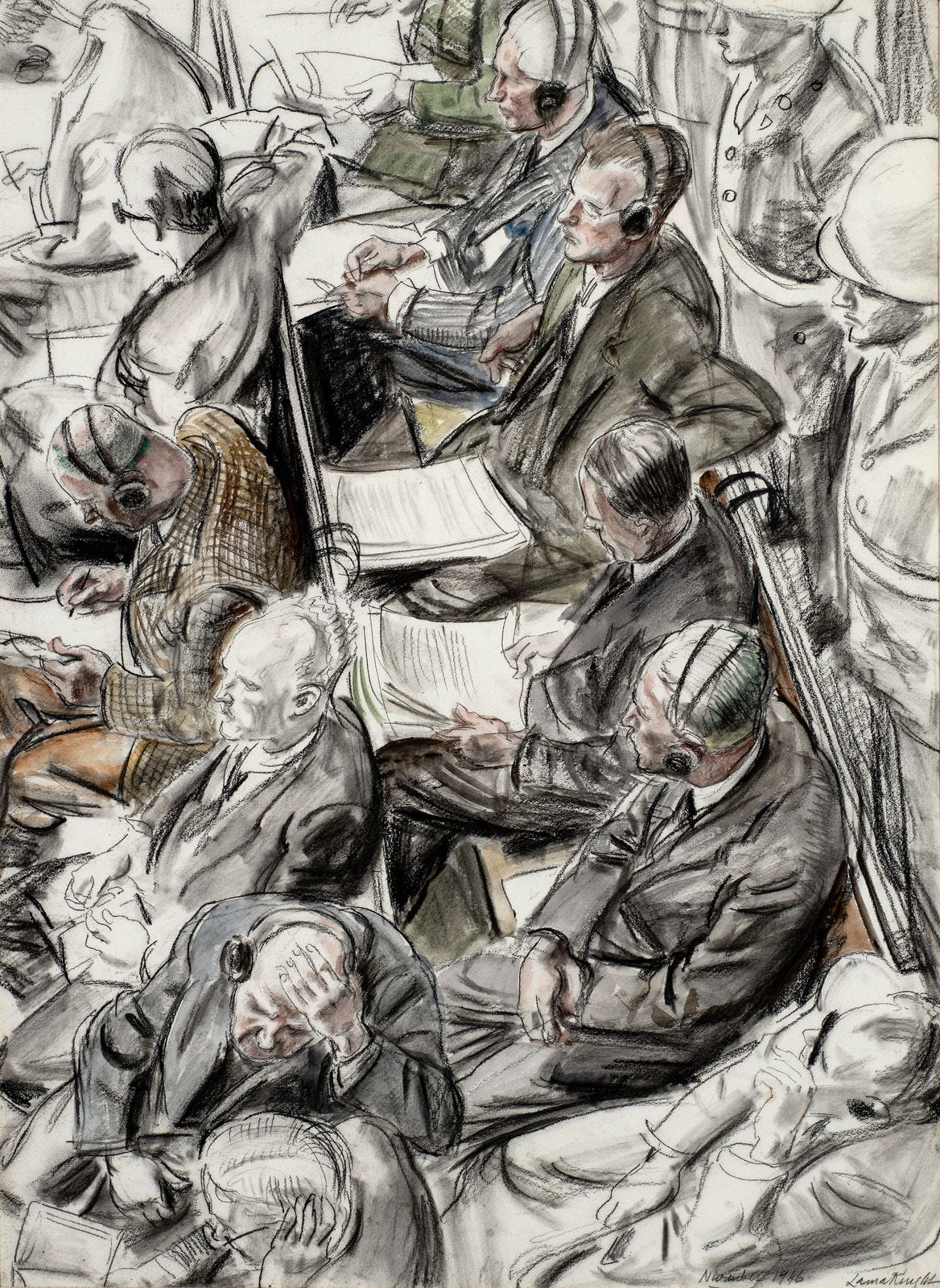
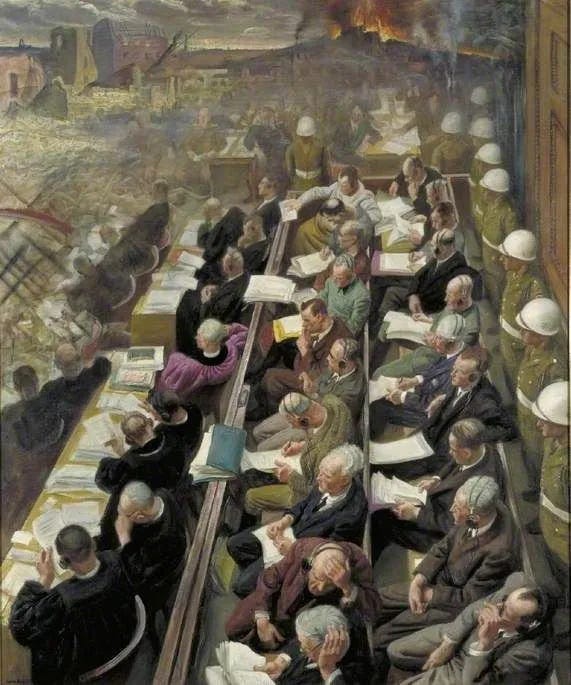
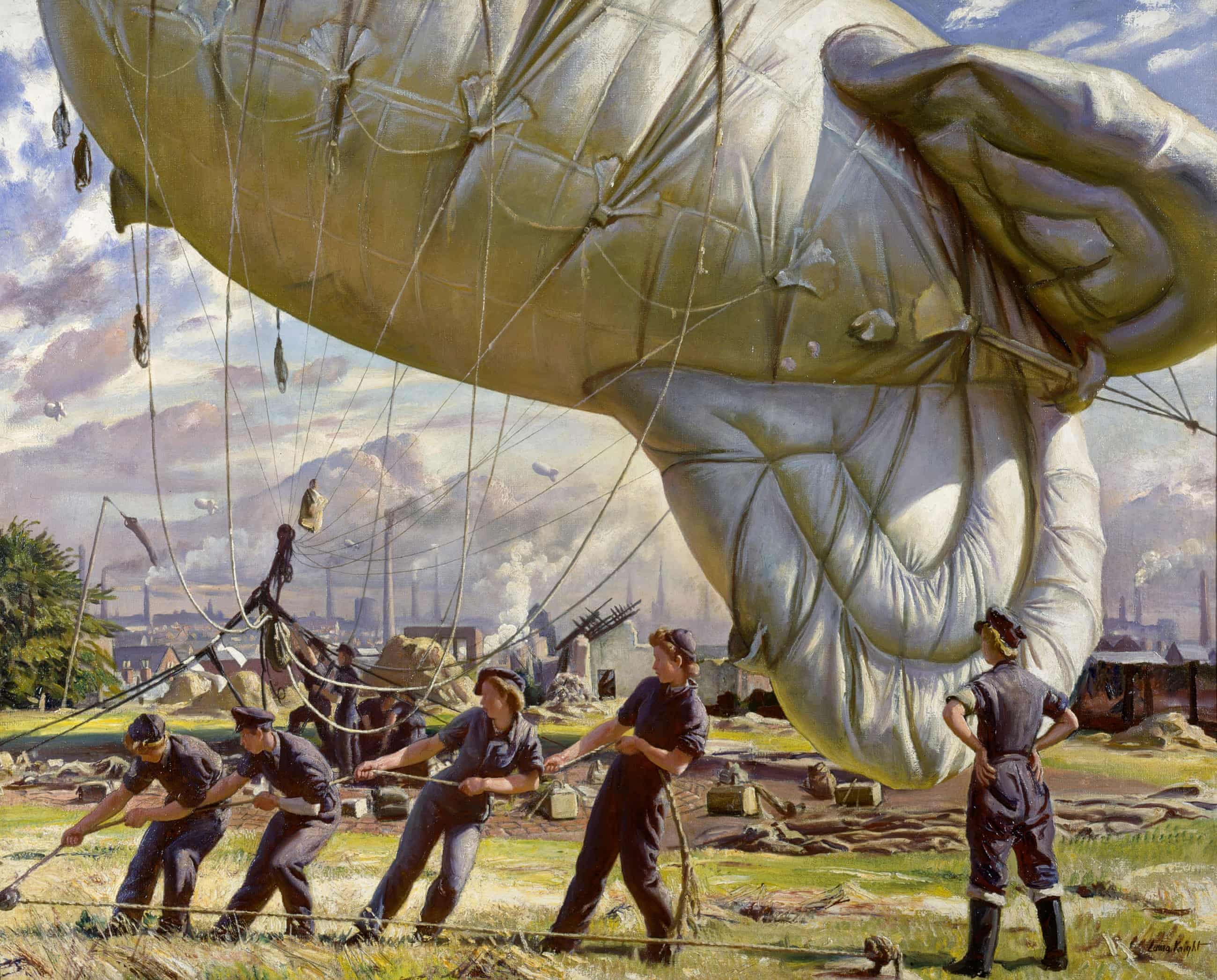
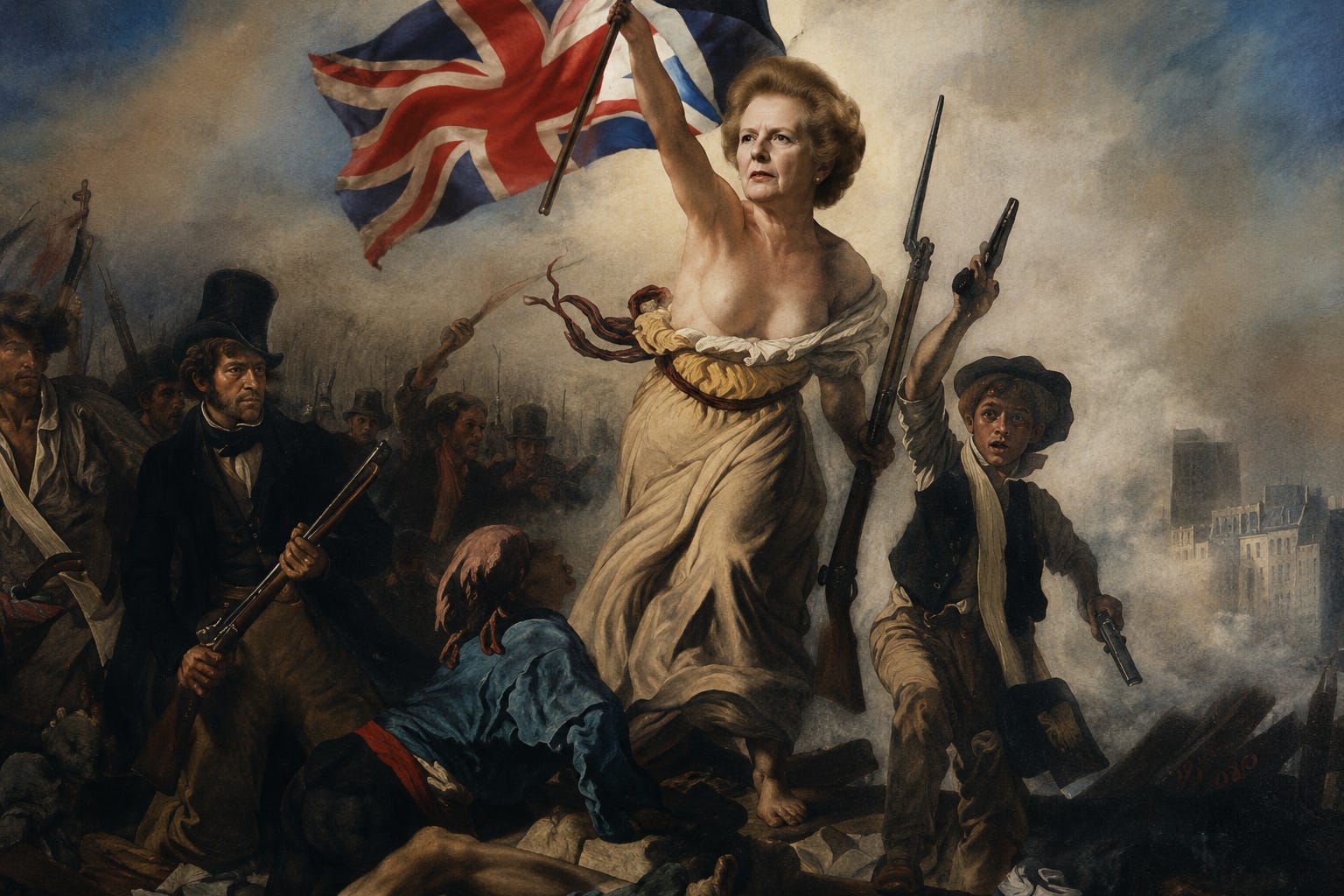
A wonderful British artist I was completely unaware of. Here are some of her pictures with others to follow between the articles below.
Tackling inflation
The COVID shock showed that our 2 to 3 per cent target for inflation isn’t quite that. It’s better than that. If a big price spike needs to go through the economy, we let it elevate the inflation rate for some time, and so long as inflation returns to the target band, we’re happy, even though the period of elevated inflation means that we’ve not, strictly speaking, met the medium-term target - we’ve exceeded it. What matters isn’t so much the target itself, but keeping inflation expectations anchored at a low rate. So, for as long as confidence remains strong that we will return to target, we can miss strictly hitting the target.
However, as Oscar Wilde would have said if he’d been an economist, to miss the inflation target over a sustained period because of one price spike might be regarded as a misfortune. Missing it twice looks like carelessness. The second time we try this trick, we end up having a Mr Churchill problem. Winston Churchill, you will recall, was the British Chancellor of the Exchequer who sought to engineer sufficient deflation that the pound sterling would rise to the same rate against gold that it did before WWI. And that was a terrible idea.
In any event, this is the adventure that we are now on. No, we’re not trying to engineer actual deflation, but we’re wanting to get back into target when much (though not all) of what’s taking us above the target is an external supply shock. So slowing the economy to wring the inflation out of the system will be a pretty grim affair.
In any event, at times like these, people get very angry at the pain being inflicted. And I often get quite a few calls from journalists who know that I’ve got some ideas about this. Alas, I can’t spare you the pain. What I can offer you is to spread it around more equitably, precisely and quickly than is possible if you rely too heavily on monetary policy. Anyway, here are a few well-chosen words on some of those options in our current situation in a recent article from ABC business editor Michael Janda.
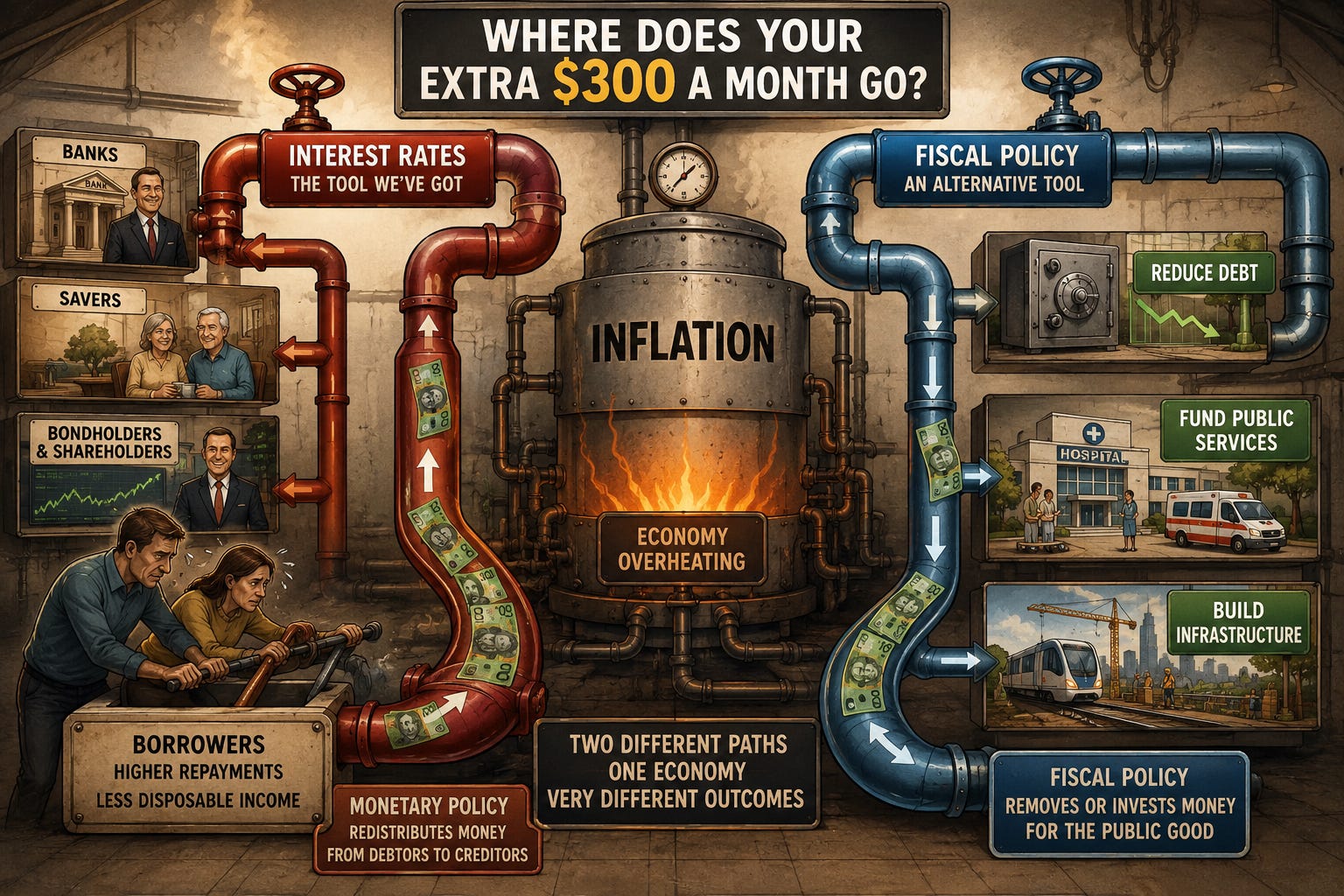
Would you rather hand over an extra $300 a month to your bank or the federal government? ...
The bank, which will pay it out to savers, bondholders and shareholders?
Or the government, which can use it to reduce debt, fund public services and build infrastructure?
Currently, governments have decided that the bank and its investors will get your cash because they have outsourced inflation management almost entirely to the Reserve Bank. ...
“The interest rate is the tool we’ve got,” [Bullock] responded to a question from my colleague Emilia Terzon. ...
On a fairly typical $700,000 mortgage, the three rate rises this year are costing a borrower $317 in extra interest payments each month.
But what if there was another way? ...
Is there a better way to tackle inflation?
[Veteran economist Saul Eslake points to the more regulated 50s and 60s, when tax changes were a common tool against inflation — though with similar drawbacks to rate rises.] ...
As another leading Australian economist, Nicholas Gruen, put it in a late 90s paper:
“The central problem is that fiscal expansion is generally more politically popular than contraction, which generates a bias towards expansion.” ...
That is one of the principal arguments against using so-called fiscal policies, such as changing tax rates, for economic management; politicians can’t be trusted to put the national interest above their political interests.
Another argument is that it takes too long to change tax rates because such changes have to be passed by parliament.
As Bullock noted: “It’s not a very nimble way to address inflation.”
Is a ‘Central Fiscal Authority’ the answer?
However, in that same 90s paper, Gruen advocated a potential solution for both of these problems, one supported by another eminent Australian economist, Ross Garnaut.
That is to create a “Central Fiscal Authority” (CFA), an independent board similar to the Reserve Bank, but with the power to tweak government tax settings within a predetermined range.
For example, parliament might change the income tax legislation so that the “base rates” are adjustable by up to 2 percentage points in either direction at the discretion of the CFA. ...
Such a body wouldn’t replace the RBA or eliminate the need to raise and lower interest rates altogether, but it would work alongside, or even within, the central bank to boost demand when the economy is weak or reduce demand when it is overheating, and inflation is too high.
That should mean the RBA could be less aggressive with both rate hikes and cuts, reducing the volatility in borrowers’ repayments and in savers’ interest returns. ...
Firstly, he argued that changing tax rates “can influence the economy more quickly and in a less sector-specific way than monetary policy, which has very uneven effects”.
[Through PAYG, tax changes hit most workers within a fortnight; rate changes take 12 to 18 months for full effect.] ...
If the revenue raised were used to reduce government debt, then that would potentially remove cash from the economy more effectively than higher interest rates, which predominantly redistribute money from debtors to savers.
Finally, as Gruen argued, markets and the wider public might have more faith in an independent fiscal authority than they do in government, as is generally the case with the Reserve Bank.
“As with monetary policy, greater policy independence could improve not only the policy settings chosen but also their effectiveness, by enhancing policy credibility.”
A CFA still comes with drawbacks
Despite its merits, Gruen’s CFA idea also comes with drawbacks.
The first would be whether it is constitutional in the first place.1
The House of Representatives is the body charged with taxation, and there would be a serious legal question about whether it could legislatively delegate a degree of this authority to independent technocrats. ...
Another risk that Gruen himself identifies is that economic technocrats may do no better job than politicians, perhaps even worse.
“It is possible that the professional culture of the CFA could come to value fiscal conservatism too highly,” he observed. ...
Is there any way governments can help out the RBA?
In the absence of a scheme like that proposed by Gruen, the Reserve Bank (and Australia’s mortgage borrowers) are counting on their elected representatives to do their bit to fight inflation. ...
But surely it’s a discussion worth having at the highest levels.
In running into this passage this week, it occurred to me how much of what we think this captures. I’d say right now it captures most people’s thinking about ‘democracy’. They know how bizarrely it fits with its social function. How much it allows the very worst to get to the top (one of Hayek’s main arguments against central planning). But, not knowing the alternative, they stick with it. They’re right that the non-democratic alternatives are probably worse, but there ways to heal our democracy if we think just a little differently.
In the present age—which has been described as “destitute of faith, but terrified at scepticism”—in which people feel sure, not so much that their opinions are true, as that they should not know what to do without them—the claims of an opinion to be protected from public attack are rested not so much on its truth, as on its importance to society.
Kos Samaras on how things seem to being handed to the ALP on a plate.
Picture a Saturday morning in Wyndham Vale. Or Schofields. Or Glen Waverley. The father is a GP, or a civil engineer, or a senior nurse. His wife runs the family business — a chemist, an IT contracting outfit, a small NDIS provider. Two kids in private school uniforms are climbing into the back of the SUV for Saturday tutoring. The mortgage is heavy but manageable. Private health insurance is non-negotiable, not a lifestyle choice. Sundays might mean temple, or gurdwara. Politics runs to the right of the suburb’s average...
If you described this household to a Liberal Party strategist in 1995, they would have told you you were describing the median Coalition voter. Aspirational. Small-business minded. Family first. Educationally ambitious. Socially conservative. Privately insured. Home-owning...
This week, the Australian Bureau of Statistics confirmed that this household is now the largest overseas-born demographic in the country. As of June 2025, there are 971,020 people in Australia born in India, narrowly overtaking the 970,950 born in England, for the first time in our history. A decade ago, the India-born figure sat at 449,000. It has more than doubled in ten years...
These are Indian Australians. And on every demographic and lifestyle indicator the Liberal Party has ever used to identify its base, they should be its bedrock vote.
They are not.
The reasons are not mysterious. They are written into the public record of every immigration debate the Coalition has chosen to wade into for the last fifteen years. Every dog-whistle on “Asian crime”. Every “we’ll bring the numbers down” without specifying which numbers... Every Pauline Hanson handshake tolerated for the sake of a preference deal in regional Queensland. Indian Australian households were watching. They understood the gestures were not addressed to them. They also understood the gestures were addressed about them.
This is the strategic problem we have been calling “Chasing Pauline”. Every vote clawed back from One Nation in a regional seat costs a multiple in the urban seats where Indian and Chinese Australians actually live... You cannot run a national majority strategy on a demographic that is statistically retiring while ignoring one that is statistically buying its first home.
Victoria and NSW together have roughly 930,000 India- and China-born residents, concentrated in middle Melbourne and Sydney’s middle ring and west. These are decisive in specific seats — Chisholm, Menzies, Aston, Deakin, Bennelong, Reid, Parramatta, Banks, Greenway — seats that determine whether either major party forms government.
This is where the Coalition’s federalism becomes its own worst enemy. The dominant voices in the party room are Queensland MPs who grew up in cities where the migrant story is still largely English, Scottish, or New Zealand. In Western Australia and Queensland, the largest overseas-born communities are still English and New Zealanders... Their political imagination of a “marginal seat voter” bears less and less resemblance to the seats that actually decide elections.
When a senior Coalition figure from Queensland tells a journalist that migration is “out of control”, they are playing to a model of Australia in their own head... The Indian Australian voter listening through the radio in a Glen Waverley driveway hears it. So does her sister in Wentworthville. So does the father picking up his kids from cricket training in Tarneit. They calibrate, and they vote accordingly.
Labor’s advantage here is not strategic brilliance but geographic accident and free kicks from the Coalition. Its MPs walk past Indian grocery stores on the way to their offices. Their staffers are second-generation Chinese and Indian Australians...
The numbers tell the generational story. The median age of an England-born Australian is 59.8. The median age of an India-born Australian is 36.1. One cohort is drifting out of the workforce. The other is buying its first home, having its second child, taking out the family’s first private health policy, and starting its own company.
Every demographic indicator points in the same direction. The only question is whether anyone in the Coalition can break the habit of the last fifteen years long enough to notice.
The data published this week is not the end to this new Australia. It’s just the beginning.
Brand ambassador for stoicism objects to people making a brand out of stoicism
Having seen the original video and wondered about it, I was intrigued by this objection to it. I don’t know what I think. But, as I said, I was intrigued. Maybe you will be too.
On April 27, 2026, Stoic influencer Ryan Holiday posted a short video that inadvertently provides an excellent example of how Stoicism can induce conceit and moral overconfidence...
In the body of the video, Holiday criticizes Ivanka Trump for saying things about Marcus Aurelius that even Holiday admits are true...
Holiday... finds it unobjectionable to say:
“Ivanka Trump quoting Marcus Aurelius. I mean, that’s as eye-rolly as you can get. The only similarity you have with the Aurelius family is that you’re a Commodus and so are your shitty brothers.”
While he’s saying this, his body language theatrically conveys contempt.
Contempt is one of those unhealthy passions that Stoicism is supposed to help one get rid of, but for some reason, Holiday seems to want everyone to know how upset he is about all of this...
Holiday’s conviction that his view of things is the correct one displays remarkable conceit. Conceit is the moral failing that the ancient Pyrrhonists so often pointed out the Stoics were guilty of...
Stoic texts are fine conveyors of ancient spiritual exercises, but they also contain this unfortunate Stoic conceit, providing philosophical rationalization for dogmatic moral convictions of the kind Holiday embraces here. The Pyrrhonists have a cure for this...
I gave ChatGPT instructions to illustrate the echidna strategy, but then suggested it through the switch to Vaudville and add some more iconic fauna. Filed under “Orangutans and Tigers turning up when you least expect them”.
Meanwhile, far from the land of pretend, Taiwan has realised it needs to be ready - at least organisationally. (Even though it’s been spending around 2.5% on defence). And when the moment comes, it wants a system a little more responsive than most Western countries have these days (See Abundance for the basic diagnosis.) Anyway, even if we feel the need to go on pretending we’ll get a few submarines in a decade or so, this looks like the kind of thing we should be doing - but are not.
Australia’s recently released National Defence Strategy highlighted the need for enhanced national resilience. However, it contained no discussion about how Australia might mobilise as a nation for future threats... A recent visit to Taiwan, including discussions with the commander of the new All-Out Defence Mobilisation Agency (ADMA), offered insights that can inform an Australian debate on these topics.
Taiwan has constructed one of the most sophisticated whole-of-society defence architectures in the Indo-Pacific... It is a serious institutional response to a proximate military threat.
ADMA was formally established in January 2022... The reforms that followed addressed three interrelated problems: fragmented coordination across government agencies; the absence of legal frameworks for faster action in conflict; and the lack of a central body capable of integrating the full machinery of government.
While this case for reform predated Russia’s full-scale invasion of Ukraine, the war in Ukraine subsequently became an important reference point... What ADMA’s architects understand... is that modern national defence is not a military problem alone. Military forces may fight, but it is societies that sustain wars. The orchestration of government, industry, and civil society into a functioning and sustained wartime endeavour matters as much as military force structure at the start of a war.
Ukraine’s influence on ADMA’s approach is openly acknowledged... The Ukrainian experience – a society mobilised in spirit, in organisation, and through the dispersal of critical functions to reduce vulnerability – shaped Taiwan’s efforts to build societal resilience.
The all-out defence mindset ADMA seeks to instil in Taiwan’s citizenry draws explicitly on this experience... By demonstrating the depth and resilience of Taiwan’s mobilisation capacity and societal will, ADMA signals to Beijing that any military campaign will not produce a quick or clean result... That makes ADMA not just a coordination body but an active component of Taiwan’s strategic deterrent.
The insights from ADMA extend beyond its responsibilities. Where it sits and how it is structured are also important... In peacetime it operates primarily as a policy body, subordinate to the Ministry of National Defence... What it does have is a cross-government mandate: it provides recommendations to the mobilisation committee of the national cabinet, for which it also serves as secretariat. That proximity to cabinet... is the source of its authority and its effectiveness.
In wartime, the agency transitions... ADMA would shift... to become a joint coordination centre, linked into regional and local coordination agencies across the island. Critically, this is rehearsed regularly as part of Taiwan’s national mobilisation drills...
The need for this frequent rehearsal... is based on a sobering assumption: the PLA can move directly from large-scale training to military operations rapidly. The time between Taiwan’s strategic decision and the full activation of wartime structures must be measured in hours, not days...
Australia’s approach to national mobilisation remains fragmented... overall responsibility for coordinating civil and military capacity in a crisis remains dispersed across multiple ministerial portfolios, without a dedicated integrating body at the cabinet level. This is a structural weakness that deserves attention.
The lesson from Taiwan’s evolved mobilisation approach is not that Australia should replicate ADMA... But the underlying logic is applicable: whole-of-society defence requires whole-of-government coordination, led by an organisation with independence, cabinet-level authority, and the resources and mandate to rehearse its wartime functions in peacetime.
Taiwan has demonstrated this architecture can be built without a massive bureaucracy... The question is not whether Australia needs an institution capable of performing ADMA’s functions – the strategic environment has already answered it. The question is how much longer Australia can defer building one.
Meanwhile the Americans are tearing apart all the hard work of the civil rights era in preventing voter suppression. Meanwhile, look at the Washington Post’s reaction to Republican gerrymandering (get over yourselves Democrats, you’ll probably win despite the corruption) and Democratic counter gerrymandering (help, help, we’re being ‘plunged’ into a gerrymandering war).
I like this graph.
I’ve used it in articles, classes and presentations to the public. It shows how registration rates between Black and White voters varied in Louisiana since Reconstruction. In a single image, it tells the story of political power and discrimination. Black voters had power, briefly, then it was taken from them. ...
This ended with the Voting Right Act of 1965, which removed the ability of governments to put in place facially neutral but clearly discriminatory practices, and ratcheted up Black registration in Louisiana until it matched White voters. ...
The reason I like these graphs is that they are clarifying. They cut through the noise. ... They tell you the story of Reconstruction, Redemption, Jim Crow, and the Civil Rights era. ... The big picture is clear: different eras allowed the use of power either toward equality and honoring the constitution, or toward inequality and discrimination. ...
The Louisiana v. Callais decision from the Supreme Court decision effectively guts what was left of the VRA. So lets be clear about what is happening.
What did the Supreme Court do to our democracy?
What has been the impact of the Roberts Court on democracy? Wealthy people have more political power than everyone else. Partisan actors have more power to reduce voter choice. Black people and minority groups are offered fewer protections. ...
With Citizens United in 2010, the Roberts Court killed any meaningful effort to regulate the flow of money in politics. ... With the Shelby County decision in 2013, it eliminated the pre-clearance section of the VRA ... Now with Callais, SCOTUS gave state the green light to redistrict majority Black districts out of existence. The Court insisted it is not overturning the Voting Rights Act, but it made the bar for demonstrating such actions are illegal so high as to be impossible.
What happens next?
Immediately after the Callais decision, multiple Southern states moved to change their voting maps to eliminate remaining majority Black districts. ... In all, eight Southern states could redistrict over a dozen seats by eliminating Black-majority districts. ...
This response to Callais was entirely predictable. After Shelby, several states changed their laws, leading to almost 100 more restrictive election laws being adopted. ... The racial turnout gap between White and Black voters grew almost twice as quickly in parts of the country that were previously governed by the VRA. ...
Looking for clarity
Political scientists like to talk about polarization and commentators talk about culture wars because that’s the coin of the realm in their respective fields. But those are not really an explanation for the evolution of the Supreme Court ... ...
The banal explanation is that very wealthy groups organized a project to capture the institution through investments into college campuses and the legal profession, such as with the creation of the Federalist Society. ...
What are the solutions?
Vote harder is not a great recommendation if the Court takes aim at making voting processes less representative. ...
[The VRA] was born of the literal blood of Union soldiers and civil rights marchers. It ushered in awe-inspiring change, bringing this Nation closer to fulfilling the ideals of democracy and racial equality. ... Only they have the right to say it is no longer needed—not the Members of this Court. I dissent, then, from this latest chapter in the majority’s now-completed demolition of the Voting Rights Act.
The VRA was eliminated not because it was no longer necessary, but because it had succeeded in challenging power structures. ...
Roosevelt’s effort at court packing [is] seen as a dangerous overreach. But today, the conditions are different. “The Supreme Court itself has shown itself to be the enemy of democracy” according to legal scholar Rick Hasen. Under these conditions, court reform becomes a logical solution. ...
But when the opponents of democracy are radical, the defense has to be clear-eyed. We look at countries like Brazil and South Korea, where leaders have been imprisoned for anti-democratic actions, or Hungary ... They recognize the urgency of their moment. Do we? ...
Remember when you read a book or watched a movie about the 1930s, and you asked yourself “what would I have done under these conditions?” The answer is: whatever you are doing now.
Spoiler alert: because defending freedom is the pretext of choice for right wingers to support the powerful against the weak, the rich against the poor. Marxist, market trader and thoughtful commentator Chris Dillow takes up the story. (Though he lets the left off too lightly, as you might expect.)
Freedom is once again under attack in the UK. Labour and the Tories want even more bans upon pro-Palestinian marches; the government wants to ban young people from using social media...; as Chandran Kukathas pointed out, controlling immigration requires the state to reduce the freedom of all citizens.
To someone [formed in] the 70s and 80s, this is weird. “In our system, under our principles, the government is there to serve and satisfy the liberties of the people” said the most influential politician of my lifetime.... Which poses the question: why are Thatcherite values now opposed by those who live in the shadow of Thatcher...?
Three mechanisms explain the abandonment. First, the optimism bias: politicians are selected to be overconfident about their ability to control human affairs from the top-down, heedless of Hayek’s argument that
...we will rarely know what we lose through a particular restriction of freedom.... we always over-estimate the advantages of central direction. (Law Legislation and Liberty Vol I, p56-57)
Reform’s desire to detain tens of thousands of people is the reductio ad absurdam of this bias — over-estimating what James C Scott called legibility: the state’s ability to distinguish illegal immigrants from citizens. The party’s supporters think it will be other people who get stopped and detained, oblivious to the fact that even the whitest of Brits cannot be easily distinguished from a Romanian or Pole. Second, politicians are selected to be psychopaths — people who are superficially charming, willing to take risks, and who lack empathy — and psychopaths want to control others. Third, restricting freedom expresses out-group hatred. Immigrants and ethnic minorities are one out-group; so are young people. Why ban them from social media when older ones are just as likely to be radicalized online? And mightn’t such a ban harm isolated youngsters — neurodivergent or trans ones — who can find a community online that they can’t otherwise?...
But there’s a deeper explanation. The right’s professed love of freedom was insincere. Talk of freedom [served to] legitimize western governments against communism, and to legitimize hierarchy and... profit. That’s why the right talked more about Russian unfreedom than that suffered by black South Africans, Chileans or Indonesians.... As Corey Robin has written:
When the libertarian looks out upon society, he does not see isolated individuals; he sees private, often hierarchical, groups, where a father governs his family and an owner his employees.
What the right today means by freedom is instead mere narcissism — the belief that they should be free from social obligations: masks, speed limits, carbon emissions; “free speech” for racists but not for supporters of Palestine.
By contrast, it is the left that is more... sincerely pro-liberty.... Whether there are many votes in such a stance is, however, questionable.
I was recently interviewed by someone who was making some videos about money. Rather than simply illustrating the views of ‘experts’, it starts from the host’s own rather vexed relationship with money as a ‘creative’ who’s mostly tried to ignore the subject as far as he might and still get by.
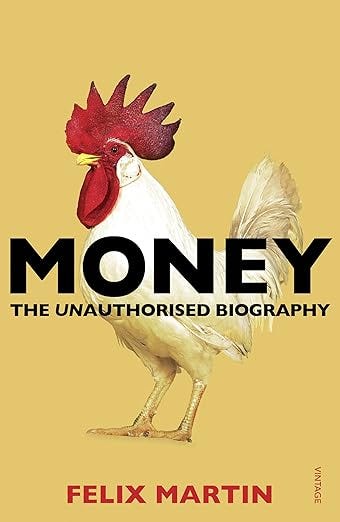
Anyway, to get myself in the right frame of mind for my interview, I thought I’d re-read a book of considerable terrificness on the subject, namely the one you see illustrated above. I read it when it first came out and I recall reading it in a minibus from Istanbul to the Gallipoli Peninsula, where I inspected the hallowed ground and then went on to Troy across the Dardanelles.
I contacted Felix the next time I was in London and we became fast friends. Anyway, I can recommend the book highly enough. It is extremely well researched and written. The writing is dense in the sense of having a lot in it and being very well considered and worked over. Yet it’s also a real pleasure to read - a difficult trick to pull off.
I asked Claude to summarise the book and, as I hope you’ll agree, it did an excellent job of it.
The other standout fact about this book is that, in its second edition, the artist illustrating the cover felt that the concept of ‘money’ was well conveyed by having a large chicken on the cover and nothing else. And who am I to argue? Felix tells me this was very good for sales.
Part One: What Money Really Is
The Stone Money of Yap
Felix Martin opens with one of the great thought experiments in economic history. In 1903, the American anthropologist William Henry Furness III visited the Pacific island of Yap and discovered a monetary system consisting of enormous limestone wheels — some twelve feet across — called fei. What astonished him was not their size but their logic. Transactions were recorded not by moving the stones but by changing who was understood to own them. One family’s wealth consisted of a fei lying at the bottom of the sea, shipwrecked generations ago. It had never been seen by anyone alive. Yet its value was unquestioned throughout the island.
Keynes read Furness’s obscure travelogue in 1914 and was astonished. So, separately, was Milton Friedman in 1991. That two economists of utterly opposed ideological temperaments both admired the monetary philosophy of Yap tells us something important: the Yapese had grasped what most economists had forgotten. Money is not the coin or the note or the stone. Money is the underlying system of credit accounts and their clearing that the physical tokens merely represent.
Martin uses this insight to demolish the standard story taught in economics textbooks. The conventional account — endorsed by Aristotle, John Locke, and Adam Smith — holds that money emerged from barter: people once exchanged goods directly, found it inconvenient, and eventually chose one commodity (typically gold or silver) to serve as a universal medium of exchange. This story is not just incomplete. It is, as Martin puts it flatly, “entirely false.”
No Barter Economies Exist
The barter-to-money story is not based on evidence. It is a philosophical inference, a “just-so” story that economists found intuitive and repeated to each other across centuries. But when anthropologists actually looked for economies that operated through barter, they found none. Not one. The Cambridge anthropologist Caroline Humphrey concluded that “no example of a barter economy, pure and simple, has ever been described, let alone the emergence from it of money.” The American scholar George Dalton reached the same verdict in 1982. What observers had sometimes identified as barter was always embedded in prior credit relationships, with commodity exchanges settling net balances rather than serving as the basic medium of exchange.
What did pre-monetary societies use instead? Martin examines two very different cases. The Homeric world of Dark Age Greece — reconstructed from the Iliad and Odyssey — organised itself through three interlocking institutions: the distribution of booty from war, reciprocal gift-exchange between aristocrats, and the communal sacrifice of oxen with equal distribution of roasted meat to all male members of the tribe. Ancient Mesopotamia — the city civilisations of Ur and Uruk, which invented writing, numeracy, and accounting — used none of these but instead an elaborate temple bureaucracy with centralised planning and limited-purpose units of value adapted to specific economic sectors. Neither economy used money. Yet both were coherent, functional societies.
Money as Social Technology
If money did not arise from barter, what is it? Martin’s answer, stated precisely: money is a social technology composed of three elements. First, an abstract unit of value — a unit of account applicable to anything. Second, a system of accounts that tracks individuals’ credit and debit balances as they trade with one another. Third, and most critically, the transferability of those obligations — the ability for the original creditor to transfer the debtor’s IOU to a third party in settlement of an unrelated debt.
This third element is the key. A bilateral IOU that stays between two parties is just a loan. It is when credit becomes transferable — negotiable — that it becomes money. The nineteenth-century monetary thinker Henry Dunning Macleod stated this memorably: the most consequential discovery in human history was made by “the man who first discovered that a Debt is a Saleable Commodity.”
The Irish bank closure of 1970 confirms this account under almost experimental conditions. When Irish banks went on strike for six and a half months — the entire retail banking system, in one of the then thirty wealthiest economies in the world — economic activity continued almost unchanged. Businesses wrote cheques that could not be cleared. Individuals accepted each other’s IOUs. Ireland’s pubs and small shops served as clearing houses, since their proprietors knew their customers’ credit well enough to assess it. By November, over five billion pounds in uncleared cheques had accumulated. The key point: money did not disappear when the official monetary system shut down. Society improvised a substitute using the same basic ingredients — transferable credit, shared units of account, and mutual trust — that had always constituted it.
Part Two: The Invention and History of Money
Greece and the Concept of Universal Value
Money as Martin defines it requires something that neither Dark Age Greece nor ancient Mesopotamia possessed alone. Mesopotamia had accounting technology but its units of value were limited-purpose, sector-specific, and embedded in a centralised bureaucratic system that had no need for a universal comparator. Greece had the germ of universal value — the tribal ritual of sacrificial distribution, in which every male member received an equal share, expressing the fundamental equality of worth among members — but lacked the accounting technology to generalise it.
When Phoenician trade brought Mesopotamian literacy and numeracy into contact with archaic Greek culture in the seventh century BC, the collision was volcanic. The Greek concept of equal social worth, expressed in ritual, could now be fused with abstract accounting. The result was the concept of universal economic value — a single measure applicable to anything, in terms of which any two goods, services, or obligations could be compared, negotiated over, and exchanged.
From this concept followed everything else. Once society shared a unit of abstract economic value, prices could be argued over, credit accumulated against individuals, and those credits transferred to settle unrelated debts. Markets became possible. Coinage provided a convenient token for recording and transferring these credits. By 480 BC there were nearly a hundred mints operating across the Greek world.
The social consequences were enormous and immediate. What had been fixed social obligations — the sharecropper’s tribute to his lord, the civic duties of the wealthy, obligations of honour and kinship — became financial relationships with flexible values. Status became relative rather than absolute. “Money! Money is the man!” complained the aristocrat Aristodemus when he lost his fortune — and with it his friends. The ancient Greek poets, playwrights, and philosophers understood money’s double promise with a clarity we have since largely lost: money offered liberation from the constraints of traditional society, but at the price of the unlimited insatiability of the Midas curse.
The Battle Over Who Controls Money
Once money existed, a second great question arose: who should control it? Martin traces this battle over two thousand years.
The Jixia academy in fourth-century BC China provided the first systematic answer. The scholars of the Guanzi, writing at almost exactly the same moment as Aristotle, reached the opposite conclusion to the Western tradition. Money, they argued, is a tool of the sovereign. Its value rests entirely on authority, not on the intrinsic worth of any commodity. The sovereign who controls the money supply can redistribute wealth, stimulate or restrain commerce, and “bring peace and order to the Subcelestial Realm.” When the Han emperor briefly permitted private minting in 175 BC, the resulting monetary entrepreneurs accumulated enough wealth and power to launch a revolt. The lesson, stated by the imperial adviser Sang Hongyang: “If the currency system is unified under the emperor’s control, the people will not serve two masters.”
In medieval Europe, the emerging money interest faced the opposite problem. Sovereigns debased the coinage to extract seigniorage — France saw no fewer than 123 debasements between 1285 and 1490. Nicolas Oresme, in his 1360 Treatise on Money addressed to the Dauphin Charles, made the first sustained argument that the monetary standard was a public trust, not the sovereign’s private property. But argument alone could not force the sovereign’s hand, since the only realistic money was the sovereign’s money.
What actually changed the balance of power was banking. The great Italian merchant houses of the late medieval period discovered, incrementally, that a hierarchy of credit could be constructed that enabled private IOUs to circulate as money on a continental scale. At the quarterly fairs of Lyons, the exchange-bankers would clear multilateral credit balances accumulated over three months of international trade, without any coin changing hands. By the mid-sixteenth century they had built “a supranational private money interacting with domestic public monies.” The medieval bankers had assembled a viable private money system that operated entirely outside any sovereign’s jurisdiction.
The Great Monetary Settlement
The denouement of this centuries-long struggle came in England in 1694, with the foundation of the Bank of England. This was the Great Monetary Settlement: a quid pro quo in which the private money interest agreed to fund the sovereign’s wars, while the sovereign granted the Bank the right to issue notes — private credit endorsed with the authority of the state.
The implications were far-reaching. The sovereign’s authority made the Bank’s liabilities universally acceptable; the Bank’s commercial acumen and independence made the sovereign’s credit reliable. As Adam Smith summarised it: “The stability of the Bank of England is equal to that of the British government.” This mutual dependence is the structural origin of all modern monetary systems: sovereign money as the ultimate settlement asset, with the overwhelming majority of circulating money consisting of credit balances at private banks, backed by the state’s implicit guarantee.
Part Three: The Wrong Theory and Its Consequences
Locke’s Catastrophic Error
Just as the Great Monetary Settlement was being struck, the philosopher John Locke committed an error that would shape economic thought for three centuries. Called upon to advise Parliament during the Great Recoinage debate of 1696, Locke argued that a pound sterling was simply a definite weight of silver — a fact of nature, not a social convention. The practical expert William Lowndes had argued, sensibly, that the silver content of the coinage should be reduced by 20 percent to reflect market reality. Locke dismissed this as conniving with coin-clippers.
Locke’s motives were political rather than monetary. He had devoted his intellectual life to constructing the foundations of constitutional government. His argument rested on the premise that property rights exist by nature, not by sovereign grant. To admit that the value of money was merely a social convention was to concede that the most important form of property in the new commercial world was ultimately at the mercy of those in power. This Locke could not allow.
The immediate disaster was severe: an acute coin shortage, deflation, business collapse, and widespread human misery. But the deeper catastrophe was intellectual. Once money was understood as a natural commodity rather than a social technology, the entire question of what the monetary standard should be — who should bear economic risks, how wealth should be distributed — ceased to be a legitimate political question and became instead a question of measurement accuracy. Money had, in Martin’s phrase, “gone through the looking-glass.”
The most appalling illustration of the practical consequences of this Looking-Glass world is the Irish Famine. When the potato harvest failed in 1845 and then again in 1846, the British government’s response was constrained by dogmatic adherence to classical economic theory. The editors of The Economist, citing Adam Smith, argued that government intervention was scientifically impossible. While people died in their hundreds of thousands, the policy debate continued at the level of abstract principles. Nassau Senior, one of the government’s economic advisers, reportedly feared that the famine “would not kill more than a million people, and that would scarcely be enough to do much good.”
Economics Forgets Money
The classical economists — Say, Ricardo, Mill — accepted Locke’s premise that money was simply a commodity and built from it an entire theoretical edifice in which money played no fundamental role. Say’s Law — the doctrine that supply creates its own demand — followed logically: if money is just another commodity, there can be no general shortage of purchasing power, and recessions must originate on the supply side. The policy implication was fatalism: do nothing, let markets clear.
Walter Bagehot, writing in the aftermath of the catastrophic collapse of Overend Gurney in 1866, argued the opposite with brilliant clarity. His masterwork Lombard Street insisted on starting from “concrete realities.” The overwhelming majority of money in a modern economy is private transferable credit — bank deposits and notes. The demand for sovereign money in a crisis is not like the demand for other commodities. It rises sharply, precisely because sovereign money is the only liability whose safety is unconditional. Bagehot’s prescription for crisis management — lend freely, on good security, at a penalty rate — follows directly from this understanding.
Keynes extended Bagehot’s critique in the 1930s, arguing that in a monetary economy, Say’s Law need not hold because people can choose to hold money rather than spend their income. When confidence collapses, they do exactly that — and only expansionary fiscal and monetary policy can break the deadlock. But neither Bagehot’s critique in 1873 nor Keynes’s in 1936 succeeded in dislodging the conventional view. Arrow and Debreu’s 1954 proof that a market economy tends to general equilibrium — provable only in a model without money — became the axiomatic foundation of mainstream macroeconomics. Modern, orthodox macroeconomics, as the Governor of the Bank of England observed in 2012, “lacks an account of financial intermediation, so money, credit, and banking play no meaningful role.”
The answer to Queen Elizabeth’s question — why did none of the economists see the 2008 crisis coming? — is therefore simple. Their main framework for understanding the economy did not include money. And why did bankers and regulators not realise how risky what they were doing was? Their framework for understanding finance did not include the macroeconomy.
Part Four: The Crisis and the Path Forward
What Went Wrong After 1694
The Great Monetary Settlement of 1694 was a balanced exchange of benefits. The private banks got sovereign endorsement that made their credit universally transferable. In return, they provided the sovereign with reliable credit at sustainable rates. Under Bagehot’s doctrine, the central bank would provide liquidity support in a crisis — lending freely against good collateral — but credit support (bearing losses on behalf of bondholders) was not part of the bargain.
By 2007, the bargain had been transformed beyond recognition. The growth of a shadow banking system — money market funds, structured investment vehicles, asset-backed securities, collateralised debt obligations — had allowed the creation of private money on a scale entirely outside the regulated banking system. In the US alone, the shadow banking sector had a balance sheet of roughly twenty-five trillion dollars on the eve of the crash, more than twice the size of the traditional banking sector. None of this enjoyed formal sovereign endorsement. But all of it was implicitly backed by the sovereign, as became clear when Lehman Brothers collapsed.
The result was that sovereigns ended up providing not just liquidity support but credit support: absorbing actual losses on behalf of bank bondholders and depositors. The US spent 4.5 percent of GDP recapitalising its banks; Ireland spent over 40 percent of GDP. In Martin’s phrase, the historic quid pro quo had become a quid pro nihilo: something for nothing. The banks got both liquidity and credit insurance. The taxpayer got nothing.
The Sceptical Tradition and Structural Reform
Martin traces three historic strategies for managing money’s inherent instability. The Spartan solution — abolishing money and reverting to traditional society — fails because it destroys the very freedom that money uniquely provides. The Soviet solution — containing money by administrative restriction — produces a world of absurd contradictions, as the satirical hero Ostap Bender discovers when his million roubles cannot buy him a train ticket. The third strategy, represented by Solon and John Law, addresses the problem structurally: by reforming the monetary standard itself.
John Law’s System in France in 1720 was the most audacious monetary experiment before the twentieth century. Law understood with complete clarity that money is transferable credit, not a commodity, and that the appropriate monetary standard must be flexible enough to accommodate economic uncertainty. He replaced the gold standard with fiat money and converted France’s public debt into equity shares in the Mississippi Company. The System collapsed catastrophically when its promises exceeded its real economic foundations.
The lesson Martin draws is not that Law was wrong about money — he was substantially right — but that he was wrong about politics. He believed an absolute monarch was the appropriate authority to manage the flexible monetary standard his system required. Solon, in sixth-century Athens, had shown the correct answer two and a half thousand years earlier. When Athens faced its first financial crisis — a debt crisis produced by the monetisation of agrarian society — Solon negotiated a political compromise: debt cancellation, the reform of property law, the introduction of trial by jury, and the codification of a comprehensive body of law. In Martin’s formulation: money requires a flexible standard; only democratic politics has the legitimacy to decide when and how that standard should flex; and only law can enact it.
Three Policy Conclusions
Martin ends with three practical conclusions.
The first concerns the monetary standard. The conventional view holds that low and stable inflation is a sufficient condition for financial stability. The crisis proved otherwise. The single-minded pursuit of inflation targets drew attention away from the building of unsustainable debt, credit bubbles, and balance-sheet fragility. What is needed is a broader mandate: monetary policy whose ultimate goal is not monetary stability but a just and prosperous society, with flexibility to use the standard as a tool of political adjustment when inequalities become unsustainable.
The second concerns democratic accountability. The conventional view implies that monetary management can be delegated to technocrats operating under rule-bound mandates. The alternative view implies the opposite: monetary policy is intensely political, because the monetary standard is nothing other than a continuously negotiated settlement about the fair distribution of economic risks. Central banks should not be independent in the way they currently are; their decisions should be subject to democratic oversight.
The third concerns the structure of banking. Irving Fisher’s 1935 proposal for “100 percent Money” — now advocated under the label “Narrow Banking” — would require that any deposit withdrawable on demand be backed 100 percent by sovereign money, held in a dedicated institution with no other activities. Everything else banks now do would be separated out and left to the capital markets without special sovereign support. The proposal eliminates the fundamental structural flaw of modern banking — the spurious promise of “liquidity transformation,” a mismatch between short-term liabilities and long-term assets sustained only by implicit state guarantee — by confining sovereign endorsement to the narrow core of the payments system. Outside that core, private risk-taking would be genuinely private.
The Ultimate Argument
Martin’s deepest point is that the conventional view of money — Locke’s understanding, built into the foundations of classical and neoclassical economics — is not merely an intellectual error. It is what sociologists call “naturalisation”: the transformation of a social arrangement into an apparent fact of nature. Once people accept that economic value is a natural property of things, it becomes almost impossible to ask whether the monetary standard is fair, or whether the distribution of economic risks between bankers, bondholders, and taxpayers is just. The questions cease to be formable.
The alternative view of money recovers what the conventional view eclipsed: the recognition that money is one of the most powerful tools of self-government ever invented; that its standard is always a political choice; and that the purpose of that choice is not accuracy but justice. Money’s promise to combine freedom and stability must be continuously renegotiated by democratic politics, enforced by law, and structured in institutions that align private incentives with public purposes.
As Keynes warned in 1923: “The absolutists of contract... are the real parents of revolution.” Or, in Martin’s own formulation: it is not experimenting with the alternative understanding of money that risks a revolution — it is sticking to the conventional one.
I can’t help editorialising at this point that I’d be amazed if the Australian Parliament can’t delegate such an instrument to an independent body. Yes, there’s a long tradition according to which the authorisation of government expenditure is the foundation of parliamentary government. But authorisation via appropriations is separate from revenue raising. And even if it were not, this is a power to make small variations across the board, all entirely within carefully designed delegation from the parliament itself.
A Central Fiscal Authority is politically (and maybe legislatively) infeasible as you note, but are there any other good ideas? How about adjusting the super rate? Economy too hot, we force up the compulsory savings, economy sluggish we all get more cash. ?




























Yep.
That's a policy I got the Business Council to sign up to in 1997.
It's kind of obvious.
A Central Fiscal Authority is politically (and maybe legislatively) infeasible as you note, but are there any other good ideas? How about adjusting the super rate? Economy too hot, we force up the compulsory savings, economy sluggish we all get more cash. ?