


Dragging our politics out of Plato’s cave
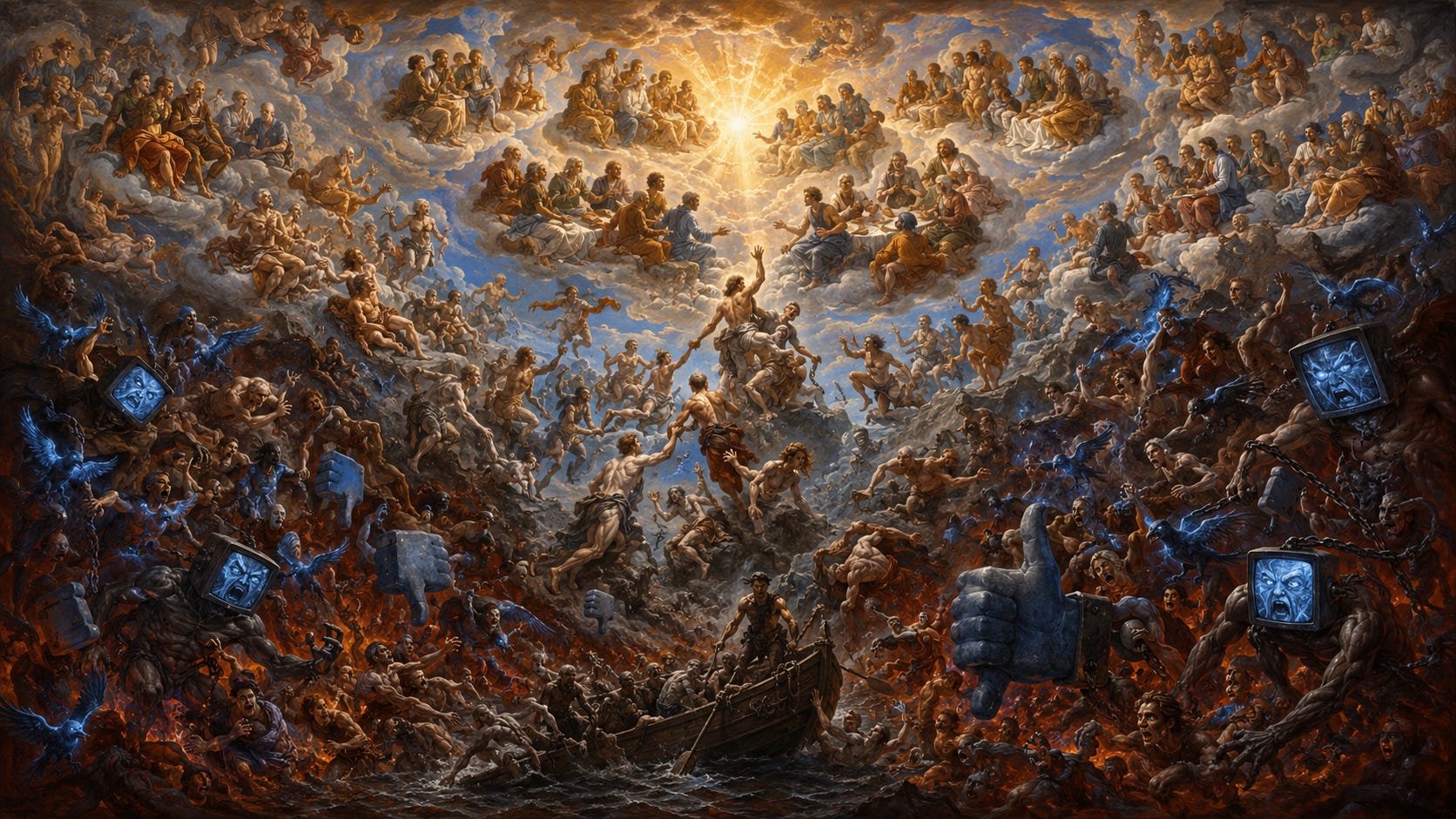
On the sortition blog Equality by Lot, Yoram Gat recently argued that the "deliberative transformation" — people leaving deliberative forums with their firm convictions reversed — would, were it common, open a dangerous gap between an allotted assembly and the untransformed majority, undermining the legitimacy of sortition. This was my response.
I think the most important concerns raised here are best considered not as considerations for and against sortition, but as an agenda for institution building. Electoral democracy consists of numerous institutions which have been developed over centuries. Sortition will need similar articulation and development over time.
On the Irish assemblies: the two most often cited by sortition advocates — on same-sex marriage and abortion — had features that made them unusually tractable: clear binary questions, strong civil society momentum, and a referendum as the outlet. Most other citizens’ assemblies — most climate assemblies, including the French and British ones, and several of the other Irish ones — produced recommendations that went nowhere.
And here’s the thing. That’s the system acting as designed. Politicians wouldn’t implement the more ambitious recommendations of the assemblies because they understood how it would prejudice their chances of reelection. We will be forever frustrated by this until we begin to constitutionalise the two forms of representation as checks and balances on each other.* My illustration of this principle in my videos gives the assembly the right to require any elected house with which it disagrees to take a second vote, this time by secret ballot. This changes the incentive structure without overriding parliamentary sovereignty. One could vary the balance further — a joint sitting in the event of disagreement, for instance — but the relationship between the two bodies needs to grow into a constitutional settlement which is accepted as democratically legitimate, not be left to the usual political moralising by opposing factions.
The concern that a people’s body might be manipulated by those running it looks like an objection to sortition, but again I think the better response is institution building. (I note parenthetically that manipulation is the very essence of virtually all political speech in an electoral democracy — something which I believe is a far bigger part of people’s growing contempt for their political system than is commonly understood, but, even if the point is conceded, it doesn’t address the substantive point.) The real answer is to build a people’s house that is self-governing and, in that sense, resistant to capture. Rotation and limited tenure within a people’s chamber are foundational. But we can still build institutional continuity and learning around those foundations. To illustrate, I’ve suggested a council of elders — chosen through the ‘brevia’ mechanism that combined sortition and election in the selection of Venetian officials. This could provide the continuity and accumulated wisdom to sustain that growth in a way that is true to the idea that the people’s house is self-governing and self-developing.
A final point, and to my mind the most important, “I want my say” feels like a democratic instinct worth defending. But I’d argue it’s actually a form of narcissism . Democracy is not about me. It’s about us. Insisting that democracy must be about me having my say retreats from the actual problem of social decision-making into a token of participation. In a system of social (as opposed to individual) decision-making, I can’t will my say for myself without willing it for others. But a true democracy built on everyone having their say logically entails voting as the foundationally democratic institution — it’s the only way for everyone to participate. Yet if everyone votes, unconsidered opinions overwhelm considered ones. I have willed, without intending it, a system in which considered opinions (mine and others) cannot make themselves heard. Moreover, my say — considered or ill-considered — has an infinitesimal impact on the outcome. Like Narcissus, I have been seduced not by the thing itself, but by its reflection. I express myself in my vote, as I do with my ‘likes’ and ‘shares’, but its impact is infinitesimal.
If we want people’s considered opinion into how they are governed, this necessarily requires just a sample of the population to participate — so they can be given the time and resources to deliberate properly. At which point “I want my say” dissolves into a more coherent preference: I want my considered opinion represented, and the only system that approximates that for everyone equally is sortition. I am almost certainly not going to be in the sample. But by the same token, my vote gives me infinitesimal influence. Turns out that, neither system is about me as an individual. But even if we think of nothing but our own self-interest, most of us would accept that we’re better off living in a community governed by the considered opinions of our peers than their aggregated snap judgements.
* Some will object to my suggestion that the two forms of representation, by election and by sampling, operate as checks and balances to each other because they are committed to sortition replacing elections. I’m not very interested in that debate for two reasons. I don’t know enough and believe no one knows enough to pronounce that one system is wholly better in all respects than the other. And more importantly, any realistic scenario involves introducing sortition to the existing system. So that’s the task that is before us. Philosophers and blowhards are welcome to pontificate about the superiority of sortition but that is not the practical or the intellectual situation in which we find ourselves.
Kind of fun
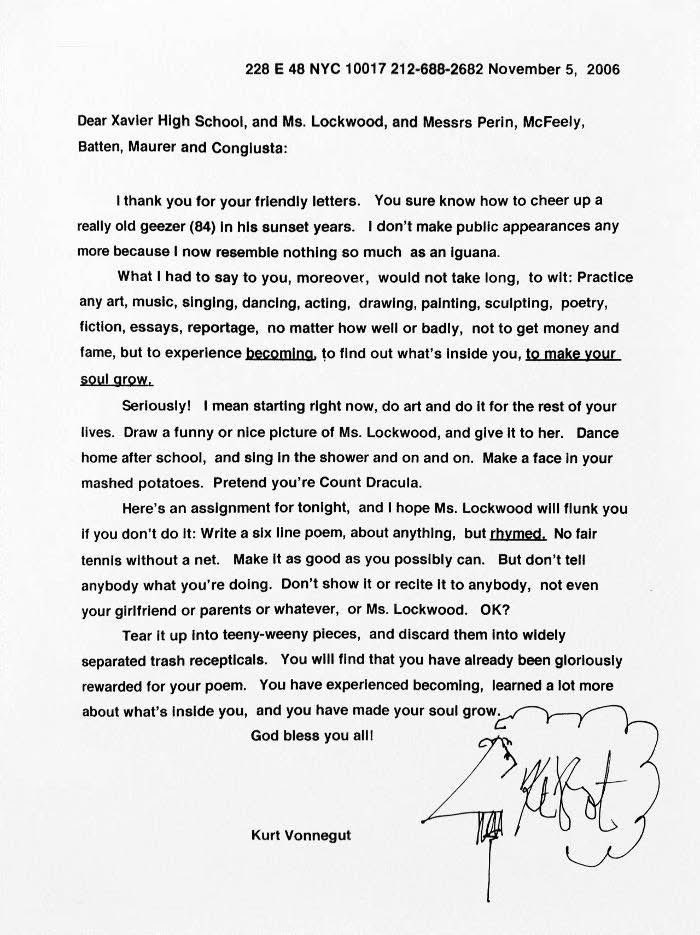
Kurt Vonnegut was the only respondent when a teacher got her students to write to a famous author seeking advice.
Swapping trenches in the gender wars
I found myself very moved by this video. Perhaps you will be too. And that was before I learned of her fate, which you can read about here, a fate discussed in more general terms below.
Then I looked up this interview.


How Brexit made the UK more European
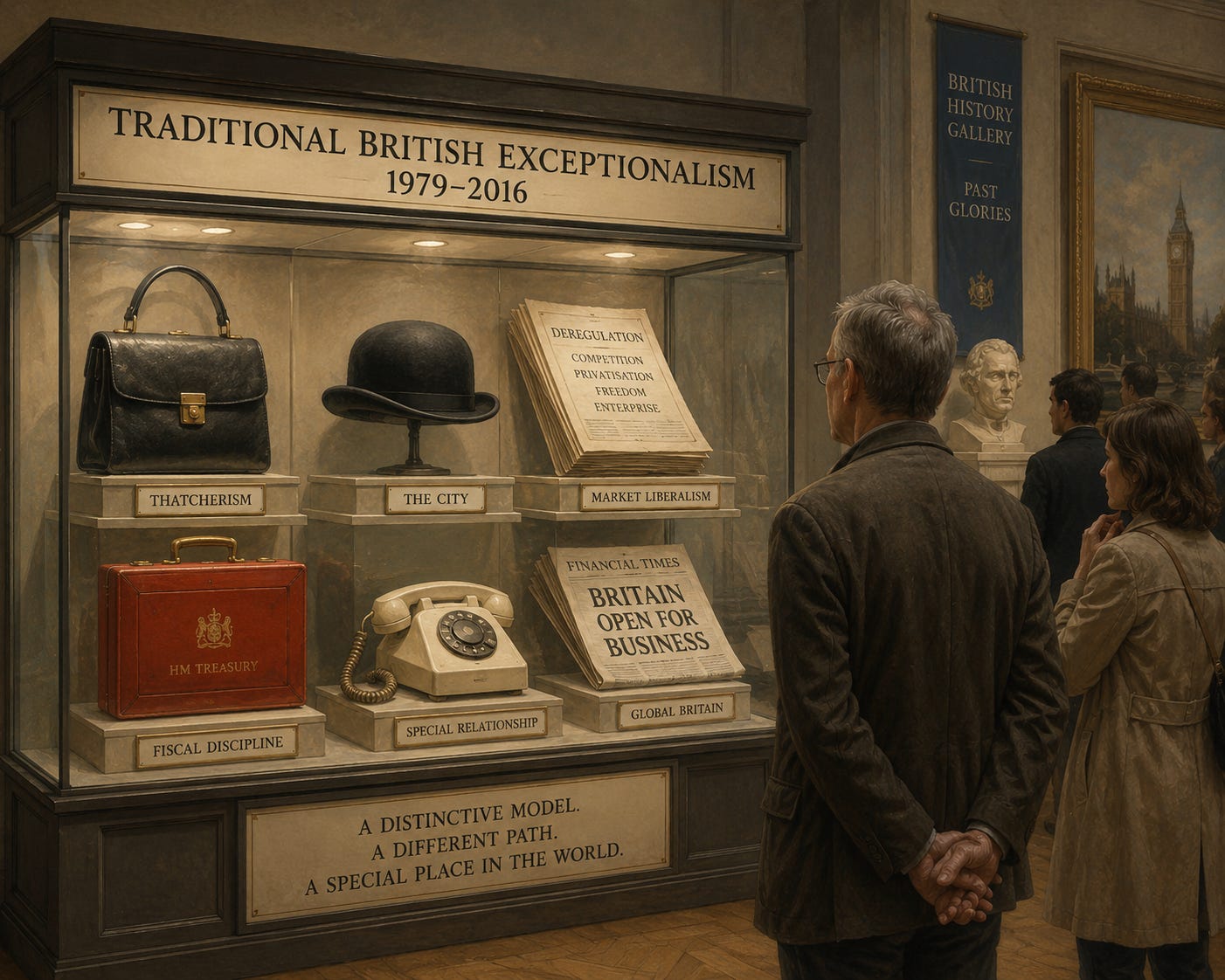
FT columnist Janan Ganesh making a contrarian point. A good provocation, methinks.
Italians saw seven changes of prime minister in the 1950s. Compared to such upheaval, Brussels officialdom was not so bad. A Spaniard with memories of Franco, or an Irish voter who grew up with an overbearing church, might even associate it with modernity. In other words, some Europeans welcomed the EU as a kind of deliverance from their ropey national politics. The well-run UK had much less to gain from contracting out its administration to foreigners. As an explanation for British Euroscepticism, this is immensely self-flattering, but it at least lines up with the circumstantial facts.
No longer. Since leaving the EU, Britain has become much more European in its political chaos. It might soon have its seventh prime minister since 2016. There are no fewer than five parties polling in double digits, suggesting a German or Dutch level of political fragmentation but with a majoritarian voting model that cannot accommodate it.
The UK’s famed “institutions” were said to make it unusual in Europe. Few have had a good decade. Neither Labour nor the Conservatives pretend the civil service is a Rolls-Royce now. ... The Andrew Mountbatten-Windsor scandal has compromised the royals. If it is true that what drove the European project was not just utopian zeal but also its opposite — deep cynicism about institutions at the national level — then Britain is starting to fit into that continental experience.
This political convergence with Europe was hard to see coming. But there has been an economic convergence too, a move to continental welfare, and Britain always had that in it.
Who still believes that British voters are instinctive free-marketeers? ... The state now has a larger role in British economic life than it did before Brexit — and people voted for it. The flexible labour market that once distinguished the UK from the continent is ever more clogged with rules, taxes and a high minimum wage. ...
The British public’s expectations of the welfare state are more French or German than American or Singaporean. The idea that an “Anglo-Saxon” economic model exists was always hogwash. If there were an ethnic or cultural predisposition to free markets, where did it go in the mid-20th century, when unions ruled the UK and marginal tax rates spurred the Beatles to complain in song? Britain’s Thatcherite consensus of 1979 to 2016 coincided with EU membership. It now stands out as a freak interval between two periods in which the nation showed its collectivist nature.
The surprise is that anyone is surprised. In essence, Leave was a paternalist movement — its key pledge was to spend EU membership dues on the NHS — led by unrepresentative libertarians from the safety of London’s two or three ghastliest private members’ clubs. This internal contradiction did not stop them winning, but it did make it obvious that no pro-market revolution could ever happen. ... The Leave campaign elevated retired people and deindustrialised regions over working people (most voted Remain) and productive cities. Ever since, politicians have obsessed over that winning coalition. This has obvious implications for policy, and they aren’t neoliberal.
I don’t suggest that Britain should or will rejoin the EU. ... The revelation of the past decade is the underlying — the increasing — Europeanness of Britain as a society. ... Owing to the Russia threat, Britain’s defence arrangements are becoming enmeshed with the continent’s in ways that would once have been seen as a betrayal of Nato. ...
A recurring question nowadays is whether the country is “ungovernable”. If it is, then nothing could be more European. ... The US suffers from dysfunction of the political but not — so far — the economic kind. ... To endure both at once is very Old World. A cycle of low growth and weak governments: the British disease is the French disease, which is the German disease. Join the EU? In the ways that matter, we already have.
A relentlessly optimised video on relentless optimisation
From a friend and subscriber
Youthanasia
A confronting piece from Charles Lane of the American Enterprise Institute, presented without any smart suggestions from me as to what side you should be on.
Dr. Menno Oosterhoff leaned forward in his living-room chair, took a sip from his coffee mug, and told me about the first time he ended a patient’s life. She was 18 years old and had been diagnosed with obsessive-compulsive disorder, an eating disorder, and autism. Despite years of treatment, she was still bedeviled by negative thoughts, and she told Oosterhoff, a specialist in child and adolescent psychiatry in the Netherlands, that she couldn’t stand any more suffering. He suggested deep brain stimulation, an invasive procedure sometimes used to treat severe OCD. She insisted that she wanted help dying instead.
Dutch law gave Oosterhoff the power to grant her request. In 2002, the Netherlands began allowing doctors to administer death to patients who make “voluntary and well considered” pleas to end “unbearable” suffering from any medical condition—provided there is no “prospect of improvement” and no “reasonable alternative” to dying. Eighteen-year-olds are adults and can request euthanasia even over family objections....
Oosterhoff’s patient had no physical illness, fatal or otherwise; he concluded, rather, that she was “mentally terminal.”... On the appointed day in October 2022, Oosterhoff went to the girl’s home and asked one last time whether she wanted to die. When she said yes, he injected her with a series of chemicals: first lidocaine to numb the area where the needle entered, then a coma-inducing drug, and finally rocuronium, a muscle relaxer, to stop her breathing.
The right to die by euthanasia is popular in the Netherlands. It is even a point of national pride.... But while absolute prohibitions might feel oppressive, they can also be useful, because they spare us the costs of making difficult moral choices—and the potentially catastrophic risks of getting them wrong. Seeking euthanasia for psychiatric reasons is the grayest of gray areas. It’s very hard to know whether a suffering person could get better, and the desire for death can be a symptom of the illness itself.
Now Dutch physicians, politicians, and journalists are beginning to sound alarms. The overwhelming majority of physician-assisted deaths in the country of 18 million still involve terminal physical illness—about 86 percent of the 9,958 cases in 2024. But the number of people who received euthanasia solely on the grounds of mental suffering spiked from 88 in 2020 to 219 in 2024. In that five-year period, doctors ended 675 lives for psychiatric reasons, more than in the previous 18 years put together. In 2024 alone, 30 people ages 15 to 29 were killed because of psychological conditions. ...
Oosterhoff personally administered lethal injections to 12 psychiatric patients in a 13-month stretch from 2023 to 2024. The youngest were 16 and 17—the first minors in any country ever lawfully euthanized for mental illness.... “Most psychiatrists intuit that it’s not a logical thing to equate somebody with a death wish at 25 and somebody with two weeks to live at age 80,” Jim van Os, a psychiatrist at the Utrecht University Medical Center, told me.... [V]an Os was one of 87 Dutch psychiatrists who signed an open letter warning that current practice “inevitably carries the risk that psychiatric patients will die unnecessarily by euthanasia.” ...
Dutch public television broadcast Milou’s Battle Continues. It tells the story of Milou Verhoof, a 17-year-old girl who received euthanasia from Oosterhoff.... At 13, she was raped and spiraled into post-traumatic stress, depression, and violent self-harm.... She made several suicide attempts.... On October 2, 2023, Oosterhoff gave her a lethal injection in her childhood bedroom. “Girl, have a good trip,” he told her, as her mother and father looked on. “You’ve been through so much.”...
What defenders of psychiatric euthanasia fail to acknowledge is that “people are always ambivalent about the death wish,” Koos Neuvel, the editor in chief of the Netherlands Journal of Literature and Medicine, told me.... “Even if the patient has lost all hope, the doctors shouldn’t give up hope,” he said. “There’s always something people want to live for, that they find interesting.”
A blast from the past


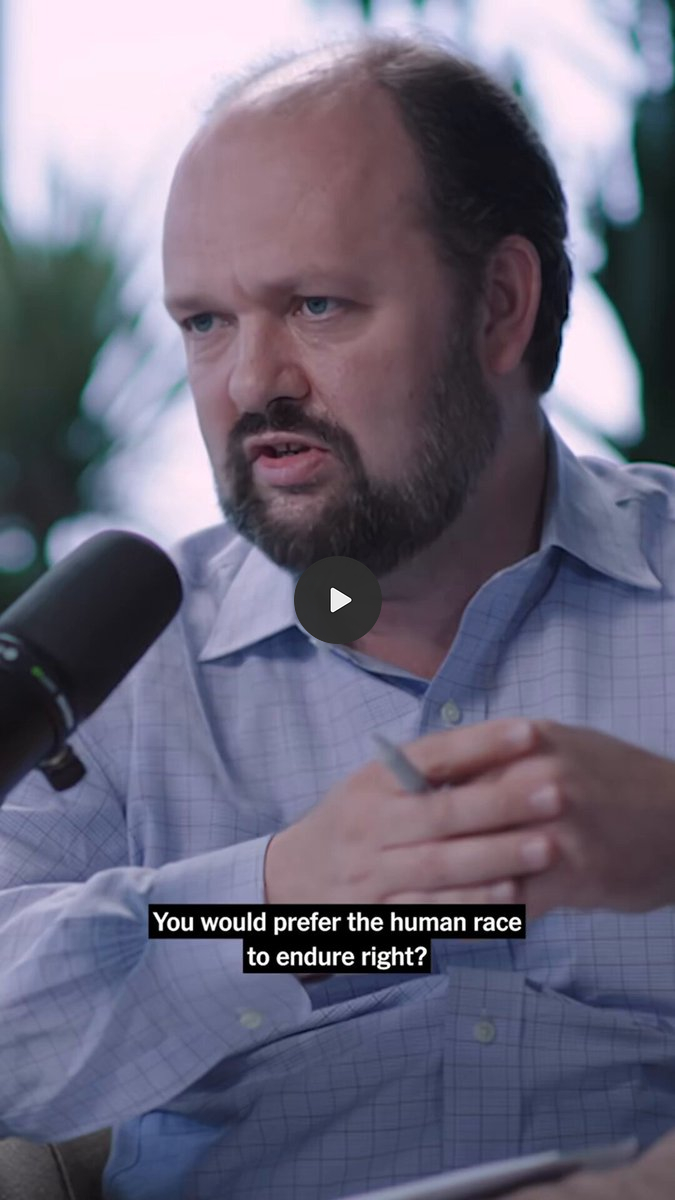
Peter Thiel features again in Fruitcake Watch ®

On not speaking about facebook
Having previously featured an extract from her book Careless People, I was very pleased to meet Sarah Wynn-Williams in London (I was at the kind of party for the beautiful people I’m constantly invited to whenever I depart my own land for a bit of respite from prophet without honour duty ;)


I failed as a novelist

On the last day of a lovely trip to Oxford to visit my lovely son, I happened upon this essay by a guy who had just celebrated the first anniversary of his first novel … about Oxford. A very amusing and classy essay it was too. If you have the time, please click through from this tease to the whole thing. And/or buy the novel itself! I have. One copy for my son. One for me.
One year ago to the day, my first novel hit the shelves. It was called Shibboleth, sold for £14.99 from all the major bookselling chains, and made me feel, for two or three weeks following its publication, like the coolest person in the world. The reviews were by and large excellent; all the attractive, well-dressed people on the London literary circuit endlessly told me how funny it was; and in the first two weeks, it massively outsold the publishers’ expectations – despite the fact that I was only twenty-seven years old, had no social media presence to speak of, and didn’t know any novelists myself. I was even featured in a number of flattering magazine profiles, all of which made noisy reference to my youth and precocity – which at least made a nice change from concerned older family members anxiously inquiring as to why I didn’t have a job.
Of course, the slop-swilling masses were always going to get their snouts into my novel eventually. I was prepared for this, or so I thought...
Still, I wasn’t quite prepared for the absolute orgy of incomprehension that the next year or so would loose on my novel. In one sense, I hadn’t exactly helped myself. I had chosen to write about the culture war and campus politics... But in the end, it turns out, the logic of the culture war was far more powerful than I thought. Soon, retired army colonels were writing me error-riddled letters congratulating me on having the courage to ‘reckon with the Muslims’. Kindly-looking middle-aged women were taking me aside at literary events and asking me, in a conspiratorial whisper, what I thought of ‘all this trans nonsense’. On the other side of the aisle, things were even worse. To quote some of the lovely things posted on the Oxford University Subreddit, I was ‘embarrassing’, ‘the kind of guy who votes Reform’, and made one of the commenters ‘wanna shoot myself’. My novel itself was sneered at from every possible angle: ‘The premise sounds tedious. The plot sounds tedious. The person who has written it sounds extremely tedious.’ Not that they had read it of course. Reading a novel before passing judgement on it was considered very dangerous indeed.
When I have put this grievance to my friends, they have tended to suggest that I write a sort of explanatory addendum... Upon hearing that the big anniversary was approaching, one friend suggested that I use it as an occasion to write just such a document, perhaps publishing it on my massively neglected Substack with a title like ‘How to Approach My Novel.’ Reader, I tried. But whenever I start typing out the apologia, I stop...
I think, however, that I just might have found a solution. I can see it now, undulating into view in front of me, like a mirage in the desert. It is, admittedly a solution that is seriously frowned upon among professional writers. It is only really thinkable, in fact, if you are Luigi Pirandello, or some hideous fanfic creature from the abysses of Wattpad, or an actually diagnosed schizophrenic. But I’m going to try it anyway. It goes like this: the actual people of the actual world have failed you, so why not ask the characters of the novel what they think? Maybe they can give a better account of your novel than you can. In reality, it’s true you are a failure. But what are you to the voices gibbering on inside your head?

Affordable housing
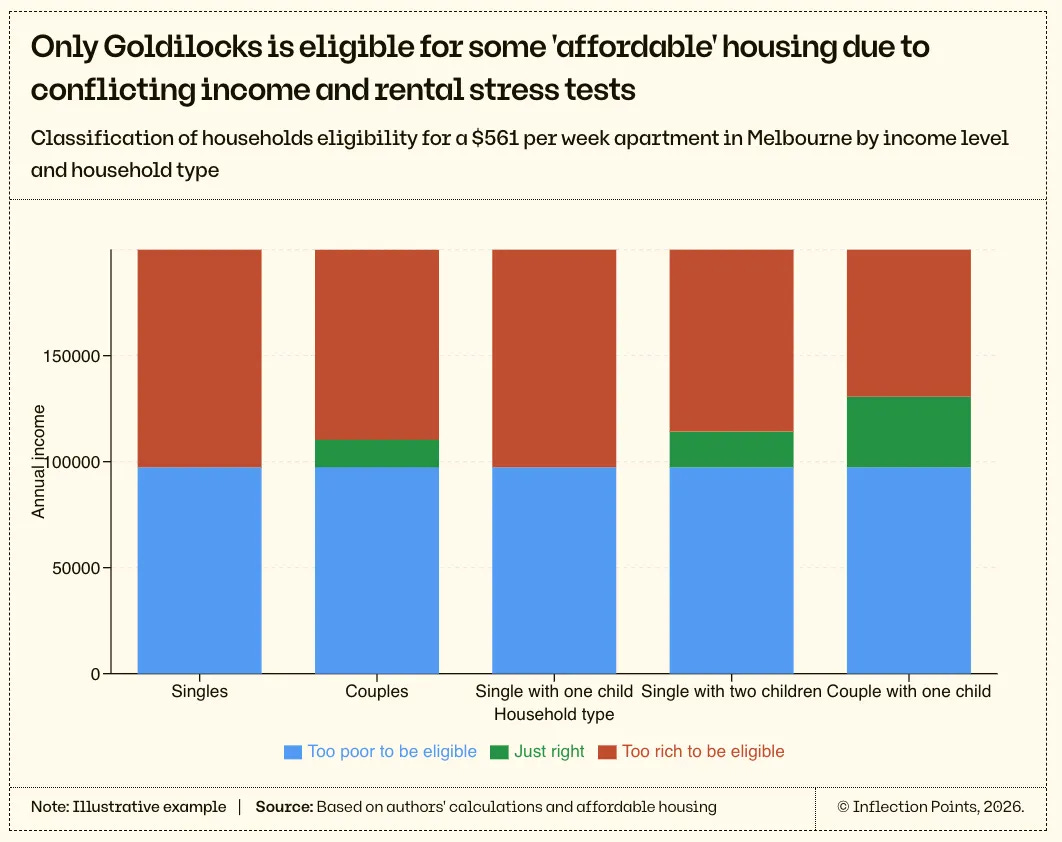
A worthwhile intervention, or so it seems to my inexpert eye.
In 2025, The Guardian Australia reported that ‘affordable’ housing tenants were being forced to use ‘poor doors’—a back entrance that separated them from market-rate tenants within the same building. ...
The building that sparked the controversy is Watermans Residences, a 30-storey tower ... in Barangaroo, where the median rent for a two-bedroom unit is currently a staggering $2,400 a week. So-called ‘affordable’ housing in the building rented for less than that: an estimated $1,800 a week. As part of the trade for reduced rents, ‘affordable’ housing tenants are unable to access the pool, gym, or even, yes, the main entrance. ...
Put simply, rents for new-build apartments in Australia’s major cities are so high that, even after a discount, the only people who could possibly benefit from a moderate subsidy are those already earning relatively high incomes. ...
The reality is that ‘affordable’ housing is deeply, intrinsically flawed. It is a wasteful use of public funds that redirects government support away from the people who need it most. ... Most importantly, the policy is wholly ineffective at delivering the outcome Australians actually want: not ‘affordable’ housing, but inexpensive housing.
It’s time for Australia to move on from ‘affordable’ housing.
What is ‘affordable’ housing?
... ‘affordable’ housing is not social housing. ... Unlike social housing, it’s explicitly targeted at higher earners, and rents are generally set at a discount in relation to market rates, as opposed to tenant incomes. ...
‘Affordable’ housing is poorly targeted
... Consider [a Melbourne] ‘affordable’ housing unit, listed at $561 per week. To avoid the 30% rental stress ceiling, a tenant must earn at least $97,240. However, the maximum income a single person can earn in order to qualify for the unit is $73,530. ... a single person can never legally qualify for this home. ...
The government is picking up the tab for ‘affordable’ housing, even when it thinks it isn’t
... [Where units are delivered through planning requirements, the] financial cost to the government of these units is zero. However, what really matters is the opportunity cost ... the real cost – the money the government could have had instead of requiring discounted rent – is almost $400,000 for every single unit [in Barangaroo]. ...
‘Affordable’ housing does not benefit those who need it most
Financial support makes a bigger difference to someone’s wellbeing the less money they have. ... This is the classical utilitarian case for redistribution ... you can do far more good with your dollars by providing support to those on the lowest incomes first. ...
‘Affordable’ housing is a bad deal for tenants
... by tying the subsidy to housing units, rather than to the people living in those units, the money provides help in a form that many recipients don’t really value. ... If offered the choice between receiving $31,000 in income support a year or the right to rent a 2-bedroom apartment in Barangaroo for $1,800/week, ... they would prefer the cash ... To borrow a turn of phrase from the great economist Arthur Okun, ‘affordable’ housing is a ‘leaky bucket’. ... It’s like we’re paying for pints, but only giving people pots.
‘Affordable’ housing is bad for ‘key workers’
... linking someone’s housing to their job ... make[s] it far harder for them to change either their job or their home. ... job-linked housing can act as ‘golden handcuffs’, trapping people into suboptimal situations. ...
‘Affordable’ housing means we’ve given up on solving the actual problem
... There is no solution to the housing crisis that does not involve the level of market rents falling substantially. ... Government-subsidised ‘affordable’ housing is the natural result of decades of policy cowardice. And it doesn’t even solve the problem.
What should we do instead?
... Aim low. The most good is done by helping those on the lowest incomes. Trust people. ... providing people with monetary support, and letting them choose how to spend it, is more efficient than in-kind subsidies. Be explicit. ...
First, we should redirect ... government funding for ‘affordable’ housing ... to social housing instead. ... Second, we should reform policies that ... encourage developers to provide ‘affordable’ housing ... to instead take contributions in cash. ... Third, what support we do provide for moderate-income renters and key workers should be provided in cash ... such as Commonwealth Rental Assistance (CRA) which should be increased and expanded. ...
And then governments can focus on the real policy task ahead of them: not just making housing ‘affordable’, but making it inexpensive.


Quote of the week
The first thing done in the corruption of manners is banishing truth; for, as Pindar says, to be true is the beginning of a great virtue, and the first article that Plato requires in the governor of his Republic. The truth of these days is not that which really is, but what every man persuades another man to believe; as we generally give the name of money not only to pieces of the just alloy, but even to the false also, if they will pass.
Montaigne from “Of giving the lie”
Ethel Spowers


Sam Roggeveen plugs away at the AUKUS turkey

The basic facts of the AUKUS deal have never passed the pub test. But once the deal was made, presumably to prevent the Albo Opposition being wedged in the election before last, it hasn’t been in the Government’s or the Opposition’s interest to question it. Right now we can back out for a measly $800 million. But that’s not in anyone’s interest (other than 28,000,000 Australians, obviously.
What does the AUKUS deal really say about Australia’s long-term defence policy?
In the long story of Australia’s ascent to fully realised nationhood, who would have predicted a final chapter about submarines? ...
But never has an ostensibly mundane military acquisition project become a proxy for profound questions of Australian identity. Until now. AUKUS ... is, overwhelmingly, being debated as defence policy. But it is much more than that. AUKUS is a hinge point in Australian history because of its strangely reactionary character. ... “reactionary” ... is meant in the more specific sense of an attempt to reverse the evolution of Australian nationhood in order to return the country to an idealised past. ...
But the election of the Howard government marks the beginning of a period in which Australia integrated its military more closely with that of the US. ... By far the most dramatic expression of the retreat from self-reliance was AUKUS ...
[F]rom the late 1960s, self-reliance began to enter Australian government thinking ... a recognition that Australia might need to fight in conflicts that the US judged insufficiently important to take part in. ...
[W]e have grasped our independence by degrees. ... Bob Hawke called it a story of “peaceful and ungrudging disengagement”. ...
In this context, AUKUS looks like a dramatic disjuncture.
At the centre of Australia’s defence strategy now stands a program that only makes complete sense if Australia is intent on using its submarines as an adjunct to the US Pacific Fleet ... we are essentially building an extension to America’s fleet. This is a revival of the “forward defence” doctrine. ...
So disfiguring is the nuclear submarine project ... that defence expert Marcus Hellyer has dubbed it the “fourth service” ... if you were designing a self-reliant Australian Defence Force from scratch, you wouldn’t start with nuclear-powered submarines. ...
Australia has agreed to an expansion of Tindal air base ... and to an upgraded HMAS Stirling, near Perth, to host up to four American nuclear-powered submarines. Both facilities are designed to be used by the US in wartime operations, the first time Australia has permitted that since World War II. ... these are foreign bases in all but name.
Why did we do it?
... we shouldn’t dismiss the most obvious motivation: the rise of China. ... We also need to appreciate the power of the US alliance in Australian political culture. ...
On only one occasion did an Australian government try to defy this historical evolution by reclaiming a more prominent place for the monarchy, and that was prime minister Tony Abbott’s decision, in 2015, to ... award one to Prince Philip. ... this wasn’t conservatism; it was reactionism. ... A reactionary ... aims to return the life of the nation to a real or imagined previous state. ...
So it is for AUKUS, which attempts to turn Australia back to a time before Sir Arthur Tange and self-reliance ...
Donald Trump changes that equation. ...
Trump changes the politics of AUKUS because he makes it possible to think and say things about the US that haven’t been contemplated before. ...
AUKUS not only ties Australia more closely to the US, it also ties us more closely to Trump. ... AUKUS ... leaves Australia vulnerable to coercion. We should consider the possibility that the alliance will be easier to preserve without AUKUS. ...
[I]t ought to be possible for Australians to remain favourably disposed to the alliance while drawing a line under the AUKUS submarine project and the basing of US forces on Australian soil. ... the political costs of reversing course ought to be manageable. ...
But what ought to clinch the case is ... that AUKUS itself creates greater military risks for Australia. At present, Beijing has almost no incentive to attack Australia. ... starting in 2027, China’s incentives will begin to change. That’s when the US is scheduled to begin operations from its new nuclear submarine facility at HMAS Stirling. Soon after, American ... bombers will start conducting missions from RAAF Base Tindal ... Both facilities will be used if the US and China ever go to war, which gives China the strongest possible reason to attack Australia. ...
AUKUS is strange because it reflects a mood of pessimism and uncertainty that is starkly at odds with Australia’s achievements. ... the refusal of our political and security elites to countenance the idea that we have the ability and resolve to meet this challenge represents a failure of imagination ... unworthy of a great nation.


Heaviosity half-hour
Cosmopolis: The Hidden Agenda of Modernity
I’ve always liked what I’ve read of Stephen Toulmin, but I’d been unaware of Cosmopolis. So, I got Claude to summarise it. I thought the summary, which I’ve reproduced below, was fascinating. Oddly enough, going to the original source, Toulmin’s book, I found it padded out with a lot of academic throat-clearing. I can’t think of anything more dull than a few pages on the subject of whether to start some historical ‘period’ from this date or that? I mean, the things happened, and we grouped them into periods. Aren’t the exact dates of those periods pretty much arbitrary?
His fundamental point is that the great figures that preceded the generation often regarded as the early architects of the Enlightenment - Descartes and Hobbes - included figures like Shakespeare and Montaigne. And where the former were reductionists par excellence, the latter were gloriously expansive in their outlook. It’s a fascinating thing to think about what modernity might have been like if it had been built on their foundations. But doing it by discussing what you call their period seems to be about the dullest and most arbitrary way imaginable.
Overview
Cosmopolis is a work of philosophical history that argues the received account of modernity is largely wrong — and that getting it right matters for how we understand our present crisis. The standard story says modernity began when Galileo and Descartes replaced medieval superstition with rational method, enabling the Enlightenment, science, and the liberal state. Toulmin argues this story is historically false, philosophically distorting, and politically self-serving. The real story is more unsettling: modernity’s defining turn toward mathematical certainty, decontextualised theory, and sovereign nationhood was not a victory for reason. It was a response to catastrophe — a defensive retreat from a more humane and tolerant Renaissance tradition into rigid frameworks that offered psychological shelter during the religious wars.
The book is organised as a long arc: from the first, humanistic phase of modernity (the sixteenth-century Renaissance) through the second, rationalist phase (the seventeenth century), through three centuries of the Newtonian cosmopolis, to its collapse after 1914, and finally to a tentative proposal for what should come next.
Part One: The Standard Account and Its Failures
The Dating Problem
When did modernity begin? Depending on who you ask: 1436 (Gutenberg), 1520 (Luther), 1648 (Westphalia), 1776 or 1789 (the Atlantic revolutions), or 1895 (Freud and modernism). Beneath these disagreements lies a rough consensus: the core of modernity is the commitment to rationality that began with Galileo and Descartes in the early seventeenth century, replacing medieval superstition and theological authority.
Toulmin’s target throughout is this received view. He does not dispute that something decisive happened in the seventeenth century; he disputes what it was and why.
What the Received View Gets Wrong
The standard story rests on several factual claims, all of which Toulmin shows are historically false:
The claim of prosperity. The early seventeenth century was not a time of leisure and comfortable inquiry. It was, as the French historian Roland Mousnier demonstrated in the 1950s and others have since confirmed, a period of general crisis: economic depression after a century of New World silver drove an expansion that collapsed after 1610; repeated plague (France was hit hard in 1630–32 and 1647–49); several cool wet summers destroying harvests across an agricultural society; widespread rural depopulation; and, above all, thirty years of religious warfare so destructive that central Europe still recalls it with horror. The standard history of seventeenth-century science in the New Cambridge Modern History manages to write about Galileo and Descartes without mentioning the Thirty Years’ War at all.
The claim of diminished Church pressure. Far from ecclesiastical constraints loosening, they intensified after the Council of Trent. The distinction between “doctrine” and “dogma” — the notion that certain doctrines were beyond even sympathetic re-examination — was invented by the Counter-Reformation. Aquinas could debate ideas that got Bruno burned. Galileo’s condemnation was not a relic of medieval intolerance but a product of specifically modern dogmatism.
The claim that lay culture was a seventeenth-century novelty. Printing had been available for over a century before Galileo. The lay humanist tradition of Erasmus, Rabelais, Montaigne, and Shakespeare was fully formed by the late sixteenth century. If anything, the move from 1580 to 1640 — from Montaigne’s Essays to Descartes’ Meditations — represents a narrowing of intellectual horizons, not an expansion.
The Two Phases of Modernity
This is Toulmin’s first major revision. Modernity had not one beginning but two, fifty years apart and pointing in opposite directions.
The first phase, from roughly 1500 to 1610, was humanistic. Erasmus, Rabelais, Montaigne, and Shakespeare explored the kaleidoscopic variety of human experience, celebrated diversity, tolerated uncertainty, and resisted doctrinal dogmatism. Their heir in politics was Henry of Navarre, whose Edict of Nantes (1598) attempted something daring: a large kingdom that could contain citizens of different religions without persecuting them.
The second phase, from the 1630s onward, was rationalist. This was Descartes’ philosophy, Galileo’s physics, Newton’s cosmology — the program of abstract, universal, timeless theory that has defined “modern philosophy” ever since.
The crucial historical fact that the received view suppresses is that the second phase was not an advance on the first: it was in important ways a retreat from it. Something happened between Montaigne and Descartes — between 1590 and 1640 — that made skeptical tolerance not just intellectually unfashionable but socially dangerous.
Part Two: What Changed — The Counter-Renaissance
Henry of Navarre’s Assassination
On 14 May 1610, at midday, in the rue de la Ferronnerie in Paris, a large red-headed man leapt onto the side of Henry’s open carriage (the awnings were down for the warm day), reached past the duc d’Epernon, and stabbed the King three times. By the time the coach returned to the Louvre, Henry IV was dead.
Toulmin uses this moment — deliberately modest in his causal claims, treating it as “epoch-marking” rather than “epoch-making” — as the pivot of his historical argument. Henry’s death sent across Europe a simple message: the policy of religious toleration had been tried and had failed. For the next generation, the tide ran the other way.
What makes the connection to Descartes more than metaphorical is a piece of archival detection. The young Descartes was a student at the Jesuit college of La Flèche when Henry died — indeed, Henry had specifically deeded the college a property and stipulated that his heart be enshrined in the chapel. The ceremony installing Henry’s heart was attended by the whole college, including Descartes. For the occasion, the best students composed Henriade — memorial exercises. Toulmin found in the Bibliothèque Nationale a volume of these exercises, In Anniversarium, that had been miscatalogued since its confiscation in the Revolution. Among the French-language pieces is a sonnet — remarkable for its energy and its fixation on Galileo’s newly discovered moons of Jupiter — that Toulmin tentatively attributes to the young Descartes. The sonnet fuses grief for Henry with excitement about Galileo’s cosmological discoveries, linking the collapse of the human order with the disruption of the old heavenly order.
John Donne Mourns for Cosmopolis
The resonance of Henry’s death extended to England, where the teenage Prince Henry, who regarded the French King as a second father, withdrew to his bed for days upon hearing the news. The poet John Donne, writing in 1611, produced two remarkable poems. The better known is An Anatomy of the World, nominally an elegy for a girl Donne had never met, but actually a catalogue of cosmic disintegration. Its most-quoted lines — “Tis all in pieces, all coherence gone / All just supply, and all Relation” — are usually read as anticipating the scientific revolution. Toulmin reads them differently: Donne was a conservative mourning the collapse of the old order, not celebrating the new. The “new philosophy” — the atomism of Copernicus’s successors, the dissolution of fixed celestial spheres — was for Donne evidence of decay, not progress.
Donne’s dismay was at the collapse of cosmopolis: the classical idea, with roots in Stoic philosophy and Greek political thought, that the order of nature (cosmos) and the order of society (polis) were mirrors of each other. When that correspondence broke down — when new astronomy disrupted the heavens, religious warfare disrupted society, and economic depression disrupted commerce, all simultaneously — the result was precisely what Donne described: a world in pieces.
Toulmin’s Yeats connection: between the Donne lines and W.B. Yeats’s The Second Coming (”Things fall apart; the centre cannot hold”), the parallelism is close enough that Toulmin runs them together on the page. The early seventeenth century and the early twentieth are, on his reading, structurally similar moments.
The Politics of Certainty
By 1640, with the Thirty Years’ War still grinding on, philosophical skepticism — Montaigne’s readiness to live with ambiguity and diversity — had ceased to be a tenable intellectual position. It was not simply that Descartes disagreed with Montaigne. In a world where theological disagreements were literally matters of life and death, and where armies were still fighting over doctrines that nobody could prove, the mood demanded certainty. The Quest for Certainty was not, Toulmin argues, a purely philosophical choice: it was a politically timely response to a specific historical crisis.
Descartes was not the innocent esprit of the Grande Encyclopédie biography — a pure mind whose “true life story is the history of his thoughts, the outward events of his existence having interest only for the light they throw on the inner events of his genius.” He was a man who had witnessed Henry’s death commemorated annually at La Flèche, who had followed the Thirty Years’ War at first hand (joining the Duke of Bavaria’s army on campaign), and who settled in Holland in the early 1630s to do his thinking in a country that had retained something of Montaigne’s tolerance.
The comparison between Montaigne and Descartes — the book’s sharpest piece of intellectual portrait-painting — illustrates the shift in sensibility. Montaigne wrote frankly about sexuality, flatulence, impotence, and bodily weakness; he wore the body’s limitations without shame. Descartes, who described himself in his public life as larvatus prodeo (”I present myself masked”), kept his illegitimate daughter secret and treated his housekeeper-lover as a servant. More philosophically: where Montaigne embraced “nothing human is foreign” and drew on ethnography, travel writing, and the variety of moral customs, Descartes confessed in the Discourse on Method that he had once been fascinated by history and ethnography, then learned to overcome this weakness. “History is like foreign travel,” he wrote. “It broadens the mind, but it does not deepen it.”
Part Three: The Four Exclusions
Toulmin identifies four moves by which seventeenth-century rationalism stripped practical philosophy from the philosophical agenda:
From oral to written. Rhetoric — the study of how arguments work with particular audiences in particular situations — was demoted from a philosophical discipline to a vulgar art of manipulation. Logic alone counted. Arguments were to be assessed by their internal validity, not by their fit with circumstance or audience.
From the particular to the universal. Casuistry — the case-by-case analysis of moral problems, which had been a sophisticated philosophical discipline — was destroyed by Pascal’s Lettres provinciales and never recovered. In its place, ethics became a search for timeless universal principles.
From the local to the general. Ethnography and history, which the humanists had treated as indispensable evidence about the variety of human practice, were exiled from philosophy. Descartes needed abstract axioms, not Montaigne’s cannibals and nudists.
From the timely to the timeless. Practical wisdom — the capacity to judge pros ton kairon, “as the occasion requires” — was no longer philosophical. Permanent structures were in; transient circumstances were out.
These four exclusions together constitute what Toulmin calls the shift from practical to theoretical philosophy, from humanism to rationalism. Their joint product was the research program of modern philosophy: context-free, universal, abstract, certain.
Part Four: The New Cosmopolis
After 1648
The Peace of Westphalia (1648) established the system of sovereign nation-states that would govern European diplomacy until 1914. Each sovereign chose his state’s religion; the Pope protested loudly and was ignored. From now on, political obligation was national rather than feudal or confessional. This was the political face of the same transformation that Descartes was enacting in philosophy.
The reconstruction of European society after the Religious Wars needed more than a peace treaty: it needed a cosmopolis, a comprehensive account of how the natural and social orders corresponded. It was Isaac Newton who provided it.
Newton’s Cosmopolis
Newton’s Principia (1687) offered a mathematical account of nature in which a central force (gravitation) held a hierarchical system (the solar system) in stable, predictable orbits. As a piece of physics this was revolutionary. As a piece of political theology it was perfect: God’s wisdom was demonstrated in having created a rational, stable, self-sustaining order. What God is to the solar system, the monarch is to the state.
Toulmin’s analysis of the Leibniz-Clarke correspondence (1715–16) is the sharpest demonstration of this. Leibniz and Samuel Clarke (Newton’s proxy) were ostensibly arguing about physics — can there be a vacuum? Does God intervene in nature? — but the real stakes were cosmopolitical. Both sides assumed that nature must exhibit the same virtues they demanded of society: stability, hierarchy, rational order under a supreme authority. The unstated agreement between the two parties — that any adequate natural philosophy must support a “rational theology” — is the hidden agenda of the title.
The “subtext of Modernity” extended further. The doctrine that matter is inert — unable to set itself in motion without a superior agency — was not merely a physical theory. Joseph Priestley, a provincial Nonconformist, showed in 1777 that the doctrine made no difference to the explanatory power of Newton’s mechanics. Yet it was defended with ferocity. Its defenders understood, at some level, that the political implications were inseparable from the physical ones: active matter meant social atoms capable of spontaneous self-organisation, which meant the political authority of the lower orders. The Sedgwick family graveyard at Stockbridge, Massachusetts — arranged as a planetary system with the patriarchal Judge Sedgwick at the centre and generations of descendants arrayed in orbits around him, their feet pointing inward so that on Judgment Day they need see no one but Sedgwicks — is Toulmin’s perfect emblem of the cosmopolitan settlement.
Part Five: The Dismantling (1750–1975)
The scaffolding of modernity — its presuppositions about inert matter, fixed natural laws, the sharp division of reason from emotion, humanity from nature, the nation-state as the natural unit of political life — was dismantled timber by timber over two and a half centuries.
Darwin questioned the fixity of species and, more deeply, the short Biblical time-scale. Helmholtz and his students dissolved the Cartesian division of mental from physical in sensory physiology, preparing the ground for Freud. The Vienna school challenged the distinction between mental and physical illness. La Mettrie and Priestley challenged inert matter from the margins of respectability (both ended in exile, which Toulmin treats as evidence that more than physics was at stake). Einstein’s relativity and Planck’s quantum mechanics demolished the Newtonian certainties. By 1914, all the intellectual material for a return to Renaissance values was available.
But the time was not ripe. The First World War, the Depression, and the Second World War imposed their own demands for certainty, clean slates, and fresh starts. The inter-war period saw the rationalist dream revived in its most extreme forms: logical positivism, twelve-tone music, Mies van der Rohe’s universal architecture, the Vienna Circle’s Unified Science. “Where Euclid was, there Russell shall be!” All of these were, on Toulmin’s reading, repetitions of the seventeenth-century move — sweeping away the clutter of tradition, cleaning the slate, starting from formal foundations.
The 1960s and 1970s were when the dismantling finally became socially as well as intellectually effective. Rachel Carson’s Silent Spring (1962) reintegrated humanity with the natural world. Freud’s successors had made the emotions intellectually respectable. The civil rights movement, the women’s movement, and opposition to the Vietnam War challenged the hierarchies the cosmopolis had naturalised. Robert Venturi and his colleagues challenged Mies’s abstract universalism in architecture. The pattern Toulmin identifies is precise: the specific doctrines of the Modern Framework — inert matter, stable nature, Reason versus Emotion, the sovereign nation — each came under attack in turn, and each attack was connected to the others because the doctrines had always formed a system.
The frame-story is exact: at the beginning of modernity, Henri IV’s assassination (1610) was the moment when tolerance was murdered and the Quest for Certainty began. At the end, John Kennedy’s assassination (1963) served analogically as the emblem of the end of the old certainties — Kennedy the last avatar of the nation-state’s self-confidence, his death opening a generation to doubt.
Part Six: The Way Ahead
Against the Clean Slate
Toulmin’s positive program begins with a demolition: the idea that rational action means sweeping away inherited structures and starting from scratch — the fantasy of the tabula rasa — is illusory. Descartes demanded it; the French Revolution attempted it; the inter-war avant-garde revived it. It is always a dream. There is no neutral scratch line. The Founding Fathers of the United States thought they were starting fresh; in practice they recreated, in purified form, the traditions of English constitutional liberty they had crossed the Atlantic with. The French revolutionaries who replaced the week with a ten-day décade found that their rational calendar simply did not stick.
Humanising Modernity
The positive proposal is not to reject the achievements of seventeenth-century rationalism but to reconnect them with the practical wisdom of the Renaissance humanists. Toulmin wants to recover:
The oral alongside the written — rhetoric, speech acts, argumentation in context
The particular alongside the universal — casuistry, case ethics, the revival of which he sees in the work of Michael Walzer on the morality of war
The local alongside the general — ethnography, cultural history, Alasdair MacIntyre’s attention to different “traditions” of moral reasoning
The timely alongside the timeless — practical wisdom, Aristotle’s phronesis, clinical judgment, the recognition that some decisions must be made pros ton kairon
From Leviathan to Lilliput
In the political realm, the analogue is a move from the omnicompetent sovereign nation-state to a plurality of subnational, transnational, and multinational institutions. The Hobbesian Leviathan — the central sovereign whose overwhelming force keeps the social atoms in their orbits — was appropriate to the seventeenth century’s desperate need for stability. It is not appropriate to a world of ecological interdependence, cultural diversity, and the exhaustion of absolute sovereignty. The ecological model of society, with its emphasis on diversity, adaptability, and the fit between institutions and local circumstances, replaces the Newtonian model of stable hierarchical systems governed by central force.
The rational and the reasonable: Toulmin’s final distinction. “Rational” has come to mean formally valid, calculatively rigorous, decontextualised. “Reasonable” is an older and richer word — it captures practical wisdom, proportionality, sensitivity to circumstance. The task is to reclaim reasonableness without abandoning rigour.
The Argument in Summary
Toulmin’s thesis has several interlocking parts:
Modernity had two phases, not one. The humanist phase (1500–1610) was tolerant, diverse, and practically oriented. The rationalist phase (from 1630 onward) was rigid, dogmatic, and theoretically obsessed.
The transition between them was not a scientific advance but a political and psychological retreat: the collapse of Henry IV’s tolerant experiment, the horror of the Thirty Years’ War, and the resulting conviction that Montaigne’s modesty about certainty was a luxury no one could afford.
The new cosmopolis — Newton’s unified account of natural and social order — served political as much as explanatory purposes. It legitimated hierarchy, inert social masses, and the absolute sovereignty of the nation-state.
The dismantling of this cosmopolis has been going on since the mid-eighteenth century, in philosophy, natural science, the arts, and politics. It was completed, in social terms, in the 1960s and 1970s.
The way forward is not post-modernist rejection of rationality but a humanised modernity that reconnects the abstract rigour of the seventeenth century with the practical wisdom of the sixteenth — a recovery of the oral, the particular, the local, and the timely, alongside the written, universal, general, and timeless.
The book’s deepest claim is that the Quest for Certainty was never purely intellectual. It was always also a political wager — a bet that clear and distinct foundations could substitute, in a world torn by religious war, for the slow, messy, inconclusive business of living with difference. Three hundred years of history have shown the wager was lost. Modernity’s hidden agenda, now exposed, turns out to have been the restoration of cosmopolis — a stable order in which the arrangements of heaven would underwrite the arrangements of earth. With that project finished, the task is to think again about what reasonableness, without certainty, might look like in practice.
First published 1990 (Free Press); University of Chicago Press edition 1992. 238 pages.


Heaviosity half-hour--
Ada Palmer's "Inventing The Renaissance" is the very last Hugo book and is on the ballot for Best Related Work because it is written by a fandom-beloved SF novelist. (Once the world was a simpler place and this award was "Related Non-Fiction Book" but it can now be essentially anything in any medium.) However I commented to spouse that it is "the decadent pleasure of a 7-layer chocolate cake" and has a good more subtle reason to be on the ballot because it is meta-fantasy that questions the notions of what is medieval and what is Renaissance inherited by canonical fantasy authors. Palmer says very simply that what is Renaissance and what is modern depends on in what discipline you sit and made this funny by walking around to colleagues and asking them what in their discipline is "modern". "Modern DNA structures" is 530,000,000 BCE. "Modern computing" has a range of two centuries with the earliest date being 1812. The real deep dive into what Renaissance humanism was is more than 100 pages from now but it will involve the recovery of Greek and of the classics as soft power. Renaissance humanists are not dealing with religious wars or theology vs. reason as much as the pope being a pure political actor with no moral authority and Luther comes along by the time the Italian Renaissance has been going for 100 years.
May one be permitted to be a lover of beauty? I adored girls from afar for years. But the French proverb "Woman promises to Man what only God can give." is sadly true. Yet perhaps it teaches us to love and forgive our own imperfections...