

Reader Robert Banks liked the Fred Astaire video yesterday and sent this. I once lived in a group house with someone who was a huge fan of Fred Astaire movies who would occasionally say “That idea’s so crazy, it just might woik”.
Ruth Forrest and the proposed Hobart AFL stadium
Last week Tasmania’s Coordinator-General, John Perry released an analysis of the economics of the Hobart Stadium which claimed that it would generate around $5 for every dollar spent on the stadium. It was nonsense of course. You could use the same methodology to prove that spending $1 billion on digging a hole and filling it in again would be a good idea. When I was asked to comment on the study I simply asked ChatGPT this very neutral question:
let’s say you wanted to build a stadium in Hobart to ensure you got a Tasmanian team in the AFL, which of these two reports do you think does a better job of assessing its economic impact and why.
You can read its reply here. ‘Nuff said. Anyway, Ruth Forrest is a member of Tasmania’s upper house and chair of the Parliamentary Accounts Committee. She trained as a nurse but gets on top of her brief. And this is the tantalising thing about Tasmanian politics. In the midst of poor government from the duopoly parties, because they use the Hare-Clark system,1 there are lots of independents in the Tasmanian parliament and a good proportion of them do their jobs as MPs.
In any event, here is an edited version Ruth Forrest’s really excellent explanation of all that is wrong with Mr Perry’s report.
Tasmania’s Coordinator-General, John Perry, has made an extraordinary late-stage intervention in the stadium debate, publishing an opinion piece that seeks to reframe the $1.13 billion Macquarie Point project as an act of economic prudence rather than extravagance. It’s dressed in the language of analysis and investment logic, but beneath the surface it is something else entirely: a sales pitch masquerading as economic evidence.
At first glance, Mr Perry’s central claim is arresting. He argues that for every dollar Tasmania spends servicing debt for the stadium and the AFL club, around $44.5 million per year, the state will reap nearly $221 million in “new economic activity”. That’s a ratio of $4.97 of benefit for every $1 of cost. To the casual reader, it sounds irresistible. Yet on closer inspection, the calculation relies on faulty logic and selective inclusions...
The first and most glaring error is to treat the interest repayment costs on stadium borrowings as the project’s cost base. He then compares that limited annual financing cost to his estimate of “economic activity”, a measure drawn from input-output multipliers (I-O) rather than a proper economic cost–benefit analysis (CBA). In other words, he measures an apple slice of cost against the whole fruit salad of benefit.
Infrastructure Australia and Treasury guidelines make this distinction crystal clear. A compliant CBA measures all resource costs – the total capital expenditure, operating and maintenance outlays, refurbishment, and the asset’s residual value – discounted to present terms...
Had he applied standard appraisal practice, he would have had to include full building costs, annual operating costs, major refurbishments after about 30 years, and depreciation. Stadia rarely last forever...
The next problem lies in Perry’s definition of “benefit”. The $221 million he claims is not new wealth created for Tasmanians. It’s a tally of gross turnover, money moving through the economy, much of it already happening or quickly leaking interstate...
By contrast, a proper CBA, Infrastructure Australia’s gold standard, focuses on net welfare gain: the extra value to consumers and producers after accounting for opportunity costs and externalities after subtracting the local spending displaced or the leakage of profits to mainland chains and suppliers.
A cornerstone of every credible CBA is the base case – what happens if the project doesn’t proceed. Mr Perry never defines one. Macquarie Point was already slated for redevelopment; the real question is whether adding a stadium delivers more benefit than an alternative use of the site...
Perhaps the most extraordinary omission is the absence of any allowance for asset depreciation. In corporate analysis, depreciation is a fundamental cost...
Another flaw is the uncritical blending of multiple economic frameworks (CBA, CGE models, and I-O multipliers) into a single headline figure. These tools serve different purposes and cannot be aggregated...
A rigorous cost–benefit analysis, using Infrastructure Australia’s own parameters, would almost certainly deliver a BCR below one meaning the stadium wouldn’t create economic value at the State level even if it generated jobs and spending. Projects can stimulate the economy yet still make society poorer when costs exceed benefits. That is the central truth Mr Perry’s argument conceals.
Tasmania deserves transparent, evidence-based assessment of its biggest capital commitment in decades, not a glossy spreadsheet promising gold at the end of a very expensive rainbow.

Stella Bowen
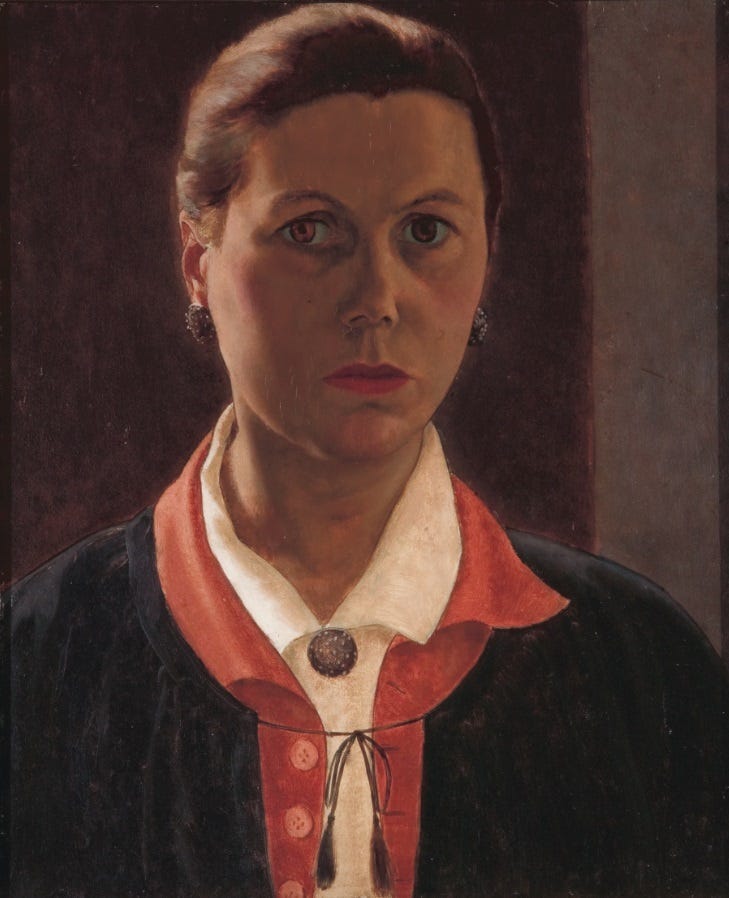
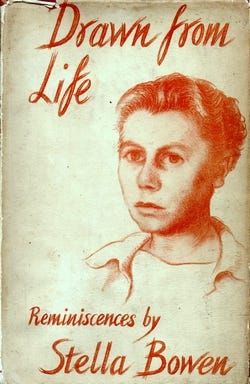
I think I came across Stella Bowen in the way described in the passage below. I love her book Drawn from Life, the first chapter of which is extracted below.
I came to Stella Bowen’s memoir, Drawn from Life (1941), through Drusilla Modjeska’s wonderful book, Stravinsky’s Lunch (which I’ll discuss in a separate post). Born in Adelaide, Australia, Bowen met the writer Ford Madox Ford while studying art in London and they lived together from 1919 to 1927. Modjeska devotes the first half of her book to an account of how Bowen struggled to establish herself as an artist while simultaneously dealing with domestic demands — first of Ford and later as a single mother raising their daughter, Julie — and quotes liberally from Drawn from Life. It only took a few excerpts to convince me that I had to read more.
“The land where I was born is a blue and yellow country,” opens Drawn from Life, with a rhapsody about the landscape of Australia — which, ironically, she left at the age of 18 and never returned to. Though her father died when she was just three, her childhood, as she recounts it, was entirely conventional: “We were, in fact, a suburb of England.” ...
When her mother died in early 1914 and Stella and her brother were left with an annuity of two hundred pounds a year, Stella seized an opportunity to accompany a friend’s family on a journey to England. In London, she studied painting under Walter Sickert, who drove the importance of seeing the unique visual features of any subject. “He taught one to trust one’s faithful eyes, and to open them wide. I had never before been required to look at things so minutely, and having looked, to record them with so little fuss.” ...
She also met a number of influential figures, starting with the poet Ezra Pound, and in early 1918, at one of Pound’s parties, she was introduced to Ford Madox Ford. They experienced an instant rapport. Bowen found him “quite simply the most enthralling person I had ever met.” ... Soon he was telling her that “he wished to place his person, his fortune, his future in my hands.” He was tired of the world and just wanted “to dig potatoes and raise pigs and never write another book.”
Within a year, after Ford’s discharge from the Army, they were moving into a tumble-down cottage in Sussex. ... Not long after, Bowen became pregnant.
Although Ford had vowed to give up writing, it didn’t take long for them to realize they couldn’t survive without the income. He set to work on articles and a novel, eventually published in 1923 as The Marsden Case. Soon the rhythm of the house became set by Ford’s work:
He would retire upstairs to write, and leave me to wrestle with the dinner. At eight I would say, “are you ready to eat?” and he would reply, “in a minute.” At eight-thirty I would say, “It is eight-thirty, darling,” and he would reply, “Oh, give me another twenty minutes,” and I would return to the kitchen and concoct something extra — another vegetable, or a savoury. At nine I’d say, “what about it?” and he’d tell me to put the meal on the table. At nine-thirty I would suggest putting it back on the fire, to re-heat. “What!” he’d cry, “dinner on the table all this time? Why ever didn’t you tell me?” Well, we’d eat perhaps at ten, with enormous appetite, and discuss the progress of his book and of my cooking.
“We enjoyed ourselves,” Bowen writes, but the preservation of Ford’s “working conditions” meant that she had to take over most of the domestic chores and all of the responsibility for managing their affairs. ... It was not enough for Bowen to keep the pig from wandering off to the next farm or take care of all the cooking and cleaning and feeding while in the last months of her pregnancy. “If ever a man needed a fairy godmother, he did,” she eventually concluded. And meanwhile, her painting “had, of course, been hopelessly interfered with by the whole shape of my life….” ...
A major theme in Drawn from Life is the near-impossibility of a woman working as an artist when all her time, attention, and energy is devoted to caring for a man pursuing his own career. “I was learning the technique of a quite different role: that of consort to another and more important artist.” Bowen’s blunt eloquence makes this a pioneering work of feminism, on the order of Virginia Woolf’s “A Room of One’s Own.” ...
They moved to Paris in September 1924, and were soon at the heart of the thriving expatriate scene. Ford’s brother, Oliver Hueffer, convinced him to take on the job of editing a new magazine he was establishing called the transatlantic review. Although the review failed after just one year, what a year that was. Ford has a marvelous gift for spotting good writing and collected pieces from Hemingway, Gertrude Stein, Djuna Barnes, and H. D., although with the first excerpts from James Joyce’s “Work in Progress” (Finnegans Wake). He also published the work of a fragile and destitute writer from the West Indies named Jean Rhys — and began an affair with her. ...
Drawn from Life deserves to be recognized as a minor classic. It’s a fiercely feminist text, one that echoes the messages of Elizabeth Cady Stanton’s speech, “The Solitude of Self,” and anticipates The Feminine Mystique and other works of decades later:
If you are a woman, and you want to have a life of your own, it would probably be better for you to fall in love at seventeen, be seduced, and abandoned, and your baby die. If you survived this, you might go far! Otherwise, emerging from a love-affair into the position of a middle-aged housekeeper, you may suffer the most desperate sensations of constriction and futility which your situation will give you little chance to survive.
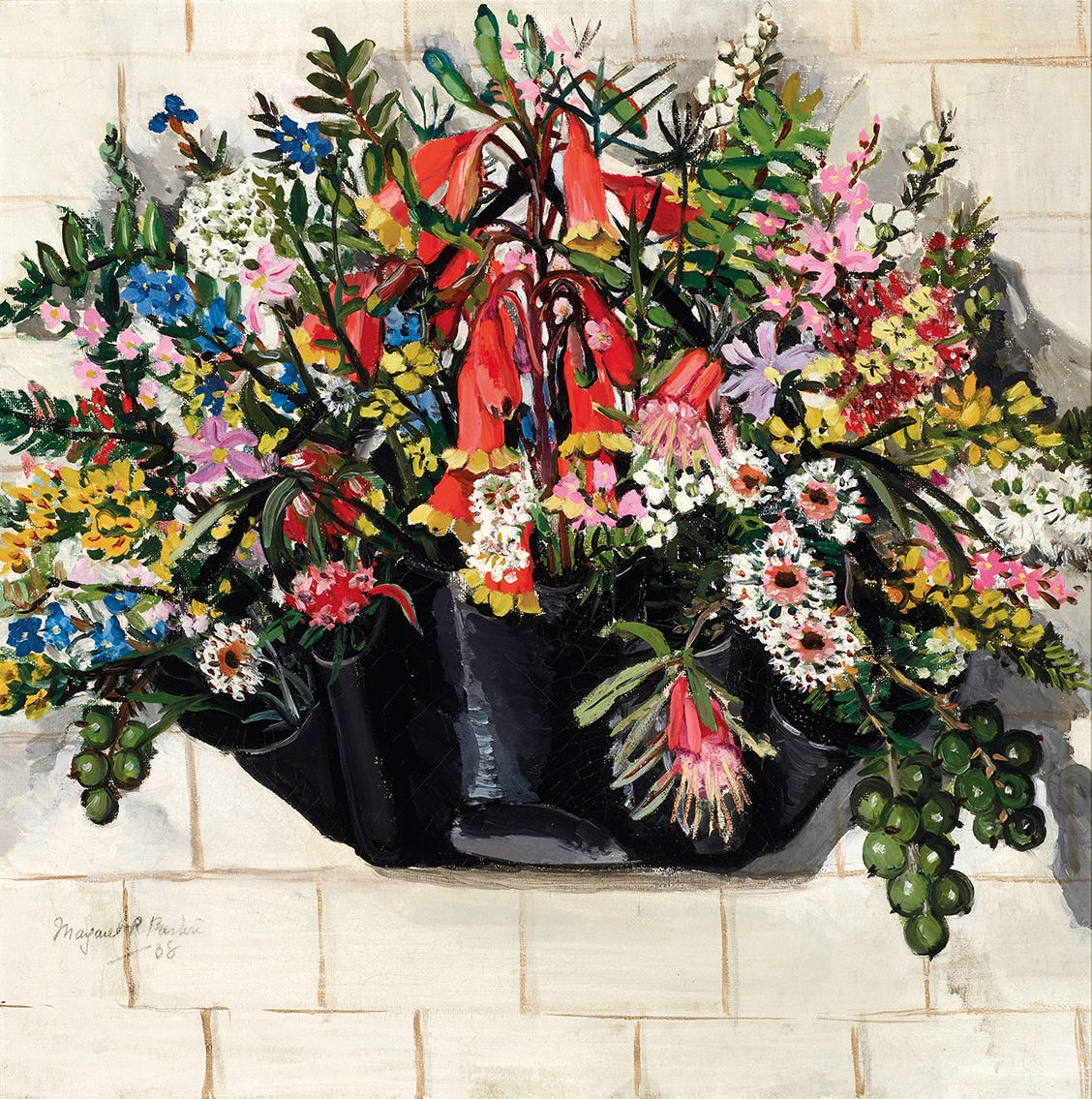
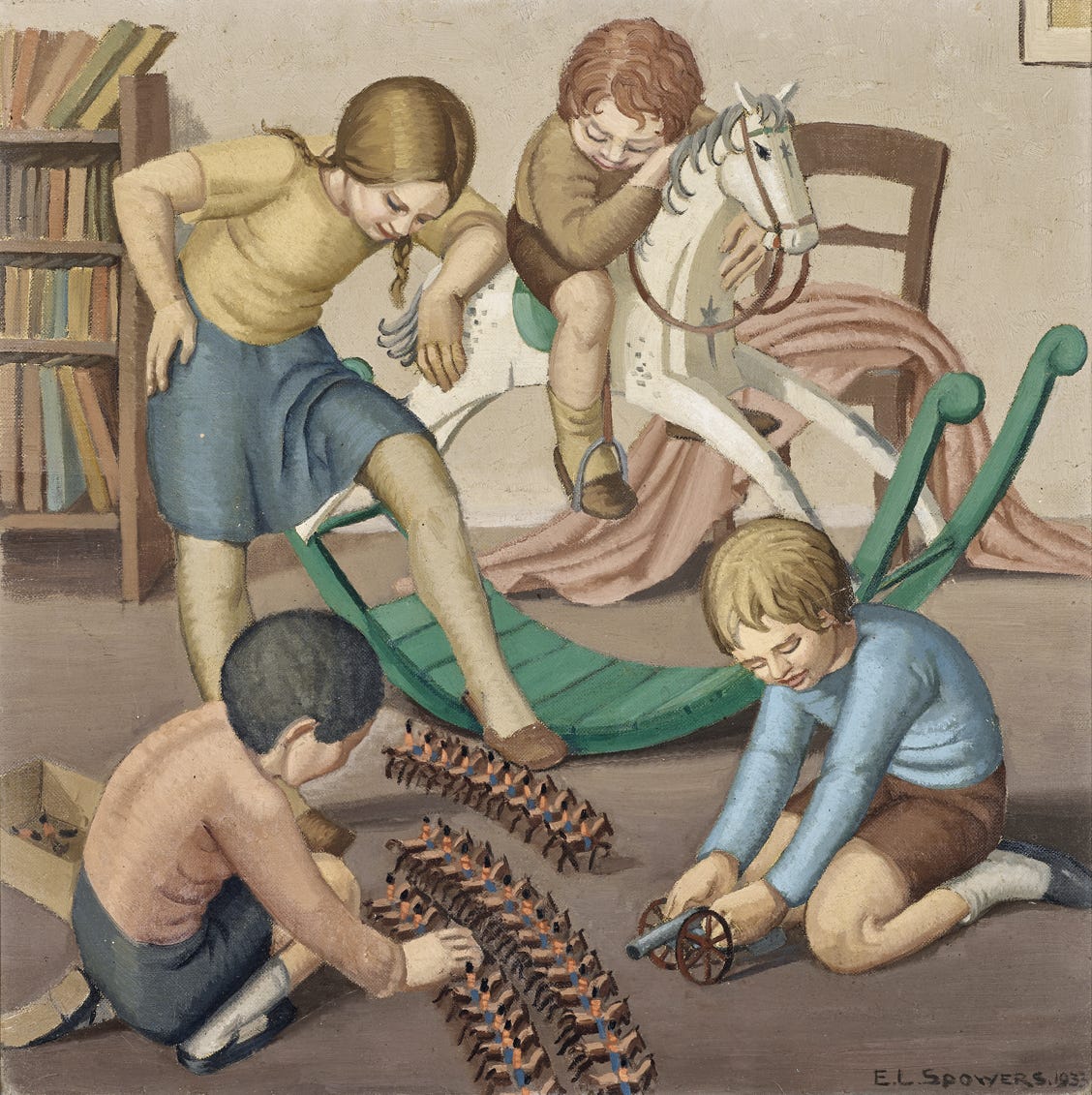
Australian Women artists sold through Menzies


Heaviosity Half Hour
CHAPTER ONE: Adelaide
THE LAND where I was born is a blue and yellow country, although when the sun pours out of a cloudless sky, there is very little colour to be seen. The blazing sky itself is almost empty of blue, and the yellow ochre of the dried grass is silvered by the glare. Even the shadows are less blue than painters like to pretend, and the air is so dry that the distance has the same quality as the foreground, and you can judge of space and perspective only by the diminishing scale in size. Local colour—flowers in the garden, or a little girl’s dress—is sucked out and bleached by the sun, and the extreme visibility is tempered only by a shimmering heat-haze rising in the middle distance from the baked earth. The world is seen as a pattern of light and shade.
If you want to see a pattern of colour, to see the flowerbeds as a rich mosaic and the child’s frock a miracle of pink, you must come north where the sun is veiled in mist, and to your undazzled eyes, colour comes into its own. I never knew verdure until I came to England, and I have never forgotten my first surprised delight in the separate veils of blue which define each stage of the English distance.
On the first day of an Australian heat wave, you shut and darken all the doors and windows of your home. Underneath the corrugated iron roof lies a layer of insulating seaweed. The hours pass in a dim and listless obscurity, until eight o’clock—or perhaps nine—when it has become cool enough outside to open up the windows. After dark, all the houses are empty, and from every garden comes the sound of quiet voices, relaxing into sociability.
Perhaps at midnight you carry your mattress on to the lawn, where a mass of pinky-white oleander flowers, sweeping to the ground beside you, reflect such brilliance from the moon that you must needs turn the other way. You wonder whether what your nurse said is true, and that the moon can change you into an idiot with a crooked face; but you are too tired to care much.
When the early dawn arrives, to chase you indoors with its dog-barkings and its cock-crowings and its glare, you are still unrefreshed and quite unready for to-morrow. The house is closed again before the sun gets up, and you go back to bed to sleep again till breakfast-time.
Your English cousin, seeing trees bending in the wind, says: “Doesn’t it look fresher? Couldn’t we go out?” But if she ventures her nose into that scorching oven-blast, straight from the desert—”I don’t think it would be safe,” she’ll say.
Sand and grit are everywhere, and flies of course, and no water for the garden. And all the talk is of the bushfires to the north.
But the business of the town goes on as usual, the men don’t even wear white suits, and the hours of work are the same as on the days when it is cool. When the change comes, which may be in five days, or in fifteen, the wind swings round quite suddenly, and a great freshness blows up from the sea. Doors bang and the trees bend the other way and the temperature may drop 20° in half an hour. Everyone collapses.
After that, comes a period of the kind of weather that good Australians refer to when they talk about their wonderful climate. The kind of weather in which you remember bathing all day long in the bluest sea in the world, and eating all the fruit you could stomach—figs warm from the trees, grapes (we were very fussy about the kinds we thought worth eating), oranges, of course—and once you really start eating oranges there is no reason why you should ever stop—passion-fruit, apricots, peaches and nectarines, all the fruits of the earth and no stint. It was considered inevitable, but unimportant, that we children should make ourselves a little ill sometimes in the fruit season.
And you remember the grey-green gum trees which give no shade, and the pine trees and the pepper trees which are not much better in this respect, and the great light spaces of the open landscape, in contrast with the luxuriant gardens, painfully maintained in times of drought, with their green lawns and deep shade, verandas screened by trellised vines and flowering creepers, plumbago, bougainvillea, hibiscus, mimosa (but we call it wattle) and dozens of flowers whose names I have forgotten.
And of course there were hammocks under the vines.
I wish I knew the truth about that strangely dim and distant life in Adelaide before the war. I have reconstructed it in my memory as a queer little backwater of intellectual timidity—a kind of hangover of Victorian provincialism, isolated by three immense oceans and a great desert, and stricken by recurrent waves of paralysing heat. It lies shimmering on a plain encircled by soft blue hills, prettyish, banal, and filled to the brim with an anguish of boredom.
I must be wrong. There must have been more in it than ever met my eye. My poor small eye was placed very close to the ground, and my view was doubtless a worm’s-eye view. But it was the only view I had....
I was born in the sort of house that must inevitably end its days as a boarding house. It was sizable, rather gloomy, at a sufficiently good but not fashionable address, detached, with two little lawns and a summer-house in front and a back yard behind containing clothes lines, a stable and a coach house, a necessary and a swamp. Being in Australia, it had a front veranda with balcony above, and its roof was largely smothered in Banksia roses, bougainvillaea and other greenery. There was a trellis of vines covering the path from the front to the back and figs, apricots, lemons and oranges grew around the back yard.
There was a pampas-grass in the garden, and an aspidistra in the drawing-room.
There were no modern conveniences. The nicest thing about it was the view. Being placed high on the edge of the town’s oldest suburb, it looked down over low-lying park lands where cattle grazed, over the distant slums surrounding Port Adelaide, where factory chimneys trailed smoke wreaths, and delicately drawn ship-masts reared themselves against the most spectacular sunsets I have ever seen.
Trains going north ran across the middle of this view. They ran for three days as far as the desert, and then came back again. I hated the thought of that dead-end!
I never went more than a few hours north on that line myself, when visiting those of my girl friend’s whose parents had sheep stations in the fertile belt near the coast. The life on those stations was the most characteristically Australian life I ever saw. It had its own style and its own flavour and it could never have been the same anywhere else. In the towns, except for the modifications imposed by the climate, we were just pale imitations of something which was already moribund in England....
Going to England was called “going home,” even by people who had never been there and whose fathers had never been. We all talked with varying degrees of Australian accent, of which we were ashamed when we became aware of it. We regarded a real English accent with positive reverence.
At Christmas, which came at midsummer with the temperature at—perhaps—100° in the shade, we sat down at midday to turkey and flaming plum pudding, having sent each other cards depicting robins in the snow.
We were, in fact, a suburb of England. But it was different in the country. If you were a hearty sort of person who liked riding, and the great open spaces (and they certainly were very great and very open), and if you did not mind living in an ugly bungalow with a corrugated iron roof, and liked rough-and-ready polo, and racing, and driving big distances in derelict cars to visit your nearest neighbours; if you liked jogging on horseback through the dusty sunlight behind a herd of sheep and had no hankering after the Arts or other sophistications, then you might well hold the view that life on a station was the only life worth living.
But I was a town girl.
My mother was the daughter of a low-Church vicar from Melbourne. Her favourite brother, who came to visit us sometimes, was a high-Church parson with the piercing eye and the long, crooked upper lip of the actor or the preacher. He was full of culture—the consciously-whimsical, Englishessayist kind of culture that flourishes in the Anglican Church and never disturbs anybody’s faith. He would have done very well in a vicarage at Kent, with just that little bit of fifteenthcentury wrought-iron or fourteenth-century stone-work about which he could have had man-to-man chats with his Bishop. In Melbourne, he had to be content with his books. He was the only male relative who counted in our lives, my father having died when I was three, just before my brother’s birth. I think that to my Mother, Uncle Charlie represented the limit of what was permissible in the way of colour, dash, and broadmindedness. I believe he was a very good preacher.
My mother was a gentle and loving saint whose life was lived in willing obedience to all those pious maxims which governed Victorian womanhood. When I knew her, she was above all a widow. An enlarged photograph of my father (who must have been a rather charming, cheerful little man, addicted to water-colour sketching and the making of wonderful maps) hung above the mantelpiece of every room in our house, and we always referred to him as Dear Father. My mother wore deep mourning for him until she died.
It is a privilege to be associated with anyone whose life is a simple and perfect demonstration of all that they believe, and it is an especially valuable privilege for a child. No compromise, and no lapse from her own high standard of conduct can ever have clouded my mother’s conscience. But conscience was her sole criterion. Reason, or the discoveries of science, were irrelevancies which had to be trimmed to fit in with that arbitrary sense of right and wrong which, however artificially induced in the first place, ends by being all-toonaturally clung to by the simple-hearted. My mother’s piety and selflessness were spontaneous and absolute, and the only failing that could possibly be attributed to her was a gentle and naïve snobbishness, which persisted in spite of straitened circumstances and social timidity. Her friends were the Bishop’s wife, the Governor’s wife, the wives of the University professors and the higher clergy. There being no aristocracy in Australia, the professional classes led the way, and my mother never quite hit it off with my father’s relatives, whose outlook was not predominantly Church of England and whose forebears had been in the building trade. In these circumstances, she was not impressed by the fact that the husband of one of my aunts had been Lord Mayor of Adelaide, and the other, who owned the Conservative daily paper, had received a knighthood in England when attending a press conference. Nevertheless, the cousins in both these families, who were more modern, better educated, and tougher-minded than my mother’s people, were a godsend to me as I grew up into the perplexities of adolescence.
When I fish into my memory between the ages of six and twelve, I land such small fry of trivial happenings that I am in two minds whether to dish them up or throw them back into the waters of oblivion.
I can remember many teas at Bishops’ Court, an imitation Gothic building, which had a lovely musical-box with dancing sailors hidden in a dark corner under the staircase, where a spike in the carving had a potato stuck upon it, to protect our young heads. The Bishop’s little girl was between the ages of my brother and myself, and we all played decorous games in the garden, which became less decorous only when shared by Harold Tennyson, the youngest of the Governor’s three sons, who at six was given to such passions of rage when crossed, that he was the terror of us milder children. Lord Tennyson called these tempers “a rush of blood to the head” and prescribed its immersion in a pail of cold water. But in the absence of authority, no such reprisals were possible, and when I was invited to stay to tea with Harold after the Government House dancing class, and he sloshed my new white furtrimmed coat with green slime out of the goldfish pond, I was much too frightened to complain to his nurse, who gave me a good scolding for getting so dirty.
My young brother Tom was also given to childish rages of a spectacular sort, but I did not then know, what I have since observed, that these small unmanageables generally turn into the most valuable adults.
I must have been about nine at the time of the dancing classes. Eight little boys and eight little girls were instructed by Miss Young, Adelaide’s most exclusive dancing teacher, whose father had, they said, been born in the very ballroom where our lessons took place. That ballroom was my idea of true elegance. Banquettes of crimson plush, white and gold walls with panels of crimson brocade, great mirrors from floor to ceiling, and immense crystal chandeliers. I imagined Society in England to be one vast extension of this kind of glory.
Watching us, the mammas would sit on pale blue tufted satin chairs with Lady Tennyson in the inner drawing-room. The other reception rooms were all flowery chintz and white paint, and the house, a vaguely Georgian affair planted squarely in a large garden in the centre of the town, had a portico for carriages in case people arrived in the rain. When it was sunny, there came from the lawn the perpetual click of bat on ball as Mr. Jose, the handsome and muscular tutor in holy orders, bowled endlessly to Lionel Tennyson, already destined to become a star cricketer.
Aubrey, the second boy, was a member of the dancing class and my first partner in the polka. To think that we learnt the polka and the lancers before learning the waltz!
I was a stodgy and law-abiding little girl. I had a straight fringe and long dark ringlets, artificially induced. I was always dressed in white or cream—delaine, I think, was the material. There was one hat I did not like. It was a gathered chiffon affair on a vast wire frame, such as you may see in photos of the Diamond Jubilee (we were behind the times in Adelaide) and I used to walk next to the wall on the way to church so as to be able to feel my way and spoil it, but I think that was almost the limit of my naughtiness.
My really besetting sin was reading, and this got worse. I would read in bed, against orders, extinguishing my candle when I heard my mother’s footsteps in the passage, and relighting after she had passed. I would persuade myself that I could get to school in ten minutes and read till I had but seven left in which to cover a quarter of an hour’s walk, and arrive late again, and breathless. My mother spoke to me very gravely about this self-indulgence.
There was no lack of reading-matter in our home. We had the complete works of Carlyle, very handsomely bound; all the Victorian poets and essayists; the History of the Reformation, the Decline and Fall, and criticisms and biographies of many writers whose own works we did not possess. There were also the complete novels of Dickens, Thackeray, George Eliot and Charlotte Brontë, which I was allowed to read, with the exception of Adam Bede and Jane Eyre. But my earliest reading consisted of Rosa Nouchette Carey, Charlotte Yonge, and Juliana Horatia Ewing. I swallowed them all with enthusiasm, and was easily convinced that nothing mattered in life but unselfishness and piety. At one time I announced that I would like to go as a missionary to Melanesia!...
On Sundays we were not allowed to read secular literature, but there was a long series called “Sunday Echoes in Week-day Hours,” which illustrated the Collect, Gospel, or Epistle for the day in a lively manner. I can remember that the writing on this pill was definitely insufficient. I can also remember suffering much from the compulsory hymn-singing around the piano on Sunday evenings, chiefly, I think, because we sang very badly, and my mother was no pianist.
Many years later, when I had occasion to accompany a small child to the Catechisme de Saint Sulpice in Paris, I discovered that the Catholic ear for music is not necessarily superior to the Protestant. The person who there played the harmonium produced an erroneous and ghastly wail reminiscent of all the tin chapels in the world, to which it was impossible for the children to sing correctly. And let no Christian propagandist imagine that this sort of thing does not matter!
It mattered very much to me, as a child, that I had no gift for music. Of course I had piano lessons, with two hours daily practising. But owing to a complete lack of musical facility, the whole thing was a dreadful bore, and I had enough ear to dislike the sounds I made. And then one of my cousins, who had been studying the violin in Leipzig, came home and gave a recital in the Town Hall. Nora was a handsome creature and a real musician. There was a Bach concerto on the programme which I thought divinely beautiful (I suppose it was the first real music I had ever heard) and Nora thereupon became my ideal person and Bach my favourite composer. He still is! But the piano lessons after that became more insupportable than ever. If Nora Kyffin Thomas had only been a painter, my artistic leanings might have escaped earlier in that direction; but at that time I had never seen a decent picture nor met a real artist. It is true that I was sent as a child to the School of Design on Saturday mornings because I was supposed to have a gift for drawing and my mother knew that one should not neglect one’s gifts. There I learnt to draw cubes, cones, pots, scrolls, and plant-life, and later to paint (in water-colour, if you can believe it) still-life groups consisting of a fan, a slipper, and a string of beads, or a vase with a peacock’s feather stuck in it and a satin bow tied round its neck. (The School of Design was the Municipal Art School, and ladies went there to buy original designs for their embroidery. They were always of water-lilies.) But these classes stopped when I began to work for school exams. Not so the music, however, since my mother felt that had a social value far beyond anything I could get from Art!
My adored Nora had a very strong-minded friend called Ethel Cooper, an excellent pianist and composer, who also played the trombone for visiting orchestras and might often be seen, camouflaged by a black coat and man’s tie, amongst the wind instruments at the Theatre Royal. It was she who suggested to me that the cornet was much easier than the piano, and that if I really wanted to enjoy music, I could join her own Woman’s Orchestra as a cornet player. “Women must come to Wind,” she said firmly. So I said, would she ask my mother if I might learn the cornet instead of the piano, which she did, but of course my mother wouldn’t hear of anything so unnatural.
Behind out house was a Catholic convent, and by looking through the red or blue corners of the bathroom windowpanes, I could see the nuns walking amongst their lemon trees. They kept a boarding school, and my mother was distressed to discover a little Protestant girl amongst the boarders. She obtained permission to take this child to our church, and when we knocked at the convent door to collect her on Sunday mornings I was always impressed by the nun’s smiling composure to contrast to my mother’s nervous embarrassment. Of course, I considered it was very deceitful of the nun to smile, when she must have been furious at the loss of her prey! All the same, I thought their chapel (I peeped in) was much prettier than our Parish church.
Our drawing-room was very dark because the bow-window was under the veranda. It contained a Bechstein semi-grand piano and a reproduction of a Raphael Holy Family standing on an easel, under a large palm. On the walls were my father’s water-colours in gold frames, and over the door hung an oriental portière on a hinged brass rod, which squeaked.
I do not remember ever to have enjoyed myself in this room.
But I had a room of my own, which, provided that I spent no money on it and did everything myself, I was allowed to arrange and decorate as I liked. I am sorry to say that I stencilled it all over with dreadful peacocks! I adored this room, and the privacy which I there enjoyed was my most valued privilege.
My young brother was content with the use of the inkstained school-room. He was a much more active, normal, outgiving person than I, and managed his life much better. He was hardy, good-looking, tempersome and cheerful. He was very popular. But I was too old for him. We shared a governess when we were quite young, but afterwards I was sent to a small and select private school run by a friend of my mother’s—a charming and cultivated lady whose lessons in English literature were a delight, but who taught me little Latin, less mathematics, and no science. At fifteen I sent to a large and quite unselect school for two years, in order to be put through the Senior Public Examination. This was a salutary and stimulating experience, for I was forced to keep pace with a large class, and quickly to make up my deficiencies in science, which I enjoyed. I acquired a respect for hard facts and straight thinking from a certain Miss Benham, who was the first teacher I had ever met who would not put up with a blur or a wobble in answer to a question, and who insisted on speed. She discovered in me a natural aptitude for geometry—where after all there is something visual to go by—but I was completely blind to algebra.
After passing the Senior Exam, I left school at seventeen and have remained to this day a disgracefully uneducated person in any academic sense. This book is about an education of another sort....
I must still have been at school when Kathleen (Nora’s youngest sister) began lending me books by Wells and Shaw. They blew through my poor little home-made mind like a thrilling but alarming tornado. I felt it to be dangerous—but how desirable—to regard the human will as a precious life-force instead of merely something to be subdued and trimmed to fit a pious pattern. I hoped soon to become brave enough to face the cold and searching light of logic and reason....
I was at this time extremely distressed by the realization that the Church of England was not in the least interested in æsthetic values. I was at the “Beauty is Truth, Truth Beauty” stage of adolescence. I also realized that the Church of England was not in the least interested in scientific thought, and I could not understand why, if God created man in His own image, He did not intend him to exercise the reasoning powers which He had given him. It is funny and pathetic now, to trace the long, slow path that the young of my day had to tread towards any intellectual freedom. To-day we try to confer this freedom ready-made upon our children—and they do not even thank us for it! They are asking for a law, obedience to which will keep them safe and cosy. Maybe this is not entirely reaction against the older generation, but a natural fear of the atrocious aspect of the world to-day. Wishful thinking has come back.
At a quite early age, I exercised my embryonic reasoning powers to elucidate some of the facts of life, about which no one had been willing to enlighten me. If hens laid eggs, then it was logical to suppose that puppies and even babies came from inside their mothers. And the idea that you had to be married in order to have children did not seem reasonable in face of the fact that dogs and cats evidently had no need of any ceremony. This was borne out by reading stories in which fallen women were mentioned, and their attempts to conceal their shameful maternity. It soon became obvious that the arrival of the offspring was not due to chance, but to some definite and conscious act of intimacy. Why such intimacy should ever occur, when the penalties were so frightful, puzzled me until I hit upon the explanation that it must in itself be highly pleasurable. This led straight to an understanding of what was meant by physical passion in contrast to spiritual love. Physical passion was of course extremely discreditable, but I suspected that, since it was part of the system on which the rest of creation worked, it was probably very difficult to confine it to the wedding-ring principle. Having arrived unaided at these conclusions, I considered that I had solved the entire sexual question, and at that time thought very little more about it. My one care was to spare my mother the embarrassment of enlightening me with her own construction of these unpalatable facts, and myself the embarrassment of admitting that I “knew.” As a matter of fact, she attempted no enlightenment until I was eighteen, and was then easily persuaded that there was not anything I wanted to know. She was, however, a little hurt that I wouldn’t talk about it, nor allow her to correct any undesirable impressions I might have received.
I was eager to leave school when the time came, for by then there had settled in Adelaide a red-headed little firebrand of a woman who was not only an excellent painter, fresh from Paris, but a most inspiring teacher. She had opened a studio in the city, and I should think was the only person in South Australia to employ a nude model. She had about twenty pupils—mostly older women, and none from amongst my mother’s circle of friends, but I was absolutely determined to study with her. The piano lessons had by now been abandoned, and my mother was persuaded that it would be right for me to cultivate my talent for art, provided it was in moderation. So, in spite of her dislike of the nude model (who after all was only a little girl of fourteen) I was allowed to go to Rose MacPherson’s classes on two days a week.
Going up the stairs to that studio were the happiest moments of my life. All sorts of new æsthetic sensibilities began sprouting in my spirit like mushrooms.
I was taught to paint by tone-values, to study degrees of light and shade, and to make a direct attack upon the canvas. I found this method still in vogue in the first art school I subsequently attended in London. It is not the method which I now follow, and I could wish that I had had an architectural rather than a photographic sense developed in those early lessons. It would have saved a lot of time.
All the same, Rose MacPherson’s knowledge, integrity, and dynamic enthusiasm did wonders in setting all my machinery in motion. And what else is a teacher for?
After my mother’s death, I found a pathetic entry in her diary, deploring the undue influence of Miss MacPherson who was convinced that I would one day escape to Europe in order to study. “You know, Mrs. Bowen, you won’t be able to keep her,” she had said, and to my poor mother this must have sounded like the knell of doom. She lived entirely for us children. Even her activities as secretary to the Mother’s Union were but an extension of her own parenthood. And she was a simple person whom it would have been easy to make happy if one had not become such a prickly young egotist. Brother Tom was still at school, and anyway he had the prerogatives of his sex. Boys did leave home. Girls didn’t. So my mother and I got in trouble together and were both quite unhappy for some months, whilst I went chasing sententiously after alien gods which I probably called Beauty and Freedom!
But I am glad to remember that just before her last illness I had promised that I would never again ask to leave home. If she had lived, I think she would eventually have let me follow my own ideas, and would even have come with me wherever I wanted to go....
Miss MacPherson’s art classes were short-lived. She could not stand the petit bourgeois Adelaide atmosphere, and was bothered by the animosity of the School of Design. To my dismay, she suddenly packed up and went back to Paris, leaving me bereft of all contact with the world of painting. I tried to get up a club to share a model with the pupils who remained, but it died of inanition. I worked by myself, of course, but there was no one to criticize my efforts. It was at this moment that I began to beg—unsuccessfully—to go to Melbourne to study.
There was, however, another side to life. Naturally. There was sport and there was dancing.
In Adelaide your social popularity depended pretty exactly upon your proficiency at tennis. Not to play at all was unthinkable—it debarred you from almost all the day-time entertainment that there was. If you were a bad player, you nevertheless tried to run hard and to seem keen, and if you were cheerful, humble, and energetic, you were tolerated. It was necessary to be tolerated, because otherwise what would you do on Wednesdays and Saturdays? Everyone else would be at the Oval where the Adelaide lawn tennis club had sixteen lovely grass courts, and everything was properly done. My father used at one time to be honorary secretary of this club and my mother still came down sometimes to tea....
It took courage to cross those immense lawns alone, hoping that you had on enough petticoats (it was a crime to reveal that you were a bi-ped above the hem-line, a difficult thing to conceal in the slanting Australian sunshine), hoping that you would be able to find a four, and that it wouldn’t be quite the worst four, as it was last week, and that you would still find employment after six o’clock when the male population began to turn up for mixed doubles.
There were no men of leisure in Adelaide—everyone was in business who was not studying for a profession. The Australian brother was usually much less civilized than the Australian sister, who had utilized her leisure to cultivate her person and her manners, and even her mind. Brother would often be a pimply young simpleton, either too shy to speak, or boisterously hearty. The few who weren’t—the good dancers and the good talkers who were interested enough in femininity to be interesting themselves—behaved like the lords of the earth and had everything their own way.
The Adelaide Oval was very prettily situated. There were trees all round and you could see the distant hills from the tennis courts, while the grandstand faced the whole range of Mount Lofty. And what with the Test Matches, and interstate and intercollegiate football and cricket, as well as the international tennis, the Oval was a great centre of social life. It was there that I acquired that hatred of all games and especially cricket, which has lasted all through the years. I can neither explain this nor excuse it, but even to-day, there is something about a band playing, flags flying in the sunshine, green grass, and the scramble in the tea-tent, that fills me with a huge, irrational, agonizing depression....
Next to sport, almost the only activity open to an Adelaide girl was dancing. I was a pretty good dancer, but alas! the conversational ease, and above all the brightness of manner considered essential to a good time, were never acquired by me. Of course I had “come out,” in white net over white satin, trimmed with my mother’s honiton lace which she had heroically had bleached for the occasion, and with a bouquet of white flowers. And I had another dress of peach-coloured satin trimmed with diamanté, and a third of yellow chiffon trimmed with brown velvet. But in spite of these aids to success, I didn’t catch on at all. It was not that I expected to find anyone to talk to about Art, but I think that in my solemn way I must have been looking for someone who would talk to me about Life, and this made me so heavy in hand that I became the hostesses’ despair. There was no subterfuge I did not practise to conceal my partnerless condition, from lurking darkly in the garden to hiding in the cloakroom. I found that a parked car was no use as a hidie-hole as it was bound to be occupied....
The supper extras were the real trouble because if you didn’t have a partner you didn’t get any supper, and if your hostess discovered this she would begin to fuss, and send you in with some old gentleman who had already supped, and your shame would become public.
It is true that there was some improvement in this state of things when my friend Margaret came home from England where she had been sent to be “finished.” She was the daughter of a rich and adoring widower, and had plenty of aunts to entertain for her. She was a wise and easy-going young woman whom I had known well as a child at Victor Harbour during our long summer holidays. We used to do each other’s hair and teach each other new stitches in needlework. In those days she and I were known locally as “Two Fishes,” because of our aquatic proclivities. We bathed in a piece of deep sea fenced in against sharks, stingarees and octopuses, but unfortunately the tides on those parts are unpredictable and unaccountable, and sometimes the sea would rise in the night and pour over the piles and deposit a large shark. This would be waiting to welcome the first bather, who fortunately was always a man, because the women’s bathing hours were later in the day!
Well, Margaret with her fine blonde looks and a wardrobe from London (three white evening-dresses for her coming out!) and lots of polish, was quite a glamorous person, and ready to take me in hand and instruct me in the better conduct of my life. Her simple theory was that the first essential was to make everybody very fond of you, and afterwards you would be allowed to do as you pleased.
Margaret’s friendship led an even more dazzling person called Hilda, to take me up as well. Hilda had been to Europe three times, played excellent tennis and really important golf, and was blessed with the quickest tongue and the most effervescent vitality I had ever met. But the chief thing about Hilda was her remarkable mother. Mrs. Fisher was every bit as slender, elegant, and spirited as her daughters. She had a pretty wit and used to say things which my mother would certainly have stigmatised as “not quite kind,” and I thought her marvellously brilliant.
It was from this family that I first learnt to respect the hard-headedness that goes into the making of anything firstrate—even if it is only a party! The Fishers entertained enormously and their parties were the best in town. But the principle on which they picked their guests was not that which would have prevailed in my home. Instead of “I think Angela ought to be asked, dear, she gets out so little,” it was “I’m not going to have Angela, mother, the boys can’t bear her and anyway I’ve got enough girls.” I also remember my shock when Hilda went to play in a golf tournament on the day that her mother was going under an anæsthetic for some trivial operation. That could never have happened in my home; but then, my mother’s daughter could never have become a golf champion—or even, it seemed, a painter!
We were pretty well chaperoned in those days. The entertaining was all done for the unmarried girls, who found a sad falling off in partners as soon as they acquired a husband. Even the Belle of the Town, after quite a popular marriage, had difficulty in filling her programme. “Brightness” was the quality most prized in a débutante; but the worst thing that could happen to her was to be considered fast. A dashing young lady who came visiting in Adelaide from Perth scandalised everyone by lunching alone with a man in a restaurant. Another girl, down from the country for the occasion, had two glasses of unaccustomed champagne at a Government House ball, which turned a shy rustic into a flushed chatterbox, and I can still remember the shocked comments that were whispered between the long curtains that swayed between the ballroom and the garden.
We also had one example of real vice—an erstwhile distinguished barrister who lived in open sin with a woman he could not marry. Of course we never met them. They were merely pointed out, with bated breath, at concerts and so on. They were quite old, and had been together for years.
Once my mother saw a young man lay his hand for an instant on my arm to emphasize a remark. She told me afterwards that I ought never to let people touch me. Needless to say, I was never kissed!
All the same, it is probably reasonable to suppose that I should have ended by marrying some serious young man and settling down for ever in Adelaide, if it had not been for my mother’s death. Since the brief period of Miss MacPherson’s art classes my appetite for painting had had nothing to feed on, whilst the ministrations of Margaret and Hilda had helped to diminish my sense of social inferiority. I can well remember the intoxication of having my conversation listened to, for the first time, by five people at once! Also, I had by then given up all hope of going to Melbourne, where I had a cousin who was a painter and another who was a pianist and where there was a big Art School, for my mother’s health was failing and it was not possible to suggest leaving her.
Her last illness was my first experience of tragedy. When they told me she could not recover, I was terror-struck. The freedom that I had longed for was coming towards me, but I did not want it. Not just then. But even in the most poignant moment of loss, I knew that some day I should want it again, and that I should know what to do with it when it came.
My mother died superbly, in a gentle radiance of religious faith. She had no doubts whatever that she was going straight to join my father, so she was not in the least afraid, and not in the least sorry for herself. She displayed incredible courage, first in concealing from us all the seriousness of her disease, and afterwards in facing its horror with composure. It was a great performance. In the desolation at her loss that smote upon Tom and myself, we told each other that we must stay very closely together and everything must always be as she would have wished....
What actually happened, however, was that Uncle Charlie, as our guardian, sent Tom to a boarding school and decreed the sale of our home, and I seized the opportunity to persuade him and the Trustees to let me go to England for a year, until Tom should have left school. They bought me a return ticket, allowed me £20 a month, placed me in charge of the Fishers (travelling as far as Marseilles) and arranged for me to stay as a paying guest with the secretary of the Mothers’ Union in Pimlico....
That was in April, 1914, and I have never gone back.
Read the rest here.
Andrew Inglis Clark who helped design and promote the system was the Tasmanian Founding Father of Australian federation. He saw the appeal of it precisely in its preventing too great a dominance of politics by the major parties.
The way you used ChatGPT to dismantel the stadium's economic claims was incredibly sharp. Do you think such tools, beyond their critical analytical capacity, could also be systematically integrated into the generation of more objective and transparent impact models from the outset?
After Stella Bowen's time but I was excited by this new information since the latest incarnation of the Adelaide tournament is maybe 5 years old https://www.tennis.com.au/adelaide-international/about#tabs-40195ac4ac-item-9eb01f8120-tab
"A suburb of England" is just emphasized by every named plant being a European one (supported by a trip to New Zealand--sibling was there on work and exchange program, no Peter Jackson sites were visited)