


The Sea of Faith
Was once, too, at the full, and round earth’s shore
…
But now I only hear
Its melancholy, long, withdrawing roar,
Retreating, to the breath
Of the night-wind, down the vast edges drear
And naked shingles of the world.
— Matthew Arnold, Dover Beach

Johann Kurtz’s essay “Young Adults Are Poor Despite Every Generation Becoming Richer” highlights something hiding in plain sight — that every generation inherits far more than wealth, technology and physical infrastructure. We also inherit an enormous stock of intangible infrastructure. It used to be called the social fabric, but we’ve given it an honorific economic title, ‘social capital’. It includes trustworthy neighbours, functioning public institutions, stable families, effective schools, civic associations and the countless informal norms that make ordinary life work. Much of it was held in common and inherited free. Like Arnold’s Sea of Faith, we notice this commons only once its begun its melancholy roar of retreat.
Kurtz shows that as social capital becomes scarcer, its value is capitalised into house prices in neighbourhoods that remain safe and cohesive, into the premiums commanded by private schools and desirable catchments, into gated communities, into the paid childcare and after-school care once provided by neighbours or extended family, and into the larger houses and backyards that substitute for parks and communal space. Again and again, things earlier generations inherited as part of the community commons must now be bought back.
Having helped to make social capital invisible, an economic view of the world is at least now helping to show how concrete its loss is. That helps get the loss taken seriously in our ‘show me the money’ age. Money changing hands is always good ‘proof-of-concreteness’. But this also carries a risk. The prominence of economic valuations can lure us into treating social capital as one more commodity. Yet much of it is degraded by the very fact of having to be bought.
But the level at which social capital is now priced may still be a small part of the story about its contribution to our economic and wider wellbeing. In a well-functioning market, the price at which people exchange a good is a miraculously accurate measure of its value to the parties to the transaction. That holds because the only people the trade affects are the two who make it. Social capital is not like that. In its neighbourhood form it is a local public good: shared among the residents, and rationed at the boundary by the price of a house. That is why it capitalises into property prices. But its benefits do not stop at the boundary. Well-behaved citizens pay their taxes (most of which leak outside the neighbourhood) and work outside the area, so much of the good they sustain escapes the neighbourhood that priced them in. The price captures what residents will pay to get inside. It cannot capture what spills out.
There is a second gap. Suppose poor social capital harms welfare to much the same degree in anyone exposed to it, whatever their income. The harm of exposure is then much the same for rich and poor. Those with means move to higher ground; those without stay where they are. Their harm is not priced anywhere because a price only records what people can pay to escape.
The premiums Kurtz describes are therefore gross underestimates of the value of social capital. They measure only what people will pay for access to the social capital that is left. Kurtz’s own post, citing Scott Alexander, adds some colour. An overpriced neighbourhood becomes perversely desirable once price is the only legal way left to discriminate in an increasingly dysfunctional society.
Free childhoods disappeared alongside the loss of something harder to measure: the trust that makes a child outdoors seem normal rather than negligent and the local conditions that once made such trust reasonable. These conditions - like many other kinds of social integrity such as intact two-parent homes - have become aggressively sorted by class…
Consider a primary school on the losing side of this sorting. More children arrive without the vocabulary, habits of attention and familiarity with adult authority that other pupils bring from home. Teachers spend more of their time containing disruption, bullying and violence before any learning can begin. The system rarely responds to the difficulty with higher salaries or greater resources. As the voluntary effort demanded of them grows, many teachers become demoralised and withdraw, unwilling to be taken for mugs. The most self-sacrificing may take up part of a withdrawing colleague’s load, but there are only so many hours in the day and they agree to be mugs for only so long.
The costs fall most heavily on those closest to the classroom and lowest in status. Classroom teachers absorb them most directly — in harder-to-manage classes, in more out-of-class individual coaching of those falling behind, in more preparation. Subject and year-level coordinators are more insulated from these stresses, principals more insulated again, and officials in central offices remain largely untouched. The pattern is general: the costs of declining social capital settle on those with the least power to resist them or to go elsewhere. The long withdrawing roar is loudest for those with the least wealth, income and status.
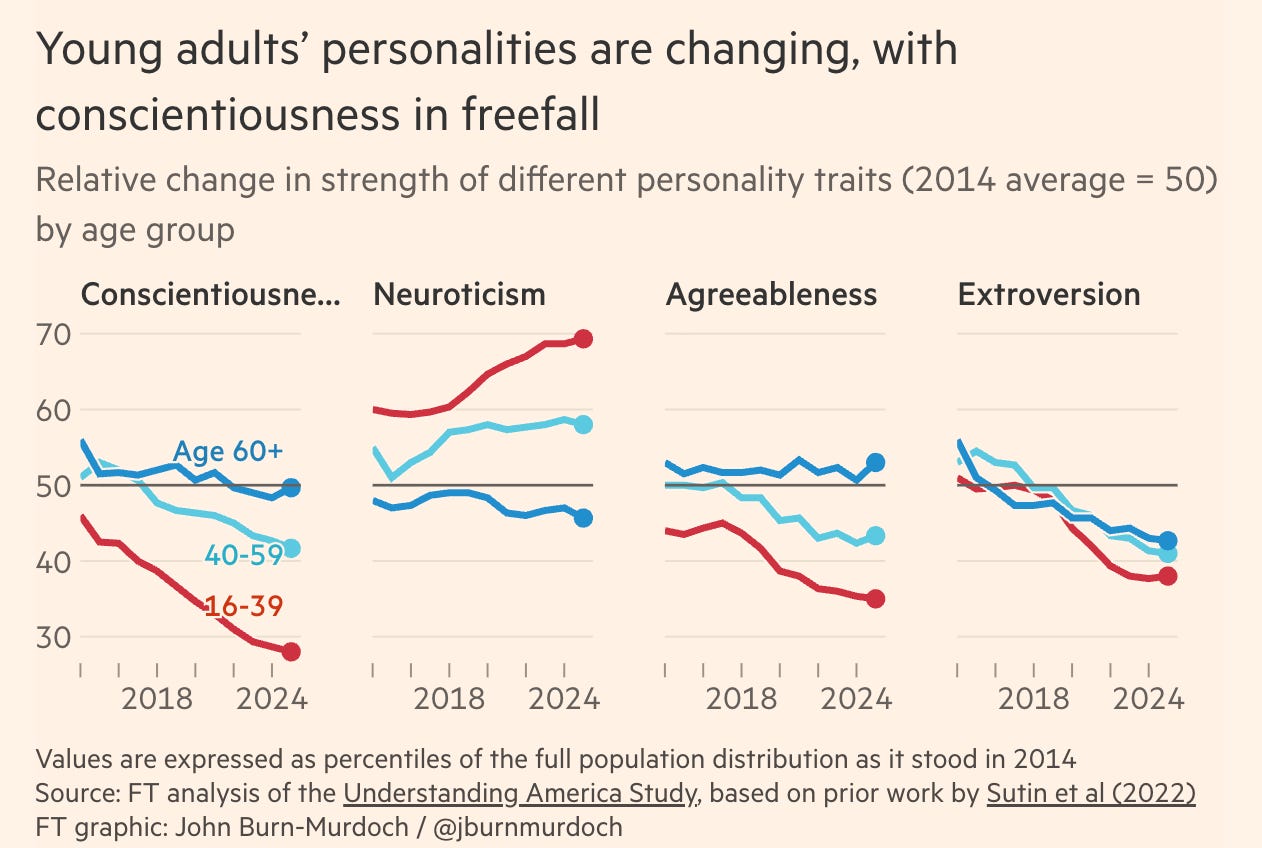
John Burn-Murdoch’s account of declining conscientiousness is part of the same story. Of the available candidates, “conscientiousness” may be the best single word describing what drives social capital: conscientious people do their bit without being told. It is declining precipitately. It certainly describes the mechanism I’ve sketched above with conscientious people initially bearing an intensifying load, discovering that their reward is still more work and eventually withdrawing their goodwill. Burn-Murdoch’s evidence, however, compares cohorts rather than measuring the demoralisation of lower-status professionals within them. It therefore appears to capture an additional, perhaps more powerful effect — the long withdrawing roar of younger cohorts.
There’s a fractal quality to all this. High-performing employers faced with declining conscientiousness will compete for the most conscientious members of the coming cohort, just as desirable schools and neighbourhoods tend to end up with the families who help sustain them. Those employers will prosper and replenish their own social capital, holding enough people who keep promises and show initiative without supervision to sustain it within their corporate cultures.
Others must recruit from what is left. As trust and conscientiousness grow scarcer, those employers intensify monitoring, targets, procedures and disciplinary machinery. Employees who expect little reciprocity learn to protect themselves and to do only what can be seen, and so insisted upon. Call the result Hobbesianism with HR characteristics: not open warfare, but cynical and demoralised workers reporting to careerist bosses disengaged from the work itself, workplaces which focus on whatever is legible to the system — on form rather than the substance of collectively building something worth having.
This is the dystopia Alasdair MacIntyre prophesied 45 years ago. His external goods are what the system can see — with the conscientiousness with which the work is done remaining invisible:
We should … expect that, if in a particular society the pursuit of external goods were to become dominant, the concept of the virtues might suffer first attrition and then perhaps something near total effacement, although simulacra might abound.
Social capital is thus retreating into private consolidation — geographically, institutionally, and up the income and age distributions — in the affluent neighbourhoods, the successful schools and the high-performing workplaces that grow harder to enter. As another common stock — this time of faith — drained away, Matthew Arnold retreated into a similar consolidation: “Ah, love, let us be true / To one another!” The question for our time is whether we can manage something better together: whether we can build institutions that corrode the social capital they depend on less, or, better still, that actively rebuild it. If I know anything, I know it will take the patience and curiosity necessary to get past the buzzwords and talking points in which these questions are usually buried. Still, I think it is less difficult than it sounds. I have offered a few suggestions of my own and hope to develop them further.


A digest of the original article
A recent article from The Cut received a huge amount of attention: ‘It’s Hard to See My Parents Live So Lavishly While We’re Struggling’. The piece includes vignettes of Millenial hardship:
…his dad, Steve, sold his company to a private equity firm about five years ago, which enabled him to retire comfortably in his mid-60s…
Two years ago, Joe asked his dad for a loan… He presented Steve with his business plan, which included a schedule to pay back the money. Still, Steve said “no.”…
“It’s not that I can’t afford to help him,” Steve told me. “I just have a real problem with handouts…
The virality of this piece prompted a discussion between Louise Perry and Rob Henderson…: ‘The politics of the downwardly mobile class’.
Rob disagreed with the Cut article’s perspective:
…generally, Millennials are doing just fine… incomes have remained flat across the three generations…
I disagree!… I think there have been structural changes to our economy and society which clearly explain why these cohorts are failing to move through the five pillars of a stable middle-class existence: education, stable employment, marriage, homeownership, children…
On the surface it does seem as if the young are fine… purchasing power has risen roughly 63 percent since 1973…
And yet this generation is also not marrying, not buying homes, not having children… I think we’re clearly in the midst of a tremendous measurement failure…
Price indexes measure the individual cost of discrete goods, but they are not intended to convey the total cost of personally repurchasing a destroyed commons…
In 2024, for example, a compelling study by Lawrence Summers and colleagues showed that the gap between depressed consumer sentiment and cheerful official statistics closes once borrowing costs (excluded from the modern CPI but important for family finances) are counted as part of the cost of living. The consumers were right.
What actually got cheaper over the past fifty years? Electronics, entertainment, fast fashion, processed food, toys, screens of every kind. And what got more expensive, usually by many multiples? Housing, education, childcare, healthcare, insurance…
Housing is the least ambiguous case. At age 30, 55 percent of the Silent Generation owned homes. For Boomers the figure was 48 percent, for Gen X 42 percent, and for Millennials 33 percent…
The standard escape from renting is saving for a down payment, but soaring rent has made saving near impossible. Roughly half of all renter households now spend more than 30 percent of their income on rent and utilities, the federal threshold for being “cost-burdened,” and more than a quarter spend over half…
One rebuttal you hear… concerns square footage. The line is that… houses today are larger than the bungalows of 1955… the young… are demanding more luxury and are pricing themselves out of the market.
This is unconvincing… zoning regimes across the country make it easier to build large houses than small ones, and buyers who would prefer modest homes in decent areas frequently cannot find them…
[T]he added, expensive square footage — like private school — is a hedge against public dysfunction and is another example of a replacement purchase…
Marriage follows the same pattern. Women now substantially outnumber men on university campuses… yet the preference for husbands who match or exceed a wife’s income and education has not correspondingly relaxed…
Daniel Lichter, Joseph Price, and Jeffrey Swigert constructed statistical profiles of the husbands that today’s unmarried women would marry… These “synthetic husbands” have incomes 58 percent higher than the real unmarried men available…
The average annual cost of childcare reached $13,128 in 2024, a 29 percent rise in four years…
A household with a parent at home produces an enormous stream of untaxed, uncounted output… the daily maintenance of relations with other families…
Move the at-home spouse into the labor market and every service she provided must be repurchased… GDP records each purchase as growth. A family can thus be measured as substantially richer while consuming the same services…
Education is the same… This is where Rob Henderson’s analysis really misses the mark: if a hugely increased percentage of young people are going to college… without substantially increased earnings, that bodes very badly for the young indeed…
Real tuition and fees have roughly tripled at public universities since 1990… total student debt now approaches $1.8 trillion… the debt functions purely as a tax on family formation: it… delays marriage, and delays or forecloses children…
[T]he options are pay private tuition (which has risen about 158 percent in real terms since 1973), pay the housing premium for a catchment with a functional school… The “good school district” premium is a particularly pure example of social capital being financialized and resold as real estate…
The young are told they are richer, and in the currency of flat-screen televisions they are. But the goods that constitute a life — house, spouse, children, good school, good neighbors — have inflated so far beyond wages that the ordinary life path of 1965 now requires an extraordinary income. It turns out that we do actually need social capital. They are not doing well!
Two thousand more words are available by clicking on the article below.


Thanks for this analysis, Nick.
Many of the good things in human civilization require a high-trust and trustworthy society. I claim that the West has usually been better than China in this aspect during the last 200 years. While China continues to explore how low-trust a society can be, the West seems to be copying that bad Chinese trait in business conduct and international diplomacy. Without any precise statistics, I think the US today is noticeably less trustworthy than it was 40 years ago. I don't trust other drivers to reach full stop at stop signs or follow traffic lights. And how much do you trust your doctors now?
Social Fabric (or in any other name) is critical to human civilization and survival. In general, I think that fabric has been weakened and decomposition has started. I believe morality is one of such fabric, yet morality cannot be easily taught or enforced. Strong anti-crime actions might help, but that approach has its own risks.