


Auld Lang Syne
This popped up in my feed. The song Auld Lang Syne has always brought tears to my eyes. But, here’s the thing. It first brough tears to my eyes when I was a primary school kid and used to go to family friends the Lloyds in Beaumaris on New Year’s Eve. We’d all sing the song as Lola Lloyd plonked it out on the piano. (Long gone, she graduated from the Sydney con and, at least for a musical ignoramus like me, she was near concert pianist standard. Some readers may know of her and/or her husband, the economist and great friend of my father Alan Lloyd.) I’m still friends with their son Chris, who has charted the same temperamental journey as John McEnroe from someone who could fly into insane rages at small things (John M did this in his twenties, Chris did it when he was 6) to an aggressively sane and decent adult.
Be that as it may, it wasn’t the words, as I didn’t know what they meant. It was the melody. But not quite. “For the sake of auld lang syne” does conjure the idea of auld memories. And as a kid, you don’t need to be certain to believe something - so it was a song about holding on to old memories as life just went roaring on. And “we’ll take a cup of kindness” wasn’t just easily understood. It went right to my heart. And I think it did with my mother, too. I may be imagining it, but I think I recall tears in her eyes as she sang those words. It was always people’s kindnessess that brought tears to her eyes.
My father? I saw him cry only twice that I recall, never at a time like that. Each time it was about the horrors inflicted on his parents’ generation. But he made a point of remembering and going to visit those who’d changed his life with great kindnesses, something I made a point of acknowledging in the speech I gave in his honour.
And here for the first time (for me anyway) the original words by the incomparable Robbie Burns - with a little translation (though my Mum would have understood quite a few of the Scots words). I didn’t even know for instance that “Should” is the beginning of a rhetorical question. And no. auld acquaintance shouldn’t be forgot - or never brought to mind for that matter.

And speaking of Robbie Burns
Sliding into soft despotism
Henry Oliver documents a bizarre development. And one that can’t end well for what’s left of the left.
When it comes to free speech, Britain is living through a sustained institutional failure. The number of people being arrested for speech offences is astonishing. Earlier this year, The Times reported:
Officers from 37 police forces made 12,183 arrests in 2023, the equivalent of about 33 per day. This marks an almost 58 per cent rise in arrests since before the pandemic.
Policy Exchange estimates that the police spend more than 60,000 hours per year dealing with non-crime hate-incidents.
In January, six officers turned up to arrest a married couple because they made complaints about their children’s school in WhatsApp. The constabulary later had to pay £20,000 in damages. More recently, eleven police officers are reported to have entered Elizabeth Kinney’s home while she was in the bath and arrested her for using the word “fa**ot” in a text message...
And the laws are creeping into more mundane, everyday areas too.
Other speech restrictions are coming into force in the UK. The new Online Safety Act means internet users have to verify their age before they can read something like Ed West’s history Substack. Online fiction which contains sex or violence also requires age verification, as do columns by the Free Press. If Substack doesn’t comply with these rules, it can be fined 10% of its qualifying worldwide revenue, even though it is not a British company...
Britain didn’t plan any of this.
It got here slowly, decision by decision. Legislation that sounds sensible at the time is later put to illiberal purposes. The total effect will gradually become overwhelming. Injustice becomes normalised by every exception. While thousands are arrested for speech offences, in the year to June 2024, 1.9 million violent crimes were closed without being solved. That is 89% of offences. So while hundreds of thousands of violent criminals walk free, thirty people are arrested every day for speech offences.
The man with 18 months jail time and the single mother who sent offensive texts were both reported to the police by someone they were in a personal feud with. This is what illiberal laws do. They pit friends and relatives against each other. The police won’t retrieve your stolen phone or solve violent crimes, but they will send officers to your house because your friend reported you for using hate speech in a private message...
Make Britain Liberal Again
Britain was once a bastion of free speech. Now that is slipping away we must be careful about what we support. If Britain keeps going like this, it will not like the future it makes. More and more people will use these laws to get revenge on friends and relatives. More and more people will think twice before they say something.
Illiberalism is starting to creep across England like a frost. Let’s hope we do not have to wait too long for the thaw.

Do we have anything like emergent ventures? (Hint: No)
A quick chat with ChatGPT
Having seen a particular chapter of Emergent Ventures in India, I wondered. So I asked.
You: Is there anything in Australia like Emergent Ventures?
Me: Well, there are a few things that come to mind. At the government end you’ve got programs like Business Research and Innovation Initiative, which funds early-stage ideas tied to public-sector problems, and state-backed vehicles such as Breakthrough Victoria or Advance Queensland, which support startups and research commercialisation. There are also accelerators, seed funds, and various philanthropic fellowships in science, medicine, and the arts.
You: None of those are really what I had in mind.
Me: Ah—right. I think I see the issue. Those programs look similar only at a very superficial level: they move money to new ideas. But they’re nothing like EV in spirit.
You: Exactly.
Me: EV isn’t just “early-stage funding.” It’s backing people most of those Australian schemes systematically filter out.
You: Yes—that’s the point.
Me: Then the difference becomes clear. Australia doesn’t really have anything that combines:
Extreme procedural simplicity – minimal applications, fast decisions, almost no bureaucracy.
High tolerance for youth and outsider status – no credentials, institutions, or track records required.
Explicit appetite for divergence and weirdness – ideas that don’t fit disciplines, programs, or markets.
Philanthropic risk-taking – small bets where failure is expected and culturally acceptable.
You: Which explains why nothing you listed actually counts.
Me: Exactly. Australia has funding—but not that kind of patronage.
Thrilling
Quite an enjoyable exchange
Go to the opening note if you want to get the context.
Really enjoyable medieval history podcast
Computation and its connotations
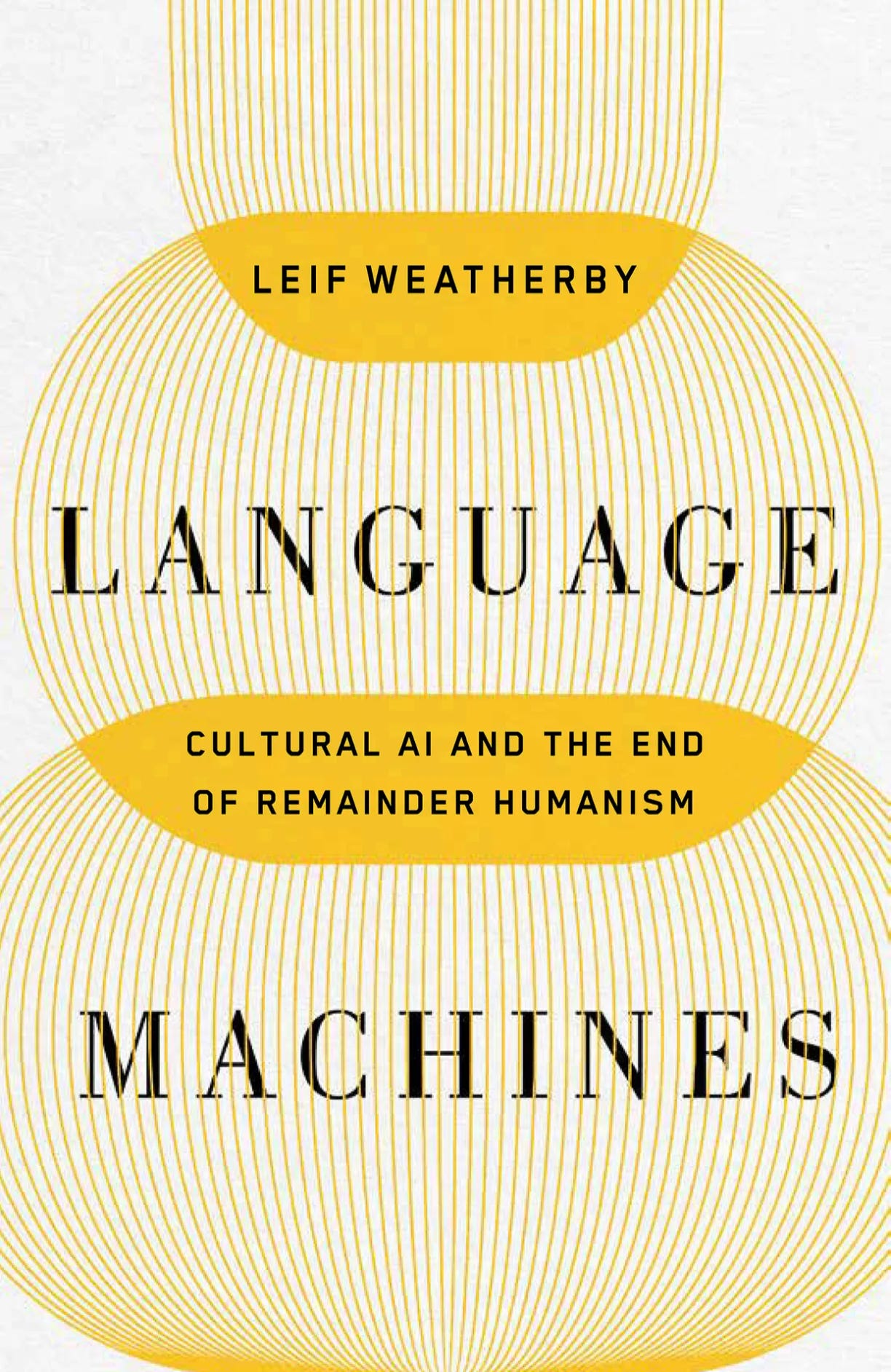
I listened to this 7,500 word review of a new book on LLMs by Leif Weatherby who has an interesting background. He’s an American scholar of German and interested in structuralism. And though I’ve lost what curiosity I ever had about structuralism, the piece’s references to structuralism are not too gobbledigooky if you pay attention. More to the point, it helped me understand certain things about LLMs better and even interact with them more thoughtfully and productively.
A Review of Language Machines by Leif Weatherby
[When Word2Vec emerged a decade ago, it seemed like the clearest vindication of structuralist linguistics - the idea that meaning comes from relational patterns between words rather than reference to the world.] Yet as deep neural networks evolved into large language models (LLMs) like ChatGPT, [structuralists still haven’t embraced them.] I’ve been waiting a decade for someone to write a book about this. Leif Weatherby’s Language Machines finally does, explaining what LLMs are actually doing and what this reveals about language itself.
[These systems represent words as vectors in high-dimensional space, where meaning is determined by relational patterns between values.] This validates the differential hypothesis: linguistic meaning is principally determined by relations of difference between arbitrary signs. ...
[Why haven’t structuralists embraced this vindication?] One key issue is that the humanities have become gripped by remainder humanism - summoning some special feature of the human spirit that machines might never emulate. ...
Weatherby’s key move is to bracket language from deeper questions to which it’s supposedly bound.
Against cognitive scientists, he brackets whether LLMs are ‘intelligent’, focusing instead on their communicative role. Against philosophers of language, he brackets both the referential function of language and the intent involved in using it. ... He argues that LLMs cut across rigid distinctions between syntax and semantics, sifting pragmatic patterns from psycho-social contingencies. ...
Weatherby proposes that structural relations between words are implicit in the redundancy of the linguistic signal. ... Communication involves partial uncertainty about how the signal will continue - its ongoing trajectory. The probability distributions LLMs use to generate text capture these patterns. There’s a tension between meaning as static relationships between words and meaning as dynamic tendency toward completion. ...
LLMs treat language as a surface without depth. ... They take linguistic input and produce linguistic output, never leaving the linguistic surface. ...
But LLM outputs are peculiarly self-referential. What makes transformers powerful is their attention mechanism, which tracks how tokens are relevant to one another over large swathes of text. ... This means they prioritize the internal coherence of a message over its correspondence to the external world. Weatherby claims that for LLMs the poetic function of language is primary. Just as the poet crafts coherent connections between words heedless of consequence, so does the LLM craft coherent responses heedless of correctness. This is why LLM writing is better at aping holistic vibes than reporting discrete facts. Weatherby suggests we might better call them large literary machines. ...
[The author offers an important qualification through inferentialism - the view that meaning is tied to inference, the “game of giving and asking for reasons.” This suggests LLMs should be understood not as non-cognitive but as pre-cognitive.] ...
We might distinguish between implication and connotation. ‘That’s strange’ and ‘that’s queer’ may have similar inferential roles, but ‘queer’ bears complex associations that subtly warp discourse, signalling affiliations or summoning topics. ... These proto-inferential patterns offer generative inspiration to cognitive discovery.
LLMs don’t draw this distinction. They capture implication and connotation together. This is why they’ve been better at producing stylistic coherence than logical consistency. ... [Reasoning models may help filter implication from connotation, shaping] the generative potential of language along a recognisable trajectory from pre-cognitive to cognitive. And it’s ultimately this trajectory that Weatherby’s plea for structuralism makes visible.
Lecture on the poetics of AI by Leif Weatherby
Yes, sounds poncy I know, but as you’ll have observed from the piece above, his use of the term poetics is quite intriguing and, I think informative. Make sure you listen to him talking about Edgar Allan Poe. And sorry that the sound quality varies.

Semantic Apocalypse Now: More on LLMs

Thanks to friend and subscriber Michael for alerting me to this piece.
“Like an alien consciousness,” is how chess grandmasters describe the play-style of supercomputers.
The chess “apocalypse” began some time after November 2005, when grandmaster Ruslan Ponomariov defeated Deep Fritz, the last time a human would ever beat the machine... effectively the game is “solved.”...
Crossing a similar event horizon with language would be the “semantic apocalypse” - when no human will be able to construct a sentence more beautifully or saliently than a machine, as judged by other humans.
We can, I think, glean a lot about this new apocalypse from the former...
Grandmasters aren’t making hundreds of thousands of calculations. They’re seeing the “gestalt” of the board and “feeling” out what move to make next... As good chess players become great, activity migrates away from their calculating left brain, toward their intuitive right.
That’s why the AI feels like an “alien” to the grandmaster... Yeah, it wins, but so what?
Magnus can’t compete with the computers, but millions still want to watch Magnus because Magnus has a personality...
And now I hear the cries of the AI guys: these are just Luddite artifacts of human sentimentality... but the endgame of AI is to solve reality better and more efficiently than any human mind ever could...
To that I say… you sure about that?
Think about why we even invented games like chess: you put a few simple rules on a grid, suddenly combinations explode... It is, in a word, a simulation.
By having computers “solve” the simulation, you haven’t proved that you are on your way to solving the reality it represents. You’ve just proved you don’t understand the point of a damn game. You’ve brought a revolver to a boxing match.
And the same is true for language...
Thinking is embodied... Words are just what happens... when we look back and try to record a thought...
Like chess, language has relatively simple rules... but uncountable possible combinations...
The large language models are getting better at “solving” the language game... What’s terrifying is not the possibility of AI stealing our humanity. It can’t. Rather, it’s the sad fact that such a large number of people make their living pushing linguistic symbols around in arbitrage, like a machine...
As a writer, GPT feels like an “alien consciousness” - without vitality or an ethos... But it can’t feel the gestalts! so, who cares, then?...
What really frightens people is that we have become totally convinced that “the language game” is reality... Language is best when it only attempts to gesture at this underlying reality, as in poetry...
As the LLMs continue to fail to generalize, we will continue to come up with creative reasons why we’re “not quite there yet.”...
Our natural nervous systems are perfectly adapted to this ultimate uncertainty by being able to “play.”... Machines fundamentally can’t do this... because they begin by breaking into halting ones and zeros what is finally flow...
I do still fear AI, though, not because I think it can do what I do. It can’t, specifically because it doesn’t have a wife and feet and bowel movements. I fear it because it will give power to a mistake: one that thinks the games we build to simulate reality are the meat of being itself.
I believe that this mistake - the ideology of the materialist and his machines - has already caused much suffering. AI can and will augment this mistake beyond comprehension, and that is a sort of apocalypse...
We can only fight them by becoming even more human...
The right thing to do, I think, is to become like Magnus Carlsen: become a master of play, despite the apocalypse.

Fabulous
The unlikely team that routed around bureaucratic incompetence to help win the civil war
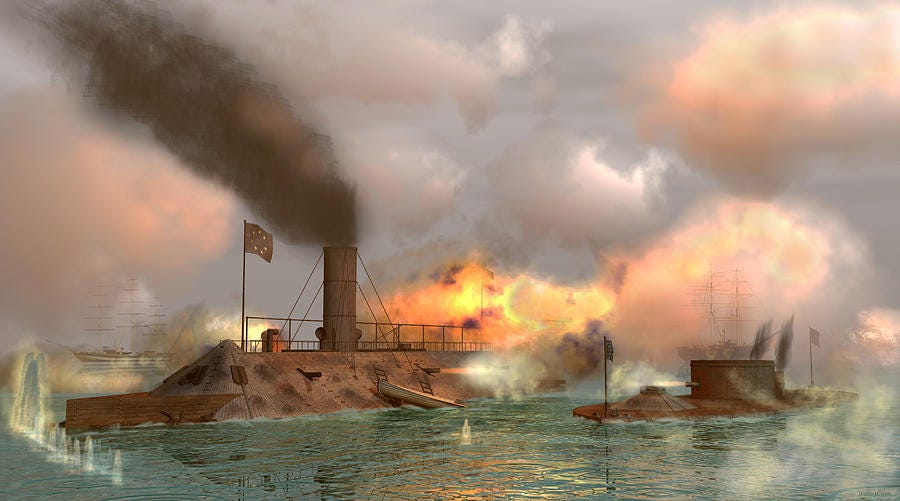
On the morning of March 8, 1862, the CSS Virginia steamed into Hampton Roads and announced the future of naval warfare. Built from the wreckage of the USS Merrimack and armored with iron plate, the Confederate ironclad devastated the Union’s wooden fleet... By day’s end, 261 Union sailors were dead. It was the worst day for the U.S. Navy until Pearl Harbor...
On March 9, the USS Monitor, the Union’s ironclad, arrived. One observer called it a “cheesebox on a raft.” For hours the two ironclads hammered one another at point-blank range, each ship’s shots bouncing harmlessly off its adversary...
A tactical draw, the battle was a watershed in naval warfare. Within weeks, the U.S. Navy ordered more ironclads. Britain halted construction of wooden warships.
What made March 9 extraordinary was that the Monitor had been built in only 100 days.
100 Days to Revolution
On August 3, 1861, Congress directed Secretary of the Navy Gideon Welles to study ironclads and appropriated $1.5 million. Five days later, the board advertised for “iron-clad steam vessels of war,” giving contractors twenty-five days to submit proposals...
One contract would change everything. It demanded delivery in 100 days, set a fixed price with no cost overruns, and included a performance warranty: if the vessel failed in battle, contractors would repay the government. That vessel would become the Monitor...
Behind it was an unlikely partnership: a disgraced inventor, a young venture capitalist, and a Navy secretary willing to bet everything on unproven technology.
The Heretic and His Necessary Partners
John Ericsson was exactly the visionary the Union needed—and exactly the kind who would never work with the U.S. government again. The Swedish-born engineer had designed the U.S. Navy’s first screw propeller in 1844, but disastrous results left him bitter... When the Navy’s ironclad solicitation came, Ericsson had the answer, but refused to submit it...
Enter Cornelius Bushnell, a New Haven financier. [A] colleague connected him with Ericsson. At their meeting, the inventor explained his radical design: a vessel with a submerged hull and rotating turret, “absolutely impervious to the heaviest shot and shell.” Bushnell immediately saw its superiority and urged Ericsson to present it to Washington. When Ericsson refused, Bushnell told him he’d do it himself.
This was Bushnell’s genius: recognizing breakthrough innovation and knowing how to deliver it. He lobbied Welles “amid the cigar smoke and genial pandemonium” of the Willard Hotel...
But even Bushnell’s tenacity wasn’t enough. The innovation needed an internal champion.
Navy Secretary Gideon Welles was that man. When the Ironclad Board balked, Welles told them he would “assume the risk and responsibility.”...
The Monitor‘s success required all three men. Ericsson provided the breakthrough. Bushnell furnished the resources to hack the system. Welles absorbed the risk and shielded the project from institutional resistance...
Ready for the Next Crisis
It’s tempting to dismiss the Monitor‘s story as a product of existential crisis. There’s truth to that.
But the lessons concern how breakthrough innovation reaches the field.
First, heretics alone don’t deliver innovation. Ericsson’s genius would have stayed in a dusty box without Bushnell and Welles. Today’s defense innovation needs all three: heretics, system-savvy enablers, and risk-absorbing bureaucrats.
Second, design acquisitions that prioritize outcomes over process. The Monitor‘s contract gave Ericsson 100 days with a performance warranty. The principle holds: eliminate requirements that don’t serve the mission. Test multiple prototypes. Make contractors share the risk.
Finally, the Monitor leveraged existing industrial capacity and proven technologies in a novel configuration.
We can’t manufacture crisis. But we can build the partnerships and industrial base now so that when crisis comes we are ready.
Textbook versus pragmatic reform

In my PhD I showed how Australian economists had taken a tendentious understanding of ‘textbook’ economic reform from Max Corden and so had not properly understood the way in which reform could be done through special economic zones. So I found this interesting.
This is largely being ignored but it’s easily one of the biggest China news of the year.
What China is doing with Hainan - a huge island (50 times the size of Singapore!) - is pretty extraordinary: they’re basically making it into a completely different jurisdiction from the rest of the country, and an extremely attractive entry gate for the Chinese market.
You can now import most products in the world (74% of all goods) entirely duty free into Hainan. And, if you transform the product and add 30% value locally, you can then send it to the rest of mainland China completely tariff-free.
So for instance: import Australian beef into Hainan tax free. Slice it and package it for hotpot in Hainan: it can enter all mainland supermarkets duty-free.
They also have insanely low corporate tax rates: 15%, lower than Hong Kong (16.5%) and Singapore (17%) or the rest of the mainland (25%).
That’s not all, Hainan now has different rules from the rest of China in dozens of areas:
HEALTH: Basically the rule is that if a medicine or medical device is approved by regulatory agencies anywhere in the world, it can be used in Hainan - even if banned on the mainland. Which undoubtedly makes it THE place in the world with the widest range of medical treatments available.
NO FIREWALL: Companies registered in Hainan can apply for unrestricted global internet access
OPEN EDUCATION: Foreign universities can open campuses without a Chinese partner
VISA-FREE: 86 countries get visa-free entry, probably one of the most open places in the world
CAPITAL: Special accounts let money flow freely to and from overseas - normal mainland forex restrictions don’t apply
So they’re running a pretty extraordinary “radical openness” experiment there.
They’re basically building a “greatest hits” of global free zones: Singapore’s tax regime, Switzerland’s medical access, Dubai’s visa policy - all in one giant tropical island attached to the 1.4 billion people Chinese consumer market.
Fabulous
Heaviosity half-hour
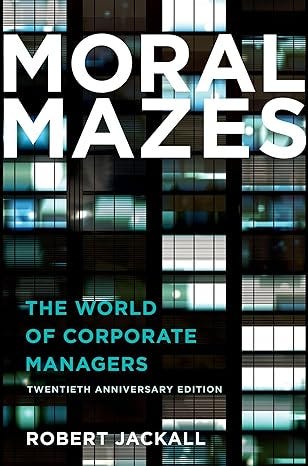
I hadn’t heard of Robert Jackall’s Moral Mazes, an investigation into the ethics of corporate workplaces, not according to anyone’s idea of how it should be, but as an empirical matter. It’s not a pretty sight of course. It struck me that the book should have been a key text for interpreting Robodebt. But it wasn’t. Reflecting a practice I’m finding really useful, here’s Claude’s summary of the book - an excellent guide from which one can choose to dip in and out of the original thing.
Summary of Moral Mazes: The World of Corporate Managers by Robert Jackall
Introduction: Business as a Social and Moral Terrain
Jackall opens with a puzzle: corporate leaders tell their charges that hard work leads to success, yet managers themselves no longer see success as necessarily connected to hard work. Instead, they see politics, luck, connections, adroit talk, and self-promotion as the real sorters of people into sheep and goats. This dissonance is the book’s central concern.
The book examines the occupational ethics of corporate managers—not prescriptive morality but the actual moral rules-in-use that managers construct to guide their behaviour at work. Jackall treats ethics and morality sociologically, as empirical realities to be investigated, not as fixed systems of norms.
Bureaucratic work, Jackall argues, causes people to bracket the moralities they might hold outside the workplace and follow instead the prevailing morality of their particular organizational situation. As a former vice-president puts it: “What is right in the corporation is not what is right in a man’s home or in his church. What is right in the corporation is what the guy above you wants from you. That’s what morality is in the corporation.”
Jackall’s fieldwork was conducted primarily at three companies given pseudonyms: Weft Corporation (textiles), Alchemy Inc. (chemicals, part of Covenant Corporation), and Images Inc. (public relations).
Chapter 1: Moral Probations, Old and New
This chapter traces the transformation from the Protestant ethic to the bureaucratic ethic.
The Protestant ethic linked self-probation, work in the world, and eternal salvation. Hard work in a worldly calling, crowned with economic success, proved a person before others and helped convince him he was among God’s elect. This ethic provided both the economic and moral foundations for modern capitalism—a ready-made prescription for building capital and an ideology justifying wealth accumulation.
But this ethic came under assault from two directions. First, the very accumulation of wealth it made possible gradually stripped away its religious basis. By the late 1800s, the specifically religious meaning survived principally among independent farmers and small business proprietors. The ethic had become secularized into the work ethic, rugged individualism, and the success ethic.
Second, and more fundamentally, bureaucratization transformed the organizational form of work itself. The hallmarks of the emerging system were administrative hierarchies, standardized procedures, regularized timetables, uniform policies, specialized expertise, and centralized control. This produced the decline of the old middle class (entrepreneurs, free professionals, independent farmers) and the ascendance of a new middle class of salaried employees—clerks, managers, technicians, professionals—whose chief common characteristic was their dependence on the big organization.
American bureaucracy, Jackall argues, differs from Weber’s classical model of legalistic objectivity and impersonality. Instead, it is a hybrid combining features of modern bureaucracy with patrimonial bureaucracy—the organizational form of kings’ courts, marked by personal loyalty, patronage, and factional intrigue for the ruler’s favour. In America, the hierarchies of corporate bureaucracy allow the hankerings for attachment generated by American historical experience to be focused on chief executive officers.
Jackall gained access to his field sites only through personal vouching and demonstrating that he already grasped managerial morality—illustrating the probationary nature of managerial circles.
Chapter 2: The Social Structure of Managerial Work
The hierarchical authority structure is the linchpin of bureaucracy and dominates how managers think about themselves and their world. Managers always describe their work in relational terms: “I work for [Bill James]” or “I’m in [Joe Bell’s] group.”
American businesses centralize and decentralize simultaneously. Power concentrates at the top in the CEO while responsibility for decisions and profits is pushed down through “management-by-objective” systems. This creates a chain of commitments from the CEO down to the lowliest product manager.
In practice, this shapes a patrimonial authority arrangement. A subordinate owes fealty principally to his immediate boss. He must:
Never overcommit his boss
Keep his boss from making mistakes, particularly public ones
Keep his boss informed (never let him get “blindsided”)
Never circumvent his boss or appear to do so
Never contradict his boss’s judgment in public
Extend ritual deference even within informal first-name cultures
Details are pushed down and credit is pulled up. Superiors avoid giving detailed instructions to preserve their right to declare that mistakes have been made. This protects their “deniability.” Credit flows upward to the highest-ranking officer involved—authority provides a license to steal ideas. The person who appropriates credit redistributes it as he chooses, giving credit “not necessarily where it is due... but where prudence dictates.”
The CEO’s power is enormous. His wishes become commands through zealous subordinates. Great efforts are made to please the CEO—when one visits a plant, the most significant order of business is a fresh paint job, even when costing over $100,000. Speculation about the CEO’s plans, intentions, and style is the most common topic of managerial conversation.
Managers carry elaborate cognitive maps containing biographical sketches of every other manager of equal or higher rank—previous reporting relationships, patronage ties, alliances, social slights, battles won and lost. These maps are crucial because “in the rough-and-tumble politics of the corporate world, individual fates are made and broken not necessarily by one’s accomplishments but by other people.”
The chapter illustrates political struggles through the 1979-1983 upheavals at Covenant Corporation: the “big purge” (Bloody Thursday) when a new CEO installed his own people, the subsequent shake-ups when Smith overcommitted Alchemy Inc. and faced blame-time, Brown’s exile and later rehabilitation. These shake-ups are endemic to corporate life—each new CEO reorganizes to prevent inheriting blame, project an image of aggressiveness, and rearrange fealty structures to place loyal barons in power.
Success depends on membership in circles of affiliation—networks, coteries, cliques—that establish informal criteria for trustworthiness, emotional comfort, and admission.
Chapter 3: The Main Chance
Once managers pass certain “breaking points” in the hierarchy (grade 13/25 at Alchemy, grade 20/29 at Weft), competence is taken for granted and assumed not to differ greatly from one manager to the next. Future chances then depend principally on meeting social criteria established by authority, political alignments, and organizational ethos.
Managers must master their public faces. Bureaucracies rationalize not just work but people’s external appearances. From college recruiting onwards, managers learn that “proper management of one’s external appearances simply signals to one’s peers and to one’s superiors that one is prepared to undertake other kinds of self-adaptation.”
The premium on self-control is paramount. Managers must mask emotion and intention behind bland, agreeable public faces. They must avoid betraying secret knowledge or intentions through any relaxation of self-control. A case study of a president’s flagrant affair demonstrates that even those at the top are condemned by subordinates not for sexual behaviour as such but for being “out of control,” for “losing their cool,” for “acting irrationally.” The price of bureaucratic power is relentless subjection of one’s impulses, at least in public.
Team Play
Team play has multiple dimensions:
Appearing interchangeable with other managers—strong convictions of any sort are suspect
Putting in long hours at the office (norms set by superiors; 12-14 hour days are common)
Being seen as an effective group member, not a prima donna—striking characteristics are dangerous; being called “brilliant” almost invariably signals trouble
Style Over Substance
Style matters more than substance. Managers must cultivate the ability to present themselves in the right way: seeming authoritative, decisive, articulate. What counts is not objective measures but others’ perceptions. “Self-rationalization” becomes key—treating oneself as a commodity to be systematically developed and marketed.
Patronage
Patronage is essential for advancement. Patrons provide visibility, connections, protection. A subordinate’s relationship with his patron parallels his relationship with his boss but is more ambiguous. Without a patron, one has no one to fight for one’s interests in the forums where decisions about careers are made.
Performance and Luck
Performance matters only within social context. “You can lose money and still be an insider; you can make money and still be an outsider.” The socially determined nature of failure means managers are rarely told directly they are “nonpromotable”—they are expected to “get the message” through indirect signals.
Luck is considered crucial—being in the right place at the right time. But the real task is to shape others’ perceptions of oneself and to outrun one’s mistakes by moving quickly before problems surface.
Chapter 4: Looking Up and Looking Around
Decision-making prowess is the core of the managerial mystique, but the actual rules for making gut decisions differ sharply from theory and rhetoric. The basic principles are: (1) avoid making any decision if at all possible; (2) if a decision must be made, involve as many people as you can so that if things go wrong, you can point in as many directions as possible.
Looking up (to bosses) and looking around (to peers) paralyzes decision-making. The social psychology is rooted in pervasive uncertainty—managers’ sense of organizational contingency, authoritative capriciousness, and the lack of firm connections between work and reward lead many to doubt their abilities. Many managers live in constant fear of “being found out.”
The structure of bureaucratic work itself prompts this behaviour. Bureaucracy fragments knowledge—only those with a “need to know” are privy to crucial details. This separation, paradoxically, provides a stimulus to link people socially. When a manager faces a hard decision, even when he knows others are aware of it, he must actively involve them to hope for their support later.
Short-Term Thinking
Short-term thinking dominates for several reasons:
Professional managers’ training emphasizes financial wizardry and quick turnarounds over production
Accounting systems stress short-term profit maximization
Evaluation based on short-term results
A case study of the coking plant illustrates the consequences: in 1975, managers faced a $6 million decision to restore a deteriorating battery. The CEO had ordered deferral of capital expenditures. No decision was made. By 1979, the battery collapsed entirely, triggering breach of contract, EPA violations, and costs exceeding $100 million. The managers chose short-term safety (not contradicting the CEO) over long-term gain.
Blame-Time
Blame-time is what managers fear most—being scapegoated when things go wrong. There is no tracking system for responsibility; whoever is currently in charge is blamable. Managers “CYA” (cover your ass) with memos during crises, but the real defense is agility and political connections.
“Milking“ plants and businesses—deferring maintenance and investment, taking the money and running before deterioration becomes evident—is common. “Young’s catastrophe” illustrates what happens when someone tries to think long-term: pausing to consider the future allows mistakes to overrun him.
Chapter 5: Drawing Lines
The moral ethos of managerial circles is notable for its lack of fixedness. Morality does not emerge from internally held convictions but from ongoing relationships with people who matter. Since these relationships are multiple, contingent, and in flux, managerial moralities are always situational, always relative. The corporation places a premium on “flexibility.”
Case Study 1: White (Weft Corporation audiologist)
White discovered that 75% of textile workers had hearing damage—12% already compensable, another 63% steadily worsening. He proposed extensive educational programs. But White:
Stood at the margin of the fealty structure
Had an unsympathetic boss
Had no powerful patron
Made other managers uncomfortable by framing hearing loss as a moral issue rather than a “liability consequence” or “rational/technical problem”
His report was buried. He left the company. The eventual OSHA rule produced only minimal changes.
Case Study 2: Brady (financial VP)
Brady discovered $75,000 in doctored invoices, then a much larger manipulation: $18 million from the employee pension fund being used as a profit slush fund to ensure executives hit bonus targets. He tried to report through proper channels but discovered the CEO himself was behind the manipulation. The entire dual reporting system was partly a spy network to guard against discovery.
When Brady went to the corporation’s chief lawyer with the full case, the lawyer “did not want to touch the issue with a barge pole.” A friend urged Brady: “Look, why don’t you just forget the whole thing. Everyone does it. That’s just part of the game in business today.”
Other managers’ assessments of Brady are revealing. They saw him as violating bureaucratic rules: going around his boss, not keeping quiet, insisting on professional ethics irrelevant to the organization. “When rubber hits road,” abstract principles don’t help.
Alertness to Expediency
Bureaucracy transforms moral issues into practical concerns. Managers’ pragmatism stems from the priority given to organizational rules and social context over principles. Alertness to expediency—accurate assessment of the intersection between situational exigencies, institutional logic, and personal advantage—is the key virtue.
Tucker’s stories illustrate the ambiguity:
He saved his company from a product disaster by reporting test failures—was never thanked, but established a reputation for discretion and trustworthiness.
He covered up workers’ exposure to carcinogens—rationalized through loyalty to colleagues and belief in the organizational support system.
Alertness to expediency eliminates fixed ethical lines, but managers must still legitimate actions publicly.
Chapter 6: Dexterity with Symbols
The ideological complexity of corporations matches their social density. Managers must manipulate with finesse a variety of sophisticated, often contradictory, symbolic forms.
Euphemistic and Provisional Language
Public language is euphemistic and provisional. Managers use indirect, ambiguous language that can be reinterpreted if contexts change. They are not held to what they say because it is understood that their word is always provisional. Stock phrases in performance appraisals carry hidden meanings: “Exceptionally well qualified” = “Has committed no major blunders to date”; “Tactful in dealing with superiors” = “Knows when to keep his mouth shut.”
Euphemism serves multiple purposes:
Allows reinterpretation if social relationships change
Protects superiors’ “deniability” by concealing problem dimensions in abstract terms
Defuses public criticism through unemotional characterizations (cotton dust becomes “air-borne particulate”; byssinosis becomes “symptom complex”)
Management Consultants
Management consultants exemplify ambiguous expertise. They are rooted in:
Scientific management (Taylor)—systematic rationalization of work
Human relations (Mayo)—making people happy at work
Social science applications—surveys, tests, programs
Consultants help managers legitimate expedient action and transform problems into rational/technical issues. But their relationship with clients is political—they must depend on authorities’ problem definitions and maintain a stance of rational expertise while serving clients’ interests.
The short-term ethos means programs constantly change as executives seek fresh approaches to impress peers. Managers privately mock consultants as “whores in pinstripe suits” but publicly embrace whatever programs bosses favour.
The Cotton Dust Case
The cotton dust case (Weft Corporation) illustrates adeptness at inconsistency. The company:
Publicly fought regulation, claimed no problem existed, blamed smoking
Privately knew the problem existed and used regulation to force modernization that increased productivity while reducing dust
Multiple contradictory messages went to different audiences: regulators, the public, internal hierarchy. “Being able to speak out of both sides of your mouth without missing a step” becomes essential for executive success. Inconsistency without moral uneasiness becomes a taken-for-granted habit of mind.
Chapter 7: The Magic Lantern
The need for symbolic dexterity intensifies as one ascends the hierarchy. Public relations transforms moral issues into issues of image management. The goal: shape public opinion to allow uninterrupted business operation.
History of PR
Began with circus barkers (P.T. Barnum)
Evolved through press agents and publicity stunts (Harry Reichenbach)
WWI propaganda (Creel Committee) brought together journalists, PR experts, and advertisers
Ivy Lee counseled openness and grand conciliatory gestures
Edward Bernays developed sophisticated techniques for moulding public opinion by appealing to the “group mind”
Depression-era campaigns (NAM) promoted the “American business creed”
Postwar institutionalization made PR pervasive
Truth as Perception
PR practitioners see no such thing as truth—only stories, perspectives, opinions. Truth is what is perceived. Creating an impression of truth displaces any search for truth. Practitioners develop a reflexive ability to “doublethink”—holding contradictory versions of reality simultaneously.
Key PR Techniques
Fronts: fictive organizations concealing real interests (the “Alliance for Responsible CFC Policy” was actually chemical companies; “Total Litter Control” was bottle manufacturers; the “Formaldehyde Institute” was a trade association posing as scientific institute)
Landmark studies commissioned to gain publicity and legitimacy
Symbolic inversion: transforming weaknesses into strengths, subverting opponents’ credibility
Exploiting scientific ambiguity: invoking canons of science while surrounding oneself with credentialed experts
Legitimating PR Work
Practitioners legitimate their work by:
Identifying with clients’ interests
Claiming a professional advocacy role (”hired guns”)
Pointing to social goods as by-products
Arguing PR simply embodies universal human subterfuge
The most important audience is managers themselves. PR helps managers invent better reasons for expedient action, reducing the distance between “flexibility” and belief in one’s own rectitude. Rehearsals of legitimations go through three stages: casting around for perspectives, devil’s advocacy, crystallizing the rationale the circle “feels comfortable” with.
Public-relations-mindedness makes placating publics the principal goal and leaves substance in dim periphery.
Chapter 8: Invitations to Jeopardy
The bureaucratic ethic contrasts sharply with the Protestant ethic:
Protestant Ethic Bureaucratic Ethic Linked hard work → success → salvation Success depends on capricious superiors and market Self-confident propertied class Dependent salaried employees Word as bond Language separated from meaning God as judge Boss as judge Internal moral gauges Organizational rules and social context as moral gauges
Bureaucracy creates a Calvinist world without a Calvinist God—the same profound anxiety but stripped of comforting illusions.
Recurring Dilemmas
1. Interpersonal Ethics vs. Dominance Struggles
At bottom, much managerial work consists of ongoing struggles for dominance and status. Real administrative effectiveness flows from prestige—the ability to work one’s will. Managerial effectiveness requires the willingness to battle for dominance and to make whatever moral accommodations such struggles demand. Those who adhere to an ethic of brotherly love risk faltering. But those who hone themselves to do what must be done accept the peculiar emotional aridity that is one price of organizational striving.
2. Pervasive Mediocrity
The lack of fixed criteria to measure quality produces a leveling process and comfortable mediocrity. This breeds an endless quest for social distinctions that might give one an “edge” and encourages a predatory stance toward one’s organization—a search for private deals, working the system for personal advantage. The system is characterized by the exchange of personal favours, collection of damaging information about others, and pervasive secrecy.
3. The Meaning of Work
There are no intrinsic connections between corporate good, individual good, and the common weal. Connections can be forged through ideology but are difficult to sustain.
The food preservative case illustrates the ambiguity of “corporate responsibility”: when a preservative was fingered as carcinogenic, the CEO divested the business as an act of responsibility. Alchemy managers saw this as “caving in”—they argued the real responsibility was doing necessary but tainted work (risk of slight cancer increase vs. certainty of botulism surge). Managers feel altruism is always denied them. They wonder: is corporate responsibility maintaining a sense of moral purity while someone else does necessary dirty work?
Work becomes increasingly abstract as one advances—losing connection to concrete tasks and technical expertise. Rational efforts beget irrationality. This produces nostalgic yearnings for simpler times.
The Real Meaning of Work
The real meaning of work becomes keeping one’s eye on the main chance—maintaining position and career through social intricacies. Acceptance into managerial circles provides professional intimacy but requires continual compromises with integrity. Self-rationalization produces psychic asceticism—disciplining oneself, stifling spontaneity, objectifying oneself. This creates narcissism and curious guilt expressed in private emotional life.
For those with requisite discipline, flexibility, and tolerance for ambiguity, rewards can be great. Those who succeed shape the moral rules-in-use that filter down through organizations:
Principles → guidelines
Ethics → etiquette
Values → tastes
Responsibility → public relations
Truth → credibility
Managers pragmatically take the world as they find it, pursue careers within the rules, and unintentionally create a society where morality becomes indistinguishable from the quest for survival and advantage.
Afterword: Moral Mazes and the Great Recession (2010 edition)
Jackall revisits his themes in light of the 2008 financial crisis, arguing that the cataclysms illustrate organized irresponsibility at scale:
Outsourcing of core industries
S&L collapse ($124 billion taxpayer cost)
Derivatives explosion (over $1 quadrillion market)
Political pressure on Fannie Mae and Freddie Mac to lower lending standards
Enron’s manipulation and collapse as paradigm
Housing bubble and crash
Bear Stearns, Countrywide, and subsequent failures
The structural themes of Moral Mazes predict these outcomes: short-term thinking, diffusion of responsibility, manipulation of symbols over substance, the premium on appearing rather than being, the separation of action from accountability. The Great Recession was not an aberration but an expression of the bureaucratic ethic operating at civilizational scale.
Core Argument Summary
Bureaucracy shapes moral consciousness by:
Personalizing authority while fragmenting responsibility
Separating action from accountability through diffusion of decision-making
Making career success dependent on social rather than substantive criteria
Requiring the bracketing of external moralities in favour of situational, organizational ones
Placing a premium on symbolic manipulation over substance
Creating a world where “what is right is what the guy above you wants from you”
The resulting bureaucratic ethic:
Is always situational and relative
Values “flexibility” (the ability to redefine one’s position as circumstances change)
Rewards alertness to expediency
Transforms moral issues into issues of public relations
Makes truth a matter of credibility rather than correspondence with reality
Strips work of intrinsic meaning, leaving only the quest for survival and advantage
Managers are not villains but rational actors responding to the structural incentives of their world. They unintentionally create and perpetuate the very system that constrains them. The bureaucratic ethic is thus self-reproducing—those who succeed shape the rules-in-use for those below.
Dear Nicholas: What a feast of things I like: Robbie Burns - A Man's a Man for a' That and a' That - my favourite call out of classism - and yes, too, the sentimental playing of Auld Lang Syne. During my years in Japan I was initially surprised that the tune for "Auld Lang Syne" was used for the song of graduation in Japan:
(From Wikipedia as follows:
otaru no Hikari (蛍の光; meaning "Glow of a firefly") is a Japanese song incorporating the tune of Scottish folk song Auld Lang Syne with completely different lyrics by Chikai Inagaki, first introduced in a collection of singing songs for elementary school students in 1881 (Meiji 14). The swapping of lyrics without substantial change to the music is known as contrafactum. The words describe a series of images of hardships that the industrious student endures in his relentless quest for knowledge, starting with the firefly's light, which the student uses to keep studying when he has no other light sources (originating from the story of Che Yin from Volume 83 of the Book of Jin). It is commonly heard during graduation ceremonies and at the end of the school day. Many stores and restaurants play it to usher customers out at the end of a business day. On the very popular Japanese New Year's Eve TV show, NHK's Kōhaku Uta Gassen, it has become a tradition for all the performers to sing Hotaru no Hikari as the last song. From 1993 until 2020, this was also played at Tokyo Disney Resort during fireworks shows on New Year's Eve. Another song from the same period and used at graduation ceremonies thought to be based on a Scottish folk song is "Aogeba Tōtoshi".
Lyrics
Verse Japanese text Romaji English translation
1 螢の光、窗の雪、
書讀む月日、重ねつゝ。
何時しか年も、すぎの戸を、
開けてぞ今朝は、別れ行く。 Hotaru no hikari, mado no yuki,
Fumi yomu tsukihi, kasane tsutsu
Itsushika toshi mo, sugi no to wo,
Aketezo kesa wa, wakare yuku. Light of fireflies, (moonlight reflected off) snow by the window.
Many days and months spent reading.
Before one knows it, years have passed. The door
we resolutely open; this morning, we part ways.
2 止まるも行くも、限りとて、
互に思う、千萬の。
心の端を、一言に、
幸くと許り、歌うなり。 Tomaru mo yuku mo, kagiri tote,
Katami ni omou, chiyorodzu no,
Kokoro no hashi wo, hitokoto ni,
Sakiku to bakari, utau nari. Stay or leave, either an end
Mutually, countless thoughts
from the bottom of the heart, expressed in one word
a wish for peace, we sing.
3 築紫の極み、陸の奧、
海山遠く、隔つとも。
その眞心は、隔て無く、
一つに盡くせ、國の爲。 Tsukushi no kiwami, michi no oku,
Umi yama tooku, hedatsu tomo,
Sono magokoro wa, hedate naku,
Hitotsu ni tsukuse, kuni no tame Far reaches of Kyushu and Tōhoku
Though separated by seas and mountains
Our sincere hearts are separated not
Serving single-mindedly for country.
4 千島の奥も、沖繩も、
八洲の内の、護りなり。
至らん國に、勲しく、
努めよ我が背、恙無く。 Chishima no oku mo, Okinawa mo
Yashima no uchi no, mamori nari
Itaran kuni ni, isaoshiku
Tsutome yo waga se, tsutsuganaku From the ends of Chishima to Okinawa,
We protect all part of Japan.
Contributing to our great country,
I'll faithfully devote my life.
One of my heroes out of my many years in Japan was YOSHIDA Shōin (1830-1859) a radical teacher and revolutionary - one of those bright young men eliminated in the dying days of the Tokugawa regime (known in Japan as the Edo Era) in the Ansei Purges of 1859, 1860. One of whose students (one of the Chōshū Five) after some initial studies at UCL went north to Scotland for further engineering study - where he listened to children's songs (taking the tunes back to Japan where they were married to Japanese themes) and observing the efficacy of sign language among the deaf - and taking that concept, too, back to Japan.
The Nat King Cole rendition "Only You" was attached to a short video film of CHESS a camp for Japanese senior high students I attended in 1991 - a kind of round-up before the students headed back home across the prefecture where I was then an official exchange teacher from NSW (for two years - 1991 and 1992). The song instantly transports me back to that place, that time - the JET program colleagues and to those terrific young people - now all in their early 50s!
So thanks, NG and a Happy, Happy New Year 2026 to you and yours.
What a fabulous compendium.....thank you....
Especially loved the one on cricket...very many years ago we went to the hotel of the English team in Cape Town to get their autographs with the bonus of Robert Morley and Glynnis Johns who were having tea with them.