


Me and Martin Wolf
You may have seen some clips from this discussion, but here is the whole thing, recorded many months ago. The website with all the videos and discussions of the videos is here. And here’s the audio.


Whitehead’s fallacy of misplaced concreteness and the apostasy of J.R. Hicks
It is remarkable how many great economists have ended in a state of despair about their discipline. Perhaps that’s to be expected in a discipline so rent by culture war, from the obsessive “if it’s not in maths it doesn’t exist” to Austrian economists raising the miracle of the market into disciplinary metaphysics. Nor are the disappointments all from the left. For instance, Ronald Coase at the Chicago School was fairly unimpressed with the state of economics by the time he was through.
Then there was Joan Robinson. She didn’t use the term, but she complained about the way geometry reinforced the fallacy of misplaced concreteness. Writing 36 years after the first edition, Joan Robinson’s preface to the second edition of her landmark 1933 Economics of Imperfect Competition is a confession of disappointment. She thought her straitjacketing of the issues into neat supply and demand curves was a weakness built on a “shameless fudge”. Yet that’s why her book became canonical, and what from it had been “frozen into orthodoxy”.
Meanwhile, what she’d really tried to get at received shrift that could only be described as short. “The strong points are negative. They should have cleared away a lot of rubbish.” One central insight was this:
Consumer’s sovereignty can never be established as long as the initiative lies with the producer. For the general run of consumer goods, the buyer is necessarily an amateur while the seller is a professional.
That’s a vastly larger problem today than it was in 1933. But how do you turn it into a diagram or algebra? And the story of J. R. Hicks is the most poignant one I know of the inadequacies of our discipline. And economic historian Brad Delong has just rattled off a great post on it.
Julian the Apostate, that last pagan emperor of Rome, understood that Constantine’s Christian Empire revolution had made a certain kind of civilization impossible — understood it, tried to reverse it, and failed.
We remember him for the failure: “Nenikēkas me, Galilaie”—thou hast conquered, Galilean! But we also remember the clarity and the accuracy of his vision.
John Richard Hicks (1904–1989) was, in the history of twentieth-century economic thought, a figure of similar stature. He is one of the principal architects and builders of what became the cathedral of the neoclassical synthesis. And he spent the last quarter of his life trying to explain to people why the cathedral was, at its foundations, not very helpful.
Hicks was the most technically accomplished British economist of the twentieth century.... He accomplished: Value & Capital (1939), [a rigorous general equilibrium theory in which markets cleared by coordinating agents’ plans]; the IS-LM model, the backbone of macroeconomics teaching for fifty years; and the Kaldor-Hicks welfare criterion, the foundation of cost-benefit analysis....
And then, in the last twenty years of his long life, he recanted.... The framework had, in crucial ways, obscured rather than illuminated the phenomena it purported to explain.
Take the IS-LM model first.
Keynes in 1936 was writing about a world of radical, non-insurable uncertainty — a world in which investment decisions are irreversible bets on a future that cannot be known, in which “animal spirits” are not an irrational departure from rational calculation but the only possible response to genuine ignorance. It is, in the deepest sense, a tragic vision.
The trouble is what it loses.
It loses time, sequence, optionality.... It loses the essential Keynesian insight that coordinating expectations in a world of genuine uncertainty is genuinely hard and may be genuinely impossible without external intervention....
The Hicks of 1980 understood this. “The IS-LM diagram,” he wrote:
which is widely, and rightly, seen as a convenient synopsis of what I had to say, is not meant to be a synopsis of the General Theory…
[T]he profession used IS-LM to domesticate Keynes, converting a visionary prophet who understood that capitalism’s essential problem was uncertainty into merely another identifier of discrete and correctable market failures.
The IS-LM Keynesians had made it technical, and thereby made it safe.
The apostasy over the Kaldor-Hicks welfare criterion cuts differently. The criterion is elegant: a policy change is a social improvement if those who gain could, in principle, fully compensate those who lose and still be better off....
The intellectual problem with it is that the compensation is almost never actually paid.
The gap between “could” and “did” is the gap between theory and the world in which human beings actually live, and in that gap live the actual losers of every trade liberalization, every factory closure, every “efficiency-enhancing” reform that left specific people, in specific places, with their lives materially worse.
But there is another perhaps deeper apostasy.
It is the one about time....
The fiction [in Value & Capital] is that plans are made and revised smoothly.... The reality is that economic decisions happen in historical time: they are irreversible. You cannot uninvest. You cannot un-hire. You cannot un-commit.... [W]hat matters is not the rational expectation of future states but the option value of keeping options open.
Hicks came to distinguish “static” analysis (logical time, reversible, path-independent) from “sequential” analysis (historical time, irreversible, path-dependent), arguing that the really interesting economic questions were all sequential.... The entire apparatus of neoclassical general equilibrium, including Value & Capital, was built for a world without real time — which is to say, a world that does not exist....
But we neoclassicals teach our students that Hicks gave us the tools: IS-LM for macro, Kaldor-Hicks for policy, Value & Capital for general equilibrium. We rarely teach that Hicks himself spent twenty years explaining why those tools obscured as much as they revealed — about uncertainty, about distribution, about the irreversibility of decisions in historical time. Keynes’s tragic, political vision of capitalism became a set of comparative statics diagrams; “potential Pareto improvements” became a philosopher’s stone for disruptive liberalization....


Should we have called fascism ‘gangsterism’?
A good question from David Runciman

This is a brief musing on the marketing collateral for the next episode of the often excellent podcast Past, present, future. I include it largely for the question it asks.
One of the unresolved debates among political theorists who witnessed the original rise of fascism was whether it should really be called ‘gangsterism’. ... Calling them gangsters risked trivialising them but at least it didn’t fall for their own delusions of grandeur.
Someone who had no compunction about the gangster analogy was Bertolt Brecht, whose 1941 play The Resistible Rise of Arturo Ui recast the ascent of Hitler to power as a tale of Chicago mobster politics. ... The new production at the RSC in Stratford ... resists the Trump impressions. ... portray Hitler as an American hoodlum and the moral is hard to miss.
As I was watching I was struck by Brecht’s essential insight into the technique of gangster politics. Ui’s rhetorical appeal is to offer to protect people from all the crooked operators by whom they are assailed. The gangster pitch is: You need rescuing from gangsters! So Ui lambasts all around him as con artists, schemers, grifters, thieves, and worse. ... But he can claim to be the one who is sufficiently free of cant to expose all the chicanery of what passes for standard political practice. [Why be squeamish about my indelicacies when the whole system is rigged?] At least I’m not too indelicate to call a spade a spade – or, to use a more recent analogy, to call my opponent ‘Crooked Hillary’.
Part of the reason this kind of rhetoric can work is that many people do feel the state is really just a protection racket. For a Marxist like Brecht the unreconstructed state was simply the armed wing of the capitalist class. Meanwhile, for libertarians like Robert Nozick the state is not so different from a Mafia outfit. Populists have often used this sense that the gangsters are already in charge to take charge themselves.
The problem populists find when they take over is that they can no longer claim to be calling it out. But Ui – shameless in a way that makes even Trump look squeamish – knows the answer. Now that we are the state, the only people who can protect you from us is ... us. This is the protection racket in its purest form. ... For that reason it is one of the things that separates fascism from mere populism. In the fascist version, the thugs don’t merely call their opponents thugs. They will also remind you that in the end there are no thugs like them.
One more thought, about a different kind of political drama. ... We ended with the idea that one suitable finale might be Ed Miliband inheriting the crown. ... on reflection, for the drama to feel complete, Ed Miliband should restore his brother David to high office as well. If Labour wants to show that it is capable of transcending its own history, it ought to make Ed prime minister and Ed ought to make David foreign secretary in his government. Given the mess Starmer has made of his inheritance it’s going to take something appropriately dramatic to move the story on. That should do it.
Australia’s literary elite

I used to believe that Australia had thrown off its cultural cringe with the advent of Australia’s cultural renaissance of the 1970s. These days I’m not so sure. There seems to be more genuine interest in ideas in the other English-speaking places I’m familiar with - the UK, Ireland and the US. Anyway, here’s Martin McKenzie-Murray hopping in concerning the yarts. So much so that I followed up the reference in his piece to Luke Carmen’s piece which it presents as a canonical essay in the genre of hopping into arts bureaucrats. It’s terrific and appears (a little cut back) in heaviosity half hour below.
Norman Mailer’s ego was infamously and comically pungent. Like Woody Allen’s neurosis or Warren Beatty’s virility, for decades it was a basic, popularly accepted fact of American public life – a phenomenon arguably better known than any of his books. ...
Mailer submitted his ego to serial autopsies. ... Mailer was always game to risk humiliation and test the extremities of his talent. ...
Fair enough, but among the lurid buffoonery (and domestic knife crime) there still breathed a noble capacity for risk and the expansion of his craft. That Mailer’s experiments yielded everything from the sublime to the absurd I think makes my point: his dramatic inconsistency was partly a function of a fascinating, life-long gamble with his own gifts.
[In his 1997 novel The Gospel According to the Son, Mailer ventriloquised Jesus Christ’s memoir, claiming his celebrity gave him special insight into Christ’s dual nature. Critics were withering: James Wood called it “a spastic simulacrum of biblical style.” A few months later, after accidentally encountering The New Republic’s editor, Mailer punched him in the face.]
Of course he did.
Today, can one think of anyone even close to resembling Norman Mailer? And, more to the point, in Australia? ...
Our country’s literary culture, in as much as it can be said to exist, is vapid. It is overtly governed by bureaucrats and implicitly governed by narrow conventional wisdoms. ... It has become the air we breathe.
One of those is that Writers Must Be Good People, which in practice means forsaking talent, independence, originality and aesthetics for a performative moral cleanliness. ...
In other words, it means preferring piety to artistry. And in this environment, pundits flourish and writers die.
It means that the only acceptable opinion of Norman Mailer (to arbitrarily invoke a dead and unfashionably weird beast of literature) is that he was a clownish brute who stabbed his wife. Which is true. He was. But it also means that one must be suspicious of those who read him. ...
This is the attitude of a pundit who has learnt to commodify their piety, and not that of an artist. It’s to think it interesting and useful to say obvious things – things that will, almost always, serve as neon-lit arrows pointing to their speaker’s virtue. ...
Mailer was always raging against the disinfection of culture. Against unimaginative conformity. Against conventional wisdoms. Against everything that obscured the “subterranean river of untapped, ferocious, lonely and romantic desires, that concentration of ecstasy and violence which is the dream life of the nation”.
So why do I share this with you? Because for a long time in this country, one which I think has no equal in its gift for encouraging artistic mediocrity, we have disinfected our public letters. We aren’t dreamers, or readers, or encouragers of art. We’re cleaners. We’re moral hygienists.
Our literary culture is a plastic mausoleum – stuffed with pundits, hacks and those more concerned with their moral hygiene than the quality of their sentences or the originality of their thought.
“Moral hygiene” is a phrase I found in a brilliant, collaboratively written online piece ... published late last year on Substack, which is where a large amount of this country’s best writing is published. ...
A section of the piece written by Matthew Sini reads:
The literary culture’s atmosphere of timidity and consensus is hardly speculative. I’ve experienced it myself. I’ve been to the parties, the talks, the book launches, been on the panels, been published by several of the ‘big’ literary journals. I’m not coming from a place of bitterness about feeling left out. Nor am I afflicted by ‘cultural cringe’, that lumbering rhetorical trebuchet besieging meaningful criticism in Australia. I am relating my observations with honesty and with a critical spirit all too rare in this country.
Luke Carman did the same in 2016. His exquisite jeremiad, Getting Square in a Jerking Circle, described a literary culture more concerned with moral hygiene than artistic risk, where writers are expected to submit to the prevailing tastes of an insular clique of bureaucratically minded ‘anti-artists.’
The Carman essay ... should have been canonised and perhaps would have been if its subject was not the dull and casually tyrannical arts administrators who have helped determine our thin and pious literary culture by reflecting, and eventually entrenching, their own mediocrity.
That culture is defined by bourgeoise gentility, something that long ago achieved in this country a supreme inertia, so much so that anyone left interested in the culture can no longer see it. Talent’s hard to come by – but piety? That’s much easier to acquire.
Is there an audience, much less a living, in writing that charms, beguiles, impresses, challenges and aesthetically pleases? I hope so, while knowing there’s absolutely one for the expression of shopworn pieties.
But for now, our marketplace of ideas remains a plastic tomb.
The German Jazz band that got stuck in wartime Australia

A fun segment on LNL. Just click on the image or here. And since for some reason Substack no longer embeds podcasts from Apple, I downloaded it and embedded it below.
Amazing stuff


The invention of the soul

Nicholas Humphrey, author of one of the great papers on human cognition, one that had a huge impact within academia, and the world of short explainer videos, but can be read and enjoyed by anyone. It starts marvellously thus:
Henry Ford, it is said, commissioned a survey of the car scrap yards of America to find out if there were parts of the Model T Ford which never failed. His inspectors came back with reports of almost every kind of breakdown: axles, brakes, pistons – all were liable to go wrong. But they drew attention to one notable exception, the kingpins of the scrapped cars invariably had years of life left in them. With ruthless logic Ford concluded that the kingpins on the Model T were too good for their job and ordered that in future they should be made to an inferior specification. Nature is surely at least as careful an economist as Henry Ford.
It is not her habit to tolerate needless extravagance in the animals on her production lines: superfluous capacity is trimmed back, new capacity added only as and when it is needed. We do not expect therefore to find that animals possess abilities which far exceed the calls that natural living makes on them. If someone were to argue – as I shall suggest they might argue – that some primate species (and mankind in particular) are much cleverer than they need be, we know that they are most likely to be wrong. But it is not clear why they would be wrong. This paper explores a possible answer. It is an answer which has meant for me a re-thinking of the function of intellect.
For that reason, I always know I’m likely to get something serious and interesting from Humprey and here he is with some countercultural insights about Descartes’ dualism between body and soul. But this just gives you some snippets of the argument. Click through to read the whole thing.
In his novel Penguin Island (1908), Anatole France spins a wonderful tale about a blind old monk who sets off from Brittany on a mission to the Hebrides and lands on an island inhabited only by penguins. Though the birds speak a strange language, he assumes they must be human beings. So he proceeds to baptise them.
When the news of this reaches heaven, it causes a major stir. He gathers an assembly of clerics and doctors, and asks them for an opinion on the delicate question of whether the birds must now be given souls. … After lengthy discussion, they settle on a compromise. The baptised penguins are indeed to be granted souls – but, on St Catherine’s recommendation, their souls are to be of small size. …
Descartes believed that humans too are machines of a kind. But he held that, with humans, thankfully, God has arranged the addition of a soul as standard practice. … Today, we may think such ‘substance dualism’ laughable. … Yet, by around 1838, Charles Darwin had apparently not seen the joke. ‘The soul,’ he wrote in one of his youthful scientific notebooks, ‘by the consent of all is superadded, animals not got it.’
Should we laugh? … To the contrary, anyone who looks objectively at the natural history of human beings might well conclude that Descartes and the young Darwin were pretty much on target. …
To start with, we do know what it is that we call soul. By tradition the soul … is nothing less than the spirit at the core of your being. It’s you, your conscious self, the subject of your private thoughts and feelings. … This soul of yours … is not made of bodily stuff. It lasts through the night when your body sleeps. It wanders off and leaves your body when you dream. …
What human culture added was interpretation, prestige and normativity: it turned sentience into personhood, and personhood into something sacred. The crucial catalyst was the evolution of language, which, about 200,000 years ago, gave human beings new ways to describe inner life, attribute it to others, and elevate it into a shared ideal. …
For members of the human species to live in a world where people in general have this opinion of themselves is to live in what I’ve called the ‘soul niche’. … Trout live in rivers, gorillas in forests, bedbugs in beds. Humans live in soul land.
Soul land is a territory of the spirit. It’s a place where the magical interiority of human minds makes itself felt on every side. … Where we acknowledge and honour the personhood of others, treating everyone as an independent, respectable, responsible, free-willed conscious being in his or her own right. … I could go on in this vein, but I don’t need to. You live there. You know. …
Wings can be perilous when their construction is unsound. Fly too near the Sun, and they melt. What if the conscious self is a mental illusion that can’t take the weight we put on it?
The starting point for ‘illusionism’ … is the realisation that conscious experience is no more – and no less – than a set of ideas. … Descartes was essentially right: sensations have no material substance; they are indeed just thought stuff. … Mental representations, even if they are made by matter, are not made of matter, and are therefore not restricted to having properties that conform to physical reality. … As Dennett has put it: the phenomenal quality of a purple sensation can be like ‘a beautiful discussion of purple, just about a colour, without itself being coloured’. …
To say that sensations are representations is not to deny that they exist: they exist precisely as imaginings. … Dennett’s analogy – like a beautiful ‘discussion’ – is, I think, a little too cold. Philosophers may indeed ‘discuss’ sensations. I’d rather say that ordinary people sing and dance them. Arguably, sensations are an evolved work of art, designed to raise our spirits. …
Illusionists have an unlikely ally in Carl Jung … In his Red Book, Jung tells the story of his meeting with the Sumerian god-king, the giant Izdubar. Jung explains to him the discoveries of science … The more Izdubar hears, the weaker he gets – the rational explanations strike him like poison darts. But … Jung heals Izdubar. He does this by convincing the giant to recognise himself as a fantasy, a real occupant of the imaginary world. ‘Thus my God found salvation,’ writes Jung. ‘He was saved precisely by what one would actually consider fatal, namely by declaring him a figment of the imagination.’
But why call it a figment? When such wealth makes its home in such poverty, it’s a marvel of marvels.
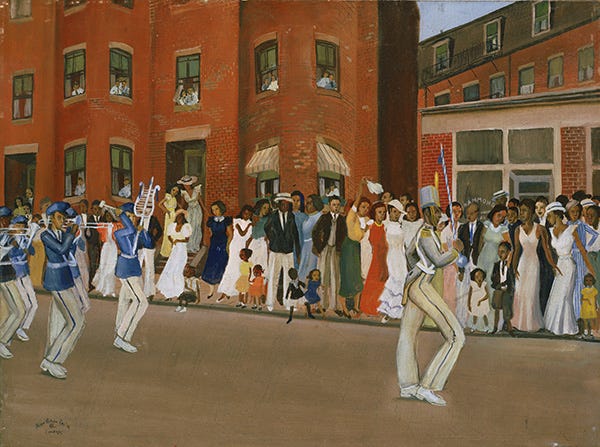
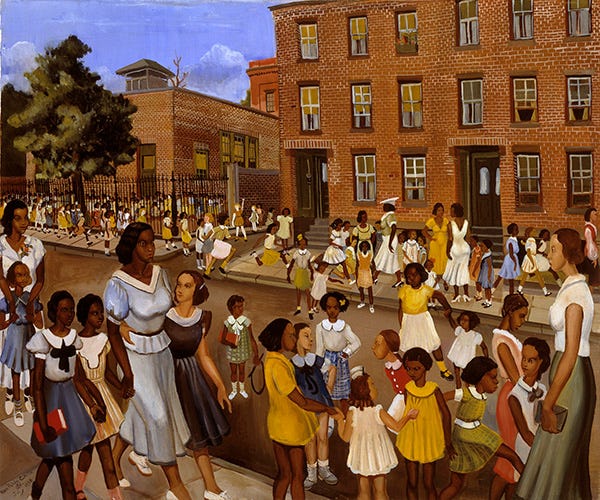
Allan Rohan Crite
A fine painter and contemporary of the Harlem Renaissance, though he was based in Boston. More here.
Why do some places have binge drinking and not others?
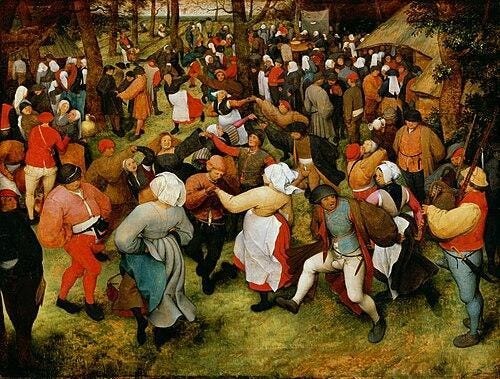
In addition to being interesting, this article cures binge drinking - not person by person, but country by country.
‘Dost thou think, because thou art virtuous, there shall be no more cakes and ale?’ (William Shakespeare)
Introduction
Mark Lawrence Schrad’s ‘Vodka Politics’ argues that Russia’s alcohol problems are not the product of national character but of political economy: for centuries the Russian state maintained a monopoly on the drink trade, creating fiscal incentives to promote vodka consumption in socially destructive ways. Schrad’s central insight is that patterns of alcohol use are historically contingent. I want to follow his train of thought with respect to England and Ireland.
For most of the Middle Ages, English drinking was ritualised, communal, and embedded within parish life, guild structures, and the festive calendar. I argue that a second-order effect of the English Reformation was to fundamentally alter this — dismantling the social structures that organised drinking, decontextualising it, stripping away the framework that had given it meaning. The culture eventually bifurcated between abstention and binge drinking.
Likewise, the Irish reputation for binge drinking is historically contingent. Drawing on Emmet Larkin‘s thesis of a ‘Devotional Revolution,’ I argue that the consolidation of a more disciplined, clerically organised Catholicism in nineteenth-century Ireland — suppressing older communal traditions such as patterns — reshaped the settings of Irish drinking in ways structurally analogous to sixteenth-century England.
Wet and dry / Set and setting
Southern European wet cultures treat alcohol as a food product integrated into daily life; visible drunkenness carries stigma. Northern European dry cultures view alcohol as a special or dangerous substance, saved for the weekend, with intoxication normalised in specific settings. The distinction maps onto ‘set and setting’ — borrowed from psychedelic research — the idea that the effects of a substance are shaped not only by pharmacology but by the social environment in which use takes place....
Why Catholics are wet and Protestants dry
In Catholic societies drinking was embedded in structured communal occasions — feast days, saints’ days, weddings, wakes — with implicit norms governing behaviour. The Reformation stripped out the liturgical calendar and relocated moral regulation from collectively enacted ritual toward internalised individual discipline. Alcohol became morally ambiguous, displaced into narrower, more episodic contexts oriented toward intentional intoxication. The foundation of a dry culture.
The fall of Merry England
Eamon Duffy captures the dynamic in ‘The Stripping of the Altars’: ‘Sixteenth-century Protestantism was built on a series of noble affirmations... But it quickly clenched itself round a series of negations and rejections.’ The 1536 reforms collapsed a ritual calendar that had filled a third of the year — roughly 90–100 feast days reduced to around 25–30. Further reforms under Edward VI completed the dismantling: fewer feast days, less ceremony, far less space for the communal festivity within which drinking had been embedded....
Ireland and the Devotional Revolution
Ireland complicates my thesis: majority Catholic for centuries, yet with a dry drinking culture — beer-drinking, binge-drinking, pub-centred. My response is that Ireland underwent a ‘reformation’ of its own within a Catholic framework. The Devotional Revolution operated much like the Protestant Reformation: a top-down reorganisation of religious life suppressed the communal festivity in which drinking had been embedded, displacing consumption into narrower, more episodic forms....
By 1843 an estimated half of Ireland’s adult population had signed Father Theobald Matthew‘s temperance pledge. Writing in 1986, Elizabeth Malcolm estimated Ireland had a higher proportion of teetotallers than almost any country outside the Islamic world — the classic signature of a dry culture, which produces both high rates of binge drinking and high rates of abstention. Alcohol is morally problematised; norms become binary; that binary produces two poles — teetotallers and episodic heavy drinkers....
Conclusion
This demonstrates that drug and alcohol policies need to be cognisant of the informal social norms shaping use via the settings in which it takes place. When Labour tried to create continental-style café culture with the 2003 licensing reforms, it didn’t achieve its aim. Keith Humphreys has written about how North America erred in trying to recreate Portuguese-style policies without accounting for the informal cultural norms — Catholic, communitarian, and conservative — that shaped how those policies worked in practice. We would all be wise to heed such voices.


Think Tanks Have Defeated Democracy

This headline is somewhat misleading, as from what the author says and my own background knowledge, it seems most likely not that think tanks displaced and drove the hollowing out of political parties, but that they stepped into the void. Nevertheless, the point it makes about think tanks as part of the hollowing out of democracy, the replacing of social deliberation and bargaining with expertise cum ideological clichés, is well made.
The austere job market for policy wonks in Canada is downstream of the country’s robust party system. Governing parties don’t need to outsource their policy development and, when they do, ideas can be supplied by ad hoc committees, commissions, and consultants that evaporate into the ether when their work is done. ...
American politics is a completely different beast. Progressive anti-patronage reforms and the move to primary elections have long since eroded the social base for thick, membership-driven political parties and the efficient party machines which excelled at delivering votes for politicians. Modern U.S. think tanks emerged in their place—holding tanks and convening spaces for Democratic and Republican functionaries while they are in and out of power. Given tight staff budgets, lawmakers outsource their strategies to whichever policy outfit overlaps with their political philosophy and electoral base. ...
Other countries outsource to independent think tanks too, but usually within a formal parliamentary relationship. Germany’s Konrad-Adenauer-Stiftung functions as the policy organ of the center-right CDU; over 95% of its funding comes from the German government. Such think tanks are adjuncts to the formal party system rather than genuinely independent policy actors.
Associations Without Members
In recent decades, ideological self-sorting has made Congress look and act more like a parliament—yet without the complementary institutions that make parliaments work. The national parties are largely lifestyle brands attached to fundraising funnels; unlike in actual parliamentary democracies, lawmakers have no direct obligation to vote with their party. The nonprofit advocacy world helps grease party cohesion by mobilizing activists and pollsters whenever a big vote is afoot, but typically derives core funding from a countable number of upstream foundations. Given the insulation of funders from electoral imperatives, there is nothing to prevent them from self-organizing around self-defeating policy platforms. Without the moderating forces of intraparty bargaining, ideological clichés become the only viable Schelling point around which to organize collective action.
Endemic political alienation is then a predictable side effect. The bulk of voters have weak identification with either major party and are largely cut out of democratic participation. While the old patronage system had its ugly side, voters could at least expect that electing Joe Schmoe to Congress would get their community money for a new post office or public park—creating programmatic linkages between participation and policy outcomes, reinforcing faith in the system. The breakdown of those linkages created the tinder for populism. In the end, we didn’t so much dismantle the old patronage system as create an all new one, only through institutions far more performative than formative.
The political economy of America’s nonprofit sector is typified by what Theda Skocpol has called “associations without members.” Beginning in the 1960s, large foundations began to fund professional network organizations in law, civil rights, consumer rights, feminism, and environmentalism. Unlike unions or churches, such nonprofits only speak for their constituencies vicariously. Opinion polling and technocratic social science replaced the voices of ordinary people. ...
As political scientist Steven Teles has noted, this helped generate characteristic features of contemporary elite polarization. On the left, the unrooted nature of elite advocacy organizations encourages an embrace of positions not widely supported by the actual people being advocated for. On the right, it encouraged an economic policy at odds with the actual preferences of conservative voters in areas like entitlement reform, trade, and immigration. Advocacy organizations on both sides are trapped in a prisoner’s dilemma: even if funders recognize they’re burning hoards of money while making politics less functional, unilateral disarmament would simply cede territory to the other side. ...
The Anti-Social Impact of Nonprofits
Sweden and Norway have some of the lowest rates of nonprofit employment in Europe, yet also some of the highest rates of social capital. The secret seems to be Scandinavia’s mutual aid tradition, which culminated in universal, publicly administered social programs that crowded out third-party providers, combined with sector-wide collective bargaining that reduced the need for “advocacy without representation.” ...
The conflation of “the neoliberal turn” with Reaganomics is about two decades too late. The regime change that displaced member-led parties first started in the mid-1960s, when large foundations swelled on post-war growth to fill the void. Collective bargaining and machine politics were replaced with a technocratic “policy state.” And what’s a policy state without policy experts? Thus the modern advocate was born. ...
Jim Naughten!




Heaviosity half hour
Luke Carmen’s ‘scintillating’ essay
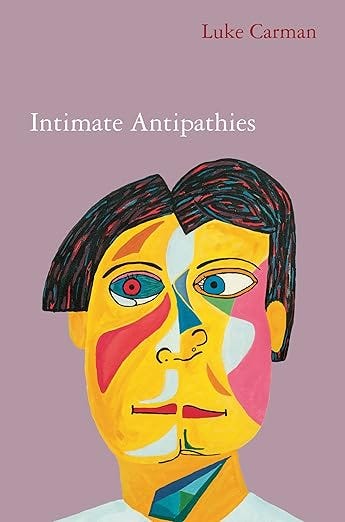
I didn’t know Melbourne was worse than other places as far as philistine arts bureaucrats are concerned, though ‘City of Literature’ seems a bit of a stretch. But what would I know? And the author identifies Melbourne as having more literary festivals than anywhere else, and that was before we got another one - Sorrento Writers’ Festival (which, it seems, has spawned its own anti-festival) So maybe there’s something to it.
Anyway, you may hate this, but I hope you’ll find it as funny as I did. But then I was instinctively sympathetic with the case it was no doubt overstating. I’ve also read some of the other articles in the essay collection it’s now anthologised in, and they were just as much fun.
The article caused quite a stir when it was published. Here’s Ben Elton on the fracas.
Getting square in a jerking circle
When asked to explain why he had dedicated his long life to American letters, Gore Vidal hypothesised the existence of two distinct subgenres of ‘writer’. The first he described as operating in the Henry James caste: a writer obsessed—for no discernible reason—with perfecting the subtle arts of written language. Someone for whom, as James himself put it, ‘there is only one recipe—to care a great deal for the cookery’. For these writers, their body of work represents an ongoing experiment with the vast frontiers of language. ... Enquiring for motives from these linguistically possessed individuals is futile—they are as unable to reveal the source of the desire behind their odd impulses as the moth might be said to understand the allure of the flame.
The second category Vidal proposed was the unhappy soul who, at some pivotal point in their infancy, suffered psychic injury—an intolerable wounding of the self—for which the only remedy was the consoling refuge of the imagination. ... Such a crutch, Vidal suggested, becomes so necessary for the subject—and the processes involved so dominant—that the individual ultimately exists in a schismatic state between the unforgiving world of the real and the seductive realm of their own private fictions. ... They lack the consistency, the focus and the commitment to thrive in most daylight vocations. The only suitable recourse open to such ‘complicated’ unfortunates is scratching a living from exploiting their fantastical reflexes.
Having created this dichotomy of the essential writer, Vidal placed himself squarely in the latter category. In his case, the reason for retreat into the imagination was an alcoholic mother. ...
This essay—though you might not have guessed from its beginning— is an insider’s account of the state of Australia’s so-called ‘writing culture’. I begin with the long and dubious digression on Gore Vidal’s ideas because I’ve always been struck by how strangely they fit the writing world as I’ve known it—and despite possessing nary the semblance of a profile myself, I tell you I’ve known it quite well. ... For the last ten years I’ve run workshops and tutorials and projects and lectures in dozens of schools, universities and writing centres across the country, attempting to teach what little I know about the subject of literacy and literature to whoever is naive enough to listen. Simultaneously I’ve had the strange pleasure of being surrounded by some of our culture’s most celebrated writers, critics and editors. ... The pond is small and the fish are big.
Among the hopefuls I’ve taught, or the accomplished writers I’ve encountered, there are only a tiny fraction who might belong to Vidal’s hypothetical category of the Jamesian word-nerd. From hopeful high schoolers to venerated Miles Franklin clubbers, the overwhelming majority have been of the basket-case variety. Childhood traumas, mental illnesses, immutable shames, neuroses of every colour and shape are the hallmark of the writer in persona. ... If such an imbalance alone was not enough to suggest a flaw in Vidal’s configurations, there is also the hollow ring of a bygone era in his distinctions. I suspect a new subset of wounded-psyche-driven figures are in ascendance: those who—borrowing again from the categories above— appear to have dealt with their intolerable damage not by indulging their creative faculties in the consolations of fiction, but with fantasies of finding a home amid those who do.
Rather than retreating into the fecund vortex of other worlds and parallel realities, these dreamers clench their eyes shut and conjure visions of themselves at play, accepted, affirmed, and celebrated within a ‘real world’ community that already exists: their impossible dream is to be welcomed into the bright and glimmering constellation of the arts industry. ...
Of course, the writer-to-be and the arts community dreamer are not mutually excluded from being one and the same person, but when the latter lacks the former, it becomes impossible to keep those who want to deal with words from colliding with those who’ll do whatever it takes to ‘make it’—and one is far better suited to the clash than the other. The advantage is almost always on the side of the cunning social arts satellite than the demented scribbler. In a culture like ours, one that places so little value on the linguistic traditions and our literary heritage, ... those with relatively meagre talents and hopes of escaping into the safe spaces of the arts community often consider the ‘writing’ world an easy option.
Reality TV shows such as Australian Idol, X-Factor and The Voice have taught a generation of Australians that to be involved with music requires being humiliated and exposed for any delusions of talent. Acting, likewise, is off-limits to the ugly and uncharismatic, so there’s no chance there. The plastic arts require a modicum of ingenuity, the learning of a new and obtuse language and an absurd level of tenacity, before one can even begin to bluff their way into its clubhouse. The writing world, as James tells us, is a house of not one, but a million windows ...
These aspirant exiles are legion, and among their number are our nation’s future paragons of poetry and prose. Not all of them will make it—exposure, if it comes, will kill more of them than it makes. Nevertheless, I have nothing but love in my heart for each and every one of our literary wannabes—I am one myself, after all, and will likely still be one when I’m laid in the dirt. The wannabe arts dreamer, desirous of making themselves part of this picture but indifferent to its meaning, observes the colossal mosaic of tinkering revenants and their culturally irrelevant obsessions and sees an unguarded hen-house of nervous, leaderless fowls. ...
Hearts aflame with envy, bearing gifts of suppression, control and a contagious spirit of nihilism, the social arts hopeful perceives themselves an inherent creative djinn: their existence is a miraculous creative act, and they scorn those who bother to make things in earnest. Writers, in the minds of these ‘change makers’, are block-headed toddlers playing in the sandbox of culture. ... Given enough support, these ‘king creators’ transcend the literary landscape, they become gods capable of making and unmaking from on high. ...
The problem is, these uninvited guardians of the language view art as a means to power. ... They do so because they’re political animals in a way that writers usually aren’t. Artists are uncommonly indifferent to power, which is why they so often struggle to thrive without aid. The arts dreamer, a natural politician, lusts after the small power of the cultural now. ... In a few short years, with the right reparations, anyone without a shred of originality or integrity can be holding court and dictating terms for an art form to which they contribute nothing but their lordly presence. ...
Much of the blame for creating the chasm in our culture from which these deluded demi-gods of arts management have arisen must lie with our universities—and the corrupting influence of ‘creative writing’ courses that serve as cash cows for our beleaguered and fatigued humanities departments. ... Every student who sits in on a tutorial is encouraged to believe publication is only a degree away. It is a cruel lie, perpetuated by the complicity of tutors and lecturers who have no option. The directive to avoid the truth—formerly, I’m led to believe, of some concern to the humanities—is driven by the perpetual commandment from upper management to commercialise or perish. ...
[Those] hopeful students who just want to know how to get their novel or their poetry collection published continue to be seduced by a watered-down exposure to literary criticism, kept slyly away from the reality that a high distinction in a creative writing course is no indication of their chances of ever being published. ...
Little wonder then, in a sector of the arts populated by lunatic fantasists who are guided by scholars enslaved to the demands of corporate universities, that those small masters of today who lust for power over the literary world are able to infiltrate our most sacred spaces. And here I might as well drop all pretence: the social climbers of the arts ... are not merely overly ambitious arts workers: they are anti-artists in human form. They are incorrigible frauds and fakes. ... [These] people are phoneys—and our literary scene is corpulent with the weight of them.
Since it is all too easy to throw around the vague and self-serving assertion that there are vampires in our midst without offering any means by which to spot them, I offer this provisional guide for discriminating the fakes in our lit scene from the genuine article. Simultaneously freewheeling and coherent, the hucksters are nonchalant pundits on every cause and effect in politics and culture. They make wonderful guest spots on Q&A. ... Observe their capacity to charm crowds online and in real life without once stepping outside the bounds of accepted bourgeois-liberal consensus like angels twerking on a pin. Their every character trait, from mental illness to class background, is worn as an adornments of generic marker. Need an expert on the working class rural writer? They have one of those. Want someone to stand in as a borderline personality spokesperson? Speak to their agent. ...
These devious characters can be identified by the breath-taking fervour with which they do nothing at all—and their insistence that anything they do not like is unmade. Only their own private vision of the world deserves life. Anything else is an abomination. Through the rigorous exertions of cultural opinion, they seek to decide who, what, where and when the flowers may grow in the garden. What they can’t nip in the bud, they denounce as a weed in the blooming. ...
What they mean by friendship, however, is some nightmarish Zuckerbergian conception of human connection: their work, their brand, their audience, their reason for being. ... It would be one thing if these sly culture creepers were merely usurping an unfair share of the literary stage, but their repressive influence is one that poisons the lot of us—writers and readers alike. As the pall of their infiltration spreads over the nation, the atmosphere in the literary scene turns from disillusionment to despair. ...
So then—having endured my screed— you might well ask what proof I have that these malignants exist. ... I don’t have the nerve to name names, which would be the quickest way to make the case—but I can tell you where they are likely to live. It will come as no surprise that the greatest concentration of these noxious weed-lingerers is to be found in the City of Literature—a town with more literary festivals per capita than anywhere else on earth. ...
The Melbourne literati mafia may have little ‘real-world’ potency, but that’s not their game. Instead, they rely on an invidious power of suggestion that gnaws its way into the consciousness of young Australian writers. ... In ‘Right Time, Right Place: How the Melbourne Voice Shuts Writers Out’, Jonno Revanche, an Adelaide-based writer, describes the influence of the ‘Melbourne Voice’ on wannabe writers. Confronting the amassed cultural capital of the ‘romanticised’ City of Literature as a young outsider with aspirations of making it in the world of letters, Revanche describes a common feeling of despair: ‘I would continually beat myself up over “not being contemporary enough”, and felt like my honest words simply weren’t valuable.’
Revanche’s account of the Melbourne voice’s ‘oppressive’ influence paints this literary clique-hole as a cultish cabal holding the country’s literary ‘stakeholders’ to ransom. It is an exaggeration of the power wielded by Melbourne’s lit mobsters, and since it played directly to the vanity of these anti-artists, they were quick to laude Revanche’s article as ‘an important and necessary provocation’—the usual descriptor the clique-lords use to describe any opinion piece with which they agree. By contrast, Brigid Delaney’s response piece in the Guardian, which suggested that the so-called ‘Melbourne Voice’ was a paper-thin mythological irrelevance perpetuated by an insular crowd of insufferable literary baristas, was dismissed by the anti-artists as a self-serving ‘think piece’ ...
There is, of course, no such thing as the Melbourne ‘Voice’, and the disenfranchising forces against which Revanche and Delaney are unwittingly united in raging against are the stateless anti-artists themselves. ... Although they have undoubtedly accumulated quite a presence in Melbourne, their reach and their connections stretch beyond any geographical borders.
James Tierney’s recent article for the journal Kill Your Darlings expressed this growing level of anxiety in the literary scene under the influence of our anti-artists. In an article titled ‘What Australian Literary Conversation?’, Tierney characterises the titular conversation as ‘one of long silences, punctuated by the occasional loud thud’. ... It’s an interesting point: why can’t we manage to be as open as our American friends? Why are we so shy whenever the conversation turns to culture?
Perhaps unintentionally, Tierney provides an insight into the reason for our muted literary character when he considers Ben Etherington’s Critic Watch column in the Sydney Review of Books. Tierney praises Etherington’s ‘sharp gaze’, one that, unlike much else that Australian literary criticism has to offer, managed to spark ‘a lot of informal, private responses’ in Tierney’s hearing. ... Despite recognising Etherington as a decent critic who managed to spark at least some kind of literary chatter, Tierney feels compelled to share with us the ‘concerns’ he has ‘heard’ about Critic Watch, namely ‘that it risks becoming a navel-gazing exercise—that to publicly and polemically consider the craft and broad judgment of Australia’s critical culture could be both self-indulgent and self-regarding, the critical equivalent of a selfie’.
Having expressed these concerns, Tierney then dismisses them as unpersuasive. There is, in Tierney’s odd pulling of the punches he throws without any evident provocation, something bizarrely Australian. ... When Tierney asks ‘what conversation?’ the answer is not the one taking place in print—it is the clandestine dialogue that is forever taking place on the periphery. As a people, Australians are perhaps uniquely sensitive to the kind of censure that Tierney’s projection establishes—it runs deep in our blood to be afraid of ‘navel-gazing’ and ‘self-interest’, derivations of the damning charge of being a wanker.
Since Europeans stamped their dubious authority on its soil, Australia has been an anxious, uncertain colony of a far-flung centre, and our literature (our literary condition) has reflected as much. ... The literary arts in this country have been abandoned to cultural guerrillas who seek nothing but to further their interests even as they diffuse the miasma of self-censorship and trepidation among our authors and readers while they ascend to power. At present the shadow conversations of the anti-artists are aimed at exploiting the deep fear in our national psyche of the charge of wankery and ‘navel-gazing’ in order to cut down anyone who dares to go against their interests. ...
The charge of wankerism was one that punctuated the climactic end point of last year’s imbroglio over so-called middlebrow literature. Ivor Indyk’s editorial in the Sydney Review of Books kicked off the controversy, arguing (with deliberate irony) that since the responsibility of discerning a winner from any given sample of current literary works is a duty too great to be entrusted to anybody at all, the money on offer might be better put to other use. ... Indyk suggested that judges might be beholden to ‘the whine of popular disappointment insinuating itself into their brains’ when considering giving the nod to works that are ‘challenging or innovative’.
Though clothed in the rags of an age-old argument about high and low culture, Indyk’s lament is principally an attack on the insidious anti-artist chorus whose endless droning leaves either side of the cultural debate unable to hear themselves think. Indyk’s real ‘target’ in his article is the nihilistic heckling from the peanut gallery—which holds the language and imagination of a nation in a thrall of self-restraint. ... Debate raged—a definite Tierneian ‘thud’ in our relative cultural silence. Indyk’s conservative ‘neo-Leavisite’ leanings made him a punching-bag for an incensed commentariat ...
And that, as they say, might have been that, but turning the furore into a frenzy was a second ‘middlebrow’ piece published in the Sydney Review of Books by academic Beth Driscoll. Using novels by Susan Johnson, Antonia Hayes and Stephanie Bishop as exemplars of the genre, Driscoll, author of The New Literary Middlebrow: Tastemakers and Reading in the Twenty-First Century, discussed the fluid and complex modes of literary appreciation that intersect the contentious terrain of the middlebrow. According to Driscoll, the works of these three authors offer readers, critics and publishers ‘manifold pleasures’. Johnson, Hayes and Bishop did not take this compliment lying down. In a rejoinder published by the Sydney Review of Books the following week, the authors were ‘as one in rejecting’ the label of middlebrow—not to mention ‘startled and offended’ by Driscoll’s ‘collective dismissal of any discriminating powers of intellectual application to our respective works’.
There’s no act more gratifying an author can perform than sticking it to a critic—though this avenging trio demonstrate how much more satisfying it is to do so as a team—and the arguments Johnson, Hayes and Bishop make are persuasive. ...
The Melbourne-centred lit-scene mobsters were quick to herald the responses of these writers as a watershed moment in Australian letters. ... More troubling, however, was the emphasis placed by the anti-artists on Hayes’ singularly polemical moment. In praising Hayes’ push back against the Sydney Review of Books’ ‘war’ on the middlebrow, the anti-artists chose to focus on Hayes’ dismissal of the journal itself as one specialising in ‘jerking-off’ (by way of reference to Susan Sontag).
This kind of caustic accusation of wankery amid an otherwise measured response to genuine criticism plays directly into the hands of the anti-artists—it reinforces Tierney’s observation that criticism and discussion surrounding literature are often delegitimised by accusation of being a giant wank. Literary culture, such accusations imply, should be driven by more meaningful, purposeful activity than shameful navel-gazing by critics and other unproductive members of society. After all, as Hayes asks, what are these ‘diatribes’ hoping to accomplish? The answer, of course, is nothing.
The ‘diatribes’ hosted by the SRB are themselves acts of culture no less than Hayes’ novel. It is the dogged moralising of the anti-artists that has perpetuated an ideology amid our burgeoning writing culture that there is something other than an autotelic uselessness to be found in writing at all. Art, as the literary critic (and white-haired dinosaur) Terry Eagleton often puts it, ‘exists purely for its own self pleasure’. ...
It would be disingenuous in the extreme not to mention here that Hayes’ final paragraph draws me directly into the middlebrow debate. Accusing Driscoll, Indyk and me of ‘savage rhetoric’, ‘empty intellectualisation’, ideological thinking and ‘jerking-off’ (all things I strenuously deny ever doing), Hayes asks, ‘What are we supposed to do with these theoretical assessments? Indyk says awards are middlebrow, Carman says festivals are middlebrow and now Driscoll says novels are middlebrow.’ Her reference to my view on literary festivals draws on a brief editorial I’d written for the SRB some weeks earlier, and although the editorial wasn’t in praise of lit festivals, I didn’t mention the middlebrow. ...
It speaks to the degraded state of our literary life that those within it assume any position that does not endorse their consensus about culture must be arguing for a reactionary, George Brandis sort of high-minded excellence. ... In the view of many of our writers, it seems those who can’t or won’t read simply don’t count—what’s point of them, they seem to think, if they aren’t going to buy your book? ...
To be clear—despite lumping me in with the ‘empty-headed wankers’ who went and stepped on the middlebrow, I don’t for a second hold Hayes’ zeal against her ... but had I known the SRB was engaged in a war on the middlebrow, I would have been much more circumspect in writing editorials. ...
Even close colleagues found it hard to back my decision to put anti-establishment thoughts into print, pointing out that it was ‘unprofessional’ to sour my relationship with the literary scene by being critical of it ... No doubt this essay will be subject to the same accusations of being a self-serving whine from a writer who ought to stick to his day job. Except this self-indulgent nonsense is my job—and it’s my solemn duty to tell the truth.
When asked why he gave away his side-gig as a politician, Gore Vidal replied that the politician’s task is never to give the game away, while the writer must always tell the truth, as he or she sees it. The two domains, Vidal explained, are non-compatible majesteria. At present the anti-artists, more concerned with acquiring power than with the arts world they inhabit, risk inverting the relationship between art and the art of politics—and we risk losing our artists and our cultural diversity to the wasteland of inhuman blandness and concern for consensus that long ago consumed the political class. ... So-called high culture has no greater claim to the truth than does the low. What art demands and depends on is a culture that is free to express its truths, whatever they might be. ...
The recent massive cuts that vivisected funding for the literary sector at the end of last year were devastating. Seizure, the Lifted Brow, Island and the Sydney Review of Books were just a few of the organisations doing great work that will have to do or die without support this year. It’s not an optimistic time for those fighting it out in our literary coliseum—but there is a silver lining: the anti-artists have taken hits too. Our resident fakes are hurting almost as much as everyone else. So with crisis comes opportunity. Right now the gatekeepers are off their game, and there’s never been a better time to burst out of the confines they have imposed and make your way in this strange little world, being as strange as you like in the process.
There’s not a lot this rather unusual tirade can hope to do about the proliferation of anti-artists in our ‘writer culture’. ... For Indyk, when judges subsume their own beliefs for the sake of some invidious idea of popular appeal, we all suffer. Similarly, when Tierney asks ‘what Australian literary conversation?’ then summons up the ghost of colonial uncertainty against the only critic he can bring himself to compliment, he demonstrates precisely why our critical culture is so haunted by silence.
When Jonno Revanche tells us that they and other emerging writers are under the thumb of institutions and organisations that are supposed to empower our young artists, we have no reason to doubt them and we should be alarmed that the situation is so. ... But if I am able to give advanced warning to even one young scribbler about the senselessness, doubt and despair our anti-art overlords are inculcating in our so-called culture industries, if I can keep even one voice from being caught up in their dull manipulations, then I’ll be more than glad to give up my hopes of being invited down to the wharf to break canapes with all those cynical shysters with champagne flutes glowing in their eyes, and business cards clutched in their hands.


What a difference a few decades makes


re the arts in Aus. I'm optimistic, because (through my niece and a TAFE course - closed by our benighted government) I've met many young people making art. They are interested in their art, collegial, and recognise quality. A second reason for optimism; thanks to social media the gatekeepers can be bypassed - very healthy for art making.
"Had I known the SRB was engaged in a war on the middlebrow, I would have been more circumspect in writing editorials." I LOLd and the entire heaviosity half-hour was great fun. I sometimes wonder if Brandon Taylor would have written it.