This Venn diagram is not mine, but I reposted it. I didn’t know things could really go viral on Substack. Perhaps it’s the beginning of enshittification. In any event, at the time of writing, this note had picked up around 2,500 likes and 250 repostings. And it’s fun.
And one good deed deserves another.
One Nation on Super: Good politics, good policy
Sorry to tell you guys, but the ALP-driven compulsory savings system is so badly designed that One Nation’s proposed watering down of the system looks like good policy. Its timing could be a little better, as we’ve got some work to do to get inflation back into the target. Also, various people are saying it won’t solve the housing crisis. Well, no it won’t. That giving first home buyers access to their own money to buy their first house would drive up first home prices. Well yes it will. Both those things should be managed by phasing in the policy. But it seems passing strange that we stop people who want to buy their first house from using their savings to do it.
Consider how unfair it is. Forcing people saving for a house to instead invest their savings in securities then earns financiers margins on both the investments in super and the larger mortgage the first home buyer needs to take out. That’s outrageous. Oh and did I mention that, in addition to its unfairness, it’s highly inefficient? It is.
Here’s Peter Martin on the subject.
While sophisticates can smile at the old adage that one should neither a lender nor a borrower be, the notion that one should not be both at the same time — unless one is earning a little margin — is harder to dismiss.
Compulsory super requires many of us to do both at the same time — to save while we are borrowing. It’s a bit like driving a car with one foot on the brake and the other on the accelerator. ... It produced a lot of friction.
When it comes to super and mortgages, putting one foot on the brake while putting the other on the accelerator can be frustrating.
Here’s a letter I received at ABC Radio National’s The Economy, Stupid from Mel, who could just about manage her finances if she didn’t have to save while borrowing.
Hi Peter, I love your podcast. ... I work in disability care and support my teenage kids and my eighty-two-year-old father in my (mortgaged) home. It’s often precarious financially. ...
My superannuation is $270,000. It would pay my mortgage and give me financial security if I could access it early. Can you see a future where the government relaxes the rules around early access to super ...?
Thank you!
Why on earth shouldn’t Mel be able to use her super to extinguish her mortgage? She’ll be able to do it when she turns sixty (if she declares she has stopped working) or when she turns sixty-five (whether she is working or not). Why shouldn’t she be able to extinguish her mortgage now when she is fifty, at a time when her finances are at their most stretched? ...
Why are retirees on average so much better off financially than Australians of working age? ... Cameron Murray points out:
They usually don’t have dependent children. They don’t have school fees. They don’t have family holidays. And the evidence that people are much more well-off includes the fact that, on average, people save during retirement.
The big exception ... is Australians who have to rent in retirement. The Retirement Incomes Review ... found that for non-renters super contributions of 12 per cent of salary would be too much. It recommended increases in rent assistance.
It’s an argument for giving people the option of contributing only 9 per cent to super through their employers, as One Nation wants, getting the rest as salary at the times of life when they need it most. ...
The idea of allowing early access specifically to assist with mortgage payments also has an impressive lineage. The quote I opened with is from ... the director of Labor’s National Housing Strategy, Dr Meredith Edwards, in 1992. That’s right, in 1992, before the Superannuation Guarantee became law.
There’s little that ought to be controversial about allowing access to super to assist with mortgages. The biggest threat to prosperity in retirement is having to rent. ...
But for someone like Mel, that’s not the point. She needs to extinguish her mortgage now, rather than wait ten or so years until she has retired. It is now that her finances are stretched. It is now that she is at risk of becoming a renter.
The idea she can’t be trusted with access to her money is unsupported by evidence. ... We behave as if people aren’t rational ... right up until super preservation age, then, the minute they get access to their super, we behave as if they are completely rational and don’t need to be protected from the folly of frittering away their money at all.
Just because an idea comes from One Nation doesn’t make it bad. These two latest ideas — access to super to pay down a mortgage, and the ability to select a super contribution of 9 per cent instead of the default 12 per cent — could be lifesavers for some.
Most of us are unlikely to use them, and that’s fine too. ...
Patiently explaining some of the higher points of Western Civilisation to conquered middle-eastern folks
Mamdani, Media, and Negativity Bias
How dysfunctional media supports dysfunctional government
The very terrific Don Moynihan, who, when I come to think of it, is one of the few academics teaching government whose output seems to be a direct engagement with our current circumstances, rather than heavily refracted it through the contortions rewarded in academia.
The image, as you might have guessed, is from The Onion. The joke (for me at least) is the idea that there would be celebratory media coverage of routine effective government performance. ...
Negativity bias: The media covers failure much more than it covers success. ... In other words, the media focuses on failure because that is what, as consumers, we click on. ...
But think about the incentive structure for politicians. If media attention goes to failures rather than successes, the incentives are to avoid failures: don’t rock the boat, don’t take risks, don’t try something with an uncertain payoff. Avoid blame at all costs. ...
Mamdani and the Political Capital of Implementation
I’ve been thinking about this challenge in the context of Zohran Mamdani’s mayorship. Mamdani is doing something interesting, which is investing a huge amount of his political capital into the nuts and bolts of governing. He has lots of videos about filling potholes, the value of public servants ...
Some of this has broken through to the public, such as stories of New Yorkers tagging Mamdani on social media about potholes or other quality of life issues, and then finding their complaints addressed. ...
But Mamdani’s strategy depends upon people hearing about implementation. And here, he and other politicians willing to devote time to public administration, face a dilemma. What if the media simply does not care? What if they won’t cover what you are doing, or give it a tiny amount of attention relative to more negative stories? What do you do then? ...
But some of it was actually part of a campaign orchestrated by City Hall to use social media influencers to boost the image of the mayor and his young administration’s policies. ...
It is not until paragraph 20 that the reporters clarify that the Mayor’s office does not actually pay the influencers. The sheer distance between this very crucial fact, and the opening paragraphs and headline is problematic. ...
The insinuation of wrongdoing gives the article its purpose, but the actual evidence of wrongdoing is thin. ...
The Story the Times (and Others) Are Not Telling About Mamdani
Let me offer one theory for why the Mamdani administration is working with social media. ...
The Mamdani administration cut $9 million in McKinsey contracts as small part of a relatively impressive effort to balance the budget. ... So, the McKinsey contract cancellation was mentioned barely at all by the New York Times, in two stories with relatively unfavorable faming (Mamdani hiking taxes and abandoning programs he favored). ...
I don’t think the contract cancelation is simply populist point-scoring, but reflects a theory of governance that is substantive, and considers structural aspects of state capacity.
The theory, more or less, is that consultants are not merely providers of services but potential rent-seekers who exploit the weird dynamics of public sector procurement markets to carve out lucrative niches, but then underdeliver. The potential solution is better procurement practices and more in-sourcing of services. To do this, however, requires building internal government capacity, especially in the tech space. ...
The New York Times did not cover the announcement of the new office. ...
My main point is that in an incredibly well-resourced, serious, and non-partisan media outlet there are a lot of stories about the conflicts Mamdani is facing ... But I think as a reader you would struggle to learn that Mamdani is devoting a lot of his energy trying to fix real problems in New York City government, and that this includes a substantively interesting approach to policy implementation. ...
But we also need them to tell us when government is working well and trying to do better. Reporters don’t have to become influencers to embrace a little bit of positivity bias. ...
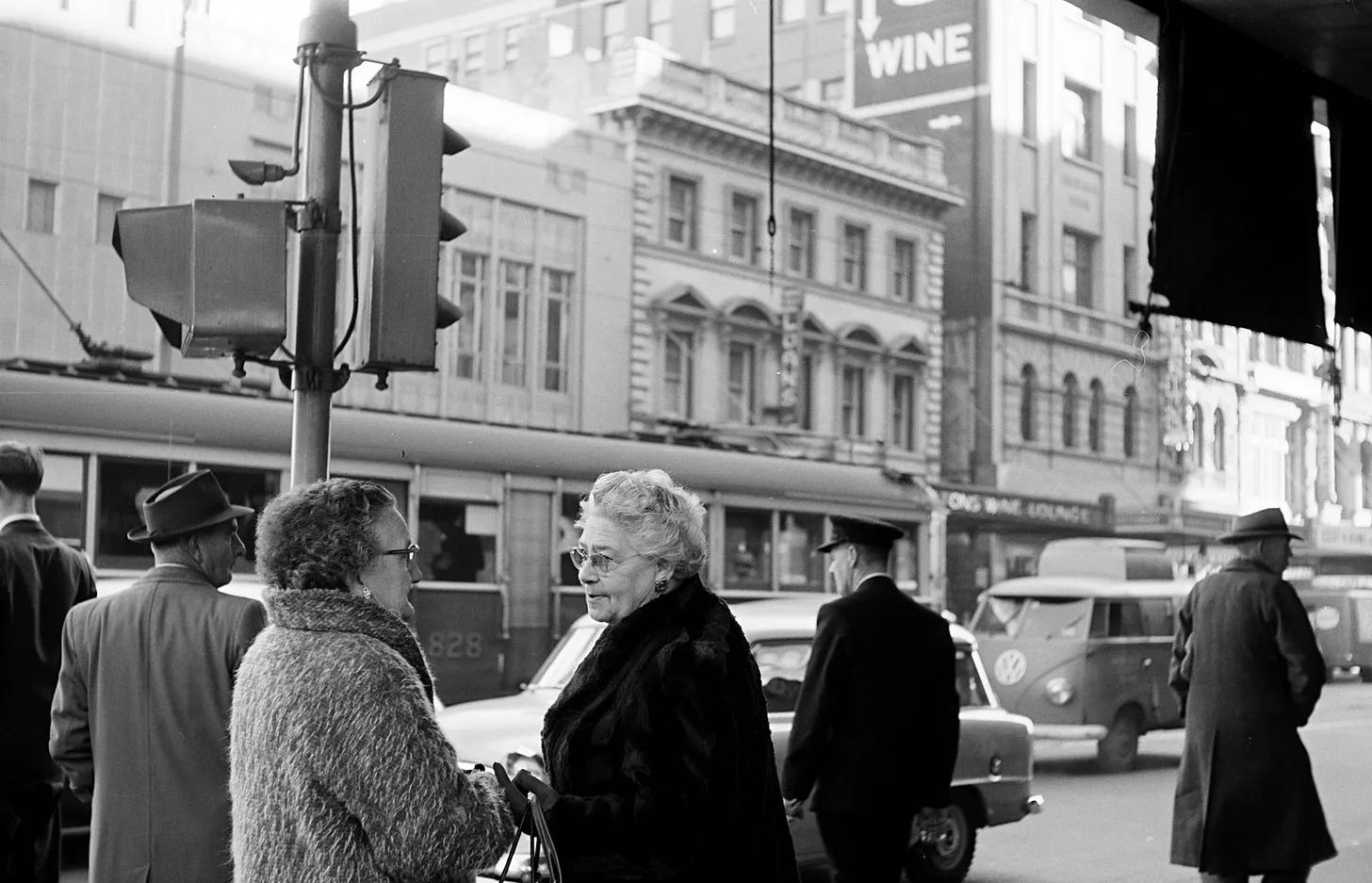
Photograph Mark Strizic. Pictures Collection, State Library of Victoria.
A nice and popular piece by James Button on how we used to speak, and now do not. And how we speak now.
#NostalgiaAlertAndTriggerWarning: as part of this newsletter’s commitment to best practice,® if you tend to suicidal thoughts when remembering the past (who doesn’t?) just go to the ‘pledge’ button and pledge me US $80 per year. Chances are it will cost you nothing (even if there are no guarantees in life) and just that bit of procrastination - or is it generosity - may just stop you ending your life for a reason that no-one will respect you for, or even remember.
Back in the day, no one said back in the day. They said in the old days. No one said knock yourself out; they said go for your life. No one thought to push back or reach out or lean in, let alone hold space. No one said Totally or Literally or A hundred per cent. They said, I’ll say, or Too right. A few even said Bloody oath! ...
Some shifts I see are a move from British- to American-sourced words and phrases, and from concrete to abstract language. The constant drive towards compression in speech sits alongside an increased concern with politeness and getting along that may be related to changes in male and female roles and positions over the past 50 years. ...
The language I knew, growing up in the 1960s and ‘70s, had a brevity and bluntness that seemed to come out of a masculine culture. The word, right, had a wide range of uses: not only too right but I’m right, which didn’t mean I’m correct but I’m satisfied or OK. ...
For all that, I feel affection for the language of that time, my time, when good things were grouse, an annoying person would be told to go jump in the lake or to rack off. ... Paedophiles didn’t exist but dirty old men did. ...
When I was a boy people worried about the invasion of American culture, but it was nothing compared to what was coming. Living in New York in the late 1980s I learnt Tell me about it and Go figure! and My bad. Not long after I got back to Australia these phrases were all in use. ...
Americanisms have burrowed like ticks into Australian grammar. We now say different than instead of different from. ... And many of us now say ‘So…’ at the start of an answer that is going to require some context and explanation, a usage reported to come from Silicon Valley computer programmers. ...
Language relentlessly seeks brevity and compression. It’s faster and sassier to tell someone to chill instead of take it easy, and to check this out rather than take a look at this. ... today’s young have gone further, turning Melbourne into Melbs, tomorrow into tomoz, and definitely into defs. ...
Two trends run counter to these largely American-derived changes. First, words now travel in more than one direction. ... All good comes from ‘90s hip-hop, but sweet as is Kiwi. Too easy is Australian, but has migrated to the UK and the US. ... No worries, once identified only with Aussies and Kiwis, was commonly used by Brits I met, probably thanks to Neighbours. Famously, Americans now use it, too. ...
One thing I learnt, writing this post, is that for all their exposure to global culture, young Australians have not lost their own tongue. ... They still halve words in the Aussie way, still say, I’m going to uni this arvo and I think I’ll chuck a sickie from work. ... And they still take the piss. ...
The second counter-trend to bluntness and brevity is more complex. Our language is getting softer, more facilitative. We have many phrases now to show agreement: totally, literally, seriously, defs and I know right?, not to mention the ubiquitous a hundred per cent, ...
Language has grown kinder: spastic (once used neutrally to denote cerebral palsy before it became offensive) and retarded gave way to disabled, which yielded to living with disability. Language has also become more abstract, and so separates us from things we can see and touch. Public works – a fine old term because it explained who funded it and who it was for – became infrastructure, which people struggle to pronounce, let alone explain. ...
Well, this is a bit embarrassingly simple-minded, but I do like pictures of diplomats emerging from seasonal migrations like turtles from the sea. Maybe you will too.
Fortunately, this is a bit more serious.
Regular readers will know that I’m forever sad at the way in which we focus on what’s in front of us rather than what’s most important. Right now I could list five or six major features of the way in which our institutions work, which would be the first things to be used by an authoritarian trying to take control. I once unsuccessfully tried to do something about one of them many years ago.
Global warming is important too, but not as important as trying not to blow up the world. But it went completely out of fashion to worry about that for many decades, and now all of a sudden it’s back. But our commentating class looks on mostly stupefied and also paralysed by the need to be savvy, by the need for whatever one proposes to be not too hard to sell to the people at the top. Still, as Friedrich Hayek pointed out way back when he was starting up perhaps the most successful ideological movement of the second half of the 20th century, it pays to be a little bolder than that. It certainly paid off for him and his tribe.
In any event, I liked this from Tayyaba Khurshid of the Lowy Institute.
A “negative security assurance” is a pledge by a nuclear-armed state not to use or threaten to use nuclear weapons against a state that has none. Its counterpart, the positive security assurance, commits nuclear states to come to the aid of a non-nuclear state if it faces a nuclear threat from elsewhere.
Both are political declarations, not treaty obligations, which is precisely the problem.
Ask a diplomat working on disarmament in Geneva whether the five nuclear-armed states will ever develop consensus on legally binding negative security assurances and the honest answer is no ...
Negative security assurances (NSA) are the least demanding, most achievable item on the entire disarmament agenda, yet the states best placed to grant them keep choosing not to. The promise of a fair and balanced non-proliferation order can be fulfilled with legally binding NSAs. The states must move from political good will towards a legal obligation. ...
The Russia–Ukraine war has normalised nuclear rhetoric that was once considered a serious escalation in itself. The United States and Iran conflict showed how fast a regional dispute can climb toward a dangerous threshold, with claims highlighting the US is considering potential use of nuclear weapons against Iran. ...
With both Iran and Ukraine facing a nuclear-armed power, that is exactly the scenario NSAs exist to guard against – and exactly where a political promise is least likely to hold.
This is not an abstract worry confined to Geneva. In South Korea, public support for an independent nuclear arsenal has sat close to 70% for years. Japan and Germany are also shifting their thinking about keeping the option open through what analysts call nuclear latency, in case the extended-deterrence guarantee looks thinner next year than it does presently.
Although all these governments are part of the Nuclear Non-proliferation Treaty, and none intend to leave, the drift is real. ...
NSAs face no legal, technical, or financial obstacles for negotiations and a majority of the membership supports them. A binding convention would not require a single warhead to move. It would give non-nuclear states a reason to remain non-nuclear, even when governments change. It would make nuclear coercion more costly, at a time when such threats have re-emerged in two ongoing wars. ...
The strategic cost of credible NSAs is low. The security gain, however, could be measurable. They could reassure countries such as South Korea, Japan and Germany that their security does not have to depend entirely on another state’s nuclear umbrella.
Every year the gap between promise and law stays open and the argument for going nuclear gets a little easier to make in each of those capitals.
Cute story, though perhaps I’m being naïve. It’s a very contemporary Instagram story:
I started following @2sisters_angie a little over a year ago. Back then she was posting the typical stuff you see from moms on Instagram -- pics of her daughter at the park, pics of her daughter eating breakfast and lots of photos of her daughter playing dress-up.
You know, the same stuff I post.
Then, about nine months ago, Angie’s feed started to change. It became clear Angie’s daughter (she calls her “Mayhem”) was more interested in fashion than the average 4-year-old. Mayhem shunned her store-bought princess dresses and started wrapping herself with scarves and sheets creating her own styles.
Then one day Angie got tired of finding her clothes in Mayhem’s toy box and suggested they make a dress out of paper. Mayhem loved the idea and they haven’t stopped creating paper dresses since.
I’ve been continually amazed every time Angie’s pictures pop up in my feed. The dresses started like this:
And over the last few months, I’ve watched them evolve to this:
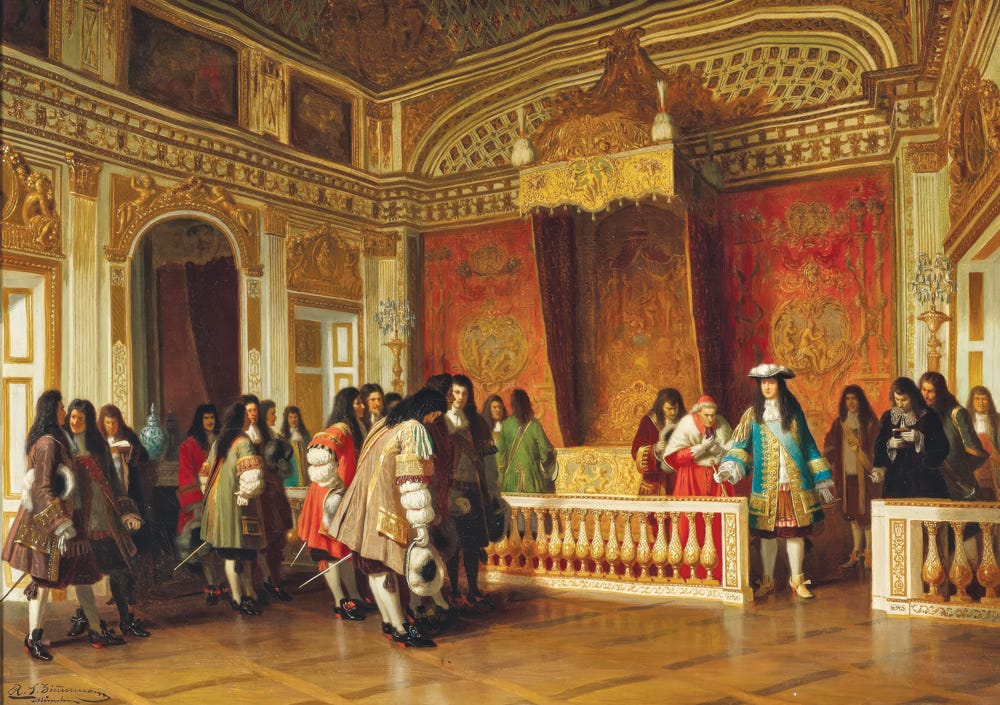
Reinhard Sebastian Zimmermann (German, 1815–1893), Audience with the French King Louis XIV, oil on canvas.
Extracts from a long and good piece.
What will people do all day? I mean, of course, if the AIs surpass us at all economically necessary forms of labor.
When the machines can do everything else, our relationships will be what’s left. … Before industrialization, there was very little sense that working, in itself, could be dignified or meaningful.2 We were not defined by our jobs but by our participation in a densely interconnected social world. And we might be again. …
I am afraid they’re right.
Power and Sex Among Apes
Let’s start with 18th-century aristocrats. Aristocrats are (typically) rich, which we certainly will be if we have robots capable of all normal nonrelational labor. … court life in the age of absolutism is as close to a purely relational world as anything I can think of. …
[The best guide is] the memoirs of Louis de Rouvroy, duc de Saint-Simon,3 a courtier at the Versailles of Louis XIV. … Saint-Simon himself is dull, petty, anti-intellectual, and obsessed with nuances of heredity and precedence … Reading his memoirs is like spending a few hundred pages in the mind of Daffy Duck. …
All the amusements of court life … are a backdrop to the real organizing activity of daily life: intrigue. … They go to see who else is there, and whether what they’re wearing could be construed as a statement of allegiance. … [He is not an outlier; Catherine the Great’s St. Petersburg was the same world.] …
But then, aristocrats are not like us. We’re bourgeois: Our idea of dignity involves being diligent, productive, responsible citizens. … Aristocratic dignity comes from honor, which is to say it comes from maintaining distinctions of family and class. …
Ladies Who Lunch
Susan Ostrander’s Women of the Upper Class5 is an ethnography of upper-class women … in 1984. … None of Ostrander’s subjects grew up with the expectation that they would work outside the home … Instead of working … they volunteer. … Ostrander writes,
The volunteer work of upper-class women has an elusive quality about it … she said, “It’s that illusion of being useful that’s satisfying.” …
All in all, this isn’t a bad life — just a small one. …
The Working Classes
Herbert Gans’ The Urban Villagers, [on Italian-American Boston in the 1950s, describes a third such world, organized around the peer group, where] mostly, they talked, and talking mostly meant gossip.
This is where the parallels to old money Midwestern ladies and European aristocrats start to show. … First, none of them see work as a source of status. … Second, they are exclusive. … Finally, they all spend an enormous amount of energy policing deviant behavior. … A person’s primary source of dignity is not their own achievements, but their relationship to the group. …
Friendship Was Invented in 18th-Century Scotland
When our personal dignity comes from our membership in a group, everything the group does reflects on us. … They were defending their collective reputations: the thing that mattered most to them in the world.
What we absolutely can’t live without is a social framework for understanding ourselves … and gaining the respect of our peers. … all of us benefit from living in a system where we can earn respect and dignity as adults from what we do, not who we know, or who we are. …
[Claudia Strauss] looked at workers coming back to the office after COVID-19 lockdowns. … most of them greeted their return with overwhelming relief:
An immigrant from El Salvador … told a reporter, “Sometimes one feels afflicted, desperate, because we want to work. … We want to feel useful.” … A Black woman in her fifties … “I hate not being able to go to work, not so much for the money, but just for a part of my sanity.” …
Unlike members of relational societies, the things we want respect for are impersonal: our skills, our accomplishments, our contributions to a shared goal. … When humans get relational, we get clannish. …
The Scottish Enlightenment understood this first.11 … Before impersonal markets and bureaucracies, the only way to survive was through personal ties to allies or to kin. … For Smith, the absence of necessity created room for a better form of friendship, based on “natural sympathy” instead of mutual need. …
I like my job, and I like liberal individualism. If the former will one day be a casualty of progress, I hope the latter will survive it.
I’ve been reading up on James Harrington, who was a contemporary of Thomas Hobbes and who published a famous and influential book called Oceania, which took a lot of inspiration from the government of Venice to propose a new and intriguing form of government. Turns out he began life as a poet and had verse put to music by contemporaries as here. Below the text of the verse.
Ye purple Robes, and Crowned heads, Upon this life the shepheard leads Could you without ambition looke you'd change your Scepter, for his Crook.
A good piece from Compact about symbiosis between Big Pharma and health activism.
In 1988, the gay author and activist Larry Kramer published an open letter to Anthony Fauci, ... the director of the National Institute of Allergy and Infectious Diseases ... responsible for overseeing most AIDS research. ... He called NIAID officials “monsters,” “idiots,” and “murderers,” and went on to compare Fauci to Adolf Eichmann. ... He referred to AIDS as “the worst epidemic in modern history, perhaps to be the worst in all history.” ...
What’s most remarkable about this document ... is ... that it turned out to be the beginning of a beautiful friendship. ... Kramer would regularly denounce him to the press but then tell him privately he “didn’t really mean it. I just wanted to get some attention.” Beneath their public antagonism, the two men had a shared interest in keeping AIDS in the public eye, since this would increase funding for drug research. ...
The bond between Kramer and Fauci exemplifies a broader transformation in the relation of activism to science and the pharmaceutical industry. Increasingly, Big Pharma has come to cast its pursuit of profits in humanitarian language borrowed from activist groups. ... The AIDS crisis ... set the stage for later developments, from the Covid pandemic to the recent explosion of transgender identification. ...
Many believed the Reagan administration wasn’t doing enough ... owing to homophobia. ... In reality, the federal government was starting to move at an unprecedented speed. In 1987, ... the first ever drug to fight AIDS, [AZT], had been approved for sale after the fastest trial in Food and Drug Administration history. ...
The same year, Kramer formed the AIDS Coalition To Unleash Power, or ACT UP. ... The movement’s rallying cry “Drugs Into Bodies” aligned it with a conservative push to deregulate the pharmaceutical industry, conversely pitting it against liberals who favored regulation and consumer protection. ... In 1990, ... Fauci spoke highly of AIDS activists ... For this, ACT UP members gave him a standing ovation. ...
In 1983, [Fauci] wrote an editorial ... suggesting AIDS could spread through “routine close contact.” Nothing could have been further from the truth: HIV would turn out to be one of the least infectious agents ever discovered. ... His claim initiated a prolonged fear campaign. ... Oprah Winfrey quoted experts ... that 1 in 5 heterosexuals might die of AIDS in the next five years. ...
Terrified parents rallied against admitting HIV-positive students to their kids’ schools. ... It’s difficult to destigmatize a disease while simultaneously claiming that soon everyone will be dead from it. ...
The simple fact is that AIDS was a tragedy for gay men and other well-defined risk groups but never posed a serious danger to the general population. ... The fear campaign worked ... but it also took a toll. ... [Both] the gay community and the general public would have been better served by more sober rhetoric. ...
Decades later, Fauci and the public-health establishment would repeat the same mistake with Covid, portraying the disease as a universal threat, despite the fact that it was overwhelmingly a risk for the frail and elderly. In both instances, the effect was the same: to promote dependence on the public-health apparatus and expand the consumer base for novel pharmaceuticals. ...
With ... PrEP, in 2012, it became common to prescribe antiretrovirals ... for healthy gay men. As ... Seamus O’Mahony has written, “Pharma’s single greatest idea was to move its focus from the sick to the well, thus creating vast new markets of ‘patients’ requiring lifetime treatment with drugs.” ... ACT UP provided a model for patients organizing themselves into a political constituency to demand drugs ... ... By funding patient-support groups, [Pharma] can present itself as the voice of the powerless. ...
But nowhere is ACT UP’s legacy more apparent than in ... contemporary transgender activism and transgender medicine. ... [The] ubiquitous talk of “trans genocide” echoes ACT UP’s rhetoric. Trans activists see themselves as a radically oppositional force, but their demands happen to coincide with the interests of a pharmaceutical industry always seeking out new groups of lifelong customers. ...
While Kramer and others exaggerated the dangers of AIDS ... many people were dying or desperately sick of the disease. ... By contrast, trans activists’ claims about looming death are almost entirely a rhetorical tactic. ... In pressuring the medical establishment to meet their demands, activists have become the shock troops of a predatory industry only too happy to expand its customer base.
In fact they’re so odd that the first two aren’t even about the Messiah.
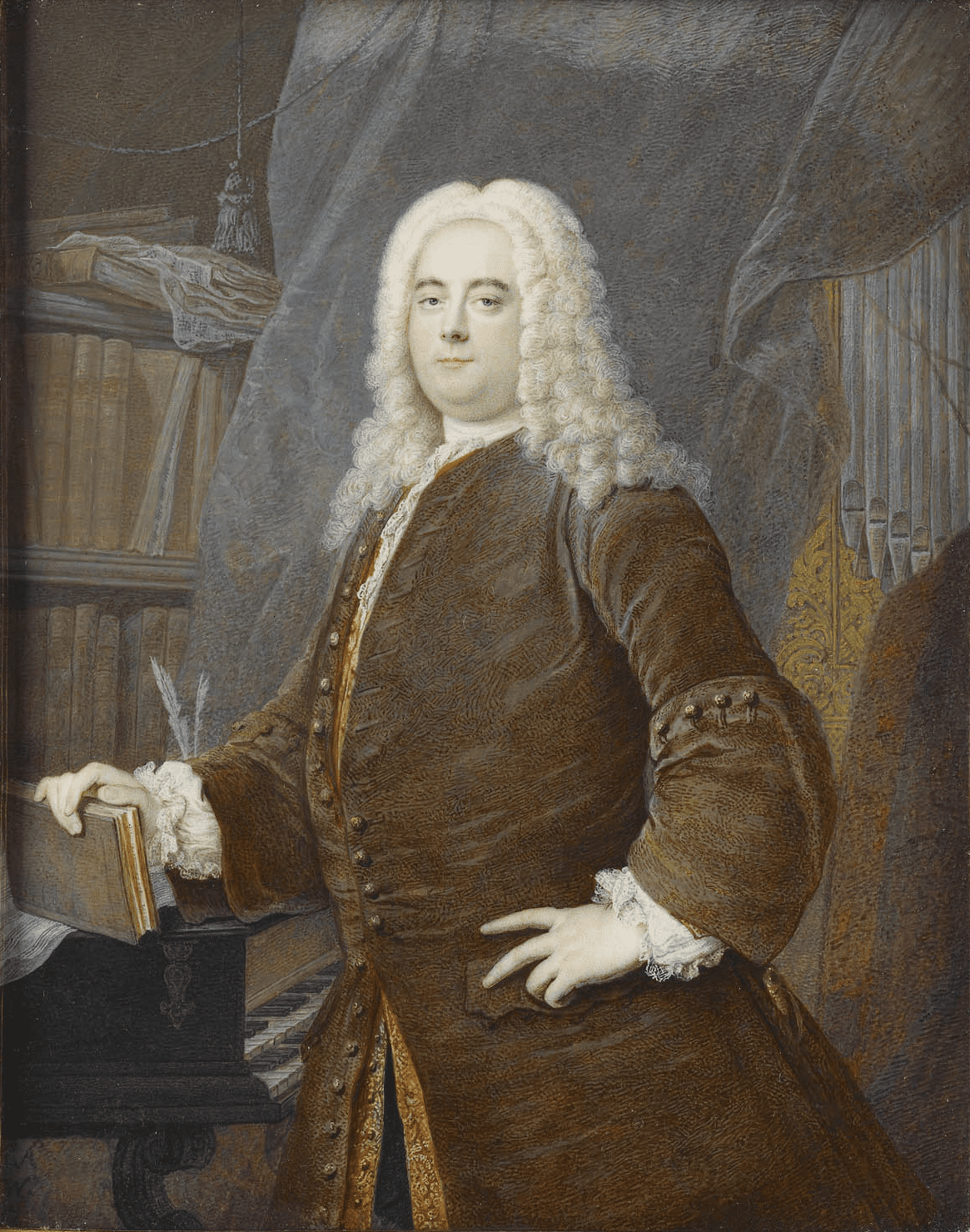
The original [German] spelling and pronunciation of George Frideric Handel’s name is Georg (GAY-org) Friedrich Händel (HEN-del). His father was a barber-surgeon (I know, right?) and Handel’s original game plan for life was to study and enter the practice of law. While in law school, he started playing the organ for a local church, and, well, that started the composing music ball rolling.
Handel was British… but not… just like King George I was British, but not. King George I was German-born, from Hanover. Before the young Handel moved to England, he’d served as Kapellmeister for George (then the Elector of Hanover) in Germany before he became King of England. Once they were both in England, well, it was likely an easy choice to stay affiliated. Handel loved England, and 1726 he became a naturalized British subject.
By 1741, Handel had fallen deeply into debt and was even threatened with debtors’ prison. Instead, he departed to Ireland for a sabbatical, where he wrote his Messiah.
Handel composed Messiah in just twenty-four days, a staggering feat, given the original score is 259 pages. Yikes. That’s some productive off-time.
In spite of the fact that Handel himself was in bad shape financially, he premiered Messiah in Dublinas a benefit, to help out some of the inmates stuck in debtors’ prison. The benefit performance was a rousing success, and 143 debtors were released from prison as a result.
As a gesture of thanks, Handel’s Irish backers returned the favor by paying off some of his own London debts.
The first London performance, a year later, wasn’t as unequivocal a success. Criticism was voiced that the work’s subject matter was “too exalted to be performed in a theatre, particularly by secular singers.” Handel tried to appease the conservatives by using a different name, calling it the “New Sacred Oratorio” instead of “Messiah.” Even then, however, the London reception of the production remained cool, and the oratorio was only performed three times that year instead of the anticipated six. Until, a few years later, at the London Foundlings’ Hospital…
Handel performed a mix of new music and older pieces including the “Hallelujah” chorus at London’s Foundling Hospital, in 1750, for a charity concert. At the time, Messiah hadn’t made its splash with London audiences (see above), but the concert was so well received that Handel was invited back the next year, where he performed the entire Messiah oratorio. Performances of Messiah became an Eastertime tradition there until the 1770s. Earnings from many early performances of the oratorio were used to help the poor, needy, orphaned, widowed, and sick.
The complete oratorio of Messiah has fifty movements, but it was otherwise a modest production. In the years after Handel’s death, Messiah was adapted for performance on a much larger scale, with giant orchestras and choirs. Mozart, as well as a few other composers, played around with it, offering a fresher (at the time) adaptation. Today, you can buy the Mozart adaptation, the original, an abridged version, popular excerpts version, Part I & II version, etc.
Audiences typically stand during the “Hallelujah Chorus” movement of Messiah. One story as to why dates back to when King George II (son of King George I) heard it being performed for the first time. Story has it, he was so dazzled, so overcome with emotion, he rose to his feet automatically. And when the king rises, all rise. So, there it is. Fact or myth? You make your own call.
This is what became the first chapter of a book called The Good Life, which in many ways was the first book of neoliberalism. Written by the great American journalist and political thinker Walter Lippmann, it was the centerpiece of a colloquium held in Paris in 1938, organised by Friedrich Hayek who assiduously made sure that Maynard Keynes who was also searching for some way to preserve the insights of liberalism from its discrediting by the excesses of 19th century laissez faire and its disastrous approach to the Great Depression.
In fact the two great influences Lippmann highlighted in the book were von Mises and Hayek’s trumph in the socialist calculation debate and Keynes’ expansionist ideas about how to fight a recession. Anyway, the introduction was published in the Atlantic more than a year before publication in the book. It’s a fine piece preoccupied as it is with the earnest search for a way forward in a world that is deteriorating fast.
[More than two years ago the Atlantic planned with Mr. Lippmann a series of articles dealing with the deeper phases of the Age of Discontent in which we live. It was proposed with apparent reasonableness that these papers should appear month by month early in 1935. As time proceeded, Mr. Lippmann’s duties and the difficulties and importance of the work he had undertaken made it manifest that either his conclusions must be published prematurely or the date must be postponed. The project had already taken on a large and growing significance and it was agreed that haste was not to be thought of. From a series of loosely articulated papers the design has been transformed into a comprehensive and unified inquiry into the premises of our political thinking. The work which now for two years has been the subject of Mr. Lippmann’s preoccupation is not complete, but the groundwork has been laid and the argument advanced to a point the public importance of which will be immediately recognized. Some measure of what the inquiry will mean to political thinking in our generation is suggested by Mr. Lippmann’s illuminating introduction printed in this number of the Atlantic. Succeeding issues will carry his argument throughout its fundamental stages. — The Editors]
Nearly twenty-five years ago I wrote a book called A Preface to Politics, intending at some later time to write the other chapters. The general scheme of the human future seemed fairly clear to me then. That was the heyday of Theodore Roosevelt’s New Nationalism and of Woodrow Wilson’s New Freedom, and I had not the faintest premonition that the long peace which had lasted since Waterloo was soon to come to an end. I doubt whether the idea had ever occurred to me that there might be a war which would unsettle the foundations of society — indeed I could not have imagined such a war, and I should not have known what were the foundations which might be unsettled.
For in that generation most men had forgotten the labors that had made them prosperous, the struggles that had made them free, the victories that had given them peace. They took for granted, like the oxygen they breathed and the solid ground beneath their feet, the first and last things of western civilization. So in writing my Preface I assumed without question that in a regime of personal liberty each nation could by the increasing exercise of popular sovereignty create for itself gradually a spaciously planned and intelligently directed social order. So confident was I that this was the scheme of the future that I hurried on to write another book which proclaimed in its title that we had come to the end of the era of drift and were entering the era of our mastery of the social order.
A year or so later the World War broke out, and since that time the scheme of the future has been much less clear to me. For more than twenty years I have found myself writing about critical events with no better guide to their meaning than the hastily improvised generalizations of a rather bewildered man. Many a time I have wanted to stop talking and find out what I really believed. For I should have liked to achieve again the untroubled certainty and the assured consistency which are vouchsafed to those who can whole-heartedly commit themselves to some one of the many schools of doctrine. But I was not able to find in any of them a working philosophy in which I could confidently come to rest.
This was not a pleasant predicament. For in these twenty-five years there has been one great crisis after another, and it was impossible to be neutral and detached. But gradually, in the course of my blundering improvisations, it began to be clearer to me why I could not make up my mind. It was because my personal confusion reflected the fact that in the modern world there is a great schism: those who seek to improve the lot of mankind believe they must undo the work of their predecessors.
Everywhere the movements which bid for men’s allegiance are hostile to the movements in which men struggled to be free. The programmes of reform are everywhere at odds with the liberal tradition. Men are asked to choose between security and liberty. To improve their fortunes they are told that they must renounce their rights. To escape from want they must enter a prison. To regularize their work they must be regimented. To obtain greater equality they must have less freedom. To make more secure the national solidarity they must oppress the dissenters. To enhance their dignity they must lick the boots of tyrants. To realize the promise of science they must destroy free inquiry. To promote the truth they must not allow it to be examined.
These choices are intolerable. Yet these are the choices offered by the influential doctrinaires of the contemporary world. Thus those who would be loyal to the achievements of the past are in general disposed to be fatalistically complacent about the present, and those who have plans for the future are prepared to disown the heroic past. It is a vicious dilemma.
However difficult it may be to find the true doctrine by which mankind can advance, surely it is not to be found in either of these alternatives. With this conviction I began again to write, with the feeling that if this is the choice, then the prospect is too dismal to be endured. It may be, of course, that the choice is inexorable and that a man is a fool who does not accept it with such resignation as he can muster. Many find this view unanswerable. Yet to embrace it is, I imagine, to mistake one’s own weariness for wisdom and to be discouraged rather than to understand. This I can say: I began to write in a mood of protest and without much hope, but at the end I have come to believe that the riddle is not inherently insoluble. The choice presented to this generation between a more comfortable and a free life is not to be borne. But whether this is a paradox arising not out of the unchanging nature of things but out of a remedial confusion in men’s minds will be for the reader to judge.
The plan of this work divides itself into two parts. The first is an analytical examination of the theory and the practice of the movement which began in the second half of the nineteenth century. It seeks to organize a directed social order.
I have sought to examine this vision of the future not only in its Fascist and its Communist embodiment but also in the gradual collectivism of democratic states, trying to determine whether a society can be planned and directed for the enjoyment of abundance in a state of peace. The question was not whether this would be desirable, but whether it was possible. I began by thinking that while it might be difficult to find planners and managers who were wise and disinterested enough, the ideal might eventually be realized through a well-trained ruling class. But I have come finally to see that such a social order is not even theoretically conceivable; that the vision when analyzed carefully turns out to be not merely difficult of administration but devoid of any meaning whatever; that it is as complete a delusion as perpetual motion. I realized at last that a directed society must be bellicose and poor. If it is not both bellicose and poor, it cannot be directed. I realized then that a prosperous and peaceable society must be free. If it is not free, it cannot be prosperous and peaceable.
It took me some time to understand that this was no new discovery, but the basic truth which the liberals of the eighteenth century taught at the beginning of the modern era. I began to read with a new interest what Adam Smith and some of his contemporaries had to say when they insisted that the sovereign must be “completely discharged from a duty, in the attempting to perform which he must always be exposed to innumerable delusions, and for the proper performance of which no human wisdom or knowledge could ever be sufficient: the duty of superintending the industry of private people, and of directing it towards the employments most suitable to the interest of the society.” It gradually dawned on me that Adam Smith would not have regarded the corporate capitalism of the nineteenth century as “the obvious and simple system of natural liberty” which he had imagined, for he had been careful to say that it was the duty of the sovereign to protect as far as possible “every member of the society from the injustice or oppression of every other member of it,” and it was plain from the whole tenor of his book that he meant something more essential than the equal right of the rich and the poor to drive hard bargains.
Yet the doctrine which has come down from him and from the great liberals of the eighteenth century has in our time become the intellectual defense of much injustice and oppression. In Herbert Spencer’s old age, liberalism had become a monstrous negation raised up as a barrier against every generous instinct of mankind. So in the second part of this book I attempt a task which is, I fear, beyond my powers. I seek to find out why the development of the liberal doctrine was arrested and absorbed. In order to do this I have tried to find out what is the inwardness of the liberal conception of life, what is the logic of its principle and the grammar of its intuition, and then to indicate certain vital points where, because the liberals failed to develop the promise of liberalism, they ceased to interpret experience and to command the interest of the people.
This is a difficult and ambitious essay and I do not offer it as a completed solution. So far only, I know how to go; someone else may find in it a clue that will lead him further. I hope so. The search is worth much trouble, for at the end of it men may find again the conviction of their forefathers that progress comes through emancipation from — not the restoration of — privilege, power, coercion, and authority.
I am cranky because it's Compact and it hit all the expected villains but part of the justification for things like school closures that went on too long especially in NYC was that school kids may not be that vulnerable themselves but might be in extremely close contact in small apartments with frail and/or elderly people. I might have been very cavalier about getting vaccinated if it was just me but to protect someone with a preexisting condition you do everything necessary and don't complain that much. (In fairness I was never stuck in the house and could always walk to the grocery store and pharmacy.) Also I am not an expert on the array of medicines taken by transgender people or whether they have to be taken your whole life but another thrust of transgender activism is that you can be fully transgender without ever doing anything medical about it. Author might have talked about psychiatric drugs and playing into the hands of big pharmaceutical companies when issues of social/emotional health are medicalized.
(The Giants were on Sunday Night Football but I got through 2 days of email falling asleep at the keyboard twice. About 4 am the choice was starkly between more email and real sleep.)
Has taken sixty years to get back to the standard of living I had as an 18 year old with Dad paying the bills. Treasury screws over families raising its future taxpayers. No wonder people become sole parents and go on the public tit.

































I am cranky because it's Compact and it hit all the expected villains but part of the justification for things like school closures that went on too long especially in NYC was that school kids may not be that vulnerable themselves but might be in extremely close contact in small apartments with frail and/or elderly people. I might have been very cavalier about getting vaccinated if it was just me but to protect someone with a preexisting condition you do everything necessary and don't complain that much. (In fairness I was never stuck in the house and could always walk to the grocery store and pharmacy.) Also I am not an expert on the array of medicines taken by transgender people or whether they have to be taken your whole life but another thrust of transgender activism is that you can be fully transgender without ever doing anything medical about it. Author might have talked about psychiatric drugs and playing into the hands of big pharmaceutical companies when issues of social/emotional health are medicalized.
(The Giants were on Sunday Night Football but I got through 2 days of email falling asleep at the keyboard twice. About 4 am the choice was starkly between more email and real sleep.)
Has taken sixty years to get back to the standard of living I had as an 18 year old with Dad paying the bills. Treasury screws over families raising its future taxpayers. No wonder people become sole parents and go on the public tit.