


A few years ago, a fellow called Lucas Blower contacted me to discuss his plan to campaign for a citizen initiated referendum to amend Ohio’s constitution.1 In any event, he told me that he and his wife had been sitting at their kitchen table and Lucas was going through his schtick for the benefit of his wife. As Lucas rehearsed the reasons people should vote for him, his wife looked at him balefully and said, “Lucas, you’re full of bullshit.”
On telling me this, I was naturally amused, but also immediately thought of Mal Meninga and also of his 30 second political career during which he thinks to himself, “I’m full of bullshit,” and pulls the plug on a career of bullshit.
Welcome to video 2 of Part Two of the series - which turns to leadership, how poorly our existing institutions do it, and how that might be improved.
And remember, please
#WatchLikeAndSaveTheWorld.
Quite the turn of phrase
Tyler Cowen on the social media ban
In principle, the social media ban is a good thing. But here’s a prediction - offered without any great confidence that I’m right. It won’t work and will be seen as a farce within 12 months. Here’s Tyler Cowen on it.
He’s more concerned about free speech for the under 16s than me (I’m pretty strong on it for adults and things will come unstuck for the UK Government for that reason). On the other hand, Tyler’s very first sentence is a doozy. YouTube is a fantastic pedagogical device. And lots of kids use it in such a way. As someone pointed out on a WhatsApp message group, he’s biased towards brilliant young up-and-comers because of running the fantastic grant making program Emergent Ventures!
I think this is another example of ‘OrtaDoSomethingAboutism’. We have a problem and want to do something about it. So far so good. But what if the problem is hard to solve. For instance improving the wellbeing of indigenous folks or out of home care kids or even reducing bullying at work or in schools. To deal with these problems we get people to put on their best “the adults have arrived” gear and then get them to do something.
Then as the evidence mounts that the new approach isn’t doing any better than the old approach or is generating whole new problems (what if anti-bullying initiatives are gamed by bullies themselves?), well then we set up a culture war between the ‘pros’ and ‘cons’.
Claude has edited the column back slightly and injected sub-headings which are quite useful.
YouTube in particular, and sometimes X, are among the very best ways to learn about the world. To the extent that the law is effectively enforced, targeting YouTube will have a terrible effect on youth science, and the ability of young scientists and founders to get their projects off the ground will take a huge and possibly fatal hit...
The Expansion of State Control
The more serious concern is that this represents a major expansion of government control over tech services and also speech. That becomes a politicized decision, as any chosen lines will be arbitrary, especially as online services evolve in their functionality...
I predict that either this law stops being effectively enforced, or the controls on companies and users have to become much, much tighter and more oppressive. In a large poll of Australian 9 to 16-year-olds, only 6 percent of them thought the new ban was going to work.
Inevitable Loopholes and Expansion
With gaming and messaging exempt from the ban, we can expect old-style “social media” to move into those areas. Discord, for instance, is exempt from the ban, a glaring hole, and in a fast-changing market there probably will be some significant loopholes most of the time. For the ban to continue to work, it will have to spread...
Who Decides What Youth Can Access?
Who is in charge of the family anyway? If I have decided that my 15-year-old should be free to follow Magnus Carlsen on X and YouTube, should we have the boot of the state tell me this is forbidden? This is a big move in the direction of what Socrates advocated in The Republic, namely that the state takes priority over the family in deciding which stories can be told to the youth.
The Slippery Slope of Free Speech Restriction
Over time, I expect this ban, again assuming it is kept and enforced, to become one of the biggest free speech restrictions on the internet. It is the incentive of government agencies to boost their budgets, spread their mandates, and enforce their dictates...
You might think that Australia’s regulatory guardians can be trusted to uphold free speech ideals, but has that been the case to date? Under Australian law, it is permissible to restrict free speech for reasons of public order, national security, and protection from harm...
The Real Calculus
It is very defensible to worry that your kid is on his or her phone too much. But if you think a massive expansion of state authority over online content is the answer, you ought to know that the associated gains from that decision will at best be modest. You will not be saving civilization or our youth; rather you will be joining the ever-growing parade against free speech.


Deliberative voters?
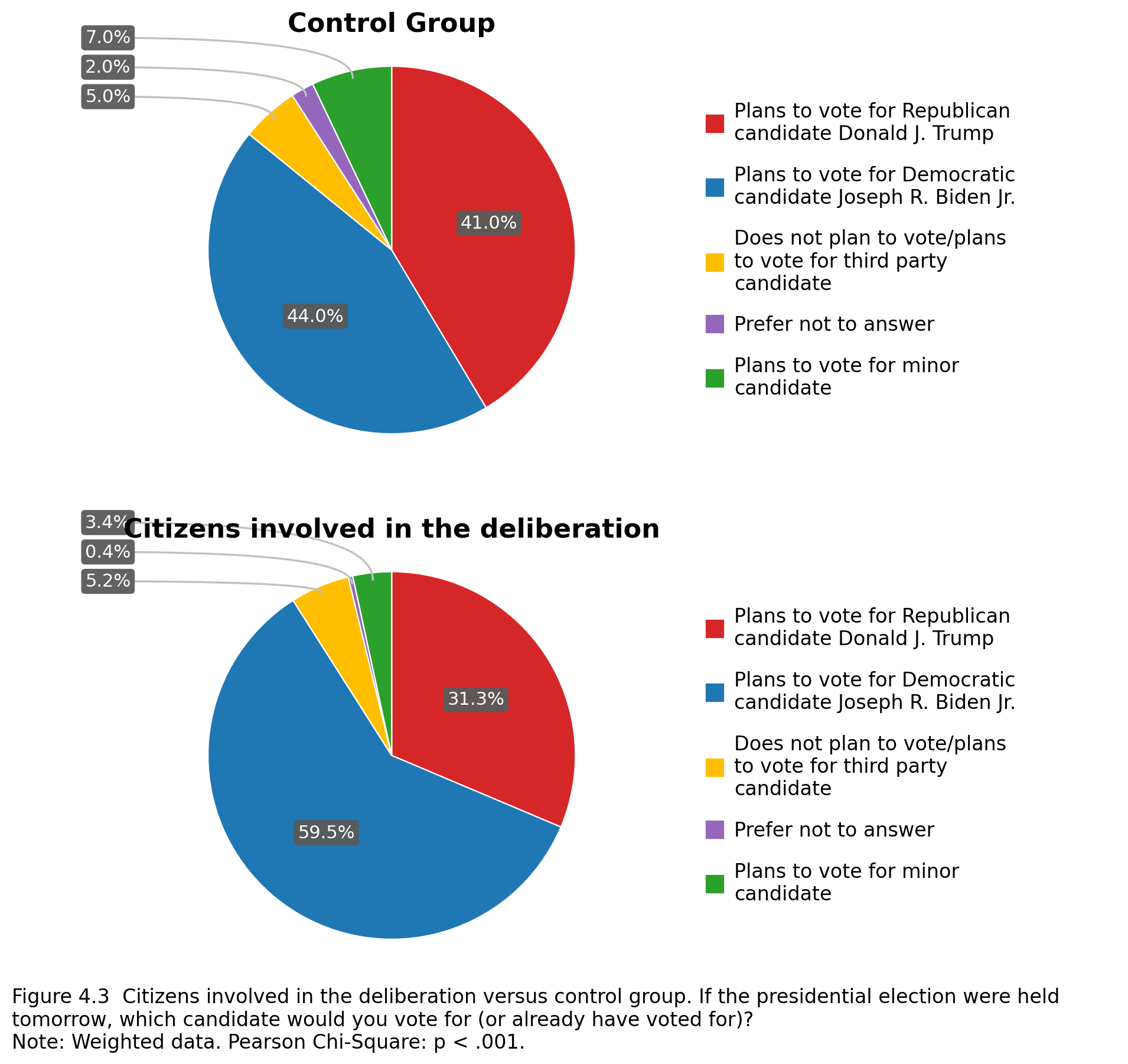
From James Fishkin’s latest.
A year after America in One Room, we followed up with the participants and the control group to see how they intended to vote (and also, just after the election, to see how they did vote) in the 2020 Presidential election. We were interested in whether or not there was any trace of an effect on their voting. In particular, we were interested in whether or not there were traces of what we could call “deliberative voting”—voting that was arguably connected with their considered judgments following deliberation. We knew that any expectation of an effect was setting a high bar. After all, the deliberations had been a full year earlier. The intervening months subjected everyone (participants, the control group, and the general mass public) to one of the most contentious campaigns on record. Why should we expect a weekend of civil discussion and deliberation on the issues to have any lasting effect after a year of distorted mud-slinging?
The follow-up surveys, just before the 2020 election as well as just after the election, with both the participants and the control group show significant differences in voting behavior for these samples of registered voters. Figure 4.3 shows the dramatic difference between the treatment and control groups in voting intention just before the election, a full year after the deliberative weekend. The control group had a gap between Joe Biden and Donald Trump at 3.8% (the actual gap in the electorate was about 3%). But the voting intentions of the participants suggest a dramatic effect of the treatment—a gap of 28.2 percentage points between the two major candidates.
How is such an effect possible? The results are surprising because the accepted wisdom in political science has long been that voting behavior, deeply rooted in group attachments, is much more stable, and presumably much harder to change, than political attitudes. We find significant effects on two aspects of voting behavior: who one votes for and whether one votes at all. The second is just as puzzling as the first in that successful interventions on turnout tend to be soon before the election. All of the effects on voting behavior discussed here occur much longer after the intervention. How can deliberation possibly have such effects almost a year later?
Our solution to the puzzle of the delayed effect is that the deliberations gave rise to a latent variable, an awakening of civic capacities, that has an effect, in turn, on voting (whether or not one votes at all) and on vote choice (whom one intends to vote for). The people who deliberated over the weekend, as compared to the control group, became more politically engaged. We take significant movement on the polarized policies over the weekend as an indicator that they were deeply involved in the deliberations. Those who deliberated were also more likely to follow the campaign, to have a greater sense of internal efficacy (belief that their political views were “worth listening to”), and to acquire (and continue to acquire) general political knowledge. Deliberative change on the issues following the campaign, feeling that you have views worth listening to, and becoming more knowledgeable are all elements of a coherent civic awakening—a picture of more engaged citizens.
These elements of a civic awakening are roughly similar to those found by Gastil et al. in their study of the indirect effects on voting from serving on a jury that reached a verdict. They found that the depth of deliberation (which they measured by the number of counts considered at a trial that reached a verdict) was one of the mediators in increasing the likelihood of voting. Our deliberators all considered the same number of policy issues, but we measure “depth of deliberation” through their opinion changes on the deliberative weekend on the issues that were extremely polarized. Gastil et al. also found public affairs media use as measured by “following the campaign,” political efficacy, and satisfaction with the deliberative process all connected to the civic awakening from jury service. We use “following the campaign” and gain in general political knowledge as mediators along with internal political efficacy.
In the jury case, the dependent variable was limited to whether or not one voted. In our analysis we are interested both in turnout and in how one voted and whether that voting behavior has a connection to one’s policy positions. The latter is essential for considering the broader question of the impact of civic engagement on collective self-government.
Thus far we have traced elements of a civic awakening—greater efficacy, increased knowledge, and closer attention to the campaign among the deliberators. We have also seen indirect effects of the civic awakening on voting at all and voting for Biden. However, we can also explore whether there is a direct effect of their time-3 (the survey just before the election, one year later) policy positions on how they voted. Once awakened, are the deliberators more likely to take their policy preferences into account in deciding whom to vote for? In fact, we found a significant direct effect of the policy positions respondents had at time 3 and their willingness to vote for Biden. In short, they made a direct connection between their policy positions at the time of voting and how they voted. Thus, we conclude that the deliberations from a year earlier helped foster more deliberative voters.
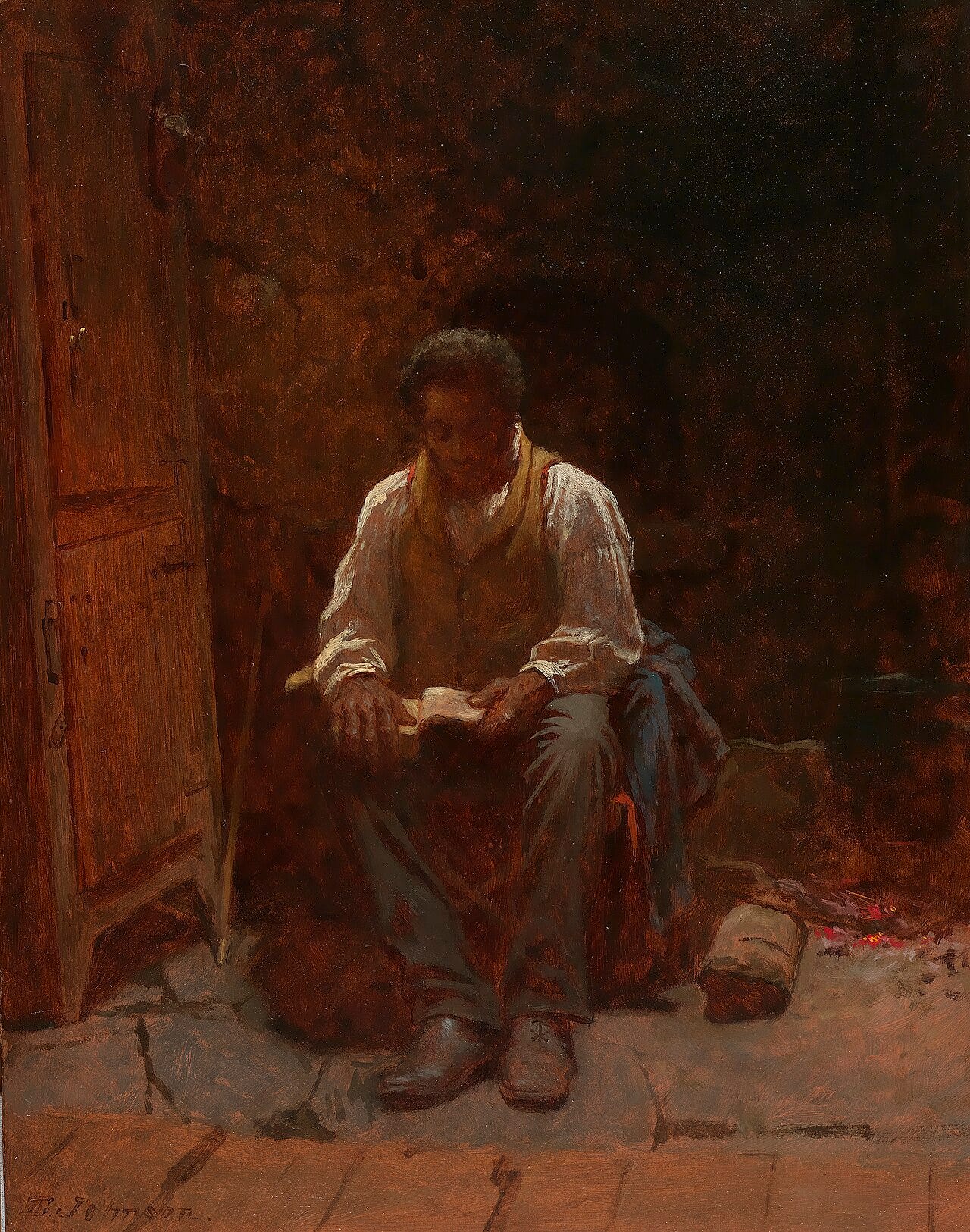
A snippet of Einstein, a snippet of Stoppard
Both from Derek Thompson’s substack:
When Viereck asked if Einstein believed in the story of human progress, he replied that “the only progress I can see is progress in organization.” Einstein continued:
The ordinary human being does not live long enough to draw any substantial benefit from his own experience. And no one, it seems, can benefit by the experiences of others. Being both a father and teacher, I know we can teach our children nothing. We can transmit to them neither our knowledge of life nor of mathematics. Each must learn its lesson anew.”
We’ll close with one of the finer letters to the editor you’ll read, from the Times of London, on the occasion of the death of playwright Tom Stoppard.
“Saved by Stoppard”: Sir, In 1993 my wife and I went to see the first production of Arcadia by Tom Stoppard (obituary, Dec 1), and in the interval I experienced a Damascene conversion. As a clinical scientist I was trying to understand the enigma of the behaviour of breast cancer, the assumption being that it grew in a linear trajectory spitting off metastases on its way. In the first act of Arcadia, Thomasina asks her tutor, Septimus: “If there is an equation for a curve like a bell, there must be an equation for one like a bluebell, and if a bluebell, why not a rose?” With that Stoppard explains chaos theory, which better explains the behaviour of breast cancer. At the point of diagnosis, the cancer must have already scattered cancer cells into the circulation that nest latent in distant organs. The consequence of that hypothesis was the birth of “adjuvant systemic chemotherapy”, and rapidly we saw a striking fall of the curve that illustrated patients’ survival. Stoppard never learnt how many lives he saved by writing Arcadia. - Michael Baum, Professor emeritus of surgery; visiting professor of medical humanities, UCL

Twins Reared Apart Do Not Exist

A long and fascinating article. Click through if you want to read it all, read the Claude Summary if you want the TL:DR
David Bessis, a mathematician, was shocked by a viral tweet from Paul Graham sharing a graphic by hereditarian blogger Cremieux, viewed 3.5 million times. The visual appeared to show that IQ differences between identical twins raised separately were barely greater than test-retest variation for a single person—seemingly conclusive evidence for genetic determinism of intelligence.
As someone whose book argues that mathematical ability can be developed through practice and mindset, Bessis found this claim existentially threatening to his worldview. He spent three months investigating the underlying studies.
The Heritability Stakes
Heritability measures how much genetic variation explains trait variation. At 30-50%, genes matter but leave enormous room for individual development. At 80%, genetic determinism would be largely vindicated. The difference is crucial: at 50% heritability, someone with average genetic potential could still become exceptionally intelligent; at 80%, outcomes are essentially fixed at birth.
The Studies Collapse Under Scrutiny
Bessis examined the five studies behind the graphic and found catastrophic problems.
First, one study (Burt) was at the centre of possibly the biggest scientific fraud scandal of the 20th century Substack—most of his “twins reared apart” never existed, as his dataset was a fabrication. Substack
The remaining legitimate studies (Shields and Bouchard/Minnesota) suffer from four compounding biases:
Shared congenital factors: Twins share nine months in the womb. Prenatal influences (alcohol, smoking, lead exposure, preterm birth) are major contributors to IQ variance—yet the studies made no attempt to correct for this.
Shared early life: “Reared apart” misleadingly suggests separation at birth. Actually, twins averaged 5.1 months together before separation; some weren’t separated until age seven or later.
Shared cause for separation: These weren’t random families—twins were separated due to illegitimacy, maternal death, illness, or poverty. These circumstances create selection biases affecting both twins.
Range restriction: Adoptive families are systematically screened. In twelve cases the twins were brought up in families that were unrelated to one another. In the remainder they were brought up by different branches of the same family, in twenty cases one twin staying with his own mother. Substack This devastating admission from Shields himself invalidates claims of environmental randomisation.
The Missing Control Group
The most damning revelation concerns the Minnesota Study. Standard methodology requires comparing identical twins (sharing 100% of genes) with fraternal twins (sharing 50%) to isolate genetic effects. Bouchard collected both datasets—then published only the identical twin data, claiming “space limitations.” This is scientifically inexplicable unless the control group showed no meaningful genetic signal.
Jay Joseph later located the withheld fraternal twin data in subsequent publications and found the two heritability estimates did not differ at a statistically significant level—meaning the study had failed to identify any genetic contribution. Substack Bouchard’s response evaded this specific claim.
Where This Leaves Us
The “twins reared apart” paradigm is now considered a dead end. Current scientific debate centres on the 30-50% heritability range—high enough that genes matter, but far from the determinism implied by 80%+. At these moderate levels, there remains substantial room for human agency and cognitive development.
The mythical experiment—twins truly separated at birth into genuinely random environments—has never been conducted and probably cannot be. Every attempt has been confounded by shared prenatal environments, delayed separation, and restricted placement ranges.
Bessis concludes that the compelling simplicity of “twins reared apart” studies is precisely what makes them dangerous—it is fundamentally hard to believe that such a simple and beautiful design could be so profoundly flawed. Substack Yet the evidence shows they are.
The full article

Karp and Zaminska’s new dispensation
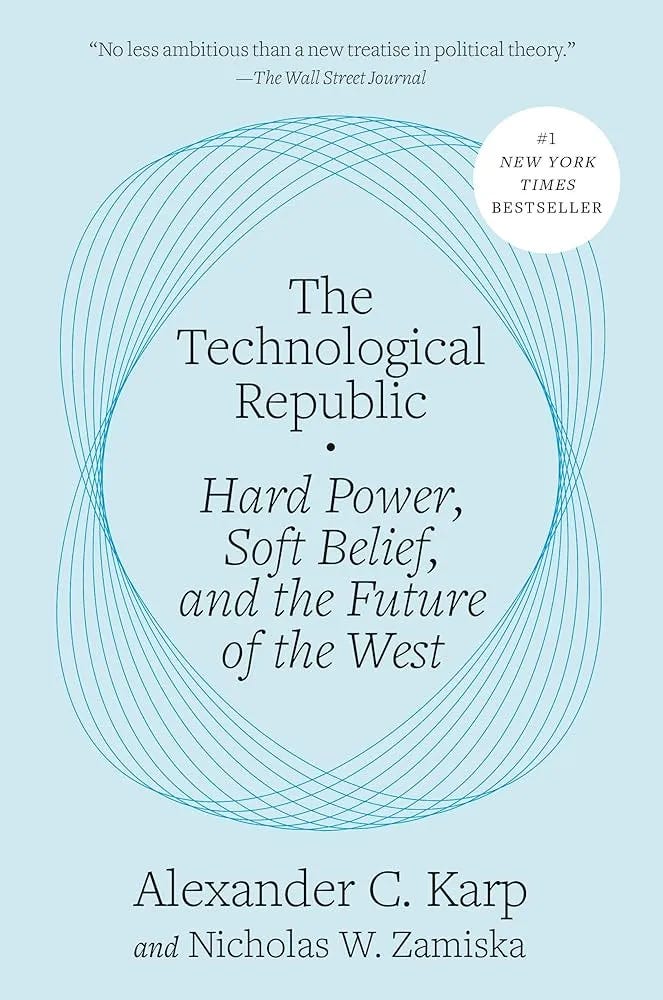
I knew enough when I first read about this book that it would be full of techbro sophistries - masculine calls to build, defences of western civilisation without any of the responsibilities such calls might suggest or any serious engagement with problems like climate change.
Anyway, conservative essayist Tanner Greer bells the cat on the pretensions of the tech bros. As we’re regularly reminded of China’s astounding achievements in building state capacity and America’s state capacity in the hands of the chainsaw wielding techbros, what could possibly go wrong?
The book’s ambition is to inspire American technologists to become techno-nationalists. Regrettably, it offers no roadmap for doing so. Karp and Zamiska invoke past technologists as moral exemplars but never examine the social, political, and institutional conditions that produced them. Sermonizing cannot conjure a governing class out of an elite that has never been trained to think of itself as a steward of the state.
The United States has had such a class before. The architects of the Second Industrial Revolution—engineers, industrialists, and financiers—believed technological development was inseparable from national power. Their descendants would later be called the “Eastern Establishment.” This class did not arise spontaneously. It was forged through war, institution-building, and dense networks of social obligation. …
The Civil War elevated two groups: Northern political elites and a rising class of industrialists and financiers. War bound them together in a common techno-nationalist project. The institutions, habits, and loyalties formed in wartime endured long after Appomattox.
In peace, they stitched the continent into a single market, tied farms and cities together with railroads and telegraphs, and built industries that projected American power abroad. This elite understood that technological development required a governing coalition willing to commit to it across generations. …
By the Gilded Age, political leadership and industrial leadership had fused into a single governing stratum. Their wealth, political influence, and cultural authority reinforced one another. Through law, finance, education, and marriage, they reproduced themselves as a class. Under their stewardship, the United States became the world’s most powerful industrial nation.
A New Techno-Nationalist Elite?
This history offers uncomfortable lessons for those who dream, as Karp and Zamiska do, of a new techno-nationalist elite. Any governing class requires three things: a political coalition, an economic base, and institutions that give it a shared culture. The Eastern Establishment possessed all three.
The Technological Republic gestures toward alignment between Silicon Valley and the state without explaining what economic, political, or cultural arrangements could make such alignment durable. It speaks of fusing a “sector” and a “state,” but what must be fused are people.
The technologists of an earlier century were not shy about articulating duty, hierarchy, patriotism, and service. Karp and Zamiska lament Silicon Valley’s reluctance to engage “messy questions” about the good life—but the problem is not that today’s technologists refuse to ask such questions. It is that they refuse to answer them.
One looks in vain in The Technological Republic for a substantive moral vision. It demands a pulpit for America’s technologists but never states the gospel they should preach. The book says nothing wrong—and, in the end, nothing much at all.
And more on the same article
Moving (perhaps only if you’re an oldie)
Peter Thiel and me

Prompted by something in my newsletter my friend Felix Martin put this prompt into ChatGPT.
what are the similarities and differences between nicholas gruen’s argument that modern political, commercial, and personal life are corrupted by institutional frameworks that encourage excessive competitiveness and peter thiel’s argument that mimesis is the primary force driving modern political, commercial, and personal culture?
My gob was smacked, my ghast moderately flabbered at the reply which he sent me and which I replicate below. I read it with a shock of recognition. I hadn’t thought about it before but Peter Thiel and I both focus on competition. But there things change rather dramatically. For him, as ChatGPT says, this is an emanation of ‘human nature’. For me, it’s a one side of the dialectic between competition and cooperation that’s present in all human interaction. So my focus falls on institutions.
For me the way institutions establish this ecology between cooperation and competition is what matters - or all we can control in any event, so all that’s worth focusing on. So it seems to me that if we can be clear about this ecology, not only do we get some nice simple insights into how things work, we might unlock powerful insights that can help usimprove the way our institutions work. That said, Peter Thiel is worth tens of billions of dollars and I’ve not even chalked up my first billion. And he has a better nose for the antichrist than me. I might meet the antichrist and not notice. If he met the antichrist, I think there’s a pretty good chance some kind of innate antichrist detection mechanism would cut in. But I digress. On with ChatGPT’s analysis.
ChatGPT said:
That’s an excellent and quite subtle comparative question — both Nicholas Gruen and Peter Thiel diagnose something pathological about modern institutions, yet they do so from rather different philosophical starting points. Let’s unpack both arguments and then compare them.
1. Nicholas Gruen’s Argument
Core claim:
Gruen argues that modern political, commercial, and personal life are corrupted by institutional frameworks that encourage excessive competitiveness.
Key ideas:
Institutional incentives — Modern systems (governments, markets, bureaucracies, universities, etc.) are structured around competition, performance metrics, and individual self-interest.
Systemic dysfunction — These frameworks, though meant to promote efficiency or innovation, end up distorting behavior: people pursue status, advancement, and measurable wins rather than collective wellbeing or genuine value creation.
Loss of cooperation and civic virtue — Gruen often emphasizes that public and private institutions fail to cultivate trust, reciprocity, and cooperation. The competitive logic becomes self-reinforcing: institutions select for competitive actors, and so the whole system becomes more zero-sum over time.
Underlying critique — His approach is informed by economics and institutional design theory: the corruption lies in rules and structures that produce pathological behaviors.
So, for Gruen, excessive competitiveness is an institutional design failure — not necessarily human nature itself.
2. Peter Thiel’s Argument
Core claim:
Thiel, drawing heavily on René Girard, argues that mimesis (imitative desire) is the primary force driving modern culture — including politics, business, and personal life.
Key ideas:
Mimetic desire — People don’t desire things independently; they desire what others desire.
Competition as imitation — This imitation creates rivalry: as we model ourselves on others, we compete with them for the same goals (status, recognition, power).
Cultural flattening and conformity — Thiel believes that modern life is pervaded by this mimetic competition, producing a world of copycats, fads, and non-differentiated ambition (e.g., startups imitating each other, politicians mimicking slogans).
Crisis of originality and transcendence — Thiel frames this as a spiritual and cultural malaise, where individuals and institutions can no longer step outside of mimetic loops to act independently or authentically.
Underlying critique — Thiel’s view is anthropological and existential, not institutional: mimesis is a deep feature of human psychology that modernity has intensified.
So, for Thiel, competitiveness is a symptom of a deeper mimetic structure in human desire — not merely the fault of institutional design.
3. Key Similarities
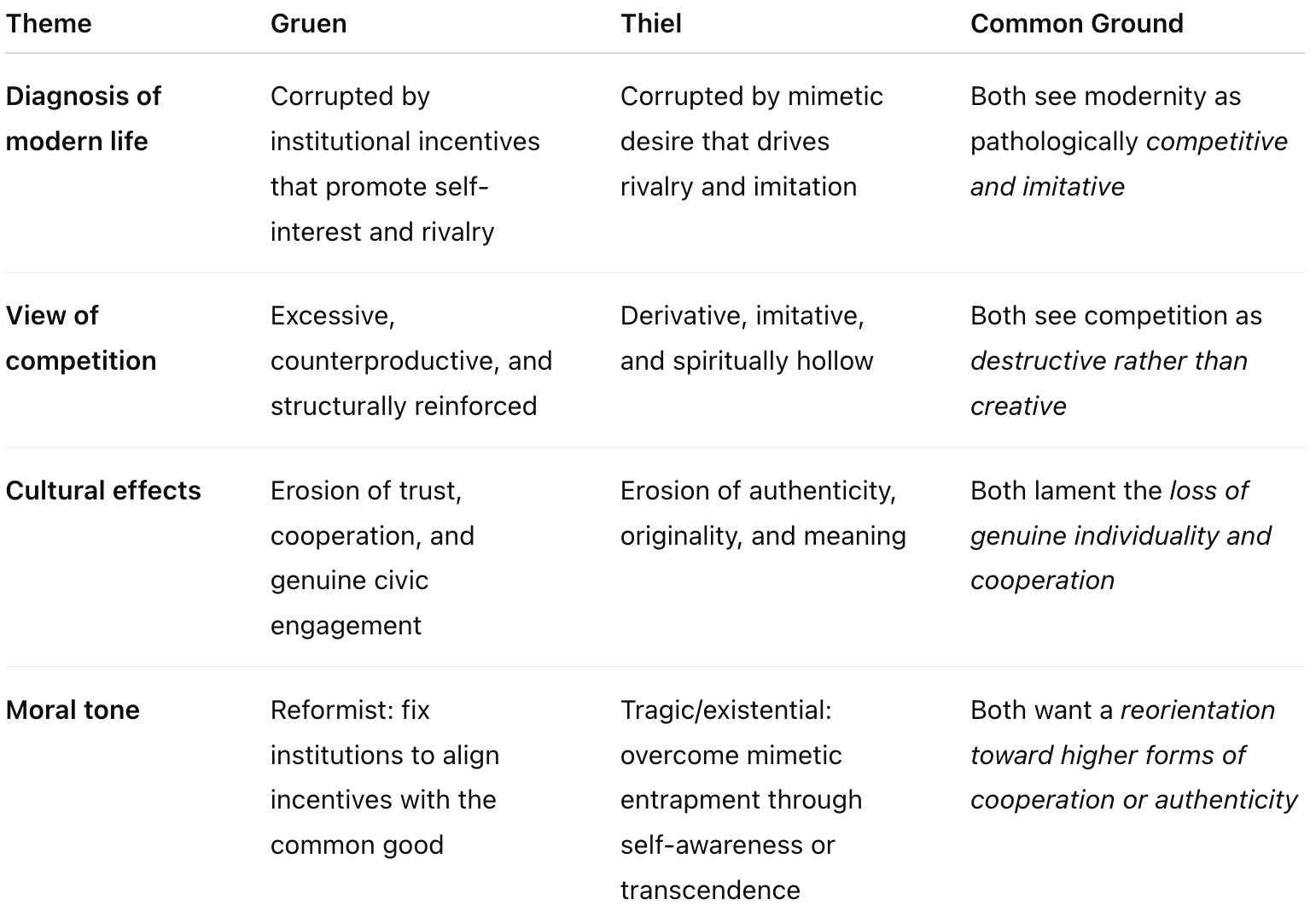
4. Key Differences
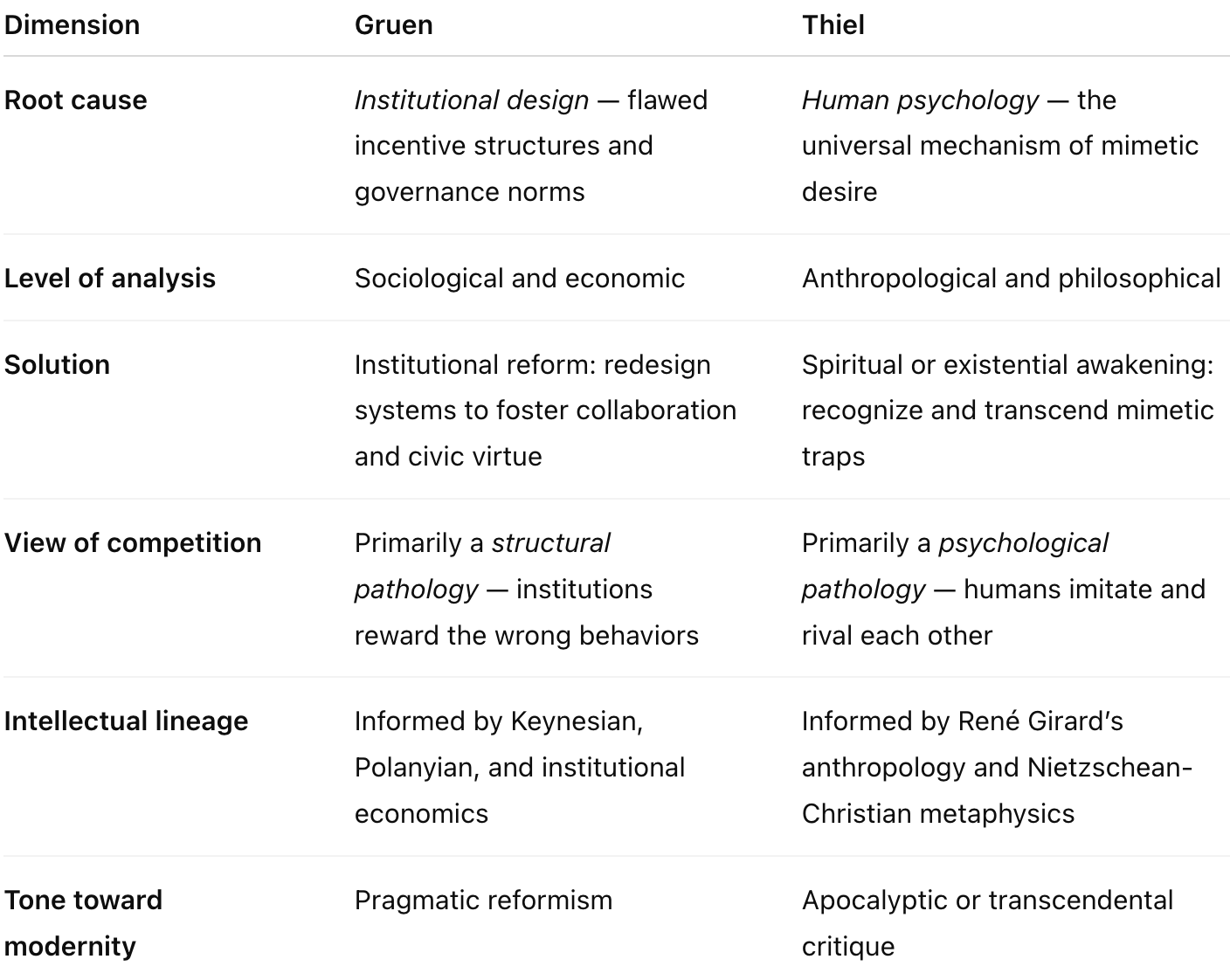
5. Integrative Perspective
You can think of Gruen and Thiel as diagnosing the same sickness at different depths:
Gruen: Our institutions are built on bad incentives — and they shape us into competitive, distrustful people.
Thiel: Our desires themselves are mimetic — institutions merely channel this primal imitation into modern forms.
So, Gruen critiques the architecture of modern life; Thiel critiques the psychology (or metaphysics) that animates it. Both see the same symptoms — rivalry, conformity, hollowness — but trace them to different sources.
Brent Crosswell: intriguing character

Spectacular!

A post-liberal Venezuela?

I found this interesting, but I know next to nothing about Venezuela so may have been taken for a ride.
Across the US political spectrum, there is little understanding of how important Catholic politics have been in shaping the Latin American right. But to understand the situation in Venezuela requires recognizing the fundamental role of the tradition of Christian Democracy.
COLLEGE PARK – [Following] US President Donald Trump’s air strikes on boats off the Venezuelan coast [announced] since September, Venezuelans are desperately guessing about their future and wondering whether Trump will make good on his promises to evict Nicolás Maduro from power.
On November 18, the Washington Post jumped headlong into this debate by giving the Venezuelan opposition leader and 2025 Nobel Peace Prize laureate, María Corina Machado, a platform to present her new “Freedom Manifesto.” The accompanying editorial cast Machado as Venezuela’s latter-day cross between Thomas Jefferson and James Madison: “America’s founding document,” the paper’s editorial board contends, “clearly inspired” this “precursor to a new Constitution.”
Machado has spent the past year in hiding, evading an arrest warrant after Maduro’s regime falsified the July 2024 presidential election results. But this autumn, Trump and the Norwegian Nobel Committee have elevated Machado’s profile...
But the Washington Post’s attempt to drape Machado in the stars and stripes misses what the Venezuelan opposition is about. Associating her with the upcoming 250th anniversary of the Declaration of Independence may well be an effective way to drum up US public support, but it elides Machado’s defining quality: she is a practicing Catholic whose faith shapes her political and economic views alike.
Machado is the scion of a long line of Christian Democrats in Latin America. In her “Freedom Manifesto,” she hitches herself not to Jefferson or Madison, but to Thomas Aquinas.
The first core value she lists is not liberty but “Dignity: Our Guiding Principle.” For Christian Democrats, “dignity” is shorthand for the image of God that can be found in each human being – understood as a person, not as some marginal unit of economic production. The Catholic concept of dignity passed from Aquinas’s own medieval Dominicans to the early Jesuits, and finally to the 19th-century “Thomist” renaissance launched by Pope Leo XIII, whose pathbreaking encyclical, Rerum Novarum (”Rights and Duties of Capital and Labor”), reconciled the Church to modernity.
It was this tradition that lay behind the French philosopher Jacques Maritain’s concept of “human rights” in the 1940s, and [Maritain was read widely] in Spanish-language America. Among his disciples was Rafael Caldera, a future president of Venezuela (1969-74, 1994-99)...
In a pivotal clause of her manifesto, Machado’s Spanish word “persona” has been rendered in English as “individual.” But this is a mistranslation. The correct wording should be, “Let dignity serve as the driving force ... that fosters the complete development of each person.” In Catholic political and social thought, a “person” is a dignity-endowed human being made in God’s image, while an “individual” is shorn of ties to community or nation.
Machado may be proposing to privatize $1.7 trillion worth of state-held Venezuelan assets, but her talk of property rights is a nod to Aquinas and Maritain, not to Hayek or Friedman...
Given such deep political and philosophical commitments, Machado’s pandering to Trump should not remotely be seen as defining her...
With oil prices declining again in 2025, the rosary-wearing Machado – if ultimately installed in power – could succeed where Caldera failed. Her ascendency is a clear sign that Catholicism is regaining salience after decades of suppression by Chávez and Maduro.
Across the US political spectrum, too few people understand how important Catholic thought has been in shaping the Latin American right. If she succeeds, Machado may find closer ideological allies not in Washington, but in Berlin, Paris, Warsaw, and Rome.

Heaviosity half hour
Robert Nisbet on totalitarianism and modern liberal democracy

Last week I included Ross Douthat’s introduction to this book. And here’s an extract from the book itself - initially published I think in 1953. Here was I expecting something more classically ‘conservative’, but it didn’t seem to have any right-wing ticks in it. I was quite taken with the similarity of this analysis and Hannah Arendt’s portrait of totalitarianism.
“I think,” wrote the brilliant Tocqueville in 1840, “that the species of oppression by which democratic nations are menaced is unlike anything that ever before existed in the world; our contemporaries will find no prototype of it in their memories. I seek in vain for an expression that will accurately convey the whole of the idea I have formed of it; the old words despotism and tyranny are inappropriate: the thing itself is new, and, since I cannot name it, I must attempt to define it.
“I seek to trace the novel features under which despotism may appear in the world. The first thing that strikes the observation is an innumerable multitude of men, all equal and alike, incessantly endeavouring to procure the petty and paltry pleasures with which they glut their lives. Each of them, living apart, is as a stranger to the fate of all the rest; his children and his private friends constitute to him the whole of mankind. As for the rest of his fellow citizens, he is close to them, but he does not see them; he touches them, but he does not feel them; he exists only in himself and for himself alone; and if his kindred still remain to him, he may be said at any rate to have lost his country.
“Above this race of men stands an immense and tutelary power, which takes upon itself alone to secure their gratifications and to watch over their fate. That power is absolute, minute, regular, provident and mild. It would be like the authority of a parent if, like that authority, its object was to prepare men for manhood; but it seeks, on the contrary, to keep them in a perpetual state of childhood: it is well content that people should rejoice, provided they think of nothing but rejoicing. For their happiness such a government willingly labors, but it chooses to be the sole agent and the only arbiter of that happiness; it provides for their security, foresees and supplies their necessities, facilitates their pleasures, manages their principal concerns, directs their industry, regulates the descent of property, and subdivides their inheritances: what remains, but to spare them all the care of thinking and all the trouble of living?
“Thus it every day renders the exercise of the free agency of man less useful and less frequent; it circumscribes the will within a narrower range and gradually robs a man of all the uses of himself. The principle of equality has prepared men for these things; it has predisposed men to endure them as benefits.
“After having thus successively taken each member of the community in its powerful grasp and fashioned him at will, the supreme power then extends its arm over the whole community. It covers the surface of society with a network of small, complicated rules, minute and uniform, through which the most original minds and the most energetic characters cannot penetrate, to rise above the crowd. The will of man is not shattered, but softened, bent, and guided; men are seldom forced by it to act, but they are constantly restrained from acting. Such a power does not destroy, but it prevents existence; it does not tyrannize, but it compresses, enervates, extinguishes, and stupefies a people, till each nation is reduced to nothing better than a flock of timid and industrious animals of which the government is the shepherd.
“I have always thought that servitude of the regular, quiet, and gentle kind which I have just described might be combined more easily than is commonly believed with some of the outward forms of freedom, and that it might even establish itself under the wing of the sovereignty of the people.” ...
Here, in these paragraphs, lies one of the most astonishing prophecies to be found anywhere in political literature. It is nothing less than a picture, nearly a century in advance of the reality, of the totalitarian community. What makes Tocqueville’s analysis immeasurably superior to all but a few others is that it points directly to the heart of totalitarianism—the masses; the vast aggregates who are never tortured, flogged, or imprisoned, but who are nonetheless relentlessly destroyed as human beings, ground down into mere shells of humanity. And the genius of his analysis lies in the view of totalitarianism as something not historically “abnormal” but as closely related to the very trends hailed as progressive in the nineteenth century. ...
Two
Nothing can come from analyses of totalitarianism based upon elements that are incidental, or that vary from one country to another. Totalitarianism is an affair of mass attitudes. Its success depends on incorporating into new structures of power those values with the widest appeal to a population. It cannot be reduced, in its fundamentals, to such manifestly abhorrent facts as racial extermination, capitalist enslavement, or military dominance.
Hideous as were the systematic killings and torturings of millions of Jews by the Nazis, there is still no justification for making anti-Semitism the essence of totalitarianism. Racialism is not the essence. What is central is not the specific image held up to the masses but, rather, the sterilization and destruction of all other images and the subordination of all human relationships to the central power that contains this image. ...
Nor are poverty and economic distress, as such, the crucial factors leading to the rise of totalitarianism. Poverty may be used as a piece of concrete symbolism for all the real and imaginary deprivations and frustrations of a population. But what is decisive is the social context, the sensations of disinheritance and exclusion from rightful membership in a social and moral order. These may or may not accompany poverty. ...
Nor can the effective source of totalitarianism be confined to any one class or section of the population. Totalitarianism can as easily be the work of industrial managers, labor leaders, scientists, church leaders, or any group of intellectuals who may find themselves strategically placed to accomplish through revolution or bureaucracy the transition from free society to totalitarianism. ...
Least of all can totalitarianism be regarded seriously as a “reactionary” movement. To describe totalitarianism as simply the effort of a minority to maintain, through force, existing institutions of society misses grotesquely the sweeping dislocations and atomizations actually involved in such a movement as Nazism. Far from being a lineal product of nineteenth-century Conservatism, totalitarianism is, in fact, the very opposite of it. ...
Nor can totalitarianism be reduced to the operation of force and terror. That these exist, and horribly, in every totalitarian country is beside the point. The essence of totalitarianism lies in its relation to the masses, and to the masses the leaders never bring the satanic arts of the torture chamber and the exterminations of the concentration camp. The totalitarian order will use force and terror, where necessary, to destroy organized minorities, but to the masses of individuals who are left when these social relationships are destroyed, a totally different approach is employed. It is an approach based upon the arts of psychological manipulation—cajolery, flattery, bribery, mass identification with new images, and all the modern techniques of indoctrination.
We merely delude ourselves if we suppose that there is always necessary conflict between totalitarian governments and the desires and aspirations of the masses. Here the recent words of Hannah Arendt are illuminating. “In view of the unparalleled misery which totalitarian regimes have meant to their people—horror to many and unhappiness to all—it is painful to realize that they are always preceded by mass movements and that they ‘command and rest upon mass support’ up to the end. Hitler’s rise to power was legal in terms of majority rule and neither he nor Stalin could have maintained the leadership of large populations, survived so many interior and exterior crises, and braved the numerous dangers of the relentless intra-party struggles, if they had not had the confidence of the masses.”
The totalitarian leader is never loath to identify himself with the “will and wisdom” of the masses. Such States may plead with, flatter, and persuade, but they never openly insult the people. It was this dependence upon popular support that permitted Mussolini to call his Fascism “an organized, centralized, authoritarian democracy,” and Hitler to refer to the Third Reich as “Teutonic democracy based upon the free choice of the leader.” ...
There are two other misconceptions, greater than any of the foregoing, each of which precludes an understanding of totalitarianism. The first consists of the view of totalitarianism as some sort of vast irrationality, a kind of collective derangement. Because totalitarianism is manifestly evil we suppose that it is also fundamentally irrational. But the total State is evil, yet we merely delude ourselves if we do not recognize in it elements of almost overpowering rationality. In terms of basic organization it is at least as rational as the huge industrial corporation, the mass political party, or the mammoth bureaucracies of all modern governments.
The total State is rational in that it recognizes in human personality certain basic needs for security and recognition and strives through every art and technique to satisfy those needs in calculated political terms. It is rational in that it seeks to eliminate from culture all of those ceremonial, ritualistic, or symbolic features inherited from the past that constitute obstructions to the achievement of a perfect mobilization of popular will. Horrible as were the Nazi concentration and extermination camps, in moral terms, we cannot miss the essential rationality of their operation. ...
To start out with the assumption that totalitarianism is irrational, and hence doomed to self-destruction, is to start out with an extremely unintelligent view of a form of society that has used all the rational arts of modern public administration, economic management, and social psychology to maintain itself.
Equally fatal to our understanding of totalitarianism is the assumption, drawn from the philosophy of Progress, that this form of society represents some kind of historical abnormality or deflection from the appointed course of history. Because we saw in political freedom, rights, and justice the basic elements of both moral goodness and historical necessity, there are many who persist in regarding such movements as Nazism and Soviet Communism as deviations from the normal development of civilization.
Related to this view are the efforts to place totalitarianism in the category of primitivism, of antique tribalism. The total State, it is said, is nothing more than a reversion to the infancy of civilization. But this view may be gratifying to sensibilities nourished by the idea of Progress, but it is as delusive as the idea that totalitarianism is a vast collective irrationality. ...
What is most dangerous in this whole view is the supposition that totalitarianism is a kind of monstrous accident, an interruption of the normal, a deflection that must be set right by the operation of the so-called laws of historical progress. But if there are any laws of unilinear progress, we have not discovered them, and there is no more justification in purely historical terms for regarding totalitarianism as an abnormal development than there is for so regarding democracy, or liberalism.
Three
There are two central elements of totalitarianism: the first is the existence of the masses; the second is the ideology, in its most extreme form, of the political community. What works toward the creation of the masses works also toward the establishment of the omnicompetent, absolute State.
The masses are fundamental to the establishment of totalitarian society. “Masses,” writes Dr. Arendt, “are not held together by consciousness of common interest, and they lack that specific class articulateness which is expressed in determined, limited, obtainable goals. The term masses applies only where we deal with people who either because of sheer numbers, or indifference, or a combination of both, cannot be integrated into any organization based on common interest, into political parties, or municipal governments, or professional organizations, or trade unions.”
The essence of the masses, however, does not lie in the mere fact of numbers. What is crucial in the formation of the masses is the atomization of all social and cultural relationships within which human beings gain their normal sense of membership in society. The mass is an aggregate of individuals who are insecure, basically lonely, and ground down, either through decree or historical circumstance, into mere particles of social dust. “The despair of the masses,” concludes Peter Drucker, “is the key to the understanding of fascism. No ‘revolt of the mob,’ no ‘triumphs of unscrupulous propaganda,’ but stark despair caused by the breakdown of the old order and the absence of a new one.”
When the masses, in considerable number, already exist as the consequence of historical forces, half the work of the totalitarian leader has been done for him. What remains but to complete the work of history, and to grind down into atomic particles all remaining evidences of association and social authority? What remains, then, but to rescue the masses from their loneliness, their hopelessness and despair, by leading them into the Promised Land of the absolute, redemptive State? The process is not too difficult, providing the masses have already been created in significant size by processes that have destroyed or diminished the social relationships and cultural values by which human beings normally live. ...
But where the masses do not already exist in great numbers, and where, through the accident of quick seizure of power, the totalitarian mentality comes into ascendancy, then it becomes necessary to create the masses: to do through the most ruthless force and in the shortest possible time the work that has been done in other areas by the operation of past processes. Such relationships must be ruthlessly destroyed. If they cannot be destroyed easily and inexpensively by propaganda and intimidation, they must be destroyed by all the techniques of the torture chamber, by enforced separation of loved ones, by the systematic obliteration of legal identities, by killing, and by the removal of large segments of a population to labor camps.
The violence and the horrors of Soviet Russia have arisen from the fact that in Russia, down to the beginnings of the First World War, the masses scarcely existed. The ancient relationships of class, family, village, and association were nearly as strong as they had been in medieval times. The realization of what Marx had called “the vast association of the whole nation” called for drastic steps—for the rapid industrialization of rural areas, for eradication of political opposition, and for the extreme centralization of power which alone could make these and other steps possible.
But, of far greater import, this realization also called for a change in the very structure of the people, its values, incentives, motivations, and allegiances. The new Communism could not thrive on popular values and relationships inherited through the ages. It was necessary, as Stalin saw the problem, to accomplish in a short time the atomization and dislocation that had been proceeding in Western countries for generations. Hence the destruction of all traditional associations and the conversion of professional and occupational associations into administrative arms of the government. ...
Four
We may regard totalitarianism as a process of the annihilation of individuality, but, in more fundamental terms, it is the annihilation, first, of those social relationships within which individuality develops. It is not the extermination of individuals that is ultimately desired by totalitarian rulers, for individuals in the largest number are needed by the new order. What is desired is the extermination of those social relationships which, by their autonomous existence, must always constitute a barrier to the achievement of the absolute political community.
The individual alone is powerless. Individual will and memory, apart from the reinforcement of associative tradition, are weak and ephemeral. The prime object of totalitarian government thus becomes the incessant destruction of all evidences of spontaneous, autonomous association.
To destroy or diminish the reality of the smaller areas of society, to abolish or restrict the range of cultural alternatives offered individuals by economic endeavor, religion, and kinship, is to destroy in time the roots of the will to resist despotism in its large forms. In its negative aspects totalitarianism is thus a ceaseless process of cultural nihilism. A sense of the past is far more basic to the maintenance of freedom than hope for the future. Hence the relentless effort by totalitarian governments to destroy memory and the ingenious techniques for abolishing the social allegiances within which individual memory is given strength and power of resistance. ...
Totalitarianism is thus made possible only through the obliteration of all the intermediate layers of value and association that commonly nourish personality and serve to protect it from external power and caprice. The political enslavement of man requires the emancipation of man from all the authorities and memberships that serve, in one degree or another, to insulate the individual from external political power.
The destruction of the independent labor unions in Nazi Germany was followed by the prohibition of independent economic organizations of every kind. All autonomous organizations were destroyed and made illegal: professions, service clubs, voluntary mutual aid groups, fraternal associations, even philatelist and musical societies. Such organizations were regarded, and correctly, by the totalitarian government as potential sources of future resistance. ...
Despite the fact that the early Nazis used the symbolism of family and religion for its possible sentimental appeal, the actual realities of family and religion were as remorselessly attacked by the government and Party as were the labor unions. The shrewd totalitarian mentality knows well the powers of intimate kinship and religious devotion for keeping alive in a population values and incentives which might well, in the future, serve as the basis of resistance. Thus to emancipate each member, and especially the younger members, from the family was an absolute necessity. What was essential was the atomization of the family and of every other type of grouping that intervened between the people as society and the people as a mindless, soulless, traditionless mass. What the totalitarian must have for the realization of his design is a spiritual and cultural vacuum.
Five
Totalitarianism is an ideology of nihilism. But nihilism is not enough. No powerful social movement can be explained in negative terms alone. There is always the positive goal and absorptive association for which all the destructive and desolative actions are but a preparation. The extraordinary accomplishments of totalitarianism in the twentieth century would be inexplicable were it not for the immense, burning appeal it exerts upon masses of individuals who have lost, or had taken away, their accustomed roots of membership and belief.
The atomization of old values and associations does not leave for long an associational vacuum. The genius of totalitarian leadership lies in its profound awareness that human personality cannot tolerate moral isolation. It lies, further, in its knowledge that absolute and relentless power will be acceptable only when it comes to seem the only available form of community and membership.
Early in his career Hitler sensed this affinity and wrote in his Mein Kampf: “The mass meeting is necessary if only for the reason that in it the individual who in becoming an adherent of a new movement feels lonely and is easily seized with the fear of being alone, receives for the first time the picture of a greater community, something that has a strengthening effect upon most people.” Knowing the basic psychological truth that life apart from some sense of membership in a larger order is intolerable for most people, the leaders of the total State thus direct their energies to the manufacture of the new order. ...
This new order is the absolute, the total, political community. As a community it is made absolute by the removal of all forms of membership and identification which might compete with the new order. It is, further, made absolute by the insistence that all thought, belief, worship, and membership be within the structure of the State. What gives historical identity to the totalitarian State is not the absolutism of one man or of a clique or a class; rather, it is the absolute extension of the structure of the administrative State into the social and psychological realm previously occupied by a plurality of associations.
Totalitarianism involves the demolishment of autonomous social ties in a population, but it involves, no less, their replacement by new ones, each deriving its meaning and sanction from the central structure of the State. The total State is monolithic. It is characteristic of the total State that the distinction between ordinary civil society and the army is obliterated. The natural diversity of society is swept away, and the centralization and omnicompetence native to the war band become the organizing principles of human life. Every decision is converted into a military decision, dependent for its meaning upon the strategies and tactics of war. ...
In the totalitarian order the political tie becomes the all-in-all. It needs the masses as the masses need it. The communal likeness of power is indispensable, for power that seems remote and inaccessible will be, no matter how ruthlessly it is imposed, unavailing and ineffectual. At every stage the power of the government must seem to proceed from the basic will of the people. The government thus chooses to bend, soften, and corrode the will to resistance in preference to forcible and brutal breaking of the will.
New meanings must therefore be created for popular assimilation. New conceptions of good and evil, of truth and falsehood, of freedom and tyranny, of the sacred and the secular, must be established in the popular mind. History, art, science, and morality, all of these must be redesigned, placed in a new context, in order to make of a power a seamless web of certainty and conformity. Totalitarian power is insupportable unless it is clothed in the garments of deep spiritual belief. ...
But the spiritual transformation of a people, the creation of new meanings and symbols, cannot proceed apart from the creation of new social contexts of belief and meaning. The atomization of old groups and associations is accompanied by the establishment of new forms of association, each designed to meet the needs and to carry on the functions that were embedded in the old forms of social grouping. To these new associations, each based upon some clear and positive function, inevitably go the allegiances of the masses. In these groups, reaching down to the most primary levels of relationship, lies escape from the intolerable emptiness and demonic nature of mass society.
Such groups, in time, come to seem the very difference between membership and isolation, between hope and despair, between existence and non-existence. From them come, for constantly widening aggregates, the anesthetic release from sensations of alienation, hostility, and irrationality. These associations are not only the context of personal identification and belonging; they are also the indispensable contexts of totalitarian indoctrination.
As old cultural values and spiritual meanings become dim and unremembered through the destruction or erosion of social relationships that once made them vivid, so, in the totalitarian order which replaces the old, new meanings and values are given root and solidity in new associations and memberships. With new social status comes in time a new set of allegiances, new values, even new perceptions. ...
Powerful and unprecedented as it is, totalitarian domination of the individual will is not a mysterious process, not a form of sorcery based upon some vast and unknowable irrationalism. It arises and proceeds rationally and relentlessly through the creation of new functions, statuses, and allegiances, which by conferring community, makes the manipulation of the human will scarcely more than an exercise in scientific social psychology.
The superficial evidences of the old political structure may be left intact. There may well be a parliament or legislature. Old civil service positions, old titles of office may be left undisturbed. There may be periodic elections or plebiscites, and the terminology of freedom may be broadcast unabatedly. All of this is unimportant, always subject to guidance and control, if the primary social contexts of belief and opinion are properly organized and managed. What is central is the creation of a network of functions and loyalties reaching down into the most intimate recesses of human life where ideas and beliefs will germinate and develop.
New organizations based upon place, work, and interest are created. Labor unions are either remade into agencies of the State, or new labor organizations are created to replace the old. New professional, scientific, and artistic groups are created. As the totalitarian psychologist well knows, within these new formal associations based upon clear function and meaning, there will inevitably arise over a period of time the vastly more important network of new informal relationships, new interpersonal allegiances and affections, and with them a new sense of personal status, which will reach like a chain from the lowliest individual to the highest center of government. ...
But the new groups, associations, and formal statuses are without exception agencies of the State itself. They are plural only in number, not in ultimate allegiance or purpose. Each association is but a social and psychological extension of the central administration of the State. Each exists as a primary context of the political repersonalization of man that follows the nihilistic process of social depersonalization. Each is the instrument, ultimately, of the central government, the psychological setting that alone makes possible the massive remaking of the human consciousness.
Nothing could be more delusive than the supposition that the totalitarian political order is without roots in the allegiances of vast numbers of human beings, that it is a flimsy structure at best. The amazing evidences of militant, collective power and of fanatical will to resist revealed by the Germans during the Second World War should demonstrate irrefutably that, even within the mere six years which intervened between the Nazi rise to power and the outbreak of the war, the successes of mass manipulation had been considerable. From these we might well ponder the undoubtedly greater successes of the Russian rulers in their three decades of almost uninterrupted creation of the will-less, cultureless masses and the assimilation of these masses into cohesive primary groups, each an agency of central governmental policy, each the seedbed of popular allegiance. ...
The monolithic reality of totalitarianism is revealed when, through military defeat, there is complete disorganization of the central government. For, from this central disorganization proceeds the inevitable collapse of all those forms of intermediate society which were dependent on central power and which were the contexts of human life.
Twice in the twentieth century Germany has been defeated by enemy powers, but the consequences of the second defeat have been vastly different from the consequences of the first. The collapse of the central government in 1918 was scarcely more than just that. The internal private governments of Germany—business associations, labor unions, churches, municipal administrations, and the like—even though some of their effectiveness had been damaged by the war effort, were still capable of exercising independently a measurable stabilizing influence upon the German people. But at the end of the Second World War Germany was, in huge areas, a social as well as a physical rubble. Twelve years of Nazism, the extermination of autonomous social functions and memberships, the incorporation of the masses into organizations each of which was a division of the central government—all of this left, when military defeat had destroyed that central government, scarcely more than an aggregate of atomic human particles, hopeless, will-less, and ground down into chronic despair.
This is the true horror of totalitarianism. The absolute political community, centralized and omnicompetent, founded upon the atomized masses, must ceaselessly destroy all those autonomies and immunities that are in normal society the indispensable sources of the capacity for freedom and organization. Total political centralization can lead only to social and cultural death.

He had an interesting proposal on his hands. He was proposing a citizen initiated referendum to change the Ohio constitution. The new arrangements he was proposing to incorporate into the constitution would create an interesting new power in which if just 25 percent of its legislators - in both its House and Senate - were to propose a measure, they could initiate a process whereby a citizen assembly would be held on the measure, and if passed by a majority, it would become law, despite the opposition of a majority of legislators.
There's so much I could say here given the rich material that's a pleasure to read and reflect over - whether it be on the critiques of Karp's work (I suspect the original manuscript is something worth reading versus the final version) or what organization following from Einstein evokes in the age of SaaS or in pushes towards homeschooling in a ragebait tradewife era, etc. So very much to say, but I have to be true to thine ownself and emphasize one line in particular that will haunt me. In fact, I believe Gen Z would describe this as something which is "sending me"...
"My gob was smacked, my ghast moderately flabbered" - this has made my day. It is going in my arsenal. I am indebted forever, Nicholas
Doctorow's description of the process of enshittification is itself a fine example of a timeless process where the explainer systematically downplays the role of chance, amplifies the bad motives of his opponents, and thus scares his users into accepting his diagnosis and often also his cure.
When we see someone talking about events this murky in such black-and-white terms, they're generally not telling us about the clarity of their thinking; they're telling us about their willingness to stretch and reshape the truth in support of their thinking.