


$6,600 raised to save the world

Thank-you very much to donors to this substack’s modest attempt to save the world. They have contributed $1,650, which I’ll match with the combined total being matched again. That leaves $850 on the table from the original offer - which I capped at $2,500, reflecting the additional donation being capped at $5,000. So if you donate today or tomorrow and email me with your details by the end of the weekend you can still get in for your chop. Donate by clicking on the image above, or at this link.
Deep Purple and Beethoven - Srsly!


Palestine: master ideological cipher for our age

A bit heavy for first cab off the rank here. It would normally belong closer to heaviosity half hour below. But there you go. If an article achieves a sufficient level of terrificness, it goes up the ranking. And this one does. It’s philosophical in the best sense. It’s not that heavy with the names of philosophers from the canon. But it’s an attempt to escape Plato’s cave. Most commentary on contemporary events is located in some place ‘inside the machine’ - or cave if you’re a metaphor purist. In this piece, one of Mansour’s principal subjects is his own struggle to free himself from the ‘cognitive trap’ set up by existing framings. In other words, he’s an intellectual thrillseeker after our own hearts here at NG.
An Egyptian raised to treat the liberation of Palestine as the organising principle of his life, he seeks to provide just enough background about himself to motivate his subject without tipping over into making it about himself.
I spent my childhood and adolescence inside the cognitive trap that this essay will describe, and I spent my adulthood... climbing out of it. The climb did not end in any promised land. It ended in the ability to see what I had been inside of... This essay is not a memoir... [W]hat follows is not the work of an outside observer theorizing about other people’s pathologies. It is the work of someone describing, from a position of partial and painful exit, a system of which he was once supposed to be a reproductive part.
Because the article is dense and very long, I got Claude to shoehorn it into a ‘tease’ for the busy readers of this newsletter, but you should defs dip into the original:
Mansour asks us to stop taking sides long enough to see the thing we are taking sides about. Palestine, in his account, is not a place or a people or a cause but a system — “one of the world’s largest systems of political and economic extraction.” His image for it is a murmuration of starlings: no bird leads, no bird sees the shape, each responds only to its neighbours, and the form emerges from countless local decisions no participant designed or controls. There is no centre, no origin, “no bird whose removal would collapse the whole.”
What the system trades in is specific: the suffering of Palestinians indexed to the presence of Jews. Not Palestinian suffering as such — suffering at the hands of other Arabs has “generated no markets” — but the conjunction. Its peculiar power is that it needs no translation. The same site reads natively in every ideological market at once: pure settler colonialism to the Marxist, a renewed Crusade to the Islamist, a human-rights violation to the liberal, a frontline of the West to the conservative and a frontline of empire to the progressive. Each reading is coherent, each incompatible with the others, and each runs without disturbing the rest, so discrediting any one leaves all the others operational. The symbol is “a generative site that produces a distinct symbolic commodity for each market simultaneously.”
Every actor is at once victim and extractor. The Arab regime keeps the symbol “hot enough to occupy the cognitive space that domestic critique might otherwise fill, but cool enough to avoid revolutionary mobilization,” and is captive to it even so. Iran, Qatar and Saudi Arabia compete for ownership of the cause as the master currency of the region — “the conflict is not what the region is fighting about, it is what the region is fighting with.” The Western university recruits Third World intellectuals to validate categories that then “trickle down to the corner mosque.” Human-rights professionals, the Western left, the foreign-policy establishment, and Israel’s own political class all extract from the same suffering. No one conspires; everyone profits and is trapped. “Everyone sees their own game, but nobody sees the board.”
So the thing cannot end. With no exploited class to liberate and no beneficiary class to depose, there is no revolutionary subject. The system is too distributed to collapse at any single point, and every proposed remedy turns out to be one of its loops — the two-state solution a position from which liberals draw prestige, the one-state proposal one from which the left draws credibility, the rights-based view one from which NGOs draw revenue. “The discourse of solution is not an exit from the system. It is one of the system’s loops.”
And then the essay turns. Having built this vast, self-sealing machinery, Mansour asks what holds it together at the very bottom — and locates a single point of failure so small it is almost invisible, one act repeated hundreds of millions of times a day. It is a private act, in his account finally a theological one, and the one move in the whole system that is freely chosen rather than imposed. That is where the argument arrives, and it is worth arriving there on his terms rather than mine.
Institutional decay (your regular reminder)


Imagine if , when we knew something was obviously wrong, we fixed it. Academia has been riddled with such things for decades. Closed publication and profiteering journals, citation metrics, the risk aversion and capriciousness associated with the amateurish approach that is taken to peer review.
A legal system completely by and for lawyers, in which the total costs of many cases are maybe 20 times what they need to be to arrive at a speedy and independent solution. Anyway, I wouldn’t know, but as Donald Trump would say “a lot of people are saying” it’s also true in Theoretical Physics too.
Hanson’s success

Ryan Heath’s response to Pauline’s Press Club effort (together with a negative, tendetious and unnecessary op ed illustration from Grok (Shame, Shame, Shame etc. Ed.)
There’s a gap in the analysis of Pauline Hanson’s National Press Club of Australia address.
Many journalists would find it offensive or frustrating — since it wasn’t aimed at them ... The Australian’s Geoff Chambers called it “meandering” while noting how effective it was in seizing attention from the Coalition. But it wasn’t meandering, and that wasn’t the test. The test was Hanson sounding competent to the One Nation-curious, while showing her fighting spirit to her base. She did that.
I was both in the room yesterday, and have been out of the country for a long time. That gives me the unusual position of knowing how populist leaders and movements operate ... without being bound up in my own emotions and memories about recent domestic politics.
I was surprised by Hanson’s agility — similar to Trump and France’s National Rally — she’d do well on a debate stage. That matters for a populist movement as it approaches power. Unlike Trump, but much more similarly to Giorgia Meloni and Marine Le Pen, she makes sense in long form ... The sentences connect, they answer the question asked; she landed a bunch of reusable lines.
Most notably ... “Albanese lied to get elected” and “We are a multiracial society, but we must be monocultural.” Many asked good questions yesterday, but nearly all were about policy. ... But again, none of that was the point yesterday.
The speech contained a lot for people frustrated at housing and living cost, skeptical that they can create a secure future for themselves, and who think many or all politicians are either useless or corrupt. Those people are not judging federal politics as most journalists and mainstream politicians are. Understanding this isn’t the same as platforming Hanson’s views: 30% of Australian adults already platformed One Nation. ...
Hanson understands the conditions that are giving her this opportunity, or as she put it yesterday, she listens. But she didn’t create the conditions: My question is whether Canberra’s mainstream political community will take lessons from her speech, about what they can do to shape the conditions that made it possible.


The bullying of Keir
I’d forgotten I’d written this back in Feb until someone just liked it in the wake of Starmer’s departure.
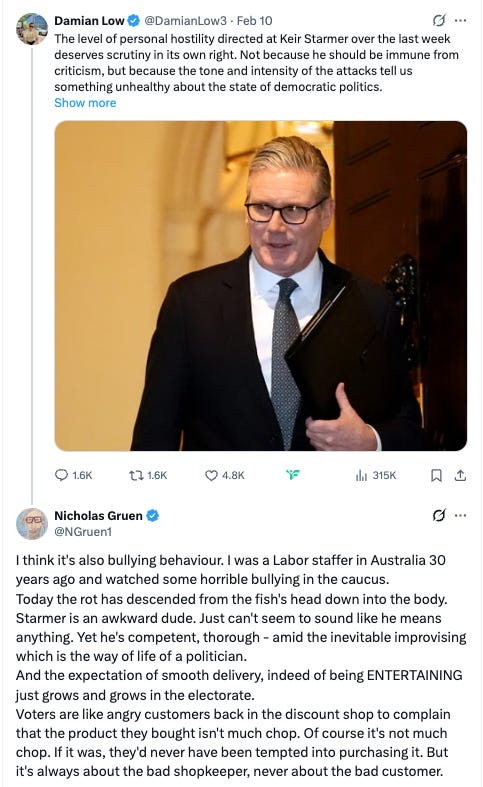
Meanwhile at No. 10
Hanson’s failure

The edited extract is longer than usual because Claude told me it couldn’t do justice to the argument and the most compelling examples in fewer words.
A protest vote is a forgiving thing… It asks only that they are not them, the political class, and for 10 months Hanson has portrayed that. Until now.
This week’s National Press Club speech changed that… She would abolish the SBS, make the country “monocultural”, put the city ABC behind a paywall, and, on wages, back employers, call workers lazy and demand they be easier to sack… positions can be measured against the lives of the people lending her their vote…
Her lead is built on the softest layer
One Nation’s vote is two movements bolted together. An old founding base, asset-secure and older, hers for a generation… And the late movers, who arrived after Bondi on grievance and the cost of living, still mortgaged… The base built the floor. The late movers built the lead. And they rent her support, because the economic pain that brought them in is what Hanson’s platform makes worse…
Industrial relations: the load-bearing crack
She defended making staff easier to sack, blaming the workers, in her own word, “lazy”… The late movers are wage earners, mortgaged… She is standing with the employer who wants to cut their wages. The “bloke in the corner store” she keeps invoking is the owner, not the worker behind the counter, and the irony here? It’s the worker that provided her the lead…
The monoculture misstep
“We must be monocultural” is a clean line for a base that wants one. But… a meaningful share of the late surge sits in outer-suburban seats among the most diverse in the country… The moment the grievance vote hears itself described as the thing that must disappear, the grievance detaches from her…
“The SBS will be gone”
Hanson would abolish the SBS, saying the internet has made it unnecessary… SBS Audio carries news and settlement information in 68 languages, to the five million Australians who speak another language at home… Each of those language services is a newsroom and, for a lot of people, a lifeline. It is how an isolated grandmother learns what a government policy means. It is how a newly arrived family is told their rights at work, how to enrol a child in school, where to go in an emergency… It switches off in-language information for the exact communities the monoculture line targeted…
And it takes the World Cup with it
The SBS is also the free-to-air home of the FIFA World Cup, where the Socceroos and Matildas are watched free by millions… Abolish the broadcaster and the most-watched free sport in the country goes behind a paywall…
A subscription ABC says the quiet part
Hanson would keep the ABC for the bush and put it behind a city paywall, “only … a subscription service”… The pensioner in an outer-suburban unit who cannot afford the streaming service loses the free service… Three times now the same hand shows. Easier sackings. A subscription World Cup. A subscription ABC… she sides with the big end of town…
The exposure the speech did not contain
Everything to this point came from her own mouth. But the speech is only half her exposure. Two larger vulnerabilities sit outside the transcript… her record on violence against women… and the steady Americanisation of the whole project…
The constituency she did not mention
Hanson catalogued the victims of modern Australia… One group never appeared: the more than one in four Australian women, 2.7 million of them, who have experienced violence or abuse from a partner… In 2019 she told national radio that some are “nothing but liars” who weaponise abuse claims… She has already decided to doubt them… The strongest predictors of exposure are financial stress and dependence, the very conditions her easier-sacking, weaker-wage agenda manufactures… One woman is killed by an intimate partner on average almost every week…
America First
One Nation has been remade in the image of the American right… Hanson flew on Gina Rinehart’s jet to CPAC inside Trump’s Mar-a-Lago… And its figurehead now treats Australia as a target: he disparaged the fallen soldiers of America’s allies, tariffed our steel, aluminium and pharmaceuticals, and during the war on Iran singled Australia out, “Australia didn’t help us”, even as Australian personnel were in the theatre, while the crisis he was prosecuting drove up the price at the bowser here. Hanson’s answer has been to praise him and sell his cap… The Coalition, not Labor, can wield this cleanly… handing the late movers, who never signed up for a foreign war, a reason to leave…
Why the late surge is the one that gets nailed
The founding base is insulated… None of it costs the base anything. The late surge is the opposite: wage-dependent, so the industrial relations position lands on it; in diverse, outer-suburban seats, so the monoculture line and the SBS cut land on it… Hanson has built her lead on the one layer of her coalition that her own program punishes… The campaign that beats One Nation does not argue with the grievance… It makes Hanson legible. It takes those positions, the sackings, the paywalls, the silence, and holds them against the lives of the late movers until the feeling and her platform no longer match.
We need more goat towers (obviously!)


Cash flow …

Liquidity, The Accounting Cat
by John Clarke (To the tune of Macavity, The Mystery Cat by T S Eliot.)
Liquidity’s a mystery; it’s very rarely seen,
It strikes and then is gone again, its getaway is clean,
And despite forensic evidence and great deductive flair,
The conclusion’s inescapable, Liquidity’s not there!Liquidity, Liquidity, there’s nothing like liquidity,
Its presence gives you confidence, its absence gives timidity,
You own perhaps a property, you own perhaps a share,
But once you’ve lost your credit card, Liquidity’s not there!
Your understated opulence inheres in what you wear,
But in the end, you face the fact, Liquidity’s not there!Liquidity’s a nifty term, it’s business talk for cash,
It’s money not tied up in things or hoovered in the crash,
Investments may return amounts of staggering obscenity,
The vastness of your holdings may explain your great serenity.
In publishing, to take the case of either of the Fabers,
A warehouse full of Larkin and The Bumper Book of Neighbours
Is very well, and when they sell, will satisfy the editors,
But not much use, in real terms, when dealing with the creditors. …
I’m beginning to wonder how long Allegra Spender can last in parliament. What with our political system’s principal rule being “never let a good deed go unpunished”, she has consistently argued for good policy. But think of the resemblances between the tax reform she was advocating and the shape of Albo’s package. In an electorate as wealthy as hers, isn’t that a negative campaign waiting to be run? I mean there are a lot of struggling job creators and innovators in Bellevue Hill, to say nothing of Double Bay and Point Piper.
Anyway, I have no inside knowledge, and I hope I’m wrong.
In any event, here she is again promoting excellent policy. It’s always struck me that speeding up the rate at which big business pays its smaller creditors should have just slid into place as a ‘no-brainer’ of economic reform. It’s politically easy and economically highly advantageous. Why? Because the cost of capital to small business is higher than the cost of capital to large business, which is higher than the cost of capital to government. Therefore, governments should pay as quickly as possible, (they’re mluch better at this these days) and large businesses should pay small businesses as quickly as possible.
And while we’re about it, I won’t bore you with the long story, but I have waged a war for about two decades now with the Australian Tax Office. It pays the R&D tax concession in arrears annually. And because one of the key difficulties for highly innovative companies, particularly startups, is cash flow, this is an extraordinarily wasteful way to spend money. If you are going to provide money to small companies to help them meet the costs of R&D innovation, you should get them the money as soon as you possibly can, consistent with safeguards for fraud. It is pure laziness for the ATO to insist on paying them in arrears annually. Yes, they need to address integrity, but that can be done quarterly. Indeed, after a firm has a good track record, has been properly vetted and has a bank prepared to lose money to them, they should be paid quarterly in advance.
Anyway, over to Allegra.
As someone who ran a business for 10 years, I know how acute cash flow pressure is. ASIC identifies cash flow problems as the number one cause of small business insolvency.
That’s why yesterday I introduced a Private Member’s Bill to stop large businesses from winning Government contracts if they consistently pay their small business suppliers late.
Too often, large businesses deliberately use delayed payment as a cheap line of credit at the expense of small businesses — who are left out of pocket when they still have their own staff, rent and invoices to cover. …
Since 2020, large businesses have been required to report their payment times, in the hope that naming slow payers would drive change. But the 2023 Emerson Review found the scheme wasn’t working. 30% of payments from large businesses are still made after 30 days … small businesses won’t just walk away from a client because they pay slowly.
My Bill implements one of the Emerson Review’s recommendations that the Government never acted on: businesses with payment times consistently over 30 days would become ineligible for Government contracts above a threshold. With $71 billion in annual procurement, the Government is well placed to set the standard.
Small businesses are the engine room of our economy. We need to make sure they are getting paid on time.


Krugman defends himself
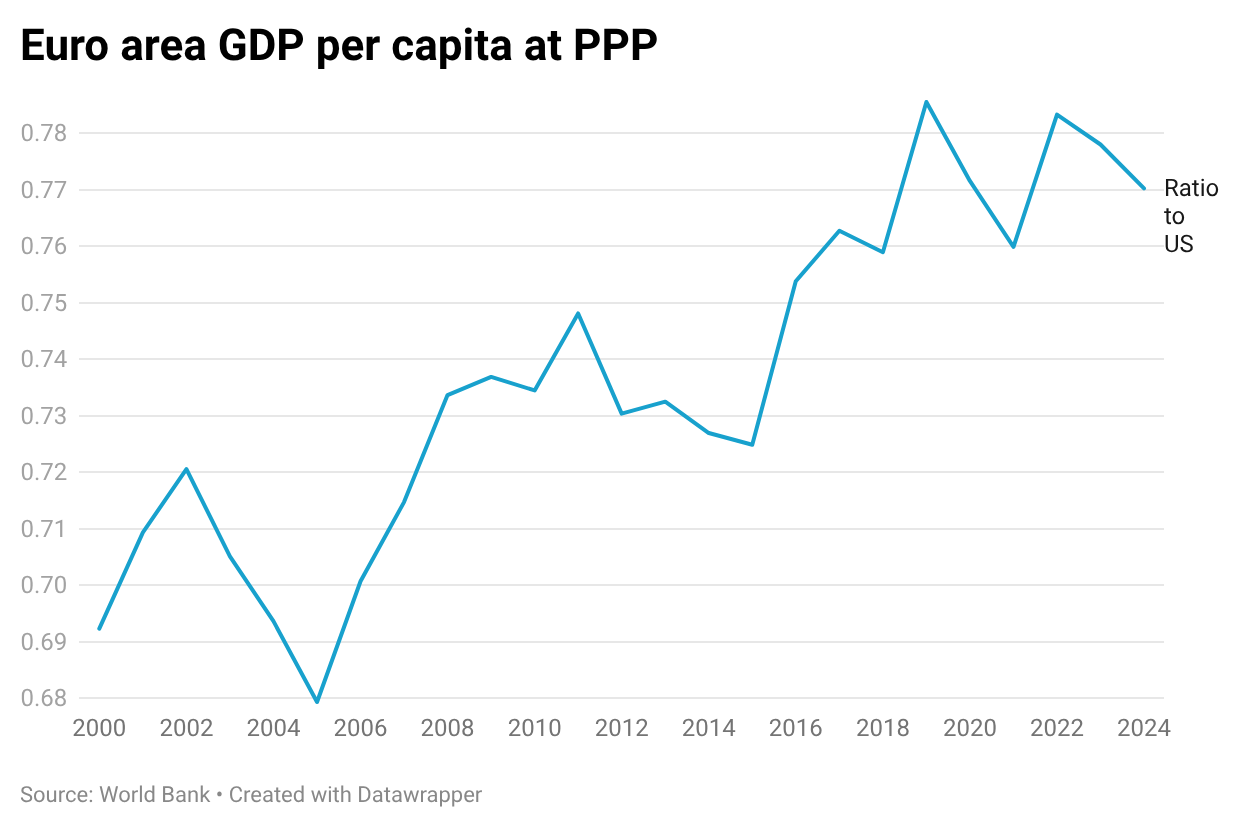
Having previously referenced this debate, I thought I’d give Krugman his right of reply. At issue is the question of the relative value of strong productivity growth in your domestic industries in funding your living standards when that same productivity growth leads to price falls of around the same magnitude within your trading partners.
Phillipe Aghion, Antonin Bergeaud and Luis Garicano have written a response to my discussions of the Europe/US productivity gap. I respect their standing as serious analysts, …
Let me be clear: I am not arguing that European productivity is mismeasured, and never said that. I am, instead, arguing that standard measures of productivity do not have the implications for cross-country comparisons of living standards and economic welfare that many people … think they have. …
Their presentation mostly centers on arguing that European productivity growth is in fact lower than US productivity growth. … But this is not the actual issue that I am trying to address. My question is whether the standard comparison of European and US productivity growth rates is a good indicator of what is actually going on in the two economies over time.
From my viewpoint, the starting point for the debate … should be the acknowledgment that a comparison of US-Europe productivity trends looks very different if you use two different metrics.
One method is to compare the growth in inflation-adjusted GDP per hour within countries. … The other method is to compare the year-by-year value of output per worker-hour, adjusted for differences in national price levels … but not for changing price levels over time. …
You might think, and I suspect that many observers have assumed, that these two approaches tell similar stories. But they don’t.
As a high-productivity nation with much lower measured productivity growth at constant prices than the US, the Netherlands, it turns out, offer a kind of reductio ad absurdum for many US-EU comparisons. … Suppose, however, that we measure GDP and hence productivity growth adjusting for national inflation rates … By this measure, Dutch productivity was 25 percent higher than US productivity in 2000.
Was the Netherlands drastically richer and more productive than America a generation ago? I doubt that many people would agree with that proposition. … But if you find this proposition implausible, you must also concede that the conventional understanding of the implications of differing productivity growth in Europe and the US is highly problematic.
Do you really want to claim that Dutch workers were much more productive than U.S. workers in 2000 because the goods they produced per hour, although roughly equal in value to the goods produced per hour by US workers at that time, would eventually be worth much more than US production at prices that didn’t prevail at the time — but would prevail two decades later, in 2020? Huh? …
Now, I have tried to explain the apparent paradox … by pointing to the fact that the US and European economies produce different mixes of goods, with the US mix tilted toward high-tech goods with rapid productivity growth but falling relative prices. …
OK, as I read Aghion et al they offer four criticisms of my analysis, as follows:
First, international comparisons of GDP using purchasing power parity are problematic and unreliable: This is, of course, true. But estimates of real GDP … are also, and I would argue equally, problematic. …
Second, productivity at constant national prices has risen much faster in the US than in Europe. Why, yes. That’s not a refutation of my analysis, it’s precisely where I started …
Third, “Current PPPs and national deflators are giving sharply different answers to what at first sight looks like the same price question, but as we saw, is not.” Indeed. That’s exactly the point I’ve been trying to make. … if we’re asking whether Europe is falling behind in purchasing power and living standards, PPPs, which say that it isn’t, are the right measure.
Finally, Aghion et al assert that the U.S. lead in technology “has led to higher US wages and profits, and the gap is widening each year.” OK, that’s the crux of the discussion. But this assertion … is simply untrue. …
The bottom line here is that while I could of course be wrong about the US-EU comparison, the Aghion et al critique doesn’t make the case that I’m wrong. The data that they claim refute my argument are basically the same data I used to make that argument …
Again, I’m quite willing to be proved wrong. But if we’re going to have a serious discussion, the critiques have to go beyond simply restating productivity data that show Europe lagging. They need to acknowledge the reality that despite these data, comparisons between the US and Europe at each point in time don’t show the gap between Europe and the United States widening, and at least try to explain why.
Martina Navratilova found this amazing. So will you!


“Vengeance, I dare predict, will not limp”


Quote of the week
John Ruskin, from The Crown of Wild Olive (1866). HT: Alan Jacobs.
All good architecture is the expression of national life and character; and it is produced by a prevalent and eager national taste, or desire for beauty. And I want you to think a little of the deep significance of this word ‘taste;’ for no statement of mine has been more earnestly or oftener controverted than that good taste is essentially a moral quality. ‘No,’ say many of my antagonists, ‘taste is one thing, morality is another. Tell us what is pretty; we shall be glad to know that; but preach no sermons to us.’
Permit me, therefore, to fortify this old dogma of mine somewhat. Taste is not only a part and an index of morality — it is the ONLY morality. The first, and last, and closest trial question to any living creature is, ‘What do you like?’ Tell me what you like, and I’ll tell you what you are.
AI. Getting better and better.
What LLMs really are, and where they’re going

TLDR: LLMs aren’t candidates for consciousness. And chatbots are giving way to ‘harnesses’. Sounds right to me.
I’ve been using AI a whole lot lately, at work and at home. ... I now believe that the practice of chatting with your AI is not long for the world. The chat box will be remembered as a primitive interface... akin to what punch cards were to early computers.
Chatbots are incredibly limited. That “oh shit” feeling we got when we first started playing with them is… an illusion. Or better put, a misdirection, largely due to the language we use to talk about them. ... We have been focusing on what these things are rather than what they’re for.
It’s become fashionable among the Silicon Valley set to mock the famous “stochastic parrot” paper, which insisted that large language models are nothing more than probabilistic language simulators. ... And without understanding, there’s no “there” there. ...
That’s not nothing. But it’s a lot less than it might seem.
I’m sure we’ve all noticed how even the most advanced models tend to get less sharp during the course of a long conversation. ... The term of art is “context rot.” ...
The “context window” is, basically, the bot’s attention span... But the bot doesn’t really “remember” your conversation. It’s quite literally “born” anew with each turn in the chat. ...
The models have no sense of time and no real memory. But most important, they have no sense of truth... The model has no way to check what it says against the world. ...
Books do in fact contain understanding, but they do not understand themselves. They encode the understanding of an author. ... AI, too, encodes human understanding... But that doesn’t mean the AI can be said to have understood anything.
The other useful metaphor for AI is that of a mirror. After some time, you come to sense that it always gives back a version of what you bring to it. ... you can tell the AI is still reflecting you back at yourself. ... it’s like a mirror with a lens in front of it: If you use it right, you can see yourself even more clearly.
But AI is never the subject. ... there is no spark of agency. ... It simply can’t “do” anything unless it is first prompted to do so. ... put two chatbots in a virtual room and never prompt either, and neither will ever start up a conversation. There is no unmoved mover.
The labs are now all-in on so-called “agentic” AI — a word that also actively misdirects us on what’s happening. Autonomous would be a better word... the goals, the wanting... that’s still entirely on our side of the mirror. ...
They are for us — or for whatever we point them at. The model can’t know whether anything it says is true; on its own it produces only plausible-sounding propositions. The usefulness comes from verifying those claims. ... Point a model at code and have a compiler check its output. ... But point it at nothing... and there’s a significant chance you’re actively being misled.
The labs are coming around to a hard economic truth: the payoff on each new round of scaling is flattening. ... The value, it turns out, is finding true things. Which is exactly why the labs are now racing to build what they call “harnesses” for their models. ... tools and verifiers like Codex, Cursor, and Claude Cowork — that supply a way to check the outputs against the world. ...
Intuitions about “intelligence” would lead us to believe that the solution is to give the bot more freedom... But that’s precisely the wrong intuition... The whole game is focusing its attention. ... The more caged the model, the more reliable it is. Cages both fight context rot, and make suspect outputs immediately checkable.
The bare chatbot is uncaged AI, with maximum freedom, no verifier and the whole internet to contemplate. ... The “oh shit” moment was real, but the conclusions we drew from it were all wrong.
The future won’t be built on ever-smarter chatbots, but on better cages. The chat interface is today’s punch card, because it’s the rawest, least-harnessed way to use an extraordinarily powerful machine. ... it will be seen as a quaint relic much faster than you imagine. You’ll struggle to explain to your children what all our furious debates about machine consciousness were even about.
Meanwhile in Hamburg
A short tour which is somewhat ‘daggy’ as we say in Oz. But enjoyable nevertheless.


How AI Will Reshape Society

Great, scary essay from Misha Saul, summarised with quotes by Gemini.
The Dawn of a New Era
Artificial intelligence has ignited what could be the largest capital-expenditure boom in history, ushering in a technological leap on par with the printing press or the atomic bomb. AI has essentially put a “genie into every pocket,” acting as the smartest advisor one could ask for. Its impact on human organization, work, and culture will be monumental, driving eight distinct shifts.
Elite Hyper-Agency and the Trillion-Dollar Man
The barrier between intention and execution is collapsing. AI lowers transaction costs so radically that it blurs the boundary between markets and organizations. This will lead to a profound “bifurcation of power.” On one end, mega-corporations will scale beyond historical limits, governed by systems rather than managers. On the other, hyper-empowered individuals will wield institutional-grade capabilities, giving rise to “the era of the trillion-dollar man.”
“Call this elite hyper-agency: the collapse of distance between will and action at a global scale. … The middle will wither.”
A Fractured Tower of Babel
AI will universally seamlessly translate languages, superficially uniting the globe into one massive community. However, this global network will mask a profound cultural splintering. Because AI hyper-personalizes our information streams, individuals will become trapped in bespoke algorithmic filters, experiencing reality entirely on their own terms.
“We may share a language, but we no longer share a reality. … [W]e no longer believe what is reported, only what is vouched for by the few human voices we still recognize as real.”
Moral De-Skilling and the Decider Divide
One of the most striking predictions is the collapse of moral agency. Historically, choices and consequences were intimately linked. AI will sever this tie as humans increasingly delegate decisions to algorithms. This “delegated agency” will result in a widespread atrophy of human judgment, restraint, and responsibility.
“A new and deeper class divide will emerge—not rich versus poor, but deciders versus delegators. The elite will reserve human judgment for themselves; the mass public will live inside automated choice architectures… Human discretion will become a luxury good.”
Status Economics, Passivity, and the Search for Meaning
While wealth and leisure time will expand, this abundance will not inherently cure human dissatisfaction. Much of the new wealth will inflate the cost of “positional goods”—scarce, zero-sum assets like prime real estate. Meanwhile, the masses may sink further into passive consumption.
In the vacuum of institutional responsibility and shared reality, spiritual malaise will deepen. The “new virtual frontier” will inevitably spawn intense cultural counter-movements, from unplugged pro-fertility communities (like the Amish) to new AI-centric cults and religions.
“The new virtual frontier will likewise launch prophets and charlatans alike, each offering cures for a spreading spiritual malaise. For some, AI itself will become the prophet.”
The Eternal Imperatives
Despite the staggering technological overhaul, the core of the human experience will remain untouched. AI cannot simulate the visceral realities of existence: the physical sensation of the ocean, the intimacy of love, or the deep satisfaction of raising a family in an increasingly hostile world.
“An AI will not be able to feel the satisfaction of teaching your children for you. Of dancing with your daughter. Of watching your boy score a goal. This is the great long trade of the twenty-first century. Your children will inherit the earth relatively more than any prior generation.”
From another time: When hypocrisy was the tribute vice paid to virtue


Reducing greenhouse gas - done wrong and right
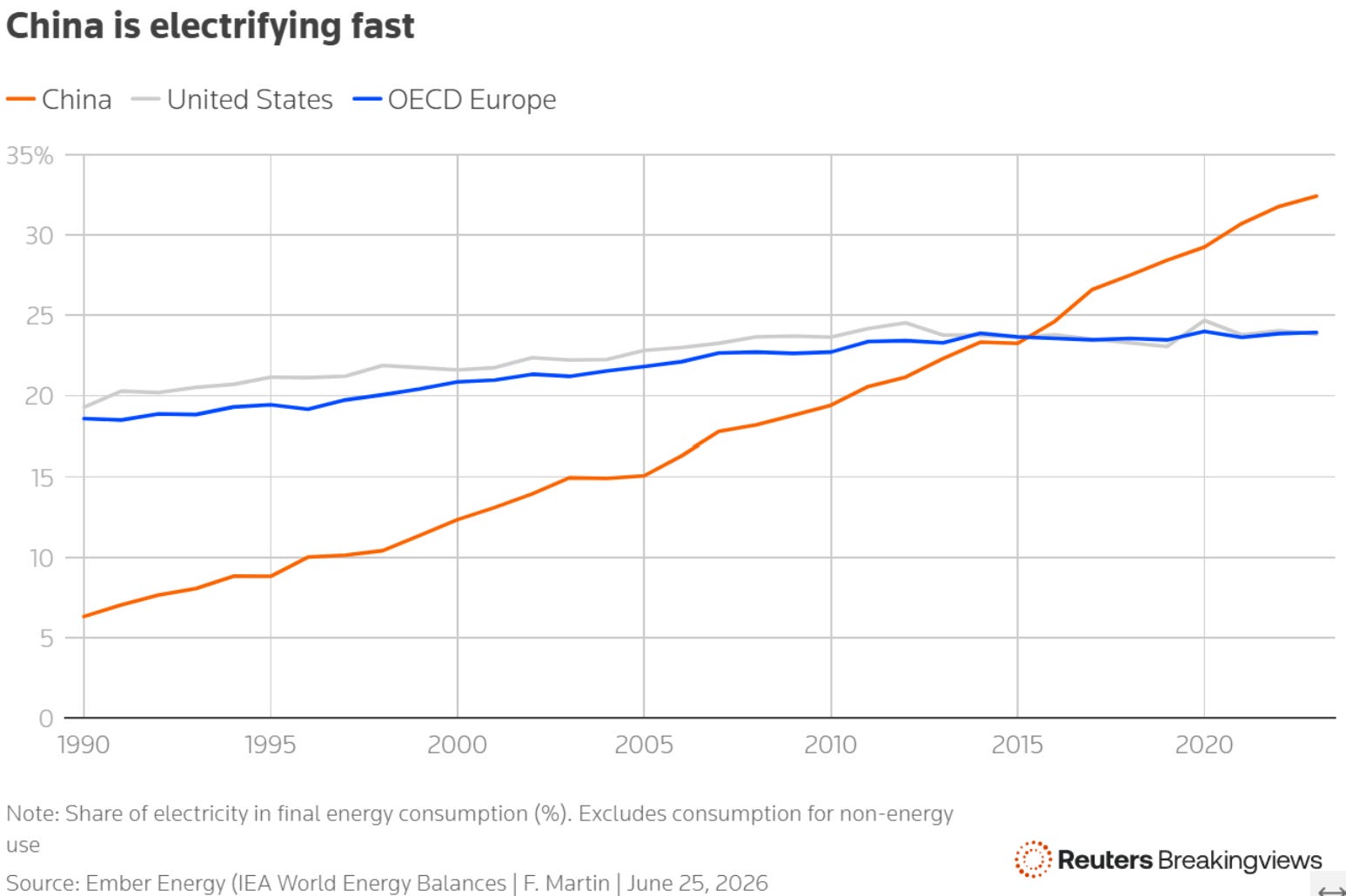
Felix Martin on Britain’s carbon reduction missteps, and China’s success - so far:
The problem is that much less emphasis has been placed on boosting electricity demand via the electrification of transport and heating. Just this Wednesday ... the UK’s Climate Change Committee reported that only 52,000 heat pumps had been installed nationwide in 2025 – far below the government’s 2030 target of 450,000. ... the share of electricity in the UK’s final energy consumption is no higher today than it was two decades ago. ... Britain’s highly successful decarbonisation of its electricity supply hits less than a fifth of its ... energy use.
The ... reason why electrification has not happened is simple. Prices ... have risen by more than 2.5 times since 2010, leaving them higher today than in all but one member of the Group of Seven ... and 25 out of 27 members of the European Union. ... one significant contributor has been the single-minded focus on decarbonising UK electricity supply by 2030 itself. The build-out of renewables, and the grid and storage upgrades ... have required ... capital investments – with the network and policy charges ... now making up over 40% of customers’ bills.
A ... thought experiment helps show why continuing on the same track makes little sense. In one ... scenario, the share of electricity in the UK’s final energy demand stays constant at today’s level of 18%, and its electricity generation is completely decarbonised ... In another, Britain’s final energy demand is 100% electrified – and ... the decarbonisation of its electricity supply ... proceeds no further. The two scenarios are unrealistic extremes ...
In the first ... the carbon intensity of the 18% ... would drop to zero, but the remaining 82% would ... have an intensity of around 220 gCO2/kWh, for an overall ... footprint of around 180 gCO2/kWh. In the second, the carbon intensity of the UK’s ... energy system would converge to that of its final electricity consumption today of 124 gCO2/kWh. ... electrification of demand is now far more impactful than further decarbonisation of supply. ...
China shows what reversing the priorities can do. For twenty years, Beijing adopted a catholic approach to its ... expansion of electricity generation, sourcing 47% of the increase from cheap coal and 41% from renewables. That helped keep electricity prices low, which ... accommodated an aggressive ... electrification campaign. In 2005, the share of electricity in China’s final energy consumption was only 15% ... By 2023, it had more than doubled to 32%. ...
Diagnosing the problem ... is easy. Unfortunately for the next Prime Minister, fixing it is not. The costs ... have already been incurred. Shifting them from electricity bills to general taxation redistributes the burden rather than eliminating it. ... Britain can at least prioritise electrification by building on what it has got right – such as eschewing special tariffs on Chinese EVs. By contrast, increasingly irrelevant – and indeed counterproductive – commitments to decarbonise electricity supply by an arbitrary date can be ditched.
Lenin famously summarised the essence of his revolution as “Soviet power plus the electrification of the whole country”. His alleged British successor will hopefully treat the first of those reforms as part of the joke – but the second as deadly serious.
Expensive experiment
Keeping one’s eye on the ball
Heaviosity half hour
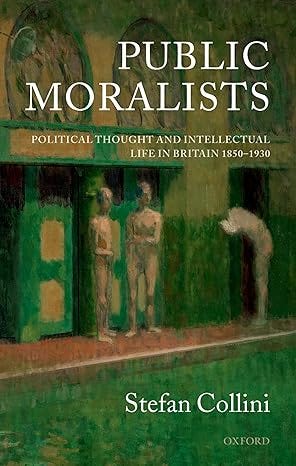
I was greatly taken with this book. Liberalism had its ancient origins and most of its life until very modern times as bound up with generosity, or the liberality of a bastion of the Roman republic - the publicly-spirited citizen. Today much of this is hollowed out into the cacophony of people demanding their rights - with little sense that your rights entail duties, not just among those who must respect your rights, but also from you yourself. So I was wide-eyed and gratified to read how seriously Victorian liberals took to the idea of the importance of altruism, particularly duties to the society at large, among the powerful.
Chapter 2: The Culture of Altruism: Selfishness and the Decay of Motive
I
The term ‘altruisme’ was coined by Auguste Comte, and, as the OED informs us, it was ‘introduced into English by the translators and expounders of Comte.’ The first recorded use occurs in G. H. Lewes’s exposition of the Cours, Comte’s Philosophy of Science, published in 1853. Subsequent uses of the term and its derivatives by other authors initially signalled their recognition of its origin, as in James Hinton’s aside to a correspondent in 1862: ‘The word altruistic I borrow from Comte. Is it not a capital word? I am resolved to naturalise it.’
‘We want it. It is the antithesis to “self’; self- being = deadness; altruistic being = life, and so on.’
Though its Comtist associations lingered, the term was soon established in its own right. ... I begin with this minor philological enquiry because it draws attention to the way in which the cluster of values I discuss in this chapter acquired a new prominence in the middle of the nineteenth century. ... [The texture of moral response among the most prominent Victorian intellectuals was marked at least as much by an obsession with the role of altruism and a concern for the cultivation of feelings as it was by any commitment to the premisses of self-interest and rational calculation.]
II
Adopting for the moment the schematic idiom of rational reconstruction, I shall begin with some stipulative definitions. First of all, I am assuming that for certain purposes it can be helpful to talk holistically about ‘Victorian culture’ as something analytically distinguishable from ‘Victorian society’, and also that among the plurality of symbolic patterns that make up a complex culture we can, in the interest of any given discussion, choose to designate one selection from that plurality as a ‘dominant’ one. By talking of a ‘dominant’ Victorian moral sensibility, therefore, I mean to suggest, rather than to deny, that there were some who did not share it and that there were degrees of sharing it, but also to suggest that its dominance would be acknowledged by the fact that those who did not share it necessarily stood in some defensive, deferential, or antagonistic relation to it.
Secondly, I am assuming that while in some general sense values are central to and partly constitutive of any culture, what is now commonly termed ‘morality’, understood as a set of rules of conduct or obligations towards others, is only one subset of those values. Furthermore, it seems reasonable to assume not only that the content of such values may vary in different cultures, but that what may be termed ‘the hierarchy of priority’ of one subset over another may vary also. In these terms, it would not be startlingly revisionist to suggest that Victorian culture was marked by what I want to call ‘the primacy of morality’, or in other words that in their more extended reflections on the political, religious, aesthetic, and other dimensions of human life, Victorian intellectuals gave evaluative priority to ‘morality’ in this sense.
With these boundary markers in place, I want to go on to construct something like an ideal-type of the notion of morality characteristic of dominant Victorian culture. First of all, morality was understood very much as a system of obligations in which there was a tendency to extend the category of ‘duty’ as widely as possible. Secondly, the characterization of the alternative to performing one’s duties stressed giving in to temptation or being seduced by one’s inclinations, and these inclinations were regarded as inherently selfish. Thirdly, it was assumed that in any given situation there was always one moral right answer: all ultimate values are presumed to be compatible, and obligations, when clearly understood, cannot conflict. Fourthly, the ‘others’ whose welfare was the object of one’s duties were coexistent with humanity as a whole; the partiality involved in privileging the claims of any more restricted group tended to be castigated as another form of selfishness. [The upshot is that within the dominant culture, the actual obligations were only rarely contested, though there was considerable theoretical dispute about their foundations.]
The characteristic preoccupations and assumptions of the leading intellectuals I am chiefly dealing with may be seen as intensifications of aspects of this more general moral framework. These assumptions, too, may be cast into baldly propositional form as follows. First, Victorian moralists exhibited an obsessive antipathy to selfishness, and consequently their reflections were structured by a sharp and sometimes exhaustive polarity between egoism and altruism. Secondly, they were intensely preoccupied with the question of arousing adequate motivation in the moral agent. Thirdly, they accorded priority to the emotions over the intellect as a source of action, and so addressed themselves particularly to the cultivation of the appropriate feelings. Fourthly, they tended to assume that our deepest feelings, when aroused, would always prove to be not just compatible with each other, but also productive of socially desirable actions. And finally, they betrayed a constant anxiety about the possibility of sinking into a state of psychological malaise or anomie, a kind of emotional entropy assumed to be the consequence of absorption in purely selfish aims.
The one feature of this pattern that may require further preliminary clarification is the exhaustiveness of the dichotomy between selfishness and altruism. ... I am suggesting, in other words, that Victorian moralists tended to assimilate the second of each of these two senses to the first, and then to see the polarity between them as exhaustive of the moral possibilities. As a consequence, given that the evaluative vocabulary was so heavily tilted towards the altruism end of the scale, it could be difficult to frame a morally positive description of purely private or non-collaborative forms of self-cultivation or self-assertion. Obviously, many of the elements of this structure were not peculiar to this period; the distinctiveness, if any, lies in the particular shape of the pattern as a whole. [The contrast with the eighteenth century is instructive: ‘living for others’ was less likely to be trumpeted as an ideal then, and a certain worldly tolerance of imperfection was perhaps lost in the nineteenth century’s more exigent moral climate.]
III
If the general scheme outlined above is to be recognized as identifying a pattern of moral assumptions fundamental to the thought of Victorian intellectuals, it must show itself able to illuminate the work of John Stuart Mill. ... The evidence which Mill’s case provides is all the more telling, for what his partly self-created reputation as the embattled champion of individuality has helped to obscure is the extent to which a fierce antipathy to selfishness, and a correspondingly intense commitment to altruism, structured his substantive moral views.
In fact, even in a primarily theoretical work like Utilitarianism, the argument depended to a considerable extent on the premiss that ‘selfishness [is] the principal cause which makes life unsatisfactory’, and on his optimistic belief that with the advance of civilization ‘a fellow-feeling with the collective interests of mankind’ would largely supplant ‘selfishness’. Not only, he asserted, ‘does all strengthening of social ties, and all healthy growth of society, give to each individual a stronger personal interest in practically consulting the welfare of others; it also leads him to identify his feelings more and more with their good’.
The extent to which Mill’s moral ideal involved an extraordinarily close coincidence of feelings among all members of the human race can also be documented from Utilitarianism. In its milder form, the ideal may seem bland enough:
‘In an improving state of the human mind, the influences are constantly on the increase which tend to generate in each individual a feeling of unity with all the rest; which feeling, if perfect, would make him never think of, or desire, any beneficial condition for himself, in the benefits of which they are not included.’
Even here, a rather demanding standard of harmony was involved: the ‘never’ suggests an austere exclusion of all private goods. Mill recognized that this happy state was some way off, yet the form of the concession seems to set the stakes even higher.
‘In the comparatively early state of human advancement in which we now live’, he lamented, ‘a person cannot indeed feel that entireness of sympathy with all others, which would make any real discordance in the general direction of their conduct in life impossible.’
The language here surely betrays an unnervingly intense yearning for total harmony: that there should be ‘an entireness of sympathy’ with ‘all others’, so that ‘any real discordance’ would not just be unlikely but would be ‘impossible’, is to set a very stiff requirement indeed. It is, for example, stronger than the claim that conflicts of interests can all be resolved by an appeal to some overarching criterion: it is saying that there will not be conflicts of interest because individuals will come to have the desires that further rather than clash with the desires of others.
Perhaps the most revealing source for my purposes is the section of Auguste Comte and Positivism in which Mill discussed Comte’s moral thought. Comte propounded, in his obsessively prescriptive Système de politique positive, what could be seen as the limiting-case of an altruism-centred moral theory. Mill, of course, objected to so vastly extending the domain of coercion, whether exercised by legal or moral means. But although he was sharply critical of Comte about the means, he revealed a very marked sympathy with the ends. Mill was, needless to say, deeply sympathetic to the idea of the Religion of Humanity, shorn of the excesses of the later Comte’s religiosity, and in defending it against potentially sceptical objections, he spoke of ‘the majesty’ of ‘the idea of the general interest of the human race, both as a source of emotion and as a motive to conduct.’ His attention was directed to its efficacy as a source of the feelings needed for moral action.
Mill, of course, was not willing to countenance Comte’s programme to extirpate all personal (or, in Comte’s binary classification, ‘egoistic’) motives to action, but he did allow to pass without comment Comte’s claim that ‘the grand duty of life [is] . . . to strengthen the social affections by constant habit and by referring all our actions to them.’ And when he cited Comte as saying that ‘all moral discipline should have but one object, to make altruism . . . predominate over egoism’, he commented, as if sifting the unobjectionable platitude from Comtean excess:
‘If by this were only meant that egoism is bound, and should be taught, always to give way to the well-understood interests of enlarged altruism, no-one who acknowledges any morality at all would object to the proposition.’
The celebration of ‘enlarged altruism’, and the corresponding presumption that conflict must represent the expression of selfishness, recurs in Mill’s writings at all levels, often colouring his views in a surprising way. For example, when deploring the self-interested attitudes fostered by much commercial competition, he declared:
‘Until labourers and employers perform the work of industry in the spirit in which soldiers perform that of an army, industry will never be moralized, and military life will remain, what, in spite of the antisocial character of its direct object, it has hitherto been—the chief school of moral cooperation.’
This is hardly the voice of the textbook stereotype of liberal individualism.
IV
Although Mill engaged with the question of how to stimulate individuals to act morally, he did not, once his youthful ‘mental crisis’ had been resolved, appear to suffer from any debilitating paralysis of the will himself. But the next step in my argument is to suggest that one of the sources of the hold on Victorian intellectuals of the pattern of moral assumptions I have been describing was that it appeared to address the problem of motivation as they actually experienced it. Their public pronouncements were spiced with personal testimony about the enervating effect of the absorption in purely ‘selfish’ aims. Much of their commitment to the ideal of altruism derived from the felt need to stimulate the will to rise above the listless despondency that was assumed to accompany the pursuit of strictly individual satisfactions. [This preoccupation with motivation was intensified by anxieties about the decline of orthodox Christian belief, and literature was increasingly looked to as a resource for cultivating the sympathetic feelings needed to overcome selfishness.]
The interplay of these themes is discernible in much mid- and late nineteenth-century moral reflection. A convenient epitome is provided by Leslie Stephen’s essay ‘Wordsworth’s ethics’, first published in 1876. A prominent part in Stephen’s literary criticism was played by the metaphor of moral or spiritual ‘health’, a standard of judgement that expressed his emotional affinity with the ethos of ‘muscular Christianity’ as well as his intellectual allegiance to Darwinian naturalism. This combination is insistently present in the declaration of critical principle with which he opens his essay on Wordsworth.
The highest poetry must be that which expresses not only the richest but the healthiest nature. Disease means an absence or want of balance of certain faculties, and therefore leads to false reasoning or emotional discord. The defect of character betrays itself in some erroneous mode of thought or baseness of sentiment. And since morality means obedience to those rules which are most essential to the spiritual health, vicious feeling indicates some morbid tendency, and is so far destructive of the poetical faculty.
The implied contrast, and the premiss of the position, is the possibility of that complete harmony of feelings that issues in the actions of the genuinely virtuous. On Stephen’s showing, neither Byron nor Shelley could resolve the moral dilemmas their own characters presented them with, ‘and therefore neither can reach a perfect harmony of feeling’. Wordsworth, by contrast, can, and can therefore help to cultivate this harmony in his readers. Like many of the poet’s Victorian admirers, Stephen was particularly taken by the lines: ‘We live by admiration, hope and love;/ And even as these are well and wisely fused,/ The dignity of being we ascend.’ And, like Mill, his judgement here rests partly on a pragmatic basis: both selfishness and despair deprive us of this one effective stimulus to action, and are thus self-defeating.
On Stephen’s reading of Wordsworth’s ethical teaching, the next step is to answer the question: ‘How can we build up our moral being?’ The criteria for discriminating this from our non-moral or immoral being are tacitly assumed, and throughout Stephen takes for granted that our strongest feelings are invariably benevolent.
‘The value of silent thought is so to cultivate the primitive emotions that they may flow spontaneously upon every common incident, and every familiar object becomes symbolic of them.’
In effect, Stephen’s account of ‘Wordsworth’s ethics’ is a discussion not of actual ethical ideals or their grounds, but of moral psychology. This is particularly evident in his long discussion of why Wordsworth is the only poet who enables us to turn sorrow to positive account. None of the usual platitudes are consoling when one is faced with the death of a loved one, but Wordsworth suggests the one source of comfort: ‘There is some consolation in the thought that even death may bind the survivors closer, and leave as a legacy enduring motives to noble action.’ And if we ask why suffering should stimulate this high-minded reaction rather than bitterness and despair, we come back to the question of the pragmatic superiority of ‘living for others’. If, claims Stephen, you are already someone who has cultivated ‘the higher motives’, then you
will be prepared to convert sorrow into a medicine instead of a poison. Sorrow is deteriorating so far as it is selfish. The man who is occupied with his own interests makes grief an excuse for effeminate indulgence in self-pity . . . [whereas] the man who has learnt habitually to think of himself as part of a greater whole, whose conduct has been habitually directed to noble ends, is purified and strengthened by the spiritual convulsion.
So, Wordsworth’s argument, as abstracted and stated in a prosier idiom by Stephen, is that there is a potential natural harmony and natural virtue in us as children—’the instrument in fact finds itself originally tuned by its Maker’—and that it then depends which pattern of life we follow whether we maintain and develop this harmony or destroy it. And what destroys it is selfishness, which withers the powerful emotions. Stephen’s conclusion is thus that ‘in this way the postulate justifies itself by producing the noblest type of character’. [Stephen’s theoretical allegiance to evolutionary naturalism is also evident in his treatise The Science of Ethics, where he argued that ‘altruism is . . . the faculty essentially necessary to moral conduct. Were it not a reality, virtue would be a name and society an impossibility.’] But he also emphasized that
You no more teach men to be moral by giving them a sound ethical theory, than you teach them to be good shots by explaining the theory of projectiles. . . . To convert the world you have not merely to prove your theories, but to stimulate the imagination, to discipline the passions, to provide modes of utterance for the emotions and symbols which may represent the fundamental beliefs.
It was to fulfil this purpose that Stephen and many of his contemporaries increasingly looked to imaginative literature. [John Morley, in addressing the University Extension movement in 1887, similarly emphasized that literature acts by ‘the cultivation of the sympathies and imagination, the quickening of the moral sensibilities, and the enlargement of the moral vision’.] The underlying conviction had been stated some thirty years earlier by that writer whom so many intellectuals of this generation revered as the most effective moral teacher of the age:
‘The greatest benefit we owe to the artist is the extension of our sympathies . . . a picture of human life such as a great artist can give, surprises even the trivial and the selfish into that attention to what is apart from themselves which may be called the raw material of moral sentiment.’
[It is arguable that the very needs that led Victorian intellectuals to place this burden on literature constrained both the selection and interpretation of the works they promoted, contributing to a thinness in the Victorian understanding of tragedy, where irresolvable conflict is at the heart of the genre.]
By this point, we may seem to have moved far from politics and political thought. However, it is part of the argument of this book that these journeyings are not deviations, but, rather, an essential way of exploring the informing dynamic of the public sensibility of the period. A helpful marker to the next stage of the route is provided by the fate of one of the emblematic fictional characters of the late nineteenth century, the eponymous hero of Mrs Humphry Ward’s best-selling novel Robert Elsmere. The novel has become a locus classicus for discussions about the struggle between Faith and Doubt. But I want to suggest that the novel also provided its first readers with a recognizable parable about the need to ‘live for others’. What it portrays as being so fatal in such figures as Langham, the aetiolated don, or Wendover, the free-thinking squire, is not their lack of religious belief, but their selfishness. For all their intellectual and worldly advantages, neither manages to find sufficient purposes to sustain life. The contrast is with Elsmere himself, who, though he loses his faith in Christianity, continues to identify his feelings with the interests of others.
The final section of the novel, where Elsmere finds peace and satisfaction working among the uneducated inhabitants of the East End, pointed the moral for those primed to see. Elsmere tells his new audience stories, using literature for the purposes of secular sermons: ‘In these performances Elsmere’s aim had always been twofold—the rousing of moral sympathy and the awakening of the imaginative power pure and simple.’ Another character is used to voice the obvious sceptical question of the point of this surrogate preaching: ‘What will you gain? A new sect?’
‘Possibly. But what we stand to gain is a new social bond’, was the flashing answer—’a new compelling force in man and in society. Can you deny that the world wants it? What are you economists and sociologists of the new type always pining for? Why, for that diminution of the self in man which is to enable the individual to see the world’s ends clearly, and to care not only for his own but for his neighbour’s interest, which is to make the rich devote themselves to the poor, and the poor bear with the rich. If man only would, he could, you say, solve all the problems which oppress him. It is man’s will which is eternally defective, eternally inadequate.’
Mrs Ward’s writing involved a sustained attempt to combine the legacy of Matthew Arnold with that of T. H. Green, to whose memory Robert Elsmere was dedicated. The considerable reputation which Green’s arcane teachings had achieved at the time of his death in 1882 suggested how the message about altruism could, when delivered in this specific context, be taken to yield a political conclusion. For, Green’s moral philosophy was an exceptionally systematic expression of the sensibility which found something repugnant in even the hint of self-regarding actions; in his scheme, private goods simply had no standing. Faced with the pressing needs of others less fortunate than ourselves, sacrifice was strictly an obligation. As Green had memorably declared at one point:
It is no time to enjoy the pleasures of eye and ear, of search for knowledge, of friendly intercourse, of applauded speech or writing, while the mass of men whom we call our brethren . . . are left without the chance, which only the help of others can gain for them, of making themselves in act what in possibility we believe them to be. . . . Interest in the problem of social deliverance . . . forbids a surrender to enjoyments which are not incidental to that work of deliverance.
In this morally demanding theory, no legitimate conflict with the demands of the common good is even possible. But those historians who have tried to see the ‘rise of collectivism’ or the dominance of ideas of ‘duty’ in the English administrative class in terms of the influence of Green’s philosophy are guilty of that misplaced individualism in explanation that is an occupational hazard of a certain kind of history of ideas. We need to approach the question from the other end and to recognize that Green theorized more fully and consistently than anyone else the assumptions of the anti-selfishness sensibility: it was because these assumptions were so widespread that his philosophy enjoyed the success it did, and not vice versa. [Green’s emphasis on the duties of altruism to those below one in the social scale became more common in the 1880s and 1890s, and several forms of ‘collectivism’ were beneficiaries of this emphasis on duty. This moral sensibility also distinguished Victorian liberalism from the cooler, more worldly Whiggism of the earlier part of the century.]
[This emphasis on ‘social duty’ suggests an intriguing connection with the whole issue of the social and political consequences of the widespread loss of religious faith among mid- and late Victorian intellectuals.] Beatrice Webb wrote in her autobiography:
‘I suggest it was during the middle decades of the nineteenth century that, in England, the impulse of self-subordinating service was transferred, consciously and overtly, from God to man.’
This obviously points towards a large truth, and the reference to ‘subordinating’ the self catches the authentic flavour of the idiom. Yet the conventional construal of this passage still leaves the psychological mechanism involved somewhat obscure. At the risk of inflating a small point into a large claim, I think the argument of this chapter suggests a mild revision of Beatrice Webb’s phrase. The constant, one could say, was the need for purposes—the kind of purposes which, when supported by the appropriate feelings, are sufficient to motivate to action. The representative Victorian intellectual, whether believer or sceptic, did not have a constant impulse to serve: he had a constant anxiety about apathy and infirmity of the will. The prevailing moral scheme, when internalized, meant that ‘selfish’ purposes, whether religious or secular, could not sustain the necessary load. Thus, it was because altruistic aims were assumed to motivate that Victorian intellectuals found social work an antidote to doubt, and not that, already having the motivation, they ‘transferred’ its direction from God to man.
V
[The exaggerated hostility to selfishness may have helped legitimate the claims of the professions in this period, and there are also connections to be drawn between these moral assumptions and the casual universalism of much Victorian political language. The more that intellectuals emphasized the subordination of intellect to emotion, the more they faced the difficulty of finding adequate motivation in feelings for a generalized ‘humanity’. The claims of actual, limited communities were often lost sight of in this universalizing tendency.] One useful corroboration of the interpretation, however, may be provided by the response of the next generation. In the present instance, it is particularly striking how salient the mid-Victorian emphasis upon the duty of altruism and sacrifice to others was in the hostile portraits of the beliefs of that age penned by the first generations of its critics, in the reaction against ‘Victorianism’ at the very end of the nineteenth and beginning of the twentieth centuries. Shaw’s Quintessence of Ibsenism would be one obvious source of evidence for the sense that the demands of an altruism-centred morality had become oppressive. ‘The lesson of the plays’, in this provocative account, was that ‘the real slavery of today is slavery to ideals of goodness’. As Shaw put it later in the preface to his ironically entitled Three Plays for Puritans, the self-assertive creed of what he called ‘Diabolonian ethics’ had had a particularly hard time of it in the Victorian period.
‘All seemed lost when suddenly the cause found its dramatist in Ibsen, the first leader who really dragged duty, unselfishness, idealism, sacrifice, and the rest of the anti-diabolic scheme to the bar at which it had indicted so many excellent Diabolonians.’
Much of the impact of Wilde’s paradoxes depended upon hitting the same target—what he called ‘the sickly cant about Duty’ and that ‘sordid necessity of living for others’.
Above all, the vogue for Nietzsche in England at the turn of the century related directly to this response. As one observer remarked at the time:
‘The present furore over Nietzsche’ should be seen as ‘simply a part of the reaction against “psychological” and “romantic” literature and against foolish “altruism” and foolish “philanthropy”’.
Nietzsche himself, of course, started from radically different premisses:
‘An “altruistic” morality, a morality under which egoism languishes—is under all circumstances a bad sign . . . To choose what is harmful to oneself, to be attracted by “disinterested” motives, almost constitutes the formula for decadence.’
Not surprisingly, the dominant response to Nietzsche’s ideas in late-Victorian England mixed hostility and incomprehension in almost equal parts.
As that response suggests, however, such outspoken critics of these moral assumptions were still very much minority voices. Many of the generation who were formed by the ‘culture of altruism’ that particularly flourished between the 1850s and the 1880s retained a commitment to these ideals through later decades. [L. T. Hobhouse, for example, looked back nostalgically to George Eliot, whose novels provided a ‘justification for all that it was then usual to sum up in the word altruism’, and he complained of ‘the unmitigated selfishness with which Shaw has indoctrinated his generation’.] Possible explanations of the deep hold of these moral assumptions about selfishness and altruism during this period would have to be explored in other ways (and by other authors), but from the standpoint of late twentieth-century knowingness it is hard not to hypothesize about the ways it may have been related to a kind of distancing of the sexual instincts. [Freud remarked that altruism is distinguished by the absence of longings for sexual satisfaction, and Comte himself ‘never ceased to deplore the sexual instincts as the most disturbing of the egoistic propensities’.] And, looking in a different direction, we must also allow that there was an element of a more general truth in T. S. Eliot’s waspish jibe at his great predecessor:
‘Like many people the vanishing of whose religious faith has left behind only habits, [Arnold] placed an exaggerated emphasis on morals. Such people often confuse morals with their own good habits, the result of a sensible upbringing, prudence, and the absence of any very powerful temptation.’
For a final, and even more general, concluding reflection one may turn to yet another remark by Nietzsche, the incomparable diagnostician of nineteenth-century moral thought. It is not necessary to endorse his sweeping dismissal of modern moral decadence, or his bitter denunciation of Christianity as its source, to recognize the truth of his perception that Victorian moralists were too prone to take the moral harmony posited in the dominant culture of their time as a universal ethical condition.
‘If the English really do believe they know, of their own accord, “intuitively”, what is good and evil; if they consequently think they no longer have need of Christianity as a guarantee of morality; that is merely the consequence of the ascendancy of Christian evaluation and an expression of the strength and depth of this ascendancy: so that the origin of English morality has been forgotten, so that the highly conditional nature of its right to exist is no longer felt. For the Englishman morality is not yet a problem ...’


Lovely painting
I knew OF Hussein Abubakr Mansour because he is one of the four new people that Mosaic is taking on as a columnist (I can easily refuse to subscribe to Mosaic because I have too many paid subscriptions already). This is really an argument with his other posts but the way I understood it Jews embraced Reform/the Haskalah [Jewish Enlightenment] in order to show their Christian neighbors that they were really like them and what they were doing is Christianity perfected and made more universalistic. (There is a Jewish Lives biography of Moses Mendelssohn out in the world but I will put my foot down and not read it this year...) If American liberal Judaism now is marginalization worship that is following post-1960s trends in American life.
I will just mention that courtesy of New Israel Fund I read "In This Place Together" by Souli Khatib and Penina Eilberg-Schwartz. Khatib is a founder of Combatants for Peace which may entail taking the necessary responsibility since the official Palestinian narrative, the irresponsible PA government immediately after Oslo, and especially Hamas he has absolutely no use for. However he was able to use very simple metaphors in the book such as the separation wall coming between his family and their traditional olive trees and going out to a field where the grape vines are dying. If you happen to know that grapes are one of the traditional 7 species of the Land of Israel this would question whether contemporary Israel really has the organic connection to the land that some forms of Zionism promised.
Regarding the treatment of Keir Starmer, it should not be surprising for a prime minister who won with a record low vote share yet came away with a large majority. 2/3 Brits didn't want him in the first place and naturally believe he never had a mandate.
Also, much of his Labour leadership has been spent attacking the people who did vote for him, not to mention numerous volte-faces on topics as broad as women's pensions, Brexit, and anti racist party reform, each of which have created some extremely embittered parts of the electorate. As a result of his own political choices, he is simultaneously hated as being too socialist, too conservative, and also a betrayer of centrists.