


Neoliberalism, the agony and the ecstacy
A first rate piece by Branco Milanovic. One of the things that makes it first rate is that it understands just what a magnificent contribution neoliberalism made - most particularly, helping lift over a billion out of poverty. But, like Michael Polanyi, Raymond Aron and Bertrand de Jouvenel - the three ‘moderate’ founding members of Hayek’s Mont Pèlerin Society who drifted away in the mid 1950s, Milanovic understands that Hayekian neoliberalism ultimately boiled down to a kind of inverse Marxism. He’s heading to Kilkenomics so I’m hoping we get to meet.
Why did neoliberalism, in its domestic and international components, fail? I ask this question, in much more detail than I can do it in a short essay here, in my forthcoming The Great Global Transformation: National Market Liberalism in a Multipolar World. I am asking it for personal reasons too: some of my best friends are neoliberal. It was a generational project of Western baby-boomers which later got adopted by others, from Eastern Europe like myself, and Latin American and African elites. When nowadays I meet my aging baby-boomer friends, still displaying an almost undiminished zeal for neoliberalism, they seem like the ideological escapees from a world that has disappeared long time ago. They are not from Venus or Mars; they are from the Titanic.
When I say that neoliberalism was defeated I do not mean than it was intellectually defeated in the sense than there is an alternative ready-made project waiting in the wings to replace it. No: like communism, neoliberalism was defeated by reality. Real world simply refused to behave the way that liberals thought it should.
We need first to acknowledge that the project had many attractive sides. It was ideologically and generationally linked to the rebellious generation of the 1960s, so its pedigree was non-conformist. It promoted racial, gender and sexual equality. By its emphasis on globalization, it has to be credited by helping along the greatest reduction in global poverty ever and for helping many countries find the path to prosperity. ...
So, to go back to the original question, why did neoliberalism not remain the dominant ideology? I think there are three reasons: its universalism, hubris of its adherents (which always comes with universalism), and mendacity of its governments.
That neoliberalism is universal or cosmopolitan requires, I believe, little convincing. Liberal ideology treats, in principle, every individual and every nation the same. This is an asset: liberalism and neoliberalism can, again in principle, appeal to the most diverse groups, regardless of history, language or religion. But universalism is also its Achilles’ heel. The pretense that it applies to everybody soon comes into conflict with the realization that local conditions are often different. Trying to bend them to correspond to the tenets of neoliberalism fails. ...
But all universalists (communists among them too) refuse to accept that defeat. As they must because every defeat is a sign of non-universalism. That’s where the intellectual hubris kicks in. The defeat is seen as due to moral flaws among those who failed to adopt neoliberal values. To its votaries nothing short of its full acceptance qualifies one as a sane and morally righteous person. ... This moral element implied lack of empathy with those who failed to find their right place within the new order. If one failed, it was because he deserved to fail. Faithful to its universalism, Western upper middle-class neoliberals did not treat co-citizens any differently from foreigners. Local failure was no less merited than the failure in a faraway place. This contributed more than anything else to the neoliberals’ political defeat: they simply ignored the fact that most politics is domestic.
The hubris which comes from success (and which got elevated to unheard-of heights after the defeat of communism) was reinforced by universalism—a feature shared by all ideologies and religions that by their very construct refuse to accept that local conditions and practices matter. Syncretism was not in the neoliberals’ playbook.
Finally, mendacity. The failure to observe, especially in international relations, even the self-defined and self-acclaimed “rules-based global order”, and the tendency to use these rules selectively—that is, to follow the old-fashioned policies of national interest without acknowledging it, created among many the perception of double standards. ... In the international arena, they ended in a cul-de-sac, manipulating words, reinventing concepts, fabricating realities, all in the attempt to mask the truth. A part of that mendacity was present domestically too when people were told to shut up and not complain because the statistical data were not giving them reason and thus their subjective views were wrong and had to be ignored.
What next? I discuss that in The Great Global Transformation. I think there is one thing on which most people would agree: that the past fifty years have seen the debacles of two universalist ideologies: communism and neoliberalism. Both were defeated by the real world. The new ideologies will not be universal: they would not claim to apply to the entire world. They will be particularist, limited in scope, both geographically and politically and geared toward the maintenance of hegemony wherever they rule; not fashioning it into universal principles. ... The only way for authoritarians not to fight with each other is to accept a very narrow set of principles, essentially those of non-interference in domestic affairs and absence of aggression, and leave it at that. Xi Jinping’s proclamation of five such narrow rules at the recent Shanghai Cooperation Organization meeting may be based on such a calculation.
Some words are less taboo in Britain than elsewhere


What to make of the 60s?
And who better to sort it out than two guys who hated each other - or at least confessed to a healthy dislike for most of their lives - Peter and Christopher Hitchens. As ever, in many ways the conservative has the better of the ‘what went wrong’ side of the argument. But - and this is one of the great flaws of many Burkean conservatives - they leave us pretty empty handed on how to build a better future. The progressive is better there. Anyway, what’s below is heavily edited and I’m thinking many readers will want to check out the whole thing. And thanks to reader Robert Banks for alerting me to the piece.
Dear Christopher,
If there is anything worse than a young conservative, it is an old revolutionary. The western world is infested with paunchy radicals. My own path—a silly flirtation with revolution followed by a return to Tory certainties—used to be a cliché. Now I am an exception. The disturbing thing about the late 1960s is that they are still going on...
The 1960s were a genuine upheaval with permanent effects... This cultural revolution was more destructive than the Reformation—and lacking any true liberation. It reduced beloved institutions to rubble while elevating garbage. Its corrosive effects on language, manners, and the education of children have been a disaster... I regret that I was involved at all.
You ought to agree with me... You cannot be pleased by the nurseries of ignorance we call schools. You cannot be glad that heroin is sold openly in pit villages... You cannot be happy that rock music is the nearest most people get to poetry, or that faith and deference have been replaced by syrupy celebrity worship epitomized in the cult of Diana.
The favorite social causes of our generation—unrestricted abortion, easy divorce, homosexual law reform, the end of censorship—have all been victorious. In every single case, the warnings of the crustiest conservatives now turn out to have been sober prophecies. The family is disappearing. Life is cheaper... Sexual tolerance led not to civilized contentment but to demands for moral equality between homosexual partners and married couples. Morality has been replaced by cold hedonism promoting sterility rather than fertility.
An ethical person is no longer one who behaves well, but one who publicly conforms to orthodox opinions... Who can deny that Mary Whitehouse had a case?... We have broken the link between pleasure and reward as well as that between crime and punishment. By mocking the ideal of the gentleman we have elevated ambition and greed, unrestrained by concern for others... We wanted everything designed for our convenience, chose causes to feel superior to our parents, and then called our selfish wails a revolution.
Yours fraternally, Peter
Dear Peter,
I am writing from Berkeley. What was the position here in 1967? College authorities claimed the right to suppress most forms of political expression. Volunteers took their lives in their hands journeying south, where millions were denied the essentials of citizenship. The university served as a think-tank for an unjust war in Indochina... California was a proving ground for thermonuclear experiments which envisaged the extinction of the human species. Thanks to cultural rebellion, the extension of civil rights became unstoppable, while a lousy war was actually stopped by a movement of citizens.
My chief regret is that I didn’t play a more active part.
Take Europe: military fascists in Greece, Spain, and Portugal. A British Labour government capitulating to racist revolt in Rhodesia. Northern Ireland a sectarian protectorate... Nelson Mandela with two decades of confinement ahead of him. At Oxford... official permission required for everything... No women admitted to my college. I helped change these things and would not take back a word or deed.
Much of what you dislike can be blamed on “the personal had become political”—a slogan I detested. But it was the exhausted terminus of the time, not its authentic expression. Václav Havel identified as a “man of the 1960s.” Gorbachev defined himself among the shestidesyatniki—”people of the 1960s”—changed forever for the better. Glasnost and perestroika are grand words that eclipse the downsides of sex, drugs, and rock and roll.
As late as 1966, it was illegal to be “queer” in Britain. Felons were hanged. The Lord Chamberlain censored books and theatre. These were the days of traditional standards. Once past murder and theft, there is no behavioral problem to which prohibition is the solution. The struggle against cretinism must be waged daily, not forwarded by those who grizzle that it’s been downhill since their memories dimmed.
Fraternally, Christopher
Dear Christopher,
Do you perhaps overstate the horrors of pre-revolutionary life? In today’s Oxford, undergraduates have never heard of Keynes, although they are free to engage in any kind of sex while college principals excuse illegal drug-taking. Could these things be connected?
The law can support the true remedy, which is a universally accepted moral code, enforced by convention, disapproval and shame. It is this invisible web of protection which the enthusiasts of 1968 sought to tear to pieces. They hoped to break down the pillars which held it up—love of country, loyalty, a shared acceptance of what is good and beautiful, religion, tradition, deference and respect for family and authority, and above all self-control.
They succeeded rather well. It is astonishing how short a time it has taken to smash up the family, to popularize abortion, to abolish history and literature, strip the altars, burn the flags, give dope and contraceptives to children but deny them poetry or parents. Every wretched slogan shouted in 1968 has come to pass in the real lives of millions. How can you still be pleased?
Yours fraternally, Peter
Dear Peter,
History goes on for a very long time... There were 1960s slogans that mutated into silliness or nastiness. But they originated as notes of desperation when the short term proved non-millennial. Against that, Gorbachev recently defined himself as one changed forever for the better by the events of that period.
An interesting question arises: which of us is the nostalgic one? I admit to finding political life in the 1960s more vivid and worthwhile than I have found it since. But this is a result of the 1960s only in the sense that the gilded age was the outcome of the American civil war... The standards of the abolitionists were mobilized for new battles under different flags. What could not be restored was the ante bellum “ideal” of an organic society in which each knew his place. Your yearning for something like this is utopian, but only in the most arid sense.
After thirty years, there’s no going back. But there are ways forward, even through the inevitable thicket of unintended consequences. You deny this to yourself by adopting an ethos of “deference” exploded long before the first baby ever boomed.
Fraternally, Christopher
Is literature useful and does it make you a better person? (Hint: no)

An existential guide to making friends

A string of mostly fun and enlightening aphorisms about friendship.
The first thing you need to know is that friendship is not natural. If you were natural you would be a moss. Moss doesn’t have friends. Moss just spreads, cold and damp and indifferent, and sometimes another moss spreads nearby, and together they make a bog, and then the bog swallows a horse. But you, unfortunately, are not a moss. You are a person, and people are creatures that rot if they are alone. To be human is to be an animal that needs witnesses...
But making friends - have you tried it? Horrible stuff. It’s like applying for a job, except the application process is permanent and the job doesn’t exist...
Aristotle: friends are either useful, pleasant, or virtuous. What he didn’t say is that every friend eventually becomes useless, boring, and morally compromised...
Nietzsche: friends should be arrows you fire into the future, meant to wound you, to test you, to make you stronger. Lovely. Except most of us are just happy if someone answers our texts...
Friendship is basically the black market trade of masks. You offer one of yours, they offer one of theirs, and if the exchange goes well, you keep bartering until you’ve forgotten what your original face looked like.
Anyway, here is your first existential tip: friendship is impossible, and therefore it must be done. If it were possible, it wouldn’t matter. Only impossibilities have meaning...
Go where hands do things.
Bars are museums of speech; workshops are factories of friendship. Put your body where objects resist you...anywhere the third thing (soil, song, soup, dice) can stand between you and the other person like a kindly chaperone. You cannot stare each other into closeness; you can only arrive there while both of you are staring at something else...
Make a specific, stupid plan.
“Let’s hang sometime” is the Esperanto of the damned. Try: “Tuesday, 7:15, the dumpling place that smells like a wet dog.”...
Bring an offering.
A tangerine. A photocopied poem. A cursed USB stick containing Romanian disco...
Ask a small favour.
Not money, not a kidney. “Can you watch my bike while I wee?”...
Tolerate untelevised time.
A friendship is mostly b-roll. Errands, waiting for buses, being wrong about directions together...
Be a small mirror, not a full-length one.
Friends do not fuse; they braid. The aim is not to be two halves of one person but two complete people orbiting a third thing that neither of you owns.
Speak plainly when hurt; briefly when angry.
A clean wound heals; a theatrical wound becomes a career. Apologies should be nouns (”I was cruel”), not weather reports (”things were said”)...
Learn to be findable.
Being findable means living somewhere in public: a regular table, a habitual lane, a community noticeboard with your handwriting on it...
Remember the metaphysics.
A friend is not a contact, not a cure, not an escape room partner. A friend is the person who proves you exist when your own gaze slips. A friend is the witness at the small trial of every day. Together you invent a jurisdiction that can overrule the world.
And if you need one final mechanism, something idiotic and immediate, take this: open your phone and text the most nearly-friend person you have. Not the perfect one; the adjacent one. Type: “Walk at 6:40? Bring the stupid hat.” Send before your cowardice wakes up.
The rest is repetition, gentle and stubborn. The rest is tending. You are not moss; you are an animal that rots alone. Make the bog with others. Save the horse.
Apple protects ICE agents
A friend sent this to me last Saturday with this comment “First half of this is excellent (second half Piers ruins it).” Yes he does rather, by spending way too long on the a discussion of whether or not to ‘platform’ someone without really appreciating Eric’s point. But good on Piers for the job he’s doing in extraordinary times.
Anyway, Eric’s stratospheric opinion of his own intelligence is painful to listen to, but there you go. He has a lot of very powerful things to say. If I were telling the story he is telling, I’d inject a good deal more of the great Australian insight - ‘always suspect a stuff-up’. I think most of the ‘revolutionaries’ you see on your screens today, like the one I highlighted last week are just playacting them for the LoLs and the strokes - and some for the money. And they’re doing so in what is increasingly becoming our culture’s only political currency - performativity. And then of course there are some crazies who go out and address a bullet to someone.
I’m not at all saying there’s nothing to worry about. Rather I’m proposing a different driver - and a more mundane one - behind our current (escalating) discontents. Anyway here’s Eric.
On Revolutionary Empathy
“Revolutionaries have a shifted empathy complex. They’re at war. They’re at war with the system in which they embed. and the nurse is administering your IV, the person making your coffee, the person at the DMV processing your driver’s license, is someone who is often completely unsympathetic with the society in which you exist and who would ask for its overthrow potentially with violence and and often violence is to be celebrated.”
On Language as Weaponry
“Notice the following words: fascist, reactionary, Zionist, Nazi. As soon as you see someone painted with those terms, the empathy complex changes... if you think about what lamb and veal are it’s one of the most upsetting concepts but you’re given language which is I’ll have the lamb no I’ll have the veal and you don’t actually think about what it means and so what I’m claiming is is that when you hear somebody talking about oh I’m fighting reactionaries I’m fighting the Zionists punch a Nazi that guy’s a reactionary far right that is the language used to paint the enemy so that you don’t need to feel bad about the enemy dying or getting hurt.”
On the Generational Crisis
“You have this group of people particularly people let’s say in their 20s now who’ve not been invited into the party of Western civilization. They are not being given the means to have babies uh a mortgage to participate in a profound way and they’re being asked to conserve a society that is more or less using them as a protein source... the real problem is that the two parties the centers of the two parties in the US don’t have ideas. They have no offerings.”
On Who Has Ideas
“The normalized revolutionaries inside the Democratic party have ideas. AOC has ideas. Mandani has ideas. Hillary Clinton does not have ideas.”
On the Scale of the Problem
“If you look at all of those videos asking for Charlie Kirk reactions, do you imagine you’re looking at thousands upon thousands of mental illness cases? No. You’re looking at an ideology that you can’t kill so easily.”
On Message Killing
“When let’s say when America went to war against Germany and Japan we used phrases like the Jerry’s and the Japs and we wrote messages on munitions that we used to kill the enemy. This is what they’re doing. They’re writing on bullets and casings. They are doing message killing.”
On the Firearms Reality
“We’ve got a country that is wall-to-wall stocked with high-powered rifles that allow very far shots to be made relatively easily. And you’re talking about the fact that woke is over. No, no. There are going to be revolutionaries at various levels throughout your life. You’ll never get rid of them.”
On the Concept of Mustn’t
“You mustn’t burn the flag. It’s not that you can’t. It shouldn’t be illegal to burn the flag. And it’s not that you really shouldn’t because it’s a bad thing to do. It should be unthinkable... There’s this concept of mustn’t which is cultural which is what stops very dangerous fit ideas... what we’re really looking for is we’re looking for very strong cultural prohibitions that leave us a free people with every legal right to express ourselves.”
On Celebrating Murder
“You mustn’t celebrate Charlie Kirk’s murder. It’s an absolute. It’s not a legal requirement that you not celebrate it. Come on, man. Have you lost your mind? Have you lost your humanity?”
Seeing like an LLM
A while back I tried to explain how the coming of LLMs sinks another boot into the carcase of Western Cartesianism - though it has to be admitted, it’s an awfully big carcase. To quote myself (fed into Claude to make it more concise):
AI illustrates the wisdom of ‘perspectivism’. We moderns think of our minds as mirrors of nature—accurate models of what’s ‘out there’ help us survive. But this understates things. As Nietzsche argued, the evolutionary advantage our minds gave us was the power of deception (plus an awful dose of vanity, all supplied in 3D surround sound).
Moderns have this backward. They elevate episteme (knowledge of necessary structures) as the pinnacle of human achievement. But our mastery of episteme is actually a narrow subset of intellect’s core role: phronesis—practical capability to act in the world to our advantage.
Modern science began exposing episteme’s limits in the late 19th and early 20th centuries. The luminiferous ether’s failure mocked the quest for a universal frame of reference. Relativity and quantum mechanics finished the job. Even in nature, statements about reality make no sense outside some frame of reference in time and space—making all knowledge partial and bounded.
The AI connection? When I Google “Who won the Australian Open in 1975,” I must think my way into search terms that will produce curated knowledge containing my answer.
AI is already more agentic (horrible word). I ask “Who won the Australian Open in 1975?” (John Newcombe—I was there! Most sublime sporting event ever burned into my psyche). It takes my point of view into the internet and gets me an answer. AI helps us see what Nietzsche pointed out in the late 19th century.
Next time someone uses “epistemic,” ask whether they mean the non-word “phronesic.” That we lack such a word tells you everything.
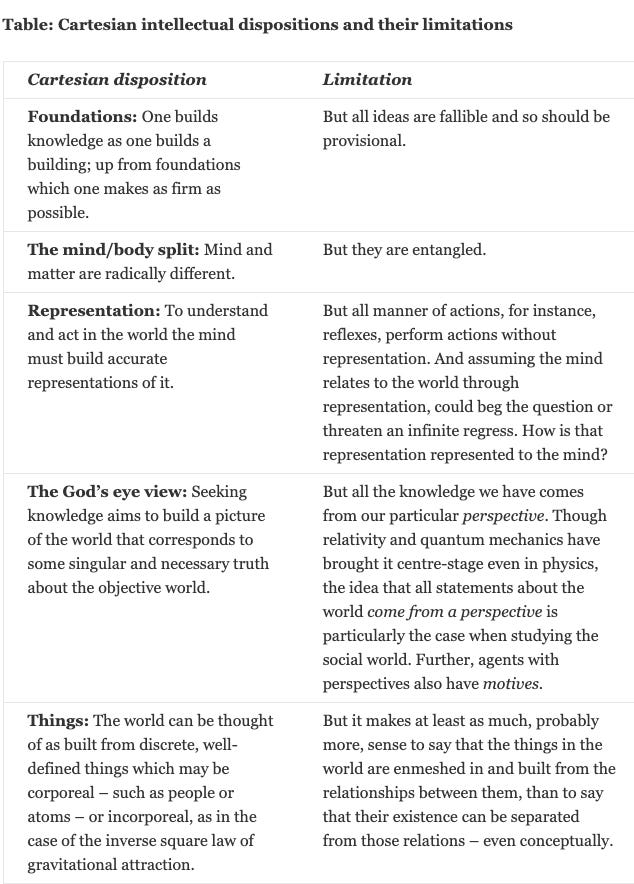
I also put a fair bit of effort into a long blog post on similar themes, having immersed myself in the embodied cognition literature. Here’s a table I came up with which I rather liked - it could have more rows, but hopefully you get the picture.
Another way to understand the two ‘world views’ is to compare the ‘Cartesian’ robot in the video above with this one.
Anyway, LLMs are leading people to the conclusions foreshadowed above. Here’s an edited back version of an excellent essay by entrepreneur and inveterate writer Dan Shipper.
When I say the word “intelligent,” you probably think of being rational. But language models show us that this assumption is wrong.
To us in the West, smarts are about being able to explicitly lay out what you know and why you know it. For us, the root of intelligence is logic and reason to ward off superstition and groupthink... Our romantic picture of ourselves as “rational animals,” as Aristotle said, has produced everything in the modern world—rockets, trains, medicines, computers, smartphones.
But this picture is incomplete. It contains a huge blind spot: It neglects the fundamental importance of intuition in all of intelligent behavior—intuition which is by nature ineffable; that is to say, not fully describable by rational thought or formal systems.
How to build a thinking machine
Let’s start with a task, something easy and basic that humans do every day: scheduling an appointment.
The problem we find is that it’s very hard to lay everything out explicitly—because everything is interconnected. To paraphrase Carl Sagan: “If you wish to schedule a meeting from scratch, you must first define the universe.”
The old, Western worldview
This approach is exactly what the first generation of artificial intelligence researchers took to try to build AI...
It failed miserably. Trying to formalize even basic thinking in terms of explicit rules turned into an infinite task requiring more computing power than would be available in the lifetime of the universe...
This way of thinking about the world is woven into the fabric of our culture. It is a form of thinking invented by Socrates, and reborn in the Enlightenment through Descartes, Galileo, and Newton...
Seeing like a language model
For the first time, we have a tool—neural networks—that allows us to work with what can’t be defined explicitly. Neural nets and language models don’t work by explicit rules. Instead, they absorb tacit patterns in language—statistical regularities across billions of words—and recreate the hidden web of associations that makes our world hang together...
If we learn to see like a language model, it will lead us to an entirely new worldview—the successor to Western rationality.
Reality as a web, not a chain
The old Western worldview saw reality as one long sequence of linear causes and effects where A leads to B leads to C...
The new worldview sees reality as an interconnected web of relationships...
Meaning as contrasts rather than definitions
The old Western worldview sought to define things and reduce them to their essence.
But [language] models see something different: Meaning emerges through contrast and relationship...
Explanations as powerful, but always incomplete
When everything is connected to everything else, any attempt to explain one thing requires explaining everything—an impossible task...
Correlation over causation
If reality is a web rather than a chain, then our notion of causation breaks down...
Context as priceless rather than as worthless
The old Western worldview saw context as noise to be filtered out...
The new worldview sees context as essential to meaning and understanding...
Participatory rather than objective knowledge
If context shapes meaning, then who we are shapes the world we see...
Pluralism over monotheism
Western science took up where Christianity left off and replaced one monotheistic God with a different monotheistic God: the laws of physics...
The new worldview recognizes the limits of abstract, general, parsimonious explanations...
Paradox and tension over resolution and certainty
The old Western worldview’s ideal end state of knowledge was the reduction of the world to a machine...
The new worldview embraces uncertainty as an essential feature of reality...
A philosophy of tools
If this new worldview makes sense to you, there is an important question: Why now?
The answer: our tools change how we see the world, and how we see ourselves...
Abundance? Not so fast. Two thoughts from Dan Davies
Robodebt: what a surprise!
Some thoughts on the totalitarianism of appearances
Here’s Ian Mcauley’s write up of Robodebt and how shocking it was. It was, is, indeed, shocking. But also how “it is so hard to believe that it actually happened”. In one sense that’s true. Bureaucrats try to avoid illegality. On the other hand the whole texture of life in the bureaucracy is tact - it’s looking after your boss who is looking after her boss, so on ad infinitum. And everyone’s ultimate boss is a politician and in politics, the arbiter is not deliberation but theatricality — how things ‘play’ on our screens.
The most fundamental driver of electoral politics in the age of profit seeking, eyeball seeking media is minimising the theatrical attack surfaces for one’s opponents. So Robodebt is always waiting to happen. Like Mr Bates and the British Post Office. It will recur again and again whenever the antibodies that stop it weaken. And, the upshot of Robodebt was a further weakening of antibodies - no-one was held properly responsible.
And that’s not to mention all the ways in which similar things happen - as they happen mostly - in quieter, more legally defensible ways.
Robodebt – the failure that goes on failing
Robodebt is so horrible that even an experienced hard-nosed journalist finds it confronting – and it’s still not resolved.
People started receiving their first Robodebt notices in September 2016. Nine years later, following an Ombudsman investigation, two Senate inquiries, a “Royal” Commission, an investigation by the Public Service Commission, a reference to the National Anti-Corruption Commission (which exposed systemic faults in that body), Robodebt is still not resolved.
No doubt Robodebt’s illegality and its contempt for Centrelink recipients was one of the factors contributing to the Federal Coalition’s political demise, but to date neither the public servants nor the minister involved have been brought to account and have not faced consequences for their illegal behaviour.
Robodebt is a gigantic public policy failure on many fronts. It is one of the few cases that can probably be described by that over-used word “incredible”, because it is so hard to believe that it actually happened. Have you ever had the experience of observing something that’s so weird, so hard to make sense of, that you think you’re in a bad dream, or that you are going crazy?
That’s how journalist and writer Rick Morton describes his experience of reporting on Robodebt. But unlike the experience of witnessing a bad road accident, for example, for Morton that experience went on for years as the illegality, immorality and idiocy of Robodebt became clearer. To quote from a short Radio National interview about his attempts to make sense of it all:
Every time you think it’s over something worse happens in terms of decision-making in this long saga of bad decisions and it just keeps going. It’s almost like it’s cursed.
Morton has two stories to tell. One is about his own incredulity, his sense of disillusionment in observing people behave in ways that were callous, blatantly illegal, and patronisingly contemptuous of those who, through democratic processes, had provided them with authority and trust to act in the public interest. Imagine, for example, the wrenching feeling if you were to learn that a long and dear friend were to be exposed as a paedophile.
The other story is about corruption. Not the corruption of a brown paper bag stuffed with $100 banknotes, but the corruption of processes and values. It’s about the sycophantic behaviour of public servants so determined to ingratiate themselves with their political masters, or so fearful about losing their jobs, that they left aside basic moral principles, including respect for the truth. It’s as if Morton is in Hannah Arendt’s place watching Adolf Eichmann’s trial, except that the person in the dock, the coldly amoral Beamte offering the plea of loyalty and obedience, is a senior Australian public servant.
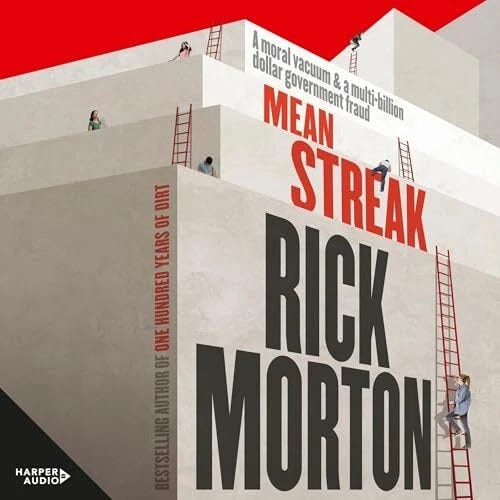
Morton’s book on Robodebt – Mean streak: a moral vacuum and a multi-billion dollar government shakedown– has won the top non-fiction prize at the 2025 Prime Minister’s Literary Awards.
Spooky

Not all spooky fin de cercle Scandinavian artists were Edvard Munch

Yes Prime Minister: what a difference a generation makes

The previous article on RoboDebt put me in mind of the gulf between Yes Prime Minister, the TV series and the stage play 30 years later, something I wrote about at the time.
I recently took my son to the stage play of the TV show Yes, Prime Minister. One could predict the kind of plot that would ensue and ensue it did. The Prime Minister and his minions manoeuvre for advantage between each other and navigate a range of dilemmas and eventually a resolution is arrived at. Life goes on happily enough for the characters and we appreciate the bon mot that Wikiquote tells us is wrongly attributed to Bismarck: ‘Laws are like sausages — it is best not to see them being made’.
But the decades have made a huge difference in the sensibility of the new production – which is written by the original authors of the TV series. The series ran through most of the 1980s, a period that contained its share of tumult, from the destruction of union militancy to the Falkland’s War. The series reflected bastardry enough. ...
Twenty years on, as the moral dilemmas piled up in the stage-play, the governors conspired against the governed.
The PM and his advisors address their common problems as insiders in the showbiz that is government by framing an innocent person at the bottom of the social pile (an immigrant). The fall guy was to be taken into custody as a suspected terrorist and kept there, incommunicado, for up to a year, after which he might be deported or his incarceration repeated.
This change in ‘Yes, Prime Minister’ points to the revolution our society has undergone in the way we ‘do’ government. Secrecy has always been the default presumption before the days of freedom of information and the craze for ‘transparency’. Today we are into our second generation of freedom of information (FoI) legislation, which seeks to move the default more fully to a state where information is presumptively open (subject to exceptions where the case can be made) rather than the converse.
Yet while these changes have been taking place – through the first and now the second wave of FoI reforms – government is increasingly ‘performed’. This has huge implications for the incentives operating within the system.
Today, departments assist ministers ‘performing’ government by putting their case, trouncing the opposition or launching policies. In virtually all of this, in its role of supporting the government, departments of state will gild the lily and deploy those stalwarts of managerialist euphemism. Arrangements will be ‘enhanced’ and ‘improved’. ‘Best practices’ will be adopted which, we will be told, will make us more competitive, whatever more sober reflection might suggest. ...
And the deceptions may be perpetrated through reticence, and may not be petty. Where an officer is in possession of information of considerable import – as in the case of the defence forces during the ‘children overboard’ episode – they will be expected to be complicit with the suppression of that information. (Though ‘honesty’ gets a guernsey from time to time, I’ve yet to see ‘candour’ chosen in any government agency’s charter of ‘corporate values’.)
So routine is this today that its absence is noticed immediately and usually punished. As it was when Treasurer John Kerin replied ‘Your guess is as good as mine’ when pressed in the depths of the 1990 recession to divine when the economy would recover. As it was when, rather than the misleading simplicity of “Read my lips” Gareth Evans conceded that a promise not to raise taxes was nevertheless not a promise to freeze each and every detail of the tax maze for the next three years – only to have this reported as a front page lead headed ‘Gareth Gaffe’. ...
In an environment like this, where the prime minister stumbling on his way onto a podium can dominate the news and so have its own effect on the trajectory of an election, it has become entirely normal for departments to be involved 24/7 in the process not just of avoiding embarrassment for their minister, but of actively ‘managing’ all aspects of everything they do that has any chance of being or becoming public.
At the same time, those whose job it is to hold them to account are, for the most part, seeking to misrepresent them for the purposes of entertainment and ratings (in the case of the media) or political combat (in the case of opposing politicians).
Consider either a public servant or a department of state in this environment. What can they say with confidence that will not cause difficulty or embarrassment? This can include the most basic factual matter. If, for instance, they indicate that the department began work on some policy at a particular time, might it not be possible for some reporter or opposition politician to juxtapose this in some invidious way with what might have been done, or with something a politician has said? In such an environment all the incentives point to reticence – to silence, or to put it more starkly, secrecy as the default. ...
Thus there is public debate about ‘enhanced interrogation techniques’ but no reporting from Guantanamo, not to mention the sites of ‘extraordinary rendition’. Thus, though our government boasted about its tough treatment of asylum seekers in the 2001 election to considerable electoral effect, it was always understood that the cameras must not get too close lest our media be awash with ‘human interest’ stories about the incarcerated. Though there were strict government instructions to prevent the media from getting close to asylum seekers in that case, very often it is quite unnecessary for politicians to issue any such instructions for such discretion to obtain.

Nick Hornby on Helen Garner’s The Season
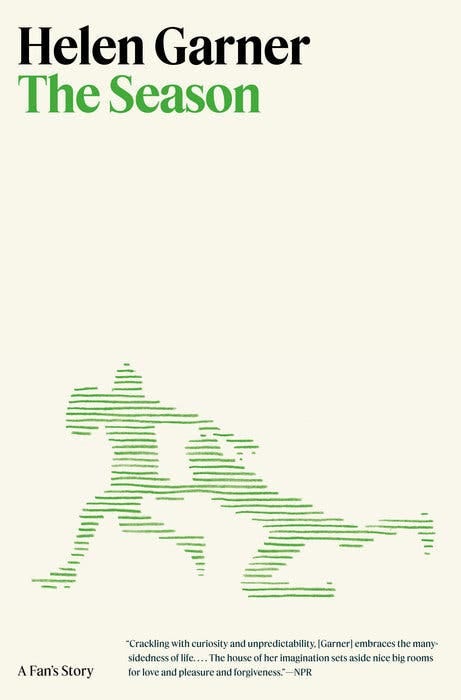
Wonderful review. I read it with mostened eyes.
Let’s not sweeten this. In “The Season,” a doting grandmother provides an account of her teenage grandson’s football season. Despite a longstanding familial loyalty to the local professional club, she has only a basic knowledge of the sport, its rules and tactics and customs, and the football in question is Australian Rules football, or “footy” as it’s known. In other words, this is a book about a sport you probably haven’t seen and in which you almost certainly have no interest, written by someone who doesn’t know much about it. And it’s beautiful.
When Helen Garner tells men that she is writing it, they are full of advice: “You should talk to so-and-so! Have you read this, or that?” The books “would be full of facts and stats and names and memories. They have been formed by footy. I can’t do it their way.” Her only response? “It’ll be a nanna’s book about footy.” And that is precisely where the beauty is: the result is inclusive and universal, curious and tender, perceptive and wise. Sports fans — maybe even Aussie Rules fans — can live without yet another book about facts and stats and names.
Garner is one of Australia’s most celebrated writers, but — and she would not object to that conjunction, I suspect — she is in her early 80s. “Now that I’ve reached the age at which my mother died demented, now that my hearing and my eyesight are packing up and I can feel my memory starting to lose its grip, I need a reason to be near him,” she writes of her grandson, Amby, “in the last years of his childhood,” she writes. “The Season” is joyful, but there is a carefully woven thread of melancholy running through it, and it is this that gives the book its lovely, old-gold sunset hue...
A book about Aussie Rules may not be the first place you’d look for this kind of tone. It’s a seemingly chaotic, violent game: 18 players on each side who kick and throw an oval ball toward massive goals, and who clatter into one another with such force that injuries are frequent and serious. They fly at their opponents with knees and elbows at head-height, and concussion is often the outcome, sometimes accompanied by terrifying amounts of blood...
Most of the players don’t wear protective clothing. That’s not the Aussie way. Garner notes wryly that a player who chose to try and avoid brain injury was teased on live TV. “What’s with the helmet? Keeping Mum happy?” the pitch-side interviewer asked...
One of the things that Garner wants to think about here is masculinity, especially in its nascent form. She is fascinated by the energy of boys: their savagery, their vulnerability, their noise and their silences. “All my life I’ve fought men,” she says, “lived under their regimes, been limited and frustrated by their power.” This is her chance, then, to look for something different, something less oppressive, and in Amby, she finds it...
Garner attends nearly every training session, and nearly every match. Perhaps uniquely among die-hard fans of the Colts, one of her absences is brought about by a commitment to see the whole of Wagner’s Ring Cycle.
Of course, she also follows the fortunes of the Western Bulldogs, the professional squad from suburban Melbourne that her family roots for. They suffer a humiliating defeat on the same day as a spectacular Colts win, and Garner realizes with a jolt that she doesn’t much care about the pros: “Can these boys be usurping the place in my heart held for 20 years by the mighty Western Bulldogs?”...
Why do we do this to ourselves, those of us who care about sports teams? “How deep it goes in men, this bond, this loyalty,” Garner notes. “I would never mock it.”
It may be because even great days contain the seeds of the bad ones to come. The title just won will not be retained; the great player will move on to a rival club, or retire...
“The Season,” you come to realize, is a great title, because there are many seasons in this slender, mighty book. There’s Garner’s late autumn, her grandson’s spring, the June winter of an Antipodean year, the contrasting seasons of the Bulldogs and the Colts.
And, to our delight and to Garner’s infectious, thrilled disbelief, it is a season to remember for the junior side...
The characters in “The Season” are real, but every bit as lovable and colorful as any network TV show could have imagined. Thanks to Boof and Amby and their teammates, this enchanting, perceptive book about so many things ends with a triumph it richly deserves.
Woody Allen is asked if Israel should give back the land it conquered in the 6 day war. His answer will leave you speechless (well not really, but we’ve all got to get with the program and write like a linkbaiting AI). And his answer is funny.
Why bad policies are so hard to kill

Having weighed in on some really poor policy recently, I enjoyed Chris Richardson weighing in on some other bad policies.
EVER WONDERED WHY POOR POLICIES ARE SO HARD TO KILL?
We often get policies that ‘feel good’ rather than policies that actually are good, for at least 3 reason
The first is when voters think that a bad policy is good for them
Feel good FBT breaks for electric vehicles fall into this category, as do a bunch of housing policies
The second is when governments see an opportunity to make the other side look bad. The recent election provides a good example. The government wanted to remind voters that, while health minister under Tony Abbott, Peter Dutton championed co-payments when visiting doctors
So the government boosted Medicare subsidies, allowing the PM to remind voters that supporting Medicare was “in Labor’s DNA”
Yet boosting Medicare subsidies actually does little to help the punters, while delivering lots to doctors
How’s that? When we raise subsidies to doctors who bulk bill, that helps both patients and doctors. But who gets what depends on bulk billing rates. If we boost bulk billing rates when they’re really low, then most of the extra money does go to patients
However, if we boost those subsidies when bulk billing rates are relatively high, it’s the doctors who get the dough. That’s because you’re giving extra money to all doctors who bulk bill some services – and most already are
The government’s own estimates show its new bulk billing policy gives about $3 to doctors for every $1 that reaches patients, but the dollars could end up being even more skewed away from patients. So this policy is actually dough for doctors, despite being marketed as a pay rise for punters
Such wedges are part and parcel of politics, and it sometimes seems the best the public can hope for is that our politicians deliver cheap wedges rather than expensive ones. Yet this particular political wedge cost $8 billion, and it was promptly matched by the opposition anyway
Last, govts will often knowingly avoid good policy when they want to be loved more than they want to govern well. That’s why they often choose the policy that raises more money from fewer people (which is why super policy repair has focussed on the wealthiest 80,000 people, rather than the best policy, and it’s why state govts are reluctant to switch from stamp duty to land tax)
It’s also why govts prefer handouts that go to many people rather than a targeted few. For example, Coalition govts spent decades boosting the largesse given to self-funded retirees. Similarly, the current govt changed its electricity subsidies from being targeted to those on benefits to instead going to everyone – landing in time for the election
Last, it’s why the quality of policies falls as an election approaches (which is when you see fifty cent fares for public transport)
To be clear, both sides do this stuff. But they’ll keep serving up Australians poor policy unless there’s a fuss.
So … let’s make a fuss.

Heaviosity half hour
David Bentley Hart on the limits of critique
There may be bits of this that are over your head - there were certainly bits that were over mine - and I even did a course on Hegel’s Science of Logic - a head-spinning adventure! But I followed the thread which is powerful and which may appeal to you. It sent it to a friend of mine who replied as follows:
It did indeed appeal - thanks for sharing. A beautiful closing paragraph.
Some stray thoughts prompted by the piece:
- The real point of Chesterton’s Fence is not to suggest a standing rational presumption in favour of conservatism, but rather to make the deconstructive impulse subordinate to perceiving the contingent basis of the extant order
- Rory Stewart’s love of beauty and tradition is an aesthetic account of the same idea; there is truth and value embodied in things themselves, beyond what is produced by their structural function
- The utilitarian wishes to copy the Toyota Production System widely so that all can benefit from its goods, without seeing that TPS is an expression of Japanese formation. One can’t merely pretend to be Japanese! Nor for that matter merely pretend to believe in God
- Love / the gift / belief - all are practices which shape perception of the thing that deconstruction attacks, and which find the fractal edges that deconstruction elides
- Faith then is not opposed to suspicion/critique, but a vow to see (and feel) the contours of reality that cannot be fully charted
- The resurrection is the atom-splitting event of this reality - its energy field so broad and propulsive that it democratises access to the truth by lived contact with its signal

Vermeer and Edward Hopper eat your heart out
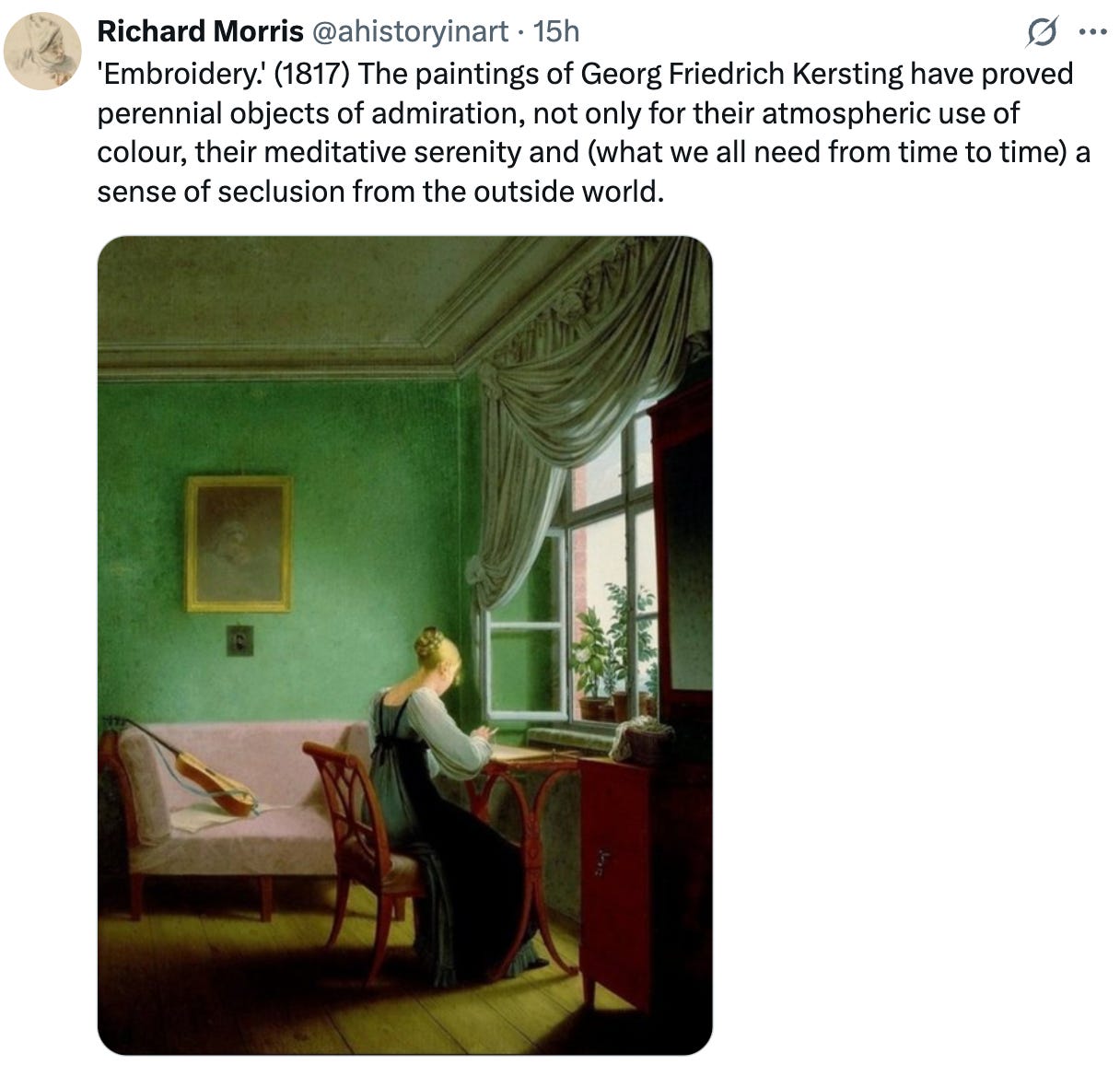

Milanovic reveals the shock of several friends when their preferred policies did not cure all known diseases.
Tough luck for them. The social world has often made fools of people who thought they had it all figured out.
But I doubt this shows that some ideology called "neoliberalism" has failed – if only because that the fact Milanovic's discussing (that understanding of the social world changes and evolves) seems itself to be a key element of quite a few versions of "neoliberal" world-view.
Advanced nations are and should be engaged in a long, continuing program of what Karl Popper called "piecemeal social engineering", where people and governments attempt to usefully improve our understanding of the best mix and the most effective elements of market, cultural and government action. This means that at any given point, aspects of the prevailing social recipe will look they're failing. Much of the time, those aspects will be.
Yet we will discard the failures and keep the wins. And the net effect will be that after some decades we will look back and marvel at how far we have come.
Call this neoliberalism or call it something else; it doesn't matter.
But making constant adjustments to this societal framework is not the program's defeat; it's the program's operation.
Note: As I've come to expect of discussions about "neoliberalism", the piece is mostly empty of specifics. (It's possible that Milanovic just means "neoconservatism", especially since he opens with an image of Margaret Thatcher. Who can tell, at least from this piece?) But if Milanovic believes, for example, that migration needs to be scaled back to preserve social harmony in developed nations, he can and should make his case. If and when he wins the debate, I'm guessing that this too will become part of "the neoliberal consensus".
The alternative waiting in the wings after neoliberalism is care ethics.