


Milestones of intellectual progress
New semi-regular segment1

From one size fits all to tailored solutions

Thanks to reader Robert Banks for sending me this article. It’s very intriguing.
On the one hand, from the write-up, it seems that this program meets my challenge. Although for the last 30 years we’ve told a story in which governments will get out those binoculars and identify innovative programs run by NGOs and philanthropies that are particularly effective so that the ones that work best will be supported with increased government funding.
I had a challenge out for a decade or so to name any such programs anywhere! One such program is Buurtzorg in Holland, and this looks like another one, though it’s unclear to me if government funding has been used. In any event, it is a rare success.
In addition to my applause, I note two important things. Firstly, the breathless write-up makes it seem like it’s all so obvious. Well, yes, it is obvious, but this is the sort of language that Tony Blair first popularised, the idea of governments taking a whole of government perspective on things. But what’s missing here is an explanation of what it is that made this program work when “whole of government” talk became ubiquitous. Need it be pointed out that Australia’s own NDIS was founded on similar kinds of principles?
My second, related point, is that there’s a deep tension in this whole story, which never surfaces. That tension is what has made the NDIS such hard going! You know, gentle reader, how hard I try to avoid jargon. It’s usually better for one’s own thinking, let alone communicating with others to avoid it. But here it’s useful. The problem is that of incentive compatibility.
Governments provide free services and free money. Either way, they must ration. If they ration by money they’ll end up classifying different levels of disability to hand people different amounts of money. Or they can do it by identifying and budgeting for services. Either way, beneficiaries have an incentive to take what’s free and few incentives to tell you what they don’t need. Anyway, on with the show:
When Harry Kruiter first met Eric, the man could barely sit still.
Tax bills were scattered across the kitchen table. Two years earlier, Eric’s wife had died unexpectedly, leaving him alone with their two young daughters and a pile of modest but mounting debt.
Eric had already seen more than 20 social workers, each reaching the same conclusion: Before he could qualify for debt relief, he would have to sell his most valuable possession — his car.
But Eric’s daughters attended a special-needs school nearly 20 miles away. Without the car, the municipality was required to transport them by taxi at an annual cost of roughly €6,000 ($6,900). “The girls were crying every morning because they missed their dad,” Kruiter recalled. Psychologists warned the distress could spiral into serious mental health problems costing tens of thousands of euros per child.
The car itself was worth about €2,100 ($2,400).
“This is bureaucracy at its finest,” Kruiter says wryly. “Because what you see in cases like this is that everybody is doing exactly what they are supposed to do — and the outcome is still disastrous.”
Eric did not lack services. He lacked a system willing to see the whole picture.
In 2010, Kruiter co-founded the Institute for Public Values (IPW) in Utrecht to tackle precisely these kinds of cases. He had spent years studying families heavily supported by the state but making little progress. “There’s almost always legal room to do what’s needed,” he says. “The problem is that nobody dares to look for it.”
Today, his Breakthrough Method is used in around 100 municipalities across the Netherlands. At its core it is an intervention in organizational psychology — confronting officials with the human consequences of their decisions and showing, in their own language of law and money, that a different choice is both permissible and prudent....
In Eric’s case, Kruiter’s team applied the method’s legitimacy triangle: Was there room within existing law to justify keeping the car? There was. What are the full public costs without it — in taxis, psychological care, years of professional meetings? Would keeping the car restore Eric’s ability to stabilize his life?
Allowing Eric to buy his car back and enter debt restructuring, the professionals involved dropped from over 20 to five. “It’s not about bending the rules,” Kruiter explains. “It’s about using them to achieve what they were intended to achieve in the first place.”
In the Hague, a pilot evaluated by Ernst & Young found average annual public savings of around €22,000 ($25,000) per participant. A 2020 follow-up study reported 81 percent experienced improved quality of life. The method reveals “wrong pocket” effects: investments in debt relief generate savings in health and youth services elsewhere....
“People with problematic debt use about three times more health care than the national average,” Kruiter explains. “And roughly 80 percent of those extra costs are in mental health care.”
He describes a 21-year-old woman with €20,000 in debt, facing eviction, who wanted to return to school. “The system said, ‘Come back when you’re 25.’” Kruiter convinced the municipality to negotiate a debt buyout. She was expelled twice but eventually completed her diploma. “When we asked her what made the difference, she didn’t mention the debt relief. She said: ‘You believed me when I said I could do this.’”
By requiring each exception be legally defensible, financially sound and focused on restoring personal agency, the method turns an informal workaround into a transparent — and auditable — decision....
After 15 years, interest from Dublin, Aarhus, Toronto, Norway, South Africa and Australia is mounting. IPW is working on a self-help version so residents can design their own breakthrough plans. “We see that people make even better plans for themselves than the professionals we teach,” Kruiter says.
Eric knew all along what he needed most. His case was not exceptional because it was dramatic. It was exceptional because someone calculated the taxi receipts.


I got myself fascinated with this picture.
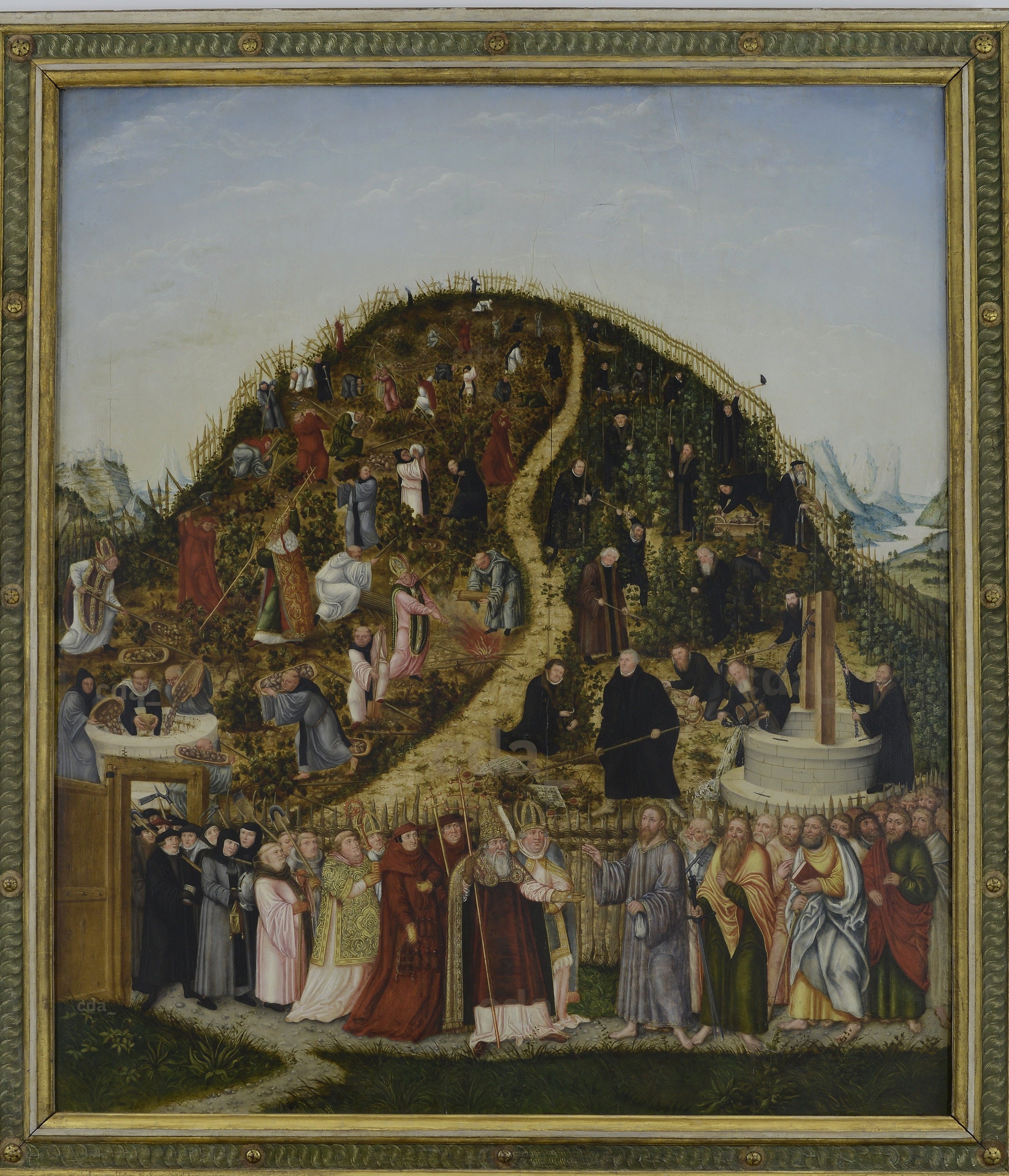
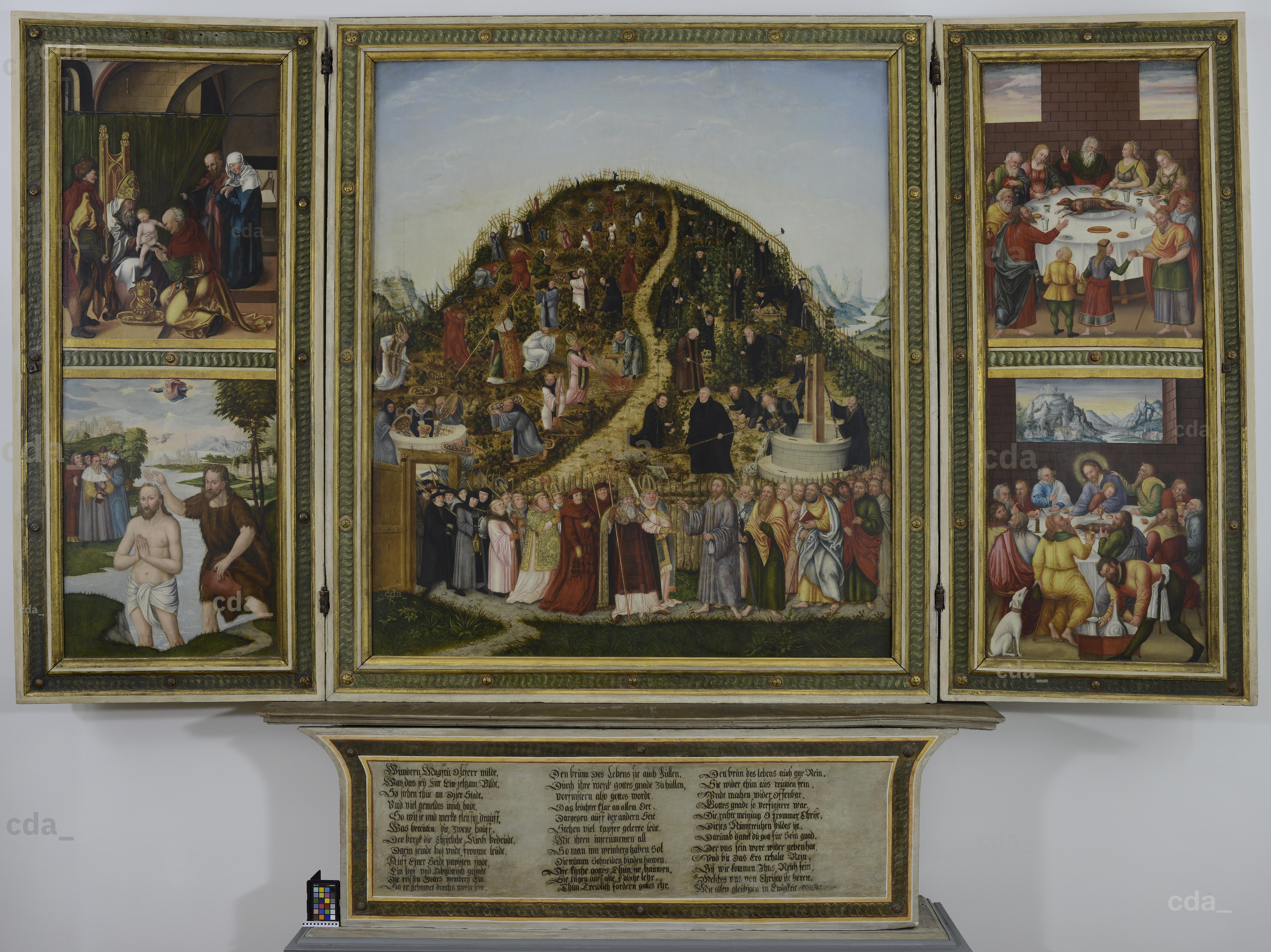
Maybe you will too. It’s by Lucas Cranach. You can click on the image above and look at it all in high definition. Here we have a revolt against elite extraction. There’s the extraction of other people’s labour, and more shockingly, the extraction of spiritual resources. In the foreground, the Pope takes a gold coin from Christ. “Nice work if you can get it” as they started saying at another time of rage and angst about elite extraction - the Great Depression.
I wonder how the current bout of popular rage against elite extraction, manipulation and domination will turn out.
The gentleman: a bildungsroman
And its projection down to the citizenry
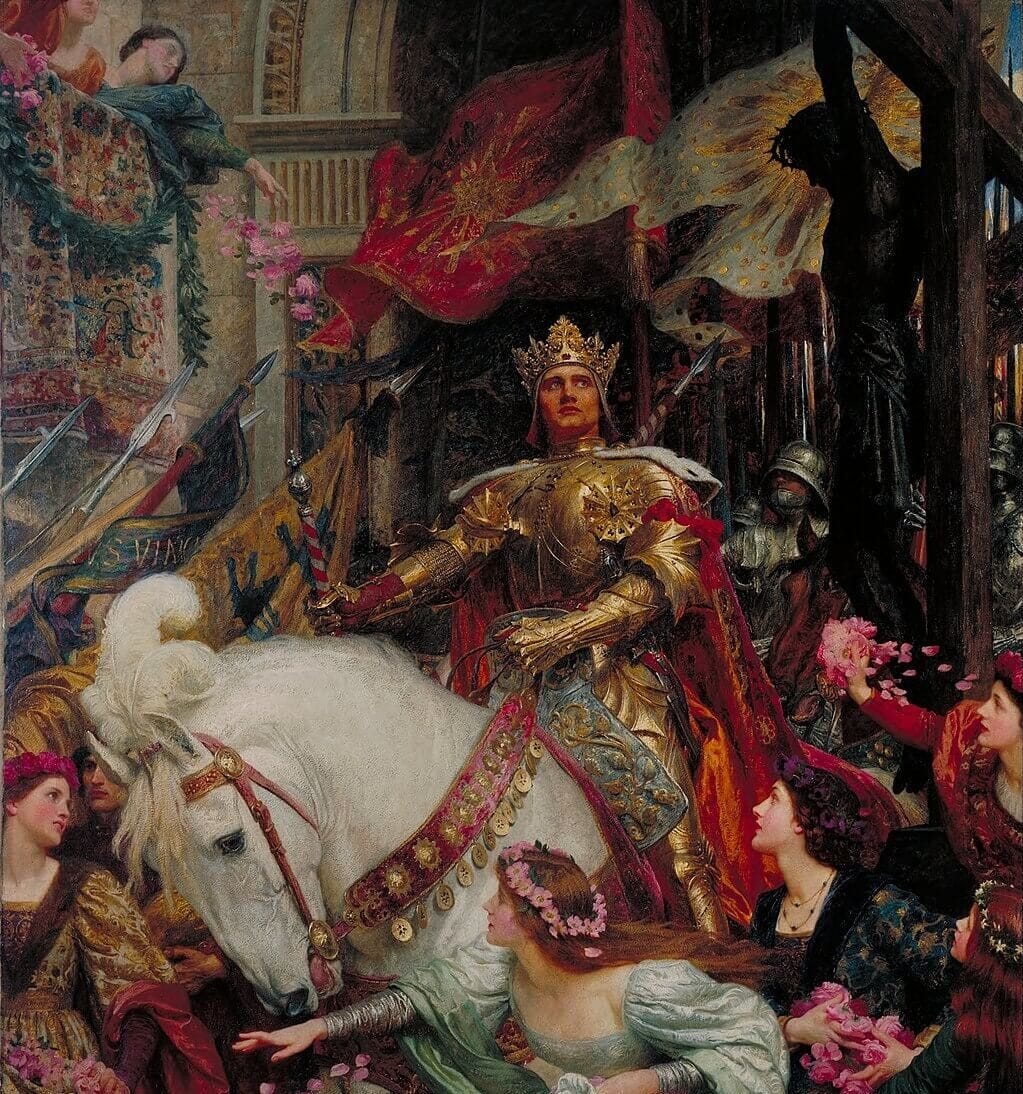
This article concludes with the assertion that the idea of “power exercised for the good of the weak sets Western chivalry apart from every other code of warrior honor”. Is that true? If it is, or is arguably true, shouldn’t we be thinking more about it?
I first got Claude to summarise it and I listened to it at the gym and decided I wanted to listen to the whole thing - which having done so Claude and I have condensed for you below. But I know that most readers have one kind of C-Suite responsibility or other and are very busy people. So given that Claude, in its wisdom offered me a one-paragraph summary, I thought I’d reproduce it for you:
The core argument, in case you want the one-sentence version: the three main objections to gentlemanliness (Rousseau’s authenticity, Rawls’s meritocratic privacy, Nietzsche’s vitalism) all fail for the same reason — they mistake the ornament for an imposition rather than seeing it as the completion of what nature gives us raw. And without the theological horizon (grace perfecting nature), you can’t explain the distinctively Western idea of power exercised for the weak.
Anyway, here’s the article heavily edited back:
Few figures are more fundamental to and more poorly understood in the modern West than the gentleman. For most, the word evokes cartoonish images of superficial courtesies—a young man taking off his hat indoors or holding the door for a lady. For the left, it must simply be a tool of oppression by men over women and by the rich over the poor. For much of the American right, the term now evokes a bowtie-wearing, effete neoconservative, one who puts style over the courage to take unfashionable positions....
To appreciate Edmund Burke’s argument in favor of gentlemanliness requires articulating the major philosophical objections to it. The story involves Aristotle, Cicero, and Rousseau.... The gentleman acts boldly and even sternly in defense of what is right. He acknowledges the many unearned advantages that make his position enviable, but he adopts magnanimity instead of self-loathing, learning to make himself a worthy example for others to imitate. Refinement understood in this way is strength, not weakness, and builds civilization....
There are at least three major philosophical tendencies that underlie the rejection of the gentleman.... The left’s objection owes much to Rousseau, who opposes art to nature and opens the way to Bourdieu and Foucault: the forms of gentlemanliness are an artificial imposition that will stifle self-expression. A second objection comes from Rawls, who argues that natural endowments “are arbitrary from a moral point of view”—the elite can balance their books with society by paying high taxes and need not set an example of generosity, elegance, erudition, and courage. Thus Rawls, in the name of social democracy, helped license the sweatpants-wearing, DoorDashing professional class that is regnant today. Yet the newest objection—from the right—is the objection from vitality: Nietzsche scorning all forms because they impose restraints.... But vitalism misunderstands what the gentleman’s ideal, developed over almost three millennia, demands.
The West progressively refined the ideal: from Aristotle’s cold, taciturn great-souled man to Cicero’s loquacious orator whose crowning virtue is eloquentia—an ornatus that ornaments the true with the beautiful—to the Christian insistence that the knight be fierce and gentle. Norbert Elias traced the mechanism: aristocratic table manners, spreading outward from Renaissance Italy, were harnessed by the Victorians who used the prestige of the gentleman to project these norms downward through the whole population. Norms against littering, spitting, brawling, and defecating in public date only to this period—and are fragile....
David Hume defended the affable, agreeable gentleman but saw no need for a theological horizon—severing human convention from natural justice. John Henry Newman saw the problem clearly: the “true gentleman” avoids “all clashing of opinion, or collision of feeling,” his great concern being only to make every one at their ease—yet thereby avoids all the most important and difficult questions of what is true, noble, and just. Newman’s exemplar is Julian the Apostate, foe of the Church, forcing us to ask: “What does it profit a man to gain a BA and lose his soul?”
Humean affability unmoored from truth and from things worth dying for does not last long. Leo Strauss responded with a defense of civilization as the cultivation of our rational nature—”making man a citizen, and not a slave; an inhabitant of cities, and not a rustic; a lover of peace, and not of war; a polite being, and not a ruffian.” But Western education instead enthroned meritocracy, an empty creed of achievement without duties proportional to privileges. Without recovering the positional duties that move the gentleman, we will be trapped between the self-creating entrepreneur who owes no one anything for his success and the leveler who in the name of equity would efface excellence....
To reanimate the spirit of a gentleman against the objections from the left, center, and vitalist right today, we must recover Cicero and Burke’s faith in the ornatus. What is given in our nature should be adorned, refined, and fulfilled through the shared arts and customs of living together in society. And, vaulting even higher, we must recover faith in the grace that does not destroy nature but perfects it. Only that revelation can truly make sense of power exercised for the good of the weak, which is what sets Western chivalry apart from every other code of warrior honor.


Christianity, Bronze Age Pervert and post-humanism

This is a long essay, if you want to click through to it from the digest I’m publishing below. I thought it was worth it because, as you may have noticed, I’m intrigued and alarmed by the hubris of the tech right. As Ross Douthat put it “if you didn’t like the religious right, wait till you see the non-religious right”.
Way back in the early 2000s, coming of age as a young conservative meant joining a sort of holy war. Faith and freedom and conservative politics had been wrapped up together in a seamless web – a clash of civilizations, pitting Christian culture against an existential foreign threat. I can still recall sitting on my bunk at Summit Ministries’ “worldview camp,” poring over Ann Coulter’s Godless: The Church of Liberalism......
This was the moral matrix that once formed the spine of American conservatism. But the web no longer hangs together. Moral concerns that once felt pressing – abortion and same-sex marriage – are decidedly marginal today. The sense of theological urgency has waned. We are well on our way to what Ross Douthat has described as the “post-religious right.”...
Post-religious conservatism is now producing its own “successor ideology”: a technological maximalism demanding ever-greater transcendence of the body on one side, and a primitivism fixated on physical strength, imputed statistical differences between races, and phrenology on the other. Both treat the body – rather than the immortal soul – as the primordial political term. The post-religious right will have its own creeds, however implicit. And it will inevitably find itself at odds with the Christian humanist tradition whose mantle it still claims....
Far-right writer Sam Francis declared in a 2001 Chronicles essay that Christianity’s leveling tendency made it “the enemy of the West and the race that created it.” He regarded Christian anthropology as a delusion, its vision of transcendental justice a hobble on the white race.... He mourned the pre-Buckleyite American Right – largely anti-Christian, including Mencken, Madison Grant, and Birch Society founder Robert Welch (a professed atheist). It had to wait for its time. That time, it seems, has come....
Two distinct but complementary intellectual instincts characterize the emerging post-Christian right: posthumanism and atavism.
Elite tech billionaires speak of “life extension” – not of human bodies but of human consciousness. Peter Thiel traces through Francis Bacon a vision in which the Christian promise of resurrection is located not in God’s grace but in technological progress: Bacon and Condorcet “thought we would have radical life extension. If Christianity promised you a physical resurrection, science was not going to succeed unless it promised you the exact same thing.” A technological future only becomes “inconceivable” when human nature itself becomes contestable....
The best-known atavist is Costin Alamariu, the “Bronze Age Pervert,” whose Bronze Age Mindset frames politics as a brute struggle for physical space. Human beings are evolved muck; those lacking natural aptitude are “biomass.” This biopolitical determinism informs the dissident right’s fixation on race-and-IQ, the manosphere’s obsession with sexual “body counts,” ever-more-strident declarations that the American food system intentionally renders the population sicker and weaker.... Anti-Semitism, too, follows this logic – no coincidence, since it is from the Jews we get the vexing notion that each man is made in the image of God....
Both currents flow from a common conviction: biology is destiny. Remove a transcendent Creator God, and assertions of human equality become noble lies....
The decisive battlefield is bioethical: questions of dependence and care. Pronatalism, through a posthumanist lens, becomes eugenics. The Bronze Age Pervert advocates mandatory abortion for parents with IQ below ninety. Biological determinism aligns perfectly with euthanasia of the elderly: why should the young and hale be sacrificed for the old and infirm?
The challenge of the post-Christian right is not that its ideas are incoherent. The challenge is that they are in fact deeply coherent – and represent a seductive alternative to a faith perceived as too anemic to withstand the coming storm.
Decades ago, Stanley Hauerwas remarked that Christians will have done well if known as “those peculiar people who don’t kill their babies or their old people.” The possibility that Christians may stand alone – accepted by neither right nor left – no longer seems far-fetched. Any victory for “conservatism” won through forfeiting the Christian ethic of active love will prove pyrrhic.
Perhaps “knowing what time it is” means choosing life, and mercy, and the possibility of forgiveness. We can still choose to see, in the eyes and hands of all of those who share our nature, the image of God.


Tech’s new generation and the end of thinking

Just a taste of Sam Kriss’s long essay, which was easily accessible on the Harper’s website.
The first sign that something in San Francisco had gone very badly wrong was the signs. In New York, advertising assumes you are an ambiently depressed twenty-eight-year-old office worker. But in San Francisco they don’t bother advertising normal things—on every corner it speaks to you in aggressively alien nonsense. ...
The motionless people drooled on the sidewalk; the Waymos whooshed around with no one inside. A kind of pervasive mindlessness. But there was one type of billboard the people of San Francisco couldn’t bear—from the most utterly despised startup in the entire tech landscape. Its ads were the only ones written in anything like English:
hi my name is roy / i got kicked out of school for cheating. / buy my cheating tool / cluely.com
Cluely and its co-founder Chungin “Roy” Lee were intensely, and intentionally, controversial. The company is loathed out of proportion to what its product is—a janky, glitching interface for ChatGPT. It involves using AI to do your job for you, but this is what pretty much everyone is doing already. ...
Behind all these small complaints, there’s something much more serious. Roy Lee belongs to a new and possibly permanent overclass. One of the pervasive new doctrines of Silicon Valley is that we’re in the early stages of a bifurcation event. Some will do incredibly well in the new AI era. But others will become useless. Even at firms like Google, a quarter of the code is now written by AI. If what you do involves the human capacity for reason, reflection, creativity, or thought, you will be meat for the coltan mines.
The future will belong to people who are highly agentic—who just do things, who drive like bulldozers through whatever’s in their way. AIs are not capable of accessing whatever unpleasant childhood experience gives you this hunger. Agency is now the most valuable commodity in Silicon Valley.
Roy Lee’s story is now firmly established. At Columbia in 2025, he founded Interview Coder—a transparent window overlaying Zoom meetings, letting [an AI] hear interview questions and provide answers. He filmed himself during an Amazon interview, got the offer, declined, uploaded the footage to YouTube, and became famous. Columbia suspended him. He dropped out, started Cluely, and moved to San Francisco to rake in tens of millions in venture-capital funding.
The startup’s breakthrough was a viral ad showing Roy using Cluely-enabled glasses on a blind date, alongside a manifesto: “We built Cluely so you never have to think alone again. . . . The future won’t reward effort. It’ll reward leverage.” The future they envisage is one in which people don’t really do anything at all, except follow instructions given to them by machines.
I found it strange that Roy couldn’t see the glaring contradiction: here was someone who reacted very violently to anyone trying to tell him what to do, whose grand contribution to the world was software that told people what to do.
Scott Alexander—whose blog Astral Codex Ten coalesced the rationalist movement that gave birth to the AI industry—observed that people outsourcing their thinking are avoiding “a terrifying encounter with their own humanity.” VCs are furiously searching for those who don’t. “They’re willing to stake a lot of money on the one in a hundred people who are high-agency and economically viable,” he told me. ...
Roy didn’t really have anything except his own sense of agency. There was a great sucking void where the end ought to be. He wanted not to be alone—the way he’d been alone for a year after Harvard rescinded his offer. Instead of making friends the normal way, he’d walked up to strangers and asked whether they wanted to start a company with him, and built the most despised startup in San Francisco. ...
By November, Cluely announced it was leaving San Francisco and moving to New York. I was in New York at the time. I didn’t go.


Safe spaces and bomb shelters

By American academic of some note: Nicholas A. Christakis
I’d never taught in a war zone before. But when the rector of the Kyiv School of Economics called last autumn, I found it impossible to say no. The visit seemed like a small show of solidarity with scientific colleagues and the Ukrainian people.
It felt, too, like an opportunity to witness theory in practice. Having spent my career studying the social roots of collective human behavior, I understood that shared adversity leads to cohesion. Still, I was amazed at what I saw.
Entering a country at war is bracing. Sandbags, anti-tank defenses, burned-out buildings and fresh burials lined the highways. My driver fell to his knees as a soldier’s hearse passed....
As my chaperone came to escort me, the first air raid sounded. “It’s just a little Shahed drone,” she said — you can hear them “like old crappy Russian motorcycles.” The ones you really have to worry about are “the missiles, which you don’t hear at all.”...
My hosts described a wartime law requiring universities to shelter all students during raids; KSE has had to double its school day. On the hallway monitors, one image recurred: a photograph of Daria Lopatina, 19, a KSE student killed while volunteering at the front.
In the middle of a lecture, the sirens wailed. We moved to an underground Soviet-era bunker. I delivered the rest of my remarks behind a thick blast door, more than 100 of us under fluorescent lights. The students were positively beaming as I shared my research on how groups can take on properties like cooperation that transcend the attributes of individuals — this group was the embodiment of my work, engaged, rapt, building on each other’s energy.
The contrast with the U.S., where people have debated how to make the university a “safe space,” was striking. Students in the U.S. like to be comfortable, surrounded by like-minded peers. Not so in Ukraine, where students seek a different kind of safety — to be able to learn, to imagine a future....
Since my visit their circumstances have become more perilous: Zoom calls from darkened cafes, a bomb destroying the top floors of a colleague’s apartment. Still, they keep going. The Ukrainian students demonstrated that learning and discovery are transcendent values — worth reaffirming in a time of chaos and fear, even in our own country.


Who’d have thunk this would happen?


Matthew Crawford swings toward nationalism

I’ve always admired Matthew Crawford since I read his excellent book, The World Beyond Your Head. For that reason, I’ve been rather downcast with his joining the recent embrace of reaction. Anyway, in the interests of having the very best of people with whom I disagree, here it is.
Actually, I should clarify. I’ve always disliked the tendentiousness with which Popper took against various thinkers like Hegel and Plato, without first trying to understand what they were getting at. He also did it with his colleagues when they had the temerity to disagree with him.
My problem with Crawford is not his diagnoses of the problems of liberal democracy and liberal economics, but the impatience with which he moves to the antithesis of the open society - nationalism. We’ve seen it all before. Last time it ended in a couple of world wars. This time, who knows? But I keep thinking of Adam Smith’s observation. “There’s a lot of ruination in a nation”. Ideals may be worth articulating, but, as Crawford in fact concludes the piece, too slavish adherence to them is Utopian. Quite so.
In his 1943 work The Open Society and its Enemies, Karl Popper offered one of the early articulations of “the open society” as an ideal — gathering up some of the West’s dearest principles: universalism, toleration, cosmopolitanism, individualism. It provides the moral basis for the West’s embrace of mass immigration. There are material interests at stake, diverging along class lines, but the adepts of the open society describe the divergence instead along the psychological axis of open-closed, with closedness understood as a failure of moral development.
In sufficient numbers, such immigration is experienced as colonization by those not insulated from its negative effects. The over-domesticated native population tends to vacate public space, ceding it to the newcomers in a cycle that the French essayist Laurent Obertone calls the ensauvagement of society....
Like any people subject to colonization, Westerners feel dispossessed of a settled lifeworld — retreating into the isolation that Robert Putnam famously called “hunkering down.”...
The ideal of the open society doesn’t simply ignore such realities, it gains force precisely as a principled negation of experience: an Olympian disregard for social realities expresses a certain magnificence among elites. Yet the renunciation demanded by our leaders falls most heavily on those they rule. Embracing the open society is the ultimate luxury belief.
Popper’s war
The idea of the “open society” is inherently polemical, requiring a foil of closedness: the “magical or tribal or collectivist” closed society versus the society of “personal decision”. This carries over to those who speak today in the idiom of universal “human rights”, as opposed to civil or political rights that attach to citizens of a particular, bounded nation. Anything bounded is “closed”. The agenda of human rights carries with it a literal military corollary....
The open society ideal slipped the bounds of any particular circumstance to become a permanent imperative, never satisfied so long as any concrete, circumscribed political community remains.
The open society will be one of disengaged monads
Both points of polemical orientation for Popper — Nazi racialist tribalism and Marxist collectivism — are forms of human association. The remedy for both, then, is individualism. Popper seems historically obtuse, failing to see that non-malignant forms of association can provide the basis for social order. Any association must be provisional, continually re-chosen. Accordingly, the open society will be one of disengaged monads who come together episodically for various forms of exchange but have no deep or abiding connection to one another.
Popper recognizes that an open society tends to become one of “abstract relations”. “We can conceive of a society in which… all business is conducted by individuals in isolation who communicate by typed letters or by telegrams, and who go about in closed motor-cars. Artificial insemination would allow even propagation without a personal element.” Openness requires positing sameness, so that peoples can be treated as a mass of interchangeable human resources.
Openness requires empire
Popper recognises that achieving the open society will require a vigorous imperial project. Today’s interventions in the internal affairs of putatively sovereign nations by trans-national organs — the European Commission, USAID, George Soros’ Open Society Foundation — capture the spirit of what he had in mind. He made his case for imperialism by historical proxy, treating the Peloponnesian War as Athens (open) versus Sparta (closed)....
The political philosopher Pierre Manent pointed out that “in a deliberately provocative way, the most archaic political form, and traditionally the most despised, becomes the generic name for all political forms and human groupings” — all groupings that fall short of the Universal and Homogeneous State administered by a post-political clerisy of the open-minded. Invade the world, invite the world.
Popper famously argues against utopianism, because it leads to totalitarianism. Yet it does not seem to bother him that his hope for a post-political condition is itself utopian and requires a total programme; an empire of openness from which no exit is to be countenanced.
A less reductive take on Popper



China, geopolitics and the classics

I found this article fascinating. Reading Laura Field’s Furious Minds on East and West Coast Straussianism, it looks like we need a new category. Western Pacific Straussianism. Suffice it to say that
Here’s Claude’s summary.
The argument in brief
China’s Communist Party has found a surprising use for ancient Greek and Roman texts: they offer cultural prestige and civilisational gravitas without the liberal democratic baggage of the modern West. Xi Jinping’s government has quietly funded a revival of classical studies — both Chinese and Greco-Roman — as part of a “cultural confidence” agenda. The article traces this story through a grand geopolitical conference, a charismatic ideologue, and a young Chinese scholar caught between two intellectual worlds.
The opening scene
In November 2024, Cambridge’s Regius Professor of Greek, Tim Whitmarsh, flew business class to Beijing for what he thought was an academic gathering. He found himself at the Yanqi Lake convention centre — venue of a previous APEC summit — at what turned out to be a state-orchestrated “World Conference of Classics.” Xi Jinping’s propaganda chief presided. Xi sent a letter declaring that ancient Greece and China had “shaped humanity’s development from opposite sides of Eurasia,” and announced the establishment of a Chinese School of Classical Studies in Athens. Whitmarsh, who had prepared a post-classicist critique of Western heritage politics, realised he had walked into something else entirely: “a geopolitical event, not an intellectual one.”
The key idea: separating the ancient West from the modern West
Xi’s letter codified a distinction that Chinese officials had been developing for years: the modern West — defined by liberalism, constitutionalism, and multi-party democracy — is an ideological adversary; the ancient West, as represented by Greece and Rome, can become an ally. Classical texts become available for appropriation precisely because they predate the Enlightenment’s political legacy. The phrase that captures this move: China wants the cultural capital of Athens without the constitutional inheritance of Washington or Brussels.
The ideologue behind it: Liu Xiaofeng and Strauss fever
The intellectual architect is Liu Xiaofeng, a philosopher and prolific translator who introduced Leo Strauss to China in the early 2000s — touching off what Chinese media dubbed “Strauss fever.” Strauss argued that Western civilisation had strayed from the ideals of “Jerusalem and Athens”; Liu adapted this to argue that China needed to rebuild its spiritual foundations through serious engagement with ancient texts, East and West. Liu noted that Western superpowers had long educated their leaders in Greek and Latin, and concluded China needed its own classics programme. Once a figure at the margins of Chinese intellectual life, Liu’s protégés now occupy a research office at the Chinese Academy of Social Sciences — the state think tank closest to policy — and helped organise the World Conference of Classics.
The institutional reality
The revival is real and substantial. Renmin University in 2024 became the first Chinese university to offer an undergraduate major in classical Chinese studies. Sichuan University opened a classics department aiming to make students “conversant in both Chinese and Western learning.” One Beijing university completed a new translation of Plato; another established a research centre, led by an Oxford professor, putting ancient Chinese texts in dialogue with Greek, Latin, Mesopotamian, Indian, and Egyptian traditions. A Princeton Sinologist’s centre at Renmin invites scholars of multiple antiquities to compare problems across traditions — discovering, for instance, that the reason ancient Chinese educators favoured oral recitation may have been that ink and brushes froze in northern winters, a question that prompted immediate recognition from a Western classicist: “I never thought of that!”
For Chinese classicists, the political moment translates into job openings, conferences, and funding — a halo normally reserved for scientists and engineers.
The counterpoint: the American academy moves in the opposite direction
While China is investing in the classics, roughly ten Western universities have closed or folded their classics departments in recent years. The field in the US has been convulsed by debates about race, representation, and complicity in white supremacist appropriations of Rome. The article’s pivot point is a 2019 Society for Classical Studies panel where a Princeton historian of Rome declared, “I hope the field dies. And that it dies as swiftly as possible.” This crisis of confidence has generated post-classicism — a move to “de-centre Greece and Rome” and incorporate marginal voices, comparative frameworks, and identity politics into the field.
The human throughline: He Yanxiao
The article’s most vivid figure is He Yanxiao, a lanky, bespectacled Chinese scholar in his early thirties who taught himself ancient Greek from Liu Xiaofeng’s textbooks after encountering a Chinese translation of the Odyssey in high school. He pursued a PhD at the University of Chicago, spent years in American academia navigating its culture wars, and returned to a postdoc at Tsinghua. His research — comparing Roman pantomime as a misunderstood hybrid art form imported from the East with the contemporary reception of K-pop — sits at the exact intersection of post-classicism and the East-West comparative tradition. When he presented this work at Princeton, Dan-el Padilla Peralta (the scholar who had hoped classics would die swiftly) called the paper “spectacular.”
Yanxiao is caught: journals redirect his work to Sinology (”that’s what I call Chinatown Classics”), Chinese colleagues think his K-pop references signal intellectual unseriousness, and the World Conference’s emphasis on timeless wisdom makes him uncomfortable. He belongs fully to neither world. At the Philadelphia Society for Classical Studies conference, among classicists, he told the author: “I felt totally at home.”
The irony the article leaves hanging
Whitmarsh’s “wrong speech” — a post-classicist warning that classical antiquity is not a timeless cultural heritage but a series of contested, invented traditions — may have inadvertently served as a warning to China’s own project of cultural instrumentalisation. The conference celebrated diversity between nations while eliding it within them. As Whitmarsh later wrote, the gathering enjoined “mutual learning” between exactly two civilisations.
Gemini 1: Grok 0
The image you see immediately above was by Gemini when given this instruction:
Draw an Escher-like image of a plate divided in to two halves by a diagonal 45 degree line. On the left-hand side, there are Western artefacts that might appear on Greek pottery, and on the right-hand side, the kinds of images that appear on Chinese pottery. In the middle, come up with some clever splicing of them together, like Escher’s Drawings.
Below is what Grok made of it. “[C]lever splicing of them together” involved tossing a leg on the Chinese plate LOL.

How major emitters might help with abatement

A simple point in a longer article, but worth noting methinks.
The case of methane emissions could point the way for building business support for the decarbonisation of a wide range of industries. ...
Methane emissions come from the production and transport of oil and gas – they are direct (”scope 1”) emissions for the oil and gas industry, akin to direct emissions from the aluminium, beef or trucking industries. ...
Methane emissions emerged as a major flashpoint in 2011 following the publication of a Cornell University paper that argued shale gas was worse for the climate than coal once methane emissions were taken into account.
Under the Obama administration, the US oil and gas industry united against federal regulation to curb methane emissions through the Environmental Protection Agency (EPA). Yet when the first Trump administration took office and attempted to repeal Obama-era methane regulations, a curious thing happened: a group of large oil and gas companies, led by ExxonMobil, opposed the rollback.
So what had changed in the space of just a few years?
... a combination of economics and stakeholder pressure drove major companies to break ranks. Falls in the cost of methane abatement technologies – partly driven by Obama-era EPA regulation – were important. But as much as economics, stakeholder pressure over the industry’s methane emissions had changed the political calculus for major companies. A widespread consensus that gas was a transition fuel had begun to unravel. Investors, NGOs, political elites and the public were questioning gas’ role in a decarbonising world. Major companies saw federal regulation as a way to address methane emissions and support the industry’s claim about gas’ role in the energy transition while allowing for continued production.


Alex is loved

As we drown in cheap talk from politicians, bureaucrats, PR comms folk and admen, and all their epigones on social media, I’m a complete sucker for stories like this
The Sydney Morning Herald’s State Political Editor, Alexandra Smith is leaving the round and has penned her final thoughts about what she considers to be one of Australia’s most dysfunctional workplaces.
After detailing numerous examples of backstabbing and debauchery she turned her attention to someone I greatly admire, but whose views have often appalled me - the former Upper House Member, Rev Fred Nile.
Rev Nile is best known as a moral crusader, campaigning against same sex marriage and abortion.
He famously urged his supporters to pray for rain during the Mardi Gras, literally hoping to rain on the parade of Sydney’s Gay, Lesbian and Trans communities.
But what was less well known was Rev Nile’s unflinching commitment to reconciliation and the rights of Aboriginal people.
Early in his parliamentary career he voted for the introduction of Aboriginal Land Rights legislation. When I worked for the Metro Land Council and later NSWALC, Rev Nile was always someone you could count on if Aboriginal rights were under attack.
His last act as a parliamentarian was to introduce Aboriginal Cultural Heritage legislation, saying this was the culmination of his life’s work in public ministry and the parliament.
The sponsor of that Bill in the lower house was one of Rev Nile’s most vocal opponents, the openly gay Member for Sydney, Alex Greenwich. Despite their many differences, the two men shared a genuine passion for improving the lives and respecting the culture of Aboriginal people. They decided to work together to try and achieve something bigger than the things that divided them.
Later, when Mr Greenwich was the subject of a number of vile and homophobic tweets from then One Nation leader, Mark Latham, Rev Nile leapt to his defence, telling reporters that “Alex is loved.”
It’s so easy to be cynical of politicians and take for granted our system of government. But the example of Fred Nile and Alex Greenwich shows our precious democracy at its best. At a time when autocracy is rising around the world, we should redouble our efforts to nurture and protect what we have in this country.
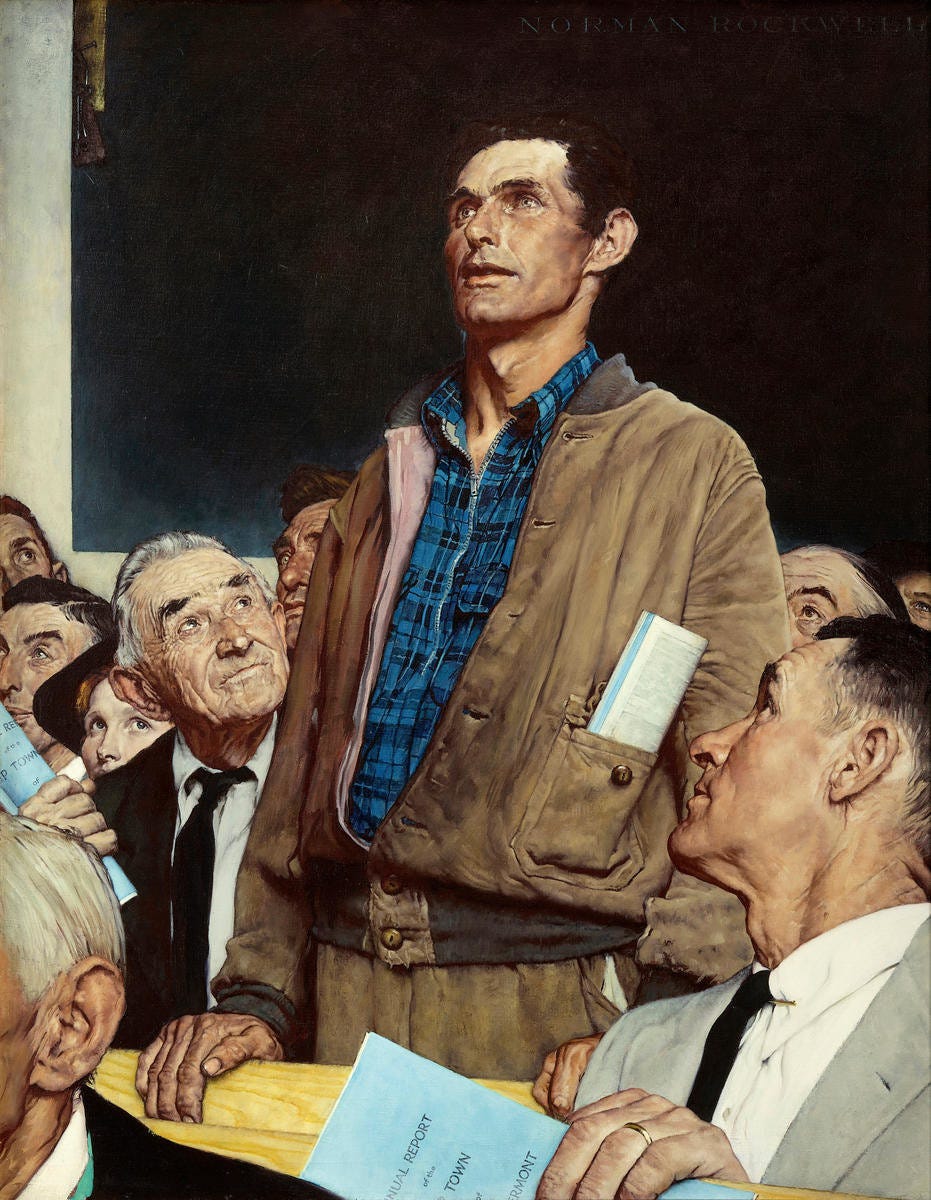
The common man as victim: Ep 325
Very powerful in it’s own way. But narcissistic as in the modern idiom.


The common man as pillar
Heaviosity half hour
Dennis Altman on therapy
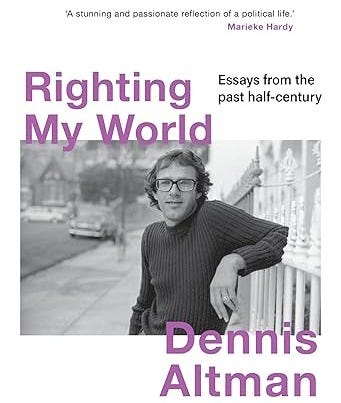
OK, there’s not a lot of heaviosity here, but it’s an enjoyable read and might have you popping off to the local bookshop and buying the book it comes from - if you’re in Australia at least.
I Think Therapy Is Good … for Other People
I have only been in therapy once and that was, not surprisingly, when I lived in New York City. Not only did all my friends have therapists but my then boyfriend, Joshua Sippen, was studying social work at New York University in the hope of himself becoming a therapist (he had spent eight years as a dancer/waiter).
Buenos Aires is said to have the highest percentage of people in therapy of any city, but Manhattan must come close. Among my friends a therapist was as common as a dentist or gym membership, and certainly more common than, say, a stockbroker. I remember two of my friends going through a protracted and self-dramatising break up, some of it while staying with me in a house on Fire Island, throughout which both were on the phone to their therapists at least as often as to each other.
This was gay New York in the early 1980s, that period of ebullient self-confidence before HIV/AIDS really hit, a time when we felt everything was possible. Openly gay men and lesbians were moving into the mainstream in unprecedented ways: I had met Joshua at a fundraising dinner at the Waldorf Hotel addressed by former vice-president Mondale,1 whose presence was symbolic of the growing political recognition of the gay community. I now suspect that much of the apparent self-confidence of the time was no more than surface bravado but being in therapy seemed just part of becoming a successful American, even if many of the scars and traumas people brought with them were directly related to growing up homosexual in a hostile world.
Joshua and I had gone a couple of times to a therapist who specialised in couples counselling, but he largely told us the obvious, while providing a neutral arena in which we could admit to some of the things that were distressing us. My own expedition into therapy was somewhat more serious, born of a sense that I had certain characteristics I disliked about myself but, after discovering them, felt quite unable to master. Almost as one might read a character in a novel I ran through my own impatience, my quickness to anger, my tendency to rehearse indecisions and slights over and over in my head, and I thought that maybe a therapist could help me.
I’m not sure how I found Larry. I remember that I wanted a gay man whom I didn’t know, and who was not a Jungian. I have a deep distrust of the spiritual side of Jungian analysis, but I also felt some jealousy towards Joshua’s relationship with his (Jungian) therapist for whom he duly recorded his dreams in a ‘dream book’ kept by the bed and to whom he unburdened himself twice a week.
I first went to Larry at the end of 1984, so it must have been cold and nearly dark in the late afternoon. He lived and worked in a large block of flats on Riverside Drive on the Upper West Side, near Columbia University, which seems to be where most New York therapists have offices – the few blocks between 92nd and 96th conjure dim memories of Woody Allen films. There were two entrances to the apartment, so patients never saw each other coming and going; I think I lay on a sofa while he sat behind me, but maybe I have superimposed a more orthodox psychoanalytic picture on what happened.
Larry was tall, and good looking in a rather cold and lanky way; I don’t think I ever thought about him sexually and certainly he behaved with disappointing propriety. In that first meeting we discussed why I had come, and I haggled a little over what I might pay, particularly over what seemed to me then outrageous (though it now seems perfectly reasonable), namely that I would have to pay for appointments I missed even if I gave notice of my absence. My friend Don Shewey was seeing a therapist nearby, and we timed our visits so we could meet up afterwards and have coffee and cake on Columbus Avenue.
You might suspect I was not taking therapy as seriously as I could, and that indeed was the case; Larry said that my resistance was enormous. I saw him perhaps a dozen times, during which I talked about ‘the issues’ that had brought me to him, as well as others that had begun troubling me, most of which were bound up in the strange impermanence of my life in New York and my ambiguous feelings about returning to Australia and academia. My last appointment, according to my diary of the time, was on 6 June 1985; I remember saying to Larry that I had lost interest, nor was I sure that much had changed through the experience. I remember wondering when transference would occur, hoping in some vague way that I would develop a crush on him as, according to my crude layman’s view of therapy, I thought was meant to happen. A month later I returned to Australia.
There was, I admit, a certain arrogance in my attitude; if Larry were here he might say that my resistance merely hid deeply buried fears and anxieties. Perhaps I recognised these but also felt better to leave them buried. I don’t deny there are many issues about myself that are worth working on, but I’m not sure that the therapeutic investment is worth it.
You might assume from this story that I am a sceptic about therapy, but in fact this is not the case. I am strongly attracted to the framework, if not the details, of Freud’s grand architectural structures; I believe that we are all governed to some extent by unconscious and repressed feelings, and that there is some advantage to be gained in exploring these. I feel about therapy rather as I do about going to the gym, that other centre of New York gay life: while it would be undoubtedly of great use to me, it is not something I am prepared to work at.
Why this resistance? (I imagine Larry asked himself that, and I wish he were here for me to ask.) Some of it I think is an Australian scepticism, allied to my deeply ingrained rationalist and agnostic view of religion and spirituality. Some is undoubtedly linked to my very strong fear of losing control, which explains, I suspect, why I hardly drink and rarely take drugs. And some is related to the fact that through my adult life I have found substitutes for therapy that offer me ways of coping with many of my semi-conscious fears and desires, though not necessarily doing much about the defects that led me to Larry in the first place.
I went to see Larry while I was writing AIDS in the Mind of America, a book I embarked on while living in New York in late 1984, relatively early during the epidemic. When I was approached to write about AIDS I thought it would help me deal with the fears that all gay men felt in those early years when we knew neither what caused AIDS nor how it was transmitted, but I don’t remember any discussions in therapy that more than skirted around those fears.
Gay liberation, which emerged when I was in my late twenties, has been the single largest therapeutic influence in both my life and career. Outsiders often miss the extent to which social movements are about the psychological needs of their participants as well as about challenging external pressures, and in the cultural and political pressure cooker of the late 1960s and early 1970s this was true for a whole range of movements.
Yet what was gay liberation if not a way of dealing with one of the major underlying problems for anyone who is actively homosexual, namely the knowledge that one’s sexuality poses in itself particular problems that demand to be managed as well as all the common problems human beings face in relationships, family ties, careers? It Is Not the Homosexual Who Is Perverse, but the Society in Which He Lives is the name German filmmaker Rosa von Praunheim gave to his documentary on the gay movement, summing up the central tenet of the movement. Once you grasped that tenet, it released a great deal of guilt and anxiety and allowed a projection of anger outwards onto what we were beginning to call an oppressive and homophobic society.
The early seventies were a period when the anti-psychiatry views of R.D. Laing and David Cooper were influential, and feminists such as Kate Millett were attacking Freud for his phallocentrism. Gay liberation also developed its own critique of therapy, of the attempts by mainstream psychiatrists (the most famous in the USA were Bieber and Socarides)2 to ‘normalise’ us. Many of those who became gay activists had their own experiences of therapy, sometimes as brutal as the electric shock therapy portrayed in Alex Harding’s play Only Heaven Knows. Thus one of the early ‘actions’ of Sydney Gay Liberation was directed against Neil McConaghy at the University of New South Wales, who practised aversion therapy to ‘change’ sexual orientation.
Much of my cynicism is not so much about specific therapies as about the therapeutic urge, the belief that we need constantly to seek to ‘be in touch with our real feelings’, as if they existed independent of our making of them. ‘Develop yourself’, says the advertisement in the Age. ‘Tap into your potential, invest in yourself’. The course in question promises to help ‘set personal boundaries’, ‘explore co-dependency’ and work at ‘self-discovery and self-esteem’.
Since the 1970s Western societies have tended to adopt increasing amounts of the modern American preoccupation with the self, with the idea that we can constantly remake ourselves, both physically – exercise, diet, cosmetic surgery, liposuction – and psychically, with the apparently unending list of New Age therapies, all devoted to uncovering ‘the real you’. Even American politicians – Jimmy Carter, Hillary Clinton – feel compelled to share in public their spiritual and emotional struggles towards personal completion. In his introduction to the English translation of Hector Bianciotti’s What the Night Tells the Day Octavio Paz writes of the author ‘drawing ever closer to his true self … the rigor of that intimate exploration, the search for oneself’.
But I doubt if there is such a person as ‘the true self’; who we are is shaped by larger social and familial forces, and there is no inner essence just waiting to be released by the right combination of therapy, good thoughts and crystals. ‘Oneself’ is a constantly changing persona, and one whom we construct rather than discover.
Part of me shares the common scepticism of therapy as a crutch, the slight disdain for people who are unable to act without first checking with their therapist. Yet I remain enthusiastic in encouraging others about its benefits. When a student came to see me recently in need of guidance I urged him to seek professional counselling, saying that it was no different to going to the doctor if he had a throat infection.
And yet my doubts remain. I suspect that much therapy encourages too solipsistic a view of the world, concentrates too much on the inner space at the expense of the larger social landscape. Maybe a lot of what we did in gay liberation was equally self-centred and narcissistic – Simon Watney has defended it against charges of being ‘a knitting circle’, arguing that much of the personal discussion ‘could not have taken place between a group of socialist men in any context other than that of GLF’. The movement helped create a sense of community and the development of political perspectives, which individual therapy fails to do. At one extreme this might seem to prescribe the sort of politically correct self-confessions that were perfected by the Cultural Revolution. Taken more critically, however, there seems to me real value in trying to marry the therapeutic and the political, to recognise both individual and social forces in the creation of, say, the battered wife, the suicidal teenager, the alcoholic businessman.
The Catholic Church knew the value of unburdening oneself when it invented confession, and this is why so many people will talk about themselves most openly to strangers when they are travelling and away from permanence. But the church also knew that there is a deeply conservative side to confession, which therapy also perpetuates, namely the idea that all problems can be reduced to individual sins or psychoses, and dealt with in the lonely quiet of sanctuary, the closed world of the therapist’s office. ‘Know yourself,’ says the old adage, but it is as important to know the social world in which we live and that shapes us, both externally and internally. Therapy is an important part of the answer as long as we remember it is not all of it.
A few years ago I was at a Gay and Lesbian Studies Conference at Yale University. I sat at dinner near a man who looked familiar. After a few minutes of conversation I admitted that I knew him but wasn’t sure how. ‘You should,’ said Larry, ‘you came to me for therapy.’
1Walter Mondale, vice-president to Jimmy Carter, 1977-81.
2Irving Bieber and Charles Socarides.


Further explanation of what “semi-regular” means in this context was provided in my previous substack announcing another semi-regular segment “Let that sink in”.
What I mean by “semi-regular” is that you may never see it again, or you may - hence “semi”. (This is to chime in with the audacious new approach to defence as embodied in a recent semi-serious contract with Australia’s great allies - the UK and the US. Anyway, all the AUKUS countries have semi-agreed that Australia will - in the words of the contract “absolutely, definitely get the best submarines anybody has ever heard of … just so long as the other countries have some spare at the time”.
Re Modern Age (sigh) gentleman piece Rousseau tries to say in Emile that Emile should not be introduced to social relations with his peers until he is about fifteen and then he will be naturally generous to them because he can imagine himself being equally as weak as they are. So author should probably have stuck to Hume and not brought in the Rousseau never to mention it again.