



The public goods we couldn’t imagine
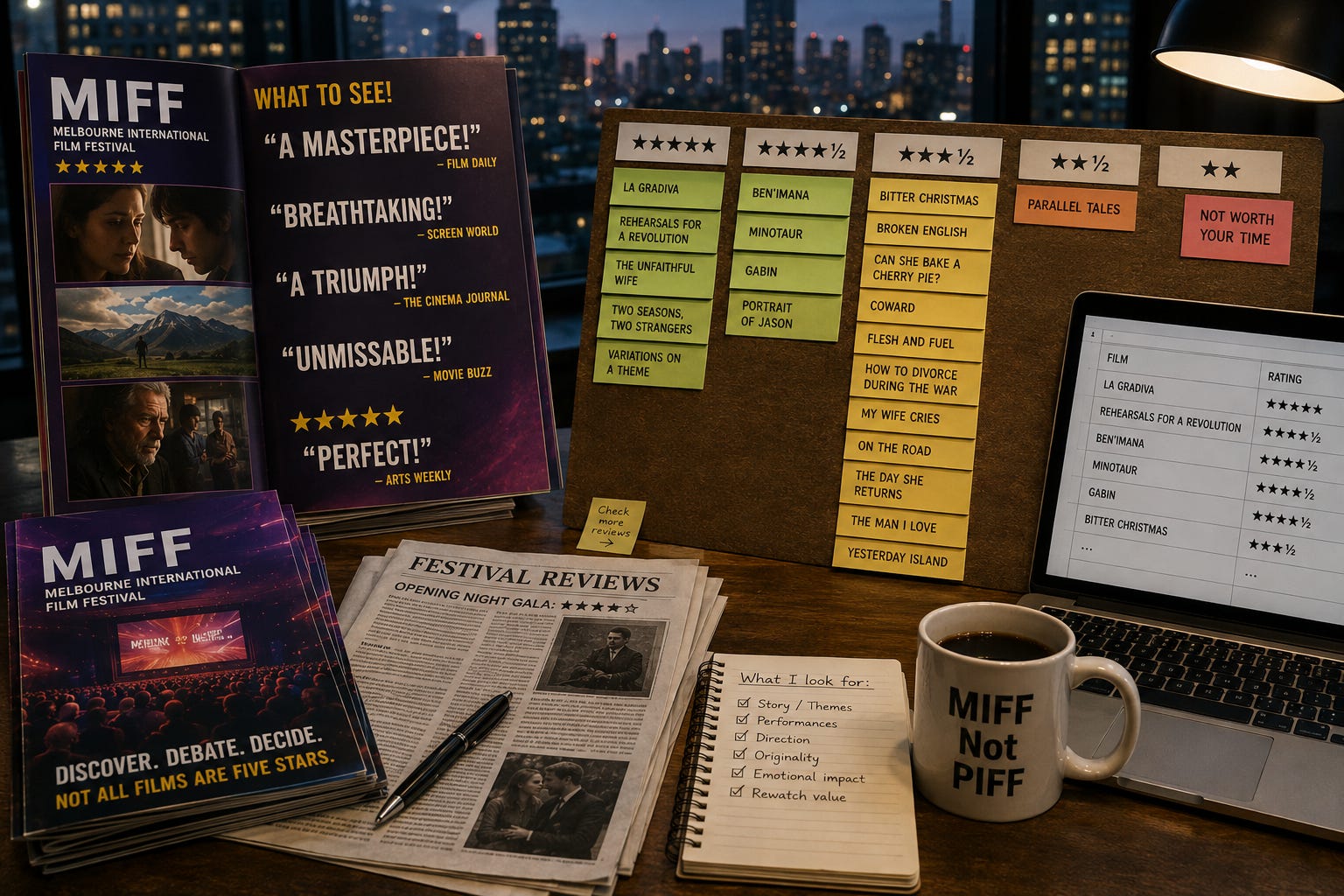
A while back, I tried to do something film festivals seemed oddly reluctant to do themselves: tell people which films were the best. They already did all the expensive work — assembling the films, describing them, building the websites, printing the catalogues and paying for advertising.
Yet, beyond helping with genre, their information on film quality was useless. Every film was wonderful, unmissable. An instant classic from the backstreets of Thessaloniki. The resources needed to help us discriminate between films were already being spent, only to fall at the last hurdle into spin.
This increased my chances of not attending any films, so you can argue that this wasn’t in their interest. Still, aiming at this higher functionality takes a bit of imagination and a taste for institution building. Whatever the ultimate benefits — speculative in any event — the short-term frictions are immediate: getting buy-in from higher-ups and overcoming objections from film promoters.
The power of such small frictions is illustrated by in-flight entertainment. When I last flew Qantas, its platform carried extracts from independent film reviews. That’s plainly more useful to passengers and costs next to nothing. Yet most airlines stick with the promotional copy they’re given.
So when Web 2.0 arrived I saw it as offering a miraculous opportunity to bend private initiative towards building better public goods. Wikipedia was the spectacular example, but the possibility was much larger. The cost of gathering dispersed knowledge, organising it and making it available to everyone had suddenly collapsed.
So 14 years ago I began my demonstration. Starting with film-festival collateral, I consulted independent reviews and reordered the films by their ratings. Eventually I paid a research assistant to do much of the legwork. I figured it more or less paid for itself in its utility to me; giving it away then generated still more surplus value (if you fancy Marxist jargon repurposed according to its plain meaning — ‘consumer surplus’ if you’re an economist). But it remained sporadic and required enough supervision, for sufficiently uncertain readership, that it became semi-sporadic, then quasi-sporadic. And if the unvarnished truth be told, in recent years its sporadic live appearances have resembled those of the justly famous, tragically decent, bird formerly known as the Dodo.
AI changes that calculation. What once took hours of searching, collating and summarising can now be done in minutes. Hence the catalogue below: the films at this year’s Melbourne International Film Festival, with the available reviews digested and converted into star ratings. Margaret and David by machine, if you like.
Web 2.0 did not merely make public goods easier to produce. It gave ordinary people extraordinary new convening power: someone could make something useful and, occasionally, millions of people could find it. The platforms that enabled this then intensified their attempts to extract rent from people’s efforts.
Even before the Age of Enshittification, our publicly funded institutions should have been all over this. Ahead of other agencies both here and overseas, Australia’s National Library turned its platform hosting digitised historical newspapers, now part of Trove, into a wiki where anyone could correct errors made by the original optical character recognition. Its wiki has never been inactive since it went live in 2007!
Appointed to its Council, I proposed we try to seed a Wikipedia of oral history. We already spent a substantial sum collecting oral history from Australians of National Significance. But who’s to say who they are, and how good those choices will look in fifty years? Why not devote a sliver of our oral history budget to seeing what happened if schools, local institutions and ordinary Australians were given seed funding to create and curate oral histories themselves? Amid some muttering that no other national library was doing it — except Singapore, with a large government grant — nothing happened. A few years later my wife and a friend set up something inspired by it in the Victorian country town of Shepparton. All on their own — just them, the shoestrings they could raise from local charities and the Shepparton community.
These are tiny examples, but they point somewhere large. A public sector with a skerrick of transformational capability would routinely devote slivers of existing budgets, within existing mandates, to seeding experiments, proving them up and championing the successes to scale. I’ve suggested a whole bunch of public-private digital partnerships that could be built largely from existing blueprints. And as commercial platforms destroy public reason by amplifying our worst instincts, publicly funded agencies could start building the means of amplifying our best — for instance, with bridging algorithms, as I outlined in this video.
That is how much of the private economy responded to Web 2.0. The successful firms did not simply graft a website onto whatever they had previously been doing. They reorganised themselves around possibilities the internet made newly feasible. We could have expected at least a little of the same exploratory energy from institutions whose purposes are already public.
Now AI gives them, and us, another chance.
You can find the guide listed both in declining order of and then alphabetically on this link.
It as if Nicholas Gruen does not see the forest for the trees. The object of AI is to make humans irrelevant. In the minor case that he mentions, some research assistant task disappears. Being a research assistant seems to be a decent occupation. How is it good if those roles disappear? Who benefits from the loss of those livelihoods? Answer: for now, some small number of investors and industrialists, but sooner or later any and all humans must lose control to something that is more intelligent than them.
I don't imagine this is a new point of view to anyone who might read this. It is the doom scenario. I do wonder how it is disregarded so easily.
The Web 2.0 was the Gutenberg 2.0 revolution. This seems insignificant compared to what has happened since with regard to public goods. I am commenting on this in my Routledge book (2020). The public goods (characterised by exclusiveness, rivalrousness and jointness) affecting our lives, are increasingly constructed by humans. They are the result of advances in availability and affordability made possible by new ICT and automation. Today public goods are to a lesser degree a result of inherent properties, and more a result of human design and technology.
Your question is whether the failure to transform social networks to "meritware" by bridging algorithms can be given a second chance by AI? Maybe so, but this demands that humans are able to find a narrow path where we invest as much in public goods as in private goods. Incentives and policies are superficial in this context. This depends on a culture upholdinig Kant's view regarding humans' inherent value - "never merely as a means". Human value should be based on the absolute dignity of each individual, not a relativized measurement. Thus, faith more than policies must come to our rescue. The main question is now whether the introduction and bypassing of AI will contribute to a culture that recognizes the joy and utility of public goods while AI provides for us. Private goods should then no longer be of a kind that decides life or death.