Our current electoral democracy looks like a bottom-up system. You can’t get elected without citizens’ votes. And yet it’s handing more and more power to the powerful - and getting more and more toxic. Why? Well political life is full of these kinds of reversals in which power subverts what looks like a bottom-up system into a more top down one.
The most striking example is the USSR, which, as its name suggests, was the Union of Soviet Socialist Republics. Only Party-approved candidates could stand, soviets were subordinated to the Communist Party, and dissent was suppressed — so voting remained, but real choice and power were removed.
It’s not nearly so bad in our system, but it’s surprisingly bad. You need money, connections and for most politicians, a party to win elections. And you’ve got to grab people’s attention. All that sees politicians representing their own interests and those of their powerful backers. Not so much ours. If they don’t do that, they’re never heard from again.
Citizen juries, you need hardly have me point out operate according to a very different, and much more democratic logic. That’s one reason why Aristotle described selection by lottery as a democratic institution while elections were an oligarchic institution. Please #LikeShareAndSaveTheWorld!
Meanwhile in my chat about the video with Colm, we discuss how frequently people show themselves to have a genuine fear of democracy. They assume that citizen assemblies are less expert than parliaments. They’re less expert at politics perhaps, but that might just be a feature, not a bug. But as for expertise, politicians are amateurs on technical subjects, just as members of citizen assemblies are. So they each take advice from experts.
Talking it through video:
What is the institutional imperative?
In this fifth and final episode of Government Transformed 2.0 I talk about the institutional imperative. Warren Buffett said business's institutional imperative was to grow (rather than to use capital as productively as possible). Government is, if anything, even more riven with institutional imperatives. And that cripples its performance.
And here’s the whole series.
Let that sink in
On the back of extraordinary compliments that flood in weekly regarding heaviosity half hour®, I’m launching a new semi-regular segment “Let that sink in”. What I mean by “semi-regular” is that you may never see it again, or you may - hence “semi”. (This is to chime in with the audacious new approach to defence as embodied in a recent semi-serious contract with Australia’s great allies - the UK and the US. Anyway, all the AUKUS countries have semi-agreed that Australia will - in the words of the contract “absolutely, definitely get the best submarines anybody has ever heard of … just so long as the other countries have some spare at the time”.
Let that sink in.
Anyway, the reason for the segment should be obvious. Some weeks ago I resolved to say “let that sink in” a lot more. It sounds very serious. And people are saying “let that sink in” a great deal more than they used to, and the elves who send all the emails out didn’t want yet another craze to go by without getting on board. In fact, we know for an absolute fact that no one in the history of the English-speaking world ever said “let that sink in” before 1892 (see above). But they’re saying it now.
Let that sink in.
Of course, it’s impossible to prove that they weren’t saying it in non-English-speaking countries, but how likely is that? I mean srsly. They’re really much more likely to have said something like “Méditez là-dessus”, “Riflettici bene”, “Lass das mal auf dich wirken”, “Пусть это дойдёт до тебя” or “让你好好想一想。”
Anyway, I can already sense that Let that sink in will deal with our collapsing institutions and what better institution to start with than academic social sciences?
Yes, much of academia is intellectually bankrupt
Let that sink in
The original writeup used quite technical language to describe what could be described to pretty much anyone prepared to focus so I got Claude to rewrite it with pretty much anyone in mind. I think it did a great job.
The Setup
Jonathan Haidt — America’s most prominent social-media-panic academic — promoted a new study claiming that adolescents who increased their social media use over two years ended up with lower cognitive performance than those who didn’t. Big sample (7,500 kids). Published in a Lancet journal. Sounds serious.
A statistics-savvy blogger called Cremieux read the paper, spotted a fundamental flaw, rang colleagues with access to the same data, and within minutes had re-run the analysis properly. The headline finding evaporated.
Imagine you want to know whether junk food makes teenagers fatter. You survey 7,500 kids, divide them into low, medium, and high junk-food groups, and compare their weight. The heavy-junk-food group is heavier. Case closed?
No — because those kids might also come from poorer families, get less exercise, and have less educated parents. Any of those things, not the junk food, could explain the difference. You can control for the factors you measured, but you can’t control for what you didn’t measure. And there’s always something you didn’t measure.
That’s exactly the flaw in the social media study. The researchers compared kids who used a lot of social media to kids who didn’t, controlling for household income and parental education and the like. But they couldn’t control for unmeasured factors — genetic predisposition to lower cognitive ability, parenting quality, school culture — any of which might independently predict both more social media use and lower test scores. The comparison tells you the groups differ. It doesn’t tell you why.
The Better Methods, Explained Simply
Cremieux re-ran the analysis two smarter ways. Both share the same logic: instead of comparing different people, compare people who are alike in all the ways that matter.
Siblings as controls. Two brothers share parents, house, neighbourhood, school district, and broadly similar genetics. All those troublesome background factors are held constant. So: does the brother who uses more social media score worse? If social media really harms cognition, you’d see it here. Cremieux ran this. No effect.
Each person as their own control. Track the same kid over time: when they use more social media than usual, do their scores drop? Their genes, family, and personality are automatically held constant because it’s the same person. No effect.
He also ran a “negative control” test — asking whether the original method would “find” that social media affects things it logically cannot affect, like a child’s racial ancestry or their genetic predisposition to intelligence, both fixed before they ever touched a phone. It did. The within-family and within-person methods did not. That’s a damning result: the original method was detecting background differences between kids, not anything social media was doing.
This Is Normal
Cremieux isn’t complaining about one bad paper. He’s saying this is standard. The authors were probably just lazy — they had access to the better methods and didn’t use them. His diagnosis: ignorant, lazy, biased, or publication-farming (publish a weak result now, “correct” it later, collect citations twice). Ignorant and lazy seem most likely.
Economics cleaned up its act after a famous 1983 paper called “Take the Con out of Econometrics.” Top journals now require dense robustness checks. Henderson’s Law captures the result, tongue-in-cheek: “When you read an econometrics study done after 2005, the probability that the researcher has failed to take account of an objection that a non-economist will think of is close to zero.” The rest of social science — sociology, psychology, medicine — hasn’t had that reckoning.
His sharpest line: “When you measure well, concussions don’t even lower intelligence and years of education don’t raise it. With those facts in mind, it should seem patently ridiculous to think that selecting into another hour a day of Twitter is going to make kids dull.”
The Fix
Empower methodologists. Lower the friction to using better methods by building them into standard software. Require journals to demand robustness checks — it costs almost nothing to publish them as supplements. He points to the “small sample” critique post-Ioannidis as proof this can work: once a methodological failure becomes a widely understood dismissal criterion, a lot of bad work dies before publication.
He ends: “Am I being too optimistic about this? Almost certainly. I live to be disappointed.”
"Le Cavalier fidèle et vrai" (folio 196), Silos Beatus, enluminure ( debut du 12eme siecle)
Industrialising thought: what could possibly go wrong?
The essay below has been making waves. It traces the systemic failure that killed 175 children in a school in southern Iran back through layers of military doctrine, procurement history, and organisational sociology. Its central argument is that what we call “AI” is often a “charismatic distraction” from more prosaic but consequential processes — in this case, the automated bureaucratic machinery of a targeting system.
But the argument has a reach beyond the military context in which Baker develops it. Its deepest claim is that formal procedures always depend on interpretive judgment they cannot acknowledge without undermining their own authority. So the judgment gets hidden — it looks like “following the procedure.” When you then further optimise or ‘scale’ as we’ve taken to saying, what you eliminate is precisely that hidden discretion. You get, as Baker puts it, “a bureaucracy that runs exactly as written.” And unions discovered this trick eons ago and called it a ‘work to rule’ regime. Workers do precisely what procedures require them to. And that completely melts the logic of getting things done.
As I’ve argued elsewhere, what happened in modern economics is analogous. Since Samuelson’s postwar revolution, the discipline has elevated technical mastery of formal models over critical scrutiny of formal moves being made within them, their suitability to the analysis they perform and what judgements might need to be added to make them add rather than detract from insightful analysis. The philosopher E.A. Burtt identified the temptation over a century ago: the inquirer “will be under a strong and constant temptation to make a metaphysics out of his method” — to suppose the universe so constituted that his method must succeed. That is precisely what happened. A useful way of thinking became a way of seeing, and then a way of not seeing.
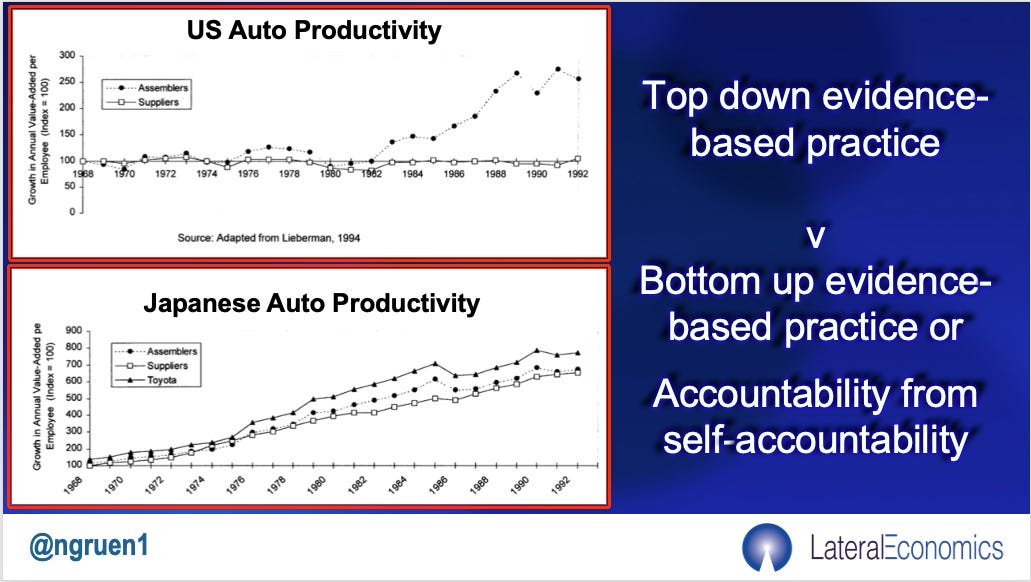
Consider Toyota’s production revolution, which permitted Toyota’s productivity growth to outstrip its American competitors fourfold between the late 1960s and the early 1990s. The Toyota production system’s preeminent value was the identification and solution of problems. Solved problems were bedded into standard procedures — but those procedures retained their focus on surfacing the next unsolved problem. Economics performs the complete inversion of these values. Far from drawing the analyst’s attention to what they cannot yet explain, its formalisms make the unexplained invisible.
Thus when Paul Krugman’s new trade theory finally incorporated scale economies into formal models, he told his Stockholm audience that the plain English version came after the theory. But as I noted in response, a long list of trade economists — Hicks, Corden, Linder, Vernon and others — had understood and written about scale economies in plain English for decades beforehand. The formalism didn’t discover the insight; it just made it legible to high priests of economics. The judgment about whether a model fits its subject — the interpretive work that connects theory to reality — got squeezed out as unscientific, as mere opinion. What remained was the procedure: publishable, defensible, and increasingly detached from economic life.
Two systems, one pathology. The targeting analyst executing a column-based workflow and the economist running a model are both operators making decisions that arrived, readymade, from elsewhere.
On the first morning of Operation Epic Fury, February 28, 2026, American forces struck the Shajareh Tayyebeh elementary school in Minab, in southern Iran, killing between 175 and 180 people, most of them girls between the ages of seven and twelve. Within days, the question organizing the coverage was whether Claude had selected the school as a target. Almost none of this had any relationship to reality. The targeting ran on a system called Maven. Nobody was arguing about Maven.
In 2018, more than four thousand Google employees signed a letter opposing the company’s contract to build AI for the Pentagon’s targeting systems. Palantir took over and built it into a targeting infrastructure fusing satellite imagery, signals intelligence, and sensor feeds into target packages. The building in Minab had been classified as a military facility in a Defense Intelligence Agency database not updated since at least 2013, years after it had been converted into a school. Maven processed that list....
The STS scholar Morgan Ames published The Charisma Machine, a study of how certain technologies draw attention toward themselves and away from everything else. LLMs may be the most powerful instance of this type in history. When the school was bombed, “AI safety” and “alignment” and “hallucination” were the terms people reached for, despite offering a poor fit for the older technologies actually involved in targeting. The real question is not about Claude or any language model. It is a bureaucratic question about what happened to the kill chain, and the answer is Palantir.
The Maven Smart System consolidated targeting across eight or nine separate systems behind a single Kanban-board interface. The AI underneath is not a language model; the systems that detect targets and fuse sensor data are computer vision, predating large language models by years. LLMs were added in late 2024 as a natural language layer — when Anthropic was blacklisted, the Pentagon replaced it with OpenAI within hours. What mattered was what Maven did: consolidated the systems, compressed the time, reduced the people. The stated goal was a thousand targeting decisions in an hour — 3.6 seconds per decision....
Lt Col John Fyfe’s study of time-sensitive targeting in the 2003 invasion found the exception: Royal Air Force officers’ “more reserved, conservative personalities” produced “a very positive dampening effect on the sometimes harried, chaotic pace of offensive operations.” On UK-led shifts there were no friendly fire incidents. What reformers would later measure as latency was the mechanism that caught mistakes.
Organizations running on formal procedure need someone inside the process to interpret the rules when the categories no longer fit the case. But the procedural form cannot admit this — so the judgment has to look like following the procedure rather than interpreting it. The system’s flexibility lives entirely in this unacknowledged interpretive work, removable by anyone who mistakes it for inefficiency....
Alex Karp describes exactly this in The Technological Republic: bee swarms, murmurations of starlings — “There is no mediation of the information captured by the scouts once they return to the hive.” No weekly reports, no presentations to senior leaders, no meetings. Karp thinks he is destroying bureaucracy. He is encoding it. Those meetings were where people interpreted the procedure, where someone could notice that the categories no longer fit the case. What Karp eliminated was the discretion the institution could never admit it depended on. Encoded bureaucracy does not bend. It shatters.
The target package for the school presented a military facility. Outside the package, the school appeared in Iranian business listings, visible on Google Maps. Nobody searched. At a thousand decisions an hour, nobody was going to. Congress did not authorize this war. The reporting reached for “AI error,” domesticating the event into something a better algorithm could have prevented. The constitutional and legal questions — who authorized this war, whether this strike constitutes a war crime — were displaced by a technical question easier to ask and impossible to answer in the terms it set.
“Decision” is wandering now. It no longer means what it used to: a person choosing to do something for which they could be held accountable. Someone decided to compress the kill chain. Someone decided that deliberation was latency. Someone decided to start this war. Several hundred people are sitting on Capitol Hill, refusing to stop it. Calling it an “AI problem” gives those decisions, and those people, a place to hide.
This is what Grok thinks might happen if you start taking William James seriously. It’s uncannily like what happened to me. There I was, minding my own business (as I invariably do) ,just trying to do a little tidying up, a little pavement laying, when a large hot-air brain appeared and started taking to the skies.
William James has always been a favourite philosopher of mine. He’s a commonsensical, practical and his intellectual exertions are not dedicated to proving his cleverness or to system building, but to figuring out the practicalities of building the best lifes we can. He argued that character had very mundane foundations. It was built on good habits, an idea that goes back at least to Aristotle. But, if you pay attention, these mundane foundations make for anything but mundane implications.
This article will put the fear of God into you (well it did with me anyway) as it explains what matters when you take James’ ideas seriously.
James’s great insight is that character changes not when we admire a better life, but when we move. The crucial instant is the first one in which the body can either obey an intention or betray it.
“It is not in the moment of their forming, but in the moment of their producing motor effects, that resolves and aspirations communicate the new ‘set’ to the brain.”
James also builds his ideas about human beings around phenomenology - or to speak less grandly, around our experience of life as it is lived, rather than on a priori principles. Sadly, phenomenology after James became the province of continental philosophers. Maybe that’s what Grok was getting at with its hot-air brain about to float up into the heavens. Anyway, over to Colin Lewis.
“Keep the faculty of effort alive in you by a little gratuitous exercise every day.” ~ William James
I have come to think that one of the strangest mistakes of modern life is the belief that freedom consists in keeping one’s options open for as long as possible. We confuse indecision with depth. William James, writing in 1890, understood something harsher and more useful. A human being does not rise above habit. A human being becomes, for good or ill, the sort of creature whose habits have already decided what will happen when the hour arrives.
That is why James begins not with inspiration but with machinery — in the stern biological sense that a nervous system records, economizes, and repeats. [James was a founding figure of both psychology and phenomenology: he reasoned not from first principles but from careful attention to what consciousness actually does, moment to moment.]
“The great thing, then, in all education,” he writes, “is to make our nervous system our ally instead of our enemy.”
James is telling us that education is not chiefly the transfer of ideas. Education is the arrangement of conduct — the slow conversion of what is admirable into what is repeatable.
Lead the Life You Mean to Lead
A society is not held together by what its members occasionally feel. It is held together by what they can be counted on to do again. James insists we guard against bad habits as we should guard against the plague. He wants to know what repeated acts are doing to the person who performs them. [This was phenomenology put to civic use — asking not what reason dictates in the abstract, but what lived repetition actually inscribes in the body.]...
Much of what we call convenience is in fact organized moral discouragement — teaching a person, hour by hour, that the shortest path is the natural one. Then we wonder why so many people speak grandly about change and so few can survive a Tuesday. …
Move
Your brain does not award merit for eloquence. It responds to performance. Speech can become a substitute pleasure — giving the emotional reward of seriousness without the material inconvenience of becoming serious. James did not despise maxims. He despised inert maxims. The world is full of people with correct language and untrained conduct. Very often the language is not an accompaniment to the failure but its smoke screen....
Internal Government
A person with no trained habits lives under a bad form of internal government. Every decision must be relitigated. Every duty must compete with appetite from scratch. Habit, at its best, is stored judgment — the prior settlement of matters that ought not consume the whole parliament of the soul each time they arise....
His final maxim cuts against a culture devoted to optimization: keep the faculty of effort alive by a little gratuitous exercise every day. Do something “for no other reason than that you would rather not do it.” The will decays when used only where incentives already point in the right direction. Skip the indulgence. Walk in the rain. Rise when the alarm rings. These are rehearsals for the day when the stakes will not be small....
Character
James saw with brutal precision the thing we keep trying not to learn: that character is less like a statement than a groove. [He arrived at this not by deducing it from a theory of human nature, but by attending closely to what experience reveals — the phenomenologist’s method applied to the mundane question of how selves are made.]
The person who has handed the right things over to habit is free for better work, free for courage when courage is required, free above all from that degrading condition in which one’s ideals remain permanently eloquent and permanently unperformed.
That is why the chapter [on habit] still matters. Life does not usually fall apart through one dramatic betrayal. It frays through tolerated repetitions. Habit is valuable because it determines who, in the decisive hour, will still be available to themself.
I loved this article by Mary Townsend and that Dolly Parton is, as the cliché goes, the real deal - it really was her vast talent, her perseverance, her calm self-assurance that lifted her out of dirt poverty. And, from the little I know, she’s retained her remarkable decency throughout.
Like the laconic wit of the ancient Spartans, American country music often inspires confusion. The reason for the fringe, stylized leaves, flowers, and animals on the boots, hats, guitars, and epaulettes is at best unclear, and at worst, as my mother would say, tacky. But like the Spartans’ calculated rejection of Athenian style, there is a canniness and sophistication to country music’s appeal to simplicity, once you can catch the joke. Few understand this better than Dolly Parton....
Dolly was born into poverty in Tennessee’s Smoky Mountains; she has written more than three thousand songs and placed forty-four albums in the top ten on the country charts....
What she did with her fortune shows her character. Dolly created a global literacy program in honor of her father, who never learned to read; made a substantial investment via Dollywood (which includes a bald eagle sanctuary); invested royalties from Whitney Houston’s cover in a Black neighborhood in Nashville; and established a medical fund for the doctor who delivered her.
These facts don’t capture what is compelling about Dolly. My impulse is to turn to Aristotle’s Nicomachean Ethics — specifically to a single untranslatable word, kalos, which in English we can only weakly render as “noble” or “fine.” Kalos describes something perfectly beautiful while astonishingly good; never merely a duty but always a pleasure. Per Aristotle, magnificent acts must be aimed at the common good. Unlike the Carnegies with their libraries, or the Rockefellers with their ice-skating rink, there is no large-scale rapaciousness to make up for, either....
In her ballads she tells about murder, suicide, madness — the anguish of people in her town. While Loretta Lynn had “You Ain’t Woman Enough (To Take My Man),” Dolly’s account of Jolene is based on admiration, not jealousy. When she first heard Whitney Houston’s version of “I Will Always Love You,” she had to pull the car off the road — what she felt was joy that her song had lifted up another woman....
One perennial obstacle to virtue is that most of us think less of ourselves than we ought, Aristotle observes. When we stand aside from projects we are capable of, we are small-souled. To aim toward greatness is to have megalopsychia — a large soul. Who ever ran across a person more capable of great things, and who knew this, than Dolly Parton? Her very hair signals it: larger than life, it announces that someone has understood the human task — to reach out toward the divine in the ways we humanly can....
In Aristotle’s description of great-souledness the person he imagines is a very male sort of man: tall, slow-walking, deep-voiced. Some readers have argued there’s even a humorous aspect. One might ask what one is to do if one wishes for greatness while being short, female, high-voiced, and fast-moving. When asked by Barbara Walters if her hair and costumes make her into a joke, Dolly fired back:
I’ve often made the statement that I would never stoop so low as to be fashionable; that’s the easiest thing in the world to do. So I just decided that I would do something that would at least get the attention. Once they got past the shock of the ridiculous way I looked and all that, then they would see that there was parts of me to be appreciated. And show business is a money-making joke. And I’ve just always liked telling jokes, you know.
With a sort of Socratic irony of wigs, Dolly dissembles her greatness while also showing it off — a masterpiece that Aristotle’s slow-moving man simply could not achieve.
There are some people, Aristotle insists, who exceed our ability to praise them. We can’t simply praise Dolly Parton. But we can bless her — raise our eyes in astonishment, wonder, and gratitude that a human being could be so beautifully good. The joke’s on us if we miss the point of her remarkable life.
Rod Sims (and Eco 101) on why we should tax super-profits on gas
Cute little pic
Nice to see some pressure coming on the Government to tax windfall gains from the Iran war. After much agonising they managed it when they ditched Scott Morrison’s tax cut in favour of a fairer one, and I’m expecting they’ll likewise agree to be forced into something that’s in their interests here.
We now know that the Albanese government will very likely introduce an extra levy imposed on gas producers’ high profits. The prime minister’s department has requested Treasury modelling of additional levies on gas companies in response to the Iran crisis that is driving up energy costs for Australians. The department was reported as saying that energy producers “should not benefit from high international prices at the expense of domestic customers”. Precisely.
But this is also a time for longer term thinking. We cannot have a temporary extra tax. We must deal with Australia’s chronic undertaxing of those utilising the gas resources that belong to all Australians. There will never be a better time for the federal government to adopt a fair share levy (FSL) – as set out by the Superpower Institute, which I chair – to ensure gas companies pay their fair share of tax. The levy is based on the taxation model used by Norway, and similar to one used by the UK.
Other major fossil fuel exporting countries typically share between 75% and 90% of fossil fuel profits. Australia shares only 27%, through a combination of the corporate tax, royalties, and the petroleum resource rent tax (PRRT). With profit defined in cashflow terms, as in Norway, Australia shares even less: just 18%.
While Australian households and businesses are being stung by extremely high fuel prices caused by the crisis, gas companies are reaping extraordinary profits from this same crisis. This is perverse. If some of the revenue raised was returned to households, this would provide significant and immediate cost-of-living relief.
If Australia already had a fair share levy in place, government revenue would have increased by $1.6bn since the start of the Iran crisis. There would be more revenue raised in four weeks than the PRRT has averaged over a whole year. The PRRT is widely acknowledged as a deeply flawed tax; in 2016 Treasury commented that firms can “defer the payment of PRRT indefinitely”. Australia’s gas belongs to all Australians. But we’re letting largely foreign-owned companies extract and often export these resources while paying some of the lowest taxes on gas in the world....
At the peak price point during the Russia-Ukraine war, the fair share levy would have raised $27bn, nearly 14 times as much as the PRRT....
Research conducted by Redbridge Group shows overwhelming support for a fair share levy: 87% of voters agree or strongly agree that Australians deserve a better return from the sale of our gas exports, with just 3% disagreeing.
There will of course be outrage expressed by the gas industry and their supporters, who will say that a levy will increase gas prices and deter investment. It will do neither. Under the levy the government shares in investment costs as well as taking its share of the upside. Norway, using the same design with the much higher levy rate of 72%, certainly has no lack of investment incentive. Australian investment will be likewise unaffected....
Let’s understand that those opposed to having the gas industry pay its fair share of taxation will express outrage whether the government opts for a temporary, small impost, or a permanent fix to what is the biggest hole in Australia’s tax system. If the government is going to be criticised whatever they do, they might as well do the job properly.
Henry Farrell reaches for the H word to identify some uncanny parallels. The other one I keep noticing is a cabinet of crazies with a smattering of Mephistophelean competence - as for instance in the case of JD, Marco and Scott. And no. Donald Trump is not hankering to murder millions of people.
I’ve been thinking about this post for a few months. It explains why the above (via Matthew Gertz this morning) plausibly describes how policy gets made in the Trump administration.
“Gooning Towards the Führer” is not a claim, either express or implied, that America is descending inexorably into Nazism. I do not believe for a moment that he is akshually Adolf Hitler.
Instead, I think that some of the historical literature on the Nazi state (Ian Kershaw obviously; also Jane Caplan and bits from Detlev Peukert’s work on Weimar) is extremely helpful in thinking about how Trumpism works as a style of policy making. Kershaw compares Hitler’s chaotic mode of making and implementing decisions to Stalin’s more orderly bureaucratic approach.... Hitlerism was jerry-built on top of imperial Germany’s bureaucratic state. Trumpism, in contrast, leans very heavily on social media to coordinate policy across the regime. Propaganda and policy making are blurred so that one can’t tell where the one ends and the other begins.
Hence, Kershaw’s notion of “working towards the Führer” isn’t quite appropriate for understanding what is happening now. Trump’s underlings absolutely try to anticipate his desires and get his attention. But they do this by adopting a particular style, which is well suited to a small set of questions, and terribly suited to a much larger one. Ideas and arguments that aren’t readily translated into visual memes have a very poor chance of making it through; there are regular fuckups, as notions that make for great memes turn out to make for shitty and self-defeating policy; and problems that can’t be meme-ified don’t really exist for the Trump administration, until they cause complete breakdown.
Ian Kershaw’s phrase, “working towards the Führer,” has escaped its original context, but it is absolutely worth going back and reading what he meant. Hitler rarely issued unambiguous commands, preferring to let arguments between his underlings sort themselves out, communicating his preferences elliptically.... The key tools for coordinating top level policy aren’t formal bureaucratic documents — they are Signal messaging groups and social media. “Banger memes” aren’t just being used to communicate with the public. They are being used to make and coordinate administration policy.
This is not “working towards” so much as “gooning towards.” The Trump administration has become addicted to creating — and consuming — social media featuring masked and tattooed goons roughing up protestors and dominating the libs. The medium isn’t completely the message, but it absolutely shapes the kinds of messages that can, or cannot, be communicated through it.
Putting ICE agents on the line at airport TSA checkpoints? 1000% goonable! Who cares whether it will work or not. Gaming out whether Iran will block the strait of Hormuz before carrying out bombing strikes on its leadership? Boring!
Take the harebrained idea to target Jerome Powell with subpoenas. The policy seems to have come from Bill Pulte, a former memecoin influencer who got a mid-level administration position. Pulte discovered he could get Trump’s attention by targeting enemies with bogus investigations — but lacked the political intelligence to understand that there are some enemies that You Do Not Go After, because they are too powerful and dangerous....
The more subtle consequence is that issues that are not goonable will become invisible. Traditional bureaucracy and goonability are alternative (and mostly incompatible) technologies of attention. The pathologies of Seeing Like an Idiot don’t just involve ineptitude and blunders, but a nearly complete incapacity to see or talk about problems that can’t be expressed via goonposting.
If you can’t goon it, it doesn’t really exist for the current Trump administration. The breakdown of traditional policy making makes it extraordinarily hard — perhaps impossible — for those who can see the disasters coming to mobilize or coordinate to do anything about it. Unfortunately, we are all being pulled along as well....
What is happening right now then, is not working towards the Führer, but gooning towards him.
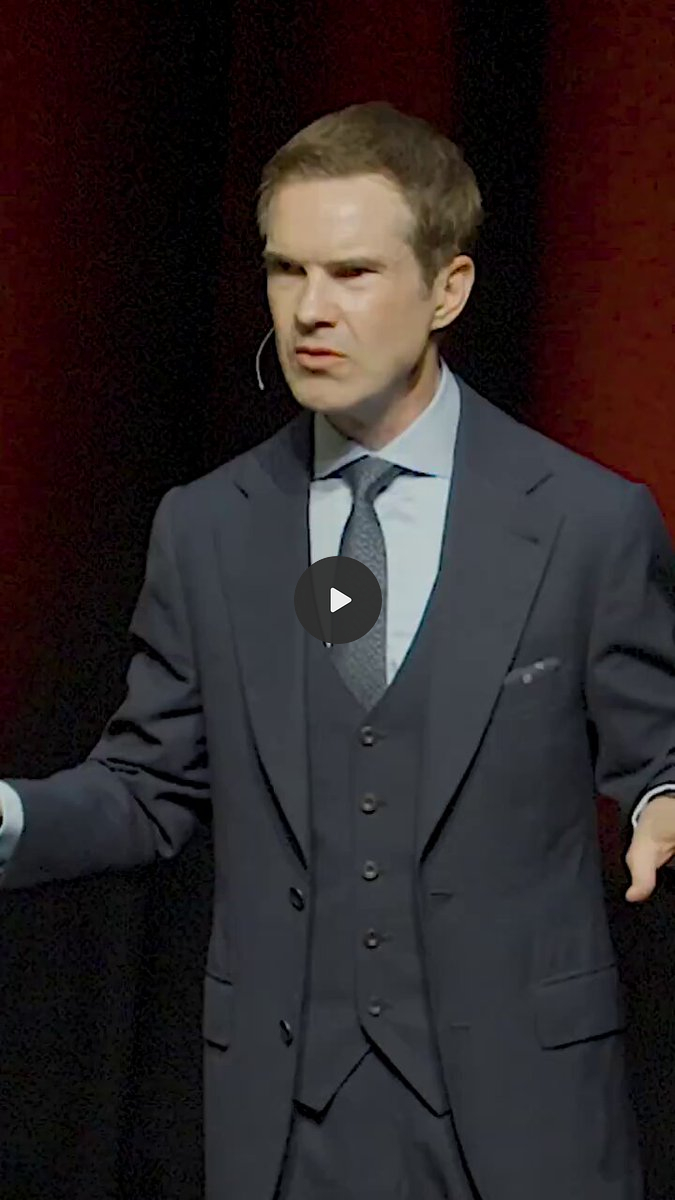
Earlier this week I published some comments on Louis Theroux’s doco on the manosphere. I was fairly unimpressed. In any event, here’s Jimmy Carr’s virtuosic impromptu take. I don’t know how seriously he’s proposing what he is as practical ideas or as examples of what we should be thinking about. But, assuming it’s the latter, I was impressed.
How Technology Re-Tribalized Us
Yanomamö villagers
A strong, simple idea runs through this piece by Robert Lynch.
In Yanomamö villages, rules aren’t enforced by courts or police. When someone violates a norm—refusing to share food from a hunt, calling someone a coward, having sex with someone else’s wife—accusations are aired publicly in the shabono, the tribe’s central communal space, in front of an audience where everyone knows everyone. Conformity is maintained because, here, your reputation is everything. Social rejection is as much a threat to survival as mistaking a snake for a stick....
Small-scale societies with high levels of inter-village hostility exert intense pressure to conform. Communities use gossip, public shaming, and the threat of exclusion to police infractions. To be on the inside is to have standing, marriage prospects, and allies; to be on the outside is to be exposed and vulnerable. My postdoctoral advisor, the late Napoleon Chagnon, recounted an incident in which a man challenged a romantic rival to a public “club fight” in the center of the village: all that mattered was the audience. Without witnesses, the conflict would have been pointless....
But as societies transitioned from kin-based bands to nations numbering in the tens of millions, the old enforcement mechanisms weakened. Anonymity became possible, audiences fragmented, and people could move between social worlds that didn’t speak to each other.... In America, one of the most mobile societies on earth, much of modern life through the end of the twentieth century was a golden age for heretics.
This wasn’t a historical accident. James Madison and the other American founders worried as much about social tyranny as political tyranny. In Federalist 10, Madison warned about the dangers of factions and explained that the Constitution was designed to disrupt herd behavior.... A healthy republic, he believed, required citizens willing to speak plainly, withstand disapproval, and risk social punishment....
So when technology restored the social architecture of our ancestors, the conformity instincts of the traditional village returned. By making social approval measurable, turning conflicts into public displays, and creating a permanent record of social strife, the internet has recreated village life on a planetary scale. This was what the media theorist Marshall McLuhan meant when he declared that “an electronic world re-tribalizes men.”
Online, remarks can be detached from context, resurfaced years later, and judged by a new audience with no relationship to the speaker. In the old world, reputational enforcement was local, and so escapable. In the new world, it is global and enduring. What McLuhan called the “global village” is a universal panopticon: we are all watching each other, and being watched by each other, all the time—never just catching up with a friend, but performing in front of a crowd of friends, enemies, and strangers.
The new village arrived at the worst possible time. Offline life had already begun to sort people into like-minded communities and hollow out the institutions that buffered people from ideological dependence—neighbors, churches, unions, bowling leagues, extended family.... My research has shown that the need for community found a new outlet in what social psychologists call identity fusion, when the boundary between self and group dissolves.... Between 1994 and 2017, partisan sorting intensified, the shared middle thinned, and people grew more conformist—the social penalties for dissent tightening first with woke culture after 2014, and then with the MAGA backlash.
The modern village offers connection and the comfort of belonging, but reneges on its promise by asking identity and politics to carry the weight of meaning, friendship, and faith—burdens they cannot bear. It offers constant contact without real companionship and then monetizes our loneliness. Over time, it turns our interactions into a branding exercise, and the mask begins to eat the face.
After a heated Oval Office clash with Volodymyr Zelensky last year, Donald Trump revealed his intuitive grasp of the new state of affairs when he turned to the cameras and said: “This is going to be great television.” In the global digital shabono, nothing matters if it isn’t performed in front of an audience; if nobody was watching, it didn’t happen.
A book is a big thing to dedicate one’s time to. And the thing is that the book will have been written for many audiences. And many very serious books are written for an academic audience and perhaps one from many years ago. Wouldn’t it be great if we could get books written for us? Well, the advent of AI brings that a little closer.
When I can, I am particularly enamoured of the possibility of getting AI to do a substantial summary of books for me. That then enables me to dive deeper into the book, but in a much more targeted way than would be possible if I only had the book to go by. Accordingly, when I can get access to the text, which is often possible on archive.org, I get Claude to write a summary of the book for me. I often then get it read to me by ElevenLabs which has synthesised voices which are now pretty close to a good human reader (and better than the worse ones - which means it’s certainly better than LibriVox). And so below, for your delectation was my first foray into Bertrand de Jouvenel’s On Power. It’s very good I think.
And in case anyone wants to copy or adapt it, the prompt I’m using at present is this:
First, please save your work as you go, in case you collapse mid-task as you often do with larger tasks.
Then summarise this book, giving priority to the overall argument and any striking illustrative facts, stories or aphoristic turns of phrase. Use subject headings if they’re helpful.
Bring the total summary in under 8,000 words.
Put the summary in two different files separate from this chat. A markdown file so I can publish it to the net with clear section headings so it can be navigated. And an .epub file I can upload to ElevenLabs which will recognise the headings and read me the output.
On Power: The Natural History of Its Growth
Bertrand de Jouvenel — Summary
Written in occupied France during World War II and published in 1945, this book asks a question that the war made urgent: why does Power always grow? Jouvenel traces the natural history of political authority across centuries, arguing that Power — regardless of who wields it or what principles justify it — has an inherent tendency to expand, crush competing authorities, and devour individual liberty. The book is simultaneously a political treatise, a work of historical sociology, and a warning about where liberal democracy was heading.
The Central Argument: The Minotaur
Jouvenel opens with what he calls the Minotaur — the monster at the heart of modern civilisation. The catastrophic scale of the Second World War, he argues, was only possible because modern states had achieved an unprecedented degree of control over their populations. Total war mobilised entire societies: workers, peasants, women, all conscripted into one vast instrument. This was not an accident of fascism or Nazism; Britain and the United States had done the same, because they had no choice but to match what Germany was doing. The logic of competitive war drives all combatants toward total mobilisation.
The disturbing question is: how did states acquire this power? And why do we hardly notice that they have it?
The core thesis can be stated simply. Power — the political authority at the centre of any society — has throughout history grown steadily larger. It has done so by eating other authorities: the nobility, the church, the guilds, the independent cities. Each time it demolished a competing authority, it posed as the liberator of ordinary people. And each time democratic revolutions replaced one ruling class with another, Power emerged strengthened rather than constrained. The history of political freedom is largely an illusion; what actually happened is that Power passed to new hands and grew more absolute.
Part One: The Nature of Power
What is Power and Why is it Obeyed?
Jouvenel begins not with constitutions but with a more fundamental question: why do people obey at all? Every society has a government, and its commands are followed by millions of people who could, if they chose, refuse. The study of Power’s forms — monarchy, aristocracy, democracy — is secondary to understanding its essence.
Civil obedience, he argues, is what makes Power possible. The resources available to Power — soldiers, taxes, labour — are strictly proportional to the obedience it commands. A medieval king could not impose direct taxation because his subjects’ obedience didn’t stretch that far. A Bourbon could not conscript armies. In our time, governments can do both, and vastly more. The history of Power is the history of expanding obedience.
Theories of Sovereignty: Divine Right and Popular Will
Political theory has offered two grand justifications for authority: divine right and popular sovereignty. Jouvenel’s startling claim is that these apparent opposites rest on the same foundation. Both assert that somewhere there is a supreme will — God’s or the people’s — to which all private rights must yield. Both transfer that will’s authority to a government which acts in its name. Both therefore license unlimited Power, so long as it can credibly claim to represent its sovereign.
The medieval doctrine of divine right was, paradoxically, more limiting than modern popular sovereignty. A king ruling by divine right was subordinate to the Church, to natural law, to a code he did not make and could not alter. “An unjust law is no law” (lex iniqua non habet rationem legis) was a genuine constraint. But popular sovereignty, particularly in Rousseau’s formulation — “the general will is always righteous” — offers no such check. If the people’s will is by definition good, then whatever the sovereign majority decrees is good. Power becomes judge in its own case.
Part Two: The Origins and Growth of Power
The Magical Origins: How Power First Got Obeyed
Reaching back to anthropology and early history, Jouvenel traces Power to its roots in magic and ritual. The earliest rulers were not warriors or chiefs in the modern sense but figures who stood between the community and the supernatural — shamans, elders, rainmakers. Their authority derived from a believed connection to the unseen forces governing harvests, weather, and luck. Power’s first home was in this sacred realm.
This matters because it means Power from the beginning required belief. The chieftain who lost his magical efficacy — whose harvests failed, whose wars went badly — lost his authority. The question “why should we obey?” has always required an answer rooted in something larger than mere force. Every subsequent theory of sovereignty — divine right, social contract, popular will — is a sophisticated version of the same need: to make obedience feel legitimate, even obligatory.
The Warrior King and the Alliance Against the Nobles
With the emergence of settled agriculture and warfare, Power shifted from the elder-shaman to the warrior-chief. The strong man who could defend the community against external enemies acquired authority independent of ritual. Violence became the engine of Power, alongside belief.
But the pattern that recurs throughout Jouvenel’s history is the alliance between central Power and the common people against the intermediate authorities — the nobility, the great landowners, the independent cities. The sequence goes like this:
A society is governed not just by the king but by a layer of powerful intermediaries — barons, bishops, guilds — who have their own rights and their own hold over ordinary people.
The king seeks to expand his power and increase his revenues. To do so, he must break the nobles.
The common people, who suffer under the nobles’ arbitrary authority, support the king. Equality and absolutism march together.
Jouvenel illustrates this with the vivid story of the Doge Marino Falieri of Venice. The Venetian nobility was so entrenched that a plebeian naval hero, Bertuccio Ixarello, could be slapped in the face by a patrician with no redress. He came to the Doge and showed the wound from the patrician’s ring: “Let us join forces to destroy this aristocratic authority — it perpetuates the abasement of my people and limits your power.” Falieri’s plot failed and he was beheaded. But the story perfectly encapsulates what Jouvenel sees as the motor of political history: Power’s need to expand, meeting the people’s desire for equality, conspiring against intermediate authorities.
Part Three: Power’s Methods of Expansion
The Dialectic of Command
Jouvenel argues that Power has an inherent egoism — those who hold it love it and wish to expand it — but this egoism is systematically concealed behind the language of public service. Power presents every expansion as a benefit to society. To govern more is to protect more, to provide more, to equalise more.
He insists, against the idealists, that some egoism is necessary for Power. A purely disinterested ruler — he cites Louis XVI and Lamartine — lacks the will to survive. Louis XVI, wracked by guilt about the revolution, told the Swiss guards not to fire. He lacked what Luther called the ruler’s sabre. Tenderness of heart, carried to self-denial, is self-inflicted death for a government.
But once egoism becomes the dominant spring, Power becomes predatory. It extracts resources from society not to serve it but to feed itself.
Power and the Common People
The key mechanism by which Power grows is its alliance with “the common people” against “the notables.” This is not mere cynical manipulation — popular pressure for equality is genuine, and Power responds to it. But the result is that each populist revolution leaves Power larger, not smaller.
Jouvenel documents this through a series of historical examples:
The French monarchy systematically used popular resentment of the aristocracy to break noble power, centralising authority in Paris.
The Dutch stadtholder Prince Maurice, frustrated by the merchant oligarchy of Holland, allied with fanatical Calvinist preachers to inflame the mob against the oligarch Jan van Barneveldt, who was executed in 1619. Maurice got what he wanted — popular backing and the removal of his rival.
The pattern repeated in the English Civil War, the French Revolution, and ultimately in the twentieth-century totalitarianisms.
Each time, the common people fought for “liberty” and got a stronger state.
Revolutions Strengthen Power
The chapter on revolutions is one of the book’s most striking. Every revolution, Jouvenel argues, begins with a cry of liberty and ends with a stronger Power than the one it replaced. This is not an accident, not the result of mistakes that could have been avoided.
The sequence is almost mechanical. Before the revolution: a weak Power, constrained by entrenched intermediate authorities. The revolution: those authorities are swept away in the name of the people. After: a new Power, liberated from the constraints that had limited its predecessor.
Before the English revolution: Charles I, unable to tax without Parliament, unable to field an army without baronial consent. After: Cromwell, commanding the New Model Army, ruling by decree. Before the French revolution: Louis XVI, whose authority was limited by the parlements, the Church, the guild system. After: Napoleon, with powers the Sun King never possessed. Before the Russian revolution: Nicholas II, constrained by the aristocracy and the Church. After: Stalin.
“The Cromwells and Stalins are no fortuitous consequence, no accidental happening, of the revolutionary tempest. Rather they are its predestined goal, towards which the entire upheaval was moving inevitably.”
The lesson Jouvenel draws is not reactionary — he is not saying the old regimes were good. It is analytical: revolutions liquidate weakness and bring forth strength. Power, regardless of who holds it, grows from the ruins of whatever had previously constrained it.
Beliefs and Folkways as Invisible Restraints
One of the book’s most interesting arguments concerns informal constraints on Power. Jouvenel observes that the official constitution of a government is a poor guide to its real power. The medieval king with supposedly absolute authority was in practice far more constrained than a modern democratic state, because his subjects held beliefs — about natural law, about the Church’s authority, about the rights of custom — that he could not easily override.
Folkways, religious beliefs, and moral codes that are independent of the state act as invisible constitutional checks. A government that destroys these beliefs in the name of rationalism or progress removes constraints on itself that no formal constitution can replace.
This is why Jouvenel takes seriously the decline of religious authority and traditional morality — not from conservative piety, but because he recognises that the Church, for all its faults, was for centuries the one institution powerful enough to say to kings: “You may not do this.” Once the Church’s authority collapses, Power faces no external moral judge.
Part Four: Democracy and Its Betrayal
How Democracy Strengthened Power
The arrival of democracy did not diminish Power; it transferred it to new hands and removed the remaining constraints on it. Jouvenel is at pains to distinguish between what democracy promised — a civilised and domesticated Power, servant rather than master — and what it delivered.
The democratic promise was that sovereignty would pass to the people, who would use it to limit government. But in practice, what happened was a conveyance of the entire accumulated machinery of monarchical command — its revenues, its armies, its legislation — to new owners who called themselves “the representatives of the people.” The imperium took no diminution; it received an accretion.
Worse, democracy gave Power a new claim to legitimacy that made it harder to resist. When the king demanded obedience, you could ask by what right. When “the people” demanded obedience through their elected representatives, resistance seemed like resistance to society itself.
Totalitarian Democracy
Jouvenel traces the slide from democratic promise to democratic tyranny through a close reading of Rousseau, whose doctrine of the “general will” he regards as the hinge on which this transformation turned. Rousseau argued that the general will — the authentic collective interest of society — is always righteous. Legislators do not create the law; they discover it. The people are not ruled by the government; they rule themselves.
In theory, this is ennobling. In practice, it abolishes all limits on what government may do in the people’s name. If the general will is always right, and the government is its expression, then whatever the government does is right. The concept destroys the very liberalism it claimed to advance.
Jouvenel quotes Rousseau’s own chilling conclusion: the citizen who refuses to obey the general will “will be compelled to be free.” Compulsory freedom — this is the contradiction at the heart of totalitarian democracy.
The historical embodiment was the Jacobins: a small group who claimed to speak for the general will, used that claim to destroy all intermediate authorities, and erected a terror in liberty’s name. Napoleon merely inherited what they had built.
Part Five: The Problem of Limiting Power
The Tradition of Limited Power
Medieval Europe, for all its chaos and injustice, embodied something valuable: a genuine plurality of authorities, none of which was sovereign in the modern sense. The king governed, but so did the Church, the barons, the guilds, the free cities, the universities. Rights were real because they were held against Power, not merely granted by it.
Magna Carta is the exemplary document of this tradition — not a grant from the Crown but an extortion from it, a record of what the king could not do. The medieval political landscape was messy, but its messiness was a structural guarantee of freedom. You could always play one authority against another.
Jouvenel traces the progressive dismantling of this pluralism, first by the centralising monarchy, then by the democratic revolution. By the time Napoleon finished, there was in France nothing between the individual citizen and the state. The result was not freedom but a new and far more efficient despotism.
The Failure of Constitutional Checks
Constitutions, bills of rights, and formal checks and balances can limit Power only if they are backed by social forces strong enough to enforce them. When those social forces have been destroyed — when the nobility, the Church, the independent cities have all been crushed — the constitutional text is just paper.
Jouvenel cites the Weimar Republic as the extreme case: a constitution of admirable liberal intent, operating in a society where the social authorities capable of supporting it had been swept away. The paper guarantees gave way immediately under pressure.
Law Must Be Older Than the State
For law to genuinely restrain Power, it must be something Power did not make and cannot unmake. The tradition of natural law — older than any state, binding on rulers as on subjects — served this function. When jurists, following positivism, reduced law to “whatever the competent authority enacts,” they inadvertently removed the only lever capable of checking authority.
If law is what Power says it is, then Power is judge in its own case. There is no appeal. “The art of distinguishing the just from the unjust is one with the art of knowing and applying the laws” — this apparently reasonable definition turns out to license everything.
Part Six: Liberty, Equality, and the Coming Welfare State
The Aristocratic Roots of Liberty
In one of his most provocative arguments, Jouvenel maintains that individual liberty has aristocratic roots. The freedoms we value — freedom of speech, freedom of worship, security of property, the right not to be imprisoned without cause — were originally privileges of the nobility, won in specific struggles against royal encroachment. They were subsequently generalised to all citizens, but their logic was always the same: there are things Power may not do to you.
This is very different from the democratic idea of liberty as participation in Power. The aristocrat’s liberty was a zone of immunity; the democrat’s liberty is a share of sovereignty. These are not the same thing, and confusing them has been catastrophic.
When liberty is understood as participation in Power, the man who votes for a government that tramples his neighbour has exercised his liberty. When liberty means immunity from Power, no vote makes such trampling legitimate. The confusion of these two concepts explains how democracies could cheerfully abolish rights while congratulating themselves on their freedom.
Liberty and Security: A Fatal Trade
By the twentieth century, Jouvenel argues, the dominant demand was no longer for liberty but for security. Industrialisation had created a proletariat dependent on wages, exposed to unemployment, illness, and old age, with no land or craft to fall back on. These people quite reasonably wanted protection. The state offered it.
The welfare state represents, in Jouvenel’s analysis, both a genuine response to genuine need and a massive expansion of Power. Every service the state provides creates a dependency; every dependency increases Power’s grip. The process is irreversible: once you have relied on the state for education, health, pensions, and housing, you cannot easily do without it.
He is not unsympathetic to the welfare impulse — he understands the real misery that drove it. But he insists on seeing clearly what is being traded. Tocqueville had foreseen it: a new kind of despotism, “soft” rather than violent, that “would resemble paternal authority if, like that, it had for its object to prepare men for manhood, but it seeks, on the contrary, to keep them in perpetual childhood.”
The Social Protectorate
The book’s final chapter describes where this tendency leads: the “social protectorate,” a state that watches over every citizen from cradle to grave, repairing all disasters, controlling all development, directing all resources. It claims not to dominate but to provide. Its power is total precisely because it is benevolent.
Jouvenel draws an arresting comparison: at the summit of this society are regents who harmonise action by harmonising thought. At the base is a population that “dutifully receives from the sovereign its orders, its faith, and its daily bread” — not unlike the subjects of ancient Egypt. The comparison is not rhetorical decoration; he means it structurally. Total provision equals total control.
Conclusion: The Book’s Message
Jouvenel does not end with a programme for salvation. He is too honest for that. The forces driving Power’s expansion are real: war, economic insecurity, the destruction of intermediate social authorities, the logic of democratic legitimacy. These cannot be wished away.
What he insists upon is clarity of vision. The great deception of modern politics is that Power advances while pretending to retreat — that every extension of state authority is presented as liberation, every conquest as protection. To see through this deception is not to solve the problem, but it is the necessary first step.
Three things can, in his view, genuinely restrain Power:
First, a moral code independent of the state — natural law, religious ethics, or some equivalent — to which rulers are genuinely subject and by which their commands can be judged. “An unjust law is no law.” Without this, Power is judge in its own case.
Second, social authorities strong enough to stand against the state — independent institutions, intermediate bodies, genuine pluralism of power. These need not be the old nobility; but something must play their structural role.
Third, a recovery of the proper understanding of liberty — not as participation in Power but as immunity from it. The democratic confusion of the two has been fatal to both.
The book was written in the shadow of totalitarianism. But Jouvenel’s argument is that the same forces that produced Hitler and Stalin were at work, more slowly and gently, in all modern states. The difference was of degree, not of kind. Power always grows. The question is whether civilisation can construct, and then defend, the conditions under which it is genuinely limited.
Bertrand de Jouvenel (1903–1987) was a French political philosopher. On Power was written while he was hiding in the Haute-Savoie after refusing to collaborate with the Vichy regime. It was first published in Geneva in 1945.
The Hundertwasser toilet block in northern Aotearoa is just as good as one would expect. I discovered Hundertwasser when I visited Caroline G. in Vienna in 2005. I was head-over-heels in love with her, after meeting her a couple of months earlier in Cádiz, but discovered she had a boyfriend. Phooey.
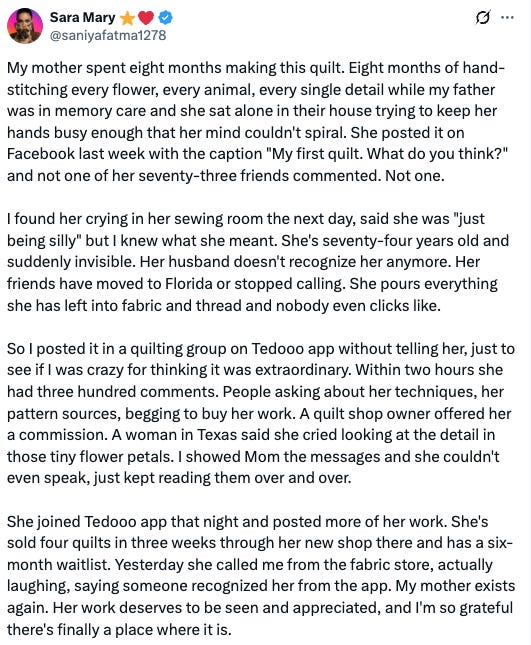
I gave this a like out of concern that my lack of recognition might render you sobbing into your macrame like the nice quilt lady you so wonderfully included. I will seek to be more consistent with this, as I rarely don’t love your weekly exploits.























The Hundertwasser toilet block in northern Aotearoa is just as good as one would expect. I discovered Hundertwasser when I visited Caroline G. in Vienna in 2005. I was head-over-heels in love with her, after meeting her a couple of months earlier in Cádiz, but discovered she had a boyfriend. Phooey.
I gave this a like out of concern that my lack of recognition might render you sobbing into your macrame like the nice quilt lady you so wonderfully included. I will seek to be more consistent with this, as I rarely don’t love your weekly exploits.