

Kill me now edition
And other things I discovered this week on my travels

Saving the world as the financial year ticks over

Effective altruism is on my tail. Their trusty CRM has revealed that I have not donated for at least 12 months. Accordingly, a donor has offered to match my contribution up to $5,000. That means I can offer to match all readers' donations up to $2,500. To activate this offer and effectively multiply your contribution fourfold, donate at this link. You’ll see that the ‘how did you hear about us’ field is already filled in — as per the image above. Please donate within the week to give me the chance to match your donation before the end of the financial year (while watching the soccer). Then again, you know about procrastination right? So don’t put it off. Do it now, and just feel the worms in those African tummies turn up their toes as you press “submit” (worm toes obviously, please don’t be difficult).
Because EA are privacy hounds (like all self-respecting folks these days), on receipt of your donation, they say they’ll send you an email and ask for your permission to tell me your name and the amount you’ve donated. It’s very important that we do it like this, because pre-authorising disclosure on this newsletter would be the thin end of the wedge and might eventually lead to another lab leak.
When too much Hobart Stadium is barely enough
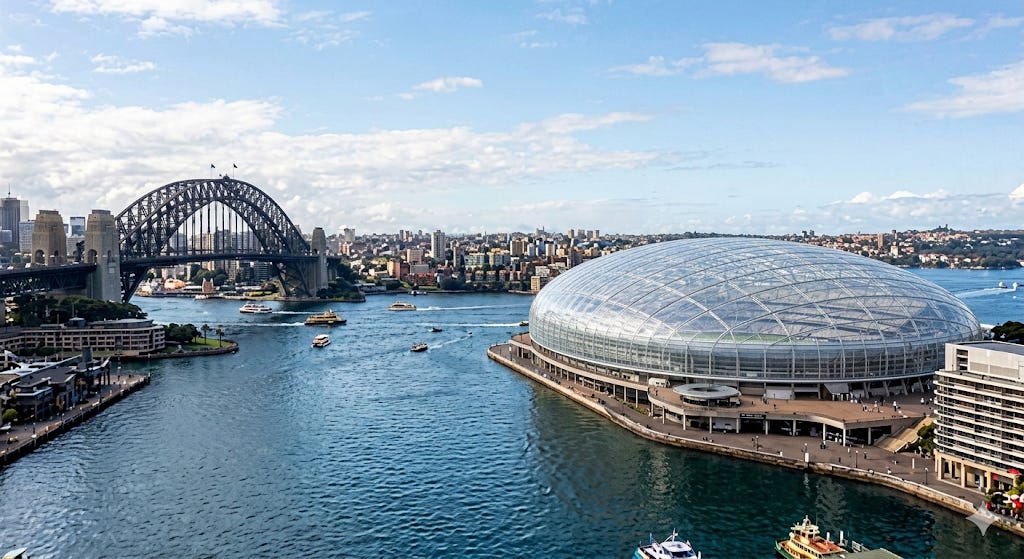
The proponent of the Lateral Economics report on the rising cost of Hobart’s waterfront stadium released it as AFL clubs were meeting. So I ended up doing quite a few media interviews about it. I reproduce two I did - the first with the indefatigable Leon Gettler, the second with Nick Feik, whose fatigability remained undetermined at the time of the interview, not that there’s anything wrong with that.
Leon Gettler


The pernicious nihilism of glass half fully empty history

I wasn’t too sympathetic to the right in Australia’s history wars during John Howard’s reign, with people like Keith Windshuttle obsessing about how few natives were killed in Tasmania wars and various attempts to argue that the removal of children purely on the grounds of race was okay. Be that as it may, it seems culturally catastrophic for a country to be unable to identify things to be celebrated about its national achievement along with the inevitable shameful episodes. Alas, a country with apparently boundless faith in its own manifest destiny seems to have ground to a very bitter halt. I’m not sure we’re doing much better.
On a July afternoon in 2019, I found myself in a large, sun-dappled room within one of America’s great estates. An assemblage of distinguished jurists, Ivy League professors, nonprofit leaders, journalists, and theologians sat around me in a half circle. I was trying to be on my best behavior, but I blurted out a word dirty enough to make them blanch.
An independent commission had spent the previous year contemplating the dismal state of American democracy. In dozens of focus groups... participants quickly identified sources of division—but requests to name things that united them as Americans were generally met with nervous laughter. Our first exercise was to list words all Americans could endorse. Searching for one so anodyne no one could object, I thought about the improbability of my own existence: a grandfather from Greek immigrants above Sparta, another from Jewish immigrants from what is now Belarus, other ancestors fleeing Puritan persecution, Ukrainian pogroms, Spanish repression in Cuba. Where else would a life like mine even be possible?...
“Patriotism,” I volunteered.
I had rolled a live grenade into the center of the room.... One woman said the word made her feel excluded. Another said it connoted violence and racism. The facilitator declined to write it on the easel. All these people had come to find a common narrative. What hope did that project have if they could not even agree—each in their own way—on loving the country they were trying to save?...
For more than two centuries, our creedal nationalism—built around equality, rights, and opportunity rather than shared religion or ethnicity—has bound together Americans of diverse faiths and backgrounds. But lately we have discovered it is also a vulnerability. To a country built on an idea, the inability to tell a common story might well prove fatal.
The traditional American story has come under sustained attack from both flanks. The left has pushed to redefine the United States as exceptional mostly for its flaws; the right has sought to... lay claim to the nation on behalf of “heritage Americans.” Unable to agree on how to tell our story, we have swiftly abandoned efforts to tell it at all.... Without a coherent national story, we will fail to be a coherent nation....
The historian Johann Neem identifies three competing schools. The “mainstream” treats the US as a work in progress—an ongoing struggle between best impulses and worst. The “post-American” left sees a settler-colonial nation founded in white supremacy, irredeemably oppressive.... The “hyper-American” right treats slavery as a deviation from the country’s founding truths rather than the system on which it was built.... Trump’s 1776 Commission called for approaching history “with reverence and love.” Vance went further: “America is not just an idea... we’re a particular place, with a particular people.”
Neem discerns a strange convergence: both far right and far left agree that America’s history has been defined by whiteness—the left refusing to assimilate immigrants into a culture tainted by it, the right viewing immigrants as a threat to it.... Naturalized citizens, more patriotic than native-born Americans, are being excluded by this narrowing story....
Historians who spent decades decentering the nation awoke to find they had ceded the task to the likes of Bill O’Reilly.... Nikole Hannah-Jones’s 1619 Project placed slavery at the center—controversial, yet it yielded something unexpected. Researching why newly emancipated slaves didn’t leave the country that had wronged them, she found them arguing that having gained rights and citizenship, they could not abandon the only land they had ever known.... “I think that’s the first time I ever felt I could see a path to patriotism,” she told me.
The evidence is that studying dark chapters doesn’t erode patriotism.... Hannah-Jones reported never having someone “walk away and say they hate this country. They say they’re ashamed of things this country has done... and they want to see the country be better.” Americans appear aligned not with Decatur’s “My country, right or wrong,” but with Carl Schurz’s addition: “If right, to be kept right; and if wrong, to be set right.”
The whole American story deserves to be told. People are hungry to hear it.... “Realizing what we’re losing might enable us to remember the America we want,” Neem said.... For us, the living, their unfinished work remains.
Lovely … and strange as
Perfect for your set of steak knives


Or really any stakeholders.
Twilight of the liberal Jew

Right-winger Nathan Cofnas, recently cancelled, for his scholarly pursuit of the relation between race and IQ, wrote this in 2023. It reflects on a noteworthy phenomenon - the transition from the Jewish presence in politics being left-wing to the current state of affairs when it is anything but.
Jewish Americans are shifting rightwards.
Who are the most politically influential American Jews under the age of 40? There are five in the top tier. Ben Shapiro is an orthodox Jew who is the face and cofounder of what is arguably the leading conservative alt-media company, The Daily Wire. Chaya Raichik is an orthodox Jewish woman who runs the “Libs of TikTok” Twitter/X account, which is the main organising force behind resistance to gender ideology. Stephen Miller, who was senior advisor to President Donald Trump, might be the most important anti-immigration activist. Vox cofounder Ezra Klein is the king of establishment-liberal wonkery. Facebook founder Mark Zuckerberg seems more concerned with building his metaverse dystopia than influencing politics, though he often follows orders from the Democratic Party.
Compared to a list of prominent boomer Jews, the list of millennials skews heavily conservative and religious. This is not a fluke. The times they are a-changin’, and the era of the liberal Jew is coming to an end. When Elena Kagan was appointed to the Supreme Court in 2010, she was one of three Jewish justices. With Ruth Bader Ginsburg’s death and Stephen Breyer’s retirement, Kagan is the only one left. ...
The main reason for this shift is demographics. With rare exceptions, the first step to becoming a prominent liberal Jew is to be born to liberal Jewish parents. That is becoming a rare occurrence. According to Pew Research Center, amongst non-orthodox Jews who married in the 2010s, the intermarriage rate was 72 per cent. ... Amongst the offspring of intermarriage, 82 per cent go on to marry non-Jews. Even when liberal Jews do marry each other, their fertility is low. Pew reports that the average non-orthodox Jew has 1.7 children compared with 4.1 children for orthodox Jews. As Covid taught us, exponential growth catches up with you faster than you expect. In 2012, 74 per cent of all Jewish children in New York City were orthodox, and by now the percentage is certainly higher. In a few decades, secular liberals will be swamped. Amongst the five Jews I mentioned above, only the conservatives (Shapiro, Raichik and Miller) have Jewish spouses.
There’s a myth that liberal Jews are highly ethnocentric and committed to Jewish group continuity. They rarely behave this way, however. Liberal versions of Judaism are universalistic and strongly deemphasize the ethnic component of the religion. [Reform Judaism recruits converts, dilutes Jewish tradition into humanism, and often combines this with anti-Israel activism, destroying secular Jewish identity.] If liberal Jews wanted to take over America (as certain people on the right have argued is their endgame), they could easily have done so by marrying each other and having four children each. Almost no one did this because almost no one had that goal.
The left wants to hear about microaggressions, not the Holocaust
With their numbers falling sharply, the few Jews who are left face stiff competition from other minority groups. Eric Kaufmann refers to this phenomenon as “trading places”. Jews at universities and other institutions are losing out to high-performing Asians as well as Blacks who are more favoured under the new leftist ideology. In 1925, Jews were 25 per cent of Harvard undergraduates. Today, just six per cent of undergraduates at Harvard — and seven per cent of students at all Ivy League universities — say their religion is Judaism. ... According to Hillel, Jews comprise 9.8 per cent of Harvard undergraduates. In surveys conducted by Kaufmann, amongst elite academics in the social sciences and the humanities who are over the age of 65, 24 per cent were Jewish and zero per cent were Asian. Amongst those aged 30 and under, six per cent were Jewish and 18 per cent were Asian.
Jacob Savage argues that “the most significant cause of the decline isn’t Jews themselves, but that American liberalism … has turned on us”. Regardless of whether this is in fact the most significant cause, it is certainly important. Contrary to Ron Unz’s false claims about a cratering of Jewish achievement, there is still a sizable (albeit much smaller) population of secular Jews who are as capable as their ancestors. The melanin-focused left no longer celebrates Jewish success, instead viewing Jews as privileged white people. ...
It’s true that there are several Jews occupying high positions in the Biden administration. A Jewish civil rights organisation, the Anti-Defamation League (ADL), is also having a moment in the spotlight. This is the last gasp of liberal Jewish influence. Jewish cabinet members are boomers who are cashing in on status that they built up decades ago. When they retire, most of them will not be replaced by Jews. The ADL has become the boogieman of the far right, and largely for this reason the liberal establishment rallied to its defence. There is no long-term future for the ADL as a leader of woke America, however. The social-justice left wants to hear about microaggressions, police shootings and slavery, not Jews and the Holocaust. They certainly don’t want to hear anything from a straight white man like ADL CEO Jonathan Greenblatt.
Whatever is distinctive about Jews won’t survive two to three generations of intermarriage. Although there will be millions of gentiles in America with distant Jewish ancestry (as there are in Spain and Germany), the mark of the liberal Jew will fade from American culture. With fewer and fewer liberals in the public eye, Jews will increasingly be stereotyped as religious and right wing.
The times, boy are they a’changin
Speaking of Jews

Robert Manne on Hannah Arendt on Zionism
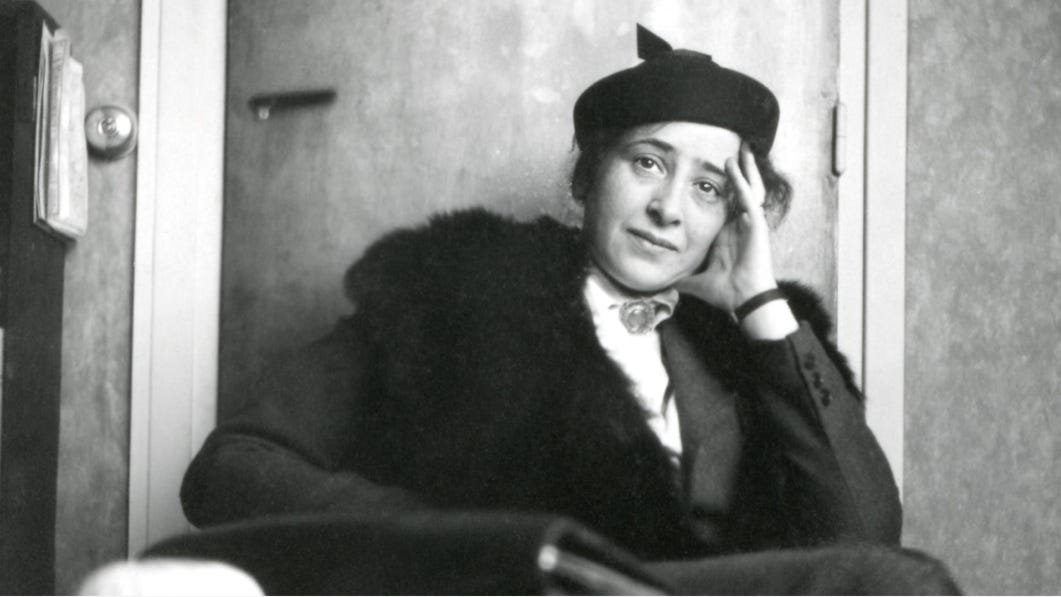
You heard it first here on this newsletter. Hannah Arendt thought the project of Israel would be doomed if it was built on a war against the Arabs. And here we are. A fine piece from Robert Manne.
...Because of “October 7”, the vicious Hamas-led mass murder of approximately a thousand Israeli Jews, the Israel Defence Forces began their pitiless destruction of Gazans and Gaza... What I have been trying to understand is why the Jewish people, who suffered the Holocaust—arguably the worst crime in history—have been willing some eighty years later to support a government conducting a policy of genocide in Gaza.
Recently I returned to the essays about Israel of Hannah Arendt, widely regarded as the most important political writer of the twentieth century. Arendt was not a supporter of a Jewish state in Palestine but of the Jewish right to a “homeland” there... She was part of the Ihud group, whose members understood that unless Jews first made peace with the Arabs, the Jewish homeland would end in disaster.
In Hannah Arendt: The Jewish Writings, I came upon “To Save the Jewish Homeland”, written in 1948...
For Arendt, Jewish unanimity about creating a Jewish state before any Jewish-Arab settlement was certain to spell disaster. If the Jewish state was “extinguished in another catastrophe…this would become the central fact of Jewish history and it might become the beginning of the self-dissolution of the Jewish people.”... Arab-Jewish cooperation was “not an idealistic daydream but a sober statement of the fact that without it the whole Jewish venture in Palestine is doomed.”
After the Holocaust, Arendt feared, Zionist feeling had “seized all sections of the Jewish people: the cynical and deep-rooted conviction that all gentiles are antisemitic…” “After two thousand years of ‘Galuth mentality’ [—the psychological and cultural adaptation of Jews in the Diaspora—] the Jewish people have suddenly ceased to believe in survival as an ultimate good in itself… Now Jews believe in fighting at any price…”
At the extreme, Jews had turned to terrorism. Arendt called for “the elimination of all [Jewish] terrorist groups…and swift punishment of them.” She was referring to the Irgun—whose leader, Menachem Begin, later became Israel’s Prime Minister—responsible for “the massacre of Deir Yassin”, which played a role in the flight of 700,000 Palestinian Arabs, the Nakba... These acts “were intended to arouse the wrath of the Arab people in order to cut off the Jewish leadership from all temptations to negotiate.”
An Arab-Jewish war was now certain. Even if the Jews won, “the ‘victorious’ Jews would live surrounded by an entirely hostile Arab population, secluded inside ever-threatened borders, absorbed with physical self-defence to a degree that would submerge all other interests and activities.”...
Arendt’s alternative was a binational federation under United Nations trusteeship... Such proposals would be dismissed as “stabs in the back.” “They are neither; they are, on the contrary, the only way of saving the reality of the Jewish homeland.”...
Alas, it was. And the idea of the stab in the back is still with us after eighty years.
On May 5 1948, Judah Magnes—President of the Hebrew University in Jerusalem and Arendt’s collaborator—met President Truman, pleading for a United Nations trusteeship over Palestine. A few days later, partly for electoral reasons, the United States recognised the Jewish state. The humanistic stream of Zionist thought ceased to matter.
In 1952, Arendt described Magnes as “the conscience of the Jewish people”: “A people that for two thousand years had made justice the cornerstone of its spiritual and communal existence has become emphatically hostile to all arguments of such a nature…The fact is that nobody among the Jewish people could succeed Magnes. This is a measure of his greatness; it is, by the same token, the measure of our failure.”
And yet over the past nearly eighty years: 700,000 Palestinians expelled or killed in 1948; existential wars survived; Arab citizens treated as second-class; the West Bank and Gaza occupied; illegal settlements supported; Gaza turned into “an open-air prison” with “mowing the lawn” campaigns; and since October 7, some one hundred thousand Gazan Palestinians slaughtered and Gaza reduced to rubble...
Intellectuals like Hannah Arendt are commonly regarded as hopeless, idealistic dreamers. However, in the case of the creation of the Israeli state in 1948, compared to Chaim Weizmann, David Ben-Gurion, or Menachem Begin, it was Hannah Arendt who was the realist.
[*The Revisionists, later the Herut and then the Likud Party, have led most of Israel’s governments since the late 1970s. Their current leader is Benjamin Netanyahu. RM’s square brackets - not mine - NG.]
Two sides to James Taylor’s masterpiece
Tim Harford at his storytelling best

A lovely chamber piece by Tim Harford.
He didn’t go to sample the Dolcetto d’Alba, I’m fairly sure of that. John Lombe’s mission was industrial espionage. He travelled to Piedmont with the goal of learning the Piedmontese art of spinning silk into strong yarn. Nobody was likely to teach him, so instead he waited until everyone was asleep, and sketched diagrams of the spinning machines by candlelight.
In 1717, Lombe brought them back to Derby and there, by the fast-flowing Derwent, he and his half-brother Thomas built the first large factory in the world. Lombe died suddenly at the age of 29.... Rumour has it that the Piedmontese sent an “artful woman” to assassinate him.
Whether or not that is true, the protection of trade secrets has long been a game with high stakes. Glass masters of Murano had many of the privileges of Venetian nobility, but were not allowed to leave Venice without permission, and to share the secrets of Murano glass with a foreign power would be to invite the death penalty.... France’s finance minister Jean-Baptiste Colbert enticed Venetian masters to share them, and by the late 1600s the best French glass rivalled that of Venice.
The death penalty no longer applies to those who reveal trade secrets. They may, however, come to wish they were dead. In 1962, chemical engineer Donald Wohlgemuth announced his intention to quit BF Goodrich to join competitor International Latex. In another case, bakery executive Chris Botticella resigned from Grupo Bimbo in 2010 to join Hostess Brands. In both cases, the jilted employers sued.... The secrets? For Goodrich, arcane techniques in making spacesuits for Nasa. For Bimbo, the baking process necessary to produce the celebrated “nooks and crannies” of Thomas’ English Muffins.
After a gruelling legal process, Wohlgemuth eventually started work at Latex.... The vivid parallel cited in the case: an employee with secrets was like a dog with teeth — there can be no presumption that the dog is dangerous until it uses them. Every dog has one free bite.
But if Wohlgemuth was chastened, Botticella was distraught. Hostess Brands withdrew the offer.... Botticella lost both jobs and later told the Revisionist History podcast, “You will never understand the impact that this had on my personal and professional life.”
It could have been worse. In 2016 Anthony Levandowski left Waymo to set up a self-driving start-up swiftly acquired by Uber, and was soon accused of stealing trade secrets. He received an 18-month prison sentence; Uber paid almost a quarter of a billion dollars in settlement.
These cases have more nooks and crannies than a Thomas’ English Muffin. Did Grupo Bimbo actually have a superior product, or were they killing two birds with one stone — making it hard for employees to join a competitor while burnishing questionable claims to something special?...
Not that trade secrets are meaningless. Albrecht Glitz and Erik Meyersson concluded that East German informants in the 1970s and 1980s divulged enough to bring East Germany’s productivity measurably closer to that of West Germany.... The spilling of trade secrets will sometimes genuinely harm the company that loses them. But there is a balance: too little protection, and nobody will invest in the know-how to build a self-driving car or bake a perfect muffin; too much is a recipe for monopoly power and stifled creativity.
There is a good case for protecting expensive ideas — the design of a plane or the formula of a pharmaceutical compound — for a limited period. But that should not be an excuse for shackling employees. And whatever the legal merits of the Botticella case, it is hard to see a public policy justification for defending a muffin recipe that Grupo Bimbo boasts is 146 years old.
Fortunately, most trade secrets don’t last. Edwin Mansfield’s 1985 survey of 100 US firms found that competitors learned about new products in about a year, and new processes in about 15 months....
From silk to spacesuits to self-driving cars, we should presume that workers will travel, and that even if they cannot copy blueprints or algorithms, they can be expected to take good ideas with them. Silicon Valley itself was built on such movement. The world is generally better off if good ideas do not take too long to spread.
David Hockney
I didn’t much like the stuff that made David Hockney’s reputation, but his later stuff is lovely.


Fascinating

Adam Tooze on China, the renewables juggernaut

If you’re the size and capability of China, it’s pretty extraordinary what you can do with a policy decision and a pile of money.
The closure of the Strait of Hormuz has roiled energy markets. Consumers are calling out for alternatives to unreliable fossil fuels. And yet we are in a world of surplus solar panels. Let that sink in.
After a huge surge in investment since 2020, Chinese companies have the capacity to produce a vast 1,000 gigawatts of panels per annum. The world cannot absorb the supply. More than 40 Chinese solar manufacturers have gone bust, been bought out or delisted. A third of the workforce at the top five survivors has been made redundant.
Clean power, on a scale that would have seemed utopian at the time of the Paris climate treaty in 2015, is now within reach. The price of solar panels has fallen to rock bottom. And yet factories are idling.
We have a variety of well-rehearsed arguments for discounting this dizzying state of affairs.
It’s an engineering problem. Solar creates too much intermittency. Battery storage is still catching up.
It’s a political economy problem. Incumbent baseload generators demand their pound of flesh. China’s own huge fleet of coal-fired power stations squeezes out demand for more solar and wind.
“It’s capitalism, innit.” ... The “relations of production” — geopolitics, national security concerns, protectionism — obstruct the forward march of the green forces of production. ...
It’s China’s own fault. New research from the OECD shows that the solar industry is the most subsidised sector in the world. Once President Xi Jinping announced his commitment to decarbonisation in September 2020, overbuilding and involution were inevitable. ... If China does not absorb its own surplus production, don’t be surprised if the rest of the world cannot. ... China’s investment-driven, mercantilist model is its own worst enemy.
In general, these are fair arguments. If we were talking about steel or cement, one would nod and agree. But solar panels? Since when were solar panels just another commodity? They are a technological miracle. They make us into farmers of the sun. ... Together with batteries, which are also rapidly approaching the point of excess supply, they are the key to a sustainable future.
The real surprise from the OECD’s subsidy numbers is that it cost China less than $18bn in sectoral support over 15 years to build an industry that can now provide more clean power than the world can readily absorb. If industrial policy in the west had delivered this kind of bang for its buck, we would be patting ourselves on the back.
From the point of view of climate policy, what we are facing is a horrifying co-ordination failure — what John Maynard Keynes would have called a “muddle”. How can we be allowing a recession in the solar industry just as the renewable sector is reaching escape velocity?
But there is no need to panic. ... China’s solar players, unlike their European counterparts in the early 2010s, are not in danger of withering away. ... Exports of Chinese solar tech to pretty much everywhere other than the US are booming. Solar panel manufacturers are now integrating batteries to offer more stability to the grid. ...
Most notable is the Mission 300 programme through which the World Bank and the African Development Bank hope to provide clean and reliable power to 300mn people in Africa. ...
The clean electro-tech revolution will triumph. Dirt-cheap solar panels and batteries are its shock troops. But mark 2026 as the moment when the world found itself with “more than enough” solar panels and we shrugged.


Major consulting companies and their values
There’s not much to say, but in light of the latest revelations about KPMG, I got Claude to run up a table of the various misdeeds of major Australian consulting companies and how they stacked up against what they call their ‘values’.
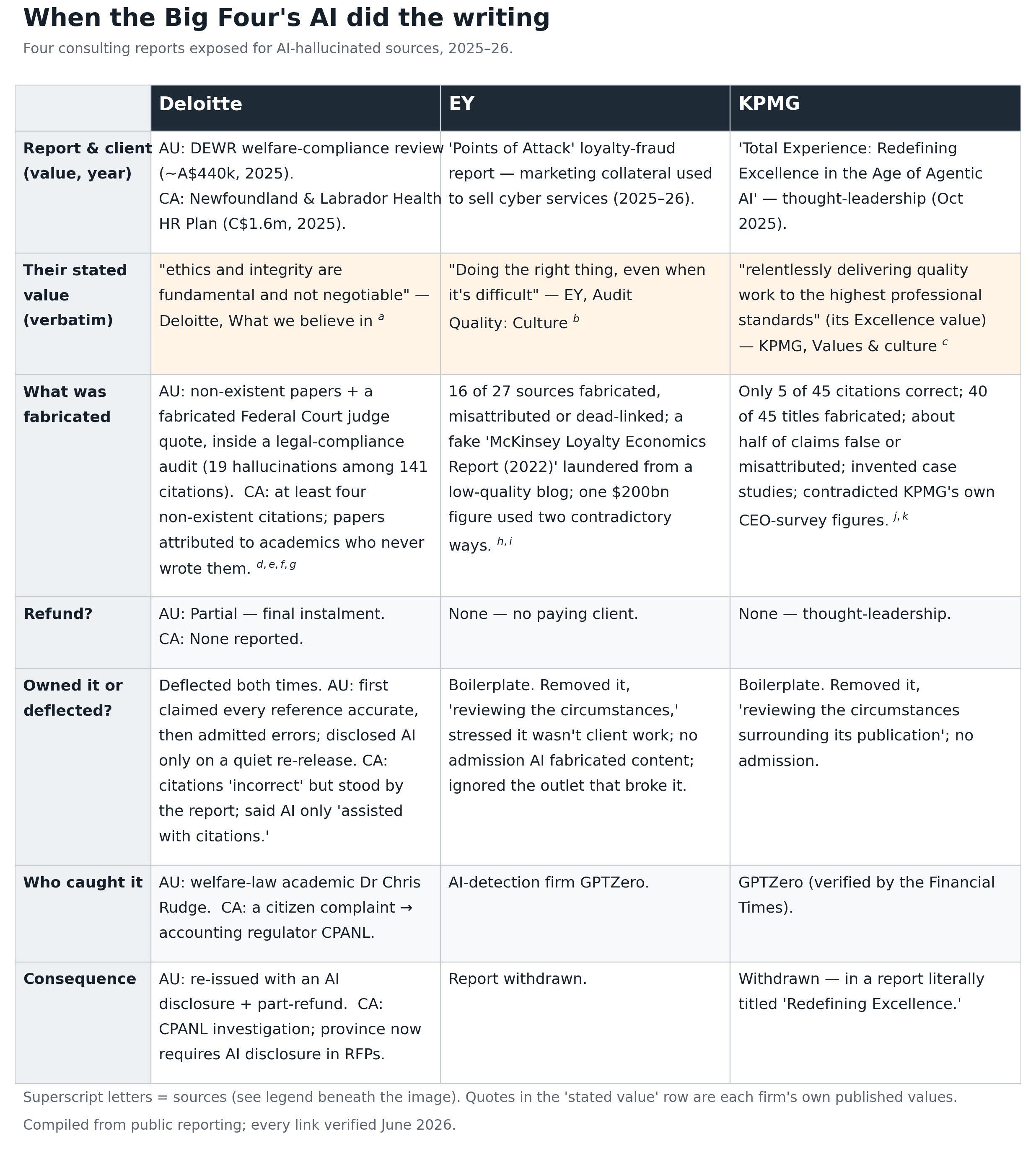
1 Click on the footnote for further sources on the table.
Commendably balanced report

Nice to see this exploration of Australian media bias - left and right. It seemed pretty even-handed to me.


Deborah Halpern





Kos Samaris blogs up a storm

Astute political strategist and social researcher, Kos Samaris has been worth reading for a long time but he seems to be really hitting his stride right now. Here’s his LinkedIn introduction to an article for Pearls and Irritations which you can read by clicking through on the blue button.
Every few years our political class goes looking for the “quiet Australians.” In 2019 they found a flattering fiction…..the aspirational mortgage-belt couple, the franking-credit retiree, the tradie worried about his ute that was being threatened by EVs. It was all BS. There was zero data behind any of it. But it told us exactly which Australians our political and commentariat class are willing to lend agency to. It’s almost never the people who actually are the real quiet Australians.
The real ones don’t read the opinion pages. They empty your bins. They wipe your parents in aged care. They clean the office after you’ve gone home. They work the night shift at the meatworks. And the political class treats their labour as the one cost that can always be squeezed and the one claim that can always be deferred.
Watch what happened when 7,000 ASU members stopped Melbourne’s bins this year. The councils blamed the state’s rate cap. The state said the councils were sitting on healthy surpluses and crying poor. Each side pointed at the other, and the garbo, a human being who just wanted to stop picking up weekend shifts to break even, dissolved into the gap between two institutions. That’s the bet our political class makes again and again: muddy who’s responsible, and the public will shrug and move on.
But voters aren’t fooled, and this is where the political class keeps getting it catastrophically wrong. In Hume, the council that told 17,000 households their bins were a casualty of state stinginess is the same council that found $24 million to restore the Broadmeadows Town Hall. The money is always there for the building, the precinct, the plaza, their own renos. It’s the people who keep the suburb from drowning in its own waste who are told the well has run dry, that there is no money to help them feed their kids.
This is why the system is being turned over. We keep telling ourselves the revolt against the major parties, the surge to One Nation, is a story about culture or grievance or misinformation. A moral failing in the voter to be fixed with better messaging. It is nothing of the sort. It is an entirely rational response from an outer-suburban, mortgage-stressed working class that has watched its political class find money and agency for everyone except people like them.
My article on why Garbos are just as important as health workers - below.


Kill me now

I filed this one under “Kill me now”.
Perhaps it’s just me, but I found this piece, recommended to me by a great authority as “excellent”, deeply mysterious. Its proposal for turning the UK around appears to be, in essence, the issuing of new job descriptions for senior political and bureaucratic officials.
These descriptions are written, as it were, on a clean sheet of paper. They set out what these roles ought to be for, while almost entirely ignoring the incentives that prevent them from being performed in that spirit.
Take the prime minister. We like to imagine the job as that of the head, or chief executive, of a large political and bureaucratic organisation whose purpose is to govern the country as well as possible. No doubt the prime minister would be happy to do this in his spare time. But his first imperative is to get re-elected.
Something similar could be said of each of the roles discussed in the post. Yet, at least as I read it, the piece describes them in a way that is almost wholly detached from this reality — which is precisely the reality that constitutes the problem.
To give you a taste, I’ll reproduce its description of the prime minister’s job, and leave it to you to decide whether such a description could help bring about the transformation it yearns for.
Prime Minister
Changing the story: From pessimism and decline to optimism and possibility
Job Description
To set a powerful direction for the country
To understand the future and position the country to take advantage of the opportunities and mitigate the risks
To hold the space for a purposeful national conversation
To drive change with unrelenting pace and direction
To exercise sound judgement on vital matters including national security and unexpected crises
To attract the best talent and build high functioning teams.


Heaviosity half hour (Nazi Schmazi edition)
Preface to the Second Edition (1926): On the Contradiction between Parliamentarism and Democracy

Carl Schmitt, later to become a Nazi, made some good points about what a hollowed-out thing parliamentary democracy was. Of course, it hadn’t been going long in Weimar Germany, but his points weren’t too wide of the mark in all parliamentary democracies of the time and are uncannily more on the money today. It’s so bad it’s hard to imagine anything worse. Anyway, Carl and his colleagues did.
On the Contradiction between Parliamentarism and Democracy. The second edition of this examination of the intellectual circumstances of contemporary parliamentarism remains essentially unchanged. This should not create the impression that I wish to lift it above any discussion. There are rather grounds for a somewhat contrary fear. A calm and factual debate that distances itself from all party-political exploitation, and serves as propaganda for no one, might appear impractical, naive, and anachronistic to most people today. It is thus to be feared that an objective discussion of political concepts will arouse scant interest and that the desire for such a debate will meet with little understanding. Perhaps the age of discussion is coming to an end after all. When the first edition of this treatise appeared in the summer of 1923, it was generally received in such a way as to confirm these pessimistic conjectures at least in this modest case. Nevertheless, it would be unjust to ignore specific examples of objective criticism, and the detailed and thoughtful review of such a leading jurist as Richard Thoma in particular deserves an exhaustive reply.
The utterly fantastic political aims that Thoma imputes to me at the end of his review I may surely be allowed to pass over in silence. Political combinations aside, his objective argument concerns my identification of the intellectual basis of parliamentarism in an outmoded system of thought, because I regard discussion and openness as the essential principles of parliament. Something of the sort may perhaps have been the definitive conception a few generations ago, but parliament today has for a long time stood on a completely different foundation. That belief in openness and discussion appears today as outmoded is also my fear. But it must then be asked, What sort of arguments or convictions are these which have given a new intellectual foundation to parliamentarism?. Naturally, institutions, like people’s ideas, change in the course of time. But I do not see where contemporary parliamentarism could find a new intellectual foundation if the principles of discussion and openness really are inapplicable, or how the truth and justice of parliament could still be so evident. Like every great institution, parliament presupposes certain characteristic ideas. Whoever wants to find out what these are will be forced to return to Burke, Bentham, Guizot, and John Stuart Mill. He will then be forced to admit that after them, since about 1848, there have certainly been many new practical considerations but no new principled arguments.
In the last century, one scarcely noticed this because parliamentarism advanced at the same time and in the closest alliance with democracy, without either of them being carefully distinguished from the other. But today after their common victory, the difference manifests itself and the distinction between liberal parliamentary ideas and mass democratic ideas cannot remain unnoticed any longer. Therefore one has to concern oneself with those “moldy” greats, as Thoma puts it, because what is specific to parliamentarism can only be gleaned from their thought, and only there does parliament retain the particular character of a specially founded institution that can demonstrate its intellectual superiority to direct democracy as well as Bolshevism and Fascism. That the parliamentary enterprise today is the lesser evil, that it will continue to be preferable to Bolshevism and dictatorship, that it would have unforeseeable consequences were it to be discarded, that it is “socially and technically” a very practical thing—all these are interesting and in part also correct observations. But they do not constitute the intellectual foundations of a specifically intended institution.
Parliamentarism exists today as a method of government and a political system. Just as everything else that exists and functions tolerably, it is useful—no more and no less. It counts for a great deal that even today it functions better than other untried methods, and that a minimum of order that is today actually at hand would be endangered by frivolous experiments. Every reasonable person would concede such arguments. But they do not carry weight in an argument about principles. Certainly no one would be so undemanding that he regarded an intellectual foundation or a moral truth as proven by the question, What else?.
All specifically parliamentary arrangements and norms receive their meaning first through discussion and openness. This is especially true of the fundamental principle that is still recognized constitutionally, although practically hardly still believed in today, that the representative is independent of his constituents and party. It applies to the provisions concerning freedom of speech and immunity of representatives, the openness of parliamentary proceedings, and so forth. These arrangements would be unintelligible if the principle of public discussion were no longer believed in. It is not as if one could ascribe other principles retrospectively and at will to an institution, and if its hitherto existing foundations collapse, just insert any sort of substitute arguments. Certainly the same institution can serve different practical purposes and thus allow various practical justifications. There is a “heterogeneity of purposes,” shifts in meanings from the practical point of view, and functional changes in practical means, but there is no heterogeneity of principles. If we assume with Montesquieu, for example, that the principle of monarchy is honor, then this principle cannot be foisted onto a democratic republic any more than a monarchy could be founded on the principle of open discussion. Indeed, a feeling for the specificity of principles seems to have disappeared and an unlimited substitution to have taken its place.
In the review by Thoma mentioned above, that is really the basic idea of all the objections he raises to my article. But he does not reveal in any way at all, unfortunately, what the apparently so abundant new principles of parliamentarism are. He is satisfied in a short reference to mention “only the writings and speeches of Max Weber, Hugo Preuss, and Friedrich Naumann” in the years from 1917 onward. What did parliamentarism mean to these German liberals and democrats struggling against the imperial political system?. Essentially and most importantly it was a means for selecting political leaders, a certain way to overcome political dilettantism and to admit the best and most able to political leadership. Whether parliament actually possesses the capacity to build a political elite has since become very questionable. Today one would certainly not think so optimistically about this selection instrument; many would regard such hope as already outmoded, and the word illusory, which Thoma uses against Guizot, could easily be applied to these German democrats.
What numerous parliaments in various European and non-European states have produced in the way of a political elite of hundreds of successive ministers justifies no great optimism. But worse and destroying almost every hope, in a few states, parliamentarism has already produced a situation in which all public business has become an object of spoils and compromise for the parties and their followers, and politics, far from being the concern of an elite, has become the despised business of a rather dubious class of persons. For a principled reflection, that is still not decisive. Whoever believes that parliamentarism guarantees the best selection of political leaders remains convinced of that, at least today, not because of idealistic belief, but rather as a practical-technical hypothesis constructed on the English model, intended for application on the Continent, which one could reasonably discard if it did not succeed. Nevertheless, this conviction can also be linked to belief in discussion and openness, and then it belongs to principled arguments for parliamentarism.
Parliament is in any case only “true” as long as public discussion is taken seriously and implemented. “Discussion” here has a particular meaning and does not simply mean negotiation. Whoever characterizes every possible kind of deliberation and agreement as parliamentarism and everything else as dictatorship or tyranny—as M. J. Bonn does in his Die Krisis der europäischen Demokratie and also Richard Thoma in the review mentioned above—avoids the real question. At every diplomatic conference, in every congress of delegates, in every board of directors, deliberation goes on, just as it does between the cabinets of absolute monarchs, between corporations, between Christian and Turk. The modern institution of parliament does not arise from these. One should not dissolve concepts and ignore the specific qualities of discussion.
Discussion means an exchange of opinion that is governed by the purpose of persuading one’s opponent through argument of the truth or justice of something, or allowing oneself to be persuaded of something as true and just. Gentz—in this matter still instructed by the liberal Burke—puts it well: The characteristic of all representative constitutions (he meant modern parliament in contrast to corporative representation or the estates) is that laws arise out of a conflict of opinions (not out of a struggle of interests). To discussion belong shared convictions as premises, the willingness to be persuaded, independence of party ties, freedom from selfish interests. Most people today would regard such disinterestedness as scarcely possible. But even this skepticism belongs to the crisis of parliamentarism. The features just mentioned, which still officially belong to parliamentary constitutions, make quite clear that all specifically parliamentary arrangements assume this particular concept of discussion. The universally repeated maxim, for example, that every member of parliament is the representative, not of a party, but of the whole people and is in no way bound by instructions (repeated in article 21 of the Weimar constitution) and the recurring guarantees of freedom of speech and public sittings only make sense in terms of a correct understanding of discussion.
By contrast conduct that is not concerned with discovering what is rationally correct, but with calculating particular interests and the chances of winning and with carrying these through according to one’s own interests is also directed by all sorts of speeches and declarations. But these are not discussions in the specific sense. When two businessmen have agreed after a trade rivalry to talk about mutual business opportunities, both have an eye naturally on their own profits, but they can still arrive at a businesslike compromise. Openness is just as inappropriate in this kind of deliberation as it is reasonable in a real discussion. There has been deliberation and compromise, as has already been noted, everywhere in world history. People know that it is better most of the time to tolerate one another than to quarrel and that a thin settlement is better than a thick lawsuit. That is without a doubt true, but it is not the principle of a specific kind of state or form of government.
The situation of parliamentarism is critical today because the development of modern mass democracy has made argumentative public discussion an empty formality. Many norms of contemporary parliamentary law, above all provisions concerning the independence of representatives and the openness of sessions, function as a result like a superfluous decoration, useless and even embarrassing, as though someone had painted the radiator of a modern central heating system with red flames in order to give the appearance of a blazing fire. The parties (which according to the text of the written constitution officially do not exist) do not face each other today discussing opinions, but as social or economic power-groups calculating their mutual interests and opportunities for power, and they actually agree compromises and coalitions on this basis. The masses are won over through a propaganda apparatus whose maximum effect relies on an appeal to immediate interests and passions. Argument in the real sense that is characteristic for genuine discussion ceases. In its place there appears a conscious reckoning of interests and chances for power in the parties’ negotiations; in the treatment of the masses, posterlike, insistent suggestion or—as Walter Lippmann says in his very shrewd, although too psychological, American book Public Opinion—the “symbol” appears.
The literature on the psychology, technique, and critique of public opinion is today very large. One may therefore assume as well known today that it is no longer a question of persuading one’s opponent of the truth or justice of an opinion but rather of winning a majority in order to govern with it. What Cavour identified as the great distinction between absolutism and constitutional regimes, that in an absolute regime a minister gives orders, whereas in a constitutional one he persuades all those who should obey, must today be meaningless. Cavour says explicitly: I (as constitutional minister) persuade that I am right, and it is only in this connection that his famous saying is meant: “The worst chamber is still preferable to the best ante-chamber”. Today parliament itself appears a gigantic antechamber in front of the bureaus or committees of invisible rulers. It is like a satire if one quotes Bentham today: “In Parliament ideas meet, and contact between ideas gives off sparks and leads to evidence”. Who still remembers the time when Prévost-Paradol saw the value of parliamentarism over the “personal regime” of Napoléon III in that through the transfer of real power it forced the true holders of power to reveal themselves, so that government, as a result of this, always represents the strongest power in a “wonderful” coordination of appearance and reality?. Who still believes in this kind of openness? And in parliament as its greatest “platform”?.
The arguments of Burke, Bentham, Guizot, and John Stuart Mill are thus antiquated today. The numerous definitions of parliamentarism which one still finds today in Anglo-Saxon and French writings and which are apparently little known in Germany, definitions in which parliamentarism appears as essentially “government by discussion,” must accordingly also count as moldy. Never mind. If someone still believes in parliamentarism, he will at least have to offer new arguments for it. A reference to Friedrich Naumann, Hugo Preuss, and Max Weber is no longer sufficient. With all respect for these men, no one today would share their hope that parliament alone guarantees the education of a political elite. Such convictions have in fact been shaken and they can only remain standing today as an idealistic belief so long as they can bind themselves to belief in discussion and openness.
What has been advanced during the last decades as new justifications for parliamentarism still only asserts that in our time parliament functions well or at least tolerably as a useful, even an indispensable, instrument of social and political technique. This is, just to affirm it once again, a completely plausible kind of observation. But one still has to take an interest in the deeper foundations of something Montesquieu called the principle of a state or governmental form, in the specific conviction that belongs to this as to every great institution, in the belief in parliament which once actually existed and which one no longer finds today. In the history of political ideas, there are epochs of great energy and times becalmed, times of motionless status quo. Thus the epoch of monarchy is at an end when a sense of the principle of kingship, of honor, has been lost, if bourgeois kings appear who seek to prove their usefulness and utility instead of their devotion and honor. The external apparatus of monarchical institutions can remain standing very much longer after that. But in spite of it monarchy’s hour has tolled. The convictions inherent in this and no other institution then appear antiquated; practical justifications for it will not be lacking, but it is only an empirical question whether men or organizations come forward who can prove themselves just as useful or even more so than these kings and through this simple fact brush aside monarchy.
The same holds true of the “social-technical” justifications for parliament. If parliament should change from an institution of evident truth into a simply practical-technical means, then it only has to be shown via facta, through some kind of experience, not even necessarily through an open, self-declared dictatorship, that things could be otherwise and parliament is then finished. The belief in parliamentarism, in government by discussion, belongs to the intellectual world of liberalism. It does not belong to democracy. Both, liberalism and democracy, have to be distinguished from one another so that the patchwork picture that makes up modern mass democracy can be recognized.
Every actual democracy rests on the principle that not only are equals equal but unequals will not be treated equally. Democracy requires, therefore, first homogeneity and second—if the need arises—elimination or eradication of heterogeneity. To illustrate this principle it is sufficient to name two different examples of modern democracy: contemporary Turkey, with its radical expulsion of the Greeks and its reckless Turkish nationalization of the country, and the Australian commonwealth, which restricts unwanted entrants through its immigration laws, and like other dominions only takes emigrants who conform to the notion of a “right type of settler”. A democracy demonstrates its political power by knowing how to refuse or keep at bay something foreign and unequal that threatens its homogeneity. The question of equality is precisely not one of abstract, logical-arithmetical games. It is about the substance of equality. It can be found in certain physical and moral qualities, for example, in civic virtue, in arete, the classical democracy of vertus (vertu). In the democracy of English sects during the seventeenth century equality was based on a consensus of religious convictions. Since the nineteenth century it has existed above all in membership in a particular nation, in national homogeneity.
Equality is only interesting and valuable politically so long as it has substance, and for that reason at least the possibility and the risk of inequality. There may be isolated examples perhaps for the idyllic case of a community in which relationship itself is sufficient, where each of its inhabitants possesses this happy independence equally and each one is so similar to every other one physically, psychically, morally, and economically that a homogeneity without heterogeneity exists, something that was possible in primitive agrarian democracies or for a long time in the colonial states. Finally one has to say that a democracy—because inequality always belongs to equality—can exclude one part of those governed without ceasing to be a democracy, that until now people who in some way were completely or partially without rights and who were restricted from the exercise of political power, let them be called barbarians, uncivilized, atheists, aristocrats, counterrevolutionaries, or even slaves, have belonged to a democracy. Neither in the Athenian city democracy nor in the British Empire are all inhabitants of the state territory politically equal. Of the more than four hundred million inhabitants of the British Empire more than three hundred million are not British citizens. If English democracy, universal suffrage, or universal equality is spoken of, then these hundreds of millions in English democracy are just as unquestionably ignored as were slaves in Athenian democracy.
Modern imperialism has created countless new governmental forms, conforming to economic and technical developments, which extend themselves to the same degree that democracy develops within the motherland. Colonies, protectorates, mandates, intervention treaties, and similar forms of dependence make it possible today for a democracy to govern a heterogeneous population without making them citizens, making them dependent upon a democratic state, and at the same time held apart from this state. That is the political and constitutional meaning of the nice formula “the colonies are foreign in public law, but domestic in international law”. Current usage, that is, the vocabulary of the Anglo-Saxon world press, which Richard Thoma submits to and even accepts as the standard for a theoretical definition, ignores all of that. For him apparently every state in which universal and equal voting rights are made “the foundation of the whole” is a democracy. Does the British Empire rest on universal and equal voting rights for all of its inhabitants?. It could not survive for a week on this foundation; with their terrible majority, the coloreds would dominate the whites. In spite of that the British Empire is a democracy. The same applies to France and the other powers.
Universal and equal suffrage is only, quite reasonably, the consequence of a substantial equality within the circle of equals and does not exceed this equality. Equal rights make good sense where homogeneity exists. But the “current usage” of “universal suffrage” implies something else: Every adult person, simply as a person, should eo ipso be politically equal to every other person. This is a liberal, not a democratic, idea; it replaces formerly existing democracies, based on a substantial equality and homogeneity, with a democracy of mankind. This democracy of mankind does not exist anywhere in the world today. If for no other reason than because the earth is divided into states, and indeed mostly into nationally homogeneous states, which try to develop democracy internally on the basis of national homogeneity and which, besides that, in no way treat every person as an equally entitled citizen. Even a democratic state, let us say the United States of America, is far from allowing foreigners to share in its power or its wealth. Until now there has never been a democracy that did not recognize the concept “foreign” and that could have realized the equality of all men.
If one were serious about a democracy of mankind and really wanted to make every person the equal politically of every other person, then that would be an equality in which every person took part as a consequence of birth or age and nothing else. Equality would have been robbed of its value and substance, because the specific meaning that it has as political equality, economic equality, and so forth—in short as equality in a particular sphere—would have been taken away. Every sphere has its specific equality and inequalities in fact. However great an injustice it would be not to respect the human worth of every individual, it would nevertheless be an irresponsible stupidity, leading to the worst chaos, and therefore to even worse injustice, if the specific characteristics of various spheres were not recognized. In the domain of the political, people do not face each other as abstractions, but as politically interested and politically determined persons, as citizens, governors or governed, politically allied or opponents—in any case, therefore, in political categories. In the sphere of the political, one cannot abstract out what is political, leaving only universal human equality; the same applies in the realm of economics, where people are not conceived as such, but as producers, consumers, and so forth, that is, in specifically economic categories.
An absolute human equality, then, would be an equality understood only in terms of itself and without risk; it would be an equality without the necessary correlate of inequality, and as a result conceptually and practically meaningless, an indifferent equality. Now, such an equality certainly does not exist anywhere, so long as the various states of the earth, as was said above, distinguish their citizens politically from other persons and exclude politically dependent populations that are unwanted, on whatever grounds, by combining dependence in international law with the definition of such populations as alien in public law. In contrast it appears that at least inside the different modern democratic states universal human equality has been established; although there is of course no absolute equality of all persons, since foreigners and aliens remain excluded, there is nevertheless a relatively far-reaching human equality among the citizenry. But it must be noted that in this case national homogeneity is usually that much more strongly emphasized, and that general human equality is once again neutralized through the definitive exclusion of all those who do not belong to the state, of those who remain outside it.
Where that is not the case, where a state wants to establish general human equality in the political sphere without concern for national or some other sort of homogeneity, then it cannot escape the consequence that political equality will be devalued to the extent that it approximates absolute human equality. And not only that. The sphere of the political and therefore politics itself would also be devalued in at least the same degree, and would become something insignificant. One would not only have robbed political equality of its substance and made it meaningless for individual equals, but politics would also have become insubstantial to the extent that such an indifferent equality is taken seriously. Matters that are dealt with by the methods of an empty equality would also become insignificant. Substantive inequalities would in no way disappear from the world and the state; they would shift into another sphere, perhaps separated from the political and concentrated in the economic, leaving this area to take on a new, disproportionately decisive importance. Under conditions of superficial political equality, another sphere in which substantial inequalities prevail (today, for example, the economic sphere) will dominate politics. This is completely unavoidable and any reflection on political theory recognizes it as the real grounds for the much-deplored dominance of economics over state and politics. Wherever an indifferent concept of equality, without the necessary correlate of inequality, actually takes hold of an area of human life, then this area loses its substance and is overshadowed by another sphere in which inequality then comes into play with ruthless power.
The equality of all persons as persons is not democracy but a certain kind of liberalism, not a state form but an individualistic-humanitarian ethic and Weltanschauung. Modern mass democracy rests on the confused combination of both. Despite all the work on Rousseau and despite the correct realization that Rousseau stands at the beginning of modern democracy, it still seems to have gone unnoticed that the theory of the state set out in Du Contrat social contains these two different elements incoherently next to each other. The façade is liberal: the state’s legitimacy is justified by a free contract. But the subsequent depiction and the development of the central concept, the “general will,” demonstrates that a true state, according to Rousseau, only exists where the people are so homogeneous that there is essentially unanimity. According to the Contrat social there can be no parties in the state, no special interests, no religious differences, nothing that can divide persons, not even a public financial concern. This philosopher of modern democracy, respected by significant national economists such as Alfred Weber and Carl Brinkmann, says in all seriousness: finance is something for slaves, a mot d’esclave. It should be noticed that for Rousseau the word slave has an entirely consequential meaning attained in the construction of the democratic state; it signifies those who do not belong to the people, the unequal, the alien or noncitizen who is not helped by the fact that in abstracto he is a “person,” the heterogeneous, who does not participate in the general homogeneity and is therefore rightly excluded from it.
According to Rousseau this unanimity must go so far that the laws come into existence sans discussion. Even judges and parties in a suit must want the same, whereby it is never even asked which of the two parties, accused or accuser, wants the same. In short, homogeneity elevated into an identity understands itself completely from itself. But if unanimity and agreement of all wills with one another is really so great, why then must another contract be concluded or even construed?. A contract assumes differences and oppositions. Unanimity, just like the general will, is either there or not and it may even be, as Alfred Weber has accurately pointed out, naturally present. Where it exists a contract is meaningless. Where it does not exist, a contract does not help. The idea of a free contract of all with all comes from a completely different theoretical world where opposing interests, differences, and egoisms are assumed. This idea comes from liberalism. The general will as Rousseau constructs it is in truth homogeneity. That is a really consequential democracy. According to the Contrat social, the state therefore rests not on a contract but essentially on homogeneity, in spite of its title and in spite of the dominant contract theory. The democratic identity of governed and governing arises from that.
The state theory of the Contrat social also proves that democracy is correctly defined as the identity of governed and governing. When it has been noticed, this definition, which appears in my Politische Theologie (1922) and in the article on parliamentarism, was partially rejected and partially taken over. Here I would like to mention that while its application to contemporary state theory and its extension to a new range of identities are new, it is ultimately an ancient, one can even say classical, definition that conforms to a tradition that is for these reasons no longer well known. Because of its reference to interesting and particularly urgent consequences in public law today, Pufendorf’s formulation should be quoted: In a democracy, where those who command and those who obey are identical, the sovereign, that is, an assembly composed of all citizens, can change laws and change constitutions at will; in a monarchy or aristocracy, “where there are some who command and some who are commanded,” a mutual contract is possible, according to Pufendorf, and thus also a limitation of state power.
A popular presentation sees parliamentarism in the middle today, threatened from both sides by Bolshevism and Fascism. That is a simple but superficial constellation. The crisis of the parliamentary system and of parliamentary institutions in fact springs from the circumstances of modern mass democracy. These lead first of all to a crisis of democracy itself, because the problem of a substantial equality and homogeneity, which is necessary to democracy, cannot be resolved by the general equality of mankind. It leads further to a crisis of parliamentarism that must certainly be distinguished from the crisis of democracy. Both crises have appeared today at the same time and each one aggravates the other, but they are conceptually and in reality different. As democracy, modern mass democracy attempts to realize an identity of governed and governing, and thus it confronts parliament as an inconceivable and outmoded institution. If democratic identity is taken seriously, then in an emergency, no other constitutional institution can withstand the sole criterion of the people’s will, however it is expressed. Against the will of the people especially an institution based on discussion by independent representatives has no autonomous justification for its existence, even less so because the belief in discussion is not democratic but originally liberal.
Today one can distinguish three crises: the crisis of democracy (M. J. Bonn directs his attention to this without noticing the contradiction between liberal notions of human equality and democratic homogeneity); further, a crisis of the modern state (Alfred Weber); and finally a crisis of parliamentarism. The crisis of parliamentarism presented here rests on the fact that democracy and liberalism could be allied to each other for a time, just as socialism and democracy have been allied; but as soon as it achieves power, liberal democracy must decide between its elements, just as social democracy, which is finally in fact a social-liberal democracy inasmuch as modern mass democracy contains essentially liberal elements, must also decide. In democracy there is only the equality of equals, and the will of those who belong to the equals. All other institutions transform themselves into insubstantial social-technical expedients which are not in a position to oppose the will of the people, however expressed, with their own values and their own principles. The crisis of the modern state arises from the fact that no state can realize a mass democracy, a democracy of mankind, not even a democratic state.
Bolshevism and Fascism by contrast are, like all dictatorships, certainly antiliberal but not necessarily antidemocratic. In the history of democracy there have been numerous dictatorships, Caesarisms, and other more striking forms that have tried to create homogeneity and to shape the will of the people with methods uncommon in the liberal tradition of the past century. This effort belongs to the undemocratic conception, resulting from a blend of liberal principles in the nineteenth century that a people could only express its will when each citizen voted in deepest secrecy and complete isolation, that is, without leaving the sphere of the private and irresponsible, under “protective arrangements” and “unobserved”—as required by Reich voting law in Germany. Then every single vote was registered and an arithmetical majority was calculated. Quite elementary truths have thus been lost and are apparently unknown in contemporary political theory. “The people” is a concept in public law. The people exist only in the sphere of publicity. The unanimous opinion of one hundred million private persons is neither the will of the people nor public opinion. The will of the people can be expressed just as well and perhaps better through acclamation, through something taken for granted, an obvious and unchallenged presence, than through the statistical apparatus that has been constructed with such meticulousness in the last fifty years.
The stronger the power of democratic feeling, the more certain is the awareness that democracy is something other than a registration system for secret ballots. Compared to a democracy that is direct, not only in the technical sense but also in a vital sense, parliament appears an artificial machinery, produced by liberal reasoning, while dictatorial and Caesaristic methods not only can produce the acclamation of the people but can also be a direct expression of democratic substance and power. Even if Bolshevism is suppressed and Fascism held at bay, the crisis of contemporary parliamentarism would not be overcome in the least. For it has not appeared as a result of the appearance of those two opponents; it was there before them and will persist after them. Rather, the crisis springs from the consequences of modern mass democracy and in the final analysis from the contradiction of a liberal individualism burdened by moral pathos and a democratic sentiment governed essentially by political ideals. A century of historical alliance and common struggle against royal absolutism has obscured the awareness of this contradiction. But the crisis unfolds today ever more strikingly, and no cosmopolitan rhetoric can prevent or eliminate it. It is, in its depths, the inescapable contradiction of liberal individualism and democratic homogeneity.
a — Deloitte, What we believe in: https://www.deloitte.com/global/en/about/story/purpose-values/what-we-believe-ethics-integrity.html
b — EY, Audit Quality: Culture: https://www.ey.com/en_gl/services/audit/audit-quality/culture
c — KPMG, Values & culture: https://kpmg.com/se/en/about/values-culture.html
d — Fortune, Deloitte Australia refund: https://fortune.com/2025/10/07/deloitte-ai-australia-government-report-hallucinations-technology-290000-refund
e — GPTZero, Deloitte citation check: https://gptzero.me/news/deloitte-australia-citation-check/
f — The Independent (NL), CPANL investigation: https://theindependent.ca/news/lji/accounting-watchdog-to-investigate-deloitte-over-fake-citations-in-1-6-million-healthcare-report/
g — CBC, Newfoundland & Labrador fake citations: https://www.cbc.ca/news/canada/newfoundland-labrador/nl-deloitte-citations-9.6990216
h — GPTZero, EY investigation: https://gptzero.me/investigations/ey
i — Computing, EY report withdrawn: https://www.computing.co.uk/news/2026/ai/ey-cybersecurity-report-withdrawn-ai-hallucinations
j — GPTZero, KPMG investigation: https://gptzero.me/news/investigations-kpmg/
k — TechRadar, KPMG report: https://www.techradar.com/pro/a-major-kpmg-report-on-ai-was-found-to-be-chock-full-of-ai-hallucinations
Claude’s commentary when asked by me to compare the firm’s conduct with their stated values.
I read each firm’s own values/purpose/code-of-conduct pages. The recurring irony is that all three centre their public identity on trust and integrity — the exact things a fabricated citation destroys. (I’ve taken “religious bumph of the order of visions and missions” to mean the quasi-creedal purpose/values statements; tell me if you meant something narrower.)
Deloitte
Deloitte’s Global Code is built on Shared Values that explicitly include integrity, and the firm’s own framing is unusually absolute. Its ethics pages state that ethics and integrity are “fundamental and not negotiable,” and that Deloitte aims to “do the right thing even—especially—when it is difficult to do so.” The Global Chief Ethics Officer frames the core value as “serving with integrity—doing the right thing,” and the Code calls upholding the trust of clients, regulators and the public the firm’s single most important responsibility. Its purpose tagline is “make an impact that matters.” Deloitte + 2
Held against conduct, the gap is widest precisely on the “even when difficult” clause. When the Australian errors first surfaced, Deloitte did not do the difficult thing — it initially told the AFR it stood by the work and that the content of each referenced article was accurate, which was false. The AI disclosure appeared only in a quietly republished version after a researcher went to the press, and even then the firm never plainly stated AI had caused the errors. Then it happened again on the C$1.6m Newfoundland health plan, where Deloitte again called the fake citations merely “incorrect” while standing by the report. For a firm whose deliverable here was literally an integrity/compliance audit, fabricating a judge’s quote is close to a definitional breach of “serve with integrity.” The one redeeming data point: it did refund the final instalment in Australia — the only actual refund in this entire set.
EY
EY’s entire brand is the purpose line “building a better working world,” and its about-us material stresses that its services exist to create long-term value for clients, people and society and to build trust in the capital markets. EY’s published values foreground integrity and “doing the right thing.” EYEY
The loyalty-systems report is almost a precise inversion of “build trust”: it laundered an invented McKinsey source out of a low-quality blog into a Big Four publication, and EY’s own consultants used it to sell cybersecurity services — i.e., fabricated evidence deployed commercially. EY’s defence that the report “wasn’t connected to any client” is true and means no client was over-billed, but it cuts against the values story rather than for it: there was no client deadline or budget pressure forcing the shortcut. It was unforced. And the response — remove the file, say it’s “reviewing the circumstances,” recite a commitment to responsible AI — is the opposite of the candour the purpose statement implies. EY also didn’t respond to the outlet that broke the story, only to the FT later.
KPMG
This is the sharpest contrast of the three, because of the title. KPMG’s five global values are Integrity, Excellence, Courage, Together, For Better. It defines Integrity as “we do what’s right… honest, fair and consistent… holding ourselves to the highest moral and ethical standards at all times – even when under pressure,” and keeping promises to “set an example for others to follow.” It defines Excellence as “relentlessly delivering quality work to the highest professional standards.” Its Courage value is “we speak up if we see something we believe is wrong.” KPMG + 2
The hallucinated report was titled Total Experience: Redefining Excellence in the Age of Agentic AI — and GPTZero found that 40 of its 45 citation titles were fabricated, with roughly half the factual claims false or misattributed. A document named for the firm’s own “Excellence” value, defined as quality to the highest professional standards, missed that standard about as comprehensively as is possible. The “even under pressure” and “speak up if something is wrong” clauses are also implicated: this was unpressured thought-leadership, yet no one in the chain of two partners-plus reviewers flagged that the sources didn’t exist. KPMG’s response was, again, the now-standard boilerplate: report removed, “reviewing the circumstances.”
The common thread
Across all three, the stated creed is trust; the documented failure mode is publishing invented evidence under a trusted brand — what GPTZero calls “poisoning the well.” And in every case the response defaulted to minimisation (defend the substance, delete the file, recite an AI-responsibility line) rather than the forthright “do the right thing even when it’s hard” that the codes promise. The fairest counterweight to record: each firm could argue these are isolated lapses against an enormous volume of work, that two of the four were marketing pieces rather than audited client deliverables, and that all eventually withdrew or corrected the material. But on the specific question you asked — consistency of conduct with stated values — the honest read is that the values held up fine on paper and the conduct did not, and that external actors (a lone academic, an AI-detection startup, a provincial regulator), not the firms’ own integrity machinery, were what surfaced every single case.
Nicholas we just love the knife set !😊
I did not see goal #2 until 2 hours ago but I now see the defender putting his foot alongside the ball when it was kicked so I cannot grant a scoreless tie on the level of "reality" which would cause the USA fans to tear their hair out about when Pulisic is coming back instead of evidently serious discourse that the USA could win the whole thing.
Cofnas clearly wrote the thing during the Biden administration and I am not around mainline liberal Jews enough to write a good analysis but some of the things he has identified are not unique to Jews. The liberal discourse that the generation of Jews over 50 could take for granted may never be the consensus of the country ever again. The mainline liberal Protestant denominations that are the equivalents of Conservative and Reform Judaism aren't doing very well either. White Jews may behave differently from other white people because a) they know what being a member of a minority group means and mostly do not have the luxury of thinking that they are the default b) materialism and the worship of wealth have not covered fundamental Jewish values about social justice. But compared to many other minority groups they have a great deal to conserve in American life. Jews have a choice whether to particularistically conserve what they have or to continue in what was the standard path of American Jewish politics that no minority group wins unless every group wins. Jews also have a choice whether to (with apologies to Joshua Leifer) outsource the entire content of their politics in America to Israel. None of those things are predetermined even if the community goes religiously more to the right. It remains to be seen whether Jewish students who would have attended the Ivy League as a matter of course attend one of the universities that are marketing themselves as friendly to Jews and cause those universities to gain status and prestige instead of a reputation for conservatism.