


It was an unaccustomed addition to the burdens of office to have the finance minister take leave of his senses.
Former New Zealand Prime Minister David Lange
A couple of weeks ago, I came across the article referenced immediately below. It gave Andy Burnham advice based on the glory days down under - namely, the reform record of the New Zealand Labour Government from the mid 1980s. I remember it well, as we had our own Australian experiment going at the same time. Anyway, Roger Douglas got many of the plaudits for pursuing ‘purer’ reform than Australia’s Hawke/Keating Government did.
It reminded me of the quote at the top of this post from New Zealand PM David Lange’s memoirs. I’ve extracted the relevant chapter for you in heaviosity half hour below. Be that as it may, Rogernomics is shock therapy. And, since New Zealand’s shock therapy, it’s done much worse than Australia’s efforts. I had a (not very definitive) go at working out what was going on in my two part 2007 blog post “Ideology to the rescue” here and here.
Shock therapy also has a bad reputation from its role in post-Soviet Eastern European and Russian reform (with the classic contrast of Deng Xiaoping’s "groping for stones to cross the river"). Be that as it may, it’s also true that there’s more than a grain of truth in the formula. Dial down the shock and awe and dial up the idea that governments’ political capital runs down over time unless it is invested in doing difficult things, which, when they’re done and are benefiting the electorate function as proof of work, proof of competence. That (and the usual modicum of dumb luck) was the secret of Australia’s Hawke/Keating Government.
Searching for the messiah: the Rogernomics meme
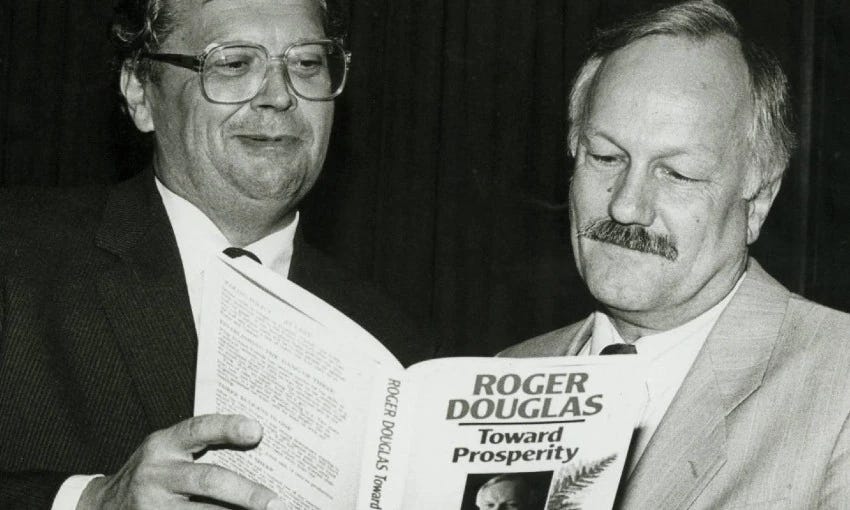
Ten rules from the person who remade New Zealand’s economy
The question of what policies a government should pursue gets endless attention. The equally important question of how to implement them gets almost none. James Breckwoldt’s essay distils Roger Douglas’s 1993 book Unfinished Business into ten practical principles for delivering structural change — applicable by governments of any ideological stripe.
Douglas was New Zealand’s Minister of Finance from 1984. In a few years he took New Zealand from levels of state intervention “unparalleled in any other developed Western economy” to one of the most open, market-oriented economies in the world — achieved by a Labour government. He then won re-election with an increased majority in 1987. [Um: no. David Lange was the PM]
1. Quality policies require quality people. Policy emerges from teams of capable, honest people — not party machines that recruit from a narrow gene pool and fill government with careerists who mistake shared assumptions for wisdom. But talented people also become passive inside systems that punish initiative. Change the incentives and the same people perform very differently.
2. Reform in quantum leaps, not increments. Groups that benefit from existing arrangements are concentrated and organised; those who bear the costs are scattered. Incremental reform is therefore the harder political path — each small change creates a focused opponent with no counterweight. Large simultaneous packages are the solution: no single group can claim it’s being singled out, and each gains from the removal of everyone else’s privileges.
3. Speed is essential. During reform, disruption arrives immediately; benefits arrive later. Governments that mistake this for a reason to slow down just stretch the painful phase. The Biden infrastructure legislation is the cautionary tale: by 2024, only 17% of $1.1 trillion from four major laws had been spent. Voters never felt it before the election.
4. Once you build momentum, don’t let it stop. Move to your next decision while opponents are still mobilising against the last one and you hold the high ground perpetually. John Boyd’s OODA Loop makes the theory explicit: success comes from completing the observe-orient-decide-act cycle faster than your opponent, presenting a new reality before they’ve finished responding to the previous one.
5. Consistency and credibility build confidence. If ministers cave whenever a group screams, promises of future benefit carry no weight. Ted Heath retreated under pressure and his authority collapsed. Thatcher’s “The lady’s not for turning” did the opposite — opponents gradually had to adapt to Thatcherism as the new status quo.
6. Let the dog see the rabbit. People cannot support a journey if they cannot see the destination. Vague goals — “smash the gangs,” “growth, growth, growth” — are worse than nothing. Ambitious targets are only damaging when unsupported by policies capable of achieving them.
7. Never sell the public short. Ordinary people make difficult trade-offs every day. Douglas wrote in 1993 about right-wing populist Winston Peters: “His monotonous allegations are unsupported by fact... Yet they set up a sympathetic resonance in many voters. The public feels instinctively that there is corruption somewhere deep in the system. And they are right.” When governments avoid hard conversations, problems worsen and voters eventually gamble on outsiders.
8. Don’t blink — composure is policy. People watch their leaders not just for information but to probe their emotional state. The easiest way to look like you know what you’re talking about is to actually know what you’re talking about.
9. Get the incentives and systems right. Systems deliver what they reward. Possession of formal power is not the same as actual power to govern — the civil service can slow timetables, narrow options and leak negative stories if its incentives aren’t redesigned early.
10. Why are you in politics? Politicians who optimise for short-term approval ratings avoid hard choices — and produce the drift that eventually costs them the popularity they were protecting. After 1987, Labour’s opponents got cold feet, Douglas was forced out, and Labour was crushed in 1990. Staying the course is not just principled — it’s the only strategy that works.


The intriguing thing about the Roger Douglas period is the wealth of good sources it left behind. Lange was charismatic and seems to have been a pretty good guy. He liked ordinary folks more than elite types. But he was hopeless at personal confrontation. So he and Roger sent letters to each other in which they explained their position. It’s a barmy way to work things out - no surprise that it didn’t - but good for us flies on the wall.
I asked Claude to ‘curate’ some snippets of their correspondence, most of which you can find duly reproduced with some other commentary here. And it did enable me to say ‘curate’ on this newsletter which is its own kind of reward and possible grounds for a grant application to the Australia Council, though that’s its old name which will be different now.
Douglas to ministers, 15 April 1987
The case for the radical strategy, which I prefer, is that it offers benefits up-front … large, up-front benefits such as tax cuts and increased low-income support … in exchange for giving up public ownership of most state commercial activities, having a higher GST rate, and charging higher-income people for some social services …Lange to Douglas, 22 April 1987
My instinctive distaste for the [radical] proposal has hardened … People are not analysts of the economy. They feel secure or they feel frightened, and that is what decides their vote … Your radical strategy … We would no longer be united …Lange prevails in the 1987 budget. After the election and the share-market crash, Douglas returns to the radical strategy. On 17 December the government announces a “flat tax package”: a single income-tax rate, GST raised to 12.5%, and asset sales.
Lange to Douglas, 6 January 1988
Now that a Laffer curve has appeared in a Sunday newspaper … I am relieved we made the point that our spending will decide our tax revenue, and not the other way around …Douglas to Lange, 15 January 1988
I see no reason for your doubts about the fiscal arithmetic … It is difficult to read those sentences without feeling that you are passing a vote of no confidence in the objectivity, the competence or the integrity, not just of me personally … but also of the Treasury …Lange to Douglas, 18 January 1988
I was flying blind, but my instincts were aroused … The announcement of a flat tax rate has … bound the government either to make large numbers of low and middle income people … pay more tax … That is intolerable … I am sure the time has come … to say publicly that the tax/benefit proposals are open for the widest possible discussion …Douglas to Lange, 19 January 1988
I cannot do that. You do not have any mandate from cabinet … to depart from the decisions cabinet made … I can only conclude that the course of action you propose is … designed to serve as a means of walking away from the package …Lange to Douglas, 21 January 1988
You are wrong to suggest that I am departing from the decisions made by cabinet … You are the one who is departing from cabinet’s decision by insisting on the implementation of your original package …On 28 January, with Douglas in London, Lange calls a press conference and announces a halt to the package. “I killed it,” Lange would later say. “In the end, it had to be done.”
Douglas to Lange, 1 February 1988
You gave me your assurance that no decisions … would be taken until my return … If that was truly your thinking, to go ahead was grossly negligent and misleading … you have damaged not only the image of unity … but have undone much of the rebuilding of confidence …Following Lange’s sacking of Richard Prebble, Douglas appeals to cabinet.
Douglas to ministers, 7 November 1988
The prime minister has unexpectedly overturned decisions or announced his own policies as fait accompli … Can he not bear the idea of losing? … If we cannot, as a cabinet, … implement consistent, reliable and predictable policies, the recovery is dead in the water, and so are we …Douglas resigns by 14-page letter. Lange treats it as such.
Douglas to Lange, 15 December 1988
I have decided to tell caucus that I can no longer work as finance minister in a cabinet led by you … New Zealand is now a country led by a government paralysed by your inability to work with me … The greatest present danger … is not our economic policy or world markets … it is this undisciplined propensity for making misjudgments … pursued with fanatical zeal … discarding the advice of the cabinet …


Podcast history of New Zealand’s first reform episode
First class series in which you will discover how Lange’s simple misunderstanding of his briefing notes for a TV show led New Zealand from its first past the post electoral system to proportional representation. It doesn’t even have any advertising.


Quote of the week
My son in primary school learned the national anthem and he was most anxious to come home and sing the national anthem that he had learned at school. It turns out no one gave him the words but he was picking this up from the big kids: Australia is full of ostriches for we are young and free with golden soil and welcome joy our home is skirt by sea. Our land abounds in nature strips of beauty rich and rare. In this respect the pastries fresh advance Australia fare.


Heaviosity half hour
Chapter 15 of David Lange’s memoirs
I took a risk when I asked Roger Douglas to stay in politics and made him Labour’s finance spokesman, but I thought it was a risk worth taking. He had energy and ideas. I knew he would work hard, and I thought he would be moderated by the responsibility of being in government.
Douglas was a subdued figure for some months after the devaluation debacle which had nearly sent us off the rails before the 1984 election. He came close to the edge and the experience knocked him back. His first budget made him buoyant. It was a significant event and the old confident Douglas resurfaced. But in government it became apparent how narrow his vision was. This was the reverse side of the doggedness which characterised him; he heard what he wanted to hear and he closed his mind to the rest. His ideas were rarely tempered by any acknowledgement that their implementation would make a difference to the way society was ordered. He focused entirely on the economic indices and disregarded the others, talking about economic policy in cabinet as if we were sitting in a tutorial. He was fortunate in that his limitations suited him to the exigencies of our first term in office, when urgency was needed and boldness was at a premium. But when the temper of the times changed, he was not capable of changing with it.
He and I did not fall out over the Royal Commission on Social Policy. I did not see him as obstructive as much as unpersuaded of the commission’s relevance, and we remained on good terms. Inside a year our relationship was to alter.
In April 1987 Douglas sent me a letter which set out three possible options for the budget he intended to present in the middle of the year. I cannot recall any detail of the first two, other than that the first was described by its author as a budget which would do very little but simply keep the ship afloat. It was accompanied by the observation that this was not to Douglas’s taste, and that I should perhaps look for a new finance minister if this was the course I wanted to take. This addendum was a characteristic idiosyncrasy. The second option escapes my memory completely, although I imagine it was something like the budget he actually did present that year.
The third option Douglas offered is burned into my memory. Its content would come as no surprise to anyone familiar with ACT policy, or at least with ACT policy as it was in the days when Douglas was the head of that party, but in April 1987, when such things were unheard of in mainstream politics, it was a shock to me. He described it at some point as radical, but radical does not do it justice. He argued for the sale of almost every government asset, including roads, hospitals, schools and universities. Every social service was to be privatised. We were to have a single rate of income tax at 15c in the dollar, and GST would be raised to fifteen percent to match.
This was Douglas’s preferred option. He offered to work on it in secret if that was what I wanted. I could hardly believe what I was reading. It was an unaccustomed addition to the burdens of office to have the finance minister take leave of his senses. I said as much to Bassett when I happened to meet him in a lift, expecting it to get back to Douglas, which it did. I asked members of the advisory group for their help in drafting a reply to his letter. His letter came to me under the cover of budget secrecy and I treated my reply the same way; I did not want it widely known that Douglas had even considered such schemes, let alone become their advocate.
The reply I sent was as strongly worded as I could make it. I told him that the adoption of his preferred strategy would shatter the unity of the government. I told him that the people of my electorate and his had not voted Labour so that in future they would have to beg for the entitlements of citizenship. I told him that I would rather raise taxes to pay our debts than privatise the social services. I said that the electorate did not expect miracles from us, and that we would be rewarded enough if we took a steady course.
An informal meeting of six senior ministers took place to consider the Douglas proposals. Palmer, Moore, Caygill and Prebble were there with me and Douglas. I cannot remember now what was said, but I can imagine what took place. Prebble was always solidly with Douglas, while Caygill was always cagey at meetings of this sort. Moore was more gung-ho when Douglas was present than when he was not. Palmer concerned himself with legal issues. I do remember he was outraged by a suggestion in the Douglas proposals that the government charge the State Insurance Office for the use of its own name. In any event, it was agreed that the radical option would not be pursued.
Douglas remarked in later years that he should have gone to see me when he heard of my reaction, as if my response were the result of some kind of misunderstanding. There was no misunderstanding. He wrote to me, I wrote back. He did come to see me and I told him what I thought. I asked him to think, if he could think of nothing else, of the politics of it. What he proposed could not be sustained in a society in which every adult had a vote. There was nothing he or I could talk about which would ever make his agenda acceptable to the public. In the first half of 1987 he appeared to accept, albeit with some carping, that the course he wished to pursue was closed to him.
Almost certainly I knew then that I had made a great mistake when I stuck by Douglas, but it was hard to face up to it. So much of my political capital was invested in him. If you set out on a course and you find yourself beset by doubt, it is not easy to concede that you are wrong and that the effort has been made in a losing cause. It is a concession almost never made in politics, not because politicians are more deceived or deceiving than the rest of humankind, but because such concessions are not rewarded with popular support. In its first term in office the public supported the Labour government in extraordinary numbers because of our unity and strength of purpose, qualities which were drawn in great part from the alliance between me and Douglas. I could not cut him loose; I consigned myself to a life of constant vigilance.
One concession was made to Douglas by way of solace for the loss of his radical option. We agreed that there would be reviews of the management of public hospitals and the compulsory education sector. There was a good case to be made for these reviews. Hospitals were run by locally elected but centrally funded boards and the proper balance between local and central authority was a long way from being achieved. School administration was based on a model devised in the 1870s. In both hospitals and schools it was sometimes hard to see where the money went and harder to measure the effectiveness of the spending. I spoke about the two reviews to members of the Royal Commission on Social Policy, as I did not wish them to see the reviews as taking precedence over their work. They took the news well enough, on the understanding that the reviews were to concern themselves with models of public-sector management and in that sense would complement the commission’s inquiries.
I talked about the education review with the responsible minister, Russell Marshall, and we agreed to appoint as its head an Auckland businessman, Brian Picot. Picot was the head of the Foodtown empire, which had its headquarters in Mangere where it had a reputation as a thoughtful and innovative employer. He had a longstanding interest in education and had given much time to its service. The health review was chaired by Alan Gibbs, a wealthy friend of Douglas.
Gibbs was only one of many in the business community who were close to Douglas. Before the 1987 election Douglas asked me to host a dinner for potential donors to the Labour Party’s campaign funds, and I agreed. All of the Business Roundtable types were there, Gibbs, Trevor Farmer, and the like, and shonky entrepreneurs of the time such as Bruce Judge. I left them to it as soon as I could. I could not stand the cant. In that company the pursuit of wealth was a public service and self-interest was a noble purpose. It was members of the Business Roundtable who were responsible in great part for the chorus of approval which increasingly greeted every suggestion Douglas made.
I do not know how much money Douglas raised from the business community since much of it was given to him personally and not to the Labour Party. He insisted that such donations be made by individuals rather than by their companies, which was as much as propriety demanded in those days. He gave some of it to the party organisation. Some he distributed to candidates, as I know from his giving $3000 to the Mangere Labour electorate committee. The existence of this independent fund was an annoyance to the Labour Party organisation, which was short of money for the campaign. At the party’s insistence, the manifesto promised to take a consultative approach to labour relations and, while it allowed for the possibility of the privatisation of public assets, it specifically promised not to privatise any of the three corporations carved out of the old post office. The first of these promises was broken before the year was out, and the second later.
Cabinet, caucus and party did agree on the general thrust of our campaign, which was that the pain inflicted by the economic policy was to be rewarded by improvement in the quality of our social services. I was happy with that and Douglas seemed to have no difficulty with it.
The general election took place on 15 August 1987. It would be kind to describe the campaign, and my part in it, as lacklustre. It started badly and got worse. ...
I disliked almost everything about the campaign. ... The National Party offered no challenge, although I thought we might well lose some provincial seats to it. National could not get traction. The Labour Party had occupied its ground and it was simply thrashing about. My televised encounters with its leader did not feel like a contest and I could not lift myself. The day-to-day activity of the campaign was almost entirely designed for television. To feed the demands of television I had to do what I did not like. I intruded on the public as they went about their business at work or in shopping centres. I had to perform as I ordinarily never would for the benefit of the cameras. The formal campaign lasted only three weeks, but it was an ordeal.
As I did in 1984, I waited for the results of the election in the Metro theatre in Massey Road. I was surprised when Douglas appeared at the hall. It was most unusual for a candidate to leave his own electorate on the night of a general election. He seemed happy; he was certainly relaxed, and we talked quite comfortably. When it was clear that we had won, and indeed increased our majority in parliament, I took him on to the stage with me to acknowledge the part he had played in the victory.
I did not imagine that we would ever do as well as we did in the 1987 general election, especially in the provincial areas which carried the greater part of the burden of economic adjustment in our first term in office. But there were grounds for concern. We came close to winning Remuera, and the Labour majority withered in some of our strongholds. That to me was a sign that caution was required unless we were to supplant the National Party entirely. It is the goal of every major political party to occupy the centre ground which is the key to longevity in government, but it cannot do that if its base is not secure, and it was plain in 1987 that we were at some risk of losing ours. It was self-serving to argue, as Douglas and his supporters did afterwards, that our victory was a mandate for yet more radical reform. Our campaign did not promise more radical reform. In terms of the electorate, and in terms of Labour’s chances in the electoral contest, it made no sense at all to have us leap even further away from our home ground.
There was by then a new cabinet. ... I no longer trusted Douglas and wanted to use the allocation to put some restraints on him. I took Prebble out of his role in finance but made a misjudgement when I gave him responsibility for all the state-owned enterprises, thinking that he would find enough to interest him in their oversight. His chief interest proved to be in selling them. Cullen was made an associate finance minister as well as social welfare minister. My greatest concern was to put ministers in place who would protect the social services from the onslaught I knew would be made on them, which was why I gave social welfare to Cullen, and housing to Clark. ...
The two major social service portfolios, health and education, were more problematic. I made Caygill health minister in his place. Bassett took the news badly; he told me he would never speak to me again unless he had to. Russell Marshall had no love for Douglas but he was not the right minister to defend education. I spoke to Palmer about taking education. He refused and so I took it myself. I doubt Douglas was happy about these changes, but he said nothing to me.
In October 1987 I heard on the way home from a Commonwealth meeting that the cabinet had decided to discontinue its subsidy to 600 post offices, which would close as a result, and not long after I got back, the stock market crashed and the bubble which did so much to sustain the government was burst. I thought then that I would never win another election. It seemed to me inevitable that Douglas would bounce back and say that the crash was a signal that the government had not gone far enough and that more must be done as proof against such adversity, and that is what he did.
I cannot remember exactly when he first brought me the package of measures he said were essential to restore confidence in the economy. I was in a low mood when I went to the Labour Party conference which was held in Auckland in November. Douglas was beyond reason and the left of the party was sullen and unresponsive. When the time came for me to speak, I did not know what to say to the audience. I read the script and walked off. My useful life as a politician was coming to a close.
The Douglas proposals amounted to a reworking of his radical option of earlier in the year. In December they went to cabinet. He argued that we should liberalise the labour market, remodel the public sector, further reduce tariffs, and sell something like $14 billion worth of public assets. Personal income tax was to be levied at a flat rate of 23c in the dollar and the goods and services tax was to be raised to fifteen percent. His fiscal projections seemed hopelessly optimistic to me. Much as had happened with GST, when benefits were raised as compensation for the impost, Douglas offered a sweetener by way of a scheme he called guaranteed minimum family income, or GMFI. This was a form of subsidy for those who were in paid employment and was designed to keep a margin between those in work and those on a benefit. The economic argument behind the package was that our boldness would inspire the country to greater effort. A tent evangelist could hardly have put it better.
The proposals went twice to cabinet where there was considerable contention. Deals were made and support was traded. Labour relations reform did not make it off the starting blocks, adventures in health and housing were abandoned, and some ministerial patches were protected at the expense of the rest. The rate of GST stayed for the time being at ten percent.
The centrepiece of the scheme was the flat rate of tax. I spoke with some feeling against it, but Cullen was the more trenchant critic. He argued its unfairness and put to flight the dubious economic case which was made for it. He explained its fiscal implications and its likely meaning for the government’s ability to fund the social services. He did all that and more, but when it came to the crunch there were only the two of us. Dear God! What a terrible lot of people they were! It is hard to believe I used to think so much of them.
Douglas came to see me after the package was approved by cabinet. He said that if I was unhappy with the measures he would delay their announcement. I told him to go ahead but I insisted that the announcement make no reference to the proposed rate of personal income tax. He had no option but to agree to that, since cabinet had asked for work to be done by officials on the GMFI and this work might well impact on the package as a whole. In the end the announcement was made in the Beehive theatre on 17 December. It was deemed worthy of the presence of seven of us ministers.
Before Christmas I sent a memorandum to my cabinet colleagues saying that they were to regard our announcement as a statement of possibility rather than of firm intention. I thought it might prove that the figures in the Douglas package were unsustainable and that we should allow ourselves a way out if we needed one. I asked John Henderson to get some advice from outside the advisory group and the public service on the fiscal implications of the proposals and the workability of the GMFI. As a result of the various investigations John commissioned, it became clear enough that the numbers were unreliable and that the GMFI was conceptually deficient, a finding later confirmed by officials, but Douglas was not disposed to listen. ...
Ivor Richardson, the judge who was the chairman of the Royal Commission on Social Policy, came to see me. It was not a happy meeting. He told me that there was no point in the commission’s continuing its work, given that the flat tax and the GMFI would in themselves determine the nature of social policy. I could only agree.
I thought for much of that summer on what I should do for the best. I considered resignation, and indeed resignation was the proper course. The conventions of cabinet government were simple enough. All members of the cabinet were bound by its decisions. The prime minister was bound by that convention as much as was the most junior minister. Convention demanded that those who disagreed resign their office if they could not submit themselves to the judgement of their colleagues.
When I first sat in that cabinet room I believed in the conventions of cabinet government and I did my best to put them into practice. It was not an easy matter for me to set them aside but I did, because I could not bear to think of the country we would have if the flat tax went ahead.
It was nearly the end of January when I made up my mind. I did not inform my cabinet colleagues. Douglas was out of the country when I made my announcement. I think that some effort was made to contact him before I spoke, but I did not care if he knew or not. I went to caucus, where I said nothing of moment, and then I held a press conference where I told the journalists there would be no flat tax. When the conference was over I felt nothing but relief.
Sounds right
A 12.5% GST or VAT is just an income tax surcharge of 12.5% with a deduction for saved income- shifting deck chairs on the Titanic. Douglas should have restored the tax on unimproved land values instead. Then the tax cuts for workers and industry would be real.