


Tick, tick, tick … The authoritarian checklist …
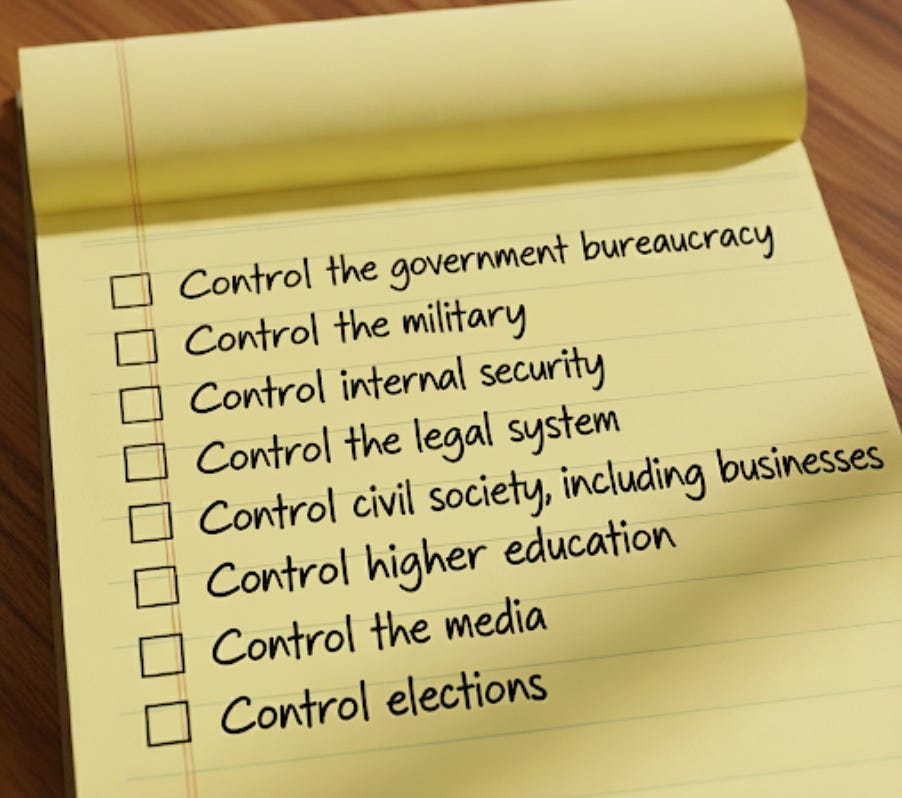
Don Moynihan has been blogging up a storm since Trump 2.0 arrived which has somewhat surprised me given his professorship is in “Public Policy” and so many of his colleagues adopt a more moderate tone. And while ‘moderation’ is usually a good thing as far as I’m concerned, it’s hardly an appropriate response to the dismantling of the American constitution - the upshot of which you can read more in Heaviosity half hour below. Note the original article is 3,000 odd words, so my extract is just a taster.
What marks Trump's second term as different from his first is his focus on the authoritarian checklist, systematically pursuing every item. He has made extraordinary progress in a short period of time.
Is this an exaggeration? Lets walk each item on the checklist.
Control the government bureaucracy
The federal government has more than 2 million employees, but only 4,000 are Trump's political appointees. The rest of the executive branch can thwart an authoritarian, simply by keeping their oath to defend the constitution...
One in 8 federal employees will be gone by the end of the year, relying largely on "voluntary" and legally questionable resignation program in the context of threatened firings...
Control the military
American civil military relations have been built around an ethos of mutual respect: military acceptance of civilian control matched by politicians giving the military professional autonomy. Trump violated this norm, purging the most senior generals...
Trump is growing more comfortable with deploying the military to police domestic matters. He has already deployed the National Guard and Marines in Los Angeles...
Control internal security
We have an immigration police state. It has become routine to watch masked security agents swipe people from their cars, homes or place of work...
The police state extends well beyond immigrants. Border Patrol turns up at rallies held by the President's political rivals in a show of force...
Control the legal system
While in other countries authoritarians found ways to control the judicial system, the American model of nominating partisans to key positions has already given Trump a leg-up in this regard...
The post-watergate norm of the DOJ maintaining some measure of independence from the President has collapsed. It is now the President's law firm, focused on targeting his enemies...
Control civil society, including businesses
One reason to feel optimistic about America's ability to resist authoritarianism is the depth of it's civil society. One reason to feel pessimistic is that many private organizations are preemptively folding...
Civil society, and especially corporations, can be co-opted with carrots as well as sticks...
Control higher education
Higher education exerts little direct power, but student-driven protests are often the vanguard of movements that challenge authoritarians...
The unprecedented control over basic aspects of higher education occurs because the federal government has many levers to damage universities...
Control the media
Much of the information I am sharing with you is only possible because of the depth and quality of American investigative journalism...
Trump has learned to exploit the dynamics of the American media system. He has removed public funding from public media, closing the Corporation for Public Broadcasting...
Control elections
Federalism is a powerful bulwark against centralized power. The constitution gives state primary power over functions not directly identified for the federal government...
In the crucial domain of elections, elections remain free, their results credible. Here, Trump has made the least progress relative to other items on the checklist...
The consolidation of Trump's power has happened very quickly, more rapidly than we have seen in other examples of competitive authoritarian systems...
Many remain unable or unwilling to see the bigger picture...
As residents of a country that has not experienced an authoritarianism, Americans remain wedded to democratic thinking. We assume that elections in 2026 and 2028 will fix things...
The nostalgia for the idea of American democracy can't blind us to it's collapse. Americans are less free than they were a year ago, more subject to state power directed by an President disinterested in democratic norms...


I researched every attempt to stop fascism in history. The success rate is 0%.

Chris Armitage does a bit of research assistance on the claim by Gary Kasparov quoted at the head of this newsletter.
In 1933, German conservatives thought they could control Hitler. Two years later, they were being executed in their own homes. I spent weeks researching this question, desperately looking for counter-examples, for hope, for any time in history where people successfully stopped fascists after they started winning elections.
Here's what I found: Once fascists win power democratically, they have never been removed democratically. Not once. Ever.
I know that sounds impossible. I kept digging, thinking surely someone, somewhere, stopped them. The actual record is so much worse than you think.
Let's start with Germany because everyone thinks they know this story. Franz von Papen, the conservative politician who convinced President Hindenburg to make Hitler Chancellor, said "We've hired him" in January 1933. He thought he was so clever. Within 18 months, the Nazis were machine-gunning von Papen's allies in their homes during the Night of Long Knives. Von Papen himself barely escaped to Austria with his life...
Italy was even dumber, if that's possible. October 1922, Mussolini announces he's marching on Rome with 30,000 blackshirts. Except here's the thing: they were poorly armed, disorganized, and the Italian military could have crushed them in about three hours. The King had his generals ready. He had martial law papers drawn up. The military was waiting for the order. Instead, he invited Mussolini to form a government. Just handed him power...
Spain might be the worst because everyone saw it coming. Three years of escalating fascist violence. Actual assassination attempts. Then in 1936, Franco and his generals launch a straight-up military coup. The Spanish Republic begged for help. France said "not our problem." Britain said "both sides are bad." America declared neutrality. The result? Franco ruled for 39 years...
Want something more recent? Look at Hungary. Orbán won democratically in 2010. By 2011 he'd rewritten the constitution. By 2012 he controlled the media. By 2013 he'd gutted the judiciary. It's 2025 and he's still in power...
Okay, but surely someone, somewhere, stopped them?
Finland 1932 is the only clean win I can find. The fascist Lapua Movement tried an armed coup before they'd secured government power. The military stayed loyal to democracy, crushed the rebellion, and banned the movement. That's it. That's the success story...
The pattern is so consistent it's almost funny if it weren't so terrifying. Every single time it goes like this: Conservatives panic about socialism or progressives or whatever. They ally with fascists as the "lesser evil." Fascists take power. Fascists immediately purge the conservatives who helped them. Then it's 30-50 years of dictatorship...
Want to know how many times conservatives successfully "controlled" the fascists they allied with? Zero. Want to know how many times fascists purged the conservatives after taking power? All of them. Every single time.
And here's the part that breaks your heart. Violence works. For them. Fascists use violence while claiming to be victims. They create chaos that "requires" their authoritarian solution. Then they purge anyone who opposes them...
The statistics are brutal. Fascist takeovers prevented after winning power democratically: zero. Average length of fascist rule once established: 31 years. Fascist regimes removed by voting: zero. Fascist regimes removed by asking nicely: zero. Most were removed by war or military coups, and tens of millions died in the process.
I'm not allowed to make the obvious contemporary comparisons, but you're already making them in your head. "We can control him" is being said right now, in 2025, by people who apparently never cracked a history book.
Based on the historical record, there are exactly three ways this goes. Option one: Stop them before they take power. Option two: War. Option three: Wait for them to die of old age.
They tried anyway.
But here's the thing: we already missed our chance. The window isn't closing; it's closed...
The question isn't whether these options are extreme. They are. The question is whether we're ready to admit that normal is already gone. The window to prevent fascism closed. But the opportunity for something else, something unprecedented, might just be opening.
The German conservatives who said "we can control him" were all dead or fled within two years. We're just months into our version of this story. The question is: are we going to be the first generation that finds a new way out, or are we going to be another cautionary tale future historians write about?
At least we're finally asking the right questions.

Kerry Short last day Wanganui School Shepparton
His last day after 38 years of teaching photography.
Luke Burgis is off to prison. Srsly
Discovering Girard in a Maximum-Security World

It was a difficult summer. My wife and I had to put a pet down, juggle demanding work and parenting, and face a difficult health diagnosis in the extended family. My dad's dementia has continued its course. In the middle of it all, while carrying what often felt like a crushing weight, I was trying to finish a book.
In early August, I had an unexpected lunch with a friend at Hope College that I hadn't seen in three years. He told me about the school's degree program for men serving long sentences at the Muskegon Correctional Facility, about an hour's drive north. I learned that one of the teachers had introduced my book Wanting: The Power of Mimetic Desire in Everyday Life, in a first-year seminar, in an effort to help the men think seriously about what it is they wanted—and to help them understand the way that conflict happens in the prison environment.
I was told that one student in that class became so captivated by mimetic theory that he tracked down and read everything he could find from Girard, exercising incredible resourcefulness to do so from behind bars, where there are extremely strict security protocols and restrictions...
"Would you be willing to go visit?" my friend asked. "It would probably make Carlos's entire day—maybe his whole year."
There was one ideal date to visit, he said: the convocation marking the start of the new academic year, August 26. That's when the arduous procedure to be screened as a visitor is a bit easier for the college to fast-track and get me inside.
Normally I'd be back in D.C. by then, but circumstances around my dad's health had kept me in Michigan. The other challenge is that my calendar is usually blocked out nine months or more, with very few days that even have five-hour blocks open at all. But—almost miraculously—that day, at the exact time frame of the event, was open.
I said yes...
The incarcerated man at the Muskegon prison, Carlos Garcia, had gone so far with his study of mimetic theory that he published an essay on positive mimesis and prison reform in Contagion, the international journal run by Girard scholars. (And I am proud to say that we are running an adapted excerpt of Mr. Garcia's essay in the Cluny Journal today.)
The program leaders thought it best not to tell Carlos I was coming—it would be a surprise...
So I drove to Muskegon.
The entry protocols were sobering. A guard drew an invisible mark on the back of my hand—it was visible only under black light—to prove that the same person who entered would be the one who left. I passed through vault-like doors and crossed the yard under armed escort, instructed not to speak with anyone until I reached the gymnasium where the ceremony was held.
When I finally met Carlos, he did a double take, then another. The founder of the program introduced the two of us, and finally it all clicked for him. We shook hands repeatedly (since we were instructed not to hug each other, we just shook hands like 20 times, over and over, while trying to squeeze our stories and background into a five-minute, rapid-fire conversation before the convocation ceremony started). Still, in that moment we exchanged as much excitement and affection as two men could under the watch of prison security.
Over lunch, I sat with Carlos and several other men, including a former Vice Lords gang member who had discovered mimetic theory through Carlos, and was trying to use it to help young men attracted to gangs recognize the real dynamics at work—and break their power.
They spoke about how the ideas reframed their lives, even within prison walls.
One story stuck with me: new corrections officers, they said, often began unconsciously mimicking the prisoners they supervised. Within months, some guards' wives claimed not to recognize their husbands anymore...
When I returned home, I took a long walk through my neighborhood, energized. I couldn't sleep that night—I woke up and wrote in my notebook for hours. I realized I felt more at home with those inmates than I ever have in any D.C. think tank.
And I'll be going back to prison.
Look what I trained the algorithm to serve up!
Mask up and nab people! Join the fun.

Militarising the hoi polloi.
Immigration and Customs Enforcement held a hiring expo this week outside Dallas at a place called the Esports Stadium. Set between the Texas Rangers ballpark and the roller coasters of Six Flags, the arena was built for video-game competitions, and a wall of bright-blue screens welcomed job candidates at the entrance. "With honor and integrity, we will safeguard the American people, our homeland and our values," one message read. "Start your journey towards a meaningful career in law enforcement."
Inside the cavernous main hall, organizers had parked a shiny Mustang with stenciled lettering that read Defend the Homeland. A blinding 90-foot-wide LED display at the center of the stage was lit up with the ICE logo and recruitment slogans. The setup resembled a poker tournament or an ESPN draft night, lending a whiff of excitement and opportunity.
ICE's pitch for meaning and purpose seemed to draw in many of the applicants I met. Some were military veterans with combat tours in Iraq and Afghanistan who told me they longed for the camaraderie and sense of belonging they once had. Others said they were bored, or wanted to serve the country, or fill a hole in their life left by a failed marriage or the creeping regrets they felt in middle age after screwing up in their 20s...
The Trump administration plans to hire, train, and deploy 10,000 new ICE officers by the beginning of next year, a frantic pace that would nearly triple the current workforce. The Department of Homeland Security is set to spend more than $40 million in the next several months on ICE recruitment, even as the department says it's already received 130,000 applications. ICE had advertised same-day offers to qualified candidates, especially those with prior military service or law-enforcement experience, and a $50,000 bonus to sweeten the pot...
A small group of protesters began to gather across the roadway, yelling "Shame!" and "Hey hey, ho ho, ICE has got to go!," but attendees in line mostly turned away.
Wandering the expo felt like walking through the set of a game show, a kind of speed dating for deportation jobs: After an on-the-spot interview, some got offers immediately and were sent to provide urine samples for drug testing, while others had to sit and wait for their name to be called...
The job-fair attendees I spoke with said the defend-the-homeland message and Donald Trump's presidency were big draws. "I want to stand up for my beliefs and protect America from foreign invaders," Brennan Sheets, 30, told me. "I'd like to be there for others who can't defend themselves. God is pushing me down this path."
Sheets, an Army veteran who has been working for a carpet-cleaning company, said he and his wife are expecting their first child, a daughter. The February 2024 murder of Laken Riley in Georgia by a Venezuelan man who was illegally in the country—which became a rallying cry among Trump supporters—"hurt my heart," he told me. He was offered a job that afternoon...
I asked Sheets what he thought it would be like to arrest families and face children crying while ICE hauls off their parents. He paused. "I'm good at compartmentalizing my emotions. I believe that I can make difficult decisions that I need to make," he said. "Life isn't all about love and rainbows."
Trump's funding bill set a goal of 1 million deportations a year. Despite a fourfold increase in immigration arrests in U.S. cities and communities, ICE is not on pace to meet that goal, with the latest data showing the agency on track for about 300,000 deportations during the 2025 fiscal year, which ends in September...
ICE has about 5,700 deportation officers nationwide. New entry-level jobs will pay roughly $70,000 to $90,000 a year, including overtime and cost-of-living adjustments, officials told me. Within Department of Homeland Security agencies, mass-hiring binges are viewed warily, and the rapid expansion of the U.S. Border Patrol a generation ago is still regarded as a cautionary tale...
Financial incentives [were] a powerful pull for many of the applicants I met. Kalvin Bayona, a barrel-chested 29-year-old who drove to the expo from his home in rural Louisiana, explained that he had been recently laid off from his job as a military police officer in the Army, after nine years. He and his wife had just purchased a home, and Bayona said he didn't want to uproot his daughters. "I built this life up to where we are now," he told me. "I don't intend to lose it."...
One applicant asked what will happen if Trump is no longer in office. ICE received $75 billion from the president's One Big Beautiful Bill Act, nearly 10 times its annual budget, and the money will pay for the staffing surge and an expansion of immigration-detention capacity over the next several years. "I'm kind of worried about the future," the applicant told Elliston. "Do we have a risk of losing our jobs if someone else gets into office?"
Elliston said ICE officials were planning for this contingency. "It's my responsibility to make sure people who work for me are protected by me," he told the crowd. "We're looking at ways to make sure if something does happen, we can protect you the best we can."
A fun tour of AI and science

New research from the University of Amsterdam makes for sober reading: even a minimal social network populated entirely by AI agents, with no recommendation engines and no human users, still produced the same dysfunctions we see on real platforms.
Within a short time, the bots split into partisan camps. Attention became concentrated in the hands of a small elite, and the most extreme voices were amplified. Researchers tested six potential fixes, including chronological feeds, hiding likes, boosting diverse viewpoints and bridging algorithms. None prevented the spiral; in some cases, the interventions made it worse.
The researchers considered whether the agents themselves carried bias. Since LLMs inevitably do, they repeated the experiment with different models (GPT-4o, Llama, DeepSeek). The same results emerged. Because the platform was stripped back to the basics of posting, reposting and following, these were not quirks of algorithms but behaviours that emerged from the network itself.
Social media is hardwired this way because its architecture is built around reactive engagement. Content that provokes stronger reactions, whether outrage, affirmation or hostility, drives reposting. Reposts attract followers, amplifying the most divisive voices. This self-reinforcing loop of engagement and visibility naturally produces insular communities, inequality of attention and the elevation of extremes.
These dynamics are not accidental. Social media companies employ more psychologists and behavioural scientists than almost any other industry. Platforms are engineered to grip attention by exploiting the brain’s reward pathways. Outrage and affirmation keep users scrolling, which means more ads and more revenue. It is telling that many executives in these companies restrict their own children’s usage.
Neuroscience shows how these same mechanisms also change how people think. Engaging with emotionally charged content activates the dopamine reward pathway, the same system that underpins addictive behaviour (Montag et al., Nature Reviews Psychology, 2021). Moral-emotional language spreads faster online because it generates stronger arousal and reinforcement (Brady et al., PNAS, 2017). Anger in particular triggers the amygdala, heightening vigilance and biasing attention towards divisive cues (Phelps & LeDoux, Neuron, 2005). Over time, repeated exposure conditions users to seek out outrage, narrowing perspective and reinforcing polarised patterns of thought.
The study makes one conclusion unavoidable: these pathologies are not the fault of any one platform, nor simply accidents of human behaviour. They are structural outcomes of any social media system built on engagement mechanics. If we want platforms that strengthen society and mental well-being rather than distort it, reform cannot stop at moderation or algorithm tweaks. Real change requires re-engineering the very foundations of social media design.
Two glorious pics from Alan Jacobs


John Menadue on Late Night Live
The coming debt crisis?

Ken Rogoff goes through the possibilities.
For much of the past quarter century, the rest of the world has looked in wonder at the United States' ability to borrow its way out of trouble. Again and again, under both Democratic and Republican administrations, the government has used debt more vigorously than almost any other country to fight wars, global recessions, pandemics, and financial crises. Even as U.S. public debt rapidly climbed from one plateau to the next—net debt is now nearing 100 percent of national income—creditors at home and abroad showed no signs of debt fatigue. For years after the 2008–9 global financial crisis, interest rates on Treasury debt were ultralow, and a great many economists came to believe that they would remain so into the distant future. Thus, running government deficits—fresh borrowing—seemed a veritable free lunch. Even though debt-to-income levels jumped radically after each crisis, there was no apparent need to save up for the next one. Given the dollar's reputation as the world's premier safe and liquid asset, global bond market investors would always be happy to digest another huge pile of dollar debt, especially in a crisis situation in which uncertainty was high and safe assets were in short supply.
The past few years have cast serious doubt on those assumptions. For starters, bond markets have become far less submissive, and long-term interest rates have risen sharply on ten- and 30-year U.S. Treasury bonds. For a big debtor like the United States—the gross U.S. debt is now nearly $37 trillion, roughly as large as that of all the other major advanced economies combined—these higher rates can really hurt. When the average rate paid rises by one percent, that translates to $370 billion more in annual interest payments the government must make. In fiscal year 2024, the United States spent $850 billion on defense—more than any other country—but it spent an even larger sum, $880 billion, on interest payments. As of May 2025, all the major credit-rating agencies had downgraded U.S. debt, and there is a growing perception among banks and foreign governments that hold trillions of dollars in U.S. debt that the country's fiscal policy may be going off the rails. The increasing unlikelihood that the ultralow borrowing rates of the 2010s will come back any time soon has made the situation all the more dangerous...
With long-term interest rates up sharply, public debt nearing its post–World War II peak, foreign investors becoming more skittish, and politicians showing little appetite for reining in fresh borrowing, the possibility of a once-in-a-century U.S. debt crisis no longer seems far-fetched. Debt and financial crisis tend to occur precisely when a country's fiscal situation is already precarious, its interest rates are high, its political situation is paralyzed, and a shock catches policymakers on the back foot. The United States already checks the first three boxes; all that is missing is the shock. Even if the country avoids an outright debt crisis, a sharp erosion of confidence in its creditworthiness would have profound consequences. It is urgent for policymakers to recognize how and why these scenarios could unfold and what tools the government has to respond to them. In the long term, a severe debt or, more likely, an inflationary spiral could send the economy into a lost decade, drastically weakening the dollar's position as the dominant global currency and undermining American power...
MAGIC MOUNTAIN
Washington's failure to deal with its runaway debt problem is in part the result of misguided (or at least oversold) economic theories that took hold over the last two decades. Throughout most of modern history, it was thought that prudent government debt management involved bringing down the ratio of debt to GDP during quiescent periods of growth in order to store fiscal ammunition for the next crisis. In the 1800s, the United Kingdom used debt to fight one war after another, taking advantage of the time in between to repair its finances...
A once-in-a-century U.S. debt crisis no longer seems far-fetched...
How and when a debt crisis in the United States could unfold is now the $37 trillion question. In one scenario, the trigger will be a collapse of confidence by investors in U.S. Treasuries—a "crack in the bond market," as Jamie Dimon, the CEO of JPMorgan Chase, warned in May—meaning a sudden spike in interest rates that revealed a larger problem. This is not as hyperbolic as it may sound; debt crises often build up steam quietly for what seems like forever before erupting unexpectedly. Alternatively, investors' growing fears about the safety of their money could cause a gradual rise in Treasury bond yields over many months or even years...
For too long, the status quo approach in Washington has been to ignore the massive debt problem and hope that a return to miraculous levels of growth and low interest rates will take care of it. But the United States is approaching the point at which the national debt could undermine not only the country's economic stability but also the things that have sustained its global power for so many decades, including the military spending that it has leveraged in many ways to maintain the dollar's formidable influence over the global financial system since World War II. Whether in the case of Spain in the sixteenth century, the Netherlands in the seventeenth century, or the United Kingdom in the nineteenth century, no country in modern history has been able to sustain a dominant currency without also being a superpower.
Intriguing

Heaviosity half hour
The devastation of the founding fathers

I’ve just finished listening to Gordon S. Wood’s The Radicalism of the American revolution the above mentioned book and really loved it. The last chapter was particularly moving ending with the founding fathers looking on dumbfounded that what they had wrought was so different and so degraded from what they had been trying to achieve.
From the perspective of a modern democrat, that’s not all bad because one of the chief objectives of the founding fathers was to rein in what they saw as the democratic excesses of post revolutionary government in the 13 states. One of those excesses was paper money which was a horrifying prospect to rentiers like the founding fathers many of whose loans underpinned the money circulating in their communities. Still, as Manning Clark might have said “they gave what they had”. I found the story very moving. Note the extract below is 1,500 words from the final chapter which is 12,000 words long. You’d better go out and read - or listen to - the book!
Chapter 19. Middle-Class Order
By the second decade of the nineteenth century Americans were already referring to themselves as a society dominated by the "middling" sort. To be sure, these terms were being used in England at the same time, but their significance in America was different. In England the term "middle class" had a more literal meaning than it did in America: it described that stratum of people who lay between the aristocracy and the working class. But in America, in the North at least, already it seemed as if the so-called middle class was all there was. Middling sorts in America appropriated the principal virtues of the two extremes and drained the vitality from both the aristocracy and the working class. By absorbing the gentility of the aristocracy and the work of the working class, the middling sorts gained a powerful moral hegemony over the whole society. The aristocracy lost its monopoly of civility and politeness and the working class lost its exclusive claim to labor. Leisure became idleness, work became respectable, and nearly every adult white male became a gentleman. It happened nowhere else in the Western world quite like this.
"Patrician and plebeian orders are unknown …," wrote Charles Ingersoll in 1810, in one of the first avowed defenses of America's national character against foreign criticism. "Luxury has not yet corrupted the rich, nor is there any of that want, which classifies the poor. There is no populace. All are people. What in other countries is called the populace, a compost heap, whence germinate mobs, beggars, and tyrants, is not to be found in the towns; and there is no peasantry in the country. Were it not for the slaves of the south," wrote Ingersoll, "there would be one rank."
The exception is jarring, to say the least; by modern standards Ingersoll's judgment that America had become classless is absurd. We today see the distinctions of early-nineteenth-century society vividly, not only those between free and enslaved, white and black, male and female, but those between rich and poor, educated and barely literate. Yet if we are to understand the wonder, the astonishment, and judgments of observers like Ingersoll, we must see, as they did, this society of the early Republic in the context of what American society had once been and what societies elsewhere in the Western world still resembled...
Tocqueville, too, saw almost at once what had happened. In a diary entry made only a few days after he landed in New York in 1831 he noted that in America the middle classes had attained "outward perfection," "or rather the whole society seems to have melted into a middle class." No one in America seemed to have "the elegant manners and refined courtesy of the high classes in Europe." In fact, there was "something both vulgar and disagreeably uncultivated" about American society. Yet "at the same time," said Tocqueville, no one in America was what the French would call "ill bred." Americans, "even to the simplest shop salesman," seemed to Tocqueville "to have received, or wish to appear to have received, a good education." All Americans seemed to behave the same respectable way—"grave, deliberate, reserved, and they all wear the same clothes." America, said Francis Grund, was "mediocre par excellence.… The manners of Americans, therefore, are as far removed from the elegance of courts, as they are far removed from the boorishness of the lower classes in Europe."...
The blurring of the distinction between gentlemen and plain people in America corresponded to a steady vulgarization of eighteenth-century gentility. The prosperous farmers, the shopkeepers, the clerks, the manufacturers, the retail merchants, the businessmen, and others who made up the middling sort did not repudiate the genteel Enlightenment but popularized it. The new middle class extolled education, but not a classical or even a liberal arts education. They wanted education that was practical and useful, and why not?...
In England, wrote James Fenimore Cooper in his Notions of the Americans, the aristocracy sought to distinguish itself from the upwardly mobile middling sorts by acting in eccentric and whimsical ways, thereby making it difficult for aspiring would-be gentlemen to know how to behave. But in America there was "as yet" none of this "high-bred folly." "The accession to the coteries are so very numerous, and are commonly made with strides so rapid," that these hordes of claimants to gentility were still likely to be "rationally polite" rather than "genteelly vulgar."...
The struggles of individuals to rise from humble origins and achieve respectability became in time part of America's folklore. Indeed, so common did such stories become in America that, as Hawthorne later remarked, all traditional European romance in them was lost...
Indeed, by the 1820s there were dozens of itinerant painters like Guild wandering all over the countryside, advertising themselves with "Sign, Ornamental and Portrait Painting executed on the shortest notice, with neatness and despatch," and selling aspiring middling American families portraits of themselves. There existed "a decided disposition for painting in this Country," said America's first art critic, John Neal, in 1829; "you can hardly open the door of a best room anywhere, without surprising or being surprised by the picture of somebody plastered to the wall, and staring at you with both eyes and a bunch of flowers." "Wretched" as these pictures may have been, however, they did enable countless numbers of middling Americans to possess what earlier had been an exclusive luxury of the aristocracy. In just such ways did ordinary people acquire the attributes of gentility and thereby democratize the culture.
At the same time as ordinary people were reaching upward and vulgarizing aristocratic and genteel culture, the gentry themselves felt increasingly compelled to reach down and embrace wider and deeper levels of the populace. Central to the republican revolution had been the desire by the revolutionary leaders to refine and improve the moral and aesthetic sensibilities of the American people...
These middle-class pressures also worked to alter fundamentally the role and position of women in America. Since civilizations were now being ranked by the way they treated women (did not "savages" regard their women as "beasts of burden"?), enlightened men with genteel aspirations were eager to escape from those "barbarous days" when a woman was "considered and treated as the slave of an unfeeling master." That sort of traditional patriarchalism had to go. Women now had to be treated with particular delicacy and love. "A woman of virtue and prudence is a public good—a public benefactor." She had the power to make "public decency … a fashion—and public virtue the only example."
"In the present state of society," declared Joseph Hopkinson in 1810, "woman is inseparably connected with everything that civilizes, refines, and sublimates man." Consequently, wives and mothers were now urged to use their special talents to cultivate in their husbands and children the proper moral feelings—the virtue, benevolence, and social affections—necessary to hold a sprawling and competitive republican society together...
At the very moment, however, that Americans were coming to appreciate their capacity to mold and manipulate the culture of their new Republic, they were less and less sure they had that capacity under control. They knew the world had changed and changed radically since the Revolution, but had it changed in directions they had intended?...
But it was increasingly clear that no one was really in charge of this gigantic, enterprising, restless nation. Government was weak, the churches were divided, and social institutions were fragmented. Nevertheless, "order" somehow seemed to "grow out of chaos," and people guided themselves "without the check of any controlling power, other than that administered by the collision of their own interests balanced against each other." The promotion of self-interest did not create the predicted anarchy, for in the new commercial society it became evident that "no man can promote his own interest, without promoting that of others."...
In a society of many scrambling, ordinary, and insignificant people, the power of genius and great-souled men no longer seemed to matter. "The direct action of great minds on the character of our community is," it was said, "unquestionably less at the present period, than in former days."...
In 1791 Madison had worried that the sprawling extent of the United States would make each individual insignificant in his own eyes, a circumstance that he thought would be unfavorable to liberty. But a generation later the magnitude of the country and the smallness of each individual had become sources of strength and wonder. What would be "more striking and sublime," asked Hugh Swinton Legaré in 1823, "than the idea of an IMPERIAL REPUBLIC" spreading over an expanse of territory larger than the empire of the Caesars, "a Republic, in which men are completely insignificant," but blend "in one divine harmony" their "various habits and conflicting opinions."...
Everything was being left to the reader, or the listener, or the voter, or the buyer—each person—to decide...
The result of all these assaults on elite opinion and celebrations of common ordinary judgment was a dispersion of authority and ultimately a diffusion of truth itself to a degree the world had never before seen. With every ordinary person being told that his ideas and tastes, on everything from medicine to art and government, were as good as, if not better than, those of "connoisseurs" and "speculative men" who had college degrees, it is not surprising that truth and knowledge became elusive and difficult to pin down...
By the early nineteenth century this newly enlarged and democratized public opinion had become the "vïtal principle" underlying American government, society, and culture. It was the standard to "which all things must be brought and all subjects submitted." In every realm of endeavor—whether art, language, medicine, or politics—connoisseurs, professors, doctors, and statesmen had to give way before the power of the collective opinion of the people. Public opinion, said Federalist Theodore Sedgwick in disgust, "is of all things the most destructive of personal independence and of that weight of character which a great man ought to possess."...
No one had expected more from the Revolution and the American Enlightenment than Benjamin Rush. "Mr. Great Heart," Jeremy Belknap called him after the character in Bunyan's Pilgrim's Progress who attacked the giants and hobgoblins that stood in the way of getting to the Celestial City. Because Rush had such high hopes for the Revolution, his disillusionment was especially profound. By the early nineteenth century, his letters were filled with despair. He looked back "with deep regret" at all his public efforts on behalf of the Revolution...
Even Jefferson, sanguine and optimistic as he had always been, was reduced to despair in his last years and to what seems to us today to be an embarrassing fire-eating defense of the South and states' rights. He hated the new democratic world he saw emerging in America—a world of speculation, banks, paper money, and evangelical Christianity that he thought he had laid to rest...
But the disillusionment felt by Jefferson and others of the founding fathers was a strange sort of disillusionment. It was not the disillusionment that English and European liberals like Wordsworth and Constant felt over the failure of the French Revolution. That the French Revolution ended in Napoleonic despotism could to some extent have been expected; the course of the French Revolution followed the classic cyclical pattern—excessive democracy leading to dictatorship and tyranny. The failure of the French Revolution did not destroy the idea of revolution in Europe; the possibility of a successful republican revolution next time was kept alive.
In America, however, the disillusionment was different. The founding fathers were unsettled and fearful not because the American Revolution had failed but because it had succeeded, and succeeded only too well. What happened in America in the decades following the Declaration of Independence was after all only an extension of all that the revolutionary leaders had advocated. White males had taken only too seriously the belief that they were free and equal with the right to pursue their happiness. Indeed, the principles of their achievement made possible the eventual strivings of others—black slaves and women—for their own freedom, independence, and prosperity.
The very fulfillment of these revolutionary ideals—the very success of the Revolution—made it difficult for those who benefited from that success, for ordinary people and their new democratic spokesmen, to understand the apprehensions of the founding fathers. The people looked back in awe and wonder at the revolutionary generation and saw in them leaders the likes of which they knew they would never see again in America. But they also knew that they now lived in a different world, a democratic world, that required new thoughts and new behavior. We cannot rely on the views of the founding fathers anymore, Martin Van Buren told the New York convention in 1820. We have to rely on our own experience, not on what they said and thought. They had many fears, said Van Buren, fears of democracy, that American experience had not borne out.
A new generation of democratic Americans was no longer interested in the revolutionaries' dream of building a classical republic of elitist virtue out of the inherited materials of the Old World. America, they said, would find its greatness not by emulating the states of classical antiquity, not by copying the fiscal-military powers of modern Europe, and not by producing a few notable geniuses and great-souled men. Instead, it would discover its greatness by creating a prosperous free society belonging to obscure people with their workaday concerns and their pecuniary pursuits of happiness—common people with their common interests in making money and getting ahead. No doubt the cost that America paid for this democracy was high—with its vulgarity, its materialism, its rootlessness, its anti-intellectualism. But there is no denying the wonder of it and the real earthly benefits it brought to the hitherto neglected and despised masses of common laboring people. The American Revolution created this democracy, and we are living with its consequences still.


Possibly John McWhorter was unaware of these "full Hannah-Jones" appearances or Andrew Sullivan is exaggerating because he was willing to appear on stage with Gladwell at the 92nd St Y to promote "Pronoun Trouble" and they were clearly having a great time delighting the audience.