An international agency approached Lateral Economics to discuss its (the agency’s) intent to develop a standardised methodology for measuring the returns to certain kinds of research and sensing infrastructure. It approached us because we’ve done a lot of work measuring the return on investment to the National Cooperative Research Infrastructure Scheme (NCRIS) and its institutional cousin, the National Earth and Environmental Sciences Facilities Forum (NEESFF).
Not surprisingly these facilities generate huge ROIs. To give just one example, one part of an organisation called AuScope (which operates within NCRIS) runs a virtual repository of geological core samples taken in the past. So if you’re prospecting for some mineral in an area, you can check out the core samples collected in the past from nearby locations, or geographically similar locations. That’s incredibly valuable information that doesn’t cost much to collect, host and store.
In our discussions, we were presented with a list of questions about how to achieve globally standardised ways of measuring the ROI on such facilities. I found myself raising a prior question: what are the traps in imagining that a standardised ROI methodology is such a good thing in the first place? Of course, in a trivial, uninteresting way, with other things being equal, what’s there not to like about a standardised ROI methodology? But everything has its price. We have some experience of such things.
Think of universities and league ladders. The criteria that govern places on the league ladder were set up by people trying to market magazines and newspapers. Yet, as in the story of the sorcerer’s apprentice, once these standards have taken hold, everyone just puts their head down and works to the standard lest they lose rating points. Meanwhile, increasingly obvious organisational pathologies metastasise all around.
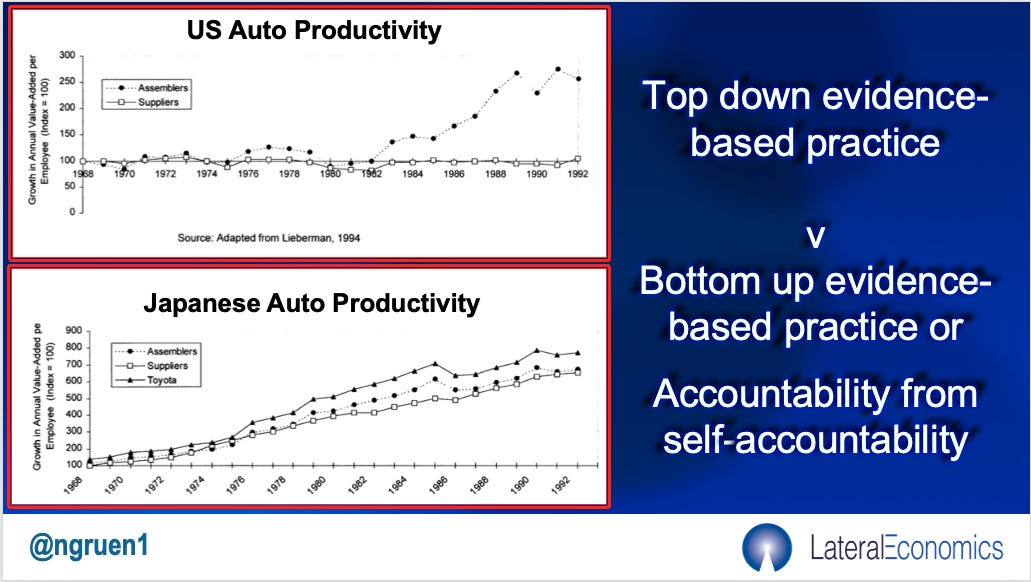
There is a different model, and we’ve known about it for decades. Here’s how we put it in a box in one of our reports for the custodians of Australia’s research infrastructure:
Empowering or Directing Practice: Top-Down and Bottom-Up Approaches to Metrics
There is an important distinction between metrics driving systems and metrics structuring and informing practice. In metric-driven systems, value is defined in advance and activity is organised to optimise measured indicators. This risks narrowing attention to what can be specified centrally and typically prompts compliance and/or gaming rather than learning.
By contrast, in bottom-up evidence-based systems, value is discovered and refined through practice. Metrics are used to capture signals emerging from operational experience and feed them back into operational and strategic decision-making. Measurement does not replace judgement; it disciplines and improves it. Crucially, this creates a dynamic feedback loop: practice generates evidence, evidence informs refinement, and refinement reshapes practice.
The dramatic productivity performance of Toyota illustrates this logic. Line workers are upskilled in managing and understanding production data and use it to improve performance which can then be tested and so on; The result is not merely better measurement but sustained, transformative gains in productivity.
The framework proposed here is based on this second model. Metrics are intended to make learning visible and cumulative, not to serve as mechanical arbiters of value. In this way, measurement supports adaptive capability and continuous improvement rather than constraining them.
Obviously enough, none of this is an argument against standards. It’s an insistence that, like most other things, they come with costs and benefits, and more to the point, what really matters is that they reflect the interests of all stakeholders. In that regard Adam Smith told us what to worry about when designing standards.
This disposition to admire, and almost to worship, the rich and the powerful, though necessary to maintain the order of society, is, at the same time, the most universal cause of corruption of our moral sentiments.
The questions on the agenda were all asked from the top, by those in charge. But the people at the top never have trouble getting their views heard. Everyone further down always does.
PS: you can find an old ABC Science Show segment where I talk about the value of Australia’s information and research infrastructure here. Or below.
0:00
-6:06
Hobart Stadium to cost $1.5 billion and counting
Long before I knew about it, my England-based son was telling me that I’d made Footy Classified, people were texting him. Anyway, there was much excitement for about 24 hours, but the AFL did what you’d expect them to do which is to hose down the excitement and press on with the plan. After all, it’s Tasmanians who are bearing the risk, not the AFL. The best line on the cost of the stadium came from Mick Molloy interviewing Nick and Josh Daicos. “Tasmania have to decide whether they want Nick Daicos or a stadium”. Anyway, here’s The Age story about the Lateral Economics update to my report on the stadium of last year.
The economist behind an independent review of Hobart’s proposed Macquarie Point stadium has accused the Tasmanian government of misleading taxpayers over the project’s cost and described the AFL’s insistence on a new, roofed venue as “bloody-minded”.
Speaking ahead of a crucial gathering of all 18 AFL club presidents in Melbourne before Tuesday night’s Australian Football Hall of Fame dinner, Dr Nicholas Gruen said the cost of the stadium would far outweigh the benefits. The presidents are set to discuss progress on the stadium, which remains a central condition of the Devils’ entry into the league in 2028. ...
“This is not just bloody-mindedness from the AFL,” Gruen told this masthead. “It’s the worst combination of bloody-mindedness and self-harm you can imagine.”
The Tasmanian government appointed Gruen to assess the project early in 2025 as part of a political deal with the Jacqui Lambie Network. Now he has completed an update of that review, commissioned by the anti-stadium Macquarie Point Vision Ltd, and concluded the project would impose a net cost on Tasmania of more than $1 billion and deliver less than 40 cents of economic benefit for every dollar invested.
The report estimates the stadium would increase state debt by $2.3 billion by 2040. The latest government estimate put total capital costs at $1.13 billion; Gruen’s latest report has that figure at $1.5 billion, with more pessimistic modelling putting it at $1.75 billion. The Tasmanian government promised $375 million for the stadium, the federal [government committed] $240 million to the precinct and the AFL $15 million. The funding gap would be covered by state borrowings.
Asked whether the Rockliff government had misled Tasmanians about the cost of the project, Gruen said: “I think the only honest answer to that question is yes.”
Gruen asserted his independence from the anti-stadium lobby ... “There are lots of people in Tasmania who support the stadium, who say it’s going to be an economic boon for Tasmania, and that’s complete rubbish,” Gruen said. “It will cost Tasmania about a billion dollars to have this stadium. But if Tasmanians feel that’s worth a billion dollars to them because they want a team, I can fully understand that and it’s a perfectly rational thing to do. But as a piece of economic policy, it’s hard to think of a more wasteful project.” ...
“The AFL, I think quite outrageously, and very much flying in the face of its own interests, has insisted on this stadium,” he said.
His report argues the financial benefit to the Devils of playing at a new stadium is worth about $5 million to $6 million a year — an amount he believes could be delivered through direct financial support at a fraction of the cost. It suggests a subsidy model combined with upgrades to existing venues could be achieved for around a tenth of the cost of building Macquarie Point. “That could be achieved at about one tenth of the cost of building a stadium by simply subsidising the Devils by that amount.”
The AFL did not answer questions about the Gruen report... “The Devils and the stadium continue to make great progress, and we look forward to welcoming a team for Tasmania into the competition in 2028,” a league spokesman said.
The Tasmanian government’s Minister for Macquarie Point Urban Renewal, Eric Abetz, said “we are unable to comment on a report we have not seen”. ...
The AFL’s current arrangements give existing clubs a significant say over the Devils’ future should the stadium fail to proceed. Gruen believes Tasmania should challenge the league directly. “If I was premier, I would ring up the AFL and say, ‘you have a perfectly viable pathway to get what you need and we’re not going to give you what you want’. You can still get what you want, which is a competitive Tasmanian team.” ...
Our Place spokesman Roland Browne told club presidents in a letter: “That veto power is no longer an asset to you, it’s a burden.” ...
“I’ve never said Tasmanians shouldn’t have this stadium,” Gruen said. “I’ve said I don’t like the way our political system is managing this because it’s not making the choices clear.”
It is a pretty well-known fact that when AI replaces 80% of jobs, things will look more or less like this.
Famed Silicon Valley venture capitalist Vinod Khosla invested in Kaggle, though in the end we were just very successful which meant he only got back several times what he put in - not several hundred times, what he put in, which is an obvious disappointment to him. Be that as it may, he thinks AI will wipe out most jobs in a decade or so. So he has a plan. I’m not endorsing his prediction, but not poo-pooing it either. As for the plan, like Mike Tyson said, everyone has one, until they get punched in the head. 30% unemployment gave us Nazism in Germany. But it seems we’re a lot more febrile these days. Unemployment isn’t too bad, but in one country after another, full-ish employment along with a stalling of living standards seems to have us heading in similar directions. Where we’re headed with 80% unemployment is anyone’s guess.
Artificial intelligence is scary to many people. Major technological revolutions force a renegotiation of society’s basic economic contract. AI will significantly diminish the requirement for labour at any given level of GDP, and if we are unprepared we will stumble into a chaotic transition.
I’m a technology optimist. ... I’m certain AI will do 80 per cent of the economically valuable work humans do today, for 80 per cent of all jobs, faster than most believe. The question isn’t whether mass underemployment arrives by the next decade, but whether we have a coherent policy framework ready when it does. Right now we don’t.
The current US tax code was designed for a world where labour gets a fair share of economic value creation and capital needs encouragement. But when AI and robotics compress labour while juicing capital returns, we will need to sacrifice some capitalist efficiency to reduce suffering. The right response requires radical simplicity and political achievability: revenue-neutral tax changes backed by 75mn voters, roughly the number who voted for President Donald Trump.
Post 2028, the US should eliminate preferential capital gains treatment and tax it as ordinary income. No principled argument survives in a world of AI-boosted capital returns. ... Reasonable carve-outs should continue for primary residences and family farms. This could generate approximately $400bn per year. These collections should flow first to those whose employment is affected by AI, then rebate the federal income tax paid by roughly 75mn Americans earning under $75,000 ... Around 40 per cent of capital gains come from those earning over $10mn a year. This isn’t redistribution. It will rebalance a tax code that was already redistributing, just upward.
Post 2030, the US should add token taxes on AI compute and robotic labour substitution revenue of 20 per cent. ... If AI displaces the payroll base, a compute-usage levy is the corrective. Proceeds should flow first to unemployment, then broaden as AI profits grow — with an estimated $150bn-$200bn per year within five years.
Post 2030, we should make “basic needs” expertise near-free for everyone. A federal initiative covering primary care, mental health, personalised tutors and legal aid could cost just a few dollars per citizen. When expertise becomes near-free, the advantage of affording doctors, tutors and lawyers collapses — an equalisation no redistribution scheme has achieved. ...
By the late 2030s we could approach a trillion-dollar annual kitty, low-cost basic services and a sovereign wealth fund with ownership of AI companies — making every American a capital owner, not a bystander to the AI economy.
AI will make it easy for 50mn Americans to be re-employed as micro-entrepreneurs by 2035. ... The human touch, artisanal, will probably be valued over pure utility. ... The majority of today’s jobs are servitude to survival, the opposite of human dignity.
None of this requires new institutions, just replacing a 1950s tax code with one designed for the 2030s. Capitalism operates by permission of democracy, and its voters benefit here. The alternative is to watch a democracy with large structural underemployment decide that capitalism itself is the problem. History doesn’t grade that outcome well. The future utopia is ours to invent. The dystopia is ours to choose.
This investigation — built from thousands of private messages, sealed prosecutorial files, court records, and interviews with the Tate brothers, their associates, and more than a dozen alleged victims — argues that Andrew Tate’s global fame as a manosphere influencer is inseparable from a criminal enterprise: a webcam-pornography business built on the systematic recruitment, psychological capture, and sexual exploitation of women, which he then converted into both a teaching product sold to other men and a political asset that has repeatedly shielded him from justice.
The raid
The piece opens in April 2022 at “American Village,” a housing development north of Bucharest adjoining the Tates’ fortified compound, where the brothers housed their recruits. A twenty-year-old American musician, romanced by Tristan Tate in Miami and lured to Romania ostensibly to teach him piano, had begun sending distress messages home: “These guys are actually evil.” Her warnings reached the US Embassy, triggering a SWAT raid and a human-trafficking investigation — at precisely the moment Tate was becoming one of the most famous men on the planet.
The method
The Tates’ recruitment followed what trafficking experts call the “lover-boy method”: industrial-scale courtship through dating apps and Instagram, love-bombing, then conversion into webcam and OnlyFans work. Tate boasted, “I built my business off the back of my dick.” Women lived in the brothers’ properties, were barred from outside relationships, addressed Andrew as “king,” and in many cases tattooed his name or cobra insignia on their bodies — more than thirty, by his count. The case of Iasmina Pencov, a former psychology student who initially refused on religious grounds to strip on camera, was narrated by Tate in real time to his paying followers as a tutorial in breaking a woman’s resistance: manufactured rages, engineered financial dependence (”If there’s no goodbye, there is only comply”), and feigned indifference. She ended up his devoted “mafia wife,” supervising other recruits.
Discipline was outsourced to two Romanian enforcers, who issued instructions through a WhatsApp group called Suspicious Death and fined workers for offences including crying on camera. When one woman tried to leave after the brothers funded her breast surgery, Tristan texted: “Hit her if you have to, I don’t care.”
Origins
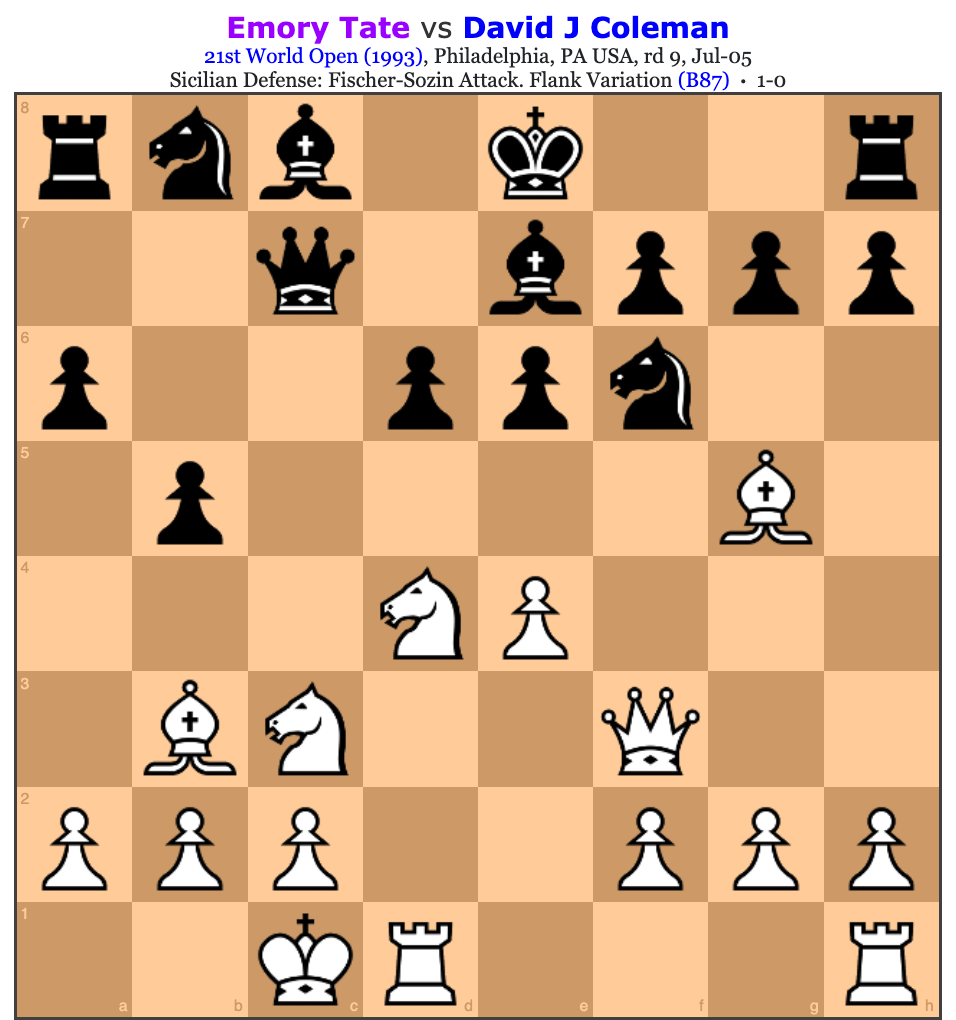
The brothers’ father, Emory Tate, a brilliant, paranoid chess master discharged from the Air Force with a narcissistic-personality diagnosis, beat his sons, abandoned the family, and posted online about enemies of “alpha males” and the “Matrix” — supplying his son’s ideological vocabulary. After Andrew’s death-of-the-father tribute (”He created a monster... As a father should”), the through-line from a violent, impoverished Luton childhood to the pimping business is direct. Tate’s first webcam worker, a Slovak girl he met when she was fifteen, performed as a Russian woman in her twenties; footage of him whipping her with a belt later surfaced. Tate studied the Chicago pimp Ken Ivy’s Pimpology, whose advice — find the weakness, make her depend on you for everything — became his operating manual.
Impunity, twice over
Blake shows that Tate could have been stopped a decade ago. Three British women reported rape and strangulation in 2014–15; Hertfordshire police botched the investigation from the start — no recorded statement, mis-stored evidence, a phone left lying around the station — and the case died, with prosecutors writing to the women explaining why they were apparently to blame. Tate fled to Romania precisely because, as he put it, “in Eastern Europe none of this garbage flies.” There he cultivated organised-crime and police connections, bragged about bribery, and bought property with bags of cash. Local police sat on at least two reports that the brothers were coercing women.
The 2019 decision not to charge him emboldened him: “The strong conquer the weak,” he told followers, before launching Hustlers University, whose affiliate-marketing army flooded TikTok with his content — twelve billion views in months. Deplatforming made him a free-speech martyr; a confidential contract shows Rumble (backed by Peter Thiel and J.D. Vance) paying him at least six million dollars a year.
The War Room
Tate’s $8,000-a-year network taught members to recruit women into “sexual slavery” via his “Pimping Hoes Degree,” assisted by a California hypnotist who promised to keep women “soul-locked.” Members shared “receipts” of recruits; the brothers hosted parties for teenage girls — “16 year old hoes are all over the house,” Andrew wrote — and Tristan’s conquest journal recorded teenagers and virgins. One Romanian disciple boasted of hitting a worker in the head with a keyboard, after which “she went in the room and worked 7 hours.”
Among the most arresting individual accounts is that of Lauren Southern, the anti-feminist activist famous for denying rape culture, who says Tate drugged, raped and strangled her in 2018 — and stayed silent for years because, as she told him, “there’s nothing I can say without destroying my career.”
Politics as protection
When Romanian prosecutors indicted the brothers, the MAGA ecosystem mobilised: Tucker Carlson, Candace Owens, Donald Trump Jr., Elon Musk. Tate’s team waged what one member called “textbook victim intimidation” against the American witness — a $300 million lawsuit threat, private detectives, doxxing, a lawyer promising to “rip her to shreds.” After Tate helped mobilise young male voters for Trump in 2024 (”THE PATRIARCHY IS BACK”), US pressure — channelled partly through envoy Richard Grenell — preceded the lifting of the brothers’ travel ban. A senior Romanian law-enforcement source said the decision came from “outside the judicial system.” The case has since stalled under a new prosecutor; this April all bail conditions were dropped. Tristan privately acknowledged being “protected by Romania.”
The reckoning, maybe
Blake’s own reporting prompted Britain’s police watchdog to open a gross-misconduct inquiry and Hertfordshire police to reopen the original case — panicking Tristan, who noted a new warrant would mean “we’re not protected by romania at all.” A civil claim by four British women has crowdfunded over £300,000. And Tate’s first recruit, now in Dubai after seven sessions of tattoo removal, runs a Telegram support group for women leaving abusive relationships and the sex industry, telling one member of an abuser: “Thats not love, never was.”
The closing interviews capture the brothers’ unblinking denial. Andrew: “Show me a victim. Show me a hurt girl... Show me something.” Tristan, musing on his own defence, observes that Ted Bundy “ruined it for fucking everyone” — the handsome man’s alibi — before insisting on a farewell hug the author felt she could not refuse.
The wider argument: Tate has normalised violent misogyny at scale — British police call the radicalisation “terrifying” and have declared violence against women a national emergency — and his trajectory shows how celebrity, money and political alignment can convert alleged trafficking into a culture-war asset.
Excellent piece, for its appreciation of the value of neoliberalism — and its failings (Hint: its intellectual failings are its triumphant universalism - same problem as international communism).
Why did neoliberalism, in its domestic and international components, fail? I ask this question ... in my forthcoming The Great Global Transformation: National Market Liberalism in a Multipolar World. I am asking it for personal reasons too: some of my best friends are neoliberal. It was a generational project of Western baby-boomers which later got adopted by others. ... When nowadays I meet my aging baby-boomer friends, still displaying an almost undiminished zeal for neoliberalism, they seem like the ideological escapees from a world that has disappeared long time ago. They are not from Venus or Mars; they are from the Titanic.
When I say that neoliberalism was defeated I do not mean than it was intellectually defeated. ... No: like communism, neoliberalism was defeated by reality. Real world simply refused to behave the way that liberals thought it should.
We need first to acknowledge that the project had many attractive sides. ... It promoted racial, gender and sexual equality. By its emphasis on globalization, it has to be credited by helping along the greatest reduction in global poverty ever. ... Even its much-reviled Washington consensus ... is fundamentally sound. ... It does not require more than an hour to explain it to the most economically ignorant person.
So, to go back to the original question, why did neoliberalism not remain the dominant ideology? I think there are three reasons: its universalism, hubris of its adherents (which always comes with universalism), and mendacity of its governments.
That neoliberalism is universal or cosmopolitan requires, I believe, little convincing. Liberal ideology treats, in principle, every individual and every nation the same. This is an asset ... But universalism is also its Achilles’ heel. The pretense that it applies to everybody soon comes into conflict with the realization that local conditions are often different. ... Local conditions ... are refractory to the beliefs founded under very different geographical and historical conditions. So in its encounter with the real world, neoliberalism retreats. The real world takes over.
But all universalists (communists among them too) refuse to accept that defeat. ... That’s where the intellectual hubris kicks in. The defeat is seen as due to moral flaws among those who failed to adopt neoliberal values. ... The morality play combined with economic success ... gave it Victorian or even Calvinist undertones: becoming rich was seen not only as a sign of worldly success but as an indication of moral superiority. As Deng Xiaoping said, “getting rich is glorious”. This moral element implied lack of empathy with those who failed to find their right place within the new order. If one failed, it was because he deserved to fail. ... This contributed more than anything else to the neoliberals’ political defeat: they simply ignored the fact that most politics is domestic. ...
Finally, mendacity. The failure to observe, especially in international relations, even the self-defined and self-acclaimed “rules-based global order”, and the tendency to use these rules selectively ... created among many the perception of double standards. Western neoliberal governments refused to own to it and kept on repeating their mantras even when such statements were in glaring contradiction with what they were actually doing. ... A part of that mendacity was present domestically too when people were told to shut up and not complain because the statistical data were not giving them reason. ...
What next? ... [T]he past fifty years have seen the debacles of two universalist ideologies: communism and neoliberalism. Both were defeated by the real world. The new ideologies will not be universal ... They will be particularist, limited in scope ... and geared toward the maintenance of hegemony wherever they rule. ... This is why the talk about global ideologies of authoritarianism is meaningless. ... Moreover, since they lack universal principles, they are likely to clash. The only way for authoritarians not to fight with each other is to accept a very narrow set of principles, essentially those of non-interference in domestic affairs and absence of aggression ... Xi Jinping’s proclamation of five such narrow rules at the recent Shanghai Cooperation Organization meeting may be based on such a calculation.
A marvellous parody of news I stumbled across. Wanna know what’s really going on? Ask the president. He’s been very lenient with Iran, but he’s running out of patience.
Back to imbalances
You’ve already seen this picture. It’s what things will look like when AI replaces 80% of jobs. But it’s also roughly the kind of thing that could happen if imbalances get too out of, well …. balance!
Michael Pettis goes through the macroeconomic logic of international imbalances. We’ve been here before. International imbalances arguably delivered us the 2008 GFC (at least when combined with lax regulation). His point seems right to me, but I wouldn’t trust me on this more than any other (non-crazed) economist. The original article was very long, and Claude’s summary does a good job of boiling it down.
Pettis takes Adam Tooze’s recent essay on global trade imbalances as his starting point and agrees that new geopolitical and technological forces matter — but argues they shape the composition of imbalances rather than their fundamental nature. The root cause, he contends, is what it has always been: distortions in income distribution that prevent wages from rising with productivity, leaving surplus economies no choice but to export unemployment through trade surpluses, or pile up debt, or both.
This is not a new insight. Pettis traces the lineage to John Hobson and Charles Arthur Conant in the 1890s, and to Joan Robinson’s 1930s coinage of “beggar-thy-neighbor” surpluses as a mechanism for exporting unemployment. His provocative claim: if you could transport Keynes, Kalecki, Nurkse, and Marriner Eccles to the present day, they would have no trouble at all understanding what is happening.
The Direction of Causality Runs Both Ways — But One Way Matters More
The conventional view holds that the US fiscal deficit drives the US trade deficit, which in turn forces foreigners to fund both. Tooze, Pettis says, has been ahead of most in recognising that causality can run the other way — but still understates how often it does.
The accounting identity that a current-account deficit country must be a net receiver of foreign capital says nothing about why the capital flows in. When a country like China — whose government controls capital and trade accounts extensively, and which has spent decades running the deepest macro imbalances in history — runs enormous surpluses, it is not doing so in order to accommodate low US saving. The causal arrow points from Beijing to Washington, not the reverse.
If China exports excess saving to the US, the US must respond: either it intervenes in its own external accounts to push the imbalance onto someone else, or its domestic economy adjusts to absorb an excess of investment over saving. Since the US does not intervene in its capital account, domestic adjustment is what happens.
Three Ways the US Absorbs the Imbalance
Pettis identifies how US domestic adjustment occurs when foreign capital floods in:
US manufacturers lay off workers — unemployment rises (Joan Robinson’s prediction).
The Fed engineers an expansion in household debt, partly by inflating asset prices.
Washington engineers a rise in the fiscal deficit to compensate for lost demand.
The key policy implication follows directly. If surplus-country saving is the driving force, then US fiscal austerity will not close the trade deficit. It will simply shift the adjustment from fiscal debt to household debt (more dangerous) or to unemployment (politically unacceptable). Keynes made exactly this point in 1944.
The US therefore faces two options, neither comfortable: begin intervening in external accounts (which will be called “protectionism”, as Robinson predicted, even if it is really a response to foreign mercantilism); or continue to absorb mercantilist surpluses and choose among unemployment, household debt, and fiscal deficits as the balancing mechanism.
Manufacturing Share vs Manufacturing Employment
Pettis draws a distinction that he says mainstream economists habitually blur. Manufacturing employment has fallen across all rich countries. But manufacturing’s share of GDP has not declined equally everywhere — it has risen in persistent surplus economies (most strikingly China) and fallen in persistent deficit economies like the US.
Two entirely different forces can reduce manufacturing jobs, with opposite implications:
Rising productivity: fewer workers produce more output. Wages rise, no unemployment, the economy grows richer. Welcome it.
Foreign industrial policy: other governments subsidise manufacturing, suppress wages and domestic consumption, and capture a larger share of global output. The US loses manufacturing not because it has become more efficient but because its trading partners have decided to take that ground.
Conflating these two processes is a serious analytical error. When the US loses manufacturing jobs to automation, that is progress. When it loses them because Germany, China, South Korea, and others are systematically bidding for global manufacturing capacity — believing that faster productivity spillovers flow from manufacturing than from services — the result is the US shifting into sectors with slower productivity growth. The aggregate effect: lower overall productivity growth, higher inequality, and reduced economic resilience.
The conclusion Pettis draws is blunt. Knowing the difference between productivity-driven and policy-driven deindustrialisation is not an academic nicety. It is the crux of understanding what is actually happening to the American economy — and what, if anything, should be done about it.
Who can’t do with a little inspiration porn? And I’ve already fessed up to my weaknesses for reality/talent quests. So I can’t absolutely promise that you won’t get more of these.
Felix Martin on responding to the imbalances
An excellent sorting through of the issues from my friend Felix. (Felix is also a cool name, though this was only a small influence on our becoming friends - but I digress). One thing I wonder is why he hasn’t included some attempt at coordinated action against China. The EU, the US and Japan would surely have more cloud than any of them on their own. And yes, the US has already gone full chaos monkey mode on the issue, but would probably respond favourably to some coordination against Chinese mercantilism.
China’s industrial prowess and soaring external surplus inspire both envy and fear in Europe. Next week the EU Council will meet to formulate a response, with the club divided between members who favour US-style protectionism and those who want to compete in China’s vast market. Yet the roots of the ‘China Shock 2.0’ lie in three distinct Chinese policies, each of which demands a different response.
The seemingly inexorable rise of China’s trade surplus, which hit $1.2 trillion last year, is petrifying policymakers around the world. They fear a second “China Shock” – a nightmarish sequel to the original which eviscerated U.S. manufacturing and jobs two decades ago. Nowhere is the topic hotter than in the European Union, whose bilateral trade deficit with the People’s Republic has doubled in the last five years to top €1 billion a day in the first quarter of 2026. ...
The members of the EU Council are split. France favours tariffs and other trade restrictions to displace Chinese imports. Germany, Italy, and the Netherlands meanwhile want to secure access to the Chinese market so European exporters can challenge local rivals, following Volkswagen’s revamped business model of relocating wholesale to the People’s Republic.
Both approaches look questionable. The EU’s proposed Industrial Accelerator Act is weak beer next to Trump’s all-out tariff war. And prying open the Chinese market does not ensure success. Volkswagen’s “in China, for China” strategy is already struggling amidst merciless price competition from local rivals.
Yet the focus on shrinking China’s headline trade surplus is too narrow. ... The economic roots of the second China Shock lie in three distinct government policies. The EU should consider each before determining whether to relax, retaliate, or replicate what China is doing.
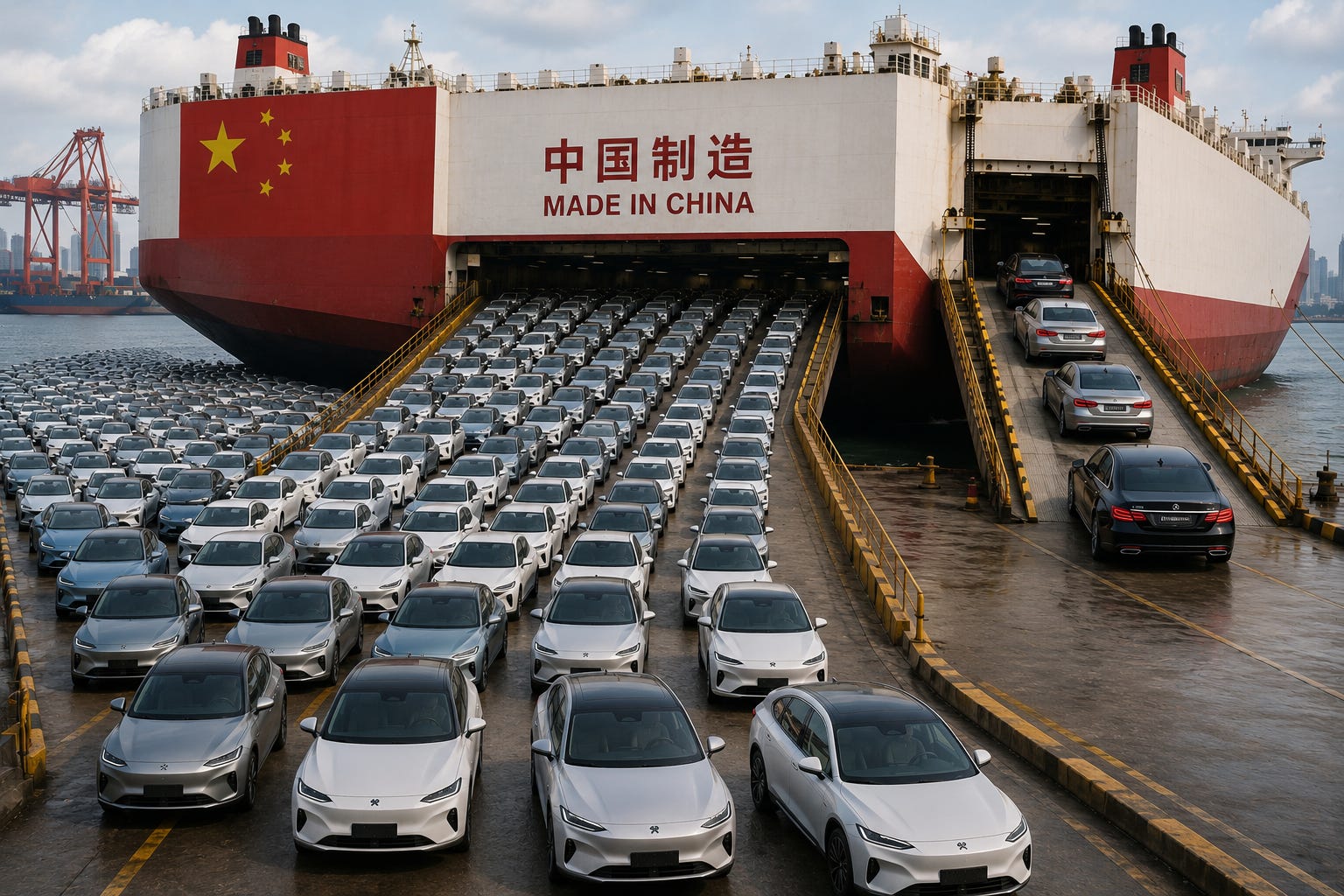
China now accounts for around a third of all global manufacturing. Its auto exports have rocketed from 1 million vehicles a year in 2020 to an annualised total of 12 million last month. ... These achievements rest on massive fiscal subsidies, easy finance, free grants of land, and other state aid. The OECD estimates Chinese firms received between three and eight times more government support than OECD members, and attributes nearly 60% of Chinese companies’ global market share gains to subsidies. To level the playing field, tariffs and other trade defences such as those the EU has already imposed on Chinese-made electric vehicles are a reasonable option.
Indeed, the EU will find allies within China itself. China is mired in “involution”: a spreading crisis of overcapacity which has fuelled deflation and rendered huge swaths of industry loss-making. Just four out of 130 electric vehicle makers were profitable by 2024. ... Retaliatory action may therefore push at an open door.
... The second major driver of China Shock 2.0 is the country’s remarkable record of technological innovation. China is now the global research leader in 66 out of 74 critical technologies, including cloud computing, computer vision, and generative AI. ... China has also made strategic policy choices rapidly emerging as superior to those in the West. In AI, Chinese firms have focused on open-weight models for local devices rather than proprietary cloud-based models. In energy, China prioritised cheap power to accelerate electrification; the EU did the opposite, leaving European economies far more dependent on imported oil and gas.
In these areas, replication rather than retaliation should be the order of the day. ...
Yet there is a third and more basic driver which dominates all the others. For European visitors China is unbelievably, inordinately cheap. The exchange rate is massively undervalued, by between 12% and 21% in real, trade-weighted terms, according to the IMF — a globally significant distortion.
... China’s central and state-owned banks actively manage down the renminbi’s value. At the same time an oversupplied economy and sky-high savings rate have kept domestic inflation materially lower than abroad. As a result, the “China price” remains unbeatable, fuelling the trade imbalance that is now such a headache for the EU.
... The IMF therefore prescribed the opposite of its usual medicine, urging China to allow the renminbi to appreciate and aggressively pursue reflation. There is no sign that Beijing is inclined to heed this sound advice.
At next week’s EU confab, trade retaliation and innovation imitation will be the easy bits. The hard question is how Brussels can convince Beijing to undertake structural adjustment in reverse. Without that, a second China Shock is indeed incoming.
I love it when, in whatever field they might be in, someone comes into their own.
I remember when Theresa May first became UK prime minister and it seemed clear that she’d been thinking of that moment for decades, so I thought we might witness something special. We might see a combination of talents, resolve and insight that had grown out of those decades. Alas, it turned out her ruminations had been private, solipsistic affairs. They’d not made any serious contact with reality. She had no idea really what to do or how to marry the affordances of her office to the needs of the moment. There’s a long line of people who acquired the top job without any real sense of mastery over their situation or even comprehension of what it was.
Against all that disappointment, it’s been good to watch Carney, the one English-speaking politician I can think of who continues to rise to the occasion.
The Bolsheviks overturned the provisional government in October 1917 in the name of giving “all power to the soviets.” But the political form they introduced in its stead was a reversible figure, displaying two very different faces. Viewed from one angle, it appeared to be a vibrant democracy, where fairly autonomous communes, run by soviets, allowed the people to govern themselves directly. These soviets in turn elected representatives to councils at higher levels, culminating in the All-Russian Congress of Soviets. It was a variation on the modern theme composed by Turgot in his “Memorandum on Municipalities.” The will of the people would be filtered through layers of councils, distilling it for administrators to execute at the national level.
But as in that memorandum, there was a countervailing force sitting atop this political structure. Viewed from on high, the entire ladder of soviets was dominated by a supreme authority that could demand “subordination,” and exert “control.” Contrary to Turgot’s model, however, where the sovereign discovered the people’s will and interests by learning about them from the general assembly, in the Bolshevik model it was the Party and its own governing bodies—the Central Committee and the Politburo—that had a monopoly on the knowledge needed for governing. The Party even overlaid its own political structure on the system of soviets, with Party elections occurring at local, regional, and national levels, leading up to the Congress of the Communist Party of the Soviet Union.
From this perspective, the system looked less like Turgot’s modern democracy and more like Plato’s republic, in that power rested in the hands of a guardian class. The multiple layers of councils, by means of which information was meant to percolate up, could also serve as a military hierarchy in which commands were passed down. The Party structure similarly served to disseminate and impose the party line that was decided at the top, in keeping with Lenin’s principle of “democratic centralism.”
In theory, the dictatorial power at the top of this pyramid was meant to fade as the democratic elements became more established. The need for subordination and control, it was assumed, would be greatest at the start of the revolution. This was certainly the case after the October Revolution triggered a civil war that lasted nearly six years. But in practice, even after the war had ended, the Party retained a stranglehold on all policymaking. The political hierarchy could at times be useful for transmitting information up the chain, notably regarding conditions after the war. This knowledge helped to shape the New Economic Policy (or NEP), which the Party introduced to help revive the postwar economy. And the soviets could also convey the impression that the government was participatory, thereby helping to legitimize the regime and garner popular support. But for the most part, governmental and party hierarchies were used to subordinate and control.
Dan Edelstein, The Revolution to Come, A History of an Idea from Thucydides to Lenin
Excellence and courage rewarded in honours: SHOCK!!
I know nothing of this, but former senior public servant Mark Cully does. From his LinkedIn post.
Too many public servants get a PSM for doing their job. Nu Nu got hers for going outside her job to air and explore an issue that made senior managers in the Treasury uncomfortable: why were the senior ranks in Treasury so white? She then got hold of an amazing data set from the Public Service Commission and used her formidable analytical talents to demonstrate that there was a systemic bias against applicants from a culturally and linguistically diverse background in winning promotions. She then set about using her formidable persuasion skills to present this work to multiple forums and force public service agencies and the Public Service Commission to recognise that this was an issue that needed to be tackled. Needless to say, Nu Nu is not lacking in courage. This is a thoroughly deserved PSM; this is what leadership looks like.
And, never one to like surprises, I was relieved to see a sound chap or two receiving due recognition for helping conceal the identities of the senior public servants who helped the Government prey on welfare recipients during that unfortunate Robodebt business.
Are you a younger sibling, and should you sue?
On reading this piece, the deep animosity between my older brother and me naturally resurfaced - as indicated in the Signal chat above.
Younger siblings enjoy real advantages in life.
“There are a lot of reasons why second-borns should do better,” said Joe Price, an economics professor at Utah’s Brigham Young University ...
But being born first is a far better bet in life, the data shows. A landmark 2005 study found that younger siblings fare worse than firstborns on lifetime earnings, educational achievement, mental health and, for women, teen pregnancy. The later the birth order, the worse the stats get. ...
Price revealed one likely mechanism that disadvantages younger siblings in a 2008 peer-reviewed study: less quality time with parents.
He found first-born children received 20 to 30 more minutes each day compared with a second-born child of the same age ... The deficit amounted to about 3,000 fewer hours ... roughly comparable to more than a year of schooling ...
Still, that left at least half the downsides to being a younger sibling unexplained. A forthcoming peer-reviewed study in the American Economic Review points to a second major culprit: germs.
Following 1.2 million Danish children born since 1980 into adulthood through government records, the study found ... Exposure to respiratory viruses before a baby’s first birthday — when immune systems are immature and before most childhood vaccinations — consistently predicted reduced earnings, education and health decades later.
The researchers estimate that half or more of the gap in life outcomes between older and younger siblings can be attributed to pathogens inadvertently brought home by older siblings. ...
Luckily, much of the harm is preventable. ...
What harms younger siblings
The Danish data ... revealed a natural experiment. Serious respiratory illnesses such as influenza and RSV ... sweep through communities in seasonal waves that hit some municipalities worse than others. [This let the researchers isolate the effects of disease exposure.]
The disparity was stark: Younger siblings were two to three times more likely to be hospitalized for acute respiratory conditions than their older siblings during their first year of life. ... Older siblings, the data suggested, were bringing home viruses to vulnerable infants ...
[After controlling for parental income, education and employment,] the pattern was clear: Earnings, education and mental health outcomes all declined as community disease exposure rose. ...
Timing mattered enormously. Disease exposure in the first six months of life produced income penalties two to three times larger than equivalent exposure in the second half of the first year ...
Janet Currie, an economics professor at Yale University ... said the likely mechanism is well known: Serious illness in early childhood can derail brain growth ...
In the first months of life, roughly 85 percent of an infant’s calorie intake goes toward neural development. A serious infection can reduce how much a baby eats and divert calories away building a brain. ...
How to stop birth order becoming destiny
The disadvantages of being a younger sibling are not fixed, and many of the drivers are within parents’ control. ...
Maximize immunity with vaccines
During the first year, especially the first six months, avoiding exposure to severe respiratory diseases is crucial. ...
“People who refuse to vaccinate their preschool-age children but send them to preschool, may be harming someone else’s infant,” Currie said. ...
Breastfeeding and hygiene keep babies out of the hospital
Breastfeeding, the researchers found, was highly effective at warding off severe illness in babies. ... Among younger siblings with high disease exposure breastfed for at least 15 months, their higher risk of hospitalization in infancy was eliminated entirely. ...
Spend extra time with your youngest children
Disease exposure appears to cause as much as 70 percent of the negative effects of birth order on income. ...
“Once you’re aware of this, you can offset it,” [Price] said, “I think you just have to always ask the question: What was I doing with the oldest when they were the same age? Don’t try to be fair today, but try to be inter-temporally fair.”
Parents can’t do it alone
I have two toddlers at home. I know how much this is asking of new parents, especially in the U.S., the only wealthy nation without universal health care or federal paid parental leave.
Policies that support parents in that first crucial year could help reduce infections: paid family leave, flexible work arrangements, lactation-friendly workplaces, and universal access to pediatric care, especially immunizations. ... They’d protect kids during the months that matter most.
Yolŋu artists Djirrirra Wunuŋmurra Yukuwa and Moyurrurra Wunuŋmurra
It’s not clear to me which of the two sisters this one is, but she looks like a cutie! More information here.
Heaviosity half-hour
The Alliance Theory of Political Belief
One of my lodestars, Alasdair MacIntyre, believed the modern ethical world was incoherent — an ethical jumble which he called ‘emotivism’. This is the condition in which moral language has lost its connection to any shared rational standard. MacIntyre opens his most famous book, After Virtue with a thought experiment: imagine a civilisation that turned against science with pogroms against scientists and widespread destruction of scientific infrastructure.
Imagine the catastrophe left behind only fragments — instruments, theories, half-remembered terminology — with no understanding of the framework that once gave them meaning. He argues that this is precisely the condition of our moral vocabulary today. We retain the words — equality, rights, justice, authority — but the tradition of reasoning that once grounded them has been shattered. What remains are shards: principles invoked opportunistically, applied to allies and withheld from rivals, wielded to manipulate people and grab the moral high-ground rather than to reason in good faith.
Well, political science has finally caught up. In “Strange Bedfellows: The Alliance Theory of Political Belief Systems”, provides some empirically grounded ‘micro-foundations’ for emotivism. Authors Pinsof, Sears and Haselton show how principles aren’t applied inconsistently by accident or through weakness of reasoning — they’re structurally generated by alliance politics. People aren’t failing to be consistent; consistency was never the point.
Full paper can be downloaded from this link, though Claude summaries - such as the one below is almost invariably a better way to read academic papers written after 1970.
The Puzzle
Political belief systems are riddled with apparent contradictions that nobody seems to find embarrassing. Conservatives believe people shouldn’t rely on government handouts — but that government should do more for working-class heartland towns. They say people are too easily offended — but bristle at criticism of Christians, white people, and police. They revere authority — except that of the FBI (once it began investigating Trump), the WHO, climate scientists, and regulatory agencies. Liberals think CEOs shouldn’t earn millions — but are relaxed about Hollywood stars doing exactly that. They want solidarity with unions — except police unions. They insist no group should be stereotyped by region — except southerners.
The standard explanation in political psychology is that people hold abstract values — equality, authority, loyalty, care — and their political beliefs flow from those values. Pinsof, Sears, and Haselton argue this is wrong. Their answer: there is no moral thread. The apparent contradictions are the point.
The Core Claim
Political belief systems are not philosophies. They are, as the authors put it, “collections of ad hoc justifications, rationalizations, moralizations, embellishments, and rhetorical tactics designed to advance the interests of complex political alliances in competition with their rivals.”
“Moral principles are not so principled. Core values are not so core. Ideological worldviews are not designed to literally view the world but to serve strategic functions like signaling allegiance or mobilizing support.”
The key insight: what you believe politically is determined not by your values but by who your allies are. Once you know whose side someone is on, you can largely predict their beliefs — because those beliefs exist to advance their allies and undermine their rivals, not to articulate a coherent worldview. The alliances come first; the moral frameworks are invented to justify them.
Part One: How Alliances Form
The authors ground the theory in evolutionary psychology. Alliance-formation is ancient — chimpanzees, dolphins, and hyenas all do it. The question is never whether to have allies, but whom to choose.
Three criteria drive ally choice:
Similarity. We favor people who share our beliefs and markers, because coordination is easier. “Minimal group” experiments show that even arbitrary labels create alliance expectations — people start favouring their group and expecting others to do the same, making the expectation self-fulfilling.
Transitivity. “The enemy of my enemy is my friend” and “any friend of yours is a friend of mine.” This principle alone generates clusters — groups of people with shared loyalty toward each other and shared antagonism toward rival clusters. It’s also what explains the strangest bedfellows: groups with nothing obvious in common end up allied because they share a common rival.
Interdependence. We feel allegiance toward those whose interests overlap with ours, and resentment toward those who threaten our goals.
These forces are self-reinforcing and partly stochastic. Small historical accidents — who allied with whom in a particular decade — snowball into the seemingly fixed ideological landscape we now treat as natural.
Part Two: How Allies are Supported — Propagandistic Biases
Once allies are chosen, partisans mobilise support for them using a toolkit of what the authors call “propagandistic biases.” These are applied not just to oneself but — crucially — to allies, regardless of whether the ally is actually in your group.
Perpetrator biases: When your allies do something wrong, you downplay their responsibility, emphasise mitigating circumstances, and minimise the harm. The same rationalising that perpetrators use to excuse themselves, partisans extend to their allies.
Victim biases: When your allies are wronged, you amplify the grievance — emphasise the perpetrator’s malevolence, deny mitigating circumstances, and embellish the severity of harm. This is why both sides engage in “competitive victimhood”: each side strives to establish that their group has suffered more injustice than the other.
Attributional biases: Your allies’ successes reflect their talent and hard work; their failures are explained by external circumstances and unfair treatment. The same logic applied in reverse to rivals — their failures are their own fault; their successes are undeserved.
The crucial finding: these biases are symmetrical across the political divide. Liberals are just as prone to them as conservatives. The difference is only who the targets are.
Part Three: The American Alliance Structure as Historical Accident
The paper maps the current American partisan alliance structure — progressives allied with African Americans, Hispanics, secular feminists, gay people, academics, and Hollywood; conservatives allied with white evangelical Christians, the military, police, small business owners, and rural working-class whites — and then asks: why these groupings?
The answer is contingency. Four mid-twentieth-century realignments created the current map:
The Civil Rights Act of 1964 drew racially conservative southerners into the Republican Party and accelerated the movement of African Americans into the Democratic Party.
Republicans took ownership of the pro-life evangelical movement, pushing Christian traditionalists rightward and secular feminists leftward.
Immigration and deindustrialisation created a resentful white rural underclass who attributed their decline to globalization and immigration.
Expanding higher education created a new “knowledge worker” upper class (journalists, academics) who came into competition and mutual resentment with business elites — splitting the upper class along partisan lines.
The point is that none of this was inevitable. The paper lists striking historical counter-examples: Latin American militaries have been socialist; early twentieth-century progressive academics championed eugenics; Green parties in post-Soviet Eastern Europe allied with right-wing nationalists; feminists during the suffrage movement excluded African Americans. The “consistency” of elite ideology is not philosophical coherence — it is loyalty to a historically contingent alliance structure that happens to be the one we inherited.
“The combination of libertarianism with Christian fundamentalism did not emerge from philosophical analysis. The only reason these philosophies go together in the United States is because of the strategic alliance between pro-life evangelicals and wealthy Republicans in the 1970s — an alliance that is uncommon in other countries.”
Other groups got pulled into the structure through transitivity. The authors suggest that conflicts between African Americans and law enforcement led both parties to polarise on police. Wars in Iraq and Afghanistan may have caused secular liberals — rivals of Christian fundamentalists, who were allies of the military — to drift toward sympathy with Muslims (enemy of my enemy). There was no principled reason for any of this. It cascaded.
Part Four: Testing Against Rival Theories
The paper systematically challenges three dominant frameworks in political psychology, each of which posits an asymmetry between liberals and conservatives.
Intolerance Theory holds that conservatives are more xenophobic, ethnocentric, and hostile to outgroups. The problem: when you actually measure antipathy toward political rivals (rather than toward specific groups already embedded in partisan allegiances), liberals are equally hostile. Liberals are just as likely to discriminate against conservatives in job applications; they show equally strong negative attitudes toward groups associated with conservatives. Crucially:
Republicans have more positive attitudes toward Asian Americans than Democrats do, despite Asian Americans being a “foreign” group — because Asian Americans are perceived as conservative-leaning.
Republican support for Putin tripled between 2015 and 2017 as Trump praised him — the opposite of what nationalism would predict.
Republican support for the FBI collapsed once it began investigating Trump — the opposite of what an authority-reverence hypothesis would predict.
In “trolley problem” experiments, liberals are more likely to endorse killing a white person to save African Americans — but not the reverse — and conservatives condone torture by the American military but not by Iraqis.
None of this fits a general theory of outgroup hostility. It fits a theory of team loyalty.
Authoritarianism Theory holds that conservatives are more deferential to authority. The same problem arises: conservatives show more respect for the authority of their allies (military, religious leaders), while liberals show more respect for the authority of their allies (civil rights activists, environmental scientists). For ideologically neutral authority figures — office managers, judges — there are no partisan differences. Authoritarianism, like everything else, tracks alliances.
Egalitarianism Theory holds that liberals have a deeper commitment to equality. The authors’ most striking evidence here: in a nationally representative study (N = 5,522), when participants chose between hypothetical societies with randomly determined distributions of wealth, there was no partisan difference in preference for equal societies. The liberal commitment to equality only appears when the relevant groups are specified. When an insurance policy disadvantages a mostly African American neighbourhood, liberals oppose it more strongly than conservatives — but when the disadvantaged neighbourhood is mostly white, the partisan gap disappears. When overpayment applies to CEOs, liberals call it unfair — but when it applies to Hollywood stars, liberals are less likely to call it unfair than conservatives.
A four-year longitudinal study (N = 759) found that prior party identification predicts subsequent egalitarianism, but prior egalitarianism does not predict subsequent party identification. The causal arrow runs from alliance to values, not the reverse.
“People rapidly switch from egalitarian to anti-egalitarian moral judgments — in a matter of minutes — depending on whether equality benefits the group they were assigned to.”
When social psychologists were asked whether they would be inclined to discriminate against a conservative job applicant, 82% of self-identified liberals admitted they would be at least somewhat inclined to do so. Liberal commitment to non-discrimination has limits: it stops at the edge of alliance membership.
Implications: Politics is Not Morality
The paper’s closing argument is philosophical. It distinguishes politics from morality: politics is about conflict and loyalty; morality is about cooperation and impartiality. Partisans who claim their positions are moral convictions are not lying exactly — but the moral framing is itself a propagandistic tactic, designed to draw third parties to their side and license attacks on rivals.
Both sides describe themselves as motivated by love, altruism, and honesty, and their opponents as motivated by selfishness and hatred. Since these descriptions cannot both be right, and since they are perfectly symmetrical, they are both distorted — “propagandistic biases” in action.
The most politically engaged partisans — those who most loudly claim moral motivation — are also the most likely to condone immoral behaviour by their allies. This only makes sense if politics and morality are distinct domains. Loyal partisans are not the most morally principled; they are the most tribally committed.
The paper ends with a striking analogy: ideological belief systems may be “analogous to the ‘two sides of a story’ that emerge from interpersonal disputes.” If you don’t back your friends’ version of events, they won’t consider you a true friend. “Motivated reasoning is not so much of a cognitive shortcoming as it is an honest signal of loyalty.”






















Mad. Hate sport even more!