


Rory Stewart and me on the mysterious eclipse of merit
I asked Rory to join me to discuss the ideas behind the most recent videos in the series. The third of the relevant videos, Video 11, was in last week’s newsletter. See what you think.
Cometh the hour, cometh the man
You’ve probably seen some of this. Our governments have bright people in them, but I think it’s telling that this guy is a bit of a newcomer to politics - that he’s been dealing in ideas for most of his life, not talking points - though a CEO does a fair bit of that too. Anyway, speaking clearly about a thing doesn’t fix it. But, in addition to providing the low-key emotional pleasure of hearing the truth spoken, it does lay some groundwork for making a start.
From Arnaud Bertrand’s Twitter feed.
Who could have expected Mark Carney, a liberal establishment figure if there ever was one, to be the flag-bearer for the end of the US-led order? And from a podium at Davos, of all places?
The more you think about it, though, the more it makes sense.
Carney is, at heart, a central banker. As such he understands the power of words and beliefs better than anyone: when you strip things down to their core, a world order - like trust in a currency or a financial system - fundamentally relies on the maintenance of belief. Systems of power exist because participants act as if they exist. That's pretty much it: perception is reality.
Once participants acknowledge the fiction as Carney just did (he literally started his speech announcing he'd "end the pleasant fiction" of the US-led order), the system itself unravels. This is incidentally a formal concept in game theory: the shift from private knowledge to common knowledge is what triggers cascades.
Carney, with his background, ought to have known this was his most potent weapon facing Trump's America: "Trump has the economic and military might. But I have something his power rests upon: I can shatter the collective belief that sustains it."
He's even explicit about this being his thinking: his entire speech revolves around Vaclav Havel’s famous shopkeeper analogy and the fact that the power of the Soviet Union rested on "everyone’s willingness to perform as if it were true," on "living within a lie."
As Carney puts it, "when even one person stops performing, the illusion begins to crack" and the entire "system’s power" starts to crumble.
Today, that "one person" was him.
Make no mistake, Carney’s speech at Davos may prove to be one of THE most important speeches made by any global leader over the past 30 years. This is genuinely epochal stuff.
More than anything, what it means is that, to the extent it even existed at all, the West irremediably lost the Second Cold War: a Cold War requires two competing systems. Carney just announced that one of them simply no longer exists.
This is the topic of my latest article: an in-depth analysis of Carney's speech and its immensely consequential implications for what comes next.
A stunner from Fred Williams

Something must be done: This is something
Another body blow for free speech
Spot the difference:
Aristotle
Socrates is a man
All men are mortal
Therefore, Socrates is mortal
Michelle Rowland, Attorney General
Did you see that horrific massacre?
We did a deal with the Opposition to give governments new powers. They’re not subject to independent oversight or subsequent review. (Goodness, is that the time? I really need to be addressing the cost of living crisis. Please get your submissions in on the new hate speech laws in the next 48 hours. I know it’s not a lot of time, but we’ve got to get on with this. Remember, we can’t do it without you. we’ll be reading every one.)
Yes, a politician will decide who gets banned but (and with the greatest respect to people who are not talking into the camera at this particular point in time) omelettes are quite tricky to make, especially if you need to keep an eye on your social media feed.
Anyway, over to constitutional lawyer Anne Twomey?
What impact will the criminal hate provisions in the Albanese government’s Combatting Antisemitism, Hate and Extremism Act 2026 have on the ability of ordinary Australians to protest?
An earlier version contained a criminal offence of promoting or inciting racial hatred. The government dropped this part of the legislation after both the Coalition and the Greens opposed it.
However, inciting racial hatred remains relevant to the other key provisions, which permit the banning of “prohibited hate groups”.
How can a group become a prohibited hate group?
A group can be prohibited under the new law if the governor-general makes a regulation prohibiting it. ... There are a number of conditions that must be met ...
First, the minister must be satisfied on reasonable grounds that the group has engaged in conduct constituting a “hate crime” ... Second, the minister must be satisfied that banning the group is reasonably necessary to protect the Australian community from social, economic, psychological and physical harm. ... [T]he third condition is that the minister must have received advice from the director-general of security ...
What is a ‘hate crime’?
The key issue is whether action is a “hate crime”, as this is necessary to satisfy the initial trigger. A hate crime is defined as including acts of violence against people based on their race, colour or national or ethnic origin ...
The original bill made promoting or inciting racial hatred a hate crime. ... While the government dropped it as a standalone offence, it slipped inciting racial hatred back in as a “hate crime” for the purpose of banning groups.
... [A] hate crime includes conduct that involves publicly inciting racial hatred that would constitute an offence against a Commonwealth law ... It would also include conduct that would constitute a specified state or territory offence. ...
This reliance on state offences makes the law very messy. ... [I]n the listed offences from Queensland, South Australia and the ACT, incitement to racial hatred is tied to threatening physical harm, whereas in New South Wales, Victoria and Western Australia, no threat of harm is required. ...
The act says no crime need actually have been committed ...
Would criticism of a country’s actions amount to a hate crime?
Is it a “hate crime” under the act to criticise the actions or policies of another country? Ordinarily, one would assume such criticism, which is a political communication, would not be regarded as inciting hatred against a group because of their race, colour, ethnic or national origin.
But in recent times, contrary arguments have been made.
... [A]ttorney-general [Michelle Rowland] was asked ... whether, if protesters were saying “Israel is engaged in genocide, or condemning Israel, saying it shouldn’t exist” and it led to Jewish Australians feeling harassed or intimidated, they could be banned. She replied “If those criteria are satisfied, then that is the case”. ...
Concern about such an interpretation and its consequential impact on the freedom of Australians to criticise the conduct of foreign governments, led to amendments to the bill being moved in the Senate. Senator Lidia Thorpe moved ... [an amendment] inserting the following statement:
As per the judgement of the Federal Court in Wertheim v Haddad [2025] FCA 720, criticism of the practices, policies, and acts of the state of Israel, the Israeli Defence Forces or Zionism is not inherently criticism of Jewish people and is protected political speech, and not hate speech.
This amendment was rejected by 43 to 12, with the major parties opposing it.
This leaves uncertain what conduct is intended to be caught. Freedom of political communication by those who wish to protest against the conduct of a nation’s government could potentially be chilled. ...

Cometh the issue, cometh the legislation
Bernard Keane is right - below - but we’re being shown something more consequential than the ineptitude of our politicians. Here’s Sophie Scamps’ report to her electorate.
In the minimal time available, I introduced an amendment, based on recommendations from the Australian Human Rights Commission, that would have addressed one of the bill’s major human rights concerns. Specifically, it sought to revoke the potential criminalisation of an individual for mere association with a group that had been involved in a hate crime, even if they had no material involvement or intention to be involved. Under the bill, such individuals could face jail sentences of five to fifteen years. Due to the extremely limited timeframe for debate, this amendment was not even considered by the Government.
But a deal between the duopoly parties is all that matters for the headlines. So it’s all that matters for the politicians.
This is directly related to our inability to regulate cost effectively. How so? Because this abomination on speech comes from the same bug in our system that prevents us even trying to regulate effectively. In both cases, those governing have next to no incentive to get the details right. They just have to have a story for the nightly news and the social media feeds. Anyway, this secret seems to be safe with the business community who don’t seem to have noticed that calling for ‘less regulation’ is almost completely useless. Politicians agree with them, announce some more red tape cutting panto, and then get back to their in-tray. Once in a generation, there might be a paroxysm and a few cobwebs might get cleaned out, but we’re so enamoured of democracy as competitive disinformation that noone’s interested in asking the naive question “how do we build a system in which decision makers are aligned with our needs”. I think it’s not so hard, but that’s another story.
When Sussan Ley chose to politicise the Bondi atrocity to damage Anthony Albanese’s political dominance, and News Corp and the Nine newspapers egged her on in the hope of either doing the same or achieving some form of regime change, some outcomes could have been predicted.
The first was that tighter gun laws would outrage the Nationals and require either urban Liberal MPs to oppose such laws — which have strong support in the community — or risk splitting the Coalition. ...
By demanding the immediate recall of parliament to rush through tighter laws and implement “in full” antisemitism envoy Jillian Segal’s bizarre set of unlawful and unconstitutional recommendations, including muzzling the press and stronger laws against hate speech, the Coalition was carefully putting in place a series of land mines — not for Anthony Albanese but for itself. And journalists, under the same delusion that this would destabilise Albanese, cheered them on as they did so.
And now, here we are, with the Nationals abandoning the Coalition and savaging Ley for doing exactly what she needed to do, which was to enforce the principle of cabinet solidarity. Nationals leader David Littleproud has now demanded a new leader of the Liberals — preferably a far more right-wing one. ...
One of those carefully laid land mines didn’t explode: Liberal moderates rolled over and opposed the gun laws — the one guaranteed 24/7 dispatchable form of renewable energy in Australia is Liberal moderates rolling. They will now have to explain to their constituents why they tried to block tighter gun laws when nearly half of urban voters want guns simply banned outright, and nearly all of the other half want tighter laws.
It was hate speech that wrecked things, though not quite in the way expected. Ley forced Labor to ditch its tightening of speech laws, corralling her troops to get behind the draconian overreach of the “hate groups” section of the bill that delivers dangerous powers to the government to criminalise membership of any group. Surprisingly, it was the Nationals who, after generations of endorsing endless extensions of security powers, suddenly decided this was a step too far. ...
None of this would have happened if the Coalition hadn’t been so eager to exploit Bondi and had thought through the consequences of making ridiculous demands, such as implementing the Segal report. Albanese’s conduct following Bondi has hardly been exemplary or politically astute, but ever since the first mutterings of “this is too rushed” began emanating from Coalition ranks, he has looked like a 3D chess player in comparison. He must be unable to believe his luck that he keeps being gifted with such inept opponents.
But Australia is the loser from this emerging Victorianisation of the whole country, in which a poor government can glide through debacle after debacle because its opponents are much, much worse. ...
For Ley, the universal commentary will be that she’s finished. Most likely she is, but she can now get on with her project of trying to make the Liberals relevant to urban electorates, to the extent that mad right-wingers and ultras like Andrew Hastie will let her.
As for all the journalists, especially at Nine, who weaponised a terrorist massacre to campaign against Albanese, they might reflect on the fact that in politics, things rarely quite pan out how you expect them to. Or, more simply, be careful what you wish for.

The F word: are we nearly there yet?


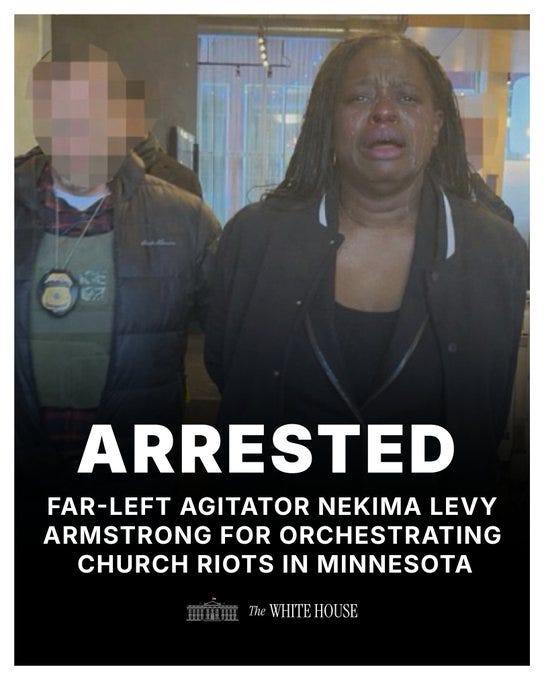
“In a photo posted to X on Thursday morning by Homeland Security Secretary Kristi L. Noem, the attorney, Nekima Levy Armstrong, appears in handcuffs with a blank expression on her face. But in an edited version of the photo posted a half-hour later by the White House, Levy Armstrong appears to be openly weeping, with tears streaming down her face. The post did not disclose that the image had been changed.”
The Washington Post
Introducing glass half-full reporting
Fake news? This won’t hurt a bit
When the government changes, I change my facts. What do you do? (With apologies to Keynes). Andrew Gelman is appalled.
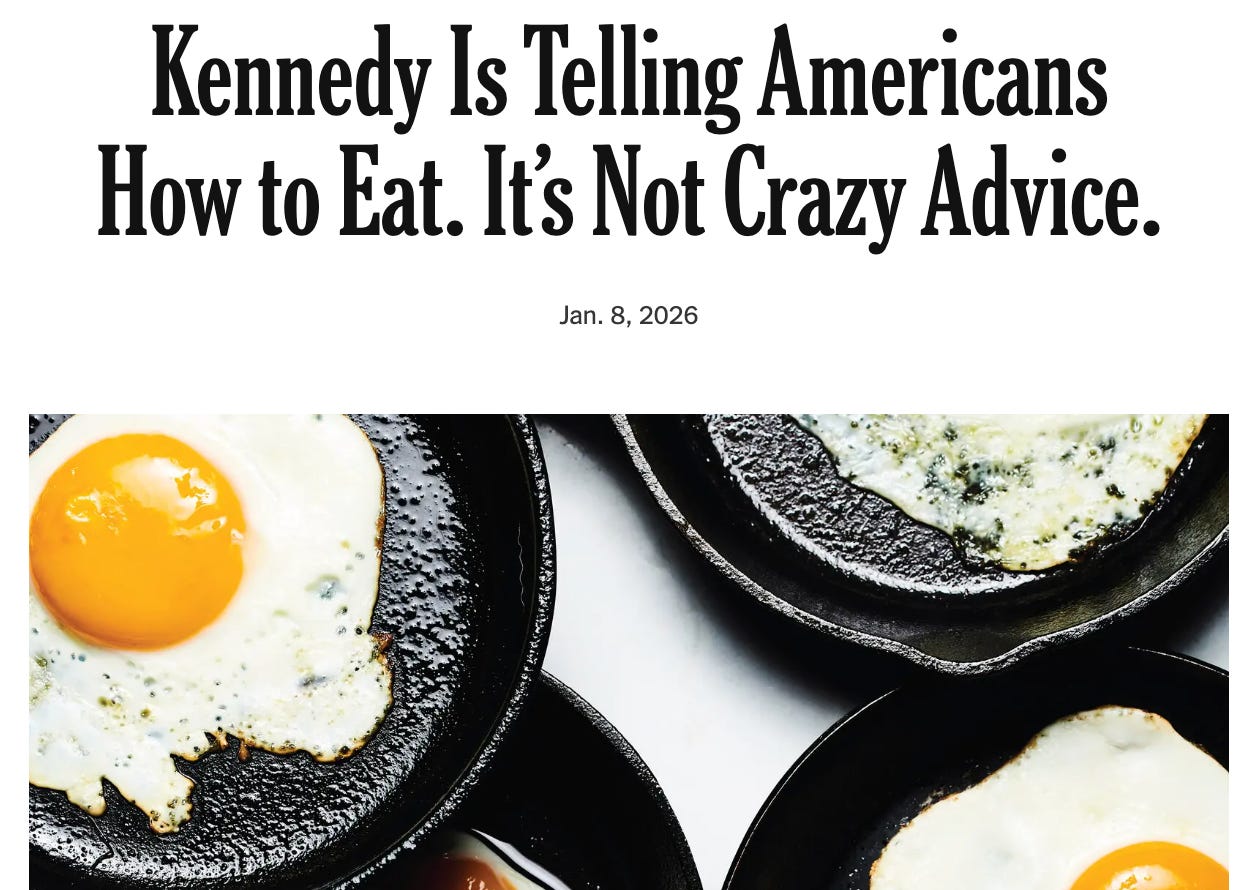
The headline of this NYT op-ed says it all: “Kennedy Is Telling Americans How to Eat. It’s Not Crazy Advice.”
That’s funny; the news article about the guidelines says that they “flip the food pyramid on its head, putting steak, cheese and whole milk near the top.” That doesn’t sound like such good advice!
If you actually read the linked op-ed (I don’t recommend you do), you’ll see that it categorizes two of the items on the new dietary guidelines as “good,” one as “totally fine”... two as “complex”... and two as “weird”...
This is just pitiful. There’s an official government publication with 8 recommendations, 2 of which the op-ed writer characterizes as “good,” and her summary is “These guidelines are a very good start for telling people where to go; now the job should be helping them get there.”
This is what we’ve come to? Official guidelines are being praised for being “not crazy”? She doesn’t even make an argument that the advice is net positive.
The U.S. government has access to top nutritional experts... If they’re giving 8 pieces of advice, these should be 8 pieces of good advice. This isn’t like baseball, where .300 is excellent and .500 is impossible.
Look, don’t get me wrong... Experts can be wrong, also food and nutrition policy are notoriously subject to political influence...
But that’s the point: if the government is giving bad advice, that’s bad! To praise them for not being uniformly crazy... that’s like if your boss’s idiot nephew comes into the office to tell everyone how to do their jobs, and after he leaves, you loudly say, “Hey, this new advice is... overall very sensible.”
My political take on this is that the author is a Democrat and suffers from something I’ve noticed in popular history writing... It’s a sort of fundamental attribution error by which our decisions and mistakes are based on context and circumstance, whereas theirs are based on their unchangeable character.
That’s the soft bigotry of low expectations: setting the bar so low that being mostly “not crazy” is enough. We should be holding the government to a higher standard than that!
More and more I’m thinking that it was a national disgrace that Ted Kennedy got away with Chappaquiddick.
Early cubists, eat your heart out!


Overconfidence and AI
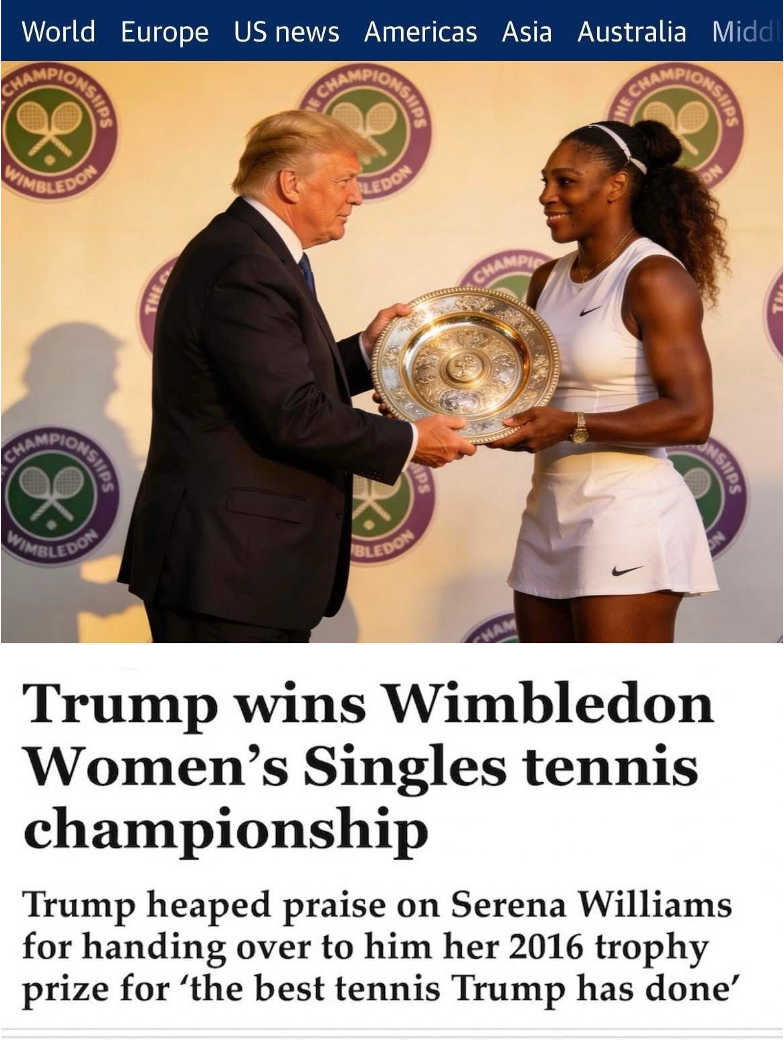
I asked ChatGPT about Arthur Ashe’s legendary demolition of Jimmy Connors at Wimbledon in 1975. I remember watching the match and Connors came back. I was so relieved when Ashe finished him off in the 4th set. Why am I telling you this? Because the description I got back on that match and two others against Conners of around the same time was interesting, nostalgic even. But was also a textbook case of the narrative fallacy, the idea that because x won, they were destined to win because of their superior this or that. And sports pundits like making a big deal of psychology. Fair enough too. Just so long as you keep in mind Lord Wellington’s response to all those flatterers who attributed his victory at Waterloo to Wellington’s genius. “Never seen such a near run thing in your life”.
Anyway, if you want to click through and check it out, my chat with ChatGPT about Connors, Rosewall, Ashe and Newcome (I watched them all in real time and was in the stands at Kooyong for the last), it’s here.
How LLMs look like pro-social media
You know - the way social media was really anti-social media

Cometh the hour, cometh the fruitcake
Carl Schmitt edition
OK, Schmitt wasn’t a fruitcake, just a Nazi, but there you go. He had some very insightful things to say, which the alt-right have gorged themselves on now for some time. And they’re running into the same kind of problem relying on him as comrade Adolf ended up in. This is a general piece - from Liberal Currents which is often good, often a bit shit. This article is good. I’m reading quite a bit of Schmitt right now, so expect him to turn up in other stuff sometime soon.
It was once said that the role of boredom in political life is rarely appreciated. The political right is first and foremost defined by its defense of a preferred hierarchy... [But] theorists on the political right will often show an openness to experimentation and radicalization that belies the stereotype. One of the appeals of far right radicalism can be its dramatic promise to offer a spectacular politics of antagonistic speed, cosmic struggle, and violence...
No figure embodied these tendencies better than Carl Schmitt, the German political and legal theorist and chief jurist of the Nazi regime... Schmitt’s writing sparkles with a savage intelligence and a talent for diagnosing the weakest points in an opponent’s position and attacking it with surgical precision... That Schmitt turned these gifts to upholding the most evil political regime in human history is one of the more troubling scandals in political thought...
A brief biography
Carl Schmitt was born in 1888... After the First World War he became a rising star in German legal circles... In 1928 he published Constitutional Theory, which argued that the Weimar Republic was riven by constant pressures... [He] took glee in observing that a Dictator who embodied the entire people could be said to will on behalf of all, paradoxically being more democratic than party politics...
But once the Nazis swept to power, Schmitt threw in his lot with Hitler... He published essays justifying state repression and the anti-Semitism and racism of the NSDAP... After the Second World War Schmitt refused to be de-Nazified... But as far right movements have enjoyed a renaissance, so too have his writings.
The existential anomie of liberal parliamentarianism
Schmitt’s critique of liberalism shares a lot in common with Nietzsche and Heidegger; particularly their shared conviction that one of the big problems with liberal democracy is how fundamentally boring it can be... From a Schmittian standpoint, liberal politics is characterized by an endless withdrawal from the most existentially fundamental problems of human life...
Liberalism’s hypocrisy
[Schmitt] defined the conflict between political theologies as one between great blocs of “enemies” and “friends”... As he put it in The Concept of the Political:
The political is the most intense and extreme antagonism... that of the friend-enemy grouping.
[Schmitt contended] that liberalism was a hypocritical farce because it was committed to a political theology which held that the highest ends of human life were to be found in the gratification of individual desire... Where [such pursuits became] politically threatening liberal states either abandoned the rhetoric of toleration and used force to dissolve the competition, or allowed the growth of an enemy, leading to their doom...
Responding to Schmitt
Schmitt was a totalizing figure. His thought drifted into binary oppositions, where one must either be a friend or an enemy...
One way to respond is by pointing out that such totalizing reasoning evades real material conditions... But compared to its authoritarian competitors, liberal states have gradually expanded toleration and rights...
But the more decisive objection is to argue that liberalism is more appealing than its competitors. The excitement of life emerges from complex relationships with others who do not simply mirror our selves back to us...
At its core Schmitt’s objection comes from disdain for liberal society’s alleged banality. But as far as I can see nothing could be less interesting than the Schmittian alternative of a unified people organized by a total state. At best it would be grandiosity without grandeur, totality without transcendence... At worst it would find an endless license for spectacular violence.
We know where the Nazi cause Schmitt committed himself to wound up... Schmitt’s failure to foresee this possibility means we should be very wary of his ideas. They’ve earned their place in the sewage of history.
The Flight 93 Election leads here. Whodda thunk?
I enjoyed this
Provocative thesis: that Hitler has been the one thing that has had some active taboo value. At least until now. Not too heavy and quite interesting, even if I skipped the last third when I reckoned I’d got the hang of it.
Two ways to think about economic reform
And everything else
For the last few decades, I’ve kept a Word doc with quotes I come across I might want to use someday. And then I forget them. Anyway, running into a quote from Whitehead the other day, I included it in my newsletter. So, perhaps starting a tradition, I’m going to quote from the file more often. Here’s Isabella Webber on how China avoided shock therapy.
Returning to it a year or so after I read it, it stands out more solidly than it did. The right way to do most thinking is humbly. And not only is humility not appealing to the ego. Being productively humble is easier said than done, because just rehearsing the idea that you don’t know much doesn’t help you much in making the next move - in thinking better about the situation you’re in. And that’s what Deng Xiaoping meant when he spoke about crossing the river by feeling for the stones underfoot.
“China’s reform economists shared one common goal above all others: economic progress. They also agreed that marketization would be necessary in the pursuit of economic development. But the two basic schools of thought clashed over how to move forward. One position was in accordance with what came to be known as the shock therapy doctrine of transition—a quintessentially neoliberal policy prescript that swept the socialist world (see the Introduction). This side held that the desired economic model would be posed axiomatically and that a shock to the old system would transform it in one go. This approach assumed that the most desirable future economic system as well as the means of establishing it could be derived from economic models. According to this view, a blueprint was to be drawn up to map a comprehensive package of measures that would redesign the entire system according to one unified concept. The alternative school of thought, by contrast, acknowledged an essential ignorance of both the end—the ultimate configuration of the Chinese economy—as well as the path to get there. This second vision took as a basic premise the absence of any blueprint or comprehensive plan that could deliver a general answer to the challenge of reform. From this viewpoint, the mechanism of reform and the specifics of the new system had to be worked out through experimentation and theoretically guided empirical research. From this latter perspective, there was simply no way to divine China’s future on a drawing board. “Armchair economics” was deemed to fail. In the following sections, I recapitulate the core reform prescripts of these two competing approaches.”
Weber, Isabella M. How China escaped shock therapy
Antarctica next?
Oliver Hartwich is a German I got to know when he was at the CIS in Sydney before he decamped to New Zealand where he now runs the right leaning The New Zealand Initiative.
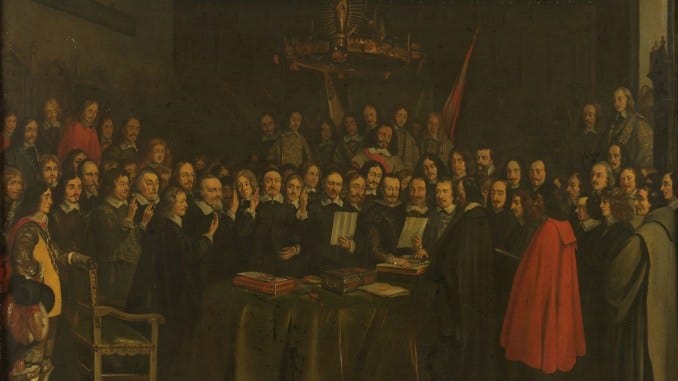
In 1648, diplomats signed the Peace of Westphalia in Münster’s town hall. Thirty years of religious war had left parts of Germany devastated. The system those diplomats created... is often treated as a turning point in the evolution of the sovereign state.
I thought of that hall last week, watching Stephen Miller on Fox News explain why Denmark has no right to own Greenland.
Miller is the White House Deputy Chief of Staff for Policy. He declared that a nation’s sovereignty requires: the ability to defend its territory, improving that territory, and inhabiting it. Denmark, he concluded, fails on all three counts.
This echoes the doctrine of effective occupation. Miller dusted off nineteenth-century imperialism and presented it as common sense.
Not long ago, this might have sounded like bluster. Then American forces extracted President Maduro from Caracas... Trump has refused to rule out force against Greenland... Last Saturday, he announced tariffs on Denmark, France, Germany and five other European allies until Denmark agrees to sell.
The norms governing territorial sovereignty... can now apparently be rewritten between golf rounds from Mar-a-Lago. [What] Trump and Miller are eroding is the legal principle of secure sovereign borders. That has direct ramifications for us here.
Australia claims forty-two per cent of Antarctica, the largest slice of the frozen continent. Like all Antarctic claims, its status sits in legal limbo under the Treaty system...
Does Australia inhabit this territory? A few dozen scientists do not constitute a population. Can it defend it? Under the ‘Miller Doctrine’ (let us call it that), Australia’s claim looks as “unfair” as Denmark’s claim to Greenland.
The Antarctic Treaty... freezes sovereignty disputes and restricts militarisation... Australia cannot satisfy Miller’s “defend it” criterion without tearing down the treaty first.
Canberra finds itself in a trap: playing by the rules makes it vulnerable to those who no longer recognise them.
New Zealand’s position is different but no more comfortable. Wellington claims the Ross Dependency... [and] has sovereign rights over resources in an Exclusive Economic Zone covering more than four million square kilometres.
New Zealand does not inhabit these waters. It patrols them with a navy that... had to tie up a third of its fleet due to crew shortages.
Yet these claims should not be legally tenuous. They rest on the Law of the Sea and a body of precedent... title in remote territory turns on intention and an actual exercise of authority adapted to conditions...
But Miller is not interested in precedent. He is reasserting the older logic, that legitimacy requires force.
Australia sensed this shift coming. One way to read AUKUS is as an early hedge, trading some strategic autonomy for deeper American protection in case the rules stop holding.
New Zealand has made a different bet. Wellington insists on its independent foreign policy and its nuclear-free principles, wagering that the rules will continue to matter.
Perhaps the rules still matter. But Miller has made clear that Washington no longer thinks so. And when the guarantor of the post-war order becomes its greatest threat, small nations face a reckoning.
That arrangement is ending. Not with a formal repudiation, but with a shrug. The Miller Doctrine does not bother to argue against Westphalia or the UN Charter. It acts as if these rules never existed, as though ‘might-makes-right’ were simple common sense.
Australia and New Zealand are now entering a world in which small states survive by finding protectors or by making themselves too costly to swallow...
The men in those portraits on the walls of Münster’s town hall lived through catastrophe... Their system held... for nearly four centuries.
They would certainly recognise the world now emerging. It is precisely the nasty, brutal one they were trying to overcome.


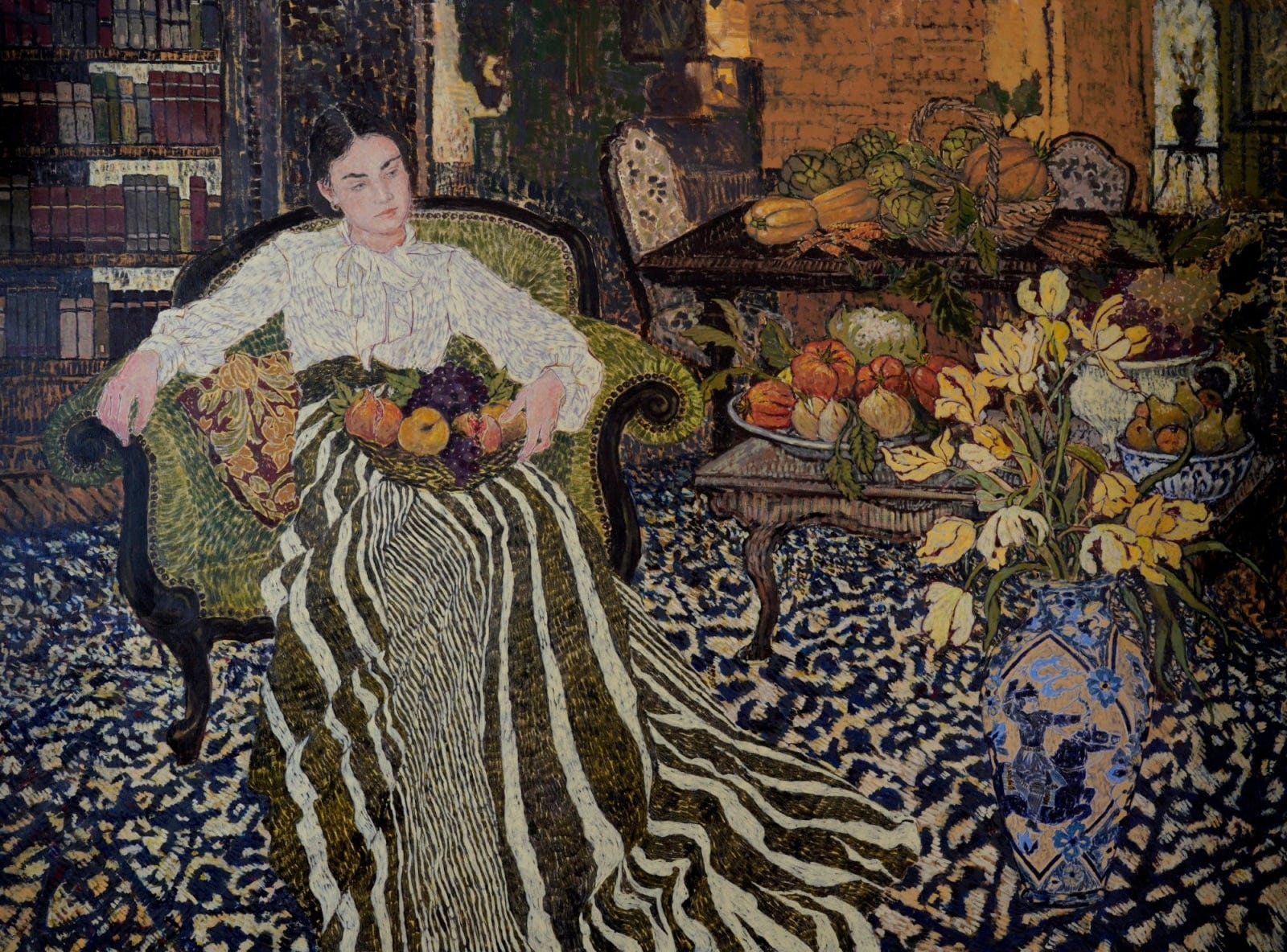
Christos on Blue Moon

Richard Linklater’s Blue Moon shouldn’t work. It is deliberately stagy, largely set in one location – the famous Broadway bar Sardi’s. It’s the 1943 premiere of Oklahoma! ...
Rogers’ former collaborator, songwriter Lorenz Hart (Ethan Hawke), has slipped out of the performance. He is trying, not very successfully, to avoid getting drunk while bitchily criticising the show to bartender Eddie (Bobby Cannavale). ... Yet Hawke’s longing, lustful stare at the hard buttocks of a departing flower delivery boy suggests that he has more subterranean, less rarefied obsessions.
The reason this film shouldn’t work is that Robert Kaplow’s screenplay is maudlin and shallow. ... Kaplow romanticises Hart similarly to the way he idealised Orson Welles in his novel Me and Orson Welles (which was adapted into a film by Linklater in 2008). ... The writing doesn’t hint at any of the Jekyll-and-Hyde combination of self-pity and cruelty that is endemic to alcoholism.
The screenplay’s nadir is a long conversation in the final act between Hart and Weiland, who is played by Margaret Qualley. ... This scene is interminable, with Hawke and Qualley valiantly trying to convey some element of honesty in the hackneyed exchange.
For all this, Blue Moon has a kick – that’s largely due to the performances of Hawke and Andrew Scott, who plays Rogers. ... [Hawke] has become an actor of great power and control. I thought him magnificent and compelling in Paul Schrader’s First Reformed (2017), an essaying of anguished loss of faith equal to the performances of Max von Sydow and Gunnar Björnstrand in Ingmar Bergman’s films.
He’s equally wonderful in Blue Moon. Hawke is working against the sophomore ideas and clunky mechanics of the script, investing his performance of Hart with a slyness and desperation that make us believe the combination of resentment and terror that he is experiencing at his former collaborator’s success. ... Watching him, we understand that alcoholism isn’t some adolescent spree: we comprehend the overwhelming weariness of the condition.
The film gains greater urgency with the appearance of Rogers and his entourage after the phenomenal success of Oklahoma!’s opening night. The interplay between Hawke and Scott is the most dynamic and complex relationship in the film, and once again the playing of these two performers overcomes the limitations of the script.
Scott captures both Rogers’ love for Hart and his wariness of him. We sense all their shared, agonising history, not in the writing but in the acting. ... Scott achieves a lovely generosity in granting him some humanity.
... Credit too must go to Linklater, whose direction is effervescently spirited in this film. ... [He] has made a careful study of the astonishing suite of theatrical films Robert Altman made in the 1980s, when that great director was ostracised by Hollywood. ... Linklater uses the limitations of the theatrical settings and form to playfully pay homage to mid 20th century Broadway.
Finally, however, it is Hawke’s film. He portrays the suffering of a man who died only a few months after the events portrayed in the film. The demons of drink, sexual guilt and self-hatred are conveyed through his eyes, in how he uses his body. ... We see the flashes of the artist he once was in moments of savagery or envy, when his intoxicating mastery of language is allowed to fly. ... Hawke conveys the wasted talent and shows us those flashes of brilliance. It’s a great performance and it honours the complications of failure.
This is a film that shouldn’t work, but after watching Hawke play Hart so intimately, so courageously for 90 minutes, I went home, put on Elvis Presley’s sublime version of Rogers and Hart’s “Blue Moon” from the legendary 1954 Sun Studio sessions, and cried my heart out.
Heaviosity half hour
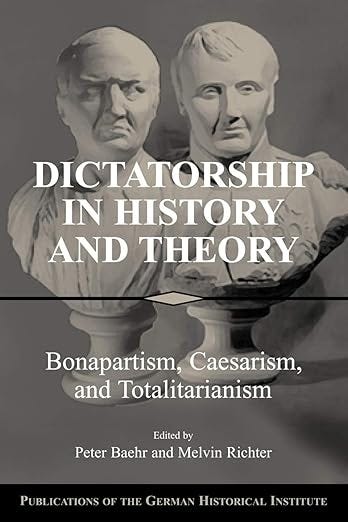
In ways that I hope to bring before you in the not too distant, I’ve been reading quite a lot about Carl Schmitt and more generally the idea of dictatorship. Like so much in our language, Adolf Hitler gave dictatorship a bad name - though not before Sulla and Julius Ceasar had done the same a couple of thousand years before. As you may well know, dictatorship was a successful feature of the Roman Republic, in which the Senate appointed dictators on a temporary basis to address emergencies. Until it became a less successful feature and the temporary bit got played down. Anyway, that gave me the interest in the book pictured above. I asked it to give me a summary of Chapter 4 which I found pretty enlightening. I hope you do too.
Tocqueville and French Nineteenth-Century Conceptualizations of the Two Bonapartes and Their Empires (Melvin Richter)
This chapter provides the most sustained and theoretically sophisticated analysis in the volume of how a major political thinker conceptualized Bonapartism across his career. Richter demonstrates that for Tocqueville, the two Napoleonic regimes were not peripheral concerns but central problems that drove his theoretical development and shaped his distinctive contributions to democratic theory.
The Central Paradox
Tocqueville’s fundamental insight, Richter argues, was identifying the “unacknowledged paradox” that from history’s two greatest revolutions (1789 and 1848) “had emerged not emancipation, but a regime considerably more repressive than the monarchies that had been overthrown.” Writing in L’Ancien Régime (1856), Tocqueville observed that “out of the very entrails of a nation which had just overthrown its monarchy, there appeared suddenly a power at once more extensive, and more minute in its application, a power more absolute than any ever exercised by a French king.” No French reader could miss the tacit parallel between the First and Second Empires.
Crucially, Tocqueville diagnosed both regimes as distinctively modern: simultaneously post-revolutionary and post-democratic. Both Bonapartes executed military coups overthrowing republican governments created by great revolutions. Both used plebiscites based on universal manhood suffrage to legitimate their violence retrospectively and establish their empires. This created what Tocqueville saw as a “pseudodemocratic argument”: the people, through popular sovereignty exercised after force, supposedly withdrew approval from parliaments they had previously chosen and delegated supreme power to the coup’s executor.
Post-Revolutionary Legitimation
The “post-revolutionary” character was equally important. Both Bonapartes justified their regimes by positioning themselves as protecting the Revolution’s beneficiaries from two threats simultaneously: from nobility and Church on one side, from radical Jacobins, Sans-culottes, or socialists on the other. They claimed to secure revolutionary gains (civil equality, abolition of seigneurialism, property transfers) while ending revolutionary disorder and extremism. They retained what Tocqueville saw as the Revolution’s preference for equality over liberty while systematically denying political participation.
Anti-Determinism and Institutional Solutions
A crucial aspect of Tocqueville’s analysis—one Richter emphasizes as particularly relevant for democratic theory—is his rejection of historical determinism. Despite diagnosing structural tendencies toward despotism in democratic revolutions, Tocqueville insisted neither revolution nor democracy in France “necessarily entailed such a repressive regime, or if it were established, guaranteed its indefinite continuation.” Democratic revolution was “subject to certain dangers, which could be mitigated or obviated, but only if the electorate were alerted to these perils and their representatives took decisions calculated to avoid them.”
Tocqueville rejected views of French decadence or doom, instead offering what we might call an institutionalist analysis: outcomes depend on institutional design, political culture, and conscious choices. This distinguishes him from both conservative pessimists and Marxist determinists, making his work particularly valuable for thinking about democratic institutional design.
The Evolution of Tocqueville’s Concept of Democratic Despotism
Richter’s most original contribution is tracing how Tocqueville’s conceptualization evolved across three decades in response to both theoretical problems and changing French political realities. Initially, in his 1835 Democracy in America, Tocqueville invoked “the tyranny of the Caesars” as the alternative to democracy with internal checks and rights. This Roman parallel was immediately contested by his brother and father, prompting fundamental reconsideration.
By 1836-1837, observing Louis Napoleon’s failed Strasbourg coup and French society’s political apathy, Tocqueville reconceptualized the threat. In a remarkable note to himself, he wrote: “A tyranny of the Caesars was a scarecrow which could frighten no one.” What menaced France was not omnipotent tyranny but “materialism, individualism, and political apathy of the society as a whole.” The tranquility and immobility following the coup attempt appalled him: it originated “not in disgust with the present government but in profound indifference towards every form of government.”
This led to his famous 1840 chapter “What Type of Despotism Democratic Nations have to Fear.” Here Tocqueville argued that modern democratic despotism would both differ from and exceed Roman imperial power. Roman tyranny was “violent in its mode of exercise, but limited in the number of those it affected”; it left private life and provincial customs largely untouched. Modern democratic despotism would be “mild [doux] rather than violent” but exercise “greater power than that attained in antiquity” through centralized administration penetrating and regulating in detail both private and social life.
Administrative and Democratic Despotism
Tocqueville distinguished what might be called two forms of modern despotism, though he didn’t systematize this distinction. “Administrative despotism” emphasized bureaucratic centralization, state penetration of social life, and destruction of intermediate institutions. This connected his analysis of Bonapartism to his broader account of French centralization from the ancien régime through the Revolution to the Napoleonic consolidation.
“Democratic despotism” emphasized how egalitarian social conditions, individualism, and materialism create populations vulnerable to paternalistic guardianship (tutelle). Democratic rulers, shaped by their egalitarian societies, would “prefer the role of paternalistic guardian to that of tyrant,” degrading rather than tormenting those they ruled. Crises and violent repression might occur temporarily, but the characteristic mode would be soft, pervasive control.
The 1842 Academy Address
A pivotal moment in Tocqueville’s thinking was his 1842 Académie française address eulogizing Cessac, Napoleon’s conscription administrator. Cessac had provided 400,000 men annually for Napoleon’s armies, enriching himself enormously while remaining personally upright. Tocqueville identified Cessac as exemplifying “a peculiar class, the first citizens of absolute power: upright, personally honest, but carrying out every order of their master, no matter what they saw, heard, or felt about its consequences.”
This analysis prefigured what would later be called “banal evil” or bureaucratic complicity. Tocqueville examined how the Empire as system created such functionaries—neither monsters nor heroes, but ordinary men performing extraordinary harm through routinized administrative roles. This connected Napoleonic bureaucracy to modern administrative states’ moral hazards.
Louis Napoleon and the Second Empire
The Second Empire’s establishment in December 1851 forced Tocqueville to return to these questions with renewed urgency. He immediately grasped the coup’s significance: “Every previous revolution had been made by a political party. This is the first time that the army has seized France, bound and gagged her, and laid her at the feet of its ruler.” The Second Empire was fundamentally military, finding “solid support in the army, the new aristocracy of democratic society,” enabling it to “re-establish the traditions of imperial despotism.”
Yet Tocqueville distinguished short and long-term prospects. While the Second Empire would last “for a time,” it could not endure indefinitely. “The positive qualities of the French, as well as their defects and even their vices,” would make perpetuating absolute power impossible. The “spirit general of the times” would ultimately prevail despite temporary circumstances favoring despotism.
Theoretical Contributions to Democratic Theory
Richter identifies several enduring contributions from Tocqueville’s analysis:
The Democracy-Despotism Dialectic: Tocqueville showed how democratic revolutions can produce their opposite—not despite but through democratic forms. Universal suffrage, plebiscites, and appeals to popular sovereignty can legitimate authoritarian rule. This challenges both democratic triumphalism and conservative anti-democratic arguments.
Centralization as Danger: The French state’s bureaucratic centralization, continuous from ancien régime through Revolution to Empire, created instruments of unprecedented control. Democratic societies require decentralization and intermediate institutions to prevent despotism.
Social Preconditions: Political apathy, individualism, materialism, and equality of conditions create populations vulnerable to authoritarianism. Democracy requires active citizens, not merely institutions.
Institutional Contingency: Outcomes depend on conscious institutional choices, not historical inevitability. This opens space for political agency and reform even in seemingly deterministic situations.
Modern Despotism’s Specificity: Unlike ancient tyranny (violent but limited), modern despotism would be mild but total, penetrating private life and thought through administrative regulation rather than terror.
Richter’s Methodological Contribution
Beyond explicating Tocqueville’s substantive arguments, Richter models how to study political concepts historically. He traces conceptual evolution through multiple texts across decades, connecting theoretical development to biographical experience and political context. He shows how Tocqueville adapted concepts (democratic despotism, Caesarism) through dialogue with critics, observation of events, and changing theoretical concerns.
This approach treats concepts as living tools in ongoing political and intellectual struggles rather than static definitions. It demonstrates why studying “contested conceptualizations” enriches understanding beyond asking whether Bonapartism “really” resembled Roman Caesarism or whether France “really” was becoming despotic. The concepts themselves shaped how political actors understood and responded to their situations.
Relevance for Democratic Innovation
For contemporary democratic theory, Tocqueville’s analysis remains powerfully relevant. His identification of how plebiscitary democracy can legitimate authoritarian rule speaks directly to modern concerns about populist leaders claiming democratic mandates while undermining democratic institutions. His emphasis on social preconditions—civic engagement, intermediate institutions, decentralization—informs thinking about how to structure participatory democracy. His anti-determinism suggests that even dangerous tendencies can be countered through conscious institutional design and political culture cultivation.
Most fundamentally, Tocqueville’s framework helps explain how democratic forms can be appropriated for anti-democratic ends—not through simple deception but through genuine popular support mobilized in ways that undermine long-term democratic sustainability. This paradox remains central to democratic theory and practice.
I now finished the entire thing.
You saw all of Connors, Rosewall, Ashe and Newcombe at Kooyong!? Wow!? (The only live tennis on that level I ever saw was a Fed Cup installment in St. Louis. I think Madison Keys was there)
It is a no-brainer for me to defend Tooze against Ganz anyway and the debate about whether this is fascism is practically pointless. I am hearkening back to Greil Marcus writing about the 1992 election coming after "12 years of brutalization". Brutalization is what this is. Trump may be the useful idiot for the real fascists standing in the background but those real fascists value a specific idea of America that is not just the canvas for the glory of Trump.
I should write something profound about Tocqueville here but it is not coming. However I read both volumes of Democracy in America as one book and the idea that events in France would change what Tocqueville said in the second book was new.
Did not even finish the description of this unholy mess but I submitted citizen testimony to the Missouri state legislature (this can be done online. I will think about actually being in the state capital for Orthodox advocacy day on February 3) trying to explain why IHRA should not be the official definition of antisemitism for the state of Missouri even if having an antisemitism point person in the state education department was probably a good idea.
At a panel at Sixth & I in Washington, DC (a former synagogue which had an intermediate life as a church but then became a center for younger Jews who had not yet formed families) Peter Beinart said strongly that blaming Jewish Americans for the actions of the Israeli government was exactly the same as blaming Chinese Americans for the actions of the Chinese government. But people are stupid and will do both things. Incidents of "I will shun and punish the Zionists that I know even if these Zionists have been appalled by Netanyahu their entire lives much less his far-right government in order to show that I am protesting what Israel is doing" have been well publicized here.