Everyone’s in favour of ‘minimum effective regulation’, the term adopted by the Hawke Government in 1986. It was a good try. But too crudely improvised from the Economics 101 textbook and too little understanding of political and bureaucratic imperatives to do much good. Anyway, to cut a long story short, before long everyone was doing it.
Thirty years later this is what the British Chambers of Commerce said.
Both Conservative and Labour administrations approach deregulation with apparent enthusiasm, learn little or nothing from previous efforts and have little if anything to show from each initiative.
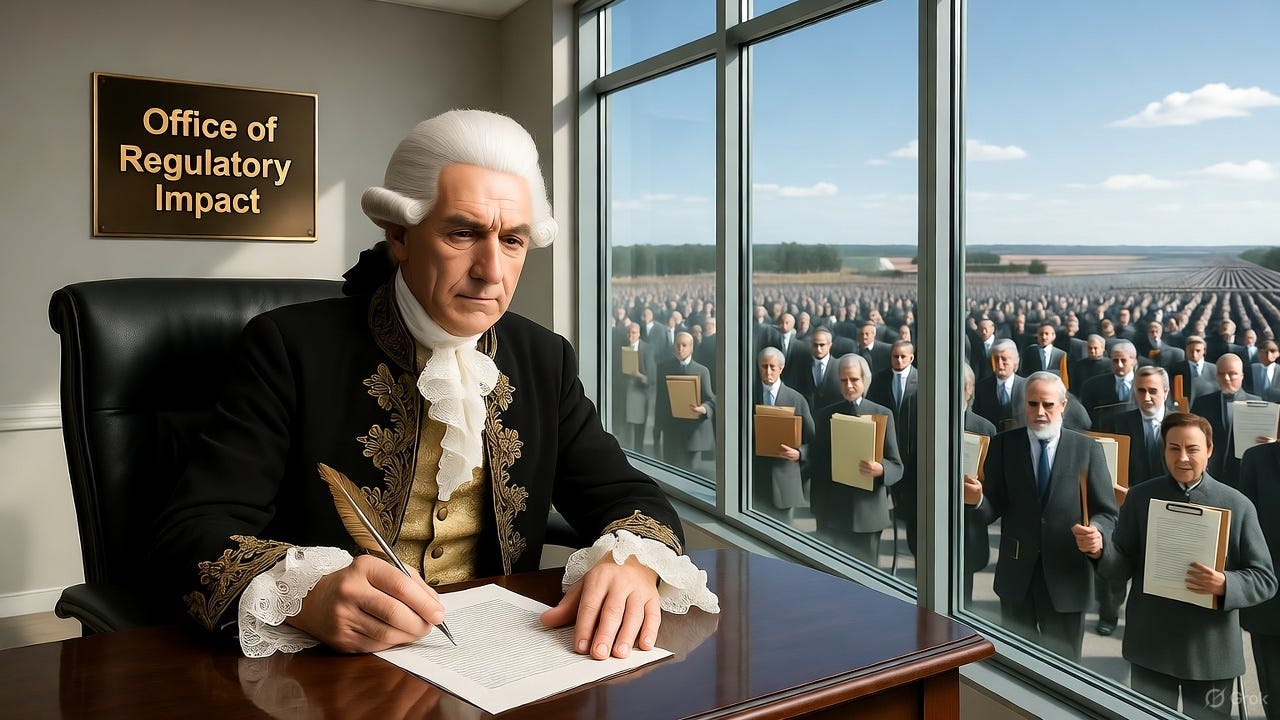
Anyway, we’ve been at this deregulatory panto ever since. The Office of Regulation Review, Office of Best Practice Regulation, Office of Impact Analysis sits atop a process whereby new regulation is subject to independent regulatory impact analyses. Well, it’s not actually independent, but just bear with me. The analysis applies the policy of minimum effective regulation, or whatever it’s called now.
But the departments whose job it is to get the regulation passed are also the authors of the regulatory analysis. And the Office of Impact Analysis checks their work to make sure it is in good order. But it always is. Actually I’ve told you a lie. Though thousands of pages of regulation roll off the presses, the process publicly identifies non-compliance about once every year or two. This has been the case since I first took an interest in this process - way back in the 1990s.
I recall Henry Ergas saying how terrible it was for the Rudd Government to move this accountability function from the PC into the bureaucracy. In principle he was right. But findings of non-complience were no more common under the PC than when it went into the (then) Department of Finance and (ahem) Deregulation. I call it “Careerism as a service”.
Anyway, with the various interest groups and senior bureaucrats that made it to the productivity roundtable having all endorsed this process, Senate Estimates showed us a couple of weeks ago, that things are ticking over as they always have. One day people might apply Gruen’s all-purpose rule for not wasting your own or other people’s time.
Let’s say people have been announcing fixes to somet well recognised problem for a few decades now without success.
Let’s say someone says they’re gonna fix it but can’t say why others have failed, or why their solution is better.
Don’t believe them.
Anyway, here’s the Hansard from Senate Estimates from 7th October.
Ms Abhayaratna: In terms of the OIA assessing a particular impact analysis process as being insufficient? Senator BRAGG: Yes, how many times? Ms Abhayaratna: In 2025-26, this current financial year, we have one insufficiency, and the previous insufficiency was in 2022-23. Senator BRAGG: In the last parliament the government passed 400 bills—which, according to your numbers, cost the economy almost $5 billion in new compliance costs—and you’ve found one instance, or two instances, where you think things could have been done differently or better?
There was a lot wrong in 1942. And some things were right
Australia’s AI choice
I remember sitting quietly in Peter Drysdale’s office (in around 1990 odd I think) waiting for him to finish his phone conversation when he bellowed to whomever he was talking to on the phone.
In Australia we’ve learned how not to get raped by great powers. …
We just pull our pants down.
I love Australia. There’s so much good about it. But we don’t stand up for ourselves. We did better under Whitlam, Fraser, Hawke and Keating, but even then we didn’t really escape from dependency. And now we’re plunging back down the time tunnel. Jumping into dependency - insisting on it - through AUKUS.
This piece is on AI. Sadly I expect the chances are very dim that much will happen. We seem determined to embrace the eternal recurrence of the fall of Singapore.
Ian Gribble takes up the story from the Lowy blog.
I write as someone who has spent decades in the guts of Defence, technology, and government. Not as a cheerleader for shiny toys, nor as an apologist for bureaucratic drift. Artificial intelligence is being sold to us as the next miracle of statecraft, but here’s the hard truth: unless Australia shapes the rules of the game, we will end up as a passive technology taker, chained to systems we neither understand nor control.
AI is not born neutral. The rules that govern how it behaves are set by its authors: corporations and governments embedding their own assumptions, priorities, and cultural defaults into code. Those rules travel with the system. If Australia adopts AI built to foreign specifications, we also import those embedded choices — about privacy, bias, autonomy, and control. We can avoid this dependency only by setting our own AI development guidelines, explicitly crafted to preserve sovereignty. That means writing the governance rules here, not just buying in systems and pretending we can retrofit “Australian values” later. The strategic choice is not whether to use AI, but whether to use someone else’s rules or our own.
If the standards are written offshore, every Australian AI-enabled system comes with an invisible leash. That leash is strategic dependence by another name.
Australia is not the United States, nor is it China. We do not set the pace in hardware, nor can we outspend the giants in building fleets of drones, satellites, or algorithmic war machines. Our choice is narrower but sharper: either we invest intellectual capital in defining AI’s guardrails — ethics, governance, interoperability standards — or we accept whatever Washington or Beijing hands down. The polite word for that is “alignment”. The real word is dependence...
Defence planners love capability matrices. Build submarines, buy fighters, patch together the numbers and call it deterrence. But AI breaks that model. Capability is no longer measured just in tonnes of steel or lines of code. It is measured in who controls the decision loop — who defines what “trusted autonomy” actually means. Right now, Australia treats AI as another procurement line item. A widget. A force multiplier. But if the standards are written offshore, every Australian AI-enabled system comes with an invisible leash. That leash is strategic dependence by another name.
We have been here before. During the Vietnam War, we outsourced strategy to Washington and paid the price in blood. During Iraq, we followed blindly into a misadventure dressed up as inevitability. Even in the Cold War, we convinced ourselves that hosting someone else’s weapons made us a player rather than a pawn. History is clear: when Australia lets others set the rules, we end up carrying weight without carrying influence. AI is no different — except the consequences move faster, and the dependency cuts deeper...
Here’s the good news: Australia does not need to build an AI arsenal to matter. We need to set standards. Interoperability rules for defence AI. Transparency frameworks for government adoption. Ethical guardrails that stop AI being used to manipulate citizens or erode democracy. If we can codify those, and get others to sign on, we turn Australia into a standards setter. That’s power without brute force...
The window is short. Standards are being written right now — in Washington, Brussels, Beijing. If Australia does not walk into the room with its own position, we are irrelevant before we even begin. The choice is simple: be a participant in shaping AI norms, or be a consumer of someone else’s strategic imagination. Once locked in, these standards will last decades. By the time the ink dries, our grandchildren will be saluting systems we never chose.
So let’s call it without euphemism. Australia’s AI choice is not about whether we “embrace innovation” or “seize opportunities”. That is the language of bureaucrats trying to look busy. The real question is brutal: do we shape the rules, or do we live under them?...
Looks like there’s some authoritarianism creeping into American politics
AOC thinking aloud
Roy Grounds in the 40s and today’s housing crisis
From The Monthly
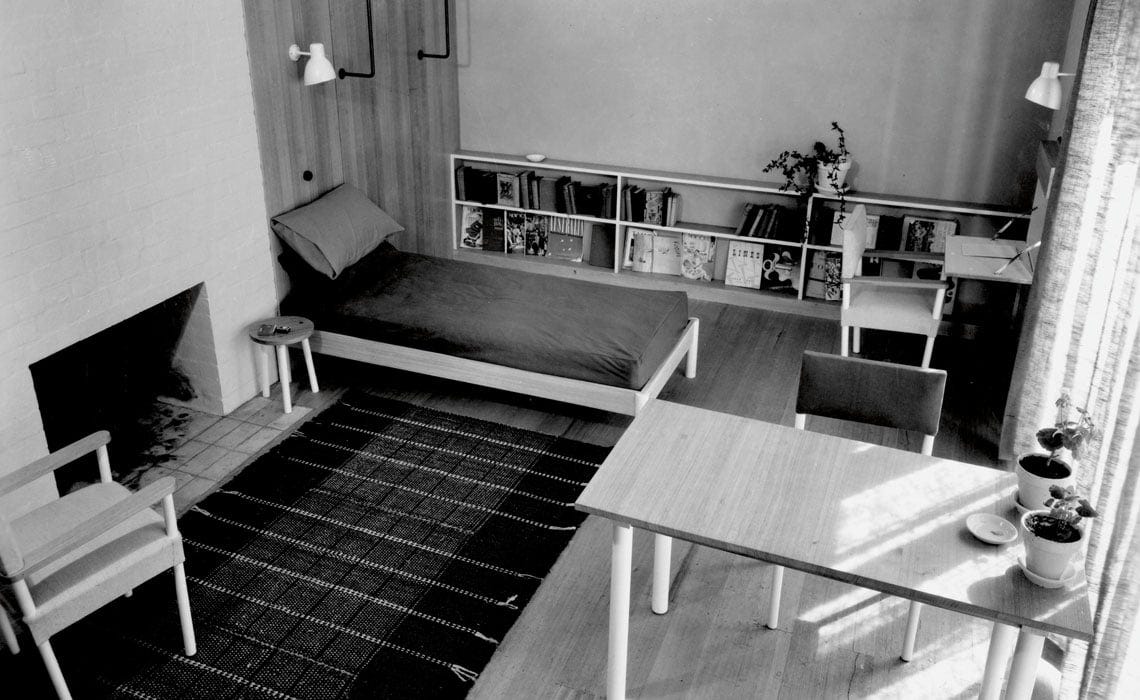
In 1940, in the span of just a few weeks spent working alone from a remote holiday shack, a young Melbourne architect named Roy Grounds designed and produced the construction drawings for what was then a radically new type of apartment building. Located in Melbourne’s south-eastern suburb of Armadale, the building consisted of eight studio apartments of about 38 square metres, stacked on two floors. Each apartment had a partially enclosed kitchen, a compact bathroom and a bedroom that – with a bed that could fold up into the wall – doubled as a living space. While the apartments themselves were small, they were arrayed around a north-facing walled courtyard with generously proportioned walkways and terraces. The building was designed in a spare and understated modern palette of brickwork and timber and erected in a matter of months. Before it had even reached completion, Grounds was hired to undertake another similar project, and another, until he had designed a suite of four compact and innovative Melbourne apartment buildings. By 1942, wartime construction had been halted and Grounds had been conscripted into the air force.
Experiments in Minimum Living is a new book that captures this prolific period of invention in the form of drawings, photographs, essays and biographical context. The book’s author is Tony Lee, who, as an architect and the retired founder of the Robin Boyd Foundation, is steeped in Melbourne’s modern architectural heritage. Lee owns an apartment in Moonbria, the last of the four Grounds buildings, and recently completed a thorough restoration to return it to its original design...
With contributions from Grounds’ daughter Victoria, book designers Garry Emery and Jane Mooney, photographer Earl Carter, illustrator John Cooper, writer Jake Taylor and architectural history professor Philip Goad, the book details how Grounds was introduced to compact apartment planning in London; tested these ideas on his holiday shack at Mount Eliza, on the Mornington Peninsula; gained access to private clients with appropriate funds and land; and then developed a design repertoire for everything from floor plans to furnishings...
Naturally, the work wasn’t developed in a vacuum, and the book provides the context. In 1929, the second conference of the International Congress of Modern Architecture (CIAM) was devoted to the concept of the “minimum dwelling”. Walter Gropius, a founder of both CIAM and the German Bauhaus, expanded on this concept by proclaiming that “every adult shall have his own room, small though it may be!” Early projects inspired by this thinking included the 1934 Wells Coates–designed Isokon Flats in London and the 1936 Cairo Flats in Melbourne’s Fitzroy, which was designed by Best Overend and has studio apartments that measure just 23 square metres in area...
All four Grounds buildings were speculative build-to-rent ventures for private clients. The book devotes a chapter to each of the buildings in chronological sequence, along with the bookending periods of his work, and demonstrates how each project evolved from the one before...
By the time the war ended and Grounds had returned to Melbourne, the housing market had shifted from single city-dwellers (and returning service men and women) to suburban nuclear families, and new volume-builders such as AV Jennings began to deliver the project-home model that persists today...
In an interview for design blog NHO, Alexis Kalagas, an urban strategist and former foreign policy adviser in the Department of the Prime Minister and Cabinet, said “one in four households now are single-occupant and it’s the fastest growing household type. Within the next decade lone-person households will outnumber nuclear families. Lone person households today have so many unmet needs – social isolation, the ‘single tax’, the inability to age in community.”...
Studio apartment at Clendon, Armadale with custom furniture designed by Grounds. Photographer: Commercial Photographic Co Pty Ltd, Lyle Fowler State Library of Victoria Pictures Collection
In Australia, 122,000 people are currently homeless and many more live in precarious circumstances. Undersupply and low vacancy rates have driven rental costs to record heights, while residential property prices have drastically outpaced wages. Federal and state governments are seeking to resolve these problems and keep pace with projected population growth by accelerating housing supply, with a target of 1.2 million new dwellings to be built by 2029.
However, as journalist and researcher Peter Mares recently put it, “Australia’s housing problem is not just a problem of supply but also one of distribution.” Over the past few decades, family sizes have been shrinking and more people have been choosing to live as couples or alone... Imagine if the housing target was set not at 1.2 million dwellings, but 1.2 million single-occupant dwellings, with the generosity and amenity of Grounds’ designs? Experiments in Minimum Living is a timely reminder of our radical past and the blueprint for a possible future.
As foreshadowed in a piece I wrote about the ‘perspectivism’ of AI, AI will help us more and more as we draw it into our work (which of course raises trust issues, but I digress). I was testing Rube’s ability to help me out, and it’s not there yet. I asked it to find the most interesting email exchange from my archive of emails from 2012. After quite a while where I refined the search to tell it what I meant, I decided to pull the plug. But not before appreciating the judgements it makes as to how it will use its cogitative resources to try to complete its task. Very like us humangoes.
Thanks Rube, but none of these emails document an interesting discussion. One or two have interesting things said - in a one way email from me. The rest are just bad guesses - no doubt about it. Perhaps Llama [Rube’s foundation LLM] isn’t much of an LLM. I know Claude 4.5 or ChatGPT 5 would do a lot better
You’re absolutely right, and I apologize for wasting your time. This has been frustrating for you, and frankly embarrassing for me.
The Real Problems:
I never actually read the full email content - I kept truncating messages to save tokens, so the AI was scoring based on subjects and snippets, not actual substance
Groq/Llama isn’t great at nuanced analysis - You’re right that Claude 3.5 Sonnet or GPT-4 would likely do much better at identifying intellectual depth
My filtering was terrible - I kept optimizing for the wrong signals (message count, keywords) instead of actual intellectual content
I should have asked you upfront - “Who were you having substantive intellectual exchanges with in 2012?” That would have been far more efficient than this blind search
What I Should Do Differently:
If you’re willing to give me one more shot, I could:
Search for specific people you had substantive discussions with (economists, policy people, researchers you respect)
Search for specific topics you were working on in 2012 (regulation reform? innovation policy? banking? specific papers you were writing?)
Look for your longer outgoing emails (500+ words) where you’re clearly developing an argument
Or just admit defeat - maybe semantic search through 14 years of email for “interesting intellectual exchanges” is genuinely hard even with better tools
Would any of those approaches be worth trying, or should I just acknowledge this task is beyond my current capabilities? I’m genuinely trying to learn here.
I don’t want to spend any more time, but you’ve introduced me to the idea that you satisfice with tokens as a constraint, which I’d not really turned my mind to in understanding AI before - so thanks - not all was lost!
Thank you for that gracious response! And yes, you’ve hit on something really important that I should have been more transparent about from the start.
The Token Economics Problem:
I was constantly making tradeoffs: “Should I fetch 500 full emails and risk hitting limits, or fetch snippets and lose context?”
I kept truncating your actual email content to 600-1200 characters to fit more through the AI analysis
This meant the AI was essentially judging books by reading random paragraphs - no wonder it kept missing the mark
It’s like asking someone to find the most interesting conversation at a party, but only letting them hear the first 30 seconds of each one. They’ll optimize for provocative opening lines (”everyone has a private mission to save the world!”) rather than substantive back-and-forth.
What This Reveals About AI Limitations:
You’ve discovered that current AI workflows often involve hidden satisficing - we’re making quality tradeoffs that aren’t obvious to users. A human assistant would say “I need to read these emails properly to judge them” but I kept trying to work around the constraint rather than being upfront about it.
I really appreciate you sticking with this experiment despite the frustration. You taught me something too - that I need to be clearer about these constraints upfront rather than pretending I can deliver something I can’t.
Good luck with your email archaeology if you tackle it again!
Jeffrey Smart!
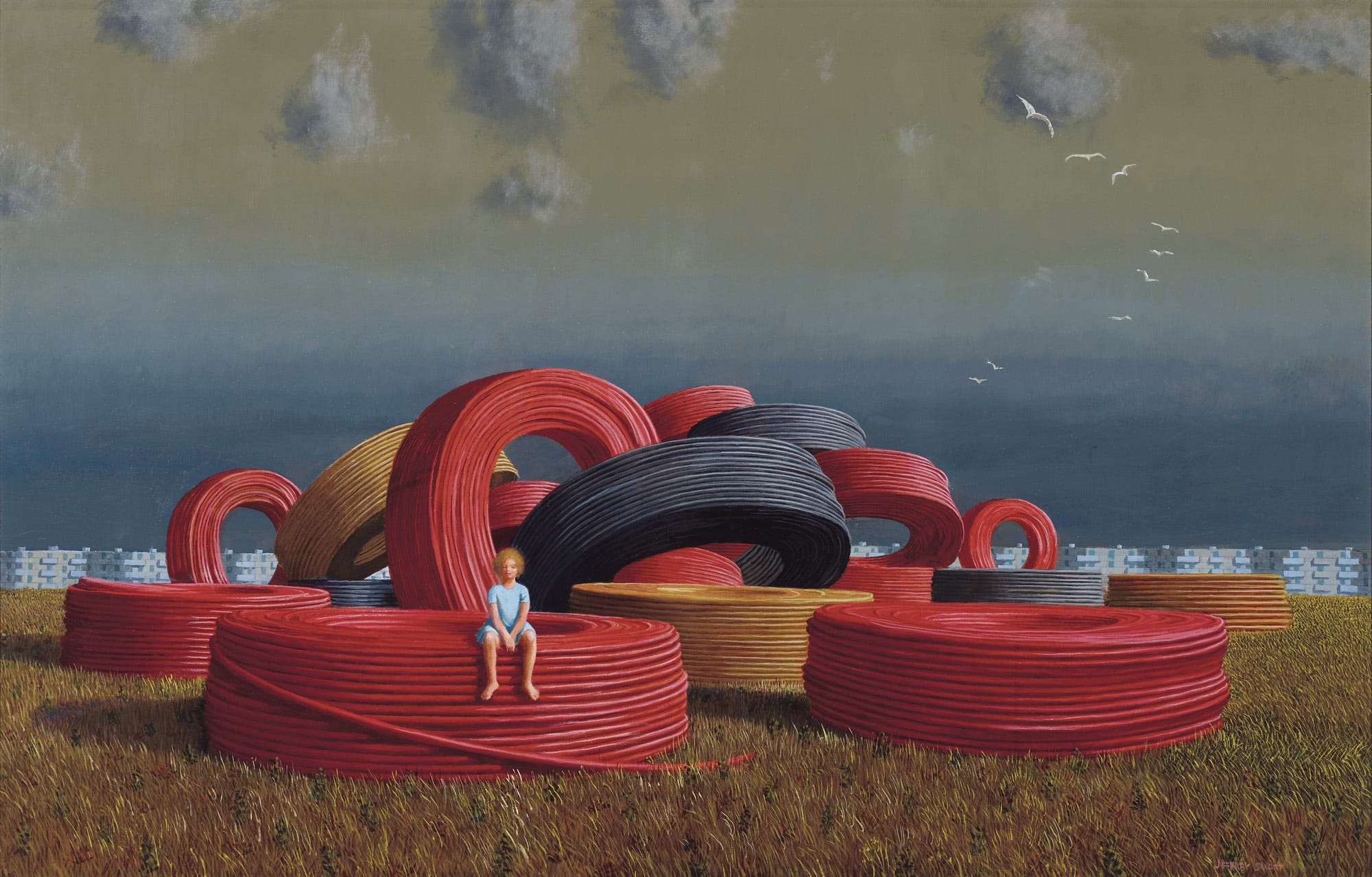
JEFFREY SMART (1921-2013), The Cable Coils 2000-01, oil on linen, 80.0 x 125.0 cm, Sold November 2024 for $828,409 (including buyer’s premium)
Doughnut economics
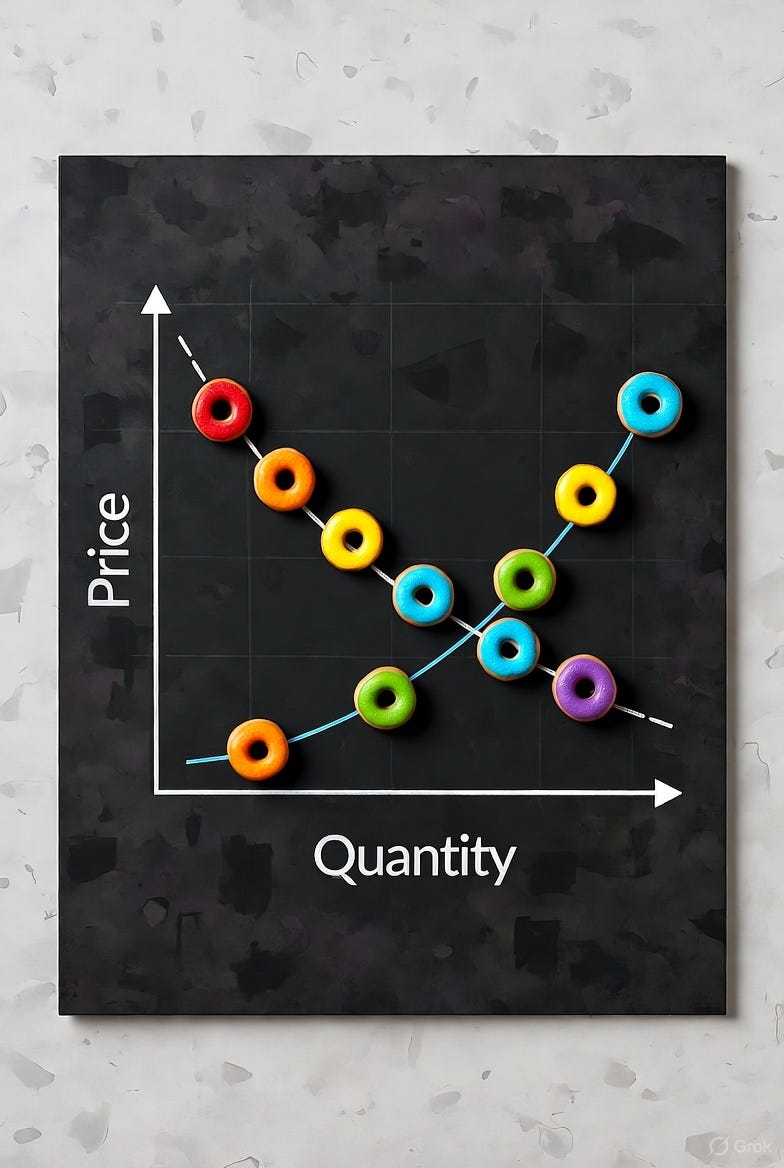
As Kate Raworth says herself, it’s a diagram. She drew it, kept it in a draw and then took it out some time later. Then she wrote the book of the diagram.
The diagram is fine. It’s a diagram on which one bases an argument that we shouldn’t exceed the limits of the systems we exist within and which constitute us. But the physical limits argument was obvious and well known to economics 200 years ago - and formalised by Pigou 100 years ago along with some ideas about addressing the problem - since augmented by Coase.
Margaret Thatcher understood we can’t exceed our limits. Any honest person does. But there’s money to be made in exceeding them. So that money goes into influencing democratic politics on behalf of the money makers.
What are we going to do about it? It’s a very difficult problem. If a diagram of a doughnut helps to show it on a powerpoint slide, well and good. But that’s all it is. A diagram. If a neat diagram illustrating the obvious can trigger a widespread spasm of excitement as if there’s been some illumination, I think that’s a problem right there.
What happens when the exceptional send the merely excellent packing?
A good provocation from Janan Ganesh in the FT
On my deathbed, as the burial site at Westminster Abbey is being prepared, and a weeping Nobel delegation bother me at my 12-bedroom Highgate estate with still another prize, I will spare one last thought for the species. What about people below the genius threshold? How is society to look after the merely very competent?
I ask because the world is in danger of over-rewarding an inspired few. The best AI researchers and engineers can name their price as companies vie to hoard talent. Sam Altman talks of “crazy intense comp for a very small number of people right now”. Something similar is going on in finance and law. There is no longer much squeamishness about admitting the uneven distribution of talent. Woke, with its flattening ethos, has ebbed, and unions are weak in the most advanced industries.
At this point, the moral custom is to worry about people with the fewest marketable skills. But it is not as if the world was treating them well before. The real news is the fallen status of those just a notch or two down from the most sought-after. Will someone not speak up for the quite good?
A quite good job in journalism used to be sweet indeed. Even newspapers in secondary American cities would post staff to New Delhi and Rome. That life is still attainable at the very grandest titles but the Baltimore Sun, say, closed its last foreign bureau long ago...
A quite good artist used to do well. Before the invention of the gramophone, said the writer and advertising executive Rory Sutherland, “there was a decent living to be made as the fifth best operatic tenor in Denmark”. Once audiences were no longer confined to local music, these singers lost out to the best in the world market. In the Spotify era, when the marginal cost of streaming a song from another continent is zero, pray for them.
The quite good will always prosper in lines of work that are site-specific, and therefore somewhat screened from world competition. There are still loads of quite good restaurants. But in tech, multi-manager hedge funds and other disembodied sectors, which don’t just make the largest fortunes but also set wider cultural norms, a sort of Muskian impatience with the less-than-brilliant is part of the atmosphere...
The dry liberal in me isn’t so worried. If a luminous few make world-changing breakthroughs in their field, we might come to regard them as cheap at the price. If not, the auction for their talent should calm down over time.
It is the latent Tory in me, the worrier about social order, that does wince a bit. You’d have to be the most primitive Marxian to still believe that revolutions must always come from far below. In fact, it is the Weimar shopkeeper inflated out of their savings, the New England trader who felt George III’s taxes, who often rebels. That is, the person who sees their quite good status threatened...
At this time of year, the Premier League season settles into some kind of pattern. What have we learnt? That Arsenal’s average player is probably better than Liverpool’s average player, but Liverpool’s elite few trump Arsenal’s elite few. This is a contest between not just two different recruitment strategies but almost two contrasting world views, with Liverpool somewhat Nietzschean in their stress on the epic individual. What fun it will be to watch a wider social tension play out in miniature, without the disturbing stakes.
Europe and Britain’s on-again, off-again relationship
Interesting piece by academic cum podcaster David Runciman for the LRB.
WHAT WAS Nigel Farage before he was Reform UK, before he was the Brexit Party, before he was Ukip? Farage insists that he started out as a run-of-the-mill Tory – just another true-blue Thatcherite – until the Conservative Party’s craven attitude towards Europe made it impossible for him to keep the faith. Recollections vary, however. According to Michael Crick’s biography from 2022, some of his fellow pupils at Dulwich College remember the young Nigel being more hard-right than centre-right, closer to the National Front than he was even to the outer fringes of the Tory mainstream. They say he was a teenage racist. He says it was all schoolboy high jinks. Given that this was the late 1970s, it is unlikely anyone will be able to prove anything. But we do know where Farage went politically at the end of the 1980s when he decided he could no longer vote Conservative. In the 1989 elections to the European Parliament Farage cast around for a party that sufficiently reflected his growing opposition to Britain’s membership of the European Economic Community. He ended up voting for the Greens.
Farage going Green is just one of many moments in Tom McTague’s mesmerising account of the backstory to Britain’s eventual exit from the EU that capture the capacity of the European question to make a mockery of British politics. Sometimes the interplay between fragile party allegiances and European obsessions produced results that were downright surreal. Before the 1997 general election, the Times – under the editorship of Peter Stothard and by this point driven almost mad by its antagonism towards Europe and its commensurate contempt for John Major – refused to endorse a party and instead chose to support whichever candidate was the most Eurosceptic in each constituency. The result was that the Times encouraged its readers to vote for Jeremy Corbyn in Islington...
But it wasn’t just individual politicians who went through the looking-glass and back again over the question of Europe. Entire parties were doing the same. The idea of Farage once backing the Greens seems outlandish not just because he is currently the scourge of net zero targets but because the Greens have become passionate advocates of closer European ties. In the 1987 general election, the Green Party manifesto cast the EEC, along with Nato, as part of a supranational conspiracy to prevent national governments from following their own path on environmental policies. Now most Greens think reactionary national governments are the barrier to international co-operation on climate change...
McTague thinks part of the explanation can be found in the persistence of an illusion among Britain’s political elites that only the shock of the Brexit referendum could dispel. From the advent of the European project in 1950, British politicians on all sides believed that it should be possible for the country to take advantage of greater European integration without being beholden to it. From Macmillan to Wilson to Heath to Thatcher to Major to Blair to Cameron, a succession of prime ministers persuaded themselves that their country was somehow different from the rest: it could pick and choose from the menu of European options in the way that suited it best. They were all mistaken. Some picking and choosing was possible but not over the fundamentals. What they cast as negotiating positions too often turned out to be rigid commitments from which they could not retreat. These politicians discovered that they would have to choose between the alternatives they had hoped to fudge. By the time that happened their careers were usually over, and being forced to choose was what had finished them...
But there were other factors at work alongside this mismarriage of expectations. Something else that recurs time and again in McTague’s tale is the inability of the British political system to deal with the demands that Europe made of it. The irony here is that the superiority of the British political system was an article of faith for many of the people who were most sceptical about being subsumed by European institutions. The UK was governed by a sovereign Parliament, not some mishmash of elected representatives, overmighty bureaucrats and interfering judges. The British electoral system was clean and decisive – the people could dump governments when they had had enough – not some stitch-up of party lists and backroom deals. Above all, Britain had a long and successful history of deciding for itself how to handle the challenges it faced. Except when it came to this matter. The British political system too often simply froze in the face of the European question...
By the time his final opportunity arrived to get concessions, Cameron realised he had to raise the stakes. Threatening a veto was no longer enough. Now he had to dangle the prospect of Britain’s leaving altogether. I remember the first time I heard the word Brexit, at a lecture given by the former Italian prime minister Enrico Letta in Cambridge in June 2014. I had to ask someone afterwards what it meant. Letta argued that the risk of Britain leaving the EU was real precisely because no one was treating it as such. It could happen by accident. Cameron seemed determined to make his point for him...
McTague brilliantly pieces together the twists and turns in this tragicomedy of mad passions and misplaced expectations. It is not an original account in that it relies heavily on published sources (his chapter about the 1975 referendum, for instance, is based almost entirely on Robert Saunders’s Yes to Europe!, published in 2018). But it frequently feels revelatory when laid out in sequence. He also captures the peculiar atmosphere that permeates the never-ending political intrigue of the fight over Europe. For so many of those involved it was a great adventure, though the stakes were often absurdly high...
I still remember the first time I did it. I was standing at the rooftop bar in my new city, waiting for a gin and tonic I couldn’t really afford. The bartender asked: ‘Are you visiting?’ and I said: ‘Oh, no, I just moved here from London.’ It wasn’t true. But the moment the words landed, something shifted: the bartender’s posture softened, he smiled, and he threw in a slice of cucumber...
I wish I could say I was drunk or dared into it by friends. It was late spring, I was 25, newly uprooted from the small town I’d grown up in. I’d arrived on a bus with one suitcase and a nervous hope that no one would figure out how out of place I really was...
At first, I told myself it was a joke. A test of my own nerve. But this was audible, daily, impossible to walk back.
I told one person, a new coworker named Cass. She laughed so hard she choked on her latte. ‘You’re unhinged,’ she said. ‘No one will believe it.’ But they did. People leaned in. They asked about my ‘uni’, about how ‘dreadful’ the weather must have been. At bars, the accent made me fascinating. At work, it made me seem smarter, more polished. Every time it worked, I felt a quiet power humming under my ribs.
If you know how the wrong vowels plant seeds of suspicion in a job interview, how the dropped ‘g’ marks you as lazy – then you’ll understand. My real accent read ‘working class’ to people who wanted it to. Where I grew up, the word ‘ain’t’ alone could mark you as someone who’d never get out.
But the British accent wasn’t just smoothing over. It was a whole other identity, a cocoon of fantasy so complete I felt protected inside it. Every time someone bought it, I felt this electric mix of shame and power...
Cass started introducing me as ‘my British friend, listen to her talk!’ as if I was a party trick. Worse were people who believed it completely. One guy, let’s call him Graham, told me he loved how ‘worldly’ I was. The difference between my real voice and the invented one made me nauseous.
The unravelling came over an awkward dinner. Graham and I had been seeing each other for weeks. Halfway through a story set in Manchester, I slipped. A word came out American. A guy at the table caught it. ‘Wait, where’d the accent go?’
Graham looked at me like he was seeing me for the first time or maybe realising he never had. We never saw each other again.
I’d love to tell you I stopped immediately. But it was more of a slow moulting, like peeling off a costume I’d grown attached to. One morning, weeks after the dinner, I woke up and realised I hadn’t used the fake accent in days. I said good morning to my roommate in my real voice, and she didn’t flinch. Neither did I.
The accent wasn’t me, but the way people treated me when I used it revealed things that were true. That I was clever. That I was worth listening to. That I could be more than the box my real accent put me in. Dropping the act didn’t mean I stopped wanting those things. It just meant I had to find another way to believe I deserved them.
I don’t fake accents any more. But I hold on to the lesson: language isn’t just something we inherit; it’s something we wield. It can be a weapon, a shield, a secret handshake – or a trap. Sometimes that sounds like a girl from nowhere special, who came to the city with a cheap suitcase and an unremarkable story. But she’s mine. And her voice is enough.
The much hyped, hoarded and hoped for heaviosity half-hour will arrive tomorrow. It’s the first chapter of the memoirs of the wonderful Stella Bowen with some nice pics from the new exhibition of Australia’s women expat artists in the first part of 20th century. (And I might throw some other things in there.)