The Shared Centre explores two complementary ideas — each suggests the case for rebalancing the way competition and cooperation are entangled within institutions.
1. Elections represent the people — but so do juries, chosen by lottery.
Elections frame politics as contest, building polarisation and theatricality into the system’s DNA.
Juries frame it as the collective search for solutions most of us can live with.
2. Open competition for leadership tilts the scales towards the self-assertive and self-interested.
Leaving other human virtues unrewarded – listening to, involving and considering others.
The alternative is ‘bottom-up meritocracy’. It delivered widely celebrated stability and competence to Venice’s republic for five hundred years and governs Wikipedia today.
This video introduces this second idea. And here’s my chat with Colm about it.
A perverse poster child for free speech
‘In the 65-year history of Adelaide writers’ week there have been no civil disturbances apart from the occasional harrumph about the coffee queues,’ Louise Adler. (Photograph: /Andrew Beveridge)
As was evident during COVID, our systems of organisation aren’t really set up for reasoning. There’s only one part of government where the reasoning behind decisions is regarded as essential to their legitimacy - the judicial branch. The other branches give reasons too. But they’re usually post-hoc rationalisations of positions already adopted.
And then there is bureaucracy. You’d think that bureaucracies containing things like independent “Chief Medical Officers” might be capable of reasoning things out. You’d think, for instance, that when the prospect of an unprecedented public health crisis became clear in the first few days of 2020, they might have been able to give bona fide health advice on mask wearing. You’d think they’d immediately review pre-prepared readiness plans predicated on the crisis being an influenza when it was a coronavirus with quite different contagion dynamics. But you’d be wrong. It was months before these things were got right, not just in Australia but in all Western countries. (The Asian countries did much better, I presume because they had coronaviruses to deal with more recently).
Likewise, the Adelaide Writers Week has had some difficult decisions to make. They’d invited a Palestinian writer and someone who thought that massacring over a thousand random civilians was kind of pretty cool. Anyway, as you know, another massacre closer to home brought on a vibe shift. Now vibe shifts are the kind of thing that you bring in comms folk on. Vibes shifts are their kind of thing.
Anyway, cultural sensitivity is also the order of the day - alongside free speech of course - so Randa Abdel-Fattah got uninvited. Then, there was another vibe shift. Aghast at things collapsing around them, they apologised to all and sundry [this is now a dead link - I put the link in one vibe shift too soon.]. Anyway, for those who are not paying close attention, this was a writer’s festival. And this was their writing.
We also apologise to Dr Randa Abdel-Fattah for how the decision was represented and reiterate this is not about identity or dissent but rather a continuing rapid shift in the national discourse around the breadth of freedom of expression in our nation following Australia’s worst terror attack in history.
I don’t think you can be clearer than that. The national discourse around the breadth of freedom of expression in our nation kind of, well, recalibrated itself, requiring the board, after due consideration, to walk back their original invitation and then walk that back, thus ending up at the end of the day having done a good deal more walking and finding themselves a good deal further back than they would otherwise have been as best practice on the breadth of freedom of expression went through a paradigm shift.
Anyway, you might not have seen any of this if I hadn’t encountered this principled piece from the Jewish Independent. It’s a huge advertisement for Jewish culture, which remains open and highly contested, as one would expect.
Wherever one comes out on the merits of the case, the piece below is the opposite of ‘cheap talk’ by a Jew who is deeply offended, as well she might be, by Abdel-Fattah’s positions and conduct, including her implicit embrace of Hamas and their massacre of the innocents of Oct 7. As such, it is more informative than Louise Adler’s equivalent effort. Alas, she says nothing about the attempted cancellations of Jewish folks, as the author of this piece does.
Espousing your morals and ideas and living your life in alignment with them are two very different concepts.
Everyone wants to believe they are living a life of good decisions and moral fortitude, but in reality, there are lots of temptations that get in the way; sweet schadenfreude, the deliciousness of revenge, the hunger of greed, the power of ego, the pull of power or ambition. ...
Some of the most central tenets of social justice include centring lived experience, not talking over people who have skin in the game, and applying the same standards and humanity to all people, rather than engaging in selective judgement of who is deserving.
The left has been guilty of widespread hypocrisy over these values since October 7. Nowhere has this hypocrisy been more evident than in the work and writing of Randa Abdel-Fattah.
It therefore gives me not one iota of pleasure to write that pulling Randa Abdel-Fattah from the program of the Adelaide Writers’ Week – and the way in which it was done – was a mistake.
She calls for the recognition of the humanity of her own people, while simultaneously dehumanising others
These festivals are forums for conversation and debate. Free speech is not without limitations of course, but arbitrary cancellation at the whim of a few (or even many) is not appropriate. ...
It’s painful and ill-judged decision-making that prompted withdrawals from at least 180 other writers and has now led to the cancellation of Adelaide Writers’ Week.
Double standard
At the core of my current frustration is that although I disagree with the cancellation, I am equally offended by Abdel-Fattah’s current swift elevation to be the poster child for Australian free speech.
She has been outspoken about free speech, when it applies to the Palestinian cause, but she is perfectly willing to shut down those she perceives have a different view. ...
If you genuinely believe in freedom of speech or artistic freedom, you cannot be selective about who gets to enjoy it
She has written extensively on the word “intifada” and the phrase “from the river to the sea”, criticising any attempts to define these words in any way other than how she defines them. Given that they are words used by her community and her cause, she is justified in defining how they are used.
But she simultaneously denies Zionists the same right. ...
In a move reminiscent of two arsonists shouting “fire” at each other while holding burning matches, she calls for the recognition of the humanity of her own people, while simultaneously dehumanising others.
Abdel-Fattah, and many now crying “freedom of speech” signed a letter to the 2024 Perth Festival calling for the removal of Jewish musician Deborah Conway. She also signed a letter asking for the removal of journalist Thomas Friedman. ...
We believe in free speech, or we don’t
Thomas Friedman is a sometimes-controversial figure but a well-informed journalist. Rightly, his invitation was not rescinded. Unfortunately, Abdel-Fattah’s was, and, despite everything, it shouldn’t have been, because we either believe in freedom of speech or we don’t. ...
I find Randa Abdel-Fattah’s rhetoric abhorrent. It is my opinion that her hyperbole is intellectually disingenuous, and ethically and morally questionable.
But I will still go to my grave defending her right to free speech as well as my right to rebut her assertions or to simply not listen to her spite-filled diatribes. ...
If you genuinely believe in freedom of speech or artistic freedom, you cannot be selective about who gets to enjoy it. Living your ideals in the real world is challenging.
In the immortal words of Tom Hanks in the film A League of Their Own: “It’s supposed to be hard…If it were easy, everyone would do it.”
Luke Slawomirski on our health system and the Evaluator General
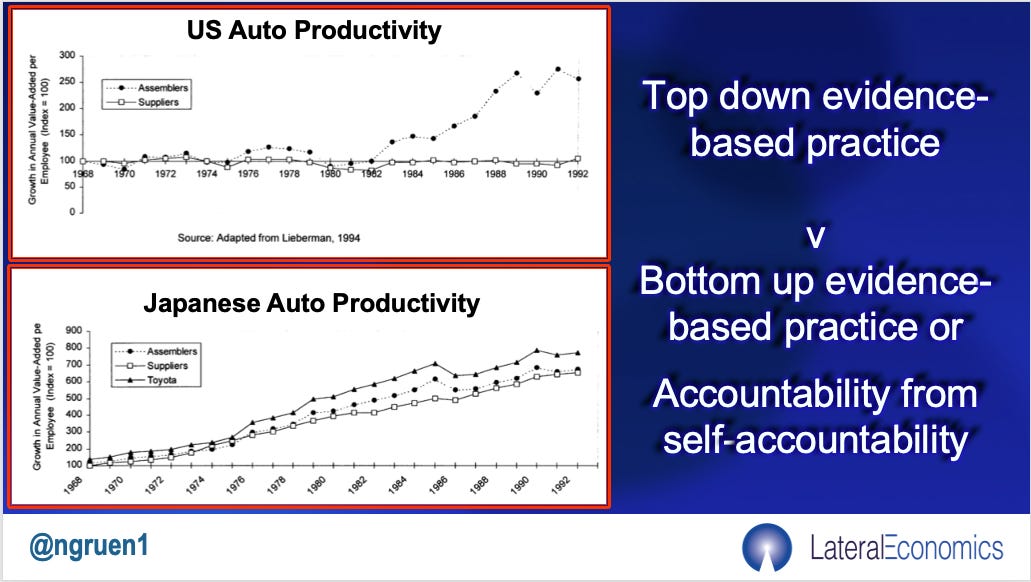
This is a good podcast with Luke Slawomirski, an Australian health economist I met about a decade ago when I gave a talk at the OECD. I was pleased at the interest taken in my idea of the Evaluator General and also Luke’s solicitude about what it is. As I try to explain here, though no-one above director level in the public service ever remembers, it’s an attempt to build accountability from the bottom up - from self-accountability. If that sounds countercultural to you, then you should read Adam Smith’s Theory of Moral Sentiments, or learn something about the Toyota production system.
Anyway, whenever the idea of the Evaluator General comes up, I like to show people this stunning graph.
Prediction markets: not so fast
Makes a strong, if perhaps somewhat overstated case. It provides a large part of the explanation for why prediction markets have taken so long to take off. It suggests the two big ones that have taken off now, might be bubbles. We’ll see. I expect another reason they’ve been hard to get going is that, in principle they make sense inside large organisations, but when adopted senior managers lose control of the narrative. And that’s not a good thing - at least for the senior managers.
Prediction markets are having a moment. Polymarket daily volumes are around $30 million. Kalshi ... recently raised a funding round at a valuation of $2 billion. ... Indeed, prediction markets are ascendant. ...
And what’s not to love, at least on paper. Economists such as Robin Hanson have been arguing for prediction markets for decades. ... And who doesn’t want better predictions about the future?
I want them. But prediction markets aren’t going to provide them. And if these markets get big enough, they might just kill our society.
Prediction markets are bad markets
... The best, most efficient financial markets (such as S&P500 futures, or Treasury bond futures) have ... heterogenous participants [who] find an efficient price when lots of different organizations are incentivized to contribute their own knowledge and understanding. ... It’s that last key property, that of heterogenous participants, which prediction markets so resoundingly lack.
The missing hedgers
Fundamentally, financial markets work because different participants have different risk preferences. ... The S&P500 future (ES) trades almost half a trillion dollars a day! But the reason is hedging. ... People [do] -EV trades, willingly, because those trades are positive utility for them. ...
And it’s precisely those hedgers ... who are missing in prediction markets. ...
Prediction markets are binaries
The outcome of a prediction market is either yes or no. ... Binaries have failed basically every time they’ve been tried. ... They’re approximately impossible to hedge ... ...
The absence of natural hedgers ... [is] prediction markets’ Achilles heel. Everyone in the market is either a noise trader (the polite term for “degenerate gambler”) or a sharp. ... Prediction markets only work when there is a steady supply of dumb money.
Markets are reflexive
... But even if [natural hedgers emerge], prediction markets are still bad. Possibly fatal for the kind of society we all currently enjoy. The reason is reflexivity. ...
The main selling point of prediction markets ... is that they aggregate information ... [to] create a truth-seeking mechanism. But this view completely ignores reflexivity. If the existence of a prediction market directly affects the outcome, then it’s not truth-seeking anymore.
Once a prediction market becomes large enough, it transitions from being truth-seeking to being tautology-seeking. ...
The vibes-based economy
... [Prediction markets are] a way of disintermediating the vibes/bullshit generation process by giving participants a direct economic stake in those vibes. ... By creating an economic incentive to manipulate probabilities, the vibes can actually become true if they’re even remotely manipulable.
A concrete example
Let’s consider a prediction market on “Will Trump run for reelection in 2028?” If the market is small, it’s a true prediction market. ...
Now consider a prediction market with billions of dollars a day trading on the question. ... It’s now a vibe. Large amounts of societal resources are being deployed to argue for or against it. This feedback cycle directly increases the probability of [rare] events ... ...
... [This is] clearly not good. ... [S]o prediction markets will naturally converge much more on “will there be a civil war by 2030” types of questions than on “will we discover anti-gravity by 2030” questions.
Thus, the market for vibes (and hence predictions) will be dominated by irrelevant stuff that sucks economic resources (sports), or societally negative outcomes.
But aren’t financial markets already like this?
No.
The reflexivity in financial markets (usually) leads to positive externalities, not negative ones. People plowing money into TSLA or NVDA creates risk capital to fund their competitors. ... [W]e all get richer, and the market becomes more efficient as a result. ...
Conclusion
Prediction markets are bad. They’re bad market design and they induce bad incentives.
But there’s still time to put the genie back in the box.
I liked this column, but decided it was a ‘must include’ when I read this sentence.
It takes cocksure Americans to spout such idiocy.
I keep thinking of the Greeks in the Persian War, constantly squabbling and failing to fully commit to what was necessary— collective defence. But they did it. We must hope Europe does too.
The US national security strategy published in December singles out the failings of its European allies. Its text is brutal. It claims that Europe’s “economic decline is eclipsed by the real and more stark prospect of civilizational erasure. The larger issues facing Europe include activities of the European Union and other transnational bodies that undermine political liberty and sovereignty, migration policies that are transforming the continent and creating strife, censorship of free speech and suppression of political opposition, cratering birth rates, and loss of national identities and self-confidence.”... In sum: “Our goal should be to help Europe correct its current trajectory.”
The main way in which the US intends to do so is to help “patriotic European parties”. No leader of such a party is more admired by Maga than Hungary’s Viktor Orbán. So, how has he done in promoting freedom of expression and liberal democracy, more broadly? According to the respected Varieties of Democracy (V-Dem) database, the answer is very poorly: the country’s index of “liberal democracy overall” fell from 0.77 (out of 1) in 2009 to 0.32 in 2024. Maga’s beloved Hungary is a corrupt and authoritarian state...
Then consider freedom of speech more narrowly. Again, according to V-Dem, many European countries, including the UK, France and Germany, protect freedom of speech and what it calls “alternative sources of information” better than the US... This is not to say that all is well in Europe. There exists a host of potent concerns, including the state of free speech even in the UK... Yet anxieties about those “patriotic” parties are also reasonable. Europe, after all, has a history. This tells us with brutal clarity that “patriotic” parties, and indeed nationalism more broadly, can all too easily be roads to ruin...
Hitler was also one of those “patriots” terrified by what the NSS calls “civilisational erasure”. In May 2025, Germany’s Alternative for Germany (AfD) was designated “rightwing extremist” by the country’s federal office for the protection of the constitution. No doubt, it is not a Nazi party. But it does have neo-Nazis within it. Should Germans who know their history just smile and say, “Why not? Freedom of speech is after all sacred.” It takes cocksure Americans to spout such idiocy. Alas, similar backgrounds and ideas can be seen in other rising European rightwing parties.
Equally foolish is the assault on the EU. Here, too, there are many confusions. Nation states are not natural political features of Europe. They were created, many of them quite recently (just as the US itself was created). What is more, they were also created largely through bloodshed... The EU was created in order to manage and, ideally, eliminate any chance of a repetition. The idea was that co-operation and open markets would be better than war. This, the NSS tells us, is folly.
Yet there is another powerful reason for preserving the EU. As the Belgian Paul-Henri Spaak, one of the EU’s founding fathers, said long ago:
“There are only two types of country in Europe: small countries . . . and countries which are small, but don’t yet know that they are.”
In a world dominated by superpowers and a continent threatened by a nuclear-armed Russia, it is a case of unify or become a victim...
This brings us to the fear of imminent “civilizational erasure”. It is rooted in an identity politics more extreme than that of the left. The identities in question are national, racial and chauvinist. It is linked to the fear of a “Great Replacement”, which many in Maga embrace... [This] is a projection upon Europe of what animates the administration itself — a burning hatred of the way the US has been changing, demographically and culturally.
I do agree that states must exercise control over their borders: their values may be universal, but citizenship cannot be open to everybody in the world. Yet liberal democracies can be beacons. What has emerged painfully (and often hypocritically) over many centuries is indeed a great civilisation. It is based on ideals of individual freedom, equal rights of citizens, rule of law, the pursuit of knowledge and fairly elected government... In brief, this administration wishes to erase the republic itself, in its 250th year. That is why Europe is its enemy. It is also why Europe must defend itself.
On a recent interstate trip, I took in the last 40 odd minutes of a not very good American university movie. I then had a chat with ChatGPT about its Americanness. It wasn’t that good at helping me out. Until I asked it to explain how it would be different if it had been a British movie. Then I thought it was terrific. And at least as depicted in this film and the virtual one conjured up by ChatGPT, there’s no comparison. One is a kind of panto morality, at least in my opinion, an illiteracy about how we encounter ethical questions in our lives. The other is grounded in how life is.
It reminded me of a recent discussion when someone had asked me why I was an advocate of virtue ethics. I said that, for all their uses in various contexts, utilitarianism and duty-based ethics (the word ‘deontological’ sounds kind of ridiculous) are alienating ways to think about our own relationship with the moral structure of our lives. They treat morality as somehow fundamentally external to ourselves, rather than something we assimilate into our identities and, through that, our conduct and ultimately our being. That’s kind of what Adam Smith argued.
User: Do you know the full plot of the film, The Emperor’s Club?
Assistant: Yes. Spoilers below.
The Emperor’s Club (2002) centres on William Hundert, a classics master at an elite boys’ school who teaches that education should form character, not just intellect.…
A new student arrives mid-term: Sedgewick Bell—rich, charming, disruptive—crucially, the son of a U.S. senator, and already skilled at the mixture of performance and impunity that goes with power. Hundert decides Bell is redeemable and gives him special attention. Bell begins to improve, but Hundert senses that what’s growing is not virtue but political talent: charisma, manipulation, the ability to work a room and evade responsibility.
Hundert then makes the compromise that binds the whole story: he adjusts a grade so Bell qualifies for the top three in the Mr Julius Caesar contest, displacing another student. Hundert tells himself it’s a moral wager—get Bell onto the stage, and he might rise to it.
In the contest, Bell cheats, and Hundert realises it. Afterward, when Hundert confronts him, Bell doesn’t deny it; he effectively acknowledges Hundert saw and presses the real issue: why didn’t Hundert call him out? … Hundert reports the cheating to the headmaster, who urges him to let it go, with the clear implication that Bell’s family influence/donor power makes a scandal undesirable. Hundert backs down, and the film makes the point sharply: an institution dedicated to forming virtue trains a future elite in how to get away with things, and even a decent man becomes an accessory by “being realistic.”
Decades later, the school organises a reunion event and re-stages the contest. Bell—now a polished adult—returns as a public-facing political figure/aspirant (the film strongly codes him as someone who has carried his youthful habits into a career of power). He wants the symbolic victory again, as part of the cultivation of status. He tries to rig the rematch (with an earpiece). Hundert doesn’t dramatically denounce him in public; instead he manoeuvres so Bell can’t profit from cheating, and Bell loses (Deepak wins).
The political sting is in the end-state: Bell is essentially unchanged—still transactional, entitled, and contemptuous of constraints—whereas Hundert’s arc is about recognising his own complicity and recovering integrity. The film’s view of politics is bleakly classical: the school can produce men who know the language of virtue while treating it as rhetoric, and power—especially inherited power—turns institutions into accomplices unless someone is willing to pay the social cost of calling it out.
⸻
User: How would it be different if it were English? I’m less interested in institutions and more in cultural/ethical differences.
Assistant: An “English-tempered” version would likely shift the moral staging:
Less moral sermon, more moral atmosphere: fewer speeches; more meaning carried by tone, silence, embarrassment.
Wrong as bad form, not sin: cheating framed as vulgarity/“not done” rather than a dramatic ethical rupture.
Less faith in rescue: fewer “a good teacher can redeem him” energies; more acceptance of entrenched type.
Power treated as water, not scandal: patronage/influence acknowledged more matter-of-factly, less as a shocking betrayal of ideals.
Climax more indirect: the teacher manoeuvres quietly; avoids open denunciation to avoid seeming gauche.
Villain more socially plausible: less outright entitled sociopath, more charming cad—harder to condemn without breaking decorum.
In short: ethics would be conveyed more via restraint, shame, and social judgement than via explicit principle and redemptive declaration.
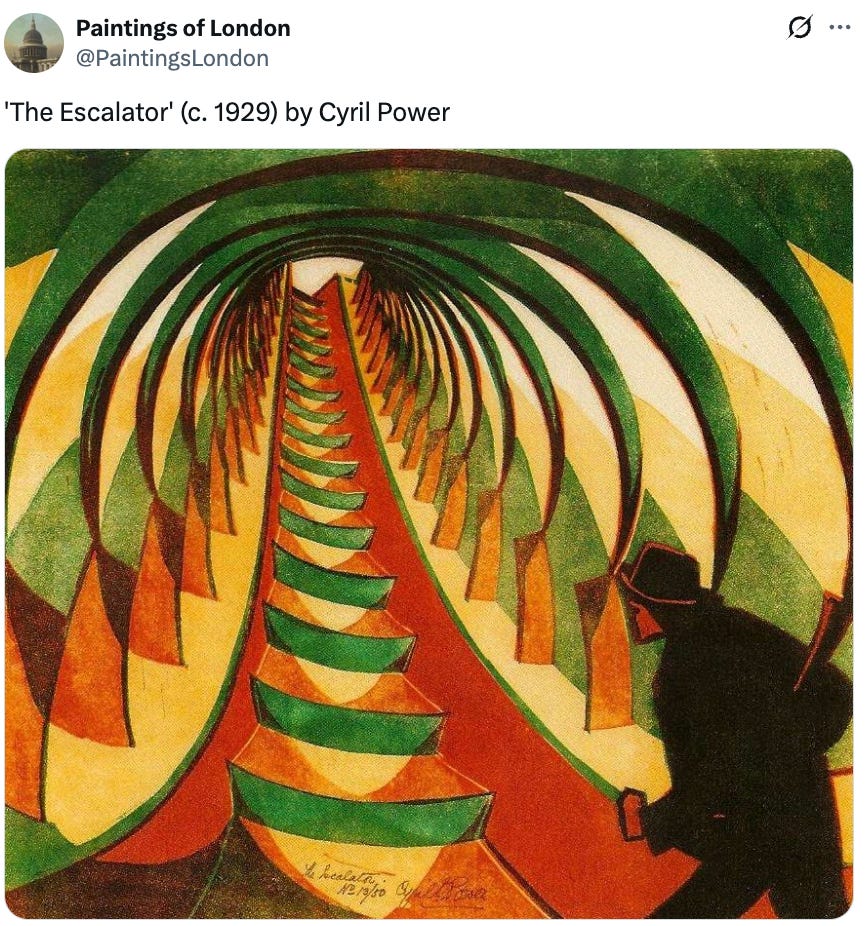
Amazing how these prints caught on in the late 1920s. Not just in the UK (above) but in Australia - particularly among the women artists celebrated in the “Dangerously Modern” at the Art Gallery of NSW. It’s wonderful, as were the artists (I think so anyway). See it if you possibly can.
When the data catches up
Intriguing!
Remember when every car manufacturer decided physical buttons were "outdated"?
Tesla, VW, Peugeot, Volvo - they all went full touchscreen. Everything from climate control to opening the glove box buried in digital menus. Minimalist. Futuristic. The future of automotive design.
Looked brilliant in the showroom. Absolute nightmare on the M25. Then the crash data arrived.
Distraction-related crashes in Europe jumped 20% between 2020 and 2024. Research by TRL found that using in-car touchscreens was as impairing as texting whilst driving or having a light tipple before getting behind the wheel. Tasks that took 2 seconds with a physical button were taking 5-40 seconds on a touchscreen. And taking your eyes off the road for just 2 seconds doubles your crash risk.
Let that sink in. Car manufacturers built touchscreens into their vehicles that impair you as much as being over the limit.
Euro NCAP, Europe's car safety authority, looked at the numbers and said: "Right, we're done with this nonsense."
From January 2026 (this month), any car wanting a 5-star safety rating must have physical buttons for indicators, hazard lights, horn, wipers, and emergency SOS. Touchscreen-only? You lose points. Simple as. And here's the really mental part: Whilst Tesla, VW, and others were spending billions designing sleek touchscreen interfaces, Mazda just kept making physical buttons. They looked old-fashioned. Proper analogue. Like they'd completely missed the memo on modern design.
Turns out they were the only ones who actually got it. Now VW is retrofitting physical controls back into newer models after customer backlash. Volvo's EX30, which controls mirror adjustment through a touchscreen (seriously), is suddenly facing a safety rating problem. And Tesla's minimalist interior, once their signature design flex, is now a regulatory liability.
The manufacturers who bet everything on touchscreens are now spending money to reverse course. The manufacturer who stayed old-school looks like a genius.
Touchscreens were cheaper to produce than switches and knobs. They enabled software updates. They looked modern. They photographed well in marketing materials.
They also made cars objectively more dangerous to drive.
Your big innovation could be making things worse, and you won't know until the data catches up.
A review of Surviving Rome: The Economic Lives of the Ninety Percent by Kim Bowes, by my friend Felix Martin.
“Thus will we all be, once Death carries us away!” That is how the parvenu tycoon Trimalchio greets the pièce de résistance of his legendarily tasteless dinner party — a fully articulated, solid silver skeleton — in The Satyricon, a Roman comic novel written by Petronius in the first century AD. All the wealth and trappings of even the greatest empire in the world would succumb to the ravages of time and be lost to posterity for ever.
Yet Trimalchio was mistaken. He had not reckoned with Kim Bowes, professor of ancient history and archaeology at the University of Pennsylvania, and a revolution in our understanding of the economic lives of the ancient Romans that she masterfully summarises in her new book, Surviving Rome.
Understanding Roman Life
Until relatively recently, our knowledge of the realities of daily life in the Roman empire relied heavily on literary sources — “Cicero & Co”, as Bowes dubs them. They inevitably focused on the imperial elites.
The past 40 years, however, have seen an explosion in the discovery of new material and textual evidence. Traditional digs have unearthed masses of new insights regarding land use and consumer culture. Painstaking analysis of thousands of far-from-literary texts — account books, shopping lists, shop signs, graffiti and so on — have given piercing revelations into commercial and financial life. And “economic anthropometrics” — ingenious inferences from those skeletal remains Trimalchio believed to be no more than a memento mori — have transformed our understanding of diets and health...
The meticulous triangulation of all this new evidence by scholars has birthed a new, data-driven school of ancient history that has yielded an extraordinarily detailed picture of the lives and livelihoods not just of the empire’s privileged upper classes but of everyone else as well — what Bowes calls, in a nod to modern political debates, Rome’s “90 percent”. The result is thrilling, because it overturns so many earlier assumptions.
Health and Diet
It used to be thought that the harsh living conditions of most ancient Romans must have taken a terrible toll on their health. Yet new bio-archaeological techniques reveal that skeletal signatures of childhood disease were twice as high in Victorian London as in Roman British cities... But in general, as Bowes puts it, “Oliver Twist had it worse”.
The Romans’ relative good health probably had something to do with their diet. Here, it is the assumption that most scraped by on a subsistence level which new data consigns to history. In fact, Bowes calculates, even slaves enjoyed typical daily calorific intakes nearly twice the subsistence level. “The Colosseum was not built on 1,900 calories per day,” she quips.
Urban and rural diets were surprisingly rich and varied — bone analysis reveals a healthy mix of seafood, meat, dairy and legumes — even in the farthest-flung corners of the empire. The remains of one modest Wiltshire farm reveal consumption of Spanish olive oil and Italian wine...
Women’s Economic Role
The economic irrelevance of women and girls is another misconception. A remarkable second century AD letter from an industrious female wool-spinner, preserved among the famous cache of papyri discovered at Oxyrhynchus in Egypt, has cracked open the likely reality by detailing her accounts. Textiles were a vast industry, employing up to half of all the labour in the empire, and what women could earn from spinning rivalled some male monthly wages. Thus for an enormous number of Roman households, the female members were economically just as important as the males.
Financial Systems
Then there are the account books of the notaries’ office of Tebtunis, a town in Lower Egypt. These offer such granular insights into mid first century AD Roman financial plumbing that Bowes calls them justly “one of the most extraordinary documents from the ancient world”. They reveal that coins, which were once assumed to comprise the pinnacle of Roman monetary sophistication, represented only a tiny fraction of a vast and intricate web of account money, personal IOUs and trade credit that reached down to the lowest levels of society. Far from finance being the preserve of the elites, “the Roman world, it is now clear, was awash in borrowing”.
Surviving Rome contains many more such fascinating surprises. One of the biggest of all is the fact that the treasure trove of novel historical data it catalogues was discovered largely by accident, as a byproduct of a boom in big construction projects in Europe in recent decades. As Bowes writes, in an irony worthy of the great satirist Petronius, “more information about the rural Roman 90 per cent has emerged from the construction of Euro Disney than from the well-intentioned excavations designed to find them”. Yet, how fitting that the honest pursuit of pleasure for today’s 90 per cent has so expanded our understanding of imperial Rome’s.
“They did not arrive as disruptors. They arrived as intensifiers.”
A really marvellous and far-ranging exploration of the chestnut ‘can LLMs do science’ though my extract below is heavily edited, and I recommend reading the whole thing.
The argument about whether large language models can “do science” has the structure of a trap... Both sides assume the only question worth asking is a capabilities question.
This framing has a certain intuitive appeal, but it’s the wrong question... From a constructionist perspective—the tradition associated with Bruno Latour and science studies more broadly—this gets the epistemology backwards. Galileo’s telescope didn’t access some pre-existing truth about Jupiter’s moons; the moons became scientific facts through a process of enrollment.
The better question is whether LLMs can be usefully integrated in the processes by which scientific knowledge gets made, validated, and disseminated... a technology’s potential uses are not its actual uses, and its actual uses are shaped by the institutions that take it up... To ask about LLMs and science is to ask what program was already running when they arrived. The program, as it turns out, had been running for decades, and it was not optimized for epistemic depth.
Something happened to the social organization of American science in the early 1960s... a cluster of influential works made science newly visible as a system that could be studied, quantified, and administered... Together, these works made science legible as a system—and legibility, as James Scott has argued, is the precondition for management.
This new legibility of science created a problem: how do you manage a system that produces more literature than anyone can read. One answer, developed through the 1960s and institutionalized in the 1970s, was citation metrics. Eugene Garfield‘s Institute for Scientific Information built tools to track who cited whom, which journals mattered, which papers had influence... But solutions curdle. The tools built to navigate the literature became tools to evaluate the people who produced it. What had been an instrument for managing information became an instrument for managing careers.
Robert Merton saw this coming, though he couldn’t stop it. In 1940, Merton had theorized the phenomenon he called “goal displacement”—the process by which instrumental values become terminal values, means transmuted into ends. The measure becomes the target; the proxy becomes the prize.
Three decades later, Merton found himself in an awkward position... Merton attended [a conference], and he warned Garfield directly: “I’d like to get on the record the problem of goal displacement as it might work with citation analysis.” But Merton didn’t only warn. He sat on ISI’s board of advisors... And when Garfield worried about evaluative misuse of citation data, Merton reassured him that massive use for appointments and promotions was “not in the cards.” He was wrong.
A common and—at this point—hopelessly clichéd response to this history is to invoke Goodhart’s Law: when a measure becomes a target, it ceases to be a good measure... But this response misses what’s actually wrong. The problem is not in the metric but in the organizational form that needs metrics to function.
Into this context—a scientific system already optimized for measurable output, already decades into goal displacement—arrive large language models.
They did not arrive as disruptors. They arrived as intensifiers. LLMs function as an accelerant for the existing optimization machine, making the logic run faster rather than challenging its foundations.
The evidence is already accumulating. In February 2024, the journal Frontiers in Cell and Developmental Biology published a paper featuring AI-generated images of a rat with grotesquely oversized genitals; it was retracted within 72 hours, but only because the errors were absurd enough to catch attention... In 2023, Hindawi retracted over 8,000 articles linked to paper mills—more than all publishers combined had retracted in any previous year.
These are not, primarily, stories about artificial intelligence. They are stories about institutions optimized for volume... LLMs did not create [this structure]. Rather this technology arrived into this context, offering a faster way to produce the artifacts the system rewards.
What strikes me about the discourse around LLMs and science is that many critics have such bad intuitions about it... Both agree that the technology is the agent; they disagree only about valence.
I don’t have a program for reform, but I also don’t think reform is possible unless we change the way we look at the problem. What I’ve tried to do here is make a different question askable—not whether LLMs can “do science” but how they get enrolled within a scientific system whose goals have already been displaced.
LLMs have context windows—the span of text they can attend to at once. It’s a telling reduction: “context” as buffer size, not a history, a situation, or a scene. The discourse around LLMs and science has its own context window, and it’s remarkably narrow... LLMs didn’t create the dysfunction in scientific publishing; they inherited it, intensified it, made it run faster. Like a normally benign pathogen wreaking havoc in an immunocompromised patient, they point to the problem, but imagining them as the totality of the problem would be a deadly mistake.
I was incredibly moved by this video (HT: Paul Krugman). It’s a sentimental country folksong. But at least as I heard it, its ultimate subject is sentiment as a fatal siren song. Or, as another great modern folksong - this time from the city - has it “a man hears what he wants to hear and disregards the rest”.
And all this trouble in our fields If this rain can fall, these wounds can heal They’ll never take our native soil But if we sell that new John Deere And then we’ll work these crops with sweat and tears You’ll be the mule I’ll be the plow Come harvest time we’ll work it out There’s still a lot of love, here in these troubled fields
Once you sell the John Deere, how do you think things are gonna work out?
The song itself kind of peters out with that terminal thought hanging in the air as the bankers and the next generation take what they can and move on.
And so, as the generations face each other in bewilderment, the older one which might lead - but in fact, mostly turns away - leaves a patrimony behind, as its gift to the next. An inheritance and a curse.
And the river of life murmurs on.
Sic transit gloria mundi.
Faith lives in that space where hypocrisy is the tribute vice pays to virtue.
Heaviosity half-hour
My favourite Paul Graham essay. It’s more useful in telling one something about oneself and the world one is in that almost any academic stuff, political theory or anything else. It also does that thing that I realise after all these decades was always the thing that got me going intellectually - exploring ideas that are not just about the world ‘out there’, but, at the same time about what’s going on inside your own head. And since these are new(ish) insights, they’re revelations usually about what is hiding in plain sight. And they’re usually critiques both of the world and oneself into the bargain.
It’s why Whitehead is one of my favourite philosophers. Here he is in Science and the Modern World.
The disadvantage of exclusive attention to a group of abstractions, however well-founded, is that, by the nature of the case, you have abstracted from the remainder of things. In so far as the excluded things are important in your experience, your modes of thought are not fitted to deal with them You cannot think without abstractions; accordingly, it is of the utmost importance to be vigilant to critically revising your modes of abstraction. It is here that philosophy finds its healthy niche as essential to the healthy progress of society. It is the critique of abstractions. A civilisation which cannot burst through its current abstractions is doomed to sterility after a very limited period of progress.
Anyway, on with the show:
December 2019
The most damaging thing you learned in school wasn’t something you learned in any specific class. It was learning to get good grades.
When I was in college, a particularly earnest philosophy grad student once told me that he never cared what grade he got in a class, only what he learned in it. This stuck in my mind because it was the only time I ever heard anyone say such a thing.
For me, as for most students, the measurement of what I was learning completely dominated actual learning in college. I was fairly earnest; I was genuinely interested in most of the classes I took, and I worked hard. And yet I worked by far the hardest when I was studying for a test.
In theory, tests are merely what their name implies: tests of what you’ve learned in the class. In theory you shouldn’t have to prepare for a test in a class any more than you have to prepare for a blood test. In theory you learn from taking the class, from going to the lectures and doing the reading and/or assignments, and the test that comes afterward merely measures how well you learned.
In practice, as almost everyone reading this will know, things are so different that hearing this explanation of how classes and tests are meant to work is like hearing the etymology of a word whose meaning has changed completely. In practice, the phrase “studying for a test” was almost redundant, because that was when one really studied. The difference between diligent and slack students was that the former studied hard for tests and the latter didn’t. No one was pulling all-nighters two weeks into the semester.
Even though I was a diligent student, almost all the work I did in school was aimed at getting a good grade on something.
To many people, it would seem strange that the preceding sentence has a “though” in it. Aren’t I merely stating a tautology? Isn’t that what a diligent student is, a straight-A student? That’s how deeply the conflation of learning with grades has infused our culture.
Is it so bad if learning is conflated with grades? Yes, it is bad. And it wasn’t till decades after college, when I was running Y Combinator, that I realized how bad it is.
I knew of course when I was a student that studying for a test is far from identical with actual learning. At the very least, you don’t retain knowledge you cram into your head the night before an exam. But the problem is worse than that. The real problem is that most tests don’t come close to measuring what they’re supposed to.
If tests truly were tests of learning, things wouldn’t be so bad. Getting good grades and learning would converge, just a little late. The problem is that nearly all tests given to students are terribly hackable. Most people who’ve gotten good grades know this, and know it so well they’ve ceased even to question it. You’ll see when you realize how naive it sounds to act otherwise.
Suppose you’re taking a class on medieval history and the final exam is coming up. The final exam is supposed to be a test of your knowledge of medieval history, right? So if you have a couple days between now and the exam, surely the best way to spend the time, if you want to do well on the exam, is to read the best books you can find about medieval history. Then you’ll know a lot about it, and do well on the exam.
No, no, no, experienced students are saying to themselves. If you merely read good books on medieval history, most of the stuff you learned wouldn’t be on the test. It’s not good books you want to read, but the lecture notes and assigned reading in this class. And even most of that you can ignore, because you only have to worry about the sort of thing that could turn up as a test question. You’re looking for sharply-defined chunks of information. If one of the assigned readings has an interesting digression on some subtle point, you can safely ignore that, because it’s not the sort of thing that could be turned into a test question. But if the professor tells you that there were three underlying causes of the Schism of 1378, or three main consequences of the Black Death, you’d better know them. And whether they were in fact the causes or consequences is beside the point. For the purposes of this class they are.
At a university there are often copies of old exams floating around, and these narrow still further what you have to learn. As well as learning what kind of questions this professor asks, you’ll often get actual exam questions. Many professors re-use them. After teaching a class for 10 years, it would be hard not to, at least inadvertently.
In some classes, your professor will have had some sort of political axe to grind, and if so you’ll have to grind it too. The need for this varies. In classes in math or the hard sciences or engineering it’s rarely necessary, but at the other end of the spectrum there are classes where you couldn’t get a good grade without it.
Getting a good grade in a class on x is so different from learning a lot about x that you have to choose one or the other, and you can’t blame students if they choose grades. Everyone judges them by their grades — graduate programs, employers, scholarships, even their own parents.
I liked learning, and I really enjoyed some of the papers and programs I wrote in college. But did I ever, after turning in a paper in some class, sit down and write another just for fun? Of course not. I had things due in other classes. If it ever came to a choice of learning or grades, I chose grades. I hadn’t come to college to do badly.
Anyone who cares about getting good grades has to play this game, or they’ll be surpassed by those who do. And at elite universities, that means nearly everyone, since someone who didn’t care about getting good grades probably wouldn’t be there in the first place. The result is that students compete to maximize the difference between learning and getting good grades.
Why are tests so bad? More precisely, why are they so hackable? Any experienced programmer could answer that. How hackable is software whose author hasn’t paid any attention to preventing it from being hacked? Usually it’s as porous as a colander.
Hackable is the default for any test imposed by an authority. The reason the tests you’re given are so consistently bad — so consistently far from measuring what they’re supposed to measure — is simply that the people creating them haven’t made much effort to prevent them from being hacked.
But you can’t blame teachers if their tests are hackable. Their job is to teach, not to create unhackable tests. The real problem is grades, or more precisely, that grades have been overloaded. If grades were merely a way for teachers to tell students what they were doing right and wrong, like a coach giving advice to an athlete, students wouldn’t be tempted to hack tests. But unfortunately after a certain age grades become more than advice. After a certain age, whenever you’re being taught, you’re usually also being judged.
I’ve used college tests as an example, but those are actually the least hackable. All the tests most students take their whole lives are at least as bad, including, most spectacularly of all, the test that gets them into college. If getting into college were merely a matter of having the quality of one’s mind measured by admissions officers the way scientists measure the mass of an object, we could tell teenage kids “learn a lot” and leave it at that. You can tell how bad college admissions are, as a test, from how unlike high school that sounds. In practice, the freakishly specific nature of the stuff ambitious kids have to do in high school is directly proportionate to the hackability of college admissions. The classes you don’t care about that are mostly memorization, the random “extracurricular activities” you have to participate in to show you’re “well-rounded,” the standardized tests as artificial as chess, the “essay” you have to write that’s presumably meant to hit some very specific target, but you’re not told what.
As well as being bad in what it does to kids, this test is also bad in the sense of being very hackable. So hackable that whole industries have grown up to hack it. This is the explicit purpose of test-prep companies and admissions counsellors, but it’s also a significant part of the function of private schools.
Why is this particular test so hackable? I think because of what it’s measuring. Although the popular story is that the way to get into a good college is to be really smart, admissions officers at elite colleges neither are, nor claim to be, looking only for that. What are they looking for? They’re looking for people who are not simply smart, but admirable in some more general sense. And how is this more general admirableness measured? The admissions officers feel it. In other words, they accept who they like.
So what college admissions is a test of is whether you suit the taste of some group of people. Well, of course a test like that is going to be hackable. And because it’s both very hackable and there’s (thought to be) a lot at stake, it’s hacked like nothing else. That’s why it distorts your life so much for so long.
It’s no wonder high school students often feel alienated. The shape of their lives is completely artificial.
But wasting your time is not the worst thing the educational system does to you. The worst thing it does is to train you that the way to win is by hacking bad tests. This is a much subtler problem that I didn’t recognize until I saw it happening to other people.
When I started advising startup founders at Y Combinator, especially young ones, I was puzzled by the way they always seemed to make things overcomplicated. How, they would ask, do you raise money? What’s the trick for making venture capitalists want to invest in you? The best way to make VCs want to invest in you, I would explain, is to actually be a good investment. Even if you could trick VCs into investing in a bad startup, you’d be tricking yourselves too. You’re investing time in the same company you’re asking them to invest money in. If it’s not a good investment, why are you even doing it?
Oh, they’d say, and then after a pause to digest this revelation, they’d ask: What makes a startup a good investment?
So I would explain that what makes a startup promising, not just in the eyes of investors but in fact, isgrowth. Ideally in revenue, but failing that in usage. What they needed to do was get lots of users.
How does one get lots of users? They had all kinds of ideas about that. They needed to do a big launch that would get them “exposure.” They needed influential people to talk about them. They even knew they needed to launch on a tuesday, because that’s when one gets the most attention.
No, I would explain, that is not how to get lots of users. The way you get lots of users is to make the product really great. Then people will not only use it but recommend it to their friends, so your growth will be exponential once youget it started.
At this point I’ve told the founders something you’d think would be completely obvious: that they should make a good company by making a good product. And yet their reaction would be something like the reaction many physicists must have had when they first heard about the theory of relativity: a mixture of astonishment at its apparent genius, combined with a suspicion that anything so weird couldn’t possibly be right. Ok, they would say, dutifully. And could you introduce us to such-and-such influential person? And remember, we want to launch on Tuesday.
It would sometimes take founders years to grasp these simple lessons. And not because they were lazy or stupid. They just seemed blind to what was right in front of them.
Why, I would ask myself, do they always make things so complicated? And then one day I realized this was not a rhetorical question.
Why did founders tie themselves in knots doing the wrong things when the answer was right in front of them? Because that was what they’d been trained to do. Their education had taught them that the way to win was to hack the test. And without even telling them they were being trained to do this. The younger ones, the recent graduates, had never faced a non-artificial test. They thought this was just how the world worked: that the first thing you did, when facing any kind of challenge, was to figure out what the trick was for hacking the test. That’s why the conversation would always start with how to raise money, because that read as the test. It came at the end of YC. It had numbers attached to it, and higher numbers seemed to be better. It must be the test.
There are certainly big chunks of the world where the way to win is to hack the test. This phenomenon isn’t limited to schools. And some people, either due to ideology or ignorance, claim that this is true of startups too. But it isn’t. In fact, one of the most striking things about startups is the degree to which you win by simply doing good work. There are edge cases, as there are in anything, but in general you win by getting users, and what users care about is whether the product does what they want.
Why did it take me so long to understand why founders made startups overcomplicated? Because I hadn’t realized explicitly that schools train us to win by hacking bad tests. And not just them, but me! I’d been trained to hack bad tests too, and hadn’t realized it till decades later.
I had lived as if I realized it, but without knowing why. For example, I had avoided working for big companies. But if you’d asked why, I’d have said it was because they were bogus, or bureaucratic. Or just yuck. I never understood how much of my dislike of big companies was due to the fact that you win by hacking bad tests.
Similarly, the fact that the tests were unhackable was a lot of what attracted me to startups. But again, I hadn’t realized that explicitly.
I had in effect achieved by successive approximations something that may have a closed-form solution. I had gradually undone my training in hacking bad tests without knowing I was doing it. Could someone coming out of school banish this demon just by knowing its name, and saying begone? It seems worth trying.
Merely talking explicitly about this phenomenon is likely to make things better, because much of its power comes from the fact that we take it for granted. After you’ve noticed it, it seems the elephant in the room, but it’s a pretty well camouflaged elephant. The phenomenon is so old, and so pervasive. And it’s simply the result of neglect. No one meant things to be this way. This is just what happens when you combine learning with grades, competition, and the naive assumption of unhackability.
It was mind-blowing to realize that two of the things I’d puzzled about the most — the bogusness of high school, and the difficulty of getting founders to see the obvious — both had the same cause. It’s rare for such a big block to slide into place so late.
Usually when that happens it has implications in a lot of different areas, and this case seems no exception. For example, it suggests both that education could be done better, and how you might fix it. But it also suggests a potential answer to the question all big companies seem to have: how can we be more like a startup? I’m not going to chase down all the implications now. What I want to focus on here is what it means for individuals.
To start with, it means that most ambitious kids graduating from college have something they may want to unlearn. But it also changes how you look at the world. Instead of looking at all the different kinds of work people do and thinking of them vaguely as more or less appealing, you can now ask a very specific question that will sort them in an interesting way: to what extent do you win at this kind of work by hacking bad tests?
It would help if there was a way to recognize bad tests quickly. Is there a pattern here? It turns out there is.
Tests can be divided into two kinds: those that are imposed by authorities, and those that aren’t. Tests that aren’t imposed by authorities are inherently unhackable, in the sense that no one is claiming they’re tests of anything more than they actually test. A football match, for example, is simply a test of who wins, not which team is better. You can tell that from the fact that commentators sometimes say afterward that the better team won. Whereas tests imposed by authorities are usually proxies for something else. A test in a class is supposed to measure not just how well you did on that particular test, but how much you learned in the class. While tests that aren’t imposed by authorities are inherently unhackable, those imposed by authorities have to be made unhackable. Usually they aren’t. So as a first approximation, bad tests are roughly equivalent to tests imposed by authorities.
You might actually like to win by hacking bad tests. Presumably some people do. But I bet most people who find themselves doing this kind of work don’t like it. They just take it for granted that this is how the world works, unless you want to drop out and be some kind of hippie artisan.
I suspect many people implicitly assume that working in a field with bad tests is the price of making lots of money. But that, I can tell you, is false. It used to be true. In the mid-twentieth century, when the economy wascomposed of oligopolies, the only way to the top was by playing their game. But it’s not true now. There are now ways to get rich by doing good work, and that’s part of the reason people are so much more excited about getting rich than they used to be. When I was a kid, you could either become an engineer and make cool things, or make lots of money by becoming an “executive.” Now you can make lots of money by making cool things.
Hacking bad tests is becoming less important as the link between work and authority erodes. The erosion of that link is one of the most important trends happening now, and we see its effects in almost every kind of work people do. Startups are one of the most visible examples, but we see much the same thing in writing. Writers no longer have to submit to publishers and editors to reach readers; now they can go direct.
The more I think about this question, the more optimistic I get. This seems one of those situations where we don’t realize how much something was holding us back until it’s eliminated. And I can foresee the whole bogus edifice crumbling. Imagine what happens as more and more people start to ask themselves if they want to win by hacking bad tests, and decide that they don’t. The kinds of work where you win by hacking bad tests will be starved of talent, and the kinds where you win by doing good work will see an influx of the most ambitious people. And as hacking bad tests shrinks in importance, education will evolve to stop training us to do it. Imagine what the world could look like if that happened.
This is not just a lesson for individuals to unlearn, but one for society to unlearn, and we’ll be amazed at the energy that’s liberated when we do.
Notes
[1] If using tests only to measure learning sounds impossibly utopian, that is already the way things work at Lambda School. Lambda School doesn’t have grades. You either graduate or you don’t. The only purpose of tests is to decide at each stage of the curriculum whether you can continue to the next. So in effect the whole school is pass/fail.
[2] If the final exam consisted of a long conversation with the professor, you could prepare for it by reading good books on medieval history. A lot of the hackability of tests in schools is due to the fact that the same test has to be given to large numbers of students.
[3] Learning is the naive algorithm for getting good grades.
[4]Hackinghas multiple senses. There’s a narrow sense in which it means to compromise something. That’s the sense in which one hacks a bad test. But there’s another, more general sense, meaning to find a surprising solution to a problem, often by thinking differently about it. Hacking in this sense is a wonderful thing. And indeed, some of the hacks people use on bad tests are impressively ingenious; the problem is not so much the hacking as that, because the tests are hackable, they don’t test what they’re meant to.
[5] The people who pick startups at Y Combinator are similar to admissions officers, except that instead of being arbitrary, their acceptance criteria are trained by a very tight feedback loop. If you accept a bad startup or reject a good one, you will usually know it within a year or two at the latest, and often within a month.
[6] I’m sure admissions officers are tired of reading applications from kids who seem to have no personality beyond being willing to seem however they’re supposed to seem to get accepted. What they don’t realize is that they are, in a sense, looking in a mirror. The lack of authenticity in the applicants is a reflection of the arbitrariness of the application process. A dictator might just as well complain about the lack of authenticity in the people around him.
[7] By good work, I don’t mean morally good, but good in the sense in which a good craftsman does good work.
[8] There are borderline cases where it’s hard to say which category a test falls in. For example, is raising venture capital like college admissions, or is it like selling to a customer?
[9] Note that a good test is merely one that’s unhackable. Good here doesn’t mean morally good, but good in the sense of working well. The difference between fields with bad tests and good ones is not that the former are bad and the latter are good, but that the former are bogus and the latter aren’t. But those two measures are not unrelated. As Tara Ploughman said, the path from good to evil goes through bogus.
[10] People who think the recent increase ineconomic inequalityis due to changes in tax policy seem very naive to anyone with experience in startups. Different people are getting rich now than used to, and they’re getting much richer than mere tax savings could make them.
[11] Note to tiger parents: you may think you’re training your kids to win, but if you’re training them to win by hacking bad tests, you are, as parents so often do, training them to fight the last war.
Thanksto Austen Allred, Trevor Blackwell, Patrick Collison, Jessica Livingston, Robert Morris, and Harj Taggar for reading drafts of this.
Thank you SO MUCH! Finally the first piece I've read that explains the whole Adelaide Writers' Week debacle in a sensible context! And quotes this gold: "Some of the most central tenets of social justice include centring lived experience, not talking over people who have skin in the game, and applying the same standards and humanity to all people, rather than engaging in selective judgement of who is deserving."
One thing that still troubles me is how quickly the focus shifts from institutional judgement to individual consistency.
Hypocrisy and selective free-speech advocacy obviously shape the terrain, and I can see why you treat that as diagnostic of the bind institutions now find themselves in. They learn fast, and usually defensively. Still, once the argument turns on whether a speaker is morally coherent, the organisation that actually exercised power starts to slip out of frame.
Adelaide Writers’ Week didn’t need to decide whether Abdel-Fattah is a free-speech purist. It needed to decide whether it could explain, own, and carry a decision once the heat arrived. Managing risk is rational. It just isn’t the same thing as legitimacy.
The costs of standing still fall unevenly across boards, staff, funders, and ministers, which makes reversals understandable. It also raises the harder question of who institutions are optimising for when pressure hits.
Free speech rarely collapses because no one believes in it. It collapses because belief buckles under reputational and political exposure.























Thank you SO MUCH! Finally the first piece I've read that explains the whole Adelaide Writers' Week debacle in a sensible context! And quotes this gold: "Some of the most central tenets of social justice include centring lived experience, not talking over people who have skin in the game, and applying the same standards and humanity to all people, rather than engaging in selective judgement of who is deserving."
One thing that still troubles me is how quickly the focus shifts from institutional judgement to individual consistency.
Hypocrisy and selective free-speech advocacy obviously shape the terrain, and I can see why you treat that as diagnostic of the bind institutions now find themselves in. They learn fast, and usually defensively. Still, once the argument turns on whether a speaker is morally coherent, the organisation that actually exercised power starts to slip out of frame.
Adelaide Writers’ Week didn’t need to decide whether Abdel-Fattah is a free-speech purist. It needed to decide whether it could explain, own, and carry a decision once the heat arrived. Managing risk is rational. It just isn’t the same thing as legitimacy.
The costs of standing still fall unevenly across boards, staff, funders, and ministers, which makes reversals understandable. It also raises the harder question of who institutions are optimising for when pressure hits.
Free speech rarely collapses because no one believes in it. It collapses because belief buckles under reputational and political exposure.