


Breaking out of the politics of ‘don’t mention the war’
After a chat between Bernard Keane and me, we decided to try to explore the issues in a recorded podcast. The pretext is that, when a major party doesn’t have a majority, they are slightly less able to rely on the reasoning of the Very Serious People; slightly more amenable to new ideas. As Ginger Rogers said to Fred Astaire in some movie I can’t name “That idea’s so crazy, it just might woik.”
The basic line of argument goes like this. Despite our endless retreat to Churchill’s line that democracy is the worst form of government except for all the others that have been tried, if you really look it in the eye, it’s modus operandi has a nasty tendency to avoid the difficult conversations. That’s why a couple of newsletters ago I quoted the great American journalist Walter Lippmann itemising how the democracies - every one of them - avoided the need to rearm to stave off Hitler in the 1930s.
Our discussion uses the Tasmanian election as a microcosm to illustrate ‘don’t mention the war’ politics.1 The Tasmanian politicians from the major parties don’t only steer clear of difficult questions about the stadium. They move in lockstep on what they would actually do to balance the budget.
And this is roughly the story of the last federal election when it comes to
the structural budget deficit
how we’ll fund increased expenditure on
Defence
With the fantasy submarine deal in a special category all on its own. AUKUS
the NDIS
Aged care
Childcare.
In the interview, I explore the way in which citizen juries just might be able to take us back to the 'glory days' of the Hawke Government where the Accord helped organise major strategic deals between the social partners before the Opposition tried to pick them apart, something I wrote about here. Of course non of this would happen mechanically. It would require political leadership and some imagination. But no more than we saw when Hawke established the Accord.
Anyway, I hope you enjoy the podcast which you can navigate if you want to focus on the ‘throughline’, I’ve sketched above.
National treasures to the rescue

If you read this piece, you’ll understand why I’m partial to Bernard Keane, and in fact regard him as a national treasure.
The biggest losers from the Tasmanian election are the two major parties — an appropriate outcome given how poorly they have served their citizens.
After forcing a minority government to an election, Tasmanian Labor suffered a swing of over 3% and barely crawled to over 25% of the vote — a stark contrast to federal Labor's thumping success in Tasmania less than three months ago, and far below the level of combined support for the Tasmanian Greens and independents. The Tasmanian Liberals earnt a 3% swing but, despite securing half as many seats again as Labor, still remain well short of majority government.
As Saul Eslake pointed out today, neither Labor nor the Liberals have demonstrated any seriousness about the long-term fiscal problems facing Tasmania — problems demonstrated in the Liberals' shambolic budget and its addiction to ever-more spending. And both sides remain committed to the gravest fiscal folly of all: the Hobart stadium, about which the Liberals were prepared to ignore clear evidence and basic process to get started.
Despite efforts by the Hobart media, including the ABC, to attacks sceptics of the stadium proposal, the great majority of Tasmanians are opposed to it and want the deal for a football team renegotiated with the rapacious, gambling-addicted AFL...
That leaves the Liberals and Labor — both of whom have undermined Tasmania's sovereignty in their support for the AFL deal — with the choice of either continuing to ignore the terrible business case of the stadium, and undermine basic planning processes in an effort to ram the project through, or accept that being in minority government requires some different thinking about how to go about governing — and perhaps even governing in the state's interest, rather than their own narrow partisan interests.
Ironically, one of the people who has made the Liberals' lives so difficult in relation to the stadium debacle might have a way forward on that front. It was economist Nicholas Gruen who shredded the risible "business case" for the stadium put together for the Liberals by KPMG and showed it would cost far more to build, and generate far less revenue, than claimed by proponents.
But Gruen, wearing one of his other caps as national treasure and public policy wonk, has long backed the idea of citizens' assemblies as a mechanism for resolving policy issues that the political class has struggled with. An assembly drawn by ballot, not election, could be charged with resolving the issue of what is acceptable to Tasmanians in relation to any deal with the AFL, conduct its own inquiry, choose its own experts and hold its own hearings.
There are questions around how long the body would meet, how or whether its members would be remunerated and what status its conclusions would hold with the government that is eventually formed, but its conclusions would carry democratic legitimacy of a kind that's hard to see being achieved by the Tasmanian Liberal or Labor parties cosplaying at majority government. Moreover, it would provide a way forward currently unavailable to either of the major parties, given their support for the stadium...
As Gruen's analysis of the stadium showed, the decision by the Tasmanian government to proceed with the stadium was bereft of informed deliberation. Instead, it was a political decision that was dressed up in the garb of proper policy process — a bespoke government agency, a shonky big four consultants' report — designed to convey the impression there was deliberation going on, when there was none. It was only because the government's minority status saw it pushed to seek an independent assessment of the proposal that this sham of a process was exposed.
This is the increasingly dominant mode of decision-making in majority government systems across Australia — decision-making undertaken based purely on political imperatives, with some faux-deliberation draped over them to spare the perpetrators' blushes... The retention of minority government in Tasmania enables this fraud — for that is what this process of fake deliberation is — to be short-circuited, if crossbenchers are willing to force the big parties to think outside the majority mindset.
Freddie Deboer making a similar point to me

In this overly long piece, Freddie deBoer puts a similar argument to mine though the concept he appeals to is arrested development rather than turning away from discomfort. But in this paragraph he makes my point:
People sometimes ask me why I care. “Why do you care if a 38-year-old woman has a Squishmallow collection?” “Why do you care if a grown man cries over finally deciding on his Hogwarts House?” And I admit that this is a good-faith question. There are many things I don’t care about. If you’re not hurting anyone, if your regression is private, if you want to let your inner child out to play on weekends, go with God. But when the collective orientation of a society shifts away from maturity, and when entire media ecosystems are devoted to protecting people from the experience of being challenged or confronted, we don’t just lose some abstract dignity. We lose the capacity to solve real problems. Adults who refuse to be adults leave no adults to run the world. And somebody has to.
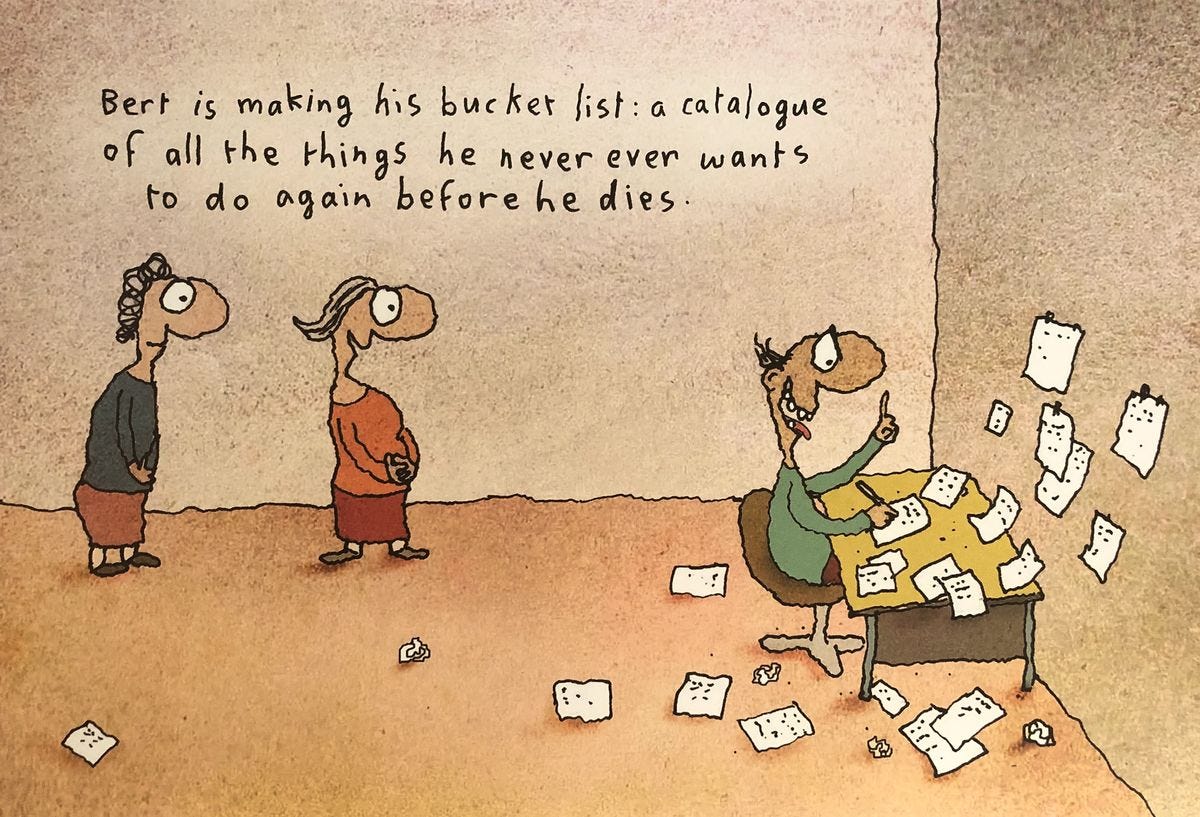
Keeping a straight face and wondering where your orangutan went
The best commentary on the Israel imbroglio I’ve come across
Bob Carr on Israel

The former Labor foreign affairs minister Bob Carr says the federal government should sanction the Israeli prime minister, Benjamin Netanyahu, and move quickly to recognise Palestinian statehood, saying it would send "a message that we are turned inside out with disgust by what appears the deliberate starvation" of Gaza.
Carr, the former New South Wales state premier and Labor elder, praised Anthony Albanese's latest statement condemning Israel, which accused Netanyahu's government of denying aid and killing civilians – including children – seeking water and food.
But Carr said Australia should seek to be a world leader in responding to the humanitarian disaster and follow the example of France in pledging to recognise a Palestinian state.
"The PM's instinct is right, but I reckon the Australian public wants him to push further and harder. Any notion in Dfat [the Department of Foreign Affairs and Trade] that we should wait till the UK moves on recognition is just us being too supine," Carr told Guardian Australia.
"We should move decisively, now the French have, and get credit in Asia and elsewhere for having a mind of our own, not just waiting for the UK – or, God help us, a signal from Washington."...
Carr's call was echoed by Labor MP and former cabinet minister Ed Husic, who said: "The time is now."
Albanese on Friday made his strongest condemnation yet of the starvation in Gaza, where international humanitarian organisations have pleaded for attention on starvation and malnutrition concerns.
At least 45 people have died of hunger in the past four days. The UN and aid groups blame Israel's blockade of almost all aid into the territory for the lack of food...
Noting Australia had imposed travel bans and financial sanctions on two far-right Israeli ministers in June, Carr suggested the government take similar action on Netanyahu.
"They need to sanction Netanyahu. He's directing this operation … subjecting the civilian population to collective punishment, including mass starvation," he said.
Amir Maimon, Israel's ambassador to Australia, released a statement on Friday saying his country was "not only entitled but obligated under international law" to defend its citizens.
"To condemn Israel for defending itself is wrong. It deflects attention from the real perpetrators of this horror: Hamas," Maimon wrote...
The foreign affairs minister, Penny Wong, said the withholding of vital food aid from Palestinian children was "indefensible", describing the situation in Gaza as "beyond the world's worst fears."...
Wong said Australia remained committed to a two-state solution, and reiterated that Australia no longer saw Palestinian statehood "at the end of a peace process only".
"It [a two-state solution] is ultimately the only hope of peace and breaking the cycle of violence and assuring the security and aspirations and peace for both Israelis and Palestinians."
Carr, the NSW premier from 1995 to 2005 and then federal foreign affairs minister from 2012 to 2013 in the Rudd and Gillard governments, said recognition of a Palestinian state had been Labor policy for many years.
He noted that he had moved such a motion at the 2014 NSW Labor conference. Carr believed the move would have majority support in Australian society.
"Recognition sends a message that we are turned inside out with disgust by what appears the deliberate starvation of the nation, identified as drip feeding," he said.
"I have not the faintest doubt it has majority support. People are coming up to me regularly and saying, 'keep up what you're doing on Palestine'. That's unusual. The message has gotten out there...
Carr said he believed the Labor party rank-and-file membership were "virtually unanimous on this".
Husic told the ABC that Australia should recognise Palestinian statehood immediately.
"There will be a number of countries that will do so, and given our party has said we want to do this, it seems right that the time is now for us to step forward and say we will recognise the state of Palestine now," he said...
The Labor Friends of Palestine, an internal pressure group, has written a motion calling for Australia to sanction the Israeli government, which has been adopted by 80 local branches, according to co-convener Peter Moss.
"Labor members fought long and hard through the party's democratic structures to establish in 2018 recognition as official policy that was to be delivered by the next Labor government," Moss said.
"We call on the Australian government to implement official platform policy and immediately and unconditionally recognise a Palestinian state on the pre-4 June 1967 borders. There has never been a more urgent time to assert the rights of the Palestinian people to self-determination, dignity, safety, and equal rights."...
Clever idea, wonderfully executed

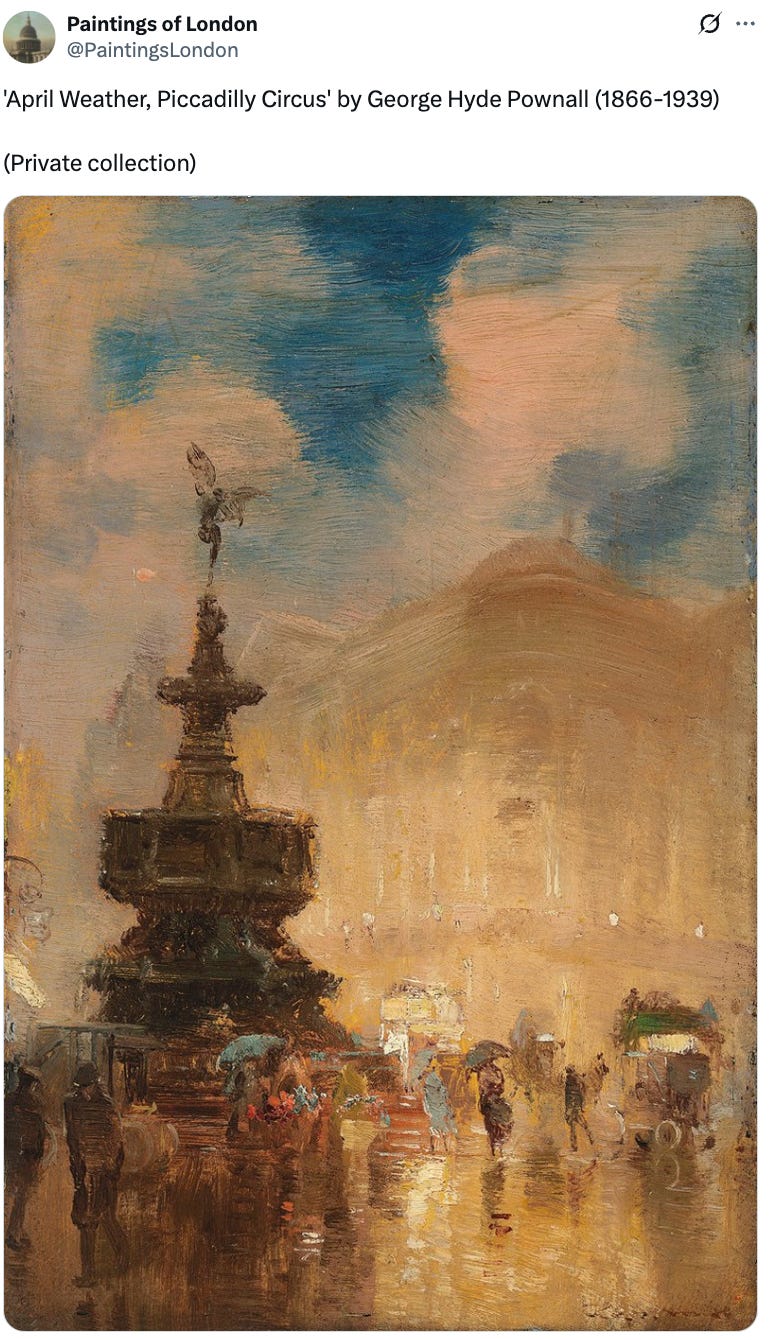
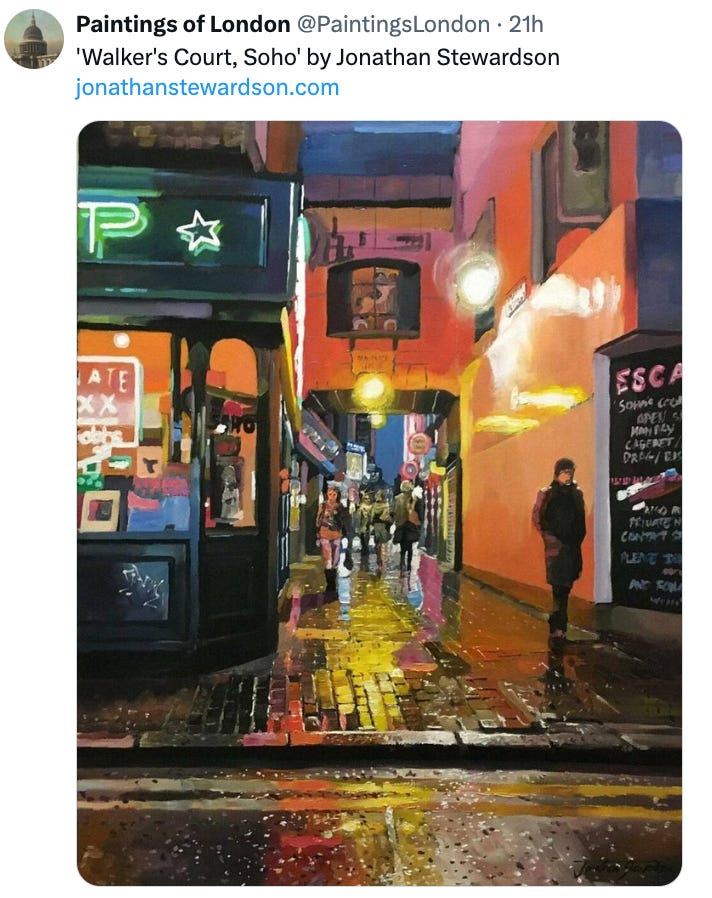
And, having discovered “Paintings of London”, I discover it rains a lot!


Germany charts a new course from oursourcing its energy supply to Russia, the consumption of its goods to China and its security to the USA
Watching this excellent short doco by the FT, I wondered how much of Europe’s economic under-performance might arise from austerity
I Watched It Happen in Hungary
Now It’s Happening Here.

By David Pressman, U.S. ambassador to Hungary from 2022 to 2025.
As the most recent U.S. ambassador to Viktor Orban's Hungary, I'm often asked if the Trump administration's tactics and policies feel familiar. The short answer is yes. But the more important — and unsettling — question is this: Does the way Americans are responding feel familiar, too?
After years watching Hungary suffocate under the weight of its democratic collapse, I came to understand that the real danger of a strongman isn't his tactics; it's how others, especially those with power, justify their acquiescence.
Take the judiciary. I met leaders of Hungary's sole independent judicial body in October 2022 to discuss their work. For months afterward, their faces (and mine) were plastered in the papers, branded as traitors and foreign agents, just because they had raised concerns about the rule of law in Hungary. The response from other powerful judges? Silence.
Or take the private sector. Since Mr. Orban became prime minister in 2010, the state has awarded billions in public contracts to his son-in-law and childhood friend, a former plumber named Lorinc Meszaros. What have Hungarian business leaders said? Nothing. ...
Hungarians with little power or privilege to lose would occasionally protest. But those with power remained reliably, pliably silent.
The American officials and academics who, like me, lived in Hungary during this period would often tell ourselves stories to explain this submissiveness: that docility is rooted in Hungary's oppressive communist past, that its democracy was simply too young to withstand a strongman.
Then I returned to the United States, and what I've witnessed over these past months at home has exposed those stories as wishful thinking.
Here, too, powerful people are responding to authoritarian advances just as their Hungarian counterparts have — not with defiance, but with capitulation, convinced that they can maintain their independence and stay above the fray. ...
Many law firms have opted to become instruments of a strongman rather than custodians of the rule of law. Former self-identified defenders of our democracy (back when it cost nothing to support democratic principles), including some who served in Democratic administrations, remain partners at captured institutions, earning millions while skirting their moral and civic responsibility to take a stand.
They cling to the illusion that they can preserve their independence and integrity while making deals with a strongman, just as Hungary's elite believed they, too, could emerge unscathed. ...
During my time in Hungary, I saw Hungarian mayors tell themselves that they were pursuing a savvy strategy by appeasing Mr. Orban even as he effectively stripped them of their revenues and authority.
Investors and executives bought into this narrative, even as their businesses and entire sectors fell prey to economic policies intended to enrich Mr. Orban's family and friends.
Hungarian judges bought into it, even as Mr. Orban's machine slowly swallowed their profession. Some saw capitulation in simple terms: as the only way to preserve their access to resources and keep the people who worked for them employed. "We'll eventually get through this," they surely told themselves, "but first, we must go along." ...
Those best positioned to uphold democratic norms chose the comfort of an illusion over the courage of action. They were and are invisible by choice — and that choice disfigured them and ultimately their country.
The lesson of Hungary is this: We cannot claim to care about democracy only when it costs nothing. President Trump, like Mr. Orban, no doubt believes that everyone can be bought. America's elites are proving him right. There is a Hungarian phrase I heard often: "Van az a penz" — "There's always a price." ...
Last month, young Hungarians marched in Budapest's Pride — despite the fact that Mr. Orban had banned it. As usual, Hungarians with power and privilege mostly stayed away. ...
To the stewards of our nation's great cultural and commercial institutions: Don't dupe yourselves. The illusion that you are smarter than the strongman, that you'll outmaneuver him with silent cleverness, is just that — an illusion. Now, more than ever, your principled leadership matters.
Look at those kids in the streets of Budapest last month — and learn from them.
Allegra’s Tax Roundtable
Many contributions were excellent. Greg Kaplan’s particularly so.
Individual income taxes in Australia raise nearly half of Federal government revenue. Given their size and scale, getting the design of these taxes right is important. A poorly designed tax system disincentivises productive activities (efficiency), reducing overall incomes and unfairly places the burden on particular individuals (equity).
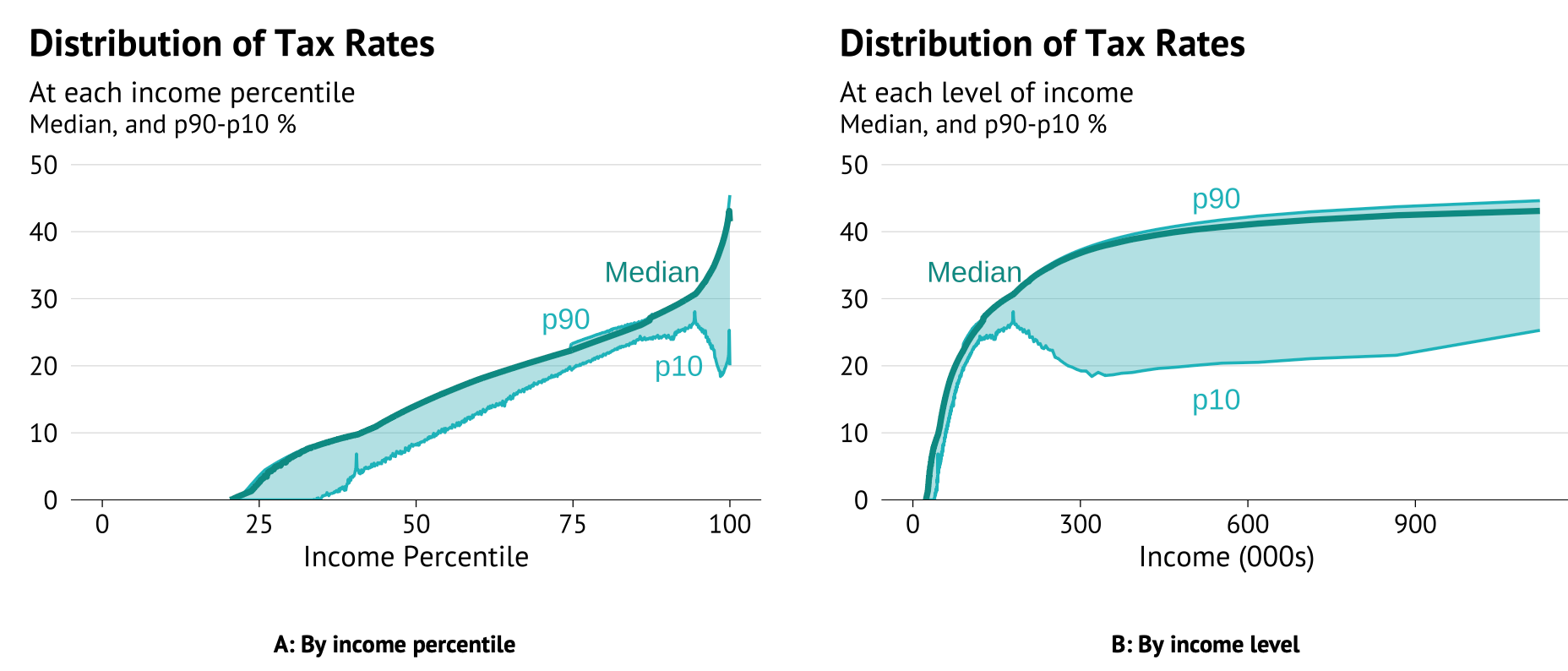
Our findings paint two starkly different pictures of horizontal and vertical equity in effective tax rates at high and low levels of income.
• For the bottom 95% of individuals who account for 63% of income tax revenue (those with incomes below about $187,000), tax rates are highly progressive. Effective tax rates rise steeply with income, and individuals with similar incomes pay similar tax rates.
• For the top 5% of individuals who account for 37% of tax revenue (those with incomes above $187,000), there is a very wide range of effective tax rates and income bares almost no relationship with the tax rate faced by any one person. Among this group, the effective tax rate is unrelated to income, but there is a large amount of dispersion in tax rates at any given income level. Conditional on income, the difference between 10th and 90th percentile of tax rates is around 20 percentage points.
Australia’s taxation of higher incomes exhibits substantial horizontal and vertical inequity and as a result is highly inefficient. It risks incentivising people to prioritise activities that are rewarded with capital gains over other forms of income even when they have a lower economic return. This unequal treatment may contribute to insufficient investment in more highly taxed activities such as human capital acquisition, that are important for the long-term performance of the Australian economy.
Keeping the lights on
Domination or enlightened self-interest

I really enjoyed this thoughtful post and it’s answer - enlightened self-interest, not the dark tunnel Peter Thiel wants to head down.
I never would have expected to be writing about Peter Thiel. I am not particularly interested in the tech industry, and I don't find his political opinions very edifying. But I published a book, one third of which is devoted to René Girard, and I have to face the fact—despite having written a post lamenting it—that what a lot of people want to know about Girard is how he influenced Thiel. So I had to do a bit of research on Thiel, and now I can't help but share some thoughts on what I found.
In an article I wrote for Unherd, I mentioned "The Straussian Moment", an essay that Thiel gave at a conference he organised and funded in 2004, on "Politics & Apocalypse". Girard was invited to the conference and contributed a chapter to a book based on the proceedings.
"The Straussian Moment" is largely a response to the attacks of 11 September, 2001—"9/11" as it's known in the USA. These were at that time fresh in everyone's memory. Thiel treats 9/11 as an apocalyptic event, in the sense of revealing something hitherto obscured. As he puts it:
the entire political and military framework of the nineteenth and twentieth centuries, and indeed of the modern age, with its emphasis on deterrent armies, rational nation-states, public debates, and international diplomacy, was called into question.
One of Thiel's targets throughout the essay is the post-WW2 system of global governance. As he sees it, the vision behind this system was a belief that "economic incentives" could be "powerful enough to contain violence". Economic development, "under the aegis of the World Bank, the International Monetary Fund, and an array of other organizations", would replace the state of constant war, in which nations had formerly existed, with a new era of cooperation based on mutually beneficial trade. In Thiel's eyes, Bin Laden and his agents shook "the West" awake from this happy dream...
Thiel opens his essay with a quotation from Alfred Lord Tennyson's poem Locksley Hall [which envisions] aerial bombardment, the United Nations ("the Parliament of man"), and international ("universal") law.
Thiel quotes this poem, presumably, as an example of the happy dream he saw 9/11 disturbing: the idea that a federation of nations, motivated by "common sense", might manage to keep the world at peace ("hold a fretful realm in awe") under a rule of law holding at the international level...
[In] a revealing paragraph [Thiel writes]:
Strauss also reminds us of the exceptional framework needed to supplement the American regime: "The most just society cannot survive without 'intelligence, i.e., espionage," even though "[e]spionage is impossible without a suspension of certain rules of natural right." Again, there is no disagreement with Tennyson on ends, but only on means. Instead of the United Nations, filled with interminable and inconclusive parliamentary debates that resemble Shakespearean tales told by idiots, we should consider Echelon, the secret coordination of the world's intelligence services, as the decisive path to a truly global pax Americana.
[Thiel] states it plainly: "a truly global pax Americana".
Well, that is not at all what I took Tennyson to be proposing. I had seen the "Federation of the world" as akin to the United Nations: a federation of nations, governed by multilateral agreements and a rule of law applying equally to every nation. That isn't at all the same as a pax Americana—that is to say, a neo-imperial arrangement maintained by a single global hyperpower...
After reading his essay, I needed a bit of self-care. I found it in The Great Convergence: Asia, the West, and the Logic of One World, by the great Singaporean diplomat and former representative to the UN, Kishore Mahbubani. I recommend it to anyone wanting a more positive and inclusive vision of the future of geopolitics. Interestingly, Mahbubani quotes the same passage from "Locksley Hall". The meaning he draws from it is quite different...
Ange Mlinko on Michelle de Kretser’s Theory and Practice

I’ve not read this book, or anything more than snippets of de Kretser, so I can’t say I agree with its negative take on her latest, but I could at least relate to the author of the review - poet Ange Mlinko’s question and her answer:
Is this a novel of ideas, or a novel about people who like to talk about ideas? I suspect the latter. And yet I wasn’t sure if it was the ideas or the people that made the book veer wildly between the entertaining and the banal.
Over to Ange.
Do women hate art?
'I'm going to focus on making art that doesn't look like art. Art that has the feel of women talking everyday crap, like you and me here, me solving all your problems.' This is Anti (short for Antigone) talking to the unnamed narrator of Theory and Practice, a graduate student at the University of Melbourne. It is 1986. You can still write a fan letter to Simone de Beauvoir – at least for a few more months – and in addition to quoting Shakespeare, Shelley, Elizabeth Bishop and Joseph Brodsky to your friends, you might be memorising apothegms from Roland Barthes's A Lover's Discourse...
After a day spent with Theory, I'd come away from the library feeling headachy and crushed. My undergraduate years had taken on the aspect of a wasteland. The foundations on which I'd expected to build were mere rubble underfoot. To understand Theory, I had to master Continental philosophy going back to the Greeks. I had to read Derrida, Irigaray, Kristeva, Cixous, Foucault, Lacan, Nietzsche, Deleuze and Guattari.
But it isn't theory that the narrator and her friends want, and it doesn't quite seem to be art either. Rather than focusing on the novels of Virginia Woolf, as agreed with her thesis adviser, the narrator finds herself captivated by the five volumes of Woolf's diaries... 'These intimate objects that Woolf had handled so often made a vibration in time, bringing her close.'
They need a mother, these girls – or a 'Woolfmother', as the narrator calls her favourite heroine. Obsessing over A Room of One's Own seems slightly more respectable than producing 'passionate, alarming, footnote-free essays about "Sylvia"'. But it's the same 'morbid symptom', the way diaries are morbid symptoms. 'When the symptoms could no longer be contained by her diary, she waded into a river with her pockets full of stones.'...
The contradictions of love, for instance. How piquant is it that the narrator, as an undergraduate, is devastated by a cheating boyfriend but then goes on, as a graduate student, to become a side dish herself?...
Michelle de Kretser is one of Australia's leading novelists. She emigrated from Sri Lanka with her family as a teenager, and the mores of educated liberal Australians is her imaginative terroir... Theory and Practice is her eighth novel. There is some ambiguity about whether it's autofictional: the cover of the Australian edition sports a photograph of de Kretser from the mid-1980s, and the jacket copy suggests that the book 'bends fiction, essay and memoir into ... new shapes'. The nameless first-person narrator encourages us along these lines and makes a point of wrongfooting us. For the first ten pages or so, we find ourselves reading a story set in Switzerland in 1957, written from the perspective of an Australian geologist. It ends abruptly: 'At that point, the novel I was writing stalled.' The narrator turns out to be a writer...
It is now a truism that art (form) is bad and truth (mess) is good, but even when it is as cunningly argued as it is at the end of Rachel Cusk's Parade, I don't buy it...
Theory and Practice is also formally elaborate: there's the false beginning, the start of a manifesto, then the dive into the past. Towards the end of the book, narrative gives way to more philosophising, and a reunion of old Melbourne friends from the 1980s takes place in Paris in the present day, bringing the circle round to narrative again...
The significant moment in Theory and Practice arrives when the narrator's mother dies. Until that point she has been a source of irritation to her daughter: a maudlin widow, an unassimilated donner of bright colours and bangles. But she is one of those casualties of 'widespread psychological, social and historical rupture'. 'As it aged,' the narrator notices, 'my mother's body had shrunk everywhere except in the middle. In the last year of her life she looked like a pregnant child. In death, her contours annihilated by a heavy quilt, she attained the truthfulness of formless form.' Then, a couple of paragraphs later, the narrator's name is belatedly, anticlimactically, revealed to us. It's Cindy.
At the end, Cindy is reunited with her university friend Lenny in Paris. He and some of his friends survived the Bataclan massacre of 2015...

The Impact of Unconditional Cash Transfers on Parenting and Children
This paper examines the impact of a large, randomized cash transfer on parental behaviors, investment in children, children's social, behavioral, and educational outcomes, and pregnancy and childbearing. We find that parents who were randomly selected to receive a $1,000 per month unconditional cash transfer for three years spent more on their children each month and reported better parenting behaviors (such as supervising their children more closely) compared to those randomized to receive $50 per month over the same period. However, possibly due to this closer monitoring, parents in the treatment group also reported that their child was experiencing more developmental difficulties and stress. Parents with the lowest incomes at baseline experienced the largest improvements in parenting; among these parents, the transfer also increased the use and quality of non-parental child care. The transfer did not have a meaningful effect on most educational outcomes measured in school! administrative records, nor did it affect characteristics of the home environment, child food security, exposure to homelessness, or parental satisfaction. Although treated families were more likely to move, we did not detect changes in most measures of neighborhood quality, though proximity to child-focused amenities such as daycares appeared to increase in the treatment group relative to the control group. The transfer did not affect childbearing, pregnancy, or outcomes related to contraception. While the transfer reduced parents' stress and mental distress in the first year of the program, these effects were short-lived and dissipated by the second year of the transfer, analogous to what was documented previously in the full population of participants.

The lighter (and darker) side of being Sarah O'Connor

A thought provoking fable - even though it’s true.
Are you a member of the same club as me? If so, the following story will be familiar. I am booking a flight. The online form instructs me that I must enter the passenger's name "as appears in their travel document". I add my surname — O'Connor — as it appears in my passport. The website refuses to let me proceed. It adds another — entirely contradictory — instruction. "Please use letters without accents and avoid using special characters!"
Welcome to life online if you have a "special character" in your name. It's an interesting sort of problem: infuriating to some; invisible to most. Yet it presents a question which matters to everyone. Should machines adapt to humans in all their variety, or should humans flatten themselves to be acceptable to machines?
First, a quick rundown of life with a name computers hate. Airline websites are particularly stressful, because often your only choice is to leave out the bit which offends the machine, and hope you don't have problems at the airport (I never have, but the worry persists). Other error messages are inadvertently offensive. "Name is invalid" is a common one. I once had "Last name must be filled in English".
The issues don't stop there. I receive so many parcels addressed to "Sarah O'Connor" that I barely notice any more. Then there are the occasions where one person has entered my name into a database, and now a different person is searching for it. "You're not in our system" is a little annoying if it's a restaurant reservation, but can be quite alarming if it's a hospital appointment...
When I posted about this on social media, I was inundated with similar stories from people whose names contained hyphens, accents or spaces. I also heard from people whose names were deemed by online forms to be too long, or too short.
More than 30 years after the World Wide Web began, why do these problems persist? One explanation is technical. An apostrophe, for example, can be used by hackers in an "SQL injection attack". But this is no longer much of an excuse. Computer programmers told me there were ways to handle this risk. Indeed, well-programmed systems can handle special characters perfectly well. But there are still lazy or rushed programmers out there, and even good programmers don't always want to trust that all the other systems that need to interact with their system have also been programmed well...
The other explanation is more straightforward: many programmers make ill-informed assumptions about what names actually exist. In 2010, technologist and writer Patrick McKenzie wrote a witty online essay called "Falsehoods Programmers Believe About Names". McKenzie tells me he didn't think it would be "much of anything" at the time. But it has become a canonical text in the world of programmers. "It's the best-distributed thing I've ever written — read by millions of people at this point," he says. But although awareness of the problem has grown, he said there were "many millions of computer systems left to fix, and the work continues".
Does it really matter? While I would classify the problem as infuriating but surmountable, people trying to operate outside of their native language or culture, or who lack digital skills or confidence, can become really stuck. "If they do not share some of the advantages that we share, that is the end of the engagement for them — they simply don't get the thing they want from society," McKenzie says...
Then there is the quieter danger: that human names slowly become less diverse, less unusual, less upsetting to machines, as people opt for convenience over history and identity in an increasingly online world.
That being said, if certain gloomy technologists are right, and the future will be dominated by machines that are immensely powerful but not necessarily benevolent, there might be some advantages to having a name that renders you digitally invisible. As a few wags have pointed out, if Sarah Connor's ancestors hadn't dropped the O', maybe the Terminator wouldn't have been able to find her.
I am not machine-readable. There is a certain subversive pleasure to that sentence. I might even put it on a badge. Fellow members of the club: let me know if you want one.
HT: Paul Krugman
Heaviosity half hour
John Hirst on indigenous issues and the liberal fantasy
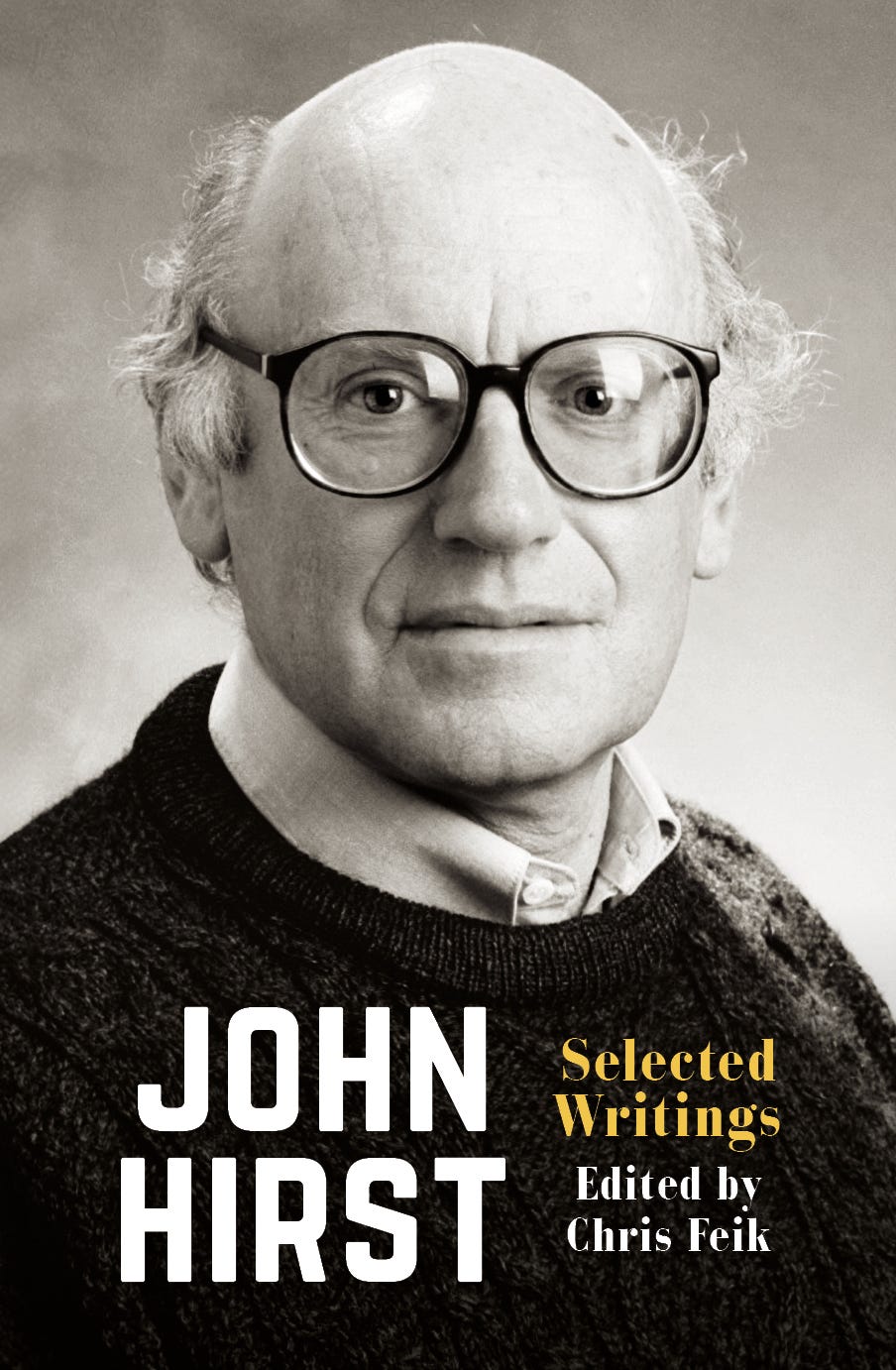
Given this newsletter’s dedication to speaking about the uncomfortable, I’ve always liked John Hirst’s take on this - including this piece, though it goes without saying that I may not agree with everything in it. But naming the liberal fantasy is a service.
Black Ink have just republished a grab of his better essays, so I headed for my old copy of Sense and Nonsense in Australian History. And there it was. I’ve previously commented on something he’d drawn my attention to. The airbrushing of uncomfortable facts from official descriptions of aboriginal culture.
How Sorry Can We Be?
In 1897 John Farrell, editor of the Sydney Daily Telegraph, wrote a poem to mark Queen Victoria's jubilee and sent it to Rudyard Kipling, hoping for praise and endorsement. Kipling lighted on the passage in which Farrell regretted the bloody excesses of the empire's conquests and took Farrell to task for his easy moralism. He declared:
A man might just as well accuse his father of a taste in fornication (citing his own birth as an instance) as a white man mourn over his land's savagery in the past.
The critic only exists because of the deed he criticises. Let us call this the hard realist view of Australia's origins. It avers that it is morally impossible for settler Australians to regret or apologise for the conquest on which colonial Australia was built. It is the view that I share.
No-one has been putting this view publicly in the recent history wars over the extent of frontier violence. Keith Windschuttle, rightly sensing that accounts of violence towards the Aborigines have been used to question the legitimacy of the nation, argued not that violence was inevitable but that its extent had been grossly exaggerated. In the case of Tasmania, on which he has produced the first of a promised series of books, he concludes that only 118 Aborigines were killed (later increased to 120). To his mind, with this low figure, he has rescued the reputation of the British empire and its successor settler nation from their detractors. Compared with the Spanish in the new world, the British in Australia, he says, were restrained by Christian and Enlightenment values in their dealings with the indigenous inhabitants. Tasmania 'was the least violent of all European encounters in the New World'.
With his other critics, I believe that Windschuttle has a misplaced faith in the documents he uses as giving a complete account of what was happening on the frontier. The documents from which he draws the figure of 118 dead themselves speak of terrible deeds being committed in the woods, which by design were leaving no records. But even if Windschuttle were right about the number of those killed by direct violence, he cannot deny that forty years after the European settlement, all the Tasmanian Aborigines had either perished or had been removed to offshore islands. Empires even good empires believe in conquest and by any standards this was a complete and rapid expropriation. A people and their way of life had been destroyed. Compared to the starkness of that fact, how many had been directly killed by settler violence seems a matter of lesser consequence. ...
In question time one woman in the audience declared that she was sick of the argument about numbers. Even one death, she said, was one too many. This remark was met with spontaneous applause, which though not universal was nevertheless revealing. The woman and those who applauded believe that it was possible to dispossess the Aborigines without bloodshed. The woman did not speak of dispossession but she and her supporters were located in the Malthouse Theatre which stands on land that formerly belonged to Wurundjeri. Let us label this the liberal fantasy view of our origins. It avers that the conquest could have been done nicely. This view is quite widespread and influential and warrants close examination.
Liberal fantasy is prominent in the judgments given in the Mabo case in the High Court. The Court found that since 1788 the common law had not been properly interpreted: it should have respected the Aborigines' rights in their land. The Court did not rule that the invasion itself was illegitimate. On the contrary, it legitimised the invasion by declaring that the British Crown's proclamation of sovereignty over Australia could not be questioned in an Australian court. The error of the Crown and the courts was to assume that sovereignty meant that Aborigines could be summarily dispossessed of their lands. Justices Deane and Gaudron in a famous passage said this:
The acts and events by which that dispossession in legal theory was carried into practical effect constitute the darkest aspect of the history of this nation. The nation as a whole must remain diminished unless and until there is an acknowledgment of, and retreat from, those past injustices.
This envisages that the nation could have come into being without a dark past. The darkness is only an 'aspect' of our history; there could have been a nation without it. But even if the law had been as the High Court now declares it should have been, the desire of the white invaders for Aboriginal lands would have been no less. The clash between Aboriginal hunting and gathering and European pastoral pursuits would have been as stark. What would have happened if the Aborigines on being fully appraised of the invaders' intentions had refused to negotiate any of their land away? – they would have been forced to negotiate. Even if each tribe had been persuaded to yield half their land, Aborigines would still have regarded the invaders' sheep as fair game and white shepherds would have misunderstood what was involved in their acceptance of Aboriginal women – two potent sources of conflict in the world as it really happened. It is very hard to envisage a settlement history without violence. It is a great conceit on the part of these two judges to think that a difference in the law could have tamed the force of European colonialism and given us a history with no dark aspects. From all that we now know of what the land meant to the Aborigines, they would not have yielded it without a fight. The judges insult them by thinking that it could have all happened peacefully.
From 1823 the law in the United States on Indian land was as the High Court says it should have been in regard to Aboriginal land in Australia. The United States had sovereign control over the whole landmass, but the Indians had the right of occupancy over their lands until it was extinguished. Indian land could officially only be yielded up by treaty. But the Indians were not free to make or not make treaties. They were pressured into treaty-making after they had been defeated in battle or in an attempt to save some of their lands from the onrush of the settlers, who did not wait for official sanction before pressing into Indian country. Under these treaties Indians in the east had to agree to be moved westward and the Indians in the west were confined to reservations. The treaties provided that on the reservations they should be supported in money or goods, but the Indian agents frequently robbed them of their due. Their reservations were always subject to incursions by settlers. If the Indians fought back, this was an 'uprising' that the US army would savagely suppress. The area of the reservations was regularly reduced and from 1887 reduced even further by the policy of allotting farm-size plots to each Indian family and opening the rest to the settlers. The process of Americanisation of the Indians required that children be forcibly removed from their parents and placed in boarding houses. The recognition of an Indian right in land did not save the United States from a 'dark aspect' of its history.
One might have thought that Henry Reynolds, the author of the classic work on Aboriginal resistance, the Other Side of the Frontier, would be proof against the liberal fantasy. Yet it sustains one of his later books this whispering in our hearts, which deals with those few colonists who opposed the disruption and destruction of Aboriginal society. One or two of these dissenters thought the Aborigines could be saved only if the colonists left. Most thought that colonisation could and should proceed by 'purchase, treaty and negotiation'. This view Reynolds endorses without considering how this process would have been implemented and what difference it would have made. The dissenters were all opposed to punitive expeditions. Reynolds himself is very definite that punitive expeditions were 'indiscriminate and disproportionate violence'. So the historian who celebrated Aboriginal resistance and wanted their battles to protect their lands honoured in the War Memorial now thinks that milder measures – a bit of deft police work, perhaps – would have been enough to make the Aborigines give up the fight.
The liberal fantasy has a strong hold on Kate Grenville, one of the best of our fiction writers. Her latest book the Secret River deals with the European settlement along the Hawkesbury River north of Sydney. The chief character is loosely based on one of her ancestors, a waterman on the Thames who was transported for thieving. In the modern way she has talked and written a lot about her project and hence revealed the impulses that drive her. She told the ABC:
You want to go back 200 years and say to the settlers, 'Look, this is how the Aborigines are,' and to the Aborigines, 'Look, this is why settlers are behaving the way they are. Let's understand this. There's no need for all this brutality.'
Here is the liberal faith that conflict comes from misunderstanding. Actually, if Aborigines had earlier understood the settlers' intentions there would have been more violence and sooner. The settlers were fortunate in that the Aborigines at first welcomed them or avoided them or attempted to accommodate them. ...
Worrying over the conquest; wishing it were peaceful; feeling that somehow it has to be rectified if settler Australia is to be at peace with itself: these are the products of the liberal imagination. Its decency knows no bounds or thought. Even one death is one too many. This mindset has perverted Aboriginal policy over the last thirty years so that it has not been dealing with Aborigines as they are or may be and it raises expectations that cannot be met. The Mabo judgment was a great offender in this. Having denounced settler atrocity and called for a retreat from past injustices, it then proceeded to legitimise the invasion and declared that native title had been extinguished on all freehold and leasehold land. ...
The liberal imagination, appalled at European violence on the frontier, tends to cast the Aborigines as victims merely and not fine practitioners of violence themselves. Violence was more central to their society since its practice was not allotted to a professional caste of soldiers; all adult males were warriors. Aboriginal warfare was endemic, usually with a small number of deaths, but occasionally Aborigines massacred each other. This is an account based on reports by the perpetrators:
Spears and boomerangs flew with deadly aim. Within a matter of minutes Ltjabakuk and his men were lying lifeless in their blood at their brush shelters. Then the warriors turned their murderous attention to the women and older children, and either speared or clubbed them to death. Finally … they broke the limbs of the infants, leaving them to die 'natural deaths'.
The writer is T. G. H. Strehlow, who grew up with the Aranda of the Centre. His life work was to record and translate their songs. Of their warrior songs he wrote that the 'unbridled expression of blood-lust was relished by old and young'. ...
There is literally no place for settler Australians to stand to decry the conquest of this country. It all belonged to the Aborigines. The only honest approach is to recognise the conquest as conquest and not to give any utilitarian defence of it – like that the land under European control was able to provide food and fibre to the rest of the world, a view which Geoffrey Blainey advances. In the European world of the late eighteenth century acquiring new territory was perfectly legitimate; what dispute there was concerned the treatment of the people already there. An heroic moralist of today may say that the European conquests were wrong and attempt the impossibility of imagining world history without conquest. Better, if you must speak of right and wrong, to say that according to their lights the settlers were right to invade and the Aborigines were right to resist them. It is our common fate to live with the consequences of that conjunction. The consequences were more varied than is commonly imagined. Here is a thumb-nail sketch of race relations since 1788, the work of an Aboriginal radical which would be assented to – except perhaps for the Nazi comparison – by many progressively-minded settler Australians.
When white men arrived in this country, they shot the blacks, poisoned their waterholes, murdered them, left, right and centre. Those that were left were rounded up like dogs and cattle and stuck in these places called Aboriginal reserves, which were nothing less than concentration camps. And there they stayed until very recently.
It is correct that there were two attacks on the Aborigines, but wrong to imply that the second followed hard on the first. After the first attack – the taking of the land and the crushing of resistance – the Aborigines were more or less left alone. The time between the two attacks was as much as a hundred years in the lands settled first in New South Wales.
The Aborigines, depleted in numbers more by disease than violence, remained on their own land. Unlike the American Indians they did not have to be put on reserves to stop their resistance. Many took work in the pastoral industry, which until 1900 was much more important than farming and sat more lightly on the land. The boss who hired them might well a few years previously have been shooting at them. The more remote the property, the more reliant was the pastoralist on Aboriginal labour and the less likely the Aborigines were to be paid wages. But where the white presence was slight Aborigines could retain more of their traditional life. As Ann McGrath wrote in Born in the Cattle, we can exaggerate the significance of the settlers to the Aborigines, ruthless and exploitative though the settlers were. As well as doing the regular work on the pastoral stations, Aborigines became drovers and shearers. The Shearers Union (later the AWU) was fanatical in its opposition to Chinese labour but allowed Aborigines (and Maoris) to be members. There were some reserves and missions, more important as refuges to the Aborigines where settlement was denser, but Aborigines were not confined to them; they were free to come and go. ...
The second attack began in the decades around 1900. The Aborigines presented no new problem to white society except that they continued to exist. By processes that had little to do with the Aborigines, the new nation had formed its ideals in and through the slogan White Australia. Once the nation had given itself that racial identity, the Aborigines became an anomaly. Much indulgence had been shown to the Aborigines in the nineteenth century because they were expected to die out; now there were growing numbers of mixed-blood people. The white nation seemed likely to have a permanent group of people of 'inferior' blood. Two solutions were adopted. In the more closely settled areas part-Aborigines were to be separated from their full-blood kin and encouraged to disappear into the wider community. This involved the shrinking and destruction of the Aboriginal communities on the reserves and missions and the removal of children from their parents. Where Aboriginal populations were larger they were to be confined on reserves (as far as was compatible with the need for their labour) and their interbreeding with whites forbidden. To control, confine and manage Aborigines in this way their civil rights had to be removed.
The second attack on the Aborigines disturbs me much more than the first. I am not shocked at a settler riding out to shoot Aborigines. He acted in hot blood to protect what was close to him, the lives of himself and his workers and the survival of his highly risky enterprise. Nor am I shocked that settlers and their men sometimes rode out together hoping to kill enough Aborigines to give themselves finally the security they craved. But I cannot be calm at police arriving at settled communities to drag children away from their mothers. This was cold-blooded cruelty planned by a distant Bureau in pursuit of the ideal of racial purity. Humankind has been very inventive in its cruelty, but cruelty of this sort did not appear until the early twentieth century. We are still struggling to come to terms with it.
Concern for racial purity was then general in European civilisation; it had a peculiar intensity here because Australia happened to form its national ideal when racism was at its peak and it had experienced and disliked migration from Asia. Its ideals of a progressive, egalitarian and harmonious society became fully mixed with the racial poison. Now that they have been untangled the nation should apologise to those that suffered – particularly to children forcibly taken from caring parents. I believe that more settler Australians would be ready to acknowledge this wrong and apologise for it if the proponents of apology did not urge apologies for everything.
So why does the second attack on the Aborigines warrant an apology and the first one not? Though the High Court judges in Mabo spoke of the Australian nation expropriating the Aborigines, this is not so. The settlers were English, Irish and Scots who invaded Aboriginal lands with the sanction of the British state. Only subsequently was the Australian nation formed by those settlers and their children. It is true that the nation was only made possible by this expropriation, which is why I consider it cannot be apologised for. Some might be tempted to point the finger at the British, but settler Australians are the beneficiaries of their deeds. The second attack on the Aborigines was an attack by the Australian nation (though the agents were the various state governments) in pursuit of a national ideal. I accept what Rai Gaita has argued that if a nation can feel pride at its past achievements it can properly feel shame (though not guilt) for its past misdeeds. Forcibly removing Aboriginal children was undoubtedly a misdeed. What finally makes the case for apology compelling in this instance is that some of the victims are still alive. ...
Civil and political rights were rapidly restored to Aborigines from the 1950s. Settler Australians showed their willingness to see Aborigines become equal citizens by the overwhelming assent they gave to the 1967 constitutional amendment. But just at this point Aboriginal policy took a new separatist turn. The new policy proposals were for self-determination, land rights, a treaty, even Aboriginal sovereignty. These were the fruits of liberal fantasy conjoined with Aboriginal radicalism, which fed on each other.
The liberal fantasy is that the conquest would have been acceptable had there been recognition of the land rights of traditional owners and negotiation with them. Hence the most urgent need of policy is to rectify these omissions which are the source of all our ills. But a treaty with the Aborigines would not be with a traditional grouping. The traditional groups numbered about 500 tribes, only a few of which survive. The Aborigines are a group formed since the conquest from those tribes people and their descendants who had the common experience of oppression and exclusion at the hand of Europeans. The failure of 1788 is to be rectified by dealing with a group that did not exist in 1788. ...
The High Court in Mabo encouraged all Aborigines to think that they had been deprived of their land rights, but it indicated that traditional ties would have to be demonstrated still to exist for a claim to land under native title to be established. Many non-traditional groups attempted to present themselves as having traditional ties to land. An early indication that these claims were spurious was the ferocious battles between Aborigines over who constituted the groups and over what land they had a claim. After millions of dollars of public money had been spent on lawyers' fees, the Federal Court and then the High Court ruled that the Yorta Yorta in Victoria no longer had traditional ties to their land; they had been washed away in the tide of history. No other decision could have been reached, but the Yorta Yorta now have a grievance that they did not have before policy departed from need and all Aborigines were encouraged to think of themselves as traditional. ...
In the 1980s the Hawke Labor government contemplated and then abandoned the idea of a treaty. Instead it proposed a process of Reconciliation which would begin in 1991 and be completed in time for the centenary of federation in 2001. Liberal fantasy was again at work. The premise of Reconciliation was that nothing significant had so far been done to right past wrongs and yet complete harmony was within close reach.
Reconciliation as a process was borrowed from societies where two groups had been at loggerheads if not at war. In Australia Aborigines had regained their civil and political rights thirty years previously; they enjoyed a large measure of goodwill from the settler Australians and huge sums of public money had been spent on their welfare and advancement. Aboriginal art and dance were widely appreciated; Aboriginal sports people were honoured. Traditional Aborigines had acquired the rights over their land. Assimilation and integration of other Aborigines – though those names could not be breathed – were proceeding rapidly. Intermarriage was high and increasing. And yet Reconciliation presented Australia as a fundamentally divided society. We were compared to South Africa or the Middle-Eastern conflict between Jews and Palestinians.
The naming of the groups presented them as being a long way apart. There were indigenous Australians and non-indigenous Australians. This is an amazing formulation; 98% of the population is defined by what it is not. The use of the term indigenous for Aborigines had innocent enough origins. The Torres Strait Islanders do not want to be mistaken for Aborigines, though they want to share their status. Hence the mouthful term 'Aborigines and Torres Strait Islanders' had to be used. Indigenous was a simpler portmanteau term and simultaneously it was coming into use at the United Nations which also needed a generic term. But only in Australia was the settler population then defined as non-indigenous – there are not non-indigenous Americans or non-indigenous New Zealanders. 'Non-indigenous' implies a people without roots in this place; it elides the fact that settlers have been here for eight generations, that they have formed a distinctive polity and are not indigenous to anywhere else; they regard Australia as their home. On the other side it elides the fact that most Aborigines are descendants of settlers and the original indigenous population. The formulation in fact casts modern Australia as if it were 1788: one group has just stepped off the boat and confronts the traditional owners of the country. That's where the liberal imagination is fixated. ...
The acute social problem that Australia faces is not the division between Aborigines and settler Australians. It is that many Aborigines in remote Australia live in communities which have appalling records on health, housing, employment and rates of imprisonment. These are Aboriginal communities; the few settler Australians who live there provide services to them. Decent liberal-minded people worry enormously about this social malaise, but they keep mistaking its cure; they think that the moment of reconciliation which they desperately seek is necessary to fix this problem. In fact their attitudes have been making it worse. ...
The social situation in these communities has got worse over the past thirty years not better. Welfare without the usual work tests replaced employment at low wages; schools were built without ensuring that students attended them; health declined because of alcohol and drug abuse. Huge sums were spent on buildings and equipment that were trashed or never used. the situation was allowed to continue because of the commitment to supporting traditional life on Aboriginal lands, though there were few worthwhile jobs there. Generosity and respect in this generation have done more damage to Aboriginal communities than the indifference and neglect of the past.
Now in Cape York the erstwhile radical leader Noel Pearson is steering a new course. He has attacked welfare dependency; he wants to create real jobs for his people; and he plans to send the young away to get a decent education. He has identified as part of the problem the progressively-minded people in Sydney and Melbourne who walked across bridges as one of the symbolic acts sponsored by the Reconciliation Council. He complains that their soft-headness about social problems has been too influential on policy: the treatment of welfare as a right; of alcohol abuse as a symptom of malaise rather than something to be attacked in itself; and the willingness to excuse anti-social behaviour as the result of poor treatment in the past. Perhaps soon the progressively-minded people will be asked to apologise. ...
When David Malouf was working on the Declaration for Reconciliation, he was for the most part improving on the standard talk about Aborigines and settler Australians. He had one novel idea that quickly disappeared because his clients could not understand it. His draft began with 'The people of Australia, of many origins, recognising the gift of one another's presence …' That's not being sorry or forgiving at all.
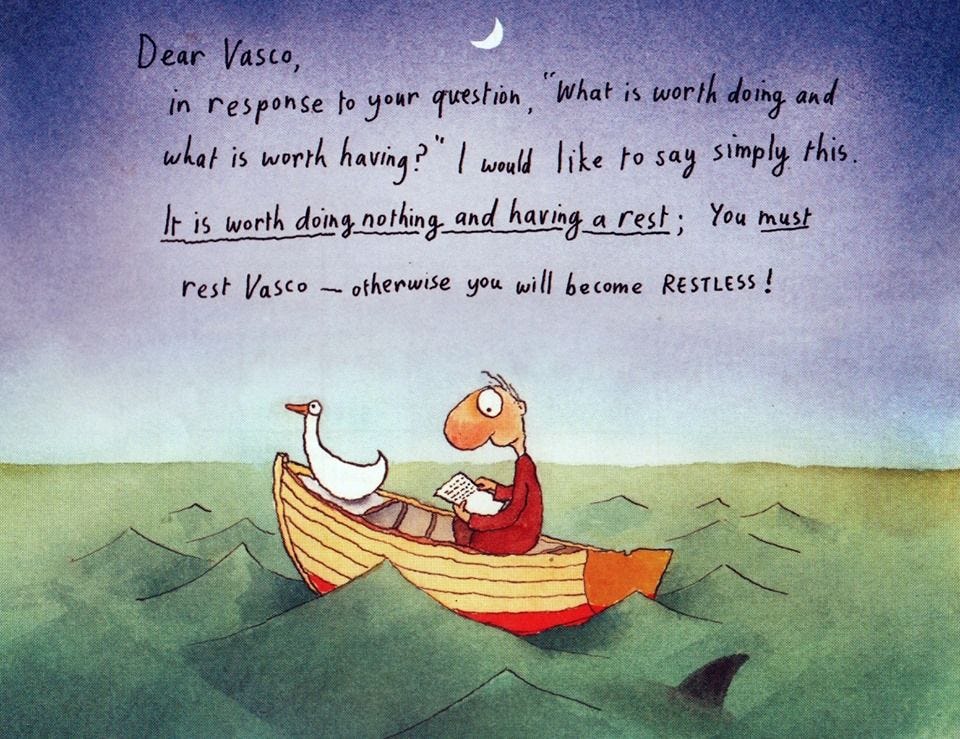
You can tell you’re watching meme history being made because when I use the term “Don’t mention the war”, I get it wrong. By the end of the program my brain has had enough time to whirr around the hard drive to summon up the correct term. (This happened to Abraham Lincoln when he read about the ‘guardian angel of the nation’ in the first draft of the second inaugural. True story, but I digress.)