


Democracy as theatre
This week’s video was produced differently to the others. Where they were produced from a script worked up in numerous drafts with a collaborator, this was worked up from some ‘grabs’ to the camera as I attempted to ‘do it live’ - though those grabs were then written into a script.
I also made it before I came across Ari Adut’s 2016 book The Reign of Appearances which tackles the central liberal notion - most associated with Habermas - that the ‘public sphere’ is essentially about deliberation. No it isn’t Adut argues, it’s most fundamental essence is theatre and performance. The first chapter is reproduced in Heaviosity half hour below.
I think he’s right. Ask yourself when some tripwire was tripped in some political crisis and what matters is almost invariably how things look, not the breaking through of some deliberative insight. Thus Australians may remember the ABC footage of aboriginal kids in the Don Dale prison being placed in ‘spit hoods’. This led to an instant Royal Commission. But there was a public report available at the time which documented all the abuses. On a more trivial level, Andrew, the Royal formerly known as Prince was de-princed because a book came out that rehashed all we knew about him. But something had to be done in response to this new round of publicity, and so it was.
Anyway, please check out the video - which weighs in as the shortest in the series at less than 3 minutes! #likeShareSaveTheWorld
And here’s Colm and I discussing it.
Escaping the event horizon of the noble savage

A worthwhile perspective methinks.
If I think about my grandma, the first memory that pours into my head is us sitting in her 1970s living room on the reserve with rosaries in one hand and tobacco in the other, kitschy mass-produced portraits of the Sacred Heart of Jesus staring down at us. Between the rising smoke of sage or some other sacred plant, I was sometimes sure I saw the face move.
The majority of indigenous people in Canada today identify as Christians, and nearly a third of them as Catholic. In the United States, proportions are similar. But when the Vatican returned 62 artifacts from its ethnographic collection on November 15, it framed the move as “part of the Catholic Church’s reckoning with its role in helping suppress Indigenous culture in the Americas.” But is Catholicism not my culture? The Vatican’s return of artifacts to their “rightful owners” does more than acknowledge past wrongdoing; it implies a clean separation between “their” religion and “our” identity. In doing so, it affirms the broader cultural fantasy that indigenous people are never active players in history or universal humanity, only ever the victims of its imposition...
Years ago, I recall a piece of junk science floating around social media purporting to show that indigenous North Americans are the most genetically distant people on earth, uniquely separate from the human family tree. But one imagines nineteenth-century race scientists triumphantly sitting up in their graves to proclaim, “I told you so!” In reality, the genetic evidence shows nothing more exotic than the typical patterns of migration, periodic isolation, and interconnection that shape every human group on earth. But this fetish of absolute difference, however well-intentioned, carries a whiff of the old racist notion that we are fundamentally incompatible with the rest of humanity.
The anti-colonial writer Frantz Fanon wrote, “I am a man, and in this sense the Peloponnesian War is as much mine as the invention of the compass.” Fanon was no assimilationist; his point was that the colonized have the right to the entire human inheritance, not just the fragments of it assigned to them. If it happened to humans, it is part of my story too. Those artifacts are yours in the same way that Plato and Aristotle are mine. The treasures of human culture are ours, and the cruelty of our past blots all of our souls...
Yet today a whole industry is devoted to pretending that “giving indigenous people back their culture” can fix everything from addiction to suicide to poverty. Policymakers love this. Culture is cheap and provides ample photo ops. It proposes that the problems of indigenous communities stem not from material deprivation but from a colonial trauma safely buried far back in the distant past. Why build water systems, housing, roads, or job markets when you can fund another workshop by a “trauma-informed” well-being specialist? Yet dozens of communities still live under boil-water advisories...
Some years ago, reports that some middle schools had been asked to write on the “positive outcomes” of residential schools caused widespread outrage. But if we are serious about the universal, then this subject cannot be reduced to a single moral note. Tomson Highway, a Cree playwright, novelist, and classical pianist, said of his years at a Catholic residential school: “Nine of the happiest years of my life I spent it at that school. I learned your language, for God’s sake. Have you learned my language? No, so who’s the privileged one and who is underprivileged?” It was there that he met Brahms, Chopin and Beethoven, all of whom he could play on the piano by 18. Schools were often underfunded, and allegations of abuse are widespread and well-known. But the problem isn’t that schools tried to give indigenous children a liberal education; it’s that, more often than not, they didn’t.
The word “catholic” comes from the Greek word for “universal.” Whatever else can be said against it, the Church at least theoretically believed that no people were beyond the reach of salvation. Missionaries may have called my ancestors “savages,” but they also believed those savages had souls like theirs. Indigenous peoples’ belonging to the universal human family was never in question...
Repatriation sends a different message: These things are yours. They’ve got nothing to do with us. Take your totem pole and your pipe and your kayak and go tell your own story. But is not the Catholic Church my church, too? The guiding assumption is often that Christianity is a “white man’s religion” and if indigenous people are Christian, it must be because of brainwashing. But many indigenous people did embrace Catholicism, and continue to do so. Indigenous Catholics were often unsure of how to blend the old with the new—but like my grandma, they went to church anyway.
Even those who are not Catholic should be able to recognize in the church an aspiration for something greater than our parochial, “ancient and venerable prejudices and opinions.” Those artifacts lived in the Vatican for 100 years, part of the shared history of the Church that at least in principle belonged to all its members. As the Vatican now hands them back, we must ask: Are we not Catholics, too?
Stewart Lee on Stewart Lee fans
Ian b linked to this clip in comments on witnessing the Stewart Leee clip in last week’s newsletter. I’d seen it once before, but enjoyed watching it again. And the Great Algorithm brought me this 30 minute analysis of Lee’s comedy which is good. An interesting thing about Lee is that I’ve seen some of his stuff from much earlier in his career and he’s already honing these ideas, and yet it’s much, much less successful comedy. Alas I can’t find it, (this is the closest I could find) but it really shows you how much is ‘under the hood’ in Lee’s performances today.
Shock development: People vote against being kidnapped and terrorised by masked men
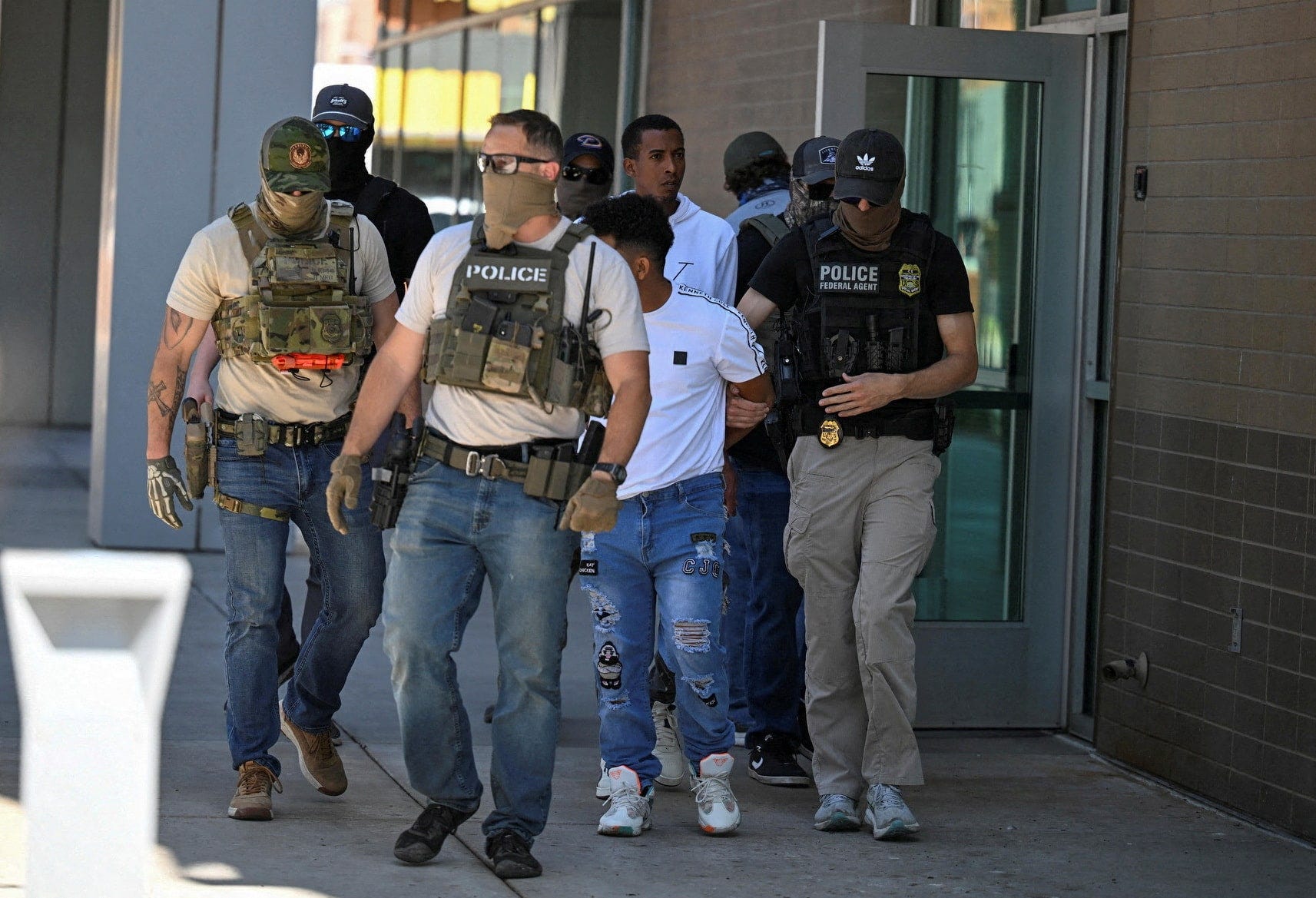
An interesting new snag for the Autocrat in chief. Hispanic Americans don’t like being kidnapped by masked men from the government. Paul Krugman takes up the story. As a matter of course I discount predictions that some demographic has been lost to some party for any long period of time. We live in an endless present these days. Still, maybe folks take kidnapping more seriously than a spike in electricity prices. It’s certainly possible.
HT: Anna 💍
Something big happened in New Jersey Tuesday — namely, Hispanic voters made a major voting reversal. Last year, across the country Hispanics swung Republican in a significant departure from past voting patterns, helping propel Trump to victory. But yesterday, in New Jersey, they swung back hard to the Democrats. And I’m going to go out on a limb and make a prediction: They won’t be going back to the G.O.P. for a very long time.
Jonathan V. Last very helpfully focuses on Union City, N.J., an overwhelmingly Hispanic area. Donald Trump got only 19 percent of the vote there in 2016. But in 2024 he received more than twice that share, 41 percent. The Republican candidate for New Jersey governor, Jack Ciatarelli, received only 15.1 percent of Union City’s votes on Tuesday. What happened?
In this case, the simple answer is the right one — it’s the economy, stupid. The 2021-2022 surge in prices infuriated many Americans, particularly working class Americans who have little surplus to spare... They remembered the low inflation, low mortgage rates and full employment that prevailed on the eve of the pandemic and let themselves be persuaded that Trump would turn back the clock.
But, equally important, the 2024 Hispanic swing to the Republicans was also a function of what voters chose not to believe. Namely, many Hispanics chose not to believe warnings that a second Trump administration would be an era of racial profiling and mass deportations, of Hispanic communities terrorized by ICE agents. After all, the reasoning went, that didn’t happen during Trump’s first term.
But as Tuesday’s results showed, they know now. As G. Elliott Morris puts it, the best explanation for 2025 is that voters didn’t know what they were getting with Trump 2.0 last November, but now they do — and they don’t like it. They know now that Trump’s promise to lower prices was just another scam, that his tariffs and deportations have in fact driven prices higher. Moreover, the continual insistence by Trump and his minions that the economy is great and that prices are down adds insult to injury.
For Hispanic voters, even worse is the devastating discovery that everything Democrats warned would happen to them under Trump II is happening. Suddenly, America has become a place where it’s not safe to have brown skin or speak Spanish with your family, even if you’re a citizen.
So Tuesday showed that the Hispanic vote has re-realigned. And my prediction is that this won’t be a pendulum... Why do I feel confident in saying that? By analogy with the Jewish vote. One of the longstanding anomalies of U.S. politics has been the consistent support of Jewish Americans for Democrats, despite the fact that as a relatively high income group Jews are more likely than the average voter to benefit from tax cuts... What explains this persistence? Historical memory. Jews have many generations’ worth of experience with right-wing antisemitism. Many of us understand, I believe, that whenever bigotry of any kind is given free rein, we’re always next in line.
And sure enough, rabid antisemitism is surging within MAGA, which should surprise absolutely nobody.
As I see it, Hispanic voters are now learning a similar lesson. Until this year many of them could brush off evidence of right-wing racism, including Trump’s tirades about Mexican rapists, as unlikely to affect their lives. Now they’re seeing friends and family grabbed on the street by masked government thugs. Many will never trust the right again. The G.O.P. didn’t just lose the Hispanic vote for one election. It has lost that vote for good.
Wayne Thiebaud. American Still Life


You too can be depressed about Europe

Gideon Rachman (extracted below) is pretty depressed about Europe. Those EU countries do seem incapable of really doing what’s needed. Rather like the Greek city states were always squabbling and vetoing each other while great powers loomed from the East to monster them. Then again they rallied in the end in the Persian Wars. Before encountering Rachman’s views, Martin Wolf explores similar territory but ended up with a hopeful thought.
[T]he conclusion might be that Europe now suffers from a paradox of its history: the fragmentation that made its states powerful and rich is, in the new world, a barrier to their remaining so. In an age of continental-scale superpowers, European fragmentation may be an insuperable handicap.
Yet a happier possibility also exists. Imperial ossification remains a threat to huge states. We see this in the over-centralisation of Chinese power and the attempted creation of a corrupt autocracy in the US. Maybe, Europeans should remain delighted that Rome fell, and despite many efforts, has never returned.
Over to Rachman
For centuries, Europe imposed its will on the world. Now the world is beginning to impose its will on Europe.
A photo taken at Turnberry golf course at the end of July captured the situation. The European Commission president Ursula von der Leyen was pictured smiling weakly, with her thumbs-up, next to a beaming Donald Trump. The EU had just meekly agreed to accept a 15 per cent base tariff on EU exports to America without hitting back.
Trade was thought to be the one area where the EU could stand toe-to-toe with global superpowers. The European single market is comparable in size to the economies of China or the US. In the months running up to the Turnberry debacle, there was plenty of talk in Brussels about European retaliation against the Trump tariffs.
In the end, the EU folded — largely because the Europeans feared that if they tariffed the US, the Trump administration would hit back by reducing its security commitment to Europe. With war raging in Ukraine, that was a risk they were unwilling to take. Europe’s weakness on security had negated its potential strength on trade. ...
Examples of European weakness or irrelevance are piling up. The EU is being diplomatically sidelined — even when wars are happening right on Europe’s borders. European countries are now the largest providers of military and financial aid to Ukraine. But when Trump tried to end the war, he chose to negotiate directly with Vladimir Putin — with the Europeans desperately lobbying the White House. It was the same story with Gaza. The decisive diplomacy to secure a ceasefire centred around the US, Qatar, Egypt and Israel. Europe was once again reduced to chipping in from the sidelines.
The brutal war in Sudan will certainly lead to new refugee flows towards Europe. But the key outside players fuelling the conflict are the United Arab Emirates, Egypt, Turkey and Russia. French influence in west Africa has been in sharp decline. ...
So why does Europe seem so powerless? The deficits that are most often pointed to are military and financial. But these are not the most serious issues. There is a large European defence industry and Europe remains a rich continent.
The bigger problems are structural, political and even psychological. Brussels is a bureaucracy good at process and law. But it is incapable of acting quickly and ruthlessly like the European great powers of the past, or like the US and China today.
European appeals to morality and international law often fall on deaf ears in Africa and Asia — whose countries’ histories were shaped by centuries of ruthless European imperialism.
At the height of the European imperial age, the great powers — Britain, France, Germany, even Belgium — participated in a “scramble for Africa”. Now, with European power in retreat, we may be witnessing what the Oxford scholar Dimitar Bechev calls a “scramble for Europe”, as outside powers assert their influence across the European continent.
In the western Balkans, whose countries are theoretically on the path to EU membership, the influence of Russia, Turkey and China is growing. Beijing exercises influence through infrastructure projects and loans. ...
The scramble for Europe threatens the EU’s internal unity, as outside powers play divide and rule. Different EU countries and industries had different interests, which the US could play upon over tariffs. ...
Europeans take comfort from the fact that, while the continent lacks hard power, it still has soft power in abundance. But the wealth and security that underpins civilised society may ultimately come under threat if Europe cannot find a way to exercise hard power.
Might AI be a catastrophe for India and its back-office processing?
Pascal’s wager (well Paul McCartney’s anyway)

A new synthesis in political theory
Another tendentious failure

I was intrigued to read this review of a new synthesis in political theory. But not intrigued enough to take it further, for reasons explained in the review. (Maya Krishnan reviews Progress and Regression by Rahel Jaeggi, translated from the German by Robert Savage.)
HT: Reader Robert Banks.
Rahel Jaeggi, a leading exponent of contemporary critical theory, defends the concept of progress in her latest book, published in German in 2023 and newly translated by Robert Savage. Against the gloomy picture of our current age, Jaeggi seeks to show what it would mean for progress to be something we could fight for, arguing that grasping the bleakness of the present moment requires a theory of progress and progressive social change.
Jaeggi’s main examples of progressive change involve moral improvements like the abolition of slavery and the outlawing of marital rape, which took place alongside broader social and economic changes. But to refer to such complexes of moral and social change as progress is to say something more. Teleological theories, which suggest a goal toward which collective life is heading, fail to capture what progressive social change is really about, according to Jaeggi.
Instead, Jaeggi offers a “processual” account, appealing to characteristics of problem-solving itself: progress, she says, is the result of a “self-enriching experiential process.” Progressive social changes open up new opportunities for problem-solving, while regressive ones generate “blockages of experience.”
It is an ambitious theoretical maneuver to use a second-order theory of change to gain a theory of progress without the normative hubris of substantive moral argument. But how far does this processual approach really get us?
The author questions whether Jaeggi’s theory can avoid smuggling in substantive judgments, using the hypothetical example of a “Tradwife Society” where women embrace a 1950s-inspired lifestyle of domestic submission. Could this count as progressive by processual criteria if women describe it as a “self-enriching” learning process? Jaeggi’s repeated invocation of mainstream leftist causes like Black Lives Matter suggests an implicit substantive conception of progress.
The author also challenges Jaeggi’s assumption that having more opportunities for problem-solving is always better, noting that conservatives might argue true human flourishing comes from narrow but deep commitments. Advocating for any political change involves acting under some conception of the good, taking what Gillian Rose called “the risk of the universal.”
While the author finds Jaeggi’s approach compelling in its attention to the historical contingency of moral norms, they worry it risks collapsing into relativism. Jaeggi adamantly denies this, holding that “norms are valid because and insofar as they are the result of a particular development.” But the author questions whether processual criteria can justify concrete judgments of progress or regress without surreptitiously relying on substantive values.
The author suggests an alternative: accepting that political action requires acting on fallible universal judgments while acknowledging the possibility of being wrong. Perhaps there is no escaping the difficulty of being both participant in and theorist of a historically contingent social world—the central challenge of critical theory that Jaeggi’s book navigates, even if not always successfully.
How to strengthen monopolies
by regulating against them

When major crypto exchanges advocate for licensing or tech companies urge AI regulation, a key explanation is that regulatory costs reshape market structure.
Regulations designed to protect consumers can reshape competitive dynamics in ways lawmakers don’t anticipate. Regulatory compliance creates fixed costs that affect smaller competitors and new entrants differently than they affect established firms. While incumbents absorb compliance costs easily, smaller competitors may struggle or fail, and potential entrants may never emerge.
A European example.
The European Union’s General Data Protection Regulation (GDPR) offers a clear example. When the legislation took effect in May 2018, within one week of implementation, market concentration among web technology vendors increased by 17 percent as websites dropped smaller service providers in favor of larger platforms. The regulation triggered immediate consolidation.
The impact on companies varied dramatically based on their size. Small IT firms experienced a 12 percent drop in profits following GDPR implementation while large IT firms saw only a 4.6 percent decline. MIT researchers found that GDPR has effectively functioned like a 25 percent tax on smaller companies despite applying the same rules to everyone.
Compliance infrastructure doesn’t scale linearly with firm size. A startup with 50 employees and $10 million in revenue needs to hire GDPR specialists and implement the same systems. Three compliance specialists and infrastructure costing $500,000 annually would represent a 5 percent hit to revenue. The competitive disadvantage compounds through user consent requirements, where large platforms like Meta or Google more easily obtain the permissions required, while smaller companies struggle to convince users to consent to data collection from unfamiliar services. ...
A pattern across industries.
A $2 million compliance burden represents 0.2 percent of revenue for a billion-dollar company compared to 20 percent for a $10 million startup. This compliance monopoly effect has appeared across industries and decades. ...
The 2008 financial crisis prompted the Dodd-Frank Act of 2010, which aimed to prevent banks from becoming “too big to fail.” The actual results contradicted these goals. Community banks—those with less than $10 billion in assets—faced the same regulatory framework as megabanks but lacked the scale to absorb compliance costs efficiently. Between 2012 and 2019, the number of community banks declined from 6,802 to 4,750, a 30 percent reduction. The regulation designed to constrain the largest banks instead accelerated the elimination of their smaller competitors. ...
Addressing the trade-off.
The problems these regulations address are real. The 2008 financial crisis destroyed trillions in wealth. Food contamination sickens thousands annually. Data breaches expose millions to privacy violations. But the policy choice isn’t simply between regulation and inaction. The relevant question is whether increasing regulatory compliance burden delivers better outcomes than liability, reputation, and competition already provide. ...
When regulation is warranted, design choices matter. Infrastructure-based regulations create fixed costs that disproportionately burden smaller firms. A more market-oriented approach might recognize that different institutions pose different risks and require different solutions.
Getting ahead of regulation.
Today’s technology sector shows examples of this dynamic. Major cryptocurrency exchanges built extensive compliance infrastructure, then advocated for federal licensing requirements that would favor firms with the capabilities they had already developed. Coinbase spent $2.9 million on lobbying in 2023 while advocating for “regulatory clarity” through frameworks that would require precisely the systems they possess.
This represents rational business strategy rather than conspiracy. If regulation appears inevitable, established players have strong incentives to shape that regulation in ways that leverage their existing advantages.
Understanding this dynamic requires evaluating regulatory policy proposals beyond their stated intentions. The question isn’t whether regulations protect consumers, but whether the compliance structure creates systematic advantages for larger players while eliminating smaller competitors, independent of product quality or innovation.
Martin King at Australian Galleries


Heaviosity half hour
The Reign of Appearances: Ari Adut

A Critique
Reflections on the public sphere have been mostly oriented by the writings of Jürgen Habermas. Despite certain disagreements with some parts of his theory, most commentators have followed the German philosopher. Here is his understanding:
By ‘public sphere’ we mean first of all a realm of our social life in which such a thing as public opinion can be formed. Access to the public sphere is open in principle to all citizens. Citizens act as a public when they deal with matters of general interest without being subject to coercion.[1]
Public opinion can be formed only in physical or virtual spaces where citizens can partake in conversations regarding the common good, according to Habermas. So The Transformation of the Public Sphere, his groundbreaking work, traced the history of the phenomenon from the eighteenth-century coffeehouses to contemporary television.[2]
In the communications that are to take place in these spaces, the eminent thinker claimed, the particularities of the speakers – their social class, economic interests, passions and prejudices, ethnicity, religion, etc. – need to be bracketed out for the public sphere to function as it is supposed to: universalistic discourse is a necessity. Access should be universal as well. There ought to be widespread and informed participation; the presumed outcome of dialogue is rational consensus.
Habermas claimed that these conditions were not satisfied before the eighteenth century.[3] It was, above all, he argued, thanks to the commodification of news and culture and to the rise in literacy during the early modern period and the Enlightenment that the European bourgeoisie could organize itself as a deliberating public in the eighteenth century by discussing general matters in coffeehouses, newspapers, salons, and reading clubs. The hierarchical and fragmented feudal world had not allowed for such an organization. Neither did the Greek agora (the market place) nor the pynx (the venue of the Athenian legislature) do any better by Habermas’s lights: these were simply competitive arenas for recognition and not fora for rational deliberation. While literary matters were the original discursive objects of the public sphere, soon politics became its cynosure. Censorious of secrecy and arbitrariness, the national bourgeoisies challenged their own governments. The principle of publicity regarding matters about the common good was held against the doctrine of arcana imperii, just as, in the same breath, truth and rationality were pitted against raison d’État. Deprived of participatory citizenship, the bourgeoisie demanded to critically discuss in physical spaces as well as in print matters pertaining to administration and economics. And eventually this rising class would seize political rights with the ascendance of the constitutional state, in part by dint of the opposition gathered in the coffeehouses and the press.
At this point, Habermas’s narrative grows glum, though. The public sphere started to deteriorate in the 1870s, as competitive capitalism succumbed to the sway of monopolies. From then on, states took to intervening regularly in political conflicts, and economic interests invaded the public sphere – a paradoxical upshot of the extension of suffrage. In the course of the twentieth century, industrial capitalism transformed citizens into selfish consumers, democracy into masses, sensationalistic media into emotional dupes, public relations experts into subjects, and the welfare state into clients. Particularistic concerns, emotional irrationality, voyeurism and exhibitionism, technocratic reason all combined, conspired to vitiate civic communication. The content of the public sphere, now mostly supplied by mass media, was depoliticized, manipulative publicity superseding rational dialogue in print as in television.[4]
“The world fashioned by the mass media is a public sphere in appearance only,”[5] wrote Habermas with undisguised disdain.
The Habermasian approach to the public sphere has been very influential, spurring countless studies, typically with an explicit concern to broaden civic participation, in the absence of which democratic decision-making processes are expected to suffer. According to the political theorist Seyla Benhabib, for instance, the public sphere entails anonymous conversations in civil society by and among associations, networks, and organizations. Such communications are “the embodiment of discursive democracy in practice.”[6] For sociologists, too, the emphasis is on civic discussion in public spaces.[7] Similarly, those who study social capital in the wake of Robert Putnam’s Bowling Alone search for ways to reverse the decline of civic participation in America.[8]
Now, The Transformation of the Public Sphere, while a watershed, set off a flurry of criticism as well.[9] Historical research has questioned its timing. A full-fledged political public sphere – one with explicitly religious concerns, which are slurred over by Habermas – was already afoot during the English Revolution in the form of petitions.[10] Habermas has also been taken to task for his class reductionism: the enlightened public of the eighteenth century displayed little class unity; many of its leading lights were in fact liberal aristocrats.[11] And because of the repressiveness of the absolutist state, in several European countries the enlightened bourgeoisie politically operated within the secretive world of Masonic lodges, not open coffeehouses.[12] The substance of their discourse was not nearly as empyrean as the German thinker imagined; their motives were far from disinterested. There are, in effect, multiple ways of exercising citizenship other than the cerebral template championed by Habermas: the nineteenth-century American public sphere was at times quite carnivalesque, coarse, and even corruptible, a world where political allegiance could be openly traded for money.[13]
Habermas posited a public sphere with a unitary public in his original formulation. By contrast, numerous scholars have pleaded for a multiplicity, for counter-publics contesting the hegemony of dominant ones.[14] According to such left critics of Habermas, the universalism of the public sphere is a chimera, if not a chicanery: the actual public sphere privileges the discourses of the mighty and sets normative standards that discriminate against and mute the downtrodden.[15] Critics have maintained that historical public spheres have frequently been erected upon ethnic and racial exclusion. Feminists have, in a similar fashion, argued that the private and public distinction that Habermas takes for granted is, in fact, a gendered and gendering institution with iniquitous impact, that it equates the female with the private and the emotional – thereby barring half of humanity from public life.[16] They have objected to the banishment of personal and sexual matters, along with issues like childcare which predominantly affect women, from public discourse – a banishment that both disguises and actuates the dominium of men over women. At the same time, distinctly female forms of public action that do not square with the model stipulated by Habermas have been uncovered by feminist historians. Craig Calhoun has claimed that identities are often formed in the course of public debates, as opposed to preceding them.[17] Others have thrown into doubt the superiority of rationality over narrative knowledge and personal experience.
These criticisms have yielded incisive insights about debate in civil society. Still, Habermas and his followers, but also his critics – along with many who write about the “public realm,” “public square,” “public space,” or the “public domain” – all operate in broad strokes within something that I will refer to as the conventional perspective. Commentators in the media have equally, by and large, adopted it. The focus here is the civic or civil dialogue that is supposed to take place in physical and virtual public spaces. Public space is not treated in its own right. I will get to this very problematic – indeed damning – omission in the next chapter, but before doing that let us see how the conventional perspective suffers from three problematic elements: i) the condition of civicness or civility, ii) the conflation of the public sphere with citizenship, and iii) the ideal of widespread, egalitarian participation. There are scholars who have addressed some of these problems. Yet studies that escape one are usually marred by the others.
Civicness and Civility
Barring important exceptions,[18] the scholars adopting the conventional perspective posit a close link between the public sphere and the normative orientation of its inhabitants. Public does not only qualify the space that we are in, but also the group we constitute as well as the moral telos of our action. When we are not oriented to the common good, when we are not plentiful the public sphere deteriorates, loses its raison d’être. According to Habermas, this is what happened when, as a result of capitalism, economic interests came to govern communications in public. For some, the public sphere is even contingent on a civic attitude. Nina Eliasoph writes that the public sphere “comes into being when people speak public-spiritedly.”[19] Jeffrey Alexander’s “civil sphere” – an offshoot of the concept of public sphere – is equally defined by a universalistic morality:
“a solidary sphere in which a certain kind of universalizing community comes to be culturally defined and to some degree institutionally enforced.”[20]
Yet concern for the common good, far from being a self-evident social fact, is more of a will-o’-the-wisp, very hard to verify objectively by scholars or laypeople. The public-spiritedness that one spots in the world is frequently simply a reflection of one’s ideological biases: hence the proclivity of public sphere scholars, most of whom are openly liberals or radicals, to key in on left-leaning movements and their overall silence on nonprogressive groups – except to denounce them.[21] Opponents in public discussions and controversies attribute selfishness to each other as a matter of fact. Indeed, how can we exclude that there can be a whole kaleidoscope of self-serving interests in our minds while we are marching in demonstrations, participating in parent-teacher association meetings, signing petitions, or sending off op-ed pieces? One can obviously attend a local meeting not only to reflect on public matters, but also to socialize, to meet prospective mates, to project a reputation for being smart, to signal a righteous concern to neighbors, to deny housing to immigrants, to prepare for a lynching, to kill time. Those who lead these events – community leaders – will typically have self-regarding political ambitions. Or it can reasonably appear that way to observers. Of course, from the National Rifle Association to the ACLU to anti-abortion organizations, most politicized groups, or rather their spokespeople who intone in public, dress up their discourse in universalist nomenclature – with terms like equality or freedom.[22] Few would write a publishable letter to a newspaper without a pretension to speak in the name of some general, grandiose principle. But there is no reason for us to take these claims at their face value. High-minded rhetoric in public is not uncommonly found by its addressees to be ritualistic, hollow, not to say devious. The motive behind such discourse cannot be easily pinned down, and public-spiritedness in public rarely goes without instigating ethical assaults aiming to debunk it. Those who participate heavily in public affairs are typically recognized as partisan; they will not fail to be perceived by their opponents as selfish or brainwashed. Arguments in a supposedly civic debate are difficult to distinguish from the standard ideological positions in a society; it is hardly surprising that such situations get heated in no time.
What if we relax the discursive conditions and say that the public sphere is where people – whatever their intentions – engage in civil debate? But then we are still left with very little: it is difficult to find interesting and consequential public events, discursive or otherwise, that don’t feature disruptiveness, ad hominem attacks, malice. It is a rare – and usually boring – debate, one that solely involves issues. The more a politician disquisitions impersonally, logically, professorially in public, the more, the linguist Michael Silverstein points out, the
“message being conveyed is, in actuality, [his] rigidity, narrowness, and myopia.”[23]
In political life, the more important the debate, the nastier it tends to get. Consider how both Donald Trump and Hillary Clinton cruelly cudgeled each other’s character in each of the three presidential debates in 2016.
Further, the one who receives attention from a multitude will be automatically aggrandized; personality, thus, cannot but be an integral part of any public debate. Even, or especially, when the stakes are low, public debate almost always induces grandstanding, if not in reality then in perception, which then instigates moral assaults on the grandstanding of the grandstanders. And public debate, no matter its civil genesis, will usually end up fomenting partisanship and polarization.[24] Parties routinely complain of each other’s incivility, and the worst hidden agendas are ascribed to one’s opponent in the press, on television, at the town hall. This holds as much as for today as it did for the golden age of American associational life touted by Tocqueville. Michael Young has found that the antebellum evangelical sin societies and fraternal associations charged one another unremittingly for being uncivil and anti-democratic.[25] The same goes for the voluntary organizations of the Reconstruction and Progressive Eras, whose antagonisms compounded the ethnic and religious rifts in the United States.[26] Consider as well the acrimony that dictates any debate about gun laws in the American public sphere, where each side habitually, hatefully holds the other responsible for untold homicides.[27]
In a broader sense, the more people talk in public and the more public their talk becomes, the cheaper their talk gets – and, as Frank Knight’s first Law of Talk posits,
“cheaper talk drives out of circulation that which is less cheap.”[28]
At the same time, public positions in controversies tend to turn increasingly radical and noncompromising. The ease with which one can respond to discourse in the public sphere will only make things more uncivil. On Twitter, for instance, any public tweet – in its original or retweeted form – can be responded to by anyone. Responses, particularly to controversial tweets, are very often abusive, bordering on harassment.[29]
Last but not least, most speech and action that succeed in changing society are rarely civil. The primary aim of civil disobedience, the paradigmatic example of effective public contestation, is to provoke violence by authorities. The public that most commentators write about is a collection of rational, well-behaved citizens. It is the opposite of a mob, which is irrational, rowdy, feverish, and manipulated by ill-intentioned politicians. Yet the referents of these categories cannot be easily agreed upon. Groups one likes are publics; those that one doesn’t, mobs. In the United States, conservatives thought that the Occupy Wall Street protestors were a mob; predictably, liberals characterized the Tea Party members exactly in the same way.
Citizenship
The conventional perspective identifies the public sphere – for example, the town square or the media – as the site where citizenship is or ought to be exercised,[30] whether this entails rational dialogue or discursive struggles between dominant and subordinate groups.
“The public sphere is a theater in modern societies in which political participation is enacted through the medium of talk,”[31]
in the words of Nancy Fraser. Such a conflation of the public sphere with citizenship is problematic on multiple grounds.
First, while the darlings of most public sphere commentators are associations discoursing in the open, the very essence of citizenship is indubitably something else. It is voting: the only political act that a majority of citizens ever engage in. Even more devastating, voting in modern societies is a solitary act carried out in secret – that is, outside the public sphere. After all, the secret ballot is the sine qua non of contemporary liberal democracy. The rationale is that voting should not take place in public because its visibility can discourage good citizens from expressing their true preferences, while encouraging the venal ones to sell their votes – both of which would pervert citizenship.[32] And most people who actively engage in politics in the town square or the media are not simple citizens but elites of some kind. It is often some kind of an intellectual – whom Sartre defined as “he who meddles with things which are none of his business.”[33] Or it is some kind of a political actor – in other words, someone who has an apparent gain in meddling. Simple citizens, even when they genuinely care about public matters, would rather hide their names or positions, especially if they think they may not be in the majority; open, sincere engagement is imprudent, perilous. This is why the hallmark of a liberal society is not widespread political participation in the open, which is rarely voluntary and is more of a feature of totalitarian states, but its opposite: the right given to citizens to not engage with political matters in public, and the liberty to peacefully lead private lives free as much as possible from societal and governmental surveillance and interference.
Second, there is ample elevated public discourse (which relate to truth, God, art, etc.) that has little to do with citizenship. Even in Habermas’s narrative, the origin of the bourgeois public sphere was in literary matters: discussions of eighteenth-century bestsellers such as Samuel Richardson’s Pamela. This problem, already noted by several scholars,[34] is not necessarily an insurmountable one; nevertheless, the emphasis on citizenship would leave out many significant communications – but also events – from the public sphere.
Finally, there is here a dubious motivational distinction among political activity within civil society, the political system proper, and state institutions. Public sphere is usually situated within civil society – the site of autonomous social organization outside the ambit of the state. Political behavior here is celebrated by a romanticized, universalist conception of citizenship, particularly when undertaken by leftist or minority groups, whereas politics outside the civil society is relegated to unscrupulous power-grabbing. Yet many citizens and civil associations defend narrow interests, their discourses notwithstanding.[35] And those who claim to act in the public sphere in the name of some common good however defined (neighborhood groups, LGBT activists, professional organizations, National Rifle Association, immigrant associations, churches, labor unions, etc.) tend to be collectivities often benefiting from connections to political parties. Frequently receiving funding or subsidies from the state, these actors, for all their windy rhetoric and alpine pretensions to be above the profane world of institutional politics, are objectively indistinguishable from interest groups or lobbies. Besides, there is no evidence that private citizens – singly or collectively – are more public-spirited in their words or deeds than professional politicians, or that community activists are bereft of self-regarding ambitions.
In any case, civic life can seldom be carried out independent of political structures. The antebellum American associational life that Tocqueville praised so much sprang from political party networks and was enabled by the national postal system, canals, and turnpikes built by the government.[36] Policy decisions at critical moments in history have vastly shaped the nature and organization of the American media.[37] Marking off a pristine space of citizenship from a contaminated political society and state administration is too naïve: there are robust financial, ideological, and organic links between actors in civil society and institutional politics.
Egalitarian and Widespread Participation
The conventional perspective envisions the public of the public sphere as a discursive community. It assumes the possibility of – it indeed prescribes – widespread, egalitarian, and consequential dialogue about important general matters. The norm is a hyper-politicized world where we are all community organizers or intellectuels engagés – or at least enthusiastic joiners. A gloom-and-doom tenor is adopted when this stringent proviso is all too often not obliged by reality, and the tone turns denunciatory. As we saw, Habermas argued that the public sphere degenerated during the nineteenth and twentieth centuries, as citizens were degraded into listless, manipulated spectators. Others maintain that capitalism, neoliberalism, racism, patriarchy, or some other social evil makes the public sphere exclusionary.[38] But a paramount assumption here is that absent systemic domination and exclusion, egalitarian civic dialogue in public spaces should – almost naturally – flourish.
It is, however, again quite naive to expect that everybody can or will be equally interested in public affairs and take part equally in the critical debates about them. Pace Aristotle, only so many men – and women – are political animals; those who are, are only so part of the time. Political indifference and lethargy in social life are widespread across time and space, a fact we cannot chalk up to domination or exclusion. Participation in public life is a source of personal fulfillment for some, sheer drudgery for others. According to Albert Hirschman, when we do steer toward participation, we do it mainly because of the ineluctable disappointments in our private lives, and only temporarily so, as the public arena will never ultimately not foster frustrations of its own – all this making interest in the polis cyclical.[39] For quite a few, it is escapism, a search for distractions that generates occasional, yet rarely sustained, interest in public matters. When asked about them, citizens’ attitude is ambivalent; most don’t have strong feelings or fixed opinions and give contradictory responses.[40] Only 5 to 10 percent of Americans are active participants in local or national politics.[41] In effect, interest in politics seems to be a minority taste. With the advent of cable television in the United States, 10 percent of all viewers watched more news; 30 percent stopped tuning into news altogether, simply concentrating on entertainment.[42] Further, cable television executives realized quickly that those who wanted political content wanted it unapologetically partisan.
At any rate, deliberation about public issues is contingent upon knowledge, if not expertise, and we are ignorant about the most elementary facts.[43] A poll found that in 1964, at the height of the Cold War, only 38 percent of Americans were aware that the USSR was not a member of NATO.[44] Half of contemporary Americans don’t know the names of their elected representatives or the major political issues of the day.[45] A recent poll found that only 36 percent could name all the branches of the US government.[46] If you find this shocking, consider that the figure was even lower, less than 20 percent, in the 1960s.[47] Ignorance expectedly erodes interest. There is thus substantial evidence showing low levels of civic participation in the contemporary United States.[48] The federated membership organizations of the first half of twentieth century (such as fraternal societies like the Masons, religious organizations like the Women’s Christian Temperance Union, and veterans’ groups like the American Legion as well as labor organizations, business groups, and the PTA) have given way to professionally managed advocacy groups since the 1960s.[49] The latter are operated by paid staffs of professionals, whose principal worry is getting donations to support their lobbying efforts rather than recruiting members.
“America’s new civic universe is remarkably oligarchic,” bemoans Theda Skocpol.[50] But have Americans ever been very civic? Contra the common wisdom legated by Tocqueville, a number of historians has marshaled evidence that the image of an antebellum America with a rich associational life is a hyperbole.[51] And things were not much better in the early sixties, either. In 1961, Robert Dahl observed that most people were uninterested in politics; what they cared about mainly, he said, were
“food, sex, love, family, work, play, shelter, comfort, friendship, social esteem, and the like.”[52]
Michael Schudson has contended that all these issues have been politicized since then.[53] Maybe. Nonetheless, it is not any less true that those who have politicized them are a tiny minority of politicians, activists, and intellectuals. Most of us seldom experience these issues in our everyday lives, especially when they involve us personally, as political matters.
Obsession with civil society associationalism is peculiar to American intellectuals. Yet are European democracies, much less concerned with voluntary organizations, inferior? In fact, voter turnout, welfare functions, social services, and political literacy are superior on the other side of the Atlantic – with lower crime rates, to boot. Tocqueville, the sacred reference of America’s pride in its supposedly exceptionally vibrant associational culture, was far from uncritical of it; he saw that voluntary associations could engender standardization, conformism, intolerance. A researcher has found that those who join voluntary associations are more likely to interact with people like themselves.[54] And a long tradition in political science has argued that apoliticism is not necessarily bad. Civil society activism in the absence of stable political structures can yield anarchy, radicalism, and eventually authoritarianism.[55] Contemporary Egypt in the wake of the Arab Spring is an example. There is also evidence that fascism in Germany was fueled by an ever-politicizing civil society.[56] Waxing civic participation in a society can indeed be both a symptom and an aggravating factor of waning institutional politics. It is often because institutional politics has stopped working adequately that people take to the streets; but, in doing so, they may also frequently make it all the harder for politicians to do their job.
In any case, public communication rarely takes the form of a debate with widespread, egalitarian dialogue. Not even among intellectuals: as any academic would have to concede, it is ordinarily a handful of professors who dominate – thanks to taste, ability, ambition, or narcissism – faculty meetings; others, if they show up at all, remain, for the most part, spectators, simply spectating their colleagues perform, when they are not daydreaming or furtively checking their smart phones. We don’t find a very different situation in the colonial New England town meetings, which commentators who are censorious of modern American apathy wistfully remind us with. Turnout was apparently very low in these gatherings.[57] Agenda was set and the discussions were led by local notables, who were much more comfortable with and fond of public speaking. Action or discourse that is putatively civic is produced by ambitious elites in front of nonparticipating, nonresponding audiences. Even during times when there is growing participation in polity, the passive citizenry remains the overwhelming majority.
Nowadays, technology allows all of us to participate in the public sphere; yet we don’t. Most people who read news stories or blogs on the internet don’t write anything in the comments section. Usually that section is empty; should there be any comments, we are unlikely to read them. Twitter, which makes it extremely easy for anyone in theory to have an audience, is not more egalitarian. Most of those on Twitter have fewer than 10 followers; a very tiny few like celebrities have millions of them. Those you follow on Twitter typically don’t follow you back. It is a rare tweet that obtains a response or a retweet. Few people get any attention at all.[58]
The conventional perspective is blind to, reluctant to acknowledge, or given to denounce away the constitutive asymmetry of the public sphere between the few who receive attention and the numerous who give it, between those who speak and those who listen, between those who do and those who watch. There is such an asymmetry in all the spaces where Habermas and others labor to track down public-spirited discourse. Not only in the media, but also in small-scale settings – where people encounter one another face to face, where status differences are modest, and where formal roles allocate egalitarian speaking rights – an asymmetry between participants and spectators will nevertheless emerge swiftly, spontaneously. This asymmetry will be sharp to the extent that attention from others is profitable – hence scarce, and subject to competition. Few are visible in places that receive high publicity; even fewer are noticed; and a miniscule minority is ever heard in public. And those who seek attention are not only out to convey ideas but at least equally to acquire reputation and fame – which are at once gratifying to those with a penchant for public life and indispensable to all political action, civic or not.[59]
Public Events
Any compelling theory of the public sphere should be able to give us an adequate account of public events. How does the conventional perspective fare? Consider scandal, the quintessential public event – quintessential because one would be hard-pressed to imagine a public event that draws us more, and because we do so much to avoid it.
Scandal is an episodic event that is created with the publicization of an actual, apparent, or alleged transgression to an audience. It lasts so long as there is significant spectatorship. It is experienced, both by its participants and spectators, as the disruptive publicity of transgression. For there to be public interest in it, the transgression typically needs to be linked to a high-status person or entity.
A scandal can be about diverse things: abuse of power, heretical ideas, adultery, financial skullduggery, aesthetic novelties, organizational intrigues, celebrity fandangos. Sometimes, scandals seem trivial; other times, grave. Watergate was a scandal; as was the revelation of Paris Hilton’s sex tape. So is a great deal of what crams newspapers as well as private conversations. And as journalists and activists know instinctively, seemingly impersonal, structural issues in political and public life usually only become interesting and attention-worthy to regular people if they are presented as scandals – that is, if they appear as the result of transgressions committed by or linkable to elites. This principle applies not only to obviously scandalous transgressions like corruption but also to all sorts of public issues. Consider how the American right and the left recently treated, respectively, the healthcare reform and the war in Iraq as quasi-scandals.
Scandals entertain us; they at once let us peek into the fascinating lives of elites and sooth our resentment against them by offering a spectacle of their comeuppance; they furnish us with an opportunity to wax indignant at the violations of the norms we (pretend to) cherish. Scandals – of others – are frequently appealing. They are ubiquitous in public life too: elite competition in politics and art is frequently conducted through scandal, by public denunciations or commissions of transgressions. And it is through scandals – as a result of the reactions they elicit – that many norms are solidified, problematized, and transformed.
Yet scandals, as other consequential public events registering significant interest, don’t hew to the moral and formal strictures of the conventional perspective. Whatever their content, scandals rarely entail civic or civil debate, but rather vile public wrangles among the accusers, the accused, and their allies and associates. These episodes mix strategic cogitation with heightened affect, opportunism with prejudice. People participate in them or observe their unfolding with umpteen tangled motives, quite a few not civic. Those who take part in them are often self-interested or can be reasonably perceived that way. They feature all-out personal attacks, the publicity of things intimate and especially sexual, along with voyeurism on the part of the audiences. They tend to be partisan affairs contaminating all those they touch, sometimes unfairly with substandard evidence. Should they last a long time, they can even contaminate the public. Seldom related to citizenship, they can discredit institutions, depress general morale. When they give rise to social causes – and big ones occasionally do – scandals divide societies. Since they draw forth moralizing attitudes, scandals can look like episodes where a society debates its values. But this is not quite true. Scandals involve a sharp discrepancy between participation and spectatorship: it is the elite who partake in them, often strategically as they compete with one another.[61]
Take one of the most outstanding and momentous public events in French history, the Dreyfus affair. The scandal broke in late 1894 with the trial and conviction of a Jewish captain, Alfred Dreyfus, in a court-martial for espionage and metastasized as it looked like that the officer could have in fact been framed by higher-ups in the French military. The French elite was soon riven into two camps: the traditionalists and the Republicans. The scandal formally ended with the pardon of Dreyfus in 1899 and his reinstatement seven years later, but its repercussions reached well into the twentieth century. Vichy was, in part, the revanche of the anti-Dreyfussard animus. Hardly civil, the Dreyfus affair was a frenzied chapter in French history marked by calumny, distrust, deception, and violence.[62] Even the famous “J’accuse” of Émile Zola, as it was denouncing the genuine miscarriage of justice that the conviction of the Jewish officer was, did not desist from engaging in sexual innuendos or concocting unfounded conspiracy theories; it was indeed a provocation poised to get the famous novelist arrested so that he could defend Dreyfus with fanfare in a court of law.[63] The parties accused each other of willfully, selfishly ruining the country; accusations of grandstanding were common within the camps too. The Dreyfussards and anti-Dreyfussards were not parties in a civic or civil dialogue, but factions in a ferocious fight. Yet the fight did not involve everybody; the vociferous ones were the members of the elite, many with political ambitions. Like in all important public events, most of the French were the spectators of the scandal, not its participants.
If we abide consistently with the assumptions of the conventional perspective, we would have to leave out of the public sphere not only the Dreyfus affair but also the Watergate and Lewinsky episodes, the revolt of the Impressionists, and the sexual abuse scandals that recently roiled the Catholic Church – indeed any public event that is a little more biting than sedate, seemly discussion à la The Charlie Rose Show. Or rather we would have to classify all scandals (given the moral distemper and contamination they breed, given the vitriol and prurience they release, and given the apparent opportunism that frequently characterizes their protagonists) critically as symptomatic of a degraded public sphere.[64]
Far from being a fringe occurrence, scandal throws into full relief the logic of the public sphere. And most moral conflict mimics, even approximates scandal the moment it involves high-status personalities – and it is rare for an interesting moral conflict in the open not to devolve into attacks on persons. What make scandal incompatible with the conventional perspective are the very things that make it riveting and consequential. And an account of the public sphere that cannot deal with riveting and consequential events is a deficient one; it needs to be replaced.
FOOTNOTES
[1] Habermas 1997: 105.
[2] Habermas 1989.
[3] Habermas 1996.
[4] The decline trope can be found passim in the public sphere literature. See, for example, Aronowitz 1993, Dahlgren 1995, Hoynes 1994, Robbins 1993, Sennett 1977.
[5] Habermas 1989: 171.
[6] Benhabib 1996: 75, 80.
[7] The sociologists Pamela Oliver and Daniel Myers, for instance, call the public sphere the “abstract space in which citizens discuss and debate public issues” (1999: 38). In a typical formulation, Myra Marx Ferree and her collaborators state, “Democratic theory focuses on accountability and responsiveness in the decision making process; theories of the public sphere focus on the role of public communication in facilitating and hindering this process” (2002: 289). See also, among many others, Alexander 1998; Eliasoph 1998; Emirbayer and Sheller 1999; Koopmans 2004; Lichterman 1999; Somers 1993; and Soysal 1997.
[8] Putnam 2000.
[9] See, for example, Calhoun 1992; Hohendahl and Silberman 1979.
[10] Zaret 2000.
[11] See, for example, Baker 1990.
[12] Koselleck 1988.
[13] Schudson 1998.
[14] See, for example, Black Public Sphere Collective 1995; Eley 1992; Farge 1992; Fraser 1992; Landes 1988; Negt and Kluge 1993; Warner 1990.
[15] This is a common theme in postcolonial theory and subaltern studies.
[16] For example, see Benhabib 1992; Elshtain 1981; Pateman 1983; Ryan 1990.
[17] Calhoun 1992, 1993.
[18] For instance, Schudson 1998.
[19] Eliasoph 1998: 16. Giafranco Baiocchi, another sociologist, similarly calls the public sphere “an instance of open-ended and public-spirited communication” (2003: 55).
[20] Alexander 2008: 31. Alexander does not quite spell out how the civil sphere is different from the public sphere, except that he seems to want to avoid the face-to-face implications of the latter concept. But, in the main, his book is situated within the conventional perspective because the civil sphere is, for him, defined by universalism.
[21] This is a point driven home by Alan Wolfe (2008) in his critique of Jeffrey Alexander’s concept of the civil sphere (2008), which is mostly crowded by progressive movements. An advocacy spirit permeates public sphere studies in general.
[22] For example, see Stamatov 2000.
[23] Silverstein 2003: 18.
[24] Mendelberg 2002; Sunstein 2001.
[25] Young 2003: 20.
[26] Kaufman 2002.
[27] Compare this with Jeffrey Alexander’s civil sphere: not only “a world of values and institutions that generates the capacity for social criticism and democratic integration at the same time,” but also a sphere that “relies on solidarity, on feelings for others whom we do not know but whom we respect out of principle” (Alexander 2008: 4).
[28] Knight 1933: 7.
[29] Healy 2016.
[30] Since it is identified with citizenship, the public sphere, in most analyses, is a national entity. But some social scientists also herald the ascent of a global citizenship and a corresponding “transnational public sphere” (Guidry et al. 2000: 6–7).
[31] Fraser 1992.
[32] Kuran 1995.
[33] Sartre 1972: 12.
[34] For example, Zaret 2000. Ikegami (2005) provides a masterful account of an aesthetic public sphere in Tokugawa Japan.
[35] See, among others, Berman 1997; Kaufman 2002; Laitin 1995; Stamatov 2000.
[36] Skocpol, Ganz, and Munson 2000; Tarrow 1998.
[37] Starr 2004. State involvement in the media sector, such as regulations and subsidies, can also mitigate the unrestrained commercialism that Habermas laments. See Benson 2004.
[38] Aronowitz 1993; Calhoun 1992, 1993; Elshtain 1981; Fraser 1992; Hohendahl and Silberman 1979; Hoynes 1994; Landes 1988; Pateman 1983; Warner 1990.
[39] Hirschman 1982.
[40] Zaller 1992; Converse 1964.
[41] Putnam 2001; Milbraith 1965. Neuman (1986: 11) divides Americans into three groups: those who are politically active constitute 10 percent of the population, those who are apathetic make up 30 percent, and the remaining 60 percent are simply spectators.
[42] Prior 2007.
[43] Neuman 1986.
[44] Somin 2004: 4.
[45] Berelson, Lazarsfeld, and McPhee 1986. Ignorance is not specific to Americans (Converse 1975: 79).
[47] Neuman 1986: 17.
[48] See, for instance, Putnam 2001.
[49] Skocpol 2003.
[50] Skocpol 2003: 222.
[51] See, for instance, Altschuler and Blumin 2001.
[52] Dahl 1961: 279.
[53] Schudson 2006.
[54] Mutz 2006: 130.
[55] Huntington 1968.
[56] Berman 1997; Eley 2013.
[57] Mansbridge 1983.
[58] The discussion of blogs and Twitter comes from Healy 2016.
[59] Gianpaolo Baiocchi (2003: 65–6) remarks correctly that community meetings can be used for reputational ambitions. But he sees this as antipodal to the essence of the public sphere, which, according to him, is “public-spiritedness.”
[60] For an extended treatment, see Adut 2008.
[61] Adut 2008; Lang and Lang 1983; Thompson 2000.
[62] Bredin 1986; Griffiths 1991.
[63] Sennett 1977: 239–51.
[64] One way to think of scandals in the conventional perspective is as rituals. An example is Jeffrey Alexander’s treatment of Watergate. According to the sociologist, the famous scandal – the episode that began with the botched burglary and ended with the resignation of Nixon – was a ritual of renewal in which, via civic discourse, the central categories of American civil religion were reaffirmed (Alexander 1989). Despite his trenchant account of the sacred element in American politics, Alexander downplays the very essence of the scandal. We find very strategic, partisan actions in the course of Watergate by all actors, not just by Nixon and his minions. The investigation of the Washington Post journalists, for instance, would have surely stalled absent tips from Mark Felt, a.k.a. Deep Throat, the number two official in the FBI who capitalized on the scandal to best his opponents in the infighting within the organization that broke after the death of J. Edgar Hoover (Woodward 2005). The public was not altogether impartial and nonstrategic in its thinking, either. Attitudes were predicated on party affiliations during much of the scandal. Regardless of their beliefs as to what Nixon had done, Republicans overwhelmingly supported their president until quite late in Watergate. More important, the Independents behaved similarly. Watergate was therefore no ritual of renewal. On the contrary, it engendered an enormous contamination in American public life. The scandal was lived as a sordid affair: when Ford took office, the first thing he said was, “Our national nightmare is over,” and most Americans agreed. Not surprisingly, confidence in public authority declined both during and after Watergate. These negative dynamics are not specific to Watergate. See an extended treatment in Adut 2008.

Allow me to make things a little bit more scary: Democracy as a popularity contest and theatrics.
I am reminded of a VERY young Greil Marcus in an anthology called "The Sounds of Social Change" commenting that "Street Fighting Man" is about what happens when someone stops relying on "democratically elected representatives" and stands in the street to represent oneself and how that is far from clear or simple. The public sphere could simply be what happens when one represents oneself even though as in the excerpt that may not cover everything that is done in public.
I read the Federalist Papers in the mood of "how to save liberalism" about 25 years ago and the advice to use reason and know when you have common interests with others may simply be what is necessary to keep the republic, not that all citizens always did this. Tocqueville also wants to show that groups of citizens can make decisions from the bottom up about how public services that affect them should run and even build new things, not necessarily that they are operating in a perfect system.