

A privately funded standing citizen assembly
Welcome to video 19 of 20 where the proposals come out. Providing a model of what you’re proposing is both good and bad. It’s good because it enables you to be concrete about the kind of thing you’re proposing. It’s bad because at bottom I’m trying to get people to see something differently.
That’s not just the institutions, but also the politics of changing them. As I’ve said previously, small changes could have a big impact over time if they introduce new institutional DNA and if that gets noticed and built on. But we can do temporary special-purpose citizen assemblies, or local engagement exercises until the cows come home without having much impact on the existing system. Anyway, see what you think. And please #LikeShareAndSaveTheWorld.
And here’s Colm and me on our second last chat.


Cometh the hour, cometh the fruitcake
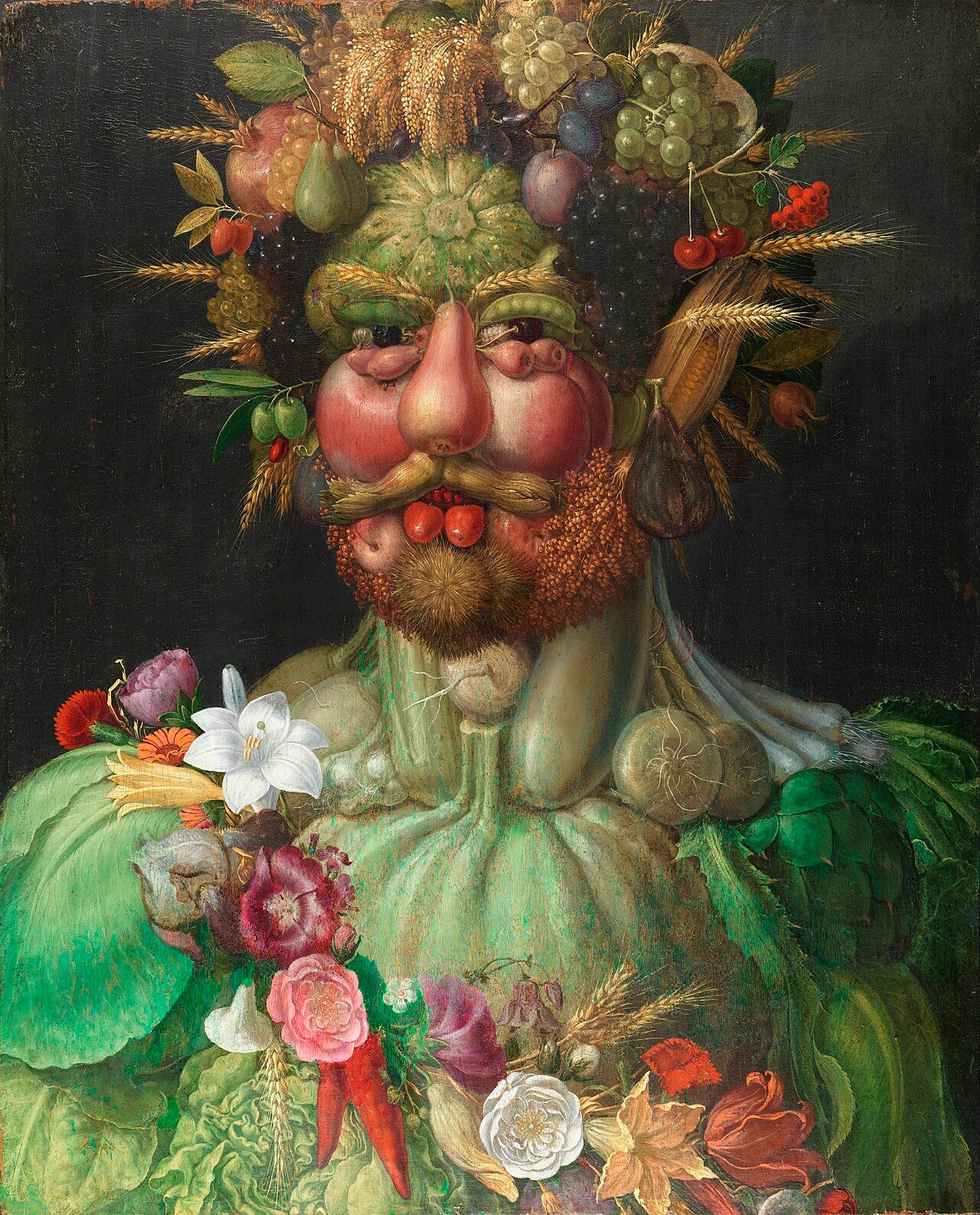
“Cometh the Hour, Cometh the Fruitcake” is a genuinely semi-regular series in this newsletter, having appeared previously. How often it will be repeated is an interesting question, which I dare not speculate upon at this time, especially given the current circumstances in the Straits of Hormuz. The supply of oil is down 20 percent, fertilisers 30 percent but the market for fruitcakes remains strong.
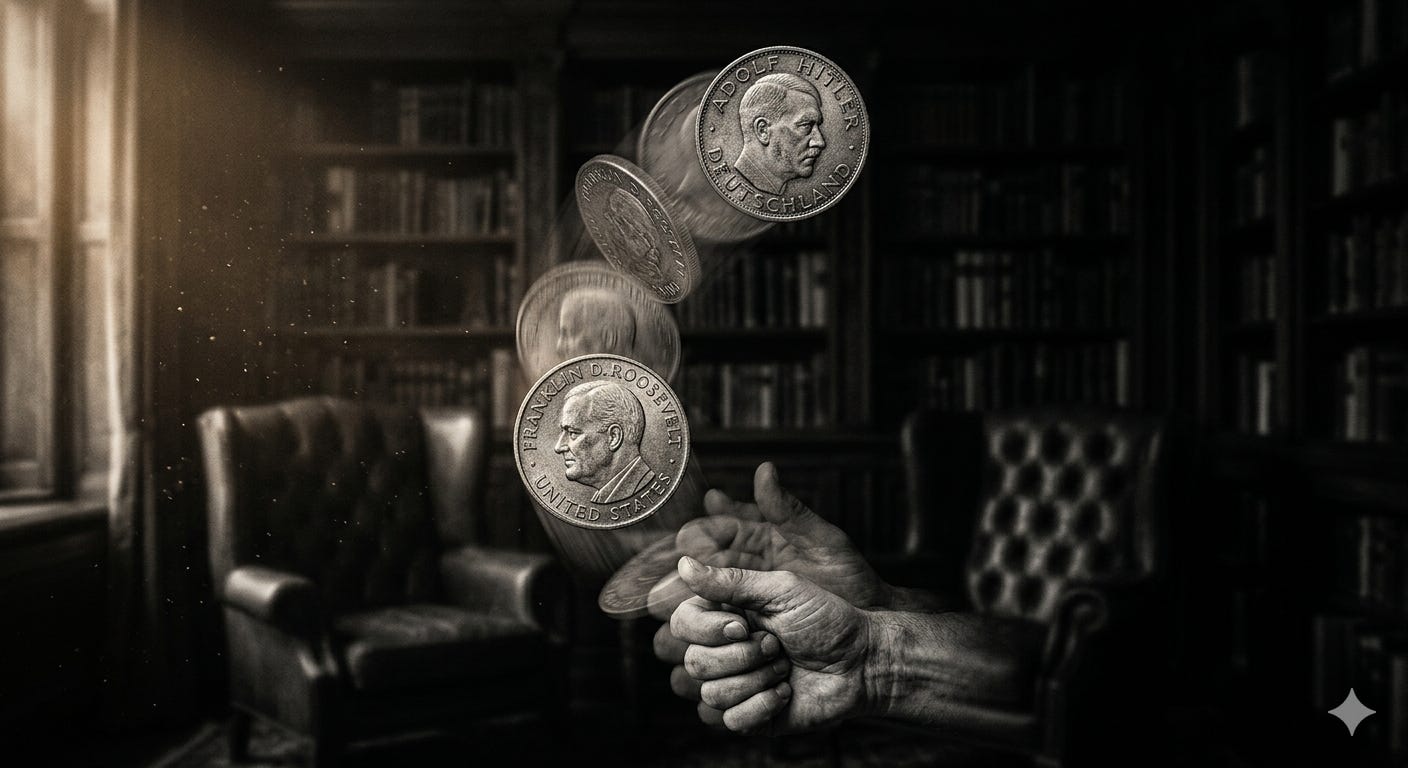
Be that as it may, here is my story. About two months ago, I came across a strange and compelling book. That book was written by a fruitcake about fruitcakes. And yet, though I thought it might be a book for fruitcakes, it was nevertheless strangely compelling. Its basic thesis was that totalitarianism was the product of a critical mass of psychos taking over a society. Still, I keep thinking of how unlikely Trump was in 2016. Trump, the protest candidate, wasn’t unlikely. But the Trump who would transform the Republican Party, flip US foreign policy 360 degrees towards Russia, declare war on Iran without wargaming the obvious results? That wasn’t on my radar. And what made it happen? It’s very hard to reject the hypothesis that a critical mass of fruitcakes just managed to self-assemble around him for Trump 2.0. In other words, there’s a coin toss in a lot of this.
Thus, although Trump was infinitely more malevolent than George W. Bush ever was, George W. Bush did far more harm to the world than Trump 1.0. Indeed, the situation we are now in is substantially the product of his disastrous invasion of Iraq. But Bush was not psychopathic; he was just a very naughty boy.
Accordingly, rather than present the ideas in the fruitcake’s book to you directly, I am extracting this review, which tells you as much as you need to know about the book and flashes around quite a lot of erudition. Indeed, it seems to me, in some ways, too much erudition because, however crazy and/or malevolent the author of the book was, his thesis sticks with me as an important theory of Totalitarianism.
Totalitarianism and a coin toss
A short excerpt from the said article - from Overland
Suppose that, riding the tram, you meet an elderly gentleman who claims to have been a psychologist in the old country. His theory: society is forever at risk of infection by a sinister group — people with deviant values and a parasitic way of life, acting in concert to spread poisonous ideologies and lead nations to ruin....
Your tram-mate reassures you his diatribe isn’t about Jews. He’s referring to a different ‘foreign body’: people with personality disorders — the hidden power behind the most destructive regimes of the twentieth century. They can only be stopped if society takes eugenic measures to breed them out of the gene pool.
Yet the views I’ve just described were those held by the late Polish psychologist Andrew (Andrzej) Łobaczewski, and in recent years they’ve been winning a surprisingly mainstream audience. The Conversation ran an article presenting Łobaczewski’s theory of ‘pathocracy’ as a guide to the governments of Trump and Boris Johnson. More publicity came from The Dangerous Case of Donald Trump (2017), which reached #4 on the New York Times Best Seller list, and Ian Hughes’s Disordered Minds (2018), with blurbs from Stephen Pinker and Jeffrey Sachs....
Information about Łobaczewski’s career has proven extremely hard to find beyond his own narratives. He claimed the original drafts of Political Ponerology were produced in secret collaboration with clinicians across Poland — but also that he was the lone survivor of this network, leaving no opportunity for corroboration. The research papers had been destroyed; the book rewritten from memory. His persecutors included the Polish State Security Service — operating ‘with the help of Jews’ — and Zbigniew Brzezinski, whose treachery he blames on the Trilateral Commission....
Let’s turn to the book. Łobaczewski owes the better part of his thinking to fin de siècle eugenics and a cyclical model of history older than Machiavelli: good times ‘create moral weakness’; adversity brings moral improvement — what he calls ‘the hysteroidal cycle.’...
His ideas become more disturbing when he explains how ‘deviant individuals’ corrupt societies — representing a ‘foreign body within the organism of society,’ akin to ‘germs … not aware that they will be burned alive.’ Dozens of times, the book refers to them as an ‘infection,’ echoing Nazi propaganda that compared Jewish communities to bacteria.
Under Łobaczewski’s theory, pathocracy is paved by schizoid intellectuals. He claims schizoid personality disorder occurs at its highest ‘among Jews,’ his favourite example being Karl Marx — labelled by a minor Polish psychiatrist as one of the ‘bearded schizoidal fanatics.’ He also finds typical schizoid thinking in The Protocols of the Learned Elders of Zion, with no acknowledgment that it is a forgery.
The psychiatry Łobaczewski advocates has been a past ally of fascism. Antonio Vallejo-Nájera — the ‘Spanish Mengele’ — also believed Marxists were ‘schizoid’ and devoted his research to finding a ‘red gene.’ Acting on his eugenic proposals, Franco’s government is estimated to have forcibly removed as many as 30,000 children from their parents....
Kernberg — a more reputable authority — cautions that ‘malignant narcissistic leadership should not be exposed with diagnostic psychiatrist labels’ but by drawing attention to corrupt behaviour; fascist discourse ‘depict[s] enemy groups with symbols … associated with bodily waste, vermin, [and] dangerous, or toxic animal traits.’ Łobaczewski’s addiction to microbial metaphors should give us pause. Dr Allen Frances — one of the psychiatrists who wrote the DSM criteria for NPD — has dismissed suggestions that NPD explains Trump’s behaviour, precisely because talking like a cartoon narcissist has proven so effective....
Łobaczewski’s proposed solution is a ‘Council of Wise Men’ — top psychologists and psychiatrists — with ‘the right to examine the physical and psychological health of candidates before the latter are elected to the highest government positions,’ backed by a eugenic ‘security system’ to ‘help progressively diminish societies’ gene pool burdens of hereditary aberrations.’
That, in sum, is Łobaczewski’s own ‘schizoidal declaration.’ Humanity is so helpless against ‘infection’ by deviants that a technocratic coterie must be given vast powers to veto election outcomes and stop ‘aberrant’ people from breeding. Łobaczewski concludes that ‘a system thus envisaged would be superior to all its predecessors.’
Many a dictatorship has made the same claim.
Ester Macleod
Lots more lovely designs here.

Orban: Kleptocracy dressed in cultural grievance
As various people have said, it’s good to make predictions. In this case, there’s been a right-wing pile into a political stock called Viktor Orbán. Steve Bannon and Tucker Carlson think he’s pretty terrific. Very terrific, really. And Patrick Denneen fancies himself as a pretty intellectual and level-headed guy. I liked his Why liberalism failed, but the game was up once he had to say how he’d change things which he did in his silly book Regime change. Anyway, he thinks Viktor is pretty on the money.
The world is full of intellectuals doing this kind of thing. They did it for Stalin in the 30s. They did it for Mao. They even did it for Pol Pot. Michel Foucault did it for the Ayatollah Khomeini. At least in the latter case, Foucault’s embrace of this new kind of spiritualism was forgivable as a gamble on something that could not be known until some years had passed. Still, one might have hoped for a little more humility. As for the post-liberal right led by Deneen embracing the transformation of liberal capitalism into a Putin-esque mafia state all happening in front of our eyes? Spare me.
In any case, I came upon this 11,000-word briefing on Orban’s record by Johan Norberg published by the Cato Institute. Claude’s summary is below.
Before doing so, I’ll quote Martin Wolf’s recent column on the subject:
Norberg’s description of Orbán’s method for accumulating power is telling and chilling. Hungary’s leader has dismantled the rule of law bit by bit, using his majority to transform the constitution. … A new National Judicial Office was created “to hire, fire, promote, and demote all of Hungary’s judges”. … The government also changed the electoral law to favour itself … went after the free media … [and] favour[ed] the activities of businessmen loyal to the regime and seiz[ed] the property of those who are not. … Remarkably and crucially, this entire system was “supercharged” with money from the EU: “in the 2010s, annual EU funds to Hungary totalled up to 4 per cent of GDP”. In sum, the EU subsidised its own subversion. Arbitrary despotism supercharged by corruption — does this system sound familiar? It certainly should, since it appears to be precisely what the Trump administration is trying to implement.
Over to you, Claude.
The Argument in Brief
This Cato Institute analysis by Johan Norberg takes direct aim at the American right’s romance with Viktor Orbán’s Hungary. Steve Bannon has called Orbán “one of the great moral leaders in this world.” Tucker Carlson broadcast from Budapest in 2022 declaring: “If you care about Western civilization… you should know what is happening here right now.” Postliberal theorist Patrick Deneen claims Hungary offers “a model” for orienting the state toward “the positive promotion of conservative policies.”
Norberg’s counter-thesis is unsparing: Orbán’s Hungary is not a model but a cautionary tale — of what follows when an executive dismantles institutional checks, captures the economy for loyalists, and substitutes crude majoritarianism for the rule of law. And the results have been bad even on Orbán’s own terms.
Dismantling the Institutional Architecture
After winning a two-thirds parliamentary majority in 2010, Fidesz moved fast. Orbán rewrote the constitution, packed the Constitutional Court with loyalists, forced senior judges into early retirement, and stripped independent oversight bodies of authority. He was candid about the philosophy. In 2014 he declared Hungary an “illiberal state, a non-liberal state” — and dismissed checks and balances as “a US invention that for some reason of intellectual mediocrity Europe decided to adopt.”
Madison had a different view. Norberg opens with the Federalist No. 47 warning: “The accumulation of all powers, legislative, executive, and judiciary, in the same hands, whether of one, a few, or many… may justly be pronounced the very definition of tyranny.”
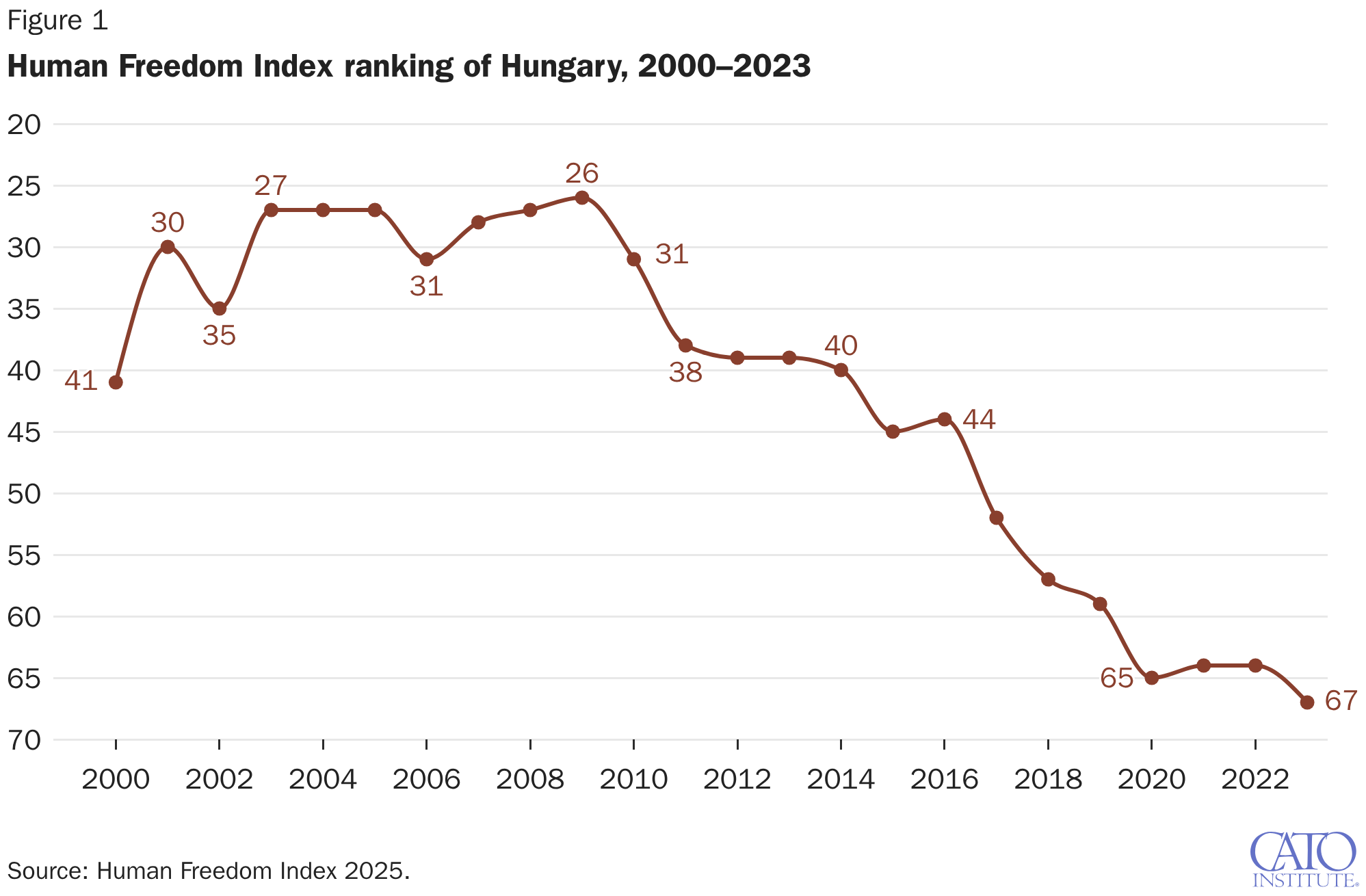
The indices tell the story starkly. The Cato/Fraser Human Freedom Index recorded Hungary dropping from 31st to 67th globally between 2010 and 2023 — placing it behind Namibia and Botswana. The World Justice Project’s Rule of Law Index now ranks Hungary 79th overall and a remarkable 123rd in “Constraints on Government Power” — behind Uzbekistan and Niger. Freedom House reclassified Hungary from “Free” to “Partly Free” in 2019, the first EU member state to lose that designation. The Varieties of Democracy Institute’s Liberal Democracy Index shows Hungary halving its score from 0.65 to 0.32 between 2010 and 2024, putting it on par with Nigeria and Kuwait.
In economic freedom, the trajectory is equally damaging. Hungary had improved rapidly after communism fell, rising from 5.52 to 7.37 on a 10-point Fraser scale between 1990 and 2010. Since then it has fallen back to 7.07 — and dropped from 39th to 61st in the rankings between 2010 and 2023. The residual score is substantially propped up by Hungary’s EU membership trade commitments.
“Society Capture”: The Economic Model
Norberg’s most detailed indictment is of what he calls “society capture” — the replacement of market competition with political loyalty as the organising principle of the Hungarian economy.
Orbán himself explained the theory. He argued that his predecessor as centre-right prime minister, József Antall, had made a fatal mistake: trying to separate government from the economy. Orbán thought Antall should instead have cultivated loyal businessmen who could serve as political instruments. Personal ties to the prime minister or his inner circle should become, in Orbán’s words, “a competitive advantage in the market.”
The vision was explicit: Hungary’s economy should be divided among “eight to ten major capitalists” personally tied to Orbán. The Cato analysis documents that this has been largely achieved.
Between 2009 and 2015, 62 percent of public contracts were awarded without any official announcement — ensuring only insiders could bid. By 2021, Fidesz-connected firms were winning contracts at six times the rate of unconnected ones. A 2022 review found just 12 businessmen close to Orbán capturing 21 percent of the value of all EU-funded contracts awarded through closed, non-competitive procedures.
The career of Lőrinc Mészáros — childhood friend of Orbán, former mayor of the prime minister’s hometown — is the emblematic case. In 2013 he ranked 88th on Hungary’s wealth list. His fortune then increased more than a hundredfold through public tenders, making him the country’s richest man. Asked what he owed his success to, Mészáros answered: “God’s will, good luck, and the person of Viktor Orbán.”
The flip side is equally instructive. Lajos Simicska — a former Orbán ally who publicly broke with him — saw his media empire stripped of state advertising, his construction contracts cancelled, and his agricultural subsidies revoked within months of their falling out.
Foreign retail chains were pushed out through a combination of special sectoral taxes (reaching over 4 percent of turnover in later versions), discretionary withholding of building permits, restrictions on opening hours, and mandatory staffing ratios. Once companies agreed to sell, permits mysteriously reappeared. Before Orbán, Hungary had privatised faster than most post-communist states; under him, the process reversed.
In December 2022, the EU froze $6.3 billion in cohesion funds to Hungary — the first country ever subjected to such a measure — citing “serious systemic irregularities” in public procurement and the absence of independent corruption investigation.
The Results: Failing Even on Conservative Metrics
Norberg argues that Hungary has not merely failed by liberal standards — it has failed by its own. The economy has been sluggish, inequality has grown, and Hungary is now the poorest and least free country in the EU. On the fertility rate, which Orbán has made a signature concern (and spent lavishly to raise), the results have also disappointed; Hungary’s rate has improved marginally but remains well below replacement.
The media landscape has been captured wholesale. Independent outlets have been either bought out by loyalists, driven out of business through advertising boycotts, or subjected to regulatory harassment. A new idiom entered everyday Hungarian: Fidesz-közeli cég — “a near-to-Fidesz company.”
The US Relevance
The analysis is pointedly addressed at the American right. Norberg’s implicit and explicit argument is that those who see Hungary as a template for the United States — whether in dismantling “deep state” oversight, concentrating executive power, or directing the economy toward political allies — should look at what the model actually produces: not conservatism, but kleptocracy dressed in cultural grievance.
Matt Groening
Matt Groening, creator of The Simpsons and Futurama, seems to do very few interviews. I didn’t much like the interviewer here, but I was interested in Matt Groening’s description of his own “journey” as we say these days. He was all the rage in the mid-1980s when I was also drawing cartoons. I was not a fan of his very successful series Life in Hell because it just seemed too dark and dystopian for me. It’s interesting to hear him reflect on that fact and how he changed. I initially didn’t watch The Simpsons because of its apparent family resemblance to Life in Hell was sufficient to put me off. When I finally watched it, I loved it.


Wither social democracy?
I’ve quoted Oliver Hartwich before. One of the right-wingers who described himself as a liberal and actually meant it. Anyway, he’s a beacon of sense, decency and courage in a pretty low, dishonest decade. And he’s lamenting the demise of the left - the responsible, social democratic left. As well he might.
A few years ago, I found an old calendar from 1979 in a box of things from my childhood. Stick figures, misshapen houses, the usual doodling. And there, in red ballpoint pen, three letters: SPD.
I grew up in the Ruhrgebiet, Germany’s industrial heartland. The Social Democrats were not just a political party. They were the natural order. In my home region, they regularly pulled [over] 50 percent of the vote.
My own political journey took me elsewhere. Classical liberalism became my personal philosophy... But what is happening to the SPD still fills me with sadness, and with worry for Germany’s democratic future.
The SPD is Germany’s oldest political party. Its roots reach back to 1863, eight years before Bismarck unified the German nation-state... The party survived the Kaiser, two world wars and 12 years of Nazi dictatorship.
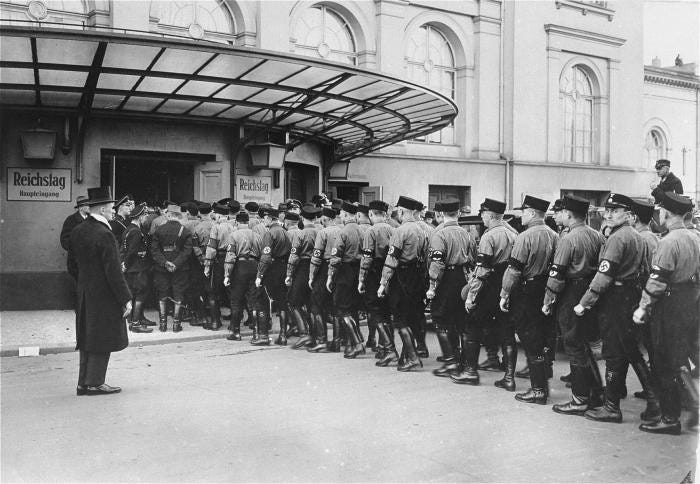
On March 23 1933, the German parliament met in a Berlin opera house. Hitler’s brownshirts filled the aisles to intimidate anyone who might vote the wrong way.
SPD chairman Otto Wels rose to speak against the Enabling Act... Every other party voted yes.
Only the SPD voted no... “Freedom and life can be taken from us, but not our honour,” Wels told the chamber. It was the last free speech in a German parliament for 13 years.
At Bad Godesberg in 1959, the SPD reinvented itself. It dropped Marxism, accepted the market economy and transformed from a class party into a broad-church Volkspartei. It reconciled millions of German workers with liberal democracy. Without Godesberg, there would have been no Willy Brandt — who fled the Nazis, spent the war in exile, and returned to become chancellor. His biography alone told Germans that their democracy was worth defending....
Then came Gerhard Schröder, the last SPD leader anyone would call a statesman. His ‘Agenda 2010’ reforms overhauled Germany’s sclerotic labour market and welfare system. They also destroyed his party.
The SPD never explained the reforms to its own voters. By the time the economy recovered, those voters had already left. Schröder’s greatest achievement became the party’s suicide note....
After Schröder, three grand coalitions under Angela Merkel turned the SPD into a permanent junior partner with nothing distinctive to say. Urban progressives found a home with the Greens, while blue-collar workers went to the far-right Alternative for Germany. Then the SPD fell silent on immigration. Deindustrialisation had hollowed out old communities; large-scale migration changed them further. Traditional SPD voters felt like strangers in their own neighbourhoods. Anyone who raised these concerns risked being called a racist. So, the party said nothing, and voters who wanted someone to listen found the AfD.
Olaf Scholz was the final indignity. Where Brandt had charisma and Schmidt had competence and Schröder had nerve, Scholz offered nothing. His coalition collapsed in late 2024.
None of this is unique to Germany.... Centre-left parties across the West are losing the voters they were built to represent. But no party with the SPD’s history has fallen so far, so fast.
In last month’s Baden-Württemberg election, the SPD got 5.5 percent, its worst result since 1945. Among manual workers, just 5 percent voted SPD but 37 percent voted AfD....
The political landscape has fragmented into six or seven parties, including several that nobody will form a government with. The AfD cannot serve as a democratic alternative because every other party refuses to work with it.
The once-proud party that voted against Hitler, that reconciled workers with democracy at Bad Godesberg, is fighting for survival.
I stopped supporting the SPD long ago. My values did not change, but I came to believe they were better served by other ideas. I never imagined I would grieve for the party I left behind.
That old calendar is still in a box at my parents’ house in Germany, and the red letters have not faded. Yet the world they belonged to has.
If the SPD loses its fight for survival, what fills the void?
Sharing a puff
Funny
Labour and Patriotism
A worthwhile piece about whether the British Labour Party can address its precipitous slide in working-class support. Still, I found it rather tame. It talks about the need to recognise the importance of borders. Well, “Derr” as the kids say. What it doesn’t say is that the rejection of lame liberal apologies for Western culture can (and should) be also had at the level of values.
You may not know this, but there are arbitrary codes of word order in our language. You’ll find if you make any changes to the word order of this phrase — “a lovely little old green French silver locket” — it will lose none of its meaning, but it will seem distinctly odd. The formal structure is opinion → size → age → shape → colour → origin → material → purpose/noun-linked qualifier. It’s amazing.
Something similar is going on in the world of left coded ideological ideas. It seems that discrimination on the basis of race and ethnicity trumps other categories. No one would want to speak against the idea that women are equal in Western liberal societies. But no one would want to speak in favour of discriminating against foreigners from one place or another. So what happens if the two principles come into conflict? Well the liberal consensus is not some considered trade-off based on the circumstances. The second principle is sacrificed for the first. To require particular vigilance about immigration from particular places or ethnicities is beyond the pale, but admitting a cohort of misogynist migrants is not. It’s amazing.
Writing from the hospital bed many thought he would never leave, George Lansbury, Labour leader from 1932 to 1935, declared: “I love England more than I can say. As the years pass, my love grows stronger. I think of this island as a jewel set in the sea.” Such words belonged not only to a wider culture but also to the Labour movement in Britain.... Starmer tried to describe his ‘love and pride’ for a Britain increasingly unsure of itself.
Labour now finds itself consistently behind Reform in the polls.... Into this vacuum, Nigel Farage has remerged as a political force, capitalising on the moral passions, long dormant, but now reshaping British politics.
The resurgence of patriotic feeling is unmistakable, but for the left it remains a source of anxiety. And yet as the historian James Stafford has put it, these attempts to fashion a more palatable form of nationalism have a “Groundhog Day” quality to them. Claims to have rediscovered patriotism typically fall back on awkward, meaningless displays that leave the impression of insincerity....
That world has slipped away. As R.R. Reno explains, we had replaced the “strong gods” – those thick attachments of sacrifice, faith, and love that bind people into a common life – with the “weak gods” of procedure, neutrality, consumption, and technocratic management.... The promise of this new age of openness has delivered not liberation from arbitrary tradition but dislocation. Citizens increasingly experience themselves not as political actors but as objects of impersonal forces, producing a brittle civic culture of anger and resentment....
What is striking about Starmer’s conference remarks is how carefully the rhetoric avoids the harder questions. Patriotism here is rendered as affect, rather than a substantive political principle.... Perhaps more instructive were remarks by the Home Secretary Shabana Mahmood, reported to have told civil servants that ‘Sovereign countries have secure borders. That statement is an article of faith for me.’ Her intervention articulates what Labour, and left politics, likes to avoid: that limits are a precondition for thinking about questions of belonging and community.
Labour has found itself described – sometimes admiringly, but most often uneasily – as Blue Labour. Founded in 2009 by Jonathan Rutherford and Maurice Glasman, Blue Labour insists that patriotism, borders, and place are not right-wing refuges but indispensable sources of solidarity around which social democracy depends.... As Wolfgang Streeck has argued, the nation-state remains the only scale at which democracy has ever truly worked. Stripped of sovereignty, the promise of politics becomes an illusion.
Yet Labour has internalised the belief that sovereignty is a relic or an obstacle.... For all his talk of patriotism, Farage mistakes internalising the MAGA agenda for asserting Britain’s national voice. In tying himself so closely to Trump, he reproduces the very pattern of dependence he claimed to oppose from Brussels and Strasbourg. In practice, Farage and Reform risk reducing Britain to a vassal state, ever more entangled in America’s culture wars.
If patriotism is to be more than rhetoric, it must take flesh in policy: rebuilding infrastructure and energy independence, reshoring critical supply chains, reviving domestic industry, strengthening military capacity.... Properly understood, it is not a regression into tribalism but an affirmation of our shared fate. It is the recognition that we belong to one another, and that politics is nothing more or less than the ordering of that belonging into institutions capable of command and care.
Starmer’s instincts may point in this direction, but he has yet to find the words, or the courage, to persuade those outside Labour that his patriotism is anything more than a branding exercise.... On the brink of something much more sinister, social democrats must talk less about patriotism in the abstract, and more about what that patriotism must stand for in practice. Unless and until they do that, they will remain spectators to a revolt they do not understand.


A recent prayer breakfast
Nothing like a little pre-war-crime spiritual cleansing

Consciousness and computation
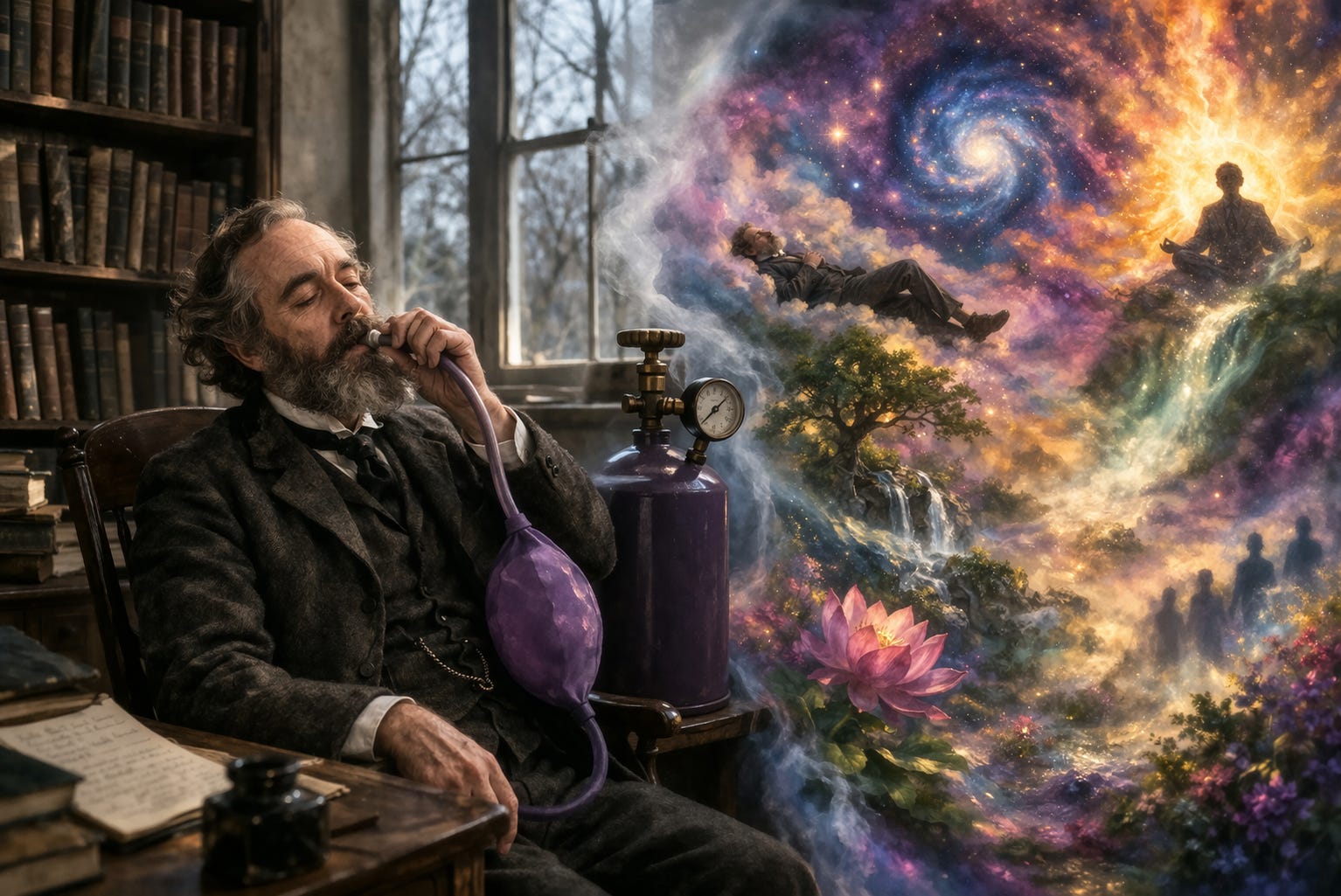
A fine review of a book I suspect I’d like.
William James did not much enjoy the effects of taking drugs. Nitrous oxide was the exception, and what an exception it was. In Varieties of Religious Experience (1902), he says that his experience inhaling the gas taught him “that our normal waking consciousness, rational consciousness as we call it, is but one special type of consciousness, whilst all about it, parted from it by the filmiest of screens, there lie potential forms of consciousness entirely different.”…
Those who study cognition have mostly abandoned James’s stream for a new analogy, one Michael Pollan calls “the reductive faith of our time—the belief that the brain is essentially a computer and that conscious awareness emerges, somehow, from the processing of information.” Neuroscience is best understood as pre-paradigmatic because of consciousness.…
A grand collection of theories
In A World Appears: A Journey into Consciousness (2026), the philosopher David Chalmers, whom Pollan calls “something of a killjoy, though an unfailingly polite one,” pops up periodically to explain why this or that theory seems implausible or just plain wrong. So no paradigm—just theories in search of evidence.
Pollan points to a paper describing “no fewer than eighty-four non-physicalist theories of consciousness” and references another that presents a selection of twenty-two candidate theories. No one could call consciousness under-theorized.…
In Does Consciousness Exist? (1904), James answers his question with an emphatic No! “It is the name of a nonentity, and has no right to a place among first principles.” Consciousness is not an entity but a function in experience—and that function is knowing.…
As Pollan says, “the ethical stakes couldn’t be higher. For the beings on whom we confer consciousness may be entitled to moral consideration.”…
Streams and words
A World Appears begins with the now-famous bet between Crick’s collaborator, Charles Koch, and David Chalmers. Koch starts out as the “quintessential brain guy.” At the end of the book, Koch has lost the bet and is having a crisis of faith—more skeptical philosopher with questions than confident scientist.…
Machined words and their shallow meanings
“Consciousness is felt uncertainty,” says neuroscientist and psychoanalyst Mark Solms. He and a cross-disciplinary team are building a digital simulation to model when a living organism eats, drinks, and rests, in the hope that this will lead, somehow, to machine consciousness. So far, the team has placed an “agent” into a simulation “populated by digital hamburgers, glasses of water, and beds, plus a hill that the agent can climb to survey its environment.” If this sounds like a basic version of The Sims, you have put your finger on the strange world created by the “belief that the brain is essentially a computer”—a world where complex models are built and commercialized much faster than academic research can create and disseminate knowledge about them.…
I believe only living creatures are entitled to moral consideration. With no living tissue and no experience of time, Claude is a nonconscious automaton, an impressive upgrade to the chess-playing and speaking devices Wolfgang von Kempelen constructed in the eighteenth century.
It would be far easier to disagree about this amicably if some of the most influential believers didn’t work at companies selling products and services created with cutting-edge AI models. Dario Amodei’s belief that Claude might be conscious and his aspiration to grow tools made of Claude into a market worth trillions of dollars are a confusing though influential combination.…
The best we can do when it comes to attempting to understand consciousness is to mix methods of inquiry, moving, as James and Pollan do, from one discourse to another. Through such movements we may glimpse workable theories of consciousness, or at least begin thinking across distinctions of spiritual, philosophical, and scientific phenomena, understanding these as relations within experience, rather than as separate universes.


The Irrational Decision: Another review

I had a terrific review of this terrific book a week or so ago. But here at Substack, too much terrific is barely enough. Another terrific review of the same terrific book.
Towards the end of his new book, The Irrational Decision, Ben Recht explains what he has set out to do.
Most books on technology either take the side that all technology is bad, or all technology is good. This isn’t one of those books. Such books focus too much on harms and not enough on limits. Limits are more empowering. Throughout the book, I’ve maintained that mathematical rationality is limited in what kinds of problems it is best placed to solve but has sweet spots that have yielded remarkable technological advances.
Ben combines a deep understanding of the technologies with a grasp of their history and the ability to write clearly about complicated things....
The good-bad dichotomy shapes our current debate. Nate Silver’s On The Edge praises the “River” of people thinking in statistical probabilities—which, as Ben suggests in a review essay with Leif Weatherby, wraps poker, AI rationalism and crypto philosophizing into a package that appears coherent if you don’t look too closely. Bender and Hanna’s The AI Con begins from the opposite: “AI” is hype—fancy spell-check and “well scoped” activities.
Neither helps. The former launches into fantasy, repeatedly demonstrating how ridiculous premises yield ridiculous results. The latter curdles into denialism. We ought to be much more worried about the triumphalists—but deflating their claims requires a more grounded perspective.
The Irrational Decision provides strong reasons for skepticism about the rationalist project, while explaining why machine learning has remarkable uses in its appropriate domain. The one weird trick of rationalism is to recompose complex problems in terms that can be rationalized. When good, it is very, very good; when bad, it is horrid....
Ben suggests there is a “sweet spot”—not useful where outcomes are too predictable or too variable, but for the messy zone between. Chip design illustrates this: assumptions about “standard cells” combined with simulated annealing allowed faster chips which ran more powerful algorithms, in a loop. But rationalism as a universal tool is problematic: optimal poker theory was less successful at optimizing poker than at optimizing poker players....
Machine learning is a powerful statistical tool: guessing missing spreadsheet entries by finding the formula that best fits existing data. Like statistics, it has a “sweet spot”—not useful where you have a clean mathematical abstraction, nor where situations are too messy, but in the intermediary zone....
Many claim the Common Task Framework—benchmarking algorithms against shared datasets—shows AI to be generally superior to humans. Ben suggests a fundamental error. Statistical prediction beats expert judgment only with clearly defined outcomes and reference cases. But tasks defined that way are definitionally the tasks computers will do better. Paradoxically:
If we can measure why humans might be able to outperform machines, then we can build machines to outperform people. On the other hand, if we can’t cleanly articulate a clean set of actions, outcomes, measurements, and metrics, then we can’t mechanize problem solving.
The tools rationalists use could almost have been purpose-crafted to conceal the problems their methods can’t solve....
Some challenges are fundamentally resistant to mathematical rationality. “Societies are not computer chips,” Ben writes. And as Ben says elsewhere, political disagreement generally resists optimization. Incommensurable tradeoffs—playground vs. fire station—take you decisively away from problems machine learning can simplify.
As soon as we can’t agree on a cost function, it’s not clear what our optimization machinery … buys us. Multi-objective optimization necessarily means there is a trade-off. And we can’t optimize a trade-off.
If you want to really understand the limits on AI, you owe it to yourself to read Ben’s book. There are many books on technology that are smart in some sense, but very few that are wise. This is one of those few exceptions.


Forbidden desire
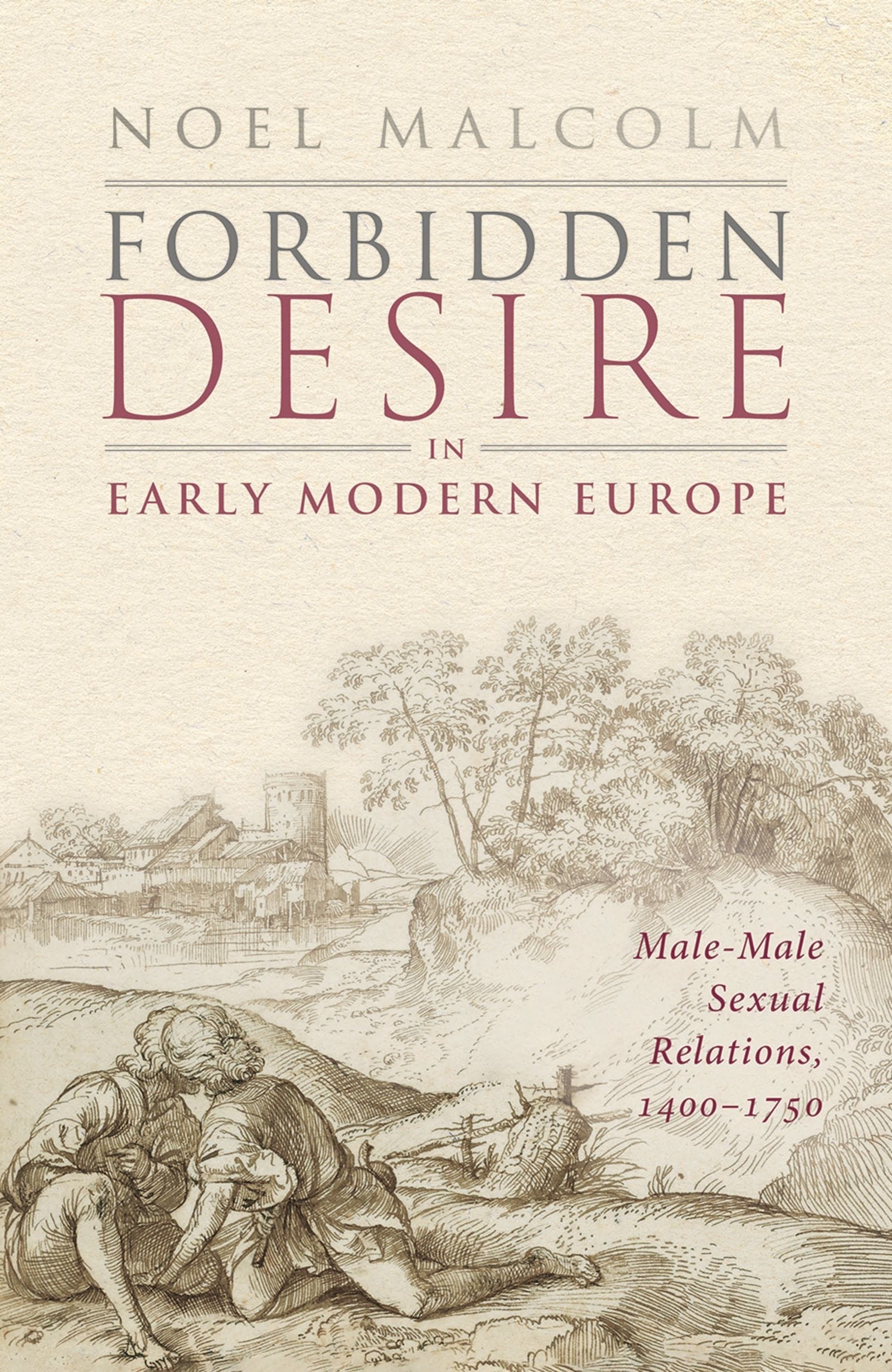
A snippet of a long and interesting review.
‘You’re not men. You’re boys. If there was no social media, you would be my concubines.’ One of the weirdest lines of the 2024 US election came from Robert J. O’Neill, a pro-Trump former Navy SEAL who claims to have been one of those who shot Osama bin Laden. He replied to a Democratic influencer: ‘I’m telling you exactly what Betas like you will be used for: food and sex.’ Fucking and devouring: enough to keep a psychoanalyst busy....
The East has overheated the erotic imagination for centuries. The habit of sodomy was often supposed to have been acquired from foreigners. ‘Buggery’, the English legal term, derives from ‘Bulgar’, referring to Bulgarian Bogomil heretics. Sodom could be much closer to home: for much of early modernity Italy was a byword for the unspeakable vice. ‘Am I perhaps in Italy,’ a Spanish servant asked, rebuffing his master’s advances, ‘that Your Grace wants to do this to me?’ One 17th-century student installed a prophylactic basket around his buttocks before visiting an Italian barber, just in case.
Readers of Noel Malcolm’s Forbidden Desire might find O’Neill’s comments less surprising. The book’s central argument is simple: between 1400 and 1750, sex between men followed distinct patterns in different places. In Mediterranean cultures, pederastic sodomy was widespread — typically an adult man and a beardless youth, with age determining the sexual role. Punishment sometimes varied by role; bottoms historically got a raw deal. In far smaller numbers, court records describe ‘inveterate’ sodomites who persisted throughout adulthood, taking pleasure in being sodomised, and occasioned the ire of priests and lawmakers alike.
In Northern European cultures no such pattern can be discerned: prosecutions for sodomy are much sparser, and proto-homosexuality only emerges in the records around 1700. The first wave of gay historians assumed the Mediterranean sexual culture must have obtained in Northern Europe too, but gone largely unrecorded. For Malcolm, such defences fail to stack up. Broad absence of evidence really is evidence of absence....
One of the effects of Malcolm’s chronological sweep is to undermine the idea, usually associated with Michel Foucault, that there is a clear watershed before which ‘sexuality’ is classified only as a series of prohibited or permitted acts, and after which it is thought of as an inner inclination and identity. As Foucault put it, ‘the sodomite was someone who committed a sin; the homosexual is now a species.’ One of the triumphs of Forbidden Desire is its demonstration that speculation about coherent sexual inclination — ce métier, ‘of that type’ — is commonplace long before any such watershed. Sodomites themselves sometimes extrapolated from the ambiguity of ‘nature’: if God created the anus so that it was capable of giving pleasure, a Venetian priest observed in 1628, it couldn’t possibly be a sin to use it for that purpose. Towards the end of the period a more confident self-assertion can be detected: French police records mention a chevalier caught cruising in 1720s Paris, who attacked the policemen with his sword and threatened to have the senior officer dismissed, ‘adding further that he wanted to fuck in the middle of the Tuileries garden without anyone daring to stop him’....
The kernel of Forbidden Desire is Malcolm’s archival find: an investigation conducted in 1588 by the Venetian representative in Istanbul into two young members of his household. Across sixteen manuscript pages, fifteen witnesses recount seeing the two young men kissing at the window of Gianesino’s little room, or gazing longingly at each other over dinner. Gianesino had given Gregorio tokens: silks, satin gloves and cap, a knife. Gregorio had crept out at night even after Gianesino’s eviction and insisted he would see him ‘even if the gallows were prepared for him’. The verdict of the kitchen boy was that ‘the barber was in love with Gianesino, and Gianesino with him.’ Gregorio agreed: ‘I loved him greatly, I took pleasure in his company and I slept with him several times.’ Yet he said they had not had sex. If this story had come down to us only as a record of a sentence — guilty of sodomy, resulting in expulsion and deportation — it might easily have been assimilated to a simple pattern. Countless Gregorios and Gianesinos, and their sincere loves, are lost to us....
In the East, theoretical disapproval was modulated by open cultural celebration and a legal regime that made actual conviction difficult, sustaining a culture of open but discreet sodomy. In Western Christendom, moral disapproval and a harsh legal structure produced a much more secretive, paranoid culture. This peculiar dance of hiding and revealing, shame and secrecy, colours our post-Christian attitudes to sexuality (even in the reversed injunction to ‘come out’)....
Foucault’s basic question is still of great interest: what is it about sex that makes people believe it expresses fundamental truths about the self, and when did that belief arise? Malcolm comes out, moved by his evidence, as a ‘moderate constructionist’ — unsurprising given how much evidence of ce métier thinking he has assembled. If there is any lesson from history, it is that few sexual orthodoxies endure. Our own socio-sexual architecture, with its fissile taxonomy of identities and non-identities, its monogamies (absolute, conditional or hypocritical) and chaotic experiments in openness, might well strike future generations as quaint or barbaric.


Heaviosity half hour
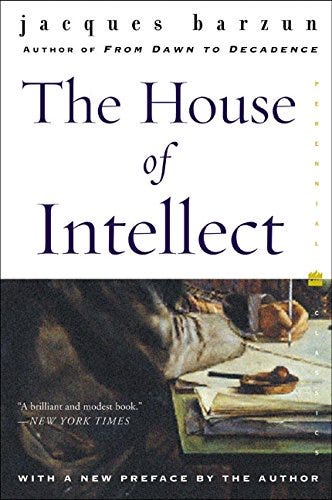
I think I had heard of Jacques Barzun, but knew nothing about him. But he’s a very thoughtful fellow who was onto a lot of things that we see today, as the rot was setting in. This is Claude’s summary of his 1959 book The house of intellect.
What the Book Is
Published in 1959, The House of Intellect is one of the great polemics of American intellectual life — a wide-ranging, acerbic, and often brilliant diagnosis of why the educated classes of the mid-twentieth century were failing to think well. Its author, the Franco-American cultural historian Jacques Barzun, was Dean of Faculties at Columbia and one of the most formidable public intellectuals of his era. The book is addressed, he insists, not to America alone but to the whole Western world wherever “egalitarian democracy, mass education and journalism, the cult of art and philanthropy” have taken root. More than sixty years on, it reads — disconcertingly — as a description of the present.
The Central Distinction: Intelligence vs. Intellect
Barzun opens with a distinction on which everything depends. Intelligence is the native, private, protean capacity any creature may possess. An intelligent dog, an intelligent footballer, an intelligent child — intelligence is “the faculty of living by one’s wits.” Intellect, by contrast, is “the capitalized and communal form of live intelligence”: intelligence stored up, codified, made transmissible through conventions, signs, and institutions. Intellect is social, historical, and fragile. It can be destroyed.
The alphabet is his emblem. Any schoolchild can learn it; no child could have invented it. Learning the alphabet requires no great intelligence — Charlemagne never managed it — but it is the founding furnishing of the House of Intellect, the indispensable gateway. Intellect, like the alphabet, is a collective achievement that must be consciously maintained; it neither sustains itself nor renews itself automatically. It requires a house — “appurtenances and prescribing conventions” — and that house is in disrepair.
The paradox Barzun begins from is this: in an age when experts, Ph.D.s, and intellectuals have more social power and public trust than ever before, Intellect as an institution is in decline. The intellectuals themselves — squabbling, fragmented, mutually contemptuous — are the chief witnesses. The decay comes not from without (from Philistines and barbarians) but from within: from intellectuals themselves, from their enthusiasms, their evasions, their fashions.
The Three Enemies: Art, Science, and Philanthropy
Barzun identifies three forces that have, without conspiring to do so, worked as enemies of Intellect — not because they are intrinsically hostile to it, but because their unchecked expansion within the House has corrupted the conditions on which Intellect depends.
Art is the first and, in Barzun’s diagnosis, the most insidious. Since the Romantics, Western educated culture has been organized around the idea that art — ambiguous, sensory, resistant to paraphrase — is the highest form of human expression. Criticism has valorized “ambiguity, sensibility, insight, imagination, irony” as the supreme intellectual virtues. Proust’s declaration that “every day I set less store by the intellect” became a cultural creed. The effect has been a systematic devaluation of articulate precision — the chief virtue of Intellect — and the elevation of the indefinite, the suggestive, and the merely felt. An educated person who has internalized this creed mistakes the refusal of clarity for depth. Modern art, Barzun argues, has become the alibi for confusion.
The paradox is that artists have never been better treated materially. The mid-century saw an explosion of workshops, fellowships, prizes, residencies, camps, colonies — a comprehensive apparatus for encouraging “creativity.” Yet the more art was celebrated, the more artists denounced Western civilization. Their discontent, Barzun argues, is not the robust discontent of critics with a program but the autointoxication of those who have persuaded themselves that everything is wrong and nothing can be done. “Art lovers are now, as they never were, the world haters.”
Science reinforces the damage through a different mechanism. Its prestige is enormous, its actual understanding among educated laypeople negligible. The result is imitation rather than comprehension. Humanists adopt pseudo-scientific jargon to seem rigorous; social scientists construct elaborate apparatus for the measurement of the obvious; the language of “research” and “findings” spreads to domains where it is inapplicable. Meanwhile science itself retreats into specialisms so narrow that communication across them is impossible. The formula universally applied — “you cannot understand my subject unless you yourself practice it” — fragments the clerisy into hostile guilds, each contemptuous of the others, each incapable of addressing the educated general public.
Philanthropy is the third enemy — not charity in itself but the application of liberal egalitarianism to things of the mind. Its watchword is help. Its assumption is that the slightest response to any intellectual opportunity creates a claim to special treatment. It bars competition, ignores failure, and equates intention with performance. “Willingness in the learner is enough: why distinguish intention and performance?” The philanthropic impulse, originally generous, has been weaponized by psychology and education into a systematic coddling that substitutes the management of feelings for the transmission of knowledge.
These three forces — art, science, philanthropy — have become allies, Barzun argues, in a war against the conditions Intellect requires: unity, concentration, communicativeness, and self-knowledge. “Few even among intellectuals think of the intellectual constituency: most think of particular artists, scientists, educationists, psychiatrists.”
The Public Mind and Its Caterers
Barzun turns from the abstract to the concrete. The second chapter is a ferocious account of how journalism and mass publishing fail Intellect — and fail not through crude vulgarity but through something more subtle: defeatism.
The middleman of culture — the editor, the journalist, the broadcaster — is educated, often intelligent, and genuinely anxious about standards. His failure is the failure of nerve: he does not believe the public can sustain difficulty. The result is a cascade of degrading habits. Editors substitute Newton for Descartes when an author uses the latter, “regardless of meaning, on the ground that Newton was better known.” Titles are changed because the word “humanities” is thought forbidding while “science” is “everybody’s meat.” Collective journalism — the article shaped by committee, stenographer, and office boy — destroys the individuality without which intellectual work has no force. “Nothing replaces the force imparted by oneness of conception.”
The machinery of “technique” — exact timing, the horror of silence, the requirement to “enliven” — takes over from thought. A panel discussion that begins to generate real intellectual exchange is cut off by the moderator who fears staleness. The superlative becomes the universal currency: every novelist is “the greatest,” every discovery “unprecedented.” Barzun calls this the Paragon Complex and illustrates it with a mordant anthology of academic thesis-writing in which every author under discussion turns out to be the supreme practitioner of their form.
The deepest mechanism is the thought-cliché: “an idea or phrase contrary to fact, which is clung to because it sounds familiar and feeds a half-attentive wish for thought.” He gives the example of Darwin: the standard account — that Darwin discovered evolution and that his theory was the survival of the fittest — is, he shows, wrong in both clauses. But correction “sounds pedantic” and the thought-cliché bounces back. Its function is to give “the pleasure of recognition” without the labor of understanding.
Conversation, Manners, and the Decay of Talk
The chapter on conversation is among the most acute. Good conversation, Barzun argues, is not the exchange of opinions (A speaks while B prepares his rejoinder) but the sifting of opinion — “the discovery of tenable positions by alternate statements, objections, modifications, examples, arguments, distinctions.” It requires the willingness to contradict and be contradicted. But democratic manners have made contradiction taboo.
The syllogism governing modern social life runs: “You are one against several = you are wrong = you are a fool.” To contradict one’s hostess is to risk being the odd man out, and since democratic society provides no stable hierarchy of rank or precedence to absorb such friction, the result is a universal conspiracy of agreement. Opinions are prefaced with “I may be all wrong, but—”; disagreement is announced with “I was candid with him. I told him—”; people report feelings rather than arguments because “I feel” can be disowned where “I think” cannot.
The ideal modern conversationalist, Barzun observes, says “frankly” before every sentence and “candid” whenever about to disagree — having transformed both words into their opposites. The vocabulary of pussyfooting is vast, the underlying motive uniform: to say nothing that could be held against you while creating the impression of saying something.
The social quest is no longer for ideas but for essences — for the “real person” beneath the social surface. This is the psychologizing mode: rather than engaging with what someone says, we read them for what they are. The result is intimate, warm, therapeutically inclined, and intellectually sterile. The highest praise available is “She’s a real person” — which, Barzun notes drily, would be strange praise in most contexts.
He traces this back partly to the novel, which for two centuries has been teaching educated people to distrust surfaces, read motive, and assume that every institutional form conceals a corresponding vice. “Biography, which has borrowed from the novel the guerrilla technique, derides ambition as pretentious and absurd.” The intellectual class has learned from fiction to be captious, ironic, and small — “studying to be small.”
Education Without Instruction
“There is, there can be, no such thing as a good school.” This lapidary pronouncement opens Barzun’s chapter on education, and it is important to understand what he means by it. He is not counseling despair but insisting that schools are made from the culture in which they exist — they cannot be better than their teachers, and teachers cannot be better than the ideas their training gives them. The question is what ideas now govern American schooling.
The answer, he argues, is philanthropy run amok. The school no longer teaches; it helps. The teacher no longer instructs; she provides “contact” — emotional nourishment delivered, he was told by one theorist, at intervals of no more than fifteen minutes to prevent the child from “withdrawing.” In a six-page article on teaching geography, Barzun notes, “not one word has to do with the teacher’s own subject, which is geography.”
The key word that has displaced instruction is education — a grander, more philanthropic term that covers everything: driver education, cancer education, alcohol education, the education of Henry Adams, and the education of a poker player. Barzun calls for the word to be banned from discussions of schooling: “Education sounds ‘broad,’ a richer, more philanthropic gift than ‘instruction.’ There is less of superior-to-inferior in it.”
The accumulated examples of educational fooling are devastating. A second-grade class takes a trip to Staten Island and builds a full-size ferry boat. Elementary schoolers stage plays about Greek life in which the teachers mispronounce the names of the gods. An eleven-year-old’s science assignment asks her to “name six persons you consider to be scientists” and describe “the contribution of each you believe to have most helped mankind” — with no assigned reading, no preparation, the right answer expected to “come out of pooled ignorance.” A high school project asks students to show “the influence of something learned in science on something in another course”; the winner composes a piece of music expressing his view of gravity, which is judged by class vote on harmonica.
His most chilling datum: he tested 170 first-year graduate history students — hand-picked, college-educated — on twenty common abbreviations (e.g., i.e., N.B., ibid., B.C., A.D.). Only one student understood all twenty. Only 10 per cent understood fifteen or more. Most thought e.g. and i.e. synonymous. Nearly all who failed “said that they sensed a difference between e.g. and i.e. but could not put it into words.”
The cult of “creativity” is Barzun’s name for what has replaced instruction. The student’s spontaneous production is treated as if it were the expression of genius — uncorrectable, precious, wounded by rigor. The paradox is that this reverence for the student’s inner life is coupled with the most intensive manipulation of personality: the school’s real aim, beneath the language of freedom, is social adjustment — “rounding off edges, working to moral specifications.”
Instruction Without Authority
At the college level, Barzun finds, the problems compound. Students arrive with what he calls the arrears of ignorance accumulated by permissive schooling, and colleges continue the pattern. The curriculum is a cafeteria of electives — hundreds of courses offered, none required, each department wanting to act as a small university. Students take courses in “Principles of Advertising Media,” “Methods in Minor Sports,” and “Stage and Costume Design,” then apply to law school.
Where academic subjects survive, they are taught badly. Young graduate assistants treat undergraduates as potential specialists in their own discipline and spend tutorials on disputed etymologies. The Sanskritist teaching Indian civilization cannot stop talking about Sanskrit. “Milton said, ‘I hate a pupil teacher.’”
The result — after sixteen years of American education — is college graduates who “cannot read accurately or write clearly, cannot do fractions or percentages without travail and doubt, cannot utter their thoughts with fluency or force, can rarely show a handwriting that would pass for adult, let alone legible, cannot trust themselves to use the foreign language they have studied for eight years.”
The Case Against Intellect
In a chapter that complicates everything that precedes it, Barzun turns the argument on itself. Intellect also has enemies within — dangers that are properly its own making. The chief is intellectualism: the tendency, having used the Intellect to make order among ideas, to believe that the order has been discovered ready-made in the facts.
His great case study is Marxism, which he treats not as a political failure but as an intellectual one. The educated Europeans and Americans who embraced Marxism in the 1930s were not stupid; they were seduced by the pleasures of systematization. They confused the order Intellect imposes on experience with the structure of experience itself. Had they retained the habit of turning Intellect on ideas — including their own — they would have seen through the jargon and pseudo-science far sooner.
Barzun also pursues the deep case against Intellect that the Romantics made: that it is hostile to life, that it “checks spontaneity, tames strength,” that the sedentary, rule-governed, artificially precise world of the intellectual is at war with the flowing, sensory, particular reality of human existence. He takes this case seriously. The Romantics were right that the eighteenth century had overextended Intellect into the formalism of an era that needed the corrective of feeling and art. “Great cultural changes begin in affectation and end in routine.” That corrective has now run its course and become its own dead weight.
The chapter ends with an account of the proper ethics of intellectual engagement. The model is Bernard Shaw — “the greatest, most dauntless intellectual fighter of our century” — who argued without fouling the air, who was “uncompromising and even outrageous without leaving a festering wound.” “His head always knew the degree to which, in the circumstance, an idea should enlist the passions.” What many people called his coldness was in fact the refusal to confuse vehemence with violence.
The Folklore of Philanthropy and the Damage Done by Money
Two chapters on foundations and funding contain some of Barzun’s most pungent writing. The basic argument is that the institutional apparatus for supporting intellectual work — the great American foundations, the federal government’s research contracts, the university system of grants — has been designed by people who do not understand what intellectual work is, and has consequently done nearly as much harm as good.
The project has replaced the scholar. Barzun describes the project as “a literary form, like the Shakespearean sonnet” — with its own conventions of tone, length, and budget. Its “correct composition is an art not vouchsafed to everyone.” The scholar who wants to pursue genuine inquiry must disguise it as “applied” or “policy-relevant” or “interdisciplinary” research, hoping to do his real work behind the shelter of accepted phrases. “The scholar salves his conscience with the thought that he will turn the proceeds to good use.”
The matching grant, the preference for large measurable projects over small individual scholars, the bias toward science and social science over the humanities (which “gave rise to no projects properly so called, were not expensive enough, and promised few social benefits”), the prohibition on publication subsidies, the annual report requiring publicly defensible decisions — all these have together produced a system in which the habits of Intellect are systematically disadvantaged relative to the habits of management.
A single sentence from William James focuses the chapter: “The social value of a college education is to tell a good man when you see one.” This, Barzun observes, has become a heresy. “You do not tell a good man when you see one: you ask him to fill out a blank.”
The government’s approach is still more absurd. Federal research contracts insist on “relatedness” — the project must connect to some approved practical aim. Scientists learn to disguise fundamental research as applied. The overhead rates universities can charge are a fraction of those charged by industry and by one government agency to another: the near-invisibility of intellectual work makes it seem not-quite-real, the scholars already in existence and their minds “working anyway.” A legislator tells Barzun that if we spent as much on medical research as on the atom bomb, we could “lick cancer” — as if the production of ideas operated like the production of rockets.
The Language of Learning and of Pedantry
The penultimate chapter is a sustained attack on the language of the mid-century educated class — “pseudo-jargon,” as Barzun calls it, the imitation of scientific precision that achieves neither precision nor science.
The basic mechanism is the replacement of verbs by nouns. The taxi driver is “behind time because the filling-up process was slow.” The dentist tries “to enlist him in a clean-mouth program.” A nurse’s training document promises “the assumption of a leadership role.” The post office instructs: “Not for deposit of mail.” These phrases, Barzun argues, are not careless; they express a deep desire to depersonalize, to make the individual’s action appear as the operation of a system, to achieve vicarious importance through abstraction.
He documents, with alarming specificity, the decay of grammar — the campaign of the academic linguists to abolish “prescriptive” grammar on democratic grounds. Charles Carpenter Fries, “the theorist who engineered the demise of grammar in the American schools,” held that there could “never be in grammar an error that is both very bad and very common.” In his wake, grammar was replaced with something called “Language Arts.” The result: “Of true knowledge at any time, a good part is merely convenient, necessary indeed to the worker, but not to an understanding of his subject: one can judge a building without knowing where to buy the bricks; one can understand a violin sonata without knowing how to score for the instrument.”
Barzun invokes Pascal’s distinction between the esprit de géométrie (which works with few, clear, remote principles) and the esprit de finesse (which works with principles resident in the midst of life, “so numerous and so fine” that they can be perceived only by trained attention). Science solves problems; language guides judgment. When language is distorted by the attempt to stuff it with scientific-sounding terms, the result is an instrument useless for both purposes — and, as Pascal says, “ridiculous besides.”
The law and diplomacy, Barzun argues, are the great human achievements of the esprit de finesse — models of what articulate precision can accomplish in complex human situations. Both are in decay, for the same reason: the linguistic power they require is no longer being cultivated. The great legal minds — Holmes, Brandeis, Cardozo — are cited and celebrated, but not emulated; they produce no successors because the education that would produce them has been dismantled.
The Summing Up
Barzun ends not with a program but with a conditional: “If you want this, you must have, or do, that.” He is deliberately refusing the philanthropist’s error — the belief that to identify a desirable end is already to have achieved it.
The conditions of Intellect are not mysterious. They require: good speech in the home; a press that takes its intellectual responsibilities seriously rather than “trembling upon the whim” of imagined readers; schools that instruct rather than help; foundations and governments that understand what they are paying for; and, above all, a habit of work — the willingness to engage with difficulty rather than evade it.
“The business of learning must above all others be represented in its true guise as difficult, as demanding effort. If television is to be used for teaching, there must be no more coaxing and wheedling — not: ‘Come with me as we explore the land of numbers,’ but ‘Ladies and gentlemen, this is arithmetic which, like many another branch of learning, is full of difficulty, danger, and pleasure.’”
He closes by distinguishing intelligence and Intellect one final time. Intelligence is adaptable, protean, and perishable — it “dies with the owner unless he embodies it in more or less lasting form.” Intellect is the form, the house in which embodied intelligence can accumulate and be handed on. That house is not destroyed yet. But it requires defenders who understand what they are defending — and why.

Thanks for that prior art of Łobaczewski. I've been wondering about this exactly for some years. (Yes everything Trump 2 has done has been on my radar).
We humans appear to have a way to police the baboon-like antics of sub-dom narcissists (Orban's mouse to Putin's lion for example) among us, but it is only taken in direct action when every other possible method is exhausted, often those methods are already subverted. It is no wonder that Łobaczewski has already poisoned the well in this regard. They are parasites on our emphatic abilities to world our lives into existence, and their existence is somewhat of a curious example of our success at surviving them, but why schoolgirls should die in Iran because of that erstwhile success is beyond me. Where is the order of which they speak?
The error or 'corruption' in Łobaczewski case would appear to be that slip from nurturing/policing to disease/unholiness/eradication which is the give away for narcissists preference to binarise all human activities. It's never a pathology, it's always naughty boys.
One issue is that the correction of narcissism (without it the dark triad is nothing) might not be possible within the span of a human life (if accurately defined in this way).
And this is the source of our moral issues to protect an empathic order by using means that a narcissist would not shy away from.
I hope the smarter angels of our nature can work that one out.
The biggest red flag of all is the narcissists focus on some imaginary social construction (tribe/race/ethnos/sacredness) to shift their 'pathologies' on to. Łobaczewski is a meta-form of it. Unable to see difference except as a pathology, that ready-made of our discontents, our dis-ease.
Barzun is a bit of a grump. I can only claim anecdotes with regards to secondary and undergraduate studies, in Australia not the US, but 'frankly' none of that rings true, not a bit. My kids are doing more rigorous work than I did thirty years ago, no question. And absolutely who cares if nobody knows what anno domini, exempli gratia, id est mean. He even said they were mostly using it correctly. Mass education only came about at the start of the twentieth century, and I think most people would regard it as a very good thing. I'm not sorry that it doesn't meet some highly arbitrary standards that he has created in his own mind.