


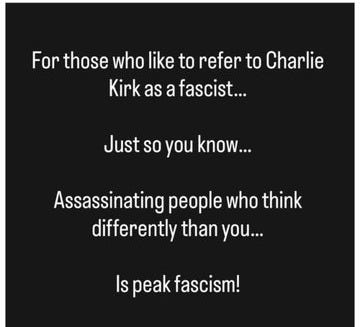
Hard to argue
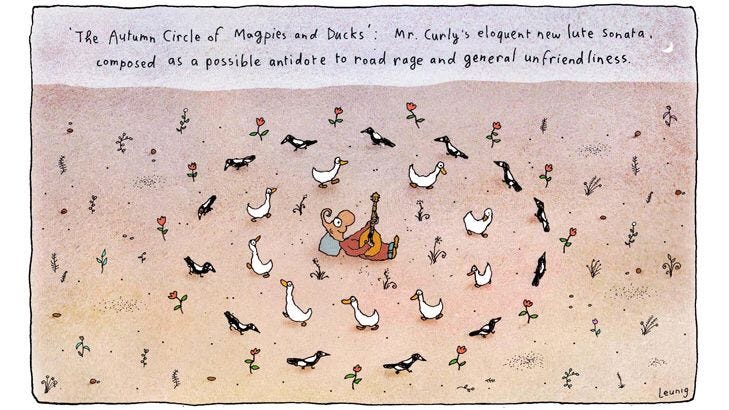
Uncomfortable collisions with social isolation
Why, in an age of constant connection, are so many of us lonelier than ever?
In this first part of my conversation with Jim Savage, friend, entrepreneur, dinner party host, acrobat and thinker on social connection, we dive into one of the defining challenges of our time: loneliness.
From the rise of singledom and the decline of community institutions, to the way technology amplifies our tendency to seek out people "just like us", we explore why friendship has become harder and why simple acts like talking to strangers seem rarer than ever. We also discuss the paradox of being wired for human connection yet behaving in ways that drive us apart, the subtle ways our social architecture is eroding and the importance of intergenerational exchange.
In that regard, check out I wish I'd asked, the intergenerational initiative I talk about. It’s fantastic. The audio file is here if you prefer to podcast it. I’ll also post our discussion of Jim’s new start up which tries to address loneliness and social isolation next newsletter. But if you click on this link you just might be able to check it out now.
Why does Curtis Yarvin hate our way of life?
I was intrigued. But I expected little but frustration from this debate between Yarvin and self-styled democratic radical and innovator Glen Weyl. Then there was a heavy handed moderator who took it upon himself to summarise, point by point, what the two protagonists had just said.
It was a sufficiently unpleasant experience that I tuned out about half way through. Yarvin’s analysis is comically flimsy. He thinks our institutions are collapsing into self-serving capture. So do I. Anyway, as I texted a friend, this was the line of reasoning:
Everything is going to shit
Therefore we should all worship the spaghetti monster - which has never been properly tried.
I'm sorry I'll read that again. Therefore, if someone puts out their shingle for "comprehensive dictator services" well, wasn't that what FDR did?
After all, having a dictator CEO works just fine for the most successful institutions - like Apple corp (unless and until its competitors beat it in the marketplace). And Yarvin’s on record for saying that a dictator CEO wouldn’t be such a great idea unless there were constraints on his power - like Apple’s board keeps its CEO accountable. His thundering silence on the point when his career started taking off as the right’s thought leader du jure is also on the record. Anyway, I always like to hear people I’m interested in - there are lots of cues about them that are hard to pick up from their written words alone. I found Yarvin very much not to my taste.
I didn’t expect much from Weyl, whose ideas are from the academy and start-up land, and so, unlikely to meet the current crisis which I think is a crisis of equality of speech or as the Greeks called it, isegoria. Anyway, given how willing that part of the debate I listened to was, he gave a good account of himself, and got to the nub of Yarvin’s bankruptcy. Rather like Karl Marx, Yarvin’s proposals about what to do are an afterthought. What he really wants to get off his chest is how shit everything is.
As Weyl put it:
Weyl: I mean, look, I think there's a lot of interesting things to discuss about the New York Times and the way the media works and how leaking in the government works. I don't think it has anything to do with whether one person should come in and control everything and stifle as much descent as they feel like or don't feel like doing and put people in … concentration camps. I mean, it just seems like those are very different questions. I mean, media reform is like an interesting question that we can debate. It's not the topic we're debating.
Yarvin: How would you go about media reform?
And so on.
Betty Chimney


In praise of Peter Thiel: Srsly

I may not like lots of what he’s done, but I think of Peter Thiel as probably the person who’s had more impact on the world than anyone else. He wrought the techbro view of the world (science and our innovative capacity are slowing down, everyone’s caught in memetic competition which is producing monocultures). This piece summarises Thiel’s disruptive support of the youngest and the brightest. I can’t help wondering how many of the youngest and the brightest participated in Australia’s productivity roundtable. Beyond what’s reported here, Thiel is also a mover and shaker in a similar initiative which takes Thiel’s cut down “just do it” philosophy into philanthropy - Emergent Ventures.
Launched in 2018, Emergent Ventures is a low-overhead fellowship and grant program that supports entrepreneurs and brilliant minds with highly scalable, “zero to one” ideas for meaningfully improving society. Mercatus faculty director Tyler Cowen administers the program, and a running list of Emergent Ventures winners can be found on his blog.
It’s an extremely simple process administered by a remarkable man in his spare time. Imagine if just a few philanthropists took a leaf out of his book. Imagine if there was a left of centre Peter Thiel.
Anyway, here’s the article on Thiel’s Fellowship program.
On Sunday, September 26, 2010, Peter Thiel and Luke Nosek, the PayPal cofounder, were on a plane from New York to San Francisco, when they had an idea: paying people to leave college.
Peter and a small team worked out minor details like whether this was legally allowed, and later the next day, he announced the first iteration of the Thiel Fellowship in an interview with TechCrunch. He'd give $100,000 to 20 people up to 20 years old — if they left school and started a company.
The famous contrarian, who'd by this point accurately predicted both the dot com and housing crashes, believed America was under the spell of yet another bubble: higher education. Specifically, the Ivy League. The economics didn't make sense ("You have to get rid of the future you wanted to pay off all the debt from the fancy school that was supposed to give you that future," Peter told TechCrunch's Sarah Lacy). But even deeper than that: the allure surrounding the Ivy League was itself immoral. Society shouldn't situate people's "best hope for a better life," as Sarah put it, "on something that is by definition exclusionary."
"If Harvard were really the best education, if it makes that much of a difference, why not franchise it so more people can attend? Why not create 100 Harvard affiliates?" Peter said at the time. "It's something about the scarcity and the status."
Outrage soon followed. A billionaire bribing kids to forgo their futures? Larry Summers, a former Harvard President (of course), called the Thiel Fellowship "the single most misdirected bit of philanthropy in this decade."
But today, as with many of Peter's heretical positions, criticizing the higher ed bubble, wherein students are commonly paying upwards of $90,000/year to learn how to do laundry and read Chaucer, is mainstream. And the Thiel Fellowship is gaining notoriety for producing so-called "unicorns" (billion-dollar companies) at a supposedly higher rate than top accelerators...
I interviewed the early architects of the Thiel Fellowship, Danielle Strachman and Michael Gibson, who're now cofounders and general partners of the VC firm 1517 Fund, to learn about what makes a Thiel Fellow a Thiel Fellow.
I think it's partially about preserving, and leaning into, your Weird.
Gumptious youngs
Initially, Peter hired Michael to help him teach a class at Stanford Law School on philosophy and technology. The two had bonded over their love of the philosopher René Girard, who came up with "mimetic theory," the idea that human desire is imitative, and that competition causes conformity. Michael's first day of work happened to be the chaotic birthday of the Thiel Fellowship. Danielle, who was skeptical of traditional education and herself, having started a charter school based on homeschooling philosophy, was hired by the next week.
In 2010, they set about finding young geniuses to protect from higher-ed's mimetic shenanigans...
"We came to hear it — this urgency and excitement and competence in the way they would talk about their field of interests," Michael said. "And they could scaffold the complexity of what they were talking about. They could go from a simple explanation to me, an outsider and ignoramus, to talking to an industry expert and being eye-to-eye with that person."...
Today, Thiel Fellow-founded companies like Figma, Ethereum, Anthropic, and OYO Rooms have created more than $750 billion in value...
Don’t compete
Michael and Danielle seem like the right people to back the unproven, because they don't take themselves too seriously. Their site at 1517 proudly boasts "No Patagonia Vests," and promises to help dropouts, renegades, and mad scientists "escape from captivity." In the interview with me, over Zoom, they appeared together in-person. "This is important," Danielle said while she physically poked Michael, who wore a car mechanic-looking suit that read: "Garage: parts and services."
"We're the pit crew; we're not the racer," Michael said.
The idea is something like: "We're going to change your tires."...
Per Michael, drawing on René Girard, the man who (kind of) started it all:
"The basic syllogism is something like the more you compete along single dimensions, the more alike you become. And the more alike you become, the fewer unique thoughts you have. So with college, it's like everyone is competing to get these exclusive seats at Harvard and Yale. What people haven't been paying attention to is the conditioning that puts upon the people in that tournament. It makes them all alike. So you have a lot of people who are becoming more and more alike to get those few seats. And there are superficial differences between them, but it's like looking at the market for water. Can you really tell me the difference between Fiji Water, Smart Water, and Dasani? It's like, okay, the packaging is different. There's all fake differentiation. Really it's the same. I think that's true of Harvard applicants. So what Peter was allowing was like, 'Hey, you don't have to participate in this tournament. And by not participating, your true individuality and uniqueness will emerge.'
"It's like that old WarGames quote: 'The only winning move is not to play.' So by not competing in this race, you're going to not become like those people," he said.
—Blake Dodge
Excellent piece
Classical liberalism faces unprecedented challenges today, threatened by authoritarian ideologies from both the Left and the Right. These ideologies, often labeled as identity politics, manifest in various forms such as intersectionalism on the Left and ethnonationalism on the Right. My career has been dedicated to defending classical liberalism—particularly its libertarian variant—against these threats. Over the past decade, I produced dozens of videos and films advocating for principled individualism, and collaborated with numerous prominent figures in the anti-identity politics movement while working at the Foundation Against Intolerance & Racism.
However, recent events, particularly following October 7th, have exposed a troubling hypocrisy among many of my former colleagues. While we once united under principles of treating everyone equally and applying the same rules universally, their embrace of Zionism—an ethnonationalist ideology—starkly contradicts these principles.
This has become painfully clear to me post-October 7th. I was raised as an Orthodox Jew (of the Modern Orthodox variety) and sent to private Jewish schools K-12 where instilling Zionism into students' identities was an explicit part of the mission. Despite being fully American, I was raised celebrating Israeli holidays, taught modern Israeli Hebrew, took classes in Israeli history (or at least a certain perspective on it), and spent my final semester of high school touring around Israel, a trip which included a week where we participated in a replication of the IDF's basic training and culminated in many of my classmates' first time shooting a gun—an IDF standard issue M16. (To see what this life is like for young Jewish-Americans, see the recent film Israelism)...
I was different, however. I'm not entirely sure why—some have suggested to me I may be mildly autistic—but I have a need for logical consistency; its absence gnaws at me, and I find it difficult to let it go. As such, my libertarianism, atheism, and anti-Zionism developed in tandem. Classical liberal philosophy is rooted in "life, liberty, and property," and a consistent application of property rights is core to the libertarian tradition...
Last year, I published my first book, Redefining Racism: How Racism Became "Power + Prejudice." The book tells the story of Leftist activists' decades-long attempt to redefine the word "racism" away from its traditional definition of "prejudice or discrimination based on race" to "Power + Prejudice," meaning any bigoted actions against a group with alleged institutional power—namely white people—cannot be called "racist."...
Recently I attended a meeting of conservative activists to promote my book. I explained my research to a room that nodded along in agreement and ended to applause; I even sold a few copies in the room. But I was not the only activist presenting that day. Another activist told the room about his project, a push to get the Senate to legally instantiate the International Holocaust Remembrance Alliance's "working definition of antisemitism." He too received impassioned agreement from the crowd. As someone who needs consistency, you can imagine my frustration...
Redefining "antisemitism" to include criticism of a foreign state is far removed from what most people think of when they hear the word. Dictionary.com defines "antisemitism" as "discrimination against or prejudice or hostility toward Jews." Merriam-Webster as "hostility toward or discrimination against Jews as a religious, ethnic, or racial group." The Oxford English Dictionary as "prejudice, hostility, or discrimination towards Jewish people on religious, cultural, or ethnic grounds."...
In the woke-era, conservatives have worked to conserve the definitions of all sorts of words the identitarian-Left has sought to redefine. "Racism" is hardly the only example, there's also "gender," "woman," "violence," "diversity," "equity," "inclusion," and more. Anyone who has taken a position against the redefinition of these words for activist ends, but supports redefining "antisemitism" for an Israeli political agenda, is either a hypocrite or never held a principled position to begin with.
I sincerely hope that my conservative friends will come around to see their inconsistency and change. Unfortunately, their track record leaves me pessimistic. In the meantime, I stand ready to work with anyone anywhere on the political spectrum to defend our ability to communicate accurately and fairly with each other, free of dangerous activist manipulations.
The destruction of 2,500 years of Western culture: the upside
New uses of old drugs: a few trillion go missing
I suspect this paper is a little naïve about IP protection which is pretty dysfunctional - because our legal system is dysfunctional. But it’s a hard problem. On reading the abstract I downloaded the paper and asked ChatGPT to summarise its basic argument and the extent to which it took account of existing IP incentives for new uses of existing drugs, and the problem known as ‘evergreening’, by which pharmaceutical companies manage to extend their patients well beyond the length of a single patent. Rather than reproduce the abstract - which you can find heading up the paper here, I asked ChatGPT to write me a 500 word blog post reflecting our conversation. It follows.
One of the quiet tragedies of our pharmaceutical system is that many potentially valuable new uses for existing drugs never get developed. We know from decades of science that most drugs are “promiscuous”: if a molecule is powerful enough to clear the FDA’s initial hurdles, it’s usually active against more than one condition. Studies have shown that blockbuster drugs almost always end up useful in multiple indications. Yet when you look at the FDA approval record, new uses fall off a cliff once generic competition arrives.
Why? Because the rules that govern intellectual property and exclusivity make it unprofitable to pursue those uses once generics are in the market. Patents on new indications—say, using a cancer drug for autoimmune disease—are technically possible. But enforcing them depends on being able to monitor how a drug is prescribed. Once generic copies are available, competitors can use “skinny labels” that omit the patented indication, leaving the brand company unable to detect infringement at the point of care. Physicians and patients may be infringing directly, but no one wants to sue them. In effect, the right collapses.
Regulatory exclusivity doesn’t plug the hole either. The FDA’s “new clinical investigation” exclusivity lasts just three years and only blocks generic approval for that specific indication. Meanwhile, the generic can keep selling the same pill for other uses. The result is that firms rush to commercialize any viable new uses during the initial exclusivity window and then stop. The paper estimates that since 1962, somewhere between 200 and 800 new uses have gone “missing” this way—foregone social value on the order of $2.5 to $10 trillion.
Instead, what do firms do? They chase alternative strategies that regulators treat as fresh drugs, most obviously fixed-dose combinations. Pair an expiring drug with another molecule in a single pill and you can secure a new round of market protections. This is classic “evergreening” or “product hopping”: the investment is real, but it’s distorted by the way incentives are structured.
So how do we fix this? The paper lays out three main pathways:
Make indication-specific rights enforceable. If payers could track prescribing at the indication level—say, through integrated electronic health records—it would be possible to reimburse differently for each use. That would let innovators actually capture returns on a new indication, even in a generic market. Pilot programs in oncology abroad suggest this is workable.
Experiment with privacy-preserving tech. A more speculative option is using tools like zero-knowledge proofs so that payers can verify a claim about indication-specific use without disclosing sensitive patient data. This could open a middle ground between protecting privacy and rewarding innovation.
Deploy pull incentives. Where enforceability can’t be fixed, policymakers can substitute cash. Advanced market commitments or prizes for validated new uses could create reliable rewards for companies willing to run the trials. This is the same toolkit used for vaccines: public funders commit to buy at a set price if the product clears the scientific bar.
The bottom line is not that firms are lazy or greedy. It’s that the current rules push them into evergreening instead of genuine innovation. If we want more lifesaving uses for the drugs we already have, we need to design institutions that reward the right kind of work.
Some lovely pics


Misha’s Kvetch on Israel’s founding fathers
By friend, Zionist and right wing firebrand on Twitter, Misha Saul. A good piece.
The Gaza Strip was an embarrassing subject; under Egyptian rule, it was dangerously close to Israeli centers, but ruling hundreds of thousands of refugees was also a bad option.
"If I believed in miracles I would want it to be swallowed up by the sea"
— Ben-Gurion, 1956, in 'Ben-Gurion, Father of Modern Israel' by Anita Shapira
Related: Herzl's Dream, The Hundred Years' War on Palestine, On Gaza
There's a lot that's surprising about the lives of the early Zionist fathers. Ben-Gurion, a Plonsk shtetl Jew who in his early-teens first adopted spoken Hebrew with his Zionist compadres, singularly propelled spoken Hebrew (a rarity) to a hallmark of Plonsk's Zionist youth. He later learned Turkish in three weeks. Jabotinsky was an Odessan cosmopolitan, an author and playwright, a cad who could flirt seamlessly in Italian and almost a dozen other languages. ... For pioneers of a nascent nation to be forged in war, they were surprisingly intellectual. Ben-Gurion was book obsessed, building a huge library into his first home, and startling Isaiah Berlin with his inner life. Jabotinsky translated Dante, Poe, and Byron into Hebrew. ... For an agrarian socialist, Ben-Gurion hated the farming life. For his reputation as a nationalist firebrand, Jabotinsky was not much of a warrior.
Ben-Gurion's agrarian socialism seems arcane and bizarre today, and it's easy to forget how dominant and very literal it was in early Israel. Ponder this paragraph, for example:
Neither the Weizmann-dominated Executive nor the Labor Zionist–controlled Council wished to see a large influx of European Jews who were not interested in agricultural pioneering. Their first priority was not maximally increasing the Jewish population of Palestine... Rather, as Weizmann stated, it was 'converting into peasant farmers an urbanized people' as part of the transformation of values in Jewish life that Zionism stood for. (Hillel Halkin, Jabotinsky)
Jabotinsky's nationalism and emphasis on a Jewish majority seem clearly correct. And when you look upon Israel today, it's proven prescient. Labor is no more. Agrarian socialism is no more. Jabotinsky's heirs in Bibi and Likud have become totally dominant. And yet, Ben-Gurion and his Labor Zionists were essential to the creation of Israel and to forging the modern Israeli. ... It took their collective wills and difficult decisions and risks to navigate the time between Herzl's death in 1904 through WWI, WWII and the Holocaust, and the great power politics and violent pangs from which the State of Israel was born. It's impossible to isolate a single cause — a man or thread of events — in this maelstrom. Even with the benefit of hindsight none of it seems inevitable.
We glimpse into early decisions that, each small enough at the time, have since ballooned out of all proportion. ... And then there are the Arabs…
One thing clearly binds the arch-rivals: an explicit belief in their own indomitable wills. Incredibly, it appears that in the incredible milieu of ideas that percolated in the early 20th century, they both picked up direct Nietzschean influences via writer and thinker Micha Yosef Berdyczewski.
... In their different ways, both men absorbed this idea, moving beyond their inherited traditions to bend history to the will of a new Jewish self. Jabotinsky and Ben-Gurion both believed in an agentic nation, a people who would make of themselves what they chose. And each lived that same forceful will in leading their respective Zionist movements against their enemies and each other. ...
It's striking how mortal both leaders appear, at least in the tellings of Shapira and Halkin. Both were prophetic, but deeply fallible. My favourite Ben-Gurion mistake was how he bet on the Ottoman empire in WWI:
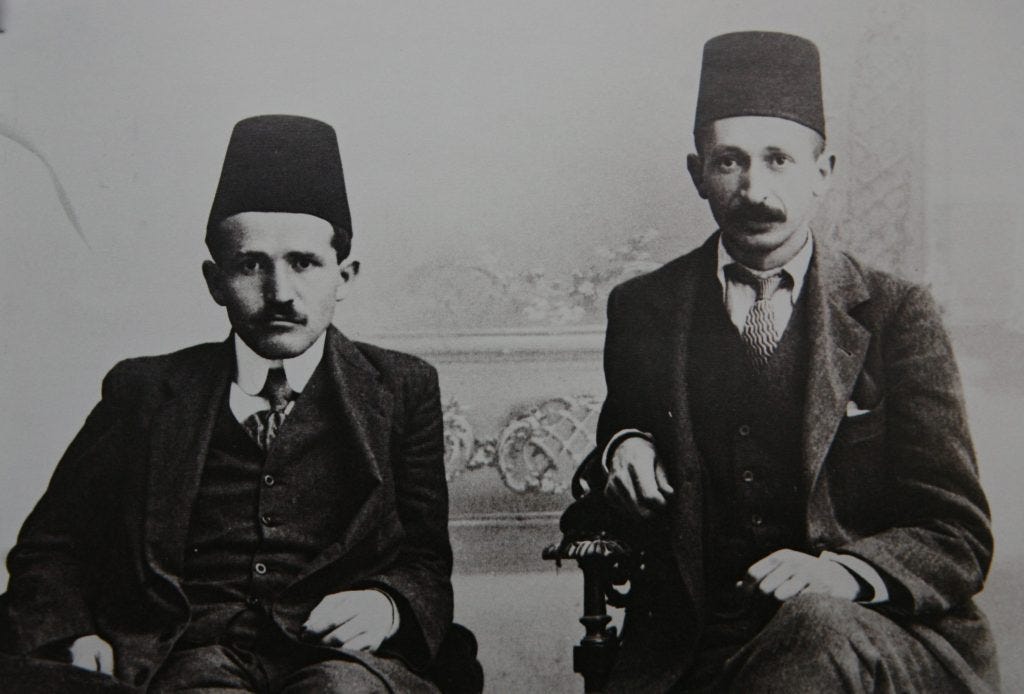
Ben-Gurion and Ben-Zvi disembarked in Jaffa sporting thick mustaches, red fezzes, and Turkish-style suits. This Ottoman look reflected their belief that the future of Jewish Palestine depended on the attitude of Turkey, so the correct policy was to gain Turkey's trust in its Jewish subjects.
A photo of them in fezzes exists! ...
What would they have been today? What hinge of history would they have pressed on? How would they have forced the world to their wills? Probably they would have just been fine middle class professionals — lawyers or academics or writers — complaining about house prices. It was both their curse to live through the greatest horror to befall their people, and their greatest blessing to answer the call of destiny to lead them out of bondage to the promised land.
PS. Isn't Ze'ev (or Zev) just a fantastic boy's name? God willing…
Defs worth a listen

Missing Markets for Innovation: Evidence from New Uses of Existing Drugs
Eric Budish, Maya M. Durvasula, Benjamin N. Roin, Heidi L. Williams #34222
For large classes of potential inventions, intellectual property rights that are available on paper are either not possible or not profitable for firms to enforce in practice. In this paper, we show that these missing incentives yield quantitatively significant underinvestment in research and development. We develop a simple model that formalizes the conditions under which such missing markets for innovation arise. We identify an empirical setting—research into new uses for existing drugs—in which there is sharp variation in the enforceability of intellectual property rights on otherwise comparable inventions over time. We show that when intellectual property rights become unenforceable, research investment and commercialization nearly cease. In doing so, we test two claims central both to our model and the innovation literature more generally—that stronger intellectual property protection does, in fact, induce investment, and that heterogeneity in the availability of ! these rights distorts investment. The welfare consequences of inadequate incentives in our empirical context are large. Our estimates suggest that 200-800 new uses for existing drugs would have been developed under counterfactual policies. Measures of the value of these uses drawn from existing literature suggest that the social cost of this particular missing market is on the order of several trillion dollars.
Wonderful!
Blast from the past
I was intrigued by this passage from Gordon S Wood’s The Radicalism of the American Revolution. In particular it described what happened in the American economy as it headed towards an ‘ideal’ state that economists call ‘perfect competition’. As you’ll see, in perfect competition all things other than the competition are driven out. All the way economic problems are solved by grace and favour and good behaviour in communities where everyone knows each other so it’s a big deal not to play along. And before the revolution the founding fathers had all been rentiers and financial pillars of their community. They lent out money - and did so at a profit. They weren’t too crazy about paper money messing up their nice little earner.
When “exchange” became the primary element of the economy, said Baldwin, then paper money became more important. “The rapidity and quick succession of exchanges” required increased quantities of money, and this paper money had democratizing effects. James Madison, like gentry creditors everywhere, may have earlier condemned paper money as destructive of “that confidence between man & man, by which the resources of one may be commanded by another.” But now many were extolling that same destruction of confidence between one man and another, for such confidence was simply another name for authority and dependency. In a traditional intimate society it had been possible for a gentleman with a reputation and property to deal with everyone personally.
But, said the physician Erick Bollman (a former participant in the Burr conspiracy) in 1810, gentlemen could not relate to people in such a personal manner anymore. When they wished, for example, to buy a turkey from a farmer, they could not say, as they had used to, “I own the big house at the corner of Ninth and Chestnut Street,” and expect the farmer to tip his cap and deliver the turkey on credit. Now the farmer will say, “What is that to me!” Proprietary wealth, conspicuous property, personal reputation, and genteel authority did not matter as they had in the past.
What the farmer wanted now was ready money, and it did not matter from whom it came: “I want a dollar,” says the farmer, “or else you cannot have my turkey.”
All these commercial activities and exchanges had corrosive effects on what remained of the traditional patronage and hierarchical confidences between men in the society. Merchants, like the Bull brothers of Hartford in 1802, now advertised they had the “cheapest store” by setting forth “the following rules—no trust, no goods sent out, no samples given, no abatement in price first asked, no goods delivered until paid for.” Paper money made these new rules possible: it destroyed personal trust, but at the same time it liberated men from older personal dependencies. All this trade and trafficking by different individuals freed men from traditional restraints and stimulated what Niles’ Weekly Register in 1815 called “the almost universal ambition to get forward.” Laborers felt freer working for money wages than they had serving apprenticeships or existing in barter relationships with superiors. Even Caesar Rodney, the attorney defending the Philadelphia cordwainers in their conspiracy trial in 1806, was willing to accept the new liberal notion that labor was a commodity bought and sold in the market. America was different from Europe, said Rodney, who was soon to become Jefferson’s Attorney General. In the Old World, “statutable provisions fix and regulate the price of everything almost.” But “here honesty and industry are sure to meet a due reward.” It was not their newfound independence from their masters that the cordwainers objected to; they simply wanted their employers to recognize that they lived in a new country “where the poorest individual can claim the full price of his labour,” and was free to withhold that labor from the market if he were not satisfied with the price.If everyone in the society was involved in moneymaking and exchanging, then to that extent they were all alike, all seeking their own individual interests and happiness. “The market house, like the grave, is a place of perfect equality,” said Philip Freneau in bitter derision. But he was right. All this commercial activity did promote equality, yet not, of course, equality of wealth. Quite the contrary: wealth was far more unequally distributed in the decades following the Revolution than it had been before. Nonetheless, early-nineteenth-century Americans felt more equal, and for many of them that was what mattered.
And from a little later on.
For middle-class people busy in the making of money, clergymen issued what one of them in 1810 called "Short Sermons, Designed for the Use of Those Who Have Little Time to Read Longer Discourses." Digests and shortcuts to gentility—in particular, scores of etiquette books for anxious mobile people—became increasingly common. Etiquette books were now even written for children, as Americans realized they could no longer wait two or three generations to make a gentleman. "Manners" became equated with sets of rules to be learned, and were now taught in schools. Some of the rules suggest how deep into the society gentility was trying to reach: people were never to sleep in any garment worn during the day, never to sit in a house with a hat on in the presence of ladies, and never to remind others of their lowly origins; it was, however, still polite to eat food off a knife as long as one's lips were not closed over the blade.
These middle-class pressures worked to popularize the morality of the Revolution. Virtue, in the North at least, lost much of the rational and stoical quality befitting the classical heroes the revolutionary leaders had emulated. Temperance, for example, that self-control of the passions so valued by the ancients and one of Cicero's four cardinal virtues, became mainly identified with the elimination of popular drunkenness—"a good cause," declared the Franklin Society for the Suppression of Intemperance in 1814, in which "perseverance and assiduity seldom fail of securing the denied object."
A republic, Parson Weems, the entrepreneurial biographer of Washington and a colorful spokesman for the new middle-class values, wrote in 1802, was "the best government for morals." It was a traditional statement, no doubt, but in Weems's updated early-nineteenth-century version the morals had become vulgarized. A republic meant no "sordid monopolizing aristocracy" to soak up money and prevent a "poor tax-ridden mother" from having enough to pay for light to mend her children's stockings. A republic was now valued for being "the cheapest of all governments, where every citizen may easily attain property sufficient to purchase books—to command leisure—and to acquire taste and knowledge." A republic was where frugality was "fashionable" and "wealth pours into every pocket." A republic was "a government where the man is looked at and not his fine coat." A republic was "the best remedy under heaven against national intemperance"; it "imparts a joy that loaths the thought of drunkenness." And finally a republic was where citizens, "seeing themselves treated with equal fairness and impartiality," knew "no pangs of jealousy and hatred: hence every countenance is bright with smiles of contentment, and every heart glows with sentiments of BROTHERLY LOVE."
These middle-class pressures also worked to alter fundamentally the role and position of women in America. Since civilizations were now being ranked by the way they treated women (did not "savages" regard their women as "beasts of burden"?), enlightened men with genteel aspirations were eager to escape from those "barbarous days" when a woman was "considered and treated as the slave of an unfeeling master." That sort of traditional patriarchalism had to go. Women now had to be treated with particular delicacy and love. "A woman of virtue and prudence is a public good—a public benefactor." She had the power to make "public decency … a fashion—and public virtue the only example."
From Gordon S. Wood, The Radicalism of the American Revolution, which you can buy here.
How Much Tax Do US Billionaires Pay? Evidence from Administrative Data
Akcan S. Balkir, Emmanuel Saez, Danny Yagan, Gabriel Zucman #34170
We estimate income and taxes for the wealthiest group of US households by matching Forbes 400 data to the individual, business, estate, and gift tax returns of the corresponding group in 2010–2020. In our benchmark estimate, the total effective tax rate—all taxes paid relative to economic income—of the top 0.0002% (approximately the “top 400”) averaged 24% in 2018–2020 compared with 30% for the full population and 45% for top labor income earners. This lower total effective tax rate on the wealthiest is substantially driven by low taxable individual income relative to economic income. First, the C-corporations owned by the wealthiest distributed relatively little in dividends, limiting their individual income tax unless they sell their stocks. Second, top-owned passthrough businesses reported negative taxable income on average in spite of positive book income, further limiting their individual income tax. The top-400 effective tax rate fell from 30% in 2010–201! 7 to 24% in 2018–2020, explained both by a smaller share of business income being taxed and by that income being subject to lower tax rates. Estate and gift taxes contributed relatively little to their effective tax rate. Top-400 decedents paid 0.8% of their wealth in estate tax when married and 7% when single. Annual charitable contributions equalled 0.6% of wealth and 11% of economic income in 2018–20.
Interesting post on Poland

In recent years, no issue has posed as much of a problem for Western liberals as immigration. Backlash to immigrants was key to Trump's two victories, the vote for Brexit in the UK, and much of the right-wing surge that has remade European politics...
Nowhere is this more obvious than in Poland, where the promises of European cooperation, internationalism, and progress remain strong—but where the threat posed by irregular migration has caused severe political backlash. Poland's government—a centrist coalition led by Prime Minister Donald Tusk—has navigated the awkward position of being liberals in government at an illiberal hour. They have explicitly suspended the right to asylum on one of Poland's borders and found themselves testing the limits of European and international law...
In 2021, a slow drip of immigration gave way to crisis. In August of that year, Belarussian leader Aleksandr Lukashenko began offering "tourist" visas to huge numbers of African and Middle Eastern migrants, allowing them to enter Belarus, before forcing them to cross the Polish border...
Poland's PiS government implemented a policy of automatically returning captured migrants to Belarus—a method of return known as "pushbacks." Human rights advocates denounced the policy as a violation of the principle of non-refoulement, the international legal stipulation that refugees may not be returned to a country in which they are in serious danger...
Six months later, Vladimir Putin invaded Ukraine. Millions fled, and many headed for Poland. Poland accepted over a million refugees in the first months of the war, and passed laws to immediately give them the same access to schooling, social benefits, and healthcare as Poland's own 40 million citizens...
Activists decried the striking disparity in attitudes towards the different groups of refugees: tens of thousands were being rejected and pushed back into Belarus, millions let in from Ukraine. Yet these steps were broadly popular: Poland's animosity towards Russia, the sense of control over the Polish-Ukrainian border, and the similarity of Polish and Ukrainian language and culture made acceptance socially possible where it had not been for those coming from Belarus...
Liberal political parties, realizing the new political reality, ran tough on migration in the 2023 Polish parliamentary elections. They won a decisive victory after eight years of PiS-dominated government.
The new liberal coalition faced two border crises, public sentiment that had moved sharply against non-Western migrants, the ever-present threat of the PiS's return to power, and the need to repair Poland's relationship with European institutions. Their response was the 2025-30 Migration Strategy, issued in late 2024... The Strategy exploded in controversy for proposing a suspension of the right to apply for asylum on the Belarussian border...
When I interviewed him this summer, Maciej Duszczyk, Undersecretary of State in the Polish interior ministry and architect of the Strategy, justified the government's actions by invoking the security threat of Belarus' instrumentalization of migrants...
Poland's former Justice Minister, Adam Bodnar, justifies the policy by arguing: "if you are not controlling the border, it means that you are not effective [...] the effectiveness of the government should be cherished in defending liberal democracy, or you create a chance for voices against liberal democracy to create a fully illiberal project."...
Despite criticism, Duszczyk is convinced his approach is working. In a two-month period after the asylum suspension, illegal crossings from Belarus fell by 48% compared to the same period in 2024. At the same time, in all of 2024, there was one death—out of 30,000 attempted crossings—in Polish territory...
Other countries are following Poland's example. The EU has gone from condemning the pushback policy to embracing the Polish government's rhetoric of itself as the "Eastern Shield" of Europe...
The current political moment in the West is one in which the memories of war and genocide still ring loudly for many, especially for liberals. It is also one where political momentum is with ideas of stability and nationhood, and where most people do not want 75-year-old international legal schemes forcing their government to accept migrants. As long as both of these things are true, liberal governments will be in an awkward position and will need to make uncomfortable compromises.
Depressing listening (if you don’t fancy dictator CEOs)
Peter Drucker: another anti-totalitarian Viennese import
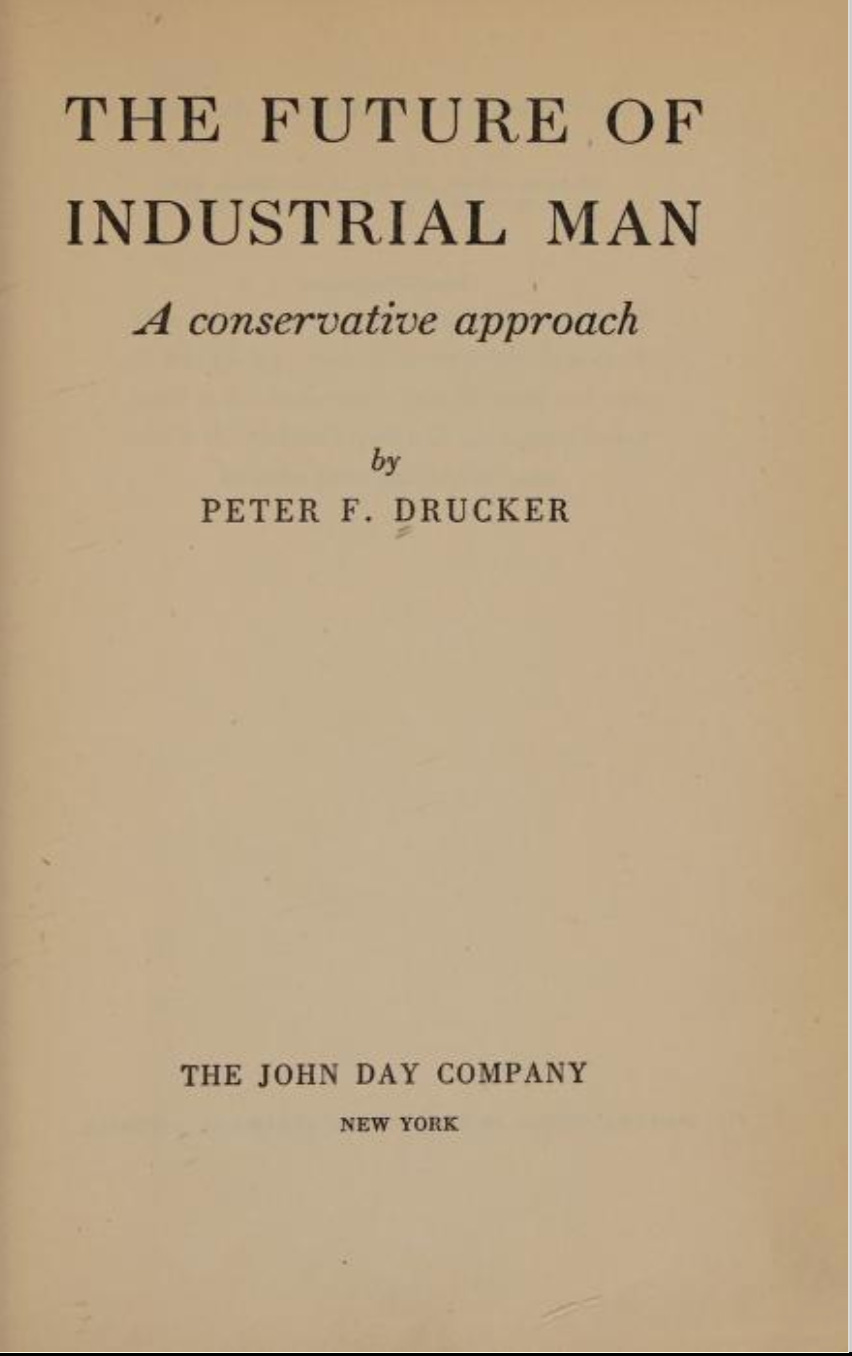
Peter Drucker was part of a generation of Viennese folks who got out before WWII. People like Friedrich Hayek, Karl Popper and Karl and Michael Polanyi (Ok, they came from down the road in Budapest but they also spent time in Vienna.) They all saw themselves as campaigners against totalitarianism. But unlike the others, Drucker didn’t set the world on fire with his big anti-totalitarianism book The Future of Industrial Man (1942) and he set to work where the competition was less intense. Business management. Anyway, I ran into this distillation of Drucker’s advice on the latter score on Linkedin.
One of the first books I ever read on management was “Innovation and Entrepreneurship” by Peter Drucker and I instantly became a massive fan of this brilliant man whose insights were always insightful and practical.
Yet we rarely here about Drucker today despite many business leaders repeating many of the same mistakes that he pointed out in his many books.
So what are the top ten Drucker lessons we keep ignoring 👇
1️⃣ Management is about people, not systems - Too many organisations still put processes and policies ahead of human motivation, talent, and wellbeing.
2️⃣ Build on strengths, not weaknesses - Most appraisal systems are designed to highlight what people can’t do, rather than unleashing what they can.
3️⃣ The purpose of business is to create a customer - Shareholder returns are a result, not the mission.
4️⃣ Effectiveness beats efficiency - Optimising the wrong activity is still one of the biggest failures in business – leaders get busy, but not better.
5️⃣ Objectives, not micromanagement - Clear goals + freedom to achieve them = performance. Micromanagers kill productivity and trust.
6️⃣ Knowledge workers need autonomy - Managing by presence (or worse, surveillance software) completely misses the point of modern work.
7️⃣ Culture eats strategy for breakfast - Yet culture-building is still dismissed as “soft stuff” until the business starts failing.
8️⃣ Decentralisation and simplicity win - Big firms still love bureaucracy, layers of management, and endless approvals, all of which kill agility.
9️⃣ Innovation and change aren’t optional - Too many companies only act when disruption is already burning down their market. By then it’s too late.
🔟 Time is the scarcest resource - And yet most leaders spend their weeks in pointless meetings and fire-fighting, not on what truly matters.
Figuring out China
I saw Keyu Jin give an impressive a couple of weeks ago, so checked out this podcast. Fridman the presenter seemed a bit dim to me, and seemed a bit flummoxed by the idea that China might be politically centralised and economically decentralised. But that’s what his guest was arguing and it’s obviously true. The way in which cities compete is a very interesting way for competition to work its way into an economy. And it doesn’t take my fertile mind long to wonder whether what advantages this might have over competition as we’re familiar with it. Given that many, many goods are partly private goods and partly public goods, it’s certainly easy to believe that this could give innovation a big boost. Anyway, I recommend the podcast. I’ve also read a fair bit of her book The New China Playbook, which is also good, though I found it a bit repetitive.
And see Isabella Webber’s effort below.
Heaviosity half-hour
Isabella Webber on Chinese liberalisation
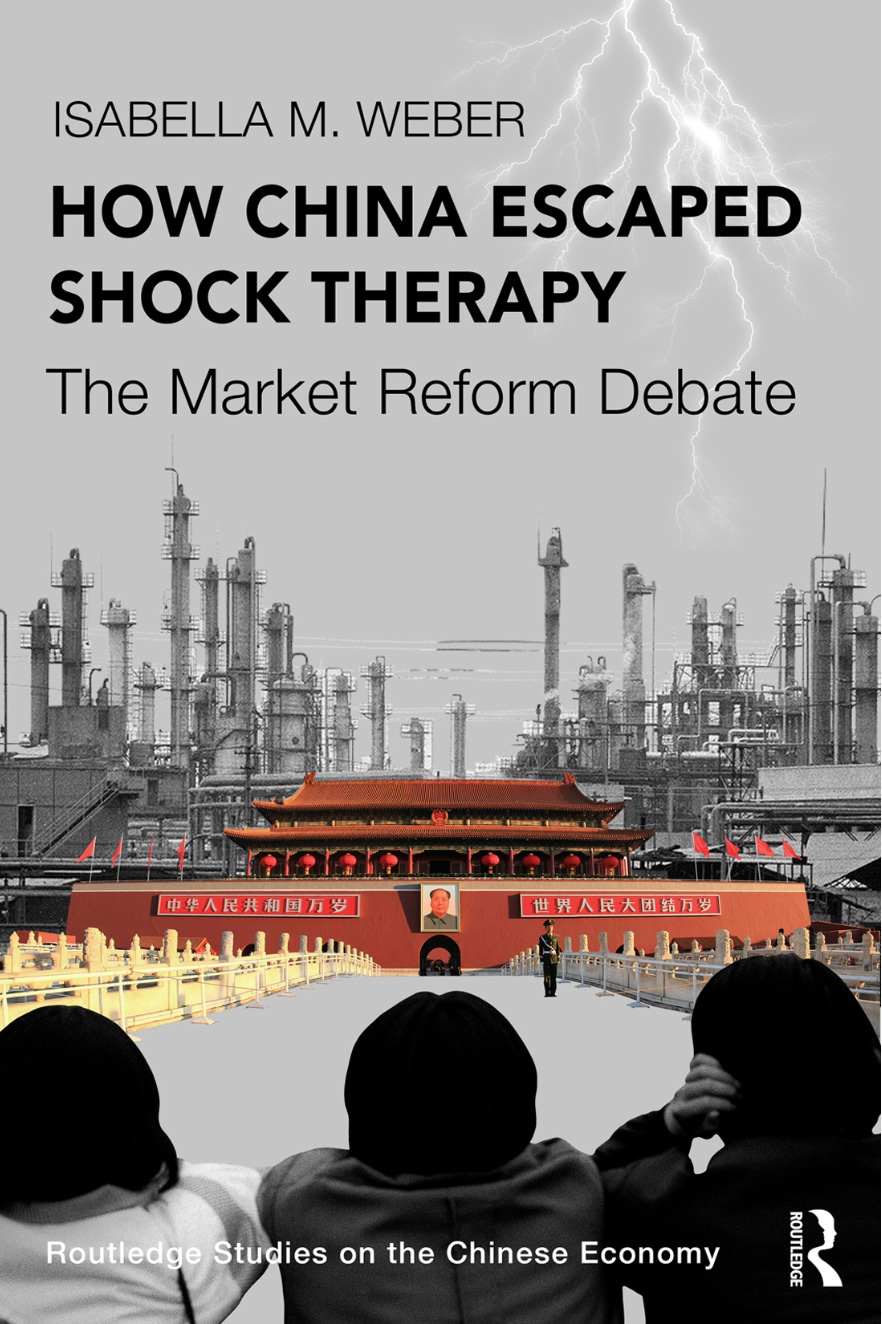
A while back I listened to Isabella Webber’s How China Escaped Shock Therapy: The Market Reform Debate. Having been through a reform process in which the economists and politicians insisted that the economy conform to their textbooks I loved reading what was a kind of intellectual thriller in which one faction of the Chinese leadership fought to devise their own reform path based on the stage their economy was at and their own intellectual traditions reaching back to the 7th century BC. What appears below is heavily edited back from the overly long Chapter 7 (an occupational hazard of PhDs that become books.)
Two roads diverged in a yellow wood,
And sorry I could not travel both
And be one traveler, long I stood
And looked down one as far as I could
To where it bent in the undergrowth….The 1984 decision instituted the dual-track price system as national policy. The logic of multi-tier pricing that kept the core of the system working while introducing markets from the margins had become the dominant reform approach. In January 1985, the State Price Bureau and the Material Allocation Bureau followed the instruction of the State Council and issued the "Notice on Deregulating the Self-Marketing of the Overproduction of Industrial Raw Materials." The previous limit of 20 percent upward or downward deviation from the planned prices for above-quota sales of raw materials such as steel, wood, and cement was abolished. This might sound like a technical detail, but it meant that the heart of the industrial economy was now officially under the dual-track price system and on its way to being marketized...
On April 12, 1985, Cheng Zhiping made an official announcement on state television:
In 1985 the basic direction for price reform is: Combine adjusting with letting go and progress in small steps. … The centrepiece of reform will be liberalising the prices of live pig and pork and the rural purchase and sales prices for grain.…
Cheng Zhiping's words have the tone of a mundane bureaucratic announcement. In fact, his statement marked the end of the backbone of the Maoist agricultural economy: The unified grain procurement system was abolished. The core of this system had been a compulsory quota of grain delivered by the rural communes to the state at a centrally set price. The massive increase in grain output in the early 1980s had brought this grain distribution system to its limits...
The transformation of China's agricultural economy, the expansion of the dual-track reform to the heart of the industrial economy, and the upward pressure on prices provided the backdrop for a dramatic clash between the two marketization paradigms—gradual marketization and shock therapy—in the second half of the 1980s. By 1985, the dual-track price system regulated the core of the Chinese economy: grain and basic industrial inputs. Opening a market track while keeping state procurement intact, the dual-track price system allowed the possibility of both a return to a greater emphasis on the plan as well as a more radical shift to the market.
On the other hand, those who had long aimed for rationalizing the price system in one "big push" took an acceleration of industrial growth in 1985 and macroeconomic imbalance as signs of overheating caused by the dual-track price system and launched a forceful campaign to impose strict macroeconomic control to prepare for a big bang in price reform. Such a big bang would have been the first, decisive step of shock therapy. As explained in the Introduction, a big bang in price liberalization was the truly "shocking" element of shock therapy...
Preparations for "One Big Step"
[I]f we don't take hard-hitting measures to supersede the dual-track system in a relatively short time and immediately establish a preliminary framework for the new system, problems will grow…. (Wu, 2013b [1988], 201)
As soon as the dual-track price system became official policy, it was fiercely attacked by economists inspired by neoclassical economics, monetarism, and the approach of the Eastern European reformers. They argued along the lines of Šik's proposal for price reform but brushed aside his warnings regarding the limitations of his approach. In this view, China had to impose strict macroeconomic austerity, adjust prices to calculated equilibrium values, and then, finally, liberalize prices in "one big step." They thus argued for the core elements of the big bang—the first and decisive step in shock therapy.
Setting the Stage for a Big Bang in Price Reform
One of the leaders of the attack against the dual-track price system was Wu Jinglian. Wu's view was and is that the approach of "groping for stones to cross the river" was inevitable while China's leaders and advisors lacked knowledge of modern mainstream economics. But it had become obsolete by the mid-1980s, as Chinese economists had progressed to new levels of scientific economic knowledge thanks to the support of foreign advisors. Wu himself exerted great efforts to acquire knowledge of "Western economics." He was one of the pioneers among Chinese reform economists in the United States when he was a visiting scholar at Yale University (January 1983–July 1984)...
This was not Wu's first encounter with leading economists of the Western world. He had been engaged with the World Bank mission, and in 1981 he attended a conference on "The Economics of Relative Prices" organized by the International Economic Association in Athens, which included prominent participants such as the Soviet mathematician Leonid Kantorovich and the Oxford economist Sir John Hicks, both of whom had won the Nobel Prize in the 1970s, as well as Herbert Giersch, who was soon to become president of the neoliberal Mont Pelerin Society. At this conference, Wu first met Janós Kornai. Kornai shaped Wu's thinking on reform, and Wu became Kornai's greatest advocate in China, promoting the translation of his works. Both men had been champions of the respective orthodoxies in Hungary and China earlier in their lives and were now in the process of becoming radical market reformers with Wu, following in Kornai's footsteps...
At the conference in Athens, Kornai clashed with V. R. Khachaturov, then-president of the Soviet Economic Association. Khachaturov held that shortages arose from planning errors and could be overcome by raising the standard of planning. Kornai, in contrast, took the position of his book and blamed shortages on the nature of the system of a socialist planned economy. It follows that the only way to overcome shortages, in Kornai's logic, is to get rid of central planning...
Wu and Kornai were united in their conviction that reform could be achieved only as system change. But there was a crucial difference in analysis between Wu and Kornai. Kornai had argued that enterprises experienced a soft budget constraint under socialism. Since enterprises were not ultimately responsible for their losses, price signals were relatively ineffective in guiding the production decisions of socialist enterprises. In Kornai's terminology, enterprises had low "price responsiveness." The softness of the budget constraint was like a tranquilizer, according to Kornai: "It leads to the economic managers hardly to be bothered by any kind of price signals." This meant that enterprises were demanding whatever inputs they could get hold of, largely independent of relative prices or financial constraints...
Wu praised Kornai's paper. But a close reading of both of their contributions at the conference reveals a logical inconsistency between Kornai and Wu. Wu suggested, "The price system is a mechanism for replacing bureaucrats" and urged for price reform. According to Kornai, enterprises under socialism did not actually care too much about prices; according to Wu, though, they should be guided by prices alone...
Wu represents a prominent example of a Chinese economist who joined the transnational network transcending the Cold War divide that Bockman has identified as the breeding ground for neoliberalism in Eastern Europe. But Wu was by no means alone in his engagement with Western economics. A CIA report rightly observes that by the mid-1980s, "increased familiarity with Western economic concepts [was] not limited to one group of scholars or bureaucrats." The divide across these groups was not in their interest for Western economics but in their approach to this new knowledge—either as tools that China could use in carving out a feasible reform path or as the theoretical source for "reform blueprints" to manufacture system change...
In the summer of 1984, Wu returned to China from his studies at Yale and joined the State Council's Development Research Center. He discovered that the young reform intellectuals had gained great influence since his departure to the United States. They were promoting a gradualist, experimental approach of "groping for stones to cross the river," which Wu considered an inferior method of reform, a makeshift solution that China had to rely on when it had lacked knowledge of "Western economics"...
Wu Jinglian propagated his view in various academic and popular publications. In May 1985, he expanded on a previous article in People's Daily (February 1985) in the prestigious journal Economic Research and laid out his vision for reform in one stroke. Wu essentially summarized the presentations by Šik and Brus and drew on Kornai's Economics of Shortage to argue that the economic system would form an interrelated, organic whole and could, as such, only be reformed by a wholesale transition to a new system. Comparing a gradual to a package approach, Wu recommended the latter...
Most importantly, price reform had to set an end to the dual-track price system. To make his main point, Wu quoted Friedman's 1981 talk in China, saying the "so-called economic miracle produced by Ludwig Erhard in 1948 was a very simple thing." According to monetarism and based on the post–World War II German experience, Wu argued that it was crucial to tightly control the quantity of money and impose fiscal austerity. This was meant to prevent inflation, which Wu considered a sufficient condition for the implementation of swift price reform...
To create an institution that would publicize the lessons from the Eastern European experience as articulated by Brus, Šik, Kornai, and others, Wu Jinglian, Zhao Renwei, and Rong Jingben founded a new journal called Comparative Economic and Social Systems in 1985. An article published in the journal's inaugural issue by Guo Shuqing as lead author exerted immediate political impact.
Guo Shuqing later became the governor of China's industrial province Shandong (2013–2017), and he is currently the chairman of the China Banking Regulatory Commission. At the time, Guo was a doctoral student at the Institute for Marxism Leninism and Mao Zedong Thought of CASS, and he was thus well versed in orthodox Soviet views while studying Western mainstream economics. Together with his fellow students and coauthors Liu Jirui and Qiu Shufang, he forcefully promoted package reform with market-oriented price reform at its core...
Guo's views on price reform closely resembled those of the Eastern European visitors. Guo laid out, in January 1985, that the first step would be to clearly define the target model. He held that "truly [understanding] the Marxist approach to social value" would mean recognizing "that market value is the only concrete and realistic form of social value" and thus, market pricing was the only right target for reform. The only exception should be prices of those goods defined in neoclassical economics as public goods, such as transport, communication, and health, which should be set by the state. But these goods should not include key industrial inputs such as steel or basic consumption goods such as rice. Those should be fully left to the free market.
Guo took an even more radical stance on the dual-track reform than Wu. He dismissed the dual-track price system as "not acceptable even as transitional model." Similar to the conclusion reached by the foreign experts at the Moganshan World Bank Conference, Guo believed that "allowing one product to have multiple prices is absolutely incompatible with the commodity economy"...
In April 1985, Guo, Liu, and Qiu published their views on "comprehensive reform" with price reform at its core in the new journal Comparative Economic and Social Systems and proposed their recommendations to the State Council in a letter. Like Wu describing the "economic system as an organic whole," they stressed that the price system "is the whole economic system from one angle." They argued that "comprehensive reform is a huge task of social system engineering" and as such would require an "overall plan" to move toward the "target model"...
Furthermore, in their view, as long as the old system prevailed, "investment hunger" and excess aggregate demand manifested in shortages must prevail. Rapid economic growth and economic system reform were incompatible. The Eastern European reform had shown that the only way was to strictly control aggregate demand and then implement a "comprehensive" package of reforms...
They added a negative case to the list of the West German and Japanese miracles crafted to support the "mantra" of macroeconomic austerity plus price liberalization. The Polish case of the 1970s would prove that gradual reform must fail. The Poles failed to carry out their plan of wholesale price reform and instead limited the scope to about 40 percent of the industrial products. Initially, this brought about very fast growth fueled by uncontrollable aggregate demand. However, "[w]hen Poland was at last forced to reform prices, the result brought on a social crisis"...
Zhao Ziyang read their report on May 19, 1985, and said that it could only be beneficial, and not harmful, to further explore this line of reasoning. The State Council ordered a working group to be set up under the State Commission for Restructuring the Economic System, which worked throughout June 1985 to draft a reform program along the lines proposed by Guo Shuqing, Liu Jirui, and Qiu Shufang...
The working group presented their results to the State Council on July 27–29, 1985. Just a few months after the official implementation of the dual-track price system, this was not the ideal moment to make a sharp turnaround and go for overall price reform in one stroke. Yet, the young intellectuals, with the support of their older-generation counterparts, had managed to put the possibility of a planned, overall reform in one go into the minds of the leadership. In only a couple more months, preparations to realize the grand plan for one big bang were undertaken.
Foreign Tailwind: The Bashan Boat Conference
The campaign for macroeconomic restraint and wholesale price reform gained support of great symbolic value from participants in a second major conference jointly organized with the World Bank, which was held on the MS Bashan cruising the Yangtze River from September 2 to September 7, 1985. In February 1984, when the World Bank mission visited China for their second report, Liao Jili, one of the high-ranking participants in the Moganshan World Bank Conference, had suggested planning another reform conference...
The ambition to invite Nobel Laureates indicated that this conference was not to be "under the radar" like the Moganshan World Bank Conference but that a group of world-renowned experts should help draw public attention and create further momentum for market reforms. In fact, up till today, the Bashan Conference remains a widely known and celebrated event among certain circles of market reformers in China and internationally...
Other members of the foreign "crocodile" who stood out for their contributions to the pivotal question of price reform included the Nobel Prize–winning New Keynesian James Tobin; Otmar Emminger, the former director of the Bundesbank (1976–1979) who had helped shape the German monetary policy of central bank independence since 1950; Aleksander Bajt, the Yugoslav reform economist who would later argue vigorously for privatization and who had also attended the 1981 Athens Conference; and János Kornai, the Hungarian star economist. Some prominent Chinese participants included An Zhiwen, Gao Shangquan, Xue Muqiao, Ma Hong, Liu Guoguang, Zhao Renwei, and Wu Jinglian, as well as Tian Yuan, Lou Jiwei, Guo Shuqing, and Luo Xiaopeng from the younger generation. Remarkably, no economists from the System Reform Institute nor any other prominent proponent of gradual marketization from the margins were invited.
Later, during the boat conference, Cairncross contrasted the British postwar experience under Clement Attlee's Labor government with the German "miracle" and called for a gradual decontrol of prices. Cairncross pointed out that relying on monetary control as a means of macroeconomic regulation required a highly developed fiscal and currency system. In China, the banking sector was still rudimentary and there was no developed money market. Under these conditions, in Cairncross's view, "monetary policy will be impotent and the effect of budgetary control will also be limited"...
Brus, whose arguments during his first visits were frequently cited by Wu, Guo, and others in favor of wholesale price reform, had arrived at a slightly more accommodating position than he had held at the Moganshan World Bank Conference. Brus explained that when reflecting with other Eastern European reformers on the failure of their reforms, they had reached the conclusion that only reforms of all aspects of the economic system, including enterprise and price reforms in one fell swoop, could be successful. But his visits to China had taught him that there was some scope for gradual reform in particular, in light of the successes in China's large agricultural sector...
Brus's somewhat more cautious stance was overshadowed by Kornai, the self-described "radical reformer." Edwin Lim, who had at the time of the conference been the World Bank's lead economist in China, stressed that Kornai was critical of the World Bank's activities in China in the 1980s due to their focus on economics rather than politics. In fact, it is remarkable that amidst the global neoliberal shift, the World Bank took a relatively balanced approach in China, bringing in a diverse set of views while leaving the judgment to the Chinese side...
On the boat, Kornai plainly expressed his criticism of such a duality of plan and market. He told his audience that "the gradualist style of reform is likely to lead to a problem of the disuniformity of 'traffic regulation', and this would cause confusion in economic operations." This same example was later invoked by Jeffrey Sachs in his arguments against gradual reform, which he described as "the rough equivalent of the British shifting from right-hand to left-hand driving by just switching over the trucks at first"...
Price reform was at the heart of Kornai's "'all-out' reform at once." Both Emminger and Kornai argued, "On the whole it will not be possible to complete China's reform within a short period of time, but the implementation of flexible market prices should not be delayed." Guo Shuqing and Zhao Renwei noted in their report on the conference that the advice was to "fight for carrying out a fairly all-encompassing price reform as quickly as possible"...
The 1986 Program Office
Shortly after the Bashan meeting, the national Conference of Party Delegates convened in late-September 1985 to adopt the "Proposal for the Seventh Five Year Plan," which was to commence in 1986. Parts of the proposal reflected the package approach to reform. It stated that changing from direct control over enterprises to indirect macrocontrol was necessary to "establish a new system for the socialist economy"...
In early 1986, preparations for a shift in the approach to reform became more apparent. Zhao Ziyang had long been torn between his experience with rural reforms and enterprise reform in Sichuan, which had taught him to "grope for stones to cross the river," and plans to jump over to a modern market economy with help of the magic of economic science. As the challenges of reform became ever more apparent, the promise of an easy, clear-cut solution gained in attraction to the point that China came very close to a big bang...
By March 1986, Zhao had crystalized his vision for this next step: "Package reform is superior to reform by individual measures," Zhao told his Personal Secretaries Bao Tong and Bai Meiqing. The most important task was to straighten out the prices of sixty-six major producer goods. This would have to be accompanied by adjusting the tax system—and, consequently, the system of public finance—and would affect the system of foreign trade and the financial system. To tie all these reforms together "will be a major battle," since it affected the interests of enterprises, local and central government, as well as consumers immediately...
Four days after his conversation with his secretaries, on March 15, 1986, Zhao addressed the National Work Conference on Urban Economic System Reform along the same lines. A package reform was the right approach, Zhao proclaimed, but out of the package, the reform of the prices of raw materials, energy, and other important producer goods was the most crucial step to be taken first, in a decisive manner. To ensure success, Zhao argued, it was necessary to prevent changes to people's real incomes. If prices were rising too much, this should be achieved by indexing wages to the consumer price index. Even if such compensations incurred short-term financial losses, price reform had to be implemented determinedly, Zhao told his audience...
Zhao managed to generate the necessary political support for his preparations for a "decisive step." On March 25, 1986, the State Council established the Economic System Reform Program Design Office (usually referred to as 方案办, henceforth Program Office) to draw up a reform plan. The same month, Deng Xiaoping endorsed the go-ahead for price reform. Deng told a delegation from Hong Kong,
Reform will certainly involve risks, it can also cause some turbulences, but it will not work without determination. If we want to reform, we have to be prepared to take risks. In the past few years our reforms have borne fruit thanks to careful consideration. If we now manage to adjust prices, we will have passed through an important pass in economic system reform.
These statements by Zhao Ziyang and Deng Xiaoping show that by the mid-1980s the idea of a trade-off between short-term and long-term pain that necessitated sacrifices now to prepare for a better future was on the minds of China's leadership. This logic of inducing suffering by policy action now, in hopes of creating a future, superior economic system, is at the heart of shock therapy...
The first reform proposal of the Program Office, titled "Basic Outline for Reform in the Next Two Years" (dated April 25, 1986) was drawn up within twenty-two days. The Program was an expansion on the 1985 draft proposal and reflected the basic logic previously supported by Wu, Guo, Lou, and others as well as promoted by the Eastern European reformers and proponents of the "Erhard Miracle." The Program was fully in accord with Zhao Ziyang's March 15 speech in which he had urged for the necessity of short-term pain for long-term gain...
More concretely the proposal stated, "The reform of energy and raw material prices is the starting point and key link of this package reform." The distorted price signals were to be corrected in one big, upward adjustment. Depending on the concrete conditions of the commodities, this would either be one big adjustment, or a big adjustment followed by one or two smaller ones. Crucially, the proposal expected that stable market conditions would arise from this exercise relatively swiftly. So, prices should be liberalized within a short period of time, unifying the dual prices into one track...
Debunking the Big Bang
In theory, for any given good, utility will be increased by eliminating price distortions. In practice, however, the nature of the goods could be decisive if one was waiting for expected responses from supply and demand after implementing the big bang.… If price distortions were primarily concentrated in consumer goods, such as bikinis and mini skirts, the big bang would be a little bang, and vice versa: the big bang would be really big if price distortions were concentrated in energy and material goods, such as oil and steel. (Wang, 1998, 25)
As the proponents of the package approach were gaining influence and the preparations for a big bang were advancing, different groups of reform-minded economists gathered forces to oppose this drastic measure. The opponents of shock therapy differed in their views on what would be the right next step in economic system reform, but they all agreed that a big bang would have disastrous consequences for the Chinese economy and people and, ultimately, for the prospects of reform.
Some young economists who had emerged from the Moganshan Youth Conference as influential reform thinkers, such as Hua Sheng, He Jiacheng, and Luo Xiaopeng, but also Zhou Qiren, Zhang Weiying, and others, saw the core contradiction between the old and the new systems not in the persistence of two different prices but in the loosely defined ownership relations. For instance, establishing clearly defined property rights over the enterprises' assets in the form of an "asset management responsibility system" was the recommendation of Hua Sheng and his group for the next step of reform. One of China's most eminent senior economists, Li Yining, argued for establishing a socialist stock market. Others, like Wang Xiaoqiang, the leader of the China Economic System Reform Research Institute, and Ji Xiaoming, promoted enterprise reform but thought that China should "transcend the logic of private ownership" rather than simply emulating Western capitalist organizational forms not suited for China's realities and socialist path...
The debate between the proponents of different versions of enterprise reform and those in favor of a big bang in price reform has typically been labeled as a debate of enterprise or ownership reform first, versus price reform first. But the confrontation between the different views was deeper than just a question of sequencing. Those in favor of a big bang were drawing on the Lange tradition of applying the logic of Walrasian equilibrium theory. For them, the market was essentially represented by a vector of prices, and the most crucial thing for China to move to a market economy was to "get the prices right." Those who challenged this view were deeply versed in the institutional reality of China and the complex historical processes that had given rise to market economies in the capitalist world. For them, the market was much more than price signals and could only emerge from the interplay between suitably structured enterprises facilitated by the state in some way. From this perspective, letting go of the prices of essential producer goods—with or without previous adjustment—would result not in an equilibrium but in chaos, inflation, and political instability.
A Big Bang in Price Reform Is No Solution to Structural Disequilibrium: Li Yining's Challenge
Li Yining used a speech commemorating the sixty-seventh anniversary of the 1919 May Fourth movement at Peking University to debunk, on theoretical grounds, the plans for a big bang...
In his 1986 May Fourth anniversary speech, Li Yining coined what Fewsmith found to be "perhaps the best-known sentence to be penned in the course of debate over economic reform":
Economic reform can fail because of the failure of price reform, but its success cannot be determined by price reform but only by ownership reform.
Although the proponents of a "big push" had promised that rapid reform of crucial input prices would bring a breakthrough, Li now warned that its failure could ruin the whole reform project, while even its success could not bring the promised advance in reform. When they invoked the need for short-term pain to achieve long-term gain, China's political leaders acknowledged that the risk and fiscal costs of a major step in price reform would be high. Li now added that, while the pain was certain, in contrast to the promises of the package reformers, the gains, even in the best case scenario, would be low...
At the core of Li's argument was that China was in a state of structural disequilibrium—an argument clearly reminiscent of Galbraith's "disequilibrium system." Li defined his notion of disequilibrium in contrast to the Walrasian equilibrium concept. Li saw a Walrasian disequilibrium as a deviation from the Walrasian equilibrium. The Walrasian disequilibrium is a state when price and quantity adjustments that are automatically forthcoming have not yet been completed. This assumes fully developed markets in the form of perfect competition, perfect information, and fully flexible prices. Hence, in this conception, disequilibrium is not a resting point but a transitionary state before equilibrium is reached.
However, China at the time, in Li's view, was in a state of disequilibrium understood as a "balance condition under which there is neither a fully developed market nor a flexible price mechanism." Li warned that overcoming aggregate excess demand under China's conditions was not a matter of adjusting prices but of developing enterprises' competitiveness...
Li's main concern was with instituting horizontal market relations between enterprises and professionalizing the government's regulatory capacities. Hence, in Li's analysis, a market would not emerge by destroying the plan and liberalizing prices. Instead, a slow process of institutional change had to be initiated by the state to create markets. As long as these institutional changes that were meant to create, essentially, an emulation of capitalist enterprises were ongoing, a dual system of prices and modes of economic regulation must prevail, in Li's view...
Crucially, for Li, equilibrium is not a goal in itself but an analytical tool to assess the conditions of China's economy. It would be easy to achieve a low equilibrium by suppressing demand to the low level of supply. But this would mean creating an equilibrium of poverty. Even if imposing macroeconomic austerity and letting go of prices would create a stable equilibrium—as the package reformers seemed to think—this would not be a desirable state for the society and economy...
Li stressed that the government's reform policies should not impose shocks but be designed to enhance continuity and stability, putting people at ease. If individuals and firms sensed the kinds of sudden changes that overnight price liberalization would bring, they would react by rushed precautionary measures, up to the point of political unrest. Thus, a swift, "big step" in price reform would create social and political dangers for the overall reform project without solving China's economic challenges in moving toward a prosperous market economy.
Lessons from Reform Practice: The System Reform Institute's Surveys in China, Hungary, and Yugoslavia
Li Yining's challenge to the package reform program had authority, thanks to his status as one of China's foremost scholars of foreign economics at the time. The reputation of the Chinese Economic System Reform Research Institute (CESRRI), henceforth referred to as the System Reform Institute, was derived from the pioneering scale of their empirical research and the sharpness of their interpretation. Their work had gained these young researchers the leadership's, in particular Zhao Ziyang's, trust and support since the rural reforms. In 1985, the newly founded System Reform Institute, under the leadership of Chen Yizi and Wang Xiaoqiang, conducted a large-scale study to evaluate the progress of reform in the urban industrial economy and to delineate possible ways forward. This was "arguably the most extraordinary empirical investigation undertaken in twentieth-century China" up to that point...
The System Reform Institute's study demonstrated that the dual-track price system was showing remarkable results only months after its official adoption in 1984, but it also warned that adjustments within the system were required. One part of the study was a questionnaire survey on the public response to price reform, conducted in more than 2,000 households all over the country in February and July 1985—before and after the abolishment of the unified purchase and sale system for grain and the letting go of the prices of a range of non-staple agricultural products. The survey showed that a large majority of respondents reported rising living standards and increasing or constant levels of food consumption, as well as an increasingly positive attitude to a partial market regulation of prices, despite these price liberalizations. The clear message of the survey was that the dual-track price system was a success in the public's perception.
Another part of the study evaluated the economic outcomes of the dual-track price system for raw materials, by surveying 429 industrial enterprises. It demonstrated that once the price liberalization at the margins for raw materials exceeded a certain threshold, it had a great effect on the enterprises' behavior. Raw material producers expanded production to meet demand, and downstream enterprises economized on raw materials. This demonstrated that under the dual-track price system, enterprises had begun to tailor their activities to market conditions...
But, besides these positive findings on the expansion of the dual-track price system to the industrial economy, the study also warned of macroeconomic imbalances driven by structural wage inflation. The spiraling up of wages would result in a hidden expansion of the consumption fund, an excessive expansion of the light industry, and a softening of the bank constraint.
The System Reform Institute researchers asserted that the "problem lies in the micromechanism." Enterprises faced "extremely uneven operational conditions," for example, with regard to fixed assets. Thus, labor productivity and profits were primarily determined by these uneven conditions rather than by the efforts of the workers. Enterprises with good initial conditions had high profits and used them to raise their workers' wages and bonuses. This kicked off a wage hike...
The underlying force driving prices up, the System Reform Institute researchers found, was an overexpansion in wages and small-scale, consumption-oriented investment in the light industry that was enabled by the banks' money creation. Thus, to ensure reform as well as the foundations for long-term development, which required large-scale coordinated investments in heavy and chemical industries, infrastructure, and so on, some of China's most radical reformers argued for a temporary recentralization. Wages had to be recontrolled, investment priorities had to be imposed, and bank lending had to be curbed by planning...
This fixed-quota approach, which kept the size of the plan constant and encouraged the enterprises to grow into the market, was at the heart of the System Reform Institute's reform strategy. They posed this as an alternative to the package reform approach. The "readjustment of prices" promoted as the first step in the "big push" was rejected as necessarily arbitrary. Such a price readjustment should be prepared by calculations, argued the proponents of package reform. The System Reform Institute researchers held against this, arguing that those calculations must be based on a static analysis of the situation at one point in time. Only by looking at a "frozen" image of the economy could a complete set of prices be calculated. However, as a result of China's ongoing reform efforts, China's economic system was evolving dynamically...
When it became clear, in early 1986, that Zhao Ziyang was actively considering taking a "big step" in price reform, the System Reform Institute researchers faced a political dilemma. On the one hand, their political influence was built on being "Zhao's Institute." On the other hand, their extensive research was making them ever more aware of the dangers of a rapid reform of the prices of raw materials and other key inputs. Although they were not challenging Zhao publicly, a fierce debate arose among China's reform economists, who agreed on marketization as the direction to take but violently disagreed on how to reform...
Wang Xiaoqiang was most articulate in his critique of the big bang. Alarmed by the dangers involved in pursuing such a shock approach, Wang personally went to the home of Zhao's Senior Secretary Bao Tong in early 1986. Bao Tong held Wang in high regard and welcomed the opportunity to discuss the next step in reform with him. Wang warned of the high risks and low prospects of success of taking the planned "big step" in price reform, hoping to influence Zhao Ziyang through his trusted secretary. Wang also directly raised his concerns in discussions with the proponents of the Program Office's plan. Wang pointed out that his argument against the big bang was very simple:
There is no question that enterprise reform is a very slow process. But if you cannot have a big bang in enterprise reform, you cannot succeed with a big bang in price reform.
Wang's basic point is that China's major industrial enterprises, at that time, were still socialist production units that formed a part of the state planning apparatus. They were not set up to respond to price signals, and they were, by design, monopolists or oligopolists. These enterprises had been created not to compete with other enterprises but to implement orders from higher-level planners. Given this institutional structure, liberalizing prices would not result in prices converging to equilibrium...
Wang cautioned that this system was built on administrative relations with administratively set prices and was not prepared to adjust to market signals—no matter whether they were "correct" or "distorted." Furthermore, Wang pointed out that the state-owned enterprises could not fire workers and could not go bankrupt. Wang put forward an argument, like that presented by Kornai at the Athens Conference, on price responsiveness. If the prices of inputs such as basic raw materials were rising as a result of upward adjustments of prices or liberalization while the budget constraint was hardened—as the package reformers recommended—enterprises had no other choice but to use their monopoly position and also raise their output prices...
This debate was not an academic argument in which the proponents of "one decisive step" in price reform would have been prepared to be convinced by the challenges to their plan based on empirical facts or theoretical analysis—or vice versa. It was, rather, a battle over influence on China's leaders. As has been derived, the package reform approach drew on the insights of Eastern European reform economists and the lessons they drew from their countries' reform attempts. The System Reform Institute, for their part, decided to see for themselves what China could learn from the frequently referenced cases of Hungary and Yugoslavia, applying their methods of on-the-ground investigation...
From May until mid-June 1986, a delegation under the leadership of Gao Shangquan, the head of the Program Office, with Chen Yizi and Wang Xiaoqiang as deputies, visited Hungary and Yugoslavia, sponsored by George Soros. Members of the delegation included not only the heads of several departments of the System Reform Institute, but also Ma Kai, the director of the Beijing City Price Bureau (Vice Premier from 2013 to 2018); Lu Mai (today, secretary general of the China Development Research Foundation) of the State Council's Rural Development Research Center, sent on behalf of Wang Qishan (today, vice president); Li Jiange, of the State Council's Technological and Social Development Research Center, who was a coauthor with Wu Jinglian, Zhou Xiaochuan, and Lou Jiwei and seen as a proponent of package reform; Zhao Ming of the State Planning Committee; and others...
The survey showed that both Hungary and Yugoslavia had gone through a "golden age" of reform that closely resembled the initial reform years in China. When enterprises had first been granted greater autonomy and the prices of processing and consumer goods industries were largely liberalized, while the prices of raw materials and energy remained controlled at a low level, the profit motive served to generate very high growth. When it was at that stage, Yugoslavia was even propelled to rank third in the world, in terms of growth rates from 1956 to 1964...
This simple combination of price liberalization and profit incentives proved insufficient, however, as a reform approach for the more capital- and technology–intensive, large-scale heavy and extracting industries. The high investment requirements and degree of concentration, long gestation periods, and central position in the distribution system of the planned economy led to these basic industries being inflexible in their response to the market. The supply elasticity for critical inputs such as energy and raw materials was very low, while at the same time the demand of the industries processing these inputs was also relatively inelastic...
As Kornai had pointed out to the Chinese delegation in his analysis of the Hungarian experience, the result of an upward adjustment of the prices of production goods would be a reversion to the initial relative prices at a higher general price level. Due to the inelasticity of supply of producer goods, more or less the same quantity would be offered at the higher price, thus increasing the input costs for the processing industries. The processing industries, in turn, would hand down the price increases to the consumers... The lesson the delegation drew from the Hungarian and Yugoslav experience was directly opposed to the recommendation that the package reformers had drawn from the writings of Eastern European reform economists. As a result of one "big step" in price reform, the delegation warned, the economy would enter into a spiral of price and wage hikes endangering its internal stability and external competitiveness.
A Warning to Zhao Ziyang
The delegation sent back a telegram to Zhao Ziyang with their warning. The survey of the two socialist pioneers of economic reforms showed that the result of a big bang in producer goods prices would be inflation and a threat to social stability. What was required for China to move toward a market economy was a slow and complicated process of "reindustrialization" turning the socialist factories from subordinate production units into competitive enterprises. A big bang in price reform would, however, endanger the institutional foundations for such a gradual reform.
The telegram carried great weight, both because it came from Zhao's trusted young economists and because it was based on historical experience and a clear analysis. More critically, the leader of the delegation and main signatory of the telegram, Gao Shangquan, was also the leader of the Program Office. The Program Office had been established to draw up a plan for a big push in price reform, combined with wage and tax reform, that would have resembled the first step of shock therapy. Now, the reform cadre, who had been put in charge to spearhead this program for a "decisive step," had come around to warning the leadership not to implement this same plan...
Shortly before receiving the delegation, Zhao had met with the senior reform officials and economists An Zhiwen, Ma Hong, Tian Jiyun, and Yao Yilin for a two-day discussion on the Program Office's plan. Ma Hong expounded his view on the basic dilemma they faced. There were two plans for price adjustments of raw materials. One was a large plan with price adjustments to the levels that had been calculated as equilibrium prices. This involved an estimated cost of 60 billion RMB for subsidies to compensate enterprises and citizens for the price rises. A smaller plan, estimated to cost 30 billion RMB, would entail only smaller adjustments...
Before meeting with the delegation, Zhao was already at the tipping point in his decision, pondering his doubts about the long-term benefits of package reform. The delegation to Hungary and Yugoslavia now delivered a thorough assessment of the prospects for success of the "big step" in price reform, based on the concrete lessons of the two countries with the greatest experience in socialist reform. The delegation concluded that experience proved that the plan was not suited to deliver a breakthrough in economic system reform and was likely to do more harm than good. The findings of the survey in Hungary and Yugoslavia, which delivered a clear, experience-based answer to Zhao's question regarding the prospects for success, were critical in convincing Zhao to stop the plan for overnight price liberalization that he had pushed with all his political capital...
If any further evidence regarding the uncertainty about the advantages of rapid liberalization, especially of key input prices, was required, it was furnished by the visit to Beijing of the West German economist Hans-Karl Schneider in October 1986... During his visit to China, Schneider warned vigorously against rapid liberalization of the prices of energy and raw material that were still in short supply. He stressed that these prices were not deregulated as part of Erhard's overnight liberalization after the war in West Germany. Steel and coal remained subject to price control until the 1970s.
Conclusion
By the late summer of 1986, what had started under the label "coordinated, comprehensive package reform" was watered down to an adjustment of only the important and symbolic price of steel, combined with a partial tax and financial reform. In the fall, the last remnants of the shock treatment were condemned. On September 15, 1986, in a speech at Peking University on "Comparing the Two Schools of Reform Thought," Li Yining reiterated his warning that price reform would not solve the challenge of economic system reform. He stressed once more the dire prospects for success.
The decisive question remained, of whether a chance for success of the Program's Office plan for price liberalization warranted the uncertain effects on the overall price level and the economy as a whole. Zhao consulted An Zhiwen once more for his evaluation of competing inflation estimates. An admitted that it was impossible to calculate the ripple effect of a price increase—even if it was for only one price, that of steel. The only experience China had was the adjustment of textile prices, but textiles were a semifinished product, so it was much easier to foresee the resulting inflation. In contrast, for an indispensable upstream product in short supply such as steel, An pointed out, it was out of the question to predict the impact of a sudden price increase on the general price level.
In 1986, China narrowly escaped a big bang. Confronted with diverse, authoritative warnings about the unforeseeable risks of imposing the shock of price reform and the uncertainty about its benefits, Zhao Ziyang ultimately gave up on package reform. This plan had appeared like a comprehensive solution in theory, but it proved infeasible in practice. Zhao came around to arguing that the basic challenge of economic reform was enlivening enterprises. This, Zhao realized, could not be achieved in parallel with a radical price reform that endangered the stability of economy and society while bearing little prospect for success. The first, most shocking element of shock therapy, overnight price liberalization, was aborted. Instead, the reform approach of marketization from the margins prevailed that left the core of the old industrial system in place but froze its size... A full-scale contract responsibility system enhancing the dual-track price system, along the lines proposed in the 1985 System Reform Institute survey, was now implemented. For the time being this settled the fierce contestation among China's competing reform economists in favor of gradually growing into the market. But the struggle over China's reform approach was by no means over.
Agree
My current position on all Kirk discourse is:
1. People need to process stuff.
2. I do not want to read any of it.