Men are 81% of homicide victims, die by suicide at four times the female rate, make up 93% of the prison population, and account for 92% of workplace deaths. The sentencing gap, the draft, the education gap — the evidence runs in the same direction across domain after domain. None of it is hidden. So why doesn't it register? Much of it gets down to the way moral cognition itself is structured.
If the evidence is this visible, why does it take a philosopher writing a book to force people to look at it? The answer, I think, lies not in politics but in cognitive psychology.
In 2009, Kurt Gray and Daniel Wegner published a study on what they called “moral typecasting”: our tendency to sort people into two roles, moral agents (people who do things) and moral patients (people who have things done to them). Once someone is cast as an agent, it becomes psychologically difficult to also see them as a patient. Perpetrators can’t be victims. Doers can’t be sufferers.
In 2020, Tania Reynolds and colleagues took this framework and applied it to gender. Across six experiments with over 3,000 participants, they found a systematic bias: people automatically typecast women as victims and men as perpetrators, even when presented with identical harm scenarios. Men were perceived as suffering less pain from the same event. Participants prescribed harsher punishment for male wrongdoers than female ones committing identical acts.
This is not some fringe finding. It sits on top of decades of research showing that people hold more favorable automatic attitudes toward women than toward men. Rudman and Goodwin (2004) found that women show strong automatic in-group bias (women prefer women), while men show no automatic in-group bias, and in some conditions show an automatic preference for women as well. The effect is sometimes called the “women-are-wonderful effect,” after Eagly, Mladinic, and Otto’s 1991 work showing that global evaluations of women tend to be more positive than evaluations of men.
Put these findings together, and you get a plausible psychological mechanism for why Benatar’s evidence doesn’t register the way it should. Our moral cognition has a gendered operating system: women are more readily recognized as people who suffer, and men are more readily recognized as people who cause suffering. When a man is victimized, we have to work against the grain of our automatic categorization to see him as someone deserving sympathy. When a woman is victimized, the sympathy is primed automatically.
That clarifies a lot. It accounts for why “violence against women” campaigns feel right even when 81% of murder victims are male. Why prison rape is a punchline (”don’t drop the soap”) rather than a policy scandal. Why a boy failing out of school reads as a discipline problem, while a girl failing out of school reads as an equity problem. Why the sentencing gap persists without anyone organizing to close it.
The typecasting isn’t wrong when it identifies female suffering. Women face ugly, severe, sex-specific harms (intimate partner homicide, sexual violence, reproductive coercion) that deserve every bit of attention they get. The problem is the asymmetry: the machine that generates empathy and policy response runs at full power for one sex and idles for the other.
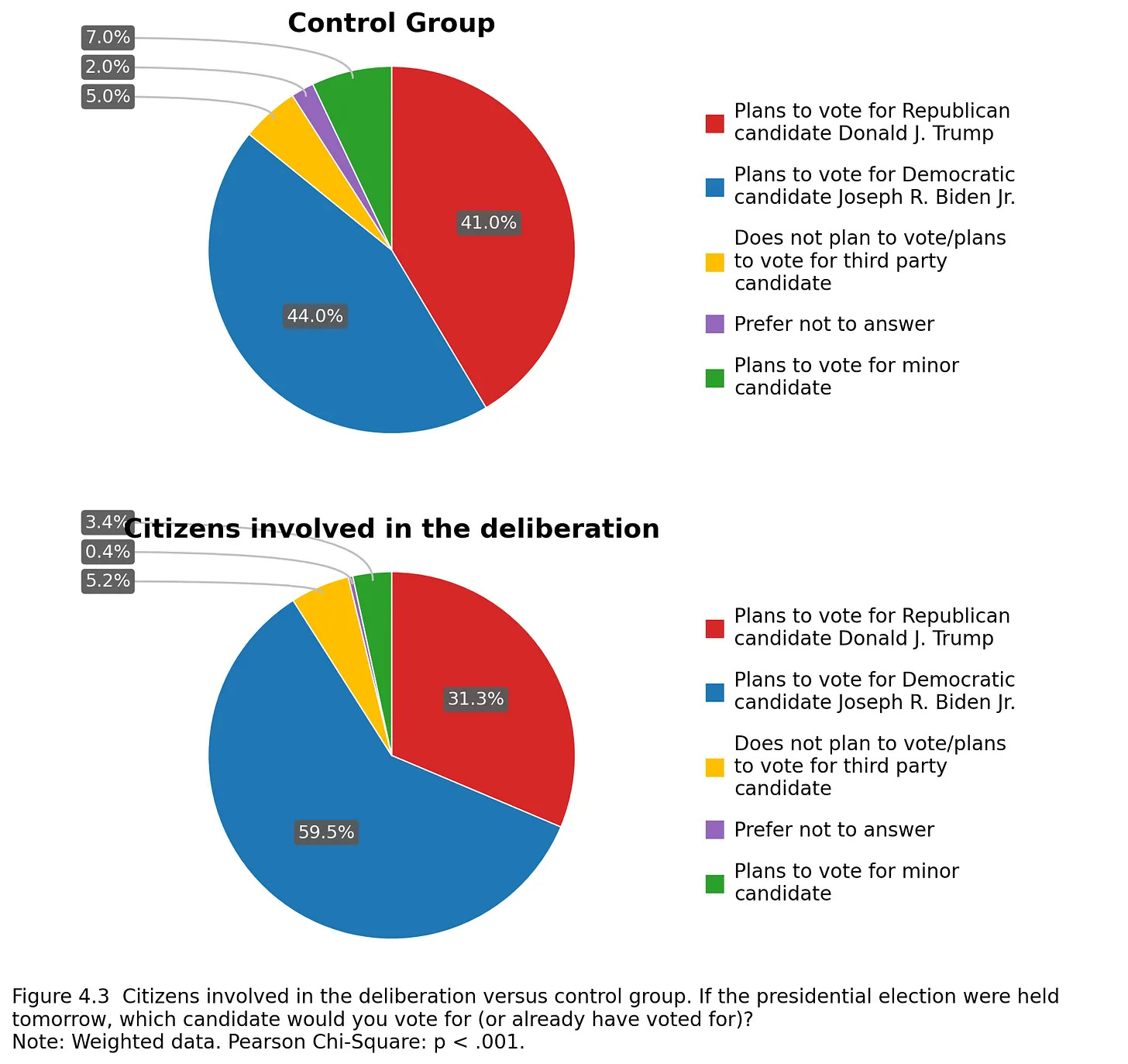
This graph, which I’ve published before, shows you the extent to which the vote for Trump falls among those who participated in a citizen assembly 12 months beforehand. My point in putting it here is not to argue that, therefore, we should have citizen assemblies, though we should. It is rather to suggest that there’s a connection between social media, the bottom of the brainstem and MAGA Republican memes, and that reality-based campaigning just has less social media cut-through.
Ethan Norton does make some good points in the piece below. Still, there’s a giant hole in the piece: The extent to which social media might favour MAGA messages. They’re not much more than a bunch of social media memes to start with. As you work your way up the brainstem, going viral gets harder and harder. That gives the stupid party an unfair advantage.
Why Democrats are failing to reach young voters like me
Democrats talk endlessly of courting young voters, but are losing my generation because they miss the point entirely. They don’t just have a young voter problem — they have an attention problem.
And if they don’t learn from Gen Z, Democrats will lose Gen Alpha while they’re still trying to figure it out.
Since losing the White House in 2024, Democrats have been pointing fingers — blaming Biden, pinning their unpopularity on woke politics, taking aim at the “manosphere” and Fox News....
That diagnosis overlooks the real problem: It’s not just what they’re up against, but how they’re communicating. Crying “constitutional crisis” won’t win votes — it’s hardly enough to get likes.
In the digital age, attention is earned, not assumed. In 2025, Media Matters reported that right-leaning digital programs commanded audiences nearly five times the size of those on the left. As Chris Hayes puts it, “if you can’t be heard, it doesn’t matter what you say.”
I know from experience. I study film and digital media, and as a young voter, I’ve scrolled past lifeless Democratic content. Friends who claim they don’t care about politics consume right-leaning media because it’s funnier and easier to share — such as Kill Tony, one of 80 right-leaning programs identified by Media Matters as “comedy, entertainment, sports, or other supposedly nonpolitical topics.”
Democrats still haven’t grasped what travels online and why.
Take the website of Senate Minority Leader Charles E. Schumer, frozen in the 1980s: a blurry photo montage at a podium, with text at the top: “See where Chuck has been and what he’s been doing.”
Because nothing gets Gen Z fired up quite like a weekly itinerary.
Schumer’s approach is dead on arrival. In the words of every content creator ever: bungle those first few seconds and your audience vanishes. What keeps someone on a web page? Is it visually compelling? Ideologically assertive? Does it invite you into a community?
Those are the qualities that grab attention online, not screaming headlines such as:
SCHUMER SOUNDS ALARM: AS TRUMP STRIPS STAFF FROM 9/11 HEALTH PROGRAM AND REASSIGNS THEM TO ICE, SENATOR DEMANDS IMMEDIATE REVERSAL TO PROTECT 140,000 SURVIVORS
The irony? There’s no alarm. Just too many words in all caps. Why not create actual visual urgency? Layer in 15-second clips that tell human stories about survivors before anyone scrolls.
Some Democrats understand how to capitalize on social media. New York Mayor Zohran Mamdani’s vertical shorts propelled him into office. Rep. Alexandria Ocasio-Cortez answers questions from followers on Instagram. Even Sen. Bernie Sanders — hardly a digital native — shows up daily with YouTube videos and shareable quotes.
Contrast that with Vice President Kamala Harris missing a chance to appear on Joe Rogan’s podcast in 2024. An appearance on a show like Rogan’s generates a stream of content — clipped, retweeted, memeified, turned into fundraising ads, parodied on “Saturday Night Live,” buzzing through comment sections and spreading the message organically.
The Harvard Kennedy School’s Ash Center showed that Gen Z favored Harris over Trump by just four points in 2024 — strikingly less than the 25-point margin for Biden in 2020. Even after the election, Trump dominated the narrative with Truth Social posts and AI videos, while Harris toured the country to promote a book.
Like everyone else, young voters are looking for authenticity. Does this person understand how to reach me?
Too often, the answer from Democrats is no.
Conservatives do not have an ideological grip on young people. They just have our time and attention.
Stop obsessing over what the message is, and focus on how it’s being delivered. And while you’re at it — try giving a raise to the interns figuring all this out for you.
An interesting piece in the WaPo by Hamid Biglari, an Iranian-American.
Iran is dangling its favorite kind of deal. Will Trump bite?
I left Iran in 1976. In the five decades since, I have watched American administrations cycle through every conceivable strategy toward the Islamic Republic and arrive each time at the same destination: a regime more consolidated than before, and a population more abandoned than when the policy began. The Islamabad talks are not a new chapter. They are the latest performance of a play Washington keeps staging.
Three errors define that script. All three are being repeated this week.
The first is the United States’ addiction to the myth of the Iranian moderate. Leading Iran’s delegation in Islamabad is Mohammad Bagher Ghalibaf — speaker of the parliament, former commander of the Revolutionary Guard Corps Air Force, former chief of the Iran’s police. He is not a diplomat who became a general, he is a general playing a diplomat. ...
The system does not produce moderates. It produces two varieties of hard-liner: those who favor confrontation as the instrument of regime survival, and those who favor tactical flexibility. Every figure the West has labeled a moderate — from former presidents Rafsanjani and Rouhani to Zarif and Larijani, and now Ghalibaf — belongs to the second category. They differ in method, not in goal.
The person who matters in Islamabad is not Ghalibaf, but IRGC commander Ahmad Vahidi, who was not in the room. Ghalibaf cannot commit Iran to anything without Vahidi’s approval. America is negotiating with the mask. The face is in Tehran, watching to see what concessions the mask can extract.
The second error is failing to recognize Iran’s master strategy, which I like to call “managed irresolution”: the deliberate maintenance of a conflict in permanent near-resolution, close enough to keep sanctions pressure manageable, far enough to prevent binding constraints from taking effect. The enrichment restrictions of the Obama-era nuclear deal were structured to expire, leaving Iran’s nuclear capability intact while banking immediate sanctions relief. Iran has rejected a 45-day ceasefire in favor of “permanent negotiations” — not because it wants permanent peace, but because permanent negotiations are the ideal vehicle for extracting concessions while committing to nothing.
Iran’s negotiators have deployed a dual-text gambit: their 10-point proposal states in Persian that the U.S. has “in principle committed to” Iran’s right to enrichment. The English version omits this entirely. When the contradiction surfaced, Tehran shrugged. ...
The third error is the most consequential: treating 90 million Iranians as irrelevant to the negotiation. The population that actually lives under the Islamic Republic — the estimated 30,000-plus protesters killed, the political prisoners executed even as the war was being fought, the Iranians who danced at Khamenei’s death and then watched the IRGC consolidate power — is not a party to this transaction.
This is presented as realism. It is, in fact, the deepest strategic error, because it misidentifies where the regime’s actual vulnerability lies. It is threatened by its own people, not by U.S. bombers. Sanctions eliminate the middle class while the Guards profit from the black markets they create; infrastructure strikes generate nationalist sentiment the regime converts into domestic legitimacy. By ignoring the people, the U.S. hands the IRGC the one thing it needs most: a bilateral negotiation that validates it as Iran’s legitimate representative and insulates it from the pressure it cannot survive.
The corrections are not complicated. Require a single reconciled text — English and Persian — before any point is treated as agreed upon. Embed automatic escalation triggers in the ceasefire agreement. And tie sanctions relief to civilian benchmarks, including restored internet access and a moratorium on political executions. ...
The question was never whether Iran had moderates. The question was whether America had a strategy serious enough to matter to the people in power — and patient enough to empower the people who could eventually change who that is.
In the famous formulation of Milton Friedman, business’s business is business - i.e. not charity. The idea is often unfairly maligned. Still, here is Dan Davies fairly maligning it! After that, Martin Wolf fairly maligns it.
Not all readers of this substack will know that a couple of years ago, one of my legs was amputated.
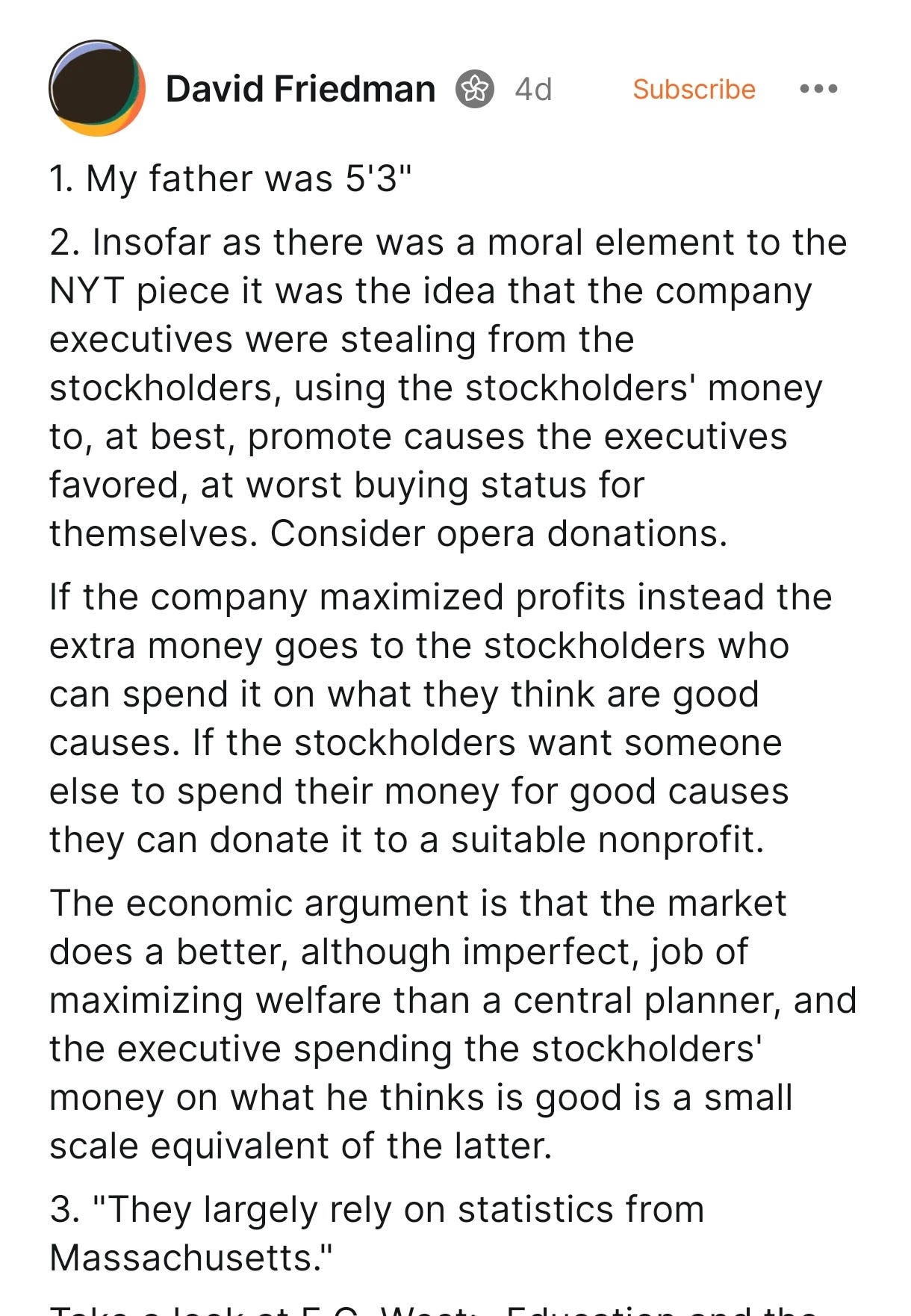
It is Caramel the rabbit again, and he is my rabbit, so the leg which was amputated is my leg, you see. But I was reminded last week that something not much less ridiculous is close to business orthodoxy. It was a post on this very platform, from David Friedman defending the legacy of his father Milton....
But it’s wrong. If a company owns the money, and you own the company, that’s not the same thing as you owning the money. Any more than a rabbit having a fluffy tail and you owning the rabbit means that you have a fluffy tail. Ownership isn’t a transitive property across entities which are capable of owning things.
This matters a lot, because what we are talking about here is “legal personality”, which is one of the big benefits of forming a company. (The other is limited liability, which also comes into play – very few people who talk about company profits as “the stockholders’ money” would also talk about “the stockholders’ debts”).
A company is a separate entity from its owners, which can sue and be sued. Because it can be sued, the company can enter into binding contracts in its own name. And it can own things, also in its own name.
Which isn’t a trivial point at all. A partnership, for example, doesn’t have legal personality. When a partnership owns cash or assets, it really is “the partners’ money”. Every single penny you get paid is less money that the partners own, so if you’re ever dealing with a partnership, get it in writing....
It is not the stockholders’ money. The company’s money is the company’s money, and if the stockholders don’t think that their ability to choose the board and approve dividends and major issues by vote is enough protection, they are welcome to choose another form of organisation.
The modern neoliberal interpretation is meant to be a moral argument rather than a legal one. The company’s money isn’t legally the property of the stockholders, but the management should act as if it was, because … reasons? Employment, like ownership, isn’t transitive. The stockholders own the company and the managers work for the company, but this doesn’t mean that the management work for the stockholders.
Every time I write about this, I’m impressed with what a sneaky trick it is. The creation of the modern limited liability company was, in itself, a huge gift to investors. And now they want to revisit the terms of that deal, making them significantly more favourable to themselves? And to imply that this is the natural order of things, and that anything else would be like stealing from them? While not in any sense proposing to take on any more duties or risks themselves? All you can or should say to this kind of argument is “nah, come off it”
Meanwhile, Martin Wolf also fairly maligned Friedman way back in Oct 2020.
I used to think Milton Friedman was right. But I have changed my mind because I no longer believe in the contractarian view of the firm: that it is merely an aggregate of voluntary contracts which reflect the freedom of individuals to choose.
In reality, corporations are powerful entities able to exercise immense influence within society. Since corporations have been told that their only responsibility is to make profits, the result is that society, including its notionally democratic politics, is dominated by feral institutions. This is an important reason why the US has ended up with a president who is now running against democracy itself.
The central point comes from Friedman’s view that corporations have a social responsibility to play within the rules of the game, “which is to say, engage in open and free competition without deception or fraud”. But this is vastly too narrow. The rules of the game have to include everything a society does to ensure that the activities of corporations are consistent with its core objectives: promoting competition and innovation, protecting public health, protecting the environment, protecting employees from abuse, raising the tax revenue needed to meet democratically-agreed objectives, and so on and so forth.
So, who makes these “rules of the game”? Well, we know quite well that a dominant influence is the power of money. The activities of companies as lobbyists, funders of research and donors play a decisive role in creating the rules of the political game. As Mancur Olson told us, concentrated interests win. There are no interests more concentrated and with more resources than corporations. They play the game according to rules they largely set themselves.
In sum, Friedman’s view is faux naif. If the game is fundamentally political, then the social obligation is to use corporate power to create a good game—one in which companies would not promote junk science on climate, kill hundreds of thousands by promoting addiction to opiates, lobby for tax havens, or seek to neuter effective competition policy...
Such failures have so weakened the democratic system that we risk ending up in dictatorships. There is a direct line from Milton Friedman to Donald Trump.
Why? Consider how one goes about persuading people to accept Friedman’s libertarian economic ideas when, in practice, they shift economic rents upwards and desperation downwards. In a universal-suffrage democracy, it is impossible. Such libertarians are a minority. To win, they have to embrace ancillary causes such as culture wars, racism, misogyny, nativism, xenophobia, and that good old standby: nationalism. The financial crisis made this even harder. Afterwards, libertarians within the Republican Party doubled down on those ancillary causes. Trump was simply the political entrepreneur best suited to do this. A natural demagogue, he was comfortable saying out loud what his predecessors had said quietly. His supporters loved him for it, because he respects their rage. His nativism, nationalism and open assault on the notion of a fair election are uncomfortable for corporate elites. But, if he gives them lower taxes and sweeping de-regulation, how many really care?...
So: one cannot get away with stating that corporations should play by the rules, when they create the rules they play by.
The starting point for reform is to recognize that corporations are not persons, cannot be citizens and have no political rights whatsoever. Corporate personality is a fiction created solely for economic reasons. Corporations should not be permitted to make political contributions or fund political campaigns. They may lobby on behalf of their commercial interests. But they must be completely transparent about what they are doing. It is essential, if democracy is to survive.
Corporations must indeed play by the rules of the game. But they must be prevented by all means necessary from writing them. I do not expect them to do the right thing in the public square. But I would really like to stop them doing the wrong thing.
Janan Ganesh makes a good point! And a welcome one for us globalised elites as we tire of clutching our pearls and, instead, tuck into some pecan and corn-fed buffalo mozzarella tartelettes drizzled with reduced goji berry jus.
In 2016, a victorious Brexiter told me that other countries would soon fall “like dominoes” out of the EU. This was the era of such twee portmanteaus as Frexit and Grexit.
Aside from the wishful thinking, what stood out was the awful pedigree of the metaphor. The most famous “domino effect” in political lore was the one that was supposed to turn south-east Asia communist if Vietnam went that way. To prevent such an outcome, the US fought a debacle of a war from which it has, in some ways, never recovered. Using the language of that bungled mission suggested that top Leavers were either superb ironists or ignoramuses.
Sure enough, a decade on, the EU’s 27 dominoes stand. In an era of ardent nationalism, this supranational club should be fighting for its life. It isn’t really. Few things are stranger about modern politics.
If anything, nationalists are fighting to reassure pro-EU voters. Marine Le Pen has softened her line on Brussels to remain electorally competitive in France. Giorgia Meloni has mostly co-operated with the EU during her three-and-a-half years as a hard-right Italian prime minister. Of all the varied reasons for Viktor Orbán’s landslide defeat, the public’s desire to mend relations with the EU was prominent. The election winner Péter Magyar favours a “return to Europe”.
Deeper trends in public opinion point the same way. Support for the euro has grown to a record high of 74 per cent in the EU, and 82 per cent in the Eurozone — a near-consensus in favour of the single currency at a time of economic malaise....
Given the jingoism of the times, the EU’s political resilience is striking, even weird. It is hard to ascribe it to great feats of leadership and administration from Brussels. Rather, the outside world keeps doing the EU unsolicited favours.
Britain was first. The divisiveness of the Brexit referendum, and the buyer’s remorse that has set in, is a first-class education in what not to do. Tellingly, Europeans started to become more optimistic about the EU in 2016. For services to the European project, there should be a statue of Nigel Farage in Brussels.
Another donor has been Donald Trump’s America. But the most generous and inadvertent benefactor is Russia. There is nothing like mortal danger to bring a club together. Three nationalist shocks — Brexit, America First, Russia’s war — have given a multilateral, technocratic and liberal institution a sense of existential purpose it was starting to lack.
Also, there is such a thing as an anti-elite pro-European — supporting Brussels on the basis that one’s own national governing class is more inept, self-dealing and high-handed. Britain had for decades a blind spot for this vein of opinion on the continent.
No longer. The debasement of its own political elite post-2016 has brought the UK closer to the European experience. Every so often, the Labour government announces a step towards the EU. Conservatives scream betrayal. Voters shrug. Through their comportment in office, Brexiters have forfeited the benefit of the doubt.
The EU cannot live on external favours forever.... The Alternative for Germany has not softened on Europe in the Le Pen or Meloni style. If it were to enter government in Berlin, the union would struggle. Eurosceptic governments often counted on Orbán to veto proposals from Brussels; his absence might now draw out their own awkward views: on Ukraine, for instance.
It is just that a decade is quite a while. None of the dominoes have fallen, because voters keep the hard right on a short leash. In the most nationalist period of politics since the 1930s, outright opposition to EU membership is still remarkably taboo. It is much likelier that a new member state will join before one leaves.
In David Szalay’s Booker Prize-winning novel Flesh, the Hungarian protagonist has a recurring and therefore maddening phrase. It could be the verdict of Europeans on the EU as the alternatives bear down on them from west and east. “It’s okay.”
This is from The Iran Embassy in Australia’sTwitter feed and so can be understood as propaganda. Still, as far as propaganda goes, this is certainly nice to look at!
Keep gatekeepers out of our public libraries
Henry Ergas and Alex McDermott suggest we might have celebrated our pride in our forebears rather than our embarrassment that they hadn’t quite got the hang of 21st-century decorum.
The bicentenary of a library founded in 1826 under governor Ralph Darling – books set against the dust of a penal outpost – ought to invite a measure of historical perspective. But at the State Library of New South Wales, perspective is in short supply.
In The Library That Made Me, produced to commemorate the event, Damien Webb seizes on the library’s 1942 bronze doors – whose monumental frieze unusually foregrounds Aboriginal figures – only to dismiss them as an open-and-shut case of cultural insensitivity.
Webb, manager of SLNSW’s Indigenous Engagement Branch, finds William Ifould, principal librarian for the 30 years prior to 1942, guilty of gross cultural insensitivity: photographs that “would not even meet our criteria for being displayed online or in the catalogue” have been reimagined into permanent bronze by a white artist for the front doors of the Mitchell Library. The one crime worse than silencing Indigenous Australians is, it now transpires, for past generations to have actually attempted to feature them. Ifould, the central figure who insisted on featuring Aboriginals prominently, is singled out for jeremiad in tones approaching the hysterical....
Webb never mentions Liberal politician Joseph Carruthers (1857-1932), the driving force behind the Mitchell Library’s establishment – who grew up among Indigenous people, learnt their language, defended their voting rights and argued that they should have elected representatives in parliament.
Recognising those facts would obviously have been inconvenient. Webb enters the archival shelves “with no small amount of trepidation” – given that “no Aboriginal hand” had guided its curation. “For an Aboriginal person, venturing into these archives is like walking through a minefield. You never know what you might see – what sacred, secret or private knowledge might be exposed.” All of this amplifies a “growing sense of dread” from which Webb eventually reels away....
The library, on this account, is a space defined not by free access but by supervised passage. You walk in, choose material, and follow a course of reading yourself. You are your own guide – not in need of a custodian. To designate as “Access Restricted” whatever is classed as “Aboriginal knowledge” imposes a dictate from on high that stands in stark contrast to the ideals of transparency. To succumb to Webb’s call that “something needs to change” would mark the abandonment, not the fulfilment, of everything libraries were built to be.
The Subscription Library of 1826 was itself highly restrictive: membership by invitation, blackballing, subscription rates equivalent to several weeks’ wages....
Governor Darling’s successor Richard Bourke saw the democratisation of learning as vital for the colony’s future. The Mechanics Institutes – whereby ordinary citizens were provided with facilities to read, study, debate, and attend lectures – spread through the colonies with extraordinary speed. The Sydney Mechanics Institute was established in 1833. By the end of the 1830s, Sydney – a tenth of the size of Manchester – could boast a membership fully a third of that of its far larger British counterpart. Small communities prioritised the dispensation of “mental food to a large circle”, circulating “the entertaining novel and the staple products of the greatest minds”. That priority reflected an almost sublime faith in “moral enlightenment” – the belief that the diffusion of knowledge carried genuine moral and social benefits, especially vital in colonial Australia, which embarked on the great experiment of mass democracy decades ahead of Britain.
By the end of the 1880s, Victoria offered more than twice as many free libraries as the entire United Kingdom – one for every 4,800 people, against one for every 300,000 in Britain. It is from this thoroughly democratic transformation, not from the restrictive club of 1826, that the modern SLNSW can and should trace its direct genealogy.
A nation that does not know its own history has no chart for its future. If we continue to treat our great libraries as minefields, those magnificent bronze doors may as well be melted down in the name of cultural sensitivity, forming the blank, unreadable horizon of a civilisation that is deliberately choosing to forget itself.
MMT is the rediscovery and development of a framework that appeared in the late 19th century as ‘chartalism’, and in the 40s as ‘functional finance’. It makes a lot of sense as a way to understand the properties of money in the affairs of governments that issue their own currency. Unfortunately, it has cult members who can tell - just tell that you don’t understand this if you don’t use the secret handshake.
Anyway, given that someone recently explained to their readers that I’d changed my mind on MMT (because I’d agreed with someone expressing negative views about it), I thought I’d refer you to Cameron Murray’s excellent summary of what’s good and bad about MMT. I don’t think there are any differences between my views and those he expresses in this post. As Cameron patiently explains, MMT offers a good foundation for thinking about money, what it is, where it comes from and what that means for managing monetary and fiscal policy. As he points out, it returns us to the hard constraints of policy - which are the constraints of real resources. As Keynes put it, “Anything we can actually do we can afford”.
I first ran into this image on Twitter attributed to David Hockney, then attributed to Sally-Ann Fitter, and attributed lower down in this thread to an AI.
Whatever it is, it is lovely. And Sally-Ann Fitter has lots of lovely paintings on her website. She evidently likes flowers, which are always a good thing to like, but particularly today, liking flowers is a kind of statement. Because Pete Hegseth doesn’t like flowers. How do I know? I just know. And if you cite my view in an academic article, that makes it that little bit more true. Fun modern fact.
You can buy prints for a few hundred dollars each. Viz
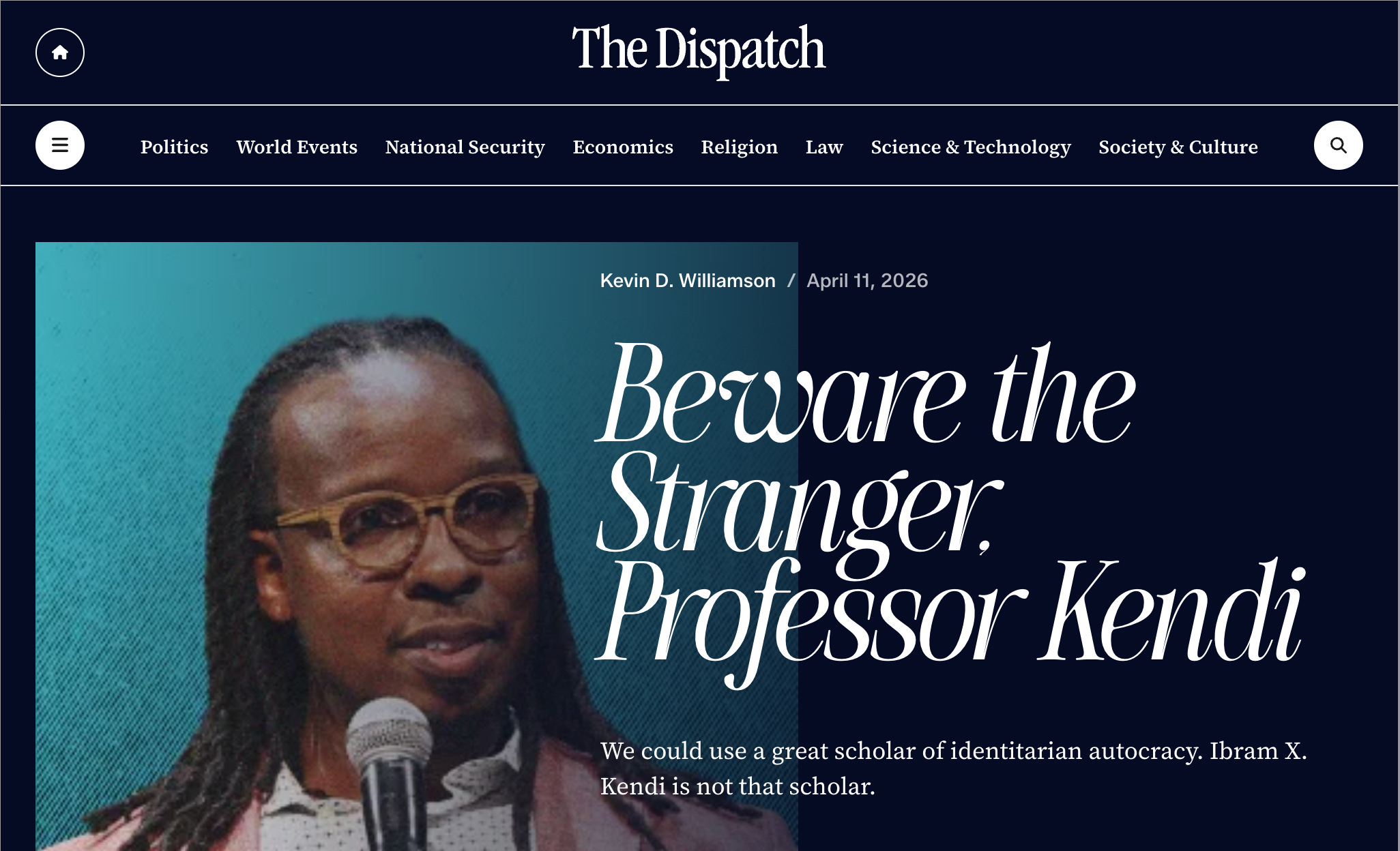
Kevin Williamson on Ibram X. Kendi. A good article, but much longer than necessary. Claude has edited it back so you don’t have to.
We could use a great scholar of identitarian autocracy. Ibram X. Kendi is not that scholar.
Our present situation calls urgently for a writer and public intellectual of the sort Kendi should be and seems to aspire to be. The president of the United States is a genuine authoritarian and undeniably an exemplar of the phenomenon professor Kendi writes about in his latest book, Chain of Ideas: The Origins of Our Authoritarian Age, in which he argues that different versions of “replacement theory” enable not only figures such as Donald Trump but also autocrats from Europe to South America. What a tragedy his book is not up to the moment.
Prof. Kendi has long worked from a crude intellectual model—crude to the point of being almost silly—that every word, thought, deed, and policy can be characterized simply either as racist or antiracist, a totalist approach in which there is no neutrality or safe harbor. ...
The book is lazy and sloppy. Kendi is a bad writer, even for an academic, and treats his readers as though they were too dumb to see the difference between theory and rhetoric. He is overly fond of the word likely. A certain racist “likely chanted ‘You will not replace us’ at a rally,” “one passage that likely stuck with Adolf Hitler,” Le Pen voters “likely enjoyed” Charlie Hebdo cartoons. He prefers to fill in details in whatever way fits his thesis. ...
Those little messes are not random. Prof. Kendi practices an ethics of moral infection—x cited y book, z cited y book, ergo x is infected with z’s moral transgressions—and where there is no known vector, he simply invents one. ...
One of the problems with this simplified politics of moral contagion is that it makes useful distinctions difficult—in this case between a noxious politics rooted in conspiracy and a more general conservatism that intersects with “replacement theory” only on ordinary policy questions. Unless we take seriously the proposition that the only two views of immigration are open borders or Trumpism, we are going to have discussions about restrictions that inescapably include Who? and How many?
Those who point out that things said today about Latin American immigrants also were said in the 19th century about Irish Catholics rarely note that those who warned such waves would forever change the culture and politics of Boston, New York, and Philadelphia were absolutely correct. They did. “The Great Replacement” may be a nutty conspiracy theory, but great replacements do happen. It is intellectually incoherent to scoff at resistance to population change and to lament “settler colonialism.” ...
That well-meaning liberal intellectuals can see the question of self-determination clearly in the matter of the First Nations in Canada but not in the case of Canada itself, much less France or the United States, shows just how parochial they can be when faced with the messy facts of real-world political decision-making. The American people, damn their eyes, have twice chosen Trump and Trumpism, at least in part because some of them saw the choice as between what Trump stands for and what such figures as Ibram X. Kendi stand for, which includes a narrow, ahistorical, and at times sanctimonious account of what it means to be a political community. Marine Le Pen, Viktor Orbán, and the rest of that ghastly horror show did not come out of nowhere. Prof. Kendi is part of the problem, though not a very big part of the problem.
Americans could use someone to do what Prof. Kendi seems to want to do, but doing it well will require a more open, more genuinely liberal, and more humane approach to the tangle of human affairs than what is on offer in this book. Prof. Kendi often seems not to have so much an idea as an enemies list, and, even though some of his enemies deserve to be all of our enemies, that is not enough.
With a shocking confession - Nabokov would be horrified!
John Henry Newman
“An ethical system can supply general rules, guiding principles, worked examples, useful distinctions, and cautions; but it cannot tell you what to do now, in this situation, given who you are. For that you must go to a living intelligence — your own, or someone else’s. The practical authority that decides is something far more searching than any set of maxims, which tend to be clearest and most precise precisely when you need them least.”
John Henry Newman
“And here I am brought to the bearing of these remarks upon my subject.” This is John Henry Newman after several pages of dense philosophical reflection about nature and various other things. You may be a better reader than me. It would not be hard. But long passages of abstruse exposition ocuring before I know what they are driving at simply has me wondering if I have any new email, or perhaps if a new war has been started. I simply can’t make it through any lengthy text like this and remember what I’ve read.
So I tried something that I expect I should be ashamed of - but, alas, am not. I asked Claude to rewrite the chapter I was trying to read in as close as possible to Newman’s voice, save the late 19th century circumlocutions which I asked it to render in contemporary prose.1 It did a marvellous job. This is Chapter 9 of his “Grammar of Assent”. He’s focused on religious faith. Be that as it may, as I’ve mentioned previously, I’m interested in faith as a foundation for all thought as I attempted to set out in this post.
Faith I’m thinking the first association you had with the one word heading above was religious - perhaps particularly if you’re not religious. The call to unbelievers to ‘just have faith’. I’m going to call that ‘heroic faith’. Science has won most of its battles with institutionalised religion on whether we need the hypothesis of God to explain the natu…
And so to John Henry Newman. If I were to say in one sentence what I find marvellous about this, it’s his anti-positivism — the way in which Newman roots thought in the inexhaustibility of the concrete, and the corresponding thinness of the abstract. Or, as Alexis de Tocqueville put it, “an abstract word is like a box with a false bottom; you may put in what ideas you please, and take them out again without being observed”.
An Essay in Aid of a Grammar of Assent (1870), Chapter IX
My aim in the preceding chapters has not been to construct a theory explaining how inference and assent work, but to establish the facts: when do we actually assent to conclusions we have inferred, and under what conditions? I have no ambition to solve, from first principles, what sharper minds than mine have attempted without convincing their opponents. I want only to describe what happens.
I maintain — with those philosophers who insist that genuine certainty is possible — that the common experience of mankind is proof enough. What people actually do on a large scale is what counts as normal human operation. The fact that we can be certain is proof that certainty is not a delusion. How this is possible metaphysically is not my concern. It is enough that certainty is a real experience.
Two terms need distinguishing. Certitude is a mental state — something that happens in a person. Certainty is a property of propositions. When I call a proposition certain, I mean that I am certain of it. Certitude is not something forced on us from outside by the pressure of argument. In all concrete matters it is an active recognition — something each person must exercise for themselves at reason’s direction, and withhold when reason so requires. Reason never licenses certainty except on adequate grounds, and adequate grounds in concrete matters can never be supplied by formal logic alone, because certitude is of the mind, and so is the inference that produces it.
Every person who reasons is their own centre of judgment. No device for establishing a common standard between minds can change this. The question then becomes: is there any criterion by which we can verify that our certitude has been correctly reached? My answer is that the sole and final arbiter of inference in concrete matters is what I call the Illative Sense — the reasoning faculty operating at full stretch. I use “sense” here as we use it in “good sense,” “common sense,” or “a sense of beauty.” I cannot go further than this in answering the question, but I can explain it more fully. I will address, in turn, the grounds for trusting the Illative Sense, its nature, and its range.
Why We Should Trust the Illative Sense
We live in a world of facts and we work with them, because there is nothing else to work with. We do not demand that fire, water, earth, and air justify themselves before we use them. We simply use them. But the thing we are even less able to doubt than the external world is ourselves — our own consciousness, reflection, and action, which together constitute our rationality. Just as we use the physical elements without auditing them, it makes no sense to stand in judgment over our own nature rather than simply using it as best we can. Our being, with all its faculties, is a given — everything else is referred to it; it is not referred to anything else.
If I may not assume that I exist, and that I exist with a particular mental constitution, I have nothing to think about and may as well stop thinking. What I am is all I have. My ideas are all assumptions; I move in a circle; I cannot avoid relying on myself, because I have no other self to rely on. My task is simply to understand what I am, so that I can use it well. Whatever faculties I possess are validated by being natural to me. The first obligation is to accept the laws of my own nature; the first disobedience is impatience with what I am, or ambition for what I cannot be.
This is confirmed by what we see everywhere in nature. Every kind of being is equipped for its own existence — its parts work together for its survival and welfare. Man is the most complex of these beings, and his characteristic feature is that, unlike other animals, he is not complete from the start. He has to build himself through the exercise of his native faculties. His development is not mechanical and not guaranteed; it is committed to his own personal effort. He is, in this sense, the maker of himself.
This self-development is carried out through the acquisition of knowledge, and inference and assent are its immediate instruments. There is no ultimate test of truth other than the testimony the mind bears to truth itself. This is a genuine feature of the human condition — not a defect to be engineered away, but a normal characteristic of what it is to be the kind of being we are, living in the kind of world we inhabit. Human progress is a living growth, not a mechanical process, and its instruments are mental acts, not logical formulas.
What the Illative Sense Is
It is the mind that reasons and controls its own reasoning — not any technical apparatus of words and propositions. The perfection of this power of judging and concluding is what I call the Illative Sense. It is best understood by comparison with analogous faculties we already recognise.
Take moral judgment. Aristotle called the faculty that guides conduct phronesis — practical wisdom or judgment. This is the controlling principle in ethical life. What virtue requires, what is right or wrong in a particular case — for answers to these questions Aristotle refers us to no code, no treatise, because no science of life applicable to an individual has ever been written or could be. An ethical system can supply general rules, guiding principles, worked examples, useful distinctions, and cautions; but it cannot tell you what to do now, in this situation, given who you are. For that you must go to a living intelligence — your own, or someone else’s. The practical authority that decides is something far more searching than any set of maxims, which tend to be clearest and most precise precisely when you need them least. Practical wisdom is seated in the individual; it comes from habit built on natural capacity, and it is formed by practice and experience. It does not produce broad philosophical theories. It delivers a verdict for this case, now.
It would be a mistake to think of phronesis as a single general faculty covering all virtues at once. There are as many kinds of practical wisdom as there are domains of action. A person may show exemplary judgment in family life and commit fraud; may be just and cruel; brave and self-indulgent. Good private character does not guarantee good public conduct; profligates have been great statesmen.
The same is true of professional skill. Brilliance at cross-examination in a courtroom does not transfer to commanding an army or managing a parliamentary debate. Each domain requires its own cultivated form of judgment. We use the same word — “tact,” “skill,” “sagacity” — but the capacities are distinct and non-transferable.
The same holds in the arts. Raphael’s standard of beauty was far more subtle and versatile than anything he could have communicated in a treatise. And artistic genius is always bound to a particular medium; a great poet need not be a great painter.
The question then is obvious: why should reasoning be any different? Why do we treat logic as a universal instrument capable of adjudicating every kind of truth, when no one would dream of applying a single formula equally to poetry, medicine, and military strategy?
Here is how I would summarise the Illative Sense. In its operation, it is the same in all concrete matters, though it operates differently in each. We do not reason in one way in chemistry and another in theology. In any concrete domain, we push formal logic as far as it will go, then supplement it with a subtler, more flexible logic of thought — because formal rules alone prove nothing. In its distribution, it attaches to specific subject-matters. A person may possess it in history and lack it entirely in philosophy. Expertise in one domain does not imply expertise in another. In its method, it works by the same principle as the mathematical calculus — the accumulation of many small considerations, each individually insufficient, which together converge on a conclusion. No single step carries the argument; the probabilities combine. In its authority, in every domain of concrete reasoning — science, history, theology — there is no ultimate test of truth and error beyond the trustworthiness of the Illative Sense that sanctions the inference. Just as there is no test of poetic excellence other than the taste of those equipped to judge it, and no test of genuine courage other than the moral sense of those who understand it, so the Illative Sense is self-authorising in its domain. Our duty is to cultivate and strengthen it.
What the Illative Sense Does
The mind is more powerful and flexible than any of its products, including language. The Illative Sense does what formal logic cannot: it determines when converging probabilities are sufficient for a conclusion, and where proof ends and mere opinion begins. No diagram or formula can do this work. We need the living mind to assess, sort, and combine the many premises that bear on a concrete question — to discern what conclusion is necessary, or probable, or merely possible.
The Illative Sense in the Conduct of Argument
Consider the great nineteenth-century debates about the prehistoric periods of Greece and Rome. Any scholar entering this territory has to make a series of decisions before formal argument can even begin: where to start; what assumptions to allow; what counts as evidence; how much weight to give tradition, analogy, linguistic data, or later reports; how to balance conflicting indications; when to draw a conclusion and when to suspend judgment.
The major scholars — Niebuhr, Grote, Lewis, Clinton, Mure — were all learned, all rigorous, and all in fundamental disagreement. Their disagreements were not the product of reasoning errors from shared premises; they traced to incompatible starting assumptions. Niebuhr’s approach was reconstructive: he took the received accounts, interrogated and rearranged them, and treated internal consistency as evidence of an underlying fact. He was prepared to “divine” — to infer from scattered indications what no source directly stated. Lewis’s approach was forensic: he would accept no evidence that had not first proved its right to admission, and considered Niebuhr’s celebrated divination nothing more than unverifiable guesswork, a claim to “retrospective second sight” denied to ordinary scholars. Grote shared Lewis’s scepticism: what Niebuhr called trained intuition, Grote called “tacit understandings” dressed up as evidence. Clinton, meanwhile, put the burden of proof on those who would impugn received accounts rather than on those who defended them — the opposite of Lewis’s position.
These are not disagreements that further argument can resolve, because they are not disagreements about evidence or inference. They are disagreements about what kind of mind to bring to the inquiry. Each scholar’s conclusions flow from his intellectual character — from what he is prepared to treat as a starting point, and what he instinctively rules out. No appeal to shared logical rules reaches this level. The Illative Sense is operating at the foundations, below the point where explicit argument can go.
The Illative Sense in Relation to First Principles
Beyond controlling the conduct of argument, the Illative Sense also governs our choice of the aspects under which we view a subject, the assumptions with which we begin, and the antecedent probabilities we bring to bear.
On aspects: every inquiry depends on the particular angle of vision — the abstraction — through which we approach it. This is not a trivial point. Bacon’s genius consisted in separating the physical from the theological and taking firm hold of efficient causation as distinct from design. He saw what others could in principle have seen, but did not. Conversely, some aspects are merely ingenious rather than genuinely illuminating — Gibbon’s account of Christianity being a well-known example of a brilliant mind applying an angle of vision too limited for its subject.
Each of us, moreover, sees the world in a way that is more personal than we realise. Some people are colour-blind; others cannot distinguish red from green. If we differ so markedly in perceiving ordinary physical objects, the differences in how we perceive intellectual and moral objects are likely to be far greater and far less visible to us. This does not mean there is no objective truth. It does mean that the differences between people run deeper than surface disagreement — deeper than argument alone can reach.
On assumptions: no inquiry can proceed without assumptions; the attempt to begin with universal doubt is self-defeating, since doubt is itself a positive stance requiring its own assumptions. We need the right to dismiss certain propositions as absurd or irrelevant, or argument is paralysed from the start. The real question is not whether to assume, but which assumptions are defensible. Of the two extremes — assuming everything or assuming nothing — the former is actually more productive. When we begin by accepting what is offered, we quickly discover internal contradictions; and since error always contains some truth, honest inquiry with genuine talent will tend over time to shed the error and retain the truth.
On antecedent reasoning: we frequently reason not from direct evidence but from what we would antecedently expect — from prior probability. This is legitimate when handled carefully. A man’s known bravery is strong evidence against a charge of cowardice on a specific occasion; a well-established character makes implausible charges hard to sustain. But antecedent presumption becomes dangerous when it masquerades as proof. The argument from natural order against miracles, for instance, is legitimate as a statement of antecedent improbability; it is illegitimate when it claims that established regularity makes exceptions impossible in principle. That is not probability but assumption dressed as demonstration — using a presumption as if it settled a fact.
A number of antecedent probabilities converging on the same conclusion can, however, give a prudent person genuine grounds for belief — not merely for acting as if something were true, but for actually accepting it. This is not unusual even in ordinary life, where we sometimes feel it right to commit ourselves to trusting another person despite residual misgivings. Such judgments are always calls on the Illative Sense.
The Illative Sense, when developed by education, practice, and sustained engagement with a subject, operates throughout the entire course of an inquiry — at the start, in how the problem is framed; in the middle, in how the argument is conducted; and at the end, in the conclusion reached. It is not answerable to any standard beyond itself. It attends the whole process with a precision and responsiveness that no apparatus of formal verbal reasoning could replicate — though in communicating with others, language remains our only instrument, however imperfect.
There is one thing the Illative Sense cannot do, which formal logic can: it supplies no common measure between one mind and another. It is a personal faculty, not a shared algorithm. Two people who reason well in their own respective domains may reach opposite conclusions when they venture onto shared ground. And since all reasoning starts from premises that ultimately trace back to personal characteristics — dispositions, temperaments, habits of attention — the most that argument can do, where deep disagreement exists, is locate the precise point of divergence, assess how fundamental it is, and decide whether further discussion is likely to be productive. Often it is not. The disagreement lies not in the reasoning but in what each person brings to reason with.
This is a contemporary-prose rendering of the condensed text of Chapter IX of Newman’s Grammar of Assent (1870). The aim has been to preserve every argument while replacing Newman’s Victorian syntax — long periodic sentences, heavy subordination, elaborate hedging — with more direct modern constructions. No content has been added; nothing substantive has been removed beyond what was already cut in the condensed edition.
I also asked Claude to edit the chapter back where Newman gave more examples than necessary to understand his argument and where he was addressing contemporary controversies that, from this vantage point, are of interest mainly to historians of ideas.