


Jillian Segal’s right-wing-anti-anti-semitism fusion
A fine piece from Richard Flanagan on Jillian Segal’s overreach. (Overseas readers shouldn't have too much trouble figuring out what’s going on.)
"A Zionist is a national socialist, a national socialist is a Zionist," wrote Joseph Roth – one of the greatest Jewish writers of the 20th century and a prophetic observer of the rise of Nazism – in a letter in 1935, going on to say that what he wished "to do was protect Europe and humanity, both from the Nazis and the Hitler-Zionists".
Roth's opinions are not mine, but were Roth – whose books were burnt by the Nazis – alive today he would not be welcome to speak in Australia under the Trumpian recommendations made by the federal government's new antisemitism report, written by Jillian Segal.
Despite the Segal report's claims about rising antisemitism, some of which are contested as exaggerated by leading Jewish figures, it fails to provide a single citation in evidence. This gifts bigots the untruth that there is no ground for concern when antisemitism has lately presented in shocking ways.
Yet backed only by her unverified, contested claims, Segal recommends that the Australian government defund any university, public broadcaster or cultural institution (such as galleries and writers' festivals) found to have presented the views of those whose views are newly defined as "antisemitic"...
At the heart of the Segal report is a highly controversial definition of antisemitism. Created by the International Holocaust Remembrance Alliance (IHRA) for the purpose of organising data, it defines antisemitism as including criticism of the Israeli state, comparing Israeli government behaviour with Nazi behaviour, and "applying double standards" when other nations behave similarly...
No less than the IHRA definition's lead drafter, Kenneth Stern, a Zionist, has warned of it being weaponised, and that using a data-collection definition as the basis of a new punitive state policy is "a horrible idea". It evokes McCarthyism, he warns, and would mean that you would "have to agree with the state to get official funding".
The ways in which the Segal report can deeply damage our democracy are frightening to ponder. Galleries would risk losing public funding if they exhibited an artist who had simply posted something about Gaza. Charities could lose their tax-deductible status if they featured a writer or artist who had, in whatever form, expressed an opinion deemed antisemitic...
The eminent Jewish historian, the late Tony Judt, put it this way in the leading Israeli newspaper Haaretz in 2006: "When Israel breaks international law in the occupied territories, when Israel publicly humiliates the subject populations whose land it has seized – but then responds to its critics with loud cries of 'antisemitism' – it is in effect saying that these acts are not Israeli acts, they are Jewish acts: The occupation is not an Israeli occupation, it is a Jewish occupation, and if you don't like these things it is because you don't like Jews.
"In many parts of the world this is in danger of becoming a self-fulfilling assertion: Israel's reckless behaviour and insistent identification of all criticism with antisemitism is now the leading source of anti-Jewish sentiment in Western Europe and much of Asia."
Anyone repeating Judt's words would risk no longer being able to speak in mainstream Australia because they would have been branded as antisemitic. Similarly, a university or writers' festival or public broadcaster could lose its funding for hosting Ehud Olmert, Israel's former prime minister, who last week compared plans for a "humanitarian city" to be built in Rafah to "a concentration camp", making him yet another antisemite according to the Segal report...
At the same time, in an Australia where protest is being increasingly criminalised, the Segal report creates an attractive template that could be broadened to silence dissenting voices that question the state's policies on other matters such as immigration, climate and environment...
Antisemitism is real and, as is all racism, despicable. The federal government is right to do all it can within existing laws to act against the perpetrators of recent antisemitic outrages. Earlier this month, the Federal Court found Wissam Haddad guilty of breaching the Racial Discrimination Act with online posts that were "fundamentally racist and antisemitic" but ruled that criticism of Israel, Zionism and the Israel Defence Forces was not antisemitic...
As the Auschwitz survivor Primo Levi wrote, "we too are so dazzled by power and prestige as to forget our own essential fragility. Willingly or not we come to terms with power, forgetting that we are all in the ghetto, that the ghetto is walled in, that outside the ghetto reign the lords of death and that close by the train is waiting."
The lessons of the ghetto are not the exclusive property of Israel but of all humanity. In every human heart as well as the lover and the liberator, there exists the oppressor and the murderer. And no nation-state, no matter the history of its people, has the right to mass murder and then expect of other peoples that they not speak of it...
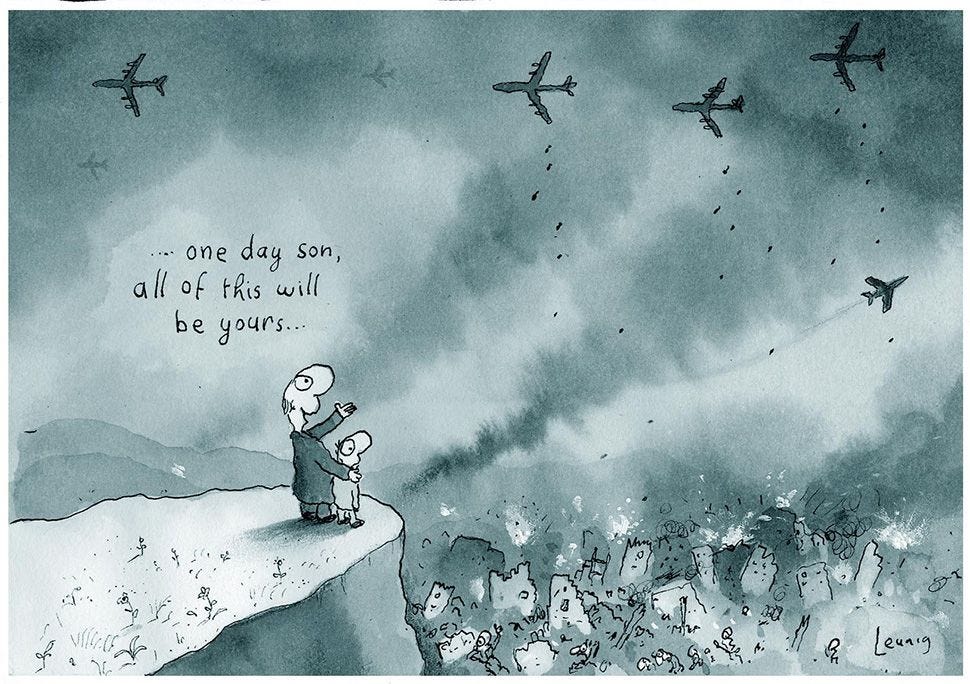
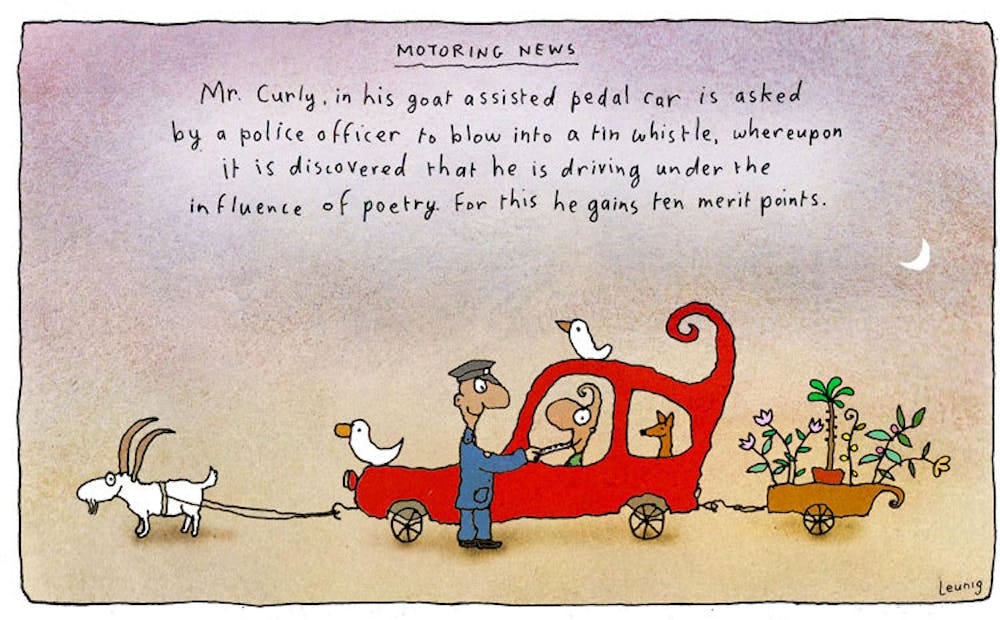
On being smeared as anti-semitic: Leunig
Of course the Israel lobby came after Leunig for the cartoon with which I illustrated the previous piece. After some effort I tracked down his response.
SEVERAL years ago I was invited to speak at Melbourne's Jewish Museum on the subject of ''The cartoonist as society's conscience''. I gladly accepted but within a week was informed by the museum that the invitation had been withdrawn because of my views on Israel. Although I had been somewhat critical of aggressive Israeli government policies I had never publicly outlined my broad views on Israel and was puzzled by the cancellation and bemused by the gross irony of being excluded from a discussion about conscience because I had acted with conscience in my work...
I relate this tale as a backdrop to more recent circumstances in which it has been publicly inferred that I am anti-Semitic because of a cartoon I created expressing sad dismay at the plight and suffering of the Palestinians in the recent bombardment of Gaza.
As a cartoonist I am not interested in defending the dominant, the powerful, the well-resourced and the well-armed because such groups are usually not in need of advocacy, moral support or sympathetic understanding; they have already organised sufficient publicity for themselves and prosecute their points of view with great efficiency.
The work of the artist is to express what is repressed or even to speak the unspoken grief of society. And the cartoonist's task is not so much to be balanced as to give balance, particularly in situations of disproportionate power relationships such as we see in the Israeli-Palestinian conflict. It is a healthy tradition dating back to the court jester and beyond: to be the dissenting protesting voice that speaks when others cannot or will not.
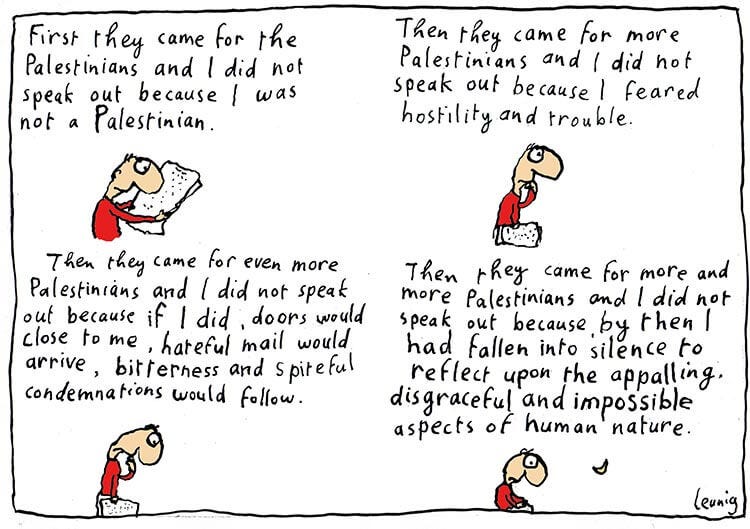
My recent cartoon ("First they came for the Palestinians … ") was a lament based on the famous lines attributed to Pastor Martin Niemoller that neatly highlight the way apathetic or frightened silence in the face of injustice is a dereliction of moral duty. It is interesting to note that Niemoller had been an active Nazi supporter but a decade after the war became a pacifist...
In spite of all the highly organised rhetoric justifying Israel's actions, the intuitive, heartfelt moral shape of the situation is becoming clearer and more obvious to the world the longer the conflict goes on. When all is said and done, it looks like the Palestinians have been massively robbed and abused, and are engaged in a desperate struggle for survival and liberation. Israel on the other hand would appear to be conducting an imperialistic campaign of oppression supported and substantially armed by the most powerful nation on earth. My cartoonist's duty and conscience compel me to focus on the plight of the subjugated, the ones most neglected, severely deprived and cruelly afflicted.
I am not against Israel but I am opposed to what I regard as its self-defeating, self-corrupting militarist policy, which is not only excessively homicidal and traumatising but sows the seeds of irreversible hatred and can never bring a lasting peace. One expects more from a prosperous democratic country...
I sense that the Jewish community in this country is itself increasingly divided on the question. I also suspect that the more aggressive Israel supporters fear this moral unease and quiet doubt in their community and are angered by any cartoons or commentary that might encourage such doubt. In spite of what the bullies say, I suspect they are not really upset by any "anti-Semitism" in my cartoons (there is none) but by the possible impact of a cartoon on the doubters. The better the cartoon, the more it must be discredited. What cheaper way to discredit than the toxic smear of anti-Semitism...
At my advanced age, I know I am not an anti-Semite, not even vaguely or remotely, but others would seem to know better as false accusers always do. If only there was some sort of test I could sit for to clarify the situation, but there is no science to this obsessive and vapid denunciation. It's cynical, it's bullying and it's lazy...
My cartoons have also had me labelled a misogynist, a blasphemer, a homophobe, a royalist, a misanthrope and a traitor, to name but a few. I would sum it all up by saying: I am a cartoonist.

Guy Rundle’s take

I like his argument, but remain sceptical of his departure from the “always suspect a stuff-up” school of political science, theory and interpretation (click through to the whole article if you’re curious).
Though it is fashionable these days to regard Anthony Albanese as a sort of one-man sleeper cell, slumbering in the NSW Left for decades, waiting for the moment when he could burst out and be an agent of capital and the US, it doesn't really add up. After the 2019 loss, Albo and others took one look at their lives, and decided they would have to do anything, anything to win and hold power. Hence the left deal with the 'Conroyites', which means being beholden to what is essentially a US asset within the party, bound up in the gambling, armaments and other industries. Not for a moment would Albo have been tying on a bandanna and yelling 'Merdeka' without the deal. But he would not have been so eager to trash much of what he once believed in this craven, capital-steered government. The style adopted is a new sort of tactic, and a clear-eyed one: give in immediately and totally to the dominant force, and avoid the left shilly-shallying, principle v pragmatism, splits etc. AUKUS and social policy are two examples of this...
Hence, last year, Labor not only responded to the demand by the ECAJ, the Executive Council of Australian Jewry, for special action on anti-semitism, they appointed a former executive of the body, Jillian Segal, as the anti-semitism 'envoy'. Anyone who knows the politics has to watch this pantomime play out in real time, as a committed political zionist is presented as some sort of hands-off sage, sorting out this difficult issue. But Labor, by doing this, has disarmed ECAJ, the forward flank of political zionism. With Segal's report and plan they have got everything they wanted, the extension of zionist supervision of what constitutes 'acceptable' speech, not only into government, but into universities and the media...
The Myth of an anti-semitism free Australia
The idea that we were free of anti-semitism is ludicrous. Robert Menzies, returning from Europe in 1938, praised Hitler as a 'great gentleman'. We turned back Jewish refugee ships, and we had informal quotas on Jewish arrivals into the 1950s; the newspapers of the 20s and 30s were filled with anti-semitic jokes and cartoons, the prosperous Jewish couple being popular comic figures... The term 'Jewboy' for an adult Jewish male was heard right into the 80s. Much of this dissipated publicly with general modernisation and multiculturalisation in the 90s. But, weakened, it has not gone away...
One anti-semitism to rule them all
Yet take a step back from it, and you'll see what a politically compromised approach this is. The truthful and confident approach would be to name these phenomena for what they are. Most of the graffiti and vandalism appears to have been a mix of grudge and false-flag operations by a handful of people, explicitly intending to give the appearance of a larger movement. The synagogue burnings appear to be the product of disturbed loners, the types who might look political on the surface, but are really just attaching their obsessions to Judaism, and its distinct position in Christian dominated societies...
The answer of course is that the ramping up of the situation, doesn't serve the Jewish community here, it serves the foreign policy and image of Israel, and represents the total takeover of Jewish peak community bodies by the zionist lobby. To do this, they have rolled over the generalised concept of [total, cultural] 'safety', developed by the left and 'anti-colonial' groups (and foolishly returned to) to the question of anti-semitism...
The Report will make anti-semitism worse
Quite aside from the deleterious effect this will have on free speech and inquiry, the counter-productive idiocy of this is hard to exaggerate. They are going to put obeisance to the sufferings of the Jewish people at the centre of the master's discourse, across social life. The effects of this will be that, as with any state-imposed value, transgressing it, becomes a way of asserting one's resistant identity. The zionist lobby's manic desire to control what is said, rather than debate it, to turn every [Middle-eastern] campus encampment into krystallnacht, are going to single handedly revive a 'discursive' anti-semitism, which begins to advance arguments about the 'difference' of the Jews. The blithe dimwitted attempt to stamp it out, will kindle it. Which will create a fresh round of repression. And round and round we go...
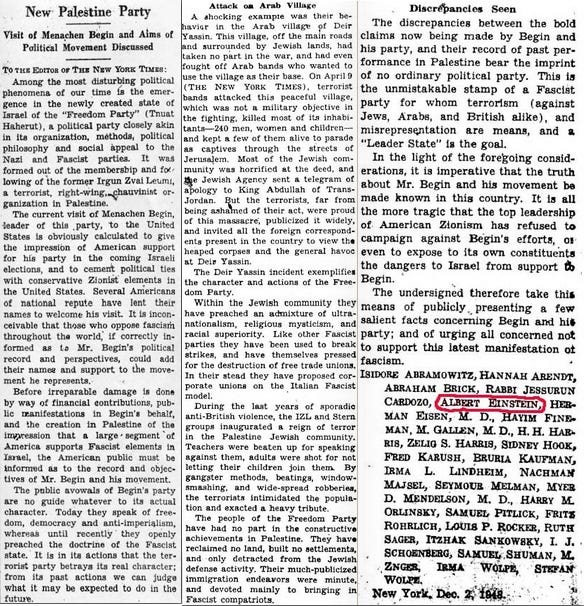
Speaking of anti-semitism: Hannah Arendt and Albert Einstein on Israel’s founding
Poking around on Wikipedia looking up Sidney Hook, I came upon this letter to the NYT from 1948 with signatories of some historical weight - most particularly Hannah Arendt and Albert Einstein.
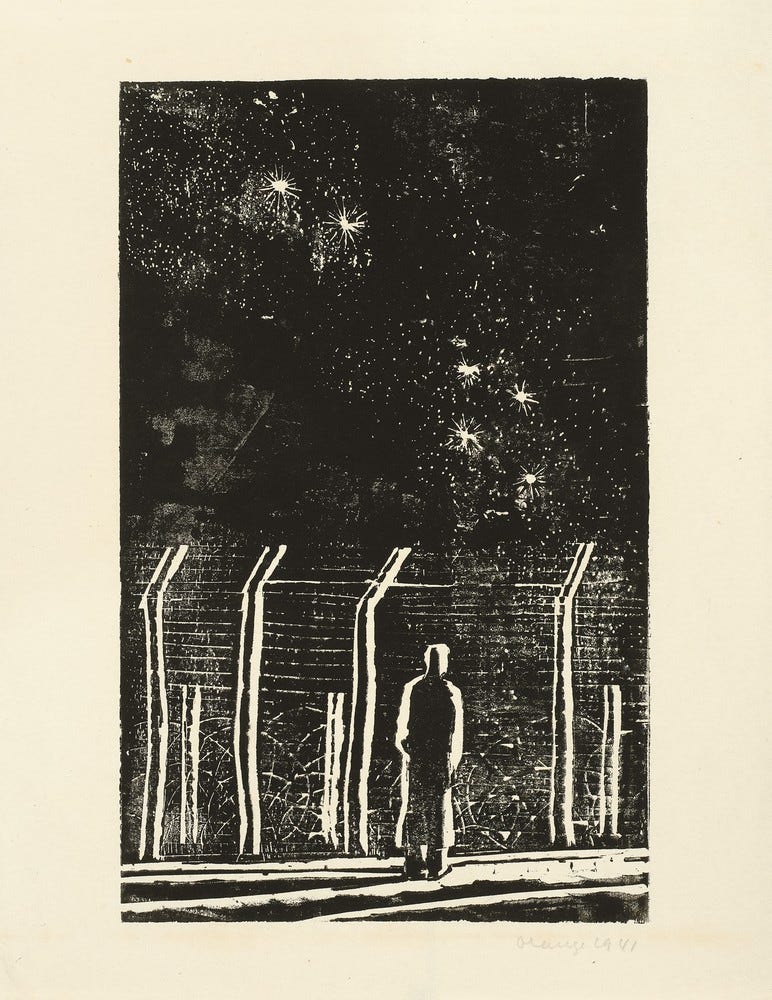
Brief interlude for some Dunera Boy art
The American monarchy
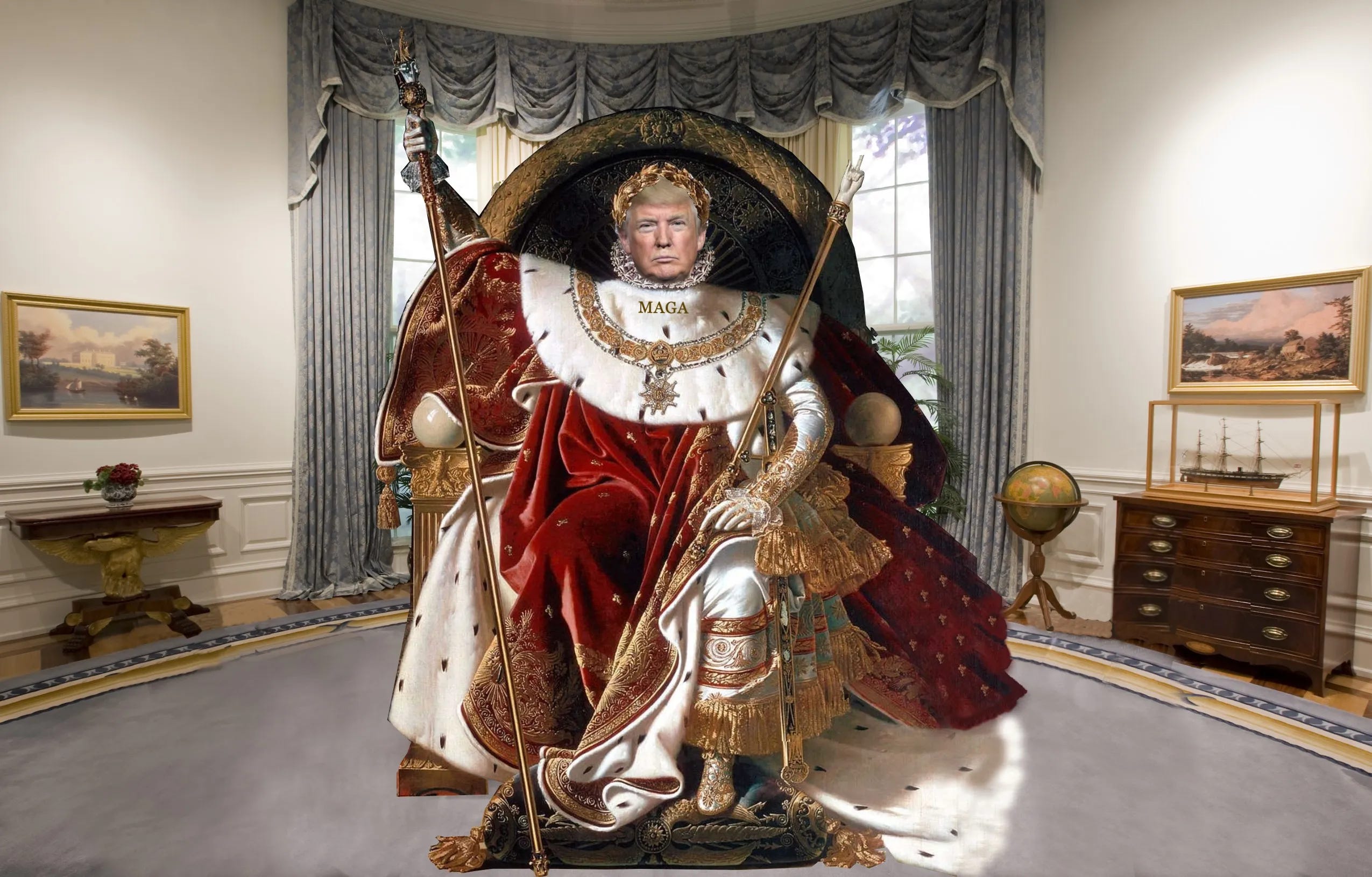
No, this isn’t an article about Donald Trump - I just couldn’t resist the sumptuous effort above. It’s about how, as the article itself concludes “The United Kingdom is a constitutional republic disguised as a monarchy, whereas the United States is a constitutional monarchy disguised as a republic.” (The pity of it is that both systems presume that government requires a single point of authority - the head of government. And that single point of authority is a single point of failure - a target for autocrats everywhere. But I’ve already argued that. Meanwhile, this is a fascinating perspective on the American constitution.
Every July 4, we celebrate America's break from the British Crown. But looking closer, we see in the patriots' appeal to the king against Parliament, the union of states in a federal commonwealth, and the unitary office of the presidency something strange. What if the United States of America is less a rejection than a reimagination of Great Britain's imperium? What if the first country to rebel against the British Empire is, in fact, its last living heir?
In casting off George III, the Founders recovered something older—a version of the British constitution more ancient, royalist, and ultimately stronger—than what America left behind in 1776. Instead of a constitutionally hereditary king, they created a constitutionally elected monarch and called him "President." ...
To understand how this came to be, we need to recover how American colonists understood the British Empire. Parliament's claim to legislate for the colonies marked a sharp break with the earlier imperial arrangement, in which royal charters had allowed colonial autonomy under the king's feudal authority. Patriots thus saw themselves as obedient rebels—not overthrowing English law but faithfully defending an older political settlement that Parliament had corrupted or abandoned.
Many colonists considered themselves subjects of the king, believing that his prerogative crossed the ocean but that Parliament's authority ended at Britain's shore. Each colony operated as a distinct realm with its own laws and legislature, connected to Great Britain through a quasi-feudal relationship with the king, who had personally chartered them. ...
Adams in 1773 wrote that in America, "we hold our Lands agreeably to the Feudal Principles of the King," and in 1775 advanced the colonies as self-governing realms under royal charter:
How, then, do we New Englandmen derive our laws? I say, not from parliament, not from common law, but from the law of nature, and the compact made with the king in our charters. . . Massachusetts is a realm, New York is a realm, Pennsylvania another realm, to all intents and purposes, as much as Ireland is, or England or Scotland ever were.
The Patriot Theory of the British Empire
According to a popular narrative on the Right, the American Revolution was a revolt of free individuals against the very idea of central authority—a Lockean uprising in defense of pure liberty. The idea that Americans were revolutionary individualists doesn't square with their appeals to feudal dependence on a king. Historian Eric Nelson calls the position of Adams, Jefferson, Hamilton, and others the "patriot theory of empire," which was a direct descendant of Royalism, the political cause of those who took the king's side against Parliament in the English Revolution from 1642-1660. ...
The trouble began, in the colonists' eyes, not because of royal tyranny, but because Parliament tried to assert supremacy over their legislatures—with taxes, regulations, and laws passed in London without colonial consent—and the king neglected to defend their rights, which were, in their view, his rights. What they wanted, at least initially, was not independence, but a return to a federal empire: a personal union under a monarch who served as a common executive authority. ...
The Presidency is the Monarchy Patriots Wanted
The Founders didn't reject monarchy—they reimagined it. With the U.S. President, Americans fashioned the constitutional monarch George III failed to be. Indeed, the U.S. Constitution restored a regime not seen in Britain since before 1688, which tilts away from legislative supremacy.
The President of the United States resembles the strong monarchy of the Stuart kings who exercised authority across legislative and judicial branches. The Stuarts summoned and vetoed legislation, commanded the military, appointed officials, and issued pardons. Sound familiar? Not to the British. Their royal executive last vetoed a law in 1708, receives a budget from the legislature, has made no military or foreign policy decisions since the American Revolution, and whose pardons depend on "ministerial advice." ...
From Federal Empire to Federal Union
In transforming a federation of imperial realms into a federation of republican states, the Founders did not abolish the architecture of British imperial structure but reinvented it. Just as each American colony had once operated as a semi-autonomous realm under the personal authority of the king, so too did each American state become a self-governing commonwealth within a federal union.
Now, in the American federation of states, a union of distinct political communities send delegations to assemble in a Congress and legislate within a defined jurisdiction, and they are joined under a common executive power "presiding" for the whole. ...
The Royalist Republic
Meanwhile, Britain has gone in the opposite direction. The American war was the last hurrah of the British monarchy, and especially in the 19th and 20th centuries, the United Kingdom evolved into a parliamentary republic. The monarch remains, but as a constitutional ornament, not a political force. All real power lies in the House of Commons. Britain calls itself a monarchy, but its political system operates entirely on republican principles. And so we arrive at the great irony: The United Kingdom is a constitutional republic disguised as a monarchy, whereas the United States is a constitutional monarchy disguised as a republic.
As we celebrate the patriots who fought for our independence, we might also remember this: they weren't just fighting the British Empire, they were fighting for their version of it. A rebel empire.
From the Department of LoL!

AI and this newsletter
In case you’d like to know, I often use AI to edit the posts appearing in this newsletter. It still takes a long time, but it also saves a lot of time. In any event, though I’ve not noticed any hallucinating, I should warn you that it’s possible. I reproduce two typical commands in this footnote for your scrutiny and in case you can adapt them to your own use.1

Hallucinating with the unhinged
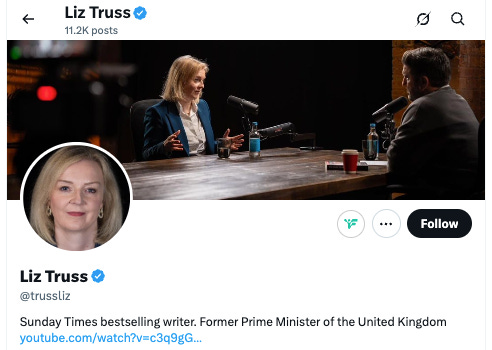
For no apparent reason, I clicked on a trending link to Liz Truss and, courtesy of the single link in her profile, discovered this really quite extraordinary video. It is made by the Wall Street Journal and is more uncannily surreal than Rikki Gervais's Office. In any event who knows how much of it you can watch, but I watched most of it while occasionally looking at other things. In it, Liz explains how she tried to put the UK on a growth path. This growth path involved cutting taxes to such an extent that the markets freaked out. After all she was unleashing the power and productivity of markets. Her main gripe is that the government didn't save her. That is the Bank of England didn't stand against the market for long enough for her to defy gravity and for growth to come roaring back. (If it ever was going to come roaring back, this would have required the Bank to hold back the tide for years. The juxtaposition of Liz Truss’s faux seriousness and the utter mayhem she unleashed had me giggling throughout.
Another take on the same genre
Flirting with monetary ruin
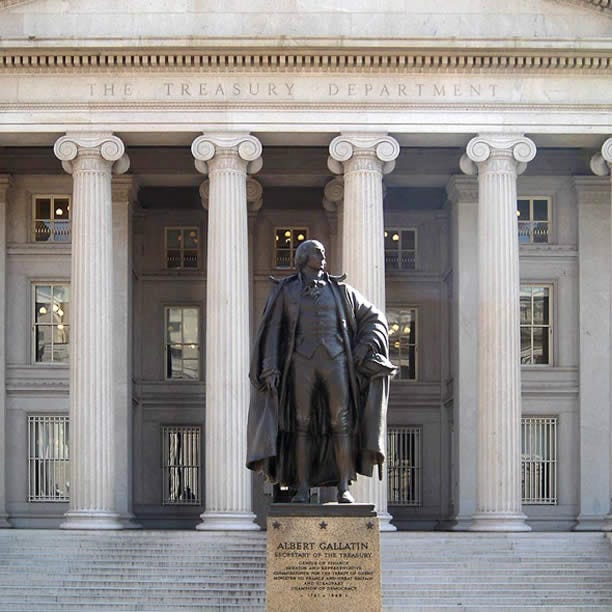
Felix Martin on how the US Administration is flirting with the kinds of ideas that John Law took to France, fuelling one of the great booms and busts.
Outside the U.S. Department of the Treasury in Washington, DC stands an imperious-looking statue honouring the institution's longest-serving secretary. Albert Gallatin was the Swiss-born founding father who engineered the financing of the 1803 purchase of Louisiana via an innovative international bond issue...
Scott Bessent, the current occupant of Gallatin's office, faces a task considerably bigger than his illustrious predecessor's. Buying Louisiana cost $15 million, equivalent to around $16 billion today. By contrast, the Congressional Budget Office (CBO) estimates the One Big Beautiful Bill Act (OBBBA) recently passed by Congress will increase the federal government's financing needs by $3.4 trillion over the next decade. Bessent's attempt to square the fiscal circle is reminiscent of an altogether more controversial pioneer of public finance: the 18th-century Scottish economist and speculator John Law, the author of the world's first inflationary financial crash.
The political stakes are high. In stark contrast to the CBO's pessimistic assessment, the White House Council of Economic Advisors (CEA) expects the president's flagship economic bill to shrink future budget shortfalls by $5.5 trillion. The CBO sees America's debt to GDP balloon to nearly 130%, while the CEA has it shrinking to a relatively frugal 94%...
Over the past six months, the outlines of a four-part plan have emerged. The first part is Trump's sweeping tariffs on imports. Economists used to the U.S. championing global free trade were understandably shocked when the president unveiled the levies in April. Yet from a fiscal perspective they are beginning to work...
Part two is even simpler: bet on economic growth. The CBO's baseline budget projections assume U.S. GDP will expand by less than 2% a year. The White House thinks that's a desultory underestimate...
Part three is to force down interest rates and reduce the cost of servicing the public debt. Interest costs are now the U.S. government's second largest expenditure category, running at nearly $1 trillion a year. For months, Trump has assailed Federal Reserve Chair Jerome Powell for what he claims is excessive hawkishness, dubbing him "Mr. Too Late", a "major loser", and a "stubborn mule"...
These measures inch Bessent closer to meeting the White House's fiscal expectations, but won't get him all the way. That's where the fourth and most exotic part of the plan comes in: the promotion of U.S. dollar-backed stablecoins. The GENIUS Act currently passing through Congress would open the floodgates for cryptocurrencies backed by dollar-denominated assets...
Gallatin would recognise the first two parts of Bessent's plan - the exceptional potential of the American economy and the bumper customs revenues it brings. But pressuring financial institutions to hold U.S. government debt and championing monetary innovation go well beyond anything the financial guru ever dreamt of.
They are, however, eerily reminiscent of the infamous "System" of John Law. In 1715, the Regent of France invited the Scottish professional gambler to cure the stricken superpower of its debt-ridden malaise. Over the next four years he implemented a visionary economic strategy the like of which the world had never seen before, nor has seen since – until now.
The lynchpin of Law's scheme was lockstep monetary and fiscal coordination. He founded France's first public bank and introduced a revolutionary innovation – paper money. Then he reformed the tax system and radically restructured the public debt, convincing investors to hold his novel banknotes instead...
Unfortunately it all unravelled in an epic inflationary boom and bust. Subordinating monetary to fiscal policy while simultaneously reinventing the means of payment itself proved an unstable combination. Law was driven out of France in ignominy and retired back to the casino in Venice. No statue commemorates him – just a plain paving stone in a local church.
Is Bessent a 21st-century Gallatin or the reincarnation of John Law? As the Scotsman himself might have put it: "mesdames et messieurs – faites vos jeux".
Great musings from Martin Wolf and Brad DeLong
Not easily edited back - so poke around on your own on the link.

What do we want … Abundance? When do we want it … in due course

Ian McAuley
Five years to build two bush huts: what hope for 1.2 million houses?
There is a way to meet the government’s housing goals. If they want to take it both the right and left need to re-frame their ideas.
In 2020 two bush huts in the ACT’s Namadgi National Park were destroyed in a bushfire. Unlike some structures in national parks which are seen as environmental blights, bush huts in the high country national parks are valued as part of the nation’s heritage, and they also serve as important emergency shelters. We might recall that earlier this year a hut in the Kosciusko National Park sheltered lost walker Hadi Nazari.
After the fires there was no question that the two huts in the ACT should be reconstructed, adhering as closely as possible to their original rude design.
Demandering Hut
Five years later, the huts still lie in ruins. Apart from site safety works immediately after the fires, no work has been done. The ACT government announced in 2023 that it was committed to their reconstruction, and produced attractive concept designs, but it has made no material progress on their reconstruction, because they have been in the process of undertaking heritage assessment, even though heritage experts see no problem in reconstruction going ahead.
There is no budgetary constraint. The cost of the materials is trivial. The labour to reconstruct bush huts is generally provided by volunteers, who themselves are obsessive about heritage values. Access is easy – one of the huts, Demandering, is on a fire trail just off a main road.
This is a story with many variants. It’s about years-long gaps between announcements and progress on roads and urban metro systems, about projects delayed by years of repeated consultations and legal challenges, about projects once started proceeding at a glacially slow pace.

Danny Kruger
I could disagree with plenty of the claims made in this fine speech, but found myself in moved agreement with its basic sentiment. I ran into it on Twitter, endorsed by Dominic Cummings in these terms. “Danny Kruger is a rare MP: moral courage, personally kind, and an understanding of English history.”


Enrico and Franca Taglietti

On the new exhibition of Enrico and Franca Taglietti’s architecture. I can’t say I was a huge fan of the heaviness of almost all the designs. But there you go. Each one was a unique creation.
The allegory is almost too perfect. It's 1955, and a bright young Milanese architect, briefly visiting Australia, travels to Canberra to scope out the site for a new Italian embassy. Bewitched by the light and landscape, the open space and the freedom from Italy's weight of history, he falls in love with the nascent national capital, making it his home and the site of his life's work over the subsequent six decades.
Embraced by local society, the architect and his collaborator wife build a kind of living embassy, as emissaries of a style of life, of culture and design, with a foot in the old country but a passionate commitment to the new. This is the story of Enrico and Franca Taglietti, as told in the exhibition Taglietti: Life in Design at Canberra Museum and Gallery...
Unlike many émigré architects, the Tagliettis weren't driven from Europe by persecution or hardship – Enrico was already a rising star in Milan and had plenty to go back for. Their main destination in Australia was actually Sydney. Enrico was the guest of Sir Charles Lloyd Jones, cultural advocate and chair of DJs, who brought him over to work on the fabled "Italy at David Jones" exposition that opened in July 1955. But despite being feted in the emerald city, Canberra emerged for them as a culmination, even an epiphany.
Enrico later mythologised their arrival: "during an afternoon in September many years ago – the wattle and prunus in bloom, the mountains sprinkled with snow – I reached the city of Canberra in a Fiat 500. A city without towers, without golden domes, without cathedrals, a city without a past. It was the dream of any modern architect."...
They also complicate another established narrative, that of the émigré architect as beleaguered and broken, driven from a philistine Australia in despair. Jørn Utzon is one powerful example of this, Walter Burley Griffin and Marion Mahony Griffin are another. While there have been hugely successful migrant architects, Harry Seidler among them, there are also many stories of professional lives blighted by the xenophobic myopia of the Australian ugliness.
It's true the Tagliettis were glamorous, charming, well credentialled, spoke good English and surely benefited from a degree of cultural cringe. Yet the extent to which they were embraced by Canberra society, by the national architectural community and, indeed, in the nation's highest honours – Enrico received the Australian Institute of Architects Gold Medal in 2007, and was made an officer of the Order of Australia posthumously in 2020 – shows that the migrant architect story in Australia hasn't always been ignominious.
Franca was herself a trained architectural talent but, in the manner of many architectural couples, often relegated to the pretty fashionista on the great architect's arm. The curators have sought to reclaim her rightful place as a significant force in the collaboration...
This is not a functionalist mode of international-style modernism – it's more idiosyncratic than that, more playful – perhaps stemming from Enrico's interest in the "organic" architectural principles of Frank Lloyd Wright and especially Bruno Zevi. The buildings might be solid but they're not without drama, they're serious but not without exuberance – angled planes hook together and jut out, walls slice away on the oblique, rainwater gutters take on heroic proportions...
The work's humanity is most evident in the libraries – notably Dickson Library – and schools – both Giralang and Flynn primaries, completed in the early 1970s, were experimental in their spaces and pedagogical agenda. At Giralang, Enrico described an attempt "to be anti-architect and anti-teacher … giving the environment back to children and supporting the proposition that primary education should be not only compulsory and free but also exciting and merry."...
Many of the ideas are evergreen: Enrico once asked, "why not create something beautiful … when you can do it for the same cost as something ugly?" It's a question that remains painfully apposite.
Academia as thinking with …
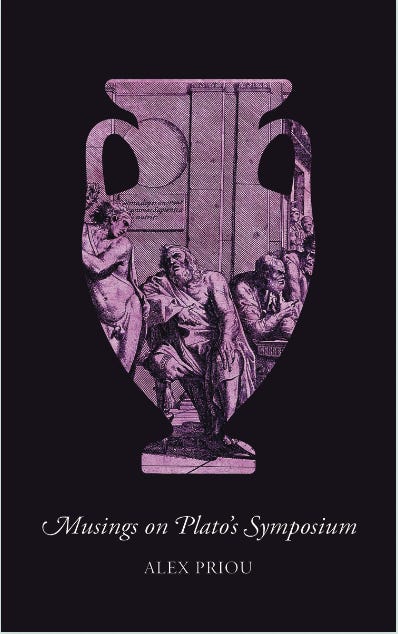
I enjoyed this preface, and the early chapters of the book in the Kindle sample. I hope you do too.
Preface
This book is decidedly not a work of scholarship, stubbornly not. It offers a holistic interpretation of Plato’s Symposium, as is conventional among scholarly books, but departs by presenting it as a series of musings, beginning with the puzzles of the dialogue’s various parts, long perplexing to me, and ascending therefrom in the direction of the whole.
I have chosen this style because I am interested not so much in speaking to scholars as I am in guiding those similarly perplexed, those whose questions come from within and whose paths are their own, rather than those who take their bearings by the community of the learned, with their pre-existing concerns and themes. To such readers, then, for whom love has become a deep, personal problem, who are drawn therefore to the Symposium and enthusiastic for distilled reflections on this or that passage—distilled and for that reason, I hope, also thought-provoking—to them do I offer this little book. I have therefore written each section so that it will be largely intelligible when read alone. Readers curious, however, about how the Symposium fits together as a whole would profit most by reading more or less straight through.
Such departures from scholarly convention occur much too rarely. Every act of interpretation, when so much as spoken—still worse when published—is something of a betrayal. For to say what an author has left unsaid is an indecent act of public stripping. Often an author is silent out of ignorance; in such cases, the exposure of his illness or deformity is justifiable at least in the name of public health. But when he has good reasons for not speaking, when he does so to make the reader complicit in the act of thinking, then to say aloud what he has passed over in pregnant silence is an offense not just to common decency but still worse to philosophy.
It is a congenital defect of the scholar that he considers it his professional duty to expose; his unscrupulousness in adducing evidence for what he has exposed even makes one shudder. Or it would, were his methods not de arte ill-suited to the mode of writing employed by the philosophers—for rarely, all too rarely, does the scholar rise to the occasion and meet the philosopher on an equal plane. Nevertheless, practically speaking, such rare moments do nothing to alleviate the general tendency of the scholar, who in demanding that the philosophers’ reasons be laid bare demands that his fellow scholars do the same, even more so. Whence the constant nods to the literature, the innumerable footnotes, the mile-long bibliographies.
Whence also my stubbornness. Were this a book on Kant, I would be far more amenable to the demands of the scholar, close as they are to the philosopher’s own mode and tendency. But in the case of Plato, such demands would be a cold shower, meant to bring you to your senses and cure you of the playful questioning, without which Plato refuses to let himself be stripped. And his Symposium? Two minutes at a “symposium” of scholars, with their PowerPoints and projectors, their handouts and convention centers, more than suffice to demonstrate how poorly their training prepares them to understand the amiable air and erotic fireworks at Agathon’s house, to say nothing of Plato’s strange mixture of the playful, prankish, flirtatious, outrageous, and beyond. It is obscene to unclasp a woman’s bra in public; to fumble at it ineptly is a double shame, to pursuer and pursued alike.
For these reasons, I could not bring myself to write such a work on the Symposium. This book is therefore not a work of scholarship but a study—properly a study: a book written, in other words, by a student and for fellow students, serious students, be this their first frolic with the Symposium or only the latest in a long string of dalliances.
It presumes, then, and reasonably enough, that its readers actually want to think; that when they open the book and see no survey of the literature, no attempt to situate the interpretation among the scholarship, they will not feel lost, nor will they feel slighted, but will allow the work to forge its way independently; that when they encounter a puzzle or question, or the occasional interruption from an unexpected interlocutor, they will not grow frustrated that no solution is proposed or speaker identified, but will search for themselves, whether in this book or in the text of the Symposium itself; that when it is claimed that the text says or does not say something, and this to their surprise, they will not be annoyed at the lack of citation, but will look to the text again, aware that the eye sees less than it would like to admit, a tendency helpfully corrected by the eye of another and gradually overcome by its looking back once again; and that when an assumption is made in one place, they will not cry foul, but seek either its support or its criticism—or even both—elsewhere in the book, even if only in passing.
I have, in short, done what scholars seldom permit themselves to do: I have written a book I actually enjoyed writing and, I will admit, enjoy reading, too. It is my conviction that this enjoyment is the surest guide to that of my chosen reader. It is, at any rate, the only guide I have.
I have therefore seldom cited the text, save where I thought such citations would aid in thinking rather than take its place. I have still more rarely engaged the scholarship, lest I burden the text with tedious notes of the “so-and-so also notices” and “so-and-so has argued” variety. I should, however, acknowledge up front those works on Plato’s Symposium that have inspired me throughout: Leo Strauss’s On Plato’s Symposium (University of Chicago Press, 2001) and Seth Benardete’s “On Plato’s Symposium,” which can be found appended to his translation (University of Chicago Press, 2001).
(Even though you can’t buy the Kindle version from Australia.)
Carter and Krugman on Keynes
Highly recommended. Would that we could have more programs of this quality on Big Ideas.
Interesting story on the music IP lottery
Why, for all my hostility to our Digital Tech overlords, I’m wary of letting them snatch some random rent from emerging technology. It’s a lottery.
Heaviosity half hour
The Creation of the American Republic, 1776-1787
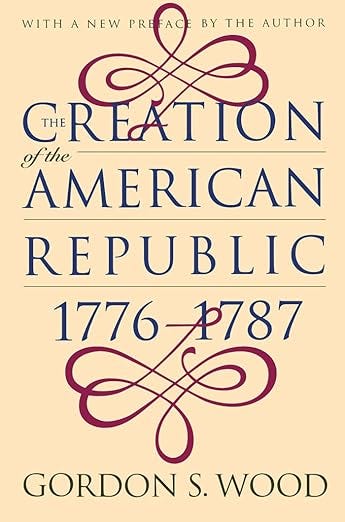
From a book written long ago - 1969 I think - by Gordon S. Wood. It’s fascinating. And amazing how little our historical focus goes into the period between the War of Independence and the constitutional convention of 1787. As America decolonised, each of the colonies had to improvise a ‘modern’ constitution. So there were thirteen experiments going on when the founding fathers turned up in Philadelphia in 1787. Anyway, here’s a shortish section from a longish book. The idea of the people being betrayed by the very elite that helped them throw off the previous elite. Well that could never happen again could it?
The perversion of republicanism
Almost immediately after the war began the Americans’ doubts and anxieties, never far below the surface in 1776, began to emerge with increasing frequency. As early as 1778 Benjamin Rush could write that “the time is now past when the least danger is to be apprehended to our liberties from the power of Britain, the arts of commissioners, or the machinations of tories. Tyranny can now enter our country only in the shape of a whig. All our jealousy should be of ourselves.” Americans now had more to dread from “our whigs” than they had “from a host of Governor Johnsons, Dr. Berkenhouts, Hutchinsons, or Galloways.” Other Americans agreed, and well before the contest with England was settled they began turning on each other with a jealousy and a fierceness that Rush could scarcely have anticipated. In 1782 Samuel Otis was writing to Theodore Sedgwick that he had expected “bloody noses” before the new Massachusetts Constitution was firmly established. “Indeed almost all revolutions are founded in blood.” But he had never expected to see the likes of what was happening in Massachusetts in these past several years. The Whigs realized there were “extravagancies that usually accompany” the “blessings of freedom,” but not what they were witnessing. The British and the Tories had warned in the 1770's that the moment a separation from Britain had taken effect “intestine quarrels will begin,” and Americans would “split into parties.” Now it seemed that such dire prophesies were being fulfilled. The Revolution, it became more and more obvious, was turning upon itself in ways that had not been foreseen, and men were emphasizing with renewed intensity that “unless a proper education of the rising generation is adopted, a new way of thinking and new principles can be introduced among the People of America, there are little hopes of the present republican Governments or anything like republican Governments being of any duration.”
It was ironic but undeniable: by the 1780's the Revolutionary ideals seemed to be breeding the sources of their own miscarriage. “The people,” said Fisher Ames in 1787, “have turned against their teachers the doctrines which were inculcated in order to effect the late revolution.” All the evils which the Revolution was designed to eliminate were instead being aggravated. “It is a favorite maxim of despotick power, that mankind are not made to govern themselves”— maxim which the Americans had spurned in 1776. “But alas!” many were now saying, “the experience of ages too highly favours the truth of the maxim; and what renders the reflection still more melancholy is, that the people themselves have, in almost every instance, been the ready instruments of their own ruin.” It had become all too evident to many that “in times of public confusion, and in the demolition of ancient institutions, blustering, haughty, licentious, self-seeking men” were gaining “the ear of the people,” exploiting republican ideology and disrupting the social fabric. Authority had been challenged in 1776 by appeals to the people that now seemed limitless. The right to rule, the Whigs had said, existed only so long as the people's good was promoted. But who could judge the people's good better than the people themselves? What do “those who are continually declaiming about the people, the people. . . mean by the people?” it was asked in exasperation. No part of the government, even their representatives, seemed capable of embodying them. By the 1780's the people had become simply the collective community standing outside of the entire government—a final court of appeal to which every aggrieved group took its case.
The republican emphasis on talent and merit in place of connections and favor now seemed perverted, becoming identified simply with the ability to garner votes, thus enabling “the most unfit men to shove themselves into stations of influence, where they soon gave way to the unrestrained inclination of bad habits.” Republicanism was supposed to unleash men's ambitions to serve the state. But what was praiseworthy ambition and what was spurious? “An emulation to excel in virtue is laudable, it gives vigor to every political nerve, advances the meritorious, and produces the most happy effects in a community; but a desire of excelling in power, grandeur and popularity, tends to the certain ruin of a society.” Who was to distinguish? Who else but the people? But were they any more capable than the Crown had been?
Equality was not creating harmony and contentment after all. Indeed, it was noted, equality had become the very cause of the evils it was designed to eliminate. In a free and independent republic “the idea of equality breathes through the whole and every individual feels ambitious, to be in a situation not inferior to his neighbour.” Among Americans, “the idea of inferiority, as of pursuing a mean employment or occupation . . . mortifies the feelings, and sours the minds of those who feel themselves inferior.” Consequently, everyone strives to be equal with those above him, “in dress, if in nothing else.” Although the Revolution had placed government almost wholly in the hands of the people, the people were still suspicious and jealous, “the offspring of envy and disappointed ambition.” “What stronger proof can we possibly have,” it was said, “of an uneasy querulous disposition in the people.” It was in the people's blood. Despite the success of the war against Britain the people remained possessed by a “general uneasiness, . . . without the least apparent cause.” Instead of a community of placid yeomen, celebrated in Crévecoeur's Letters from an American Farmer, the society appeared filled with inveterate grumblers. “Every man wants to be a judge, a justice, a sheriff, a deputy, or something else which will bring him a little money, or what is better, a little authority.”
In all of the states, from New England to South Carolina, the egalitarian atmosphere spread by the Revolution made “superiority from incidental circumstances not annexed to merit . . . galling and insufferable.” The Revolution seemed to many simply to have replaced one obnoxious elite with another. “There are some among us who call themselves persons of quality,” declared a typical diatribe from Massachusetts in the mid-eighties. But in fact they were no different from that “set of mushroom gentry” of a few years back who, dignified with imperial offices and connected with those “whom they condescended to admit into their circle,” attempted to assume “the character of the better sort of people.” So manifestly absurd was this appellation “that the very terms became thoroughly contemptible and odious in the estimation of the people.” The warning was now out against any repetition of their behavior, against any further attempt “to introduce scenes of pleasure and dissipation,” against any efforts to instruct America's youth in becoming fine gentlemen and ladies by the use of plays, operas, music, Venetian balls, and the entire courtier system of English elegance. The ferocious attacks on the Order of the Cincinnati in the 1780's actually represented only the most notable expression of these egalitarian resentments. Because this “Barefaced and Arrogant” attempt by former Revolutionary army officers to perpetuate their honor was considered by men like Aedanus Burke, James Warren, and Samuel Adams to be “as rapid a Stride towards an hereditary Military Nobility as was ever made in so short a Time,” it had little chance of maintaining itself as a hereditary body.11 In vain did supporters of the Cincinnati argue that America lacked the wealth and means for supporting the kind of aristocracy the critics talked of. Under the pressure of the public outcry and Washington's disavowal the Order was quickly forced to renounce its original hereditary character and to become simply another one of the numerous political and social organizations emerging in a country which, as the governor of South Carolina said in 1784, had gone “Society mad.”
The republican aversion to artificial distinctions was being broadened into a general denunciation of all differences, whether economic, social, intellectual, or professional. Writers scoffed at the “academical education” of their aristocratic enemies and boasted that they were “plain, unlettered” men better able to communicate with the people. “Overgrown wealth” itself was attacked: “A certain excess of fortune sets a man above the public opinion, and in equal proportion makes him despise those who are poor.” The emergent professionalization of careers became more intensely suspect, and even those fearful of too much leveling satirized the “jargon” and the “peculiarities” of the medical profession as it sought to establish itself by “technical terms” and by prescribing “what is new and uncommon.”
Naturally it was Pennsylvania that witnessed the most emphatic expression of this republican hatred of distinction and privilege. Throughout the late seventies and early eighties privilege assumed a special pointedness for the Scotch-Irish Presbyterian defenders of the 1776 Constitution confronted with a Philadelphia establishment of gentlemen with tight family and mercantile connections who carried their heads “so very high.” For the Constitutionalists equality became the great ideological weapon to be used not only against would-be social superiors, but against any sort of privilege that stood apart from the equal rights of the people. It was heatedly contended in the press and in the legislature in the sort of argument that carried well into the next century that all corporate grants, even when their public purpose was obvious, like those for the College of Philadelphia, the Bank of America, or the city of Philadelphia, were repugnant to the spirit of the American republics, “which does not admit of granting peculiar privileges to any body of men.” “Equal liberty and equal privileges are the happy effect of a free government. They are, in fact, convertible terms: neither can subsist without the other. A popular government (that is, a genuine republic) holds out this equality to its citizens; and it is this, which gives it the preeminence over monarchies, and aristocracies; in this consists its excellence. The unequal or partial distribution of public benefits within a state, creates distinctions of interest, influence and power, which lead to the establishment of an aristocracy, the very worst species of government.” Such immunities and privileged grants to groups may have made sense in European monarchical governments as devices serving “to circumscribe and limit absolute power.” But in America where only the people wielded power “all such combinations of men and property” were irrelevant and harmful, for “as much as the combination of citizens enjoying corporation immunities may be calculated, even at this day, to relieve from the weight of monarchical sway, to the same degree are they contrary to the equal and common liberty which ought to pervade a republic.” Because it was “the characteristic of freemen” and “the object of the present revolution” that the people “cannot be affected in their rights of personal security, personal liberty and private property, but by the laws and regulations of their representatives in general assembly,” no extra-legislative corporate bodies ought to be established. The Assembly “ought carefully to retain their full exercise of legislative power over every part of the commonwealth,” the city of Philadelphia included. Since “the state was one great family: and the laws are our common inheritance,” said William Findley, in an argument in 1786 against the rechartering of the Bank of North America, the legislature had no right “to give monopolies of legal privilege —to bestow unequal portions of our common inheritance on favourites.” It was true, Findley admitted, that Pennsylvanians, like the other Americans, were “too unequal in wealth to render a perfect democracy suitable to our circumstances: yet we are so equal in wealth, power, etc. that we have no counterpoise sufficient to check or control an institution of such vast influence and magnitude” as the Bank of North America. Since Pennsylvania had “no kingly prerogatives—no wealthy nobles, with vastly great estates and numerous dependents—no feudal laws to support family dignity, by keeping landed estates undivided,” there was no security to set “against the eventual influence of such wealth, conducted under the direction of such a boundless charter.” It was obvious then that wealth in America must not be allowed to concentrate in a few hands, for “wealth in many hands operates as many checks.” “An equal circulation of the signs of wealth, tends to promote equal interests—equal manners—and equal designs.” This equal circulation so necessary for a republic was difficult enough to maintain when wealth was “in the hands of jarring individuals” but it would be impossible “when in the hands of a permanent society, congregated by special privilege, and actuated by the principles of united avarice.”
Precisely because of the existence of these kinds of privileges republicanism had not brought the commonwealth consensus that had been anticipated. In fact party strife in all of the states seemed as bitter as before the war. Only now, with the elimination of royal authority and the reduction of magisterial power, the Whig conception of politics could not easily explain or justify the di-visiveness. The Tories were gone. “The success of the war, and the establishment of legal government, has necessarily coalesced all party distinctions.” The parties that were emerging were not those of the people against the rulers, the country against the court; they were instead parties among the people themselves, each aiming “at its own aggrandizement.” “Formerly, political distinctions originated in the prevailing sentiment of patriotism— in the present times, they seem only relative to particular principles of interest,” to occupations, credit, debt, or religion. Such divisions among the people, it was argued, were obvious indications of selfishness and infirmity in the society. “Parties are the dangerous diseases of civil freedom; they are only the first stage of anarchy, cloathed in mild language.” Unless they were “cramped in embrio,” they would grow and eventually tear the state apart. Factionalism in a republic “should be particularly guarded against, its existence as a free government depending on a general unanimity.”
Two typical AI prompts which I adapt to the circumstances.
The first tumbles out of my text expander when I type ‘editt’.
Please edit the pasted text to reduce its length by one third or to 700 words, whichever is smaller. In making your edits please leave in as much as you can of the construction of the argument and any simple concrete supporting illustrations. Please emulate Claude 3.7 behavior, especially in conciseness and interpretive restraint.
IMPORTANT: This is an EDITING task, NOT a summarizing task. You must:
Retain the original writing style and voice. It is an edited version of the original article and is by the original author. Not you or me.
Remove complete sections/passages and replace them with “…” (ellipses)
Make minimal changes to the original text
If you insert ANY words into the original words, place them in [square brackets]
All headings in the output should be H4. (But the first para is not a heading, just have it in normal text.)
VALIDATION STEPS (Required):
Before starting, calculate the original word count and state it
Calculate the target word count. Note which ever of the two targets is SMALLER and report this in your verification and reporting steps.
After editing, verify the final word count meets the target (±5%).
In past experience this last step has often been done by bullshitting. Before reporting the number of words in the output, check using a method that is bullshit proof.
Confirm that ellipses are properly integrated into text (not formatted as standalone paragraphs) and, where possible located in line at the end of paragraphs, not their beginning.
Where ellipses appear between paragraphs, do not place them in their own paragraph. Place the ellipse at the end of the first paragraph. That will leave the next paragraph clean.
Verify that all modified words are in [square brackets]
Check that you have not summarized or changed the meaning of passages
FORMAT REQUIREMENTS:
Preserve all hyperlinks from the original text
Maintain all block quotes as inset/blockquote formatting
Remove any advertisements, subscription prompts, captions for graphics that won’t be preserved in your output or extraneous links
Ensure output is in a format ready for direct copying into Substack
After completion, provide:
The final word count
Confirmation that the editing target was met
Confirmation that you have self-tested for bullshitting me.
Confirmation that formatting requirements were maintained
The second prompt is given by typing ‘teasee’ into my text expander.
Please edit the pasted text to produce something that is a good introductory tease to give people a bit of a taste of what it is about and what its central arguments are.
This is a two stage task. The first stage is to tell me what the original word length is, and how you propose to create the shorter tease. Please pause to get my input before proceeding to stage two.
The second stage is to implement it. Here are the instructions for that.
Reduce word length to one half of the original or 600 words, whichever is smaller.
IMPORTANT: This is an EDITING task, NOT a summarizing task. You must:
Retain the original writing style and voice. It is an edited version of the original article and is by the original author. Not you or me.
Remove complete sections/passages and replace them with “…” (ellipses) If this occurs between paragraphs, place the ellipsis at the END of a paragraph in line, not at the beginning of the next one.
Make minimal changes to the original text
If you insert ANY words into the original words, place them in [square brackets]
Any headings that exist in the original should be reproduced in H4. (But the first para is not a heading, just have it in normal text.)
VALIDATION STEPS (Required in performing stage two):
Calculate the target word count. Note which ever of the two targets is SMALLER and report this in your verification and reporting steps.
After editing, verify the final word count meets the target (±5%).
In past experience this last step has often been done by bullshitting. Before reporting the number of words in the output, check using a method that is bullshit proof.
Confirm that ellipses are properly integrated into text (not formatted as standalone paragraphs) and, where possible located in line at the end of paragraphs, not their beginning.
Where ellipses appear between paragraphs, do not place them in their own paragraph. Place the ellipsis at the end of the first paragraph. That will leave the next paragraph clean.
Verify that all modified words are in [square brackets]
Check that you have not summarized or changed the meaning of passages
FORMAT REQUIREMENTS:
Preserve all hyperlinks from the original text
Maintain all block quotes as inset/blockquote formatting
Remove any advertisements, subscription prompts, captions for graphics that won’t be preserved in your output or extraneous links
Ensure output is in a format ready for direct copying into Substack
After completion, provide:
The final word count
Confirmation that the editing target was met
Confirmation that you have self-tested for bullshitting me.
Confirmation that formatting requirements were maintained
Better yet Leon Weiseltier observed in a conference on Jews and elite universities put on by the Center for Jewish History and Martin Peretz who vetted all the speakers that this is a battle of ideas. Jews should not go running to the government if they have not given their own community good weapons to fight this battle.
Are these statistics about approaching women in person only or do they also include dating apps? (More reliance on professional matchmakers hired by the people who want to find partners would solve this entire problem :))
No matter whether the people responsible for these incidents are representative of Australian society none of them would be thinkable in the United States. It is appalling enough here when a kosher restaurant is vandalized as several of them have been. I was instantly convinced that Australia is not fit for purpose as a place to flee to escape Trump. (They likely won't take us especially since spouse can no longer work.) But it is a sign of the center-right of the American Jewish community to demand IHRA as an official definition of antisemitism. Governments should protect Jewish communities and Jews' right to study and work and receive health care but should not punish every stupid instance of speech from someone who chooses not to understand what Zionism is.